PREPPING FOR NAPLAN REVISION FOR THE ENGLISH WRITING



- Slides: 51
PREPPING FOR NAPLAN REVISION FOR THE ENGLISH WRITING TASK The NAPLAN is a politically sensitive topic, but it is also a fact of life. Schools quite rightly want to show their students as competent users of the English language.
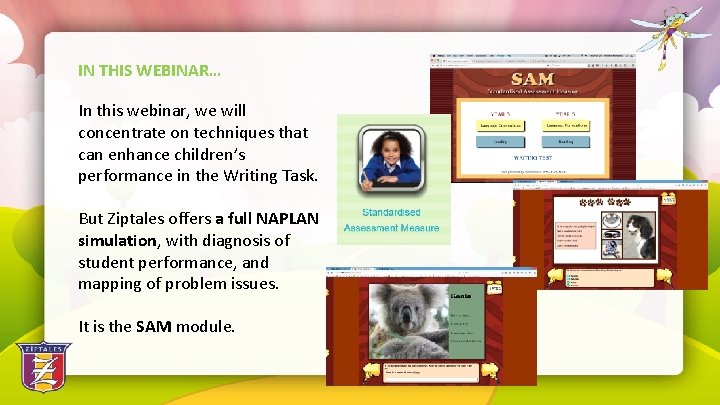
IN THIS WEBINAR… In this webinar, we will concentrate on techniques that can enhance children’s performance in the Writing Task. But Ziptales offers a full NAPLAN simulation, with diagnosis of student performance, and mapping of problem issues. It is the SAM module.
Ziptales offers extensive notes: http: //www. ziptales. com/sampleyr 3 responses. pdf http: //www. ziptales. com/sampleyr 5 responses. pdf I recommend them for final revision.
Much that is being tested in the NAPLAN English Writing test is largely a matter of underlying student competence. There are ten criteria for each of Persuasive and Narrative Writing, to a total of 48 and 47 points: NARRATIVE WRITING TASK (47) (Source: www. nap. edu. au/naplan. writing/writing. html) Audience Text structure Ideas Character & setting Vocabulary Cohesion Paragraphing Sentence structure Punctuation Spelling The writer’s ability to orient, engage and persuade the reader The organisation of narrative features including orientation, complication and resolution into an appropriate and effective text structure The selection, relevance and elaboration of ideas for a narrative Character: The portrayal and development of character Setting: The development of a sense of place, time and atmosphere The range and precision of contextually appropriate language choices The control of multiple threads and relationships across the text, achieved through the use of grammatical elements (eg conjunctions) and lexical elements (eg repetitions) The segmenting of text into paragraphs that assists the reader to negotiate the narrative The production of grammatically correct, structurally sound and meaningful sentences The use of correct and appropriate punctuation to aid the reading of the text The accuracy of spelling and the difficulty of the words used 6 4 5 4 2 6 5 6
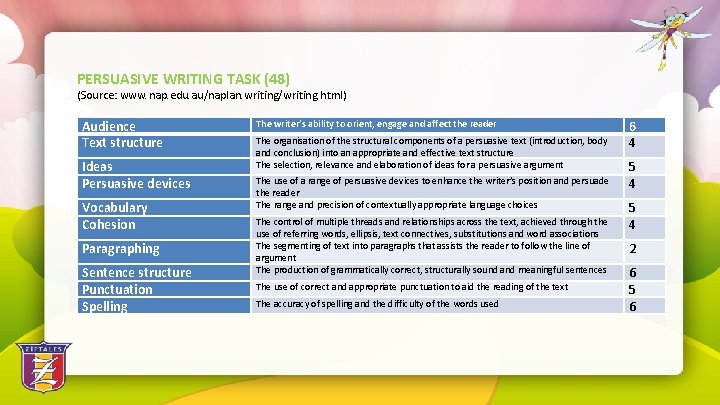
PERSUASIVE WRITING TASK (48) (Source: www. nap. edu. au/naplan. writing/writing. html) Audience Text structure Ideas Persuasive devices Vocabulary Cohesion Paragraphing Sentence structure Punctuation Spelling The writer’s ability to orient, engage and affect the reader The organisation of the structural components of a persuasive text (introduction, body and conclusion) into an appropriate and effective text structure The selection, relevance and elaboration of ideas for a persuasive argument The use of a range of persuasive devices to enhance the writer’s position and persuade the reader The range and precision of contextually appropriate language choices The control of multiple threads and relationships across the text, achieved through the use of referring words, ellipsis, text connectives, substitutions and word associations The segmenting of text into paragraphs that assists the reader to follow the line of argument The production of grammatically correct, structurally sound and meaningful sentences The use of correct and appropriate punctuation to aid the reading of the text The accuracy of spelling and the difficulty of the words used 6 4 5 4 2 6 5 6
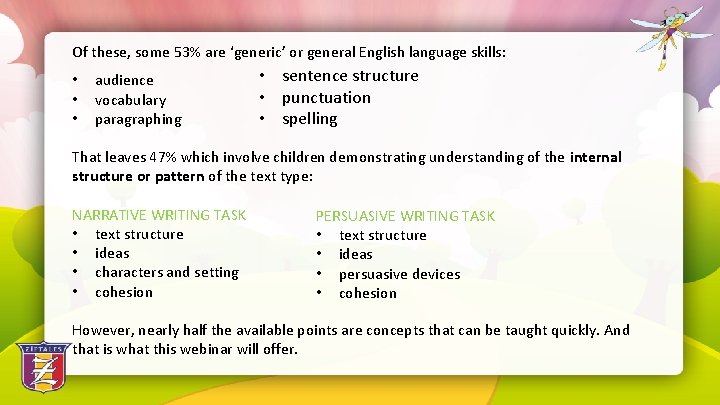
Of these, some 53% are ‘generic’ or general English language skills: • sentence structure • audience • punctuation • vocabulary • paragraphing • spelling That leaves 47% which involve children demonstrating understanding of the internal structure or pattern of the text type: NARRATIVE WRITING TASK PERSUASIVE WRITING TASK • text structure • ideas • characters and setting • persuasive devices • cohesion However, nearly half the available points are concepts that can be taught quickly. And that is what this webinar will offer.
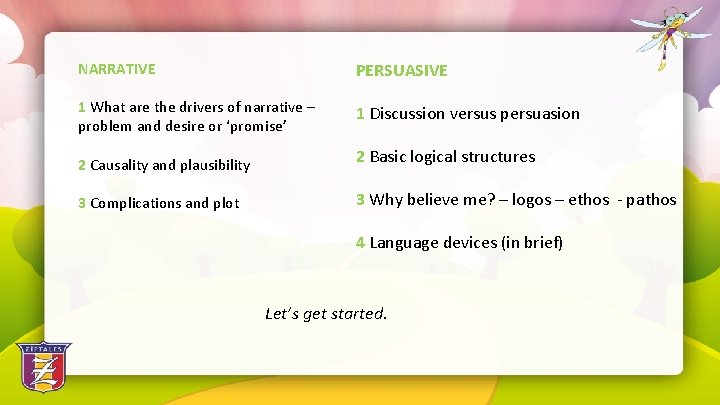
NARRATIVE 1 What are the drivers of narrative – problem and desire or ‘promise’ 2 Causality and plausibility 3 Complications and plot PERSUASIVE 1 Discussion versus persuasion 2 Basic logical structures 3 Why believe me? – logos – ethos - pathos 4 Language devices (in brief) Let’s get started.
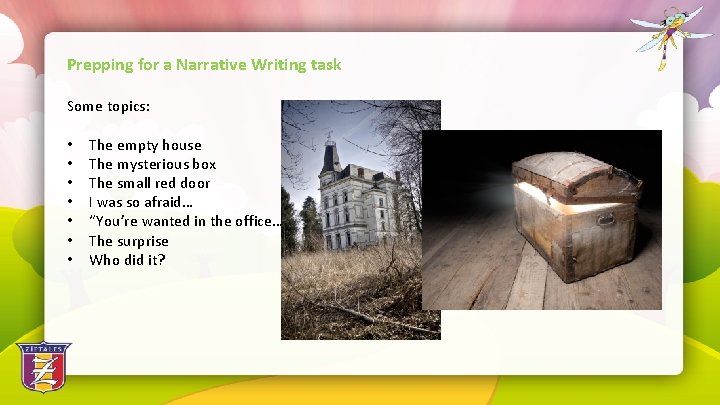
Prepping for a Narrative Writing task Some topics: • The empty house • The mysterious box • The small red door • I was so afraid… • “You’re wanted in the office…” • The surprise • Who did it?
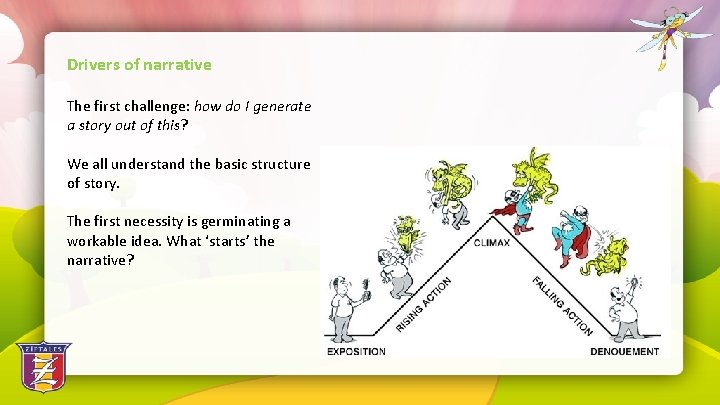
Drivers of narrative The first challenge: how do I generate a story out of this? We all understand the basic structure of story. The first necessity is germinating a workable idea. What ‘starts’ the narrative?
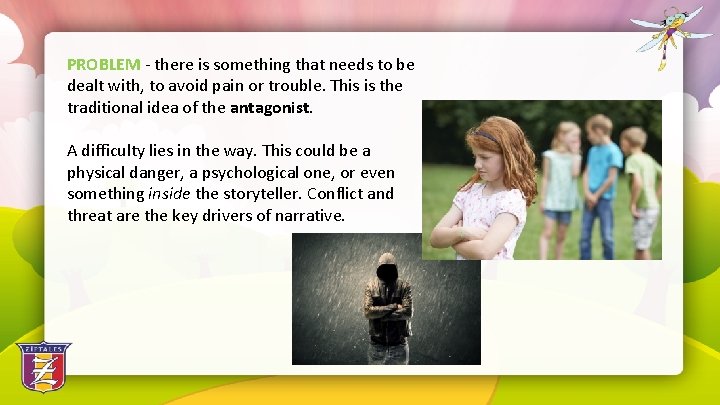
PROBLEM - there is something that needs to be dealt with, to avoid pain or trouble. This is the traditional idea of the antagonist. A difficulty lies in the way. This could be a physical danger, a psychological one, or even something inside the storyteller. Conflict and threat are the key drivers of narrative.
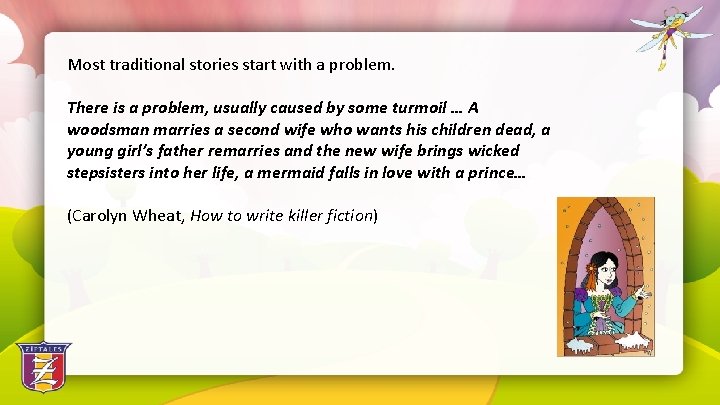
Most traditional stories start with a problem. There is a problem, usually caused by some turmoil … A woodsman marries a second wife who wants his children dead, a young girl’s father remarries and the new wife brings wicked stepsisters into her life, a mermaid falls in love with a prince… (Carolyn Wheat, How to write killer fiction)
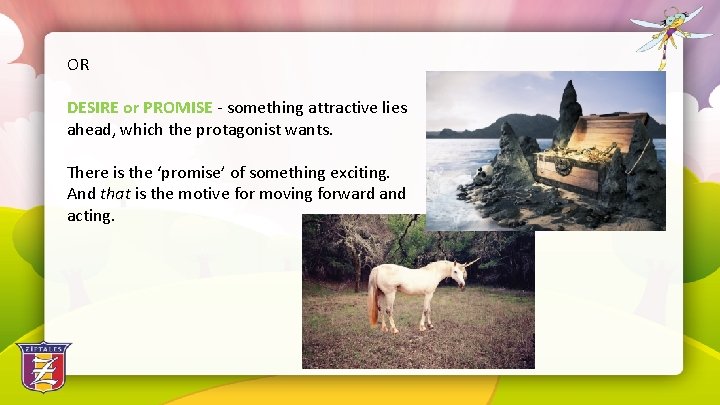
OR DESIRE or PROMISE - something attractive lies ahead, which the protagonist wants. There is the ‘promise’ of something exciting. And that is the motive for moving forward and acting.
Activities 1 As a class, talk about the ‘seed’ or ‘starting point’ of well known stories (eg The Hobbit, Tangled, Beauty and the Beast, Mary Poppins, Frozen). What ‘problem’ or ‘promise’ ‘kicks off’ the narrative? Who is the protagonist and who the antagonist? 2 Try some ‘What if…? ’ exercises. What if you could read people’s minds? What if an awful relative came to live? What if you got lost somewhere dangerous? 3 Workshop situations in which something challenging occurs eg A stranger appears; You discover something very odd and rather exciting; You accept a dare. How could this starter be made into a story?
Activities 4 Use these words as a prompt for constructing a story situation: Rescue; Temptation; Revenge; Tragedy; Horrors! 5 Look at the Write Time lessons ‘How to write a story’ and ‘Deconstructing a Story’. They give a full breakdown of how narrative works. (Suitable for high performing Grade 3 and all Grade 5 s. )
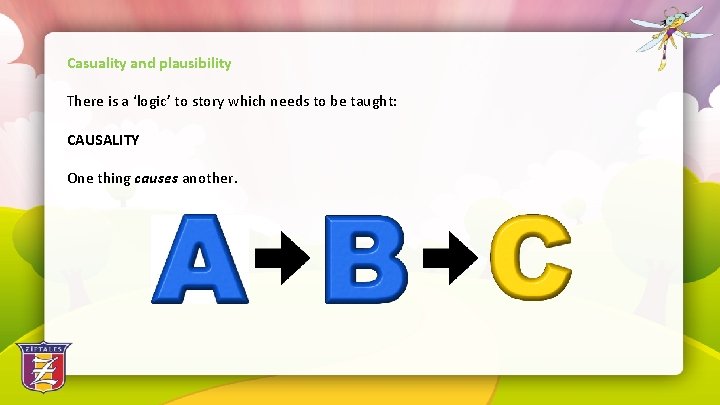
Casuality and plausibility There is a ‘logic’ to story which needs to be taught: CAUSALITY One thing causes another.
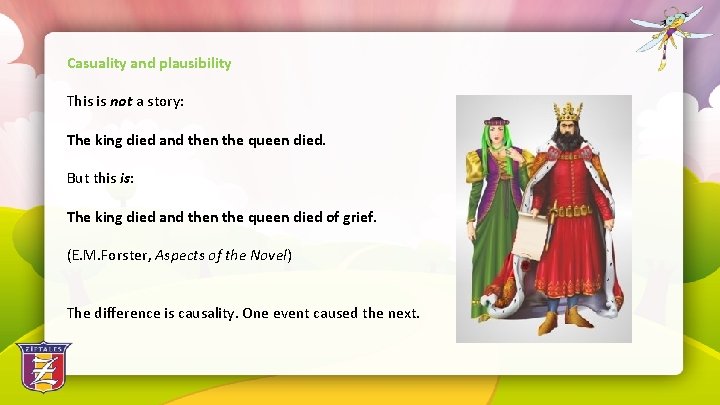
Casuality and plausibility This is not a story: The king died and then the queen died. But this is: The king died and then the queen died of grief. (E. M. Forster, Aspects of the Novel) The difference is causality. One event caused the next.
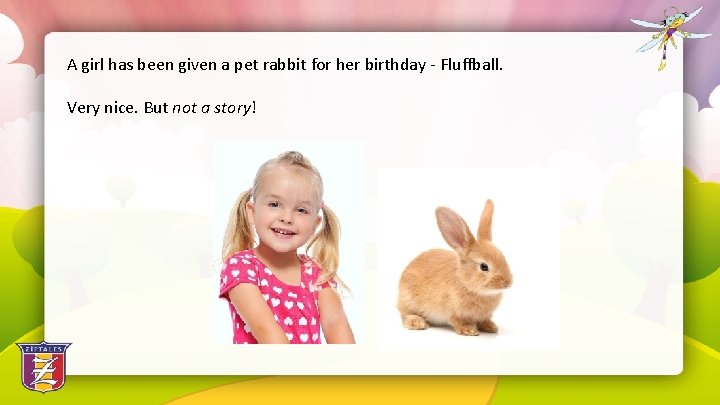
A girl has been given a pet rabbit for her birthday - Fluffball. Very nice. But not a story!
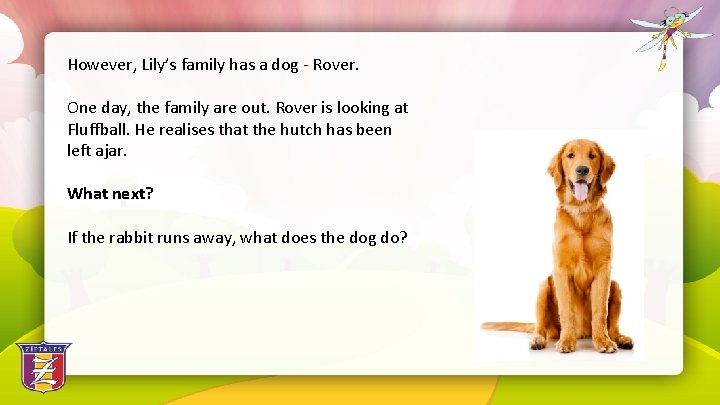
However, Lily’s family has a dog - Rover. One day, the family are out. Rover is looking at Fluffball. He realises that the hutch has been left ajar. What next? If the rabbit runs away, what does the dog do?
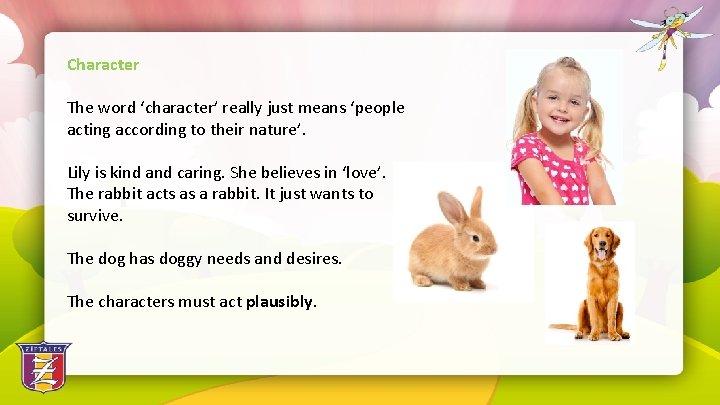
Character The word ‘character’ really just means ‘people acting according to their nature’. Lily is kind and caring. She believes in ‘love’. The rabbit acts as a rabbit. It just wants to survive. The dog has doggy needs and desires. The characters must act plausibly.
Activities 1 As a class, talk about what causes things to happen in certain well known stories. What causes the problem for the toys in Toy Story 3 (the boy is abandoning them to go off to college)? What is Harry Potter’s problem with Voldemort? What causes Frodo to go on a quest to deliver the ring back to Mount Mordor in Lord of the Rings? 2 Try workshopping some first causes for stories. A child is forced to move school, to a new place where everyone is mean. Someone wins a lottery… What would happen if aliens appeared? What if the neighbour was a witch, and she took a dislike to you? 3 Examine the notion of character and plausibility. Take a series of characters (eg superhero, evil wizard, white witch, sweet little old lady, shy dragon) and workshop how they would act in various situations. What would be plausible? What would be implausible?
Activities 4 Use the Story Machine engine in Ziptales (Developing Literacy library): it offers a wide range of characters, settings and plots (which children can choose at random) before they write their own story. 5 Look at the Specialised English Lessons ‘What’s in a Text Part A’ and ‘What’s in a Text Part B’ (Writing, Year 3) and ‘Types of Text’ and ‘Creating Imaginative Texts’ (Writing, Year 5).
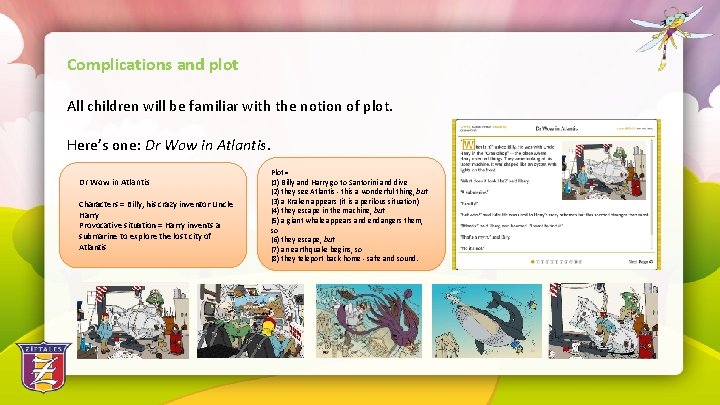
Complications and plot All children will be familiar with the notion of plot. Here’s one: Dr Wow in Atlantis Characters = Billy, his crazy inventor Uncle Harry Provocative situation = Harry invents a submarine to explore the lost city of Atlantis Plot = (1) Billy and Harry go to Santorini and dive (2) they see Atlantis - this a wonderful thing, but (3) a Kraken appears (it is a perilous situation) (4) they escape in the machine, but (5) a giant whale appears and endangers them, so (6) they escape, but (7) an earthquake begins, so (8) they teleport back home - safe and sound.
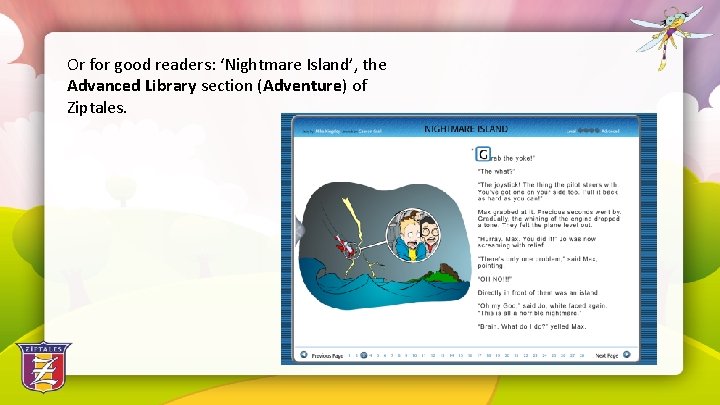
Or for good readers: ‘Nightmare Island’, the Advanced Library section (Adventure) of Ziptales.
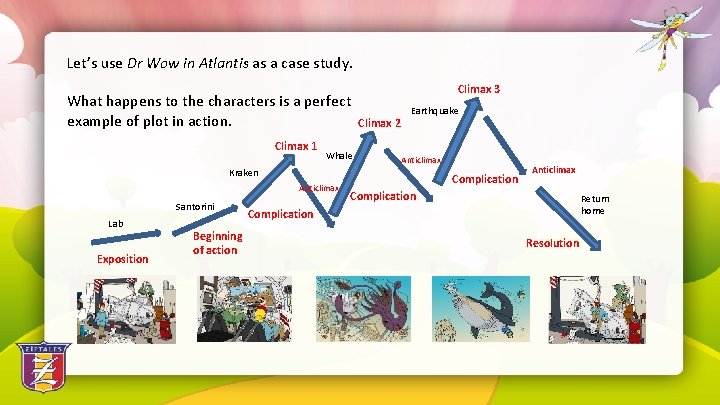
Let’s use Dr Wow in Atlantis as a case study. What happens to the characters is a perfect example of plot in action. Climax 2 Climax 1 Whale Climax 3 Earthquake Anticlimax Kraken Anticlimax Santorini Lab Exposition Beginning of action Complication Anticlimax Complication Return home Complication Resolution
The key idea is that COMPLICATIONS must occur. The characters set off towards their goal. Something goes wrong. They get away from that problem or obstacle. Something else appears to get in their way or challenge them. And so on.
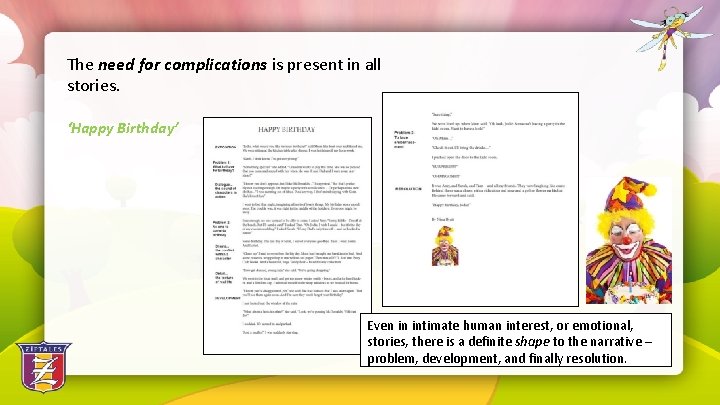
The need for complications is present in all stories. ‘Happy Birthday’ Even in intimate human interest, or emotional, stories, there is a definite shape to the narrative – problem, development, and finally resolution.
Activities 1 As a class, read and then talk about the story ‘Happy Birthday’. What are the complications? Can you chart the ‘plot’ of the story? 2 Try a workshop on one of the plot-strong stories in Ziptales. Why not try Dr Wow (Adventure, Extending Literacy library) for Year 3, or The Lost Sword or Nightmare Island for Year 5? Can students chart the plot? 3 As a class, or in small groups, choose one of the following situations and work out how to build up a successful plot out of complications: A group of school children are stuck in lift which has jammed. A horrible new girl or boy has just joined the class and is determined to be a bully. The family is out on the road in the middle of nowhere, when the car breaks down. No one’s phone works. Uncle Freddie has invented a ‘beam me up’ machine. But it doesn’t always work properly.
Activities 4 It has been said that there are only seven plots in the world (Christopher Booker, The Seven Basic Plots): • Overcoming the ‘monster’ • Rags to riches • The quest - going on a dangerous journey to find something special • Voyage and return • Comedy - something funny happens • Tragedy - something really sad happens • Rebirth - someone changes dramatically As a class or in small groups, choose one of these basic plotlines. Now a) think of a famous example, and then b) construct an original story based on that plot concept. 5 Look at the Skill Builders Comprehension lesson on ‘Narrative Writing’ and do one or other of the worksheets.
Prepping for a Persuasive Writing task Some topics: • School uniforms – YES or NO? • Mobile phones for children – A good or bad thing? • Is homework good for you? • Modern children are spoiled. Do you agree? • Zoos are cruel. • TV is bad for you. • Fast food should be banned in schools.
Discussion versus Persuasion Much of classroom discussion is open-ended and free flowing. It involves, hopefully, an inclusive sharing of views. It is multifaceted and multi-directional. Examples: • TV can be good. However there are some down sides as well. • Exercise is useful, but it is possible to hurt yourself with sport. • Some children are spoiled, but most parents treat them fairly.
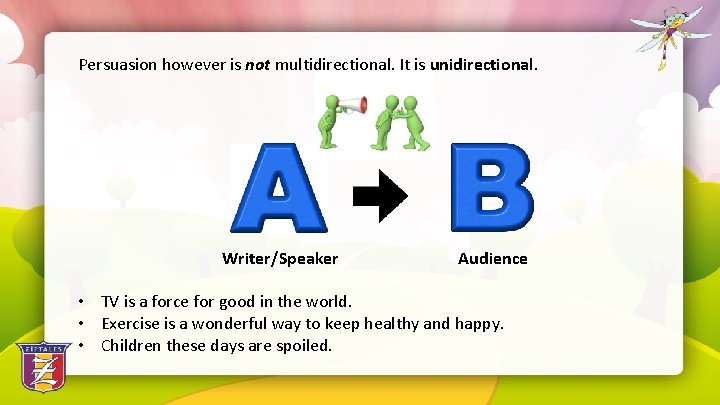
Persuasion however is not multidirectional. It is unidirectional. Writer/Speaker Audience • TV is a force for good in the world. • Exercise is a wonderful way to keep healthy and happy. • Children these days are spoiled.
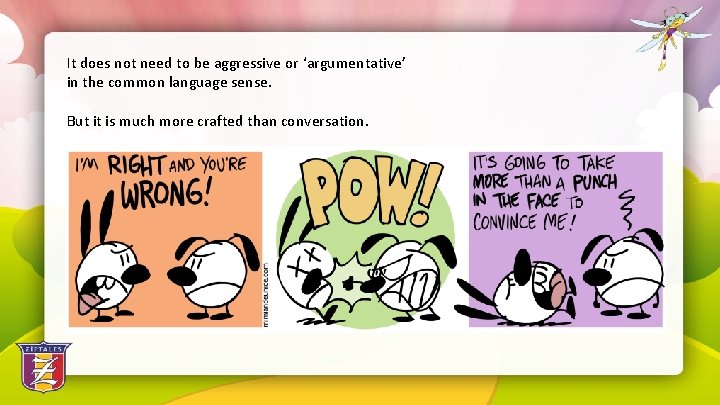
It does not need to be aggressive or ‘argumentative’ in the common language sense. But it is much more crafted than conversation.
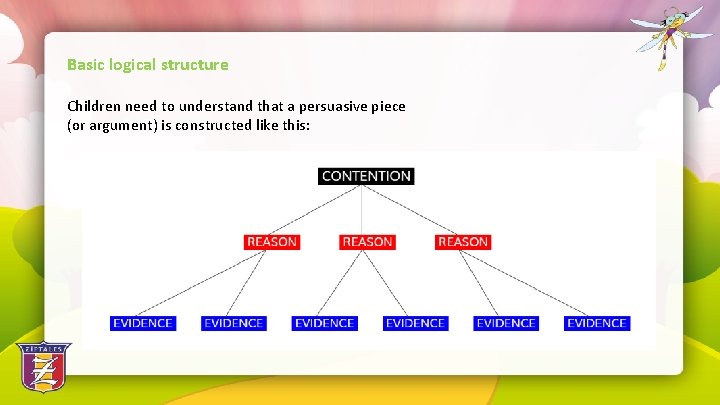
Basic logical structure Children need to understand that a persuasive piece (or argument) is constructed like this:
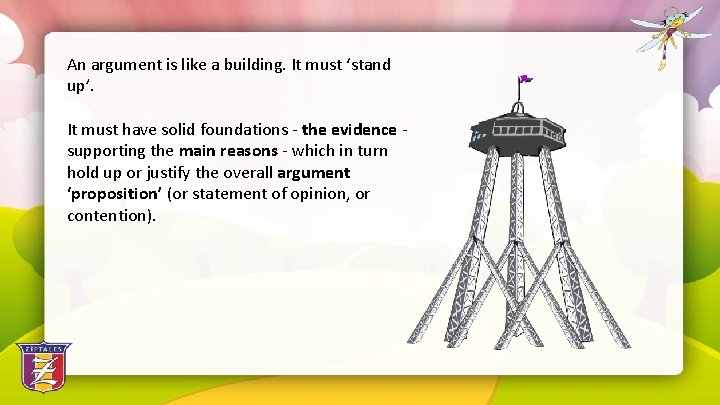
An argument is like a building. It must ‘stand up’. It must have solid foundations - the evidence - supporting the main reasons - which in turn hold up or justify the overall argument ‘proposition’ (or statement of opinion, or contention).
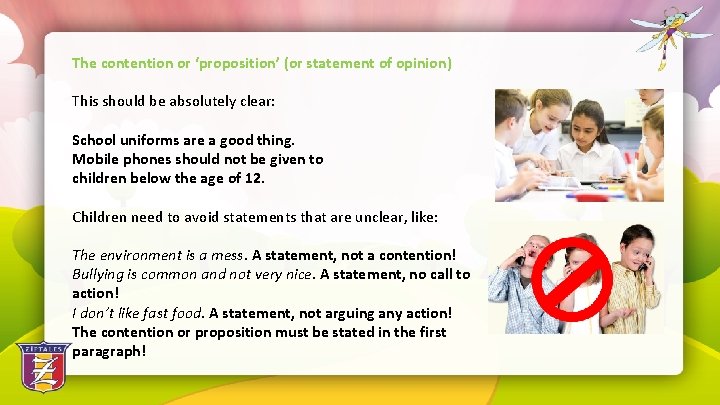
The contention or ‘proposition’ (or statement of opinion) This should be absolutely clear: School uniforms are a good thing. Mobile phones should not be given to children below the age of 12. Children need to avoid statements that are unclear, like: The environment is a mess. A statement, not a contention! Bullying is common and not very nice. A statement, no call to action! I don’t like fast food. A statement, not arguing any action! The contention or proposition must be stated in the first paragraph!
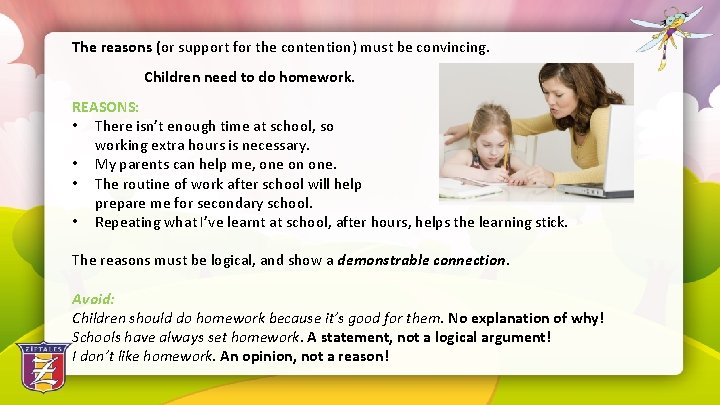
The reasons (or support for the contention) must be convincing. Children need to do homework. REASONS: • There isn’t enough time at school, so working extra hours is necessary. • My parents can help me, one on one. • The routine of work after school will help prepare me for secondary school. • Repeating what I’ve learnt at school, after hours, helps the learning stick. The reasons must be logical, and show a demonstrable connection. Avoid: Children should do homework because it’s good for them. No explanation of why! Schools have always set homework. A statement, not a logical argument! I don’t like homework. An opinion, not a reason!
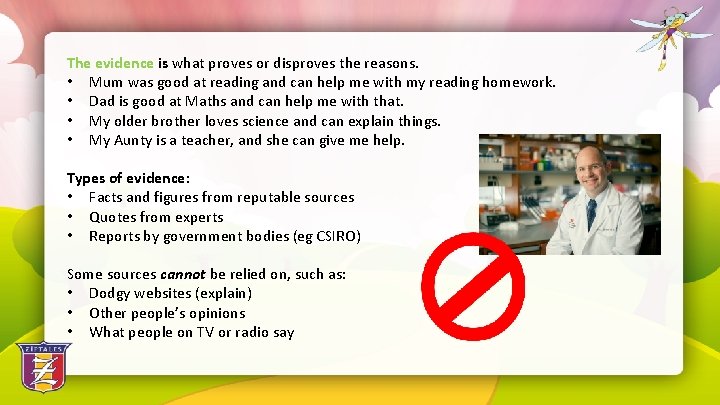
The evidence is what proves or disproves the reasons. • Mum was good at reading and can help me with my reading homework. • Dad is good at Maths and can help me with that. • My older brother loves science and can explain things. • My Aunty is a teacher, and she can give me help. Types of evidence: • Facts and figures from reputable sources • Quotes from experts • Reports by government bodies (eg CSIRO) Some sources cannot be relied on, such as: • Dodgy websites (explain) • Other people’s opinions • What people on TV or radio say
Activities 1 As a class, take one or more of the suggested topics: Mobile phones for children – A good or bad thing? Fast food should be banned in schools. What is the ‘proposition’ or ‘contention’? What are three or four good reasons for proposing it? What is the evidence to support these arguments? 2 Talk about something that makes everyone really angry eg bullying, anger, bad manners, people who lie. Now try to find: A. A proposition to make about the issue. (eg Bullying should be banished. ) B. A few good reasons to support that proposition. C. Evidence to support those reasons (if possible facts and figures, expert opinion and serious reports).
Activities 3 For younger children (Year 3) do a debate on one of these topics: • Girls are better than boys. • City is better than country. • Smoking is bad for you. • Zoos are a good thing. 4 For older children (Year 5), why not use three argument pieces in the Advanced Library: ‘Computer Games’, ‘Body Image’ and ‘Animal Welfare’? They offer strong persuasion and each has worksheets. 5 Look at the Write Time lesson ‘How to write an argument’. It gives a full breakdown of how persuasive writing works. (Suitable for high performing Grade 3 and all Grade 5 s. )
Why believe me? The science of persuasion (rhetoric) goes all the way back to ancient Greeks. Aristotle said that there are three main ways to get people to believe you.
1 LOGOS - logic or reason, data, statistics - ie logical evidence 2 ETHOS - believing because you respect the person telling you, the ‘authority’ 3 PATHOS - feeling, pity or sympathy, stories, empathy
Activities 1 As a class, take a topic like ‘Let’s banish bullying’ and talk about how logos can be used. What are the statistics or ‘facts’? 2 As a class, take ‘Let’s banish bullying’ and talk about how ethos can be used. Who in a position of authority has spoken out against bullying? What do reputable books or websites say about the problem? 3 As a class, take ‘Let’s banish bullying’ and talk about how pathos can be used. What are some sad stories of bullying? Are there any films about the subject? Try to emphasise storytelling and feeling.
Activities 4 The following stories inside Ziptales have a strong persuasive point to make about theme of bullying: The Battered Bully, The Case of the Crazy Codes, The Fancy Dress Fiend (all in Mystery), Danny’s New Glasses, A Laugh a Day, The New Girl (all in People Stories). Choose one and after reading it, discuss how theme presents the topic in such a way as to influence readers. 5 Look at the Specialised English Lessons ‘Opinions’ (Oral Language), ‘What is a paragraph? ’(Writing), ‘Types of Texts’ (Writing) (Year 3); ‘Arguments’ (Writing), ‘Topic Sentences’ (Writing), ‘Types of Texts’ (Writing), ‘What are the Shapes of Texts’ (Writing), ‘Features of Texts’ (Writing), ‘Objective and Subjective Language (Writing) and ‘Talking about Feelings’ (Oral) (Year 5). These are all self-contained lessons about the issue of persuasion.
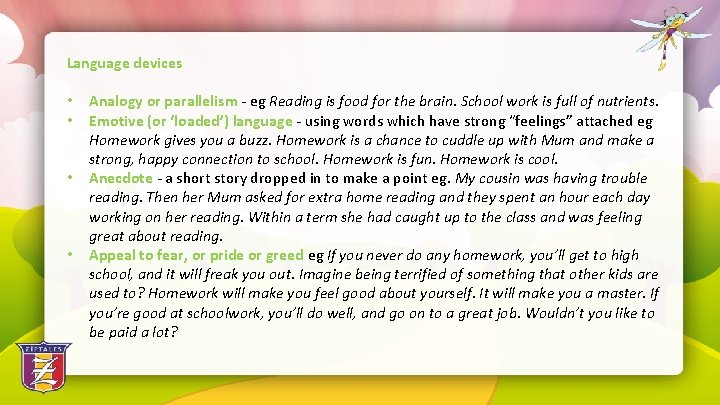
Language devices There are no less than 60 rhetorical devices. Be selective! Repetition - repeating a word or phrase several times, to make the point clearer eg Homework is good for teachers. Homework is good for kids. Homework is good for parents. Homework is good for everyone. Rhetorical question - asking a question which is really a statement eg But is one hour enough? No. So can I do it at home? Metaphor and simile - comparing something to something else eg …homework is like eating your vegetables - it may be not your first choice - but it’s good for you (simile); homework gives you bigger mental muscles - by practising that much you get really good at the skills (metaphor).
Language devices • Analogy or parallelism - eg Reading is food for the brain. School work is full of nutrients. • Emotive (or ‘loaded’) language - using words which have strong “feelings” attached eg Homework gives you a buzz. Homework is a chance to cuddle up with Mum and make a strong, happy connection to school. Homework is fun. Homework is cool. • Anecdote - a short story dropped in to make a point eg. My cousin was having trouble reading. Then her Mum asked for extra home reading and they spent an hour each day working on her reading. Within a term she had caught up to the class and was feeling great about reading. • Appeal to fear, or pride or greed eg If you never do any homework, you’ll get to high school, and it will freak you out. Imagine being terrified of something that other kids are used to? Homework will make you feel good about yourself. It will make you a master. If you’re good at schoolwork, you’ll do well, and go on to a great job. Wouldn’t you like to be paid a lot?
Activities 1 As a class, talk about each of the major rhetoric devices: • Repetition • Rhetorical question • Metaphor • Simile • Analogy • Anecdote (or narrative) • Emotive language • Emotional appeals Can students think of examples? 2 Do some rhetoric homework. Each child has to find one example of a persuasive (rhetorical) device in a newspaper or in an ad or on TV. These are then shared with the class.
3 Use one of these topics for practice: • All kids should be in bed by 8. 00 pm. • No child should be smacked. • No more native trees should be cut down. • All plastic bags should go. • Smoking should be banned in the home. • Too much money is spent on children these days. • Children are not as polite as they should be. Choose one, and create a paragraph which uses as many persuasive devices as possible. 4 Use the ‘Homework’ piece which is a supplement to this webinar, which presents a full model answer, and talk in detail about what each of the paragraphs is doing. 5 Look at the Skill Builder Comprehension lesson on ‘Argument’. It is very thorough, and offers a number of examples, plus follow up worksheets. (Suitable for high performing Grade 3 and all Grade 5 s. )
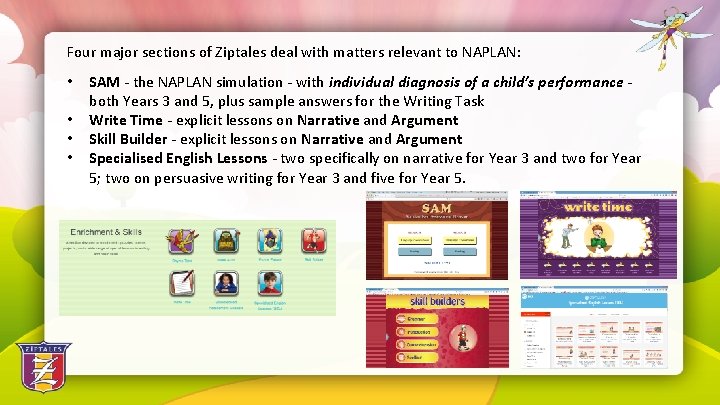
Four major sections of Ziptales deal with matters relevant to NAPLAN: • • SAM - the NAPLAN simulation - with individual diagnosis of a child’s performance - both Years 3 and 5, plus sample answers for the Writing Task Write Time - explicit lessons on Narrative and Argument Skill Builder - explicit lessons on Narrative and Argument Specialised English Lessons - two specifically on narrative for Year 3 and two for Year 5; two on persuasive writing for Year 3 and five for Year 5.
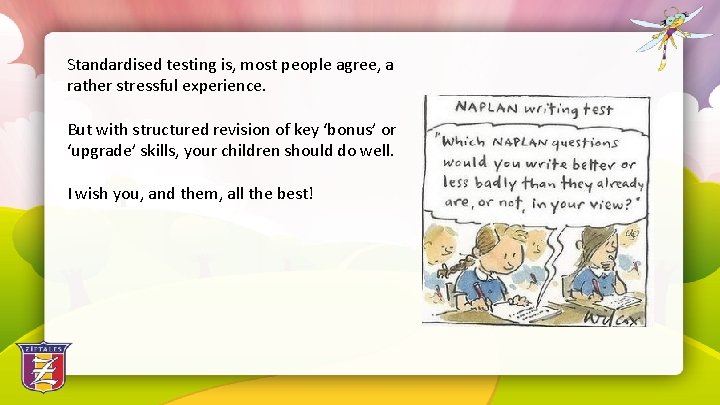
Standardised testing is, most people agree, a rather stressful experience. But with structured revision of key ‘bonus’ or ‘upgrade’ skills, your children should do well. I wish you, and them, all the best!
Questions and Answers…
If you are not a subscriber yet, register for a 30 day free trial of Ziptales at www. ziptales. com