NURS 230Spring 2013 THE NURSING PROCESS PART 1WEEK
- Slides: 52
NURS 230/Spring 2013 THE NURSING PROCESS PART 1/WEEK 3
CRITICAL THINKING DEFINED � Critical �A thinking is: continuous process characterized by open-mindedness, continual inquiry, and perseverance, combined with a willingness to look at each unique patient situation and determine which identified assumptions are true and relevant � Recognizing that an issue exists, analyzing information, evaluating information, and making conclusions
CLINICAL DECISIONS IN NURSING PRACTICE � Clinical decision making requires critical thinking. � Clinical decision-making skills separate professional nurses from technical and ancillary staff. � Patients often have problems for which no textbook answers exist. � Nurses need to seek knowledge, act quickly, and make sound clinical decisions.
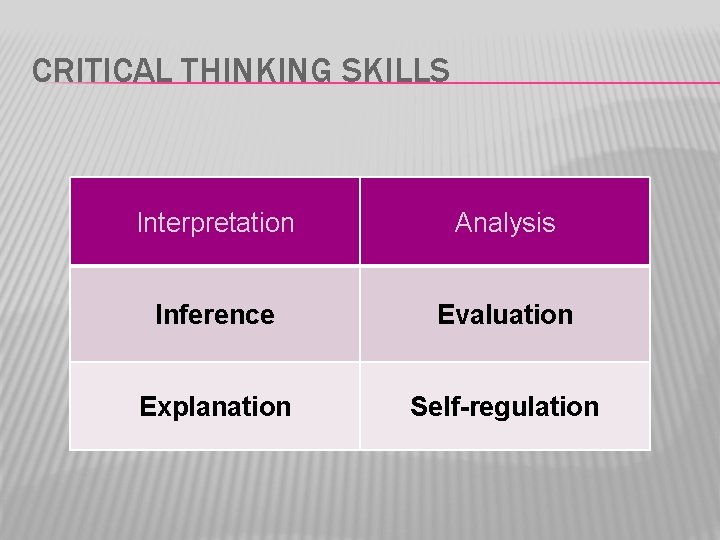
CRITICAL THINKING SKILLS Interpretation Analysis Inference Evaluation Explanation Self-regulation
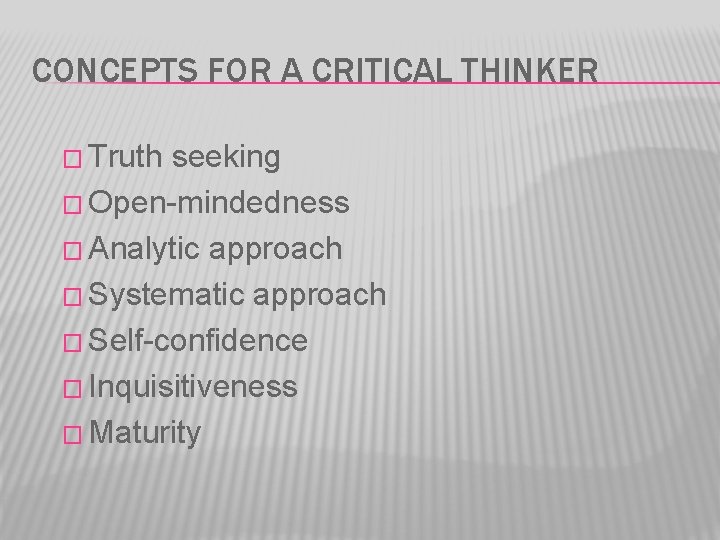
CONCEPTS FOR A CRITICAL THINKER � Truth seeking � Open-mindedness � Analytic approach � Systematic approach � Self-confidence � Inquisitiveness � Maturity
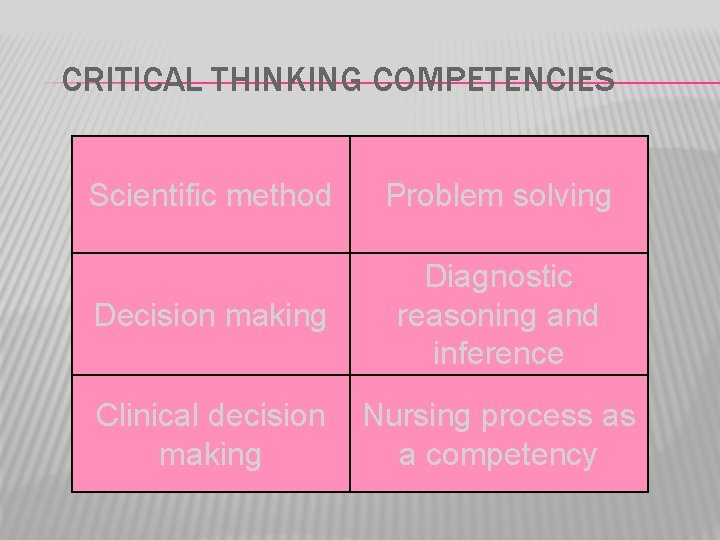
CRITICAL THINKING COMPETENCIES Scientific method Problem solving Decision making Diagnostic reasoning and inference Clinical decision making Nursing process as a competency
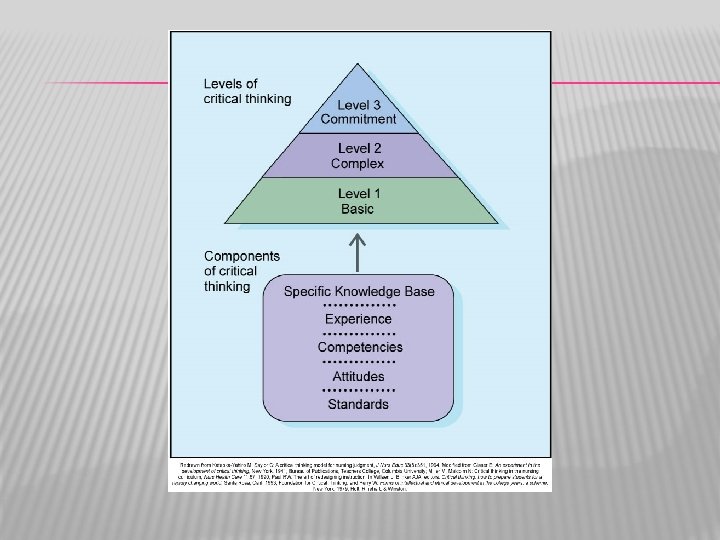
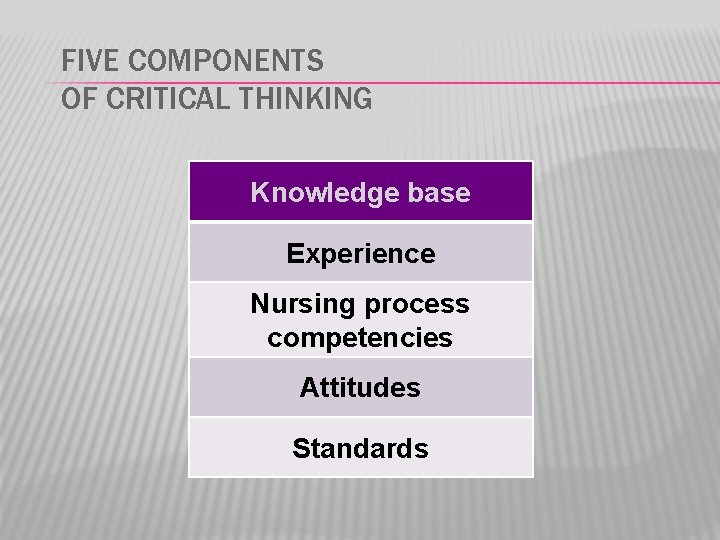
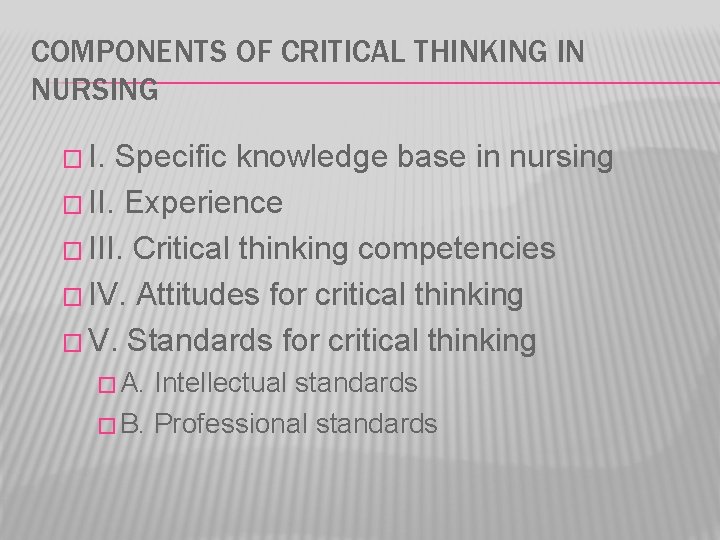
FIVE COMPONENTS OF CRITICAL THINKING Knowledge base Experience Nursing process competencies Attitudes Standards
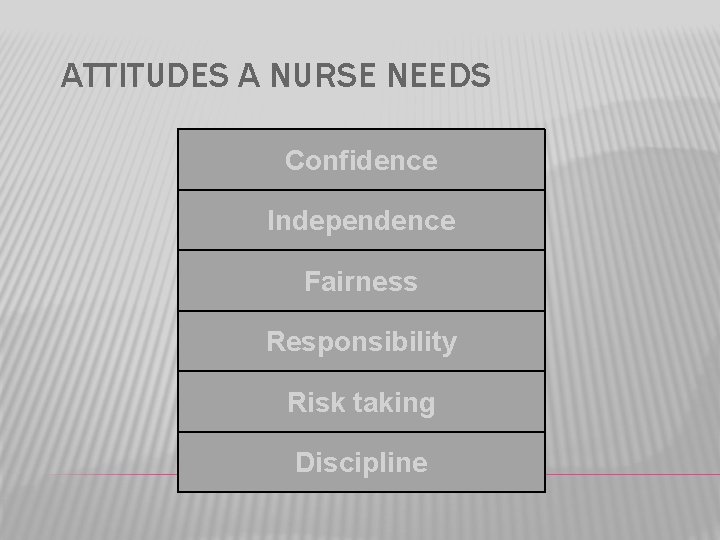
ATTITUDES A NURSE NEEDS Confidence Independence Fairness Responsibility Risk taking Discipline
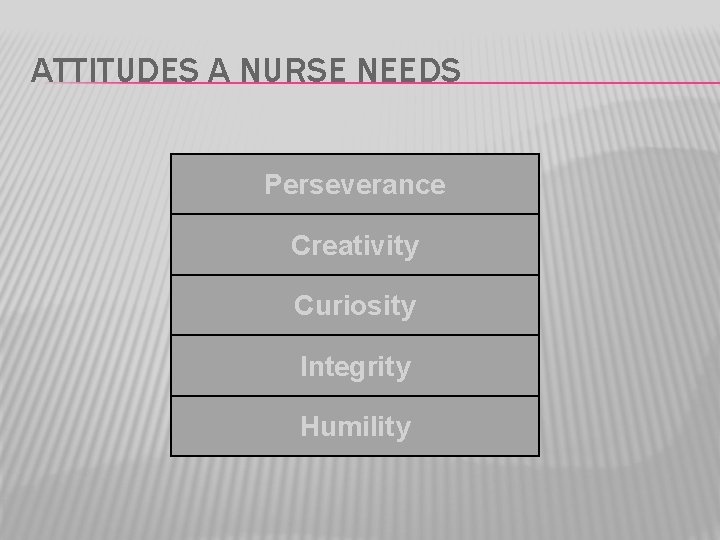
ATTITUDES A NURSE NEEDS Perseverance Creativity Curiosity Integrity Humility
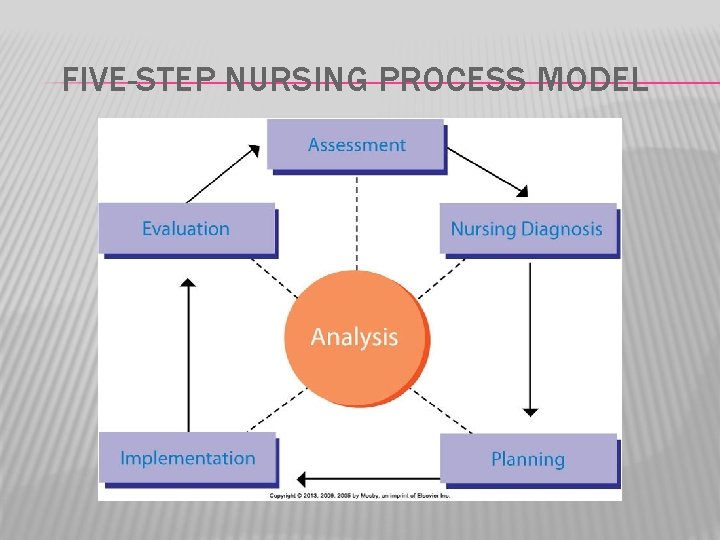
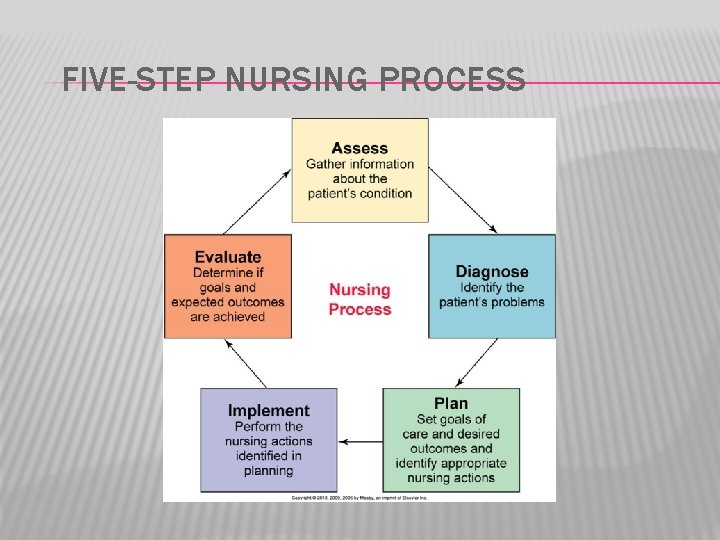
FIVE-STEP NURSING PROCESS MODEL
COMPONENTS OF CRITICAL THINKING IN NURSING � I. Specific knowledge base in nursing � II. Experience � III. Critical thinking competencies � IV. Attitudes for critical thinking � V. Standards for critical thinking � A. Intellectual standards � B. Professional standards
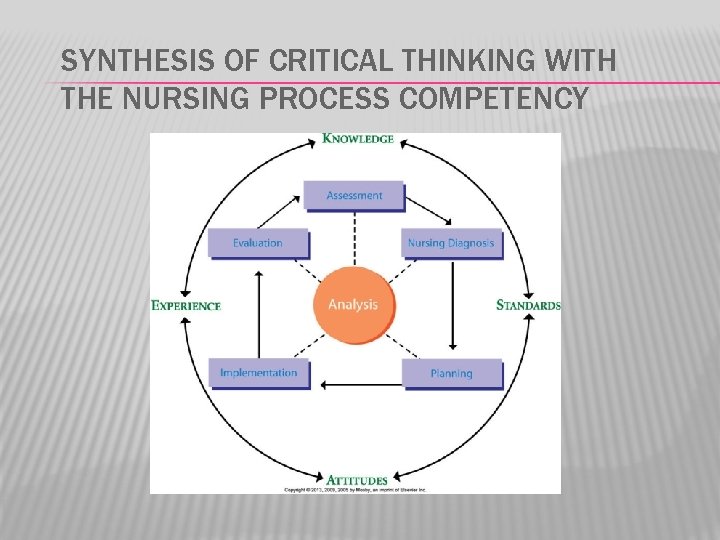
SYNTHESIS OF CRITICAL THINKING WITH THE NURSING PROCESS COMPETENCY
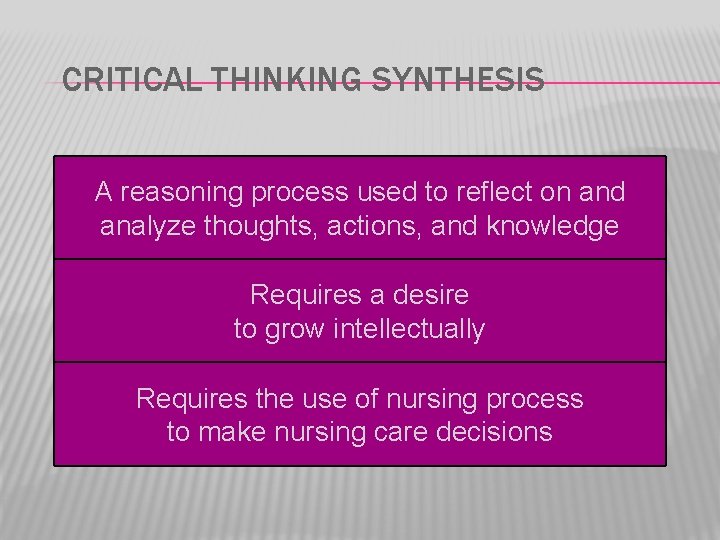
CRITICAL THINKING SYNTHESIS A reasoning process used to reflect on and analyze thoughts, actions, and knowledge Requires a desire to grow intellectually Requires the use of nursing process to make nursing care decisions
FIVE-STEP NURSING PROCESS
WHAT IS THE NURSING PROCESS? Organized Framework /A problem solving approach � A process that can be visualized, is never static, is patient centered, individualized/goal directed � Prioritizes patient care ( list in order of patient presentation) � Requires critical thinking � Requires the use of standardized language for nursing practice �
CRITICAL THINKING APPROACH TO ASSESSMENT � Assessment involves collecting information from the patient and from secondary sources (e. g. , family members), along with interpreting and validating the information to form a complete database. � Two stages of assessment: � Collection and verification of data � Analysis of data
DATABASE The purpose of assessment is to establish a database about the patient’s perceived needs, health problems, and responses to these problems. � In addition, the data reveal related goals, experiences, health practices, values, and expectations about the health care system. � Critical thinking skills help you to synthesize relevant information and use it in a purposeful way. �
DATA COLLECTION � � Sources of data � Patient (interview, observation, physical examination)—the best source of information � Family and significant others (obtain patient’s agreement first) � Health care team � Medical records � Scientific literature � Nurse’s experience Subjective vs. objective data
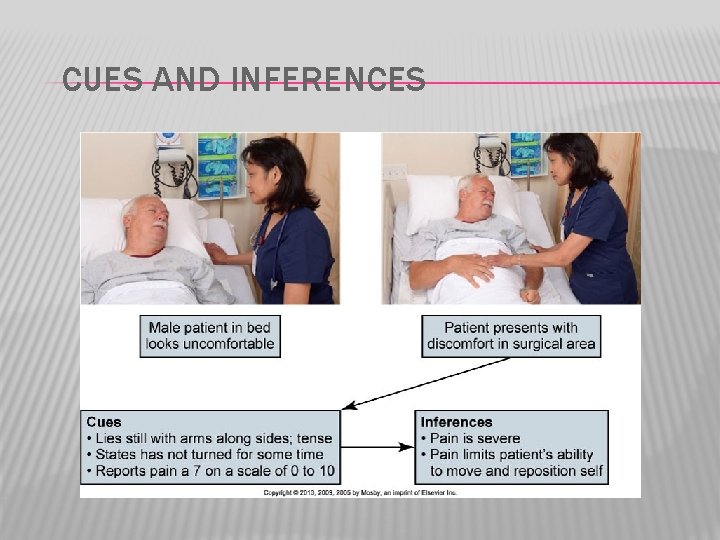
CUES AND INFERENCES
COMPREHENSIVE ASSESSMENT APPROACHES � Use of a structured database format, based on an accepted theoretical framework or practice standard � Example: Gordon’s model of functional health patterns � Problem-oriented approach � Assessment moves from general to specific.
PROCESS OF ASSESSMENT � Collect data. � Cluster cues, make inferences, and identify patterns and problem areas. � Critically anticipate. � Be sure to have supporting cues before making an inference. � Knowing how to probe and frame questions is a skill that grows with experience.
PROCESS OF ASSESSMENT � Collect data. � Cluster cues, make inferences, and identify patterns and problem areas. � Critically anticipate. � Be sure to have supporting cues before making an inference. � Knowing how to probe and frame questions is a skill that grows with experience.
METHODS OF DATA COLLECTION � Patient-centered interview = An organized conversation with the patient � Set the stage (preparation, environment, greeting). � Set an agenda/gather information about patient’s concerns. � Collect the assessment or nursing health history; assure the patient of confidentiality. � Terminate the interview (cue the end).
INTERVIEW TECHNIQUES Open-ended vs. closed-ended questions � Back-channeling � Probing ---------------------� Because a patient’s report includes subjective information, validate data from the interview later with objective data. � Obtain information (as appropriate) about a patient’s physical, developmental, emotional, � intellectual, social, and spiritual dimensions.
CULTURAL CONSIDERATIONS To conduct an accurate and complete assessment, you need to consider a patient’s cultural background. � When cultural differences exist between you and a patient, respect the unfamiliar and be sensitive to a patient’s uniqueness. � If you are unsure about what a patient is saying, ask for clarification to prevent making the wrong diagnostic conclusion. �
QUICK QUIZ! 1. A patient is admitted to the hospital with shortness of breath. As the nurse assesses this patient, the nurse is using the process of A. Evaluation. B. Data collection. C. Problem identification. D. Testing a hypothesis.
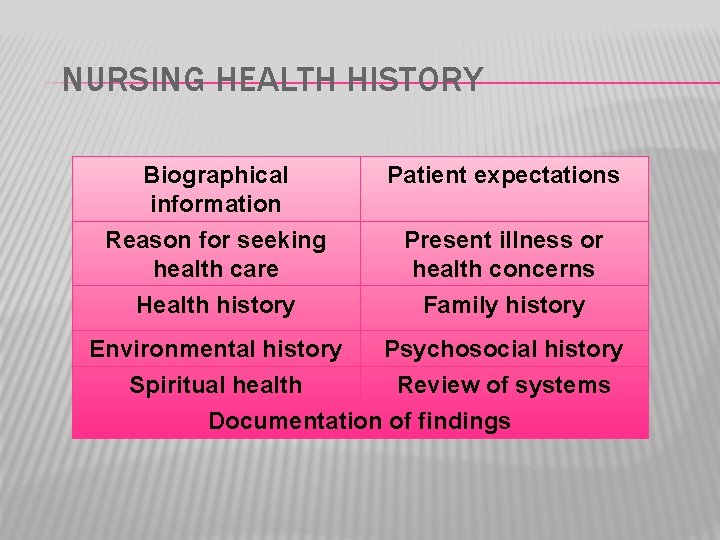
NURSING HEALTH HISTORY Biographical information Patient expectations Reason for seeking health care Present illness or health concerns Health history Family history Environmental history Psychosocial history Spiritual health Review of systems Documentation of findings
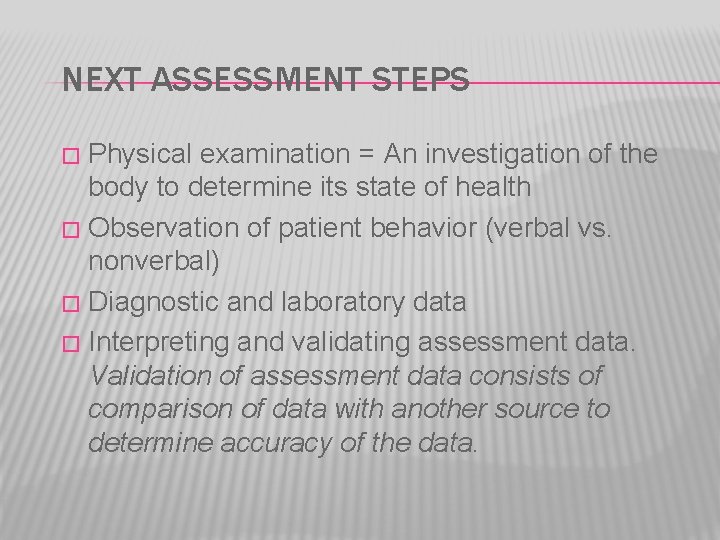
NEXT ASSESSMENT STEPS Physical examination = An investigation of the body to determine its state of health � Observation of patient behavior (verbal vs. nonverbal) � Diagnostic and laboratory data � Interpreting and validating assessment data. Validation of assessment data consists of comparison of data with another source to determine accuracy of the data. �
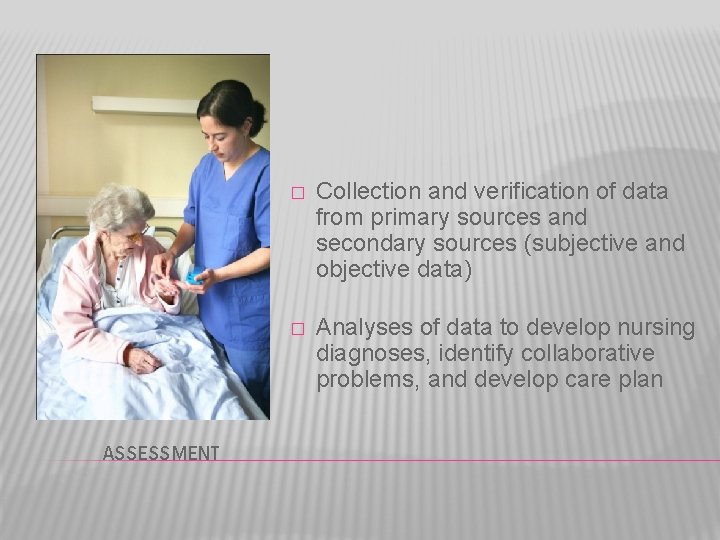
ASSESSMENT � Collection and verification of data from primary sources and secondary sources (subjective and objective data) � Analyses of data to develop nursing diagnoses, identify collaborative problems, and develop care plan
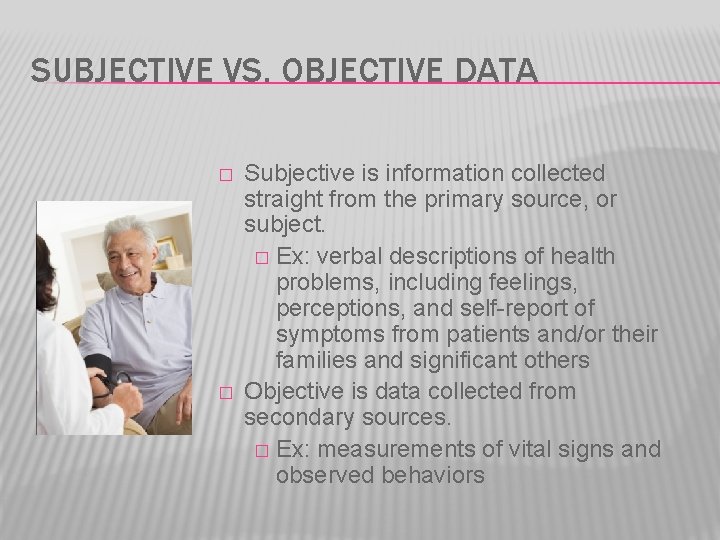
SUBJECTIVE VS. OBJECTIVE DATA � � Subjective is information collected straight from the primary source, or subject. � Ex: verbal descriptions of health problems, including feelings, perceptions, and self-report of symptoms from patients and/or their families and significant others Objective is data collected from secondary sources. � Ex: measurements of vital signs and observed behaviors
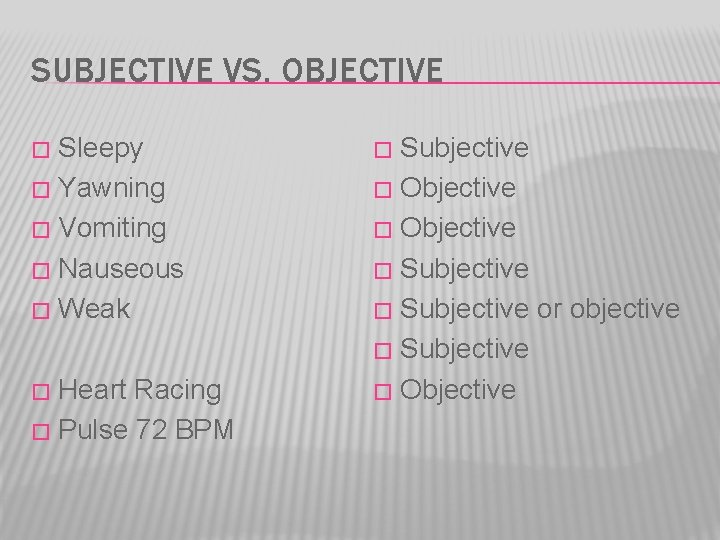
SUBJECTIVE VS. OBJECTIVE Sleepy � Yawning � Vomiting � Nauseous � Weak � Heart Racing � Pulse 72 BPM � Subjective � Objective � Subjective or objective � Subjective � Objective �
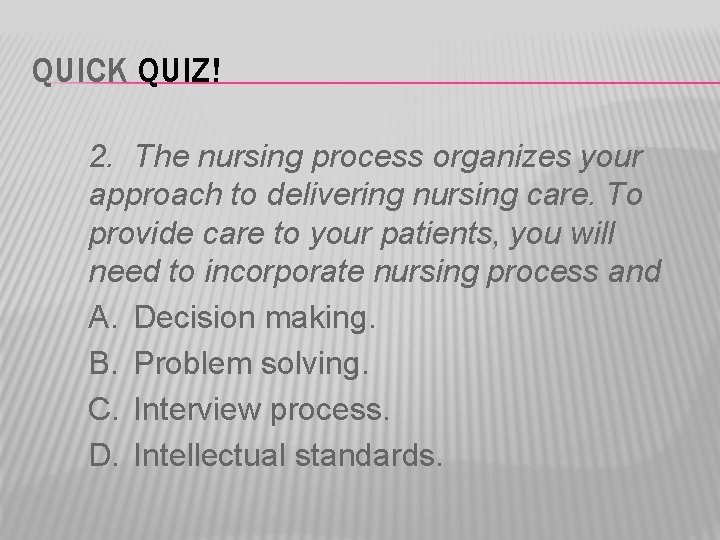
QUICK QUIZ! 2. The nursing process organizes your approach to delivering nursing care. To provide care to your patients, you will need to incorporate nursing process and A. Decision making. B. Problem solving. C. Interview process. D. Intellectual standards.
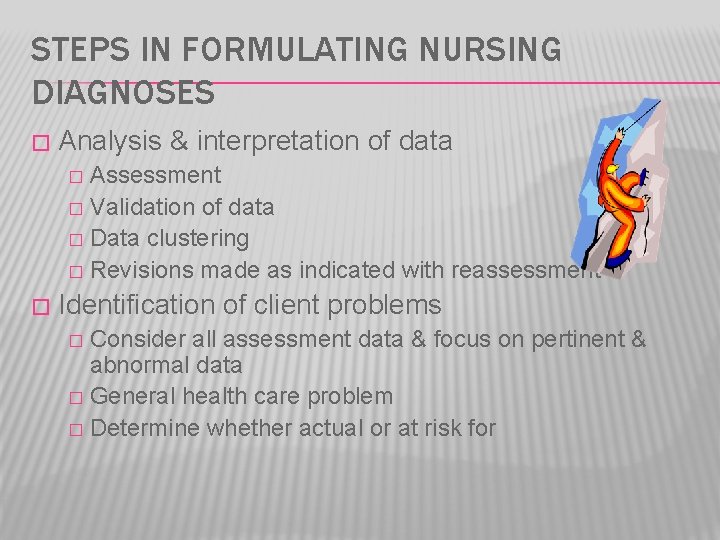
STEPS IN FORMULATING NURSING DIAGNOSES � Analysis & interpretation of data Assessment � Validation of data � Data clustering � Revisions made as indicated with reassessment � � Identification of client problems Consider all assessment data & focus on pertinent & abnormal data � General health care problem � Determine whether actual or at risk for �
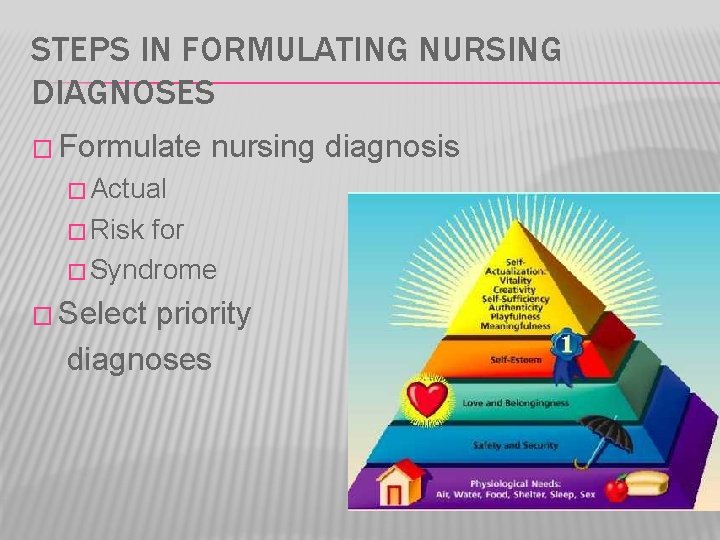
STEPS IN FORMULATING NURSING DIAGNOSES � Formulate nursing diagnosis � Actual � Risk for � Syndrome � Select priority diagnoses
WHY INTRODUCE STANDARDIZED LANGUAGE AT THE UNDERGRADUATE LEVEL? Creates an awareness of nursing language � Supports the learning of the nursing process � Provides consistency between practicum's/clinicals � Develops critical thinking skills � Improves communication � Research Based- drives EBP � What are the components of this standardized language? �
COMPONENTS OF NURSING LANGUAGE � NANDA: Nursing Diagnosis: Definitions and Classification � NIC: Nursing Interventions Classification � NOC: Nursing Outcomes Classification
NANDA: NURSING DIAGNOSIS � A nursing diagnosis is defined as “ a clinical judgment about an individual, family or community responses to actual and potential health problems/life processes. Nursing diagnosis provide the basis for selection of nursing interventions to achieve outcomes for which the nurse is accountable. ”(NANDA, 2009)
LABELS OF NURSING DIAGNOSIS’: 1. Actual diagnosis: describes health conditions that exist and supported by defining characteristics � 2. Risk diagnosis: those which describe disease or other conditions that may develop and are supported by risk factors � 3. Health Promotion diagnosis : describe levels of wellness and potential for enhancement to a higher level of functioning (consider health promotion model) �
NURSING DIAGNOSIS � Risk for (High Risk) � Client is more vulnerable to develop problems than others in the same or a similar situation � Data base contains evidence of the related (risk) factors (factors that can cause or contribute to the problem) of the diagnosis, but no evidence of the defining characteristics
WRITING NURSING DIAGNOSES � Syndrome � Comprises a cluster of actual or risk nursing diagnoses that are predicted to present because of a certain situation or event
WRITING NURSING DIAGNOSES � Two – Part � Risk for or possible nursing diagnosis � Problem + Etiology or Cause and Risk Factors � “Related to” links risk/possible problem with the related factors present
WRITING NURSING DIAGNOSES � Sample � Risk for Impaired Skin Integrity related to excessive diaphoresis & confinement to bed � Risk for Constipation related to immobility & inadequate fluid intake
WRITING NURSING DIAGNOSES � Three – Part � Actual nursing diagnosis; validated by defining characteristics � Problem + Etiology + Sign/Symptoms � ‘Related to’ links problem with etiology or related factors � ‘As evidenced by’ states the evidence or defining characteristics (subjective/objective data)
WRITING NURSING DIAGNOSES � Sample � Impaired Communication related to language barrier as evidenced by inability to speak or understand English & by use of Spanish � Diarrhea related to change in diet as evidenced by liquid stools & abdominal cramping
WRITING NURSING DIAGNOSES � Direct nursing interventions � Clear & specific � Answers: “What can nurses do about the problem? ” � Avoid legally incriminating terminology
WRITING NURSING DIAGNOSES � Avoids value judgments � Do not use medical terminology � Focuses on the person’s response to the medical problem � States only one problem at a time
CASE STUDY �A 73 year old man has been admitted to the unit with a diagnosis of COPD. He states he has “difficulty breathing when walking short distances”. He also states that his “heart feels like it is racing”(heart rate 110 BPM) at the same time. He states he is “tired all the time”, and while talking with you, he is continually wringing his hands and looking out the window.
NOC � The nursing outcomes classification (NOC) is a classification of nurse sensitive outcomes � NOC outcomes and indicators “allow for measurement of the patient, family, or community outcome at any point on a continuum from most negative to most positive and at different points in time”.
COMPONENTS �A neutral label or name used to characterize the behavior or patient status � A list of indicators that describe client behavior or patient status. � A five point scale to rate the patient‘s status for each of the indicators
NANDA/NOC LINKAGE � Each nursing Diagnosis is followed by a list of suggested outcomes to measure whether the chosen interventions are helping the identified problem � Each outcome can be individualized to the patient or family by choosing the appropriate indicators or adding additional indicators as necessary
NIC � The nursing interventions classification (NIC) is a comprehensive, standardized language describing treatments that nurses perform in all settings and in all specialties. ”