Extreme QCD and the ridge phenomenon Raju Venugopalan
- Slides: 56
Extreme QCD and the ridge phenomenon Raju Venugopalan Brookhaven National Laboratory Orsay Summer School, July 4 2014
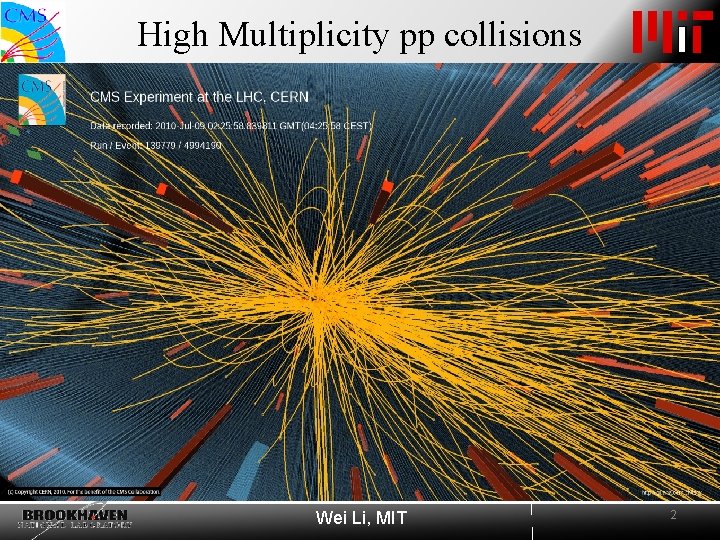
High Multiplicity pp collisions Wei Li, MIT 2
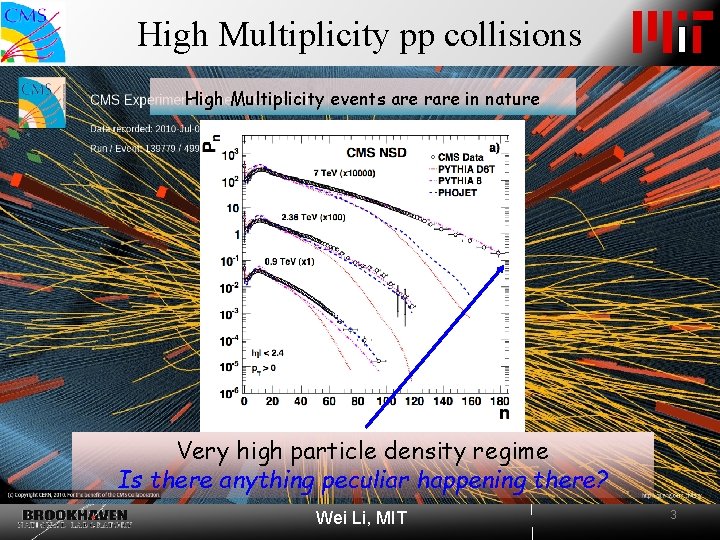
High Multiplicity pp collisions High Multiplicity events are rare in nature Very high particle density regime Is there anything peculiar happening there? Wei Li, MIT 3
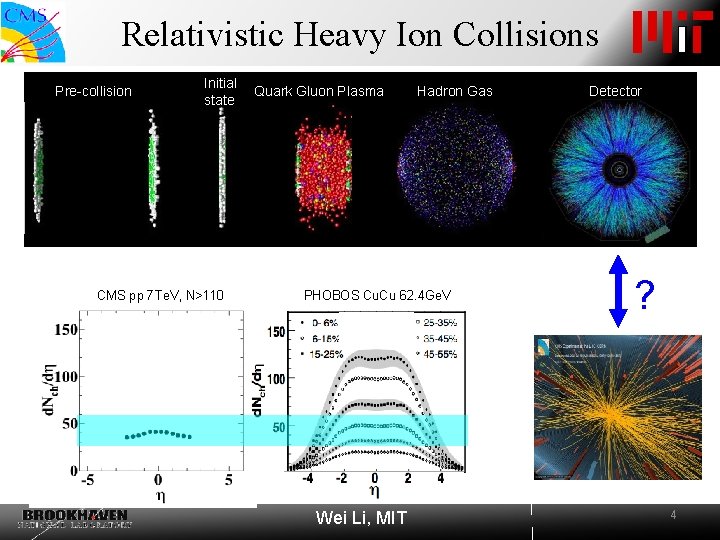
Relativistic Heavy Ion Collisions Pre-collision Initial state CMS pp 7 Te. V, N>110 Quark Gluon Plasma Hadron Gas PHOBOS Cu. Cu 62. 4 Ge. V Wei Li, MIT Detector ? 4
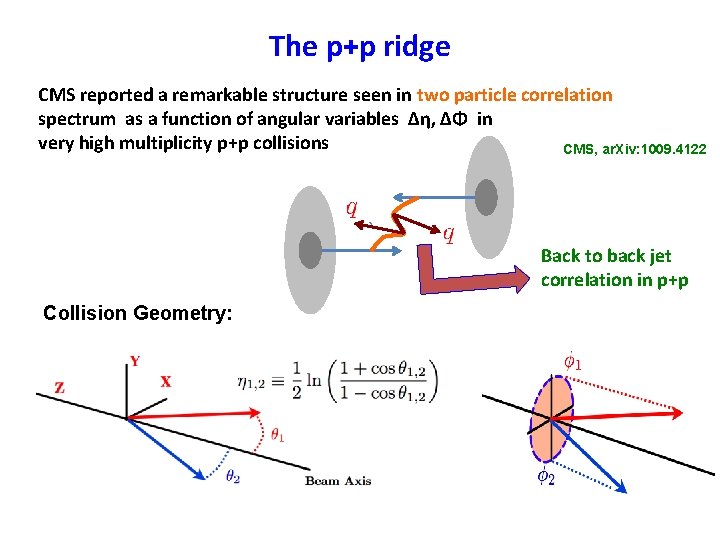
The p+p ridge CMS reported a remarkable structure seen in two particle correlation spectrum as a function of angular variables Δη, ΔΦ in very high multiplicity p+p collisions CMS, ar. Xiv: 1009. 4122 Back to back jet correlation in p+p Collision Geometry:
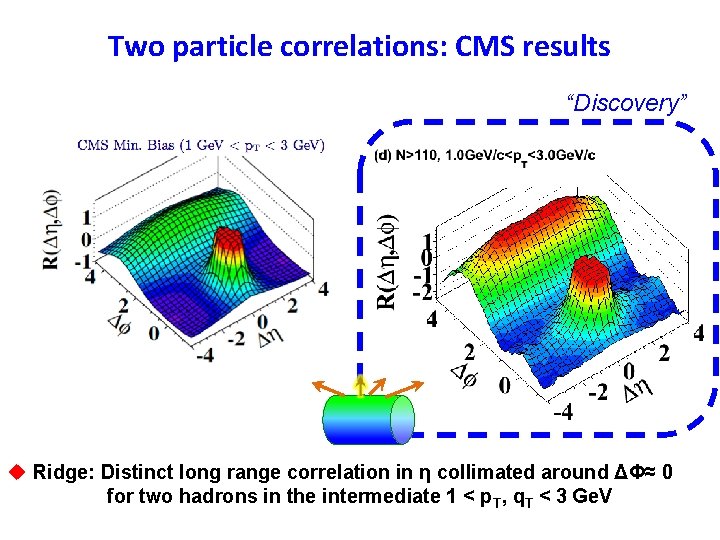
Two particle correlations: CMS results “Discovery” u Ridge: Distinct long range correlation in η collimated around ΔΦ≈ 0 for two hadrons in the intermediate 1 < p T, q. T < 3 Ge. V
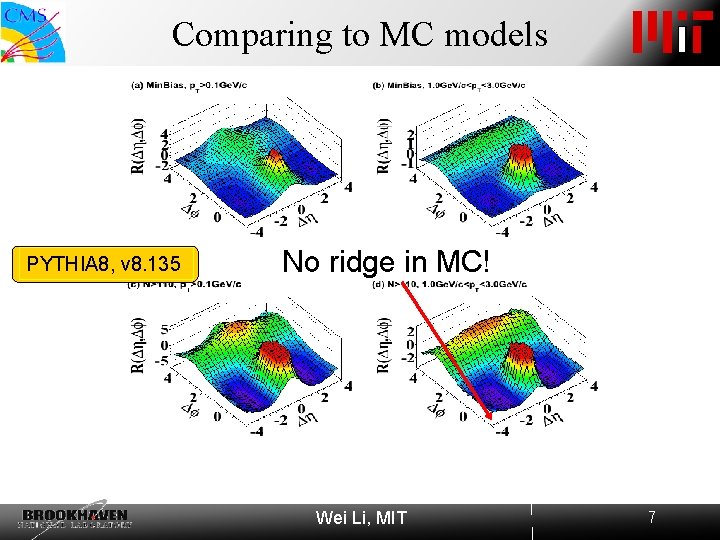
Comparing to MC models PYTHIA 8, v 8. 135 No ridge in MC! Wei Li, MIT 7
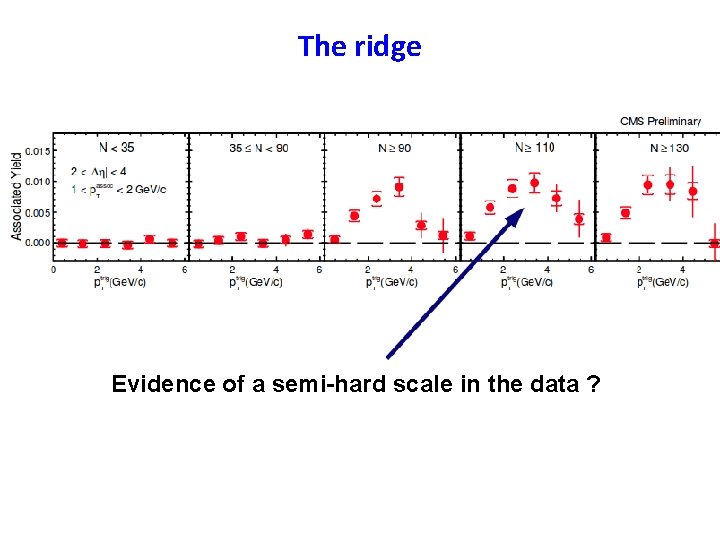
The ridge Evidence of a semi-hard scale in the data ?
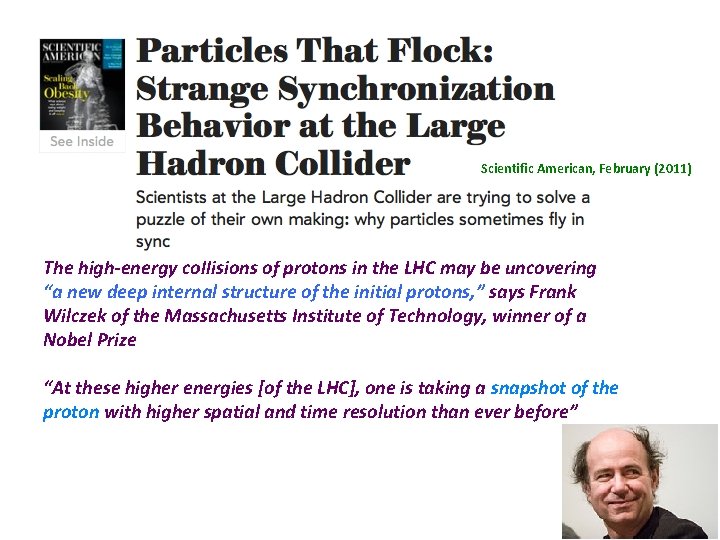
Scientific American, February (2011) The high-energy collisions of protons in the LHC may be uncovering “a new deep internal structure of the initial protons, ” says Frank Wilczek of the Massachusetts Institute of Technology, winner of a Nobel Prize “At these higher energies [of the LHC], one is taking a snapshot of the proton with higher spatial and time resolution than ever before”
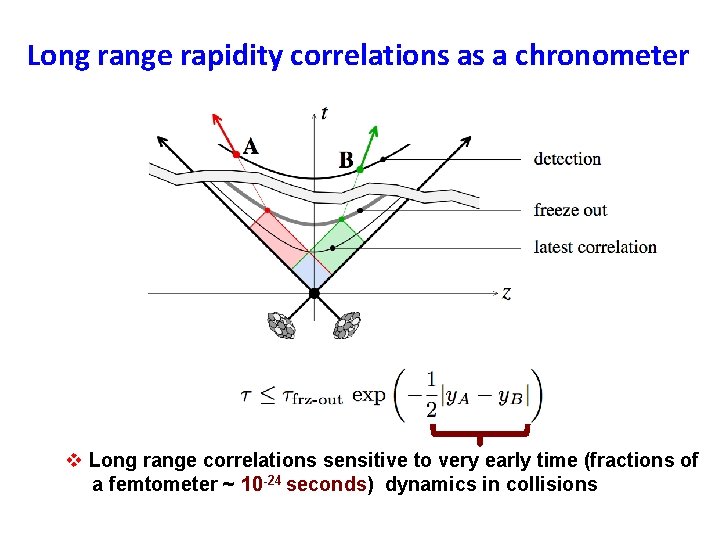
Long range rapidity correlations as a chronometer v Long range correlations sensitive to very early time (fractions of a femtometer ~ 10 -24 seconds) dynamics in collisions
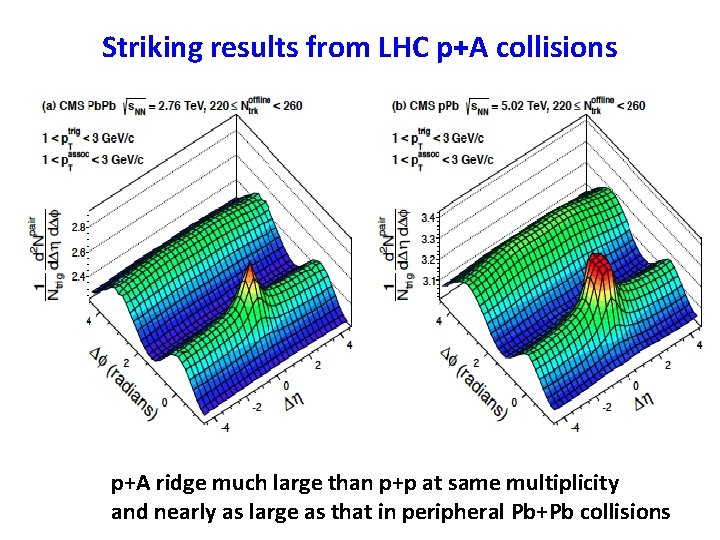
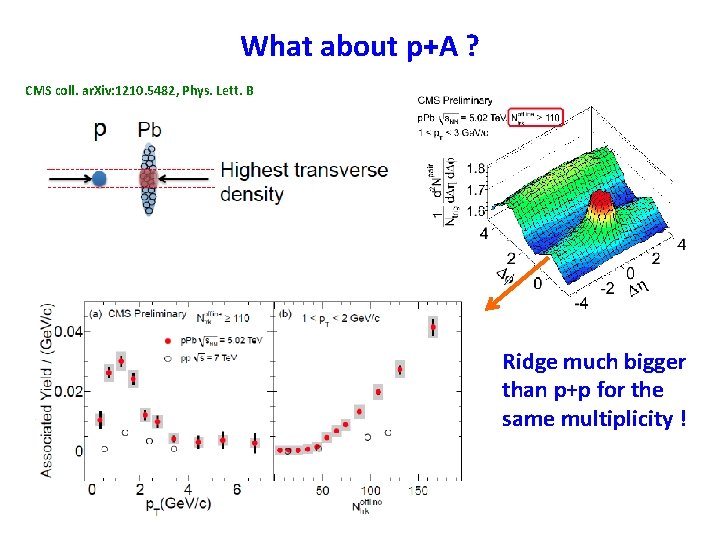
Striking results from LHC p+A collisions p+A ridge much large than p+p at same multiplicity and nearly as large as that in peripheral Pb+Pb collisions
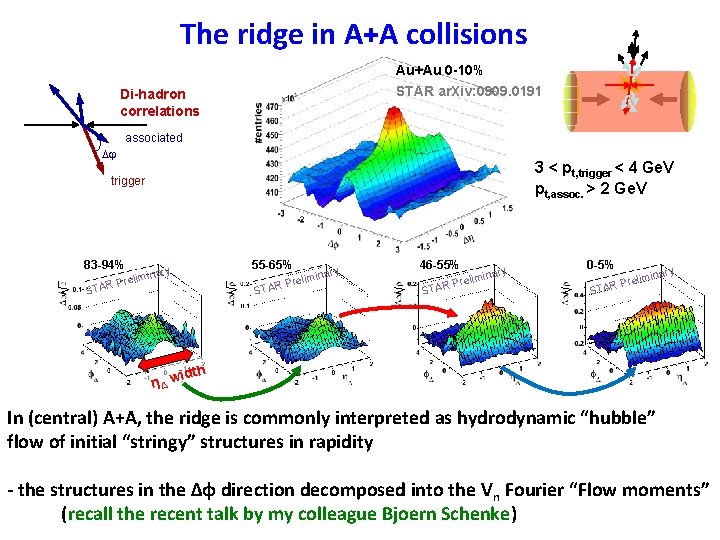
The ridge in A+A collisions Au+Au 0 -10% STAR ar. Xiv: 0909. 0191 Di-hadron correlations associated Dj 3 < pt, trigger < 4 Ge. V pt, assoc. > 2 Ge. V trigger 83 -94% STAR 55 -65% ry ina Prelim STAR inary Prelim 46 -55% STAR inary Prelim 0 -5% inary relim AR P ST idth ηΔ w In (central) A+A, the ridge is commonly interpreted as hydrodynamic “hubble” flow of initial “stringy” structures in rapidity - the structures in the Δφ direction decomposed into the Vn Fourier “Flow moments” (recall the recent talk by my colleague Bjoern Schenke)
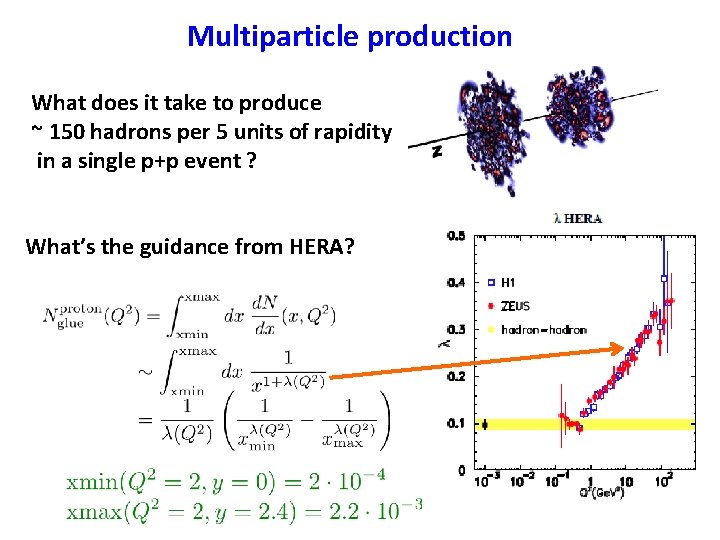
Multiparticle production What does it take to produce ~ 150 hadrons per 5 units of rapidity in a single p+p event ? What’s the guidance from HERA?
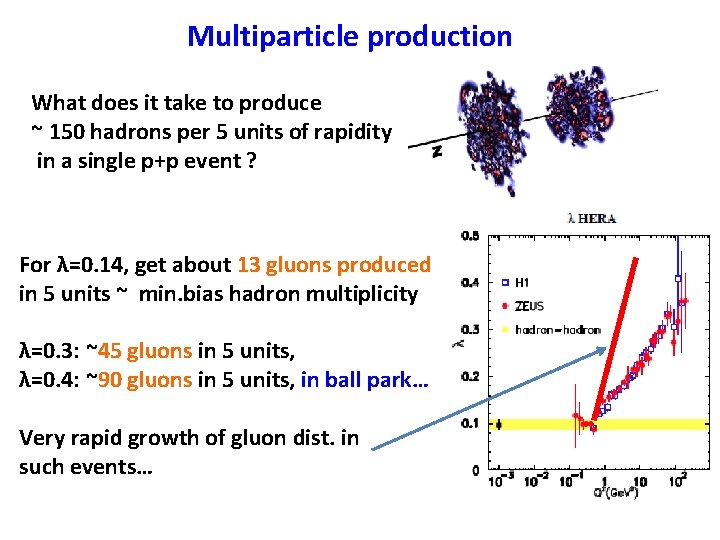
Multiparticle production What does it take to produce ~ 150 hadrons per 5 units of rapidity in a single p+p event ? For λ=0. 14, get about 13 gluons produced in 5 units ~ min. bias hadron multiplicity λ=0. 3: ~45 gluons in 5 units, λ=0. 4: ~90 gluons in 5 units, in ball park… Very rapid growth of gluon dist. in such events…
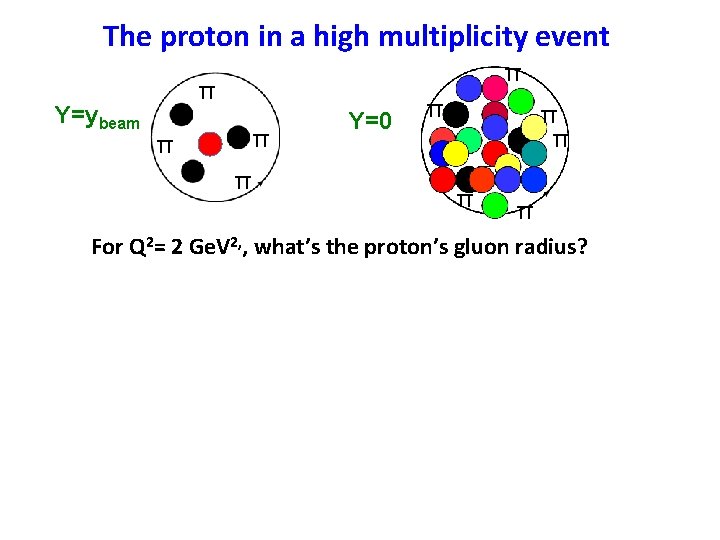
The proton in a high multiplicity event Y=ybeam π π π Y=0 π π π For Q 2= 2 Ge. V 2, , what’s the proton’s gluon radius?
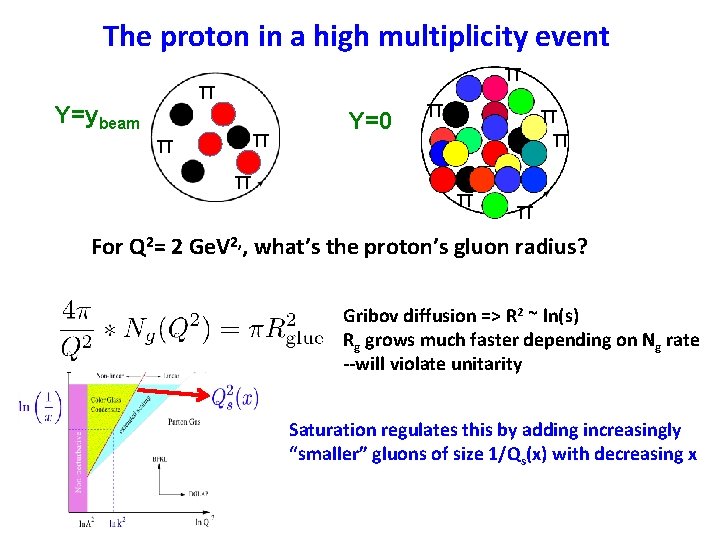
The proton in a high multiplicity event Y=ybeam π π π Y=0 π π π For Q 2= 2 Ge. V 2, , what’s the proton’s gluon radius? Gribov diffusion => R 2 ~ ln(s) Rg grows much faster depending on Ng rate --will violate unitarity Saturation regulates this by adding increasingly “smaller” gluons of size 1/Qs(x) with decreasing x
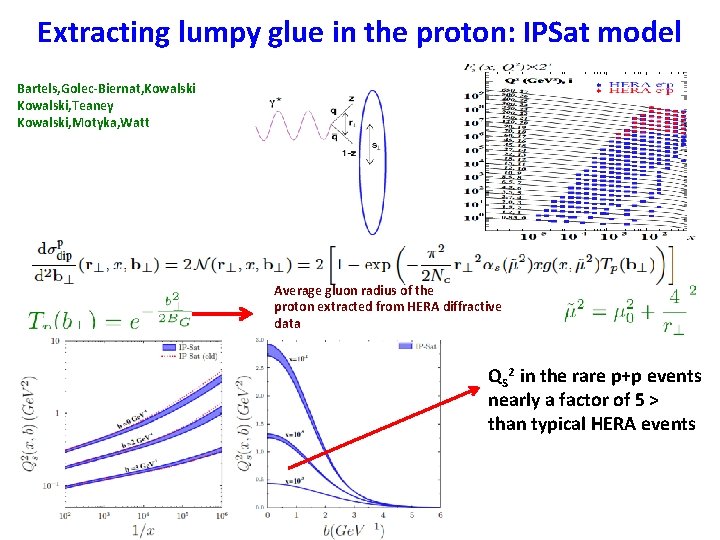
Extracting lumpy glue in the proton: IPSat model Bartels, Golec-Biernat, Kowalski, Teaney Kowalski, Motyka, Watt Average gluon radius of the proton extracted from HERA diffractive data QS 2 in the rare p+p events nearly a factor of 5 > than typical HERA events
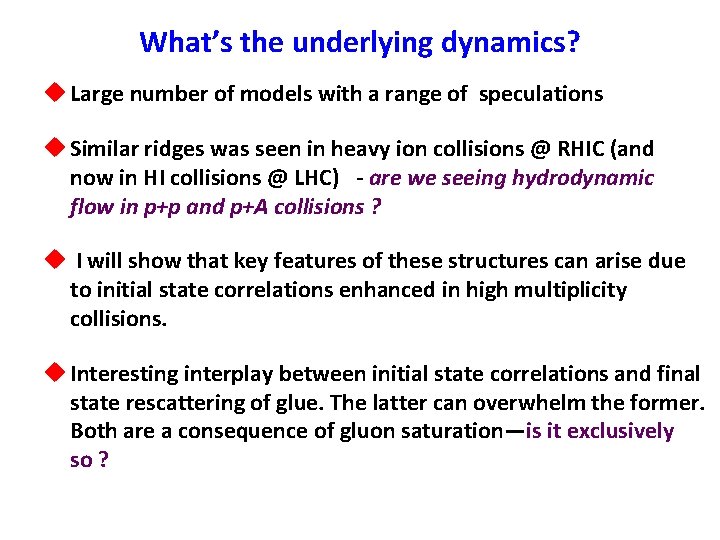
What’s the underlying dynamics? u Large number of models with a range of speculations u Similar ridges was seen in heavy ion collisions @ RHIC (and now in HI collisions @ LHC) - are we seeing hydrodynamic flow in p+p and p+A collisions ? u I will show that key features of these structures can arise due to initial state correlations enhanced in high multiplicity collisions. u Interesting interplay between initial state correlations and final state rescattering of glue. The latter can overwhelm the former. Both are a consequence of gluon saturation—is it exclusively so ?
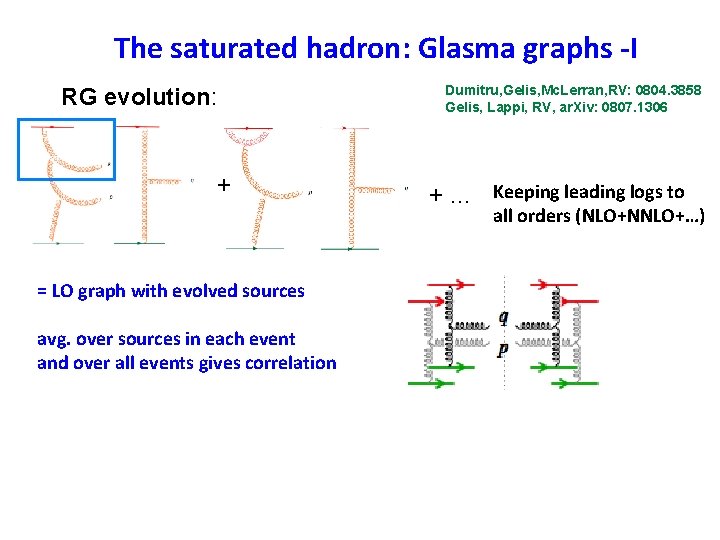
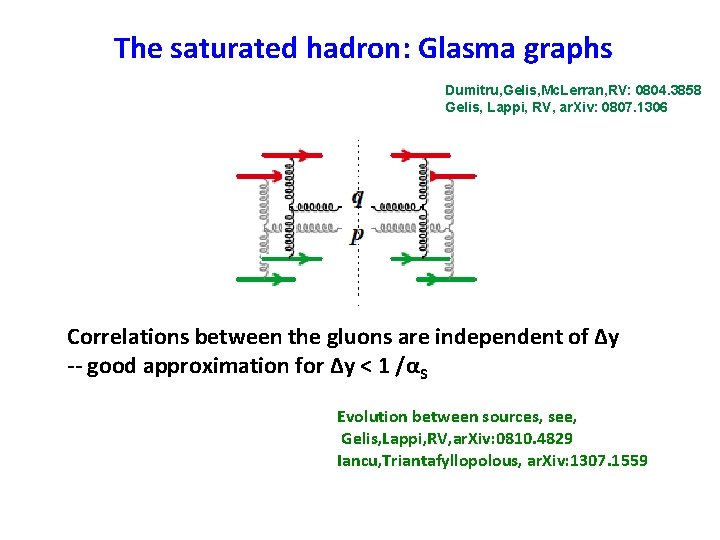
The saturated hadron: Glasma graphs -I RG evolution: + Dumitru, Gelis, Mc. Lerran, RV: 0804. 3858 Gelis, Lappi, RV, ar. Xiv: 0807. 1306 + … Keeping leading logs to all orders (NLO+NNLO+…) = LO graph with evolved sources avg. over sources in each event and over all events gives correlation
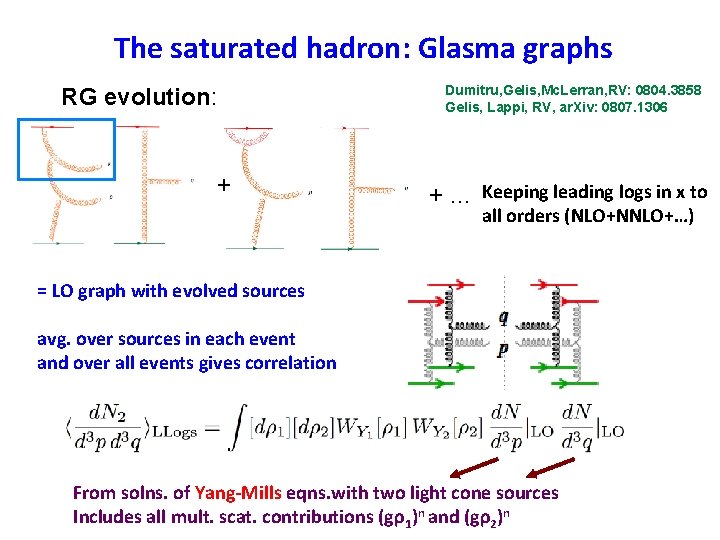
The saturated hadron: Glasma graphs RG evolution: + Dumitru, Gelis, Mc. Lerran, RV: 0804. 3858 Gelis, Lappi, RV, ar. Xiv: 0807. 1306 + … Keeping leading logs in x to all orders (NLO+NNLO+…) = LO graph with evolved sources avg. over sources in each event and over all events gives correlation From solns. of Yang-Mills eqns. with two light cone sources Includes all mult. scat. contributions (gρ1)n and (gρ2)n
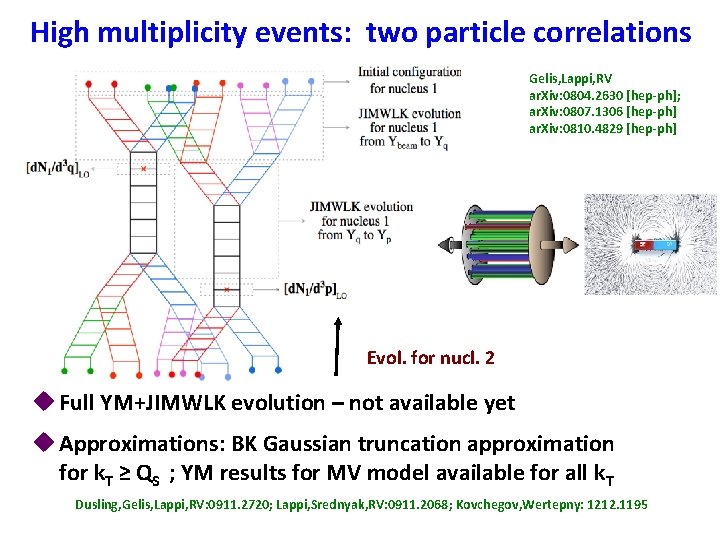
High multiplicity events: two particle correlations Gelis, Lappi, RV ar. Xiv: 0804. 2630 [hep-ph]; ar. Xiv: 0807. 1306 [hep-ph] ar. Xiv: 0810. 4829 [hep-ph] Evol. for nucl. 2 u Full YM+JIMWLK evolution – not available yet u Approximations: BK Gaussian truncation approximation for k. T ≥ QS ; YM results for MV model available for all k. T Dusling, Gelis, Lappi, RV: 0911. 2720; Lappi, Srednyak, RV: 0911. 2068; Kovchegov, Wertepny: 1212. 1195
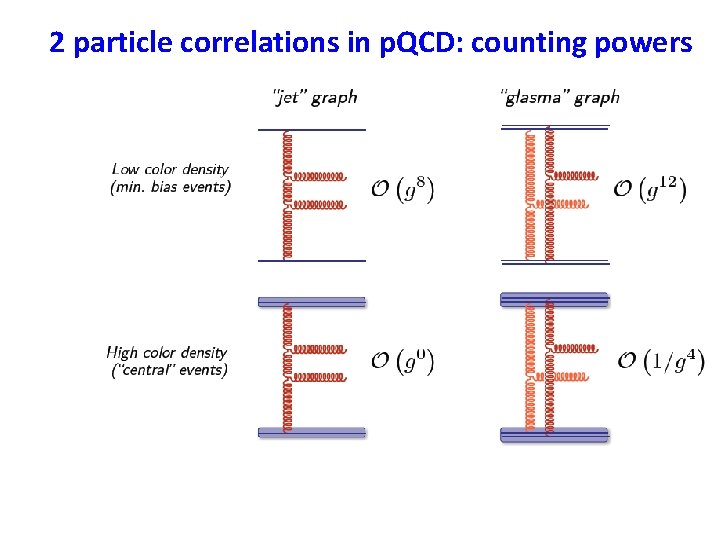
2 particle correlations in p. QCD: counting powers
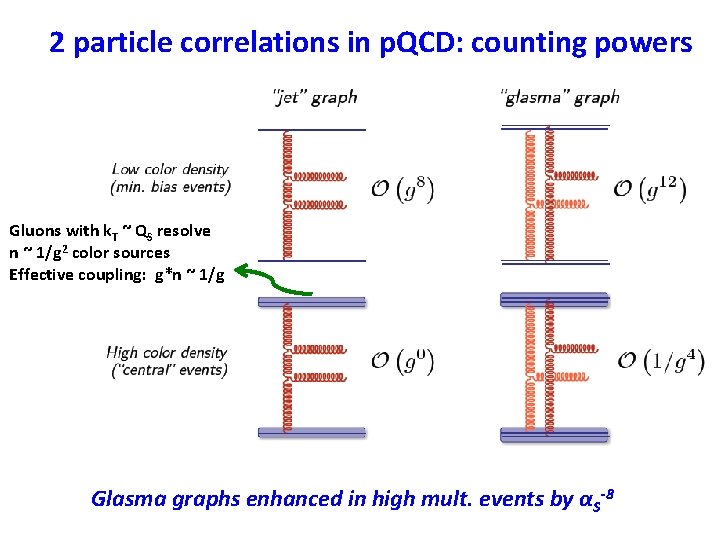
2 particle correlations in p. QCD: counting powers Gluons with k. T ~ QS resolve n ~ 1/g 2 color sources Effective coupling: g*n ~ 1/g Glasma graphs enhanced in high mult. events by αS-8
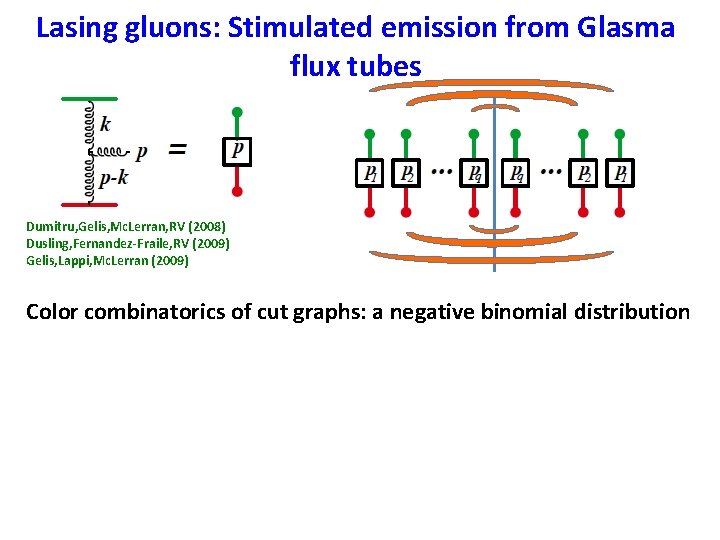
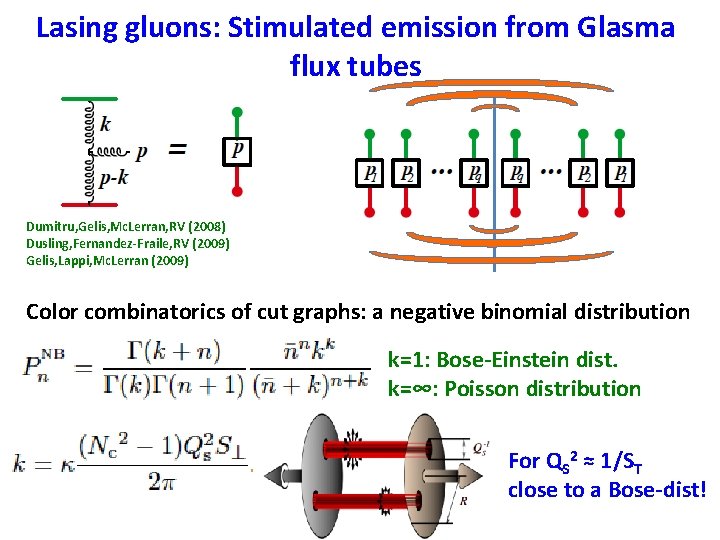
Lasing gluons: Stimulated emission from Glasma flux tubes Dumitru, Gelis, Mc. Lerran, RV (2008) Dusling, Fernandez-Fraile, RV (2009) Gelis, Lappi, Mc. Lerran (2009) Color combinatorics of cut graphs: a negative binomial distribution
Lasing gluons: Stimulated emission from Glasma flux tubes Dumitru, Gelis, Mc. Lerran, RV (2008) Dusling, Fernandez-Fraile, RV (2009) Gelis, Lappi, Mc. Lerran (2009) Color combinatorics of cut graphs: a negative binomial distribution k=1: Bose-Einstein dist. k=∞: Poisson distribution For QS 2 ≈ 1/ST close to a Bose-dist!
The saturated hadron: Glasma graphs Dumitru, Gelis, Mc. Lerran, RV: 0804. 3858 Gelis, Lappi, RV, ar. Xiv: 0807. 1306 Correlations between the gluons are independent of Δy -- good approximation for Δy < 1 /αS Evolution between sources, see, Gelis, Lappi, RV, ar. Xiv: 0810. 4829 Iancu, Triantafyllopolous, ar. Xiv: 1307. 1559
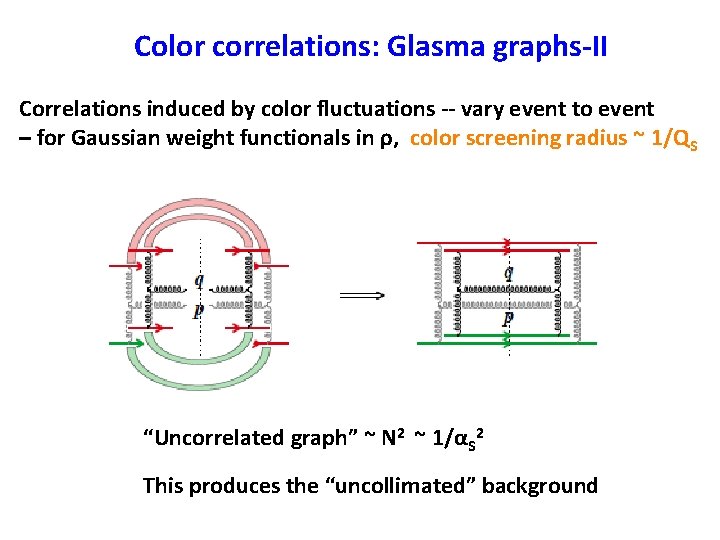
Color correlations: Glasma graphs-II Correlations induced by color fluctuations -- vary event to event – for Gaussian weight functionals in ρ, color screening radius ~ 1/QS “Uncorrelated graph” ~ N 2 ~ 1/αS 2 This produces the “uncollimated” background
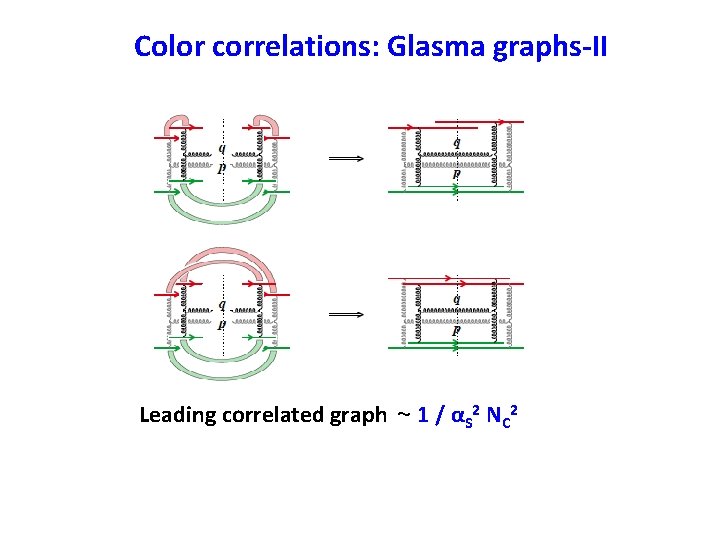
Color correlations: Glasma graphs-II Leading correlated graph ~ 1 / αS 2 NC 2
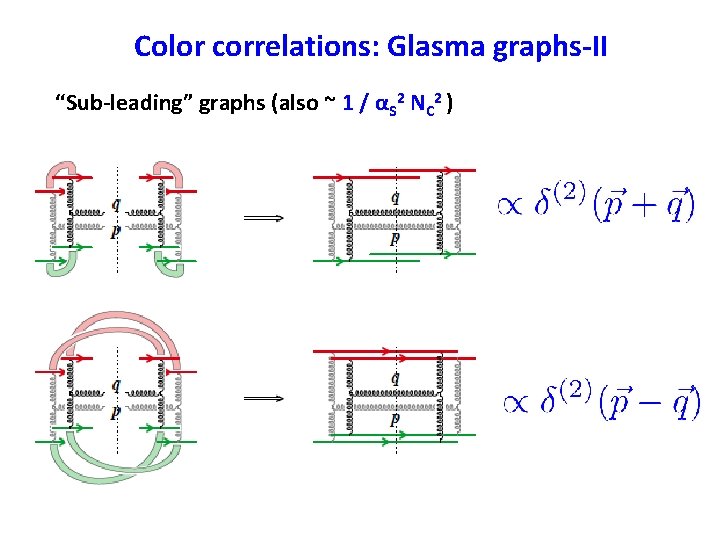
Color correlations: Glasma graphs-II “Sub-leading” graphs (also ~ 1 / αS 2 NC 2 )
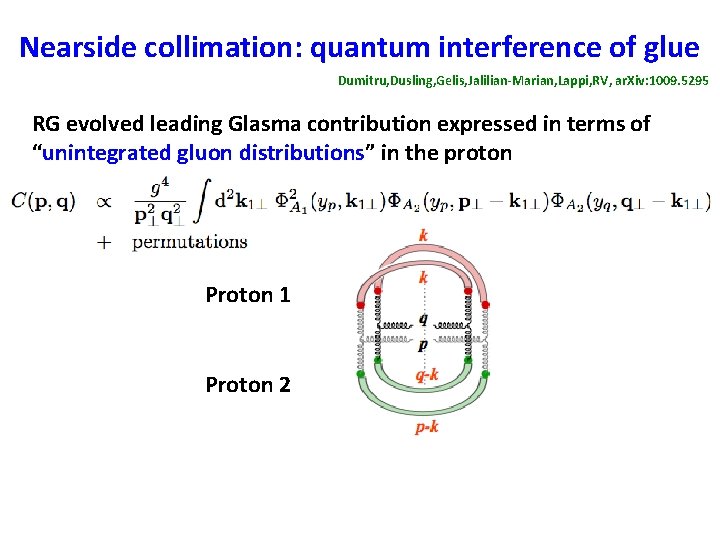
Nearside collimation: quantum interference of glue Dumitru, Dusling, Gelis, Jalilian-Marian, Lappi, RV, ar. Xiv: 1009. 5295 RG evolved leading Glasma contribution expressed in terms of “unintegrated gluon distributions” in the proton Proton 1 Proton 2
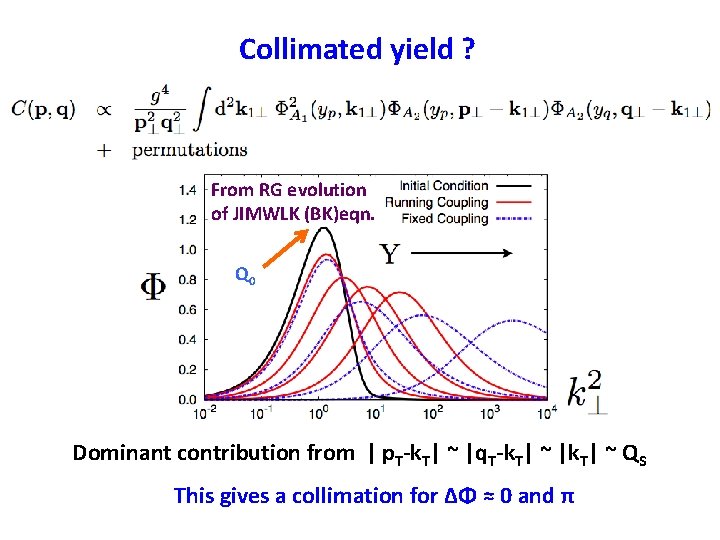
Collimated yield ? From RG evolution of JIMWLK (BK)eqn. Q 0 Dominant contribution from | p. T-k. T| ~ |q. T-k. T| ~ |k. T| ~ QS This gives a collimation for ΔΦ ≈ 0 and π
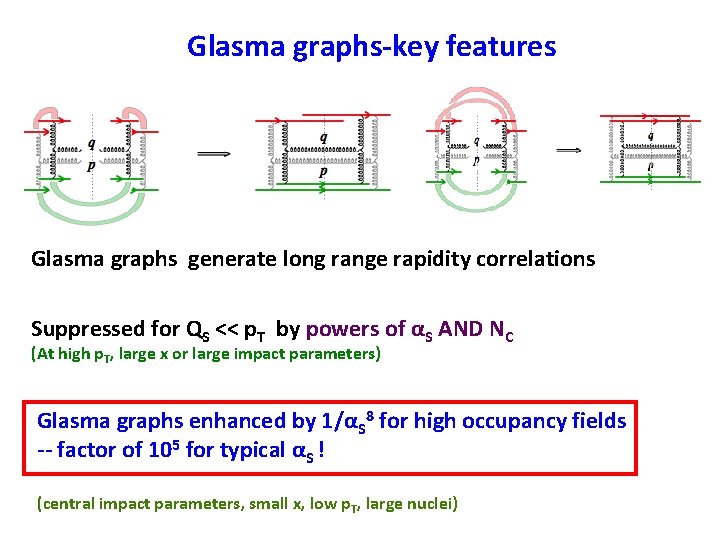
Glasma graphs-key features Glasma graphs generate long range rapidity correlations Suppressed for QS << p. T by powers of αS AND NC (At high p. T, large x or large impact parameters) Glasma graphs enhanced by 1/αS 8 for high occupancy fields -- factor of 105 for typical αS ! (central impact parameters, small x, low p. T, large nuclei)
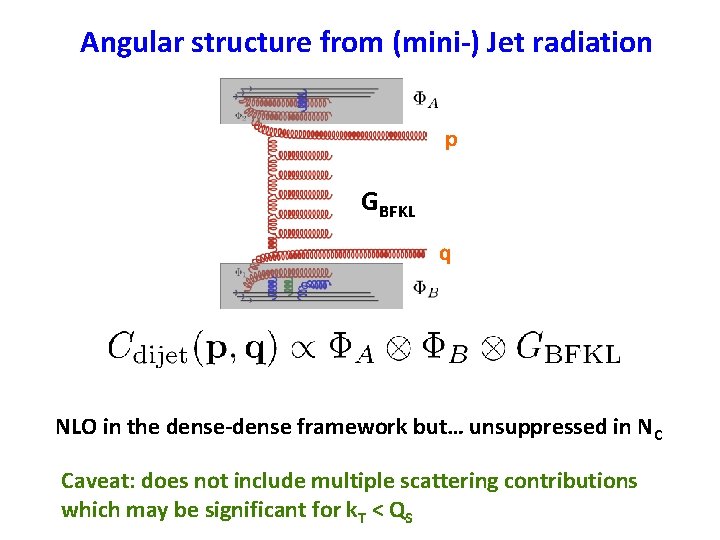
Angular structure from (mini-) Jet radiation p GBFKL q NLO in the dense-dense framework but… unsuppressed in NC Caveat: does not include multiple scattering contributions which may be significant for k. T < QS
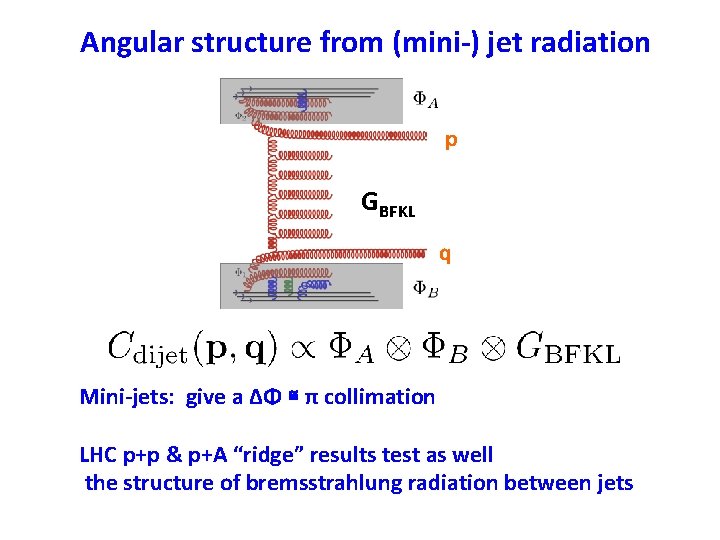
Angular structure from (mini-) jet radiation p GBFKL q Mini-jets: give a ΔΦ ≅ π collimation LHC p+p & p+A “ridge” results test as well the structure of bremsstrahlung radiation between jets
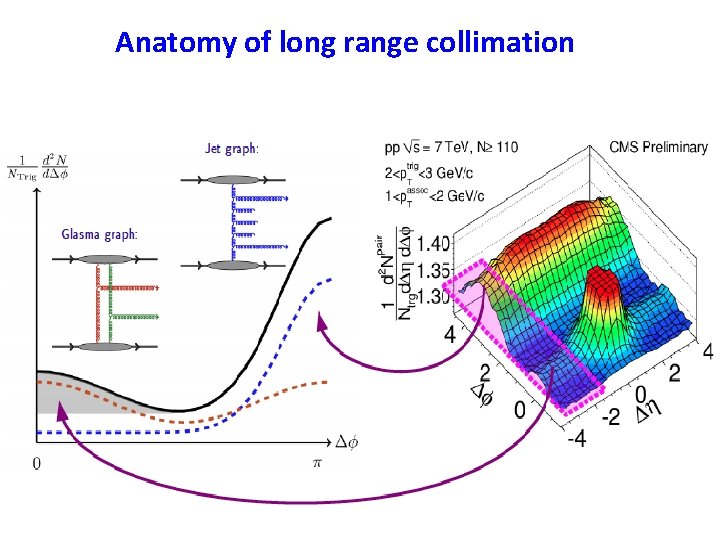
Anatomy of long range collimation
Dusling, RV, PRD 87, 051502 (R) (2013); ar. Xiv: 1302. 7018
What about p+A ? CMS coll. ar. Xiv: 1210. 5482, Phys. Lett. B Ridge much bigger than p+p for the same multiplicity !
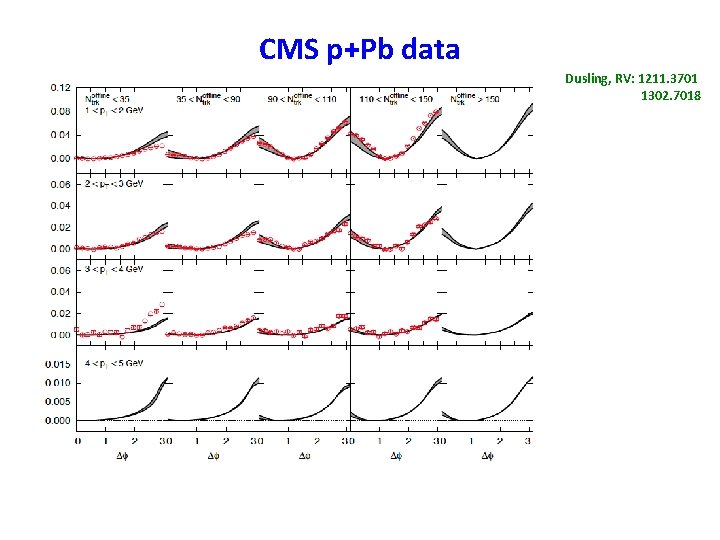
CMS p+Pb data Dusling, RV: 1211. 3701 1302. 7018
CMS p+Pb data Dusling, RV: 1211. 3701 1302. 7018
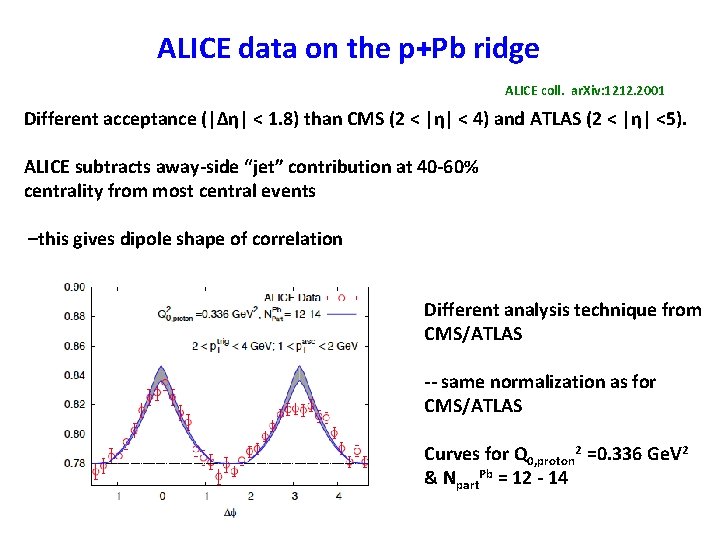
ALICE data on the p+Pb ridge ALICE coll. ar. Xiv: 1212. 2001 Different acceptance (|Δη| < 1. 8) than CMS (2 < |η| < 4) and ATLAS (2 < |η| <5). ALICE subtracts away-side “jet” contribution at 40 -60% centrality from most central events –this gives dipole shape of correlation Different analysis technique from CMS/ATLAS -- same normalization as for CMS/ATLAS Curves for Q 0, proton 2 =0. 336 Ge. V 2 & Npart. Pb = 12 - 14
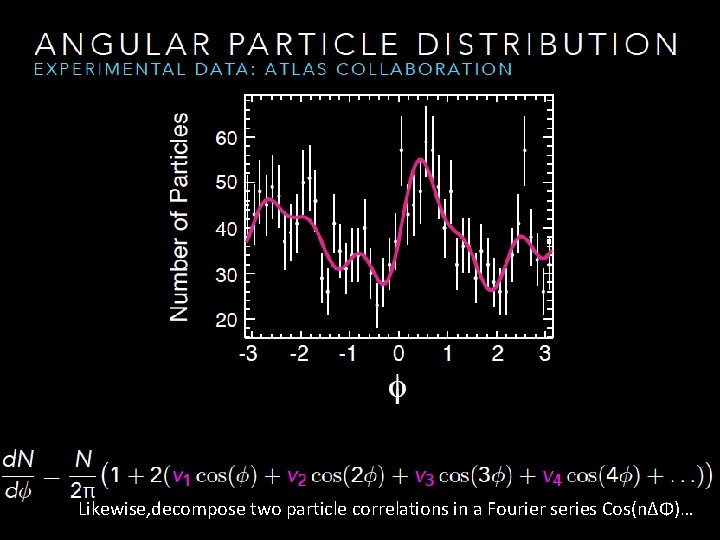
Likewise, decompose two particle correlations in a Fourier series Cos(nΔΦ)…
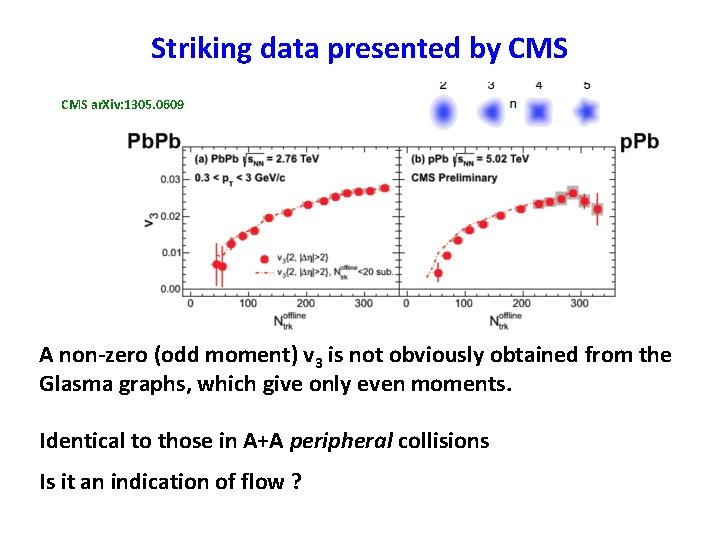
Striking data presented by CMS ar. Xiv: 1305. 0609 A non-zero (odd moment) v 3 is not obviously obtained from the Glasma graphs, which give only even moments. Identical to those in A+A peripheral collisions Is it an indication of flow ?
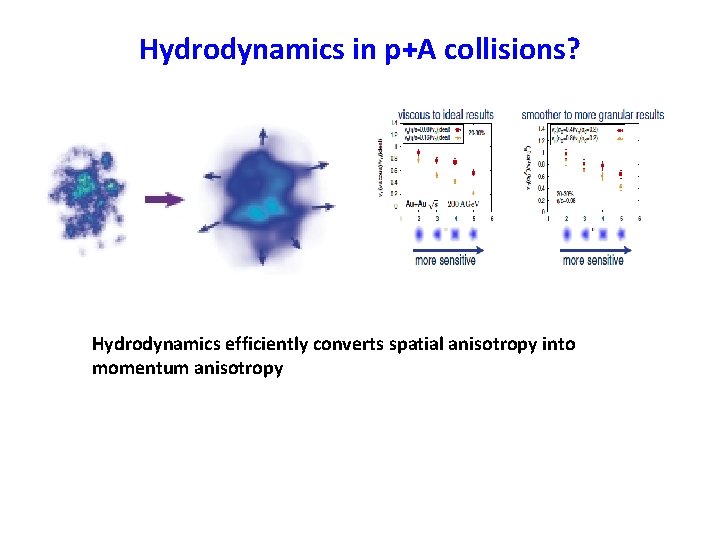
Hydrodynamics in p+A collisions? Hydrodynamics efficiently converts spatial anisotropy into momentum anisotropy
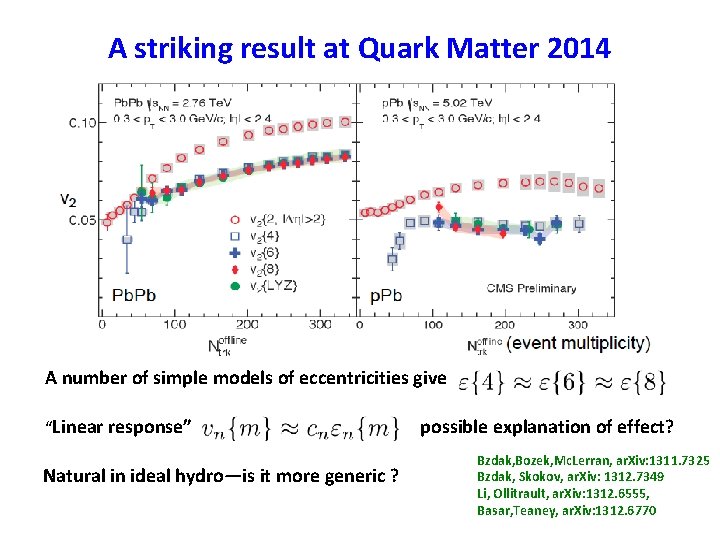
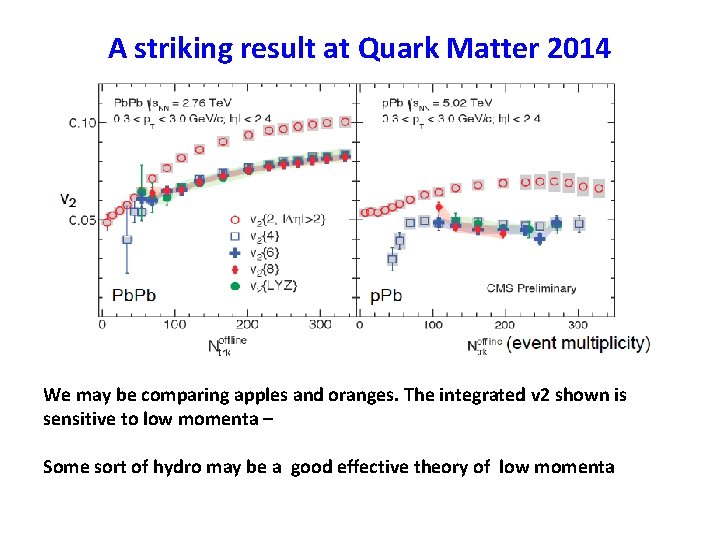
A striking result at Quark Matter 2014 A number of simple models of eccentricities give “Linear response” Natural in ideal hydro—is it more generic ? possible explanation of effect? Bzdak, Bozek, Mc. Lerran, ar. Xiv: 1311. 7325 Bzdak, Skokov, ar. Xiv: 1312. 7349 Li, Ollitrault, ar. Xiv: 1312. 6555, Basar, Teaney, ar. Xiv: 1312. 6770
A striking result at Quark Matter 2014 We may be comparing apples and oranges. The integrated v 2 shown is sensitive to low momenta – Some sort of hydro may be a good effective theory of low momenta
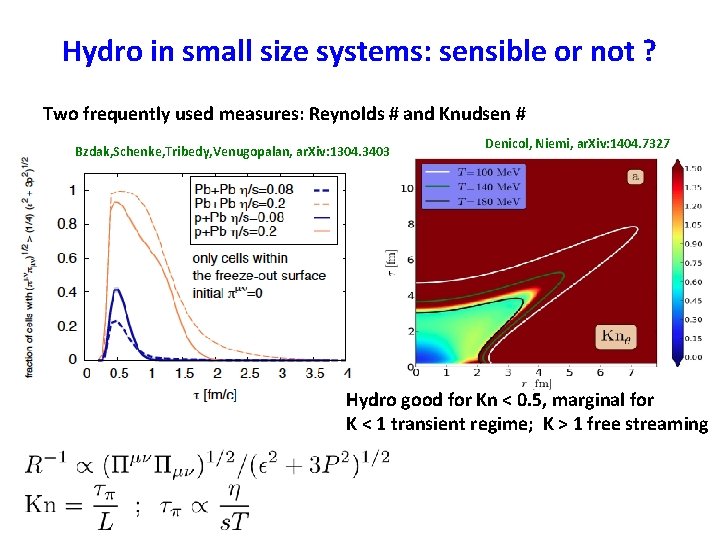
Hydro in small size systems: sensible or not ? Two frequently used measures: Reynolds # and Knudsen # Bzdak, Schenke, Tribedy, Venugopalan, ar. Xiv: 1304. 3403 Denicol, Niemi, ar. Xiv: 1404. 7327 Hydro good for Kn < 0. 5, marginal for K < 1 transient regime; K > 1 free streaming
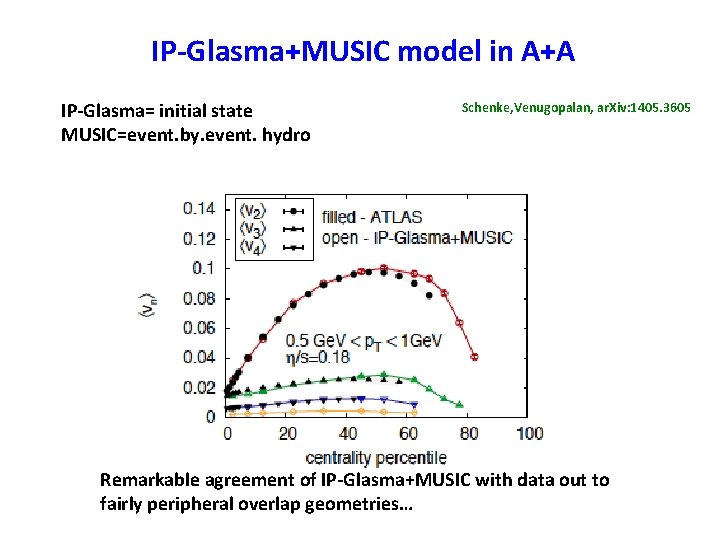
IP-Glasma+MUSIC model in A+A IP-Glasma= initial state MUSIC=event. by. event. hydro Schenke, Venugopalan, ar. Xiv: 1405. 3605 Remarkable agreement of IP-Glasma+MUSIC with data out to fairly peripheral overlap geometries…
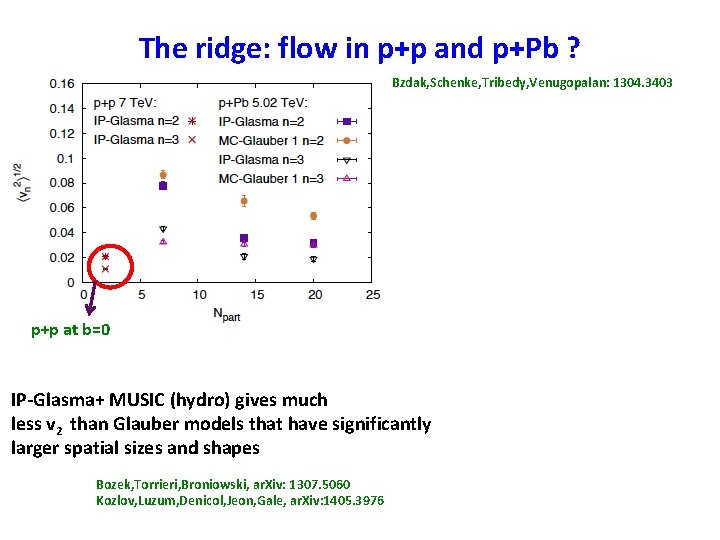
The ridge: flow in p+p and p+Pb ? Bzdak, Schenke, Tribedy, Venugopalan: 1304. 3403 p+p at b=0 IP-Glasma+ MUSIC (hydro) gives much less v 2 than Glauber models that have significantly larger spatial sizes and shapes Bozek, Torrieri, Broniowski, ar. Xiv: 1307. 5060 Kozlov, Luzum, Denicol, Jeon, Gale, ar. Xiv: 1405. 3976
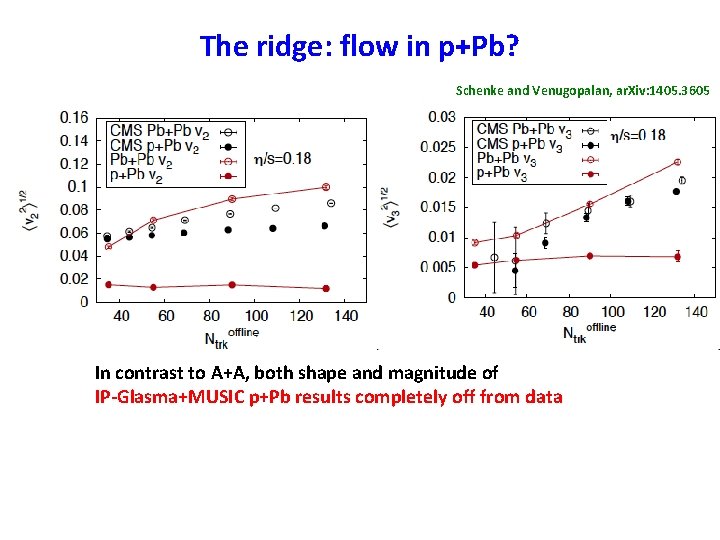
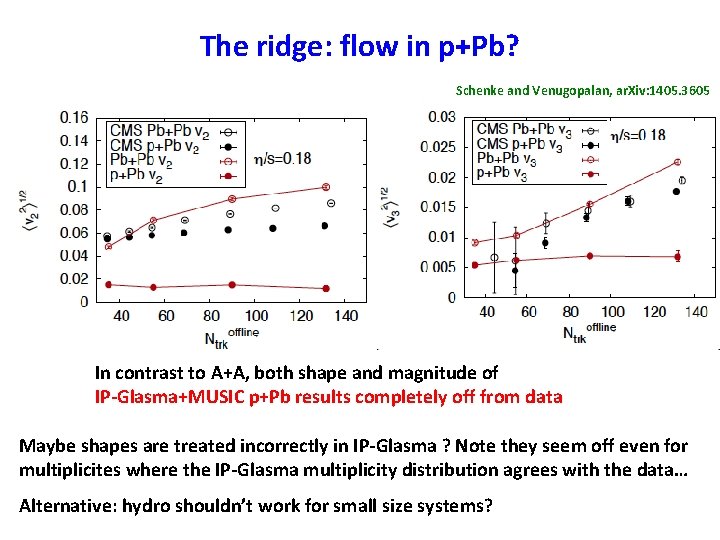
The ridge: flow in p+Pb? Schenke and Venugopalan, ar. Xiv: 1405. 3605 In contrast to A+A, both shape and magnitude of IP-Glasma+MUSIC p+Pb results completely off from data
The ridge: flow in p+Pb? Schenke and Venugopalan, ar. Xiv: 1405. 3605 In contrast to A+A, both shape and magnitude of IP-Glasma+MUSIC p+Pb results completely off from data Maybe shapes are treated incorrectly in IP-Glasma ? Note they seem off even for multiplicites where the IP-Glasma multiplicity distribution agrees with the data… Alternative: hydro shouldn’t work for small size systems?
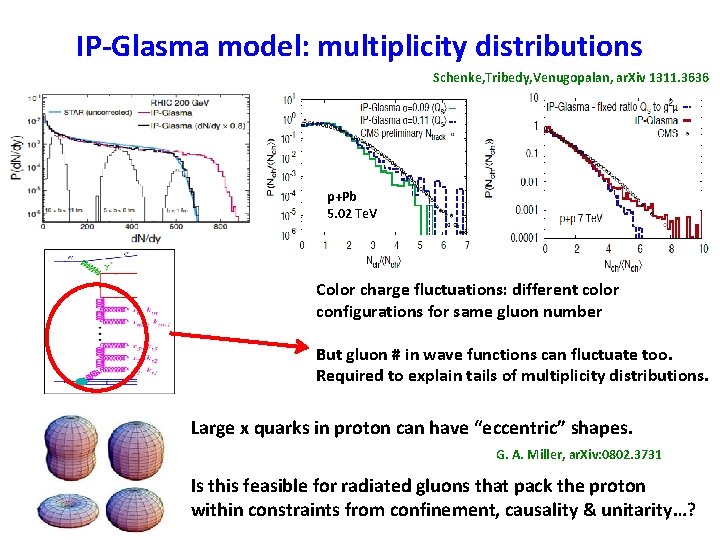
IP-Glasma model: multiplicity distributions Schenke, Tribedy, Venugopalan, ar. Xiv 1311. 3636 p+Pb 5. 02 Te. V Color charge fluctuations: different color configurations for same gluon number But gluon # in wave functions can fluctuate too. Required to explain tails of multiplicity distributions. Large x quarks in proton can have “eccentric” shapes. G. A. Miller, ar. Xiv: 0802. 3731 Is this feasible for radiated gluons that pack the proton within constraints from confinement, causality & unitarity…?
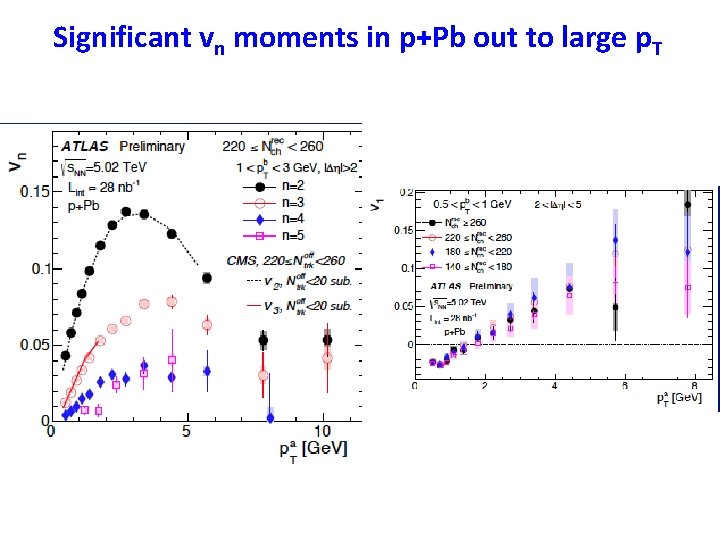
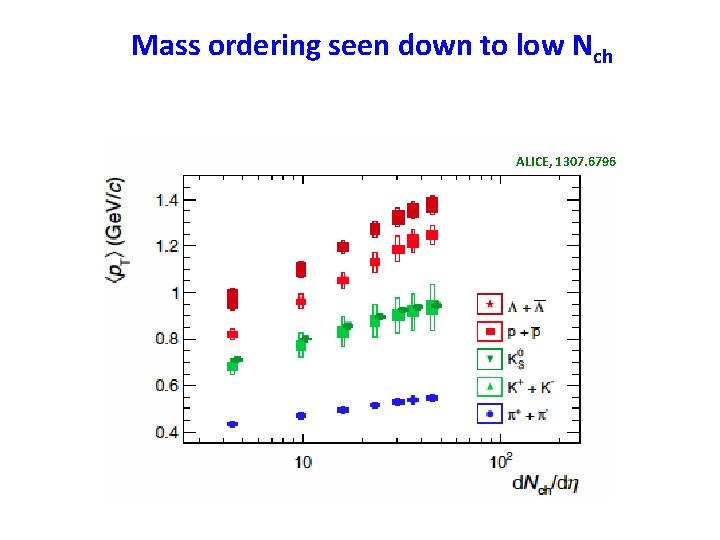
Additional puzzles for the collectivity picture in p+A • Why is there no sign of “mini-jet” quenching in p+A ? • Why is v 2 unchanged up to p. T of 9 Ge. V • Why is v 2 much smaller in p+p than p+A for the same Nch and HBT radius ? • Why is mass ordering in <p. T> seen even at Nch = 6 ? Lots of data, theory speculations, and confusion…stay tuned !!
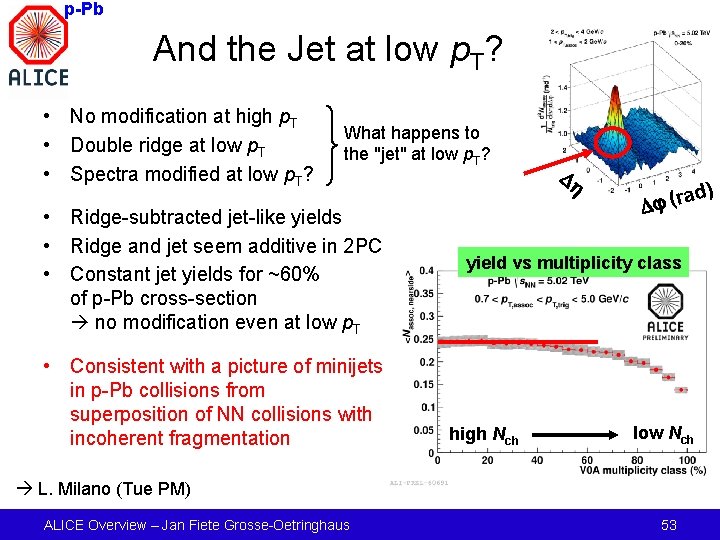
p-Pb And the Jet at low p. T? • No modification at high p. T • Double ridge at low p. T • Spectra modified at low p. T? What happens to the "jet" at low p. T? • Ridge-subtracted jet-like yields • Ridge and jet seem additive in 2 PC • Constant jet yields for ~60% of p-Pb cross-section no modification even at low p. T • Consistent with a picture of minijets in p-Pb collisions from superposition of NN collisions with incoherent fragmentation Dh ad) r ( j D yield vs multiplicity class high Nch low Nch L. Milano (Tue PM) ALICE Overview – Jan Fiete Grosse-Oetringhaus 53
Significant vn moments in p+Pb out to large p. T
Mass ordering seen down to low Nch ALICE, 1307. 6796
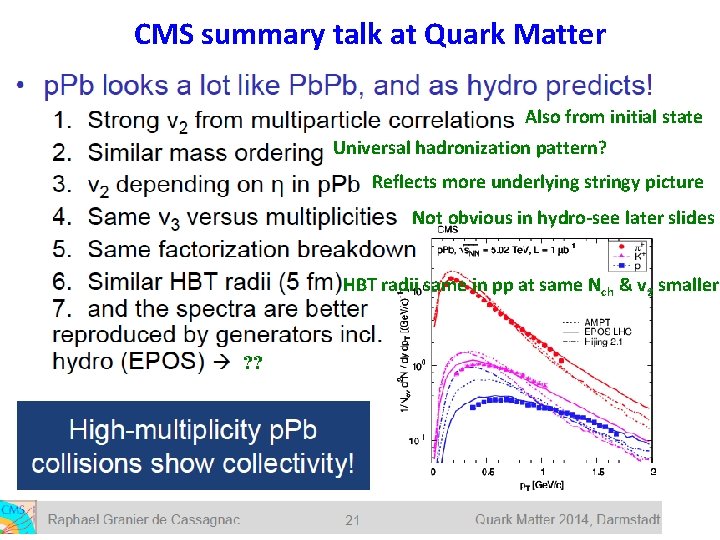
CMS summary talk at Quark Matter Also from initial state Universal hadronization pattern? Reflects more underlying stringy picture Not obvious in hydro-see later slides HBT radii same in pp at same Nch & v 2 smaller ? ?