Hadron Structure from Lattice QCD Status and Outlook


- Slides: 67
Πανεπιστήμιο Κύπρου Κ. Αλεξάνδρου Hadron Structure from Lattice QCD Status and Outlook Summer Workshop Hall C Jefferson Lab Aug. 18, 2005 1
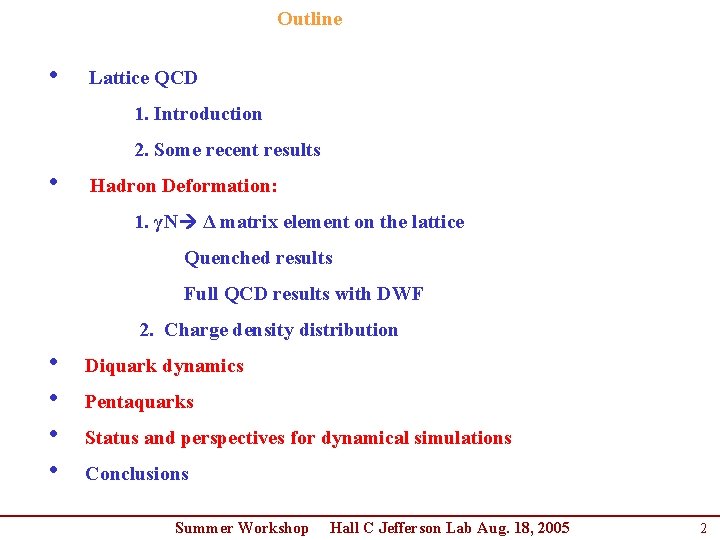
Outline • Lattice QCD 1. Introduction 2. Some recent results • Hadron Deformation: 1. γN Δ matrix element on the lattice Quenched results Full QCD results with DWF 2. Charge density distribution • • Diquark dynamics Pentaquarks Status and perspectives for dynamical simulations Conclusions Summer Workshop Hall C Jefferson Lab Aug. 18, 2005 2
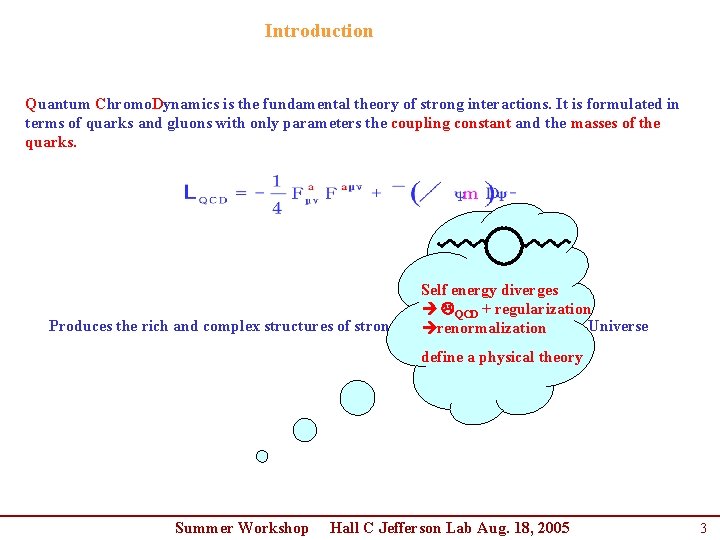
Introduction Quantum Chromo. Dynamics is the fundamental theory of strong interactions. It is formulated in terms of quarks and gluons with only parameters the coupling constant and the masses of the quarks. Self energy diverges LQCD + regularization Produces the rich and complex structures of strongly interacting matter in our Universe renormalization define a physical theory Summer Workshop Hall C Jefferson Lab Aug. 18, 2005 3
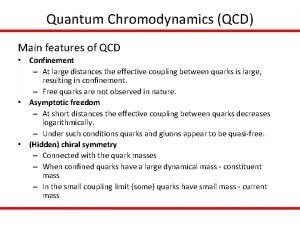
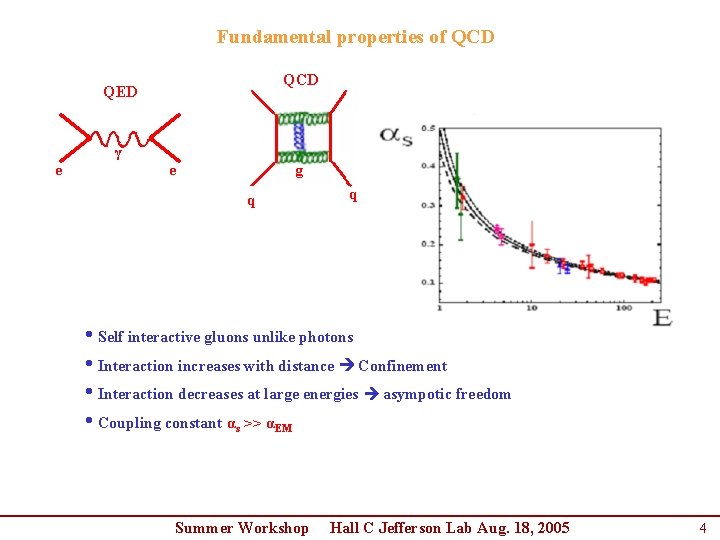
Fundamental properties of QCD QED γ e e g q q • Self interactive gluons unlike photons • Interaction increases with distance Confinement • Interaction decreases at large energies asympotic freedom • Coupling constant αs >> αEM Summer Workshop Hall C Jefferson Lab Aug. 18, 2005 4
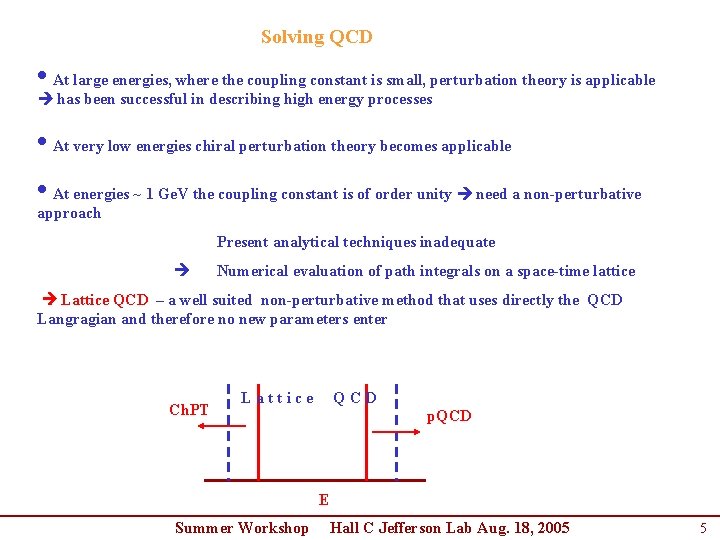
Solving QCD • At large energies, where the coupling constant is small, perturbation theory is applicable has been successful in describing high energy processes • At very low energies chiral perturbation theory becomes applicable • At energies ~ 1 Ge. V the coupling constant is of order unity need a non-perturbative approach Present analytical techniques inadequate Numerical evaluation of path integrals on a space-time lattice Lattice QCD – a well suited non-perturbative method that uses directly the QCD Langragian and therefore no new parameters enter Ch. PT Lattice QCD p. QCD E Summer Workshop Hall C Jefferson Lab Aug. 18, 2005 5
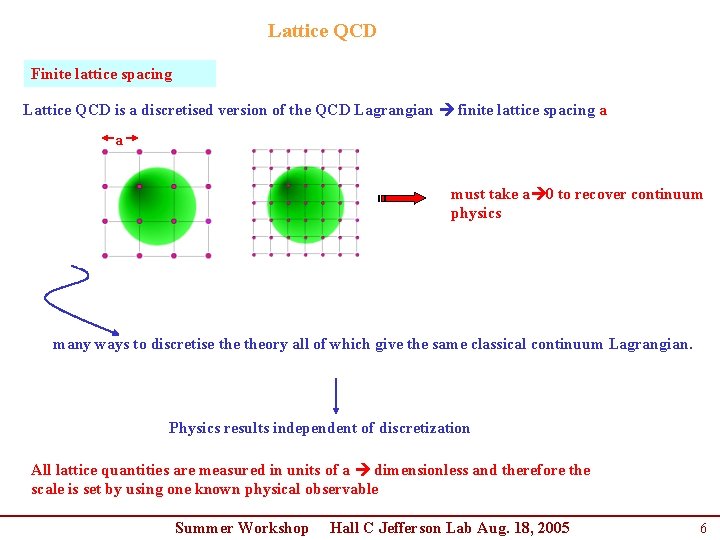
Lattice QCD Finite lattice spacing Lattice QCD is a discretised version of the QCD Lagrangian finite lattice spacing a a must take a 0 to recover continuum physics many ways to discretise theory all of which give the same classical continuum Lagrangian. Physics results independent of discretization All lattice quantities are measured in units of a dimensionless and therefore the scale is set by using one known physical observable Summer Workshop Hall C Jefferson Lab Aug. 18, 2005 6
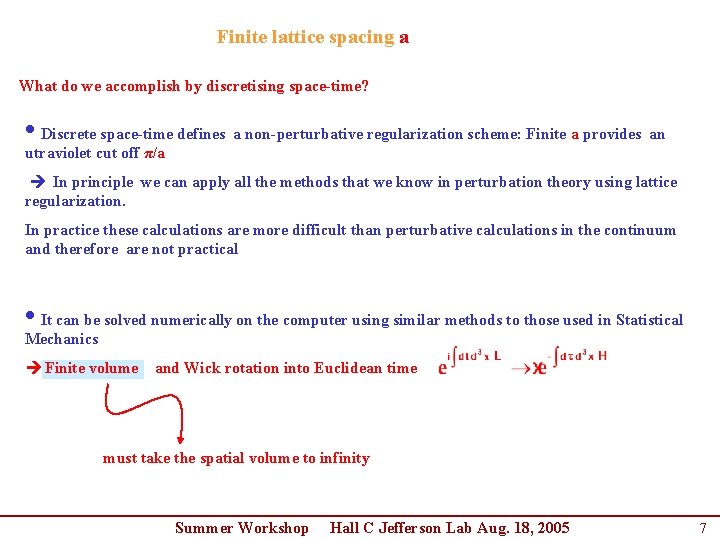
Finite lattice spacing a What do we accomplish by discretising space-time? • Discrete space-time defines a non-perturbative regularization scheme: Finite a provides an utraviolet cut off π/a In principle we can apply all the methods that we know in perturbation theory using lattice regularization. In practice these calculations are more difficult than perturbative calculations in the continuum and therefore are not practical • It can be solved numerically on the computer using similar methods to those used in Statistical Mechanics Finite volume and Wick rotation into Euclidean time must take the spatial volume to infinity Summer Workshop Hall C Jefferson Lab Aug. 18, 2005 7
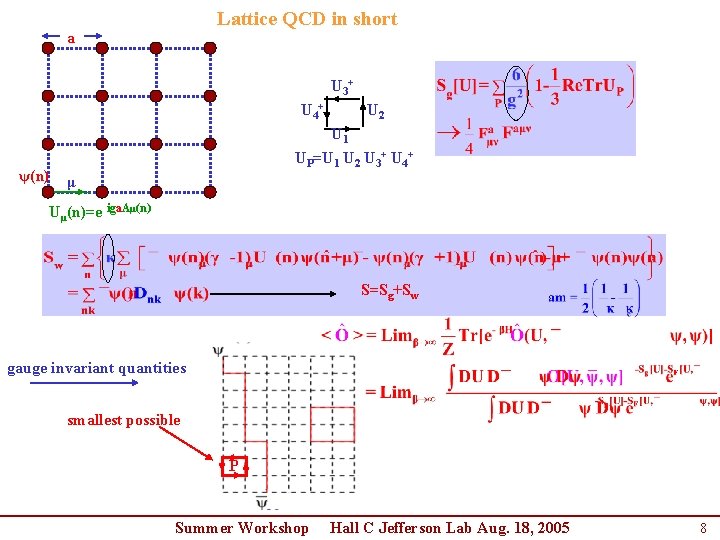
Lattice QCD in short a U 3+ U 4+ ψ(n) U 2 U 1 UP=U 1 U 2 U 3+ U 4+ μ Uμ(n)=e iga. Aμ(n) S=Sg+Sw gauge invariant quantities smallest possible P Summer Workshop Hall C Jefferson Lab Aug. 18, 2005 8
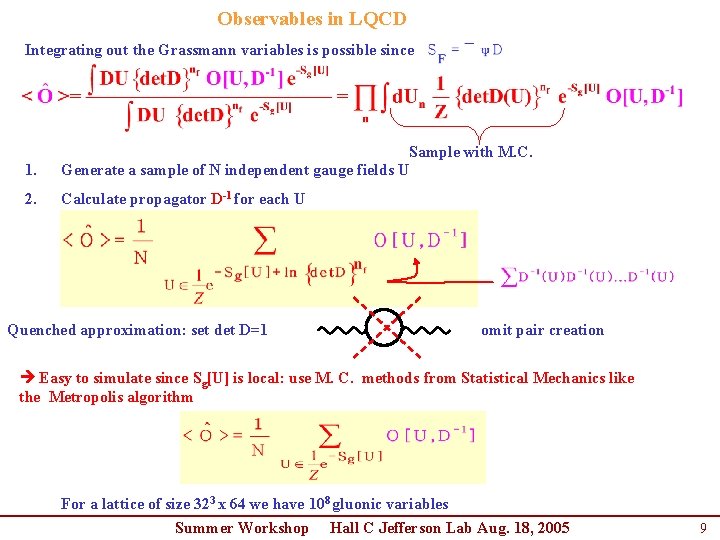
Observables in LQCD Integrating out the Grassmann variables is possible since 1. Sample with M. C. Generate a sample of N independent gauge fields U 2. Calculate propagator D-1 for each U Quenched approximation: set det D=1 omit pair creation Easy to simulate since Sg[U] is local: use M. C. methods from Statistical Mechanics like the Metropolis algorithm For a lattice of size 323 x 64 we have 108 gluonic variables Summer Workshop Hall C Jefferson Lab Aug. 18, 2005 9
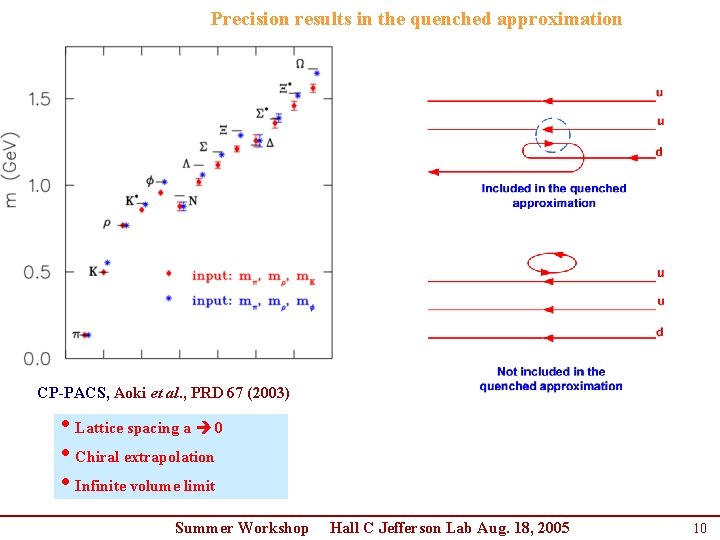
Precision results in the quenched approximation The quenched light quark spectrum from CP-PACS, Aoki et al. , PRD 67 (2003) • Lattice spacing a 0 • Chiral extrapolation • Infinite volume limit Summer Workshop Hall C Jefferson Lab Aug. 18, 2005 10
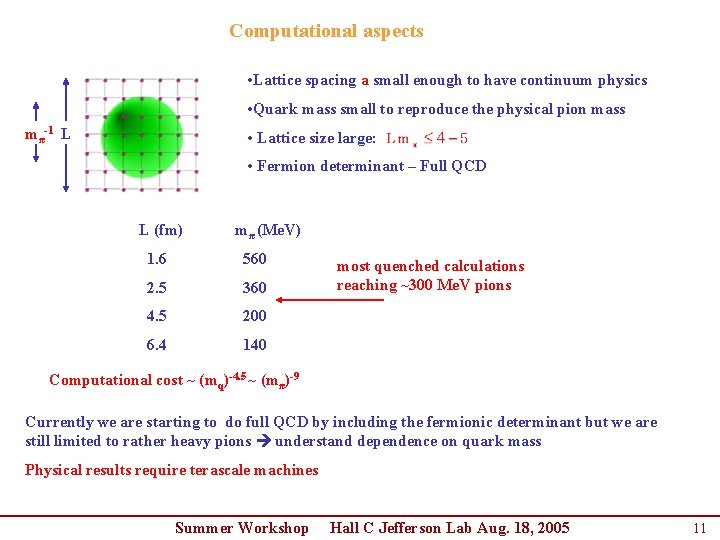
Computational aspects • Lattice spacing a small enough to have continuum physics • Quark mass small to reproduce the physical pion mass mπ-1 L • Lattice size large: • Fermion determinant – Full QCD L (fm) mπ (Me. V) 1. 6 560 2. 5 360 4. 5 200 6. 4 140 most quenched calculations reaching ~300 Me. V pions Computational cost ~ (mq)-4. 5 ~ (mπ)-9 Currently we are starting to do full QCD by including the fermionic determinant but we are still limited to rather heavy pions understand dependence on quark mass Physical results require terascale machines Summer Workshop Hall C Jefferson Lab Aug. 18, 2005 11
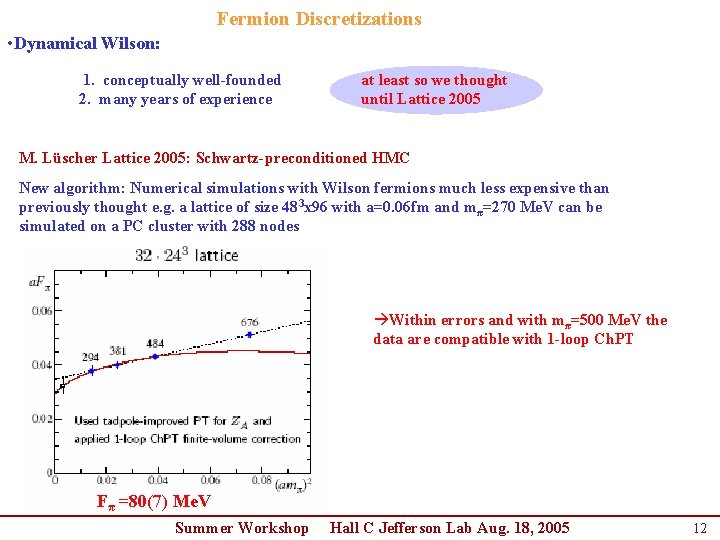
Fermion Discretizations • Dynamical Wilson: 1. conceptually well-founded 2. many years of experience least so we thought butatexpensive until Lattice 2005 M. Lüscher Lattice 2005: Schwartz-preconditioned HMC New algorithm: Numerical simulations with Wilson fermions much less expensive than previously thought e. g. a lattice of size 483 x 96 with a=0. 06 fm and mπ=270 Μe. V can be simulated on a PC cluster with 288 nodes àWithin errors and with mπ=500 Μe. V the data are compatible with 1 -loop Ch. PT Fπ =80(7) Me. V Summer Workshop Hall C Jefferson Lab Aug. 18, 2005 12
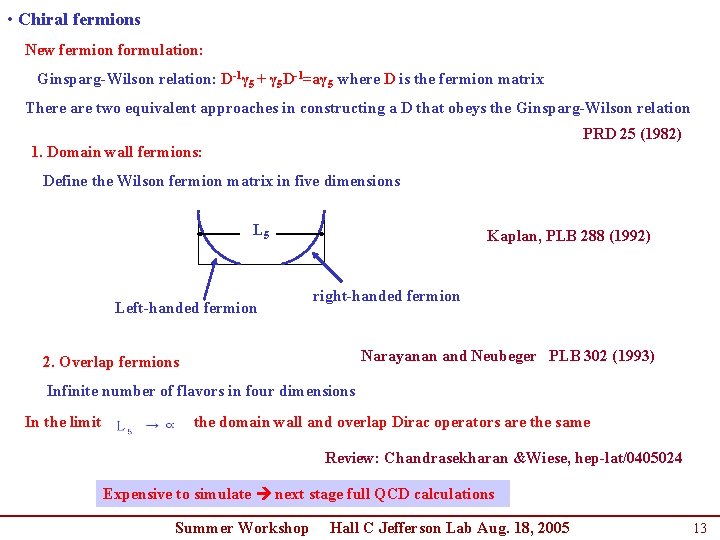
• Chiral fermions New fermion formulation: Ginsparg-Wilson relation: D-1γ 5 + γ 5 D-1=aγ 5 where D is the fermion matrix There are two equivalent approaches in constructing a D that obeys the Ginsparg-Wilson relation PRD 25 (1982) 1. Domain wall fermions: Define the Wilson fermion matrix in five dimensions L 5 Left-handed fermion Kaplan, PLB 288 (1992) right-handed fermion Narayanan and Neubeger PLB 302 (1993) 2. Overlap fermions Infinite number of flavors in four dimensions In the limit the domain wall and overlap Dirac operators are the same Review: Chandrasekharan &Wiese, hep-lat/0405024 Expensive to simulate next stage full QCD calculations Summer Workshop Hall C Jefferson Lab Aug. 18, 2005 13
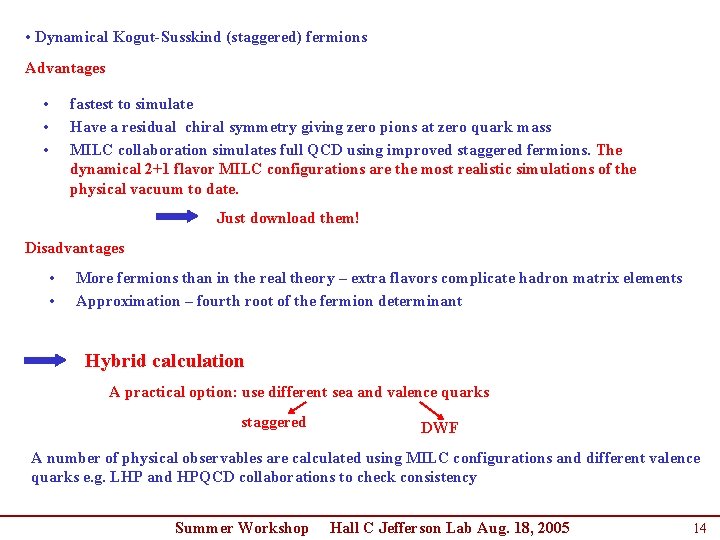
• Dynamical Kogut-Susskind (staggered) fermions Advantages • • • fastest to simulate Have a residual chiral symmetry giving zero pions at zero quark mass MILC collaboration simulates full QCD using improved staggered fermions. The dynamical 2+1 flavor MILC configurations are the most realistic simulations of the physical vacuum to date. Just download them! Disadvantages • • More fermions than in the real theory – extra flavors complicate hadron matrix elements Approximation – fourth root of the fermion determinant Hybrid calculation A practical option: use different sea and valence quarks staggered DWF A number of physical observables are calculated using MILC configurations and different valence quarks e. g. LHP and HPQCD collaborations to check consistency Summer Workshop Hall C Jefferson Lab Aug. 18, 2005 14
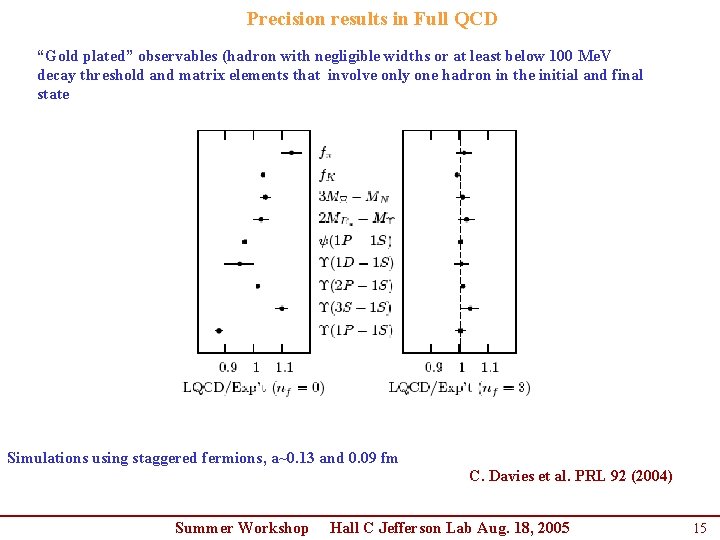
Precision results in Full QCD “Gold plated” observables (hadron with negligible widths or at least below 100 Me. V decay threshold and matrix elements that involve only one hadron in the initial and final state Simulations using staggered fermions, a~0. 13 and 0. 09 fm C. Davies et al. PRL 92 (2004) Summer Workshop Hall C Jefferson Lab Aug. 18, 2005 15
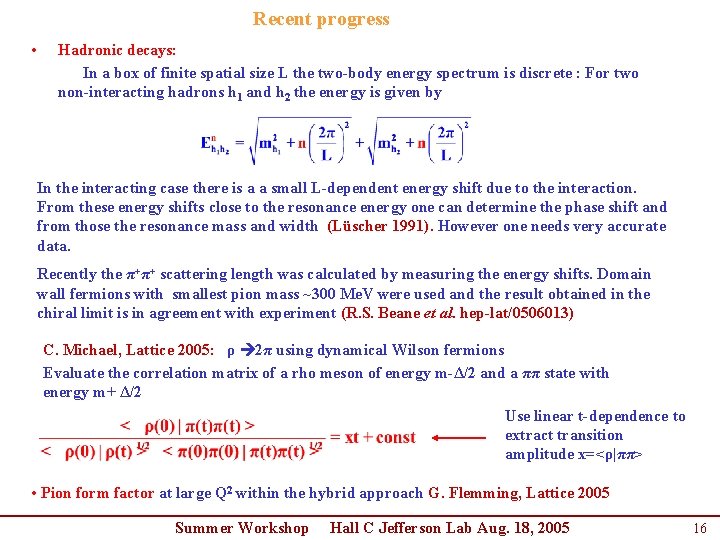
Recent progress • Hadronic decays: In a box of finite spatial size L the two-body energy spectrum is discrete : For two non-interacting hadrons h 1 and h 2 the energy is given by In the interacting case there is a a small L-dependent energy shift due to the interaction. From these energy shifts close to the resonance energy one can determine the phase shift and from those the resonance mass and width (Lüscher 1991). However one needs very accurate data. Recently the π+π+ scattering length was calculated by measuring the energy shifts. Domain wall fermions with smallest pion mass ~300 Me. V were used and the result obtained in the chiral limit is in agreement with experiment (R. S. Beane et al. hep-lat/0506013) C. Michael, Lattice 2005: ρ 2π using dynamical Wilson fermions Evaluate the correlation matrix of a rho meson of energy m-Δ/2 and a ππ state with energy m+ Δ/2 Use linear t-dependence to extract transition amplitude x=<ρ|ππ> • Pion form factor at large Q 2 within the hybrid approach G. Flemming, Lattice 2005 Summer Workshop Hall C Jefferson Lab Aug. 18, 2005 16
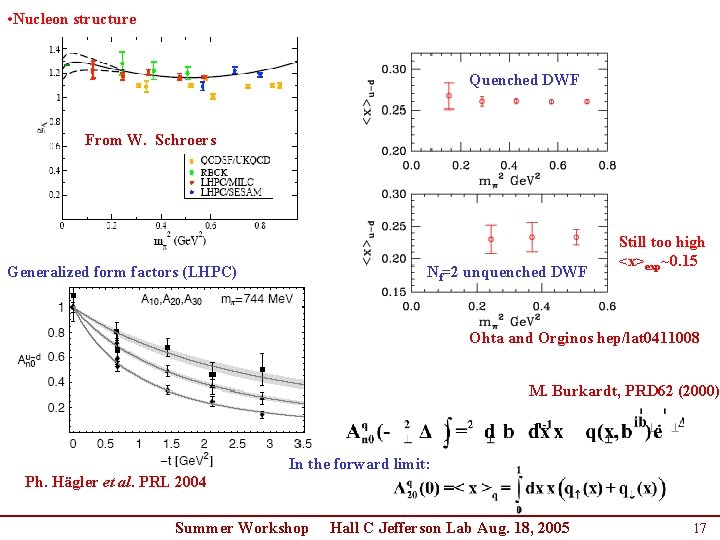
• Nucleon structure Quenched DWF From W. Schroers Generalized form factors (LHPC) Nf=2 unquenched DWF Still too high <x>exp~0. 15 Ohta and Orginos hep/lat 0411008 M. Burkardt, PRD 62 (2000) In the forward limit: Ph. Hägler et al. PRL 2004 Summer Workshop Hall C Jefferson Lab Aug. 18, 2005 17
Hadron Deformation Summer Workshop Hall C Jefferson Lab Aug. 18, 2005 18
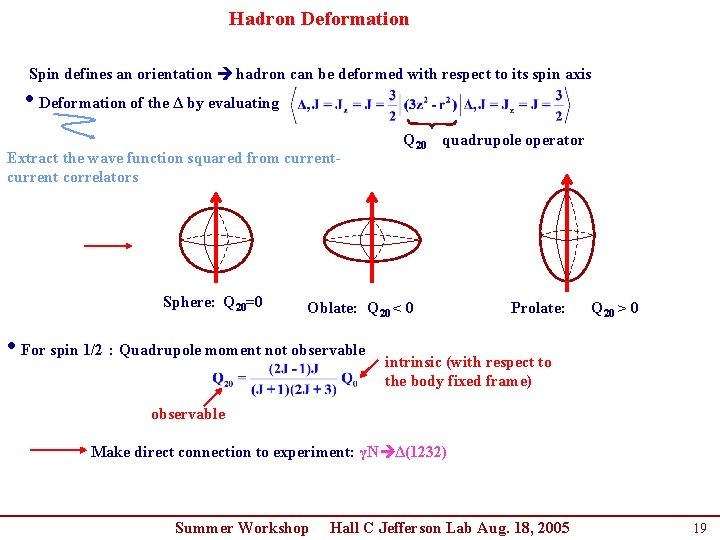
Hadron Deformation Spin defines an orientation hadron can be deformed with respect to its spin axis • Deformation of the Δ by evaluating Extract the wave function squared from current correlators Sphere: Q 20=0 Q 20 quadrupole operator Oblate: Q 20 < 0 • For spin 1/2 : Quadrupole moment not observable Prolate: Q 20 > 0 intrinsic (with respect to the body fixed frame) observable Make direct connection to experiment: γN Δ(1232) Summer Workshop Hall C Jefferson Lab Aug. 18, 2005 19
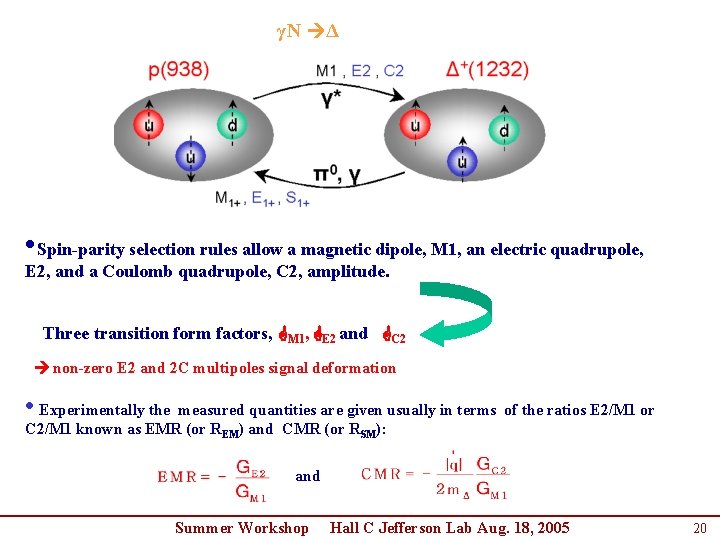
γN Δ • Spin-parity selection rules allow a magnetic dipole, M 1, an electric quadrupole, E 2, and a Coulomb quadrupole, C 2, amplitude. Three transition form factors, GM 1, GE 2 and GC 2 non-zero E 2 and 2 C multipoles signal deformation • Experimentally the measured quantities are given usually in terms of the ratios E 2/M 1 or C 2/M 1 known as EMR (or REM) and CMR (or RSM): and Summer Workshop Hall C Jefferson Lab Aug. 18, 2005 20
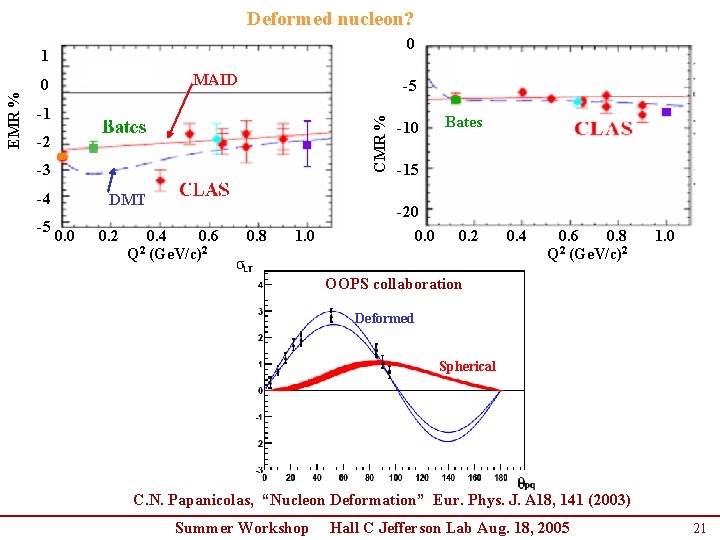
Deformed nucleon? 0 MAID 0 -5 -1 CMR % EMR % 1 -2 -3 -4 -5 DMT 0. 0 0. 2 Q 2 0. 4 0. 6 (Ge. V/c)2 0. 8 1. 0 -10 Bates -15 -20 0. 2 0. 4 0. 6 0. 8 2 Q (Ge. V/c)2 1. 0 OOPS collaboration Deformed Spherical C. N. Papanicolas, “Nucleon Deformation” Eur. Phys. J. Α 18, 141 (2003) Summer Workshop Hall C Jefferson Lab Aug. 18, 2005 21
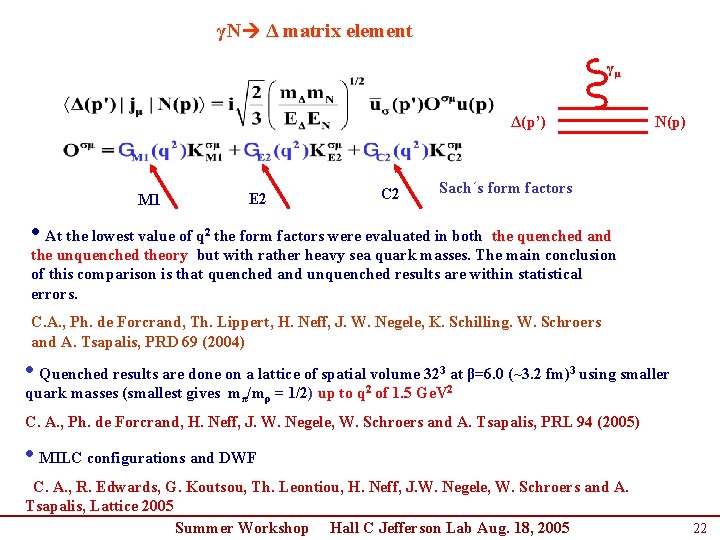
γN Δ matrix element γμ Δ(p’) E 2 M 1 • At the lowest value of q C 2 N(p) Sach´s form factors the form factors were evaluated in both the quenched and the unquenched theory but with rather heavy sea quark masses. The main conclusion of this comparison is that quenched and unquenched results are within statistical errors. 2 C. A. , Ph. de Forcrand, Th. Lippert, H. Neff, J. W. Negele, K. Schilling. W. Schroers and A. Tsapalis, PRD 69 (2004) • Quenched results are done on a lattice of spatial volume 32 3 at β=6. 0 (~3. 2 fm)3 using smaller quark masses (smallest gives mπ/mρ = 1/2) up to q 2 of 1. 5 Ge. V 2 C. A. , Ph. de Forcrand, H. Neff, J. W. Negele, W. Schroers and A. Tsapalis, PRL 94 (2005) • MILC configurations and DWF C. A. , R. Edwards, G. Koutsou, Th. Leontiou, H. Neff, J. W. Negele, W. Schroers and A. Tsapalis, Lattice 2005 Summer Workshop Hall C Jefferson Lab Aug. 18, 2005 22
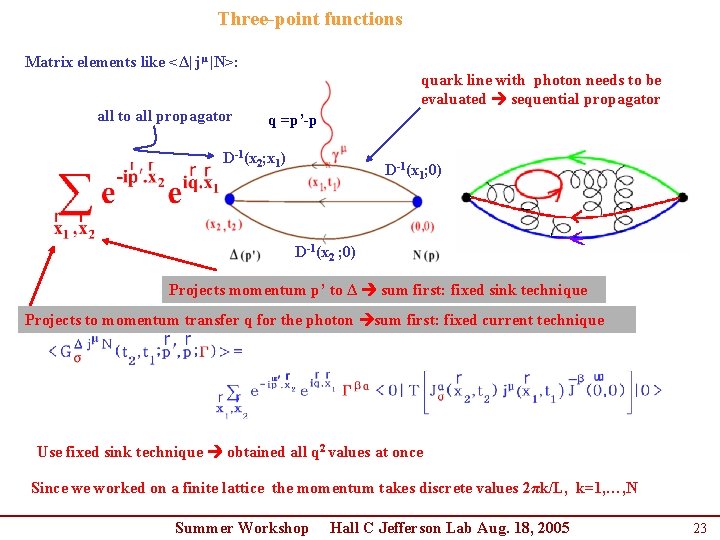
Three-point functions Matrix elements like <Δ| jμ |N>: all to all propagator quark line with photon needs to be evaluated sequential propagator q =p’-p D-1(x 2; x 1) D-1(x 1; 0) D-1(x 2 ; 0) Projects momentum p’ to Δ sum first: fixed sink technique Projects to momentum transfer q for the photon sum first: fixed current technique Use fixed sink technique obtained all q 2 values at once Since we worked on a finite lattice the momentum takes discrete values 2πk/L, k=1, …, N Summer Workshop Hall C Jefferson Lab Aug. 18, 2005 23
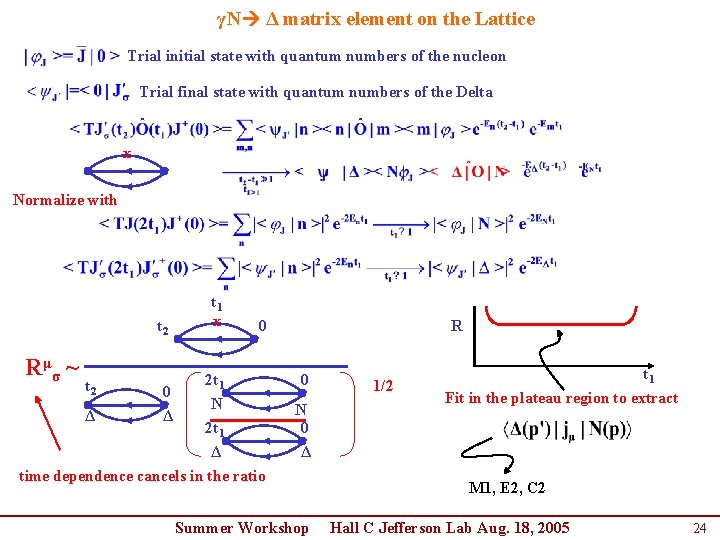
γN Δ matrix element on the Lattice Trial initial state with quantum numbers of the nucleon Trial final state with quantum numbers of the Delta x Normalize with t 1 Rμ σ ~ t 2 0 Δ Δ x t 2 0 2 t 1 N 2 t 1 Δ time dependence cancels in the ratio R 0 N 0 1/2 t 1 Fit in the plateau region to extract Δ Summer Workshop M 1, E 2, C 2 Hall C Jefferson Lab Aug. 18, 2005 24
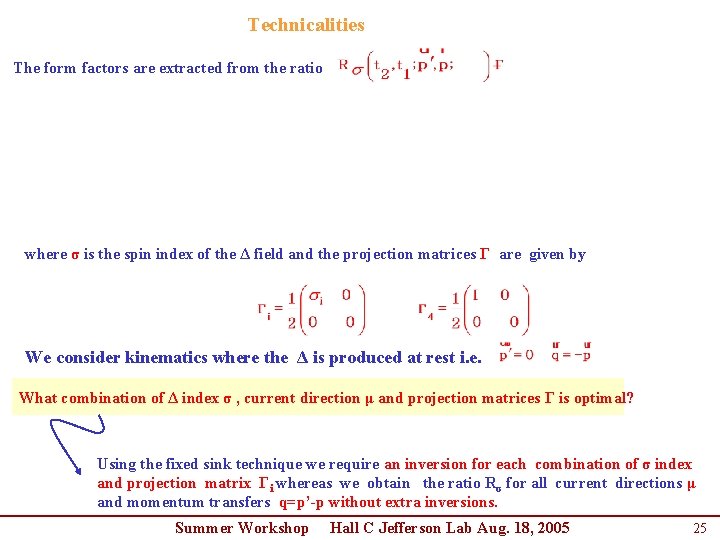
Technicalities The form factors are extracted from the ratio where σ is the spin index of the Δ field and the projection matrices Γ are given by We consider kinematics where the Δ is produced at rest i. e. What combination of Δ index σ , current direction μ and projection matrices Γ is optimal? Using the fixed sink technique we require an inversion for each combination of σ index and projection matrix Γi whereas we obtain the ratio Rσ for all current directions μ and momentum transfers q=p’-p without extra inversions. Summer Workshop Hall C Jefferson Lab Aug. 18, 2005 25
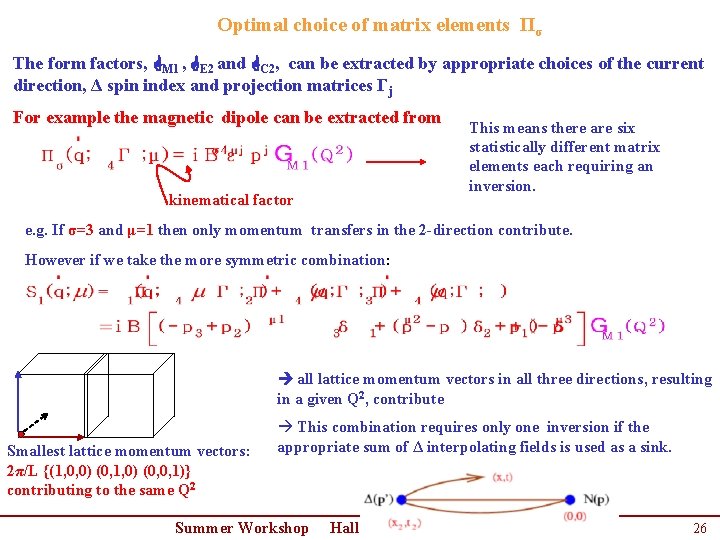
Optimal choice of matrix elements Πσ The form factors, GM 1 , GE 2 and GC 2, can be extracted by appropriate choices of the current direction, Δ spin index and projection matrices Γj For example the magnetic dipole can be extracted from kinematical factor This means there are six statistically different matrix elements each requiring an inversion. e. g. If σ=3 and μ=1 then only momentum transfers in the 2 -direction contribute. However if we take the more symmetric combination: all lattice momentum vectors in all three directions, resulting in a given Q 2, contribute Smallest lattice momentum vectors: 2π/L {(1, 0, 0) (0, 1, 0) (0, 0, 1)} contributing to the same Q 2 à This combination requires only one inversion if the appropriate sum of Δ interpolating fields is used as a sink. Summer Workshop Hall C Jefferson Lab Aug. 18, 2005 26
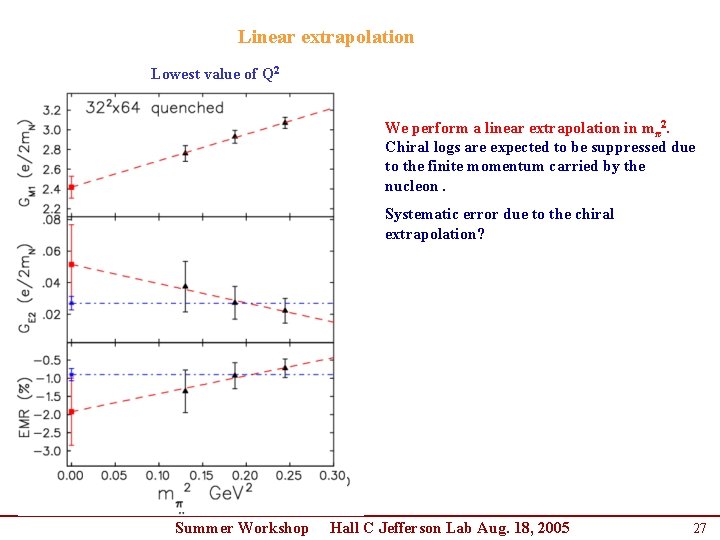
Linear extrapolation Lowest value of Q 2 We perform a linear extrapolation in mπ2. Chiral logs are expected to be suppressed due to the finite momentum carried by the nucleon. Systematic error due to the chiral extrapolation? Summer Workshop Hall C Jefferson Lab Aug. 18, 2005 27
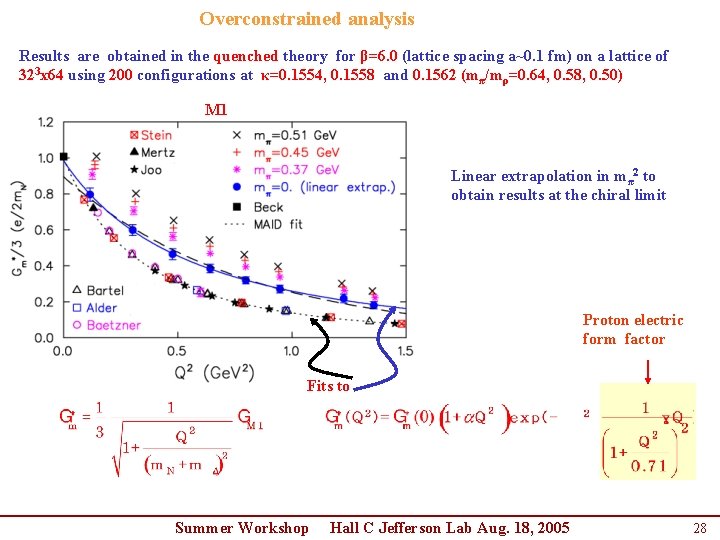
Overconstrained analysis Results are obtained in the quenched theory for β=6. 0 (lattice spacing a~0. 1 fm) on a lattice of 323 x 64 using 200 configurations at κ=0. 1554, 0. 1558 and 0. 1562 (mπ/mρ=0. 64, 0. 58, 0. 50) M 1 Linear extrapolation in mπ2 to obtain results at the chiral limit Proton electric form factor Fits to Summer Workshop Hall C Jefferson Lab Aug. 18, 2005 28
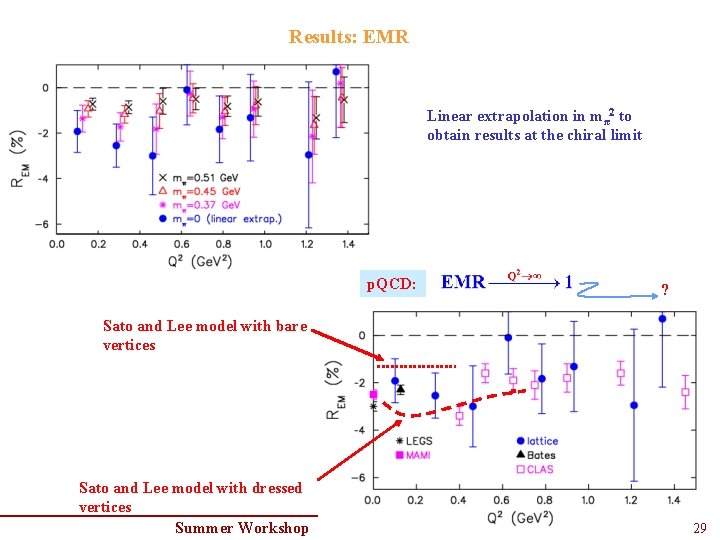
Results: EMR Linear extrapolation in mπ2 to obtain results at the chiral limit p. QCD: ? Sato and Lee model with bare vertices Sato and Lee model with dressed vertices Summer Workshop Hall C Jefferson Lab Aug. 18, 2005 29
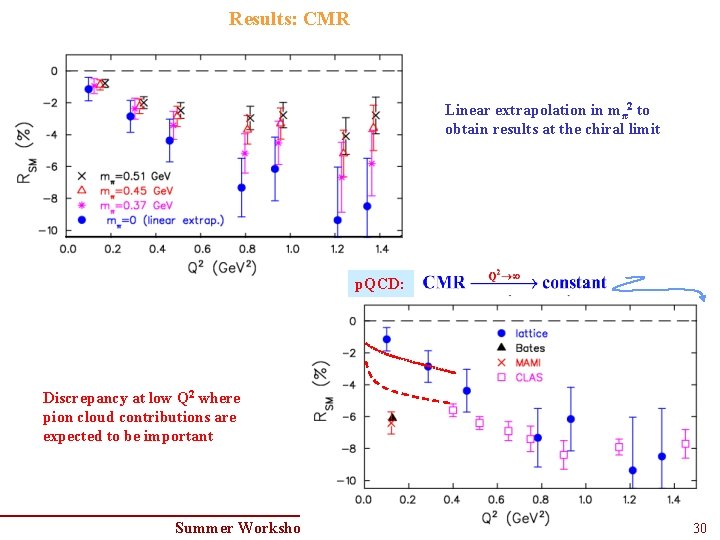
Results: CMR Linear extrapolation in mπ2 to obtain results at the chiral limit p. QCD: Discrepancy at low Q 2 where pion cloud contributions are expected to be important Summer Workshop Hall C Jefferson Lab Aug. 18, 2005 30
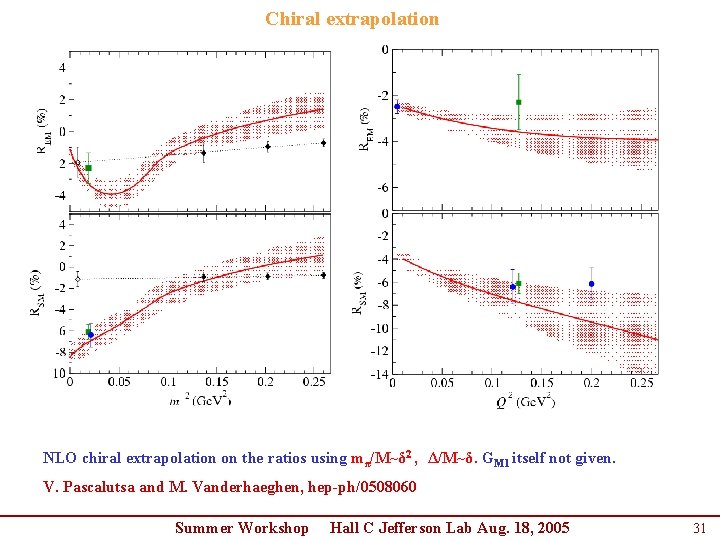
Chiral extrapolation NLO chiral extrapolation on the ratios using mπ/Μ~δ 2 , Δ/Μ~δ. GM 1 itself not given. V. Pascalutsa and M. Vanderhaeghen, hep-ph/0508060 Summer Workshop Hall C Jefferson Lab Aug. 18, 2005 31
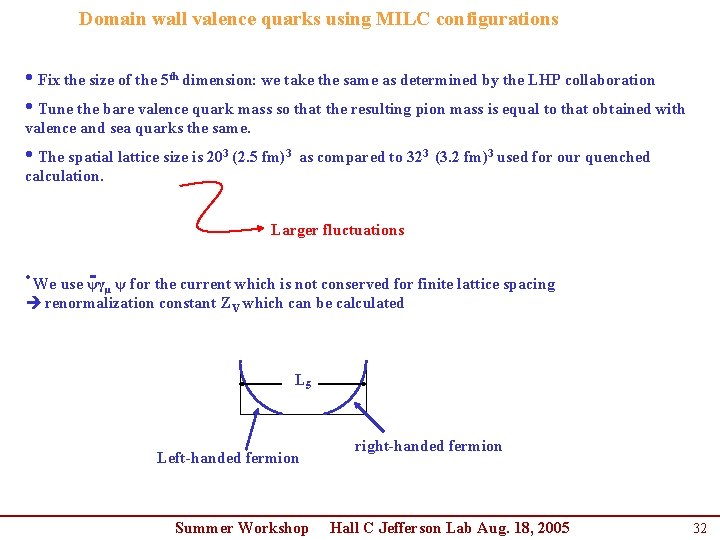
Domain wall valence quarks using MILC configurations • Fix the size of the 5 th dimension: we take the same as determined by the LHP collaboration • Tune the bare valence quark mass so that the resulting pion mass is equal to that obtained with valence and sea quarks the same. • The spatial lattice size is 203 (2. 5 fm)3 as compared to 323 (3. 2 fm)3 used for our quenched calculation. Larger fluctuations • We use ψγ ψ for the current which is not conserved for finite lattice spacing μ renormalization constant ZV which can be calculated L 5 Left-handed fermion Summer Workshop right-handed fermion Hall C Jefferson Lab Aug. 18, 2005 32
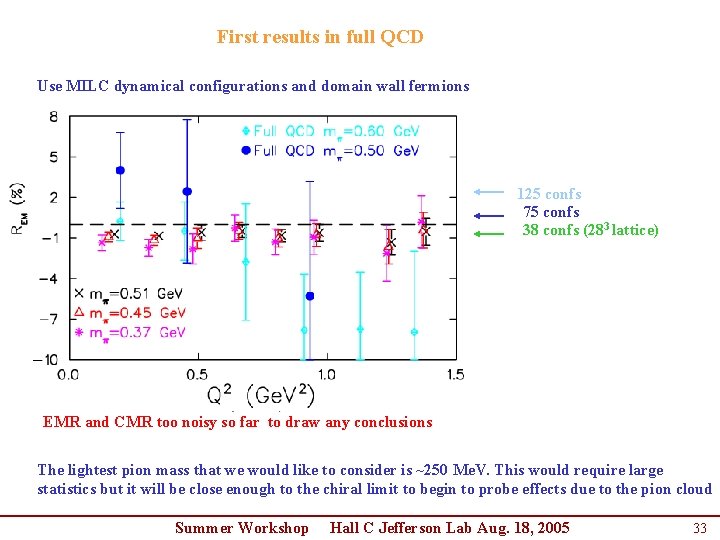
First results in full QCD Use MILC dynamical configurations and domain wall fermions 125 confs 75 confs 38 confs (283 lattice) EMR and CMR too noisy so far to draw any conclusions The lightest pion mass that we would like to consider is ~250 Me. V. This would require large statistics but it will be close enough to the chiral limit to begin to probe effects due to the pion cloud Summer Workshop Hall C Jefferson Lab Aug. 18, 2005 33
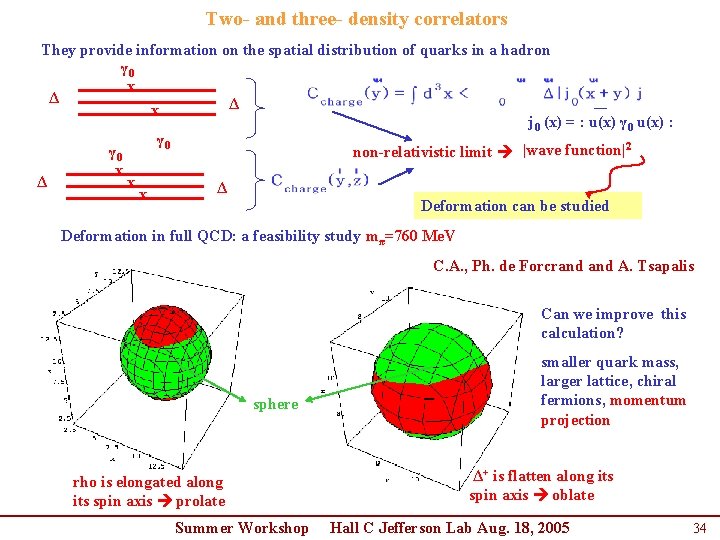
Two- and three- density correlators They provide information on the spatial distribution of quarks in a hadron γ 0 x Δ Δ x j 0 (x) = : u(x) γ 0 u(x) : γ 0 non-relativistic limit |wave function|2 γ 0 x Δ x Deformation can be studied Deformation in full QCD: a feasibility study mπ=760 Me. V C. A. , Ph. de Forcrand A. Tsapalis Can we improve this calculation? sphere rho is elongated along its spin axis prolate Summer Workshop smaller quark mass, larger lattice, chiral fermions, momentum projection Δ+ is flatten along its spin axis oblate Hall C Jefferson Lab Aug. 18, 2005 34
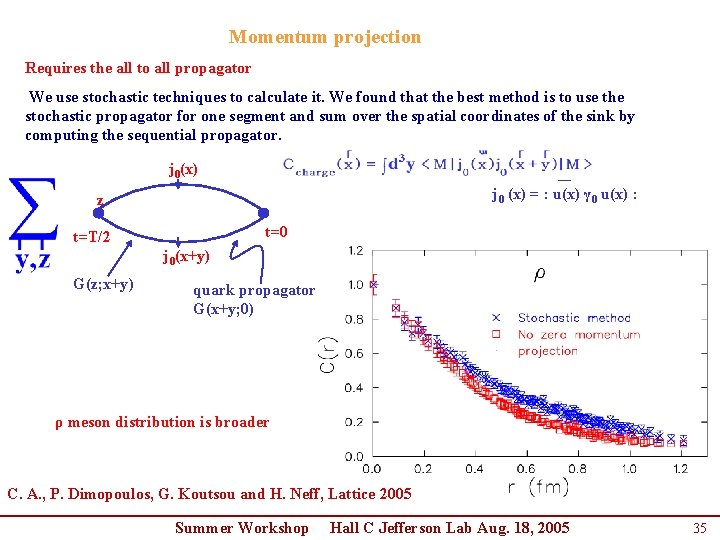
Momentum projection Requires the all to all propagator We use stochastic techniques to calculate it. We found that the best method is to use the stochastic propagator for one segment and sum over the spatial coordinates of the sink by computing the sequential propagator. j 0(x) j 0 (x) = : u(x) γ 0 u(x) : z t=0 t=Τ/2 j 0(x+y) G(z; x+y) quark propagator G(x+y; 0) ρ meson distribution is broader C. A. , P. Dimopoulos, G. Koutsou and H. Neff, Lattice 2005 Summer Workshop Hall C Jefferson Lab Aug. 18, 2005 35
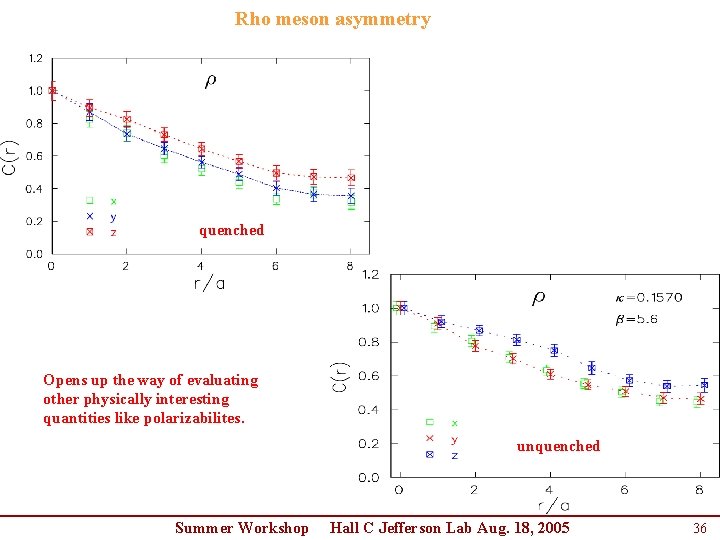
Rho meson asymmetry quenched Opens up the way of evaluating other physically interesting quantities like polarizabilites. unquenched Summer Workshop Hall C Jefferson Lab Aug. 18, 2005 36
Diquark Dynamics Summer Workshop Hall C Jefferson Lab Aug. 18, 2005 37
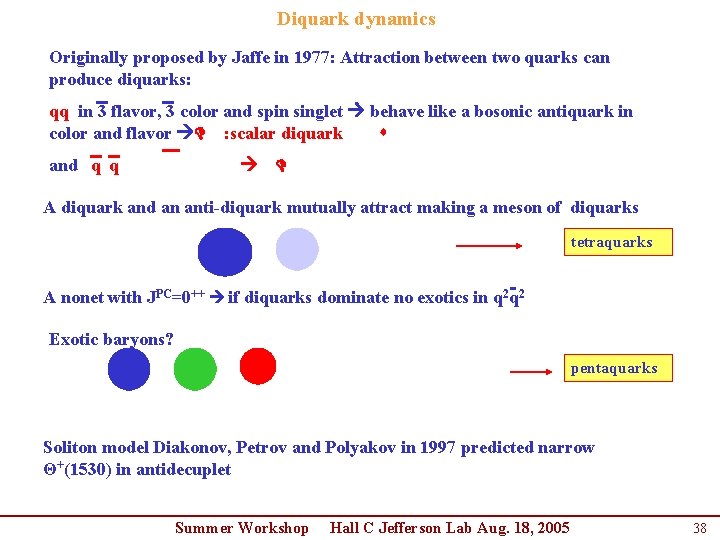
Diquark dynamics Originally proposed by Jaffe in 1977: Attraction between two quarks can produce diquarks: qq in 3 flavor, 3 color and spin singlet behave like a bosonic antiquark in color and flavor D : scalar diquark s and q q D A diquark and an anti-diquark mutually attract making a meson of diquarks tetraquarks A nonet with JPC=0++ if diquarks dominate no exotics in q 2 q 2 Exotic baryons? pentaquarks Soliton model Diakonov, Petrov and Polyakov in 1997 predicted narrow Θ+(1530) in antidecuplet Summer Workshop Hall C Jefferson Lab Aug. 18, 2005 38
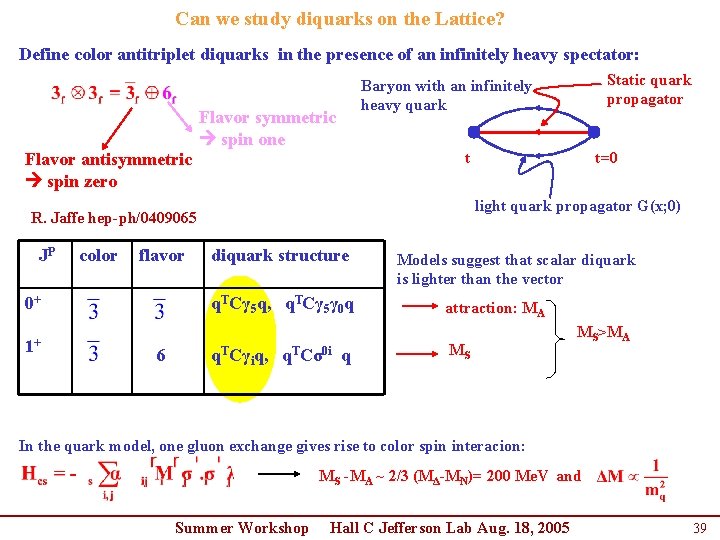
Can we study diquarks on the Lattice? Define color antitriplet diquarks in the presence of an infinitely heavy spectator: Flavor symmetric spin one t Flavor antisymmetric spin zero color flavor 0+ 1+ diquark structure q. TCγ 5 q, q. TCγ 5γ 0 q 6 t=0 light quark propagator G(x; 0) R. Jaffe hep-ph/0409065 JP Static quark propagator Baryon with an infinitely heavy quark q. TCγiq, q. TCσ0 i q Models suggest that scalar diquark is lighter than the vector attraction: MA MS MS>MA In the quark model, one gluon exchange gives rise to color spin interacion: MS -MA ~ 2/3 (MΔ-MN)= 200 Me. V and Summer Workshop Hall C Jefferson Lab Aug. 18, 2005 39
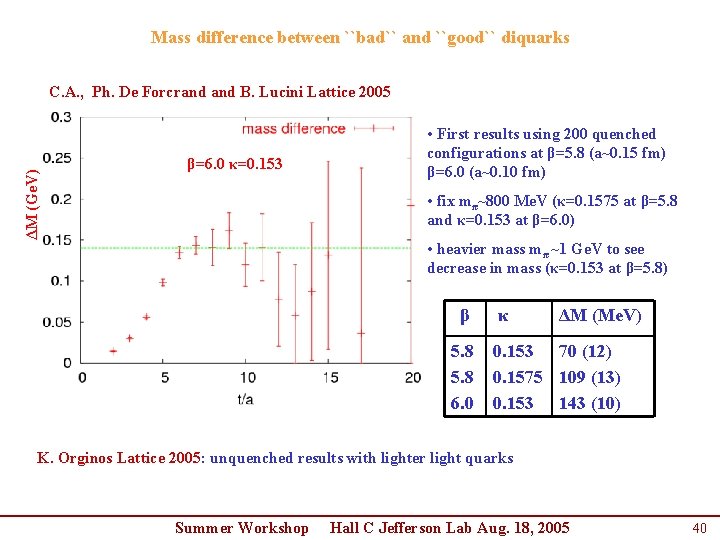
Mass difference between ``bad`` and ``good`` diquarks ΔM (Ge. V) C. A. , Ph. De Forcrand B. Lucini Lattice 2005 β=6. 0 κ=0. 153 • First results using 200 quenched configurations at β=5. 8 (a~0. 15 fm) β=6. 0 (a~0. 10 fm) • fix mπ~800 Me. V (κ=0. 1575 at β=5. 8 and κ=0. 153 at β=6. 0) • heavier mass mπ ~1 Ge. V to see decrease in mass (κ=0. 153 at β=5. 8) β 5. 8 6. 0 κ ΔΜ (Me. V) 0. 153 70 (12) 0. 1575 109 (13) 0. 153 143 (10) K. Orginos Lattice 2005: unquenched results with lighter light quarks Summer Workshop Hall C Jefferson Lab Aug. 18, 2005 40
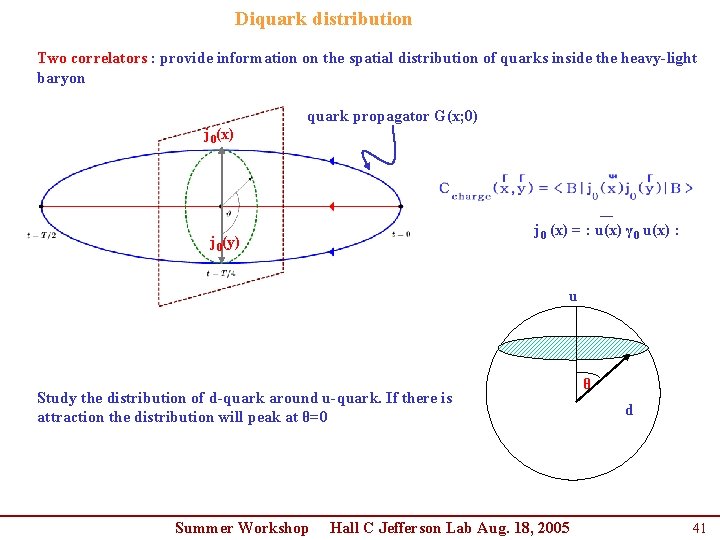
Diquark distribution Two correlators : provide information on the spatial distribution of quarks inside the heavy-light baryon quark propagator G(x; 0) j 0(x) j 0 (x) = : u(x) γ 0 u(x) : j 0(y) u Study the distribution of d-quark around u-quark. If there is attraction the distribution will peak at θ=0 Summer Workshop Hall C Jefferson Lab Aug. 18, 2005 θ d 41
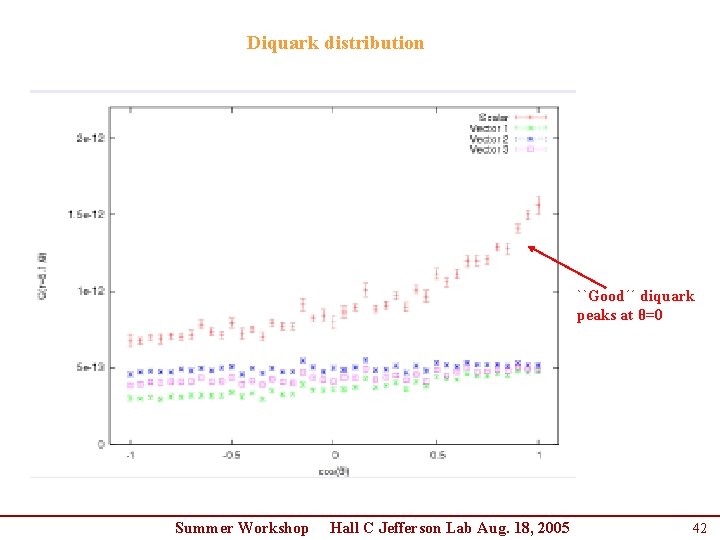
Diquark distribution ``Good´´ diquark peaks at θ=0 Summer Workshop Hall C Jefferson Lab Aug. 18, 2005 42
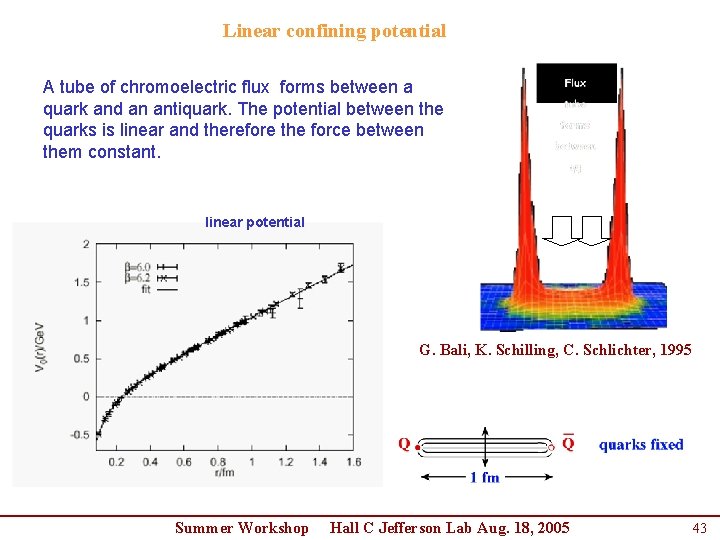
Linear confining potential A tube of chromoelectric flux forms between a quark and an antiquark. The potential between the quarks is linear and therefore the force between them constant. linear potential G. Bali, K. Schilling, C. Schlichter, 1995 Summer Workshop Hall C Jefferson Lab Aug. 18, 2005 43
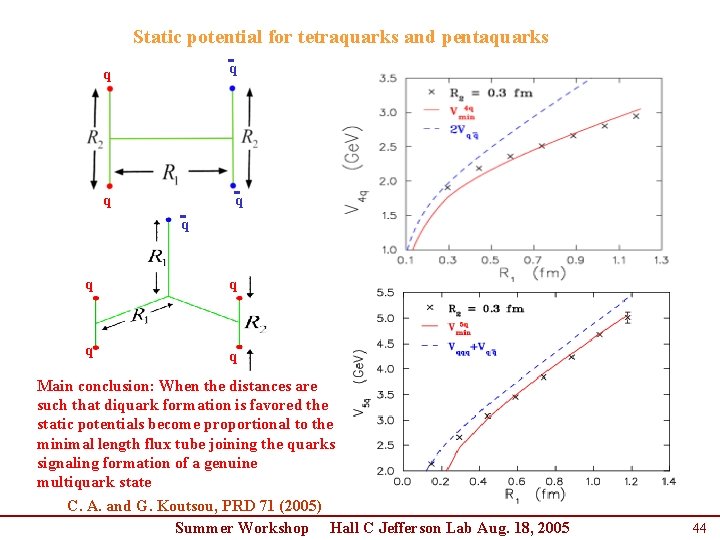
Static potential for tetraquarks and pentaquarks q q q q q Main conclusion: When the distances are such that diquark formation is favored the static potentials become proportional to the minimal length flux tube joining the quarks signaling formation of a genuine multiquark state C. Α. and G. Koutsou, PRD 71 (2005) Summer Workshop Hall C Jefferson Lab Aug. 18, 2005 44
Pentaquarks Summer Workshop Hall C Jefferson Lab Aug. 18, 2005 45
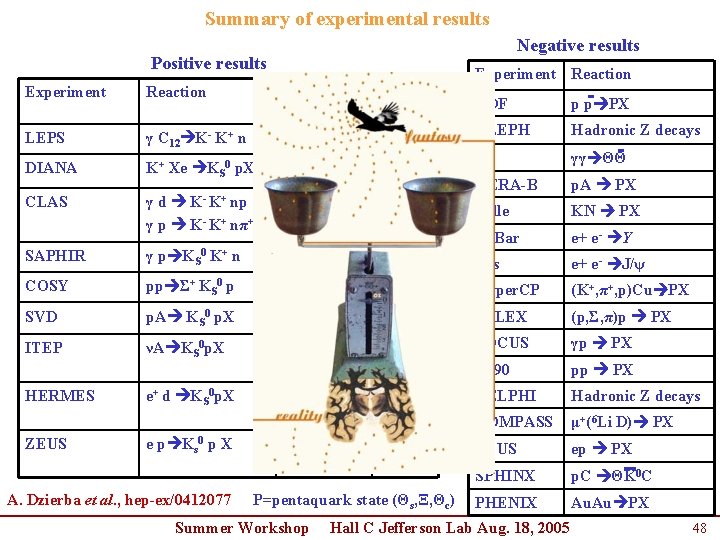
The Storyteller, like a cat slipping in and out of the shadows. Slipping in and out of reality? Θ+ Summer Workshop Hall C Jefferson Lab Aug. 18, 2005 46
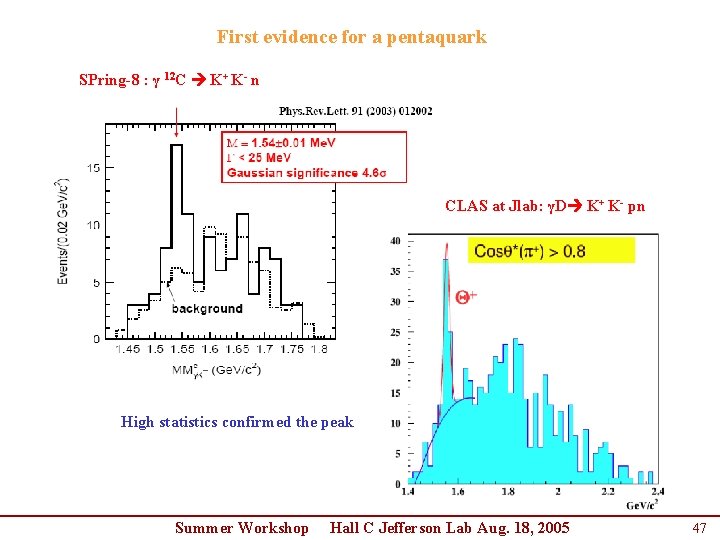
First evidence for a pentaquark SPring-8 : γ 12 C Κ+ Κ- n CLAS at Jlab: γD K+ K- pn High statistics confirmed the peak Summer Workshop Hall C Jefferson Lab Aug. 18, 2005 47
Summary of experimental results Negative results Positive results Experiment Reaction Mass (Me. V) Width (Me. V) CDF p p PX LEPS γ C 12 K- K+ n 1540(10) <25 ALEPH Hadronic Z decays DIANA K+ Xe KS 0 p. Xe’ 1539(2) <9 L 3 γγ ΘΘ CLAS γd γ p K- K+ nπ+ 1542(5) <21 HERA-Β p. A PX Belle KN PX Ba. Bar e+ e- Y SAPHIR γ p KS 0 K+ n 1540(6) <25 Bes e+ e- J/ψ COSY pp Σ+ KS 0 p 1530(5) <18 Hyper. CP (K+, π+, p)Cu PX SVD p. A KS 0 p. X 1526(3) <24 SELEX (p, Σ, π)p PX ITEP νA KS 0 p. X 1533(5) <20 FOCUS γp PX E 690 pp PX DELPHI Hadronic Z decays COMPASS μ+(6 Li D) PX ZEUS ep PX SPHINX p. C ΘK 0 C PHENIX Au. Au PX HERMES ZEUS K- K+ np e+ d KS 0 p. X e p Ks 0 p X A. Dzierba et al. , hep-ex/0412077 1528(3) 1522(3) 13(9) 8(4) P=pentaquark state (Θs, Ξ, Θc) Summer Workshop Hall C Jefferson Lab Aug. 18, 2005 48
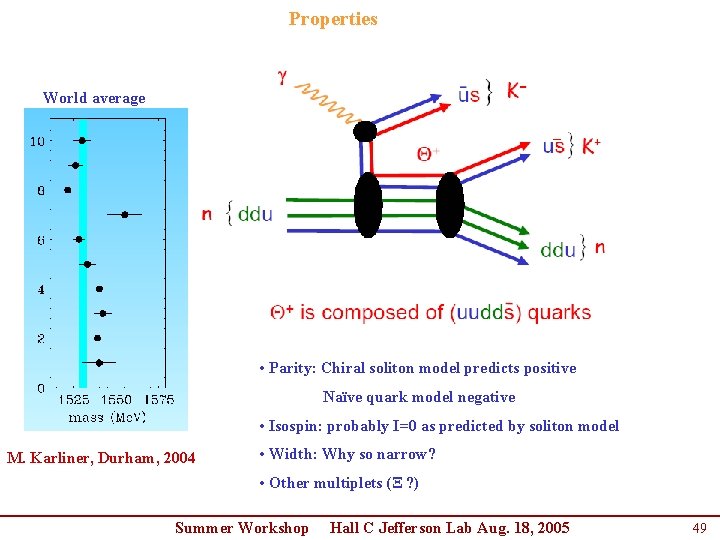
Properties World average • Parity: Chiral soliton model predicts positive Naïve quark model negative • Isospin: probably I=0 as predicted by soliton model M. Karliner, Durham, 2004 • Width: Why so narrow? • Other multiplets (Ξ ? ) Summer Workshop Hall C Jefferson Lab Aug. 18, 2005 49
Does lattice QCD support a Θ+? Objective for lattice calculations: to determine whether quenched QCD supports a five quark resonance state and if it does to predict its parity. Summer Workshop Hall C Jefferson Lab Aug. 18, 2005 50
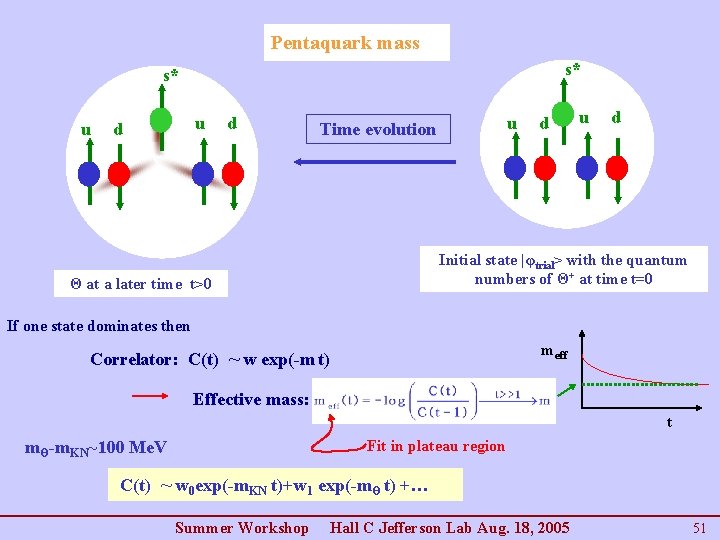
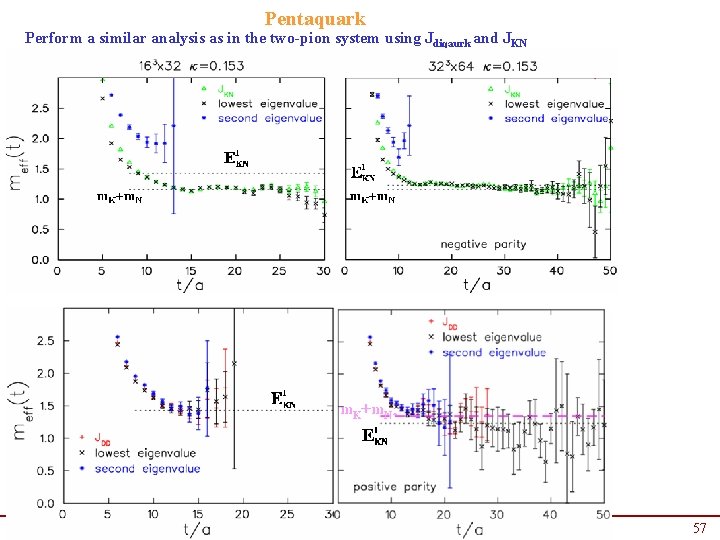
Pentaquark mass s* s* u u d d u Time evolution d u d Initial state |φtrial> with the quantum numbers of Θ+ at time t=0 Θ at a later time t>0 If one state dominates then meff Correlator: C(t) ~ w exp(-m t) Effective mass: t Fit in plateau region mΘ-m. KN~100 Me. V C(t) ~ w 0 exp(-m. KN t)+w 1 exp(-mΘ t) +… Summer Workshop Hall C Jefferson Lab Aug. 18, 2005 51
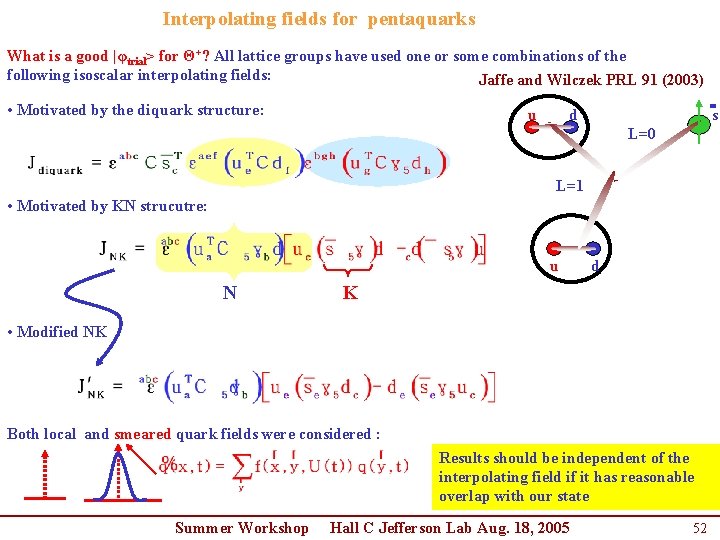
Interpolating fields for pentaquarks What is a good |φtrial> for Θ+? All lattice groups have used one or some combinations of the following isoscalar interpolating fields: Jaffe and Wilczek PRL 91 (2003) • Motivated by the diquark structure: u s d L=0 L=1 • Motivated by KN strucutre: u N d K • Modified NK Both local and smeared quark fields were considered : Results should be independent of the interpolating field if it has reasonable overlap with our state Summer Workshop Hall C Jefferson Lab Aug. 18, 2005 52
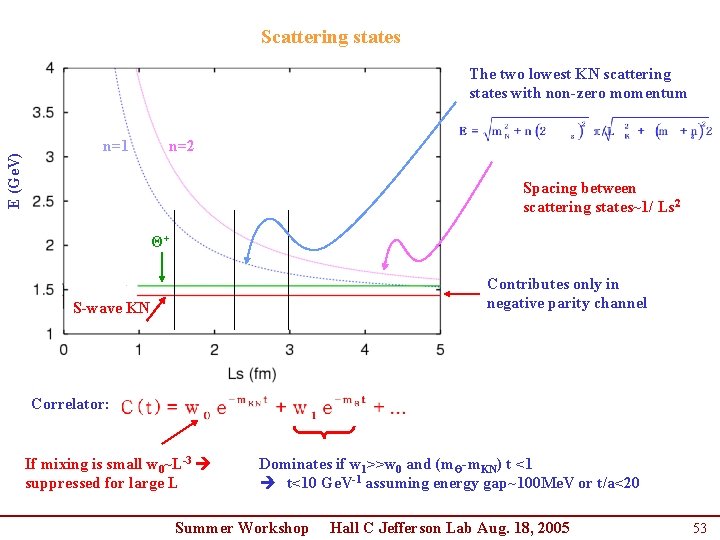
Scattering states E (Ge. V) The two lowest KN scattering states with non-zero momentum n=1 n=2 Spacing between scattering states~1/ Ls 2 Θ+ Contributes only in negative parity channel S-wave KN Correlator: If mixing is small w 0~L-3 suppressed for large L Dominates if w 1>>w 0 and (mΘ-m. KN) t <1 t<10 Ge. V-1 assuming energy gap~100 Me. V or t/a<20 Summer Workshop Hall C Jefferson Lab Aug. 18, 2005 53
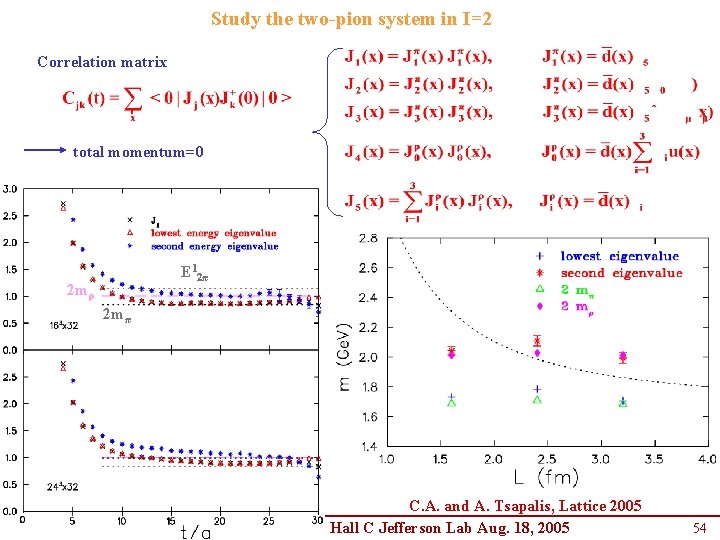
Study the two-pion system in I=2 Correlation matrix total momentum=0 Ε 12π 2 mρ 2 mπ Summer Workshop C. A. and A. Tsapalis, Lattice 2005 Hall C Jefferson Lab Aug. 18, 2005 54
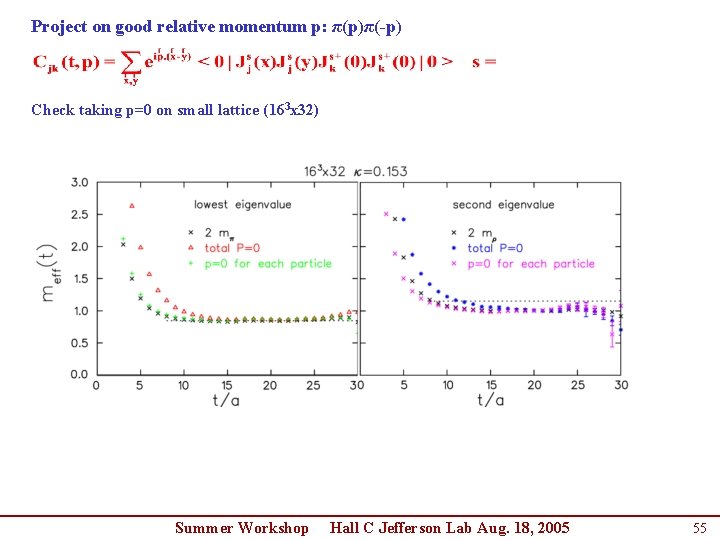
Project on good relative momentum p: π(p)π(-p) Check taking p=0 on small lattice (163 x 32) Summer Workshop Hall C Jefferson Lab Aug. 18, 2005 55
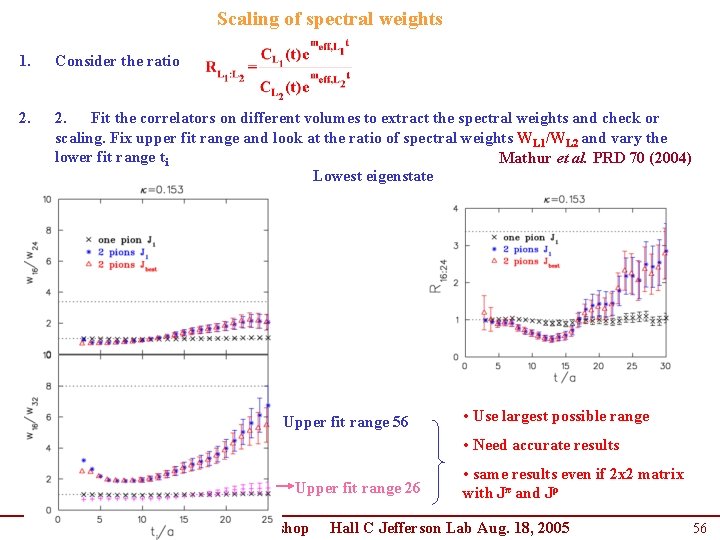
Scaling of spectral weights 1. Consider the ratio 2. Fit the correlators on different volumes to extract the spectral weights and check or scaling. Fix upper fit range and look at the ratio of spectral weights WL 1/WL 2 and vary the lower fit range ti Mathur et al. PRD 70 (2004) Lowest eigenstate Upper fit range 56 • Use largest possible range • Need accurate results Upper fit range 26 Summer Workshop • same results even if 2 x 2 matrix with Jπ and Jρ Hall C Jefferson Lab Aug. 18, 2005 56
Pentaquark Perform a similar analysis as in the two-pion system using Jdiqaurk and JKN Negative parity Summer Workshop Hall C Jefferson Lab Aug. 18, 2005 57
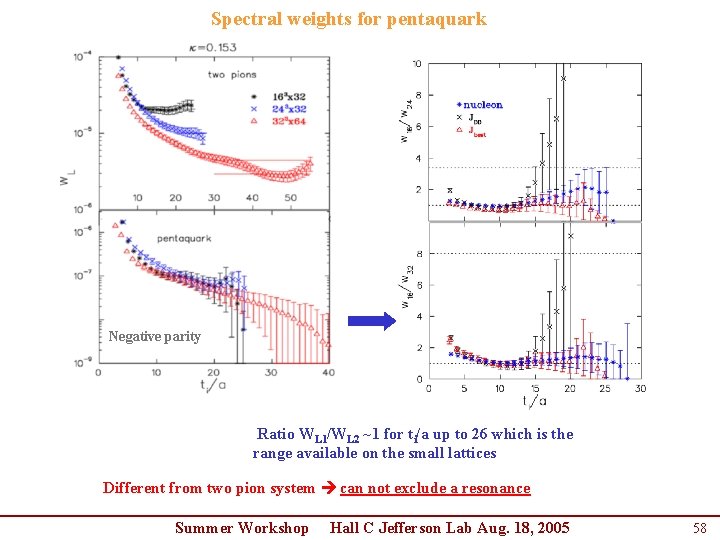
Spectral weights for pentaquark Negative parity Ratio WL 1/WL 2 ~1 for ti/a up to 26 which is the range available on the small lattices Different from two pion system can not exclude a resonance Summer Workshop Hall C Jefferson Lab Aug. 18, 2005 58
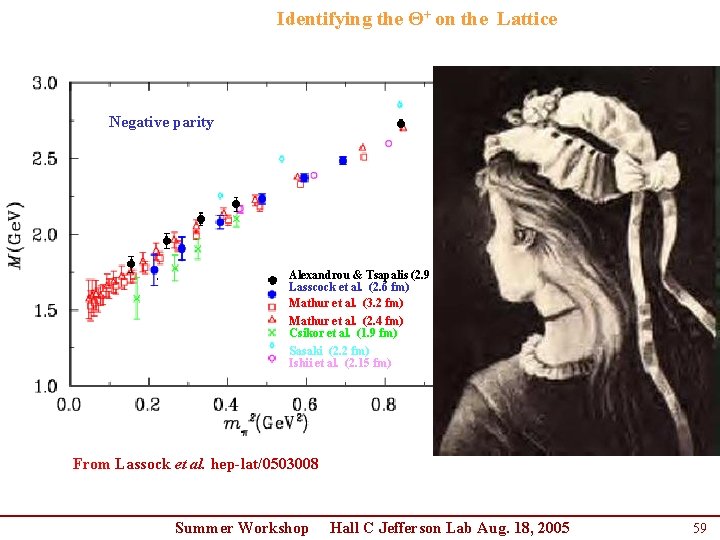
Identifying the Θ+ on the Lattice There is agreement among lattice groups on the raw data but the interpretation differs depending on the criterion used Negative parity Alexandrou & Tsapalis (2. 9 fm) Lasscock et al. (2. 6 fm) Mathur et al. (3. 2 fm) Mathur et al. (2. 4 fm) Csikor et al. (1. 9 fm) Sasaki (2. 2 fm) Ishii et al. (2. 15 fm) From Lassock et al. hep-lat/0503008 Summer Workshop Hall C Jefferson Lab Aug. 18, 2005 59
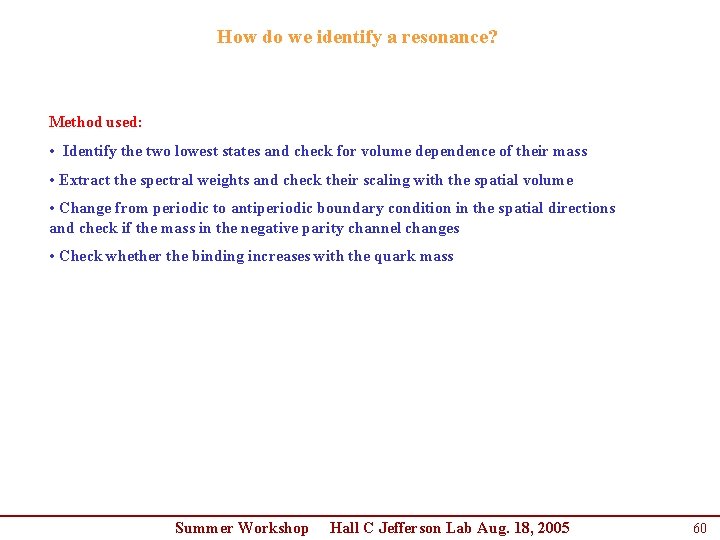
How do we identify a resonance? Method used: • Identify the two lowest states and check for volume dependence of their mass • Extract the spectral weights and check their scaling with the spatial volume • Change from periodic to antiperiodic boundary condition in the spatial directions and check if the mass in the negative parity channel changes • Check whether the binding increases with the quark mass Summer Workshop Hall C Jefferson Lab Aug. 18, 2005 60
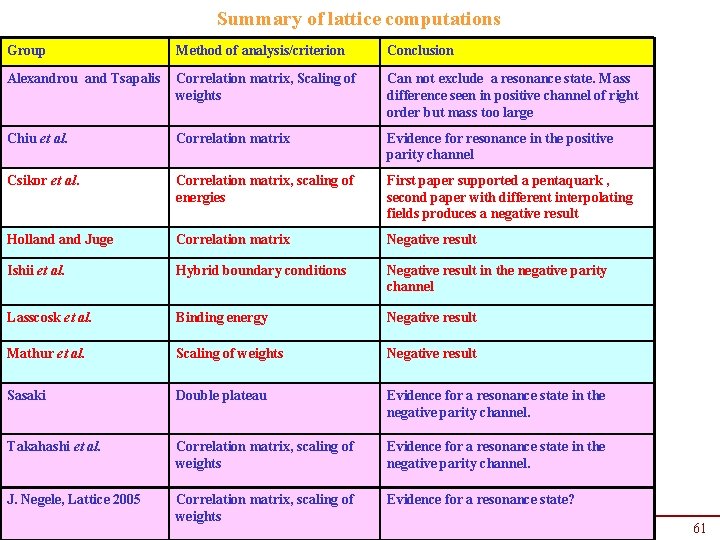
Summary of lattice computations Group Method of analysis/criterion Conclusion Alexandrou and Tsapalis Correlation matrix, Scaling of weights Can not exclude a resonance state. Mass difference seen in positive channel of right order but mass too large Chiu et al. Correlation matrix Evidence for resonance in the positive parity channel Csikor et al. Correlation matrix, scaling of energies First paper supported a pentaquark , second paper with different interpolating fields produces a negative result Holland Juge Correlation matrix Negative result Ishii et al. Hybrid boundary conditions Negative result in the negative parity channel Lasscosk et al. Binding energy Negative result Mathur et al. Scaling of weights Negative result Sasaki Double plateau Evidence for a resonance state in the negative parity channel. Takahashi et al. Correlation matrix, scaling of weights Evidence for a resonance state in the negative parity channel. J. Negele, Lattice 2005 Correlation matrix, scaling of weights Evidence for a resonance state? Summer Workshop Hall C Jefferson Lab Aug. 18, 2005 61
Dynamical calculations-status and perspectives Summer Workshop Hall C Jefferson Lab Aug. 18, 2005 62
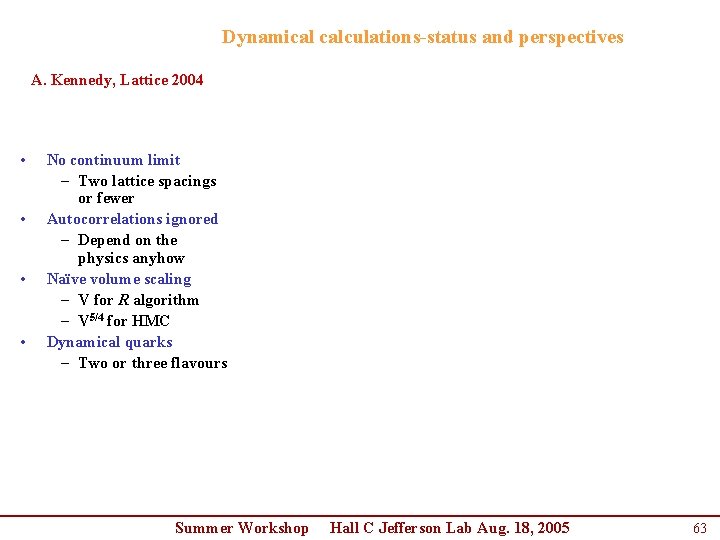
Dynamical calculations-status and perspectives A. Kennedy, Lattice 2004 • • No continuum limit – Two lattice spacings or fewer Autocorrelations ignored – Depend on the physics anyhow Naïve volume scaling – V for R algorithm – V 5/4 for HMC Dynamical quarks – Two or three flavours Summer Workshop Hall C Jefferson Lab Aug. 18, 2005 63
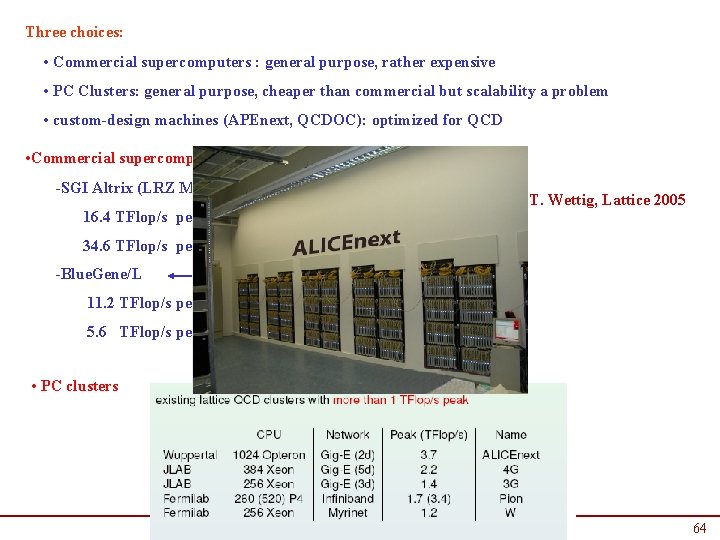
Three choices: • Commercial supercomputers : general purpose, rather expensive • PC Clusters: general purpose, cheaper than commercial but scalability a problem • custom-design machines (APEnext, QCDOC): optimized for QCD • Commercial supercomputers -SGI Altrix (LRZ Munich) T. Wettig, Lattice 2005 16. 4 TFlop/s peak 2006 -07 34. 6 TFlop/s peak 2006 -07 -Blue. Gene/L very good scalability 11. 2 TFlop/s peak at Jülich 5. 6 TFlop/s peak at Edinburgh, BU, MIT • PC clusters Summer Workshop Hall C Jefferson Lab Aug. 18, 2005 64
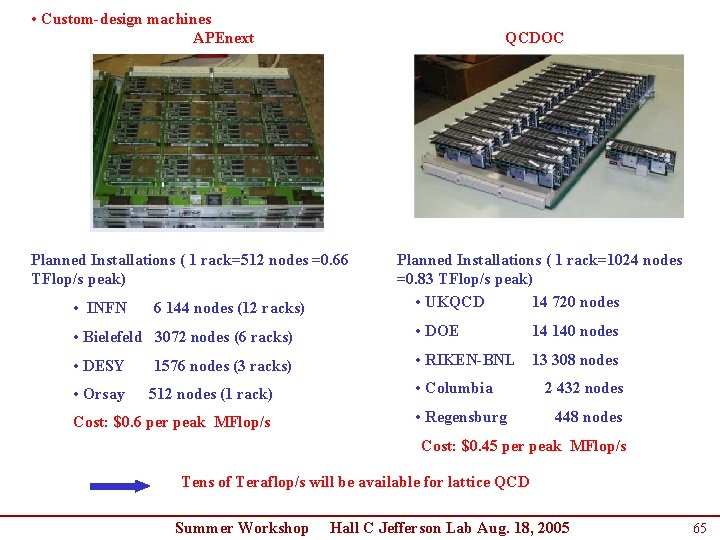
• Custom-design machines APEnext QCDOC Planned Installations ( 1 rack=512 nodes =0. 66 TFlop/s peak) • INFN 6 144 nodes (12 racks) Planned Installations ( 1 rack=1024 nodes =0. 83 TFlop/s peak) • UKQCD 14 720 nodes • Bielefeld 3072 nodes (6 racks) • DOE • DESY • RIKEN-BNL 13 308 nodes • Orsay 1576 nodes (3 racks) 512 nodes (1 rack) Cost: $0. 6 per peak MFlop/s • Columbia • Regensburg 14 140 nodes 2 432 nodes 448 nodes Cost: $0. 45 per peak MFlop/s Tens of Teraflop/s will be available for lattice QCD Summer Workshop Hall C Jefferson Lab Aug. 18, 2005 65
Conclusions • Lattice QCD is entering an era where it can make significant contributions in the interpretation of current experimental results. • A valuable method for understanding hadronic phenomena Ø γN Δ : GM 1, GE 2 and GC 2 calculated in quenched approximation in the range of Q 2 where recent measurements are taken. Results in full QCD are within reach. Non-zero values deformation of the nucleon/Δ Ø Diquark dynamics Ø Studies of exotics and two-body decays Ø • Computer technology and new algorithms will deliver 10´s of Teraflop/s in the next five years Ø Provide dynamical gauge configurations in the chiral regime Ø Enable the accurate evaluation of more involved matrix elements Summer Workshop Hall C Jefferson Lab Aug. 18, 2005 66
Thank you! Summer Workshop Hall C Jefferson Lab Aug. 18, 2005 67