
BornHaber Cycle Lattice Energy o We recall that

Born-Haber Cycle
Lattice Energy o We recall that the lattice energy is the energy required to completely separate one mole of a solid ionic compound into its gaseous ions n Ex: Na. Cl(s) Na+(g) + Cl-(g) o We cannot measure the lattice energy directly, we can use either Coulomb’s law (using charges and radius) or the Born Haber Cycle
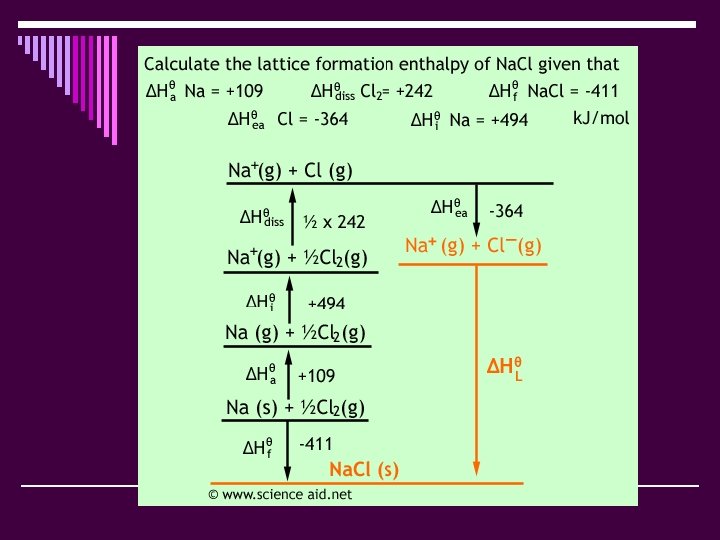
Born-Haber Cycle o A series of hypothetical steps and their enthalpy changes needed to convert elements to an ionic compound and devised to calculate the lattice energy. o Using Hess’s law as a means to calculate the formation of ionic compounds
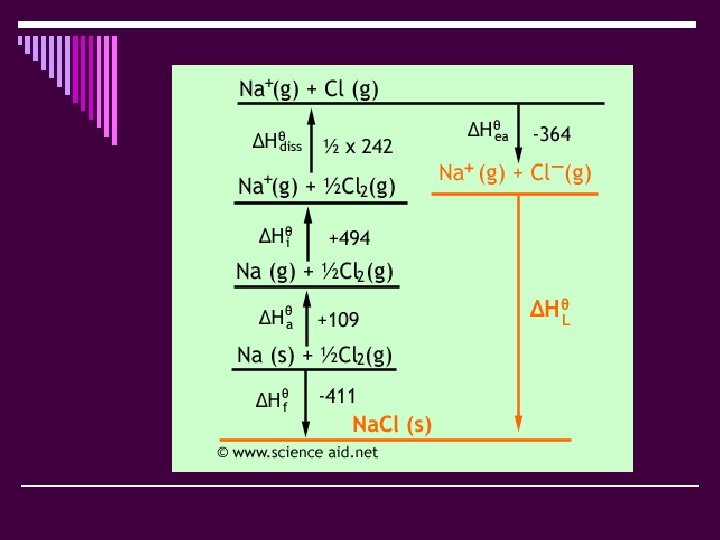
Born-Haber Cycle Steps 1. Elements (standard state) converted into gaseous atoms 2. Losing or gaining electrons to form cations and anions 3. Combining gaseous anions and cations to form a solid ionic compound Let’s consider: Li(s) + ½ F 2(g) Li. F (s) DH = -594. 1 k. J/mol
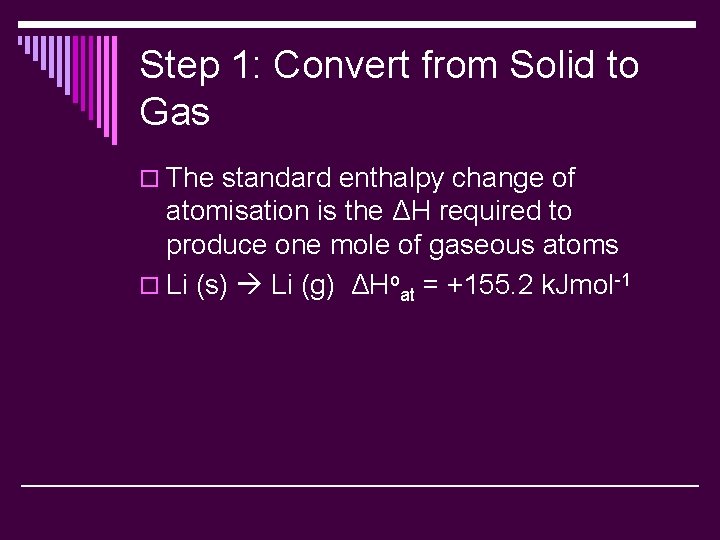
Step 1: Convert from Solid to Gas o The standard enthalpy change of atomisation is the ΔH required to produce one mole of gaseous atoms o Li (s) Li (g) ΔHoat = +155. 2 k. Jmol-1
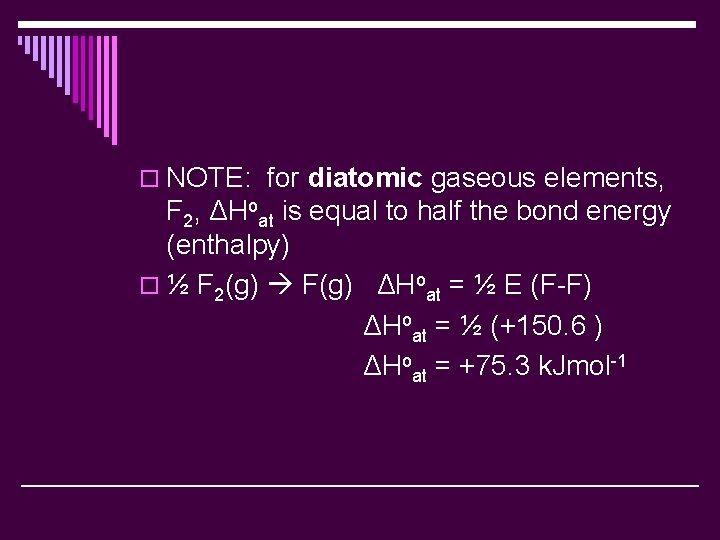
o NOTE: for diatomic gaseous elements, F 2, ΔHoat is equal to half the bond energy (enthalpy) o ½ F 2(g) F(g) ΔHoat = ½ E (F-F) ΔHoat = ½ (+150. 6 ) ΔHoat = +75. 3 k. Jmol-1
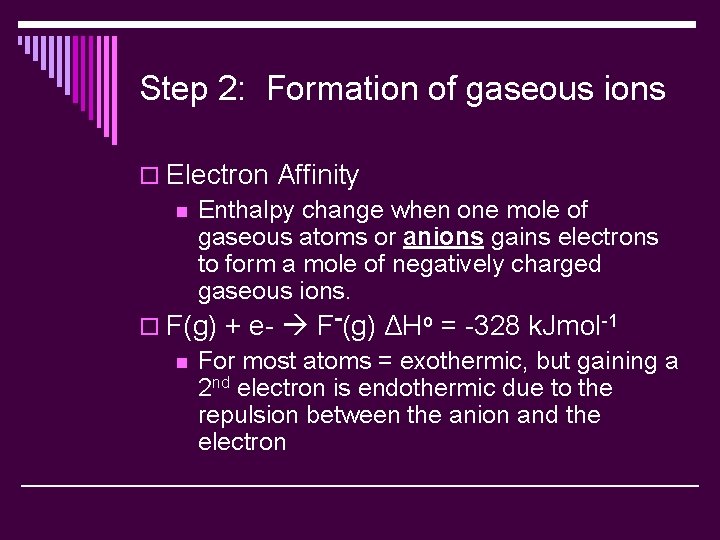
Step 2: Formation of gaseous ions o Electron Affinity n Enthalpy change when one mole of gaseous atoms or anions gains electrons to form a mole of negatively charged gaseous ions. o F(g) + e- F-(g) ΔHo = -328 k. Jmol-1 n For most atoms = exothermic, but gaining a 2 nd electron is endothermic due to the repulsion between the anion and the electron
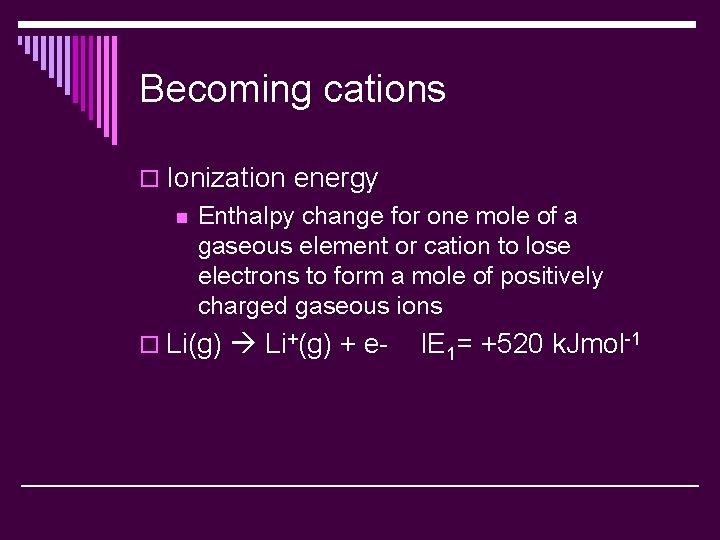
Becoming cations o Ionization energy n Enthalpy change for one mole of a gaseous element or cation to lose electrons to form a mole of positively charged gaseous ions o Li(g) Li+(g) + e- IE 1= +520 k. Jmol-1
Lattice Enthalpy o Energy required to convert one mole of the solid compound into gaseous ions. o Li. F(s) Li+(g) + F-(g) ΔHolat = ? o It is highly endothermic o We cannot directly calculate ΔHolat , but values are obtained indirectly through Hess’s law for the formation of the ionic compound o We will use the reverse of this lattice energy equation to find the lattice energy
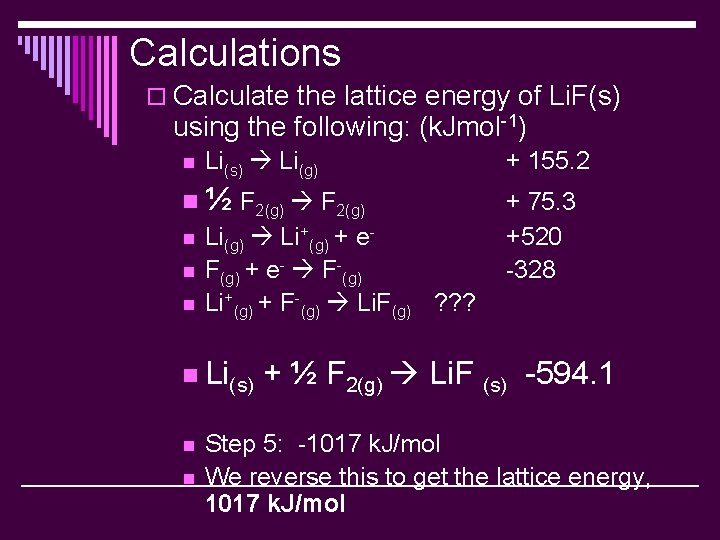
Calculations o Calculate the lattice energy of Li. F(s) using the following: (k. Jmol-1) n Li(s) Li(g) n ½ F 2(g) n n n Li(g) Li+(g) + e. F(g) + e- F-(g) Li+(g) + F-(g) Li. F(g) ? ? ? n Li(s) n n + 155. 2 + 75. 3 +520 -328 + ½ F 2(g) Li. F (s) -594. 1 Step 5: -1017 k. J/mol We reverse this to get the lattice energy, 1017 k. J/mol
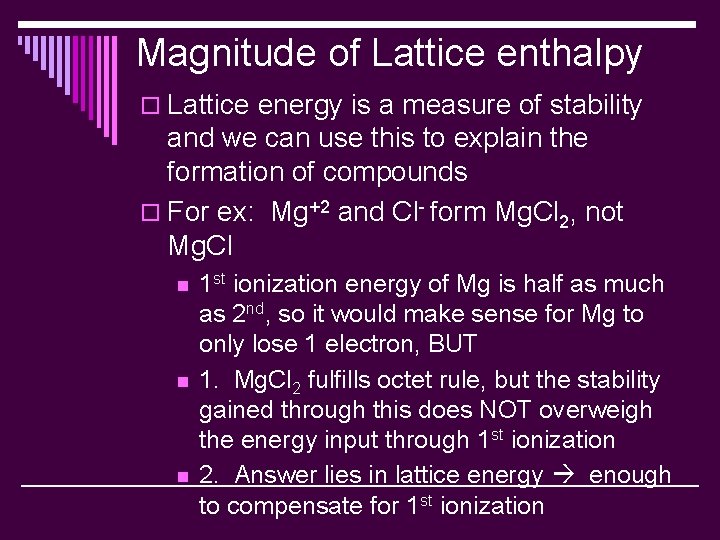
Magnitude of Lattice enthalpy o Lattice energy is a measure of stability and we can use this to explain the formation of compounds o For ex: Mg+2 and Cl- form Mg. Cl 2, not Mg. Cl n n n 1 st ionization energy of Mg is half as much as 2 nd, so it would make sense for Mg to only lose 1 electron, BUT 1. Mg. Cl 2 fulfills octet rule, but the stability gained through this does NOT overweigh the energy input through 1 st ionization 2. Answer lies in lattice energy enough to compensate for 1 st ionization
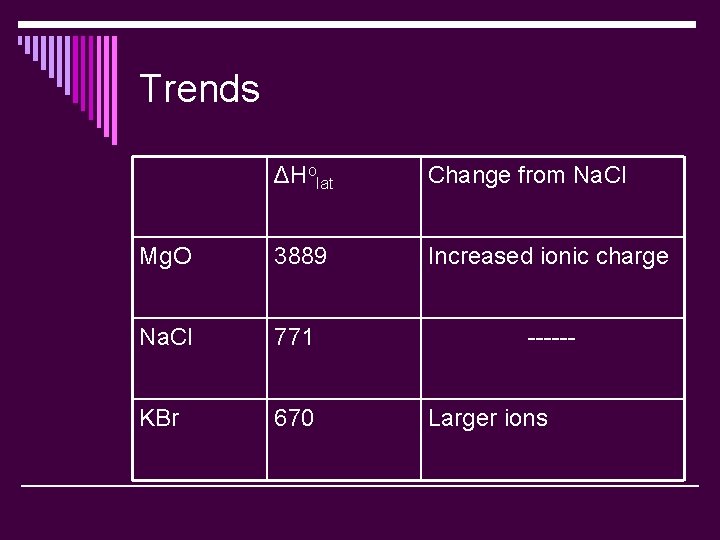
Trends ΔHolat Change from Na. Cl Mg. O 3889 Increased ionic charge Na. Cl 771 ------ KBr 670 Larger ions
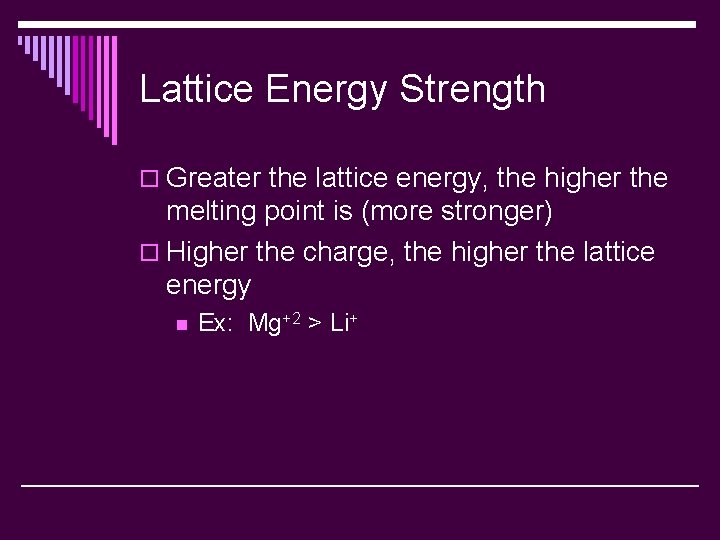
Lattice Energy Strength o Greater the lattice energy, the higher the melting point is (more stronger) o Higher the charge, the higher the lattice energy n Ex: Mg+2 > Li+
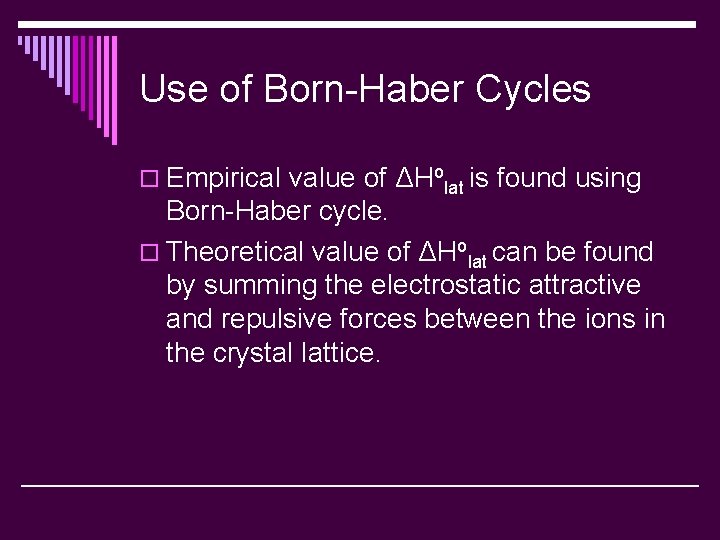
Use of Born-Haber Cycles o Empirical value of ΔHolat is found using Born-Haber cycle. o Theoretical value of ΔHolat can be found by summing the electrostatic attractive and repulsive forces between the ions in the crystal lattice.
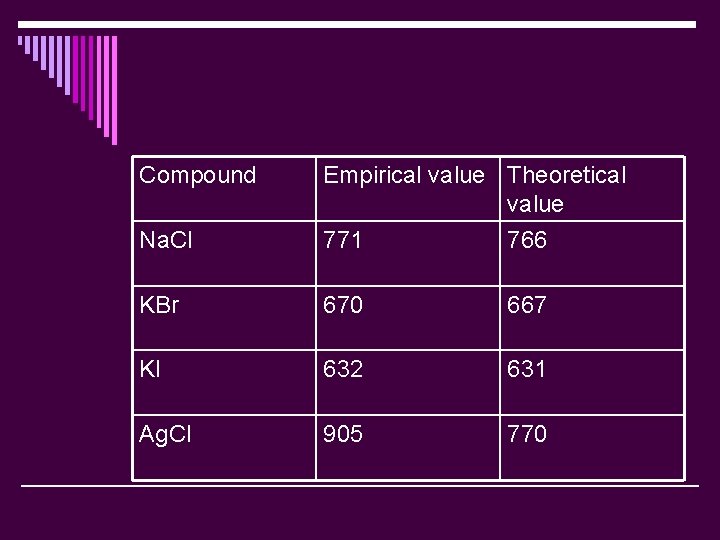
Compound Empirical value Theoretical value Na. Cl 771 766 KBr 670 667 KI 632 631 Ag. Cl 905 770
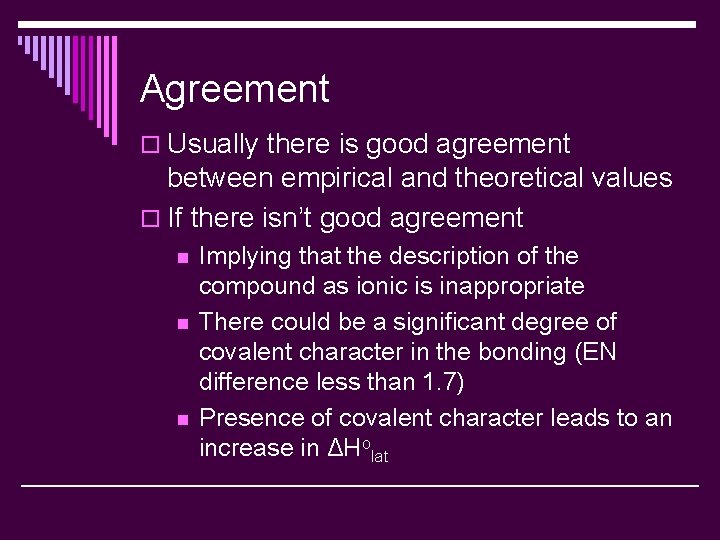
Agreement o Usually there is good agreement between empirical and theoretical values o If there isn’t good agreement n n n Implying that the description of the compound as ionic is inappropriate There could be a significant degree of covalent character in the bonding (EN difference less than 1. 7) Presence of covalent character leads to an increase in ΔHolat
- Slides: 18