
Search for the Effects of the QCD Color
- Slides: 21
Search for the Effects of the QCD Color Factor in High-Energy Collisions at RHIC Bedanga Mohanty LBNL Outline v v Motivation Color Factors Search for Color Factor Effects at RHIC Summary and Outlook 1
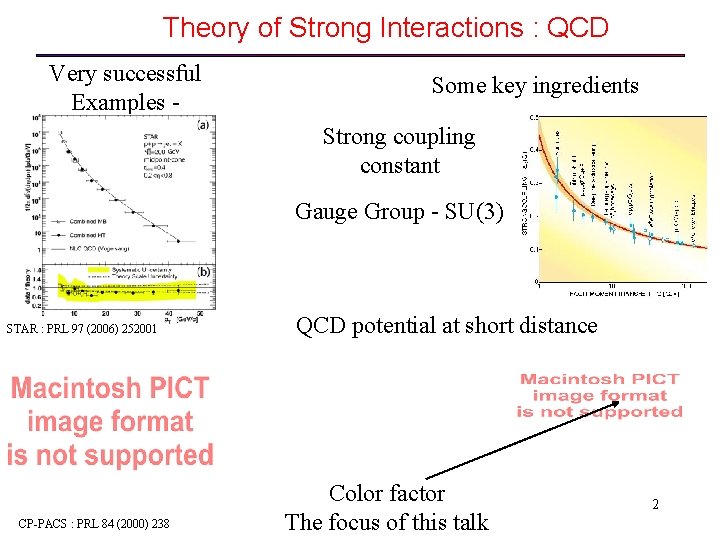
Theory of Strong Interactions : QCD Very successful Examples - Some key ingredients Strong coupling constant Gauge Group - SU(3) STAR : PRL 97 (2006) 252001 CP-PACS : PRL 84 (2000) 238 QCD potential at short distance Color factor The focus of this talk 2
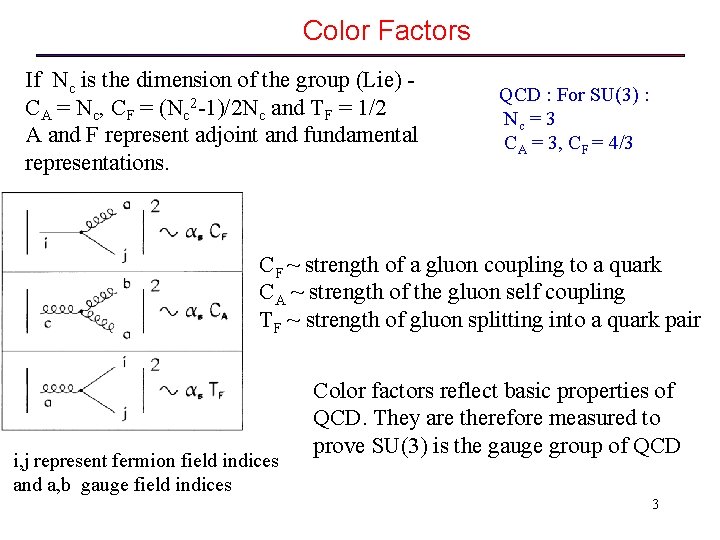
Color Factors If Nc is the dimension of the group (Lie) CA = Nc, CF = (Nc 2 -1)/2 Nc and TF = 1/2 A and F represent adjoint and fundamental representations. QCD : For SU(3) : Nc = 3 CA = 3, CF = 4/3 CF ~ strength of a gluon coupling to a quark CA ~ strength of the gluon self coupling TF ~ strength of gluon splitting into a quark pair i, j represent fermion field indices and a, b gauge field indices Color factors reflect basic properties of QCD. They are therefore measured to prove SU(3) is the gauge group of QCD 3
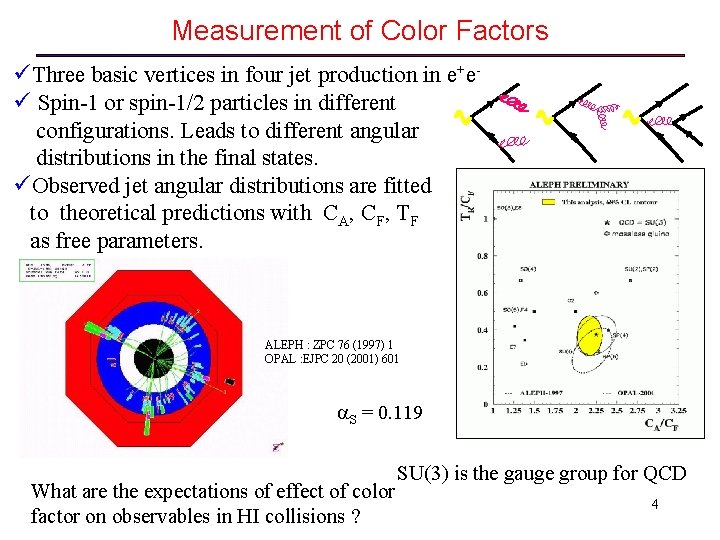
Measurement of Color Factors üThree basic vertices in four jet production in e+eü Spin-1 or spin-1/2 particles in different configurations. Leads to different angular distributions in the final states. üObserved jet angular distributions are fitted to theoretical predictions with CA, CF, TF as free parameters. ALEPH : ZPC 76 (1997) 1 OPAL : EJPC 20 (2001) 601 S = 0. 119 What are the expectations of effect of color factor on observables in HI collisions ? SU(3) is the gauge group for QCD 4
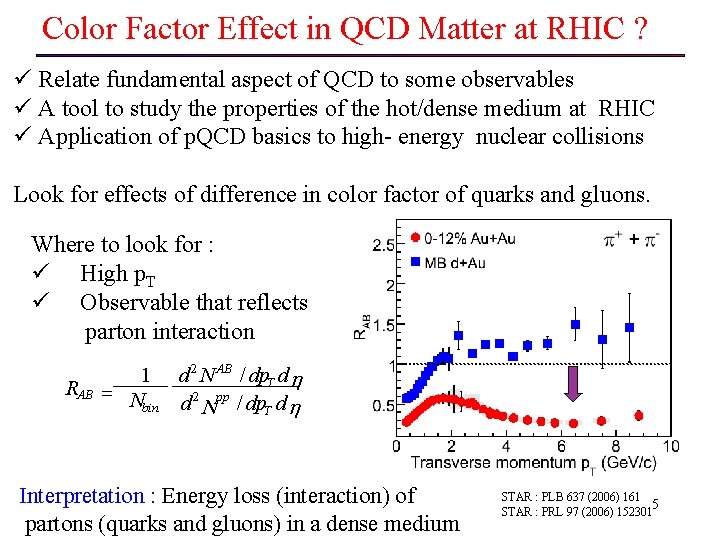
Color Factor Effect in QCD Matter at RHIC ? ü Relate fundamental aspect of QCD to some observables ü A tool to study the properties of the hot/dense medium at RHIC ü Application of p. QCD basics to high- energy nuclear collisions Look for effects of difference in color factor of quarks and gluons. Where to look for : ü High p. T ü Observable that reflects parton interaction RAB 1 d 2 N AB / dp. T dh = N d 2 pp / dp. T dh bin Interpretation : Energy loss (interaction) of partons (quarks and gluons) in a dense medium STAR : PLB 637 (2006) 161 5 STAR : PRL 97 (2006) 152301
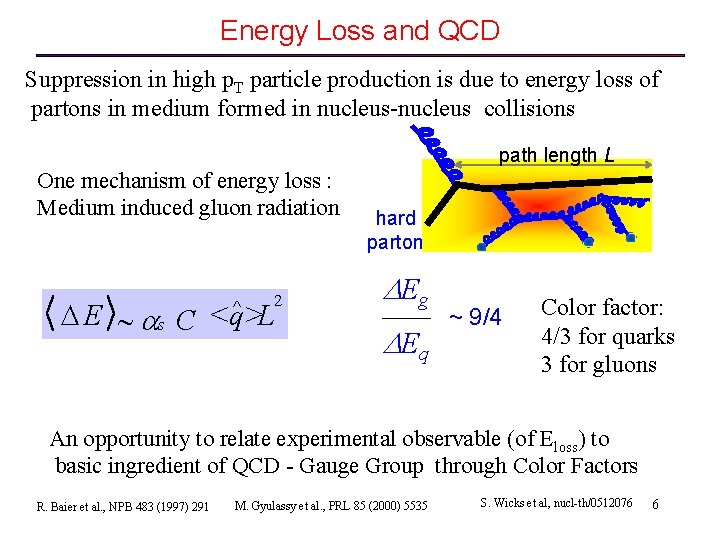
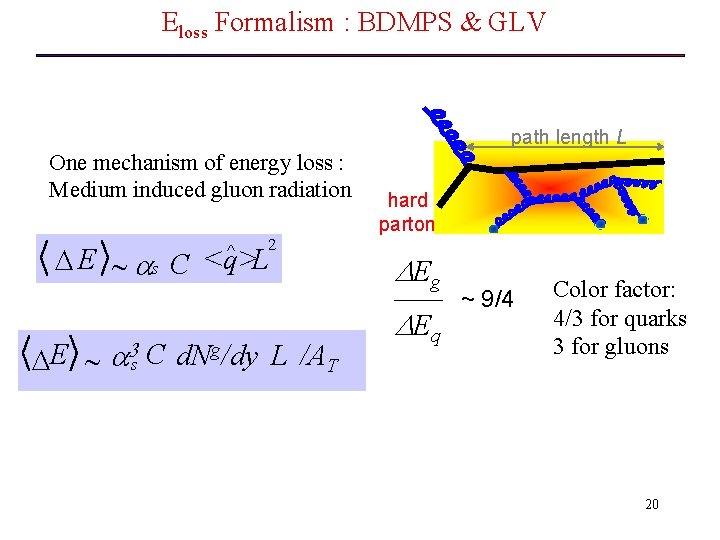
Energy Loss and QCD Suppression in high p. T particle production is due to energy loss of partons in medium formed in nucleus-nucleus collisions path length L One mechanism of energy loss : Medium induced gluon radiation 2 ^ L E s C <q> hard parton Eg Eq ~ 9/4 Color factor: 4/3 for quarks 3 for gluons An opportunity to relate experimental observable (of Eloss) to basic ingredient of QCD - Gauge Group through Color Factors R. Baier et al. , NPB 483 (1997) 291 M. Gyulassy et al. , PRL 85 (2000) 5535 S. Wicks et al, nucl-th/0512076 6
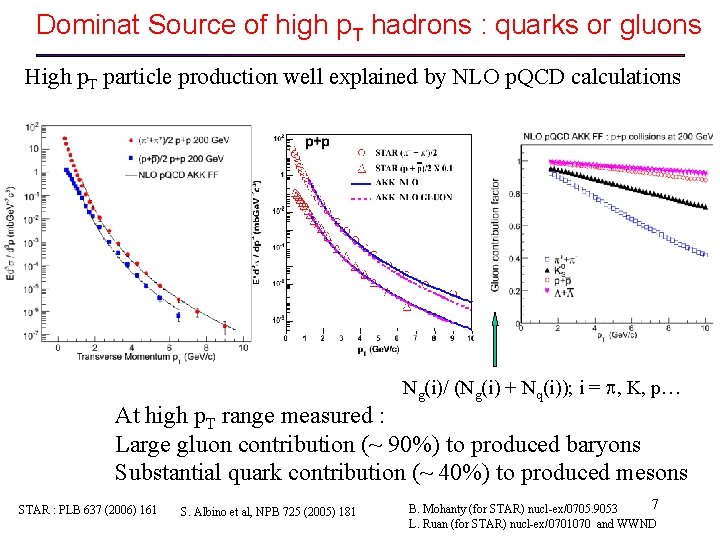
Dominat Source of high p. T hadrons : quarks or gluons High p. T particle production well explained by NLO p. QCD calculations Ng(i)/ (Ng(i) + Nq(i)); i = , K, p… At high p. T range measured : Large gluon contribution (~ 90%) to produced baryons Substantial quark contribution (~ 40%) to produced mesons STAR : PLB 637 (2006) 161 S. Albino et al, NPB 725 (2005) 181 7 B. Mohanty (for STAR) nucl-ex/0705. 9053 L. Ruan (for STAR) nucl-ex/0701070 and WWND
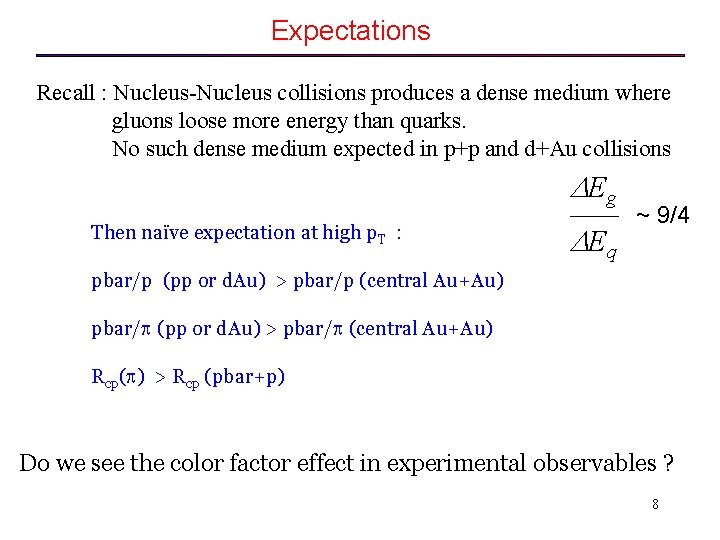
Expectations Recall : Nucleus-Nucleus collisions produces a dense medium where gluons loose more energy than quarks. No such dense medium expected in p+p and d+Au collisions Eg Then naïve expectation at high p. T : Eq ~ 9/4 pbar/p (pp or d. Au) > pbar/p (central Au+Au) pbar/ (pp or d. Au) > pbar/ (central Au+Au) Rcp( ) > Rcp (pbar+p) Do we see the color factor effect in experimental observables ? 8
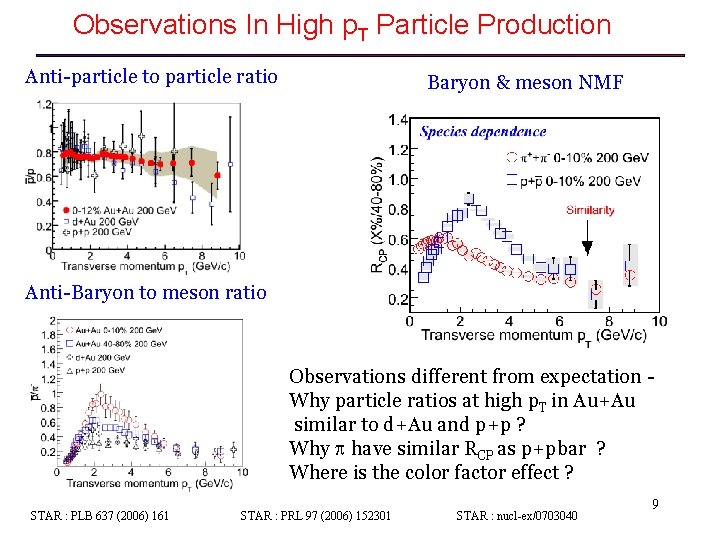
Observations In High p. T Particle Production Anti-particle to particle ratio Baryon & meson NMF Anti-Baryon to meson ratio Observations different from expectation Why particle ratios at high p. T in Au+Au similar to d+Au and p+p ? Why have similar RCP as p+pbar ? Where is the color factor effect ? STAR : PLB 637 (2006) 161 STAR : PRL 97 (2006) 152301 STAR : nucl-ex/0703040 9
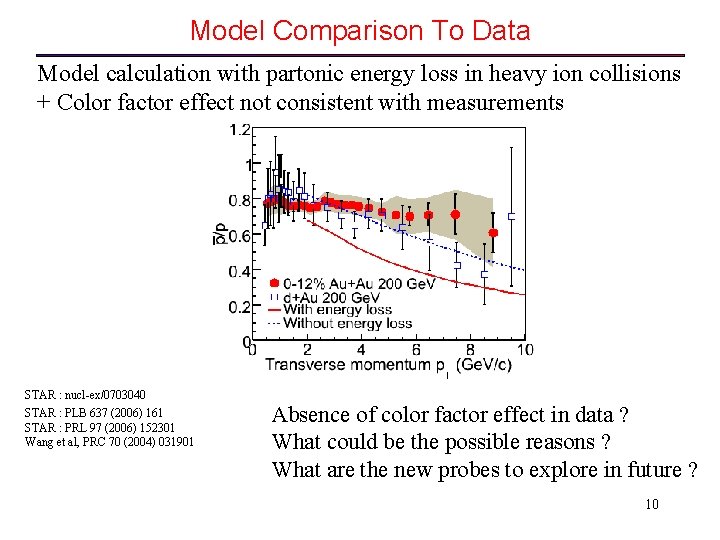
Model Comparison To Data Model calculation with partonic energy loss in heavy ion collisions + Color factor effect not consistent with measurements STAR : nucl-ex/0703040 STAR : PLB 637 (2006) 161 STAR : PRL 97 (2006) 152301 Wang et al, PRC 70 (2004) 031901 Absence of color factor effect in data ? What could be the possible reasons ? What are the new probes to explore in future ? 10
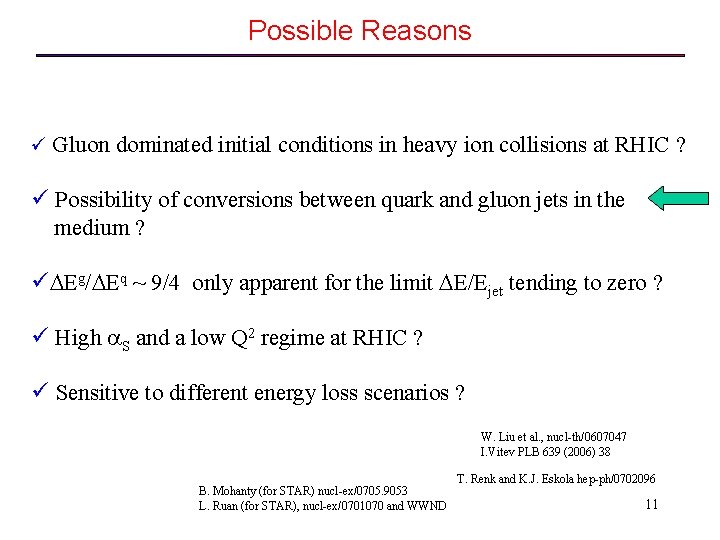
Possible Reasons ü Gluon dominated initial conditions in heavy ion collisions at RHIC ? ü Possibility of conversions between quark and gluon jets in the medium ? ü Eg/ Eq ~ 9/4 only apparent for the limit E/Ejet tending to zero ? ü High S and a low Q 2 regime at RHIC ? ü Sensitive to different energy loss scenarios ? W. Liu et al. , nucl-th/0607047 I. Vitev PLB 639 (2006) 38 B. Mohanty (for STAR) nucl-ex/0705. 9053 L. Ruan (for STAR), nucl-ex/0701070 and WWND T. Renk and K. J. Eskola hep-ph/0702096 11
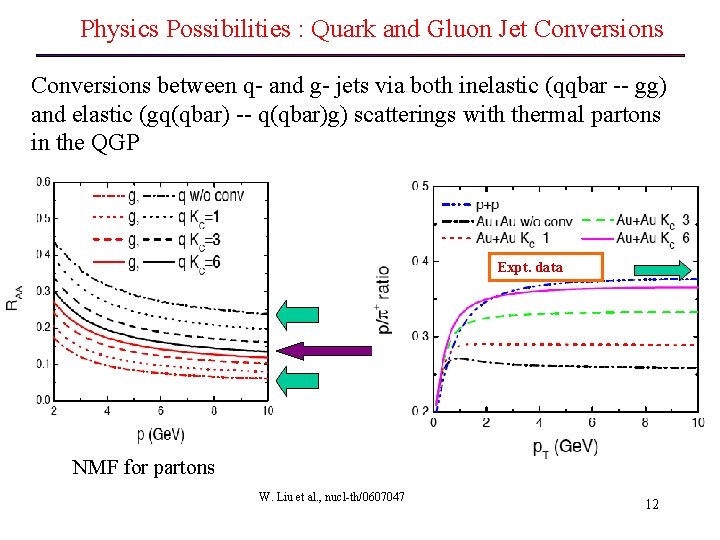
Physics Possibilities : Quark and Gluon Jet Conversions between q- and g- jets via both inelastic (qqbar -- gg) and elastic (gq(qbar) -- q(qbar)g) scatterings with thermal partons in the QGP Expt. data NMF for partons W. Liu et al. , nucl-th/0607047 12
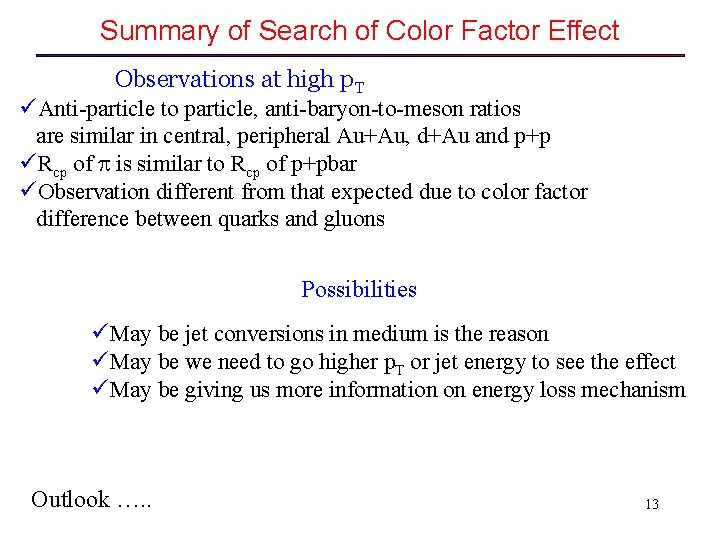
Summary of Search of Color Factor Effect Observations at high p. T üAnti-particle to particle, anti-baryon-to-meson ratios are similar in central, peripheral Au+Au, d+Au and p+p üRcp of is similar to Rcp of p+pbar üObservation different from that expected due to color factor difference between quarks and gluons Possibilities üMay be jet conversions in medium is the reason üMay be we need to go higher p. T or jet energy to see the effect üMay be giving us more information on energy loss mechanism Outlook …. . 13
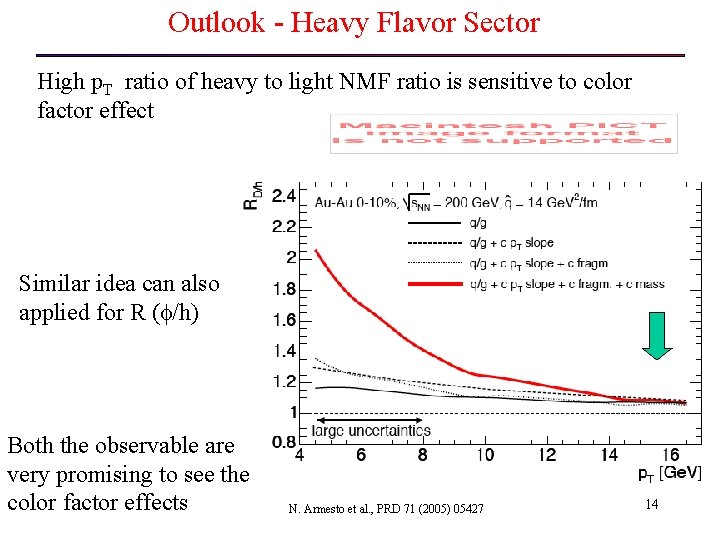
Outlook - Heavy Flavor Sector High p. T ratio of heavy to light NMF ratio is sensitive to color factor effect Similar idea can also applied for R ( /h) Both the observable are very promising to see the color factor effects N. Armesto et al. , PRD 71 (2005) 05427 14
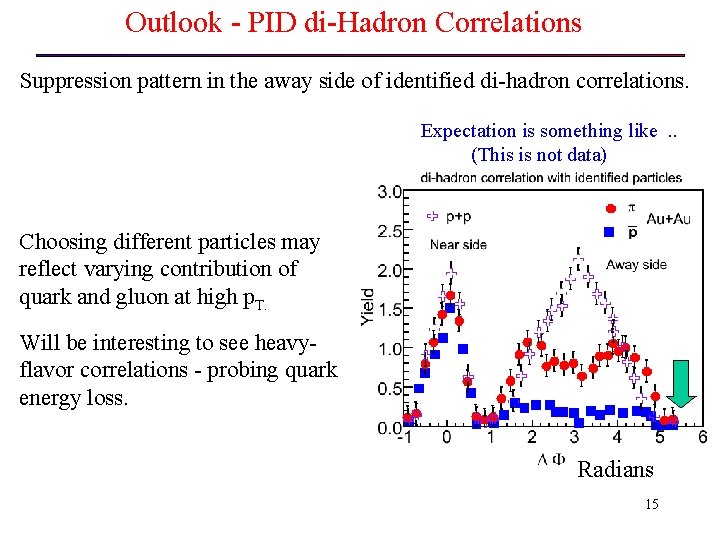
Outlook - PID di-Hadron Correlations Suppression pattern in the away side of identified di-hadron correlations. Expectation is something like. . (This is not data) Choosing different particles may reflect varying contribution of quark and gluon at high p. T. Will be interesting to see heavyflavor correlations - probing quark energy loss. Radians 15
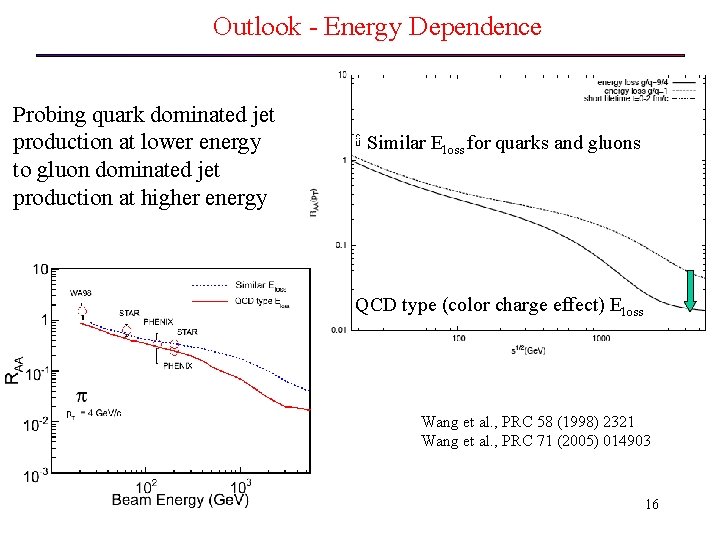
Outlook - Energy Dependence Probing quark dominated jet production at lower energy to gluon dominated jet production at higher energy Similar Eloss for quarks and gluons QCD type (color charge effect) Eloss Wang et al. , PRC 58 (1998) 2321 Wang et al. , PRC 71 (2005) 014903 16
Thanks to Organizers Thanks to STAR Collaboration 17
Back up slides 18
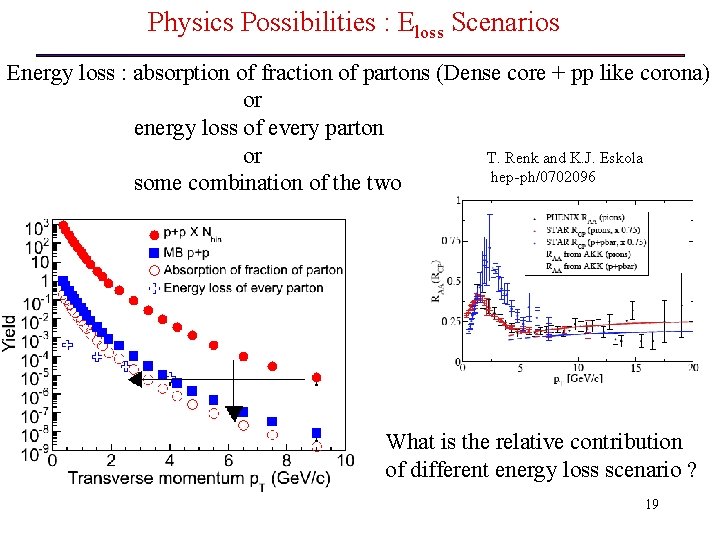
Physics Possibilities : Eloss Scenarios Energy loss : absorption of fraction of partons (Dense core + pp like corona) or energy loss of every parton or T. Renk and K. J. Eskola hep-ph/0702096 some combination of the two What is the relative contribution of different energy loss scenario ? 19
Eloss Formalism : BDMPS & GLV path length L One mechanism of energy loss : Medium induced gluon radiation 2 E s C <q>L ^ C d. Ng/dy L /A E s T hard parton Eg Eq ~ 9/4 Color factor: 4/3 for quarks 3 for gluons 20
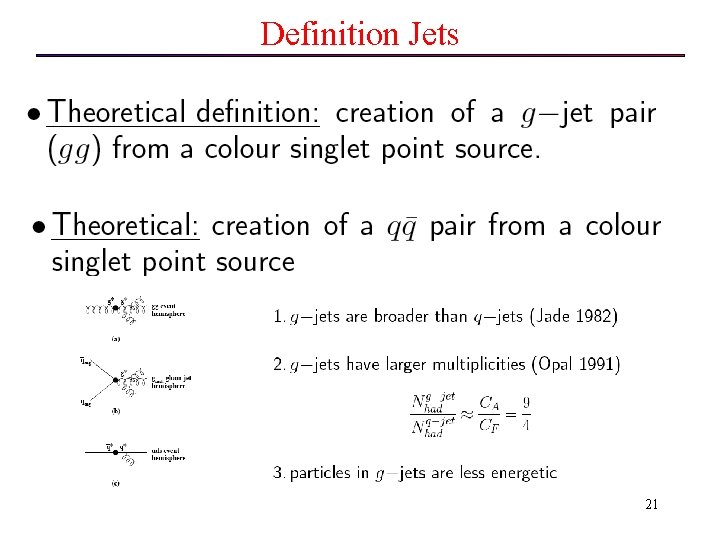
Definition Jets 21