Nordita workshop on holographic QCD July 24 2019

- Slides: 29
Nordita workshop on holographic QCD, July 24 2019 QCD club, Keio U. , July 8 2019; Arnold Sommerfeld Center, Munich, LMU, June 13 2019; Max Planck Institute for gravitational Physics, June 11 2019 Microsoft research, 25 April 2019; U. Washington, seminar, 24 April 2019; Ad. S/CFT workshop at OIST, 3 April 2019; “Machine learning landscape” workshop, ICTP Trieste, 10 Dec 2018; East Asian string workshop, KIAS, Seoul, 7 Nov 2018; KMI colloquium, Nagoya U, 25 Oct 2018; “QG meets lattice QCD workshop”, ECT*, Trento, 3 Sep 2018; APCTP focus program, Hanyang U, Seoul, 15 Aug 2018; QFT workshop, YITP, Kyoto, 31 July 2018; Machine learning workshop, TSi. MF, China, 15 June, 2018; Paris QCD workshop, 11 June, 2018; DLAP 2018 workshop, Osaka, 1 June, 2018; MPI, AEI, virtual seminar, 13 Apr, 2018; MIT, CTP, seminar, 4 Apr, 2018; CQuest, Sogang u. , seminar, 29 March, 2018; KIAS, seminar, 26 March, 2018 Deep Learning and Holographic QCD Koji Hashimoto (Osaka u) Ar. Xiv: 1907. ? ? ? w/ T. Akutagawa, T. Sumimoto (Osaka u) Ar. Xiv: 1903. 04951 Ar. Xiv: 1802. 08313, 1809. 10536 w/ S. Sugishita (Kentucky), A. Tanaka, A. Tomiya (RIKEN)
4 pages 1. Is deep learning useful? 5 pages 2. Ad. S/DL 3. Deeply learning QCD 8 pages
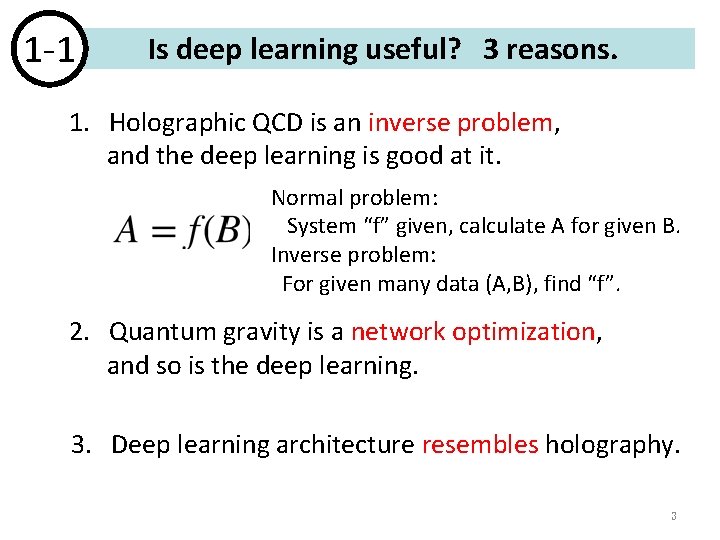
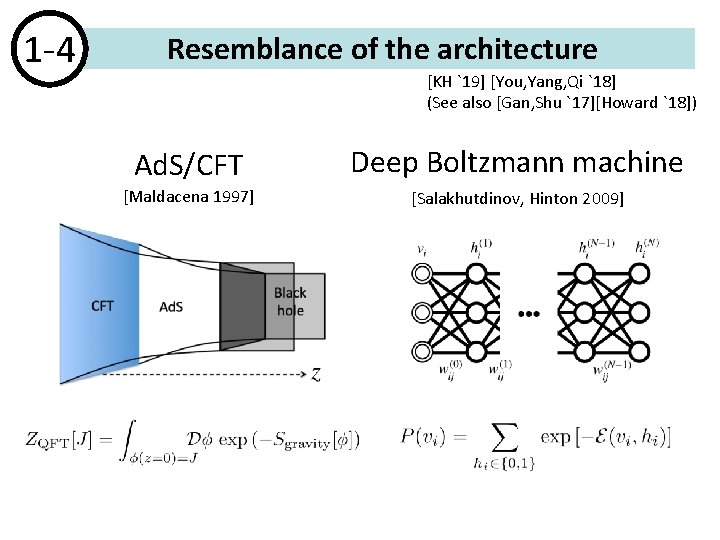
1 -1 Is deep learning useful? 3 reasons. 1. Holographic QCD is an inverse problem, and the deep learning is good at it. Normal problem: System “f” given, calculate A for given B. Inverse problem: For given many data (A, B), find “f”. 2. Quantum gravity is a network optimization, and so is the deep learning. 3. Deep learning architecture resembles holography. 3
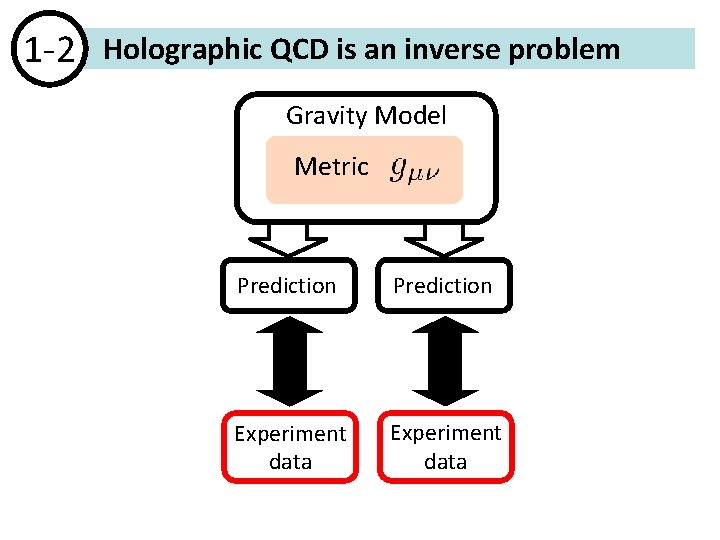
1 -2 Holographic QCD is an inverse problem Gravity Model Metric Prediction Experiment data
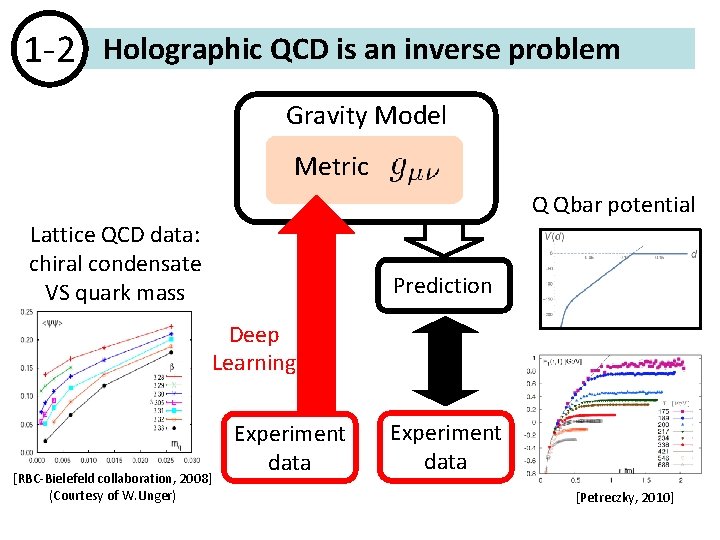
1 -2 Holographic QCD is an inverse problem Gravity Model Metric Q Qbar potential Lattice QCD data: chiral condensate VS quark mass Prediction Deep Learning [RBC-Bielefeld collaboration, 2008] (Courtesy of W. Unger) Experiment data [Petreczky, 2010]
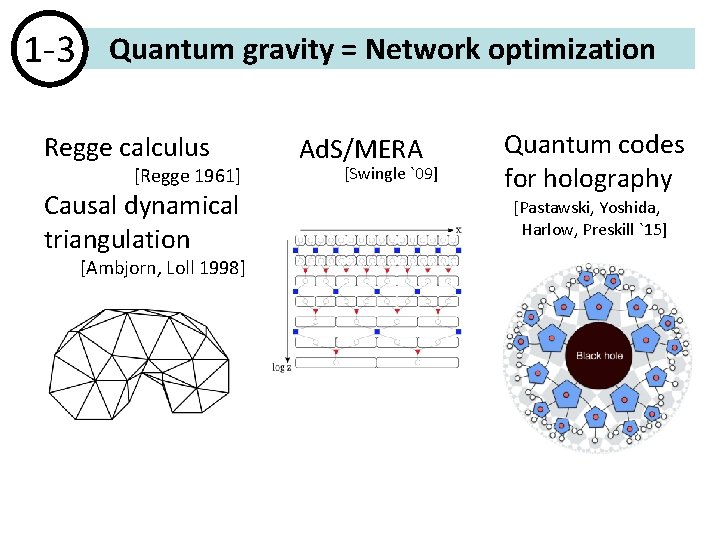
1 -3 Quantum gravity = Network optimization Regge calculus [Regge 1961] Causal dynamical triangulation [Ambjorn, Loll 1998] Ad. S/MERA [Swingle `09] Quantum codes for holography [Pastawski, Yoshida, Harlow, Preskill `15]
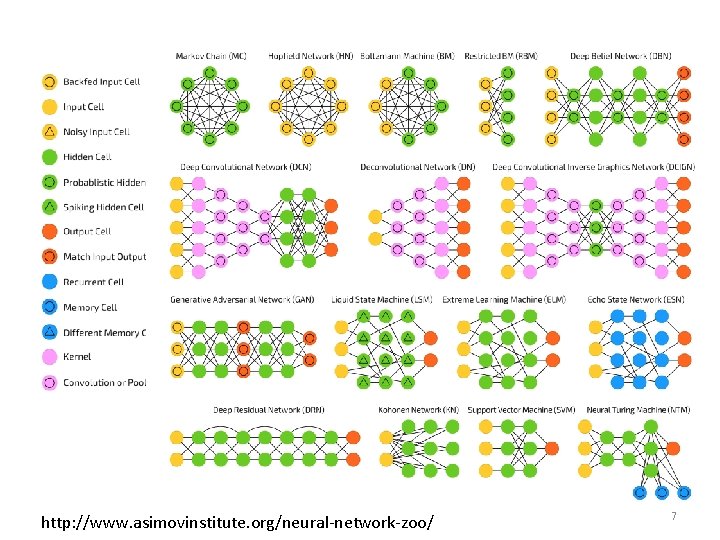
http: //www. asimovinstitute. org/neural-network-zoo/ 7
1 -4 Resemblance of the architecture [KH `19] [You, Yang, Qi `18] (See also [Gan, Shu `17][Howard `18]) Ad. S/CFT Deep Boltzmann machine [Maldacena 1997] [Salakhutdinov, Hinton 2009]
4 pages 1. Is deep learning useful? 5 pages 2. Ad. S/DL 3. Deeply learning QCD 8 pages
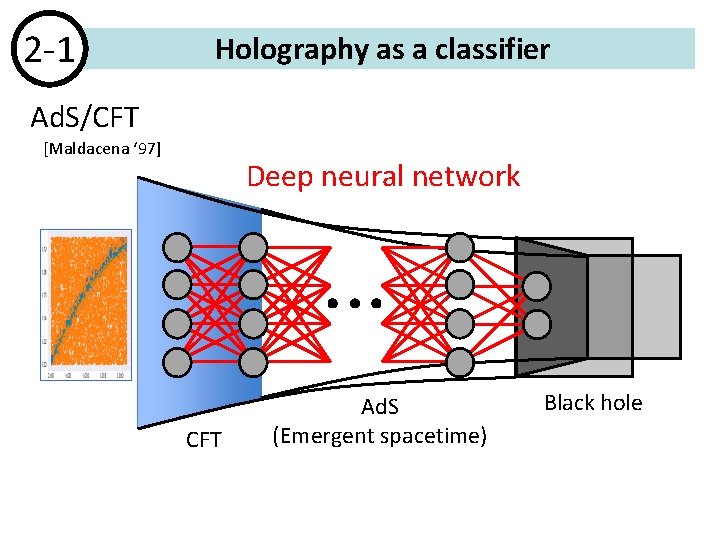
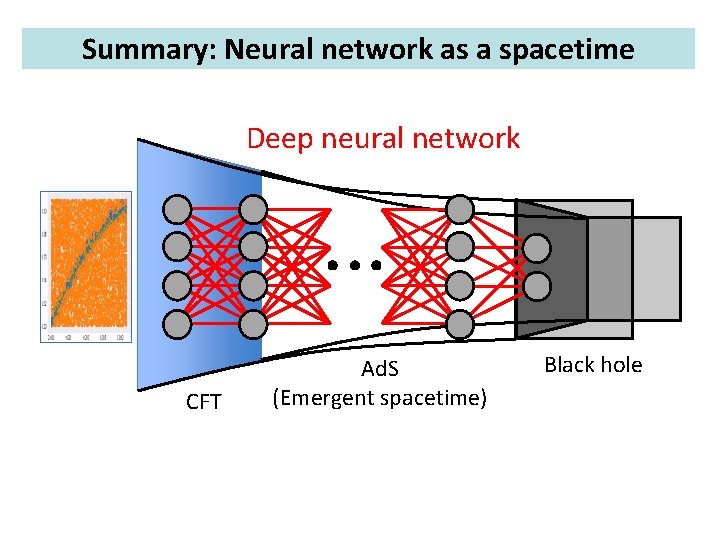
2 -1 Holography as a classifier Ad. S/CFT [Maldacena ‘ 97] Deep neural network CFT Ad. S (Emergent spacetime) Black hole
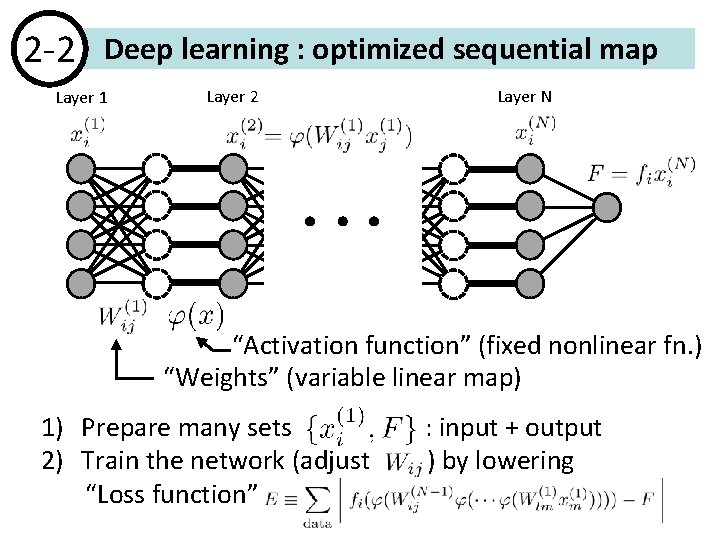
2 -2 Deep learning : optimized sequential map Layer 1 Layer 2 Layer N “Activation function” (fixed nonlinear fn. ) “Weights” (variable linear map) 1) Prepare many sets 2) Train the network (adjust “Loss function” : input + output ) by lowering
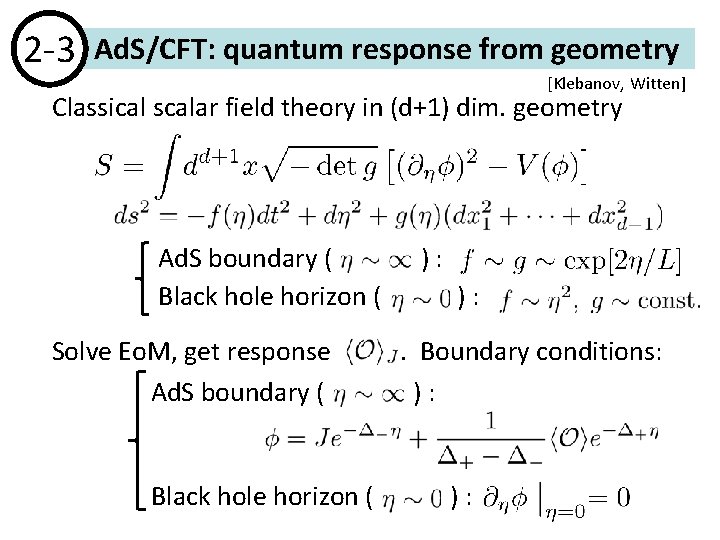
2 -3 Ad. S/CFT: quantum response from geometry [Klebanov, Witten] Classical scalar field theory in (d+1) dim. geometry Ad. S boundary ( Black hole horizon ( Solve Eo. M, get response Ad. S boundary ( Black hole horizon ( ): ): . Boundary conditions: ):
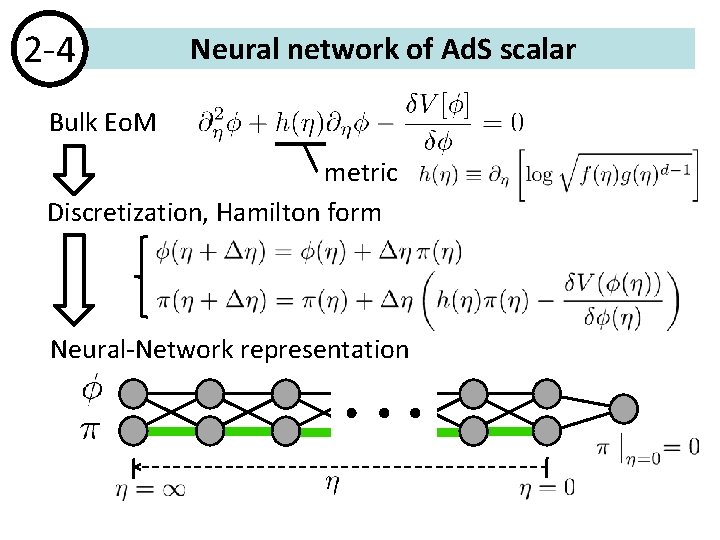
2 -4 Neural network of Ad. S scalar Bulk Eo. M metric Discretization, Hamilton form Neural-Network representation
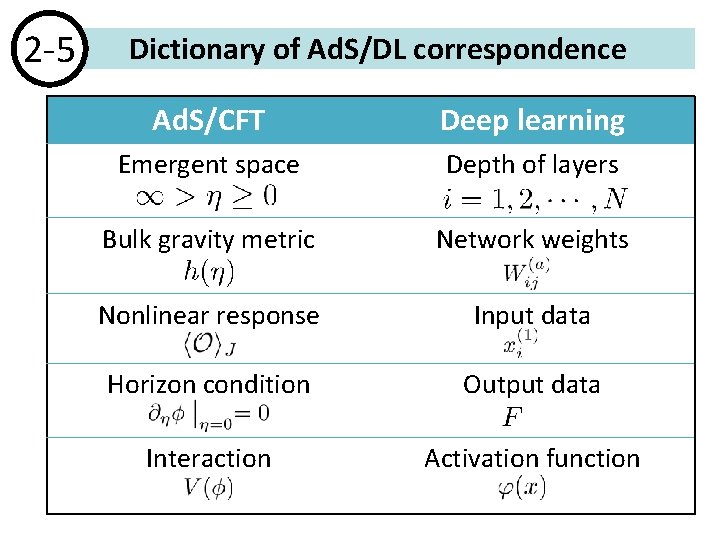
2 -5 Dictionary of Ad. S/DL correspondence Ad. S/CFT Deep learning Emergent space Depth of layers Bulk gravity metric Network weights Nonlinear response Input data Horizon condition Output data Interaction Activation function
4 pages 1. Is deep learning useful? 5 pages 2. Ad. S/DL 3. Deeply learning QCD 8 pages
Holographic QCD is an inverse problem Gravity Model Metric Q Qbar potential Lattice QCD data: chiral condensate VS quark mass Prediction Deep Learning [RBC-Bielefeld collaboration, 2008] (Courtesy of W. Unger) Experiment data [Petreczky, 2010]
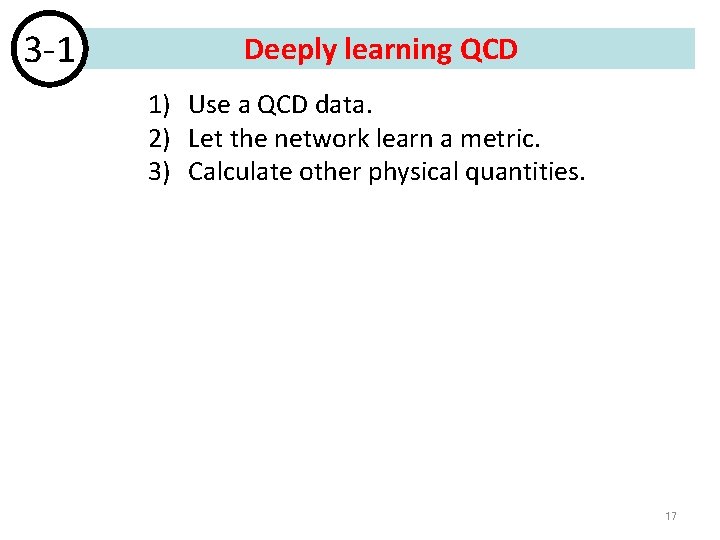
3 -1 Deeply learning QCD 1) Use a QCD data. 2) Let the network learn a metric. 3) Calculate other physical quantities. 17
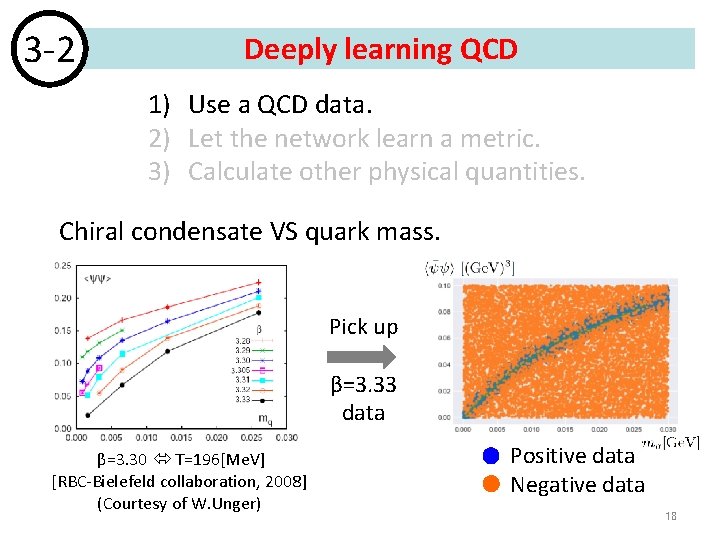
3 -2 Deeply learning QCD 1) Use a QCD data. 2) Let the network learn a metric. 3) Calculate other physical quantities. Chiral condensate VS quark mass. Pick up β=3. 33 data β=3. 30 T=196[Me. V] [RBC-Bielefeld collaboration, 2008] (Courtesy of W. Unger) Positive data Negative data 18
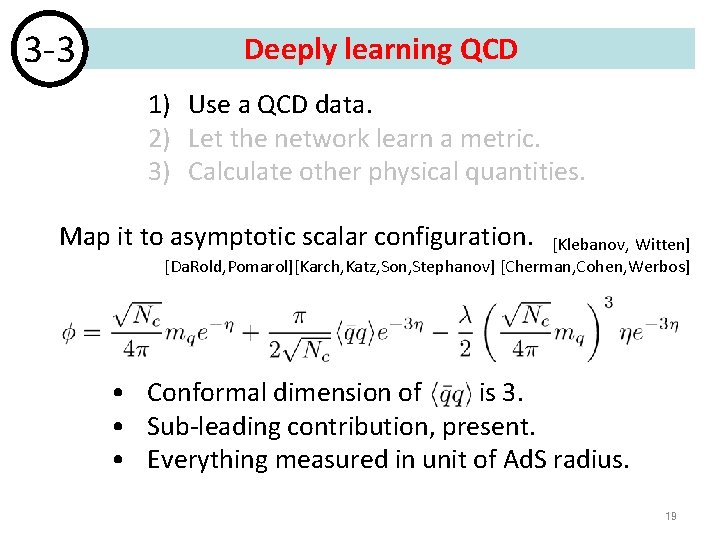
3 -3 Deeply learning QCD 1) Use a QCD data. 2) Let the network learn a metric. 3) Calculate other physical quantities. Map it to asymptotic scalar configuration. [Klebanov, Witten] [Da. Rold, Pomarol][Karch, Katz, Son, Stephanov] [Cherman, Cohen, Werbos] • Conformal dimension of is 3. • Sub-leading contribution, present. • Everything measured in unit of Ad. S radius. 19
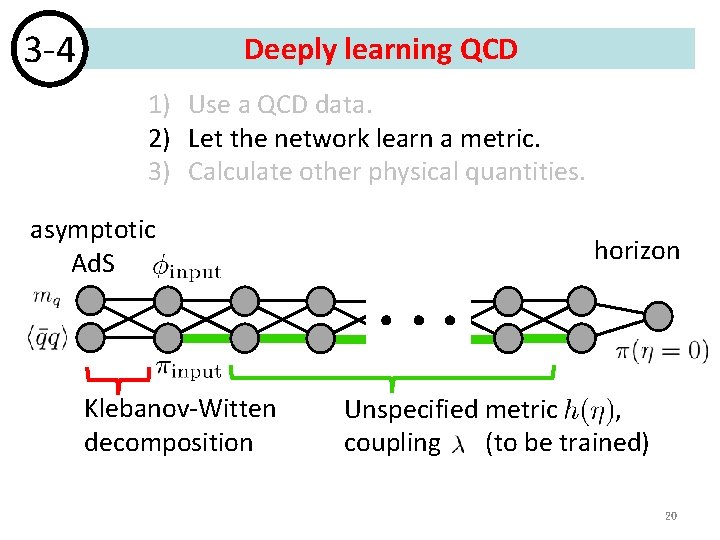
3 -4 Deeply learning QCD 1) Use a QCD data. 2) Let the network learn a metric. 3) Calculate other physical quantities. asymptotic Ad. S Klebanov-Witten decomposition horizon Unspecified metric , coupling (to be trained) 20
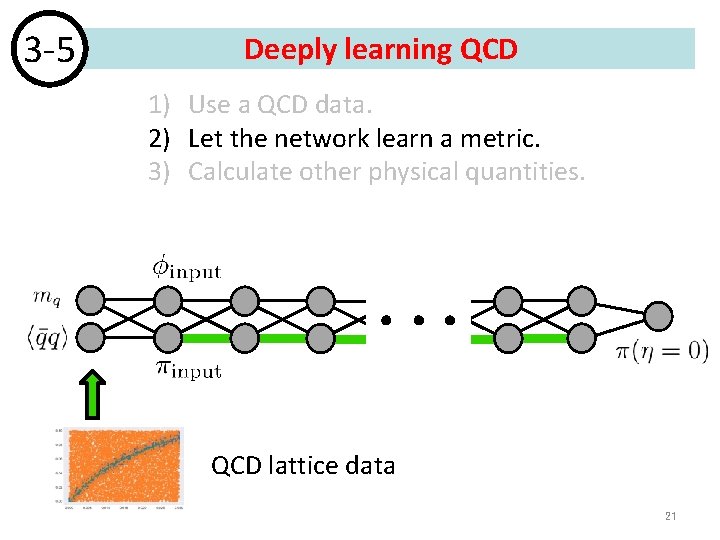
3 -5 Deeply learning QCD 1) Use a QCD data. 2) Let the network learn a metric. 3) Calculate other physical quantities. QCD lattice data 21
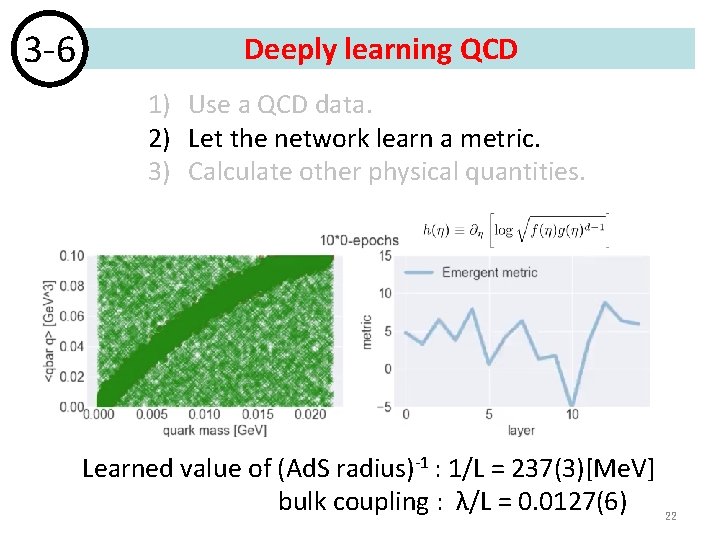
3 -6 Deeply learning QCD 1) Use a QCD data. 2) Let the network learn a metric. 3) Calculate other physical quantities. Learned value of (Ad. S radius)-1 : 1/L = 237(3)[Me. V] bulk coupling : λ/L = 0. 0127(6) 22
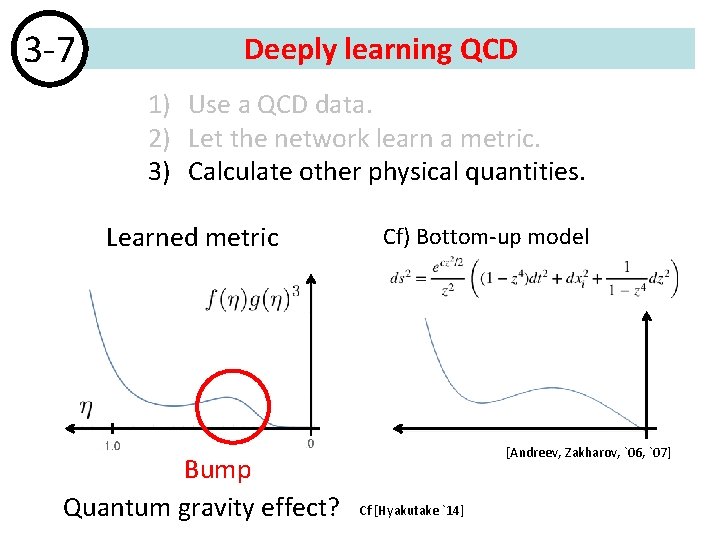
3 -7 Deeply learning QCD 1) Use a QCD data. 2) Let the network learn a metric. 3) Calculate other physical quantities. Learned metric Bump Quantum gravity effect? Cf) Bottom-up model [Andreev, Zakharov, `06, `07] Cf [Hyakutake `14]
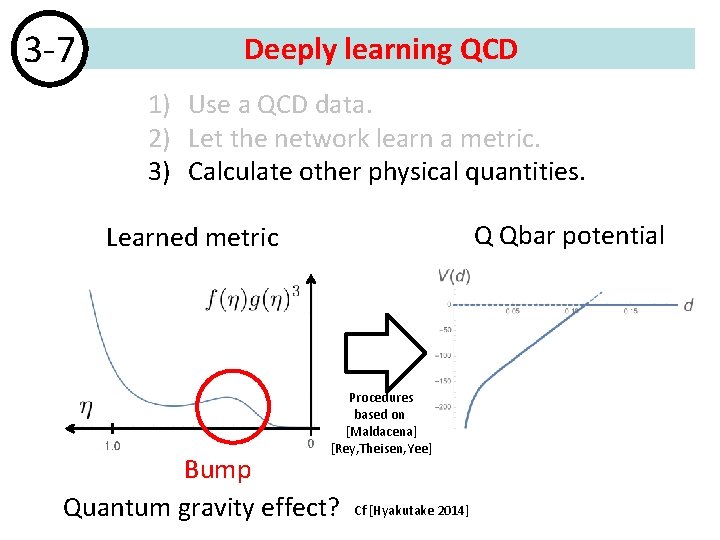
3 -7 Deeply learning QCD 1) Use a QCD data. 2) Let the network learn a metric. 3) Calculate other physical quantities. Q Qbar potential Learned metric Procedures based on [Maldacena] [Rey, Theisen, Yee] Bump Quantum gravity effect? Cf [Hyakutake 2014]
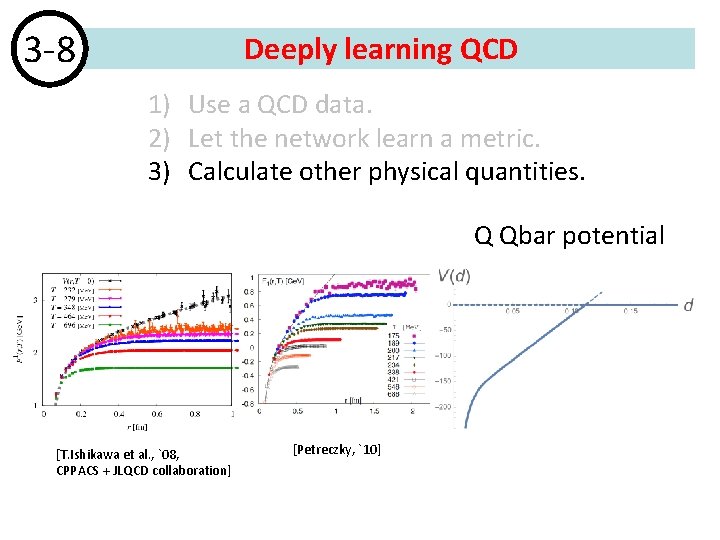
3 -8 Deeply learning QCD 1) Use a QCD data. 2) Let the network learn a metric. 3) Calculate other physical quantities. Q Qbar potential [T. Ishikawa et al. , `08, CPPACS + JLQCD collaboration] [Petreczky, `10]
4 pages 1. Is deep learning useful? 5 pages 2. Ad. S/DL 3. Deeply learning QCD 8 pages
Summary: Neural network as a spacetime Deep neural network CFT Ad. S (Emergent spacetime) Black hole
A What do we learn? Strategy for a universal modeling? - Consistency with more observables: 1 -pt, 2 -pt, 3 -pt, … and spacetime dependence? - Hadron spectroscopy. [Akutagawa, Sumimoto, KH in progress] - Rather, observable-oriented modeling? Consistency with top-down approach? - Supergravity as a regularization for learning Quantum gravity path-integral? 28
A Emergent geometry? Emergence of Ad. S radial direction? Bulk reconstruction and locality. [Heemskerk, Penedones, Polchinski, Sully 09] Entanglement entropy reconstruction. [Balasubramanian, Chowdhury, Czech, de Boer, Heller 13] [Myers, Rao, Sugishita 14] Optimization of boundary path integral. [Caputa, Kundu, Miyaji, Takayanagi, Watanabe 17] Renormalization and effective LG theory. [Ki-Seok Kim, Chanyong Park 16] Ad. S/MERA. [Swingle 12] Emergence of smooth neural network space? Statistical neural network. [Amari et al. ] 29