
A Bayesian Approach to QCD Sum Rules ar
A Bayesian Approach to QCD Sum Rules ar. Xiv: 1005. 2459 [hep-ph] (to be published in PTP) ストレンジネス核物理2010 KEK 4. 12. 2010 Philipp Gubler (Tokyo. Tech) Collaborators: Makoto Oka (Tokyo. Tech), Kenji Morita (GSI)
Contents n n QCD Sum Rules and the Maximum Entropy Method Test of the method in the case of the ρmeson channel First results of the analysis of charmonium at finite temperature Conclusions and outlook
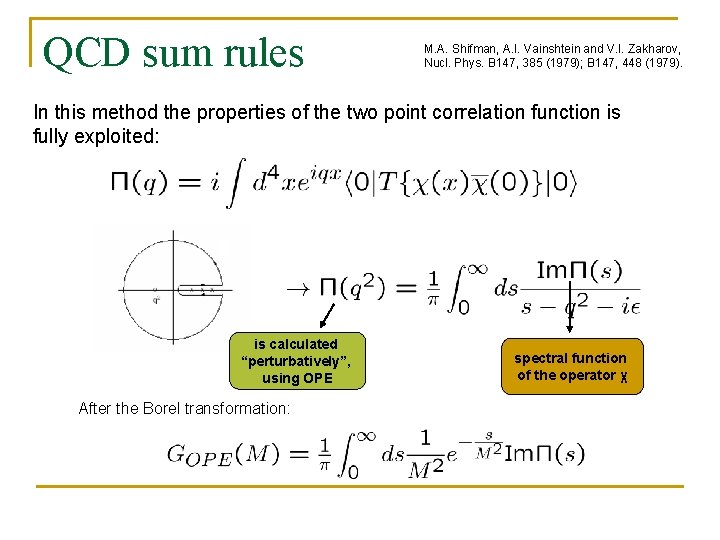
QCD sum rules M. A. Shifman, A. I. Vainshtein and V. I. Zakharov, Nucl. Phys. B 147, 385 (1979); B 147, 448 (1979). In this method the properties of the two point correlation function is fully exploited: is calculated “perturbatively”, using OPE After the Borel transformation: spectral function of the operator χ
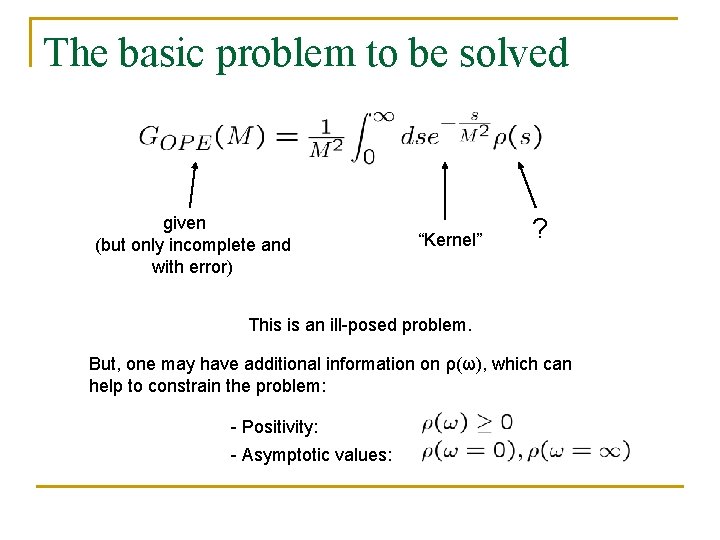
The basic problem to be solved given (but only incomplete and with error) “Kernel” ? This is an ill-posed problem. But, one may have additional information on ρ(ω), which can help to constrain the problem: - Positivity: - Asymptotic values:
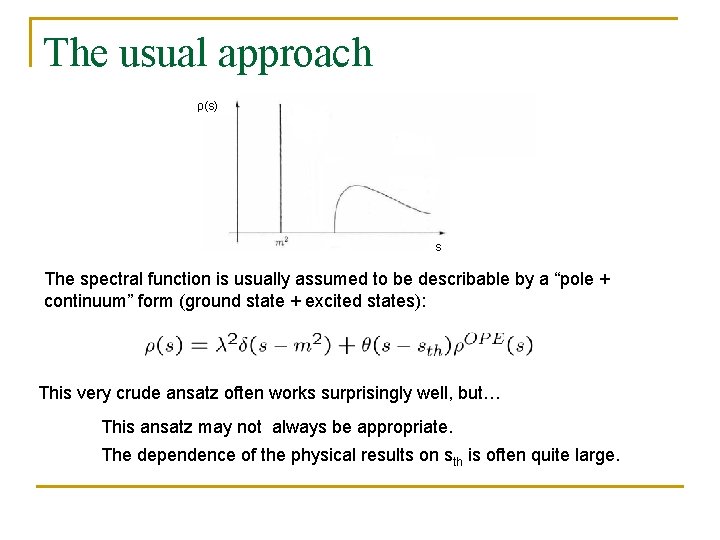
The usual approach ρ(s) s The spectral function is usually assumed to be describable by a “pole + continuum” form (ground state + excited states): This very crude ansatz often works surprisingly well, but… This ansatz may not always be appropriate. The dependence of the physical results on sth is often quite large.
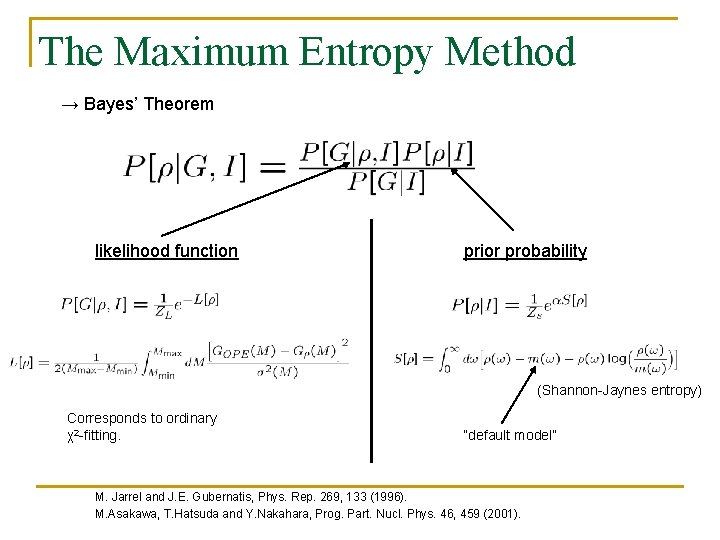
The Maximum Entropy Method → Bayes’ Theorem likelihood function prior probability (Shannon-Jaynes entropy) Corresponds to ordinary χ2 -fitting. “default model” M. Jarrel and J. E. Gubernatis, Phys. Rep. 269, 133 (1996). M. Asakawa, T. Hatsuda and Y. Nakahara, Prog. Part. Nucl. Phys. 46, 459 (2001).
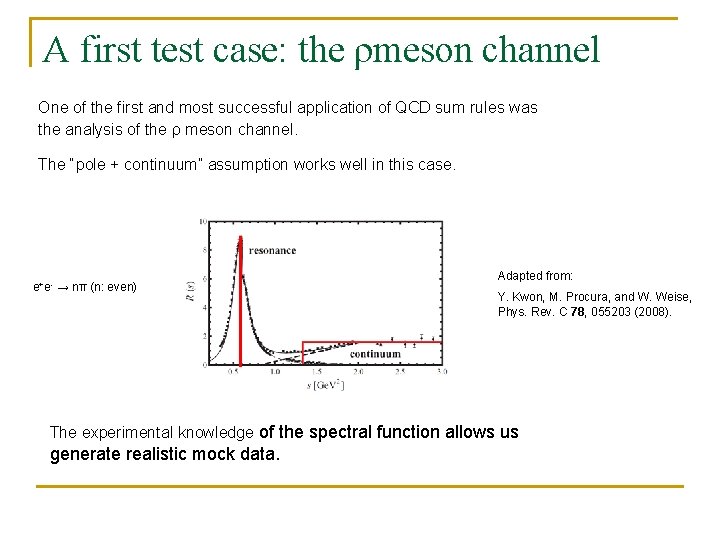
A first test case: the ρmeson channel One of the first and most successful application of QCD sum rules was the analysis of the ρ meson channel. The “pole + continuum” assumption works well in this case. e+e- → nπ (n: even) Adapted from: Y. Kwon, M. Procura, and W. Weise, Phys. Rev. C 78, 055203 (2008). The experimental knowledge of the spectral function allows us generate realistic mock data.
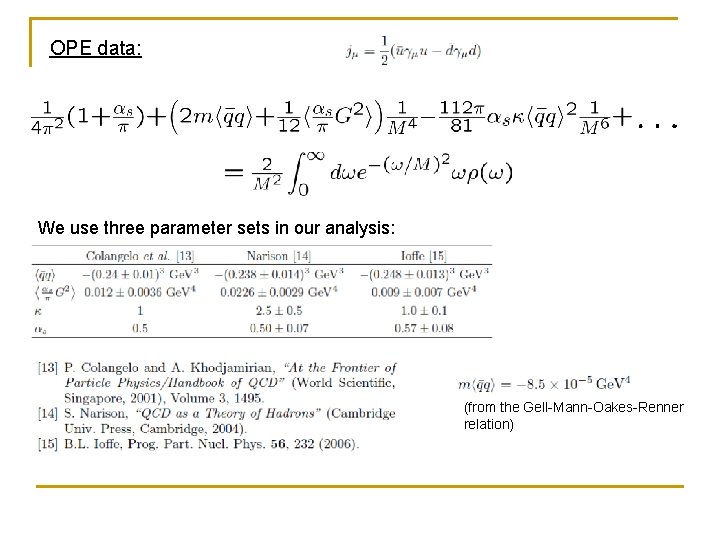
OPE data: We use three parameter sets in our analysis: (from the Gell-Mann-Oakes-Renner relation)
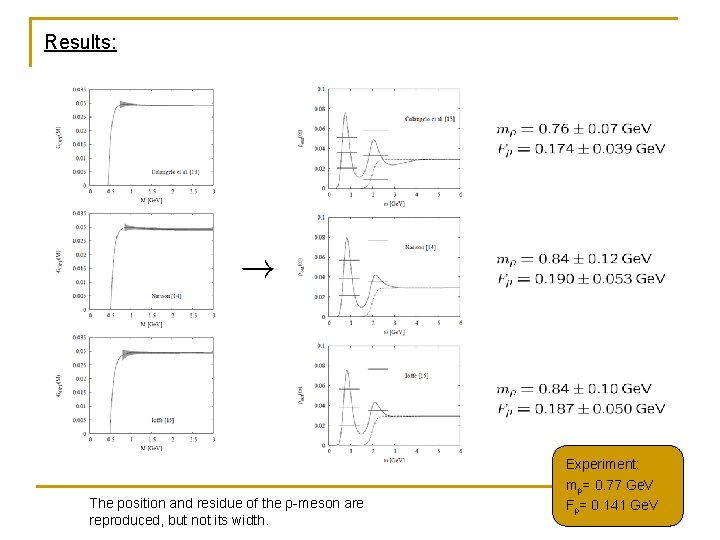
Results: Experiment: The position and residue of the ρ-meson are reproduced, but not its width. mρ= 0. 77 Ge. V Fρ= 0. 141 Ge. V
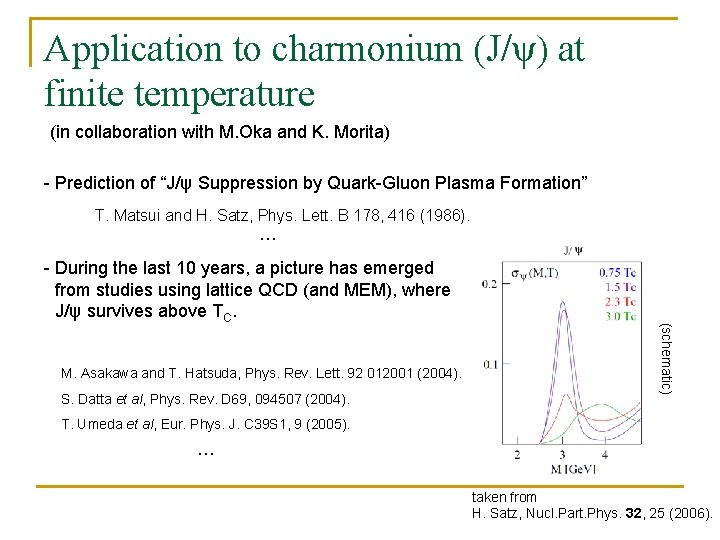
Application to charmonium (J/ψ) at finite temperature (in collaboration with M. Oka and K. Morita) - Prediction of “J/ψ Suppression by Quark-Gluon Plasma Formation” T. Matsui and H. Satz, Phys. Lett. B 178, 416 (1986). … M. Asakawa and T. Hatsuda, Phys. Rev. Lett. 92 012001 (2004). S. Datta et al, Phys. Rev. D 69, 094507 (2004). (schematic) - During the last 10 years, a picture has emerged from studies using lattice QCD (and MEM), where J/ψ survives above TC. T. Umeda et al, Eur. Phys. J. C 39 S 1, 9 (2005). … taken from H. Satz, Nucl. Part. Phys. 32, 25 (2006).
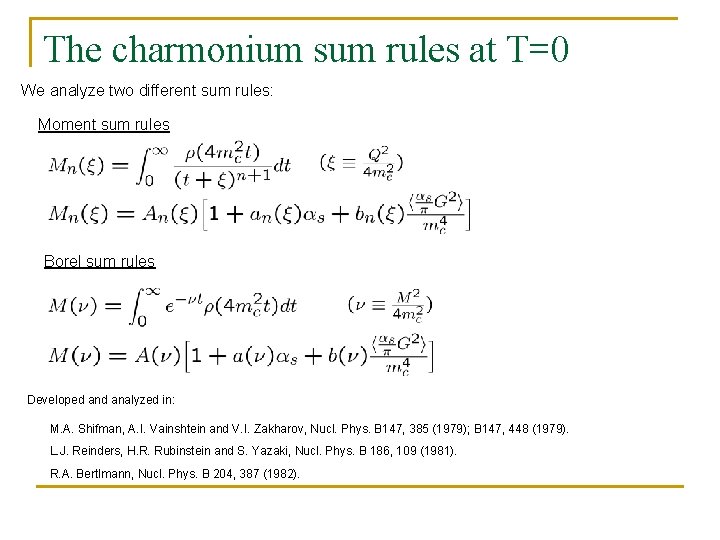
The charmonium sum rules at T=0 We analyze two different sum rules: Moment sum rules Borel sum rules Developed analyzed in: M. A. Shifman, A. I. Vainshtein and V. I. Zakharov, Nucl. Phys. B 147, 385 (1979); B 147, 448 (1979). L. J. Reinders, H. R. Rubinstein and S. Yazaki, Nucl. Phys. B 186, 109 (1981). R. A. Bertlmann, Nucl. Phys. B 204, 387 (1982).
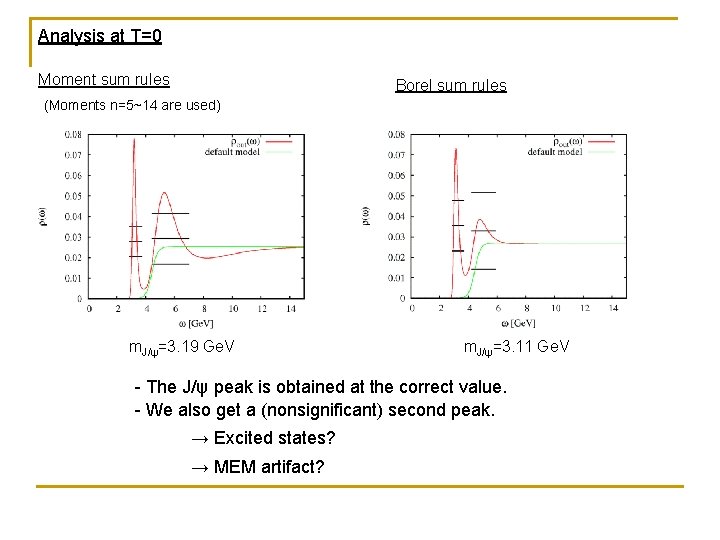
Analysis at T=0 Moment sum rules Borel sum rules (Moments n=5~14 are used) m. J/ψ=3. 19 Ge. V m. J/ψ=3. 11 Ge. V - The J/ψ peak is obtained at the correct value. - We also get a (nonsignificant) second peak. → Excited states? → MEM artifact?
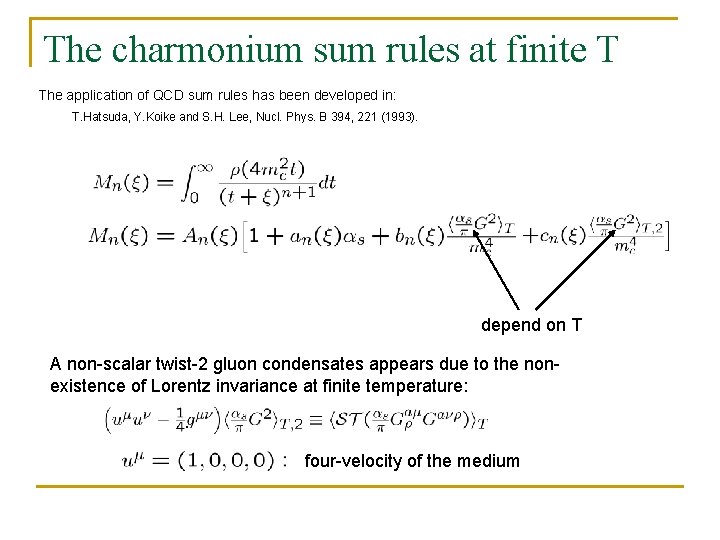
The charmonium sum rules at finite T The application of QCD sum rules has been developed in: T. Hatsuda, Y. Koike and S. H. Lee, Nucl. Phys. B 394, 221 (1993). depend on T A non-scalar twist-2 gluon condensates appears due to the nonexistence of Lorentz invariance at finite temperature: four-velocity of the medium
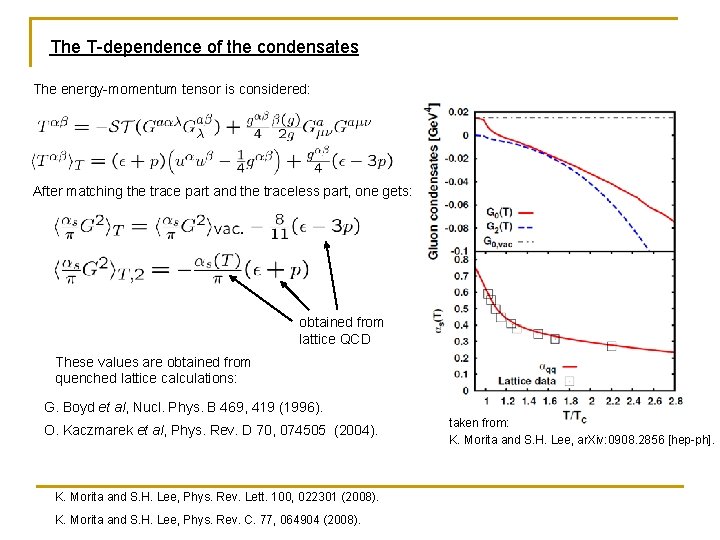
The T-dependence of the condensates The energy-momentum tensor is considered: After matching the trace part and the traceless part, one gets: obtained from lattice QCD These values are obtained from quenched lattice calculations: G. Boyd et al, Nucl. Phys. B 469, 419 (1996). O. Kaczmarek et al, Phys. Rev. D 70, 074505 (2004). K. Morita and S. H. Lee, Phys. Rev. Lett. 100, 022301 (2008). K. Morita and S. H. Lee, Phys. Rev. C. 77, 064904 (2008). taken from: K. Morita and S. H. Lee, ar. Xiv: 0908. 2856 [hep-ph].
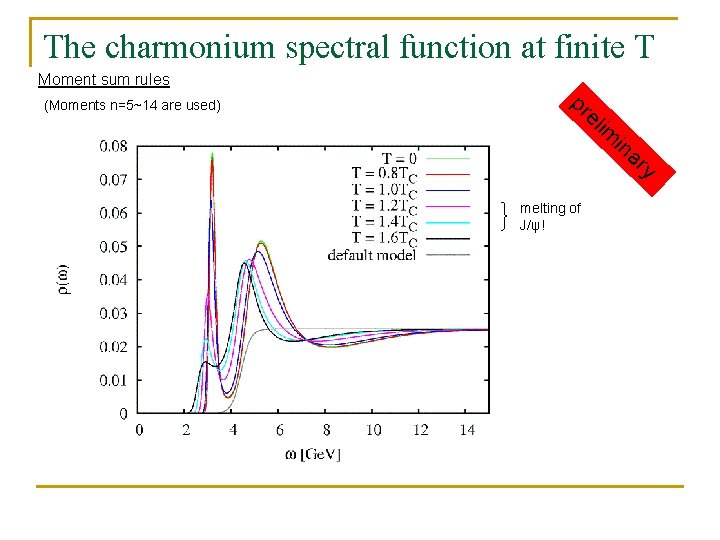
The charmonium spectral function at finite T Moment sum rules (Moments n=5~14 are used) pr el im in ar melting of J/ψ! y
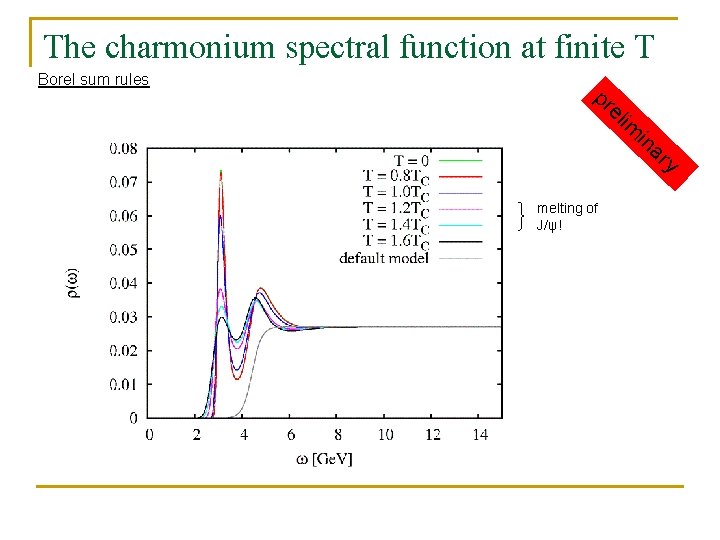
The charmonium spectral function at finite T Borel sum rules pr el im in ar melting of J/ψ! y
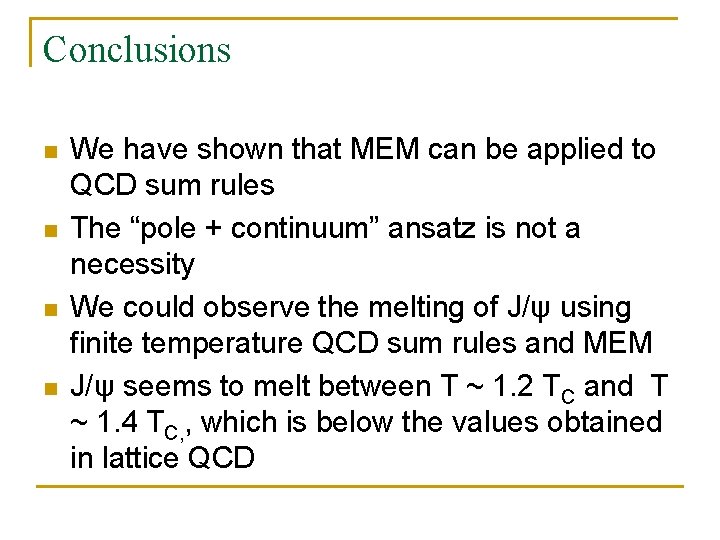
Conclusions n n We have shown that MEM can be applied to QCD sum rules The “pole + continuum” ansatz is not a necessity We could observe the melting of J/ψ using finite temperature QCD sum rules and MEM J/ψ seems to melt between T ~ 1. 2 TC and T ~ 1. 4 TC, , which is below the values obtained in lattice QCD
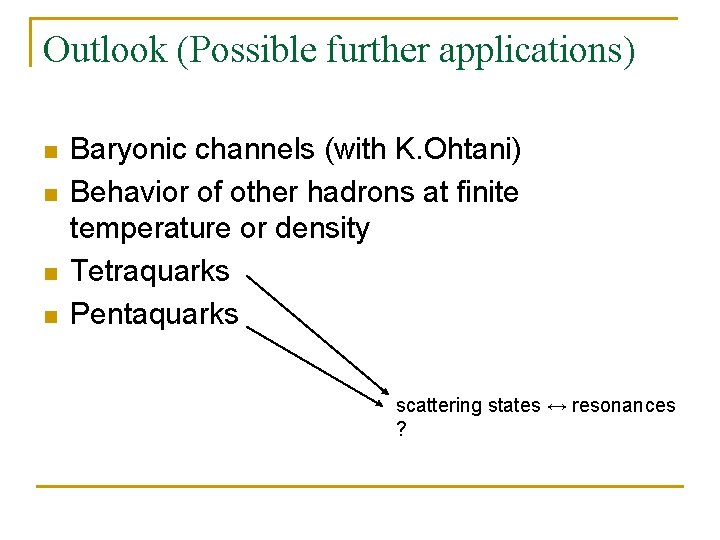
Outlook (Possible further applications) n n Baryonic channels (with K. Ohtani) Behavior of other hadrons at finite temperature or density Tetraquarks Pentaquarks scattering states ↔ resonances ?
- Slides: 18