
QCD and the Spin Structure of the Nucleons


- Slides: 65
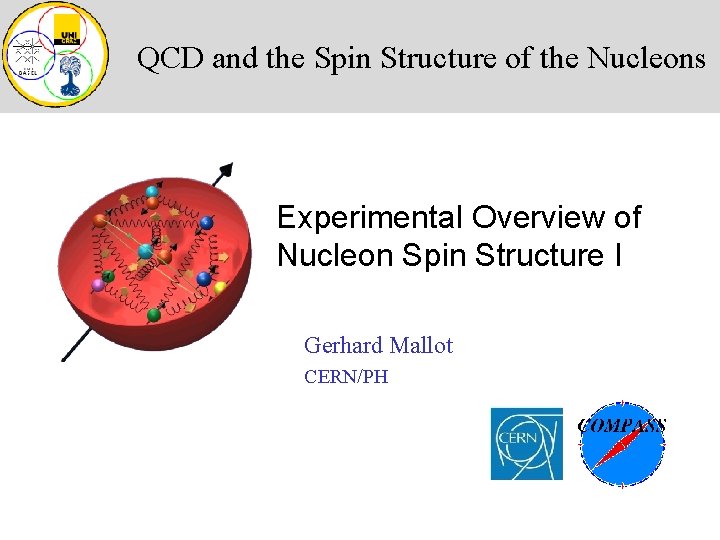
QCD and the Spin Structure of the Nucleons Experimental Overview of Nucleon Spin Structure I Gerhard Mallot CERN/PH
Plan • • Introduction DIS and structure functions Why is ΔΣ so small Experiments Inclusive results Semi-inclusive results ΔG from photon-gluon fusion RHIC pp collisions G. Mallot/CERN Tübingen, 26 November 2009
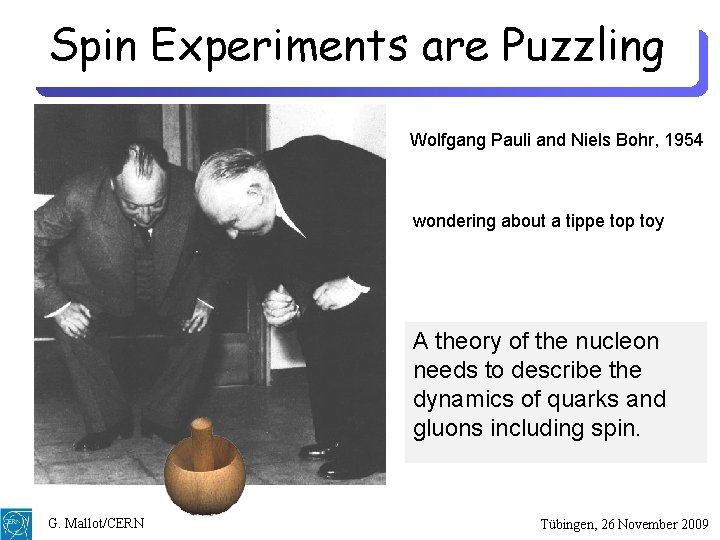
Spin Experiments are Puzzling Wolfgang Pauli and Niels Bohr, 1954 wondering about a tippe top toy A theory of the nucleon needs to describe the dynamics of quarks and gluons including spin. G. Mallot/CERN Tübingen, 26 November 2009
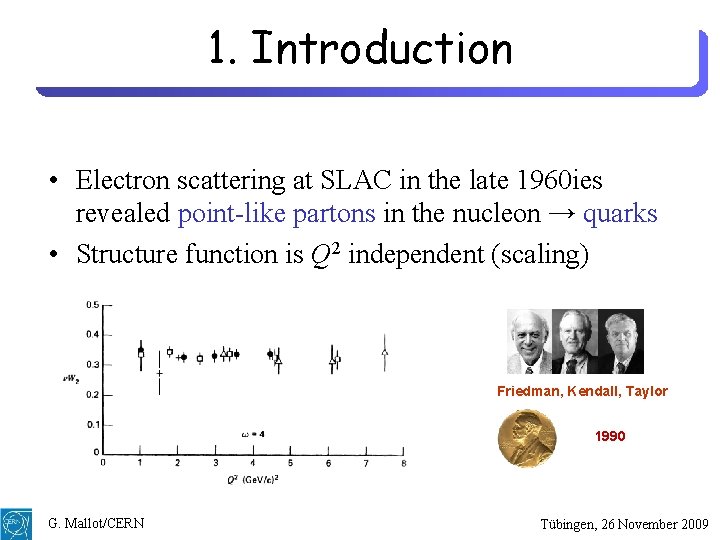
1. Introduction • Electron scattering at SLAC in the late 1960 ies revealed point-like partons in the nucleon → quarks • Structure function is Q 2 independent (scaling) Friedman, Kendall, Taylor 1990 G. Mallot/CERN Tübingen, 26 November 2009
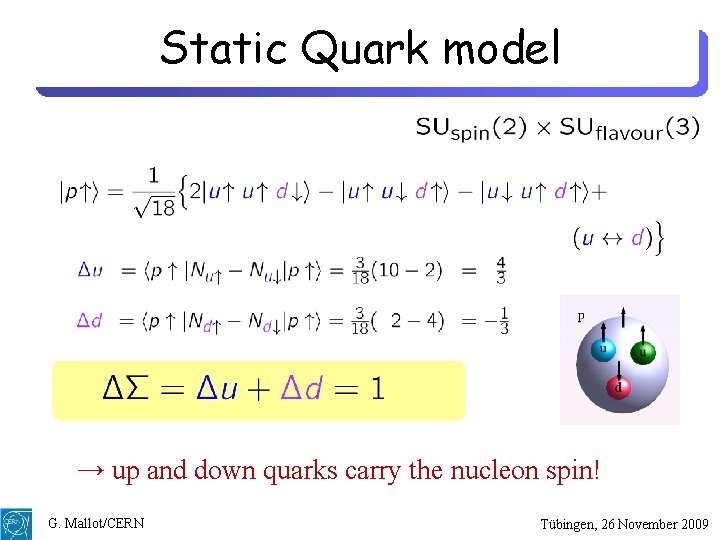
Static Quark model → up and down quarks carry the nucleon spin! G. Mallot/CERN Tübingen, 26 November 2009
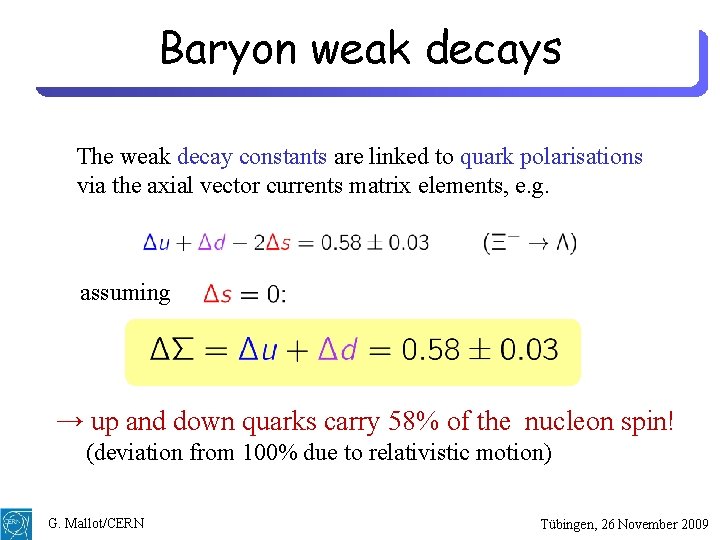
Baryon weak decays The weak decay constants are linked to quark polarisations via the axial vector currents matrix elements, e. g. assuming → up and down quarks carry 58% of the nucleon spin! (deviation from 100% due to relativistic motion) G. Mallot/CERN Tübingen, 26 November 2009
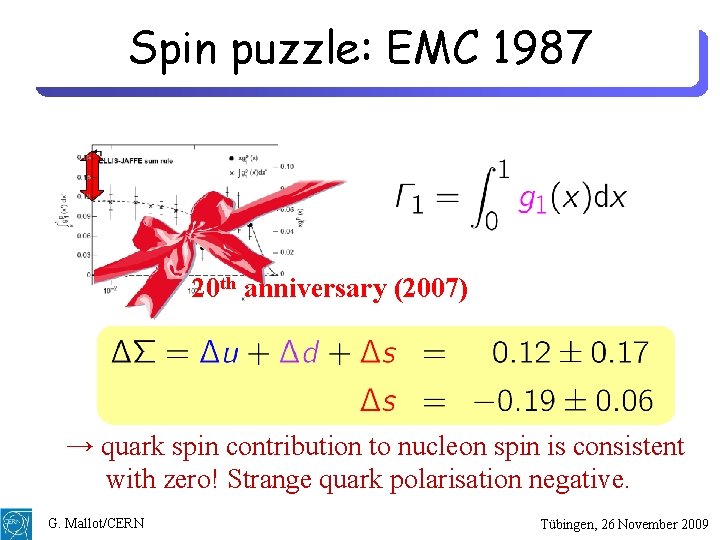
Spin puzzle: EMC 1987 20 th anniversary (2007) → quark spin contribution to nucleon spin is consistent with zero! Strange quark polarisation negative. G. Mallot/CERN Tübingen, 26 November 2009
2. DIS and structure functions • What did the EMC actually measure? • How severe is the spin puzzle? • Can the Quark Model expectation ΔΣ = 0. 6 be restored? G. Mallot/CERN Tübingen, 26 November 2009
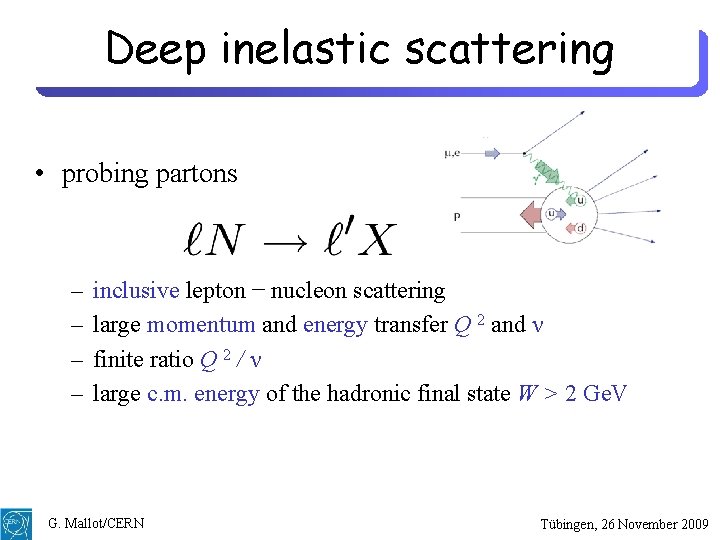
Deep inelastic scattering • probing partons – – inclusive lepton − nucleon scattering large momentum and energy transfer Q 2 and ν finite ratio Q 2 / ν large c. m. energy of the hadronic final state W > 2 Ge. V G. Mallot/CERN Tübingen, 26 November 2009
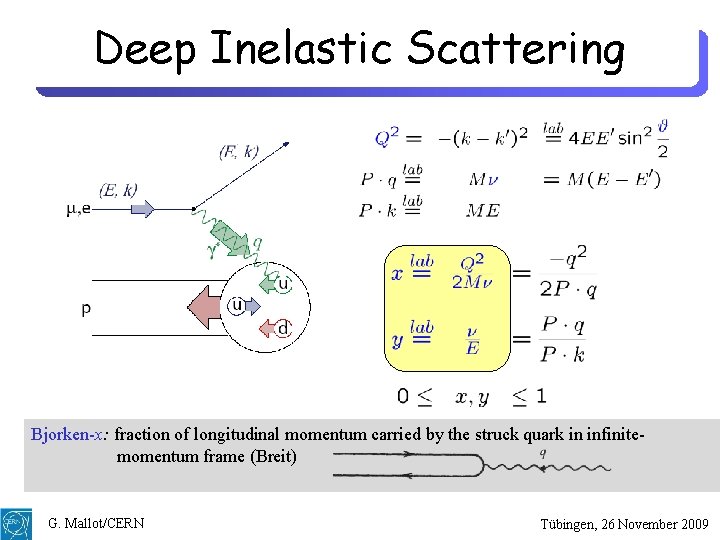
Deep Inelastic Scattering Bjorken-x: fraction of longitudinal momentum carried by the struck quark in infinitemomentum frame (Breit) G. Mallot/CERN Tübingen, 26 November 2009
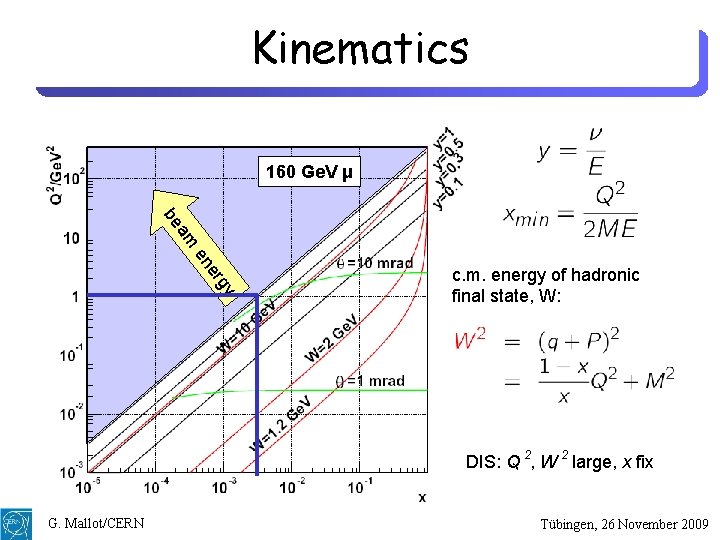
Kinematics 160 Ge. V μ am be gy er en c. m. energy of hadronic final state, W: DIS: Q 2, W 2 large, x fix G. Mallot/CERN Tübingen, 26 November 2009
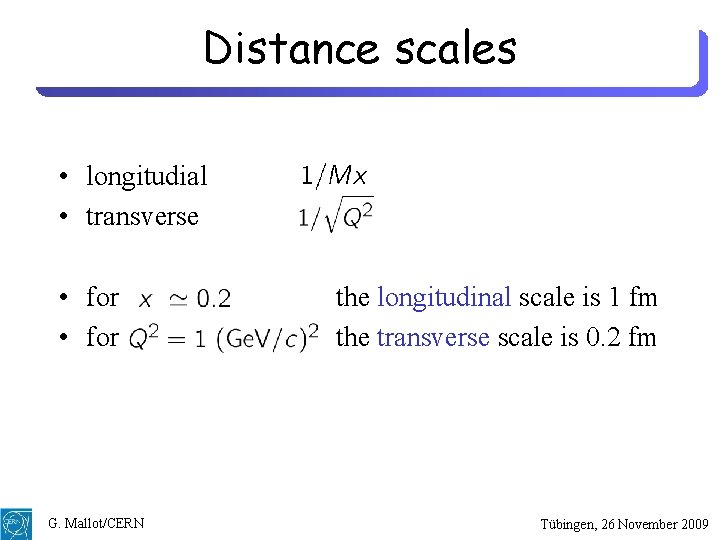
Distance scales • longitudial • transverse • for G. Mallot/CERN the longitudinal scale is 1 fm the transverse scale is 0. 2 fm Tübingen, 26 November 2009
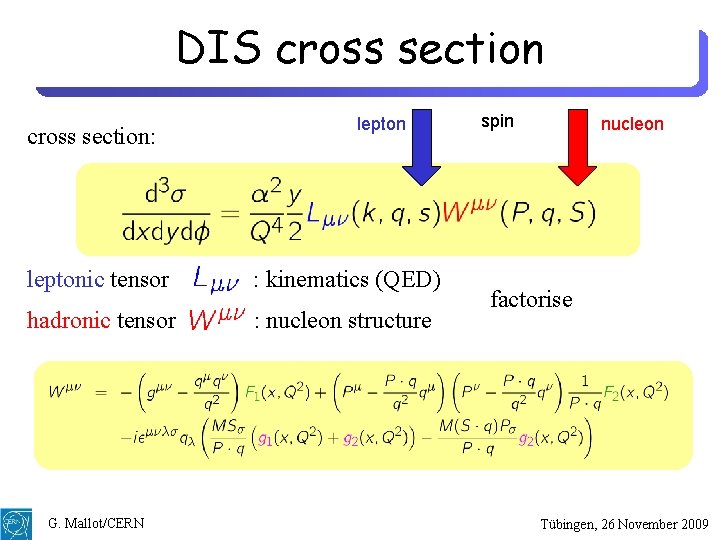
DIS cross section: leptonic tensor : kinematics (QED) hadronic tensor : nucleon structure G. Mallot/CERN spin nucleon factorise Tübingen, 26 November 2009
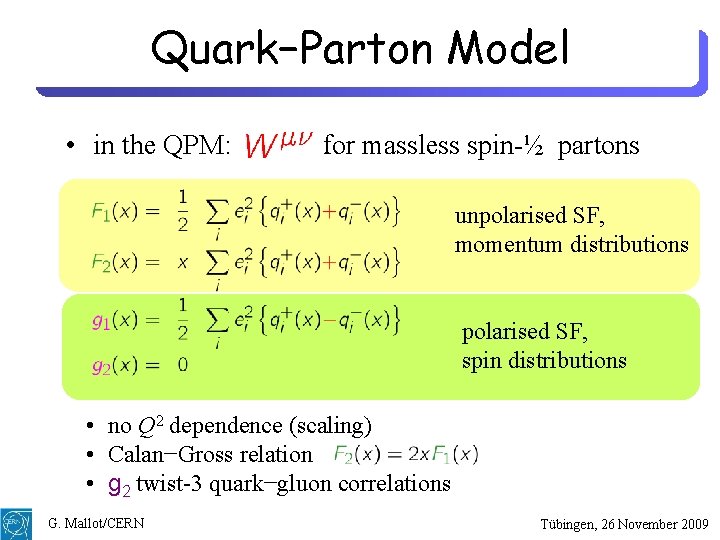
Quark−Parton Model • in the QPM: for massless spin-½ partons unpolarised SF, momentum distributions polarised SF, spin distributions • no Q 2 dependence (scaling) • Calan−Gross relation • g 2 twist-3 quark−gluon correlations G. Mallot/CERN Tübingen, 26 November 2009
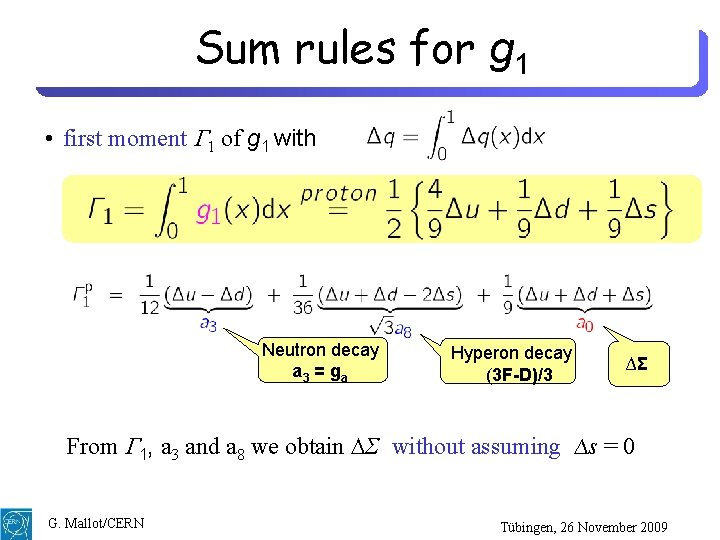
Sum rules for g 1 • first moment 1 of g 1 with Neutron decay a 3 = g a Hyperon decay (3 F-D)/3 ∆Σ From 1, a 3 and a 8 we obtain ∆Σ without assuming ∆s = 0 G. Mallot/CERN Tübingen, 26 November 2009
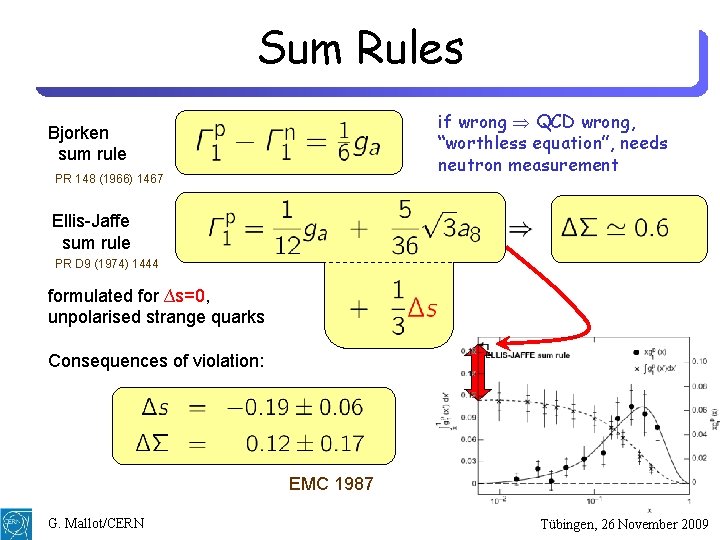
Sum Rules if wrong QCD wrong, “worthless equation”, needs neutron measurement Bjorken sum rule PR 148 (1966) 1467 Ellis-Jaffe sum rule PR D 9 (1974) 1444 formulated for ∆s=0, unpolarised strange quarks Consequences of violation: EMC 1987 G. Mallot/CERN Tübingen, 26 November 2009
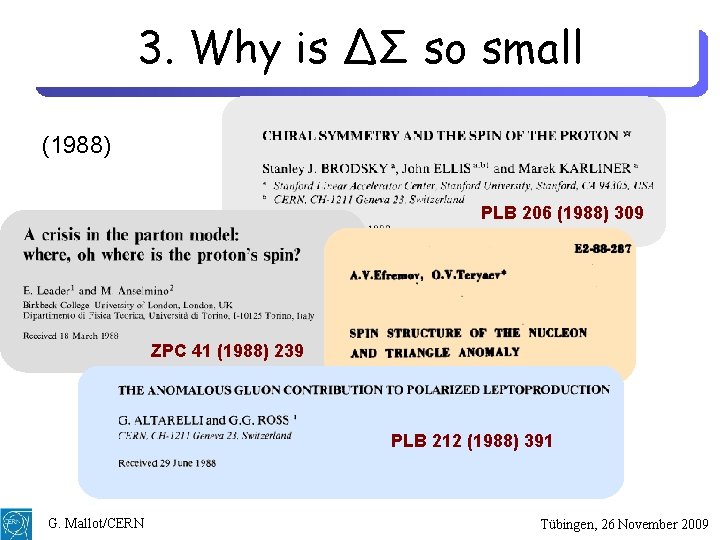
3. Why is ΔΣ so small (1988) PLB 206 (1988) 309 ZPC 41 (1988) 239 PLB 212 (1988) 391 G. Mallot/CERN Tübingen, 26 November 2009
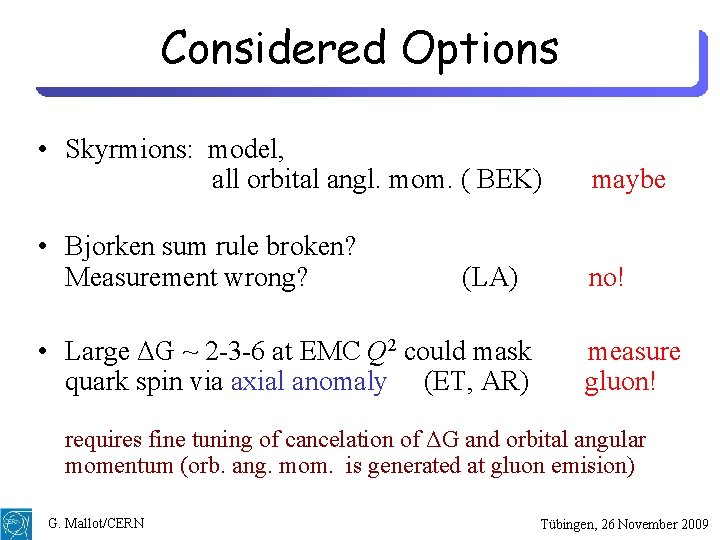
Considered Options • Skyrmions: model, all orbital angl. mom. ( BEK) maybe • Bjorken sum rule broken? Measurement wrong? no! (LA) • Large ΔG ~ 2 -3 -6 at EMC Q 2 could mask quark spin via axial anomaly (ET, AR) measure gluon! requires fine tuning of cancelation of ΔG and orbital angular momentum (orb. ang. mom. is generated at gluon emision) G. Mallot/CERN Tübingen, 26 November 2009
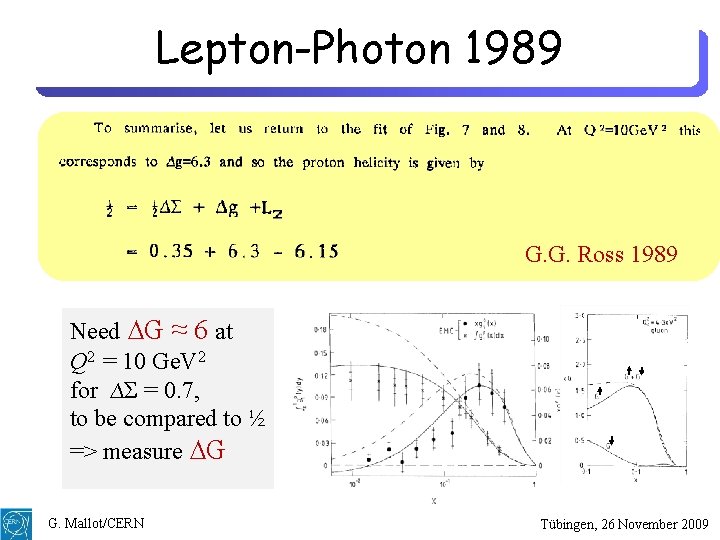
Lepton-Photon 1989 G. G. Ross 1989 Need ∆G ≈ 6 at Q 2 = 10 Ge. V 2 for ∆Σ = 0. 7, to be compared to ½ => measure ∆G G. Mallot/CERN Tübingen, 26 November 2009
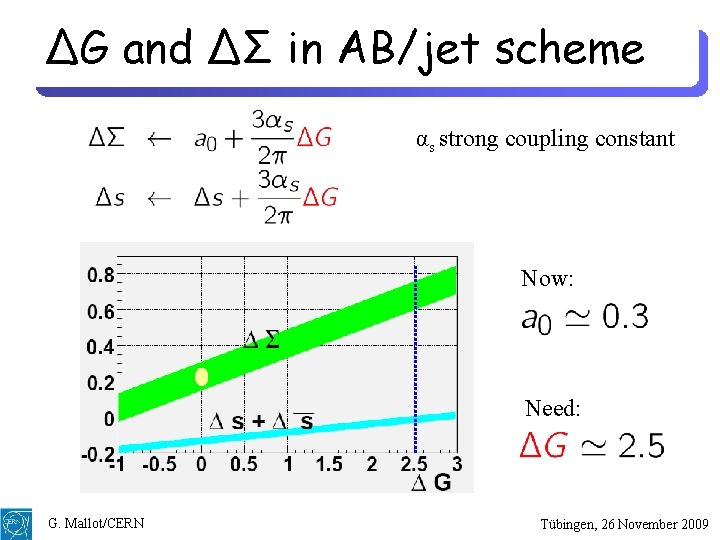
∆G and ∆Σ in AB/jet scheme αs strong coupling constant Now: Need: G. Mallot/CERN Tübingen, 26 November 2009
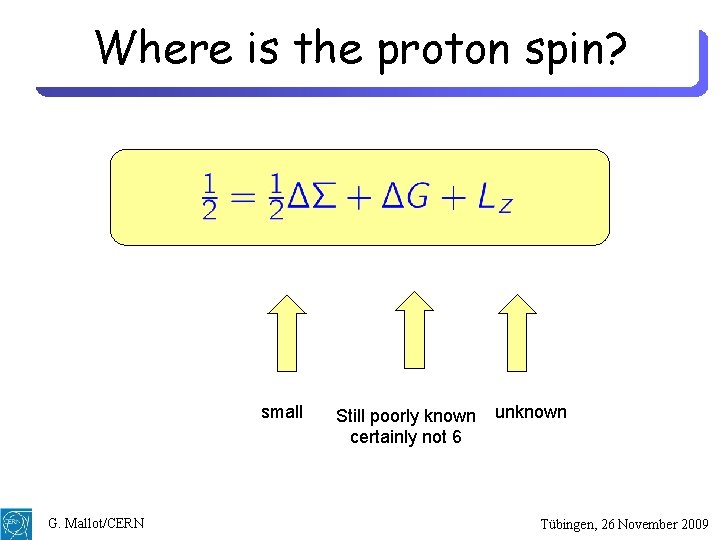
Where is the proton spin? small G. Mallot/CERN Still poorly known certainly not 6 unknown Tübingen, 26 November 2009
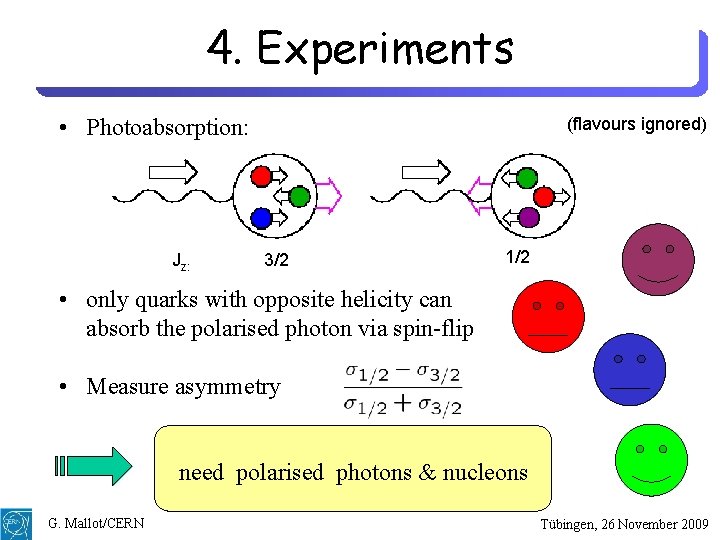
4. Experiments • Photoabsorption: Jz: (flavours ignored) 3/2 1/2 • only quarks with opposite helicity can absorb the polarised photon via spin-flip • Measure asymmetry need polarised photons & nucleons G. Mallot/CERN Tübingen, 26 November 2009
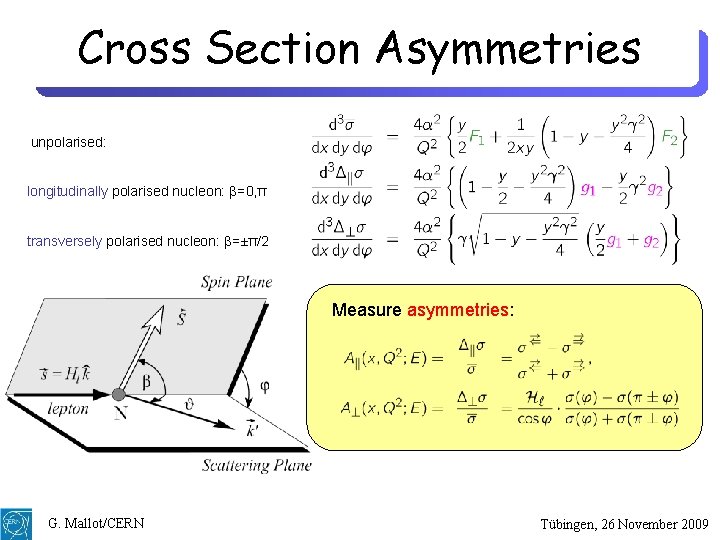
Cross Section Asymmetries unpolarised: longitudinally polarised nucleon: β=0, π transversely polarised nucleon: β=±π/2 Measure asymmetries: G. Mallot/CERN Tübingen, 26 November 2009
Experimental essentials I • up to now only pol. DIS experiments with fixed-target geometry • need polarised targets and beams • need detection of scattered lepton (or all hadrons), energy, direction, identification • need to know energy and direction of incoming lepton – detection or given by accelerator • measurable asymmetries very small – need excellent control of fake asymmetries, e. g. time variations of detector efficiencies G. Mallot/CERN Tübingen, 26 November 2009
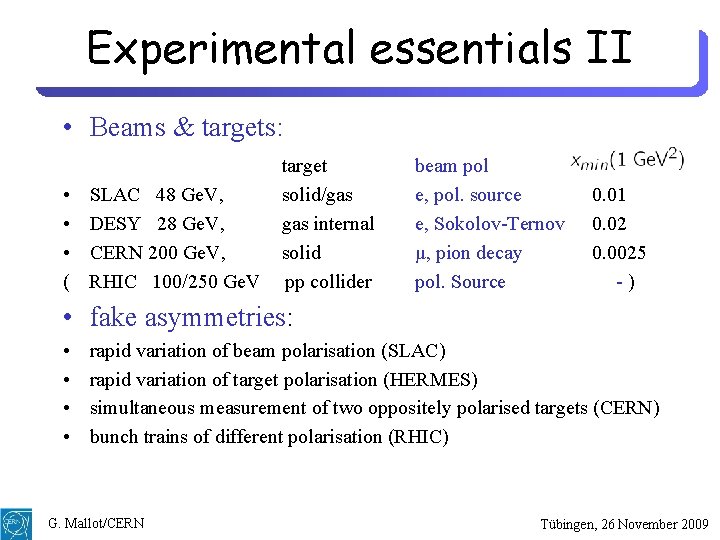
Experimental essentials II • Beams & targets: • • • ( SLAC 48 Ge. V, DESY 28 Ge. V, CERN 200 Ge. V, RHIC 100/250 Ge. V target solid/gas internal solid pp collider beam pol e, pol. source e, Sokolov-Ternov μ, pion decay pol. Source 0. 01 0. 02 0. 0025 -) • fake asymmetries: • • rapid variation of beam polarisation (SLAC) rapid variation of target polarisation (HERMES) simultaneous measurement of two oppositely polarised targets (CERN) bunch trains of different polarisation (RHIC) G. Mallot/CERN Tübingen, 26 November 2009
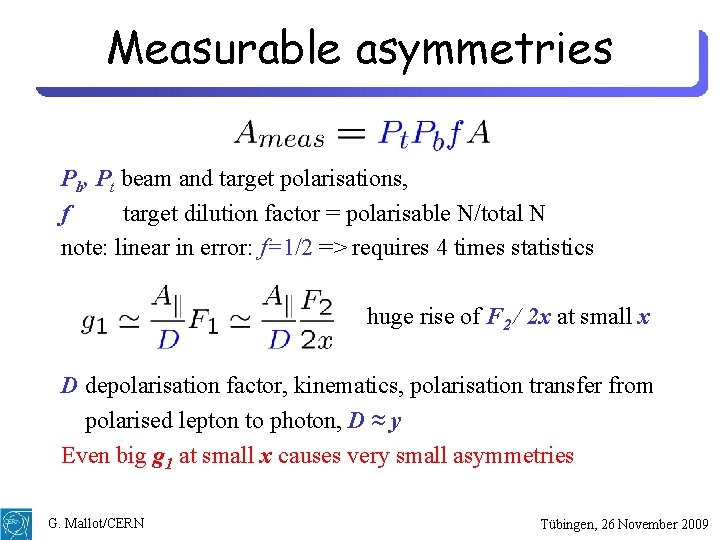
Measurable asymmetries Pb, Pt beam and target polarisations, f target dilution factor = polarisable N/total N note: linear in error: f=1/2 => requires 4 times statistics huge rise of F 2 / 2 x at small x D depolarisation factor, kinematics, polarisation transfer from polarised lepton to photon, D ≈ y Even big g 1 at small x causes very small asymmetries G. Mallot/CERN Tübingen, 26 November 2009
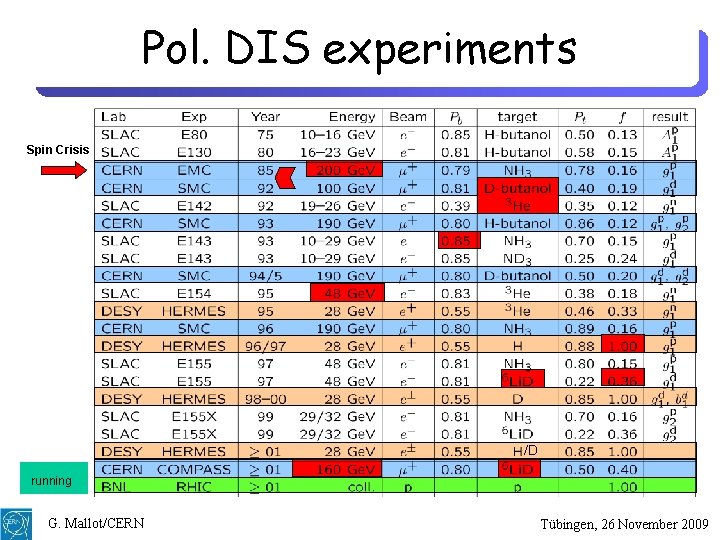
Pol. DIS experiments Spin Crisis /D running G. Mallot/CERN Tübingen, 26 November 2009
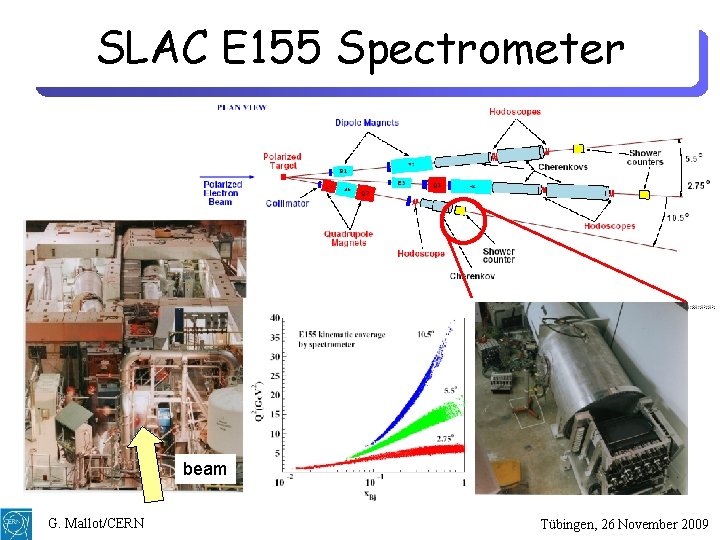
SLAC E 155 Spectrometer beam G. Mallot/CERN Tübingen, 26 November 2009
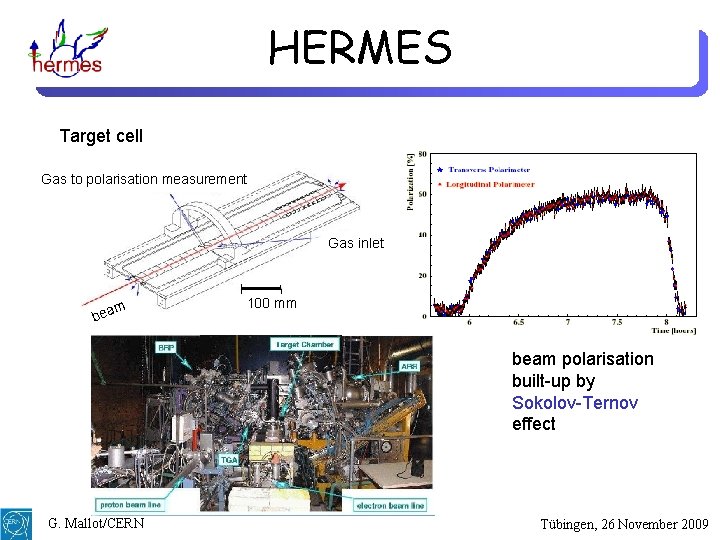
HERMES Target cell Gas to polarisation measurement Gas inlet m bea 100 mm beam polarisation built-up by Sokolov-Ternov effect G. Mallot/CERN Tübingen, 26 November 2009
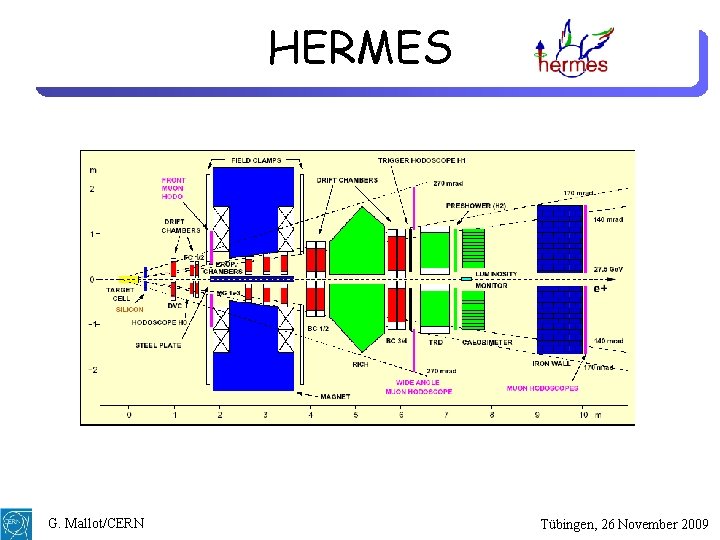
HERMES G. Mallot/CERN Tübingen, 26 November 2009
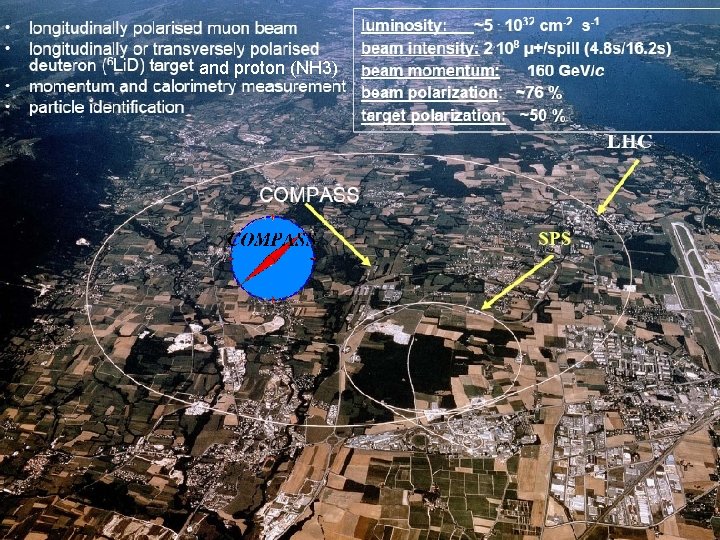
and proton (NH 3) G. Mallot/CERN Tübingen, 26 November 2009
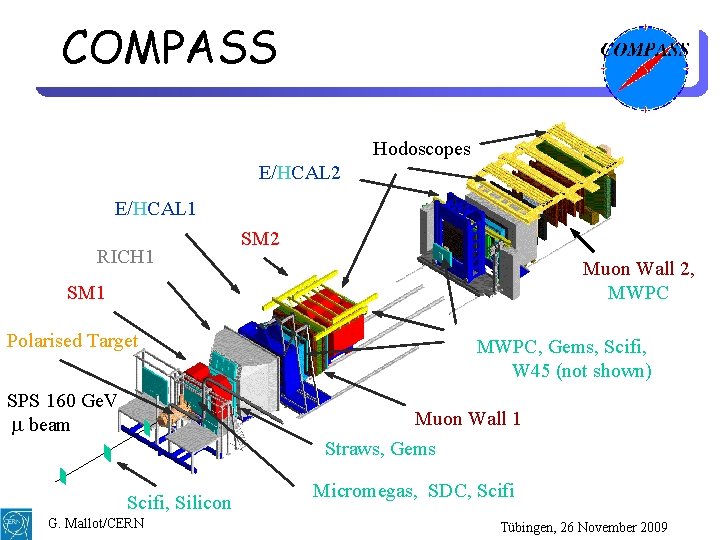
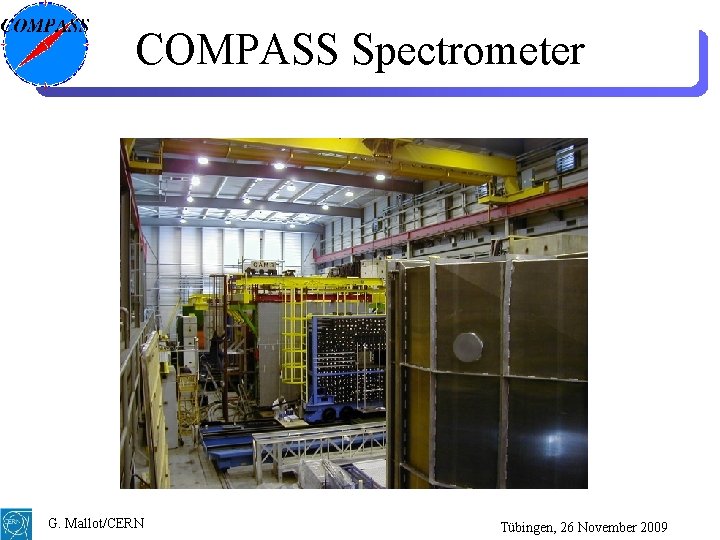
COMPASS Hodoscopes E/HCAL 2 E/HCAL 1 RICH 1 SM 2 Muon Wall 2, MWPC SM 1 Polarised Target SPS 160 Ge. V m beam MWPC, Gems, Scifi, W 45 (not shown) Muon Wall 1 Straws, Gems Scifi, Silicon G. Mallot/CERN Micromegas, SDC, Scifi Tübingen, 26 November 2009
COMPASS Spectrometer G. Mallot/CERN Tübingen, 26 November 2009
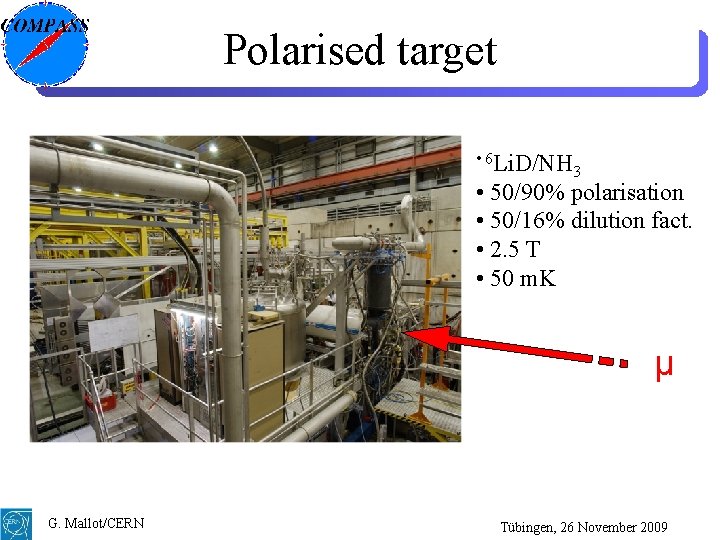
Polarised target • 6 Li. D/NH 3 • 50/90% polarisation • 50/16% dilution fact. • 2. 5 T • 50 m. K μ G. Mallot/CERN Tübingen, 26 November 2009
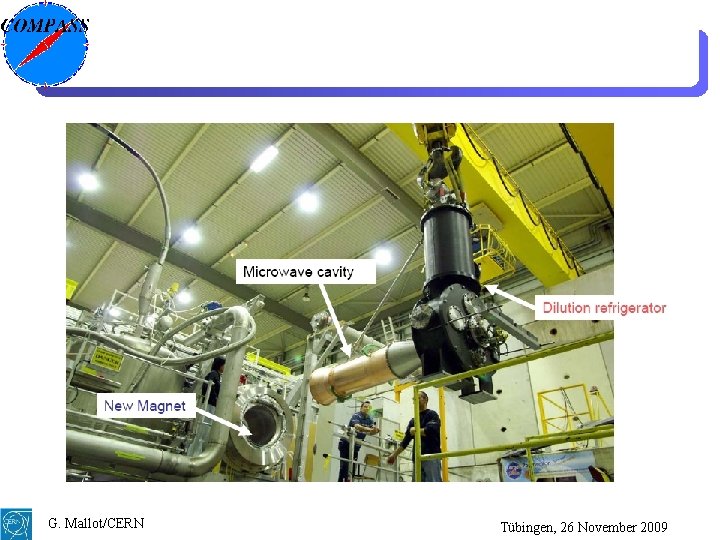
G. Mallot/CERN Tübingen, 26 November 2009
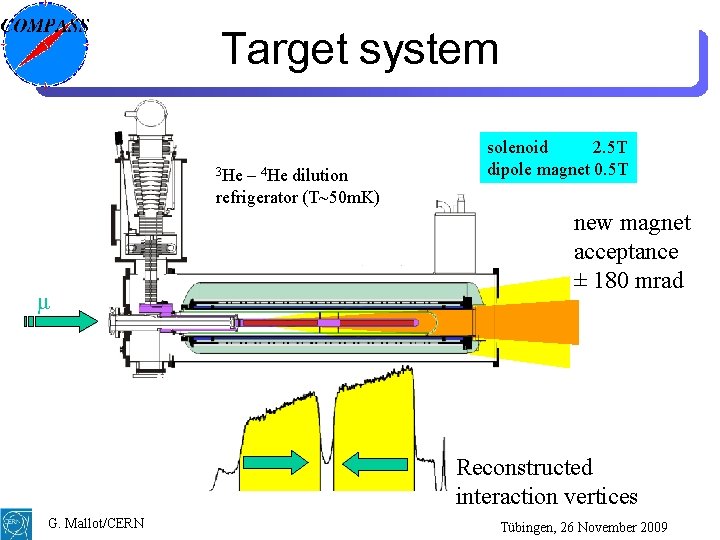
Target system 3 He – 4 He dilution refrigerator (T~50 m. K) μ solenoid 2. 5 T dipole magnet 0. 5 T new magnet acceptance ± 180 mrad Reconstructed interaction vertices G. Mallot/CERN Tübingen, 26 November 2009
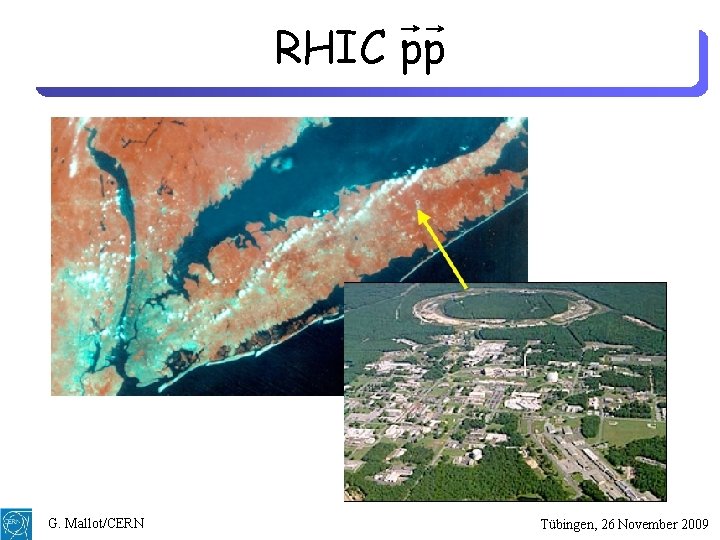
RHIC pp G. Mallot/CERN Tübingen, 26 November 2009
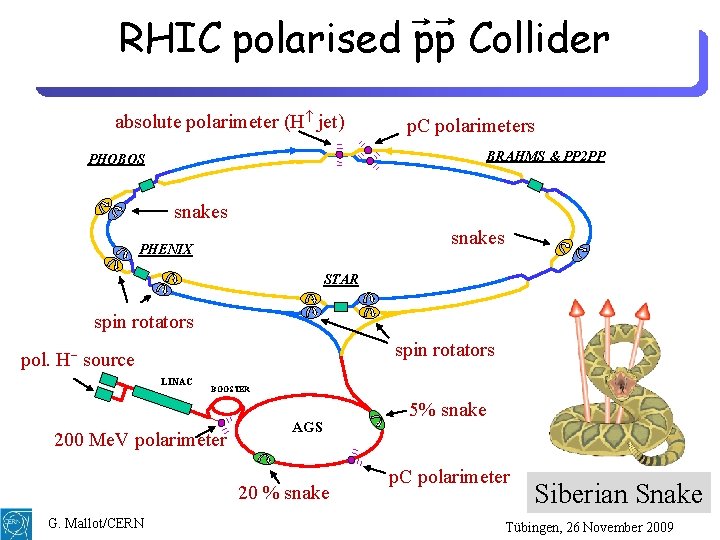
RHIC polarised pp Collider absolute polarimeter (H jet) p. C polarimeters BRAHMS & PP 2 PP PHOBOS snakes PHENIX STAR spin rotators pol. H− source LINAC BOOSTER 200 Me. V polarimeter AGS 20 % snake G. Mallot/CERN 5% snake p. C polarimeter Siberian Snake Tübingen, 26 November 2009
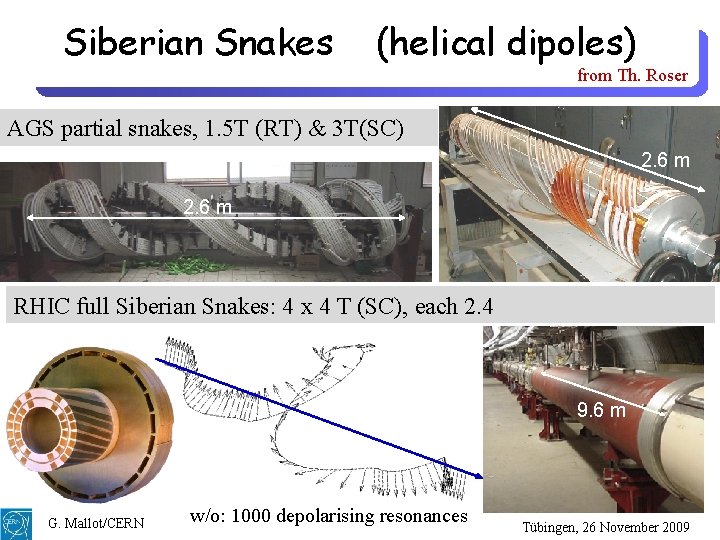
Siberian Snakes (helical dipoles) from Th. Roser AGS partial snakes, 1. 5 T (RT) & 3 T(SC) 2. 6 m RHIC full Siberian Snakes: 4 x 4 T (SC), each 2. 4 9. 6 m G. Mallot/CERN w/o: 1000 depolarising resonances Tübingen, 26 November 2009
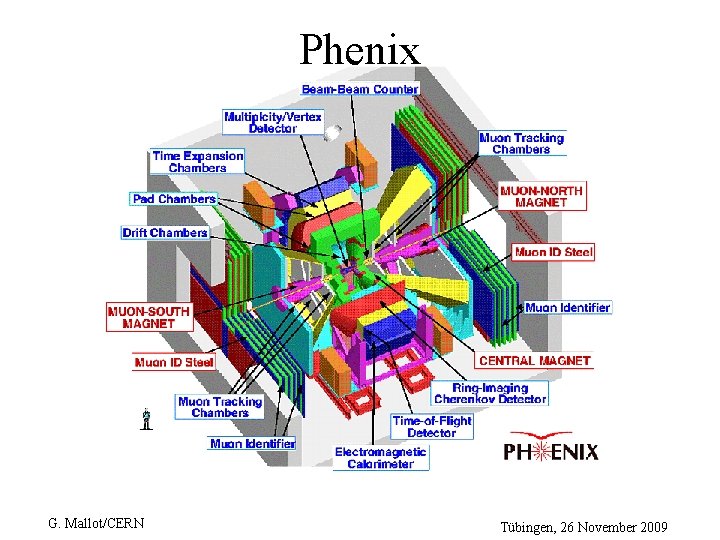
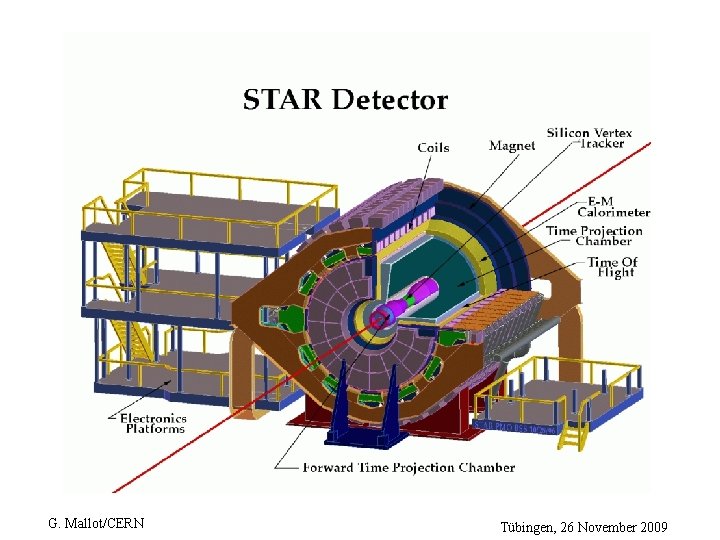
Phenix G. Mallot/CERN Tübingen, 26 November 2009
G. Mallot/CERN Tübingen, 26 November 2009
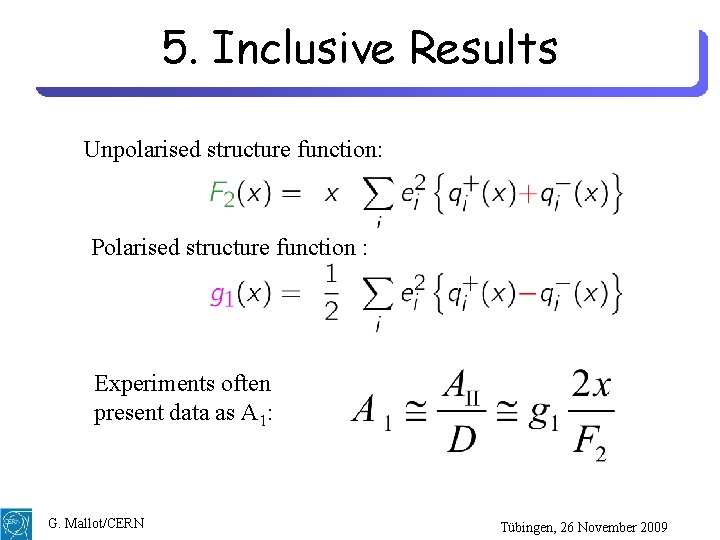
5. Inclusive Results Unpolarised structure function: Polarised structure function : Experiments often present data as A 1: G. Mallot/CERN Tübingen, 26 November 2009
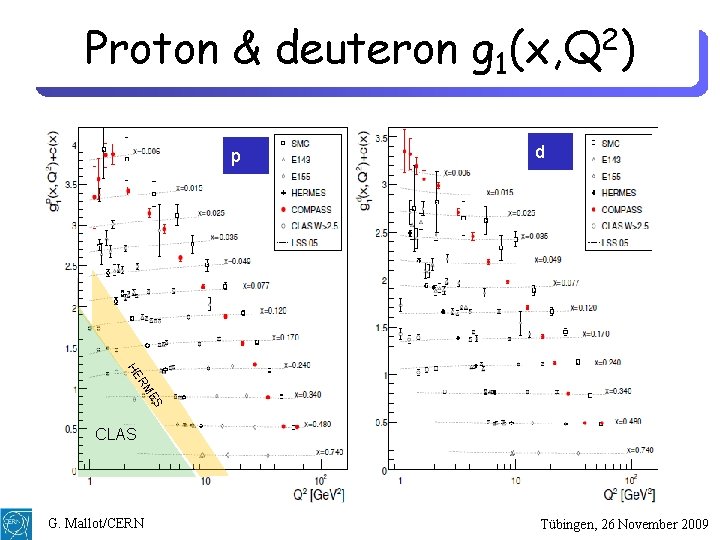
Structure function xg 1(x, Q 2) p • COMPASS deuteron data: a 0 = 0. 33± 0. 05 Δs+Δs = − 0. 08± 0. 01± 0. 02 • Hermes similar • (evol. to Q 2=∞) d G. Mallot/CERN Tübingen, 26 November 2009
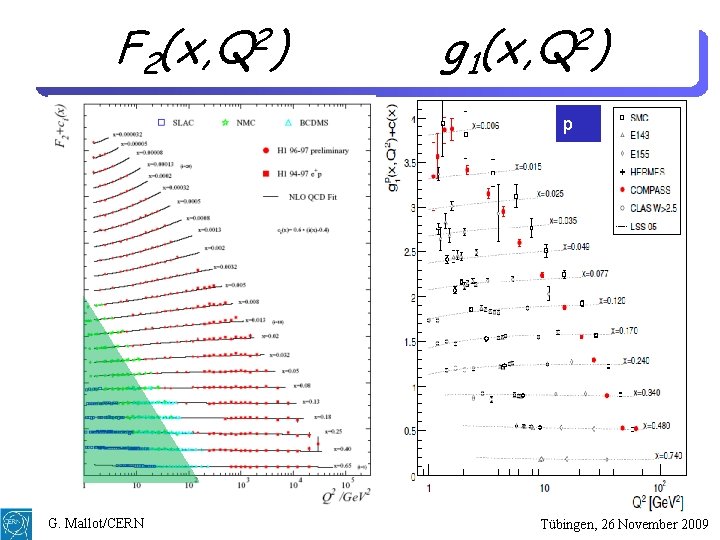
F 2(x, Q 2) g 1(x, Q 2) p G. Mallot/CERN Tübingen, 26 November 2009
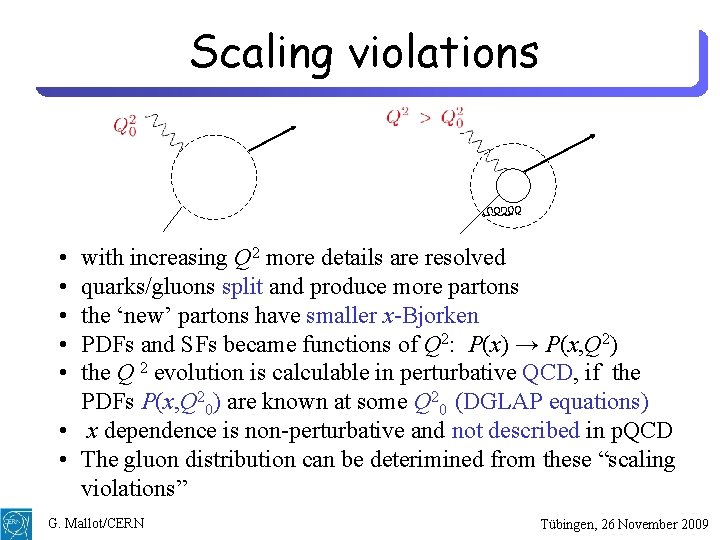
Scaling violations • • • with increasing Q 2 more details are resolved quarks/gluons split and produce more partons the ‘new’ partons have smaller x-Bjorken PDFs and SFs became functions of Q 2: P(x) → P(x, Q 2) the Q 2 evolution is calculable in perturbative QCD, if the PDFs P(x, Q 20) are known at some Q 20 (DGLAP equations) • x dependence is non-perturbative and not described in p. QCD • The gluon distribution can be deterimined from these “scaling violations” G. Mallot/CERN Tübingen, 26 November 2009
Proton & deuteron g 1(x, Q 2) p d ES RM HE CLAS G. Mallot/CERN Tübingen, 26 November 2009
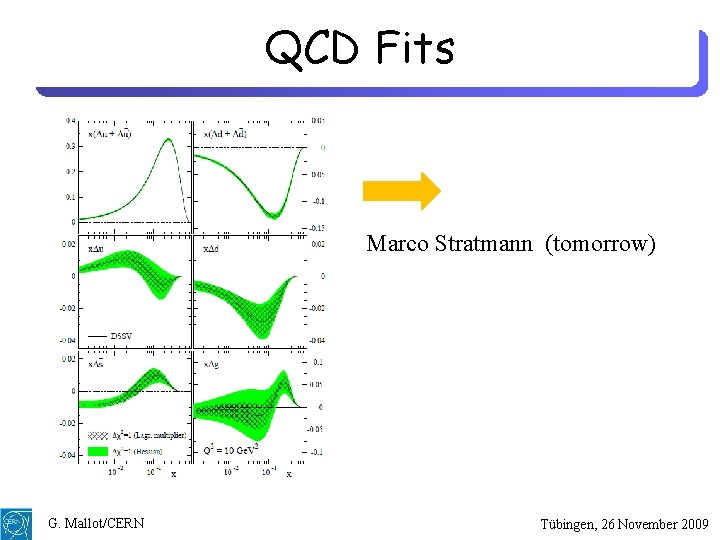
QCD Fits Marco Stratmann (tomorrow) G. Mallot/CERN Tübingen, 26 November 2009
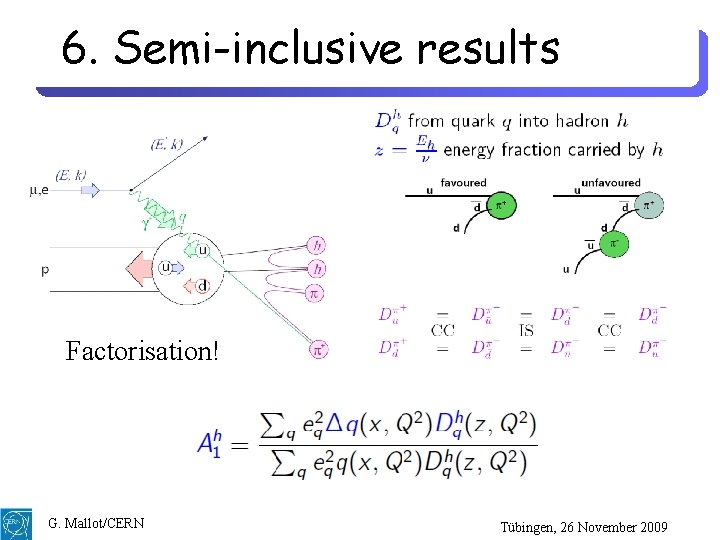
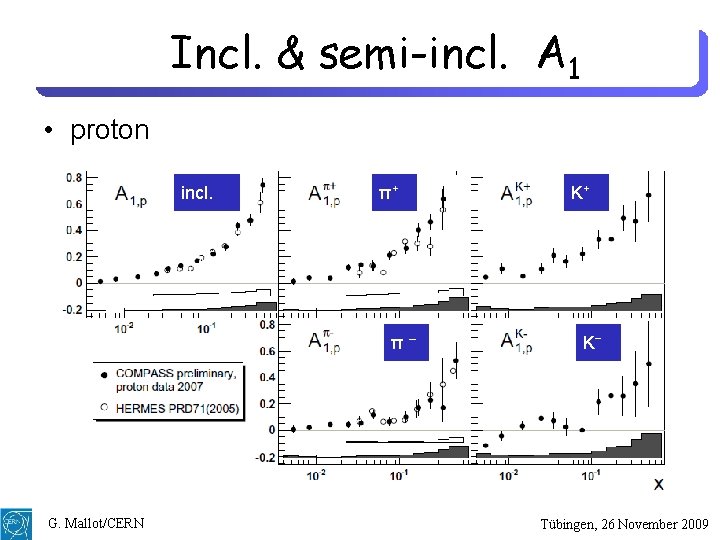
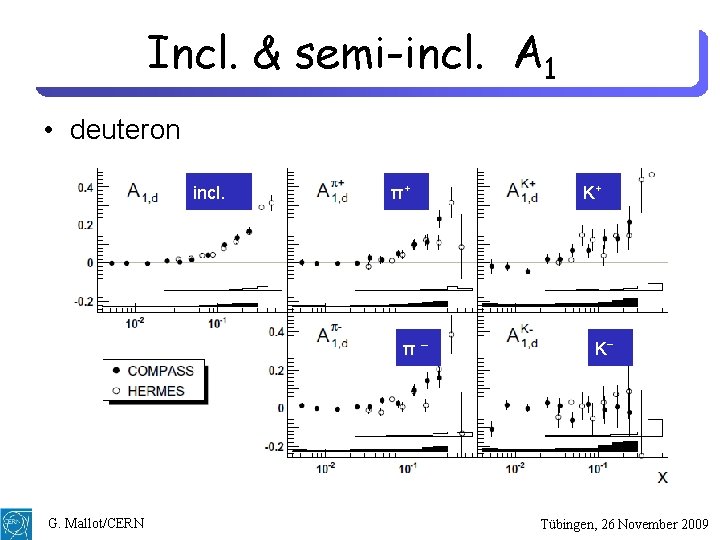
6. Semi-inclusive results Factorisation! G. Mallot/CERN Tübingen, 26 November 2009
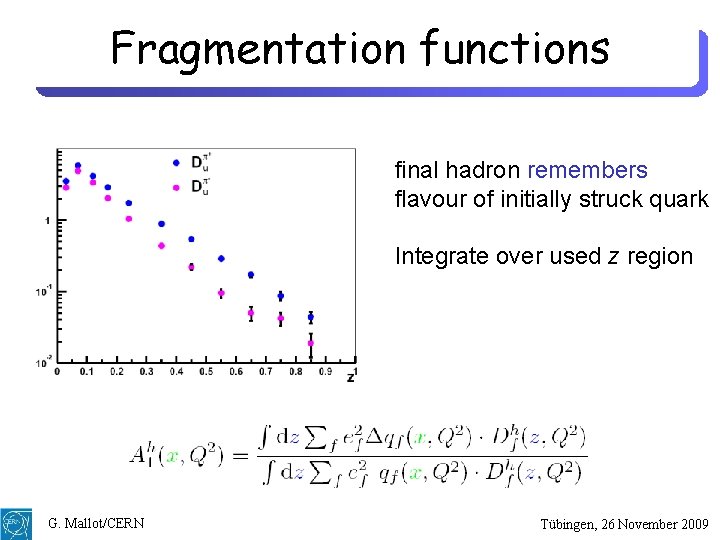
Fragmentation functions final hadron remembers flavour of initially struck quark Integrate over used z region G. Mallot/CERN Tübingen, 26 November 2009
Incl. & semi-incl. A 1 • proton incl. π+ π– G. Mallot/CERN K+ K− Tübingen, 26 November 2009
Incl. & semi-incl. A 1 • deuteron incl. π+ π– G. Mallot/CERN K+ K− Tübingen, 26 November 2009
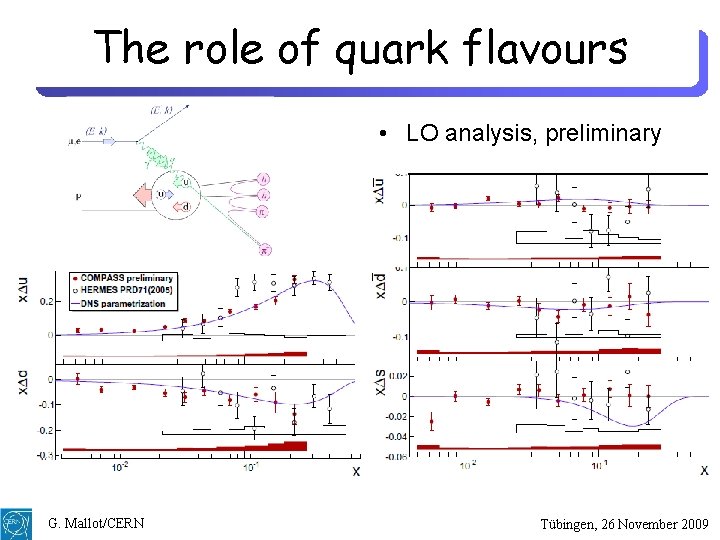
The role of quark flavours • LO analysis, preliminary G. Mallot/CERN Tübingen, 26 November 2009
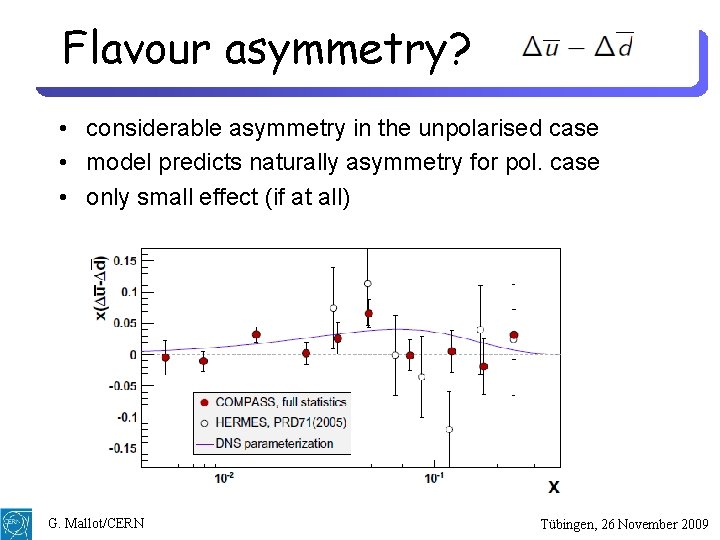
Flavour asymmetry? • considerable asymmetry in the unpolarised case • model predicts naturally asymmetry for pol. case • only small effect (if at all) G. Mallot/CERN Tübingen, 26 November 2009
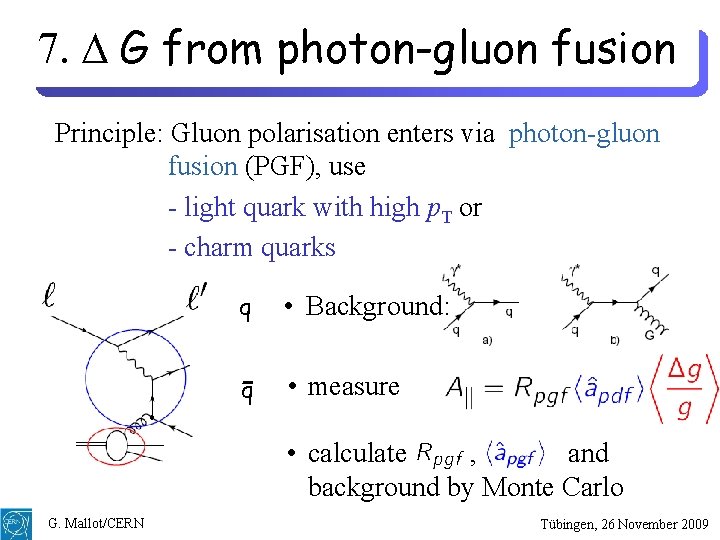
7. G from photon-gluon fusion Principle: Gluon polarisation enters via photon-gluon fusion (PGF), use - light quark with high p. T or - charm quarks q • Background: q • measure • calculate , and background by Monte Carlo G. Mallot/CERN Tübingen, 26 November 2009
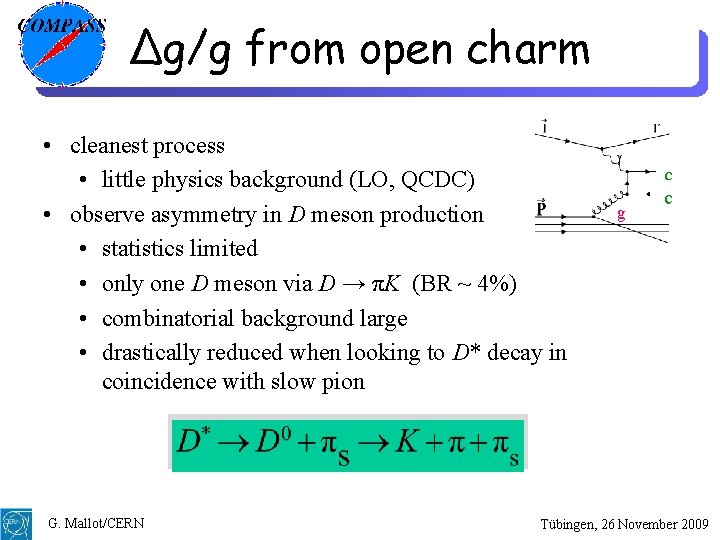
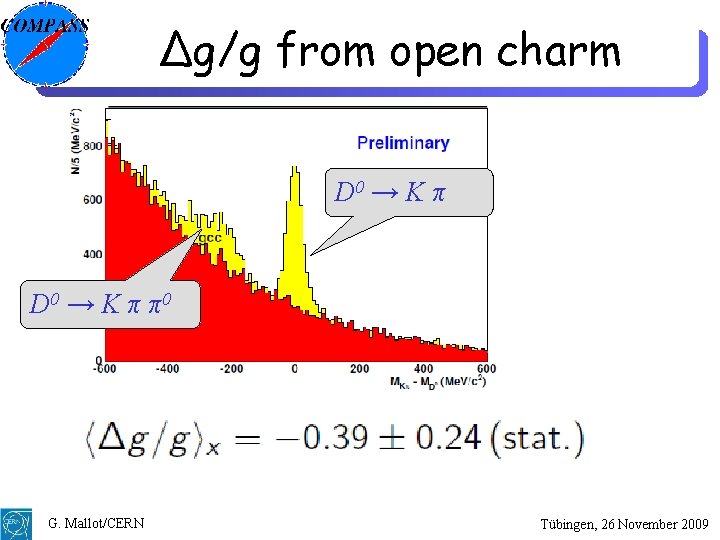
Δg/g from open charm • cleanest process • little physics background (LO, QCDC) • observe asymmetry in D meson production • statistics limited • only one D meson via D → πK (BR ~ 4%) • combinatorial background large • drastically reduced when looking to D* decay in coincidence with slow pion G. Mallot/CERN g c c Tübingen, 26 November 2009
Δg/g from open charm D 0 → K π π 0 G. Mallot/CERN Tübingen, 26 November 2009
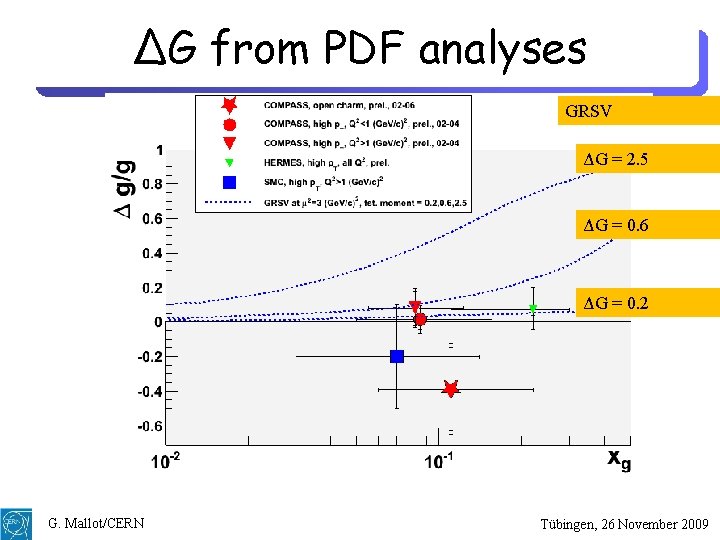
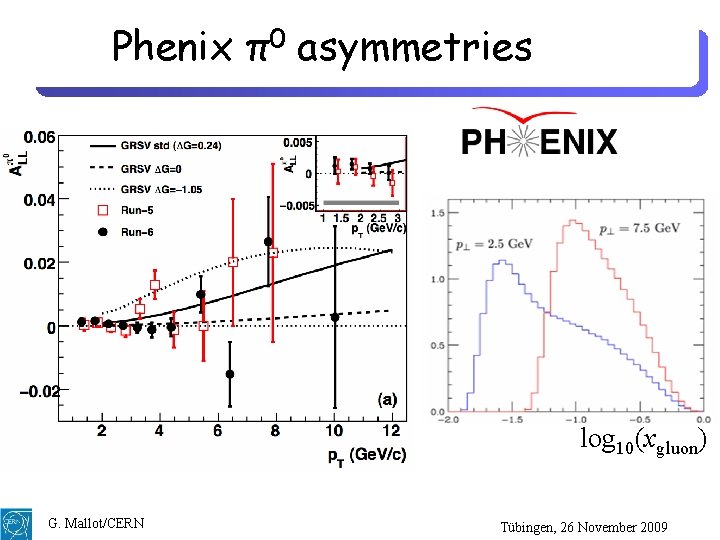
ΔG from PDF analyses GRSV ΔG = 2. 5 ΔG = 0. 6 ΔG = 0. 2 G. Mallot/CERN Tübingen, 26 November 2009
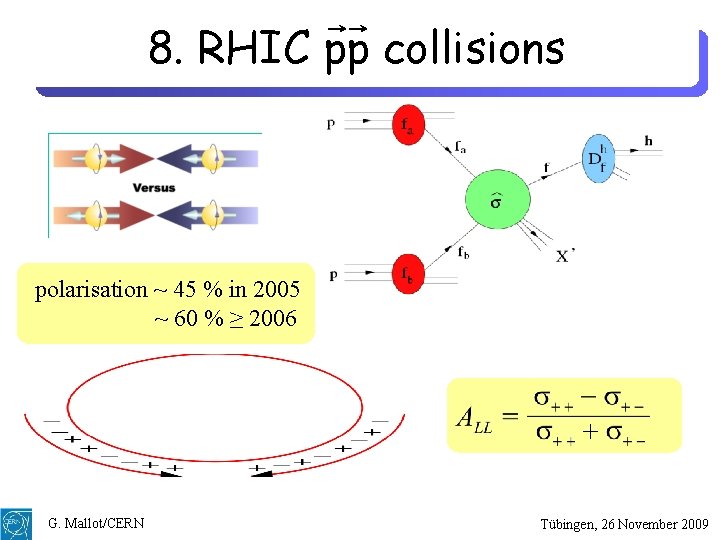
8. RHIC pp collisions polarisation ~ 45 % in 2005 ~ 60 % ≥ 2006 G. Mallot/CERN Tübingen, 26 November 2009
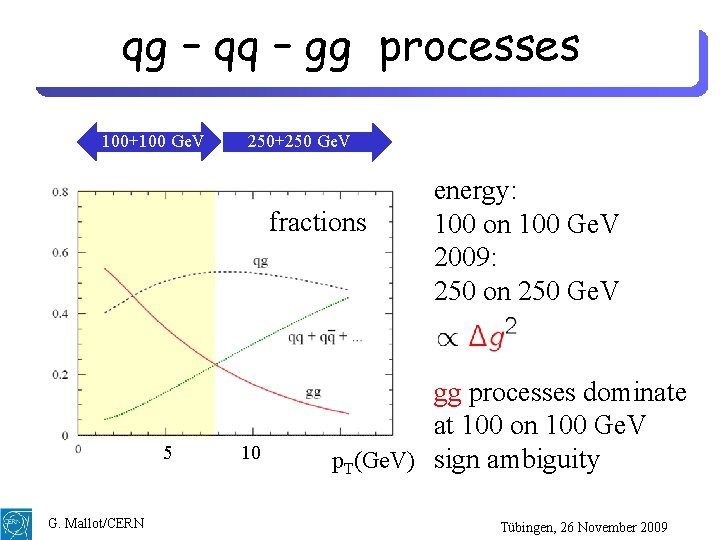
qg – qq – gg processes 100+100 Ge. V 250+250 Ge. V fractions 5 G. Mallot/CERN 10 energy: 100 on 100 Ge. V 2009: 250 on 250 Ge. V gg processes dominate at 100 on 100 Ge. V p. T(Ge. V) sign ambiguity Tübingen, 26 November 2009
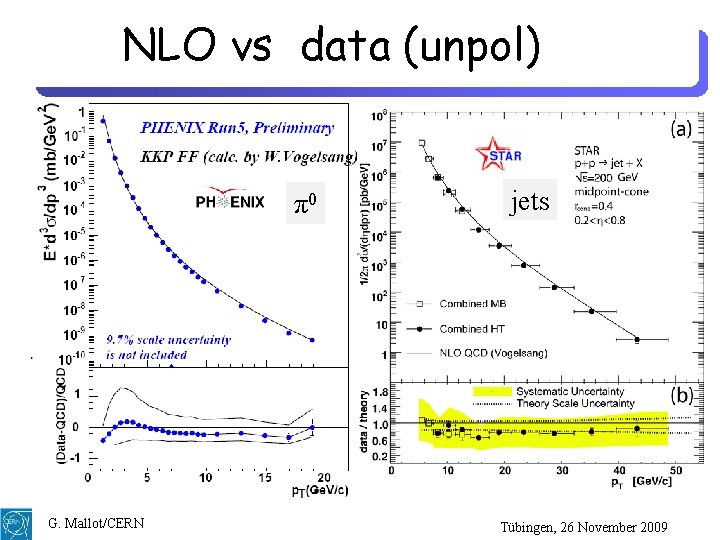
NLO vs data (unpol) π0 jets π0 production PRL 97 (2006) 252001 G. Mallot/CERN Tübingen, 26 November 2009
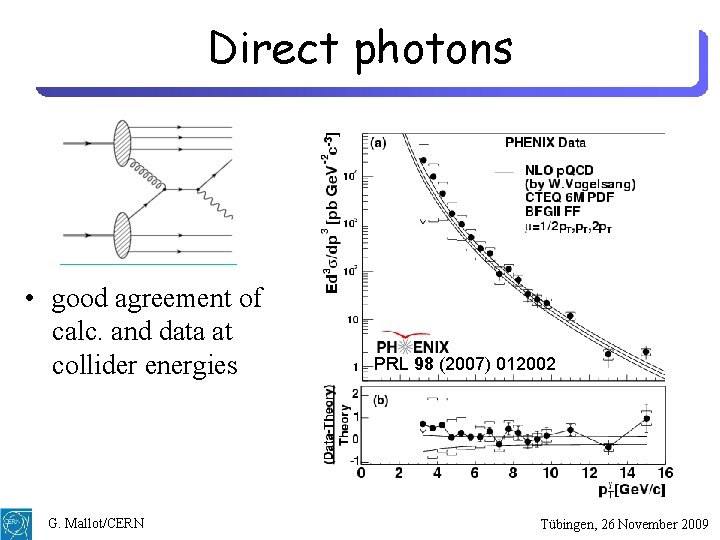
Direct photons • good agreement of calc. and data at collider energies G. Mallot/CERN PRL 98 (2007) 012002 Tübingen, 26 November 2009
Phenix π0 asymmetries log 10(xgluon) G. Mallot/CERN Tübingen, 26 November 2009
STAR incl. jet asymmetries GRSV Models: G(Q 2=1 Ge. V 2) G = G: = 1. 9 2 2 G = −G: G(Q =1 Ge. V ) = − 1. 8 G = 0: G(Q 2=1 Ge. V 2) = 0. 1 G = std: G(Q 2=1 Ge. V 2) = 0. 4 G. Mallot/CERN 2 -jet events will give information on the kinematics on the parton level event by event (xg) Tübingen, 26 November 2009
Remark • More than two decades passed since the so-called spin-puzzle was discovered. • Very fruitful investigations, both experimental and theoretical, led to a much deeper understanding. • However, the spin structure of the nucleon and the role of orbital angular momentum remains to be understood. G. Mallot/CERN Tübingen, 26 November 2009
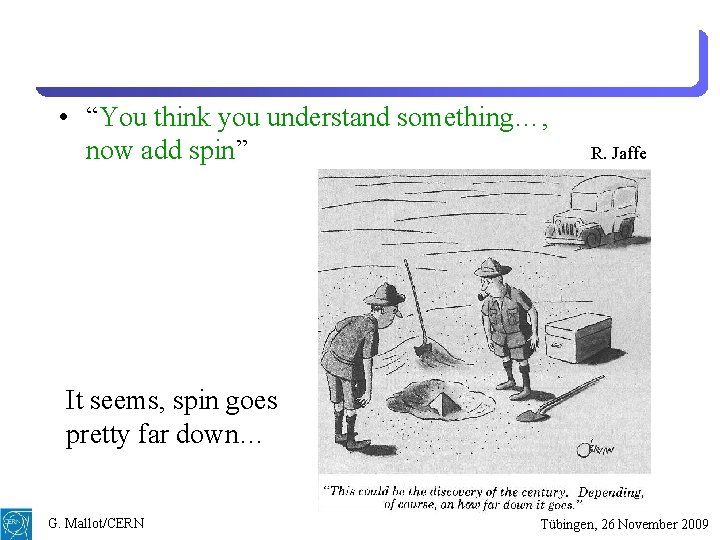
• “You think you understand something…, now add spin” R. Jaffe It seems, spin goes pretty far down… G. Mallot/CERN Tübingen, 26 November 2009