
Chapter 24 The Child with a Musculoskeletal Condition
- Slides: 67
Chapter 24 The Child with a Musculoskeletal Condition
Objectives • Demonstrate an understanding of age-specific changes that occur in the musculoskeletal system during growth and development. • Discuss the musculoskeletal differences between the child and adult and how they influence orthopedic treatment and nursing care. • Describe the management of soft-tissue injuries. • Discuss the types of fractures commonly seen in children and their effect on growth and development. Elsevier items and derived items © 2011, 2007, 2006 by Saunders, an imprint of Elsevier Inc. 2
Objectives (cont. ) • Differentiate between Buck’s extension and Russell traction. • Compile a nursing care plan for the child who is immobilized by traction. • Describe a neurovascular check. • Discuss the nursing care of a child in a cast. • List two symptoms of Duchenne’s muscular dystrophy. • Describe the symptoms, treatment, and nursing care for the child with Legg-Calvé-Perthes disease. Elsevier items and derived items © 2011, 2007, 2006 by Saunders, an imprint of Elsevier Inc. 3
Objectives (cont. ) • Describe two topics of discussion applicable at discharge for the child with juvenile rheumatoid arthritis. • Describe three nursing care measures required to maintain skin integrity for an adolescent child in a cast for scoliosis. • Identify symptoms of abuse and neglect in children. • Describe three types of child abuse. • State two cultural or medical practices that may be misinterpreted as child abuse. Elsevier items and derived items © 2011, 2007, 2006 by Saunders, an imprint of Elsevier Inc. 4
Overview • Muscular and skeletal systems work together • Arises from the mesoderm in the embryo – A great portion of skeletal growth occurs between the 4 th to 8 th weeks of fetal life • Supports the body and provides for movement • Locomotion develops gradually and in an orderly manner Elsevier items and derived items © 2011, 2007, 2006 by Saunders, an imprint of Elsevier Inc. 5
Observation of the Musculoskeletal System in the Growing Child • Assessment of the musculoskeletal system includes – – Observation of gait and muscle tone Palpation ROM Gait assessment in children who can walk • Children who do not walk independently by 18 months of age have a serious delay and should be referred for further follow-up Elsevier items and derived items © 2011, 2007, 2006 by Saunders, an imprint of Elsevier Inc. 6
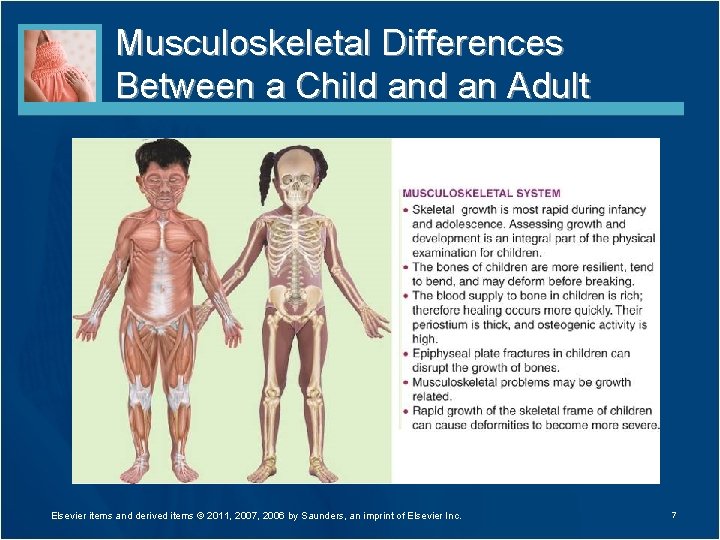
Musculoskeletal Differences Between a Child an Adult Elsevier items and derived items © 2011, 2007, 2006 by Saunders, an imprint of Elsevier Inc. 7
Observation of Gait • Toddler who begins to walk has a wide, unstable gait – Arms do not swing with the walking motion • By 18 months, the wide base narrows and walk is more stable • By 4 years of age, the child can hop on one foot and arm swings occur • By 6 years of age, the gait and arm swing is similar to the adult Elsevier items and derived items © 2011, 2007, 2006 by Saunders, an imprint of Elsevier Inc. 8
Observation of Gait (cont. ) • The nurse’s role is to reassure parents that unless there is pain or a problem with motor or nerve functions, many minor abnormalappearing alignments will spontaneously resolve with activity Elsevier items and derived items © 2011, 2007, 2006 by Saunders, an imprint of Elsevier Inc. 9
Observation of Muscle Tone • Assess symmetry of movement and the strength and contour of the body and extremities • Neurological exam includes an assessment of reflexes, a sensory assessment, and the presence or absence of spasms Elsevier items and derived items © 2011, 2007, 2006 by Saunders, an imprint of Elsevier Inc. 10
Diagnostic Tests • Radiographic studies include – – Bone scans CT scans MRI scans Ultrasound • Laboratory tests include – CBC – ESR • May help rule out septic arthritis or osteomyelitis – Human leukocyte antigen (HLA) B-27 • May help diagnose rheumatological disorders Elsevier items and derived items © 2011, 2007, 2006 by Saunders, an imprint of Elsevier Inc. 11
Treatments for Musculoskeletal System • • • Arthroscopy Bone biopsy Traction Casting Splints Elsevier items and derived items © 2011, 2007, 2006 by Saunders, an imprint of Elsevier Inc. 12
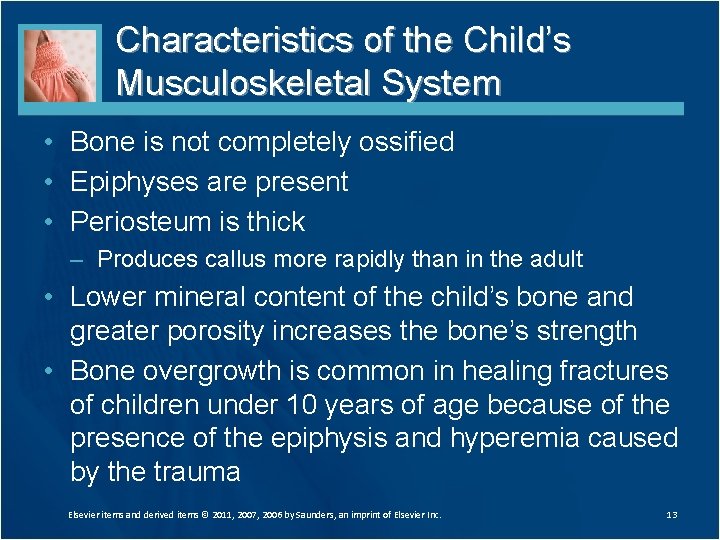
Characteristics of the Child’s Musculoskeletal System • Bone is not completely ossified • Epiphyses are present • Periosteum is thick – Produces callus more rapidly than in the adult • Lower mineral content of the child’s bone and greater porosity increases the bone’s strength • Bone overgrowth is common in healing fractures of children under 10 years of age because of the presence of the epiphysis and hyperemia caused by the trauma Elsevier items and derived items © 2011, 2007, 2006 by Saunders, an imprint of Elsevier Inc. 13
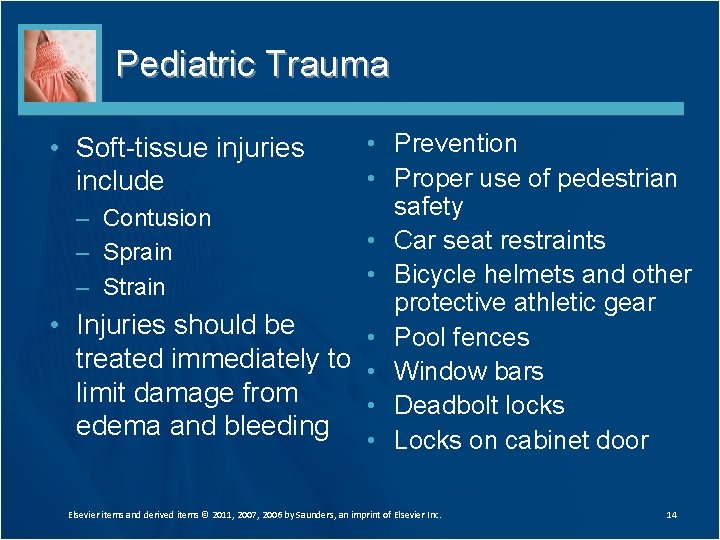
Pediatric Trauma • Prevention • Proper use of pedestrian safety – Contusion • Car seat restraints – Sprain • Bicycle helmets and other – Strain protective athletic gear • Injuries should be • Pool fences treated immediately to • Window bars limit damage from • Deadbolt locks edema and bleeding • Locks on cabinet door • Soft-tissue injuries include Elsevier items and derived items © 2011, 2007, 2006 by Saunders, an imprint of Elsevier Inc. 14
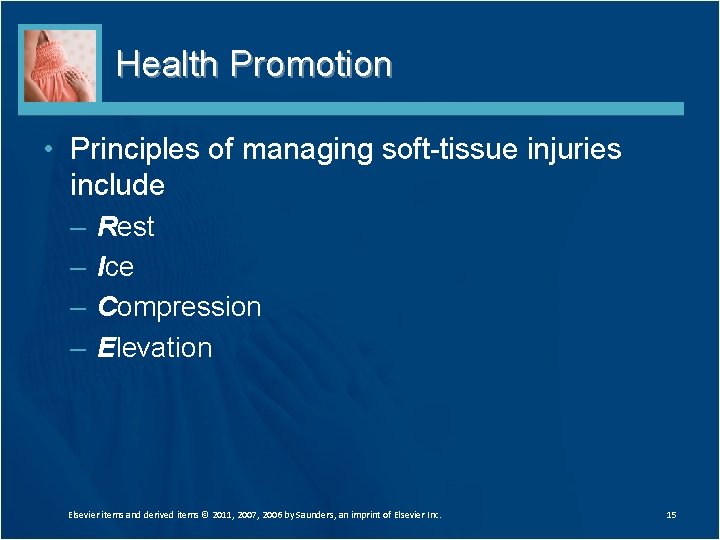
Health Promotion • Principles of managing soft-tissue injuries include – – Rest Ice Compression Elevation Elsevier items and derived items © 2011, 2007, 2006 by Saunders, an imprint of Elsevier Inc. 15
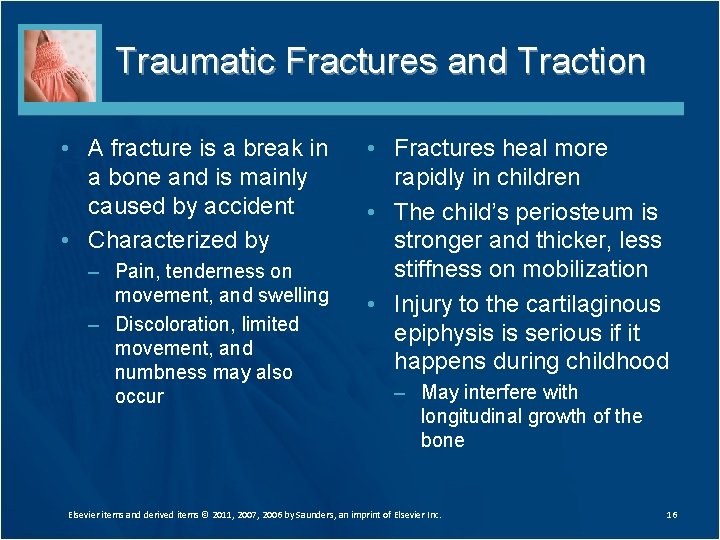
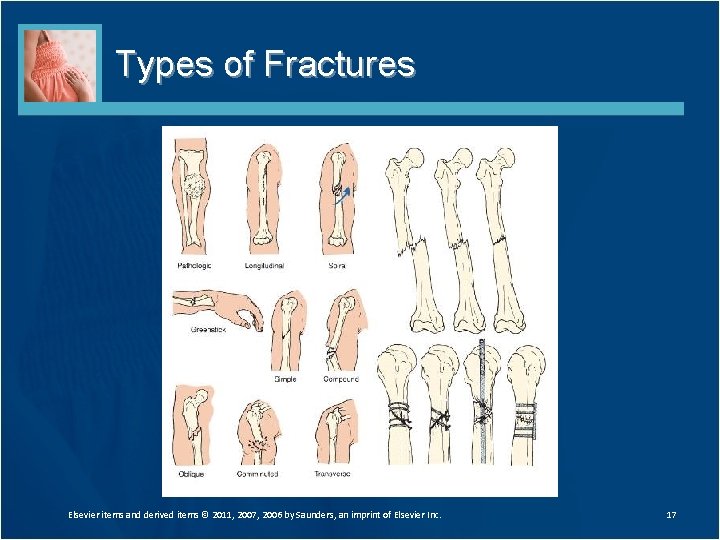
Traumatic Fractures and Traction • A fracture is a break in a bone and is mainly caused by accident • Characterized by – Pain, tenderness on movement, and swelling – Discoloration, limited movement, and numbness may also occur • Fractures heal more rapidly in children • The child’s periosteum is stronger and thicker, less stiffness on mobilization • Injury to the cartilaginous epiphysis is serious if it happens during childhood – May interfere with longitudinal growth of the bone Elsevier items and derived items © 2011, 2007, 2006 by Saunders, an imprint of Elsevier Inc. 16
Types of Fractures Elsevier items and derived items © 2011, 2007, 2006 by Saunders, an imprint of Elsevier Inc. 17
Bryant’s Traction • Used for the young child who has a fractured femur • Note that the buttocks are slightly off the bed to facilitate countertraction • Active infants may require a jacket restraint to maintain body alignment Elsevier items and derived items © 2011, 2007, 2006 by Saunders, an imprint of Elsevier Inc. 18
Buck’s Extension • A type of skin traction used in fractures of the femur and in hip and knee contractures – It pulls the hip and leg into extension – Countertraction is supplied by the child’s body • Essential that the child not slip down in bed • Bed should not be placed in high-Fowler’s position • Used to reduce pain and muscle spasm associated with slipped capital femoral epiphysis Elsevier items and derived items © 2011, 2007, 2006 by Saunders, an imprint of Elsevier Inc. 19
Russell Skin Traction • Similar to Buck’s extension traction • A sling is positioned under the knee, which suspends the distal thigh above the bed – Pulls in two directions – Prevents posterior subluxation of the tibia on the femur – Two sets of weights, one at the head and one at the foot of the bed Elsevier items and derived items © 2011, 2007, 2006 by Saunders, an imprint of Elsevier Inc. 20
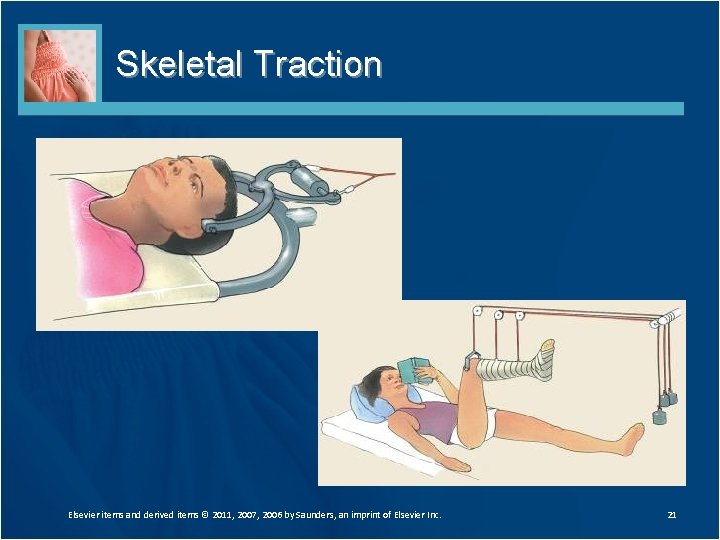
Skeletal Traction Elsevier items and derived items © 2011, 2007, 2006 by Saunders, an imprint of Elsevier Inc. 21
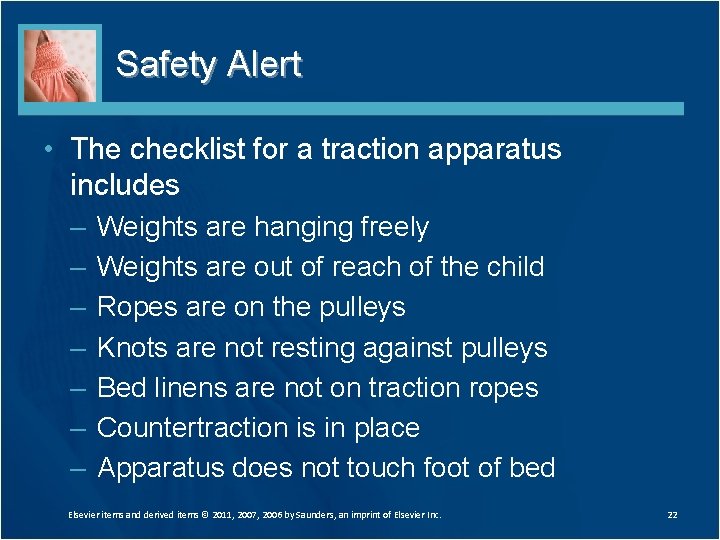
Safety Alert • The checklist for a traction apparatus includes – – – – Weights are hanging freely Weights are out of reach of the child Ropes are on the pulleys Knots are not resting against pulleys Bed linens are not on traction ropes Countertraction is in place Apparatus does not touch foot of bed Elsevier items and derived items © 2011, 2007, 2006 by Saunders, an imprint of Elsevier Inc. 22
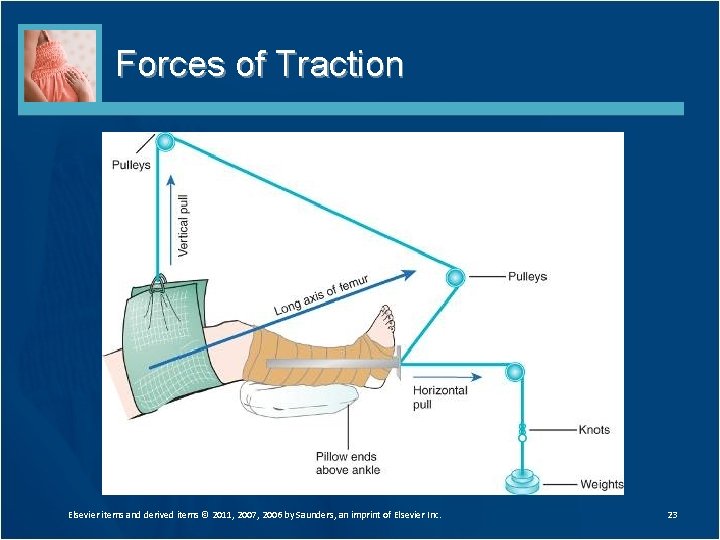
Forces of Traction Elsevier items and derived items © 2011, 2007, 2006 by Saunders, an imprint of Elsevier Inc. 23
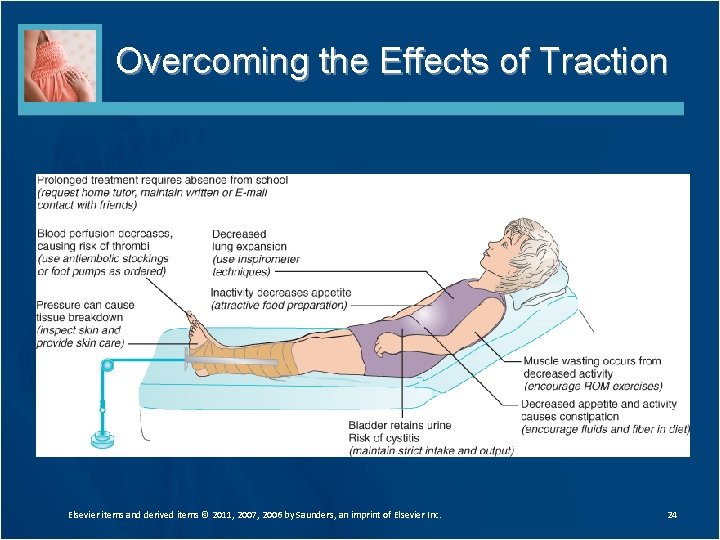
Overcoming the Effects of Traction Elsevier items and derived items © 2011, 2007, 2006 by Saunders, an imprint of Elsevier Inc. 24
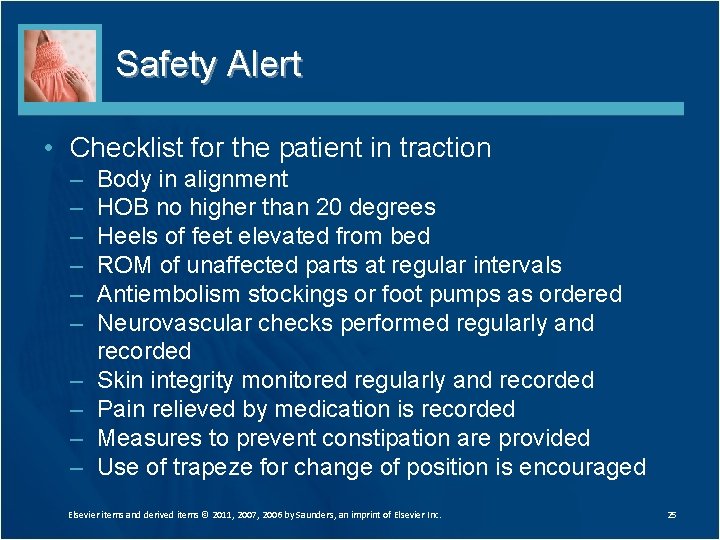
Safety Alert • Checklist for the patient in traction – – – – – Body in alignment HOB no higher than 20 degrees Heels of feet elevated from bed ROM of unaffected parts at regular intervals Antiembolism stockings or foot pumps as ordered Neurovascular checks performed regularly and recorded Skin integrity monitored regularly and recorded Pain relieved by medication is recorded Measures to prevent constipation are provided Use of trapeze for change of position is encouraged Elsevier items and derived items © 2011, 2007, 2006 by Saunders, an imprint of Elsevier Inc. 25
Infections Related to Skeletal Traction • Carries the added risk of infection from skin bacteria that may cause osteomyelitis • Meticulous skin and pin care is essential Elsevier items and derived items © 2011, 2007, 2006 by Saunders, an imprint of Elsevier Inc. 26
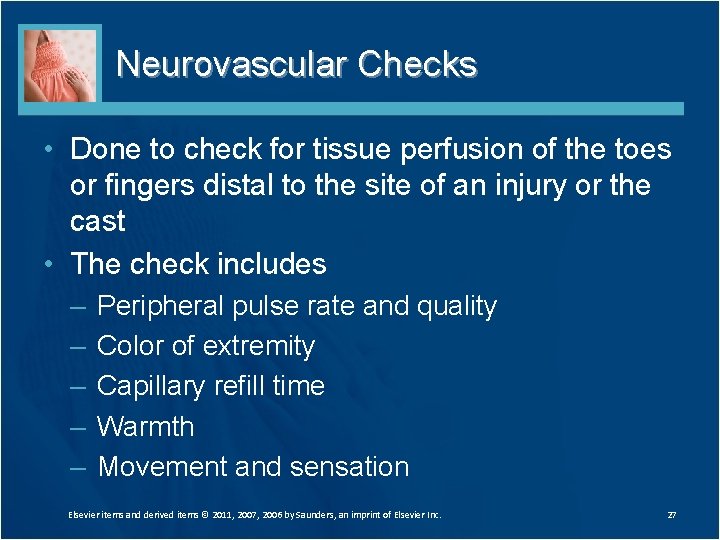
Neurovascular Checks • Done to check for tissue perfusion of the toes or fingers distal to the site of an injury or the cast • The check includes – – – Peripheral pulse rate and quality Color of extremity Capillary refill time Warmth Movement and sensation Elsevier items and derived items © 2011, 2007, 2006 by Saunders, an imprint of Elsevier Inc. 27
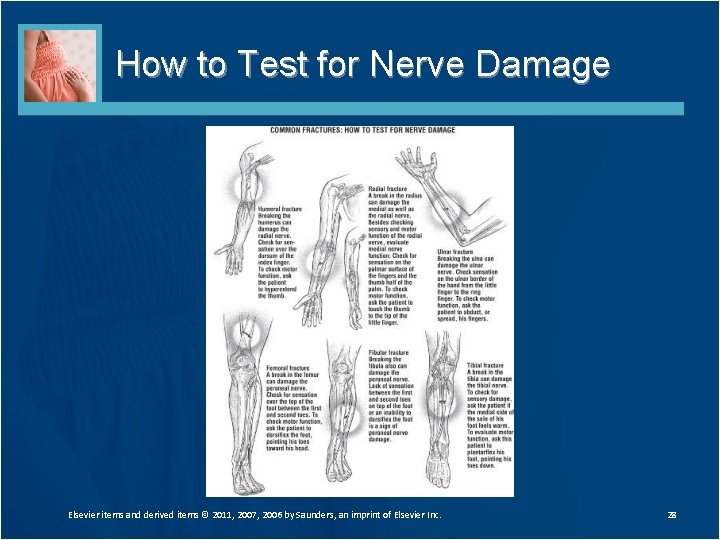
How to Test for Nerve Damage Elsevier items and derived items © 2011, 2007, 2006 by Saunders, an imprint of Elsevier Inc. 28
Casts and Splints • Can be made from a variety of materials • Child is at increased risk for – Impaired skin integrity – Compartment syndrome • Progressive loss of tissue perfusion because of an increase in pressure caused by edema or swelling that presses on the vessels and tissues • If not carefully monitored, significant complications can occur Elsevier items and derived items © 2011, 2007, 2006 by Saunders, an imprint of Elsevier Inc. 29
Nursing Care of a Child in a Cast • Material used determines positioning of effected extremity for up to 72 hours • Elevate effected extremity on a pillow • Perform frequent neurovascular checks • Teach cast care and how to support cast, safe transfers to/from chair/bed, how to use crutches safely, when a cast is too loose or too tight Elsevier items and derived items © 2011, 2007, 2006 by Saunders, an imprint of Elsevier Inc. 30
Osteomyelitis • An infection of the bone that generally occurs in children younger than 1 year of age and in those between 5 and 14 years of age – Long bones contain few phagocytic cells to fight bacteria that may come to the bone from another part of the body – Inflammation produces an exudate that collects under the marrow and cortex of the bone Elsevier items and derived items © 2011, 2007, 2006 by Saunders, an imprint of Elsevier Inc. 31
Osteomyelitis (cont. ) • Common organisms – Staphylococcus aureus in children older than 5 years of age • Accounts for 75% to 80% of cases – Haemophilus influenzae most common cause in young children • May be preceded by a local injury to the bone Elsevier items and derived items © 2011, 2007, 2006 by Saunders, an imprint of Elsevier Inc. 32
Osteomyelitis (cont. ) • Vessels in affected area are compressed – Thrombosis occurs • Leads to ischemia and pain – Collection of pus under the periosteum of the bone can elevate the periosteum • Can result in necrosis of that part of the bone • Local inflammation and increased pressure can cause pain – Associated muscle spasms can cause limited active ROM Elsevier items and derived items © 2011, 2007, 2006 by Saunders, an imprint of Elsevier Inc. 33
Osteomyelitis (cont. ) • Diagnostics – Elevated WBC and ESR – X-ray may initially fail to reveal infection – Bone scan may be more reliable • Treatment – Intravenous antibiotics for several weeks – If pus is present, it is drained and bone is immobilized – Early passive ROM once splint is removed may be ordered – Pain relief – Diversional and physical therapy Elsevier items and derived items © 2011, 2007, 2006 by Saunders, an imprint of Elsevier Inc. 34
Duchenne’s or Becker’s Muscular Dystrophy (MD) • Group of disorders in which progressive muscle degeneration occurs – Duchenne’s MD is most common • Onset is generally between 2 and 6 years of age • A history of delayed motor development during infancy may be evidenced Elsevier items and derived items © 2011, 2007, 2006 by Saunders, an imprint of Elsevier Inc. 35
Duchenne’s or Becker’s Muscular Dystrophy (MD) (cont. ) • Additional signs and symptoms – Calf muscles in particular become hypertrophied – Progressive weakness as evidenced by • • Frequent falling Clumsiness Contractures of the ankles and hips Gower’s maneuver to rise from the floor – Intellectual impairment is common Elsevier items and derived items © 2011, 2007, 2006 by Saunders, an imprint of Elsevier Inc. 36
Duchenne’s or Becker’s Muscular Dystrophy (MD) (cont. ) • Diagnostics – Marked increase in blood creatine phosphokinase level – Muscle biopsy reveals a degeneration of muscle fibers replaced by fat and connective tissue • Myelogram shows decreases in the amplitude and duration of motor unit potentials – ECG abnormalities are also common Elsevier items and derived items © 2011, 2007, 2006 by Saunders, an imprint of Elsevier Inc. 37
Duchenne’s or Becker’s Muscular Dystrophy (MD) (cont. ) • Disease progressively worsens • Death usually from cardiac failure or respiratory infection • Nursing care is primarily supportive to prevent complications and maintain quality of life • Child may experience depression because he or she cannot compete with peers Elsevier items and derived items © 2011, 2007, 2006 by Saunders, an imprint of Elsevier Inc. 38
Slipped Femoral Capital Epiphysis • Also known as coxa • Symptoms include vera thigh pain and a limp or the inability to bear • Spontaneous weight on the involved displacement of the leg epiphysis of the femur • Buck’s extension • Occurs most often traction is used to during rapid growth of minimize further the preadolescent and slippage until surgical is not related to intervention can take trauma place Elsevier items and derived items © 2011, 2007, 2006 by Saunders, an imprint of Elsevier Inc. 39
Legg-Calvé-Perthes Disease (Coxa Plana) • One of a group of disorders called the osteochondroses in which the blood supply to the epiphysis, or end of the bone, is disrupted – Tissue death that results from inadequate blood supply is termed avascular necrosis – Affects the development of the head of the femur • More common in boys 5 to 12 years of age • Healing occurs spontaneously over 2 to 4 years Elsevier items and derived items © 2011, 2007, 2006 by Saunders, an imprint of Elsevier Inc. 40
Legg-Calvé-Perthes Disease (Coxa Plana) (cont. ) • Symptoms include – Painless limp – Limitation of motion • X-ray films and bone scans confirm the diagnosis • Self-limiting, heals spontaneously with the use of ambulation-abduction casts or braces that prevent subluxation – Some may require hip joint replacement Elsevier items and derived items © 2011, 2007, 2006 by Saunders, an imprint of Elsevier Inc. 41
Osteosarcoma • Primary malignant tumor of the long bones – Mean age of onset is 10 to 15 years of age – Children who have had radiation therapy for other types of cancer and children with retinoblastoma have a higher incidence of this disease • Metastasis occurs quickly because of the high vascularity of bone tissue – Lungs are primary site of metastasis Elsevier items and derived items © 2011, 2007, 2006 by Saunders, an imprint of Elsevier Inc. 42
Osteosarcoma (cont. ) • Manifestations – Experiences pain and swelling at the site – May be lessened by flexing the extremity – Pathologic fractures can occur • Treatment – Radical resection or amputation surgery – Phantom limb pain can occur because nerve tracts continue to “report” pain • Diagnosis – Confirmed by biopsy – Radiological studies help to confirm Elsevier items and derived items © 2011, 2007, 2006 by Saunders, an imprint of Elsevier Inc. 43
Ewing’s Sarcoma • Malignant growth that occurs in the marrow of the long bones • Mainly occurs in older school-age children and early adolescents • When metastasis is present, prognosis is poor • Primary sites for metastasis are lungs and long bones • Treatment – Radiation therapy and chemotherapy Elsevier items and derived items © 2011, 2007, 2006 by Saunders, an imprint of Elsevier Inc. 44
Juvenile Idiopathic Arthritis (JIA) • Formerly known as juvenile rheumatoid arthritis (JRA) • Most common arthritic condition of childhood • Systemic inflammatory disease involving joints, connective tissues, and viscera • No specific tests or cures for JIA • Duration of symptoms is important, particularly if they have lasted longer than 6 weeks Elsevier items and derived items © 2011, 2007, 2006 by Saunders, an imprint of Elsevier Inc. 45
Juvenile Idiopathic Arthritis (JIA) (cont. ) • Three distinct methods of onset – Systemic (or acute febrile) – Polyarticular – Pauciarticular Elsevier items and derived items © 2011, 2007, 2006 by Saunders, an imprint of Elsevier Inc. 46
Juvenile Idiopathic Arthritis (JIA) (cont. ) • Systemic – Occurs most often in children 1 to 3 years of age and 8 to 10 years of age – Intermittent spiking fever (above 103° F) persisting for over 10 days – Nonpruritic macular rash – Abdominal pain – Elevated ESR and C-reactive protein Elsevier items and derived items © 2011, 2007, 2006 by Saunders, an imprint of Elsevier Inc. 47
Juvenile Idiopathic Arthritis (JIA) (cont. ) • Polyarticular – Involves five or more joints • Often hands and feet • Become swollen, warm, and tender – Occurs throughout childhood and adolescence – Predominantly seen in girls Elsevier items and derived items © 2011, 2007, 2006 by Saunders, an imprint of Elsevier Inc. 48
Juvenile Idiopathic Arthritis (JIA) (cont. ) • Pauciarticular – Limited to four or fewer joints • Generally in larger joints such as hips, knees, ankles, and elbows – Occurs in children younger than 3 years of age (mostly in girls) – May be at risk for iridocyclitis, an inflammation of the iris and ciliary body of the eye • Symptoms include redness, pain, photophobia, decreased visual acuity, and nonreactive pupils Elsevier items and derived items © 2011, 2007, 2006 by Saunders, an imprint of Elsevier Inc. 49
Juvenile Idiopathic Arthritis (JIA) (cont. ) • Treatment – Goals of therapy • • • Reduce joint pain and swelling Promote mobility and preserve joint function Promote growth and development Promote independent functioning Help the child and family to adjust to living with a chronic disease Elsevier items and derived items © 2011, 2007, 2006 by Saunders, an imprint of Elsevier Inc. 50
Juvenile Idiopathic Arthritis (JIA) (cont. ) • Long-term disease characterized by periods of remissions and exacerbations • The nurse helps the family by advocating for the child; in other words, helping the family to recognize the impact of the disease and by openly communicating with the child, family, and members of the health care team Elsevier items and derived items © 2011, 2007, 2006 by Saunders, an imprint of Elsevier Inc. 51
Torticollis (Wry Neck) • Neck motion is limited because of shortening of the sternocleidomastoid muscle • Can be congenital (most common) or acquired – Acute or chronic – Associated with breech and forceps delivery • May be seen in conjunction with other birth defects, such as congenital hip dysplasia Elsevier items and derived items © 2011, 2007, 2006 by Saunders, an imprint of Elsevier Inc. 52
Torticollis (Wry Neck) (cont. ) • Symptoms are present at birth – Infant holds head to the side of the muscle involved with chin tilted in opposite direction – Hard, palpable mass of dense fibrotic tissue (fibroma), not fixed to the skin – Resolves by 2 to 6 months of age – Passive stretching, ROM, and physical therapy may be indicated • Acquired is seen in older children, may be associated with injury, inflammation, neurological disorders, and other causes Elsevier items and derived items © 2011, 2007, 2006 by Saunders, an imprint of Elsevier Inc. 53
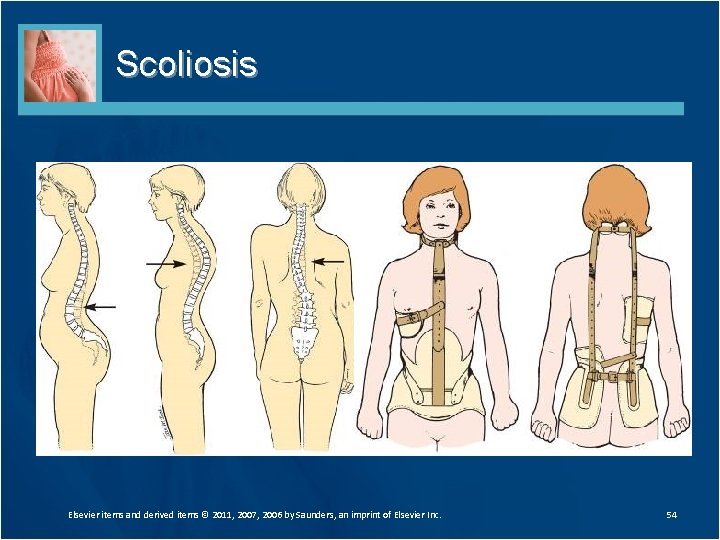
Scoliosis Elsevier items and derived items © 2011, 2007, 2006 by Saunders, an imprint of Elsevier Inc. 54
Scoliosis (cont. ) • More common in girls • Two types – Functional—caused by poor posture – Structural—caused by changes in the shape of the vertebrae or thorax • Usually accompanied by rotation of the spine • Hips and shoulders may appear to be uneven Elsevier items and derived items © 2011, 2007, 2006 by Saunders, an imprint of Elsevier Inc. 55
Scoliosis (cont. ) • Treatment – Aimed at correcting curvature and preventing severe scoliosis • Curves up to 20 degrees do not require treatment • Curves 20 degrees to 40 degrees require the use of a brace • Curves greater than 40 degrees and patients in whom conservative therapy were not successful require hospitalization – Spinal fusion is performed Elsevier items and derived items © 2011, 2007, 2006 by Saunders, an imprint of Elsevier Inc. 56
Sports Injuries • Sports-specific examinations are given for those involved in strenuous activity on entry into middle school or high school • Common injuries include – – Concussion “Stingers” or “burners” Injured knee Sprain or strained ankle – Muscle cramps – Shin splints Elsevier items and derived items © 2011, 2007, 2006 by Saunders, an imprint of Elsevier Inc. 57
Sports Injuries (cont. ) • Sports at higher risk for injury include – – – – Gymnastics Wrestling Football/Soccer Hockey Basketball Volleyball Running Skiing or snowboarding Elsevier items and derived items © 2011, 2007, 2006 by Saunders, an imprint of Elsevier Inc. 58
Family Violence • Affects children of all social classes • Includes – Spousal and child abuse – Neglect – Maltreatment Elsevier items and derived items © 2011, 2007, 2006 by Saunders, an imprint of Elsevier Inc. 59
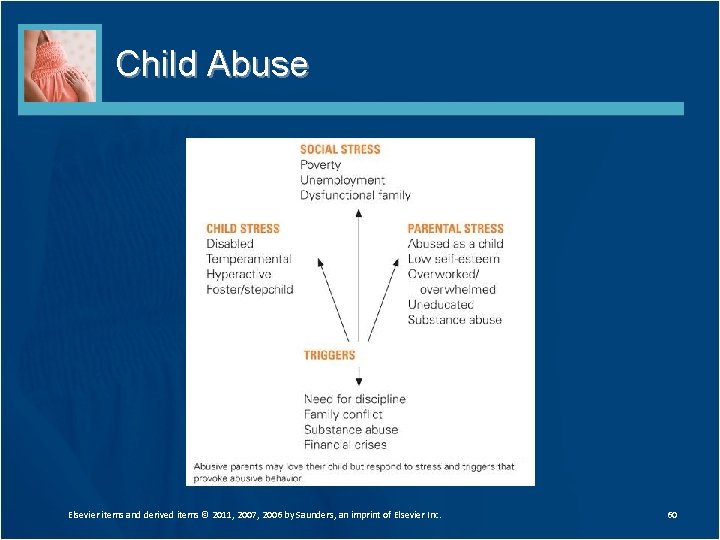
Child Abuse Elsevier items and derived items © 2011, 2007, 2006 by Saunders, an imprint of Elsevier Inc. 60
Child Abuse (cont. ) • Types of child abuse – – – Emotional abuse Emotional neglect Sexual abuse Physical neglect Physical abuse Elsevier items and derived items © 2011, 2007, 2006 by Saunders, an imprint of Elsevier Inc. 61
Legal • Reporting suspected abuse or neglect – All persons who report suspected abuse or neglect are given immunity from criminal prosecution and civil liability if the report is made in good faith • Know what your state laws mandate for health care providers Elsevier items and derived items © 2011, 2007, 2006 by Saunders, an imprint of Elsevier Inc. 62
Nursing Interventions for Abused and Neglected Children and Adolescents • • Teach child anxiety-reducing techniques Assist child in managing his or her feelings Teach child assertiveness skills Assist child in developing problem-solving skills • Assist child in value-building and clarification • Assist child in enhancing his or her coping mechanisms Elsevier items and derived items © 2011, 2007, 2006 by Saunders, an imprint of Elsevier Inc. 63
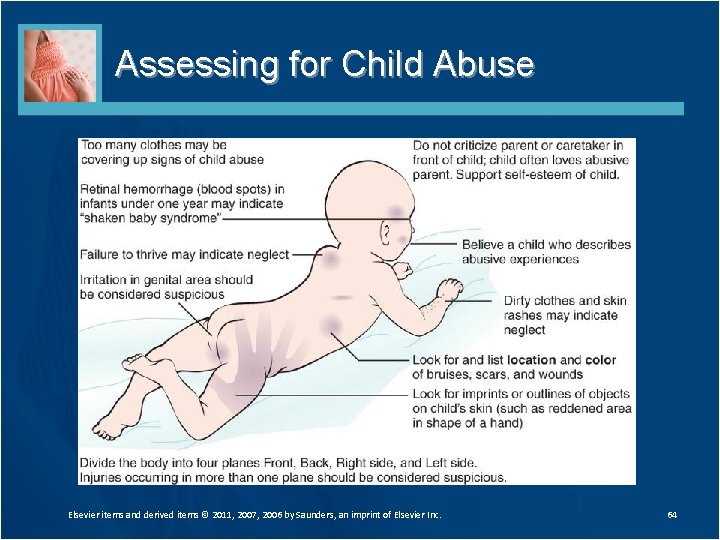
Assessing for Child Abuse Elsevier items and derived items © 2011, 2007, 2006 by Saunders, an imprint of Elsevier Inc. 64
Cultural and Medical Issues • A culturally sensitive • Document all signs of history is essential in abuse and assessing children interactions as well as suspected to be victims verbal comments of abuse between the child and • Some cultural practices parent can be interpreted as • Child protective physical abuse if the services should nurse is not culturally oversee any aware of folk-healing investigation that is and ethnic practices warranted Elsevier items and derived items © 2011, 2007, 2006 by Saunders, an imprint of Elsevier Inc. 65
Question for Review • What nursing assessments are involved in a neurovascular check? Elsevier items and derived items © 2011, 2007, 2006 by Saunders, an imprint of Elsevier Inc. 66
Review • • • Objectives Key Terms Key Points Online Resources Review Questions Elsevier items and derived items © 2011, 2007, 2006 by Saunders, an imprint of Elsevier Inc. 67