Chapter 27 The Child with a Condition of

- Slides: 23
Chapter 27 The Child with a Condition of the Blood, Blood-Forming Organs, or Lymphatic System
Anemias • Can result from many different underlying causes – A reduction in the amount of circulating hemoglobin (Hgb) reduces the oxygen-carrying ability of the blood • An Hgb below 8 g/dl results in an increased cardiac output and a shunting of blood from the periphery to the vital organs • Can result in pallor, weakness, tachypnea, SOB, CHF
Iron-Deficiency Anemia • Most common nutritional deficiency of children – Incidence is highest during infancy (from 9 th to 24 th month) and adolescence • May be caused by severe hemorrhage, inability to absorb iron received, excessive growth requirements, or an inadequate diet – Giving whole cow’s milk to infants can lead to anemia
Iron-Deficiency Anemia (cont. ) • Manifestations – Pallor – Irritability – Anorexia – Decrease in activity • Infants may be overweight due to excessive milk consumption • Treatment – Iron, orally 2 to 3 times a day – Vitamin C aids in absorption • Blood tests – RBC count – Hgb and hematocrit – Morphological cell changes – Iron concentrations • Stool may be tested for occult blood
Parent Education • Nurse stresses importance of breastfeeding for the first 6 months and the use of iron-fortified formula throughout the first year of life • Stools of infants taking oral iron supplements are tarry green • Do not give iron with milk • To increase absorption, give the iron between meals when digestive acid concentration is at its highest
Sickle Cell Disease • Inherited defect in the formation of hemoglobin • Sickling (clumping) caused by decreased blood oxygen levels may be triggered by dehydration, infection, physical or emotional stress, or exposure to cold – Membranes of these cells are fragile and easily destroyed – Their crescent shape makes it difficult for them to pass through the capillaries, causing a pileup of cells in the small vessels – May lead to thrombosis, can be very painful
Manifestations • Hgb level ranges 6 to 9 g/d. L or lower – Child is pale, tires easily, and has little appetite • Sickle cell crises are painful and can be fatal – Symptoms: severe abdominal pain, muscle spasms, leg pain, or painful swollen joints may be seen • Fever, vomiting, hematuria, convulsions, stiff neck, coma, or paralysis can result • Risk for stroke as a complication of a vaso-occlusive sickle cell crisis
Therapies and Goals • Erythropoietin and some chemotherapy regimens can increase the production of fetal Hgb and reduce complications • During sickle cell crisis, anticipate the child’s need for tissue oxygenation, hydration, rest, protection from infection, pain control, blood transfusion, and emotional support for this lifethreatening illness • Prevent infection, dehydration, hypoxia, and sickling
Leukemia • Most common form of cancer in childhood • A malignant disease of the blood-forming organs that results in an uncontrolled growth of immature WBCs • Involves a disruption of bone marrow function caused by the overproduction of immature WBCs in the marrow – These immature WBCs take over the centers that are designed to form RBCs, and anemia results • Platelet counts are also reduced • Invasion of the bone marrow causes weakening of the bone, and pathological fractures can occur
Manifestations of Leukemia • Gradual or sudden onset • As it progresses, the liver and spleen become • Low-grade fever enlarged • Pallor • Skin may have a lemon • Bruising tendency yellow color • Leg and joint pain • Petechiae and purpura Listlessness may be early objective Abdominal pain symptoms Enlargement of lymph nodes • Anorexia, vomiting, weight loss, and dyspnea are Anemia severe despite also common transfusions • Most common symptoms – Initial phase – –
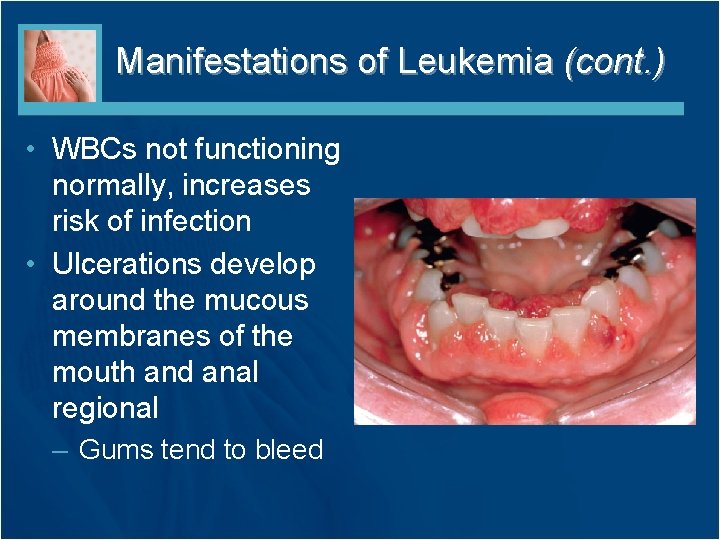
Manifestations of Leukemia (cont. ) • WBCs not functioning normally, increases risk of infection • Ulcerations develop around the mucous membranes of the mouth and anal regional – Gums tend to bleed
Treatment of Leukemia • Long-term care given whenever possible in an outpatient setting • Bone marrow suppression in chemotherapy requires family teaching for infection prevention • Adequate hydration to minimize kidney damage • Active routine immunizations must be delayed while receiving immunosuppressive drugs • Nausea and vomiting are common side effects of chemotherapy; can lead to decreased appetite, weight loss, and generalized weakness • Meticulous oral care is necessary • Bone marrow transplant
Side Effects of Chemotherapy • Steroids can mask signs of infection, cause fluid retention, induce personality changes, and cause the child’s face to appear moon-shaped • Certain chemotherapy agents can cause nausea, diarrhea, rash, hair loss, fever, anuria, anemia, and bone marrow depression • Peripheral neuropathy may be signaled by severe constipation caused by decreased nerve sensations to the bowel
Nursing Care of the Child with Leukemia • Encourage the child to verbalize feelings – Giving permission to discuss their concerns will help clear up misconceptions and to decrease feelings of isolation • Frequently observe child for infection • Monitor vital signs and for symptoms of thrombocytopenic bleeding (a common complication of leukemia) • Meticulous mouth and skin care
Chronic Illness • Behavior problems are lessened when patients can verbalize specific concerns with persons sensitive to their problems • If they feel rejected by and different from their peers, they may be prone to depression • Nurses must develop an awareness of the adolescent’s particular fears of forced dependence, body invasion, mutilation, rejection, and loss of face, especially within peer groups • Important to recognize the adolescent’s need for self-determination
Providing Home Health Care • • Observe how the parents interact with the child Do not wait for the child to cry out for attention Watch for facial expression and body language Post signs above the bed denoting special considerations, such as “never position on left side” Listen to the parents and observe how they attend to the physical needs of the child Don’t be afraid to ask questions or discuss apprehensions Be attuned to the needs of other children in the home Respite care so parents get a break
Care of the Chronically Ill Child • Focusing on what the child can do and providing successful experiences are more effective than focusing on the disability • Involvement of the entire family with the care of the chronically ill child aids in normal family interaction • Child should be integrated into rather than isolated from the community and society • The wellness of the child should be the center of the child’s life, rather than the disability
Facing Death • The nurse must understand – The grieving process – Personal and cultural views concerning that process – The views of a parent losing a child – Perceptions of the child facing death – Hostility is a normal response and may drive away those who do not understand its normalcy in the acute grieving process
Self-Exploration • How nurses have or have not dealt with their own losses affects present lives and the ability to relate to patients • Nurses must recognize that coping is an active and ongoing process • An active support system consisting of nonjudgmental people who are not threatened by natural expression of feeling is crucial
The Child’s Reaction to Death • Children under 5 years of age are mainly concerned with separation from their parents • Preschool children respond to questions about death by relying on their experience and by turning to fantasy • Children do not develop a realistic concept of death as a permanent biological process until 9 or 10 years of age • Failure to be honest with children leaves them to suffer alone, unable to express their fears and sadness or even to say goodbye
Physical Changes of Impending Death • Cool, mottled, cyanotic skin and the slowing of all body processes • Loss of consciousness, but hearing may still be intact • Rales in the chest may be heard
Stages of Dying and the Nurse’s Role • Stages – – – Denial Anger Bargaining Depression Acceptance • Nurse’s Role – Listen – Provide privacy – Provide therapeutic intervention – Provide information – Use appropriate phrases and openended statements (age appropriate)
Elsevier items and derived items © 2011, 2007, 2006 by Saunders, an imprint of Elsevier Inc. 23