Chapter 29 The Child with a Genitourinary Condition


- Slides: 36
Chapter 29 The Child with a Genitourinary Condition Elsevier items and derived items © 2015, 2011, 2007, 2006 by Saunders, an imprint of Elsevier Inc.
Lesson 29. 1 Objectives 2. Name the functional unit of the kidney. 3. List four urological diagnostic procedures. 4. Recognize urinary tract anomalies in infants. Elsevier items and derived items © 2015, 2011, 2007, 2006 by Saunders, an imprint of Elsevier Inc. 2
Development of the Urinary Tract (p. 669) Consists of two kidneys, two ureters, the urinary bladder, and urethra Function is to rid body of waste products and maintain body fluid homeostasis Produce a substance (ESF) that stimulates RBC formation in bone marrow and renin, which regulates blood pressure Elsevier items and derived items © 2015, 2011, 2007, 2006 by Saunders, an imprint of Elsevier Inc. 3
Development of the Reproductive System (p. 671) Gender is determined at time of fertilization Tests to diagnose conditions of the reproductive tract Pap Ø Blood tests Ø Cultures Ø Ultrasound Ø Pregnancy Ø Elsevier items and derived items © 2015, 2011, 2007, 2006 by Saunders, an imprint of Elsevier Inc. 4
Sexual Abuse in Children (p. 671) May be manifested by behaviors, such as Urinary frequency Ø Excessive masturbation Ø Encopresis Ø Severe nightmare Ø Bedwetting Ø Irritation or pain in genital area Ø Decrease in physical or emotional development Ø Elsevier items and derived items © 2015, 2011, 2007, 2006 by Saunders, an imprint of Elsevier Inc. 5
Question 1 Adults who commit sexual abuse usually: 1) 2) 3) 4) know the child. are dependent on drugs. are strangers to the child. have sociopathic personalities. Elsevier items and derived items © 2015, 2011, 2007, 2006 by Saunders, an imprint of Elsevier Inc. 6
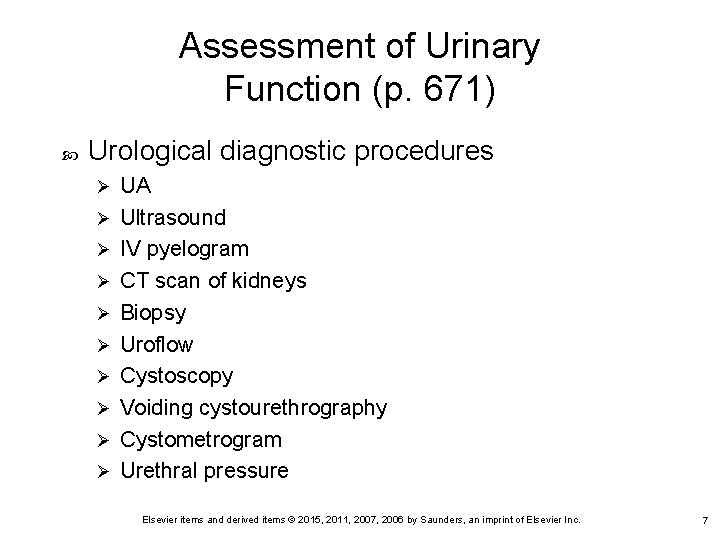
Assessment of Urinary Function (p. 671) Urological diagnostic procedures Ø Ø Ø Ø Ø UA Ultrasound IV pyelogram CT scan of kidneys Biopsy Uroflow Cystoscopy Voiding cystourethrography Cystometrogram Urethral pressure Elsevier items and derived items © 2015, 2011, 2007, 2006 by Saunders, an imprint of Elsevier Inc. 7
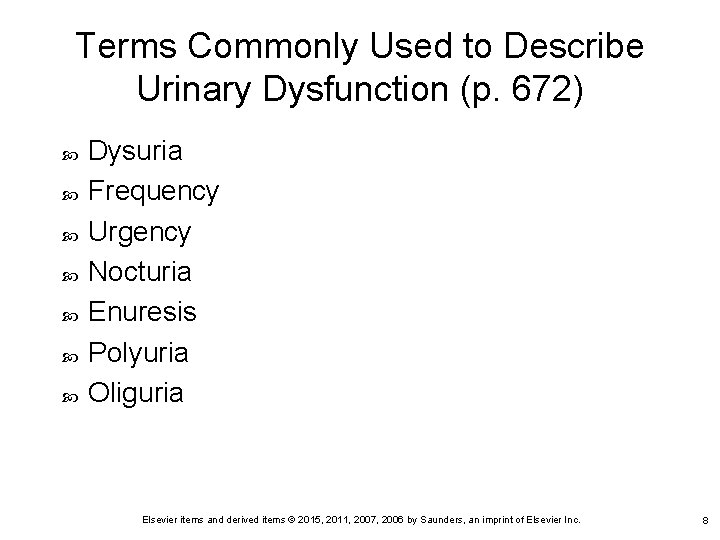
Terms Commonly Used to Describe Urinary Dysfunction (p. 672) Dysuria Frequency Urgency Nocturia Enuresis Polyuria Oliguria Elsevier items and derived items © 2015, 2011, 2007, 2006 by Saunders, an imprint of Elsevier Inc. 8
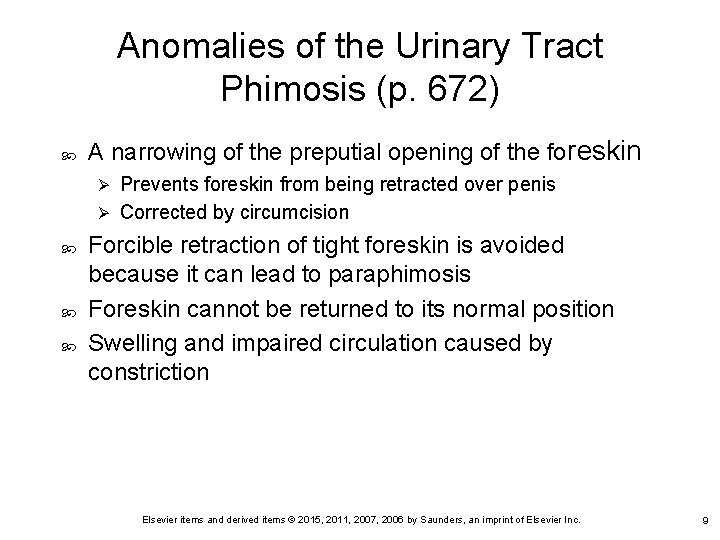
Anomalies of the Urinary Tract Phimosis (p. 672) A narrowing of the preputial opening of the foreskin Prevents foreskin from being retracted over penis Ø Corrected by circumcision Ø Forcible retraction of tight foreskin is avoided because it can lead to paraphimosis Foreskin cannot be returned to its normal position Swelling and impaired circulation caused by constriction Elsevier items and derived items © 2015, 2011, 2007, 2006 by Saunders, an imprint of Elsevier Inc. 9
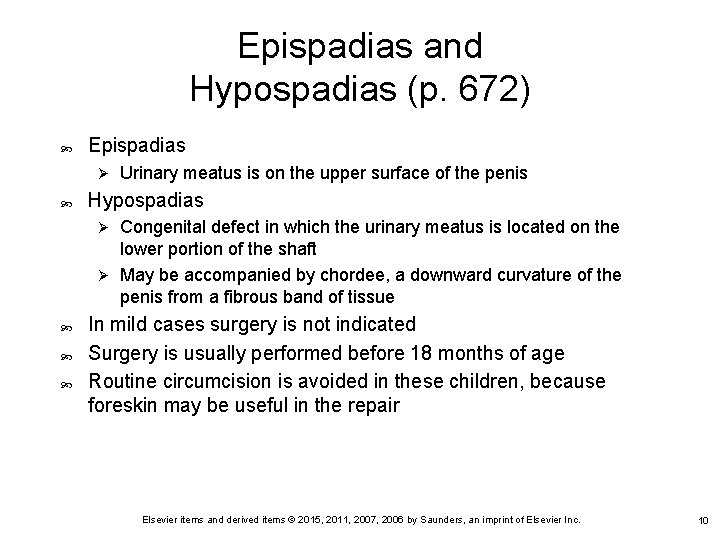
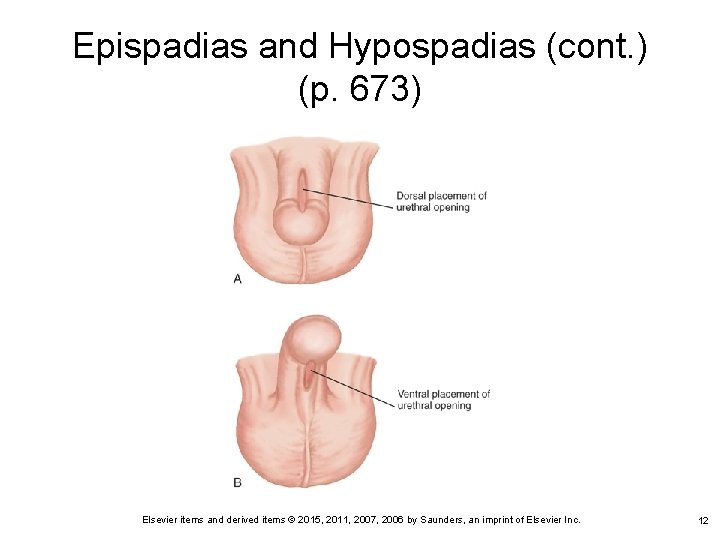
Epispadias and Hypospadias (p. 672) Epispadias Ø Urinary meatus is on the upper surface of the penis Hypospadias Congenital defect in which the urinary meatus is located on the lower portion of the shaft Ø May be accompanied by chordee, a downward curvature of the penis from a fibrous band of tissue Ø In mild cases surgery is not indicated Surgery is usually performed before 18 months of age Routine circumcision is avoided in these children, because foreskin may be useful in the repair Elsevier items and derived items © 2015, 2011, 2007, 2006 by Saunders, an imprint of Elsevier Inc. 10
Question 2 Hypospadias must be surgically corrected to preserve proper genitourinary function. 1) True 2) False Elsevier items and derived items © 2015, 2011, 2007, 2006 by Saunders, an imprint of Elsevier Inc. 11
Epispadias and Hypospadias (cont. ) (p. 673) Elsevier items and derived items © 2015, 2011, 2007, 2006 by Saunders, an imprint of Elsevier Inc. 12
Exstrophy of the Bladder (p. 673) Lower portion of abdominal wall and anterior wall of bladder are missing Noticeable by fetal sonogram Bladder lies open and exposed on abdomen Urine leaks continually from the bladder and skin becomes excoriated Bladder covered to protect mucosa Diapers placed under—rather than on the infant—to protect bladder while allowing urinary drainage Positioned on the back or side so urine drains freely Ideally, surgical closure performed within 48 hours of birth Elsevier items and derived items © 2015, 2011, 2007, 2006 by Saunders, an imprint of Elsevier Inc. 13
Obstructive Uropathy (p. 673) Calculi, tumors, strictures, and scarring may cause obstruction Hydronephrosis Polycystic kidney Urinary diversion surgery may be performed Toddler may be unable to attain independence in toilet training Ø School-age child suffers from being different, may have a distorted body image Ø Adolescent may have lowered self-esteem and is concerned about sexuality Ø Elsevier items and derived items © 2015, 2011, 2007, 2006 by Saunders, an imprint of Elsevier Inc. 14
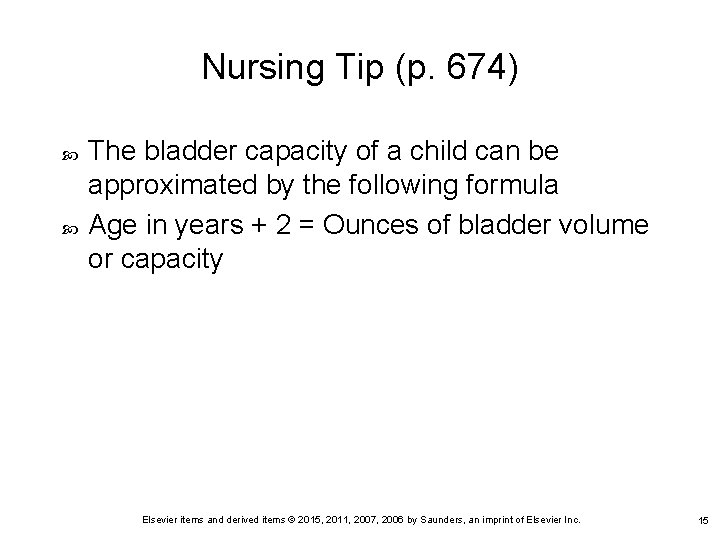
Nursing Tip (p. 674) The bladder capacity of a child can be approximated by the following formula Age in years + 2 = Ounces of bladder volume or capacity Elsevier items and derived items © 2015, 2011, 2007, 2006 by Saunders, an imprint of Elsevier Inc. 15
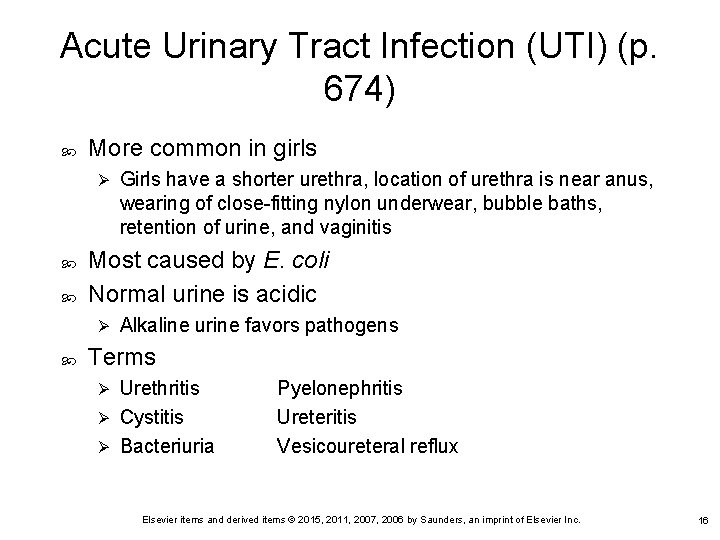
Acute Urinary Tract Infection (UTI) (p. 674) More common in girls Ø Most caused by E. coli Normal urine is acidic Ø Girls have a shorter urethra, location of urethra is near anus, wearing of close-fitting nylon underwear, bubble baths, retention of urine, and vaginitis Alkaline urine favors pathogens Terms Urethritis Ø Cystitis Ø Bacteriuria Ø Pyelonephritis Ureteritis Vesicoureteral reflux Elsevier items and derived items © 2015, 2011, 2007, 2006 by Saunders, an imprint of Elsevier Inc. 16
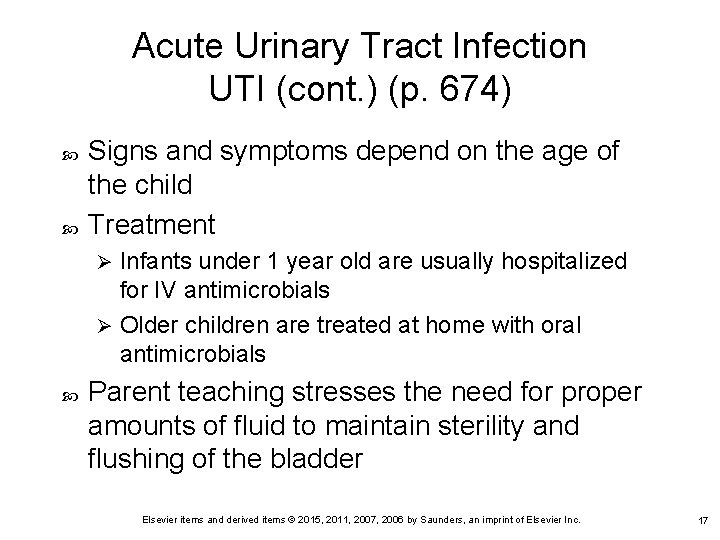
Acute Urinary Tract Infection UTI (cont. ) (p. 674) Signs and symptoms depend on the age of the child Treatment Infants under 1 year old are usually hospitalized for IV antimicrobials Ø Older children are treated at home with oral antimicrobials Ø Parent teaching stresses the need for proper amounts of fluid to maintain sterility and flushing of the bladder Elsevier items and derived items © 2015, 2011, 2007, 2006 by Saunders, an imprint of Elsevier Inc. 17
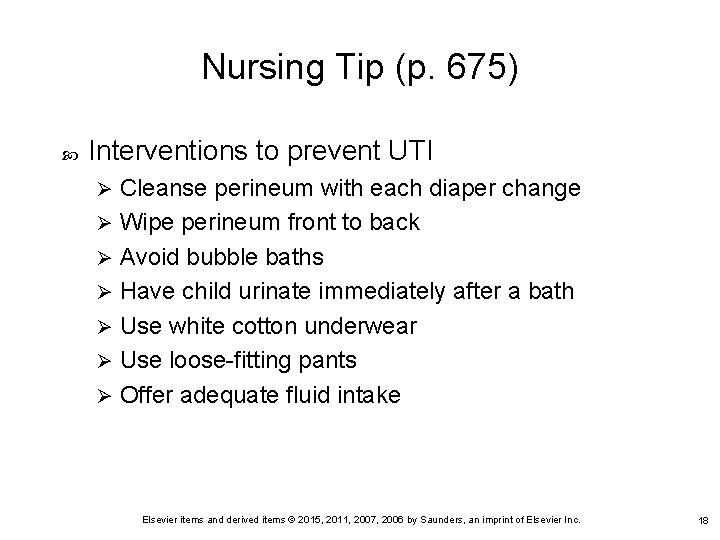
Nursing Tip (p. 675) Interventions to prevent UTI Cleanse perineum with each diaper change Ø Wipe perineum front to back Ø Avoid bubble baths Ø Have child urinate immediately after a bath Ø Use white cotton underwear Ø Use loose-fitting pants Ø Offer adequate fluid intake Ø Elsevier items and derived items © 2015, 2011, 2007, 2006 by Saunders, an imprint of Elsevier Inc. 18
Lesson 29. 2 Objectives 5. Discuss the skin care pertinent to the child with nephrosis. 6. Explain any alterations in diet applicable to the child with nephrosis. 7. Differentiate between nephrosis and acute glomerulonephritis. Elsevier items and derived items © 2015, 2011, 2007, 2006 by Saunders, an imprint of Elsevier Inc. 19
Nephrotic Syndrome (Nephrosis) (p. 675) A number of different types of kidney conditions distinguished by the presence of marked amounts of protein in the urine, edema, and hypoalbuminemia More common in boys Ø Seen more in children 2 to 7 years of age Ø May be related to a thymus T-cell dysfunction Ø Prognosis is good in steroid-responsive patients Ø Elsevier items and derived items © 2015, 2011, 2007, 2006 by Saunders, an imprint of Elsevier Inc. 20
Nephrotic Syndrome (Nephrosis) (cont. ) (p. 675) Generalized edema Weight gain Pale, irritable, listless Poor appetite Blood pressure usually normal Urine exam reveals massive albumin and a few RBCs Prone to infection when absolute granulocyte counts fall below 1000 cells/mm 3 (neutropenia) Elsevier items and derived items © 2015, 2011, 2007, 2006 by Saunders, an imprint of Elsevier Inc. 21
Nephrotic Syndrome (Nephrosis) (cont. ) (p. 675) Treatment Ø Steroids to reduce proteinuria and edema • Steroids mask infection; therefore, it is important to monitor the child for signs of infection Prevent medication toxicity Ø Diuretics have not been effective in reducing nephrotic edema Ø Avoid adding salt to foods whenever edema is present Ø Fluids generally are not restricted except when massive edema is present Ø Elsevier items and derived items © 2015, 2011, 2007, 2006 by Saunders, an imprint of Elsevier Inc. 22
Nephrotic Syndrome (Nephrosis) (cont. ) (p. 675) Nursing care Supportive care to parents and child Ø Parent instructed to keep daily record of the child’s weight, urinary protein levels, and medications Ø No vaccinations or immunizations should be administered while the disease is active or during immunosuppressive therapy Ø Positioning Ø Strict monitoring of I&O Ø Daily weight and protection from infection Ø Elsevier items and derived items © 2015, 2011, 2007, 2006 by Saunders, an imprint of Elsevier Inc. 23
Safety Alert (p. 677) When steroids are administered, the immune system is depressed. Care should be taken to limit exposure to infections. Elsevier items and derived items © 2015, 2011, 2007, 2006 by Saunders, an imprint of Elsevier Inc. 24
Acute Glomerulonephritis (p. 677) Allergic reaction (antigen-antibody) to group A beta-hemolytic streptococcal infection Antibodies produced to fight invading organisms also react against glomerular tissue Both kidneys usually affected Mild cases generally recover within a couple of weeks Elsevier items and derived items © 2015, 2011, 2007, 2006 by Saunders, an imprint of Elsevier Inc. 25
Question 3 Complete the analogy. Nephrosis : generalized edema as acute glomerulonephritis : ______. 1) 2) 3) 4) pedal edema increased abdominal girth periorbital edema hypotension Elsevier items and derived items © 2015, 2011, 2007, 2006 by Saunders, an imprint of Elsevier Inc. 26
Lesson 29. 3 Objectives 8. Outline the nursing care for a child who is diagnosed as having Wilms’ tumor. 9. Discuss the impact of undescended testes on fertility. 10. Discuss the impact of genitourinary surgery on the growth and development of children at various ages. Elsevier items and derived items © 2015, 2011, 2007, 2006 by Saunders, an imprint of Elsevier Inc. 27
Wilms’ Tumor (Nephroblastoma) (p. 678) Embryonal adenosarcoma is thought to have a genetic basis Most discovered before age 3 years One of the most common malignancies of early life Few or no symptoms during the early stages of growth Abdominal mass usually found by parent or during routine health checkup Elsevier items and derived items © 2015, 2011, 2007, 2006 by Saunders, an imprint of Elsevier Inc. 28
Question 4 The most common symptom noted in children with Wilms’ tumor is: 1) 2) 3) 4) abdominal pain. hematuria. hypertension. abdominal mass. Elsevier items and derived items © 2015, 2011, 2007, 2006 by Saunders, an imprint of Elsevier Inc. 29
Wilms’ Tumor (cont. ) (p. 679) IV pyelogram reveals a growth, tumor compresses kidney tissue, usually encapsulated May cause hypertension Until the tumor has been surgically removed, abdominal palpation must not be performed A sign above the bed and a notation on the chart must clearly state no abdominal palpation Elsevier items and derived items © 2015, 2011, 2007, 2006 by Saunders, an imprint of Elsevier Inc. 30
Wilms’ Tumor (cont. ) (p. 679) Treatment Combination of surgery, radiation, and chemotherapy Ø Affected kidney and tumor are removed as soon as possible after diagnosis confirmed Ø Nursing care Preoperative Ø Avoid abdominal examination by caregivers Ø Routine postoperative care Ø Elsevier items and derived items © 2015, 2011, 2007, 2006 by Saunders, an imprint of Elsevier Inc. 31
Hydrocele (p. 680) Excessive amount of fluid in sac that surrounds the testicle Causes scrotum to swell Chronic hydrocele that persists beyond 1 year is corrected by surgery {Insert Fig. 29 -8} Elsevier items and derived items © 2015, 2011, 2007, 2006 by Saunders, an imprint of Elsevier Inc. 32
Cryptorchidism (p. 681) Testes fail to descend into the scrotum Unilateral form is more common Testes are warmer in abdomen, sperm cells begin to deteriorate If both testes are involved, sterility can result Often accompanied by inguinal hernia Testes continue to secrete hormones directly into the bloodstream, so secondary sex characteristics are not affected Elsevier items and derived items © 2015, 2011, 2007, 2006 by Saunders, an imprint of Elsevier Inc. 33
Cryptorchidism (cont. ) (p. 681) Treatment Hormonal management before surgery consists of the administration of human chorionic gonadotropin (h. CG) Ø May precipitate descent of the testes into the scrotal sac Ø Orchiopexy improves the condition, fertility rate among these patients may be reduced Ø Increased risk of testicular tumors as the child reaches adulthood Ø Elsevier items and derived items © 2015, 2011, 2007, 2006 by Saunders, an imprint of Elsevier Inc. 34
Cryptorchidism (cont. ) (p. 681) Nursing care Scrotal support Ø Prevent contamination of suture line Ø Teach testicular self-exam Ø Psychological and emotional support Ø Surgery on “private parts” can be embarrassing Ø Nurse assures the child that his penis will not be affected Ø Elsevier items and derived items © 2015, 2011, 2007, 2006 by Saunders, an imprint of Elsevier Inc. 35
Impact of Urinary or Genital Surgery on Growth and Development (p. 681) Between 3 and 6 years of age, the child becomes curious about sexual differences and may masturbate Surgical interventions during this stage of development require guidance and preparation in order to minimize negative impact on growth and development Elsevier items and derived items © 2015, 2011, 2007, 2006 by Saunders, an imprint of Elsevier Inc. 36