Chapter 1 Preliminaries 1 1 3 Functions and


- Slides: 101
Chapter 1 Preliminaries 1
1. 3 Functions and Their Graphs 2
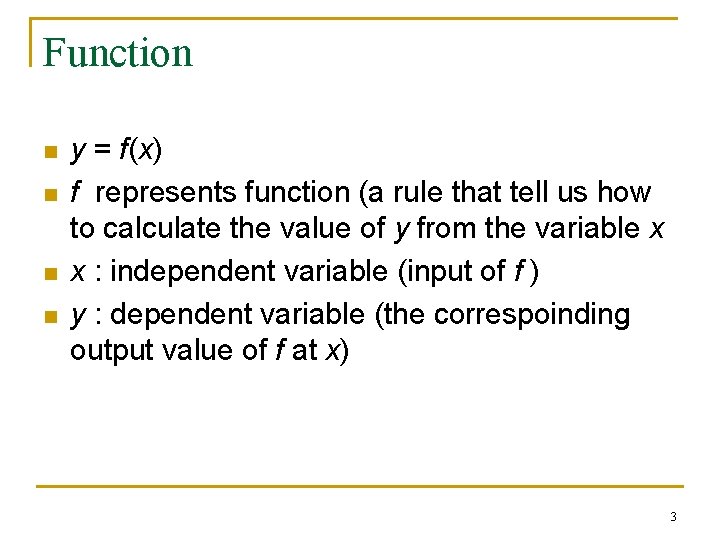
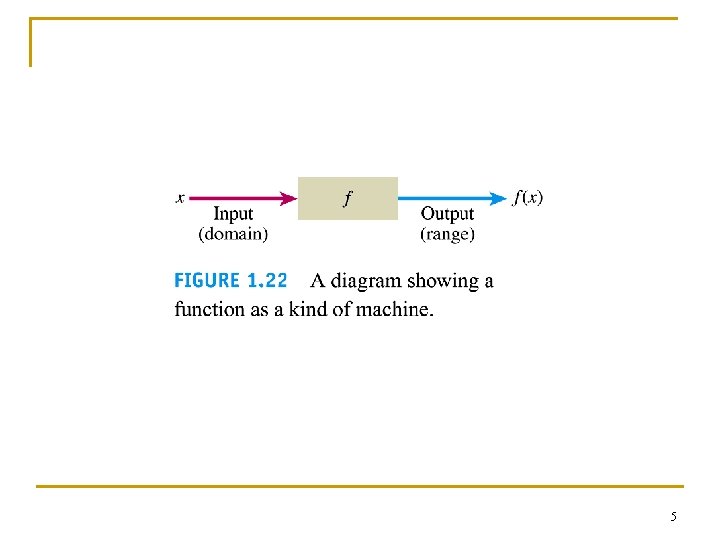
Function n n y = f(x) f represents function (a rule that tell us how to calculate the value of y from the variable x x : independent variable (input of f ) y : dependent variable (the correspoinding output value of f at x) 3
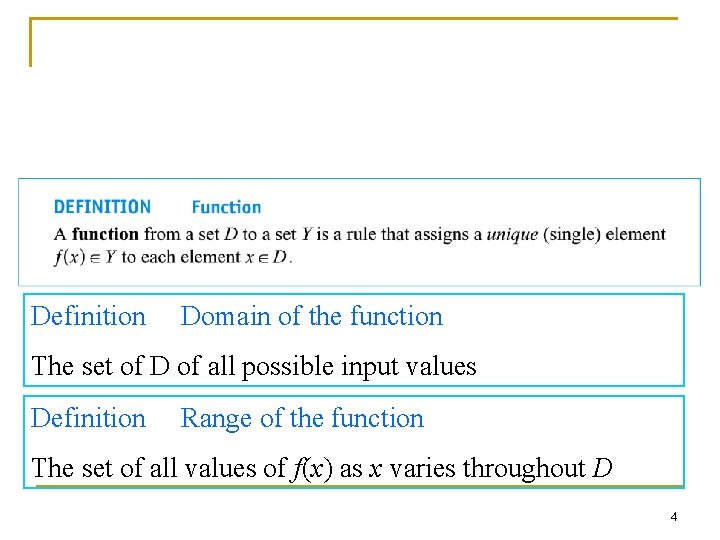
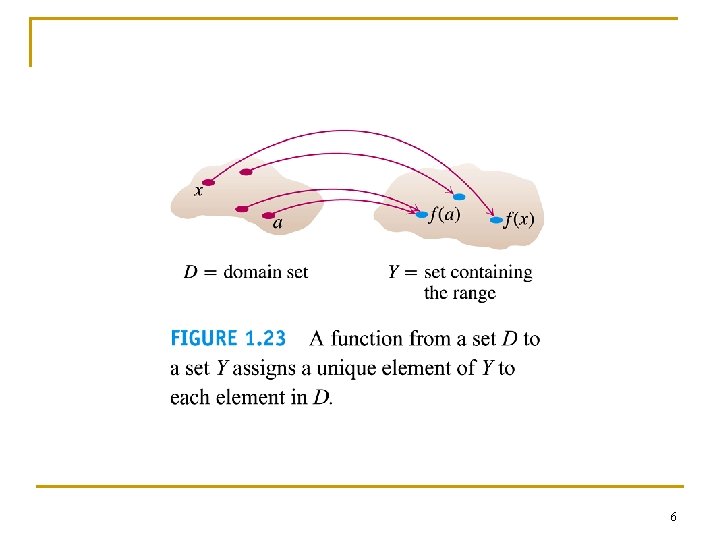
Definition Domain of the function The set of D of all possible input values Definition Range of the function The set of all values of f(x) as x varies throughout D 4
5
6
Natural Domain n When a function y = f(x)is defined and the domain is not stated explicitly, the domain is assumed to be the largest set of real x-values for the formula gives real y-values. e. g. compare “y = x 2” c. f. “y = x 2, x≥ 0” Domain may be open, closed, half open, finite, infinite. 7
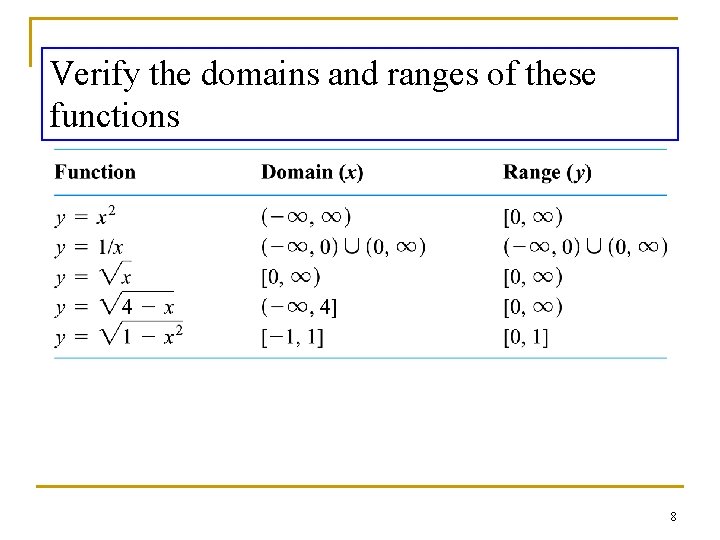
Verify the domains and ranges of these functions 8
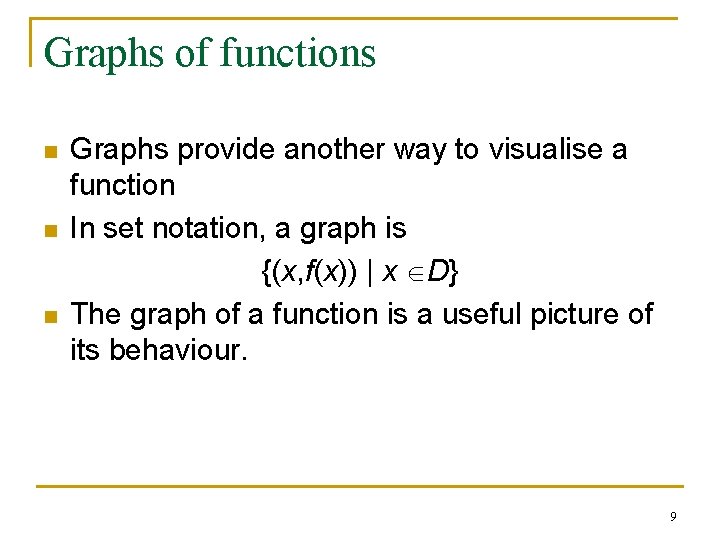
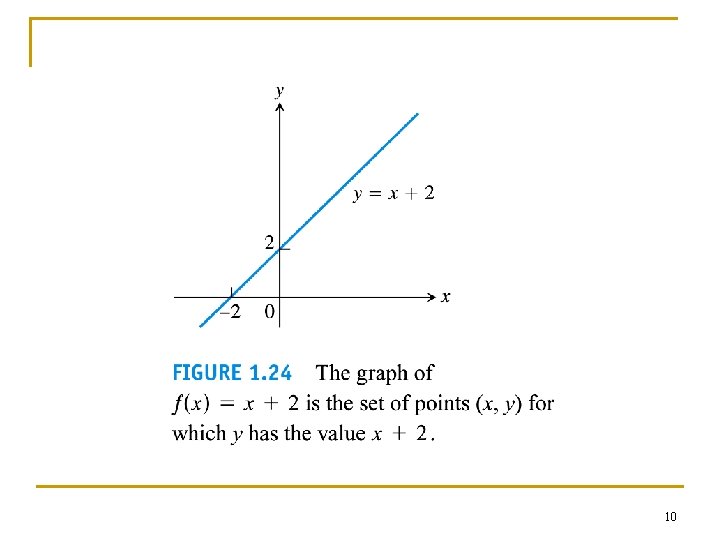
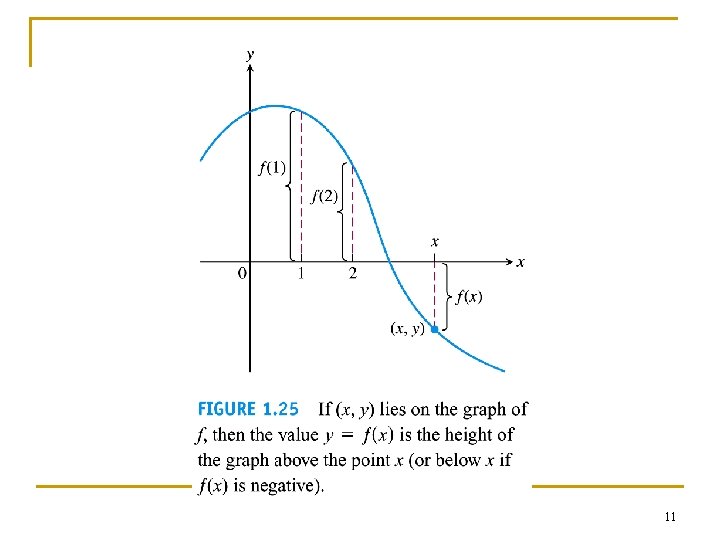
Graphs of functions n n n Graphs provide another way to visualise a function In set notation, a graph is {(x, f(x)) | x D} The graph of a function is a useful picture of its behaviour. 9
10
11
Example 2 Sketching a graph n Graph the function y = x 2 over the interval [-2, 2] 12
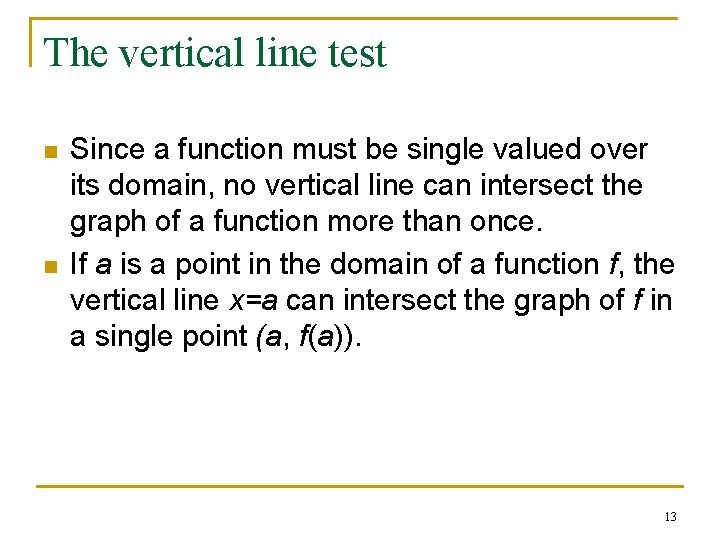
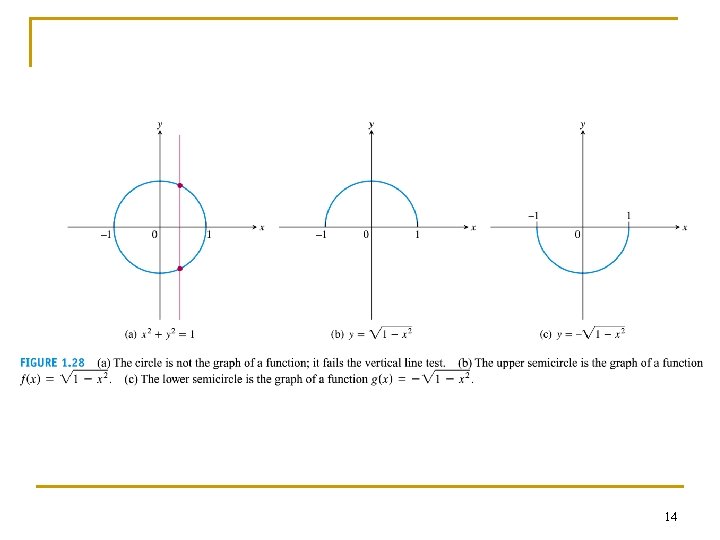
The vertical line test n n Since a function must be single valued over its domain, no vertical line can intersect the graph of a function more than once. If a is a point in the domain of a function f, the vertical line x=a can intersect the graph of f in a single point (a, f(a)). 13
14
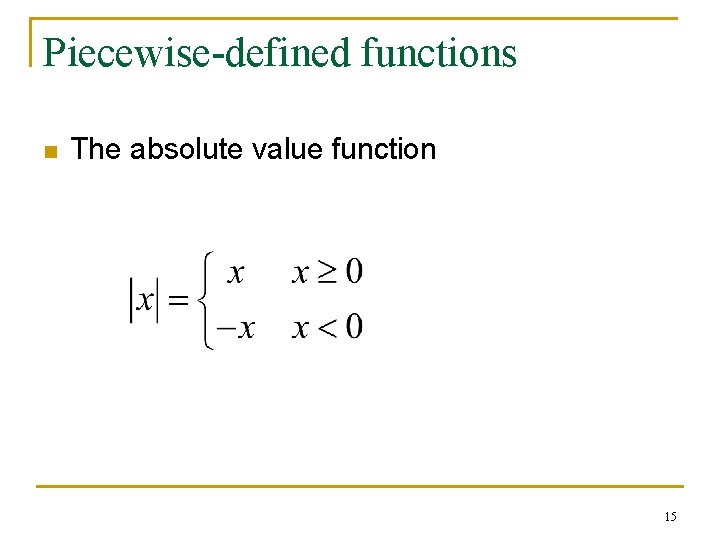
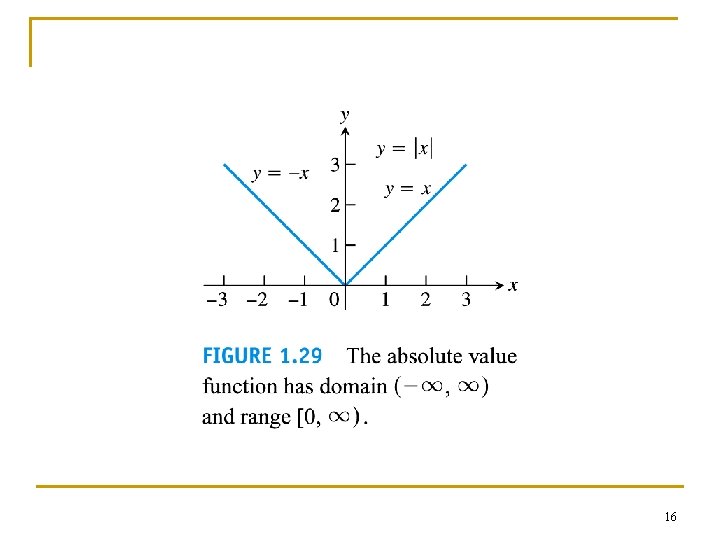
Piecewise-defined functions n The absolute value function 15
16
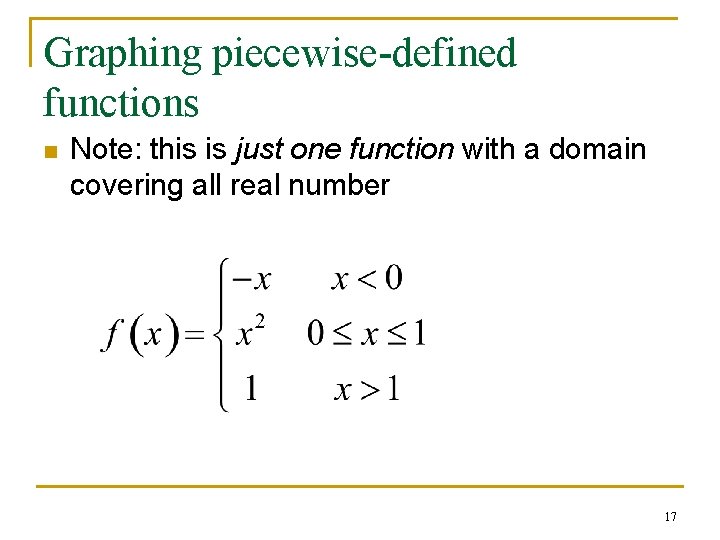
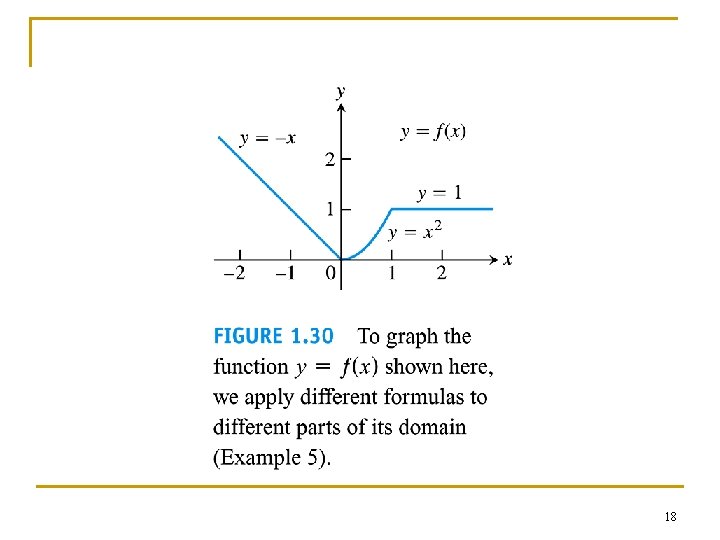
Graphing piecewise-defined functions n Note: this is just one function with a domain covering all real number 17
18
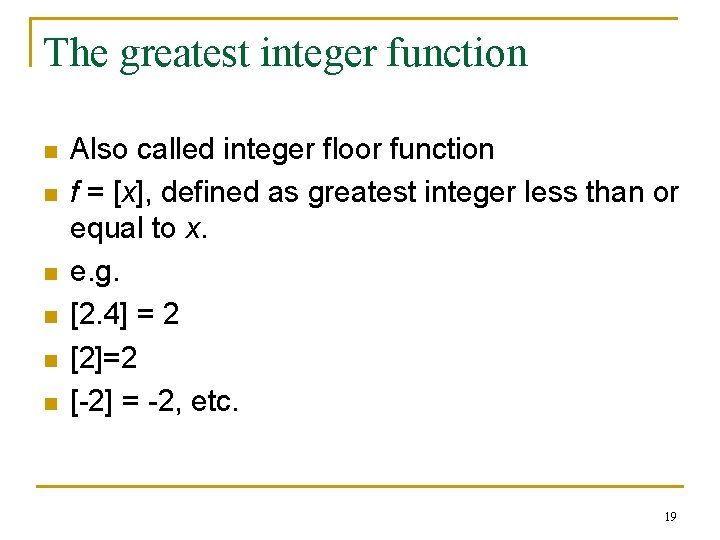
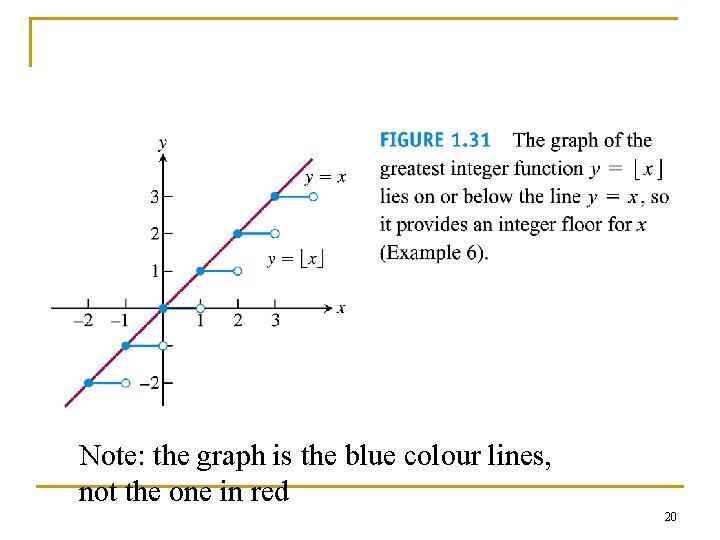
The greatest integer function n n n Also called integer floor function f = [x], defined as greatest integer less than or equal to x. e. g. [2. 4] = 2 [2]=2 [-2] = -2, etc. 19
Note: the graph is the blue colour lines, not the one in red 20
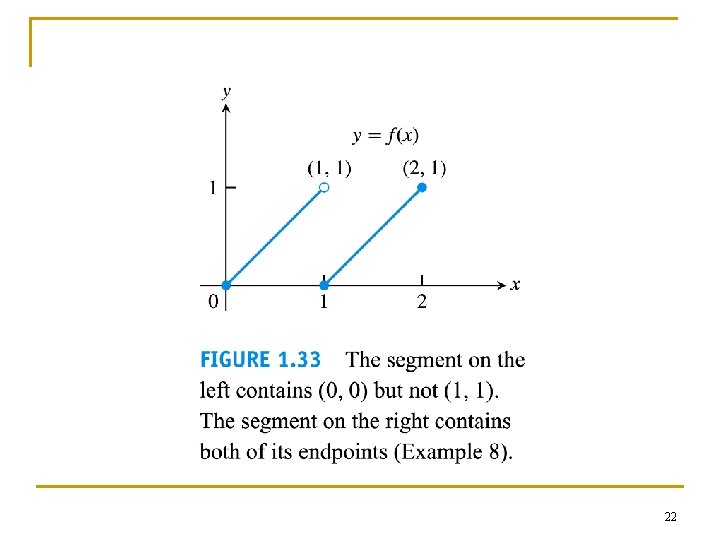
Writing formulas for piecewise-defined functions n Write a formula for the function y=f(x) in Figure 1. 33 21
22
1. 4 Identifying Functions; Mathematical Models 23
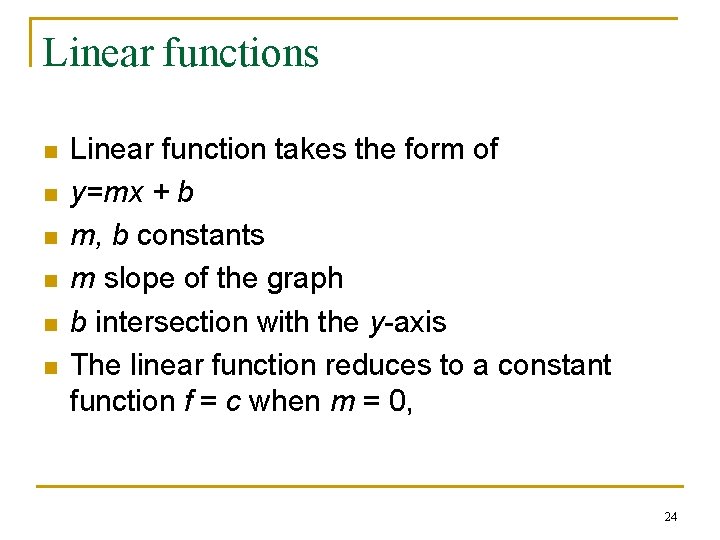
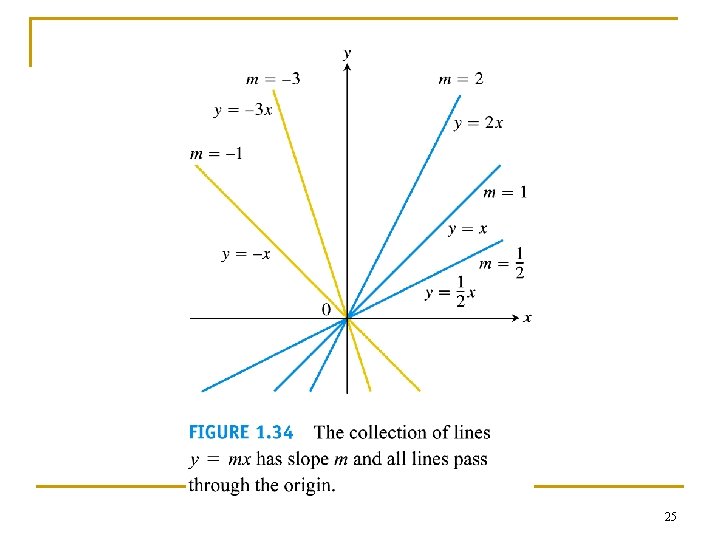
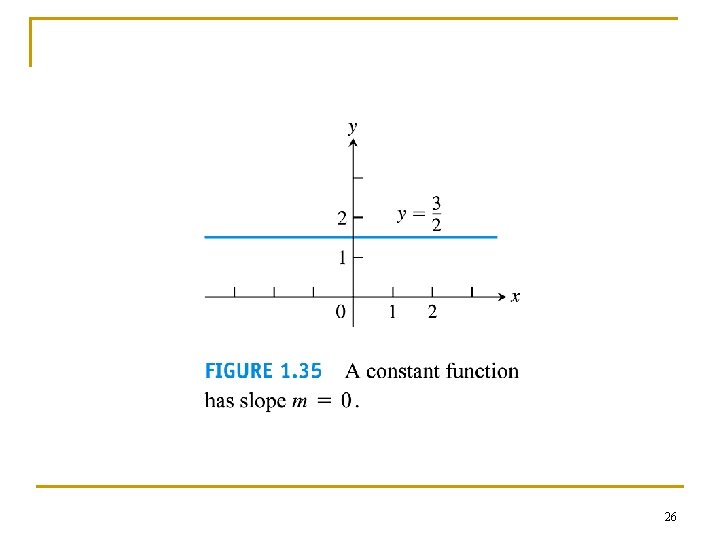
Linear functions n n n Linear function takes the form of y=mx + b m, b constants m slope of the graph b intersection with the y-axis The linear function reduces to a constant function f = c when m = 0, 24
25
26
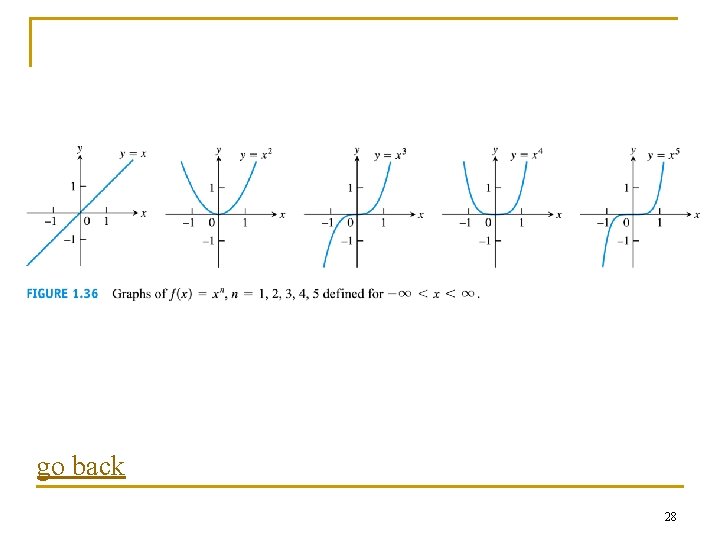
Power functions n n n f(x) = xa a constant Case (a): a = n, a positive integer 27
go back 28
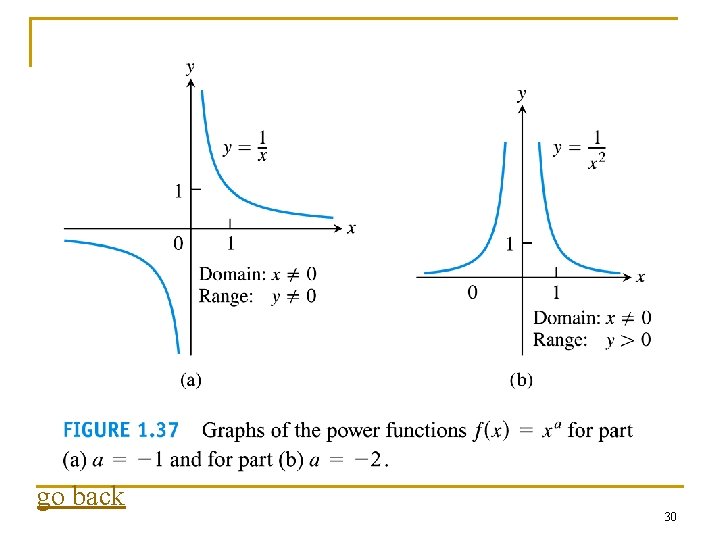
Power functions n n n Case (b): a = -1 (hyperbola) or a=-2 29
go back 30
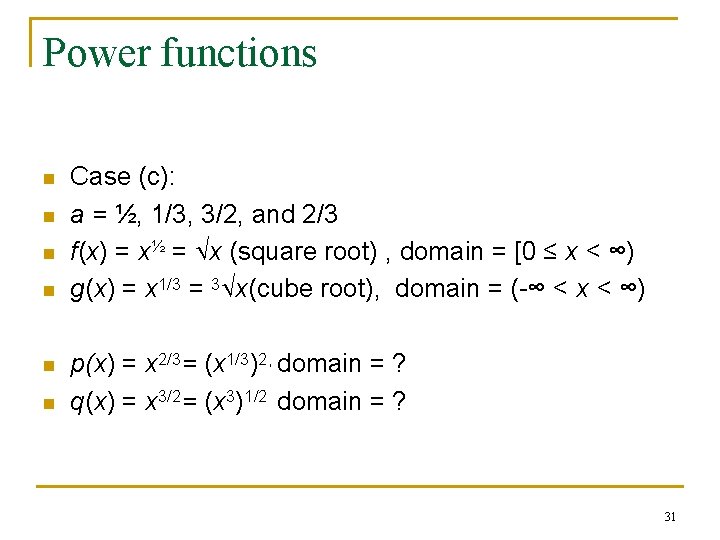
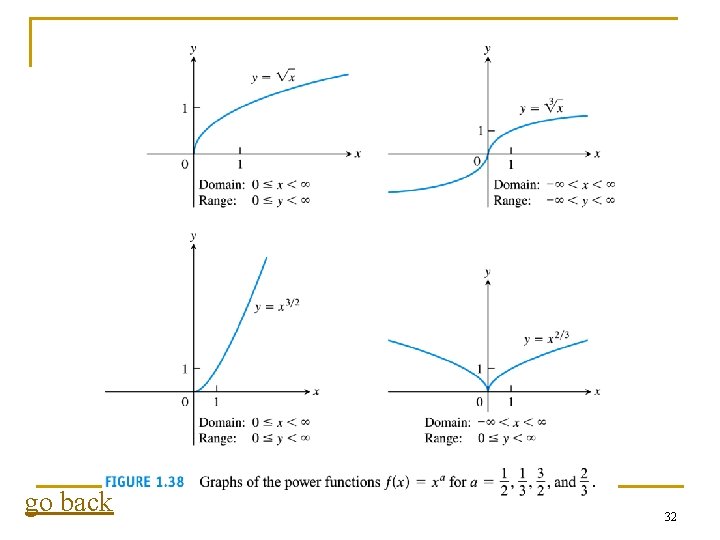
Power functions n n n Case (c): a = ½, 1/3, 3/2, and 2/3 f(x) = x½ = x (square root) , domain = [0 ≤ x < ∞) g(x) = x 1/3 = 3 x(cube root), domain = (-∞ < x < ∞) p(x) = x 2/3= (x 1/3)2, domain = ? q(x) = x 3/2= (x 3)1/2 domain = ? 31
go back 32
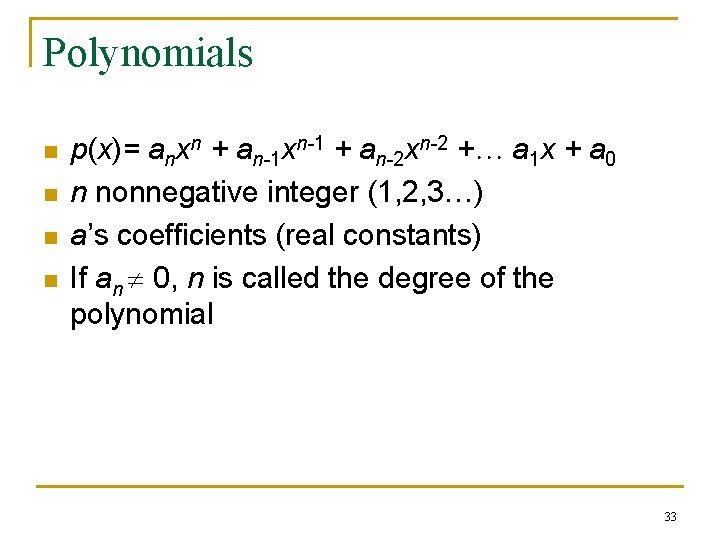
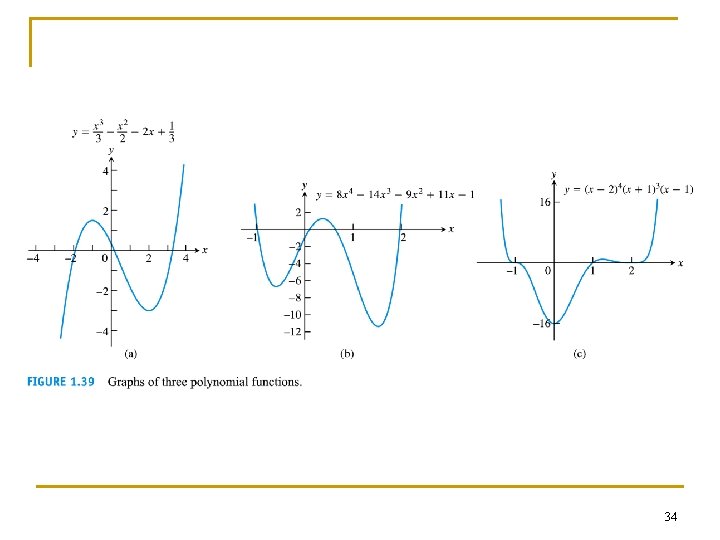
Polynomials n n p(x)= anxn + an-1 xn-1 + an-2 xn-2 + a 1 x + a 0 n nonnegative integer (1, 2, 3…) a’s coefficients (real constants) If an 0, n is called the degree of the polynomial 33
34
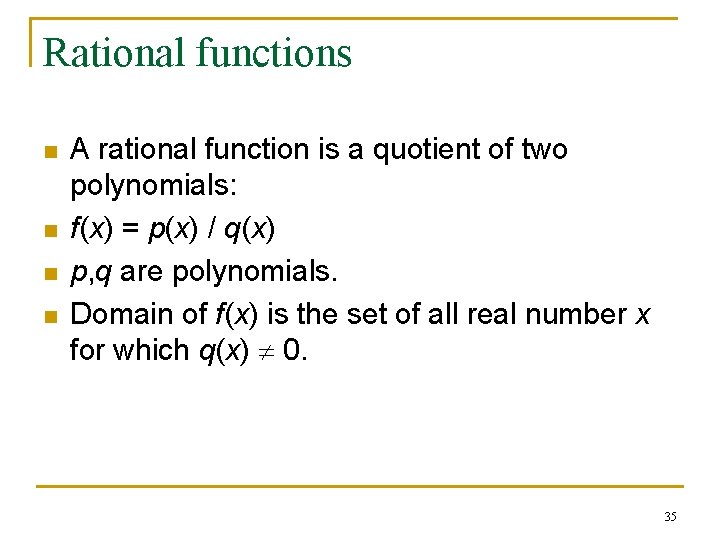
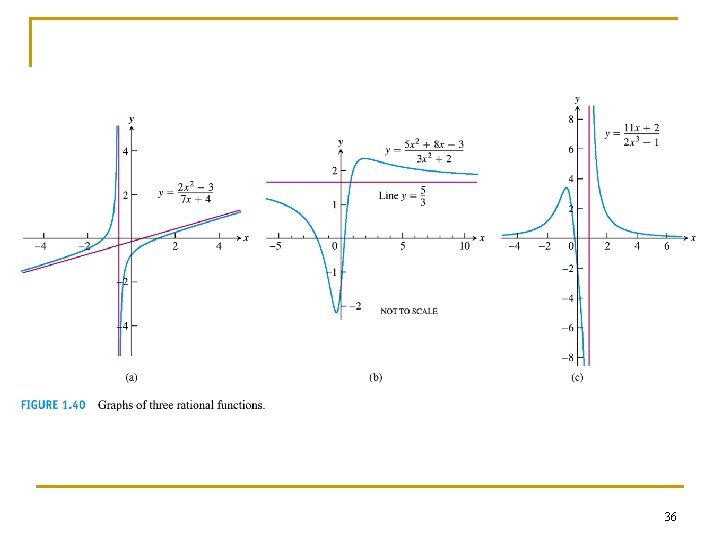
Rational functions n n A rational function is a quotient of two polynomials: f(x) = p(x) / q(x) p, q are polynomials. Domain of f(x) is the set of all real number x for which q(x) 0. 35
36
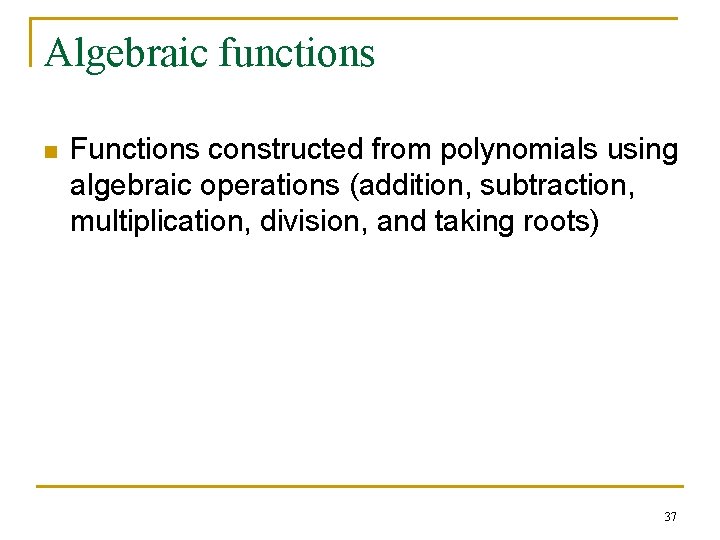
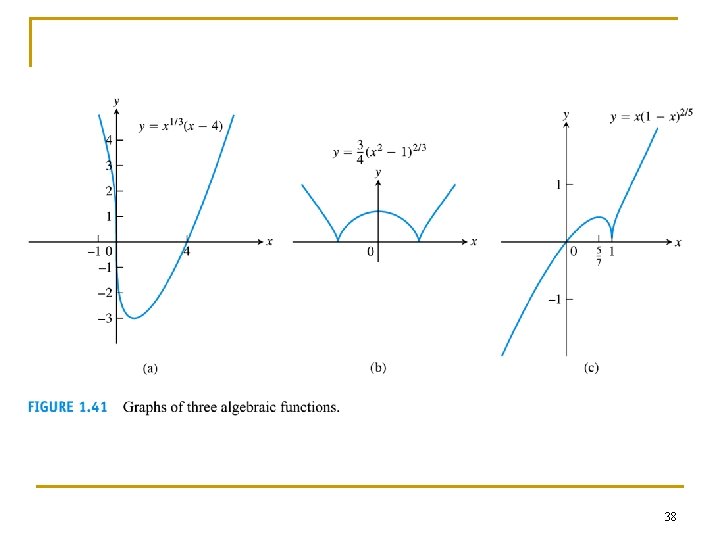
Algebraic functions n Functions constructed from polynomials using algebraic operations (addition, subtraction, multiplication, division, and taking roots) 37
38
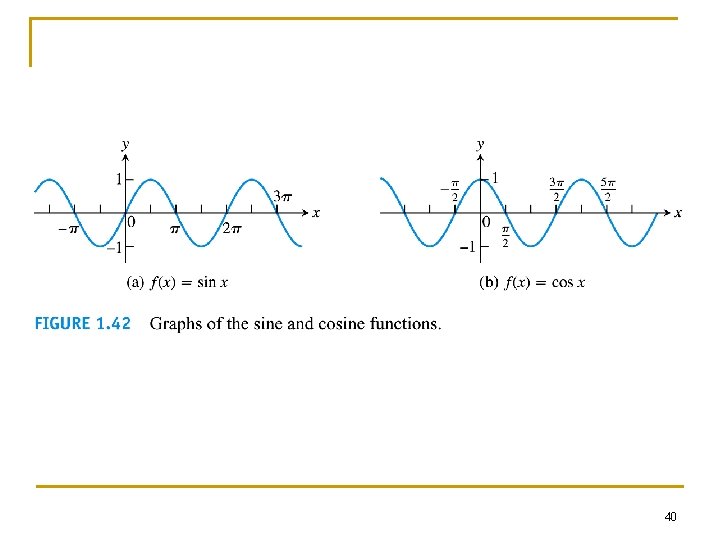
Trigonometric functions n More details in later chapter 39
40
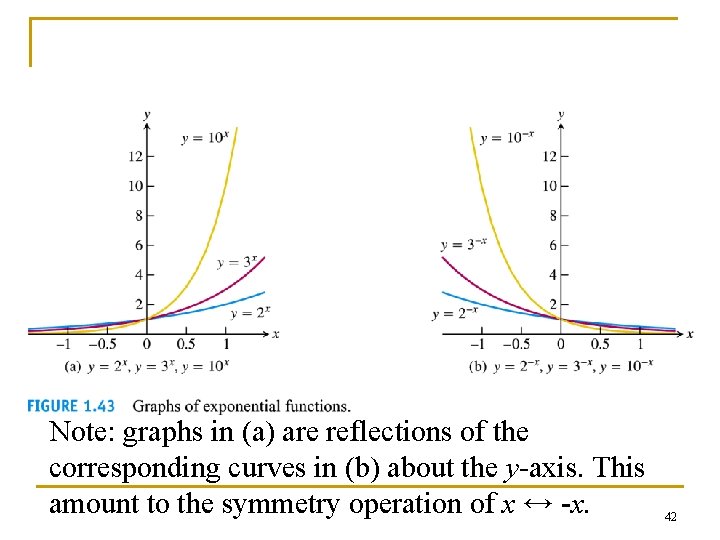
Exponential functions n n n f(x) = ax Where a > 0 and a 0. a is called the ‘base’. Domain (-∞, ∞) Range (0, ∞) Hence, f(x) > 0 More in later chapter 41
Note: graphs in (a) are reflections of the corresponding curves in (b) about the y-axis. This amount to the symmetry operation of x ↔ -x. 42
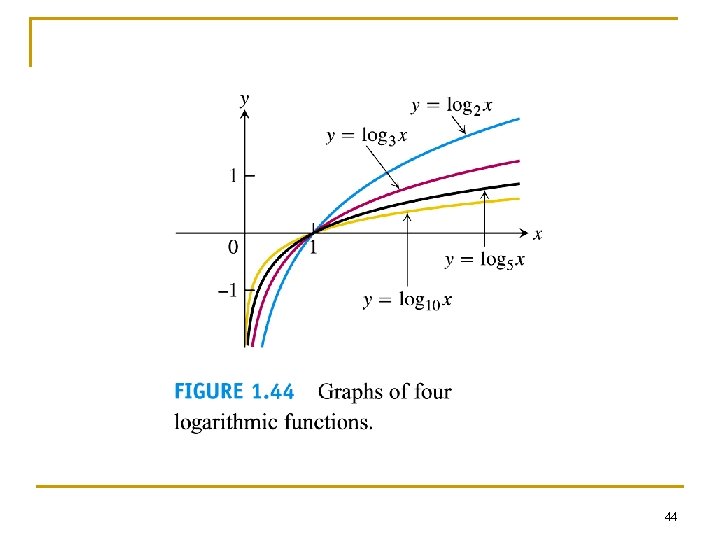
Logarithmic functions n n n f(x) = loga x a is the base a 1, a >0 Domain (0, ∞) Range (-∞, ∞) They are the inverse functions of the exponential functions (more in later chapter) 43
44
Transcendental functions n n Functions that are not algebraic Include: trigonometric, inverse trigonometric, exponential, logarithmic, hyperbolic and many other functions 45
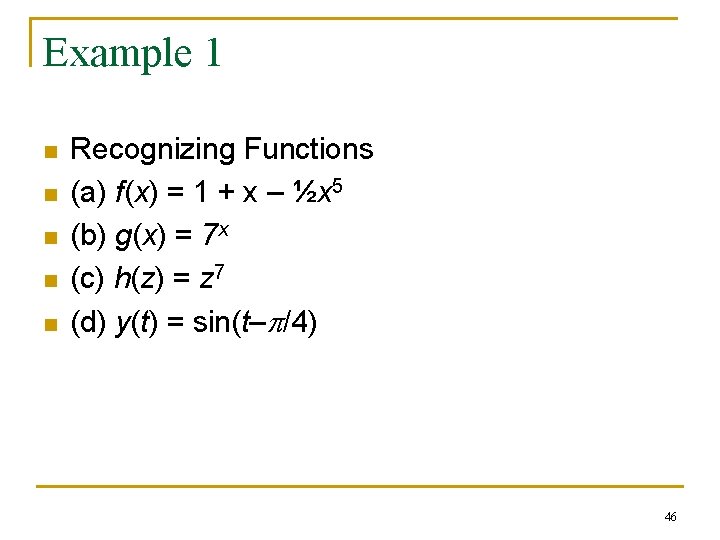
Example 1 n n n Recognizing Functions (a) f(x) = 1 + x – ½x 5 (b) g(x) = 7 x (c) h(z) = z 7 (d) y(t) = sin(t–p/4) 46
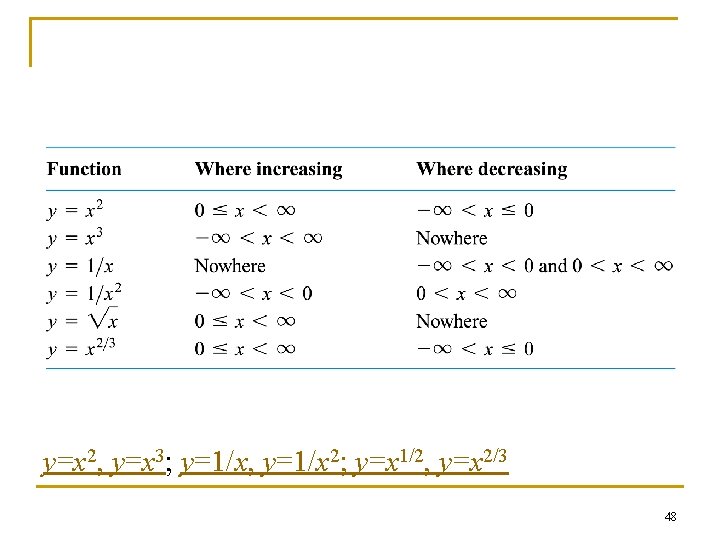
Increasing versus decreasing functions n n A function is said to be increasing if it rises as you move from left to right A function is said to be decreasing if it falls as you move from left to right 47
y=x 2, y=x 3; y=1/x, y=1/x 2; y=x 1/2, y=x 2/3 48
49
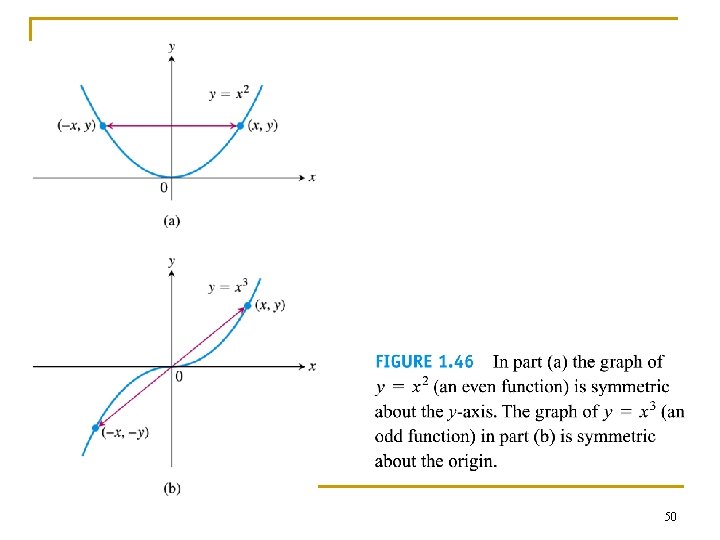
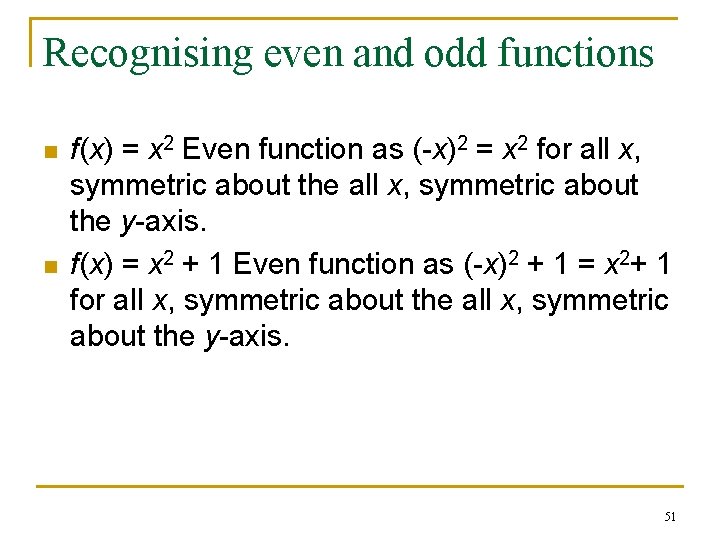
50
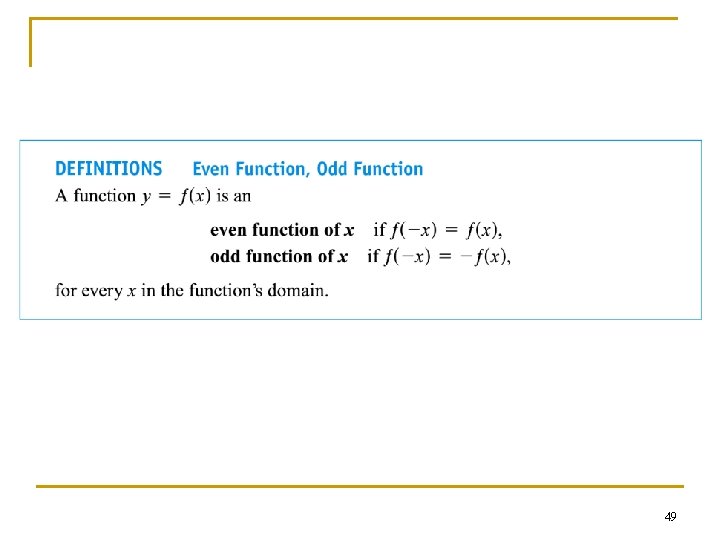
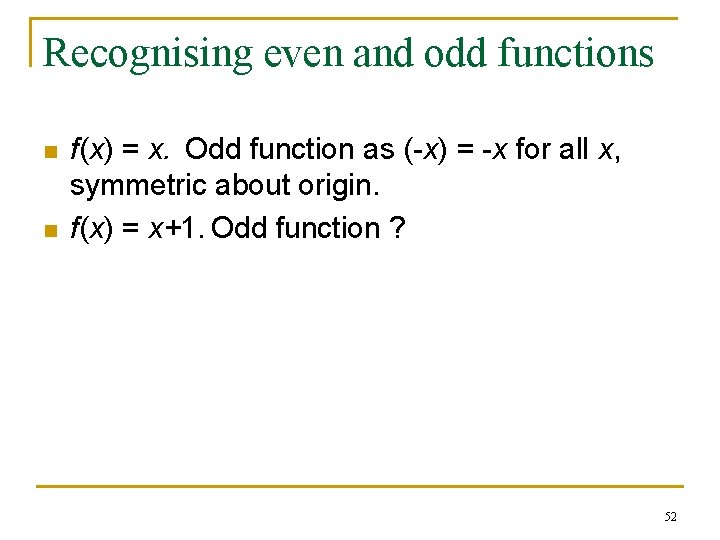
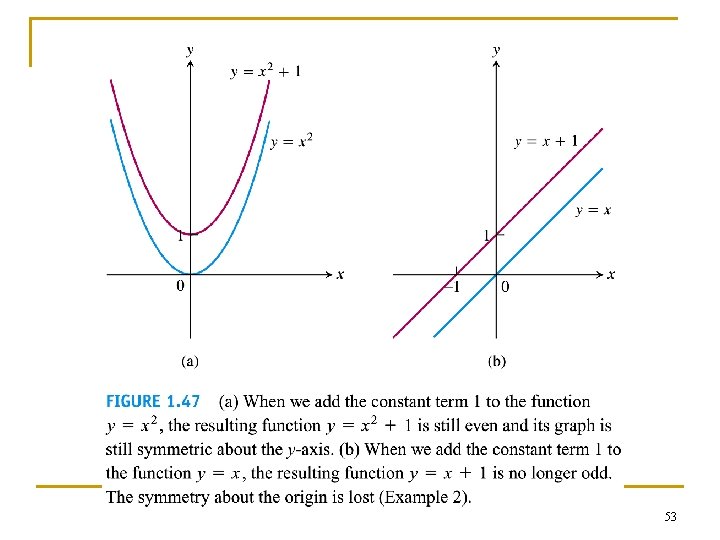
Recognising even and odd functions n n f(x) = x 2 Even function as (-x)2 = x 2 for all x, symmetric about the y-axis. f(x) = x 2 + 1 Even function as (-x)2 + 1 = x 2+ 1 for all x, symmetric about the y-axis. 51
Recognising even and odd functions n n f(x) = x. Odd function as (-x) = -x for all x, symmetric about origin. f(x) = x+1. Odd function ? 52
53
1. 5 Combining Functions; Shifting and Scaling Graphs 54
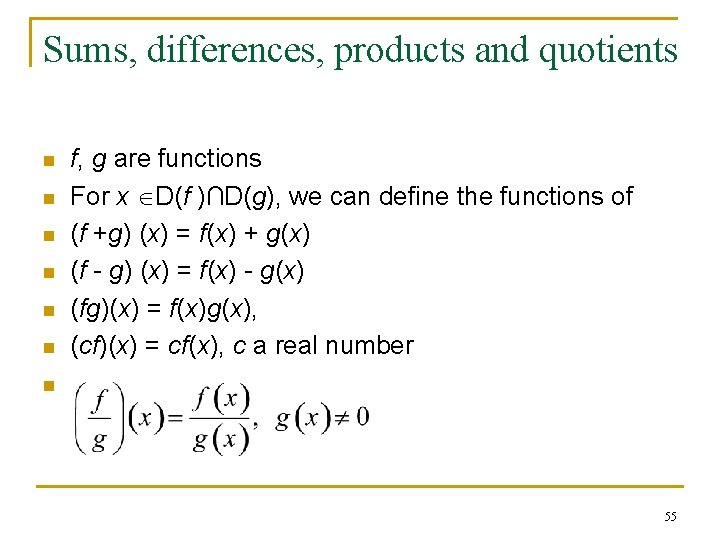
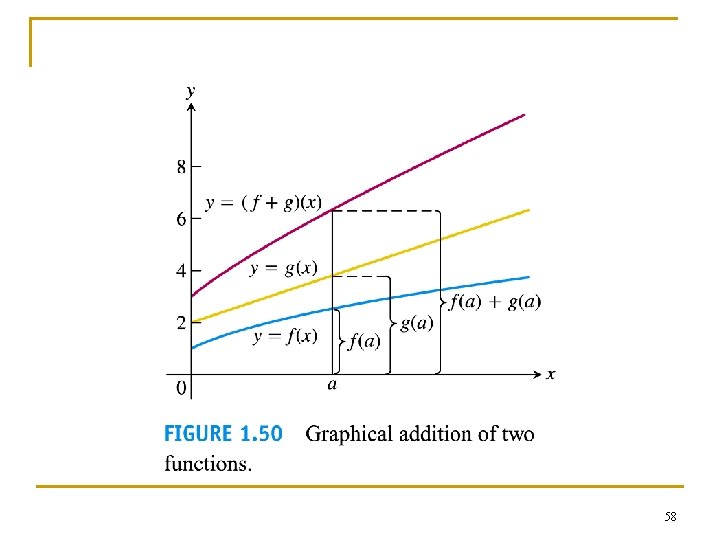
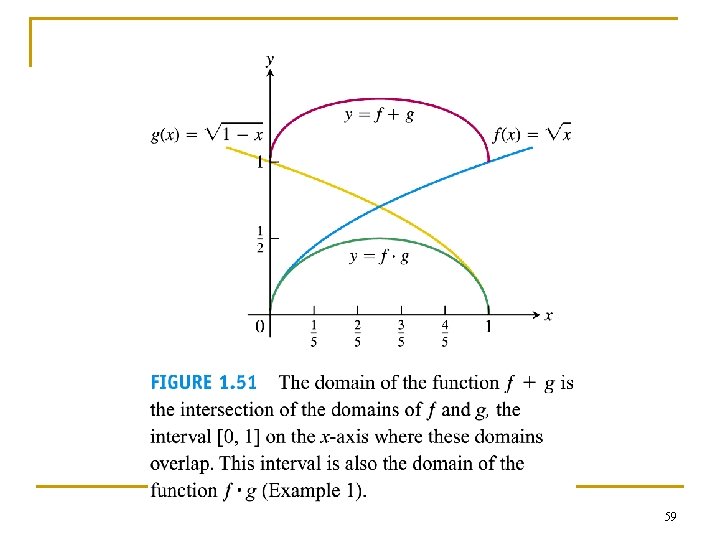
Sums, differences, products and quotients n n n f, g are functions For x D(f )∩D(g), we can define the functions of (f +g) (x) = f(x) + g(x) (f - g) (x) = f(x) - g(x) (fg)(x) = f(x)g(x), (cf)(x) = cf(x), c a real number n 55
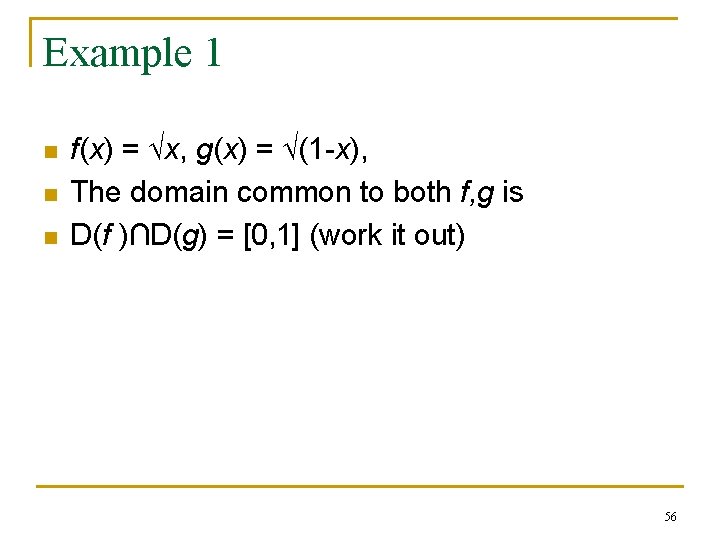
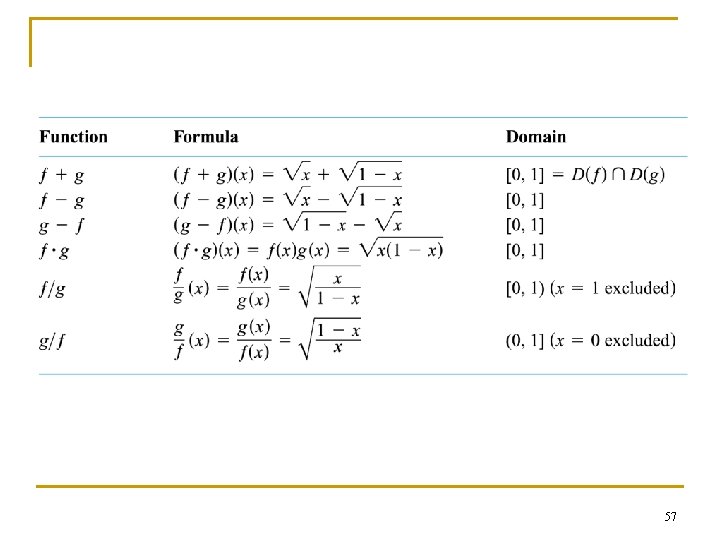
Example 1 n n n f(x) = x, g(x) = (1 -x), The domain common to both f, g is D(f )∩D(g) = [0, 1] (work it out) 56
57
58
59
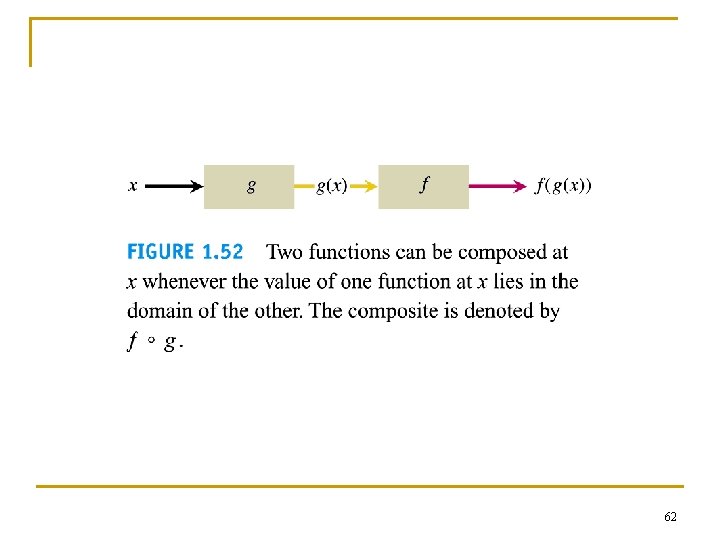
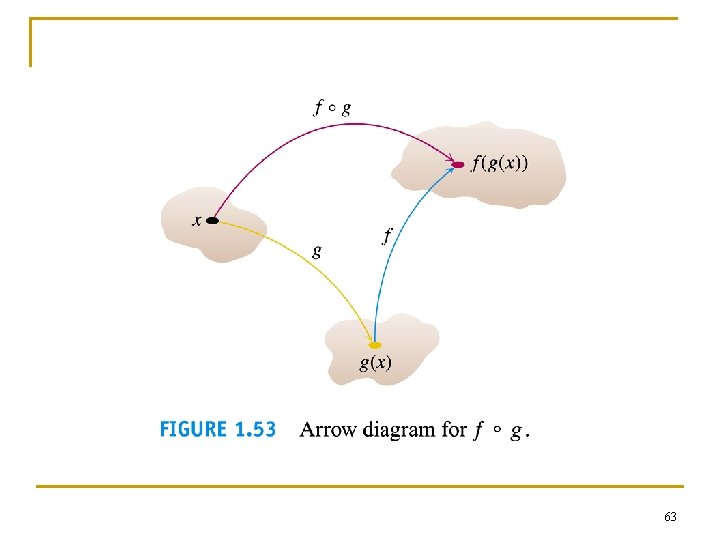
Composite functions n Another way of combining functions 60
61
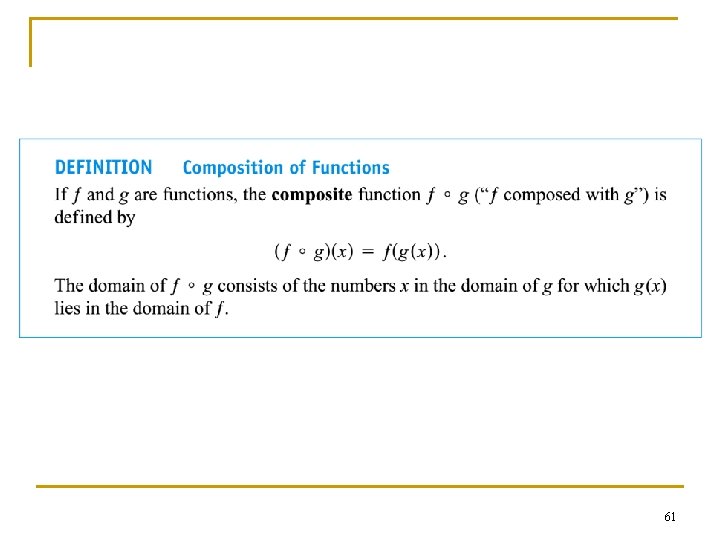
62
63
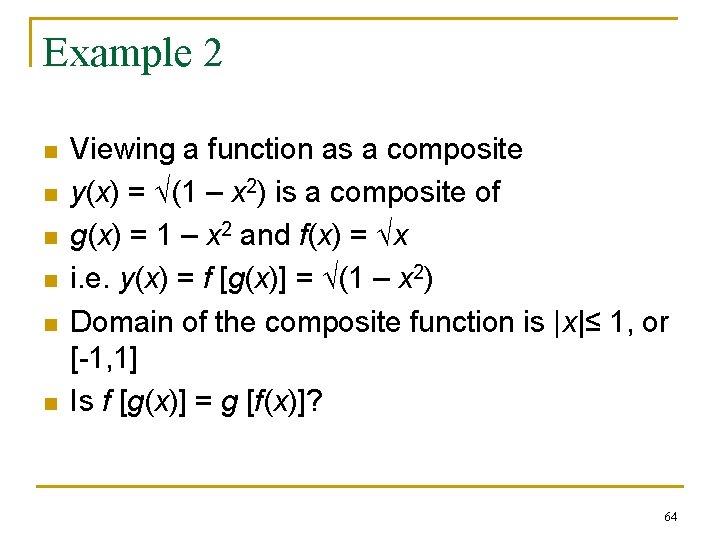
Example 2 n n n Viewing a function as a composite y(x) = (1 – x 2) is a composite of g(x) = 1 – x 2 and f(x) = x i. e. y(x) = f [g(x)] = (1 – x 2) Domain of the composite function is |x|≤ 1, or [-1, 1] Is f [g(x)] = g [f(x)]? 64
Example 3 n n Read it yourself Make sure that you know how to work out the domains and ranges of each composite functions listed 65
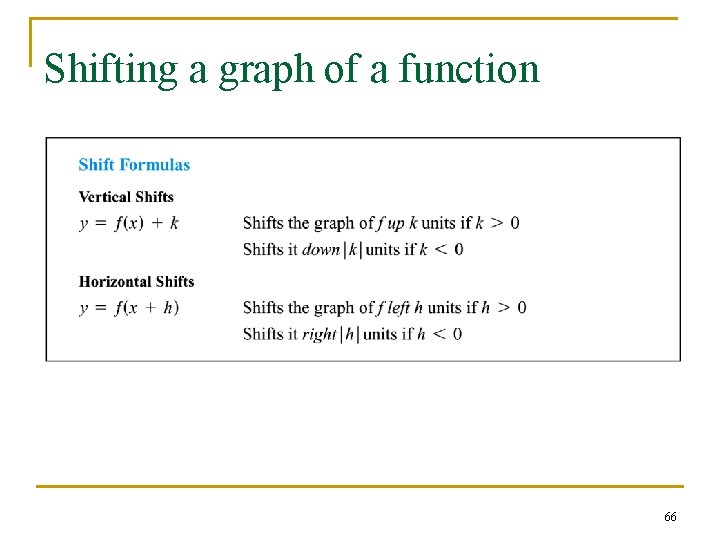
Shifting a graph of a function 66
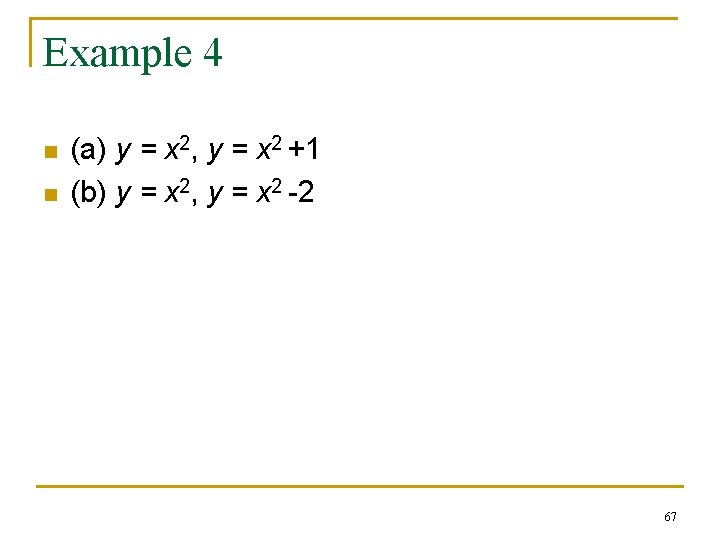
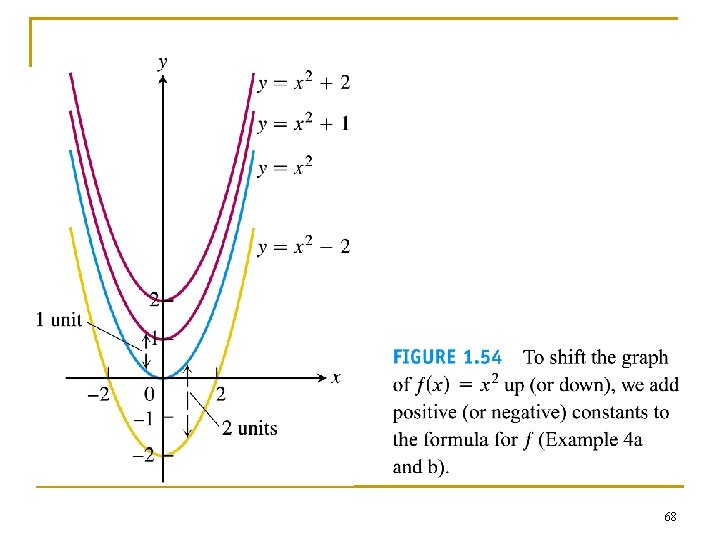
Example 4 n n (a) y = x 2, y = x 2 +1 (b) y = x 2, y = x 2 -2 67
68
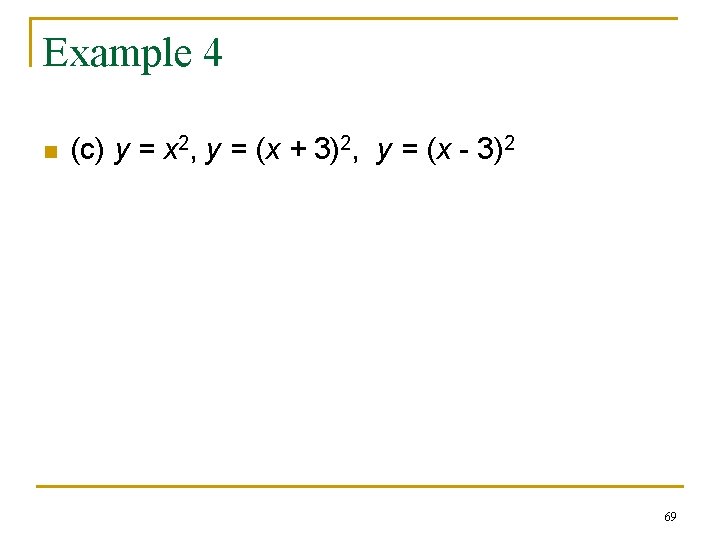
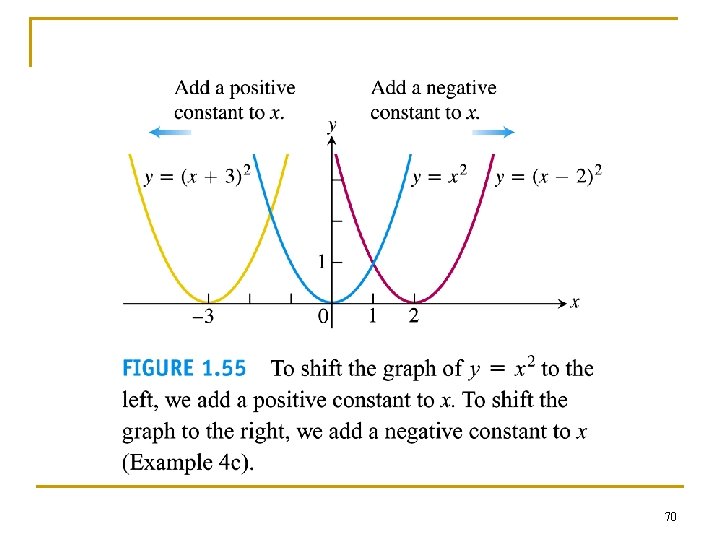
Example 4 n (c) y = x 2, y = (x + 3)2, y = (x - 3)2 69
70
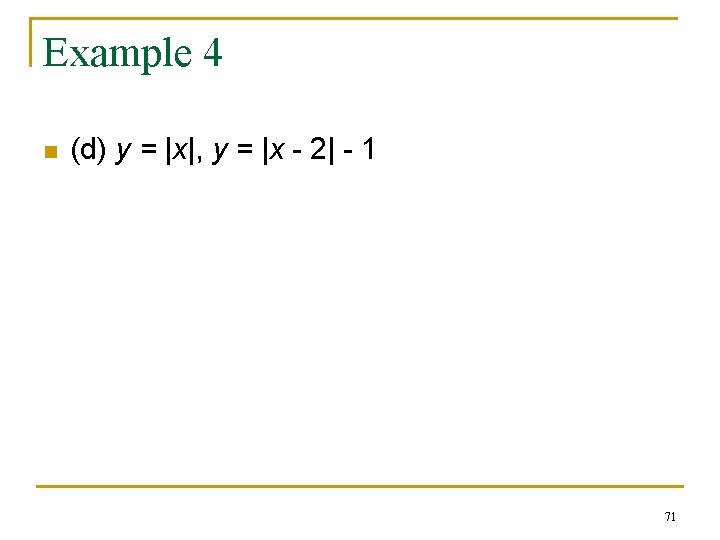
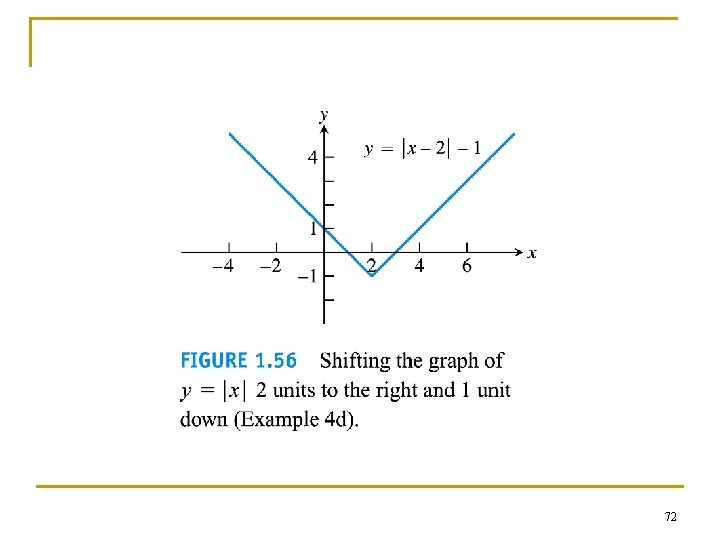
Example 4 n (d) y = |x|, y = |x - 2| - 1 71
72
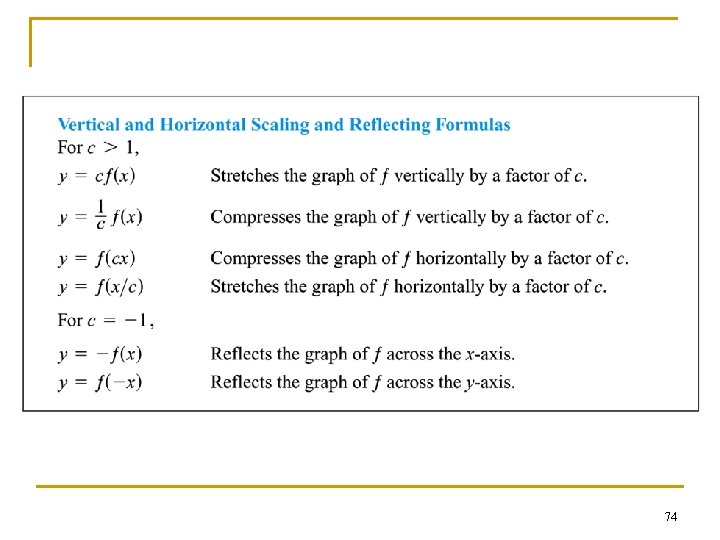
Scaling and reflecting a graph of a function n n To scale a graph of a function is to stretch or compress it, vertically or horizontally. This is done by multiplying a constant c to the function or the independent variable 73
74
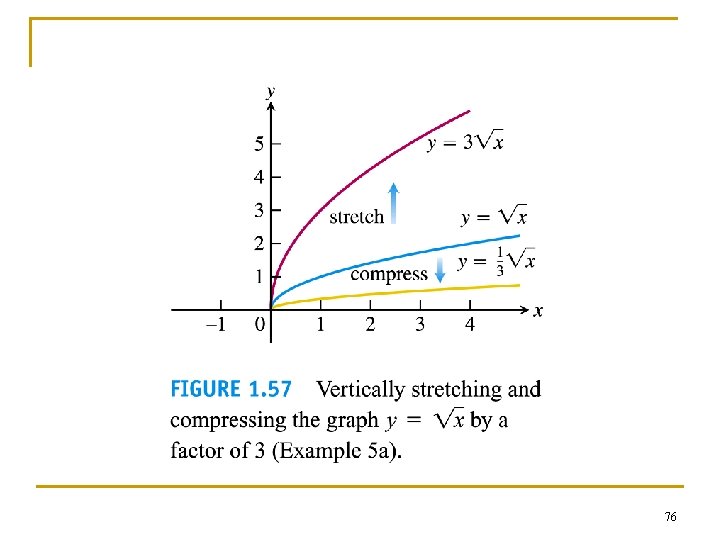
Example 5(a) n Vertical stretching and compression of the graph y = x by a factor or 3 75
76
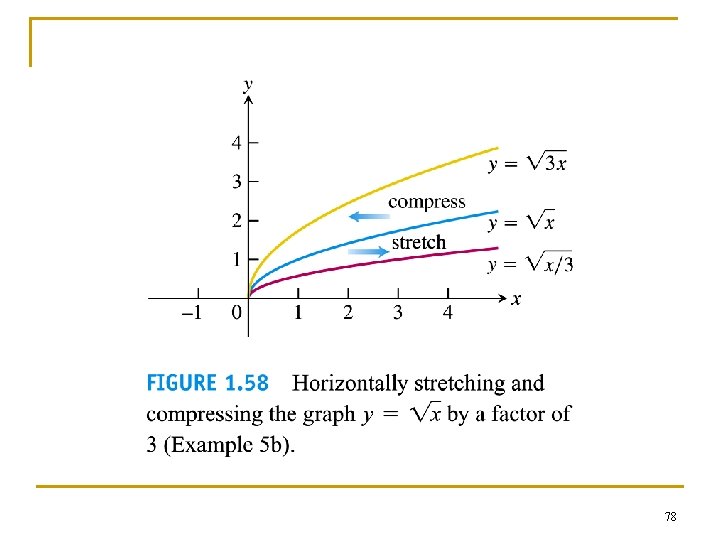
Example 5(b) n Horizontal stretching and compression of the graph y = x by a factor of 3 77
78
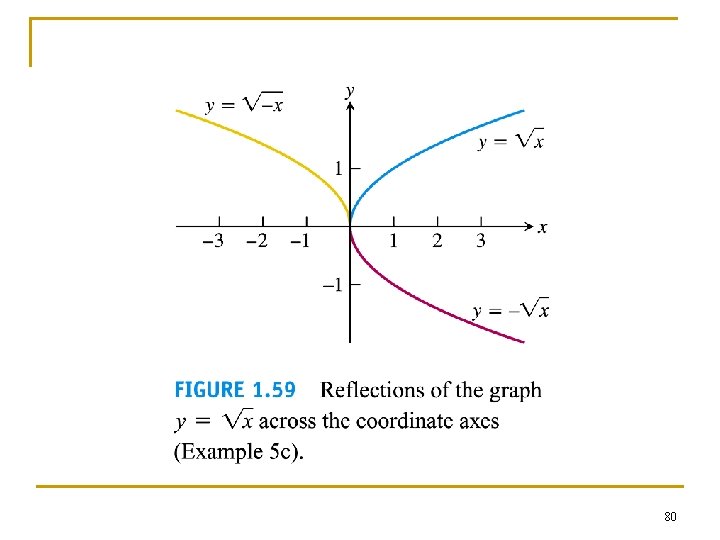
Example 5(c) n n Reflection across the x- and y- axes c = -1 79
80
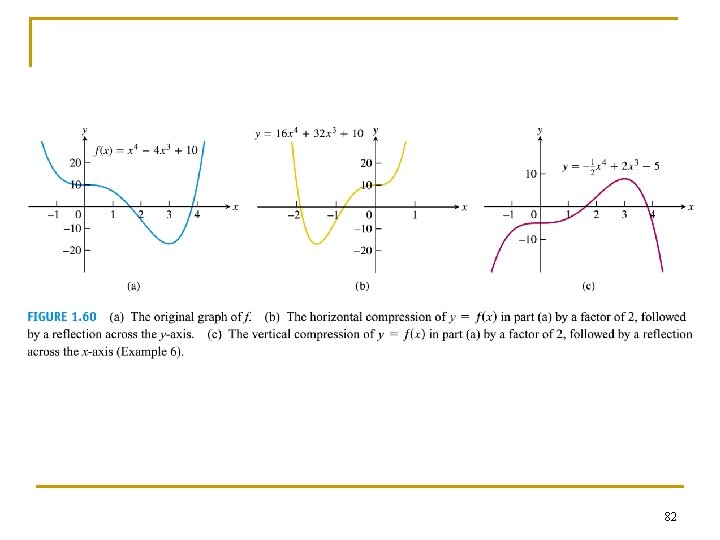
Example 6 n Read it yourself 81
82
1. 6 Trigonometric Functions 83
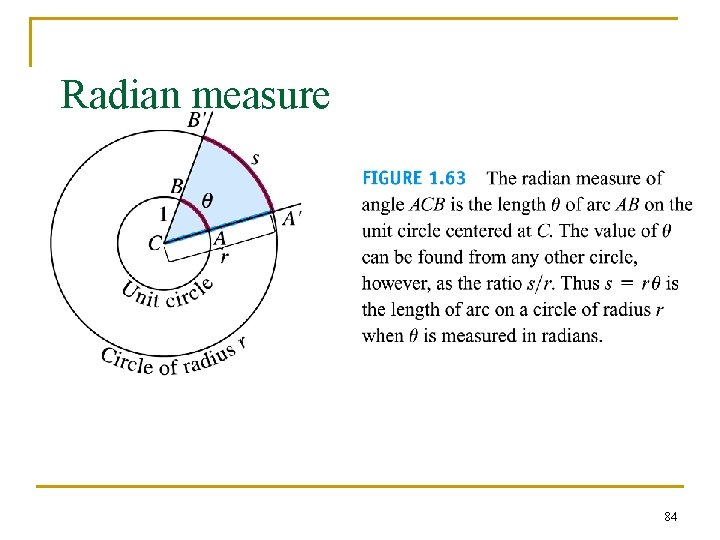
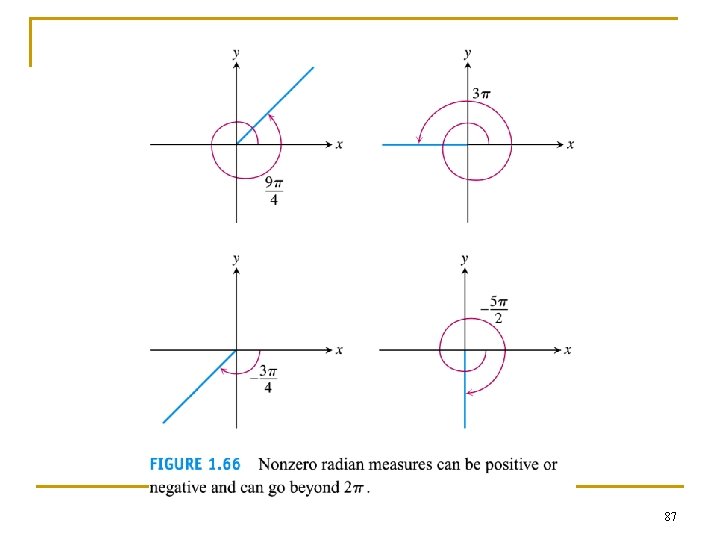
Radian measure 84
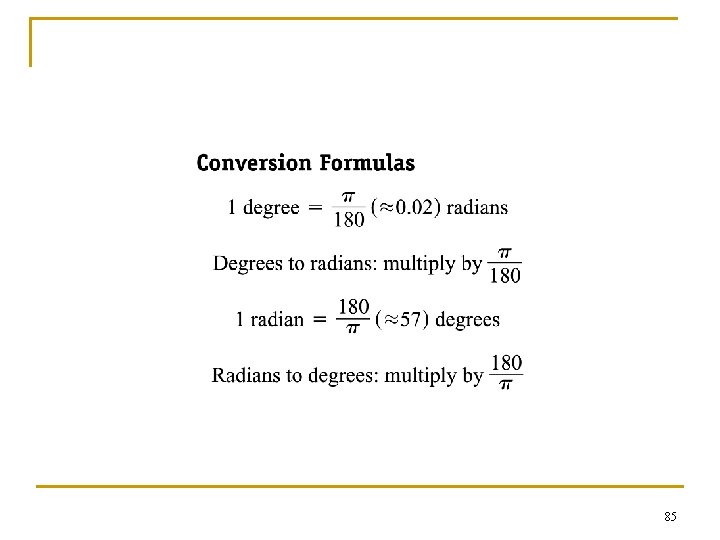
85
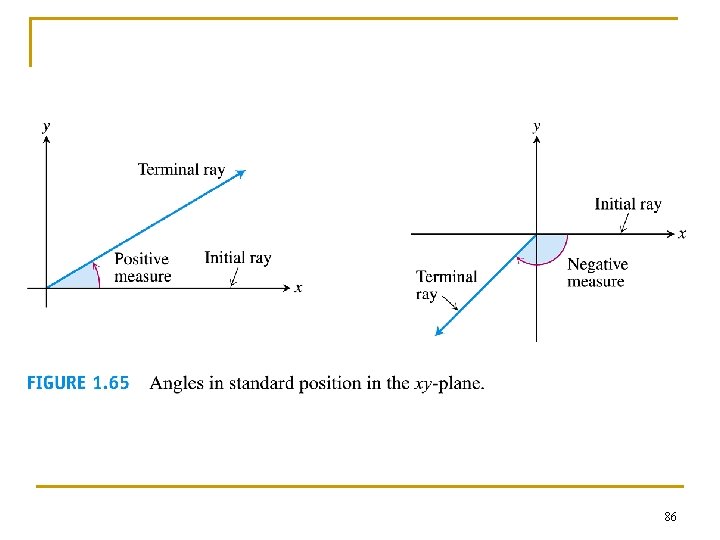
86
87
Angle convention n n Be noted that angle will be expressed in terms of radian unless otherwise specified. Get used to the change of the unit 88
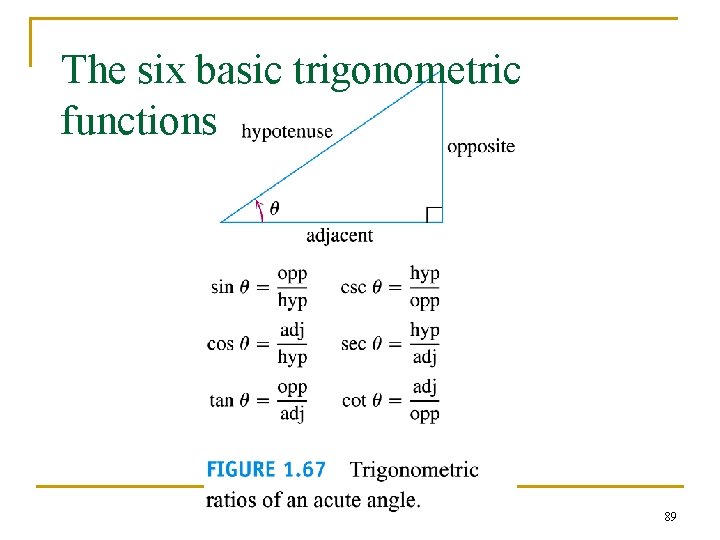
The six basic trigonometric functions 89
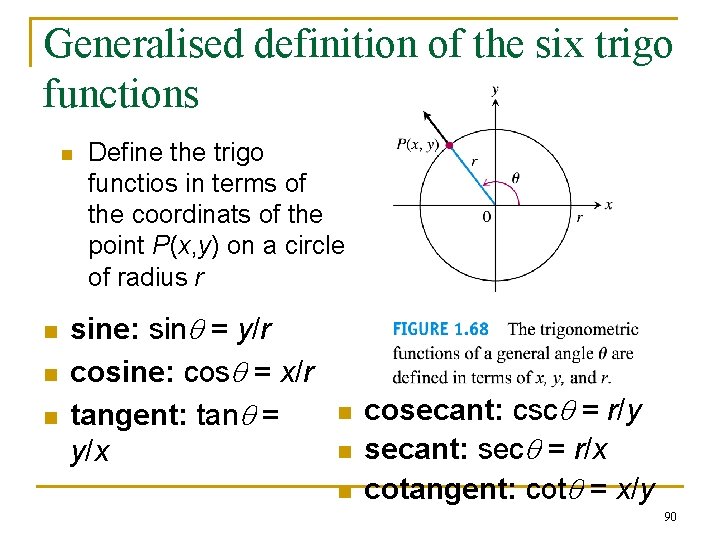
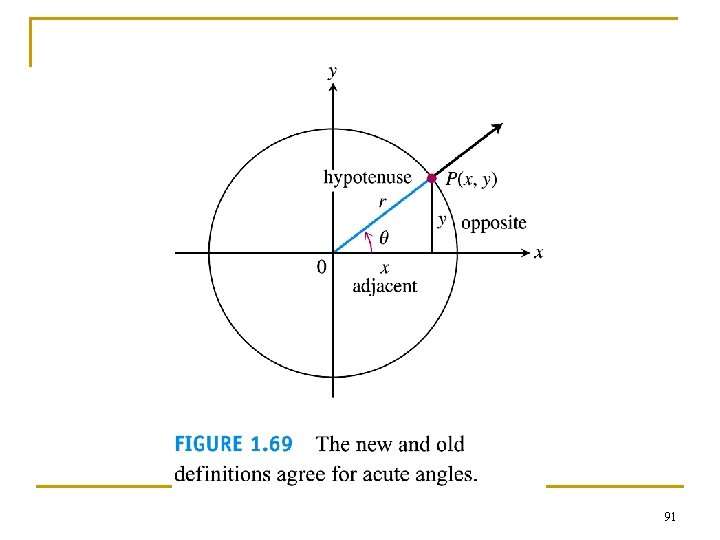
Generalised definition of the six trigo functions n n Define the trigo functios in terms of the coordinats of the point P(x, y) on a circle of radius r sine: sinq = y/r cosine: cosq = x/r tangent: tanq = y/x n n n cosecant: cscq = r/y secant: secq = r/x cotangent: cotq = x/y 90
91
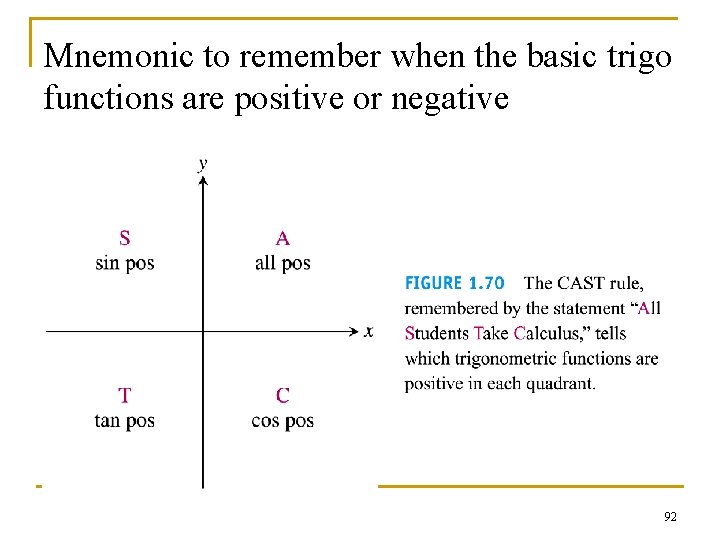
Mnemonic to remember when the basic trigo functions are positive or negative 92
93
94
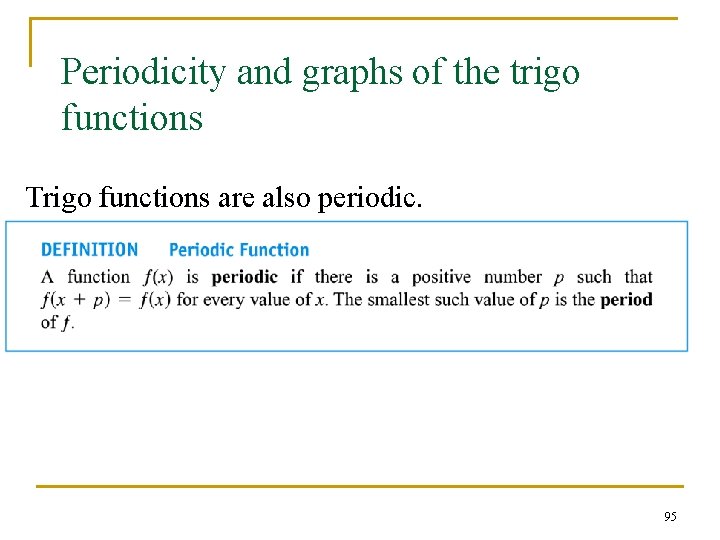
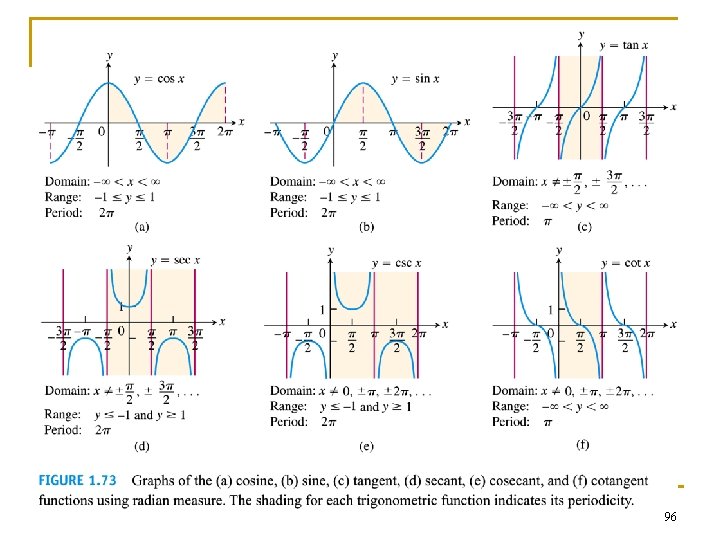
Periodicity and graphs of the trigo functions Trigo functions are also periodic. 95
96
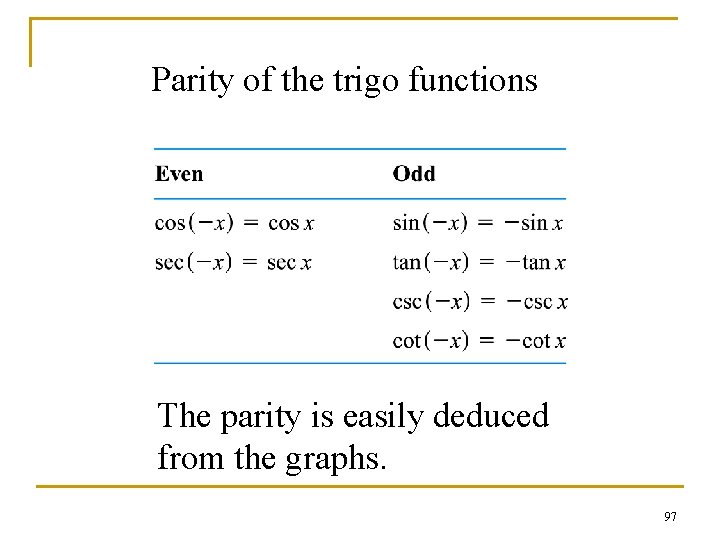
Parity of the trigo functions The parity is easily deduced from the graphs. 97
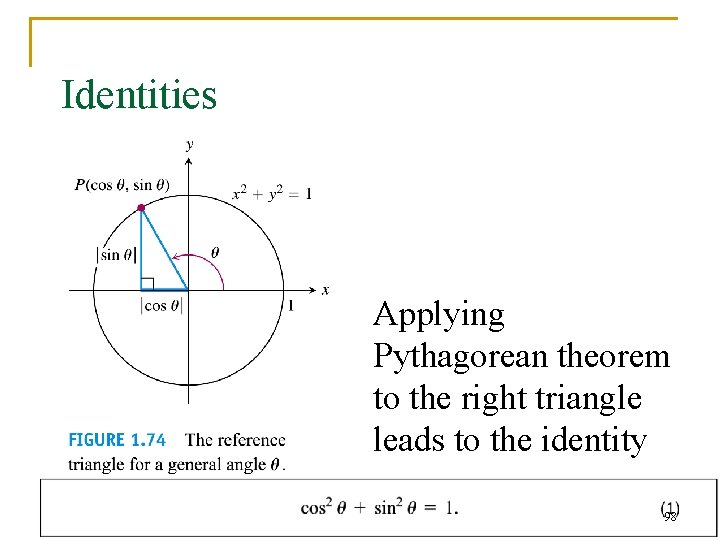
Identities Applying Pythagorean theorem to the right triangle leads to the identity 98
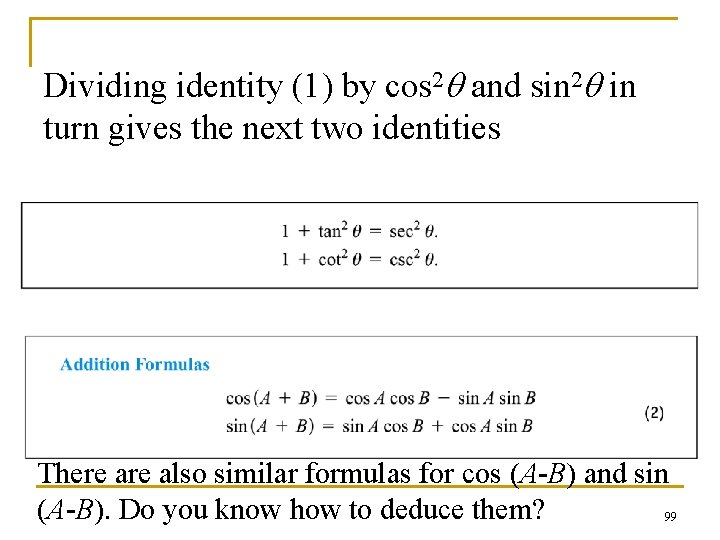
Dividing identity (1) by cos 2 q and sin 2 q in turn gives the next two identities There also similar formulas for cos (A-B) and sin (A-B). Do you know how to deduce them? 99
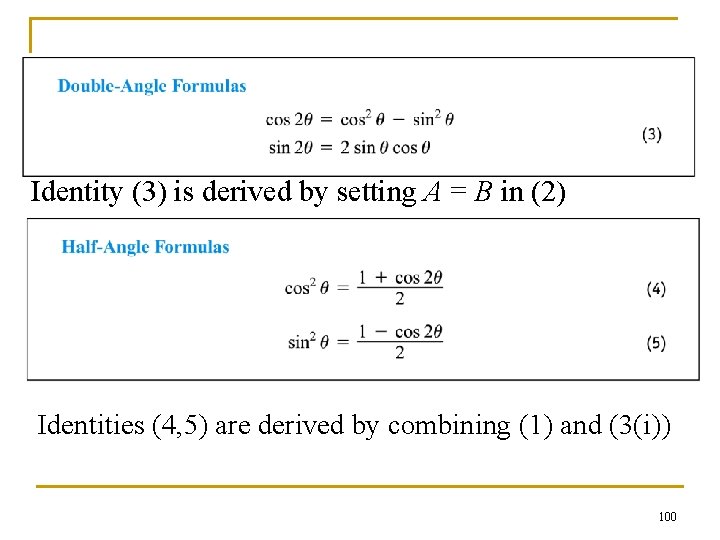
Identity (3) is derived by setting A = B in (2) Identities (4, 5) are derived by combining (1) and (3(i)) 100
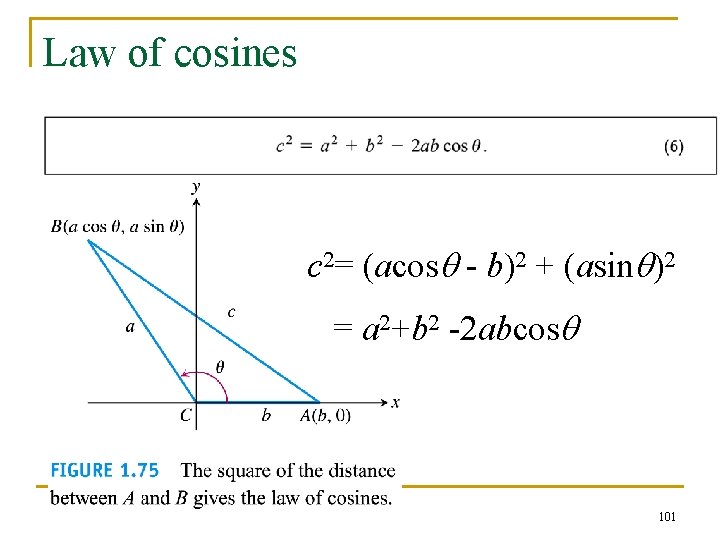
Law of cosines c 2= (acosq - b)2 + (asinq)2 = a 2+b 2 -2 abcosq 101