
Psychology CHAPTER 2 The Biological Perspective Module 4
Psychology CHAPTER 2 The Biological Perspective
Module 4 The Nervous System
Learning Objectives • LO 4. 1 • • LO 4. 2 LO 4. 3 • LO 4. 4 • • LO 4. 5 LO 4. 6 What are the major divisions of the human nervous system? What are neurons, and how do they work? What are the functions of the different parts of the central nervous system? How are the endocrine glands connected to the nervous system? How do hormones affect our thoughts and behavior? What effects do hormones have on the immune system?
Overview of Nervous System LO 4. 1 What are the major divisions of the human nervous system? • Nervous System - an extensive network of specialized cells that carry information to and from all parts of the body.
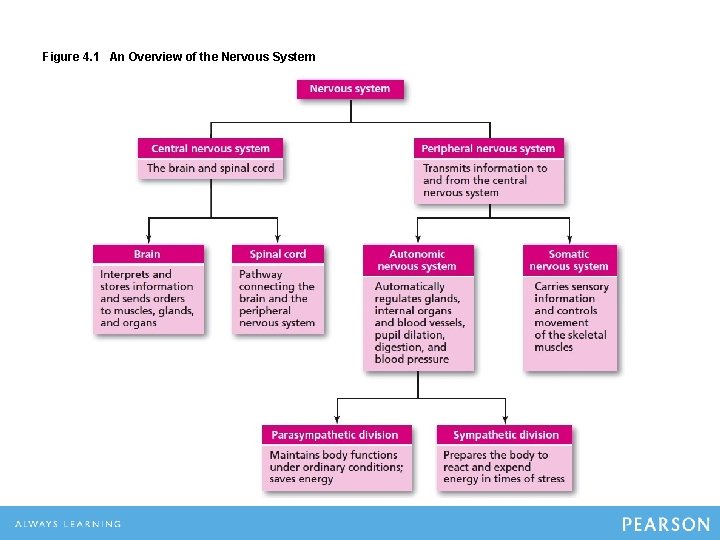
Figure 4. 1 An Overview of the Nervous System
Structure of the Neuron LO 4. 2 What are neurons, and how do they work? • Neurons - the basic cell that makes up the nervous system and which receives and sends messages within that system.
Structure of the Neuron LO 4. 2 What are neurons, and how do they work? • Parts of a Neuron – Dendrites - branch-like structures that receive messages from other neurons. – Soma - the cell body of the neuron, responsible for maintaining the life of the cell. – Axon - long tube-like structure that carries the neural message to other cells.
Structure of the Neuron LO 4. 2 What are neurons, and how do they work? • Parts of a Neuron (continued) – Myelin - fatty substances that coat the axons of neurons to insulate, protect, and speed up the neural impulse. § Insulates the neuron. § Offers a little protection from damage. § Speeds up the electrical message traveling down the axon. § Bundles of myelin-coated axons travel together in “cables” called nerves.
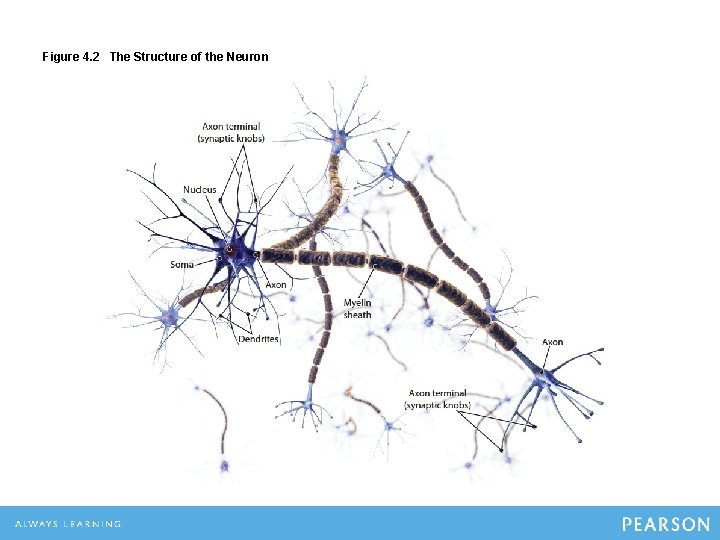
Figure 4. 2 The Structure of the Neuron
Electrochemical Message of the Neuron LO 4. 2 What are neurons, and how do they work? • Ions – charged particles. – Inside neuron – negatively charged. – Outside neuron – positively charged. • Resting potential - the state of the neuron when not firing a neural impulse.
Electrochemical Message of the Neuron LO 4. 2 What are neurons, and how do they work? • Action potential - the release of the neural impulse consisting of a reversal of the electrical charge within the axon. – Allows positive sodium ions to enter the cell.
Electrochemical Message of the Neuron LO 4. 2 What are neurons, and how do they work? • All-or-none - referring to the fact that a neuron either fires completely or does not fire at all. • Return to resting potential.

Figure 4. 3 The Neural Impulse Action Potential
Sending the Message to Other Cells LO 4. 2 What are neurons, and how do they work? • Axon terminals - branches at the end of the axon. – Synaptic knob – rounded areas on the end of axon terminals. § Synaptic vesicles - sack-like structures found inside the synaptic knob containing chemicals. – Neurotransmitters - chemical found in the synaptic vesicles which, when released, has an effect on the next cell.
Neuron communication LO 4. 2 What are neurons, and how do they work? • Synapse/synaptic gap - microscopic fluid-filled space between the rounded areas on the end of the axon terminals of one cell and the dendrites or surface of the next cell. • Receptor sites - holes in the surface of the dendrites or certain cells of the muscles and glands, which are shaped to fit only certain neurotransmitters.
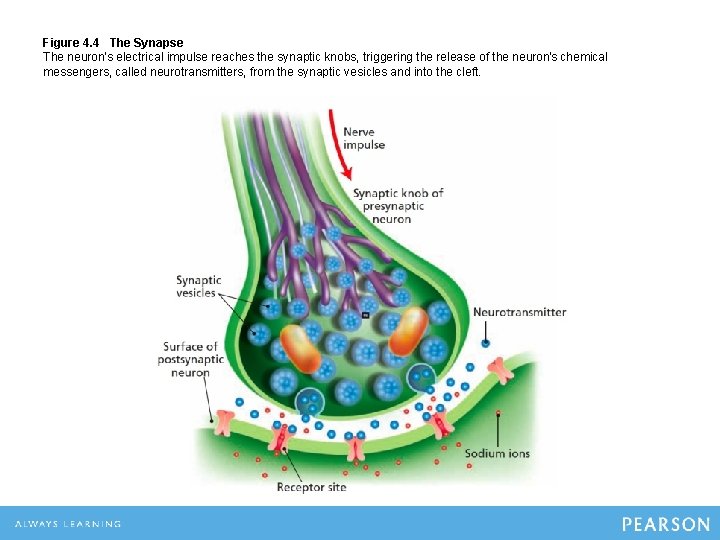
Figure 4. 4 The Synapse The neuron's electrical impulse reaches the synaptic knobs, triggering the release of the neuron's chemical messengers, called neurotransmitters, from the synaptic vesicles and into the cleft.
Neuron communication LO 4. 2 What are neurons, and how do they work? • Neurons must be turned ON and OFF. – Excitatory neurotransmitter that causes the receiving cell to fire. – Inhibitory neurotransmitter that causes the receiving cell to stop firing.
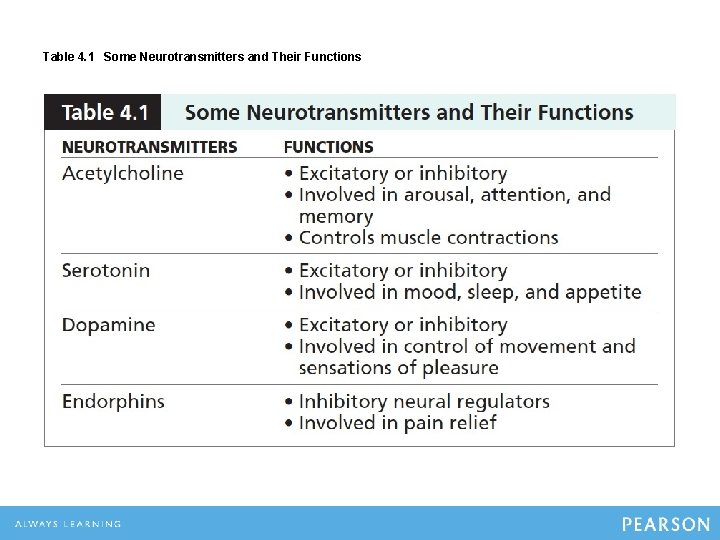
Table 4. 1 Some Neurotransmitters and Their Functions
Central Nervous System LO 4. 3 What are the functions of the different parts of the central nervous system? • Central nervous system (CNS) - part of the nervous system consisting of the brain and spinal cord. – Spinal cord - a long bundle of neurons that carries messages to and from the body to the brain that is responsible for very fast, lifesaving reflexes.
The Reflex Arc: Three Types of Neurons LO 4. 3 What are the functions of the different parts of the central nervous system? • Sensory neuron - a neuron that carries information from the senses to the central nervous system. • Motor neuron - a neuron that carries messages from the central nervous system to the muscles of the body.
The Reflex Arc: Three Types of Neurons LO 4. 3 What are the functions of the different parts of the central nervous system? • Interneuron - a neuron found in the center of the spinal cord that receives information from the sensory neurons and sends commands to the muscles through the motor neurons. – Interneurons also make up the bulk of the neurons in the brain.
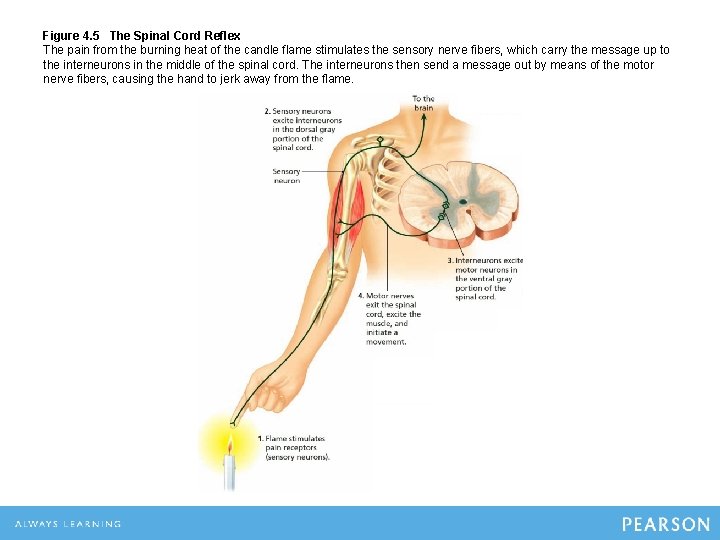
Figure 4. 5 The Spinal Cord Reflex The pain from the burning heat of the candle flame stimulates the sensory nerve fibers, which carry the message up to the interneurons in the middle of the spinal cord. The interneurons then send a message out by means of the motor nerve fibers, causing the hand to jerk away from the flame.
Peripheral Nervous System LO 4. 3 What are the functions of the different parts of the central nervous system? • Peripheral nervous system (PNS) - all nerves and neurons that are not contained in the brain and spinal cord but that run through the body itself; divided into the: – Somatic nervous system – Autonomic nervous system

Figure 4. 6 The Peripheral Nervous System
Somatic Nervous System LO 4. 3 What are the functions of the different parts of the central nervous system? • Soma = body. • Somatic nervous system - division of the PNS consisting of nerves that carry information from the senses to the CNS and from the CNS to the voluntary muscles of the body.
Autonomic Nervous System LO 4. 3 What are the functions of the different parts of the central nervous system? • Autonomic nervous system (ANS) – Division of the PNS consisting of nerves that control all of the involuntary muscles, organs, and glands. § Sympathetic division (fight-or-flight system) - part of the ANS that is responsible for reacting to stressful events and bodily arousal.

Autonomic Nervous System LO 4. 3 What are the functions of the different parts of the central nervous system? • Autonomic nervous system (ANS) – Division of the PNS consisting of nerves that control all of the involuntary muscles, organs, and glands. (continued) § Parasympathetic division - part of the ANS that restores the body to normal functioning after arousal and is responsible for the dayto-day functioning of the organs and glands.
The Endocrine Glands LO 4. 4 How are the endocrine glands connected to the nervous system? • Endocrine glands - glands that secrete chemicals called hormones directly into the bloodstream. • Hormones - chemicals released into the bloodstream by endocrine glands. – Bloodstream carries them to their target organs. – Hormone chemicals then fit into receptor sites on target organs and excite them to function.
The Endocrine Glands LO 4. 5 How do hormones affect our thoughts and behavior? • Pituitary gland - gland located in the brain that secretes human growth hormone and influences all other hormone-secreting glands (also known as the master gland). • Pineal gland - endocrine gland located near the base of the cerebrum that secretes melatonin.
The Endocrine Glands LO 4. 5 How do hormones affect our thoughts and behavior? • Thyroid gland - endocrine gland found in the neck that regulates metabolism. • Pancreas - endocrine gland that controls the levels of sugar in the blood.
Endocrine Glands and Hormones LO 4. 5 How do hormones affect our thoughts and behavior? • Adrenal glands - endocrine glands located on top of each kidney that secrete over 30 different hormones to deal with stress, regulate salt intake, and provide a secondary source of sex hormones affecting the sexual changes that occur during adolescence.
Endocrine Glands and Hormones LO 4. 5 How do hormones affect our thoughts and behavior? • Gonads - the sex glands that secrete hormones that regulate sexual development and behavior as well as reproduction. – Ovaries - the female gonads. – Testes - the male gonads.
Immune System LO 4. 6 What effects do hormones have on the immune system? • Endocrine system linked to immune system. • Immune system - system of cells, organs, and chemicals in the body that responds to attacks on the body from disease and injuries.
Immune System LO 4. 6 What effects do hormones have on the immune system? • Thymus gland - gland located near the top of the sternum that produces hormones to help fight off infections and diseases.
Module 5 The Brain
Learning Objectives • • LO LO 5. 1 5. 2 5. 3 5. 4 • LO 5. 5 How do people study the brain? What advances have made the brain easier to study? What are some recent innovations in neuroscience? What are the different parts of the brain, and what does each part do? How does the left side of the brain differ from the right side?
Study Brain LO 5. 1 How do people study the brain? • Study humans with brain damage. • Study animals. – Animals are anesthetized. – Purposefully damage part of animal's brain to study that area scientifically. – Test the animal to see what has happened to its abilities.
Study Brain LO 5. 1 How do people study the brain? • Electrically stimulate particular area of an animal's brain. – Watch results. – Deep lesioning - insertion of a thin, insulated wire into the brain through which an electrical current is sent that destroys the brain cells at the tip of the wire.
Peeking Inside the Brain LO 5. 2 What advances have made the brain easier to study? • Computed tomography (CT) - brainimaging method using computer controlled X-rays of the brain.
Peeking Inside the Brain LO 5. 2 What advances have made the brain easier to study? • Magnetic resonance imaging (MRI) brain-imaging method using radio waves and magnetic fields of the body to produce detailed images of the brain. – Functional MRI (f. MRI) – computer makes a sort of “movie” of changes in the activity of the brain using images from different time periods.
Peeking Inside the Brain LO 5. 2 What advances have made the brain easier to study? • Positron emission tomography (PET) brain-imaging method in which a radioactive sugar is injected into the subject and a computer compiles a color-coded image of the activity of the brain with lighter colors indicating more activity.

Peeking Inside the Brain LO 5. 2 What advances have made the brain easier to study? • Electroencephalograph (EEG) – machine designed to record the brain wave patterns produced by electrical activity of the surface of the brain.
Peeking Inside the Brain LO 5. 2 What advances have made the brain easier to study? • Functional Magnetic resonance imaging (f. MRI) - computer makes a sort of “movie” of changes in the activity of the brain using images from different time periods.

Neuroscience Innovations LO 5. 3 What are some recent innovations in neuroscience? • Neuroplasticity - the ability within the brain to constantly change both the structure and function of cells in response to experience or trauma. • Stem cells - special cells found in all the tissues of the body that are capable of becoming other cell types when those cells need to be replaced due to damage or wear and tear.
The Hindbrain and Beyond LO 5. 4 What are the different parts of the brain, and what does each part do? • Medulla - the first large swelling at the top of the spinal cord, forming the lowest part of the brain, which is responsible for life-sustaining functions such as breathing, swallowing, and heart rate.
The Hindbrain and Beyond LO 5. 4 What are the different parts of the brain, and what does each part do? • Pons - the larger swelling above the medulla that connects the top of the brain to the bottom and that plays a part in sleep, dreaming, left–right body coordination, and arousal.
The Hindbrain and Beyond LO 5. 4 What are the different parts of the brain, and what does each part do? • Reticular formation (RF) - an area of neurons running through the middle of the medulla and the pons and slightly beyond that play a role in general arousal, alertness, and sleep.
The Hindbrain and Beyond LO 5. 4 What are the different parts of the brain, and what does each part do? • Cerebellum - part of the lower brain located behind the pons that controls and coordinates involuntary, rapid, fine motor movement.
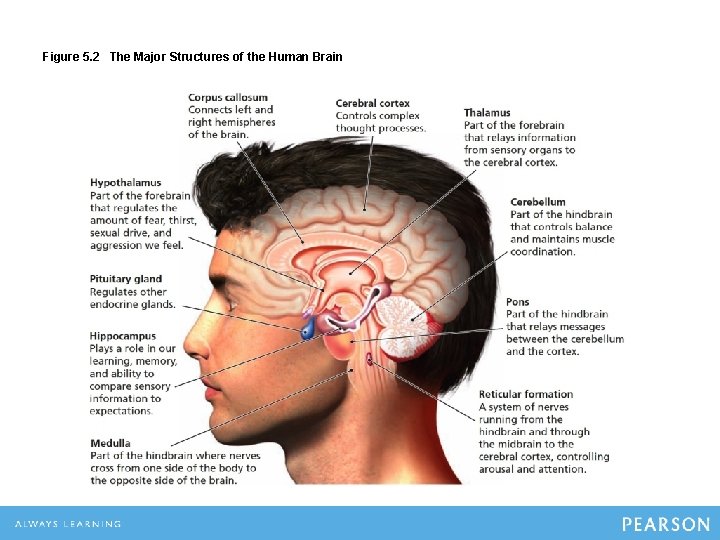
Figure 5. 2 The Major Structures of the Human Brain
Structures Under the Cortex LO 5. 4 What are the different parts of the brain, and what does each part do? • Limbic system - a group of several brain structures located under the cortex and involved in learning, emotion, memory, and motivation. – Thalamus - part of the limbic system located in the center of the brain, this structure relays sensory information from the lower part of the brain to the proper areas of the cortex and processes some sensory information before sending it to its proper area.
Structures Under the Cortex LO 5. 4 What are the different parts of the brain, and what does each part do? • Limbic system (continued) – Hypothalamus - small structure in the brain located below the thalamus and directly above the pituitary gland, responsible for motivational behavior such as sleep, hunger, thirst, and sex. § Sits above and controls the pituitary gland (master endocrine gland). – Homeostasis - the tendency of the body to maintain a steady state.
Structures Under the Cortex LO 5. 4 What are the different parts of the brain, and what does each part do? • Limbic system (continued) – Hippocampus - curved structure located within each temporal lobe, responsible for the formation of long-term memories and the storage of memory for location of objects. – Amygdala - brain structure located near the hippocampus, responsible for fear responses and memory of fear.
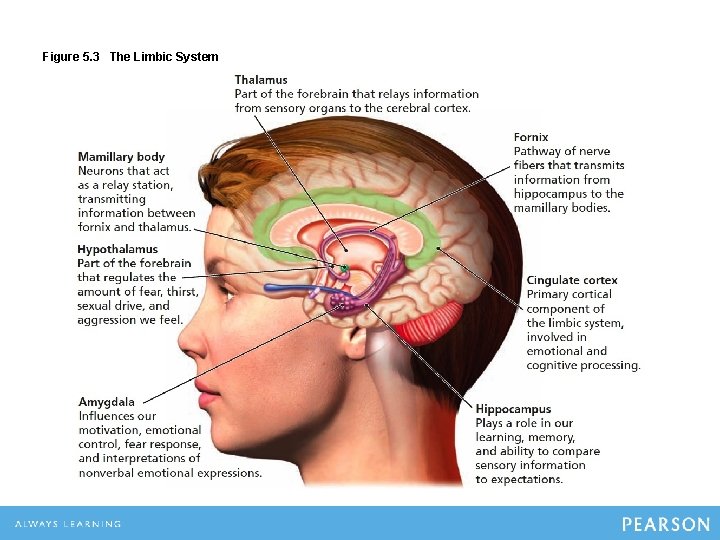
Figure 5. 3 The Limbic System
Cortex LO 5. 4 What are the different parts of the brain, and what does each part do? • Cortex - outermost covering of the brain consisting of densely packed neurons, responsible for higher thought processes and interpretation of sensory input.
Cortex LO 5. 4 What are the different parts of the brain, and what does each part do? • Cortex – (continued) – Cerebral hemispheres - the two sections of the cortex on the left and right sides of the brain. – Corpus callosum - thick band of neurons that connects the right and left cerebral hemispheres.

Four Lobes of the Brain LO 5. 4 What are the different parts of the brain, and what does each part do? • Occipital lobe - section of the brain located at the rear and bottom of each cerebral hemisphere containing the visual centers of the brain. – Primary visual cortex – processes visual information from the eyes. – Visual association cortex – identifies and makes sense of visual information.

Four Lobes of the Brain LO 5. 4 What are the different parts of the brain, and what does each part do? • Parietal lobes – Sections of the brain located at the top and back of each cerebral hemisphere containing the centers for touch, taste, and temperature sensations. § Somatosensory cortex - area of neurons running down the front of the parietal lobes responsible for processing information from the skin and internal body receptors for touch, temperature, body position, and possibly taste.
Four Lobes of the Brain LO 5. 4 What are the different parts of the brain, and what does each part do? • Temporal lobes - areas of the cortex located just behind the temples containing the neurons responsible for the sense of hearing and meaningful speech. – Primary auditory cortex – processes auditory information from the ears. – Auditory association cortex – identifies and makes sense of auditory information.
Four Lobes of the Brain LO 5. 4 What are the different parts of the brain, and what does each part do? • Frontal lobes - areas of the cortex located in the front and top of the brain, responsible for higher mental processes and decision making as well as the production of fluent speech. – Motor cortex - section of the frontal lobe located at the back, responsible for sending motor commands to the muscles of the somatic nervous system.
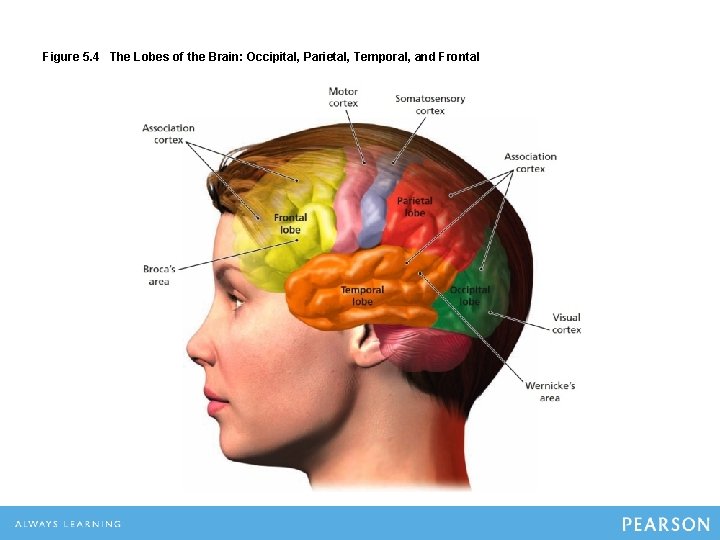
Figure 5. 4 The Lobes of the Brain: Occipital, Parietal, Temporal, and Frontal
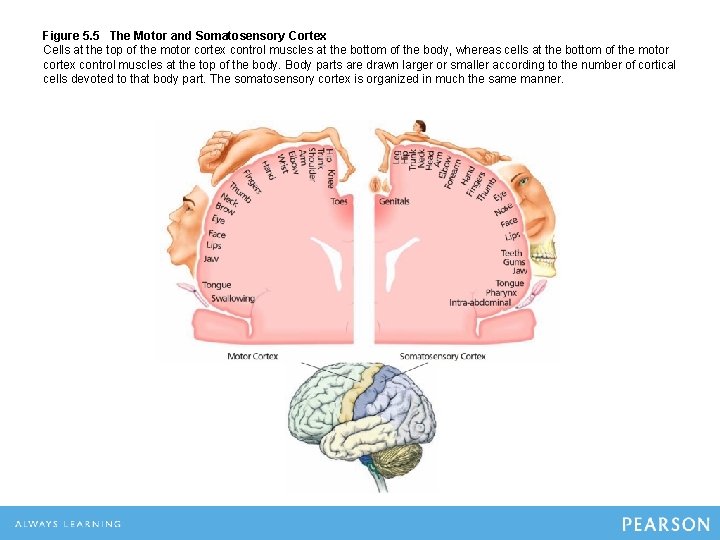
Figure 5. 5 The Motor and Somatosensory Cortex Cells at the top of the motor cortex control muscles at the bottom of the body, whereas cells at the bottom of the motor cortex control muscles at the top of the body. Body parts are drawn larger or smaller according to the number of cortical cells devoted to that body part. The somatosensory cortex is organized in much the same manner.
Association Areas of Cortex LO 5. 4 What are the different parts of the brain, and what does each part do? • Association areas - areas within each lobe of the cortex responsible for the coordination and interpretation of information, as well as higher mental processing.
Association Areas of Cortex LO 5. 4 What are the different parts of the brain, and what does each part do? • Broca's aphasia - condition resulting from damage to Broca's area (usually in left frontal lobe), causing the affected person to be unable to speak fluently, to mispronounce words, and to speak haltingly.
Association Areas of Cortex LO 5. 4 What are the different parts of the brain, and what does each part do? • Wernicke's aphasia - condition resulting from damage to Wernicke's area (usually in left temporal lobe), causing the affected person to be unable to understand or produce meaningful language.
Split Brain Research LO 5. 5 How does the left side of the brain differ from the right side? • Split brain research – Study of patients with severed corpus callosum. – Involves sending messages to only one side of the brain. – Demonstrates right and left brain specialization.
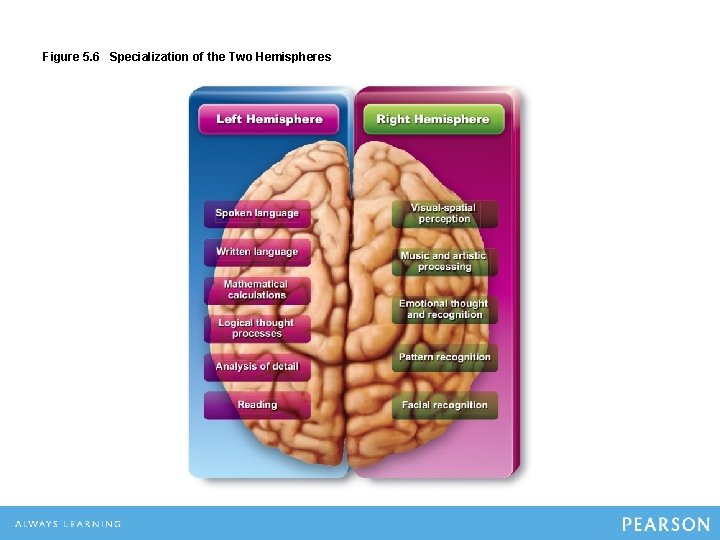
Figure 5. 6 Specialization of the Two Hemispheres
Module 6 Heredity, Environment, and Adaptation
Learning Objectives • • LO 6. 1 LO 6. 2 • LO 6. 3 How do genetic factors determine who we are? How do heredity and environmental factors interact to affect our development? How do evolved tendencies influence our behavior?
Nature vs. Nurture LO 6. 1 How do genetic factors determine who we are? • Nature - the influence of our DNA that dictates the inherited characteristics that influence our personality, physical growth, intellectual growth, and social interactions. • Nurture - the influence of the environment on personality, physical growth, intellectual growth, and social interactions.
Nature vs. Nurture LO 6. 1 How do genetic factors determine who we are? • Most psychologists believe that both nature and nurture play important roles in human development.
Heredity LO 6. 1 How do genetic factors determine who we are? • DNA (deoxyribonucleic acid) - special molecule that contains the genetic material of the organism. – Gene - section of DNA having the same arrangement of chemical elements. – Chromosome - Tightly wound strand of genetic material or DNA.
Heredity LO 6. 1 How do genetic factors determine who we are? • Dominant gene - referring to a gene that actively controls the expression of a trait. • Recessive gene - referring to a gene that only influences the expression of a trait when paired with an identical gene. • Predisposition - genetic tendency or possibility.
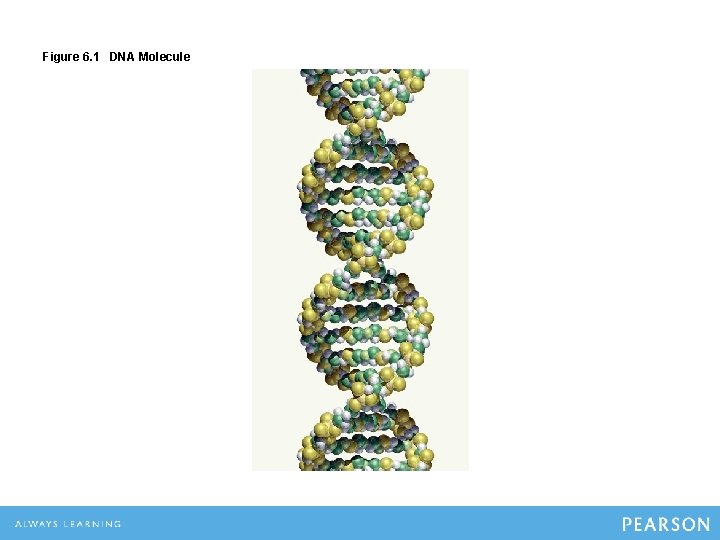
Figure 6. 1 DNA Molecule
Nature vs. Nurture LO 6. 2 How do heredity and environmental factors interact to affect our development? • DNA determines the outlines of our lives. • External forces have huge amount of power over who we become. – Parents – Peers – Cultural expectations
Nature vs. Nurture LO 6. 2 How do heredity and environmental factors interact to affect our development? • Twin studies – Minnesota Twin Family Study • Adoption studies – Minnesota/Texas Adoption Project
Evolutionary Psychology LO 6. 3 How do evolved tendencies influence our behavior? • Many psychologists believe that human behavior is shaped by biology, environment, and evolutionary forces. • Charles Darwin - 19 th century British scientist.
Evolutionary Psychology LO 6. 3 How do evolved tendencies influence our behavior? • Charles Darwin (continued) – Theory of evolution - principle stating that species of plants and animals change gradually over the course of many generations. § Evolution - a process of gradual change over time. – Natural selection - principle stating that inherited characteristics that give a survival advantage are more likely to be passed on to future generations.
- Slides: 77