
STRUCTURE AND FUNCTIONS OF RESERVE BANK OF INDIA
STRUCTURE AND FUNCTIONS OF RESERVE BANK OF INDIA
INTRODUCTION Ø It is the Central Bank of India Established in “ 1 st April 1935” under the “RESERVE BANK OF INDIA ACT”. ØIts head quarter is in Mumbai (Maharashtra). Its present governor is “Mr Shakti Kant Das”. ØIt has “ 22 Regional Offices”, most of them in State capitals.
BRIEF HISTORY Ø It was set up on the recommendations of the “Hilton Young Commission”. ØIt was started as Share-Holders Bank with a paid up capital of 5 crores. Ø Initially it was located in Kolkata. ØIt moved to Mumbai in 1937. ØInitially it was Privately Owned. ØSince Nationalization in 1949, the Reserve Bank is fully owned by the Government of India.

Key Landmarks in the journey of RBI �In 1926, the Royal Commission on Indian Currency and Finance recommended creation of a central bank for India. �In 1927, a bill to give effect to the above recommendation was introduced in the Legislative Assembly, but was later withdrawn due to lack of agreement among various sections of people. �In 1933, the White Paper on Indian Constitutional Reforms recommended the creation of a Reserve Bank. A fresh bill was introduced in the Legislative Assembly. �In 1934, the Bill was passed and received the Governor General’s assent �In 1935, Reserve Bank commenced operations as India’s central bank on April 1 as a private shareholders’ bank with a paid up capital of rupees five crore. �In 1942 Reserve Bank ceased to be the currency issuing authority of Burma (now Myanmar).
�In 1947, Reserve Bank stopped acting as banker to the Government of Burma. �In 1948, Reserve Bank stopped rendering central banking services to Pakistan. �In 1949, the Government of India nationalized the Reserve Bank under the Reserve Bank (Transfer of Public Ownership) Act, 1948. �In 1949, Banking Regulation Act was enacted. �In 1951, India embarked in the Planning Era. �In 1966, the Cooperative Banks came within the regulations of the RBI. �Rupee was devaluated for the first time.
�In 1969, Nationalization of 14 Banks was a Turning point in the history of Indian Banking. �In 1973, the Foreign Exchange Regulation act was amended and exchange control was strengthened. �In 1974, the Priority Sector Advance Targets started getting fixed. �In 1975, Regional Rural Banks started �In 1985, the Sukhamoy Chakravarty and Vaghul Committee reports embarked the era of Financial Market Reforms in India. �In 1991, India came under the Balance of Payment crisis and RBI pledged Gold to shore up reserves. Rupee was devaluated. �In 1991 -92, Economic Reforms started in India. �In 1993, Exchange Rate became Market determined.
�In 1994, Board for Financial Supervision was set up. �In 1997, the regulation of the Non Banking Financial Companies (NBFC) got strengthened. �In 1998, Multiple Indicator Approach for monetary policy was adopted for the first time. �In 2000, the Foreign Exchange Management Act (FEMA) replaced the erstwhile FERA. �In 2002, The Clearing Corporation of India Ltd Started operation. �In 2003, Fiscal Responsibility and Budget Management Act (FRBMA) enacted. �In 2004, Liquidity Adjustment Facility (LAF) started working fully. �In 2004, Market Stabilization Scheme (MSS) was launched. �In 2004 Real Time Gross Settlement (RTGS) started working. �In 2006, Reserve Bank of India was empowered to regulate the money, forex, G-Sec and Gold related security markets. �In 2007, Reserve bank of India was empowered to regulate the Payment systems. �In 2008 -09, world under the grip of Global Financial Slowdown, RBI Proactive.

Organizational Structure of RBI is a corporate body , where Ministry of Finance owns directive rights. Managed by Central Board of Directors and four local boards of directors. The bank is headed by the governor and the post is currently held by economist Urjit Patel. There are 4 deputy governors BP Kanungo, , N S Vishwanathan and Viral Acharya, Mahesh Kumar Jain. Two of the four deputy governors are traditionally from RBI ranks and are selected from the Bank's Executive Directors.


Organization and Management of RBI � Central Board – Appointed / Nominated by central government for a period of not more than 5 years – Should meet at least 6 times in an year and once in 3 months ( no. 20) Ø Official Directors - Governor and not more than 4 deputy directors Ø Non official Directors – 15 in number. Ten director from various fields and one government official are nominated by government and 4 directors from 4 local boards • Local Boards – 4 Local board region ( Mumbai, Kolkata, Chennai, New Delhi consist of 5 members appointed by central government for a period of not more than 5 years.

Organization of RBI �Central office Department – 22 Regional offices , most of them in state capitals �Training Establishment – 6 Training establishments Ø College of Agricultural Banking Ø Banker’s Training College Ø RBI Staff College Ø National Institute for bank management Ø Indira Gandhi Institute for Development Research(IGIDR) Ø Institute for Development and Research in Banking Technology (IDRBT)
PREAMBLE The Preamble of the Reserve Bank of India describes the basic functions of the Reserve Bank as : “…To regulate the issue of Bank Notes and keeping of reserves with a view to securing monetary stability in India and generally to operate the currency and credit system of the country to its advantage. "

Objectives of RBI �* To manage the monetary and credit system of the country. * To stabilizes internal and external value of rupee. * For balanced and systematic development of banking in the country. * For the development of organized money market in the country. * For proper arrangement of agriculture finance.
Objectives of RBI Contd’ �* For proper arrangement of industrial finance. * For proper management of public debts. * To establish monetary relations with other countries of the world and international financial institutions. * For centralization of cash reserves of commercial banks. * To maintain balance between the demand supply of currency.

Role of RBI in inflation control �When Inflation arises, there are two policies in the hands of the RBI. �Monetary Policy: It includes the interest rates. When the bank increases the interest rates than there is reduction in the borrowers and people try to save more as the rate of interest has increased. �Fiscal Policy: It is related to direct taxes and government spending. When direct taxes increased and government spending increased than the disposable Income of the people reduces and hence the demand reduces.
Formulate monetary policy Ø Maintain price stability and ensuring adequate flow of credit in the economy. ØIt formulates implements and monitors the monetary policy. ØInstruments: qualitative & quantitative.
Quantitative Measures ØQuantitative Measures “BANK RATE” also called “Discount Rate”. ØIt also includes “Repo Rate”. Ø“Open Market Operations” buying and selling of government securities. Ø“Variable Reserve Ratio” it includes C. R. R and S. L. R Qualitative Measures Ø Direct Action Ø Moral persuasion Ø Legislation Ø Publicity
BANK RATE Ø It is the minimum lending rate of the central bank at which it rediscounts first class bill of exchanges and government securities held by the commercial banks. ØThis is typically done on a quarterly basis to control inflation and stabilize the country’s exchange rates. ØA fluctuation in bank rates Triggers a Ripple-Effect as it impacts every sector of a country’s economy. ØA change in bank rates affects customers as it influences Prime Interest Rates for personal loans. ØThe present bank rate is 8. 75 -9. 48%
REPO RATE ØWhenever the banks have any shortage of funds they can borrow it from the central bank. Repo rate is the rate at which our banks borrow currency from the central bank. Ø A reduction in the repo rate will help banks to get Money at a cheaper rate. ØWhen the repo rate increases borrowing from the central bank becomes more expensive. ØIn order to increase the liquidity in the market, the central bank does it. ØThe present repo rate is 5. 75% ( June 19)
REVERSE REPO RATE Ø It’s the rate at which the banks park surplus funds with reserve bank. ØWhile the Repo rate is the rate at which the banks borrow from the central bank. ØIt is mostly done , when there is surplus liquidity in the market by the central bank. ØThe present reverse repo rate is 5. 50%
CRR (Cash Reserve Ratio) • Cash Reserve Ratio (CRR) is the amount of Cash(liquid cash like gold)that the banks have to keep with RBI. • This Ratio is basically to secure solvency of the bank and to drain out the excessive money from the banks. • The present CRR rate is 4%. ( June 19)
SLR ( Statutory Liquidity Ratio) • It is the amount a commercial bank needs to maintain in the form of cash, or gold or govt. approved securities (Bonds) before providing credit to its customers. • SLR rate is determined and maintained by the RBI (Reserve Bank of India) in order to control the expansion of bank credit. • The present SLR rate is 19%. ( June 19)

QUALITATIVE MEASURES 1. Direct Action: The central bank may take direct action against commercial banks that violate the rules, orders or advice of the central bank. This punishment is very severe of a commercial bank. 2. Moral persuasion: It is another method by which central bank may get credit supply expanded or contracted. By moral pressure it may prohibit or dissuade commercial banks to deal in speculative business.
� 3. Legislation: The central bank may also adopt necessary legislation for expanding or contracting credit money in the market. � 4. Publicity: The central bank may resort to massive advertising campaign in the news papers, magazines and journals depicting the poor economic conditions of the country suggesting commercial banks and other financial institutions to control credit either by expansion or by contraction.

Manager of Foreign Exchange ØTo facilitate external trade and payment and promote orderly development and maintenance of foreign exchange market in India. ØIt acts as a custodian and Manages the Foreign Exchange Management Act, (FEMA) 1999. Ø RBI buys and sells foreign currency to maintain the exchange rate of Indian Rupee v/s foreign currencies like the US Dollar, Euro, Pound and Japanese yen.
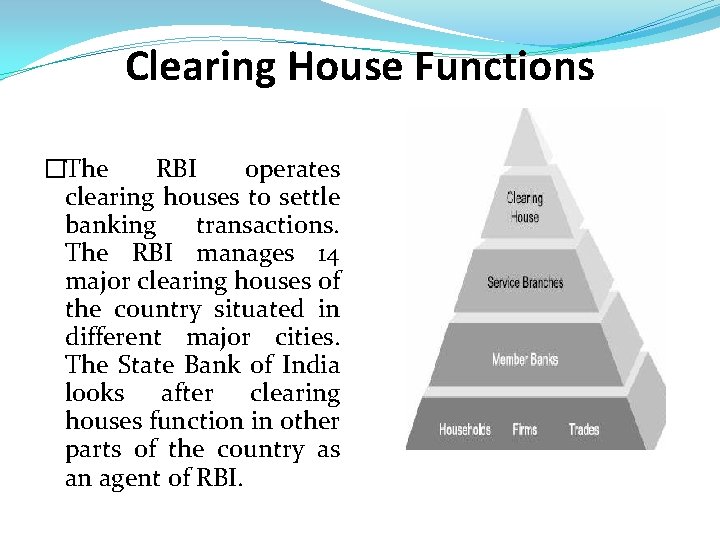
Clearing House Functions �The RBI operates clearing houses to settle banking transactions. The RBI manages 14 major clearing houses of the country situated in different major cities. The State Bank of India looks after clearing houses function in other parts of the country as an agent of RBI.
: Regulation of Banking System The prime duty of the reserve Bank is to regulate the banking system of our country in such a way that the people of the country can trust in the banking Up to perform its duty. The Reserve Bank has following powers in this regard: • Licensing: According to the section 22 of the Banking Regulation Act, every bank has to obtain license from the Reserve Bank. The Reserve Bank issues such license only to those banks which fulfill condition of the bank.
�Management: Section 10 of the Banking Regulation Act embowered the Reserve Bank to change manager or director of any bank if it considers it necessary or desirable. �Branch Expansion: Section 23 requires every bank to take prior permission from Reserve Bank to open new places of business in India. �Power of inspection of Bank: Under Section 35, the Reserve Bank may inspect any bank and its books and accounts either at its own initiative or at the instance of the Central Government.
RBI Websites � RBI Bulletin………………. . www. bulletin. rbi. org. in � RBI Annual Report…………. . . …. www. annualreport. rbi. org. in � Weekly Statistical Supplement……………. . . www. wss. rbi. org. in � Monetary and Credit Policy…………………. www. cpolicy. rbi. org. in � RBI Notifications………………. www. notifics. rbi. org. in � RBI Press Release………………. www. pr. rbi. org. in � RBI Speeches…………………www. speeches. rbi. org. in � Monetary and credit Information Review……www. mcir. rbi. org. in � Report on Trend and Progress of Banking…. . www. bankreport. rbi. org. in
- Slides: 29