Chapter 3 Linear and Quadratic Functions Section 3



- Slides: 14
Chapter 3 Linear and Quadratic Functions
Section 3 Quadratic Functions and Their Properties
DAY 1
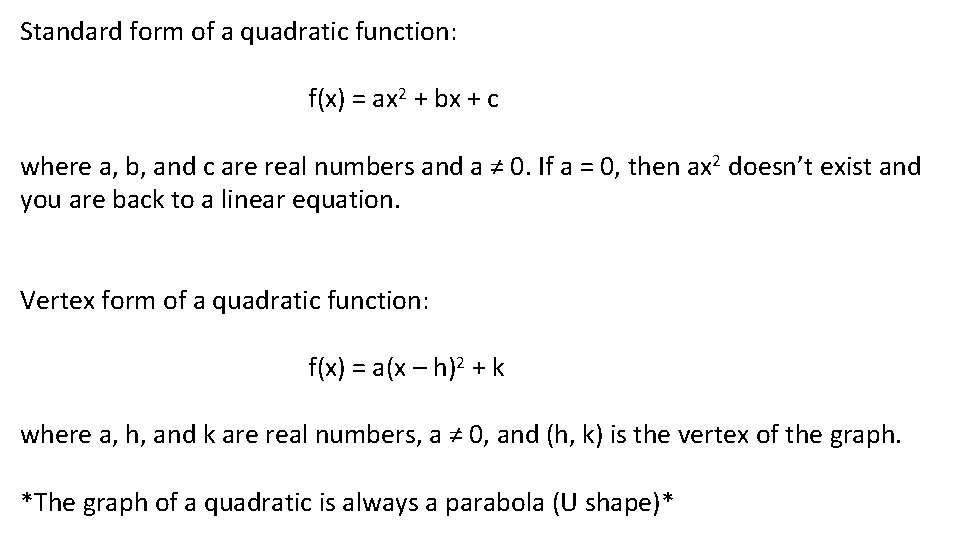
Standard form of a quadratic function: f(x) = ax 2 + bx + c where a, b, and c are real numbers and a ≠ 0. If a = 0, then ax 2 doesn’t exist and you are back to a linear equation. Vertex form of a quadratic function: f(x) = a(x – h)2 + k where a, h, and k are real numbers, a ≠ 0, and (h, k) is the vertex of the graph. *The graph of a quadratic is always a parabola (U shape)*
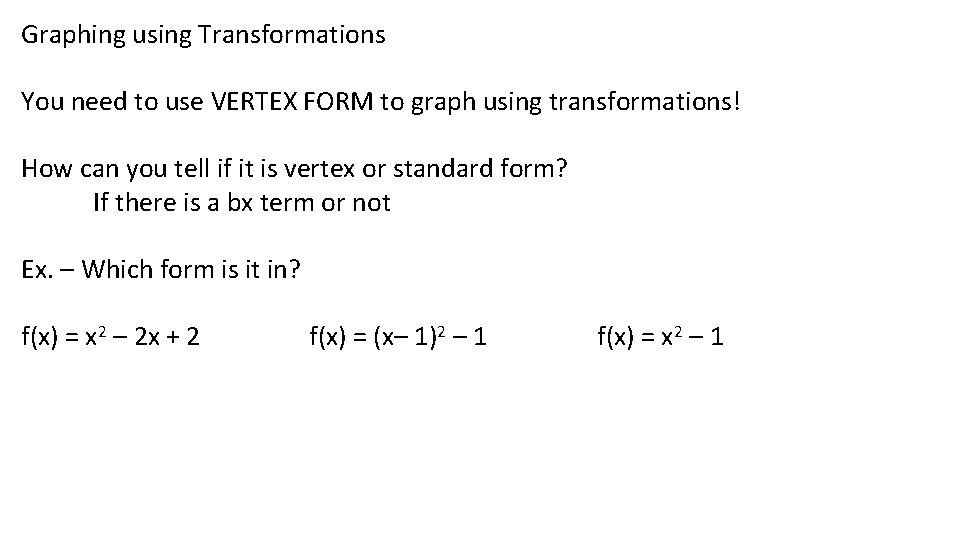
Graphing using Transformations You need to use VERTEX FORM to graph using transformations! How can you tell if it is vertex or standard form? If there is a bx term or not Ex. – Which form is it in? f(x) = x 2 – 2 x + 2 f(x) = (x– 1)2 – 1 f(x) = x 2 – 1
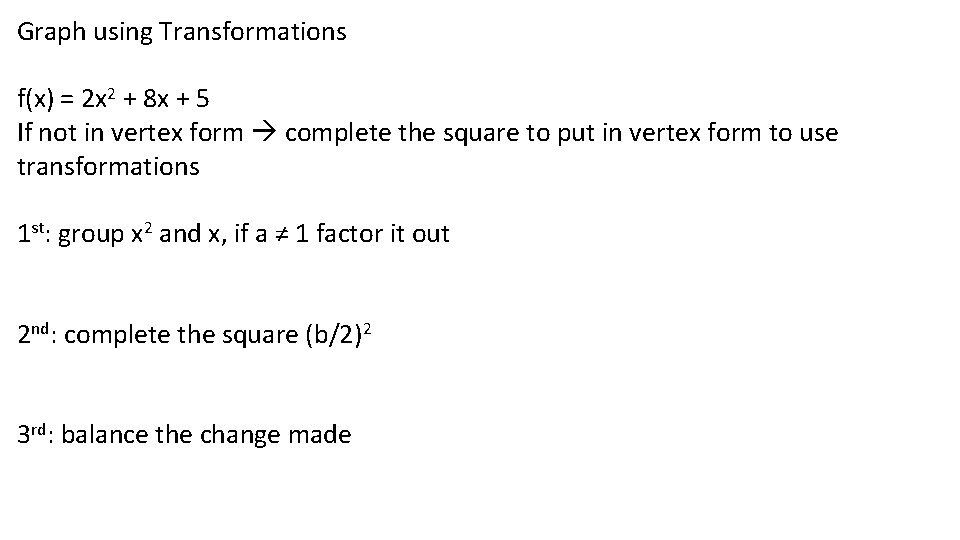
Graph using Transformations f(x) = 2 x 2 + 8 x + 5 If not in vertex form complete the square to put in vertex form to use transformations 1 st: group x 2 and x, if a ≠ 1 factor it out 2 nd: complete the square (b/2)2 3 rd: balance the change made
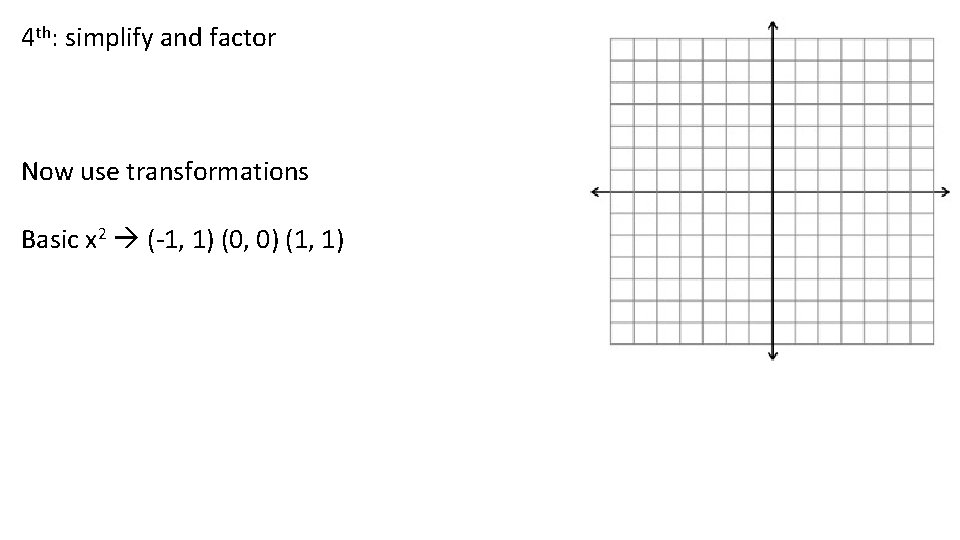
4 th: simplify and factor Now use transformations Basic x 2 (-1, 1) (0, 0) (1, 1)
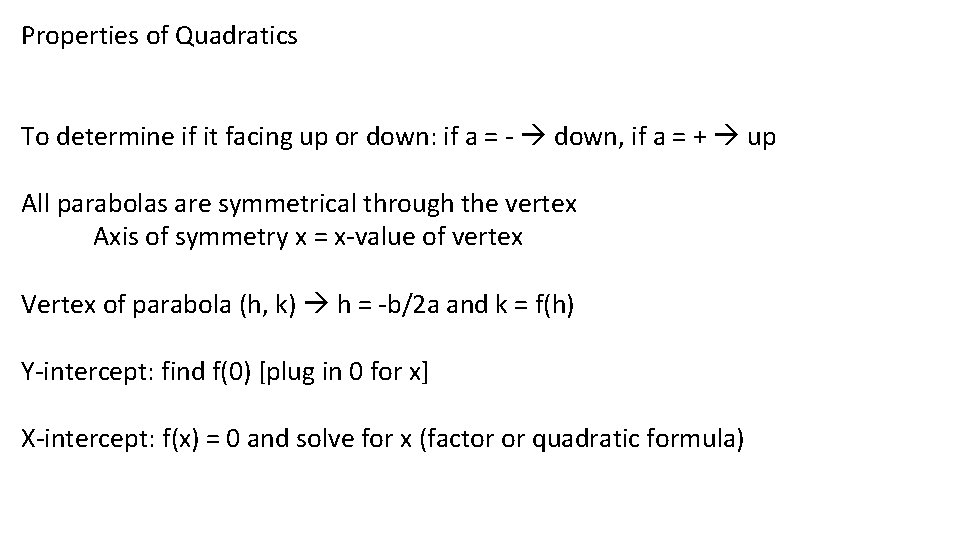
Properties of Quadratics To determine if it facing up or down: if a = - down, if a = + up All parabolas are symmetrical through the vertex Axis of symmetry x = x-value of vertex Vertex of parabola (h, k) h = -b/2 a and k = f(h) Y-intercept: find f(0) [plug in 0 for x] X-intercept: f(x) = 0 and solve for x (factor or quadratic formula)
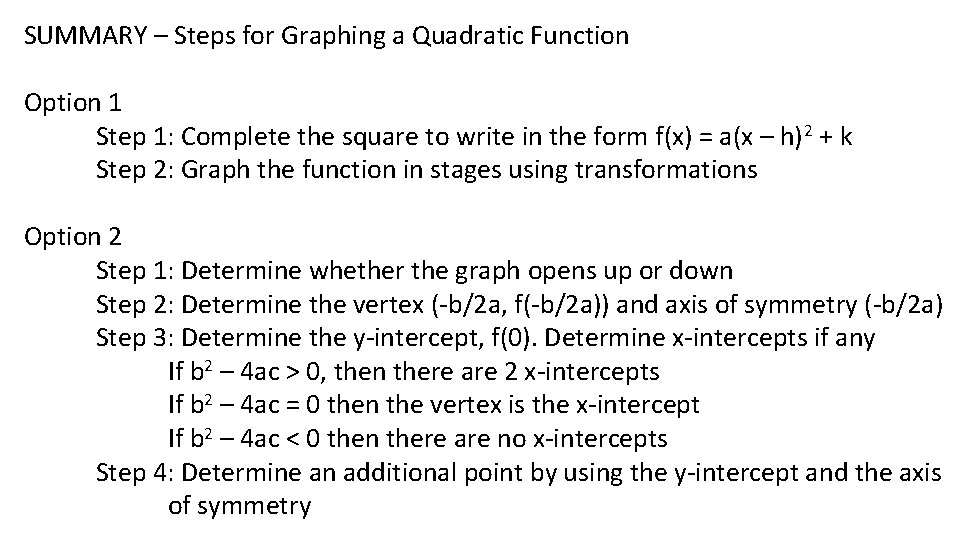
SUMMARY – Steps for Graphing a Quadratic Function Option 1 Step 1: Complete the square to write in the form f(x) = a(x – h)2 + k Step 2: Graph the function in stages using transformations Option 2 Step 1: Determine whether the graph opens up or down Step 2: Determine the vertex (-b/2 a, f(-b/2 a)) and axis of symmetry (-b/2 a) Step 3: Determine the y-intercept, f(0). Determine x-intercepts if any If b 2 – 4 ac > 0, then there are 2 x-intercepts If b 2 – 4 ac = 0 then the vertex is the x-intercept If b 2 – 4 ac < 0 then there are no x-intercepts Step 4: Determine an additional point by using the y-intercept and the axis of symmetry
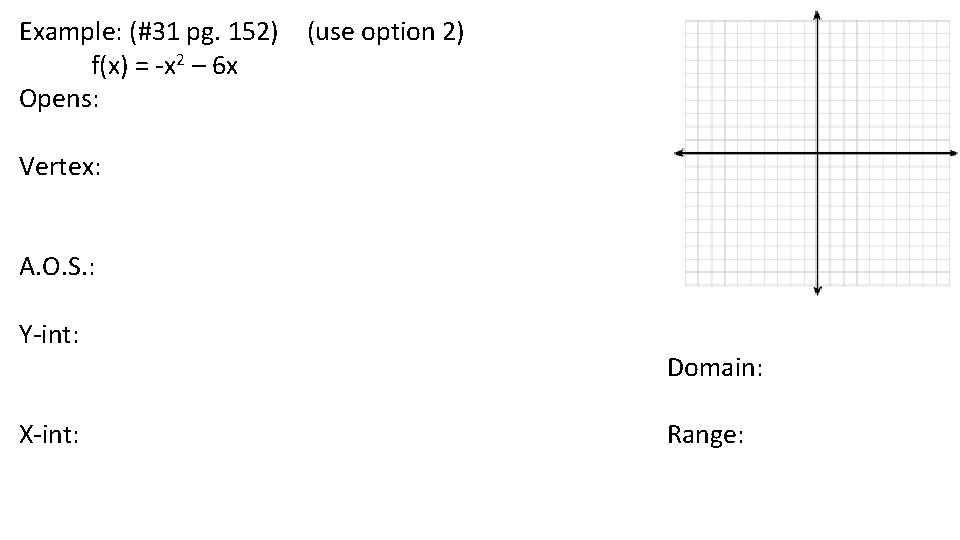
Example: (#31 pg. 152) f(x) = -x 2 – 6 x Opens: (use option 2) Vertex: A. O. S. : Y-int: X-int: Domain: Range:
DAY 2
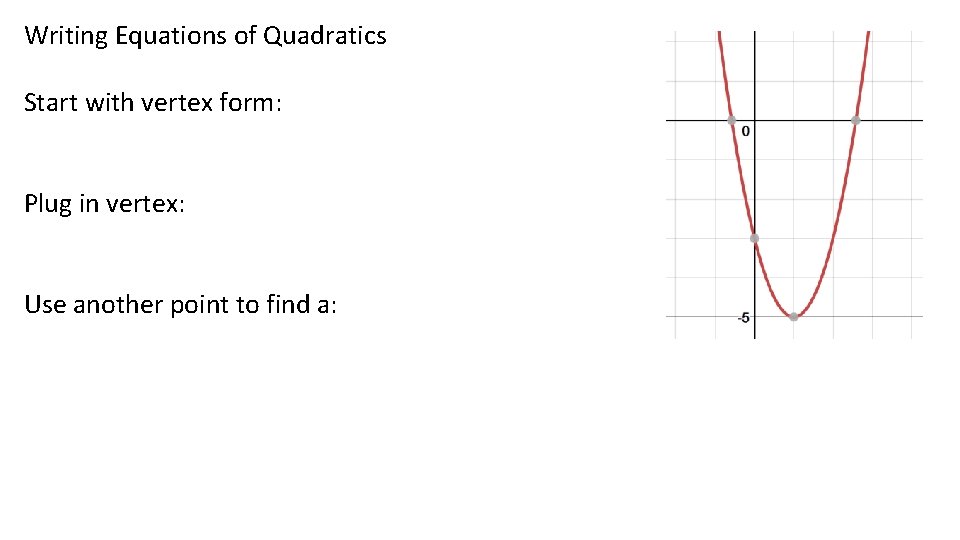
Writing Equations of Quadratics Start with vertex form: Plug in vertex: Use another point to find a:
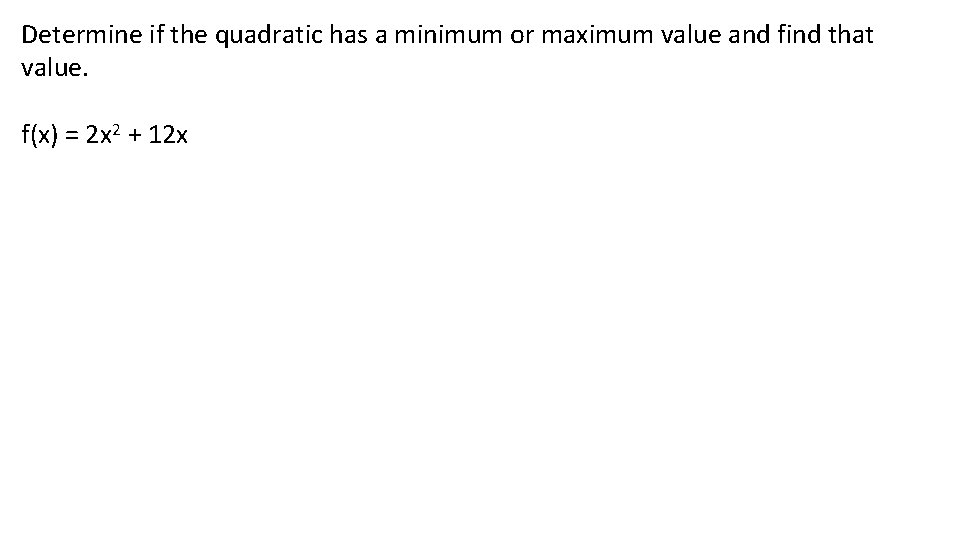
Determine if the quadratic has a minimum or maximum value and find that value. f(x) = 2 x 2 + 12 x
EXIT SLIP