4 06 Understand the functions and disorders of




- Slides: 61
4. 06 Understand the functions and disorders of the reproductive system
Understand the functions and disorders of the female reproductive system
Essential questions • What are the functions of the female reproductive system? • What are some common disorders of the female reproductive system? • How do you relate the body’s hormone control to the female reproductive system? • How do you relate the body’s use of nutrients to the female reproductive system? 4. 06 Understand the functions and disorders of the reproductive system 3
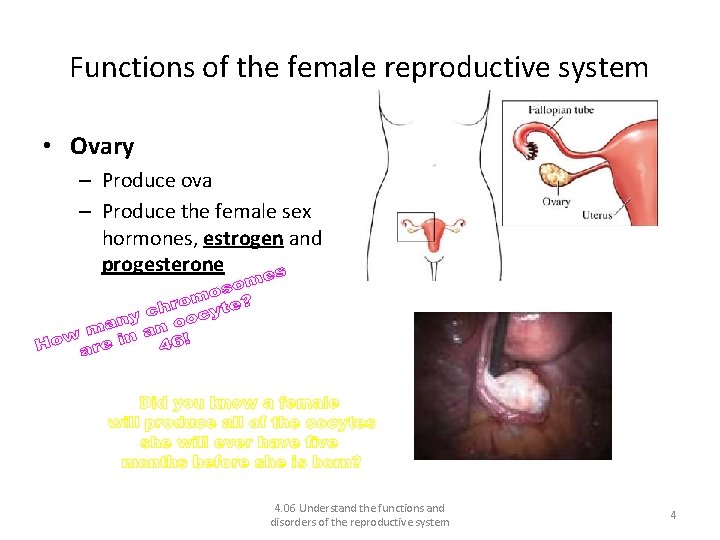
Functions of the female reproductive system • Ovary – Produce ova – Produce the female sex hormones, estrogen and progesterone 4. 06 Understand the functions and disorders of the reproductive system 4
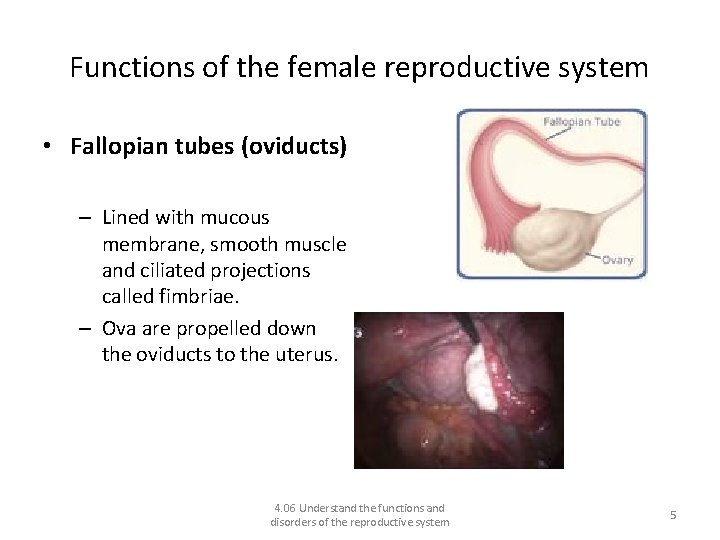
Functions of the female reproductive system • Fallopian tubes (oviducts) – Lined with mucous membrane, smooth muscle and ciliated projections called fimbriae. – Ova are propelled down the oviducts to the uterus. 4. 06 Understand the functions and disorders of the reproductive system 5
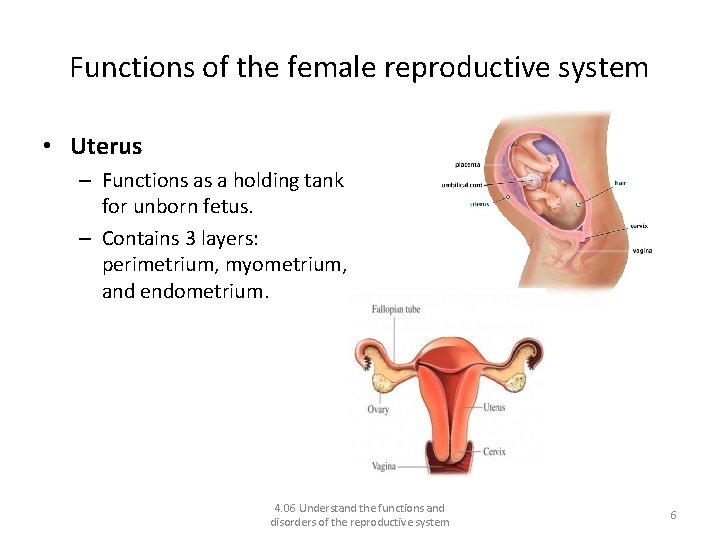
Functions of the female reproductive system • Uterus – Functions as a holding tank for unborn fetus. – Contains 3 layers: perimetrium, myometrium, and endometrium. 4. 06 Understand the functions and disorders of the reproductive system 6
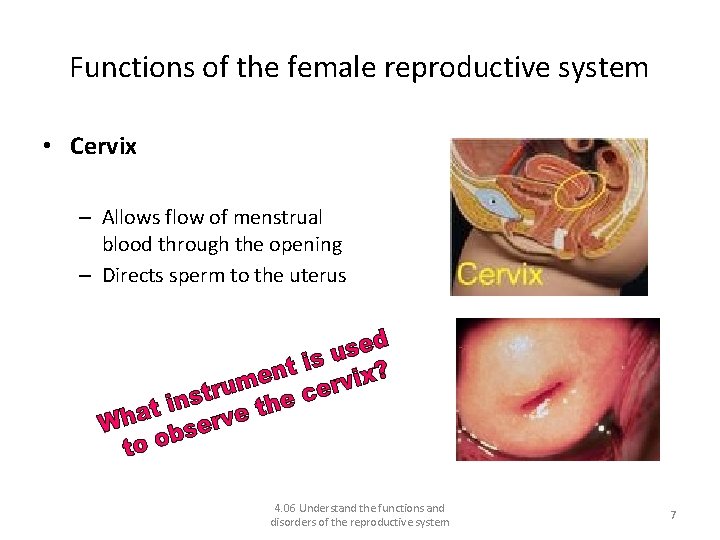
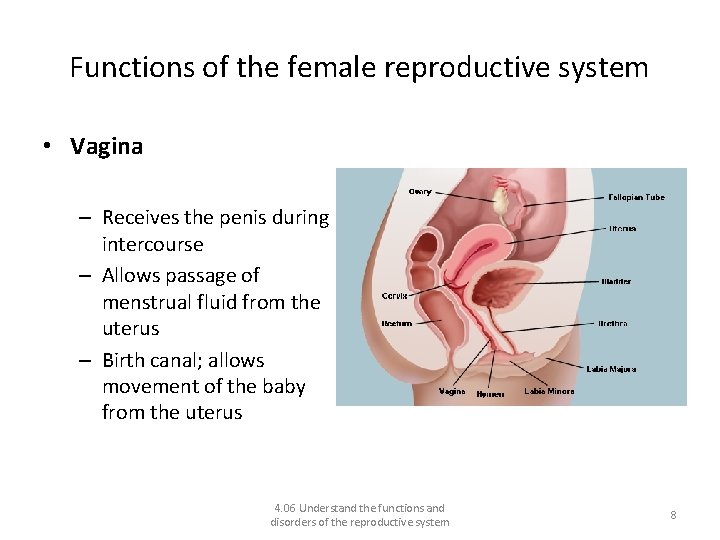
Functions of the female reproductive system • Cervix – Allows flow of menstrual blood through the opening – Directs sperm to the uterus 4. 06 Understand the functions and disorders of the reproductive system 7
Functions of the female reproductive system • Vagina – Receives the penis during intercourse – Allows passage of menstrual fluid from the uterus – Birth canal; allows movement of the baby from the uterus 4. 06 Understand the functions and disorders of the reproductive system 8
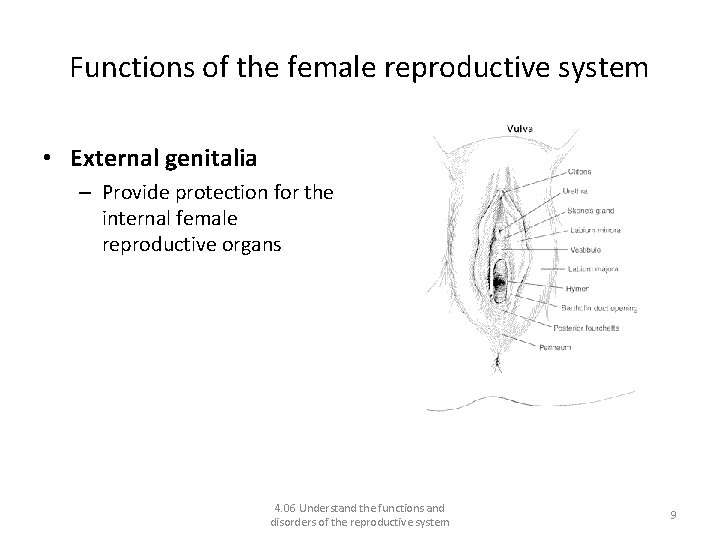
Functions of the female reproductive system • External genitalia – Provide protection for the internal female reproductive organs 4. 06 Understand the functions and disorders of the reproductive system 9
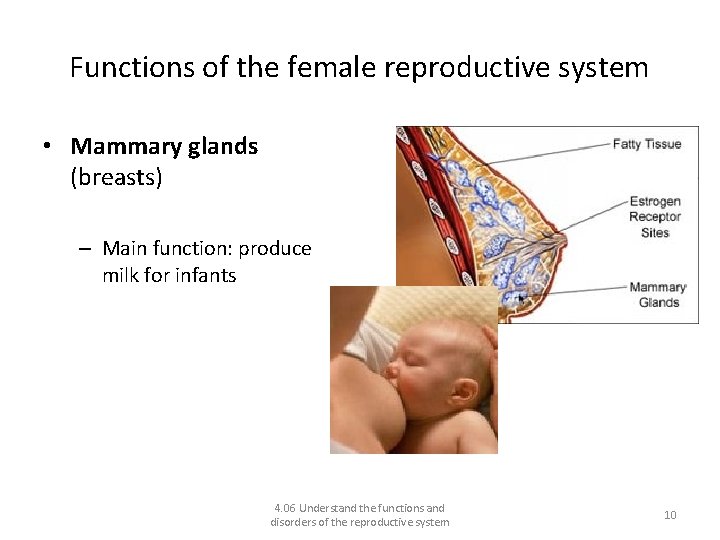
Functions of the female reproductive system • Mammary glands (breasts) – Main function: produce milk for infants 4. 06 Understand the functions and disorders of the reproductive system 10
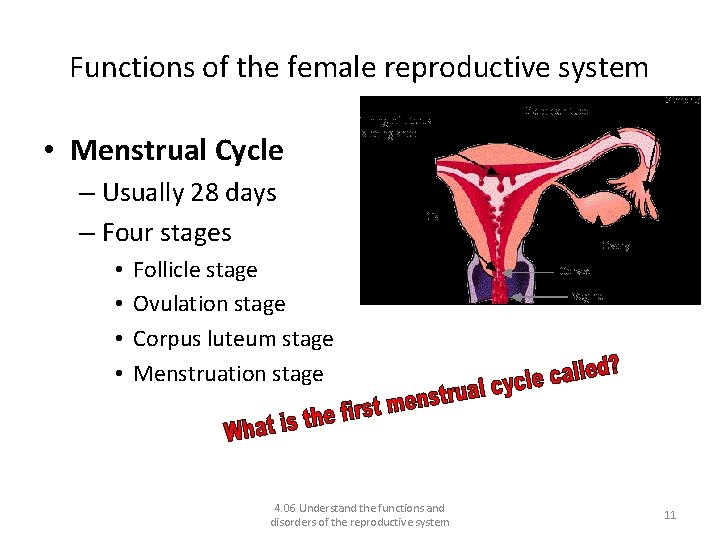
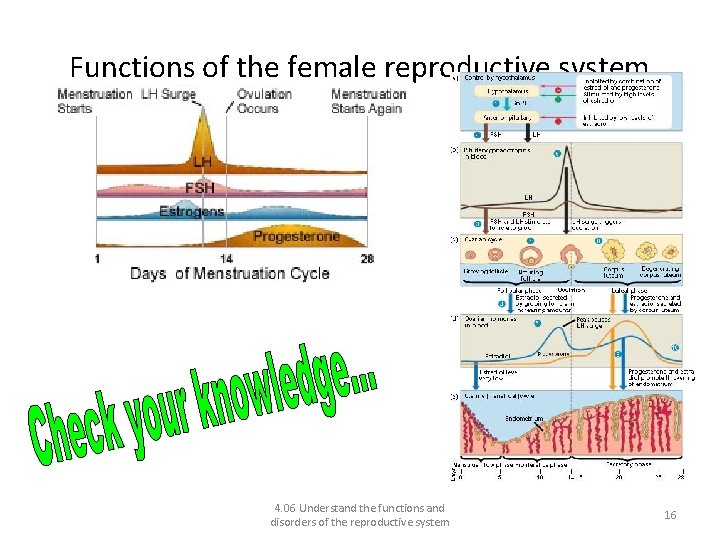
Functions of the female reproductive system • Menstrual Cycle – Usually 28 days – Four stages • • Follicle stage Ovulation stage Corpus luteum stage Menstruation stage 4. 06 Understand the functions and disorders of the reproductive system 11
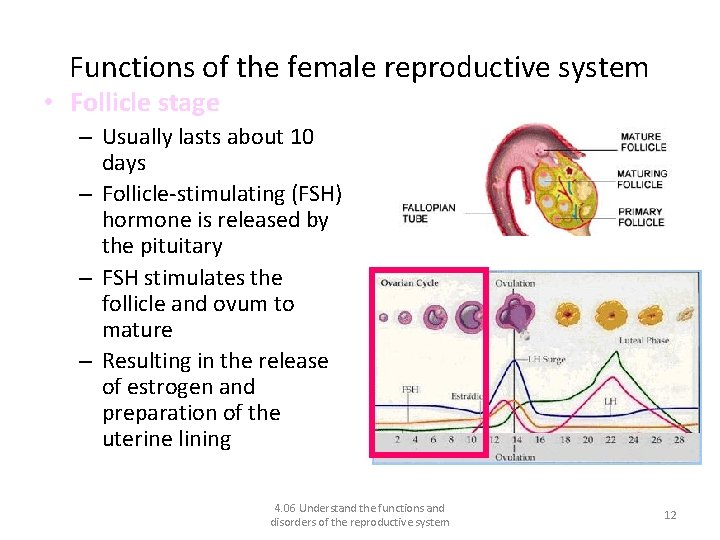
Functions of the female reproductive system • Follicle stage – Usually lasts about 10 days – Follicle-stimulating (FSH) hormone is released by the pituitary – FSH stimulates the follicle and ovum to mature – Resulting in the release of estrogen and preparation of the uterine lining 4. 06 Understand the functions and disorders of the reproductive system 12
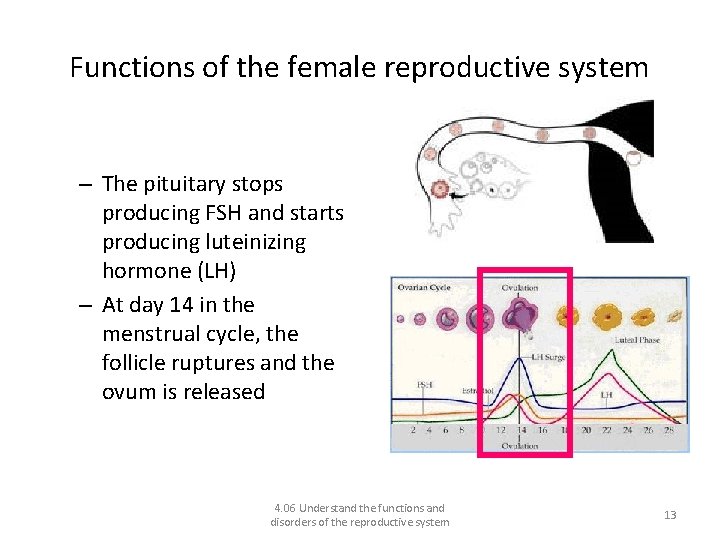
Functions of the female reproductive system • Ovulation stage – The pituitary stops producing FSH and starts producing luteinizing hormone (LH) – At day 14 in the menstrual cycle, the follicle ruptures and the ovum is released 4. 06 Understand the functions and disorders of the reproductive system 13
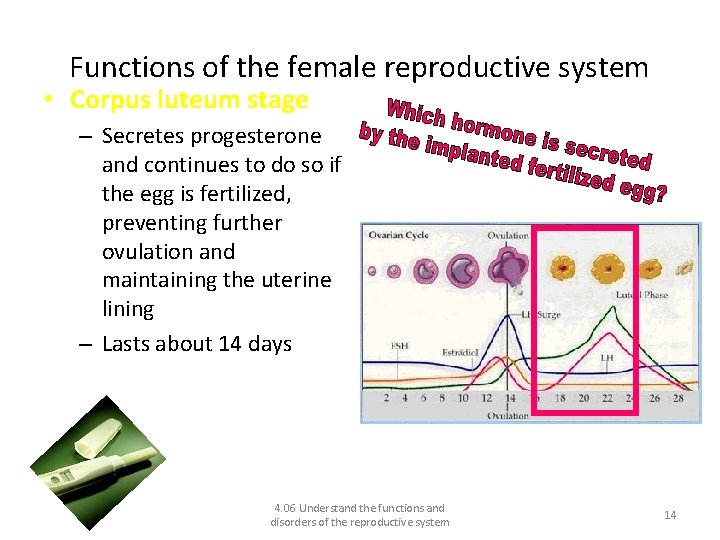
Functions of the female reproductive system • Corpus luteum stage – Secretes progesterone and continues to do so if the egg is fertilized, preventing further ovulation and maintaining the uterine lining – Lasts about 14 days 4. 06 Understand the functions and disorders of the reproductive system 14
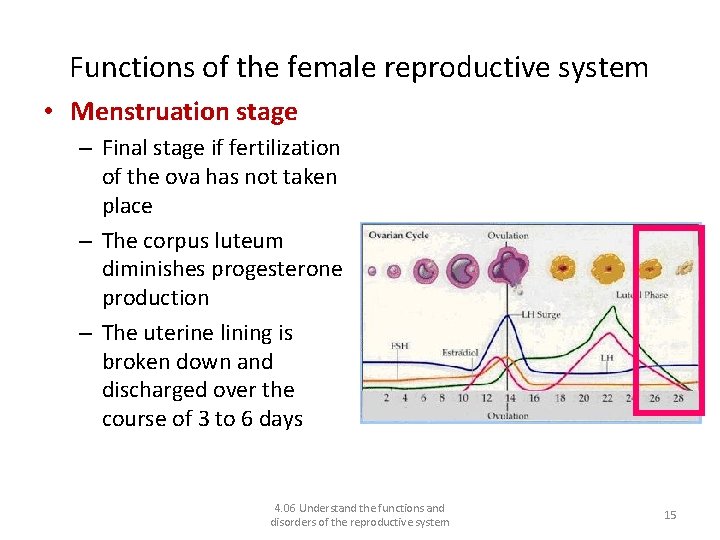
Functions of the female reproductive system • Menstruation stage – Final stage if fertilization of the ova has not taken place – The corpus luteum diminishes progesterone production – The uterine lining is broken down and discharged over the course of 3 to 6 days 4. 06 Understand the functions and disorders of the reproductive system 15
Functions of the female reproductive system 4. 06 Understand the functions and disorders of the reproductive system 16
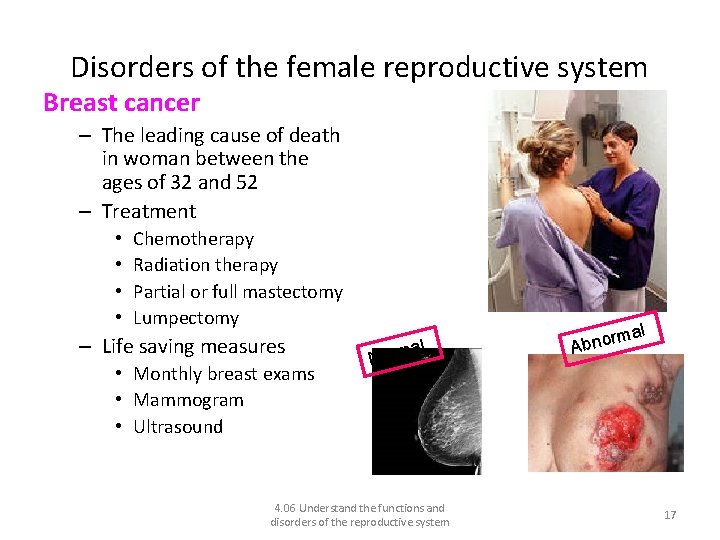
Disorders of the female reproductive system Breast cancer – The leading cause of death in woman between the ages of 32 and 52 – Treatment • • Chemotherapy Radiation therapy Partial or full mastectomy Lumpectomy – Life saving measures • Monthly breast exams • Mammogram • Ultrasound No rmal 4. 06 Understand the functions and disorders of the reproductive system al rm Abno 17
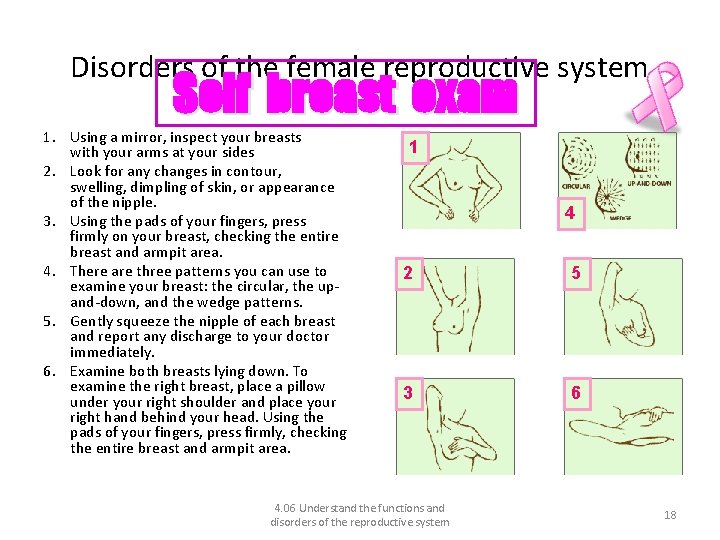
Disorders of the female reproductive system Self breast exam 1. Using a mirror, inspect your breasts with your arms at your sides 2. Look for any changes in contour, swelling, dimpling of skin, or appearance of the nipple. 3. Using the pads of your fingers, press firmly on your breast, checking the entire breast and armpit area. 4. There are three patterns you can use to examine your breast: the circular, the upand-down, and the wedge patterns. 5. Gently squeeze the nipple of each breast and report any discharge to your doctor immediately. 6. Examine both breasts lying down. To examine the right breast, place a pillow under your right shoulder and place your right hand behind your head. Using the pads of your fingers, press firmly, checking the entire breast and armpit area. 1 4 2 5 3 6 4. 06 Understand the functions and disorders of the reproductive system 18
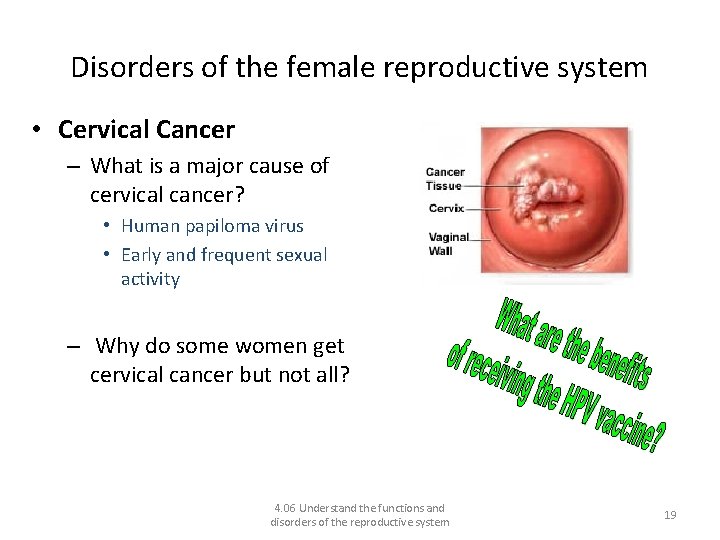
Disorders of the female reproductive system • Cervical Cancer – What is a major cause of cervical cancer? • Human papiloma virus • Early and frequent sexual activity – Why do some women get cervical cancer but not all? 4. 06 Understand the functions and disorders of the reproductive system 19
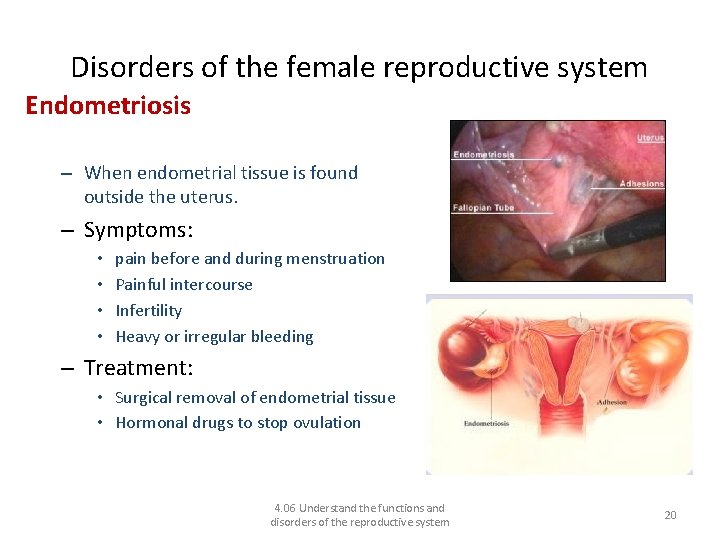
Disorders of the female reproductive system Endometriosis – When endometrial tissue is found outside the uterus. – Symptoms: • • pain before and during menstruation Painful intercourse Infertility Heavy or irregular bleeding – Treatment: • Surgical removal of endometrial tissue • Hormonal drugs to stop ovulation 4. 06 Understand the functions and disorders of the reproductive system 20
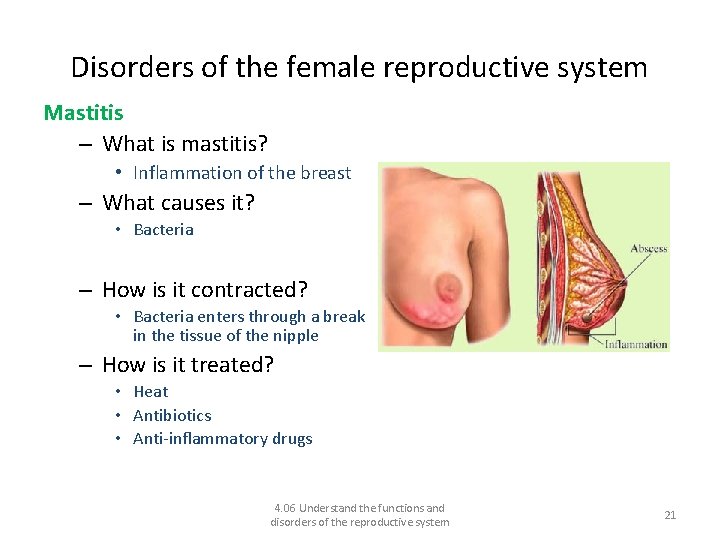
Disorders of the female reproductive system Mastitis – What is mastitis? • Inflammation of the breast – What causes it? • Bacteria – How is it contracted? • Bacteria enters through a break in the tissue of the nipple – How is it treated? • Heat • Antibiotics • Anti-inflammatory drugs 4. 06 Understand the functions and disorders of the reproductive system 21
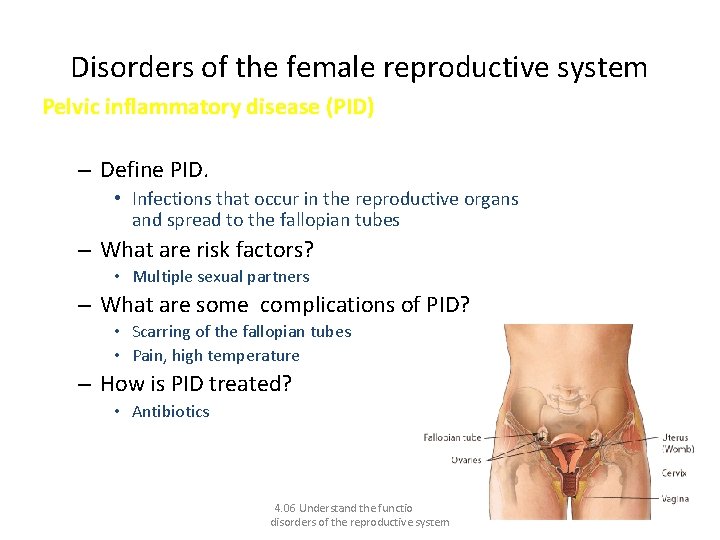
Disorders of the female reproductive system Pelvic inflammatory disease (PID) – Define PID. • Infections that occur in the reproductive organs and spread to the fallopian tubes – What are risk factors? • Multiple sexual partners – What are some complications of PID? • Scarring of the fallopian tubes • Pain, high temperature – How is PID treated? • Antibiotics 4. 06 Understand the functions and disorders of the reproductive system 22
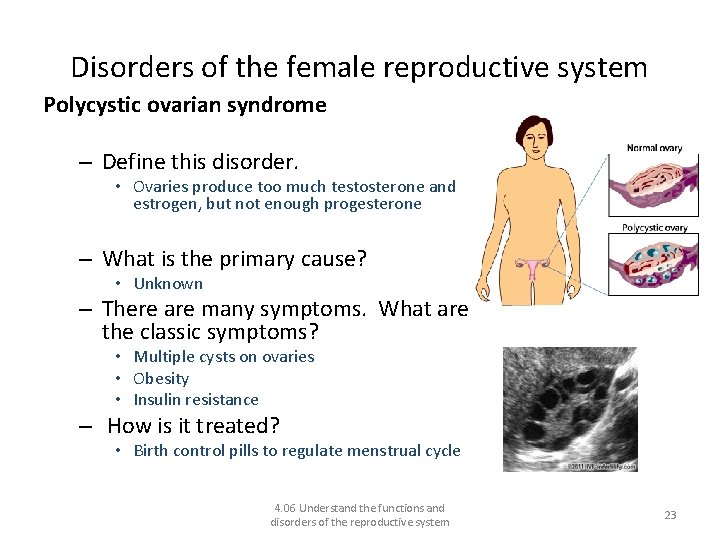
Disorders of the female reproductive system Polycystic ovarian syndrome – Define this disorder. • Ovaries produce too much testosterone and estrogen, but not enough progesterone – What is the primary cause? • Unknown – There are many symptoms. What are the classic symptoms? • Multiple cysts on ovaries • Obesity • Insulin resistance – How is it treated? • Birth control pills to regulate menstrual cycle 4. 06 Understand the functions and disorders of the reproductive system 23
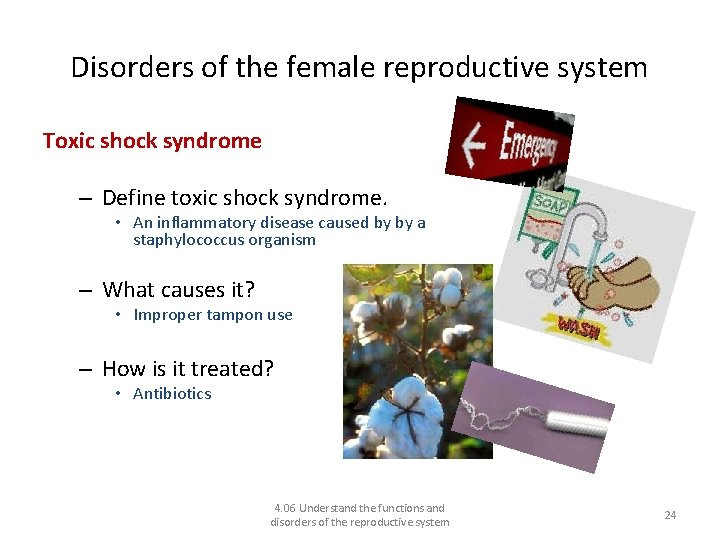
Disorders of the female reproductive system Toxic shock syndrome – Define toxic shock syndrome. • An inflammatory disease caused by by a staphylococcus organism – What causes it? • Improper tampon use – How is it treated? • Antibiotics 4. 06 Understand the functions and disorders of the reproductive system 24
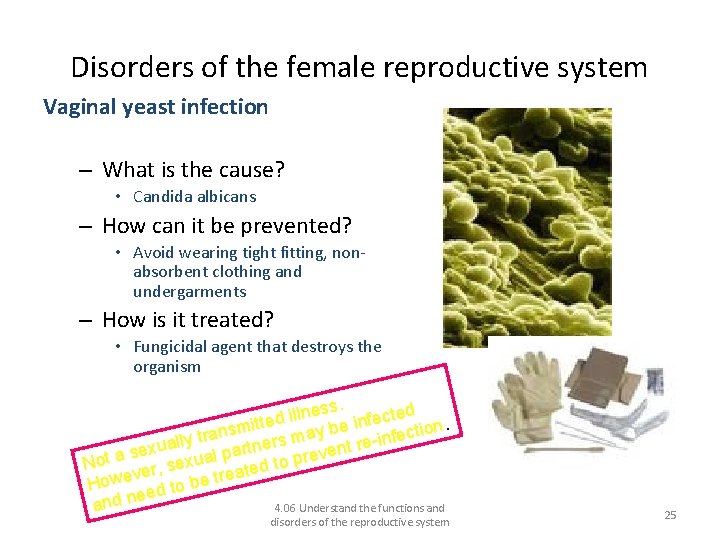
Disorders of the female reproductive system Vaginal yeast infection – What is the cause? • Candida albicans – How can it be prevented? • Avoid wearing tight fitting, nonabsorbent clothing and undergarments – How is it treated? • Fungicidal agent that destroys the organism ss. e n l l i cted e d f e n t i be on. sm i t y n c a a e r f t m ers re-in ually n t t x r n e a e s v p pre o Not a er, sexual t d e v eat Howe ed to be tr e and n 4. 06 Understand the functions and disorders of the reproductive system 25
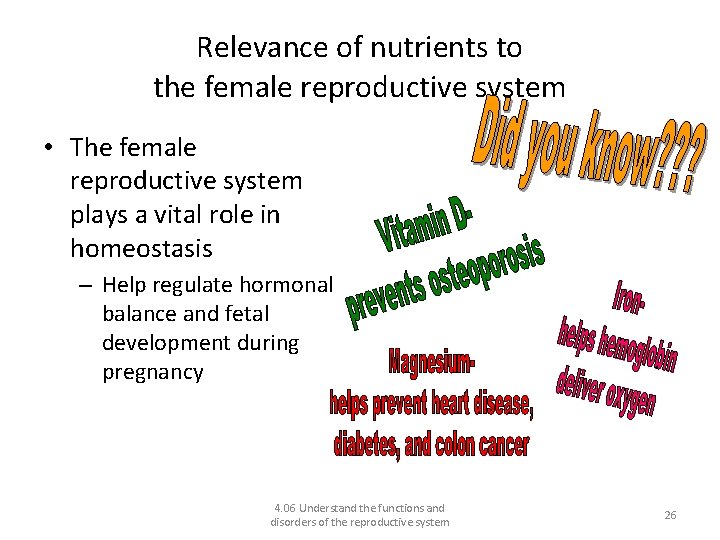
Relevance of nutrients to the female reproductive system • The female reproductive system plays a vital role in homeostasis – Help regulate hormonal balance and fetal development during pregnancy 4. 06 Understand the functions and disorders of the reproductive system 26
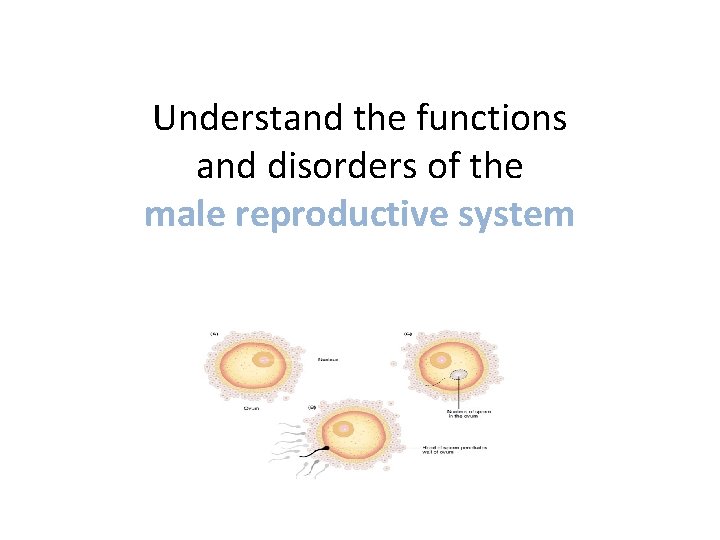
Understand the functions and disorders of the male reproductive system
Essential questions • What is the function of the male reproductive system? • What are some common disorders of the male reproductive system? • How do you relate the body’s hormone control to the male and female reproductive systems 4. 06 Understand the functions and disorders of the reproductive system 28
Functions of the male reproductive system Hormone production What is the male sex hormone? Testosterone What does it do? Responsible for development of male reproductive organs, sexual characteristics; facial, body hair, deepening voice 4. 06 Understand the functions and disorders of the reproductive system 29
Function of the male reproductive system Define reproduction 4. 06 Understand the functions and disorders of the reproductive system 30
Functions of the male reproductive system: Discuss the functions of these structures: » Seminiferous tubules : contain sperm cells Testes » Epididymis: Sperm mature here. 4. 06 Understand the functions and disorders of the reproductive system 31
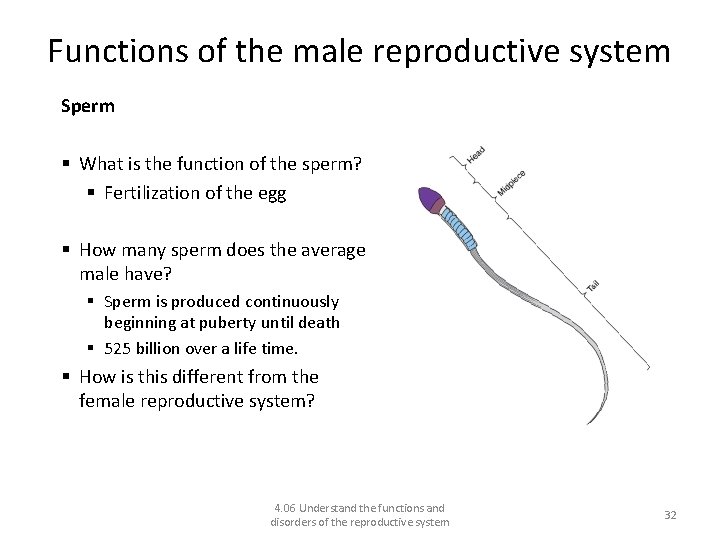
Functions of the male reproductive system Sperm § What is the function of the sperm? § Fertilization of the egg § How many sperm does the average male have? § Sperm is produced continuously beginning at puberty until death § 525 billion over a life time. § How is this different from the female reproductive system? 4. 06 Understand the functions and disorders of the reproductive system 32
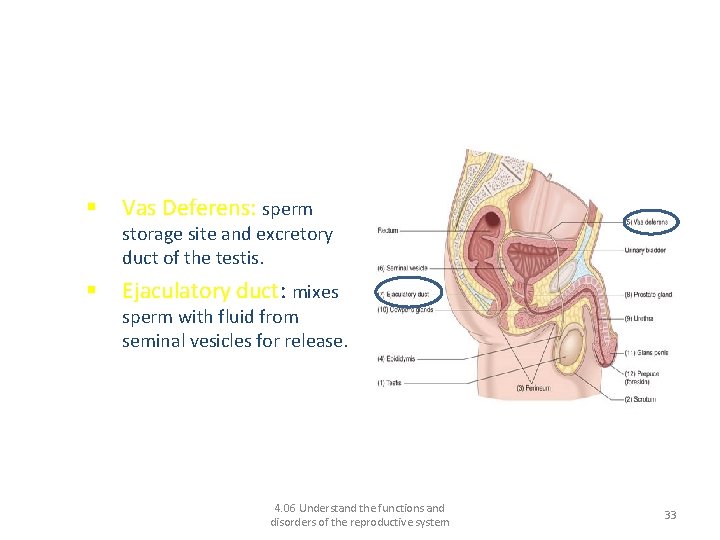
Functions of the male reproductive system: Discuss the functions of these structures: § Vas Deferens: sperm storage site and excretory duct of the testis. § Ejaculatory duct: mixes sperm with fluid from seminal vesicles for release. 4. 06 Understand the functions and disorders of the reproductive system 33
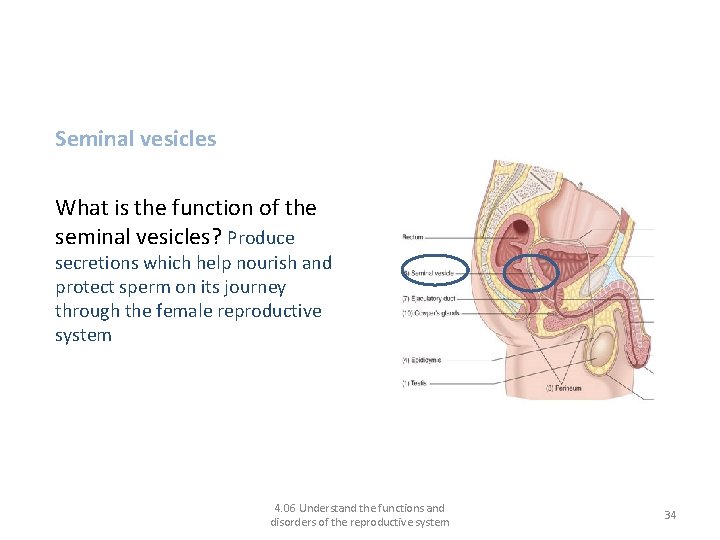
Functions of the male reproductive system: Seminal vesicles What is the function of the seminal vesicles? Produce secretions which help nourish and protect sperm on its journey through the female reproductive system 4. 06 Understand the functions and disorders of the reproductive system 34
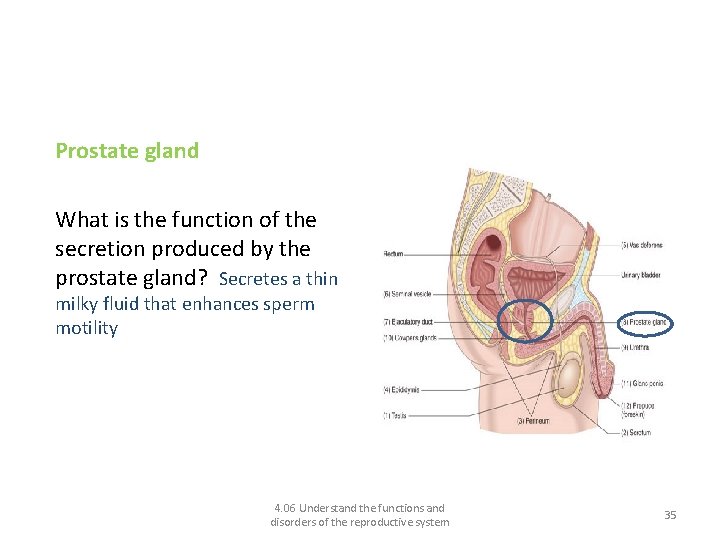
Functions of the male reproductive system: Prostate gland What is the function of the secretion produced by the prostate gland? Secretes a thin milky fluid that enhances sperm motility 4. 06 Understand the functions and disorders of the reproductive system 35
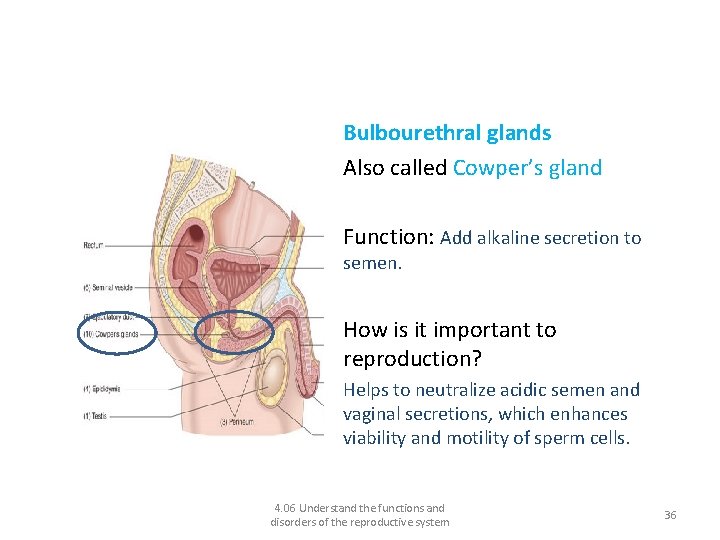
Functions of the male reproductive system: Bulbourethral glands Also called Cowper’s gland Function: Add alkaline secretion to semen. How is it important to reproduction? Helps to neutralize acidic semen and vaginal secretions, which enhances viability and motility of sperm cells. 4. 06 Understand the functions and disorders of the reproductive system 36
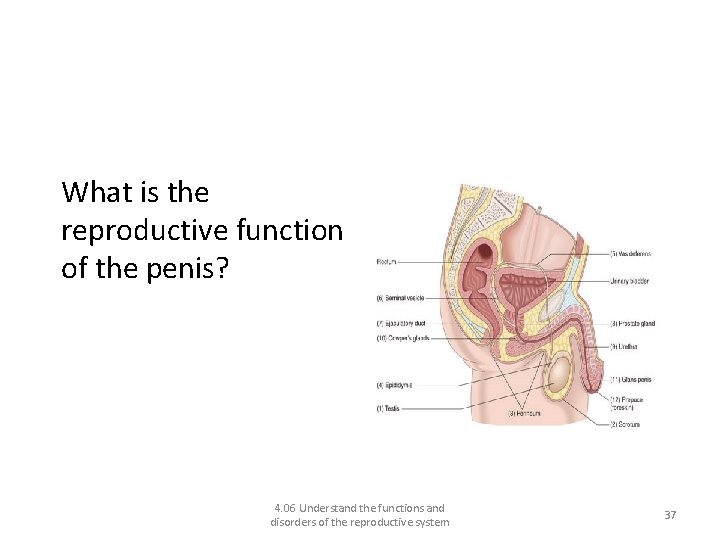
Functions of the male reproductive system: What is the reproductive function of the penis? 4. 06 Understand the functions and disorders of the reproductive system 37
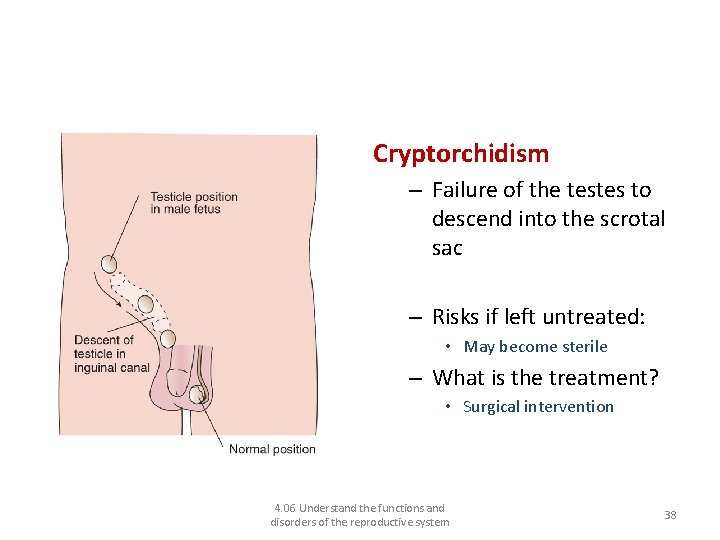
Disorders of the male reproductive system and their treatments Cryptorchidism – Failure of the testes to descend into the scrotal sac – Risks if left untreated: • May become sterile – What is the treatment? • Surgical intervention 4. 06 Understand the functions and disorders of the reproductive system 38
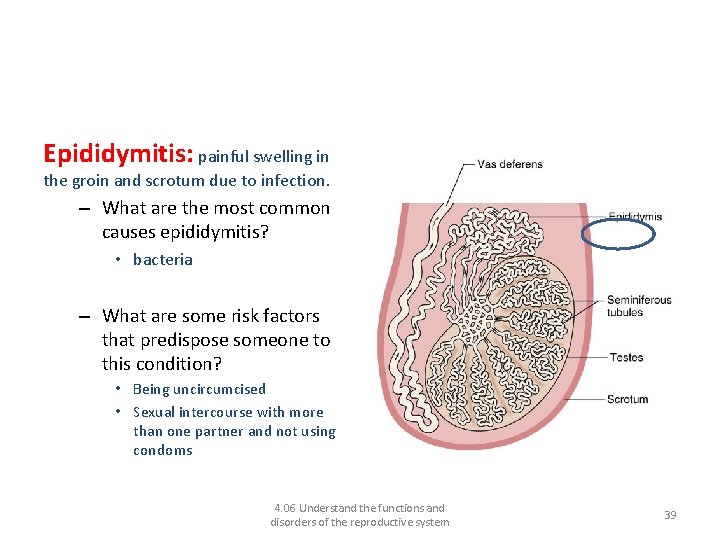
Disorders of the male reproductive system and their treatments Epididymitis: painful swelling in the groin and scrotum due to infection. – What are the most common causes epididymitis? • bacteria – What are some risk factors that predispose someone to this condition? • Being uncircumcised • Sexual intercourse with more than one partner and not using condoms 4. 06 Understand the functions and disorders of the reproductive system 39
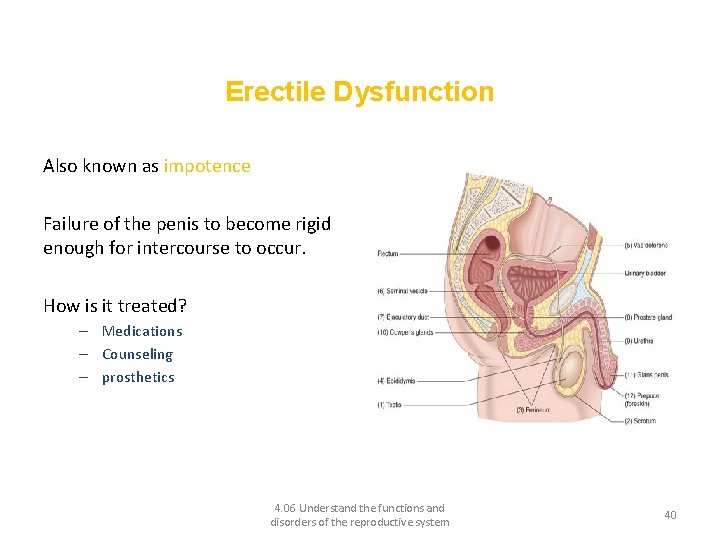
Disorders of the male reproductive system and their treatments Erectile Dysfunction Also known as impotence Failure of the penis to become rigid enough for intercourse to occur. How is it treated? – Medications – Counseling – prosthetics 4. 06 Understand the functions and disorders of the reproductive system 40
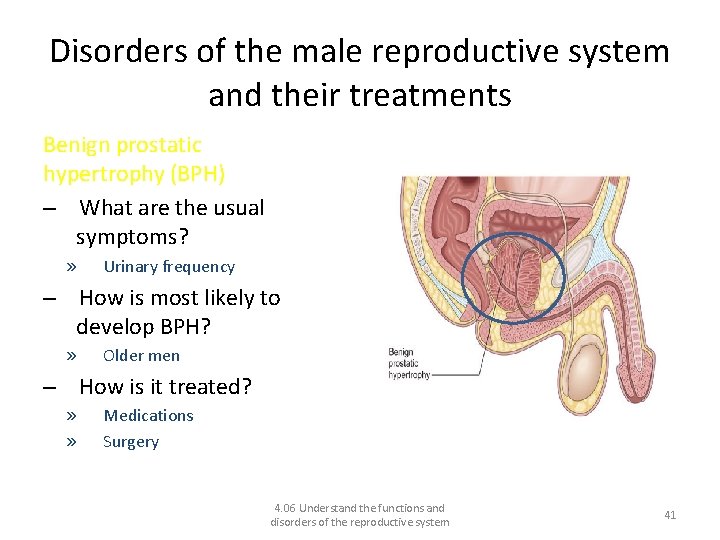
Disorders of the male reproductive system and their treatments Benign prostatic hypertrophy (BPH) – What are the usual symptoms? » Urinary frequency – How is most likely to develop BPH? » Older men – How is it treated? » » Medications Surgery 4. 06 Understand the functions and disorders of the reproductive system 41
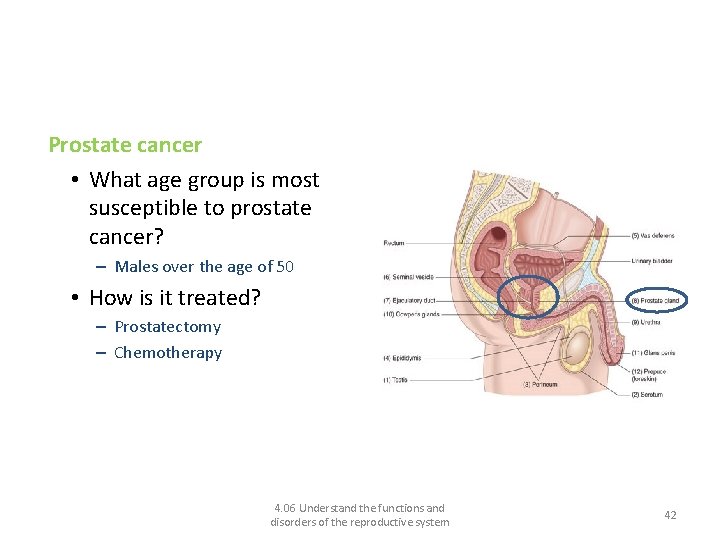
Disorders of the male reproductive system and their treatments Prostate cancer • What age group is most susceptible to prostate cancer? – Males over the age of 50 • How is it treated? – Prostatectomy – Chemotherapy 4. 06 Understand the functions and disorders of the reproductive system 42
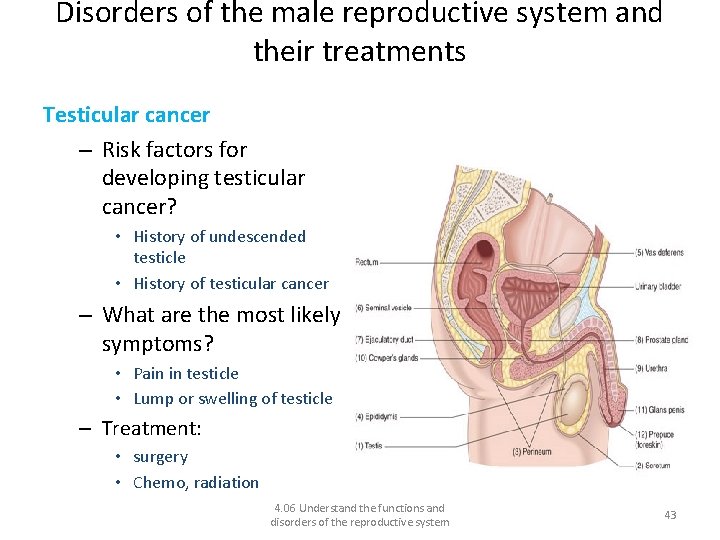
Disorders of the male reproductive system and their treatments Testicular cancer – Risk factors for developing testicular cancer? • History of undescended testicle • History of testicular cancer – What are the most likely symptoms? • Pain in testicle • Lump or swelling of testicle – Treatment: • surgery • Chemo, radiation 4. 06 Understand the functions and disorders of the reproductive system 43
Disorders of the male reproductive system and their treatments Testicular self-examination • Testicular self-examination is an examination of the testicles. The testicles (also called the testes) are the male reproductive organs that produce sperm and the hormone testosterone. They are located in the scrotum under the penis. • Perform this test during or after a shower. This way, the scrotal skin is warm and relaxed. It's best to do the test while standing. 4. 06 Understand the functions and disorders of the reproductive system 44
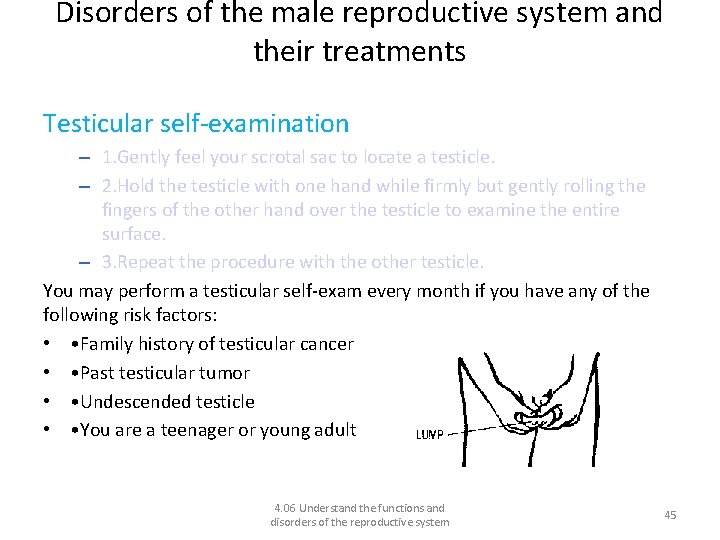
Disorders of the male reproductive system and their treatments Testicular self-examination – 1. Gently feel your scrotal sac to locate a testicle. – 2. Hold the testicle with one hand while firmly but gently rolling the fingers of the other hand over the testicle to examine the entire surface. – 3. Repeat the procedure with the other testicle. You may perform a testicular self-exam every month if you have any of the following risk factors: • • Family history of testicular cancer • • Past testicular tumor • • Undescended testicle • • You are a teenager or young adult 4. 06 Understand the functions and disorders of the reproductive system 45
Reproductive process: conception 4. 06 Understand the functions and disorders of the reproductive system 46
Reproductive process Conception -when the sperm and the egg unite -pregnancy occurs 4. 06 Understand the functions and disorders of the reproductive system 47
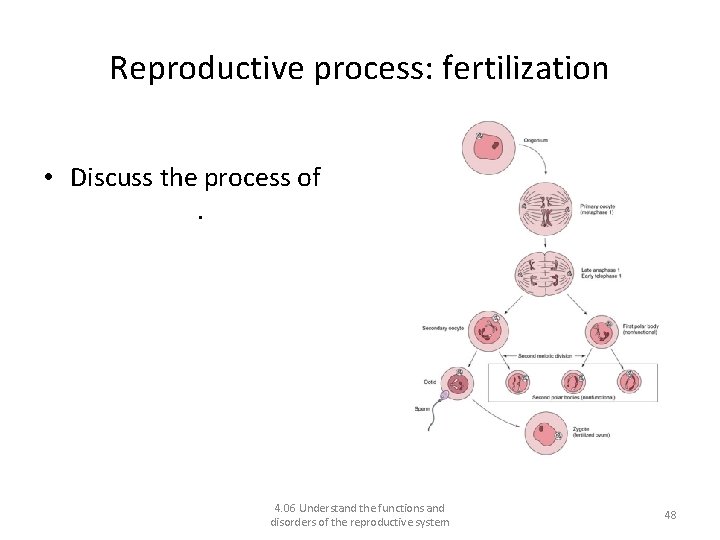
Reproductive process: fertilization • Discuss the process of conception. 4. 06 Understand the functions and disorders of the reproductive system 48
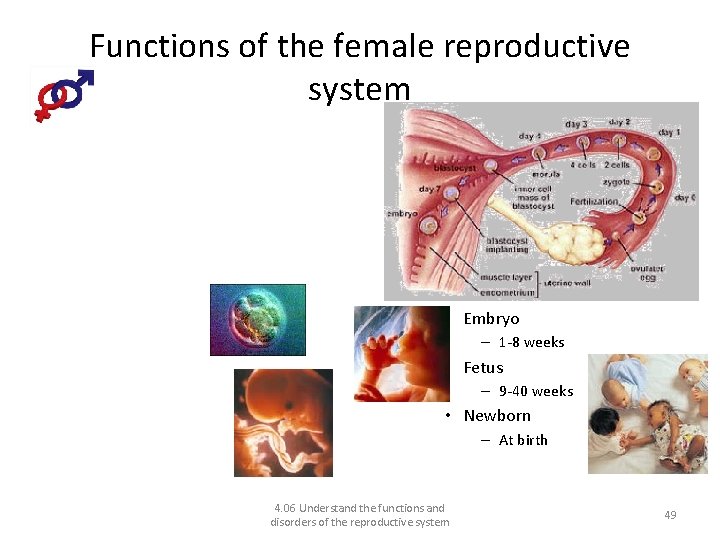
Functions of the female reproductive system Pregnancy – Define pregnancy – What is the human gestational period? – Terms to remember: • Embryo – 1 -8 weeks • Fetus – 9 -40 weeks • Newborn – At birth 4. 06 Understand the functions and disorders of the reproductive system 49
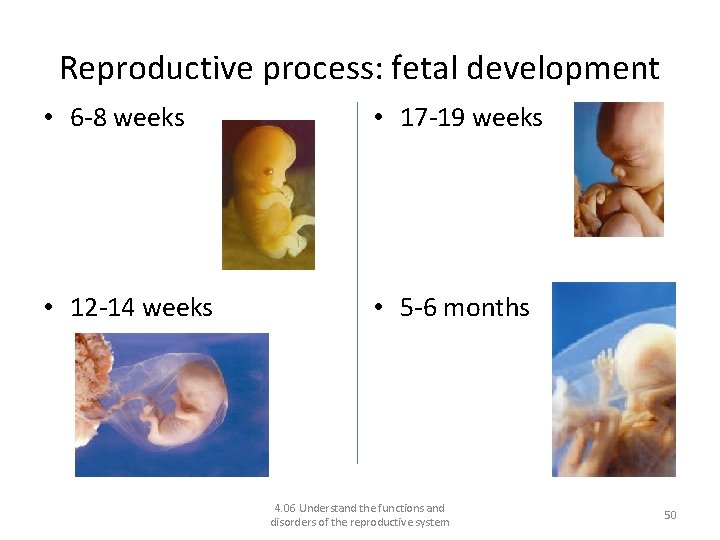
Reproductive process: fetal development • 6 -8 weeks • 17 -19 weeks • 12 -14 weeks • 5 -6 months 4. 06 Understand the functions and disorders of the reproductive system 50
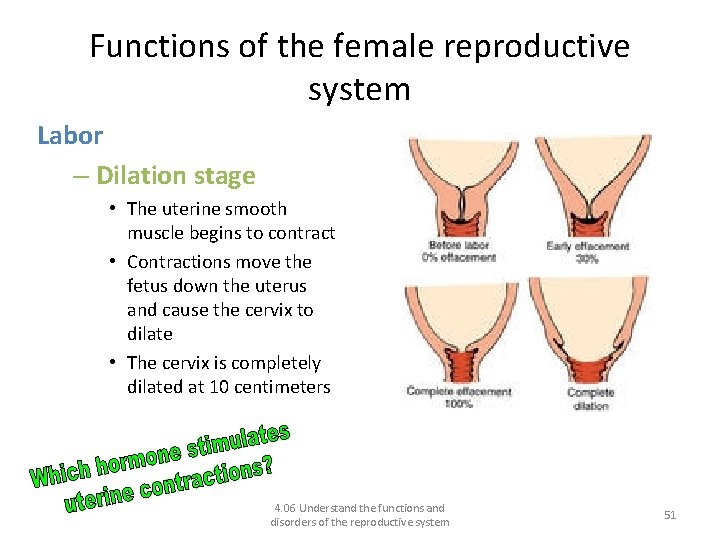
Functions of the female reproductive system Labor – Dilation stage • The uterine smooth muscle begins to contract • Contractions move the fetus down the uterus and cause the cervix to dilate • The cervix is completely dilated at 10 centimeters 4. 06 Understand the functions and disorders of the reproductive system 51
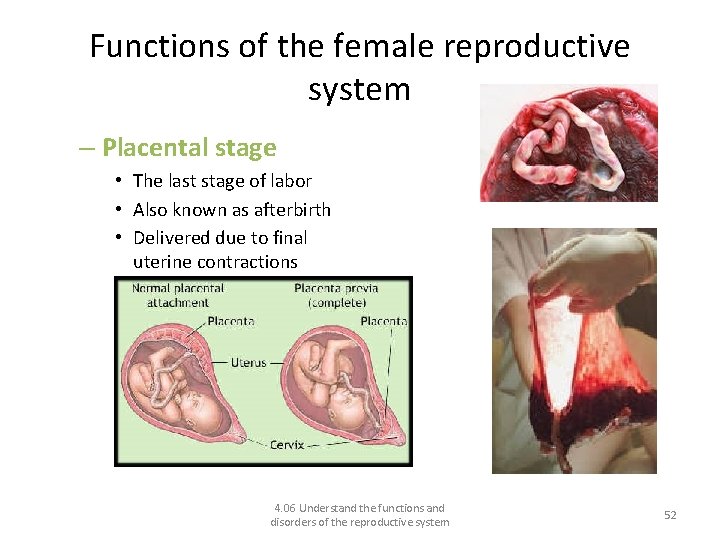
Functions of the female reproductive system – Placental stage • The last stage of labor • Also known as afterbirth • Delivered due to final uterine contractions 4. 06 Understand the functions and disorders of the reproductive system 52
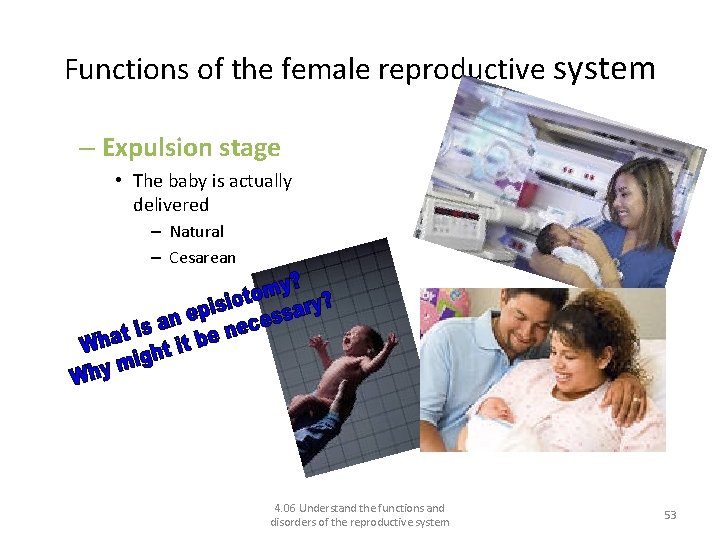
Functions of the female reproductive system – Expulsion stage • The baby is actually delivered – Natural – Cesarean 4. 06 Understand the functions and disorders of the reproductive system 53
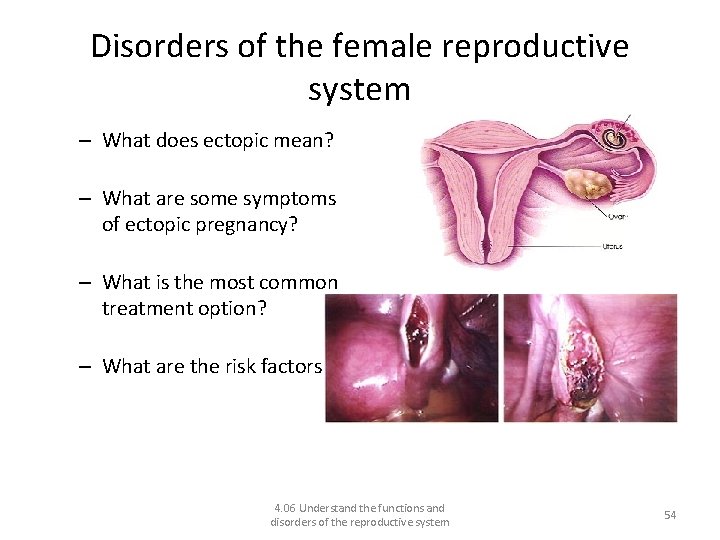
Disorders of the female reproductive system Ectopic pregnancy – What does ectopic mean? – What are some symptoms of ectopic pregnancy? – What is the most common treatment option? – What are the risk factors? 4. 06 Understand the functions and disorders of the reproductive system 54
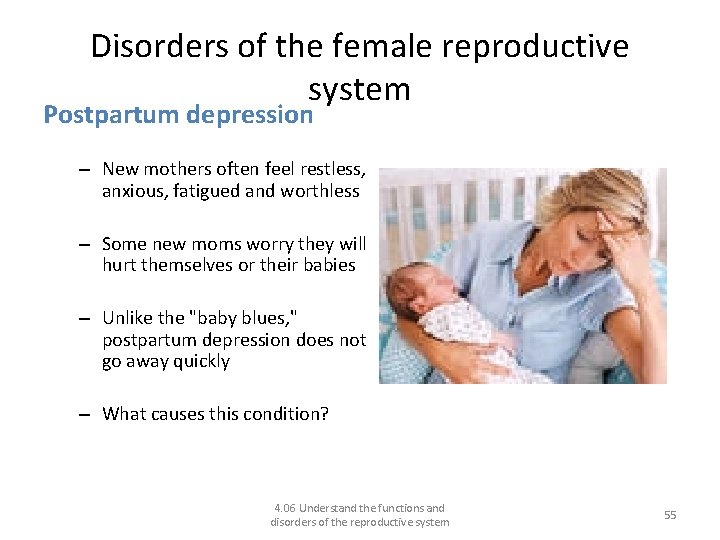
Disorders of the female reproductive system Postpartum depression – New mothers often feel restless, anxious, fatigued and worthless – Some new moms worry they will hurt themselves or their babies – Unlike the "baby blues, " postpartum depression does not go away quickly – What causes this condition? 4. 06 Understand the functions and disorders of the reproductive system 55
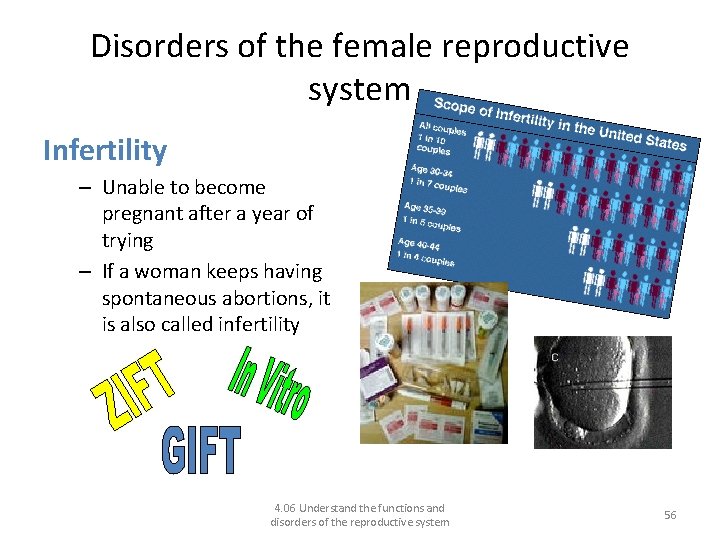
Disorders of the female reproductive system Infertility – Unable to become pregnant after a year of trying – If a woman keeps having spontaneous abortions, it is also called infertility 4. 06 Understand the functions and disorders of the reproductive system 56
Disorders of the male reproductive system Infertility • Failure for pregnancy to occur after one year of trying to conceive • Discuss the causes of infertility in the male. • What are some treatment options? 4. 06 Understand the functions and disorders of the reproductive system X 57
Reproductive process: Female contraception Abstinence Sterilization Hormonal Methods – Tubal ligation Barrier methods – – – Female condom Spermicides Diaphragm Cervical cap Contraceptive sponge Birth Control Pills Depo-Provera Lunelle Nuva. Ring/Vaginal Ring Ortho Evra Patch/Birth Control Patch – Intrauterine Device (IUD) – – – 4. 06 Understand the functions and disorders of the reproductive system 58
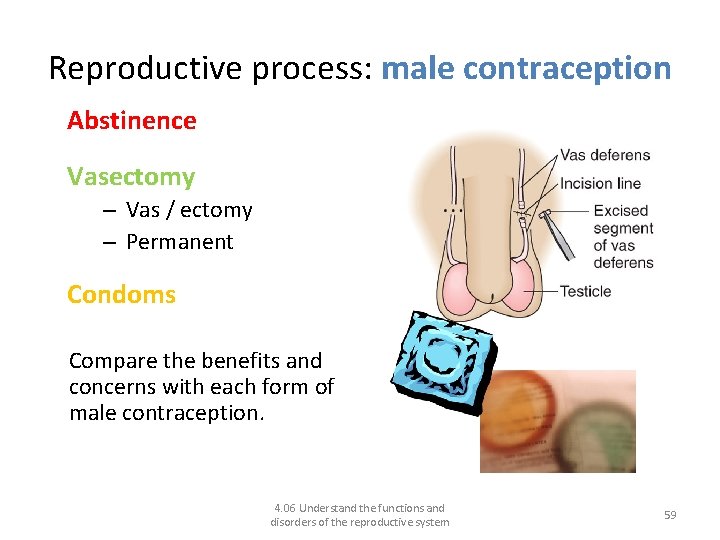
Reproductive process: male contraception Abstinence Vasectomy – Vas / ectomy – Permanent Condoms Compare the benefits and concerns with each form of male contraception. 4. 06 Understand the functions and disorders of the reproductive system 59
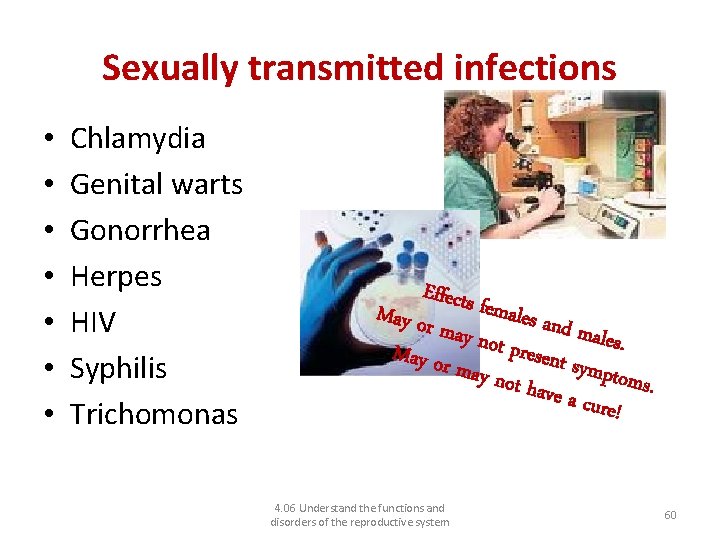
Sexually transmitted infections • • Chlamydia Genital warts Gonorrhea Herpes HIV Syphilis Trichomonas Effects females May or and ma may no l t p resent s es. May or ymptom may no s. t have a cure! 4. 06 Understand the functions and disorders of the reproductive system 60
Essential questions • What are the functions of the female reproductive system? • What are some common disorders of the female reproductive system? • What is the function of the male reproductive system? • What are some common disorders of the male reproductive system? • How do the male and female reproductive system work together? • How do you relate the body’s hormone control to the male and female reproductive systems? 4. 06 Understand the functions and disorders of the reproductive system 61