3 1 3 3 The Principles of Training



- Slides: 54
3. 1. 3. 3 – The Principles of Training and application to Personal Exercise Programmes Learning objectives To understand the basic principles of training that a performer should use to increase fitness. To be able to explain the factors that impact on the most appropriate principle of training. To understand the different methods of training used in sport. To be able to explain the most suitable method of training for specific activities. To be able to interpret data relating to fitness tests and analyse against normative values.
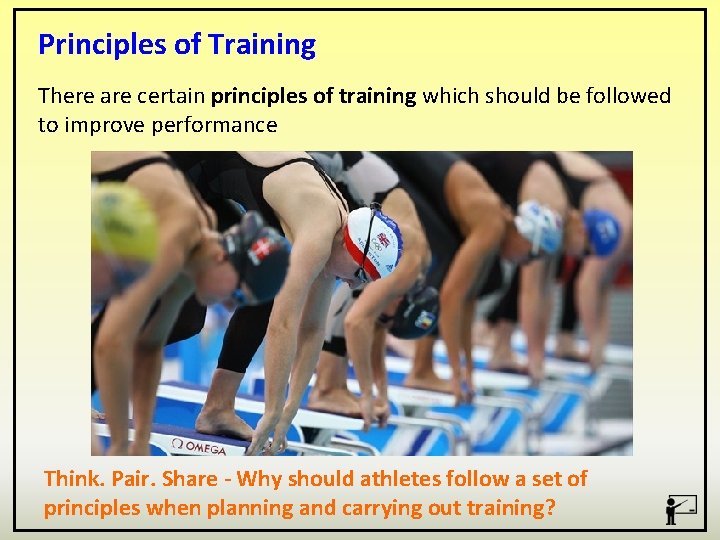
Principles of Training There are certain principles of training which should be followed to improve performance Think. Pair. Share - Why should athletes follow a set of principles when planning and carrying out training?
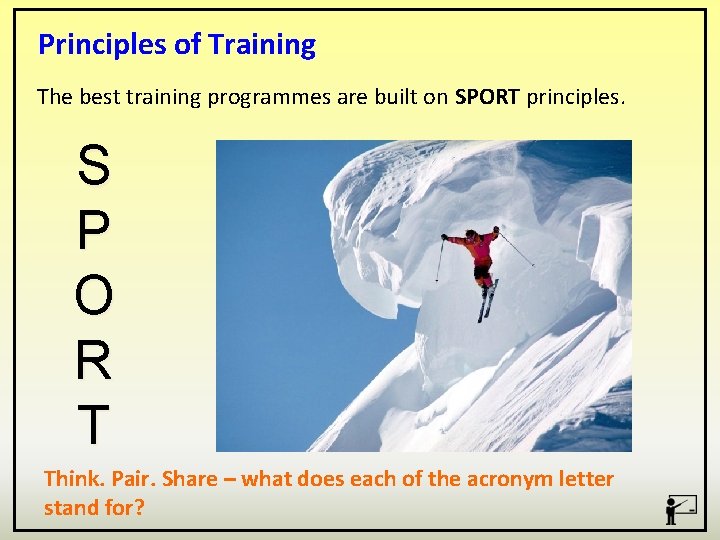
Principles of Training The best training programmes are built on SPORT principles. S P O R T Think. Pair. Share – what does each of the acronym letter stand for?
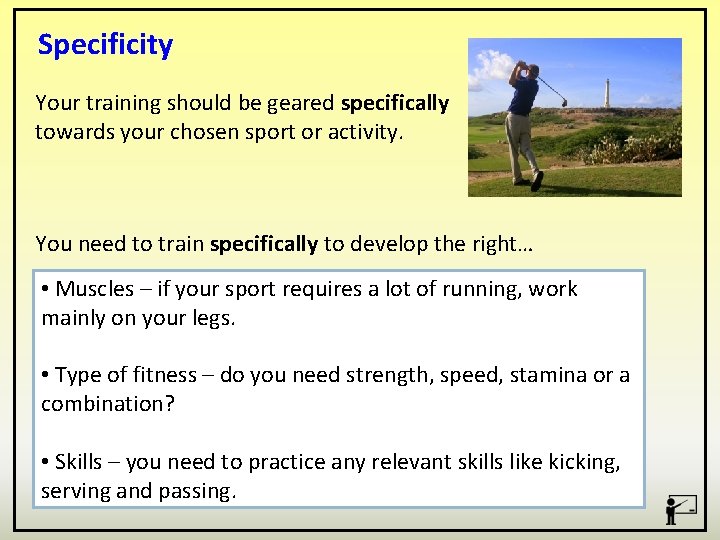
Specificity Your training should be geared specifically towards your chosen sport or activity. You need to train specifically to develop the right… • Muscles – if your sport requires a lot of running, work mainly on your legs. • Type of fitness – do you need strength, speed, stamina or a combination? • Skills – you need to practice any relevant skills like kicking, serving and passing.
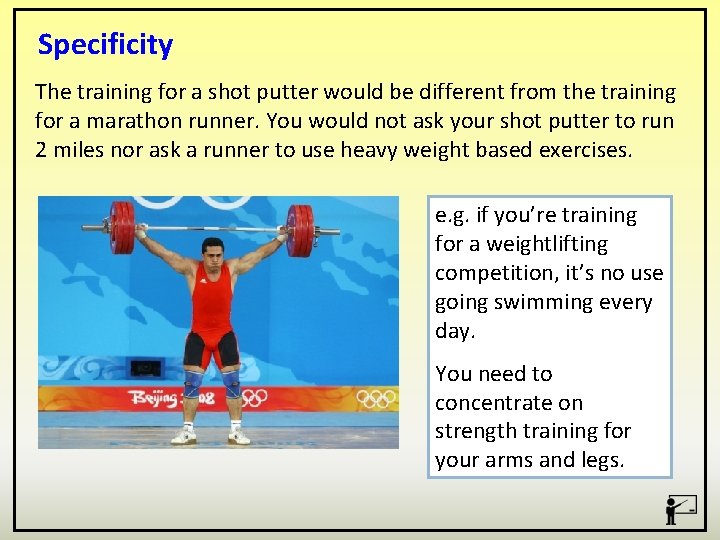
Specificity The training for a shot putter would be different from the training for a marathon runner. You would not ask your shot putter to run 2 miles nor ask a runner to use heavy weight based exercises. e. g. if you’re training for a weightlifting competition, it’s no use going swimming every day. You need to concentrate on strength training for your arms and legs.
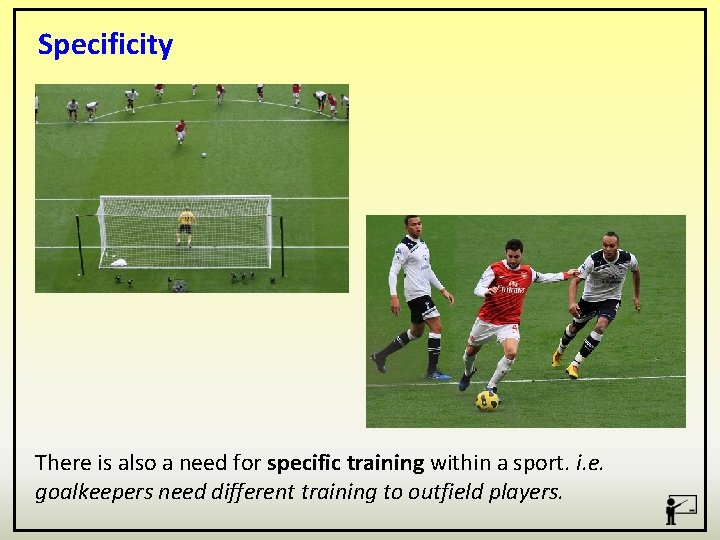
Specificity There is also a need for specific training within a sport. i. e. goalkeepers need different training to outfield players.
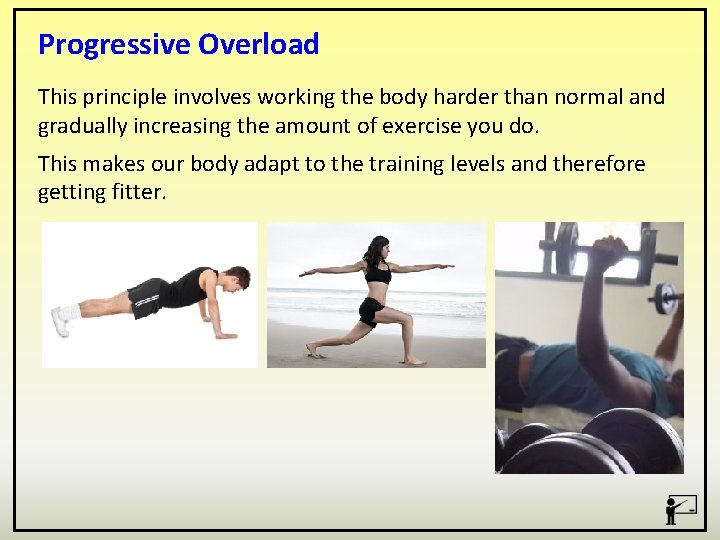
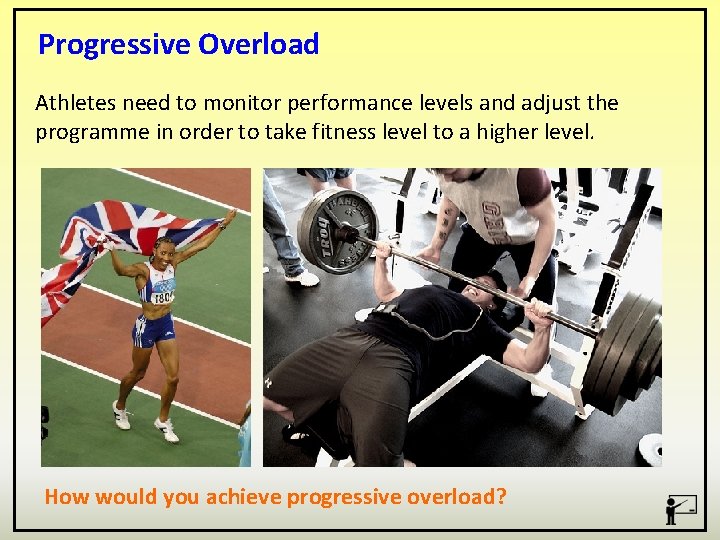
Progressive Overload This principle involves working the body harder than normal and gradually increasing the amount of exercise you do. This makes our body adapt to the training levels and therefore getting fitter.
Progressive Overload Athletes need to monitor performance levels and adjust the programme in order to take fitness level to a higher level. How would you achieve progressive overload?
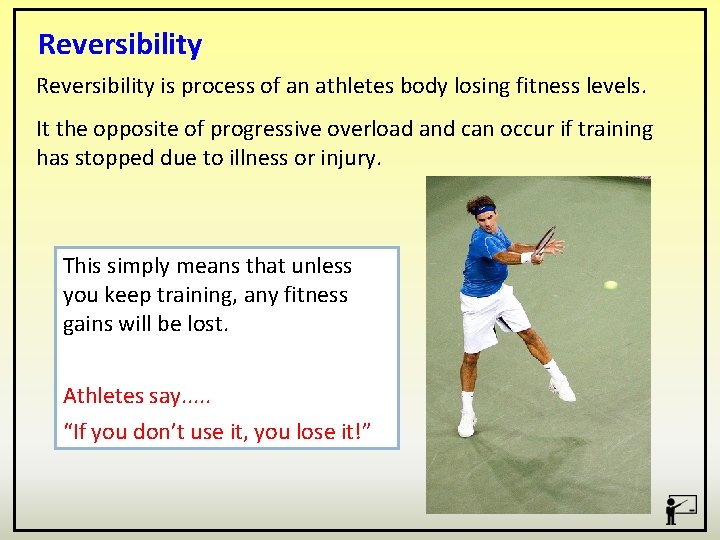
Reversibility is process of an athletes body losing fitness levels. It the opposite of progressive overload and can occur if training has stopped due to illness or injury. This simply means that unless you keep training, any fitness gains will be lost. Athletes say. . . “If you don’t use it, you lose it!”
Reversibility This means that instead of progressing or remaining at the same level, the athlete loses fitness. It only takes 3 or 4 weeks to get out of condition. This has implications does for an elite performer who’s season has just finished and may become out of shape. Reversibility may also take place after an injury or illness as normal training can become difficult.
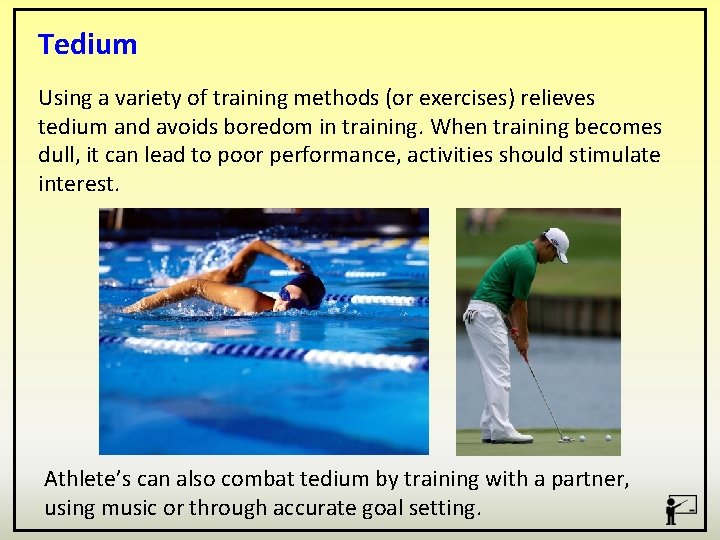
Tedium Using a variety of training methods (or exercises) relieves tedium and avoids boredom in training. When training becomes dull, it can lead to poor performance, activities should stimulate interest. Athlete’s can also combat tedium by training with a partner, using music or through accurate goal setting.
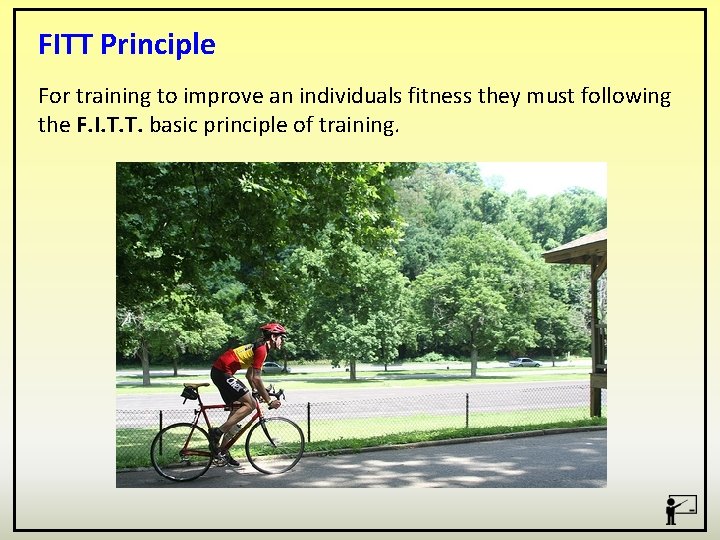
FITT Principle For training to improve an individuals fitness they must following the F. I. T. T. basic principle of training.
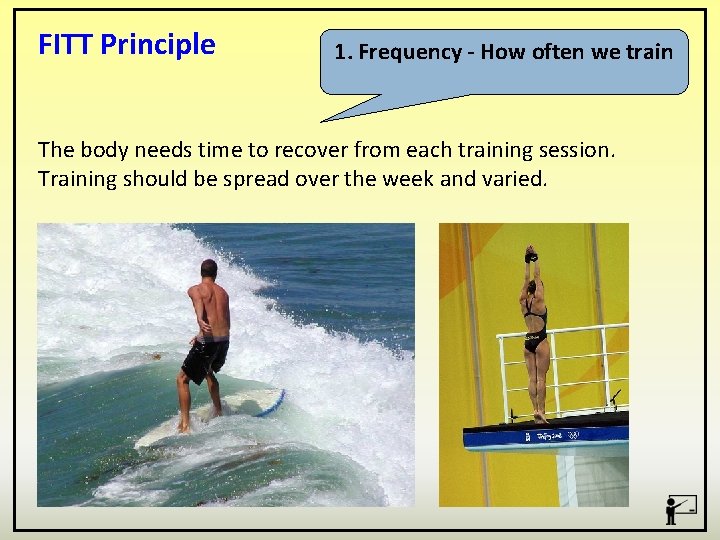
FITT Principle 1. Frequency - How often we train The body needs time to recover from each training session. Training should be spread over the week and varied.
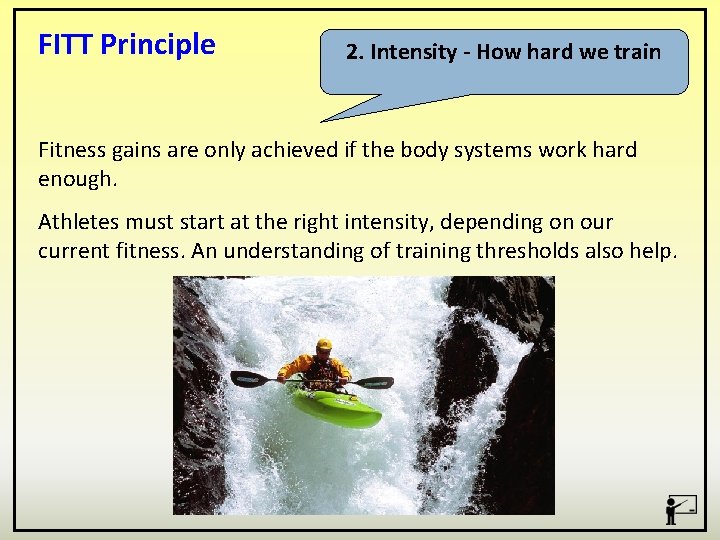
FITT Principle 2. Intensity - How hard we train Fitness gains are only achieved if the body systems work hard enough. Athletes must start at the right intensity, depending on our current fitness. An understanding of training thresholds also help.
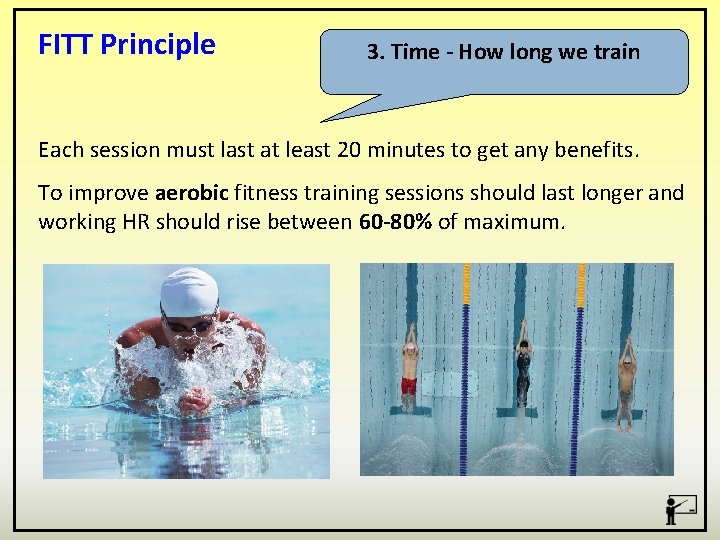
FITT Principle 3. Time - How long we train Each session must last at least 20 minutes to get any benefits. To improve aerobic fitness training sessions should last longer and working HR should rise between 60 -80% of maximum.
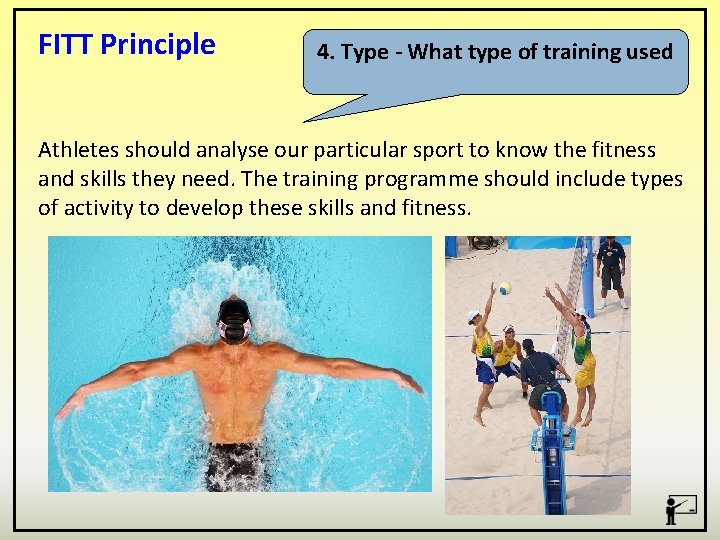
FITT Principle 4. Type - What type of training used Athletes should analyse our particular sport to know the fitness and skills they need. The training programme should include types of activity to develop these skills and fitness.
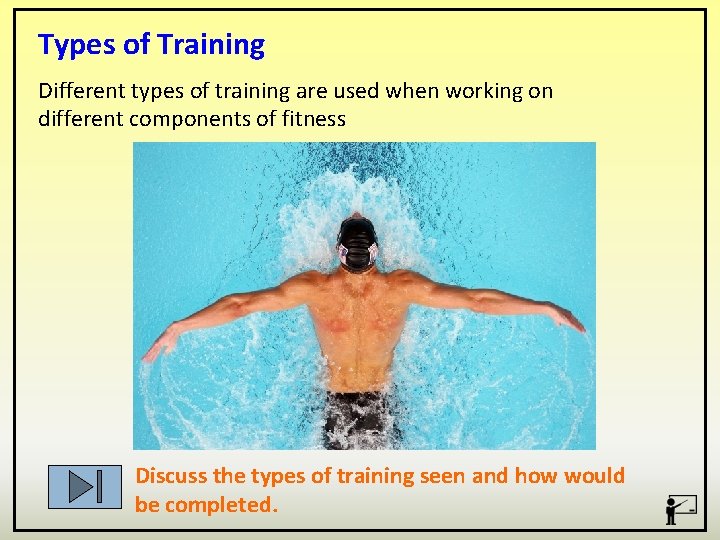
Types of Training Different types of training are used when working on different components of fitness Discuss the types of training seen and how would be completed.
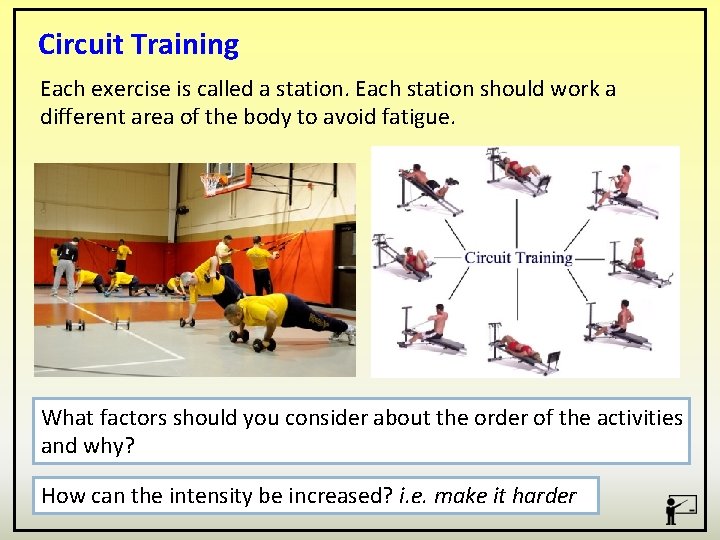
Circuit Training Circuit training is a series of exercises completed one after another. It is a very good way of developing strength, muscular endurance and power. .
Circuit Training Each exercise is called a station. Each station should work a different area of the body to avoid fatigue. What factors should you consider about the order of the activities and why? How can the intensity be increased? i. e. make it harder
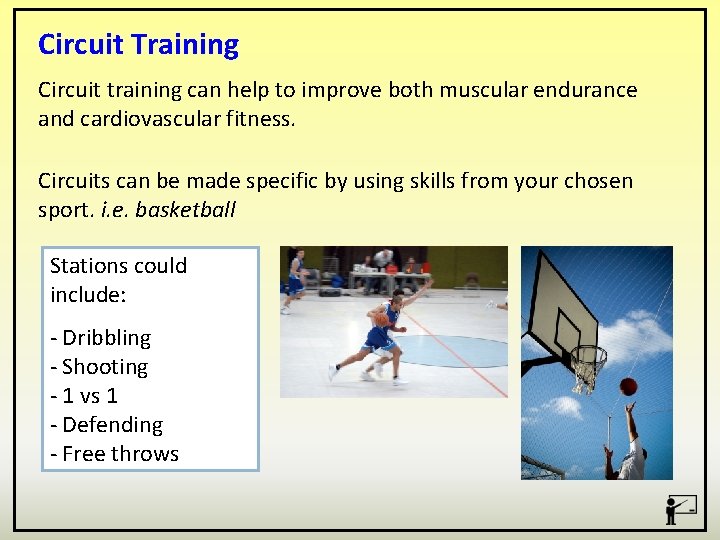
Circuit Training Circuit training can help to improve both muscular endurance and cardiovascular fitness. Circuits can be made specific by using skills from your chosen sport. i. e. basketball Stations could include: - Dribbling - Shooting - 1 vs 1 - Defending - Free throws
Circuit Training Advantages and disadvantage of this method of training: Advantages Not expensive as requires little or no equipment Quick and easy to set up Can be adjusted to be made specific for certain sports. i. e. netball specific circuit Disadvantages Requires the athlete to have the motivation and drive to complete the set amount of repetitions and sets.
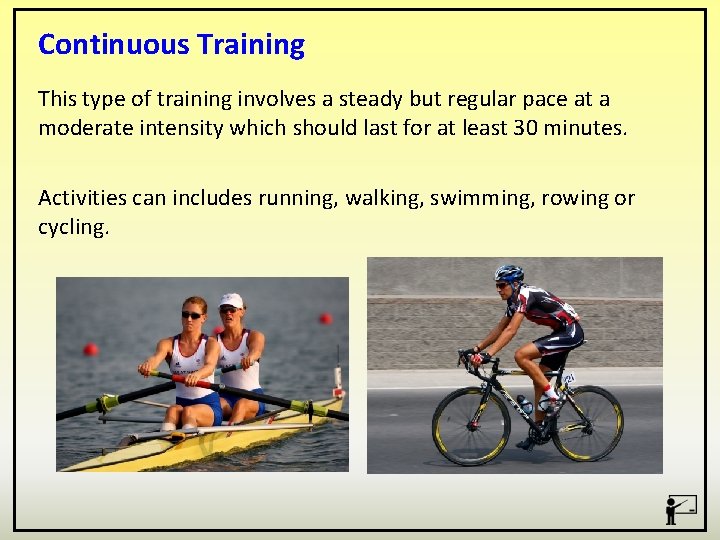
Continuous Training This type of training involves a steady but regular pace at a moderate intensity which should last for at least 30 minutes. Activities can includes running, walking, swimming, rowing or cycling.
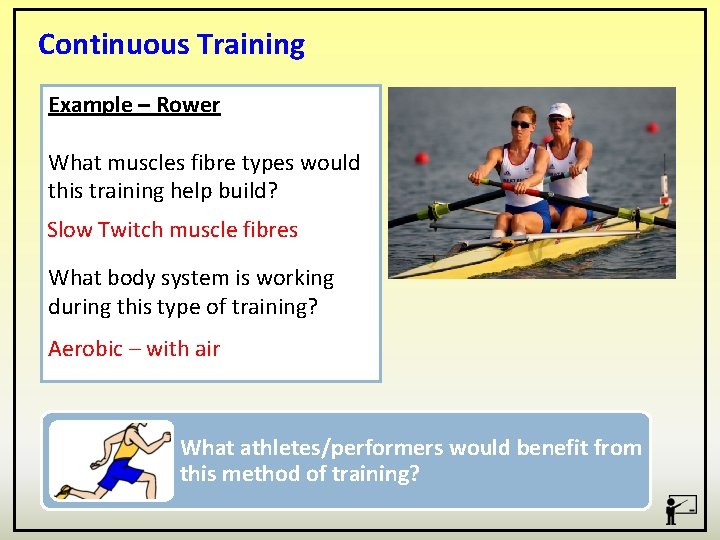
Continuous Training Example – Rower What muscles fibre types would this training help build? Slow Twitch muscle fibres What body system is working during this type of training? Aerobic – with air What athletes/performers would benefit from this method of training?
Continuous Training Advantages and disadvantage of this method of training: Advantages Disadvantages • Highly effective for long distance athletes as it best matches the requirement of the event. • Needs only a small amount of equipment. • Good for aerobic fitness • Good for losing weight • Can be extremely boring as it involves repetition and over a prolonged period of time. • Doesn't improve anaerobic fitness so isn't as good for team games like football or hockey which involve short bursts of speed
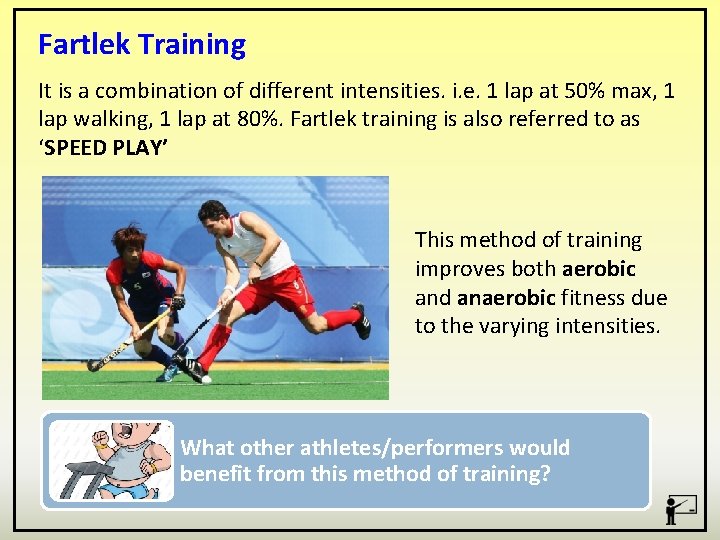
Fartlek Training It is a combination of different intensities. i. e. 1 lap at 50% max, 1 lap walking, 1 lap at 80%. Fartlek training is also referred to as ‘SPEED PLAY’ This method of training improves both aerobic and anaerobic fitness due to the varying intensities. What other athletes/performers would benefit from this method of training?
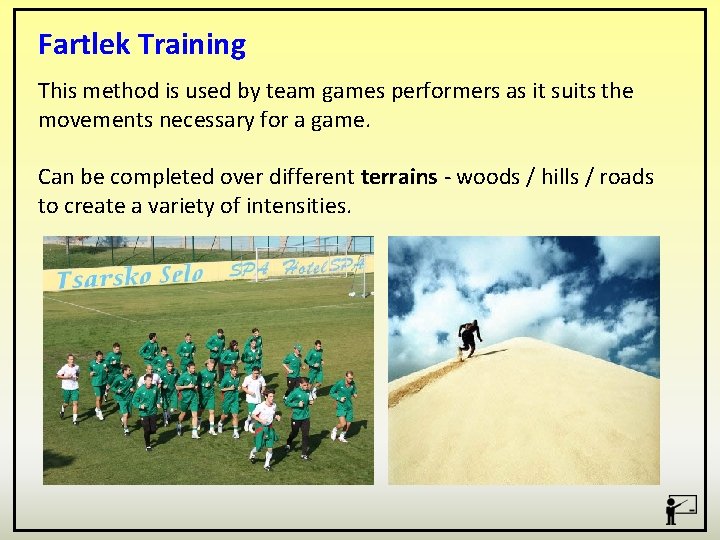
Fartlek Training This method is used by team games performers as it suits the movements necessary for a game. Can be completed over different terrains - woods / hills / roads to create a variety of intensities.
Fartlek Training Advantages and disadvantage of this method of training: Advantages Disadvantages • Good for sports which require changes in speed. • Easily adapted to suit the individuals level of fitness and sport. • Too easy to skip the hard bits. • Can be difficult to see how hard someone is trying!
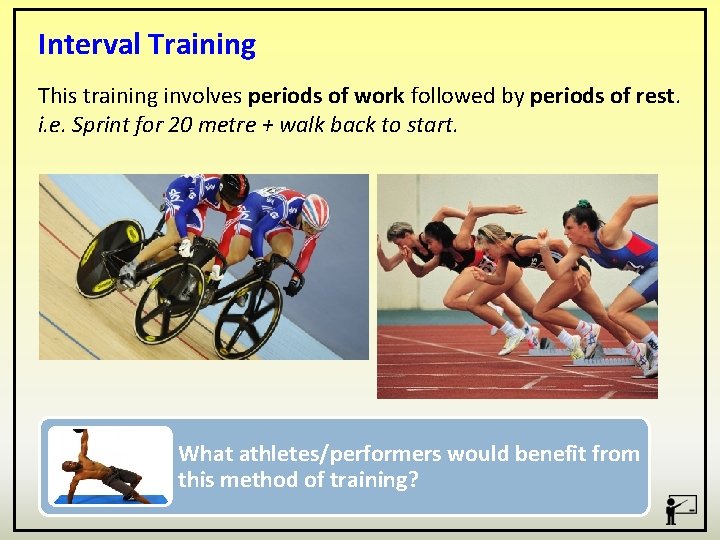
Interval Training This training involves periods of work followed by periods of rest. i. e. Sprint for 20 metre + walk back to start. What athletes/performers would benefit from this method of training?
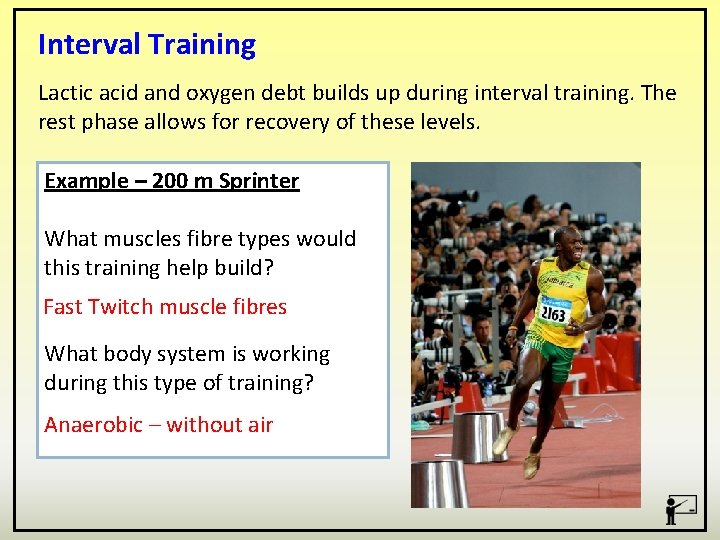
Interval Training Lactic acid and oxygen debt builds up during interval training. The rest phase allows for recovery of these levels. Example – 200 m Sprinter What muscles fibre types would this training help build? Fast Twitch muscle fibres What body system is working during this type of training? Anaerobic – without air
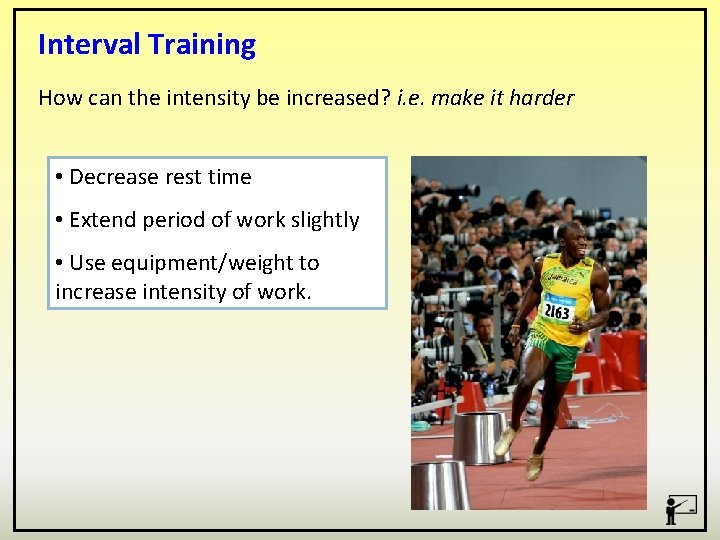
Interval Training How can the intensity be increased? i. e. make it harder • Decrease rest time • Extend period of work slightly • Use equipment/weight to increase intensity of work.
Interval Training Advantages and disadvantage of this method of training: Advantages • Quick and easy to set up. • Can mix aerobic and anaerobic exercise which replicates team games. Disadvantages • It can be hard to keep going when you start to fatigue. • Can become boring.
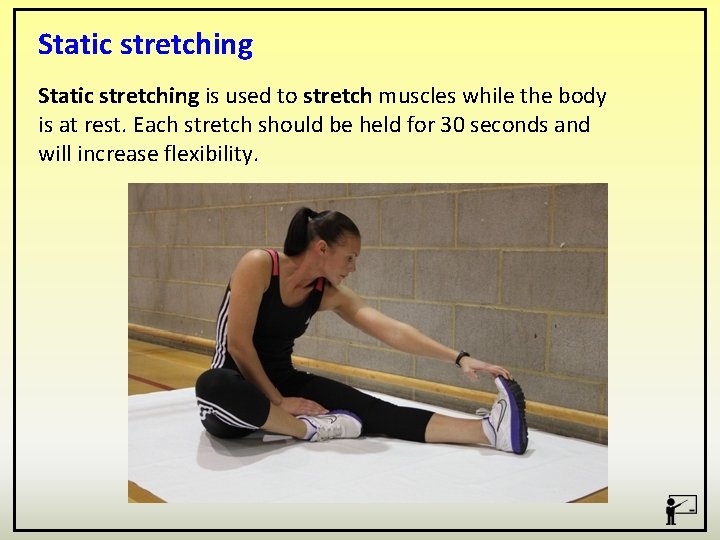
Static stretching is used to stretch muscles while the body is at rest. Each stretch should be held for 30 seconds and will increase flexibility.
Static stretching Advantages and disadvantage of this method of training: Advantages Disadvantages • A slow, easy pace conducive to relaxation and steadiness. • Static stretching is probably the safest form of stretch. • Can be done by anyone with no training required. • Can take a while to stretch the whole body. • Can only stretch a muscle within the body’s natural range of motion
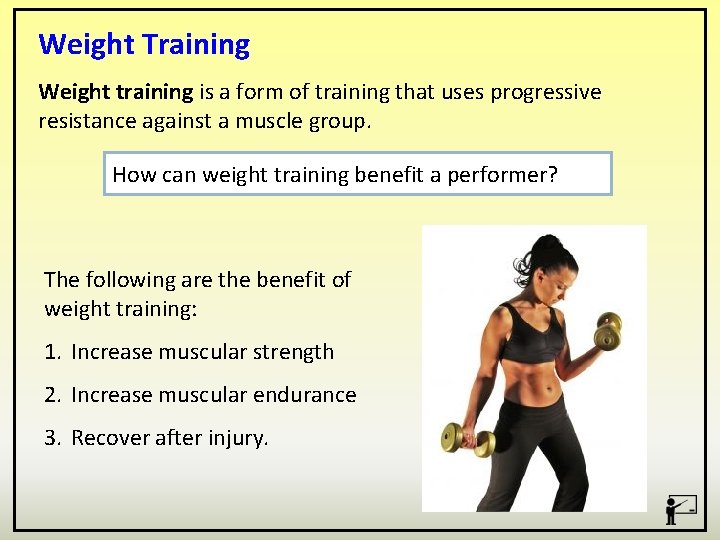
Weight Training Weight training is a form of training that uses progressive resistance against a muscle group. How can weight training benefit a performer? The following are the benefit of weight training: 1. Increase muscular strength 2. Increase muscular endurance 3. Recover after injury.
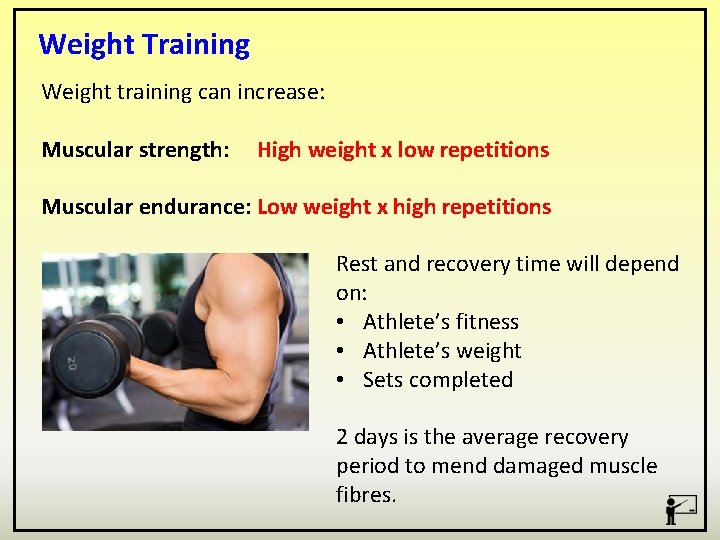
Weight Training Weight training can increase: Muscular strength: High weight x low repetitions Muscular endurance: Low weight x high repetitions Rest and recovery time will depend on: • Athlete’s fitness • Athlete’s weight • Sets completed 2 days is the average recovery period to mend damaged muscle fibres.
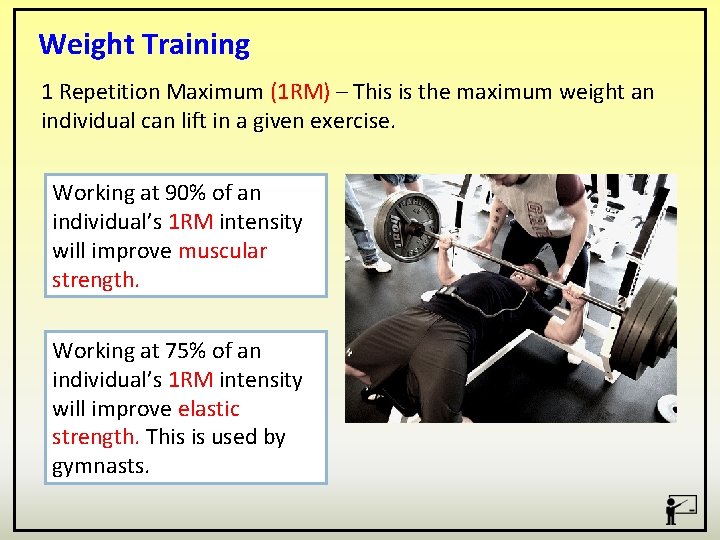
Weight Training 1 Repetition Maximum (1 RM) – This is the maximum weight an individual can lift in a given exercise. Working at 90% of an individual’s 1 RM intensity will improve muscular strength. Working at 75% of an individual’s 1 RM intensity will improve elastic strength. This is used by gymnasts.
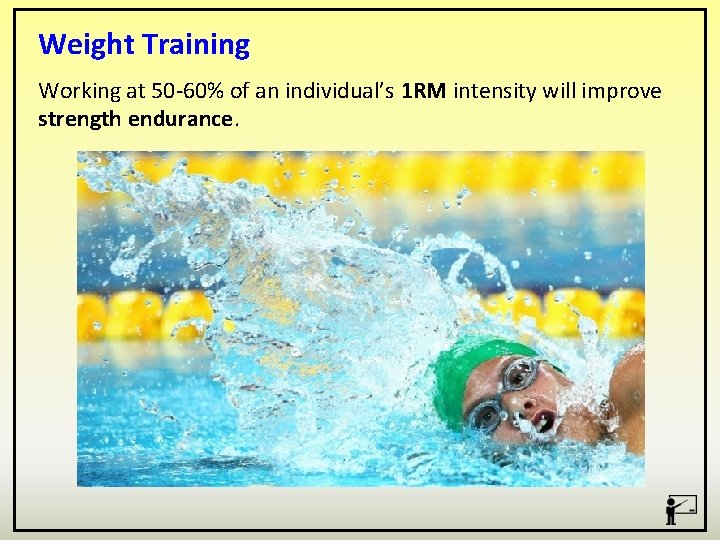
Weight Training Working at 50 -60% of an individual’s 1 RM intensity will improve strength endurance.
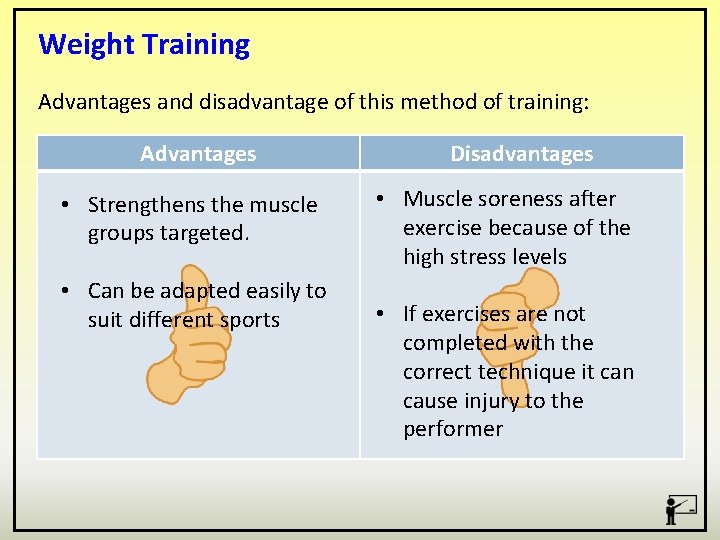
Weight Training Advantages and disadvantage of this method of training: Advantages • Strengthens the muscle groups targeted. • Can be adapted easily to suit different sports Disadvantages • Muscle soreness after exercise because of the high stress levels • If exercises are not completed with the correct technique it can cause injury to the performer
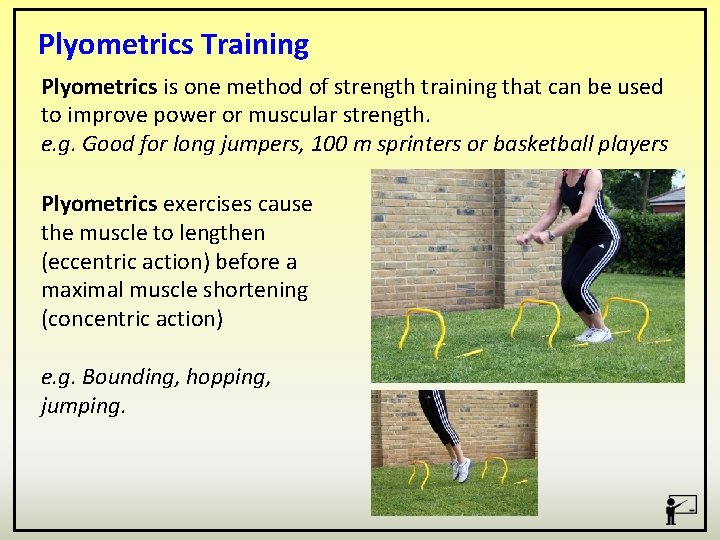
Plyometrics Training Plyometrics is one method of strength training that can be used to improve power or muscular strength. e. g. Good for long jumpers, 100 m sprinters or basketball players Plyometrics exercises cause the muscle to lengthen (eccentric action) before a maximal muscle shortening (concentric action) e. g. Bounding, hopping, jumping.
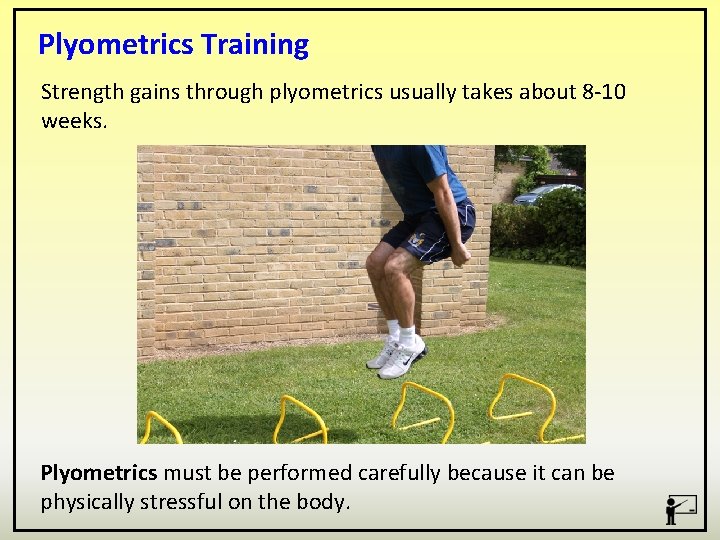
Plyometrics Training Strength gains through plyometrics usually takes about 8 -10 weeks. Plyometrics must be performed carefully because it can be physically stressful on the body.
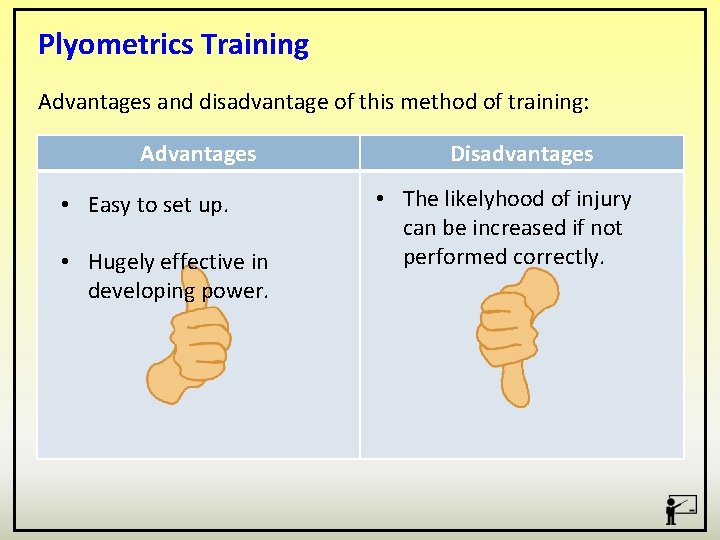
Plyometrics Training Advantages and disadvantage of this method of training: Advantages • Easy to set up. • Hugely effective in developing power. Disadvantages • The likelyhood of injury can be increased if not performed correctly.
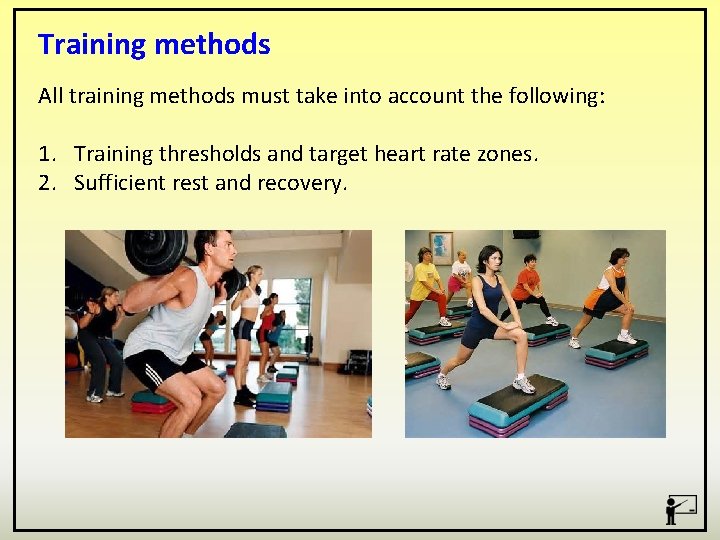
Training methods All training methods must take into account the following: 1. Training thresholds and target heart rate zones. 2. Sufficient rest and recovery.
Apply it! What has stuck with you? Describe the FITT principle and how it should be applied to a personal exercise programme. What is progressive overload? Principles of training Explain the necessity of specificity to an athlete. Describe the meaning of tedium.
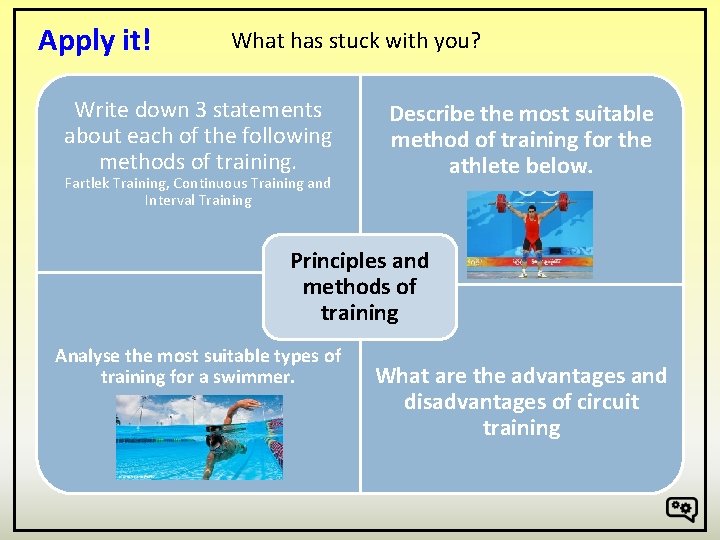
Apply it! What has stuck with you? Write down 3 statements about each of the following methods of training. Fartlek Training, Continuous Training and Interval Training Describe the most suitable method of training for the athlete below. Principles and methods of training Analyse the most suitable types of training for a swimmer. What are the advantages and disadvantages of circuit training
Practice it! Exam questions 1. Billy’s resting heart rate has dropped over the last 6 weeks of his training program. Which one of the following principles of training has the student applied in their PEP to affect resting heart rates in this way? (1) A B C D Specificity Progressive overload Reversibility Rest and recovery
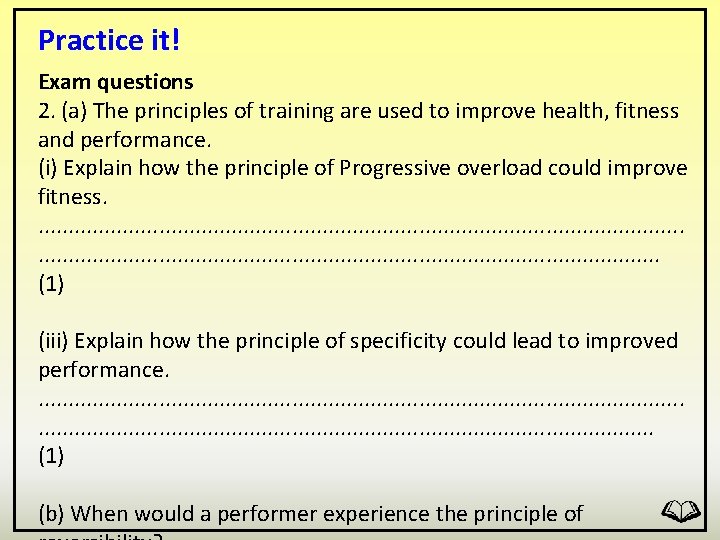
Practice it! Exam questions 2. (a) The principles of training are used to improve health, fitness and performance. (i) Explain how the principle of Progressive overload could improve fitness. . . . . . . . . . . . . . (1) (iii) Explain how the principle of specificity could lead to improved performance. . . . . . . . . . . . . (1) (b) When would a performer experience the principle of
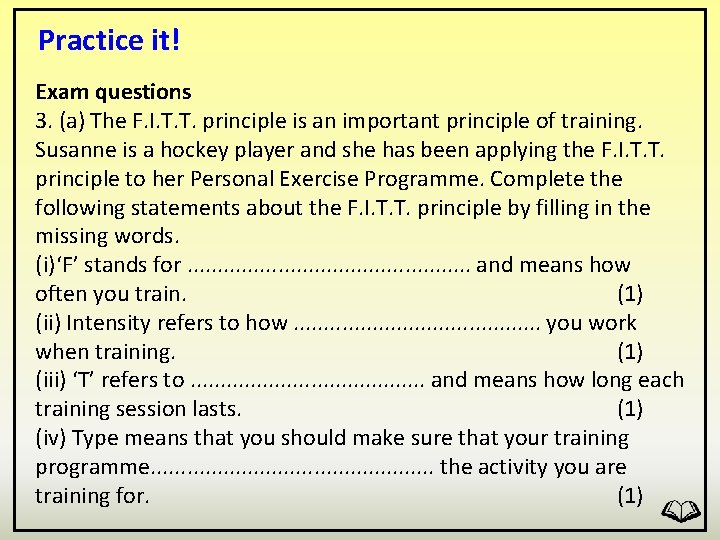
Practice it! Exam questions 3. (a) The F. I. T. T. principle is an important principle of training. Susanne is a hockey player and she has been applying the F. I. T. T. principle to her Personal Exercise Programme. Complete the following statements about the F. I. T. T. principle by filling in the missing words. (i)‘F’ stands for. . . and means how often you train. (1) (ii) Intensity refers to how. . . . . you work when training. (1) (iii) ‘T’ refers to. . . . . and means how long each training session lasts. (1) (iv) Type means that you should make sure that your training programme. . . the activity you are training for. (1)
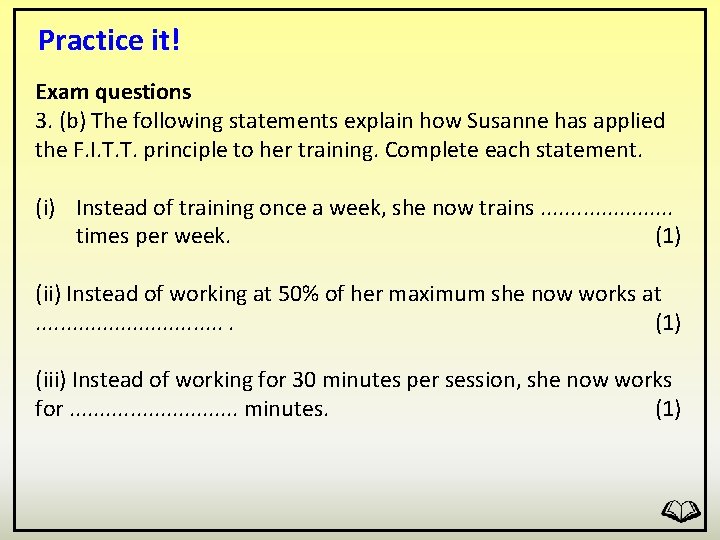
Practice it! Exam questions 3. (b) The following statements explain how Susanne has applied the F. I. T. T. principle to her training. Complete each statement. (i) Instead of training once a week, she now trains. . . . . times per week. (1) (ii) Instead of working at 50% of her maximum she now works at. . . . (1) (iii) Instead of working for 30 minutes per session, she now works for. . . . minutes. (1)
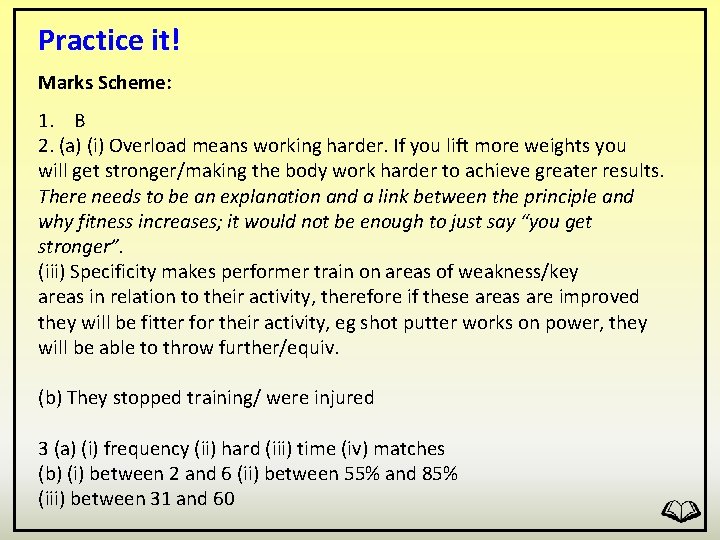
Practice it! Marks Scheme: 1. B 2. (a) (i) Overload means working harder. If you lift more weights you will get stronger/making the body work harder to achieve greater results. There needs to be an explanation and a link between the principle and why fitness increases; it would not be enough to just say “you get stronger”. (iii) Specificity makes performer train on areas of weakness/key areas in relation to their activity, therefore if these areas are improved they will be fitter for their activity, eg shot putter works on power, they will be able to throw further/equiv. (b) They stopped training/ were injured 3 (a) (i) frequency (ii) hard (iii) time (iv) matches (b) (i) between 2 and 6 (ii) between 55% and 85% (iii) between 31 and 60
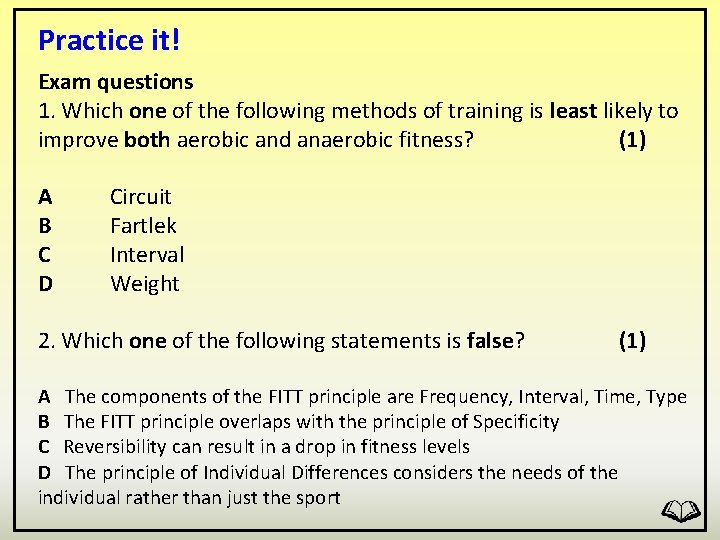
Practice it! Exam questions 1. Which one of the following methods of training is least likely to improve both aerobic and anaerobic fitness? (1) A B C D Circuit Fartlek Interval Weight 2. Which one of the following statements is false? (1) A The components of the FITT principle are Frequency, Interval, Time, Type B The FITT principle overlaps with the principle of Specificity C Reversibility can result in a drop in fitness levels D The principle of Individual Differences considers the needs of the individual rather than just the sport
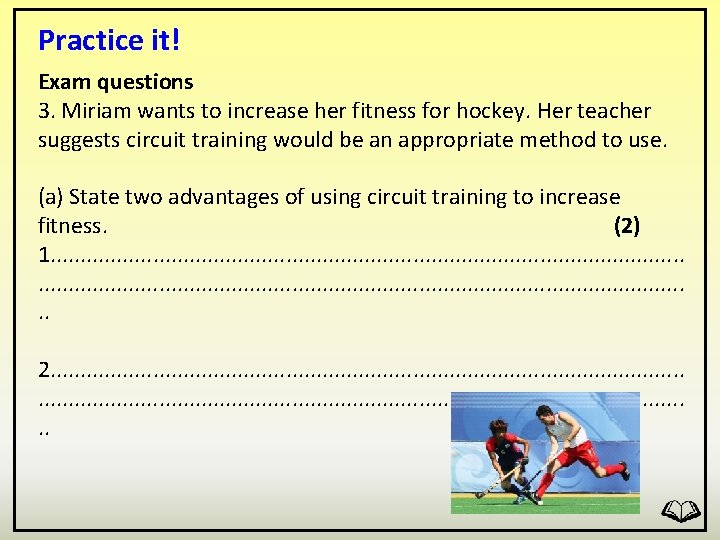
Practice it! Exam questions 3. Miriam wants to increase her fitness for hockey. Her teacher suggests circuit training would be an appropriate method to use. (a) State two advantages of using circuit training to increase fitness. (2) 1. . . . . . . . . . . . . . 2. . . . . . . . . . . . . .
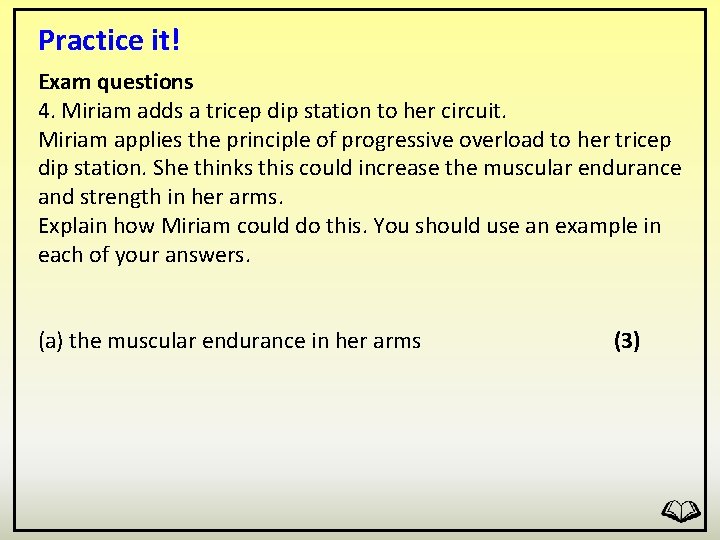
Practice it! Exam questions 4. Miriam adds a tricep dip station to her circuit. Miriam applies the principle of progressive overload to her tricep dip station. She thinks this could increase the muscular endurance and strength in her arms. Explain how Miriam could do this. You should use an example in each of your answers. (a) the muscular endurance in her arms (3)
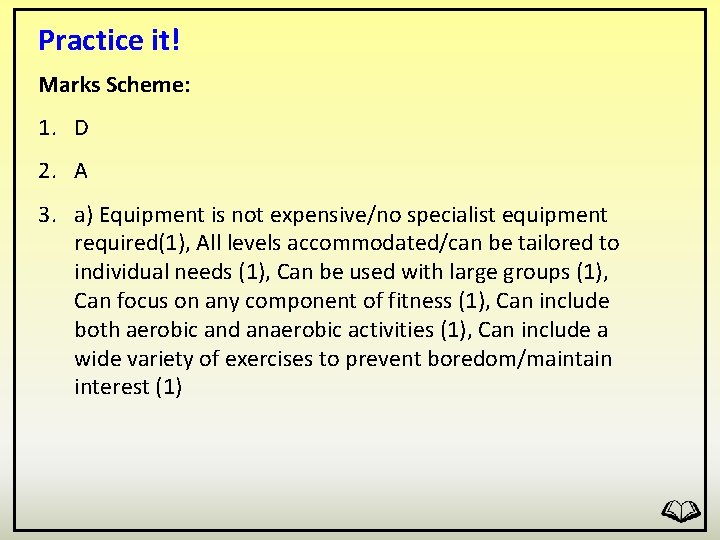
Practice it! Marks Scheme: 1. D 2. A 3. a) Equipment is not expensive/no specialist equipment required(1), All levels accommodated/can be tailored to individual needs (1), Can be used with large groups (1), Can focus on any component of fitness (1), Can include both aerobic and anaerobic activities (1), Can include a wide variety of exercises to prevent boredom/maintain interest (1)
Practice it! Marks Scheme: 4. (a) One mark for appropriate example of how to create progressive overload to increase muscular endurance and a maximum of two more marks for appropriate expansion (up to three marks). Any one from: Increase reps (1) from 12 to 15 (1) to gradually increase overload (1) OR Increase the length of time at the station (1) from 20 seconds to 25 seconds (1) so that the muscles are gradually being made to work for longer (1)