www qlectives eu The SocioEconomics of P 2






- Slides: 91
www. qlectives. eu The Socio-Economics of P 2 P Systems David Hales www. davidhales. com Delft University of Technology (Currently visiting University of Szeged, Hungary)
Big Picture • Call it – – – pervasive adaptive technology Peer-to-peer or person-to-person Mobile sensor networks Adhoc networks Self-organsing / Self-adaptive (SASO) systems Socially intelligent systems • That’s not important!
Big Picture • What is important? – Increasingly these technologies will structure our interactions (this is social engineering) – When we design them we make social and economic choices – We should be aware of these to inform “good design” – Should we design such systems for the common good?
What has sociology or economics got to do with peer-to-peer systems? • P 2 P systems are socio-economic systems – Peers cooperate collectively to achieve their goals – No peer in the system controls everything – Performance results from interactions – At the end-of-day users (people) are in control – Sociology and economics has studied such phenomena - we should steal what we can! 5
OK but what use is this to me? • Knowing some of the economic background should help you to understand: – the basic social/economic theory behind P 2 P – how this informs designs – how such designs might be improved – how to assess new developments and designs • It is also a fascinating area in itself: – If you are interested you can look-up the terms given in red italics on Wikipedia for good introductions 6
Individualism v. Collectivism • In socio-economic systems individual interests may conflict with collective interests: – e. g. over exploitation of a common resource (a river, a field, the atmosphere etc. ) – e. g. banks - lending (to those who they know can not repay) to gain a commission by selling on the debt to other banks – e. g. P 2 P file sharing system - downloading more than uploading
Individualism v. Collectivism • Consider a P 2 P file sharing system: – It is in the collective interest for all to upload to others so everyone gets the file quickly – But it is in the individual interest to save bandwidth by only downloading and hence freeriding on others – Free-riding (or free-loading) is a perennial problem in P 2 P file-sharing systems – Any efficient system needs to tackle it in some way
The tragedy of the commons • These kinds of situations have been termed “commons dilemmas” or “common pool resource dilemmas” • Called “dilemmas” because we would all be better off if we “did the right thing” but there is an individual incentive to do the wrong thing • G. Hardin (1968) summarized the issue in his famous paper: “The Tragedy of the Commons” • These kinds of situations occur in P 2 P file-sharing systems like Bit. Torrent
Talks • How Bit. Torrent is informed by a kind of economic strategy • Bit. Torrent communities and credit dynamics • What is socially intelligent ICT (designing for the common good) • How to replace the banks… : -)
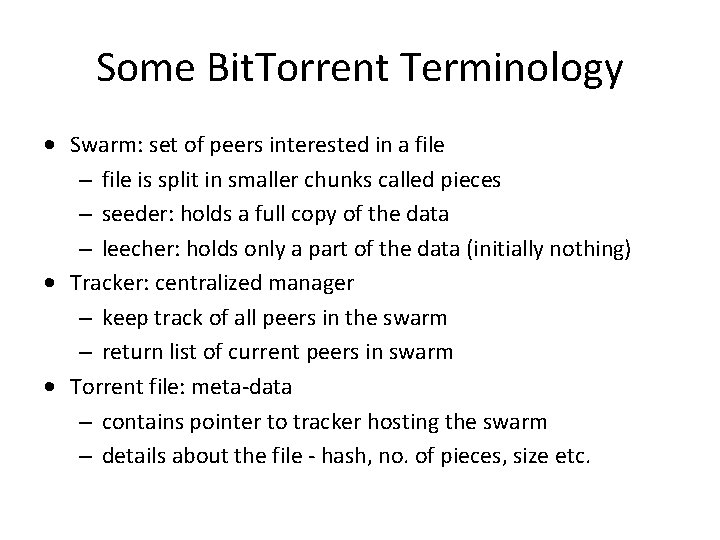
Some Bit. Torrent Terminology • Swarm: set of peers interested in a file – file is split in smaller chunks called pieces – seeder: holds a full copy of the data – leecher: holds only a part of the data (initially nothing) • Tracker: centralized manager – keep track of all peers in the swarm – return list of current peers in swarm • Torrent file: meta-data – contains pointer to tracker hosting the swarm – details about the file - hash, no. of pieces, size etc.
Bit. Torrent Protocol • Get a list of other peers in the swarm from the tracker • Ask peers their list of pieces and tell them what is yours • Exchange pieces with appropriate peers
How to avoid the commons tragedy? • Central enforcement of correct behaviour – require centralised agencies and policing – ability to identify and track individuals centrally – not suitable for pure P 2 P (but used with private trackers) • Decentralised methods – self-policing producing incentives for cooperation – do not require centralised coordination – more suitable for pure P 2 P – can apply ideas from “game theory”
What is game theory? • A way to mathematically analyse games assuming we know: – number of players – possible moves they can make (strategies) – outcome of game based on players moves (pay-off) – desirability of game outcomes for each player (utility)
What game are you playing? • Games can be categorised into two types: 1) Zero-sum games – when one player wins another loses – summing the final utilities of players = 0 – e. g. poker, chess, monopoly etc. 2) Non-zero-sum games – utilities do not always sum to zero – both players may lose or both may win – considered to capture social / economic realities – e. g. tragedy of the commons examples
Capturing a commons tragedy with a simple game • Consider a game composed of two players: – each player: • • has choice of one move (C or D) makes a single move then the game ends does not know how the other will move gets a payoff (or utility) based on how they moved and how the other player moved – for certain payoff values this game can, minimally, capture a form of commons tragedy (or dilemma) – a classic such game is called the Prisoner’s Dilemma
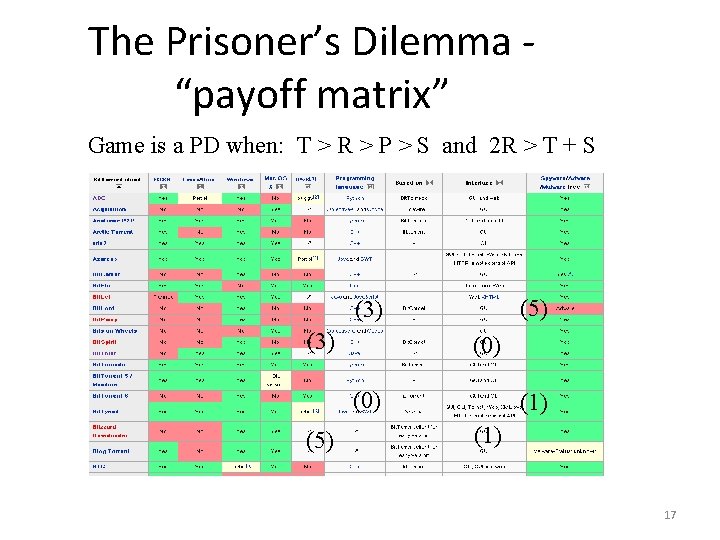
The Prisoner’s Dilemma “payoff matrix” Game is a PD when: T > R > P > S and 2 R > T + S (5) (3) (0) (5) (1) 17
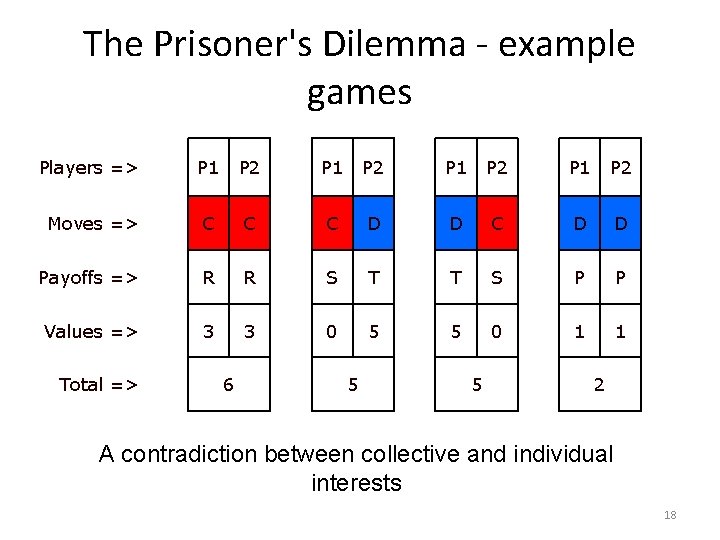
The Prisoner's Dilemma - example games Players => P 1 P 2 Moves => C C C D D Payoffs => R R S T T S P P Values => 3 3 0 5 5 0 1 1 Total => 6 5 5 2 A contradiction between collective and individual interests 18
Game theory says defect! • Game theory assumes players are: – rational - attempt to maximise their utility – selfish - don’t care about the other guy – knowledgeable - have complete information – clever - have unlimited computational time • Given these assumptions it can be proved: – agents will select equilibria where no player will improve by changing strategy unilaterally – many games have such equilibria - by the famous John Nash (so-called Nash Equilibrium - NE) – the NE for the PD is DD (all defect)
Iterated Prisoner’s Dilemma • Previous example “one-shot” PD but: – real world interactions often repeated – might meet the guy you just ripped-off in the future – allows for more complex sequence of strategies based on past interactions with others – can punish someone tomorrow for defecting against you today - “the shadow of the future” • Iterated PD (IPD) captures this and, as we will see, maps well onto P 2 P file-sharing protocols like Bit. Torrent
What is the rational thing to do in the IPD? • Traditional game theory has trouble here: – cooperative equilibria exist in infinitely repeated games but not in finite games of known length – many equilibria exist and it is not clear which one would be chosen by rational agents – In all cases defection on every round is still a equilibrium even when cooperative equilibria exist • For these reasons Robert Axelrod (political scientist), in the late 70’s, decided to find out what kinds of strategies worked well in the IPD by using computer simulation
Axelrod’s Tournament - programs as strategies • Axelrod organised an open IPD tournament: – Academics were asked to submit programs (BASIC or FORTRAN) that would play the IPD against each other – Nobody knew competitors code – The only input would be the on-going past history of the game (a string of C’s and D’s) – The aim was to get the highest score (utility) based on round-robin playoffs between all pairs of programs – Axelrod’s aim was to see which programs did best against all the others and understand why – He wrote-up his results in the famous book “the evolution of cooperation”
Axlerod’s Tournament what happened? • Basic results were: – many strategies were submitted (complex and simple) – the one with the highest overall score turned out to be simple: tit-for-tat (TFT) or “look back” – starts playing C, then “looked back” at the last move made by opponent and copied that move – submitted by Psychologist Anatol Rapoport – didn’t “win” against each strategy but did better overall on average against all strategies – TFT mechanism an example of “reciprocal altruism” (Robert Trivers)
What has this got to do with Bit. Torrent? • In the Bit. Torrent protocol: – TFT-like method used for sharing files – nodes form groups interested in a particular file (swarms) and swap or “barter” pieces with each other – if a node does not upload data then this can be compared to playing defection – it is punished in the future by being “choked” - not getting upload from others – even if you hack your client to be selfish the chances are the standard TFT-like protocol will do better overall – Bram Cohen - original BT designer - inspired by Axelrod’s tournaments
The Global Ecology of Bit. Torrent Clients • Many bittorrent clients exist in “the wild” – Bittorrent 6 (from Bittorrent. com, formally utorrent) – Others: Azureus, ABC, Transmission, many others… – bad guy clients: Bit. Thief, Bit. Tyrant • Hence: – The current bittorrent ecosystem is a global on-going experiment, like Axelrod’s, but with huge user base and rich interactions (not just TFT) incredible strategy sophistication – This is unprecedented and will surely lead to new economic theory - in general!
Bit. Torrent Clients
Take home message • Previous work in social / economic science (Axelrod’s IPD) has provided a basis for protocol design in a P 2 P system • Deployed variants of the protocol are creating a massive global economic experiment • Measurements can be made and these could inform new theory and new protocols
References • Nash, John (1950) Equilibrium points in n-person games. Proceedings of the National Academy of Sciences 36(1): 48 -49. • John von Neumann and Oskar Morgenstern: Theory of Games and Economic Behavior, Princeton University Press (1944) • Robert Axelrod (1984) The Evolution of Cooperation, Basic Books • Nowak, M. A. and Sigmund, K. (1998) Evolution of indirect reciprocity by image scoring, Nature 393, 573. • Garrett Hardin (1968) The Tragedy of the Commons Science 162, 12431248. • Trivers, R. L. (1971). The evolution of reciprocal altruism. Quarterly Review of Biology. 46: 35 -57 • Maynard Smith, J. (1982) Evolution and the Theory of Games. Cambridge University Press
From swarms to collectives Where we start to see things that look a bit like “real economics” emerge
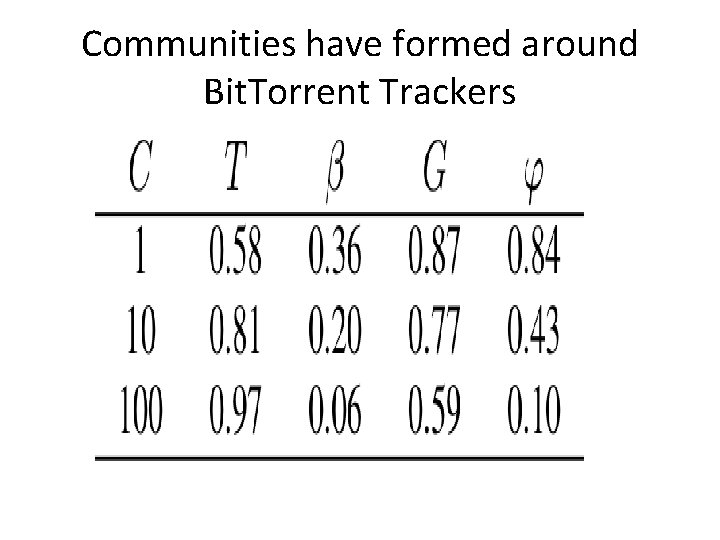
Communities have formed around Bit. Torrent Trackers
Public Trackers (e. g. Pirate. Bay) • Bit. Torrent uses Trackers to index swarms • Public trackers let anyone join or create a swarm • Sharing within a swarm is incentivised via a form of tit-for-tat (as we have seen) • However there is no incentive for: • Seeding (uploading after file is downloaded) • Capping (creating and injecting a new file) • Maintaining a Tracker in the first instance
Private Trackers (Many) • • Private Trackers have emerged more recently Only allow registered users to join swarms May track upload / download of each user Some keep centralised accounts for each user • When users download much more than upload they may be kicked out • Many different schemes: ratio, credits, points etc • Some rely on users to just be nice with various “gentleman's club” methods
A little detail on credit systems • We will give a little detail on credit systems in private BT communities • Give a flavour of how economic / collective issues are becoming significant • Present results from a simple (agent-based) model and some measurements of a real private tracker
Private Trackers - Credit • Consider a scheme based on credits – Uploading 1 MB earns one credit – Downloading 1 MB costs one credit – A user with no credits can’t download • Users must be given some initial credit • In fixed size pop. total credit remains constant • Similar to a fixed supply of money in an economy (loose analogy!)
Private Trackers - Credit • • How much credit should be put into the system? How would it effect the efficiency of the system? When do credit squeezes occur? How can they be avoided? We define a credit squeeze as a situation in which, due to lack of credit, the efficiency of the system is significantly reduced.
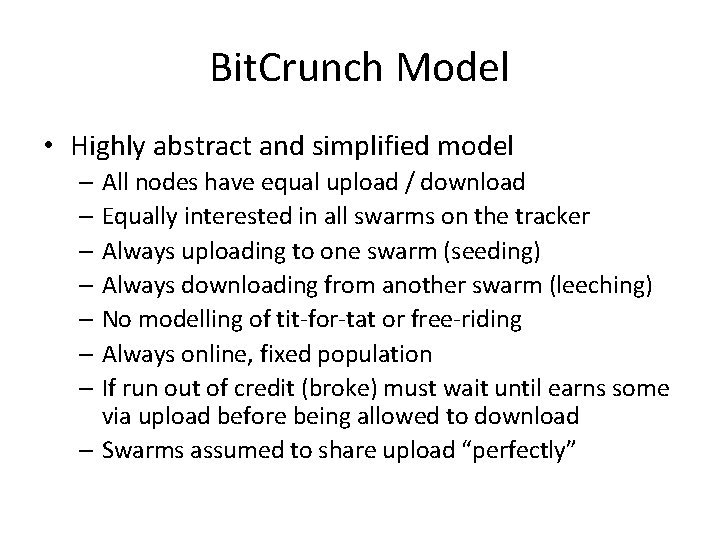
Bit. Crunch Model • Highly abstract and simplified model – All nodes have equal upload / download – Equally interested in all swarms on the tracker – Always uploading to one swarm (seeding) – Always downloading from another swarm (leeching) – No modelling of tit-for-tat or free-riding – Always online, fixed population – If run out of credit (broke) must wait until earns some via upload before being allowed to download – Swarms assumed to share upload “perfectly”
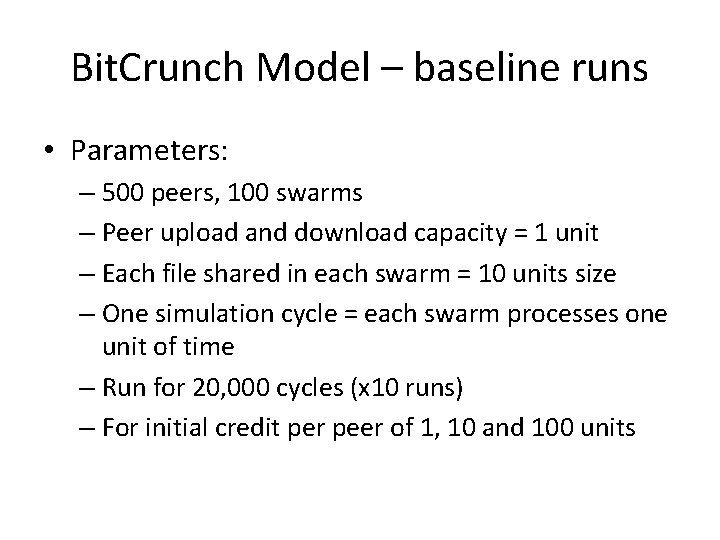
Bit. Crunch Model – baseline runs • Parameters: – 500 peers, 100 swarms – Peer upload and download capacity = 1 unit – Each file shared in each swarm = 10 units size – One simulation cycle = each swarm processes one unit of time – Run for 20, 000 cycles (x 10 runs) – For initial credit per peer of 1, 10 and 100 units
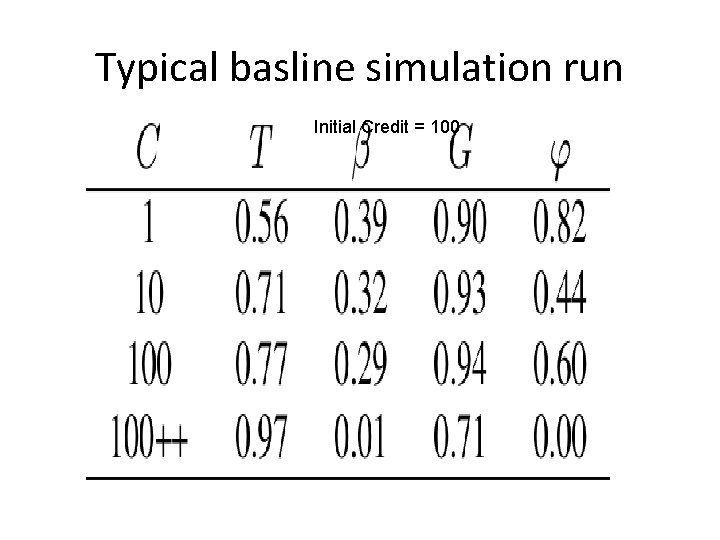
Typical basline simulation run Initial Credit = 100
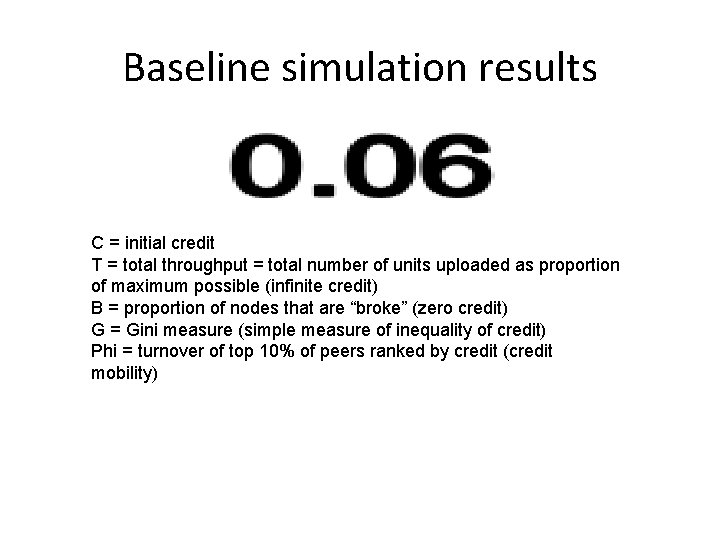
Baseline simulation results C = initial credit T = total throughput = total number of units uploaded as proportion of maximum possible (infinite credit) B = proportion of nodes that are “broke” (zero credit) G = Gini measure (simple measure of inequality of credit) Phi = turnover of top 10% of peers ranked by credit (credit mobility)
Unequal capacities runs • To determine what happens when some nodes of different upload capacities • Parameters (same as baseline runs but): – All peers download capacity = 10 units – 10% of peers upload capacity = 10 units – 90% of peers upload capacity = 1 unit – Examined a (1. 5 credit) seeding bonus approach to dynamically introduce more credit into the system
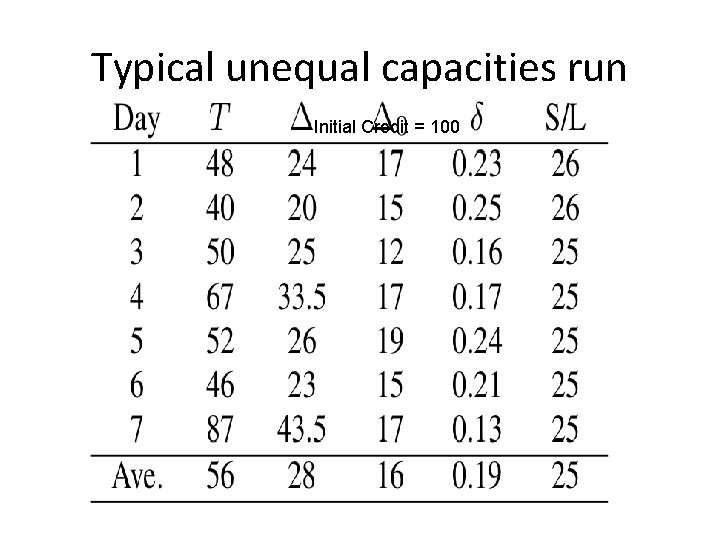
Typical unequal capacities run Initial Credit = 100
Unequal capacities simulation results C = initial credit T = total throughput = total number of units uploaded as proportion of maximum possible (infinite credit) B = proportion of nodes that are “broke” (zero credit) G = Gini measure (simple measure of inequality of credit) Phi = turnover of top 10% of peers ranked by credit (credit mobility) 100++ indicates initial credit of 100 with 1. 5 credit seeding bonus
Observations Even in a trivial model where all peers have the same capacities and user behaviour, all swarms have equal popularity and all peers start with equal credits, the performance of the system may be inhibited by credit shortages
Observations Adding extra capacity to the system, in the form of upload and download, can actually reduce the performance. This is highly counter intuitive and something that should be avoided because it implies lack of scalability.
Observations By injecting new credit into the system in the form of a ``seeding bonus’’ a credit squeeze can be ameliorated when peer capacities are unbalanced.
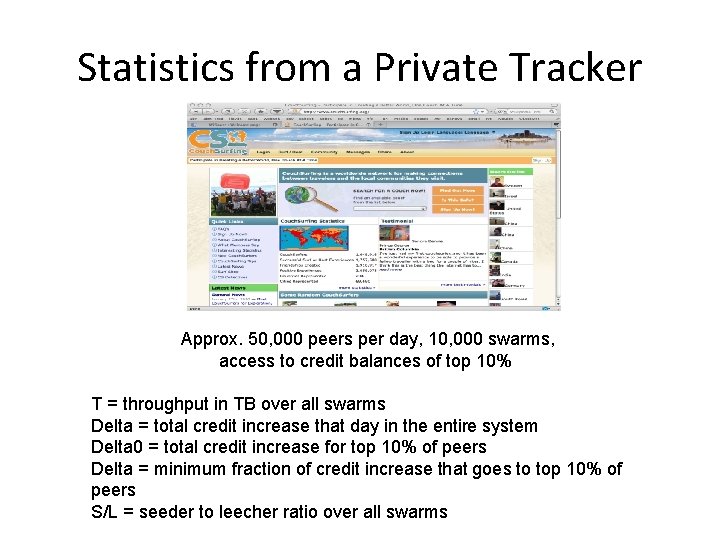
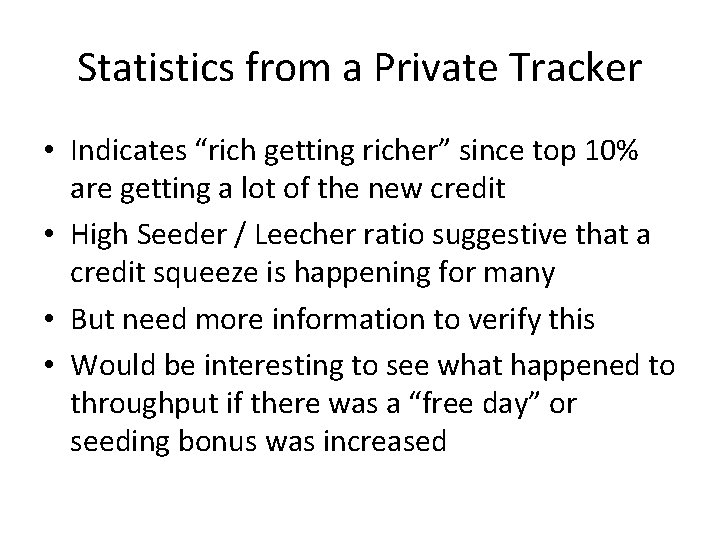
Statistics from a Private Tracker Approx. 50, 000 peers per day, 10, 000 swarms, access to credit balances of top 10% T = throughput in TB over all swarms Delta = total credit increase that day in the entire system Delta 0 = total credit increase for top 10% of peers Delta = minimum fraction of credit increase that goes to top 10% of peers S/L = seeder to leecher ratio over all swarms
Statistics from a Private Tracker • Indicates “rich getting richer” since top 10% are getting a lot of the new credit • High Seeder / Leecher ratio suggestive that a credit squeeze is happening for many • But need more information to verify this • Would be interesting to see what happened to throughput if there was a “free day” or seeding bonus was increased
Conclusions • Private trackers using “ratio enforcement” policies appear to be ad-hoc and various • But can have dramatic effects on efficiency • Too much credit could encourage free-riding • Too little creates squeezes = lower efficiency • These are just initial investigations • Much more work needs to be done!
Take home message • Communities formed around trackers provide an ongoing global socio-economic experiment • Self-organisation of socio-economic structures in measurable forms • Ideas, models and theories from socio-economics may inform and learn from this • Such communities so strong don’t be surprised if they start influencing the “real world” (e. g. the Pirate. Party)
References • Rahman, R. and Hales, D. , Vinko, T. , Pouwelse, J. and Sips, H. (2010). No more crash or crunch: sustainable credit dynamics in a P 2 P community. International Conference on High Performance Computing & Simulation (HPCS 2010) • Rahman, R. , Meulpolder, M. , Hales, D. , Pouwelse, J. and Sips, H. (2010) Improving Efficiency and Fairness in P 2 P Systems with Effort-Based Incentives. Proceedings of the IEEE International Conference on Communications • Hales, D. , Rahman, R. , Zhang, B. , Meulpolder M. , and Pouwelse, J. (2009) Bit. Torrent or Bit. Crunch: Evidence of a credit squeeze in Bit. Torrent? Proceedings of the 5 th Collaborative Peer-to-Peer Systems (COPS) Workshop
What are we trying to do? Where we ask “what is a socially intelligent ICT system? ”
COSI-ICT (ASSYST) • Complex Systems Science for Socially Intelligent ICT • Cluster of four IPS: • Qlectives, Epiwork, Socionical, Cybermotions • ASSYST is an associated CA - action for the science of complex systems and socially intelligent ICT • http: //www. assystcomplexity. eu/
Basic Questions from Jeff Johnson 1. What is ICT-enabled social intelligence? 2. What theories exists on social intelligence? 3. Are there engineering principles for creating social intelligence systems?
1. What is ICT enabled social intelligence? First let’s ask: What is Social Intelligence?
What is social intelligence? Answer It is the opposite of: Antisocial stupidity
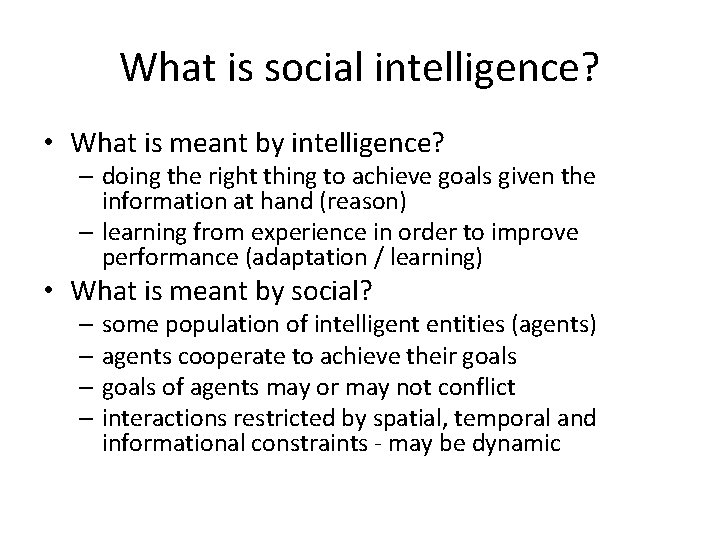
What is social intelligence? • What is meant by intelligence? – doing the right thing to achieve goals given the information at hand (reason) – learning from experience in order to improve performance (adaptation / learning) • What is meant by social? – some population of intelligent entities (agents) – agents cooperate to achieve their goals – goals of agents may or may not conflict – interactions restricted by spatial, temporal and informational constraints - may be dynamic
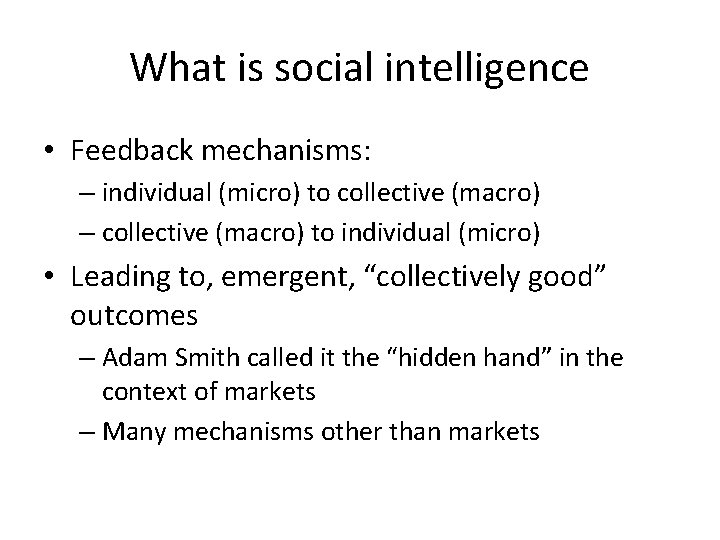
What is social intelligence • Feedback mechanisms: – individual (micro) to collective (macro) – collective (macro) to individual (micro) • Leading to, emergent, “collectively good” outcomes – Adam Smith called it the “hidden hand” in the context of markets – Many mechanisms other than markets
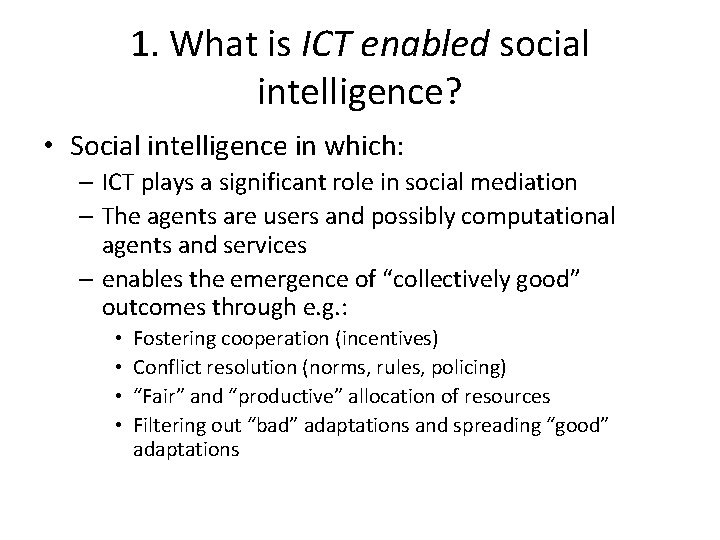
1. What is ICT enabled social intelligence? • Social intelligence in which: – ICT plays a significant role in social mediation – The agents are users and possibly computational agents and services – enables the emergence of “collectively good” outcomes through e. g. : • • Fostering cooperation (incentives) Conflict resolution (norms, rules, policing) “Fair” and “productive” allocation of resources Filtering out “bad” adaptations and spreading “good” adaptations
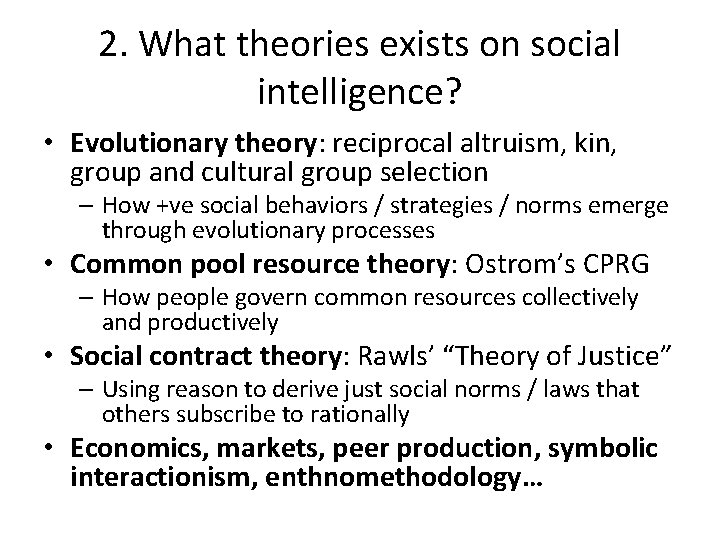
2. What theories exists on social intelligence? • Evolutionary theory: reciprocal altruism, kin, group and cultural group selection – How +ve social behaviors / strategies / norms emerge through evolutionary processes • Common pool resource theory: Ostrom’s CPRG – How people govern common resources collectively and productively • Social contract theory: Rawls’ “Theory of Justice” – Using reason to derive just social norms / laws that others subscribe to rationally • Economics, markets, peer production, symbolic interactionism, enthnomethodology…
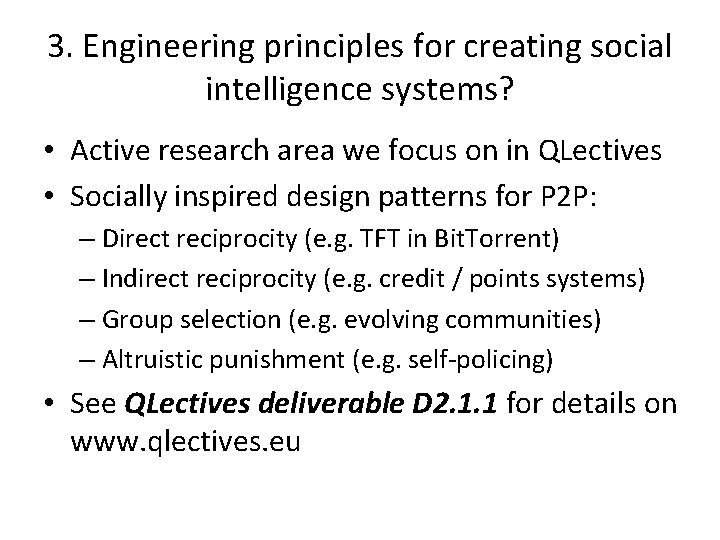
3. Engineering principles for creating social intelligence systems? • Active research area we focus on in QLectives • Socially inspired design patterns for P 2 P: – Direct reciprocity (e. g. TFT in Bit. Torrent) – Indirect reciprocity (e. g. credit / points systems) – Group selection (e. g. evolving communities) – Altruistic punishment (e. g. self-policing) • See QLectives deliverable D 2. 1. 1 for details on www. qlectives. eu
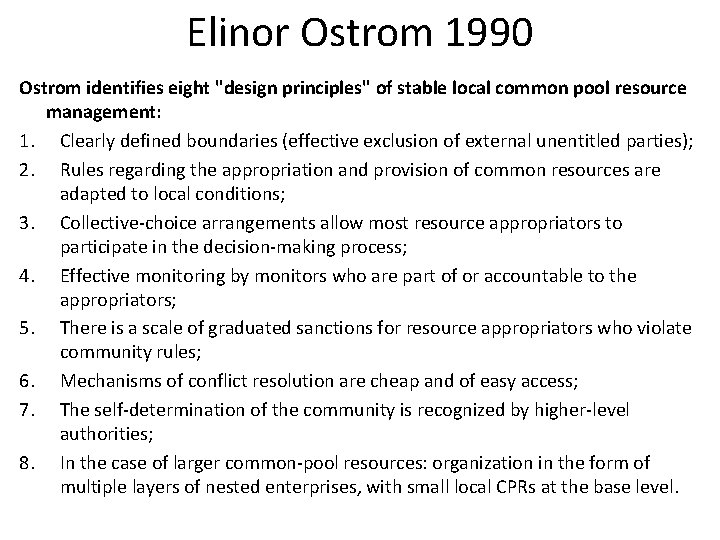
Elinor Ostrom 1990 Ostrom identifies eight "design principles" of stable local common pool resource management: 1. Clearly defined boundaries (effective exclusion of external unentitled parties); 2. Rules regarding the appropriation and provision of common resources are adapted to local conditions; 3. Collective-choice arrangements allow most resource appropriators to participate in the decision-making process; 4. Effective monitoring by monitors who are part of or accountable to the appropriators; 5. There is a scale of graduated sanctions for resource appropriators who violate community rules; 6. Mechanisms of conflict resolution are cheap and of easy access; 7. The self-determination of the community is recognized by higher-level authorities; 8. In the case of larger common-pool resources: organization in the form of multiple layers of nested enterprises, with small local CPRs at the base level.
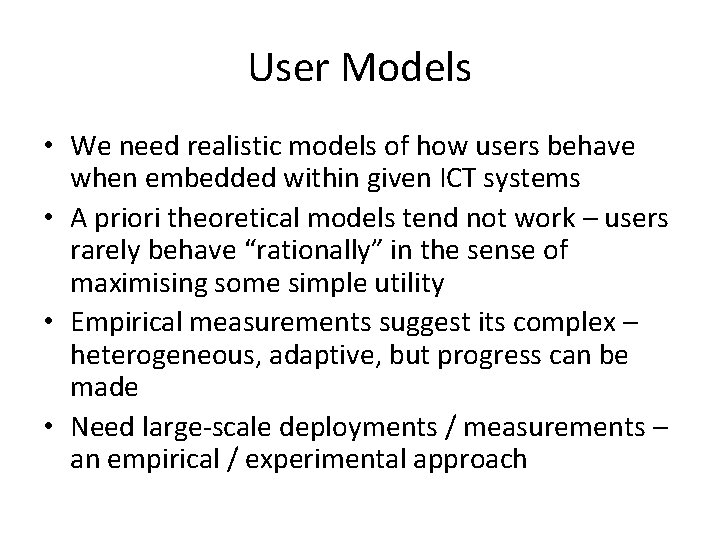
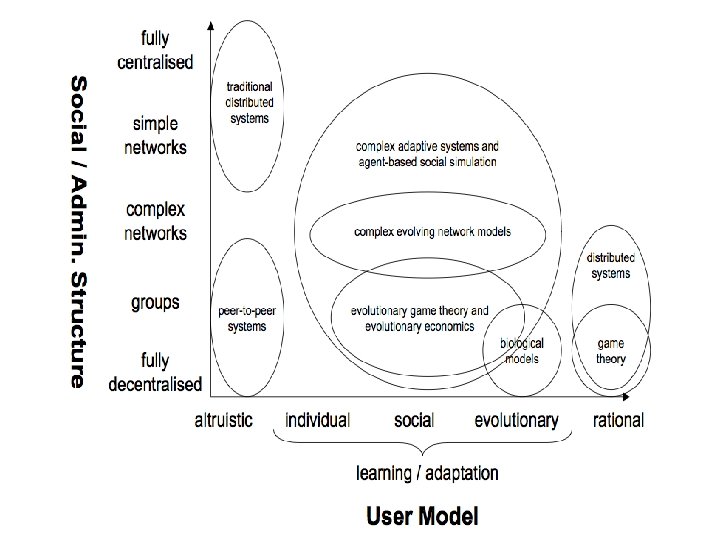
User Models • We need realistic models of how users behave when embedded within given ICT systems • A priori theoretical models tend not work – users rarely behave “rationally” in the sense of maximising some simple utility • Empirical measurements suggest its complex – heterogeneous, adaptive, but progress can be made • Need large-scale deployments / measurements – an empirical / experimental approach
Rawls’ "veil of ignorance" approach • assume we wish to specify the kind of society that is just and good • but we stand outside the society and don't know what role we ourselves would play – we are ignorant of what endowments, knowledge, capacities and position we would hold • what rules / norms would we accept as just and fair? i. e. what would we accept as “collective good”
Designing a socially int. system • We wish to specify the requirements of a system that will structure interaction between peers • the protocol could run on diverse devices with diverse goals, capacities and user behaviour • but we need 1 billion users of the system to make it a success (and get rich) • What collective goals will we define such that many different devices and users would accept and run it? • “do no evil”? or “make the world a better place”? or “from each according to his abilities to each according to his need”?
Replacing the banks….
Tragedy of the financial commons • Some examples: – Individual bank creates excessive credit through lax loans that can be securitised and sold on (to another bank) – Asset bubbles transfer wealth from the majority to the minority – State debases the coin via printing money • Two broad responses: – More central control – Hobbsian Leviathan – Less central control – Efficient markets
Some financial functions • • • Value transfer Credit creation Value storage Exchange of services and products Quality money?
Alternative • Possible emerging alternative: – Radically decentralise systems that support financial functions – Use emerging trends in distributed information systems – Alternative economic / cooperation theories
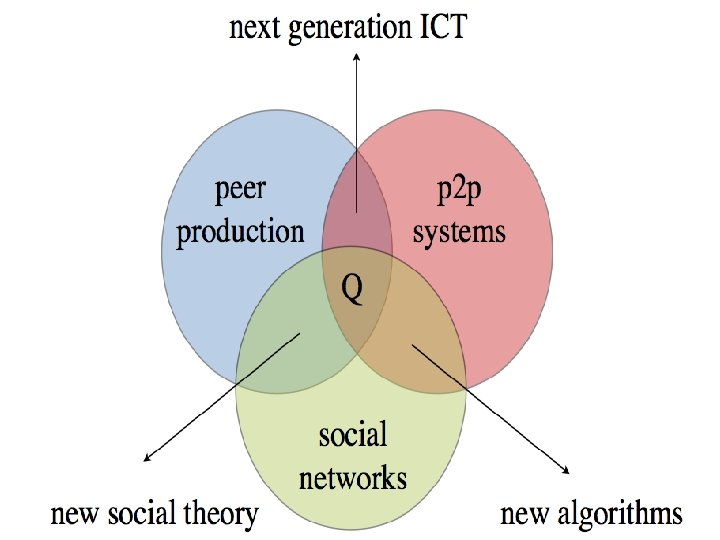
Emerging trends in info. systems • Over recent years a number trends have emerged within information systems: – social networks (facebook, Linked. In) – peer production (wikipedia, open source) – peer-to-peer systems (Bit. Torrent) – virtual currencies (second life, farmville, Bit. Coin) – cheap mobile devices connected to global networks
Alternative cooperation theories • Bottom-up forms of altruism and trust – group selection, migration • Reciprocity: – direct, indirect, network • Others: – affinity, reputation, altruistic punishment
Some on-going projects • • P 2 P lending (eliminate banks) Members banks (become part of a bank) Money free economies (eliminate money) P 2 P money (create your own money)
Eliminating banks / interest • Zopa – P 2 P lending system without a bank. Nonlocal, becoming successful • JAK Bank – Members bank controlled by and for only the members. Eliminates interest. Highly local
Eliminating money • Couch. Surfing – people freely share spare accommodation all over the world. Global and active • Freecomony – people freely share anything (generally localised)
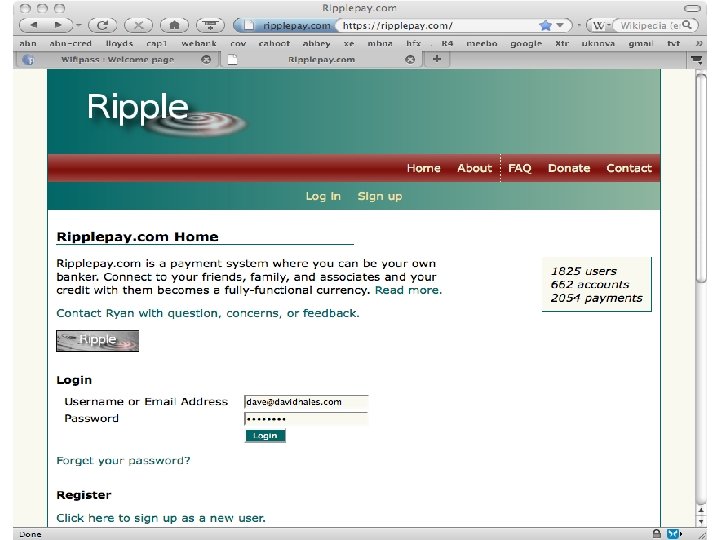
P 2 P money • Using a social network of trusted friends • Each person can apply a credit level to each link in any monetary unit • Payments between nodes (value transfer) involves the system finding a route of credit between nodes • Depends on trust and enough back-to-back transfers to balance over time • Compare to Hawala system and other “informal value transfer” IVF, systems
P 2 P Money • Currently know of no widely used deployed system • Bootstrapping problem - possible way forward: – Create a p 2 p virtual currency in a virtual game world with existing social networks – Take detailed measurements and collect data – See if it works and produce models – If successful grow the currency outside the virtual game
Quality money • Subjective rating = objective quality? • In a given community: – if enough people believe a unit of exchange is high quality they will accept it for payment – then it is high quality – But, you can only fool all of the people some of time…
Let 1000 experiments bloom • Given a sufficient ecology of financial commons systems (avoiding a financial monoculture) • Individuals can “vote with their feet” migrating to those that are of high quality • Hence even “rational” behaviour could drive quality rather than driving it out • Tiebout (1956), Hayek (1978) - back to square one?
Bits and bats • Some leftover slides that might be interesting
Trends • Recent trends – Peer Production (wikipedia, open source) – Social Networks (facebook) – Peer-to-Peer (P 2 P) systems (bittorrent, skype) • Related themes – Communities not individuals (social) – Sharing, giving, social production without traditional economic incentives – New kinds of “commons” new kinds of tools for managing those commons
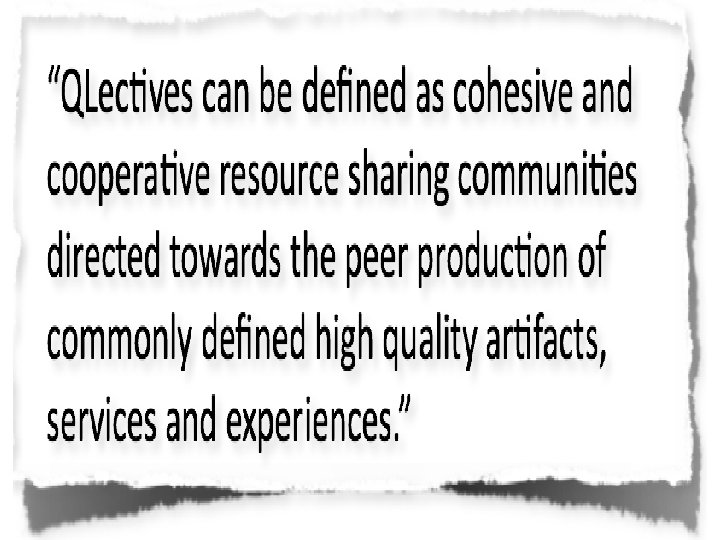
Quality Collectives
Social approach • Such systems are social from the start • Social structures are dynamic not static – they have a history • The dynamics of the structure are part of the “game” of interaction • Group formation processes important • Cultural evolution, cultural group selection • Memetics
Questions • How are dynamic social structures formed and maintained? • How do users actually behave? • User behaviour / structure feedback both micro -> macro and macro -> micro (and don’t forget the meso) • Individual rational models of user behaviour rarely directly applicable
Empirical Stuff • Public and Private Bit. Torrent Community measurement studies - scraping and processing vast amounts of data • Meulpolder, M. , D’Acounto, Capotă, M. , Wojciechowski, M. , Pouwelse, J. A. , Epema, D. H. J. , Sips, H. J. (2010) Public and private Bit. Torrent communities: A measurement study. International Workshop on Peer-to. Peer Systems (IPTPS) 2010, San Jose, California, USA • Ethnographic studies of private communities joining communities, observing and talking to people • Nazareno Andrade et al (forthcoming)
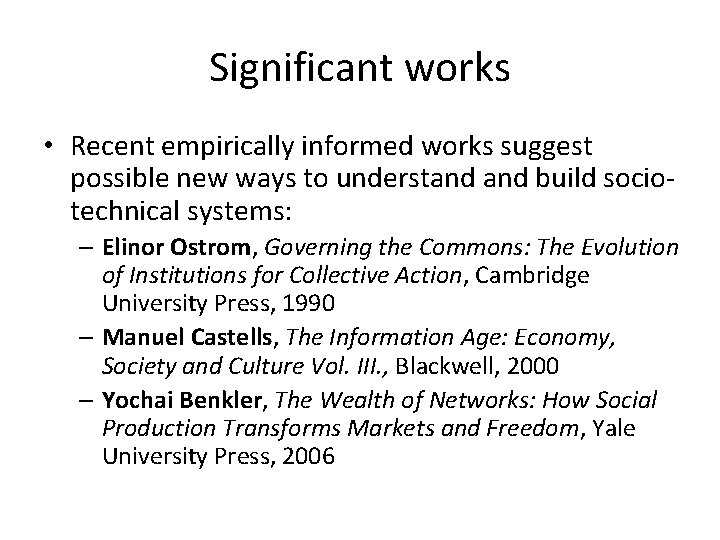
Significant works • Recent empirically informed works suggest possible new ways to understand build sociotechnical systems: – Elinor Ostrom, Governing the Commons: The Evolution of Institutions for Collective Action, Cambridge University Press, 1990 – Manuel Castells, The Information Age: Economy, Society and Culture Vol. III. , Blackwell, 2000 – Yochai Benkler, The Wealth of Networks: How Social Production Transforms Markets and Freedom, Yale University Press, 2006