What is TRIPS TRIPS is The Agreement on
- Slides: 41
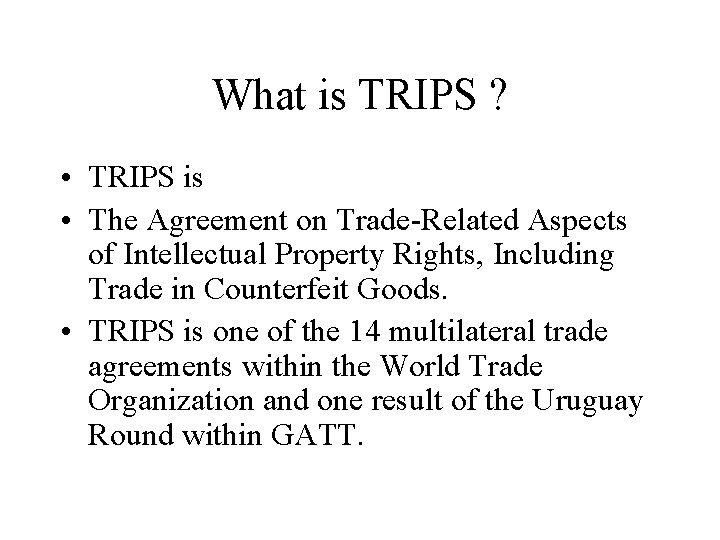
What is TRIPS ? • TRIPS is • The Agreement on Trade-Related Aspects of Intellectual Property Rights, Including Trade in Counterfeit Goods. • TRIPS is one of the 14 multilateral trade agreements within the World Trade Organization and one result of the Uruguay Round within GATT.
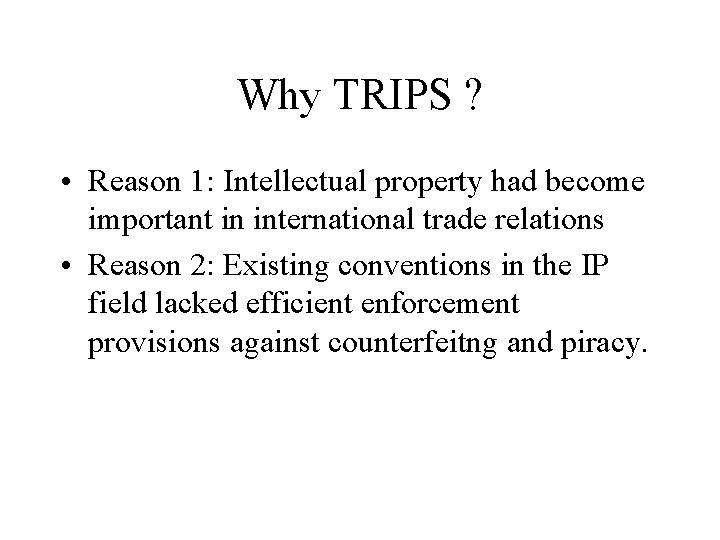
Why TRIPS ? • Reason 1: Intellectual property had become important in international trade relations • Reason 2: Existing conventions in the IP field lacked efficient enforcement provisions against counterfeitng and piracy.
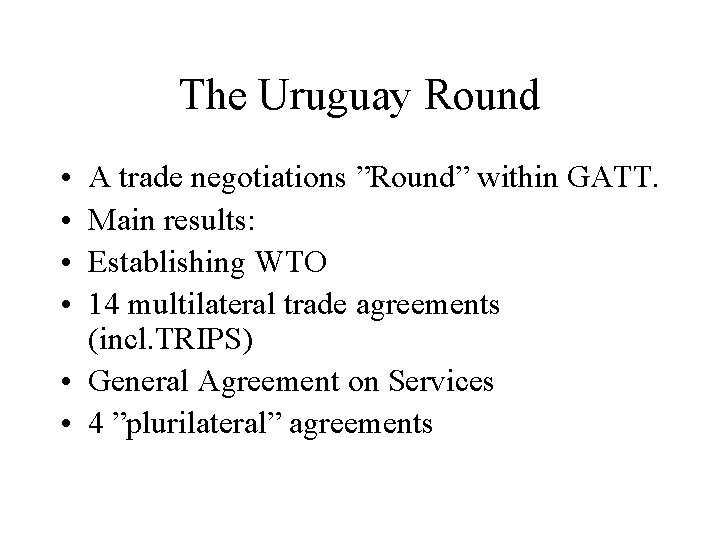
The Uruguay Round • • A trade negotiations ”Round” within GATT. Main results: Establishing WTO 14 multilateral trade agreements (incl. TRIPS) • General Agreement on Services • 4 ”plurilateral” agreements
What is the WTO ? • World Trade Organization = WTO: an intergovernmental organization with now 146 members • Not a specialized agency under the UN • Was set up as a result of the Uruguay Round. • Started functioning on January 1, 1995
What is the WTO. . • Result of Uruguay Round = one package. • Membership of WTO = binding as regards all the multilateral agreements • No opt-out possibility as regards e. g. TRIPS.
TRIPS: General • 1. Standards for the substantive protection of all essential IP rights • 2. Provisions on basic principles (national treatment and Most-Favoured-Nation t. ) • 3. Standards on enforcement • 4. Provisions on dispute settlement • 5. Transitional/institutional arrangements
TRIPS: Industrial property standards • Provisions on the contents of the rights in respect of • patents • trademarks • geographical indications • industrial designs • lay-out designs of integrated circuits • protection of undisclosed information (trade secrets)
TRIPS: Copyright Standards • . 1 General obligation • Compliance with art. 1 -21 of the Berne Convention (result: e. g. TRIPS dispute settlement procedures applicable in case of breach( • This does not apply to moral rights (which are consequently outside the scope of TRIPS. (
TRIPS: Copyright Standards. . • General principle: • Copyright protection applies only to expressions and not to ideas, procedures, methods of operation or mathematical concepts as such.
TRIPS: Copyright Standards. . • Special obligations: • 1) Computer programs in both source code and object code shall be protected as literary works under the Berne Convention. • 2) Compilations of data which by means of the selection and arrangement of their contents are intellectual creations shall be protected as such.
TRIPS: Copyright Standards. . • 3) Rental right ”at least” as regards • - computer programs (except where the program is not the essential object of the rental) • - cinematographic works (subject to the ”material impairment test). • - (phonograms
TRIPS: Copyright standards. . • 4) Special provision on term of protection for anonymous works (if not published, the term shall be calculated from the year of the making of the work)
TRIPS: Copyright standards. . • 5) Three-step test as regards limitations • a) certain special cases • b) no conflict with a normal exploitation of the work, and • c) no unreasonable prejudice of the legitimate interests of the author
TRIPS: Related Rights standards • Features: • 1) Concern performing artists, phonogram producers and broadcasters. • 2) No reference to the Rome Convention, but self-standing. • 3) Deal only with sound performers and not audiovisual performers
TRIPS: Related Rights standards… • Sound performers: • Possibility of preventing (not exclusive right) • a) fixation of unfixed performances, b) reproduction of sound recordings of performances, c) wireless broadcasting + communication to the public of live performances. • Nothing about right of remuneration for public performance of sound recordings
TRIPS: Related Rights standards. . • Sound performers: • Term of protection: 50 years from performance or fixation of it.
TRIPS: Related Rights standards • • • Phonogram producers: Right to authorise or prohibit: direct or indirect reproduction of recordings right of commercial rental (no remuneration right for public perform) Term of protection: 50 years from fixation
TRIPS: Related Rights standards. . • Sound radio and TV broadcasters: • Right to prohibit (no exclusive right): • a) fixation of broadcasts, b) reproduction of fixations, c) wireless rebroadcasting broadcasts. • Term of protection: 20 years from year of broadcast.
TRIPS: Related Rights standards. . • Limitations: • Same as permitted under Rome Convention. • Three-step test not applicable.
TRIPS: Basic operational princples • National treatment: • ”each Member shall accord to the nationals of other Members treatment no less favourable than it accords to its own nationals with regard to the protection of intellectual property” (Art. 3)
TRIPS: Basic operational principles. . • National treatment application: • Copyright: applies to all rights, also if not mentioned in TRIPS • Related Rights: ”this obligation applies only in respect of the rights provided under this Agreement” (Art. 3).
TRIPS: Basic operational principles. . • Most-Favoured-Nation Treatment. • Art 4: ”With regard to the protection of intellectual property, any advantage, favour, privilege or immunity granted by a Member to the nationals of any other country shall be accorded immidiately and unconditionally to the nationals of all other Members”
TRIPS: Enforcement standards • Why enforcement provisions ? • Discontent as to the way in which counterfeiting and piracy was dealt with in national laws and applied.
TRIPS: Enforcement standards. . • General obligations, and • Specific obligations. • Part of the TRIPS Agreement; breach may entail panel procedures and trade sanctions.
TRIPS: enforcement standards. . • General obligations: • enforcement procedures must be available; must include expeditious and deterrent remedies; procedures to be fair and equitable; must not be unnecessarily complicated or costly or entail unwarranted dealys; possibility must exist for judicial review of final administrative decisions.
TRIPS: Enforcement standards. . • No obligation to • - create a judicial IP enforcement system different from enforcement in general. • - re-distribute resources between IP enforcement and enforcement in general.
TRIPS: Enforcement standards. . • • Special obligations as regards: - Civil and administrative procedures - Broder measures - Criminal procedures
TRIPS: Enforcement standards • • Civil and administrative procedures: 1) fair and equitable procedures 2) Evidence 3) Injunctions 4) Damages 5) Disposal of infringing goods 6) Right of information
TRIPS: Enforcement standards. . • Civil and administrative procedures (cont. ) • 7) Indemnification of the defendant • 8) Provisional measures
TRIPS: Enforcement standards. . • Border Measures: • Main provision: • Procedures on the suspension for 10 working days of the release of suspected counterfeit trademark goods or pirated copyright goods.
TRIPS: Enforcement standards. . • Criminal procedures to be applied ”at least” • in respect of wilful trademark counterfeiting or copyright piracy on a commercial scale. • Remedies: imprisonment or fines or both. • Must be strong enough to constitute a deterrent.
TRIPS: Dispute settlement. • Why provisions on dispute settlement ? • Reason: when states were in breach international IP conventions the only remedy was referral to the International Court of Justice in the Hague. Never used. • Consequently, only diplomatic pressure was available.
TRIPS: Dispute settlement. . • TRIPS system: • prevention of disputes through provisions on transparency • settlement of disputes through panel procedures and decisions andtrade sanctions in case decisions are not adhered to.
TRIPS: Dispute settlement. . • Dispute prevention: • transparency, e. g. notification of IP laws to the TRIPS Council.
TRIPS: Dispute settlement. . • Dispute settlement: Legislative framework: • Dispute Settlement Understanding (DSU) • Dispute Settlement Body (DSB).
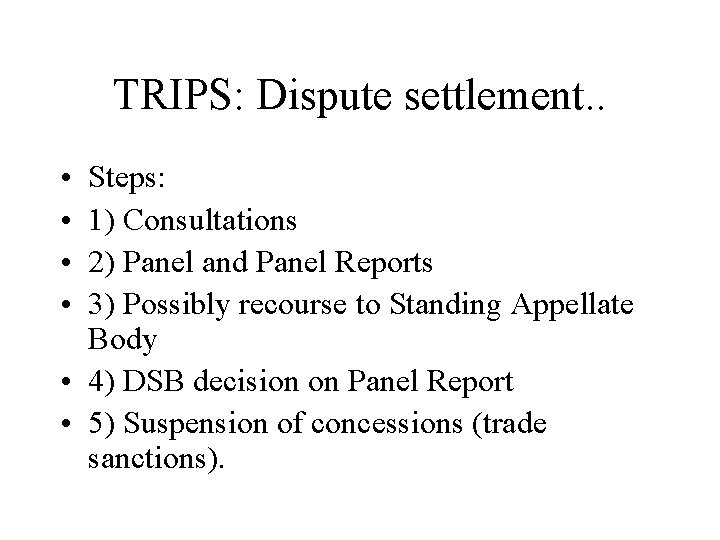
TRIPS: Dispute settlement. . • • Steps: 1) Consultations 2) Panel and Panel Reports 3) Possibly recourse to Standing Appellate Body • 4) DSB decision on Panel Report • 5) Suspension of concessions (trade sanctions).
TRIPS: Dispute settlement. . • Least-Developed Countries: • Particular consideration to be given to LDC situation; due restraint in raising matters and in requesting concessions/trade sanctions.
TRIPS: Application in time. • 1) General application of TRIPS: by January 1, 1996 • 2) Developed Countries and Countries in Transition: by January 1, 2000 • (special rules on NT and MFN and certain provisions on patents in new areas).
TRIPS: Application in time. . • Least-Developed Countries: • Upon request the TRIPS Council to postpone application to January 1, 2006 • Doha Ministerial Declaration: patent protection for pharmaceuticals only from January 1, 2016 • Provisions on incentives to promote technology transfer. • Provisions on technical cooperation
WTO/TRIPS Main bodies • Supreme body of WTO: the Ministerial Conference • In between: the General Council • TRIPS: The TRIPS Council