Swastika and the Star of David Swastika Swastika
- Slides: 44
Swastika and the Star of David
Swastika
Swastika
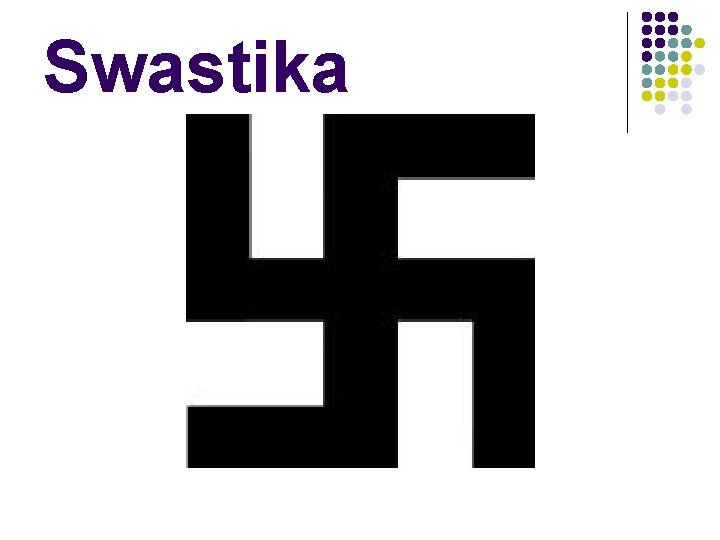
It’s Arms l. It’s arms are bent at right angles, all in the same rotary direction, usually clockwise.
Name
Name l The name Swastika comes from the Sanskrit, Svastika. l It means: l Good fortune l Well Being
Meaning
Of the arms l The Swastika has four arms. The range of its meaning includes power, energy, and migration. There are only three because it is derived from a symbol with only three arms.
Of the center l Its range also includes the highest god, the supreme power, life-force, and the sun.
How the Swastika has been used
Uses l It was used as the 1920 symbol of the National Socialist Party (where Hitler was in). l The Swastika is known as a symbol of prosperity and good fortune in the ancient and modern world.
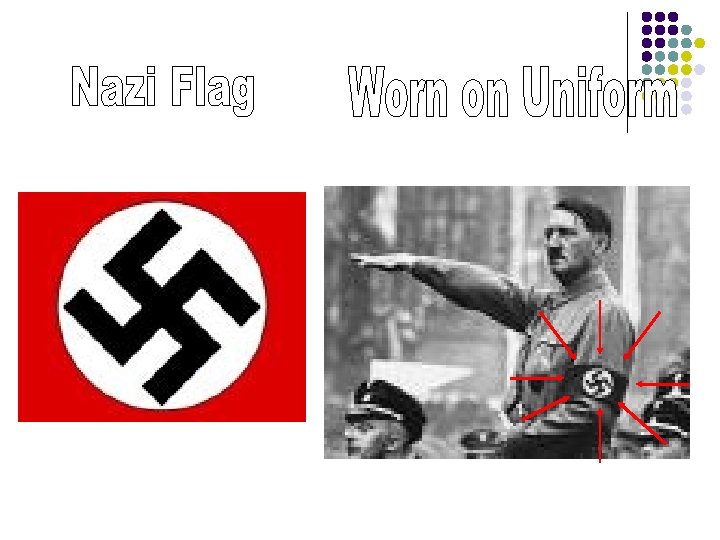
l It was used as a symbol of Aryan identity and German nationalist pride. l It was used in the Nazi flag made and designed by Hitler.
German Nationalist Pride l. The pride of being a German because of the belief that they are the superior race.
Aryan Identity l The identity of the master race. The people under this identity are believed to be the pure descendants of Greeks and Romans. The Germans, are Aryan, while the Jews, are not.
Where/On what it can be found on
l Buddhist inscriptions l Celtic monuments l Greek coins l Early Christian and Byzantine art l Nazi Flag
Byzantine l Something of the place where the Byzantine empire commonly known as the Roman empire. l Byzantine art is the art that comes from the Roman empire
Celtic monuments l Celtic monuments are the monuments of the Celts have many cultures like the La Tene culture which flourished in many countries like Germany where the Swastika was used.
l. Therefore, this La Tene culture adopted this Swastika and it became part of their culture.
In other countries/ cultures
l The Swastika has been used in other countries like China, India, Japan, and in Southern Europe. l It is used as a sacred symbol in many religions like Hinduism and Buddhism.
l It was the sign for the god Thor’s hammer in Scandinavia l And in Indian belief, the four arms of the Swastika mean the four places of rebirth, the animal or plant world, the spirit world, earth, or hell
Star of David
The Star of David l The Star of David is also known as the shield of David or Magen David (Magen is Shield in Hebrew).
l The term Magen David which in Jewish liturgy signifies God as the protector (shield) of David, gained currency among medieval Jewish mystics, who attached magical powers to King David’s shield.
Star of David
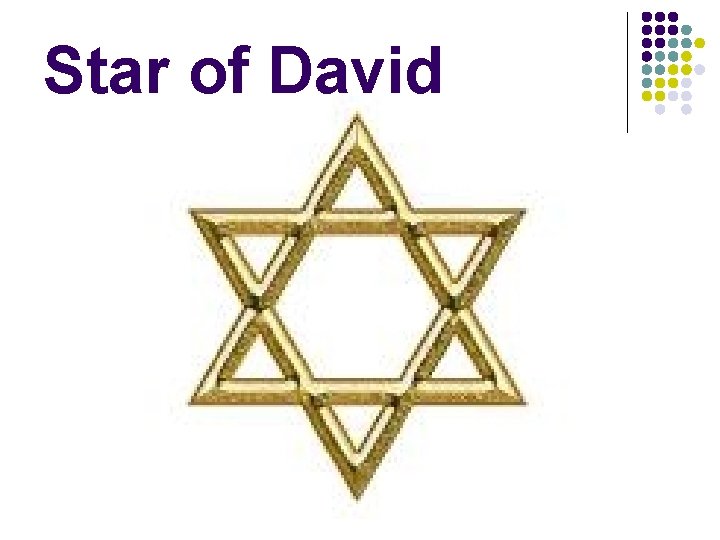
The 2 triangles l The Star of David is made up of two overlapping triangles, one face up and one face down.
l The 2 triangles represent the human’s dual nature, good and evil. l The triangle pointing up means God. l The triangle pointing down means us on Earth.
Meanings
Of the 6 points l One interpretation of what the 6 points in the Star of David is the 6 directions: north, south, east, west, up, and down.
How it has been used
l It was used by the Jews as a religious symbol. l It was used for discrimination and identification by the Nazis and Hitler.
l It was combined with the color yellow, earlier used to symbolize Jews. l It was on ships’ flags to symbolize that there was plague aboard.
l It was introduced to mark all those of Jewish birth. l Since it was used as a sign for the Jews, it was also used to find, capture, and bring Jews to concentration camps.
l It was used in the study of alchemy. It was the general symbol in representing the art of alchemy, and for cominations for fire and water, and many more.
Alchemy l The study of converting metals to gold. l A form of chemistry practiced in the middle ages.
Where/On what it can be found
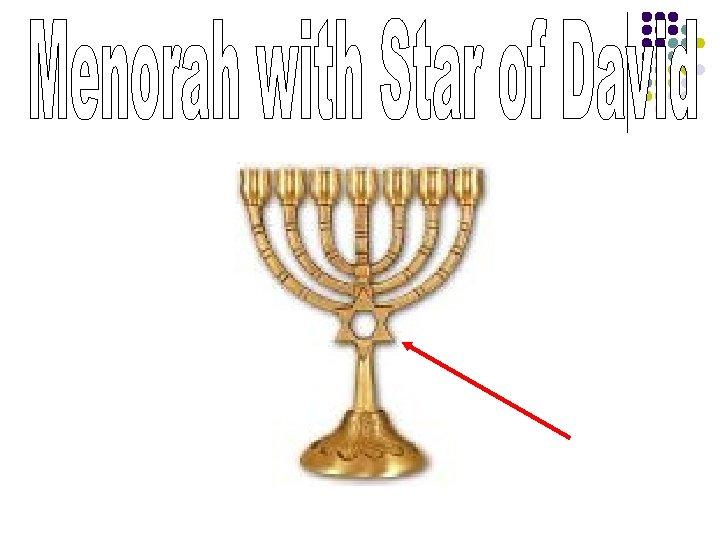
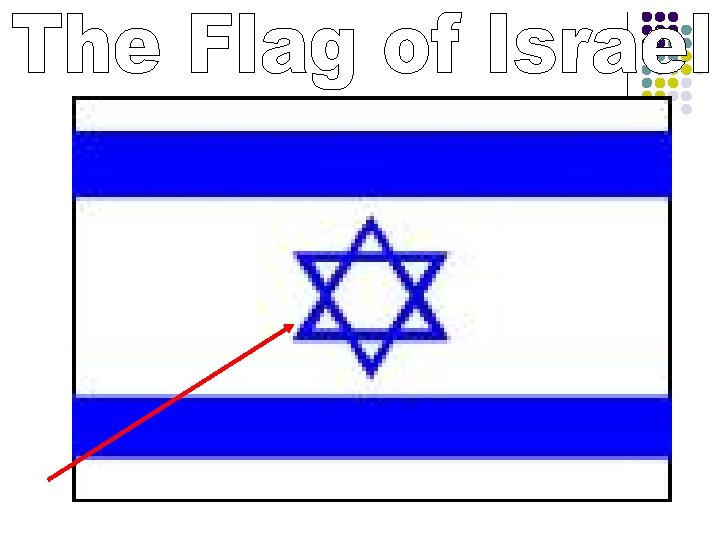
l Synagogues l Jewish ritual objects (Menorahs) l Emblems l Some Jewish tombstones l The Flag of Israel
Menorah l. A candelabrum having nine branches, for use on the Jewish festival of Hanukkah. l Candelabrums are branched holders for more than just one candle.
Emblem l An object or its representation l Symbol
Thank you for listening!!!