ICF for undergraduate students in medicine G Vanderstraeten

- Slides: 75
ICF for undergraduate students in medicine G. Vanderstraeten Guy. vanderstraeten@ugent. be University Hospital Gent Belgium Department of Physical and Rehabilitation Medicine Thanks to Gerold Stucki, Jan Reinhardt, Alexandra Rauch Nottwil Rehab Centre
World Health Organization Assessment Classification & Epidemiology Group International Classification of Functioning , Disability and Health ICIDH-2 to ICF
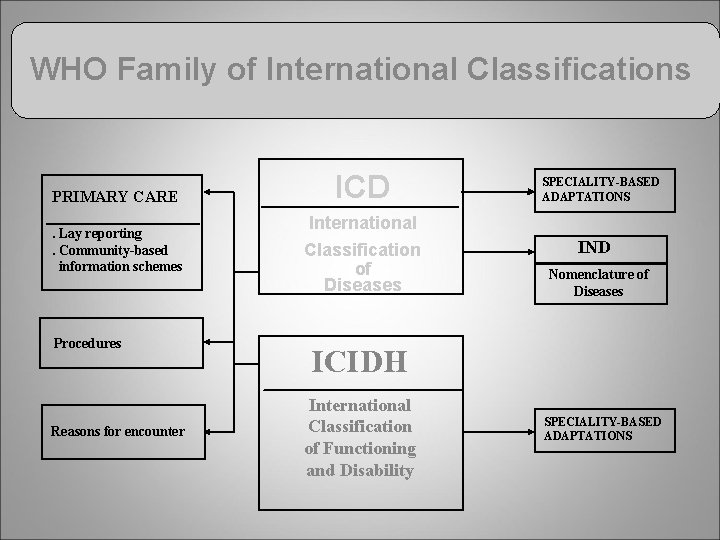
WHO Family of International Classifications PRIMARY CARE. Lay reporting. Community-based information schemes Procedures Reasons for encounter ICD International Classification of Diseases SPECIALITY-BASED ADAPTATIONS IND Nomenclature of Diseases ICIDH International Classification of Functioning and Disability SPECIALITY-BASED ADAPTATIONS
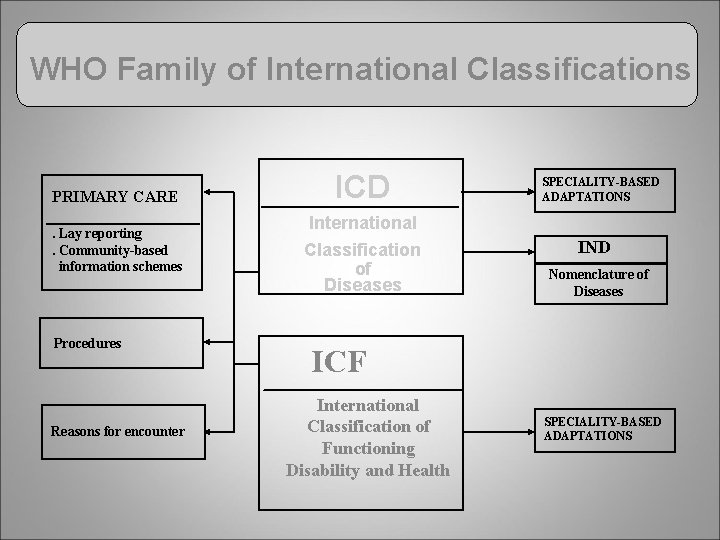
WHO Family of International Classifications PRIMARY CARE. Lay reporting. Community-based information schemes Procedures Reasons for encounter ICD International Classification of Diseases SPECIALITY-BASED ADAPTATIONS IND Nomenclature of Diseases ICF International Classification of Functioning Disability and Health SPECIALITY-BASED ADAPTATIONS
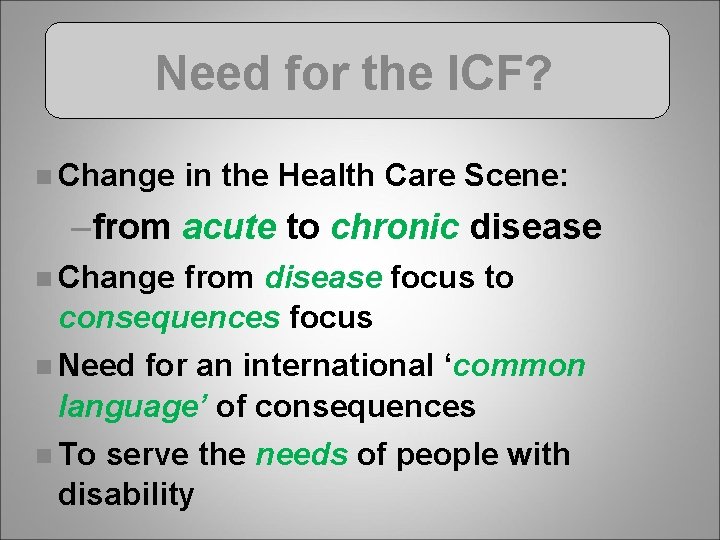
Need for the ICF? n Change in the Health Care Scene: –from acute to chronic disease n Change from disease focus to consequences focus n Need for an international ‘common language’ of consequences n To serve the needs of people with disability
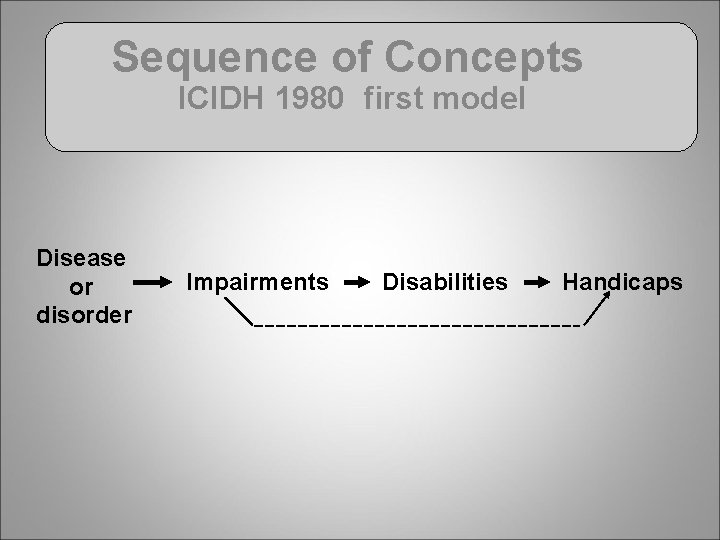
Sequence of Concepts ICIDH 1980 first model Disease or disorder Impairments Disabilities Handicaps
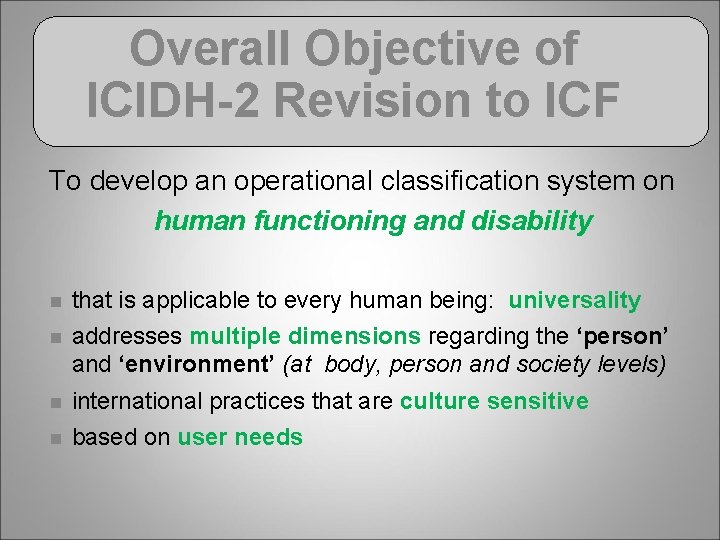
Overall Objective of ICIDH-2 Revision to ICF To develop an operational classification system on human functioning and disability n that is applicable to every human being: universality n addresses multiple dimensions regarding the ‘person’ and ‘environment’ (at body, person and society levels) n international practices that are culture sensitive n based on user needs
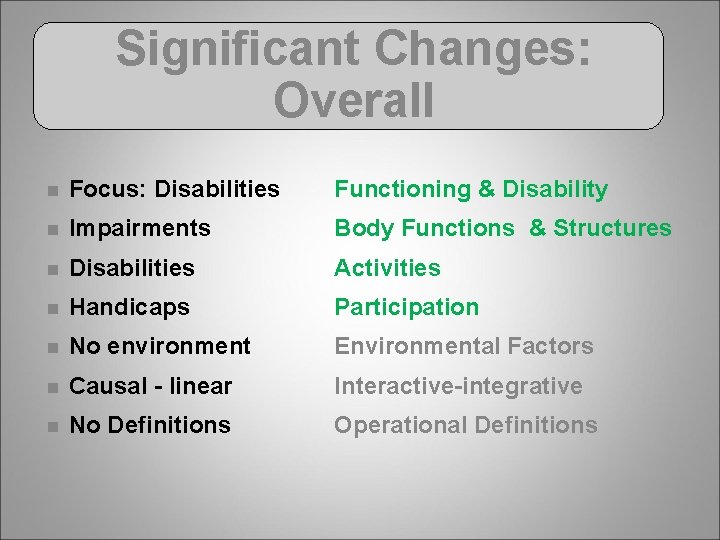
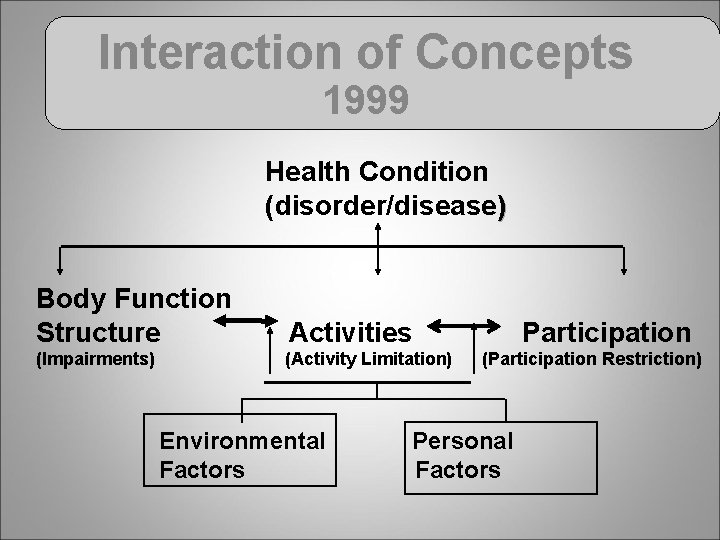
Significant Changes: Overall n Focus: Disabilities Functioning & Disability n Impairments Body Functions & Structures n Disabilities Activities n Handicaps Participation n No environment Environmental Factors n Causal - linear Interactive-integrative n No Definitions Operational Definitions
Interaction of Concepts 1999 Health Condition (disorder/disease) Body Function Structure Activities (Impairments) (Activity Limitation) Environmental Factors Participation (Participation Restriction) Personal Factors
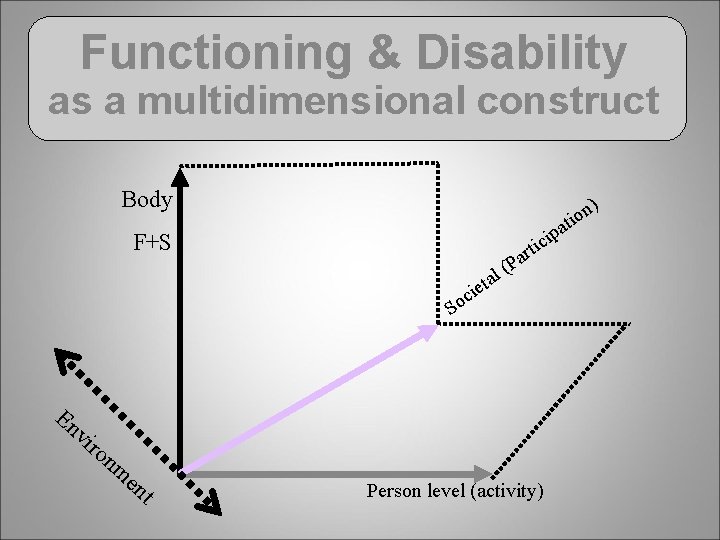
Functioning & Disability as a multidimensional construct Body ) a p i ic F+S l eta rt a P ( i c So En vi ro n m en t Person level (activity) n tio
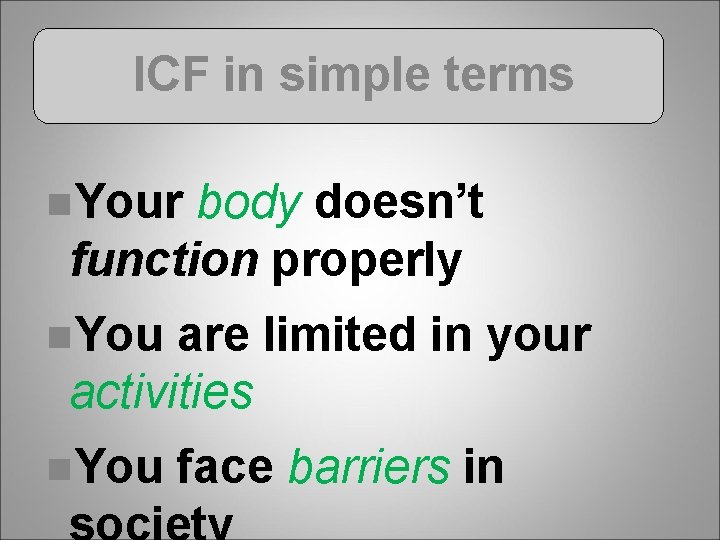
ICF in simple terms n. Your body doesn’t function properly n. You are limited in your activities n. You face barriers in
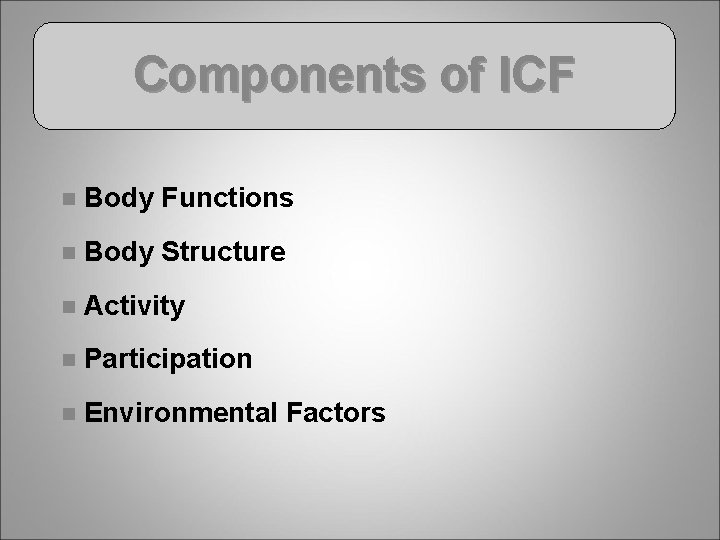
Components of ICF n Body Functions n Body Structure n Activity n Participation n Environmental Factors
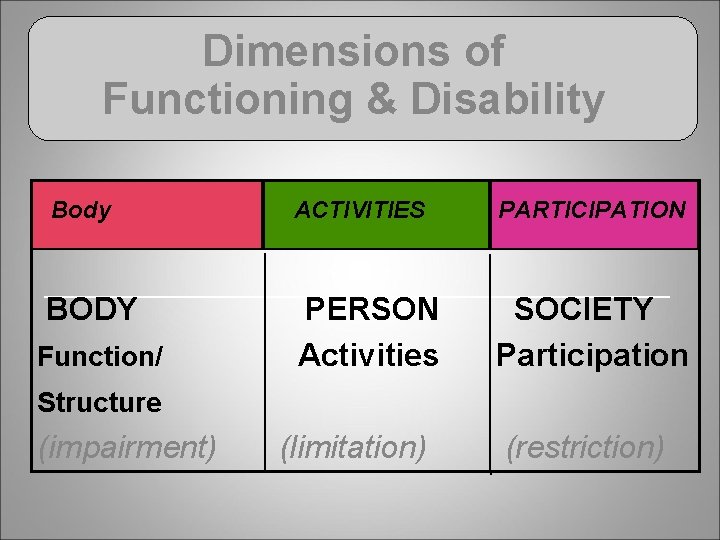
Dimensions of Functioning & Disability Body ACTIVITIES PARTICIPATION BODY PERSON Activities SOCIETY Participation Function/ Structure (impairment) (limitation) (restriction)
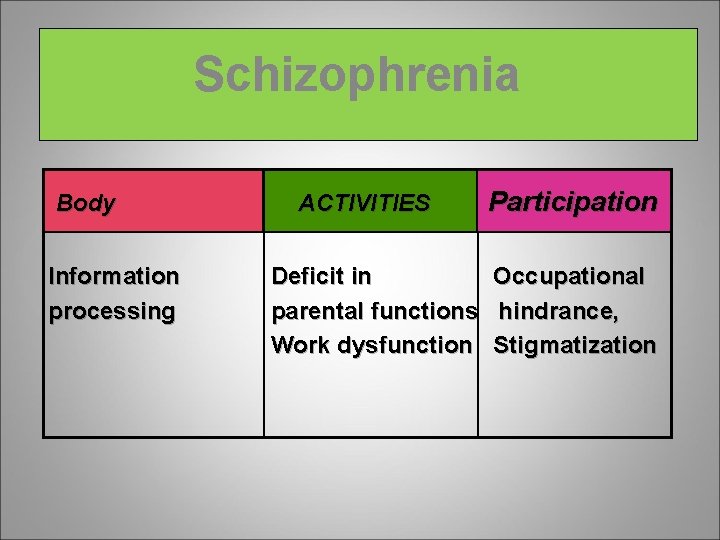
Schizophrenia Body Information processing ACTIVITIES Participation Deficit in Occupational parental functions hindrance, Work dysfunction Stigmatization
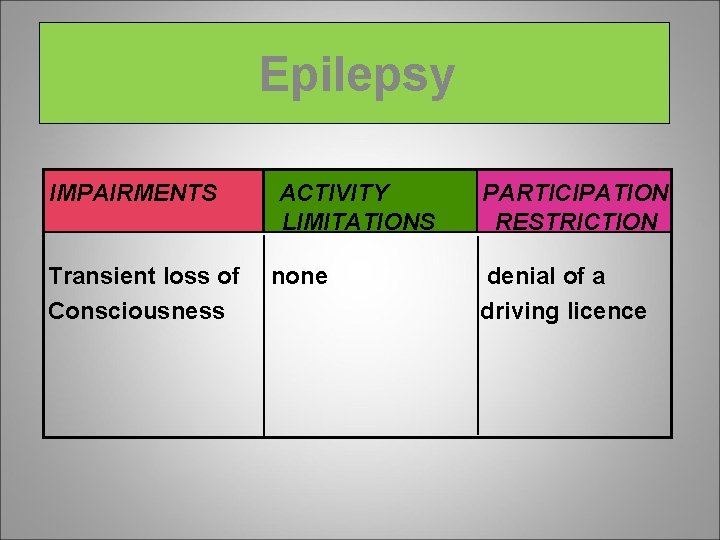
Epilepsy IMPAIRMENTS Transient loss of Consciousness ACTIVITY LIMITATIONS none PARTICIPATION RESTRICTION denial of a driving licence
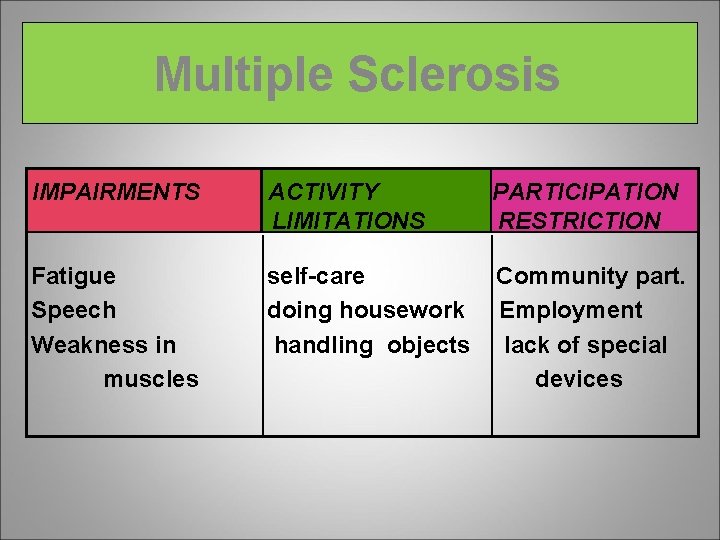
Multiple Sclerosis IMPAIRMENTS ACTIVITY LIMITATIONS PARTICIPATION RESTRICTION Fatigue Speech Weakness in muscles self-care doing housework handling objects Community part. Employment lack of special devices
Implementation of the International Classification of Functioning, Disability and Health (ICF) in Rehabilitation Medicine Gerold Stucki, MD, MS Professor and Chair, Departement of Health Sciences and Health Policy, University of Lucerne, Switzerland Director, Swiss Paraplegic Research, Nottwil, Switzerland Director, ICF Research Branch, WHO FIC CC Germany President Elect, International Society of PRM (ISPRM)
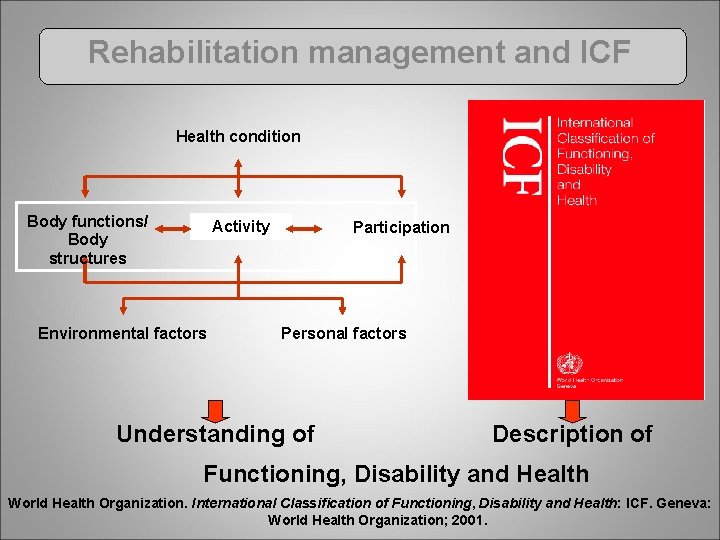
Rehabilitation management and ICF Health condition Body functions/ Body structures Activity Environmental factors Participation Personal factors Understanding of Description of Functioning, Disability and Health World Health Organization. International Classification of Functioning, Disability and Health: ICF. Geneva: World Health Organization; 2001.
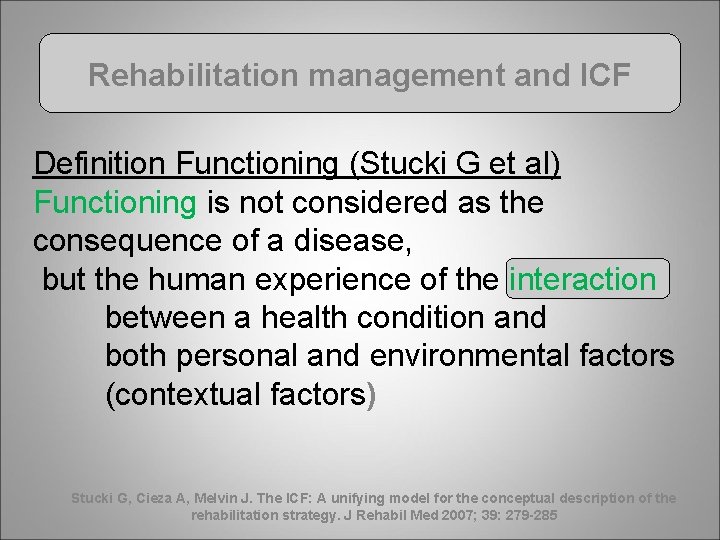
Rehabilitation management and ICF Definition Functioning (Stucki G et al) Functioning is not considered as the consequence of a disease, but the human experience of the interaction between a health condition and both personal and environmental factors (contextual factors) Stucki G, Cieza A, Melvin J. The ICF: A unifying model for the conceptual description of the rehabilitation strategy. J Rehabil Med 2007; 39: 279 -285
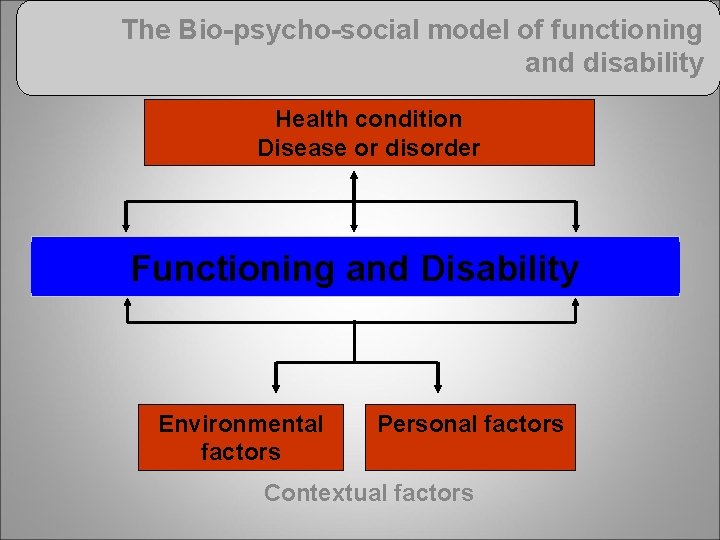
The Bio-psycho-social model of functioning and disability Health condition Disease or disorder Body functions Activities Functioning and structures Environmental factors Participation Disability Personal factors Contextual factors
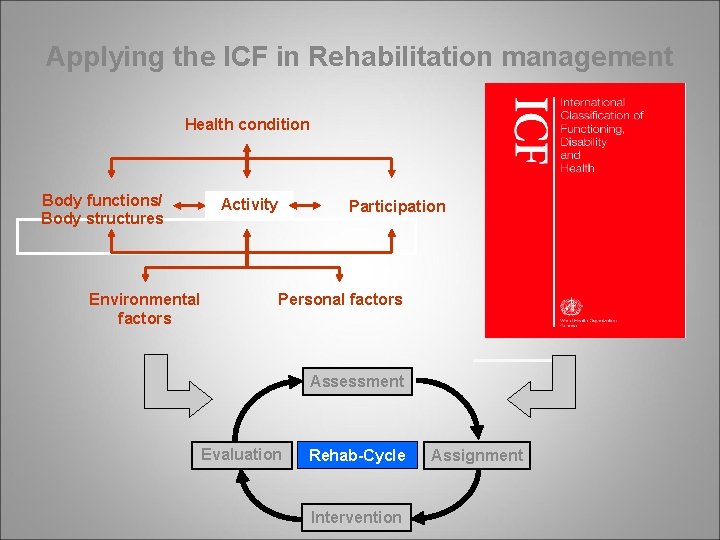
Rehabilitation management and ICF Definition Rehabilitation At the core of rehabilitation care provision are the evolving problems and needs of individuals in relation to functioning. Functioning is the starting point of a patient and goal oriented, evidence-based and iterative rehabilitation process Rauch A, Cieza A, Stucki G. How to apply the International Classification of Functioning, Disability and Health (ICF) for rehabilitation management in clinical practice. Eur J Phys Med Rehabil Med 2008; 44: 329 -42
Functioning – the individual’s experience Some examples
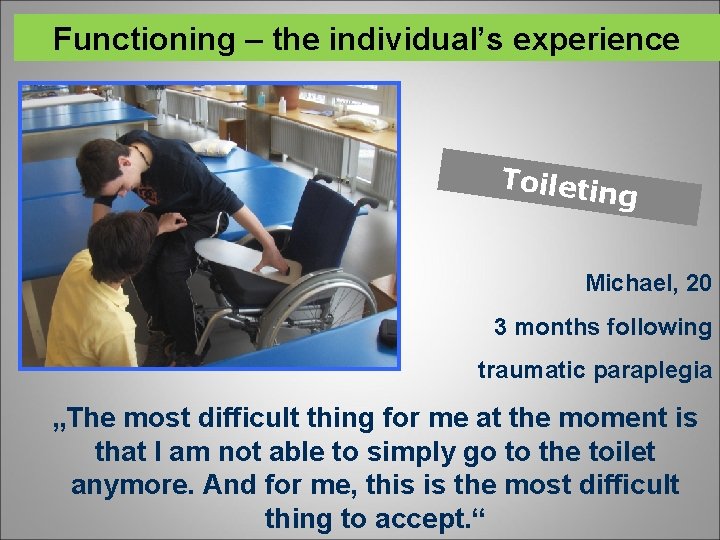
Functioning – the individual’s experience Toiletin g Michael, 20 3 months following traumatic paraplegia „The most difficult thing for me at the moment is that I am not able to simply go to the toilet anymore. And for me, this is the most difficult thing to accept. “
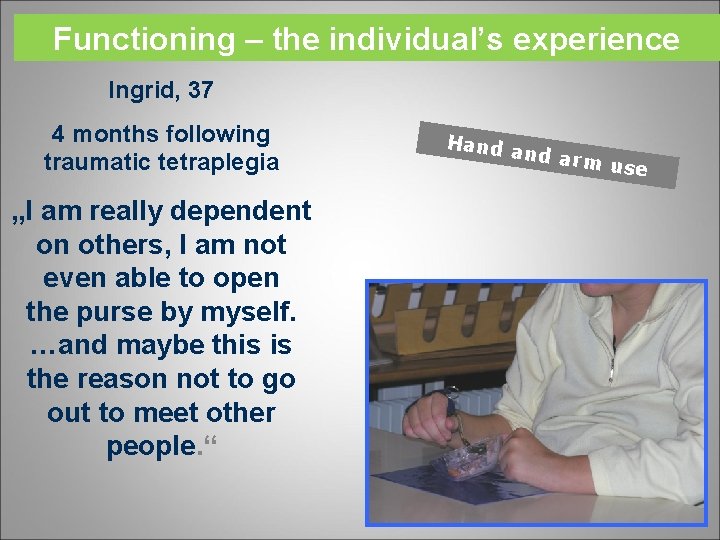
Functioning – the individual’s experience Ingrid, 37 4 months following traumatic tetraplegia „I am really dependent on others, I am not even able to open the purse by myself. …and maybe this is the reason not to go out to meet other people. “ Hand arm use
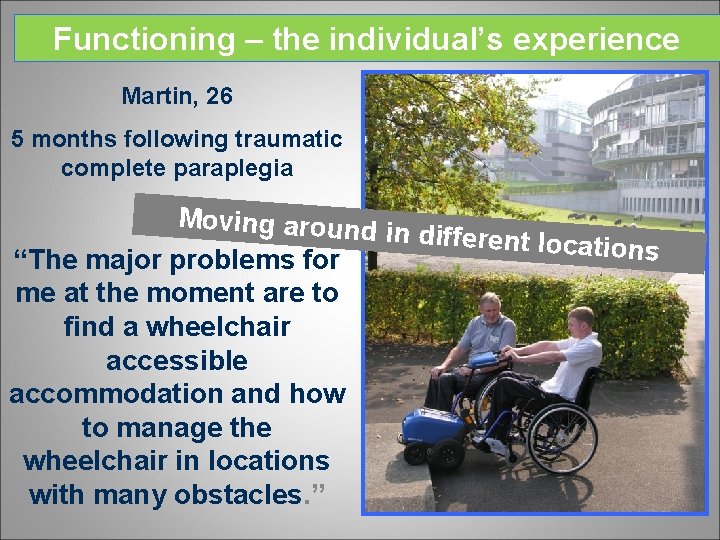
Functioning – the individual’s experience Martin, 26 5 months following traumatic complete paraplegia Moving around in different loca tions “The major problems for me at the moment are to find a wheelchair accessible accommodation and how to manage the wheelchair in locations with many obstacles. ”
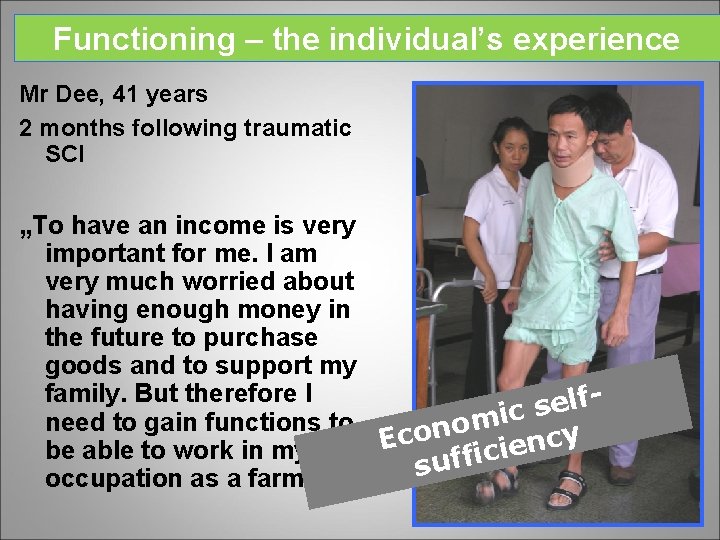
Functioning – the individual’s experience Mr Dee, 41 years 2 months following traumatic SCI „To have an income is very important for me. I am very much worried about having enough money in the future to purchase goods and to support my family. But therefore I fl e s ic need to gain functions to m o on y c c E n e be able to work in my i c i f f u s occupation as a farmer. “
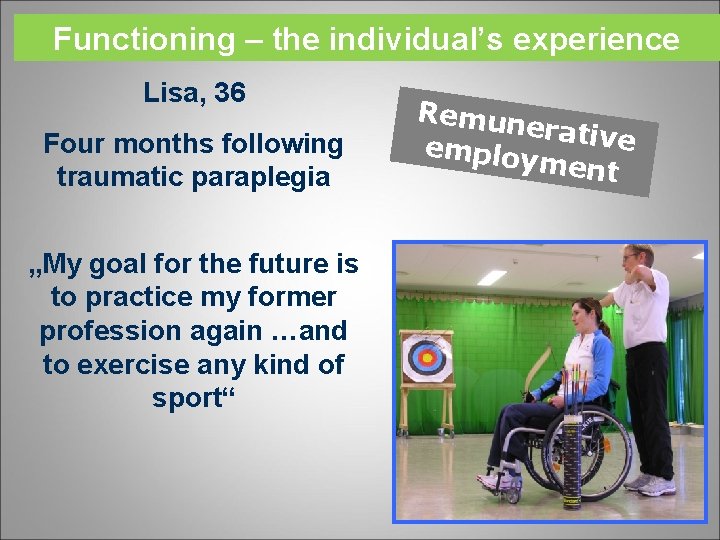
Functioning – the individual’s experience Lisa, 36 Four months following traumatic paraplegia „My goal for the future is to practice my former profession again …and to exercise any kind of sport“ Remun erative employ ment
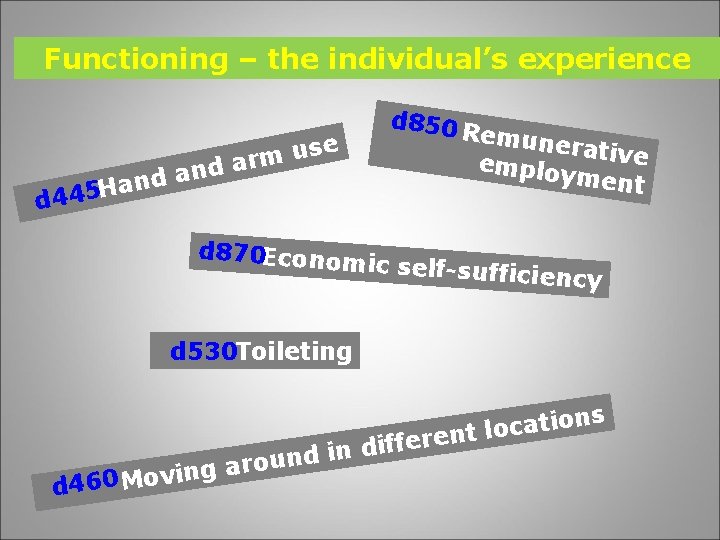
Functioning – the individual’s experience e s u m ar d n a H d 445 d 850 Remun erative employ ment d 870 Econom ic self-suffici ency d 530 Toileting ns tio a c o l t ren e f f i d nd in u o r a g n i v o 0 M 6 d 4
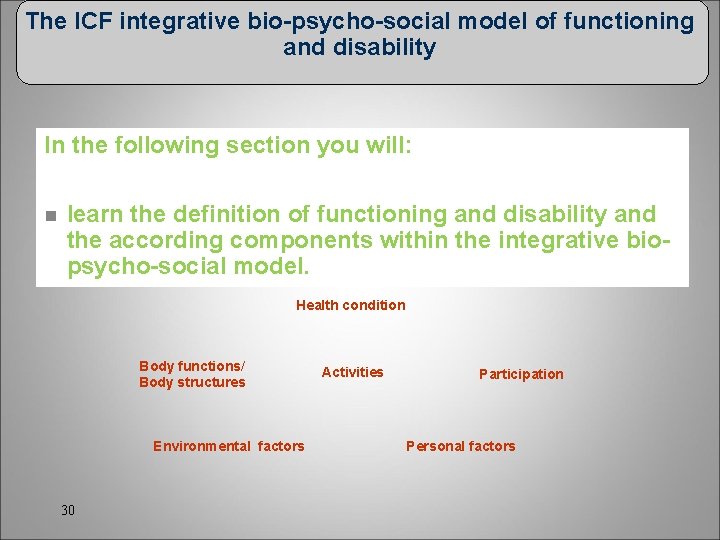
The ICF integrative bio-psycho-social model of functioning and disability In the following section you will: n learn the definition of functioning and disability and the according components within the integrative biopsycho-social model. Health condition Body functions/ Body structures Environmental factors 30 Activities Participation Personal factors
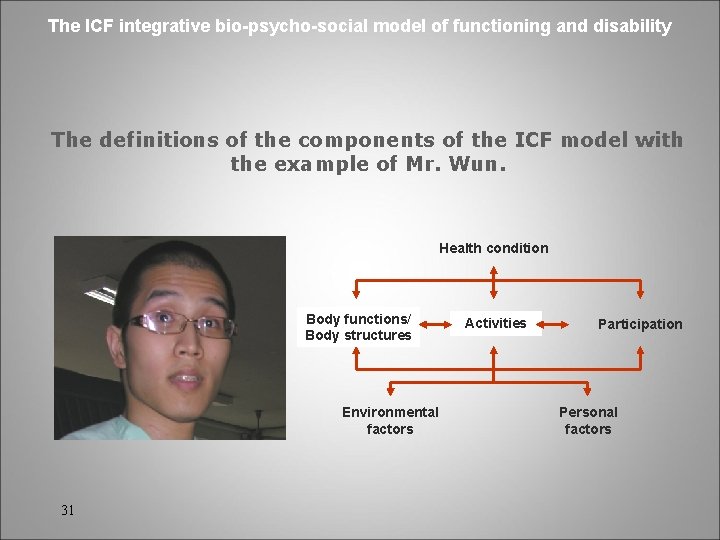
The ICF integrative bio-psycho-social model of functioning and disability The definitions of the components of the ICF model with the example of Mr. Wun. Health condition Body functions/ Body structures Environmental factors 31 Activities Participation Personal factors
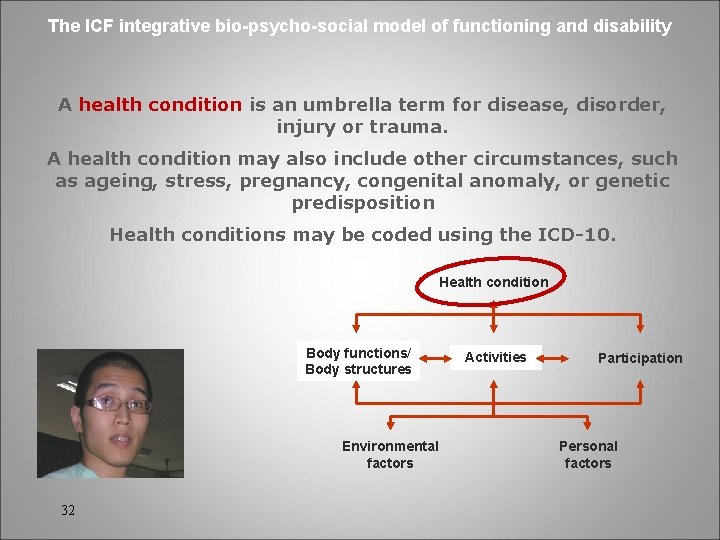
The ICF integrative bio-psycho-social model of functioning and disability A health condition is an umbrella term for disease, disorder, injury or trauma. A health condition may also include other circumstances, such as ageing, stress, pregnancy, congenital anomaly, or genetic predisposition Health conditions may be coded using the ICD-10. Health condition Body functions/ Body structures Environmental factors 32 Activities Participation Personal factors
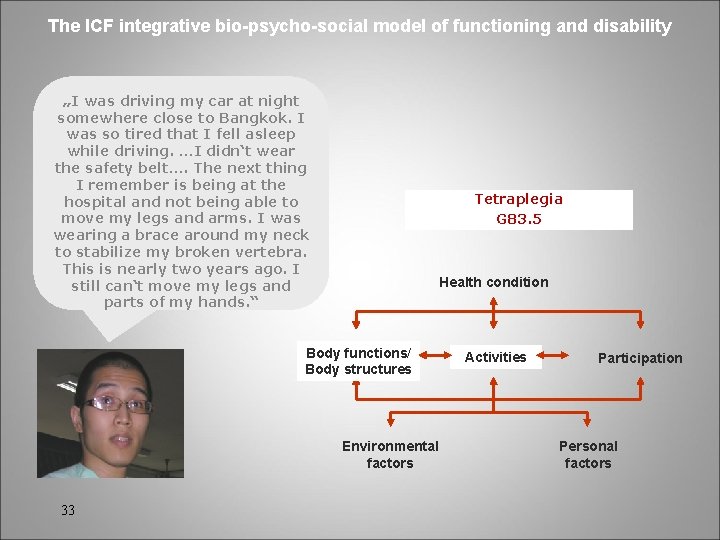
The ICF integrative bio-psycho-social model of functioning and disability „I was driving my car at night somewhere close to Bangkok. I was so tired that I fell asleep while driving. …I didn‘t wear the safety belt…. The next thing I remember is being at the hospital and not being able to move my legs and arms. I was wearing a brace around my neck to stabilize my broken vertebra. This is nearly two years ago. I still can‘t move my legs and parts of my hands. “ Tetraplegia G 83. 5 Health condition Body functions/ Body structures Environmental factors 33 Activities Participation Personal factors
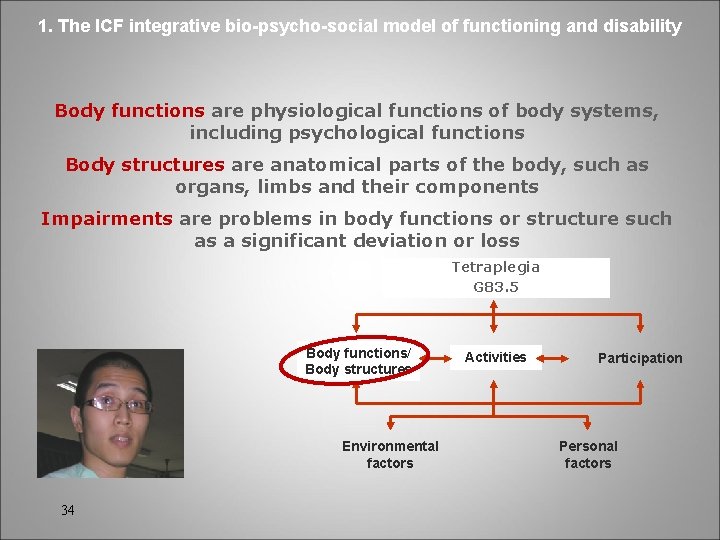
1. The ICF integrative bio-psycho-social model of functioning and disability Body functions are physiological functions of body systems, including psychological functions Body structures are anatomical parts of the body, such as organs, limbs and their components Impairments are problems in body functions or structure such as a significant deviation or loss Tetraplegia Health condition G 83. 5 Body functions/ Body structures Environmental factors 34 Activities Participation Personal factors
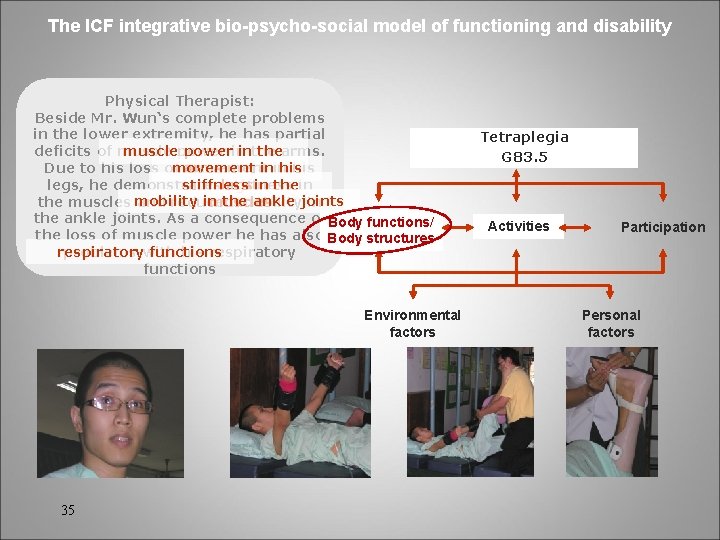
The ICF integrative bio-psycho-social model of functioning and disability Physical Therapist: Beside Mr. Wun‘s complete problems in the lower extremity, he has partial deficits of musclepowerin inthe thearms. Due to his loss of movement his arms movement inin his legs, he demonstrates stiffness legs stiffness in thein in the ankle joints the muscles mobility and reduced mobility in muscles the ankle joints. As a consequence of Body functions/ the loss of muscle power he has also Body structures problems with his respiratory functions Environmental factors 35 Tetraplegia Health. G 83. 5 condition Activities Participation Personal factors
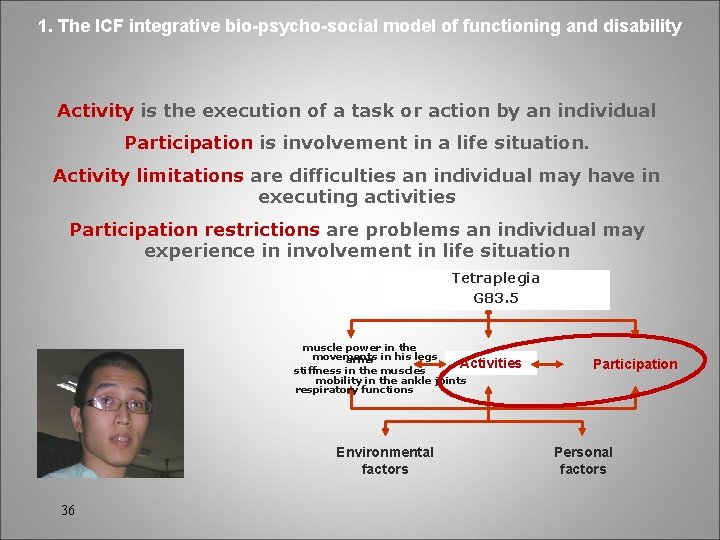
1. The ICF integrative bio-psycho-social model of functioning and disability Activity is the execution of a task or action by an individual Participation is involvement in a life situation. Activity limitations are difficulties an individual may have in executing activities Participation restrictions are problems an individual may experience in involvement in life situation Tetraplegia Health condition G 83. 5 muscle power in the movements arms in his legs Activities stiffness in the muscles mobility in the ankle joints respiratory functions Environmental factors 36 Participation Personal factors
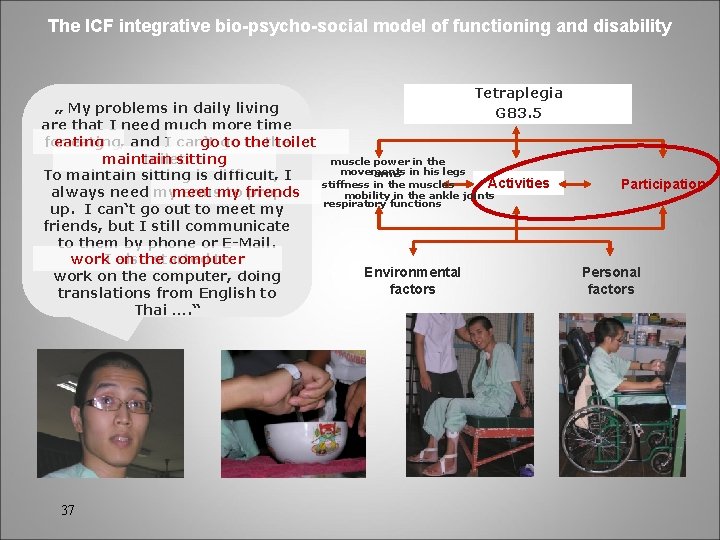
The ICF integrative bio-psycho-social model of functioning and disability „ My problems in daily living are that I need much more time for eating, and I can‘t eating go go to to thethe toilet. maintain sitting To maintain sitting is difficult, I always need mymeet armsmy to friends prop up. I can‘t go out to meet my friends, but I still communicate to them by phone or E-Mail. work. I on the computer also started to work on the computer, doing translations from English to Thai …. “ 37 Tetraplegia Health condition G 83. 5 muscle power in the movements arms in his legs Activities stiffness in the muscles mobility in the ankle joints respiratory functions Environmental factors Participation Personal factors
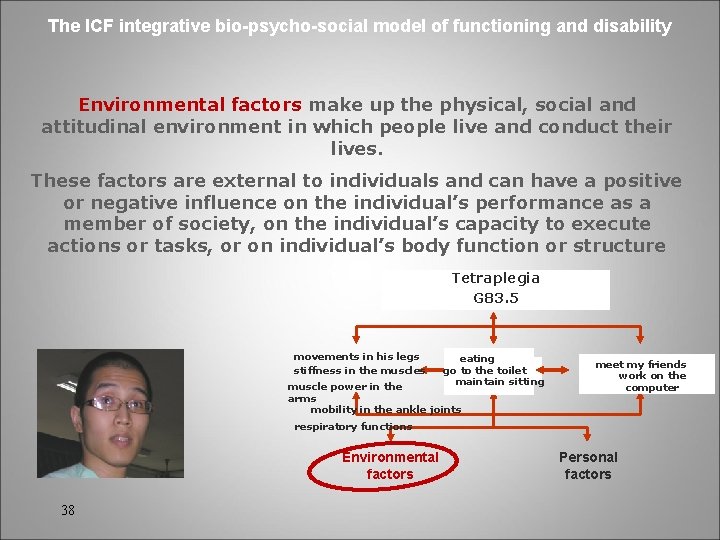
The ICF integrative bio-psycho-social model of functioning and disability Environmental factors make up the physical, social and attitudinal environment in which people live and conduct their lives. These factors are external to individuals and can have a positive or negative influence on the individual’s performance as a member of society, on the individual’s capacity to execute actions or tasks, or on individual’s body function or structure Tetraplegia Health condition G 83. 5 movements in his legs stiffness in the muscles eating Activities go to the toilet maintain sitting muscle power in the arms mobility in the ankle joints meet my friends Participation work on the computer respiratory functions Environmental factors 38 Personal factors
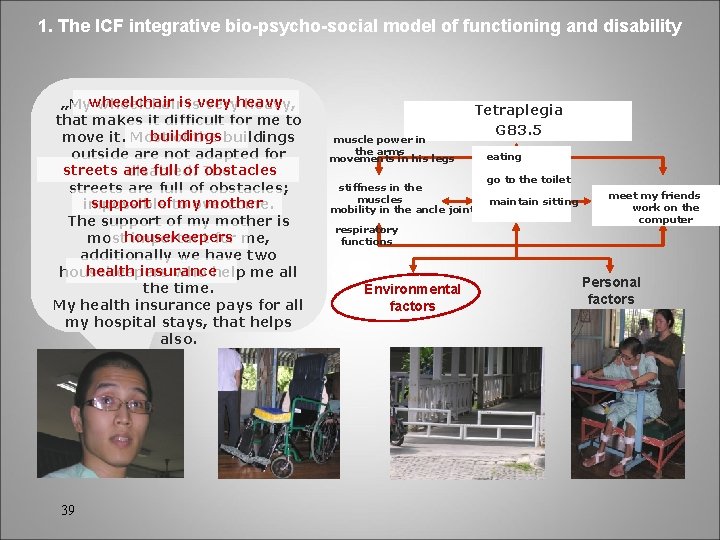
1. The ICF integrative bio-psycho-social model of functioning and disability „Mywheelchairisisveryheavy, that makes it difficult for me to buildings move it. Most of the buildings outside are not adapted for streets are full of The obstacles disabled. streets are full of obstacles; support ofto my mother impossible overcome. The support of my mother is mosthousekeepers important for me, additionally we have two health insurance housekeepers who help me all the time. My health insurance pays for all my hospital stays, that helps also. 39 muscle power in the arms movements in his legs Tetraplegia Health condition G 83. 5 eating go to the toilet stiffness in the muscles Activities maintain sitting mobility in the ancle joints respiratory functions Environmental factors meet my friends Participation work on the computer Personal factors
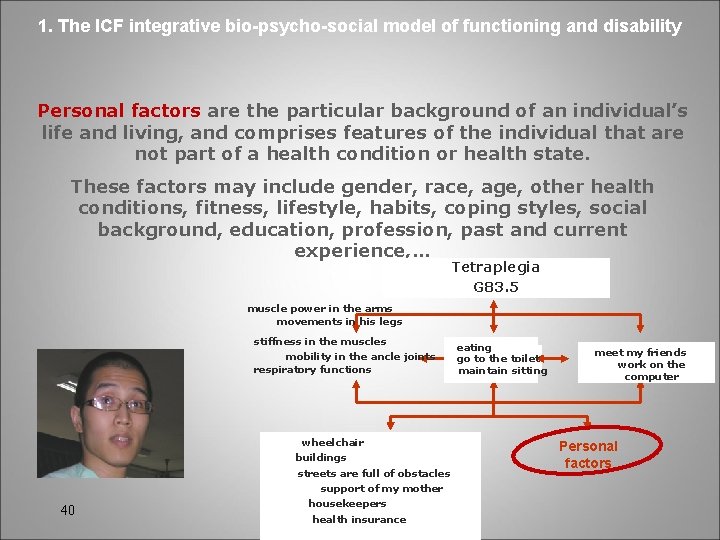
1. The ICF integrative bio-psycho-social model of functioning and disability Personal factors are the particular background of an individual’s life and living, and comprises features of the individual that are not part of a health condition or health state. These factors may include gender, race, age, other health conditions, fitness, lifestyle, habits, coping styles, social background, education, profession, past and current experience, … Tetraplegia Health condition G 83. 5 muscle power in the arms movements in his legs stiffness in the muscles mobility in the ancle joints respiratory functions wheelchair Environmental factors buildings streets are full of obstacles support of my mother 40 housekeepers health insurance eating Activities go to the toilet maintain sitting meet my friends Participation work on the computer Personal factors
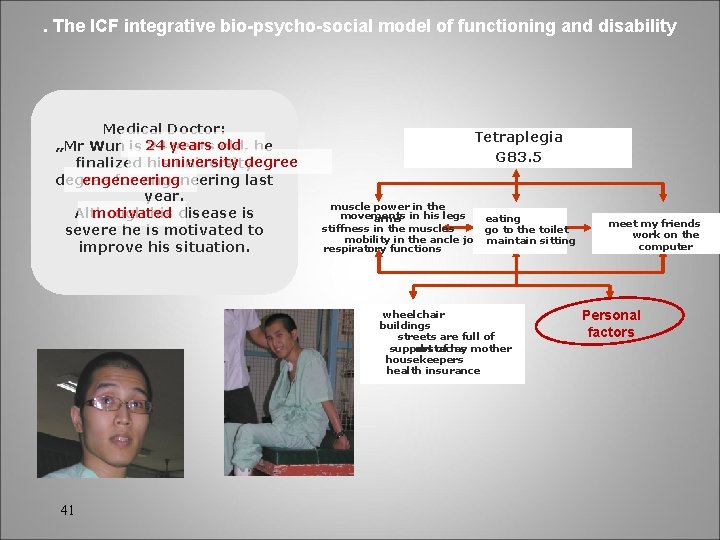
. The ICF integrative bio-psycho-social model of functioning and disability Medical Doctor: „Mr Wun is 24 24 years old, he university degree finalized his university degree for engeneering last engeneering year. Although his disease is motivated severe he is motivated to improve his situation. Tetraplegia Health condition G 83. 5 muscle power in the movements eating arms in his legs Activities stiffness in the muscles go to the toilet mobility in the ancle joints maintain sitting respiratory functions wheelchair Environmental buildings factors streets are full of support of my mother obstacles housekeepers health insurance 41 meet my friends Participation work on the computer Personal factors
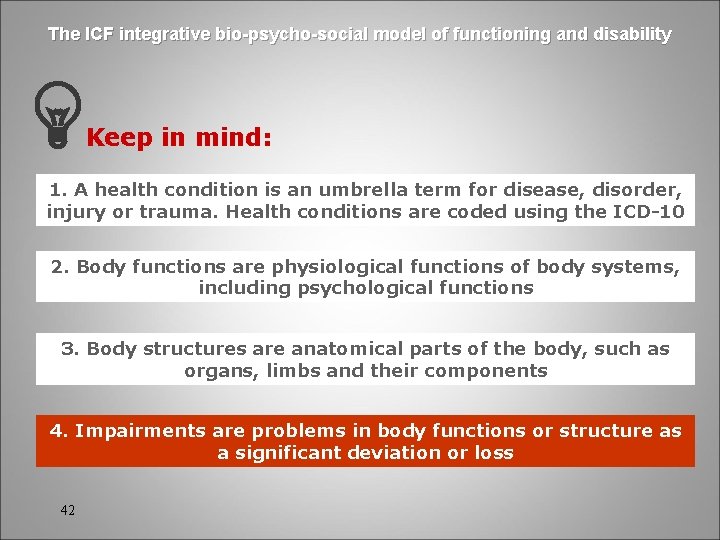
The ICF integrative bio-psycho-social model of functioning and disability Keep in mind: 1. A health condition is an umbrella term for disease, disorder, injury or trauma. Health conditions are coded using the ICD-10 2. Body functions are physiological functions of body systems, including psychological functions 3. Body structures are anatomical parts of the body, such as organs, limbs and their components 4. Impairments are problems in body functions or structure as a significant deviation or loss 42
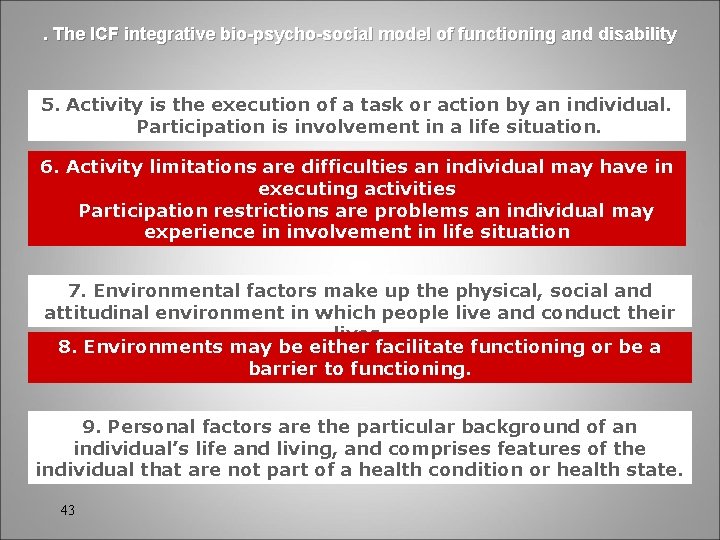
. The ICF integrative bio-psycho-social model of functioning and disability 5. Activity is the execution of a task or action by an individual. Participation is involvement in a life situation. 6. Activity limitations are difficulties an individual may have in executing activities Participation restrictions are problems an individual may experience in involvement in life situation 7. Environmental factors make up the physical, social and attitudinal environment in which people live and conduct their lives. 8. Environments may be either facilitate functioning or be a barrier to functioning. 9. Personal factors are the particular background of an individual’s life and living, and comprises features of the individual that are not part of a health condition or health state. 43
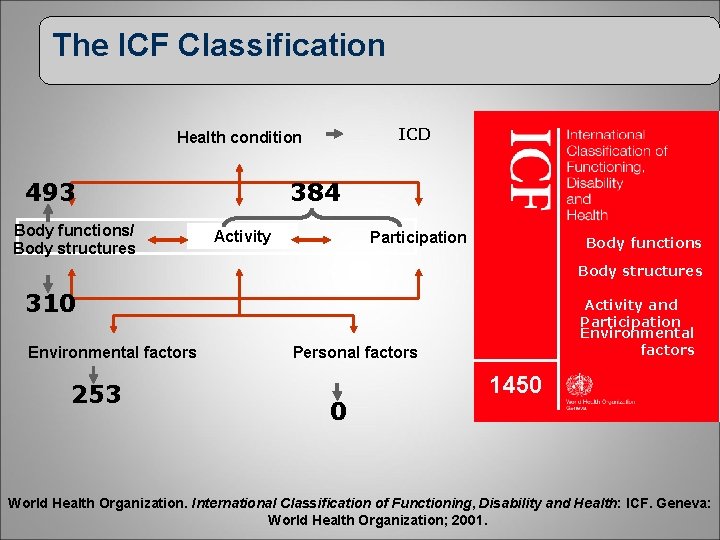
The ICF Classification ICD Health condition 493 Body functions/ Body structures 384 Activity Participation Body functions Body structures 310 Environmental factors 253 Activity and Participation Environmental factors Personal factors 0 1450 World Health Organization. International Classification of Functioning, Disability and Health: ICF. Geneva: World Health Organization; 2001.
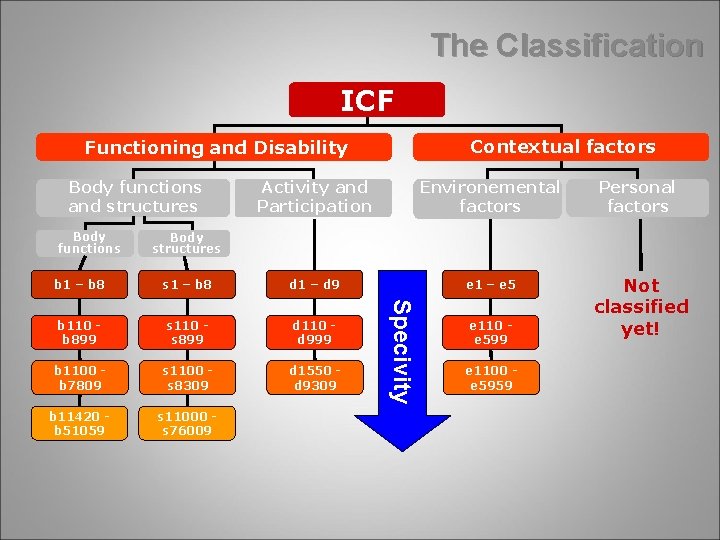
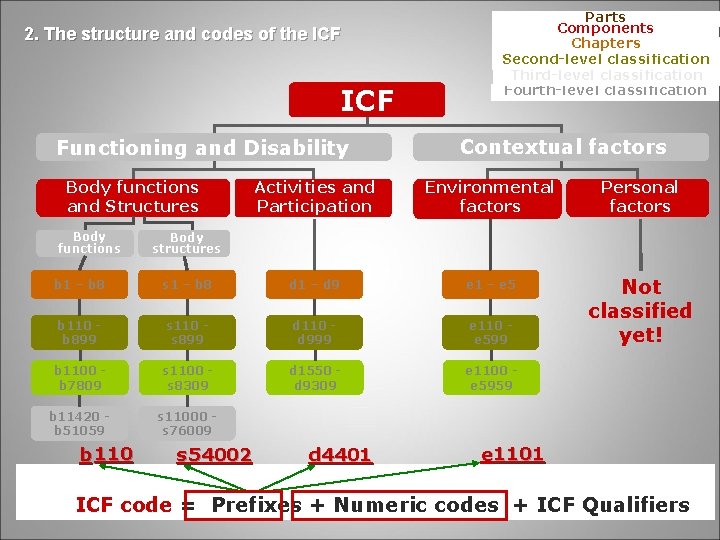
The Classification ICF Contextual factors Functioning and Disability Body functions and structures Body functions Activity and Participation Environemental factors Personal factors e 1 – e 5 Not classified yet! Body structures s 1 – b 8 d 1 – d 9 b 110 b 899 s 110 s 899 d 110 d 999 b 1100 b 7809 s 1100 s 8309 d 1550 d 9309 b 11420 b 51059 s 11000 s 76009 Specivity b 1 – b 8 e 110 e 599 e 1100 e 5959
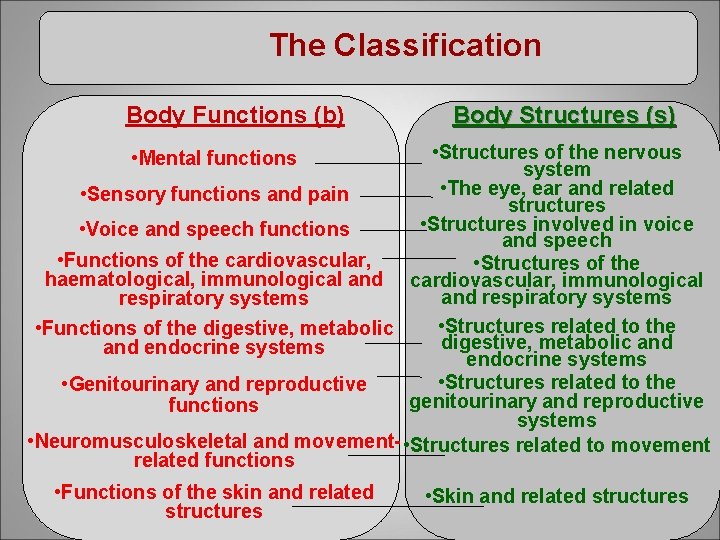
The Classification Body Functions (b) Body Structures (s) • Structures of the nervous system • The eye, ear and related • Sensory functions and pain structures • Structures involved in voice • Voice and speech functions and speech • Functions of the cardiovascular, • Structures of the haematological, immunological and cardiovascular, immunological and respiratory systems • Structures related to the • Functions of the digestive, metabolic and endocrine systems • Structures related to the • Genitourinary and reproductive genitourinary and reproductive functions systems • Neuromusculoskeletal and movement- • Structures related to movement related functions • Mental functions • Functions of the skin and related structures • Skin and related structures
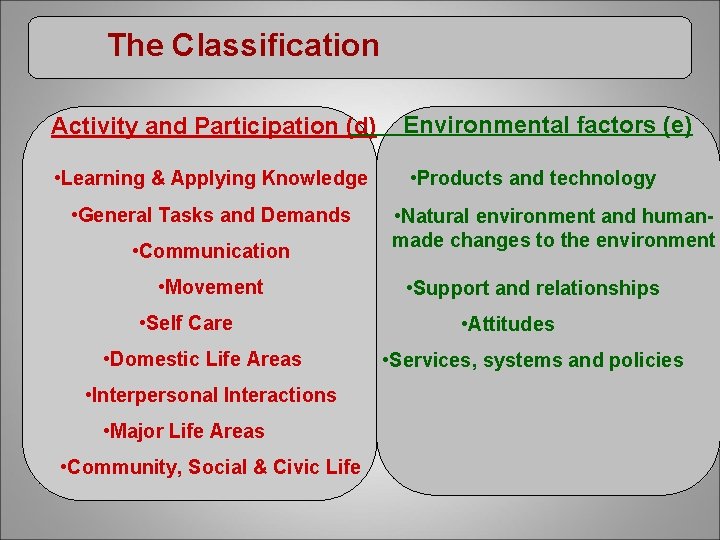
The Classification Activity and Participation (d) Environmental factors (e) • Learning & Applying Knowledge • Products and technology • General Tasks and Demands • Communication • Movement • Self Care • Domestic Life Areas • Interpersonal Interactions • Major Life Areas • Community, Social & Civic Life • Natural environment and humanmade changes to the environment • Support and relationships • Attitudes • Services, systems and policies
The structure and codes of the ICF In the following section you will… • learn the organization of the structure and codes of the classification • understand the benefit of describing functioning at different levels in the hierarchical structure 48
2. The structure and codes of the ICF Keep in mind: 1. Classification is the placing of similar objects into groups 2. Objects are often organized in a hierarchical structure 49
2. The structure and codes of the ICF The integrative bio-psycho-social model of functioning and disability is the basis for the ICF classification. There are large numbers of factors grouped into the components of the ICF model (except the personal factors). Health condition 493 Body functions/ Body structures classified within ICD 384 Activities Participation Body structures 310 Environmental factors 253 50 Body functions Personal factors 0 Activites & participation Environmental factors
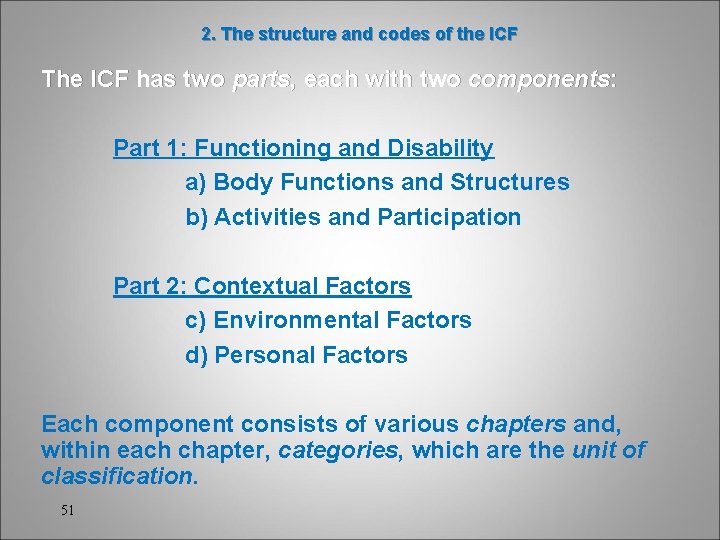
2. The structure and codes of the ICF The ICF has two parts, each with two components: Part 1: Functioning and Disability a) Body Functions and Structures b) Activities and Participation Part 2: Contextual Factors c) Environmental Factors d) Personal Factors Each component consists of various chapters and, within each chapter, categories, which are the unit of classification. 51
2. The structure and codes of the ICF Functioning and Disability Body functions and Structures Body functions Parts Components Chapters Second-level classification Third-level classification Fourth-level classification Contextual factors Activities and Participation Environmental factors Personal factors Not classified yet! Body structures b 1 – b 8 s 1 – b 8 d 1 – d 9 e 1 – e 5 b 110 b 899 s 110 s 899 d 110 d 999 e 110 e 599 b 1100 b 7809 s 1100 s 8309 d 1550 d 9309 e 1100 e 5959 b 11420 b 51059 s 11000 s 76009 b 110 52 ICF s 54002 d 4401 e 1101 code = Prefixes + Numeric codes + ICF Qualifiers
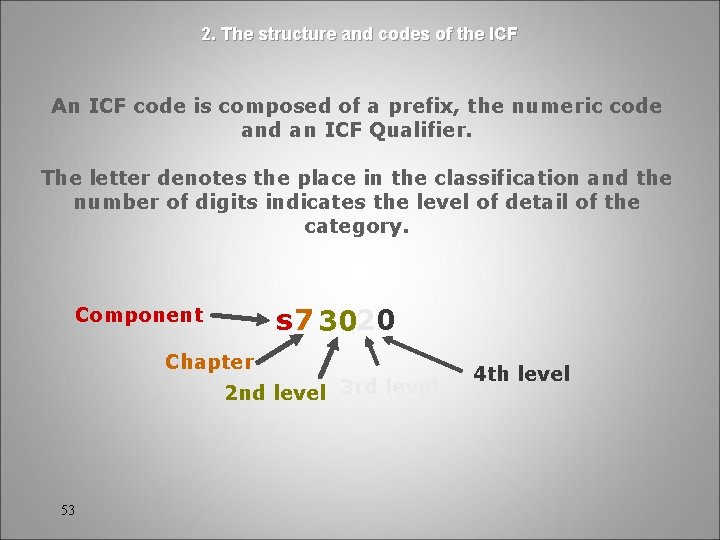
2. The structure and codes of the ICF An ICF code is composed of a prefix, the numeric code and an ICF Qualifier. The letter denotes the place in the classification and the number of digits indicates the level of detail of the category. s 7 302 0 Component Chapter 2 nd level 3 rd level 53 4 th level
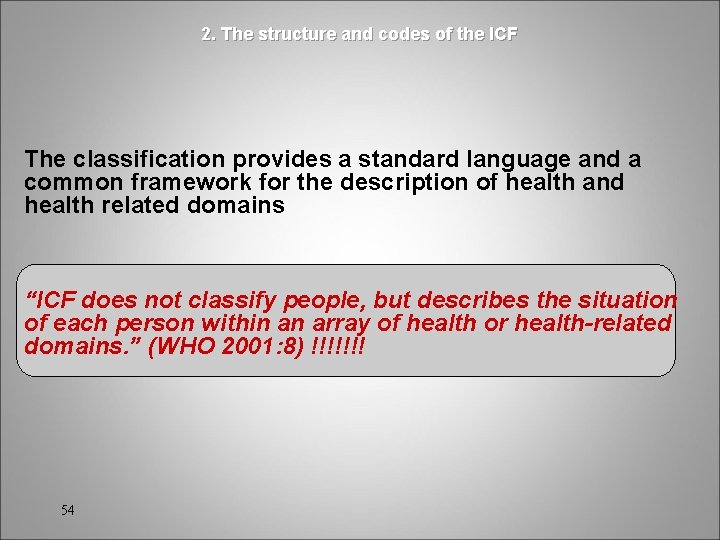
2. The structure and codes of the ICF The classification provides a standard language and a common framework for the description of health and health related domains “ICF does not classify people, but describes the situation of each person within an array of health or health-related domains. ” (WHO 2001: 8) !!!!!!! 54
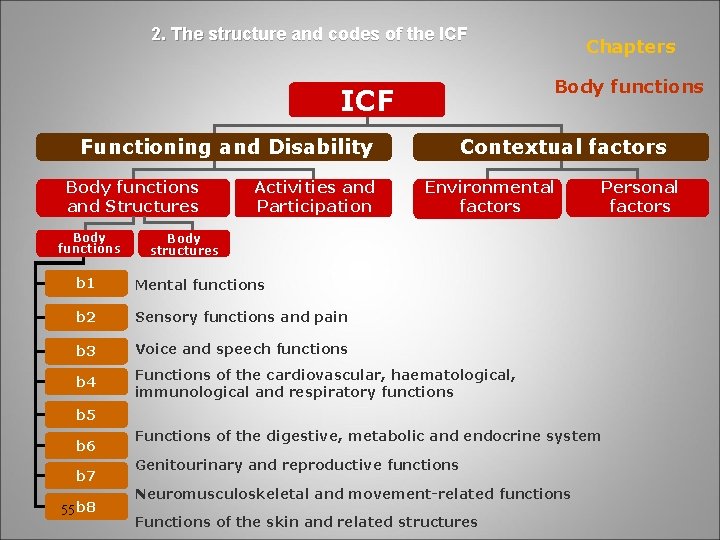
2. The structure and codes of the ICF Body functions ICF Contextual factors Functioning and Disability Body functions and Structures Body functions Activities and Participation Chapters Environmental factors Personal factors Body structures b 1 Mental functions b 2 Sensory functions and pain b 3 Voice and speech functions b 4 Functions of the cardiovascular, haematological, immunological and respiratory functions b 5 b 6 b 7 55 b 8 Functions of the digestive, metabolic and endocrine system Genitourinary and reproductive functions Neuromusculoskeletal and movement-related functions Functions of the skin and related structures
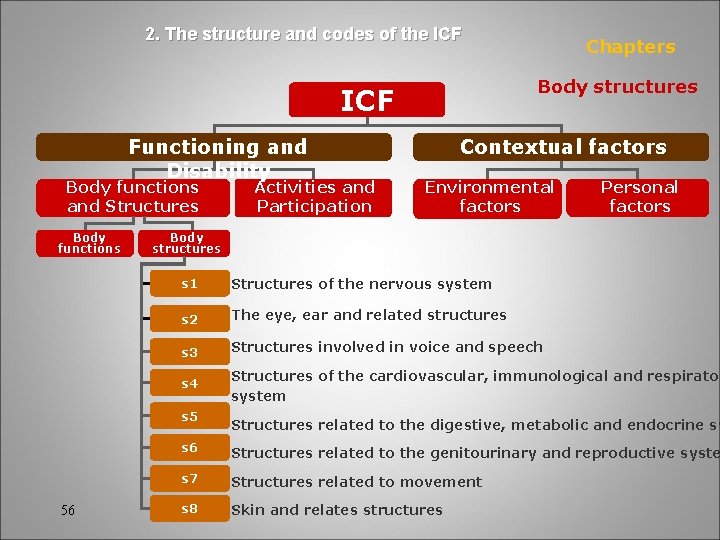
2. The structure and codes of the ICF Body structures ICF Functioning and Disability Body functions and Structures Body functions Contextual factors Environmental factors Personal factors Body structures s 1 Structures of the nervous system s 2 The eye, ear and related structures s 3 Structures involved in voice and speech s 4 Structures of the cardiovascular, immunological and respirator system s 5 56 Activities and Participation Chapters Structures related to the digestive, metabolic and endocrine sy s 6 Structures related to the genitourinary and reproductive syste s 7 Structures related to movement s 8 Skin and relates structures
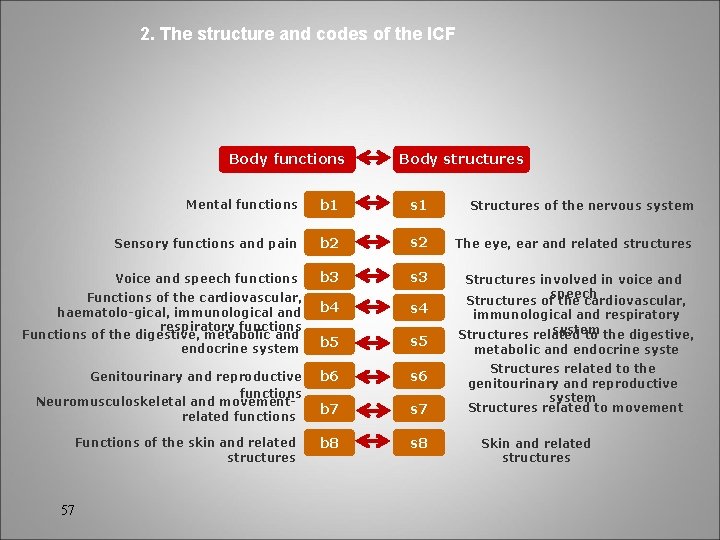
2. The structure and codes of the ICF Body functions Mental functions b 1 s 1 Structures of the nervous system Sensory functions and pain b 2 s 2 The eye, ear and related structures Voice and speech functions b 3 s 3 b 4 s 4 b 5 s 5 Structures involved in voice and speech Structures of the cardiovascular, immunological and respiratory system Structures related to the digestive, b 6 s 6 b 7 s 7 b 8 s 8 Functions of the cardiovascular, haematolo-gical, immunological and respiratory functions Functions of the digestive, metabolic and endocrine system Genitourinary and reproductive functions Neuromusculoskeletal and movementrelated functions Functions of the skin and related structures 57 Body structures metabolic and endocrine syste Structures related to the genitourinary and reproductive system Structures related to movement Skin and related structures
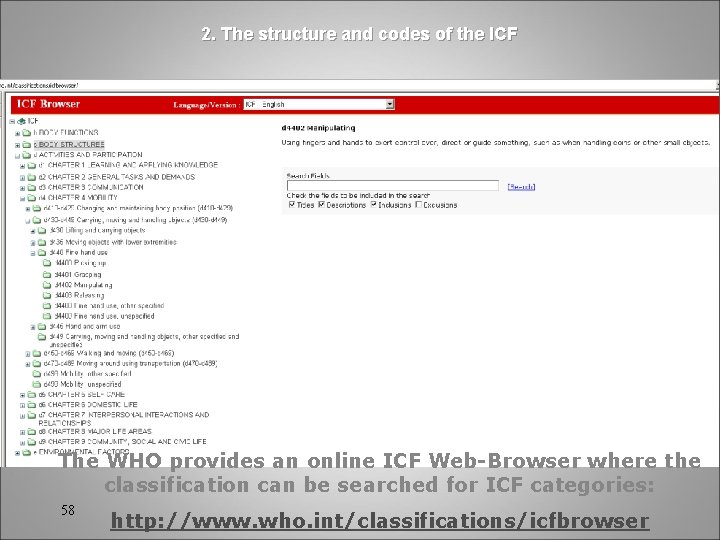
2. The structure and codes of the ICF The WHO provides an online ICF Web-Browser where the classification can be searched for ICF categories: 58 http: //www. who. int/classifications/icfbrowser
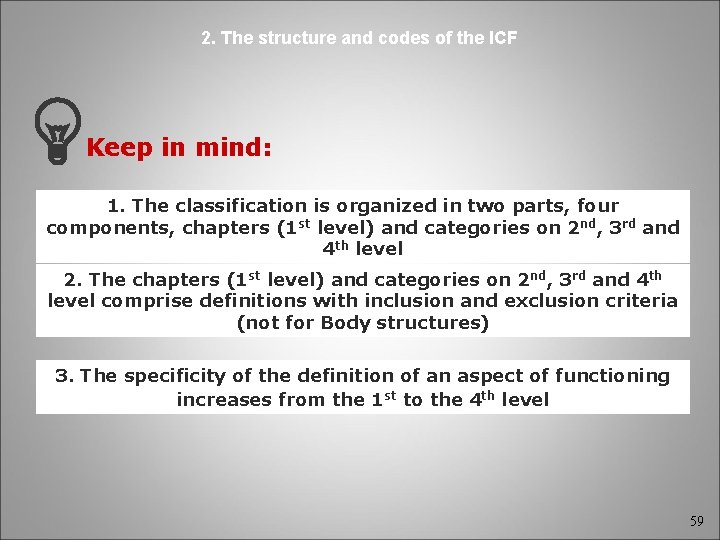
2. The structure and codes of the ICF Keep in mind: 1. The classification is organized in two parts, four components, chapters (1 st level) and categories on 2 nd, 3 rd and 4 th level 2. The chapters (1 st level) and categories on 2 nd, 3 rd and 4 th level comprise definitions with inclusion and exclusion criteria (not for Body structures) 3. The specificity of the definition of an aspect of functioning increases from the 1 st to the 4 th level 59
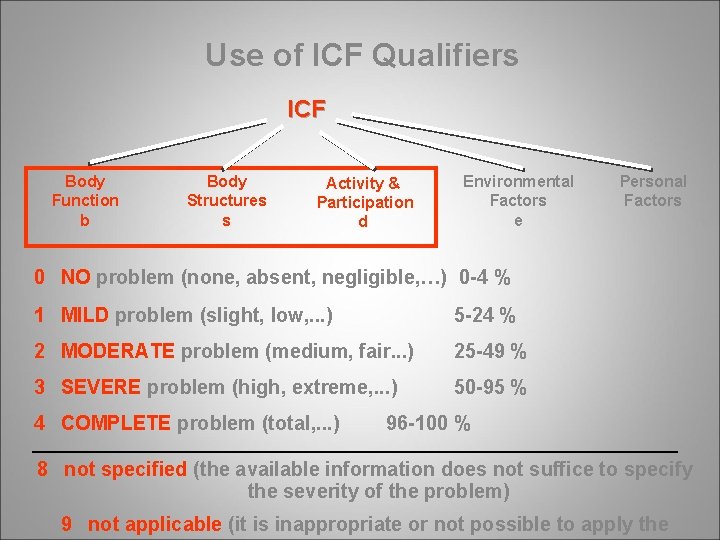
Use of ICF Qualifiers ICF Body Function b Body Structures s Activity & Participation d Environmental Factors e Personal Factors 0 NO problem (none, absent, negligible, …) 0 -4 % 1 MILD problem (slight, low, . . . ) 5 -24 % 2 MODERATE problem (medium, fair. . . ) 25 -49 % 3 SEVERE problem (high, extreme, . . . ) 50 -95 % 4 COMPLETE problem (total, . . . ) 96 -100 % 8 not specified (the available information does not suffice to specify the severity of the problem) 9 not applicable (it is inappropriate or not possible to apply the
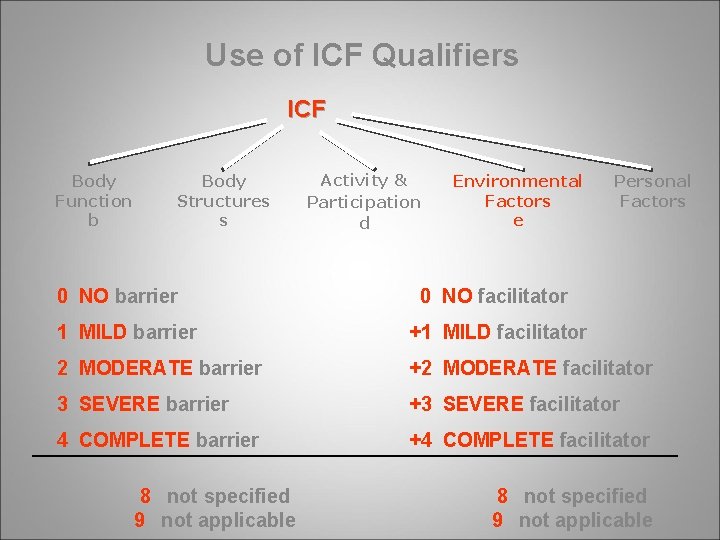
Use of ICF Qualifiers ICF Body Function b Body Structures s 0 NO barrier Activity & Participation d Environmental Factors e Personal Factors 0 NO facilitator 1 MILD barrier +1 MILD facilitator 2 MODERATE barrier +2 MODERATE facilitator 3 SEVERE barrier +3 SEVERE facilitator 4 COMPLETE barrier +4 COMPLETE facilitator 8 not specified 9 not applicable
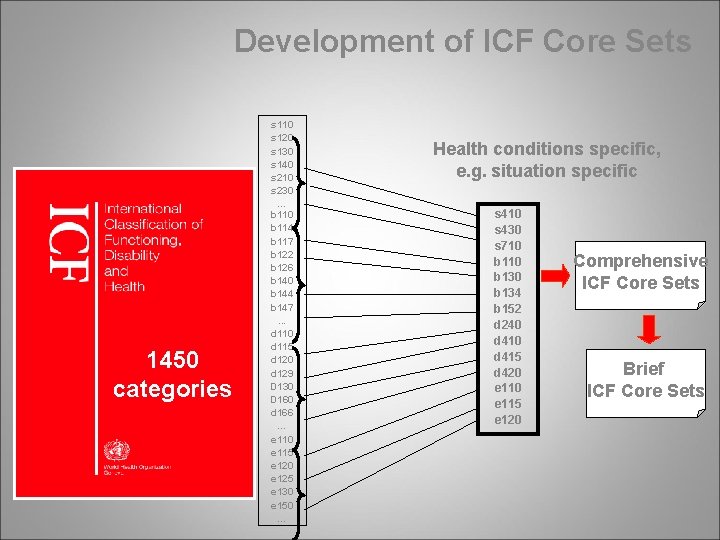
Development of ICF Core Sets 1450 categories s 110 s 120 s 130 s 140 s 210 s 230 … b 110 b 114 b 117 b 122 b 126 b 140 b 144 b 147. . . d 110 d 115 d 120 d 129 D 130 D 160 d 166 … e 110 e 115 e 120 e 125 e 130 e 150 … Health conditions specific, e. g. situation specific s 410 s 430 s 710 b 130 b 134 b 152 d 240 d 415 d 420 e 115 e 120 Comprehensive ICF Core Sets Brief ICF Core Sets
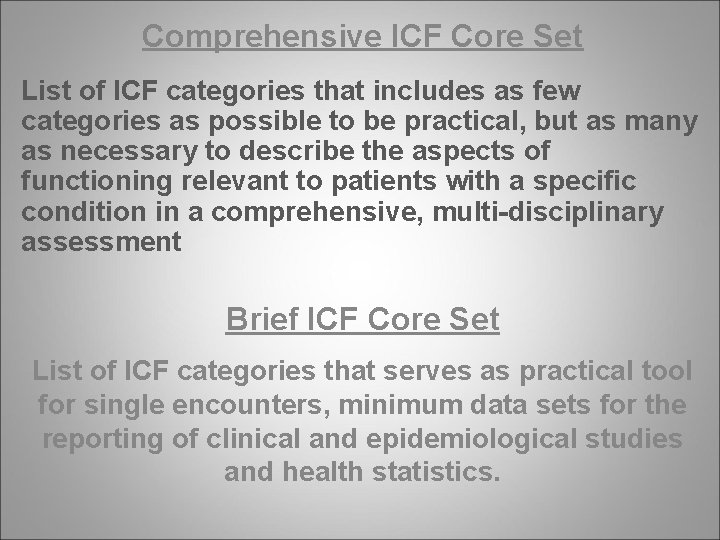
Comprehensive ICF Core Set List of ICF categories that includes as few categories as possible to be practical, but as many as necessary to describe the aspects of functioning relevant to patients with a specific condition in a comprehensive, multi-disciplinary assessment Brief ICF Core Set List of ICF categories that serves as practical tool for single encounters, minimum data sets for the reporting of clinical and epidemiological studies and health statistics.
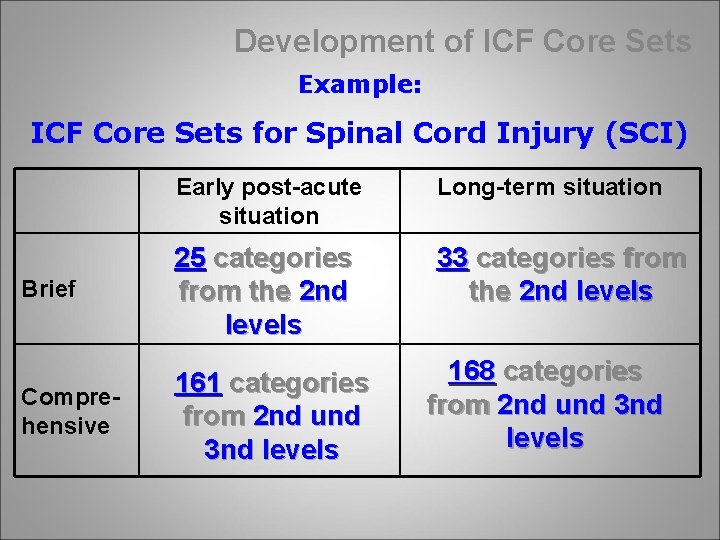
Development of ICF Core Sets Example: ICF Core Sets for Spinal Cord Injury (SCI) Early post-acute situation Long-term situation Brief 25 categories from the 2 nd levels 33 categories from the 2 nd levels Comprehensive 161 categories from 2 nd und 3 nd levels 168 categories from 2 nd und 3 nd levels
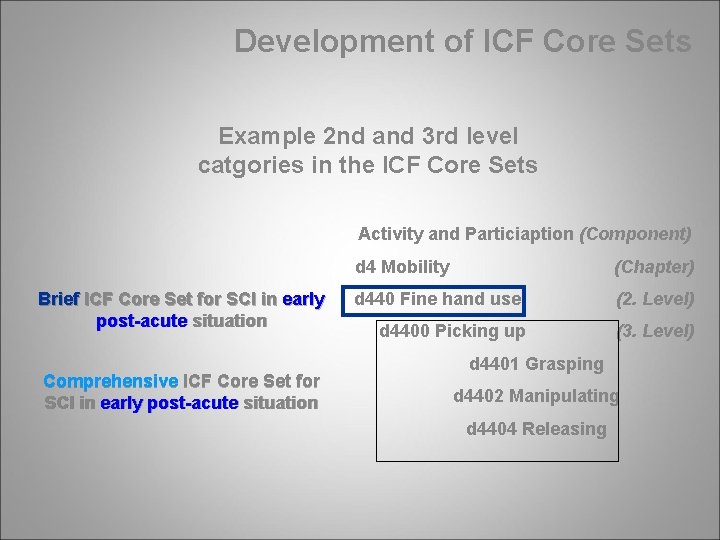
Development of ICF Core Sets Example 2 nd and 3 rd level catgories in the ICF Core Sets Activity and Particiaption (Component) Brief ICF Core Set for SCI in early post-acute situation Comprehensive ICF Core Set for SCI in early post-acute situation d 4 Mobility (Chapter) d 440 Fine hand use (2. Level) d 4400 Picking up (3. Level) d 4401 Grasping d 4402 Manipulating d 4404 Releasing
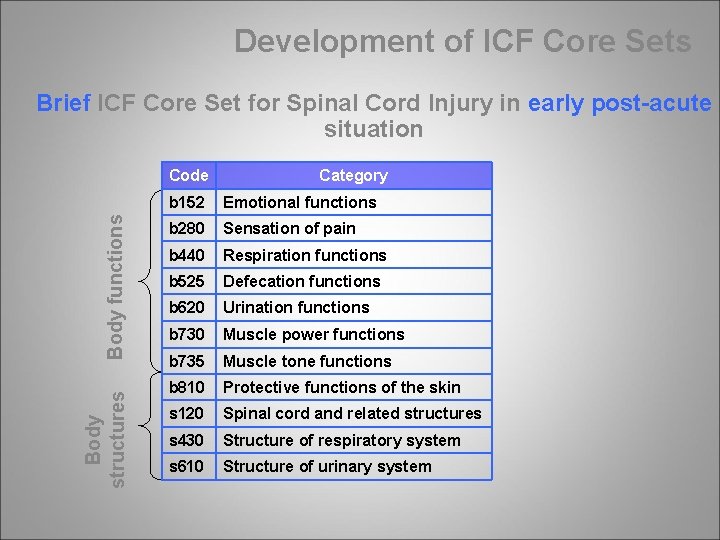
Development of ICF Core Sets Brief ICF Core Set for Spinal Cord Injury in early post-acute situation Body structures Body functions Code Category b 152 Emotional functions b 280 Sensation of pain b 440 Respiration functions b 525 Defecation functions b 620 Urination functions b 730 Muscle power functions b 735 Muscle tone functions b 810 Protective functions of the skin s 120 Spinal cord and related structures s 430 Structure of respiratory system s 610 Structure of urinary system
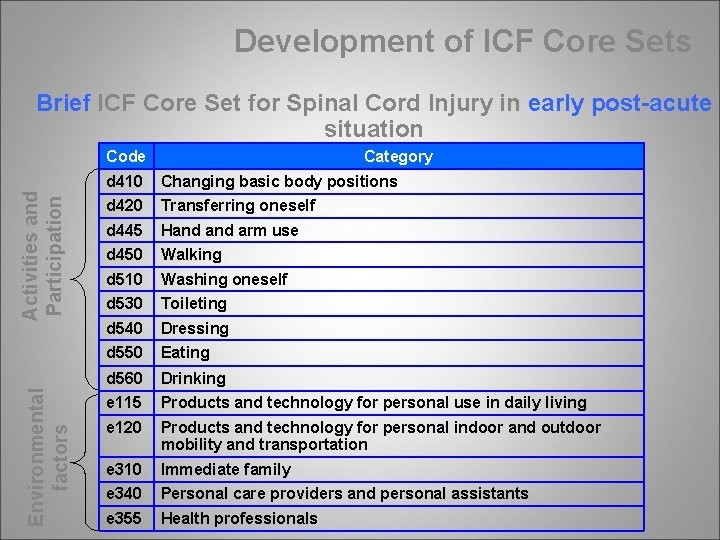
Development of ICF Core Sets Brief ICF Core Set for Spinal Cord Injury in early post-acute situation Environmental factors Activities and Participation Code Category d 410 Changing basic body positions d 420 Transferring oneself d 445 Hand arm use d 450 Walking d 510 Washing oneself d 530 Toileting d 540 Dressing d 550 Eating d 560 Drinking e 115 Products and technology for personal use in daily living e 120 Products and technology for personal indoor and outdoor mobility and transportation e 310 Immediate family e 340 Personal care providers and personal assistants e 355 Health professionals
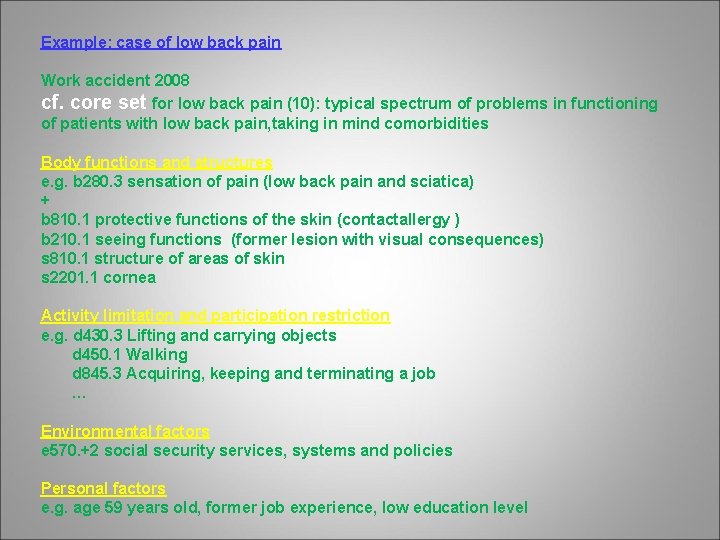
Example: case of low back pain Work accident 2008 cf. core set for low back pain (10): typical spectrum of problems in functioning of patients with low back pain, taking in mind comorbidities Body functions and structures e. g. b 280. 3 sensation of pain (low back pain and sciatica) + b 810. 1 protective functions of the skin (contactallergy ) b 210. 1 seeing functions (former lesion with visual consequences) s 810. 1 structure of areas of skin s 2201. 1 cornea Activity limitation and participation restriction e. g. d 430. 3 Lifting and carrying objects d 450. 1 Walking d 845. 3 Acquiring, keeping and terminating a job … Environmental factors e 570. +2 social security services, systems and policies Personal factors e. g. age 59 years old, former job experience, low education level
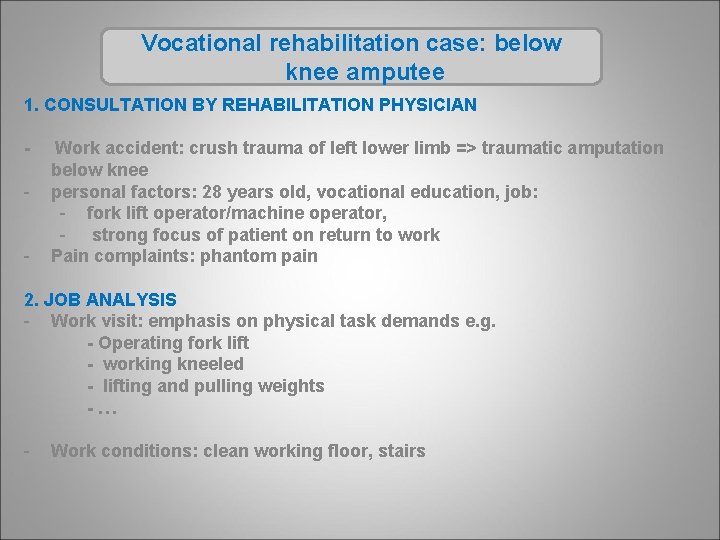
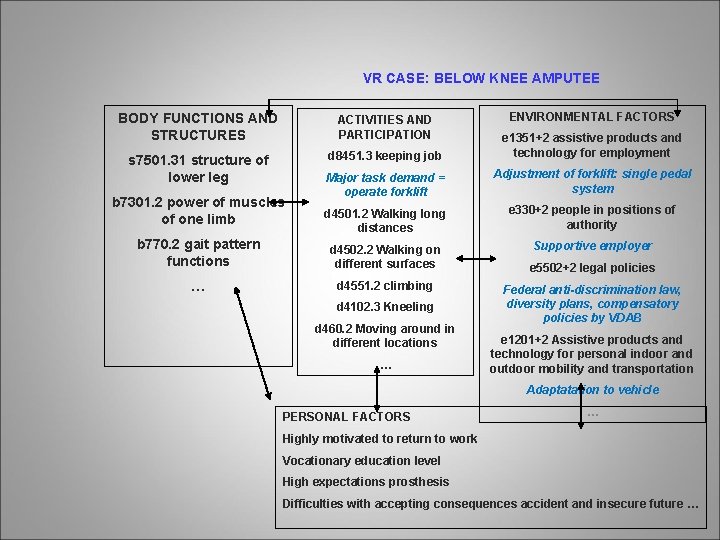
Vocational rehabilitation case: below knee amputee 1. CONSULTATION BY REHABILITATION PHYSICIAN - - Work accident: crush trauma of left lower limb => traumatic amputation below knee personal factors: 28 years old, vocational education, job: - fork lift operator/machine operator, - strong focus of patient on return to work Pain complaints: phantom pain 2. JOB ANALYSIS - Work visit: emphasis on physical task demands e. g. - Operating fork lift - working kneeled - lifting and pulling weights -… - Work conditions: clean working floor, stairs
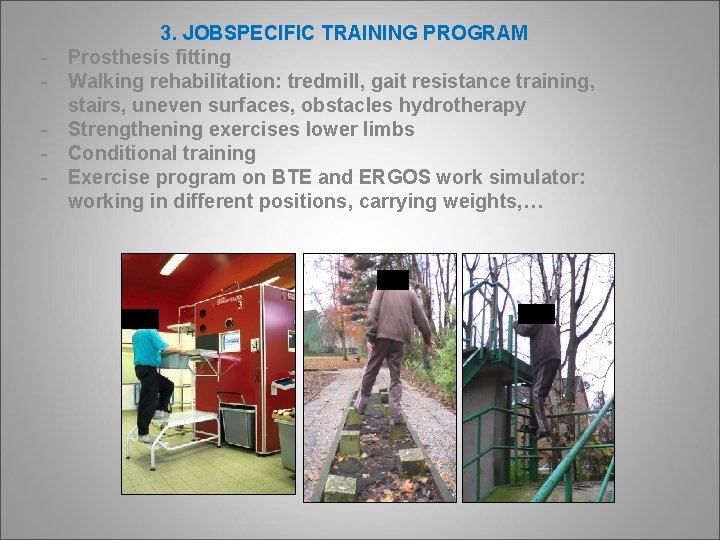
- 3. JOBSPECIFIC TRAINING PROGRAM Prosthesis fitting Walking rehabilitation: tredmill, gait resistance training, stairs, uneven surfaces, obstacles hydrotherapy Strengthening exercises lower limbs Conditional training Exercise program on BTE and ERGOS work simulator: working in different positions, carrying weights, …
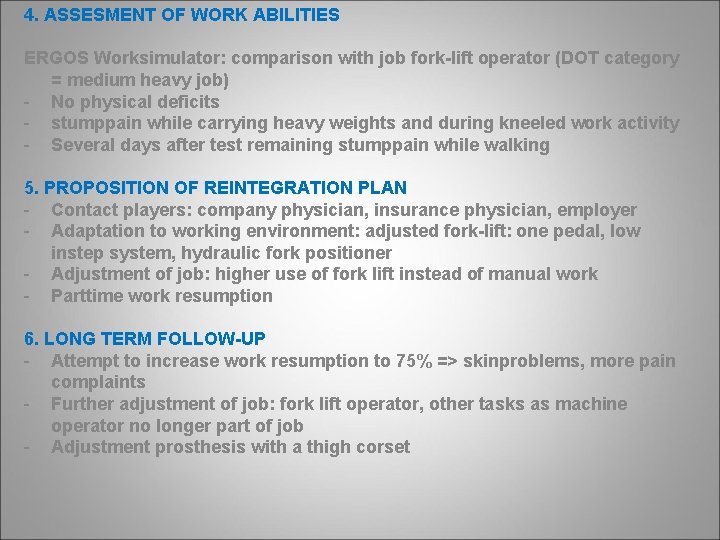
4. ASSESMENT OF WORK ABILITIES ERGOS Worksimulator: comparison with job fork-lift operator (DOT category = medium heavy job) - No physical deficits - stumppain while carrying heavy weights and during kneeled work activity - Several days after test remaining stumppain while walking 5. PROPOSITION OF REINTEGRATION PLAN - Contact players: company physician, insurance physician, employer - Adaptation to working environment: adjusted fork-lift: one pedal, low instep system, hydraulic fork positioner - Adjustment of job: higher use of fork lift instead of manual work - Parttime work resumption 6. LONG TERM FOLLOW-UP - Attempt to increase work resumption to 75% => skinproblems, more pain complaints - Further adjustment of job: fork lift operator, other tasks as machine operator no longer part of job - Adjustment prosthesis with a thigh corset
VR CASE: BELOW KNEE AMPUTEE ENVIRONMENTAL FACTORS BODY FUNCTIONS AND STRUCTURES ACTIVITIES AND PARTICIPATION s 7501. 31 structure of lower leg d 8451. 3 keeping job e 1351+2 assistive products and technology for employment Major task demand = operate forklift Adjustment of forklift: single pedal system d 4501. 2 Walking long distances e 330+2 people in positions of authority b 770. 2 gait pattern functions d 4502. 2 Walking on different surfaces Supportive employer … d 4551. 2 climbing b 7301. 2 power of muscles of one limb d 4102. 3 Kneeling d 460. 2 Moving around in different locations … e 5502+2 legal policies Federal anti-discrimination law, diversity plans, compensatory policies by VDAB e 1201+2 Assistive products and technology for personal indoor and outdoor mobility and transportation Adaptatation to vehicle PERSONAL FACTORS … Highly motivated to return to work Vocationary education level High expectations prosthesis Difficulties with accepting consequences accident and insecure future …
Rehabilitation management and ICF www. icf-casestudies. org
Applying the ICF in Rehabilitation management Health condition Body functions/ Body structures Environmental factors Activity Participation Personal factors Assessment Evaluation Rehab-Cycle Intervention Assignment
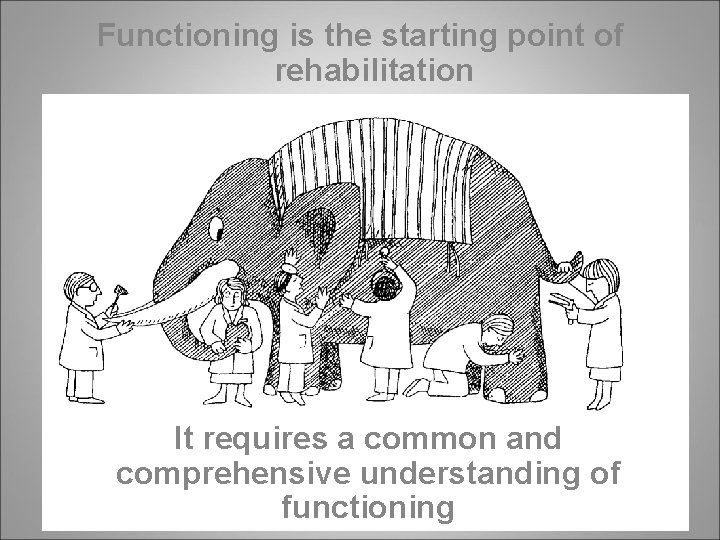
Functioning is the starting point of rehabilitation It requires a common and Comprehensive approach of How to assessunderstanding functioning? ? ? comprehensive Multidisciplinary approach functioning