Wisconsin Institute for Healthy Aging New Programs in
- Slides: 61
Wisconsin Institute for Healthy Aging New Programs in 2019!
About WIHA. . . Non-profit clearinghouse of evidence-based prevention programs in Wisconsin Mission: To spread evidence-based programs to communities throughout Wisconsin to encourage healthy living and healthy aging
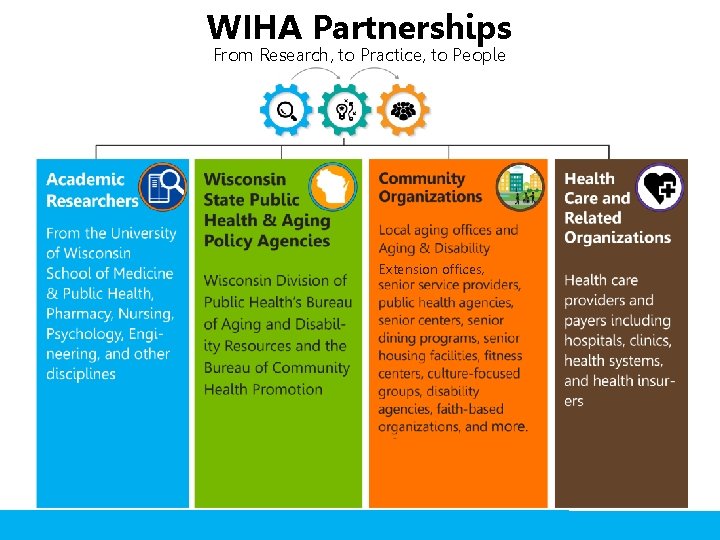
WIHA Partnerships From Research, to Practice, to People Extension offices,
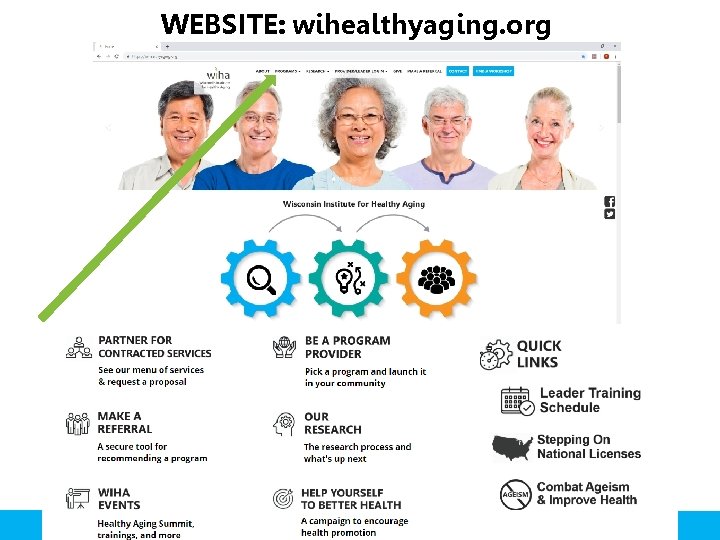
WEBSITE: wihealthyaging. org
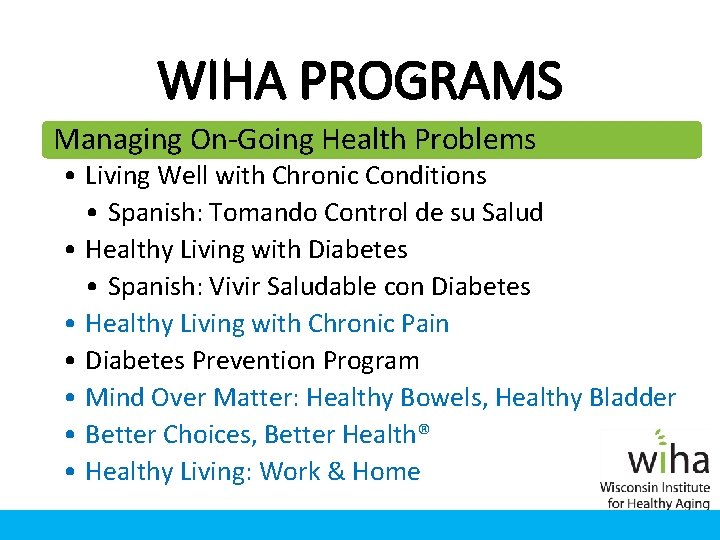
WIHA PROGRAMS Managing On-Going Health Problems • Living Well with Chronic Conditions • Spanish: Tomando Control de su Salud • Healthy Living with Diabetes • Spanish: Vivir Saludable con Diabetes • Healthy Living with Chronic Pain • Diabetes Prevention Program • Mind Over Matter: Healthy Bowels, Healthy Bladder • Better Choices, Better Health® • Healthy Living: Work & Home
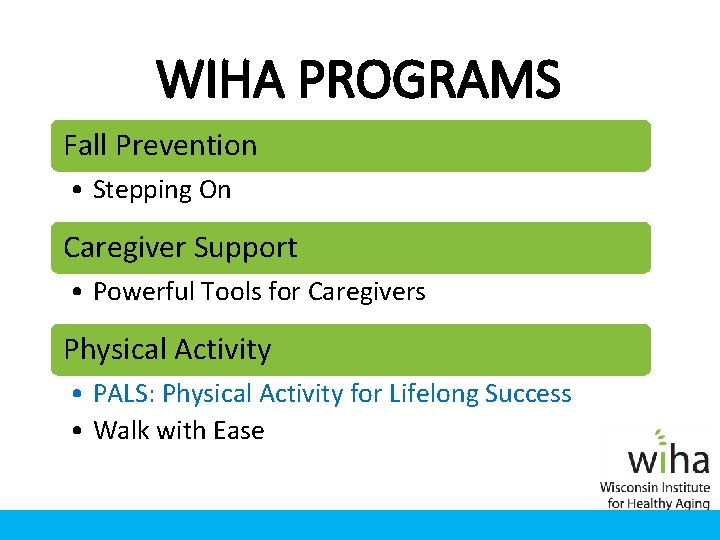
WIHA PROGRAMS Fall Prevention • Stepping On Caregiver Support • Powerful Tools for Caregivers Physical Activity • PALS: Physical Activity for Lifelong Success • Walk with Ease
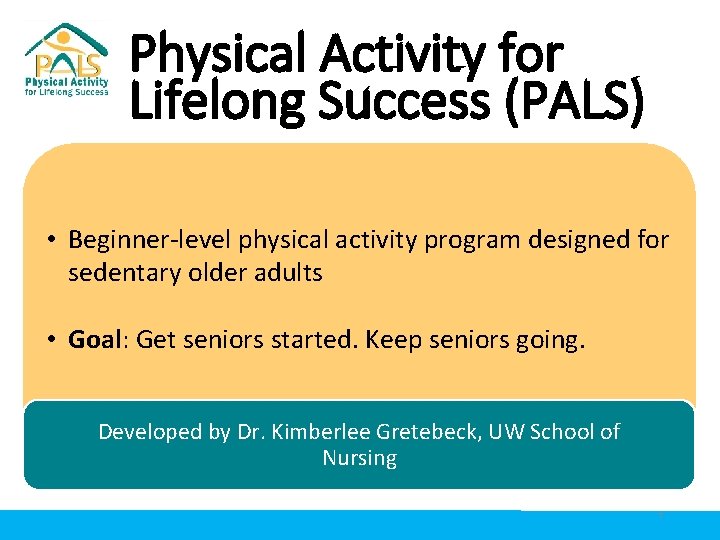
Physical Activity for Lifelong Success (PALS) • Beginner-level physical activity program designed for sedentary older adults • Goal: Get seniors started. Keep seniors going. Developed by Dr. Kimberlee Gretebeck, UW School of Nursing 7
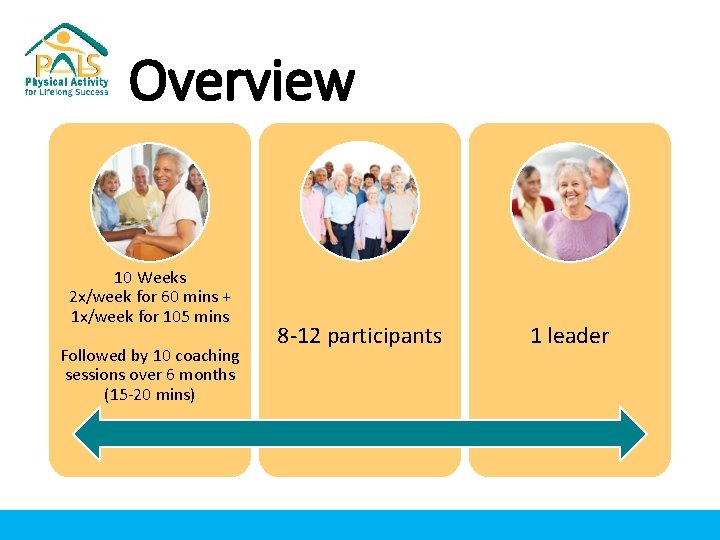
Overview 10 Weeks 2 x/week for 60 mins + 1 x/week for 105 mins Followed by 10 coaching sessions over 6 months (15 -20 mins) 8 -12 participants 1 leader 8
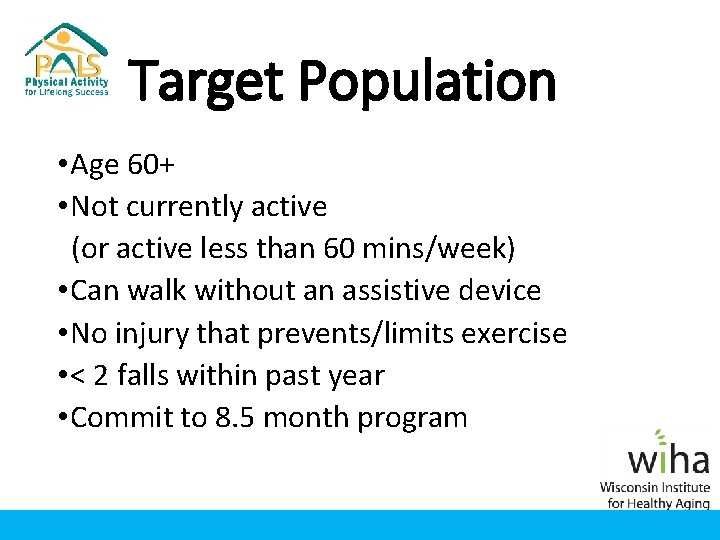
Target Population • Age 60+ • Not currently active (or active less than 60 mins/week) • Can walk without an assistive device • No injury that prevents/limits exercise • < 2 falls within past year • Commit to 8. 5 month program
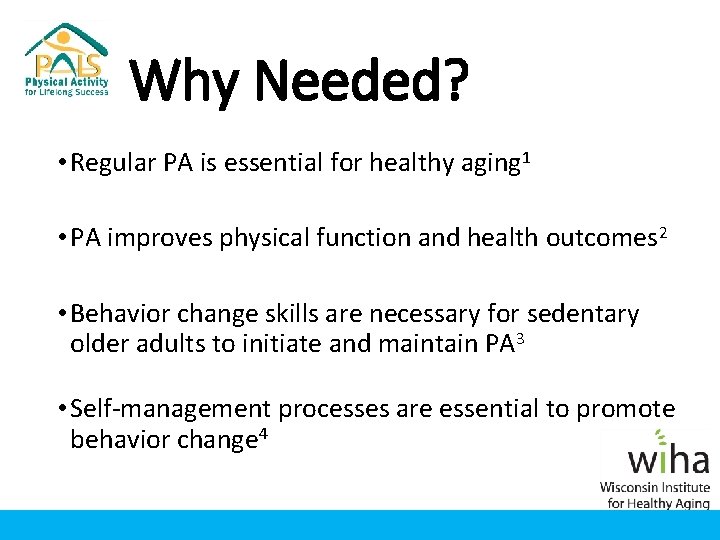
Why Needed? • Regular PA is essential for healthy aging 1 • PA improves physical function and health outcomes 2 • Behavior change skills are necessary for sedentary older adults to initiate and maintain PA 3 • Self-management processes are essential to promote behavior change 4
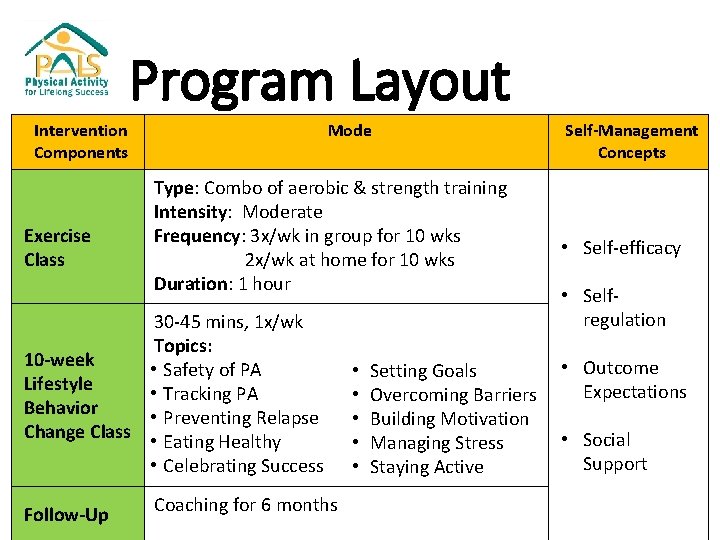
Program Layout Intervention Components Exercise Class Mode Type: Combo of aerobic & strength training Intensity: Moderate Frequency: 3 x/wk in group for 10 wks 2 x/wk at home for 10 wks Duration: 1 hour 30 -45 mins, 1 x/wk Topics: 10 -week • Safety of PA Lifestyle • Tracking PA Behavior • Preventing Relapse Change Class • Eating Healthy • Celebrating Success Follow-Up Coaching for 6 months • • • Setting Goals Overcoming Barriers Building Motivation Managing Stress Staying Active Self-Management Concepts • Self-efficacy • Selfregulation • Outcome Expectations • Social Support 11
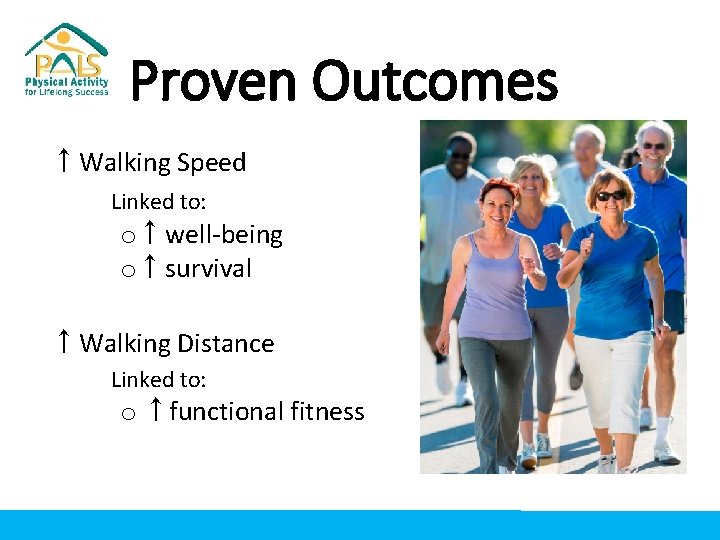
Proven Outcomes ↑ Walking Speed Linked to: o ↑ well-being o ↑ survival ↑ Walking Distance Linked to: o ↑ functional fitness
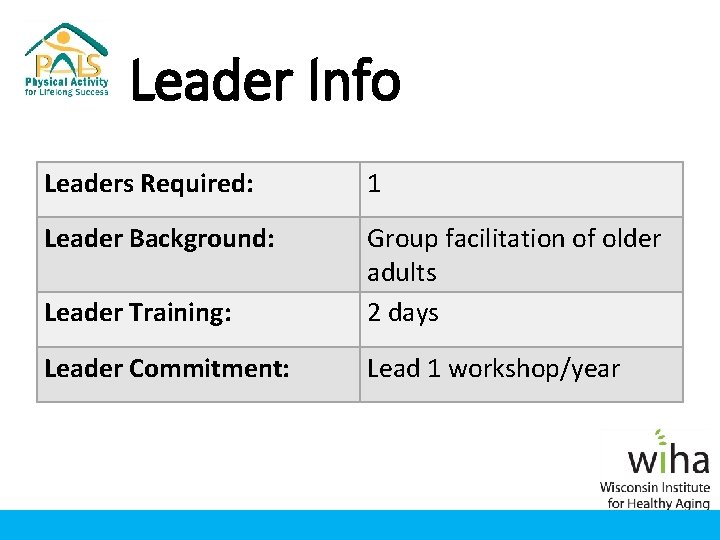
Leader Info Leaders Required: 1 Leader Background: Leader Training: Group facilitation of older adults 2 days Leader Commitment: Lead 1 workshop/year
Space/Materials Needed Setting: Senior/Community Center, Senior Living Facility, Church, Etc. o Room for up to 12 stations Equipment: o Med. Balls o Dumbbells o Steps o Chairs o Station Signs
Status in Wisconsin • Program Evaluation phase: o Cohort 1: Underway o Cohort 2: Training in August • Cohorts 3 & 4: Trainings in February & March 2020 o Funding to assist FREE 2 -day leader training ($475 value) FREE equipment ($500 value) $1, 000 stipend for your time and efforts
For more information: Erin Eggert, MS, EP-C Community Research Associate Wisconsin Institute for Healthy Aging Community-Academic Aging Research Network 608 -852 -4303 Erin. eggert@wihealthyaging. org
Mind Over Matter (MOM): Healthy Bowels, Healthy Bladder • Bowel and bladder incontinence prevention class for older adult women. • Goal: Prevent or reduce bowel and bladder incontinence and increase independence. Developed by Dr. Heidi Brown, UW School of Medicine and Public Health 17
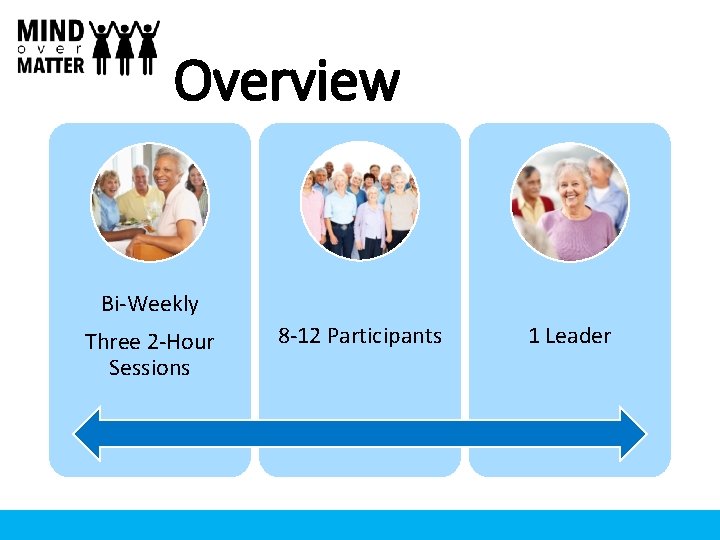
Overview Bi-Weekly Three 2 -Hour Sessions 8 -12 Participants 1 Leader 18
Overview • Covers o Pelvic floor muscle exercises o Changing fiber and fluid intake o Changing toileting practices 19
Target Population • Women 50+ • Experiencing or fear of incontinence • Interest in learning how to prevent/reduce problems with bowel or bladder incontinence
Why Needed? • >60% of community-dwelling older US women (14 M) suffer from urinary and/or bowel incontinence • Combined annual cost >$30 billion 1 -3 • Negative impact on quality of life, social isolation, and depression 4 -7
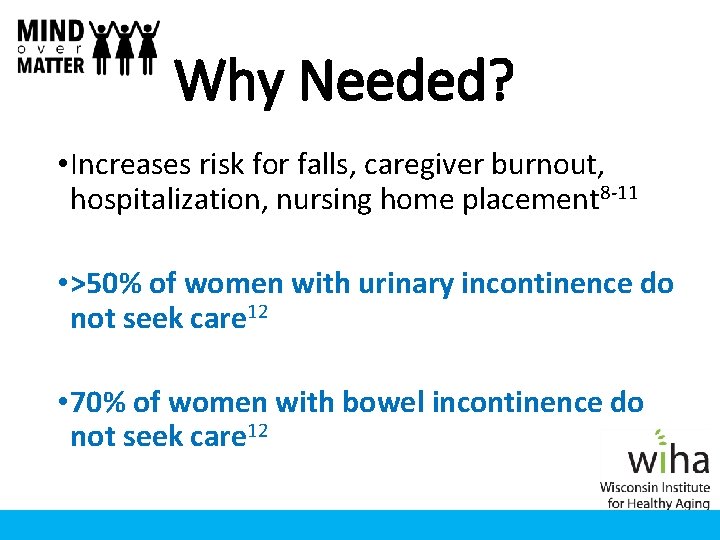
Why Needed? • Increases risk for falls, caregiver burnout, hospitalization, nursing home placement 8 -11 • >50% of women with urinary incontinence do not seek care 12 • 70% of women with bowel incontinence do not seek care 12
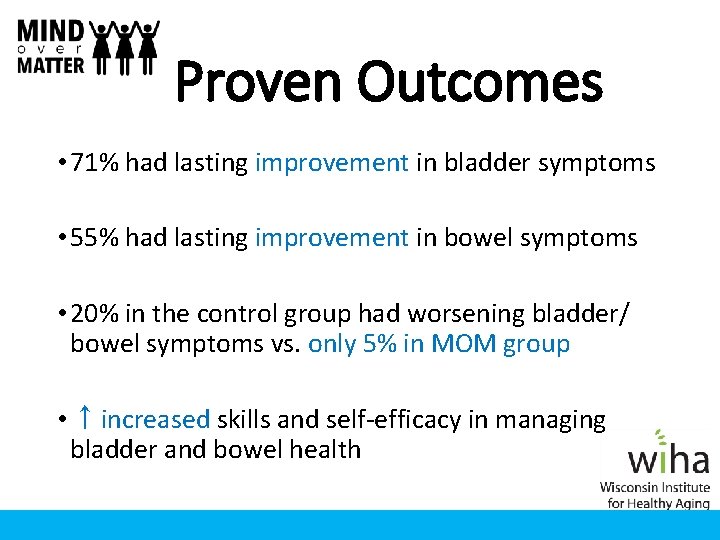
Proven Outcomes • 71% had lasting improvement in bladder symptoms • 55% had lasting improvement in bowel symptoms • 20% in the control group had worsening bladder/ bowel symptoms vs. only 5% in MOM group • ↑ increased skills and self-efficacy in managing bladder and bowel health
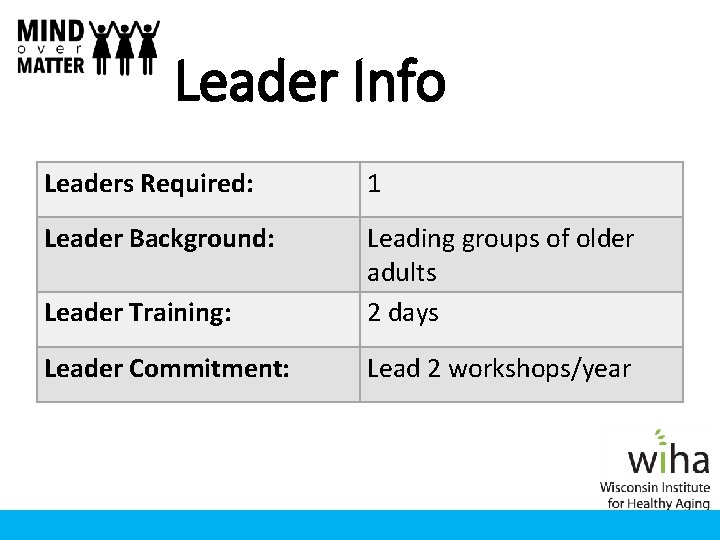
Leader Info Leaders Required: 1 Leader Background: Leader Training: Leading groups of older adults 2 days Leader Commitment: Lead 2 workshops/year
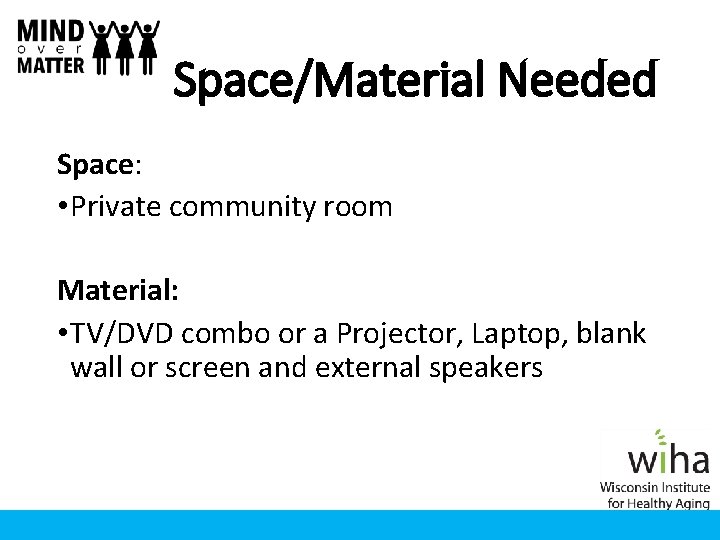
Space/Material Needed Space: • Private community room Material: • TV/DVD combo or a Projector, Laptop, blank wall or screen and external speakers
Status in Wisconsin • First facilitator training was May 2019 o (By Invitation only) • Second training Fall 2019 • (Some invites; then will open up)
For more information: Shannon Myers, CWP Director of Program Implementation Stepping On Faculty Trainer Community Research Associate Lead Wisconsin Institute for Healthy Aging Community-Academic Aging Research Network 608 -852 -0813 Shannon. myers@wihealthyaging. org
Healthy Living with Chronic Pain • A program for individuals with chronic pain • Goals: • Increase individuals’ confidence in managing chronic pain. • Reduce pain and pain symptoms. Developed by Stanford Patient Education Research Center in conjunction with Mc. Gill University (Montreal, Canada) 28
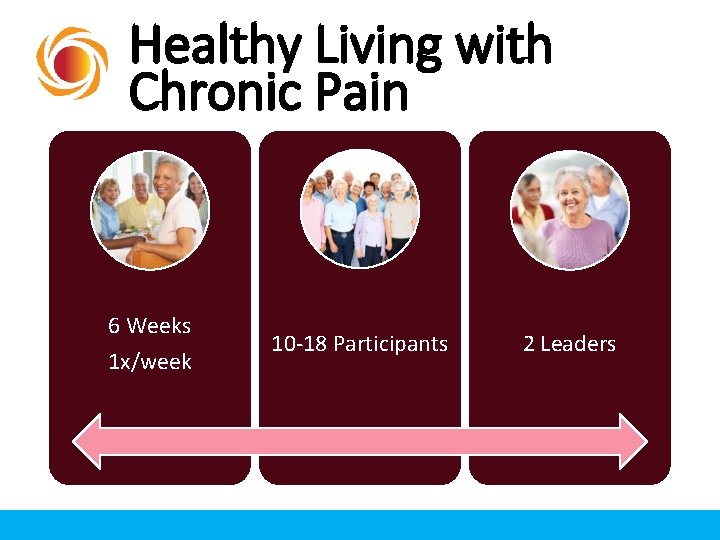
Healthy Living with Chronic Pain 6 Weeks 1 x/week 10 -18 Participants 2 Leaders 29
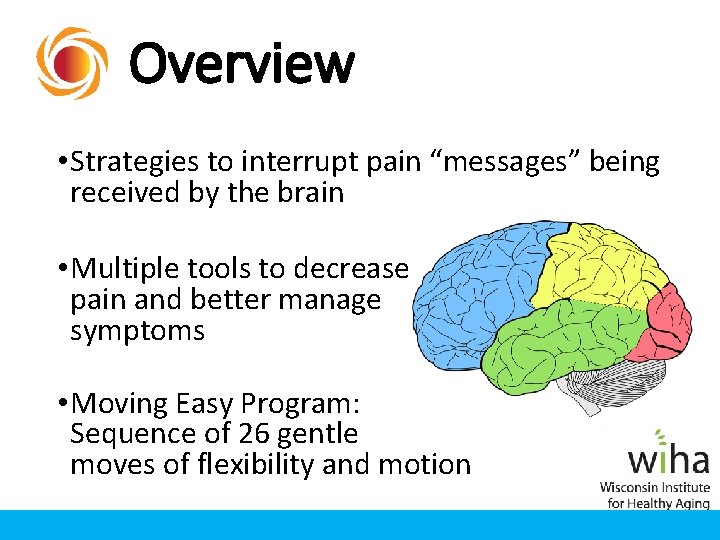
Overview • Strategies to interrupt pain “messages” being received by the brain • Multiple tools to decrease pain and better manage symptoms • Moving Easy Program: Sequence of 26 gentle moves of flexibility and motion
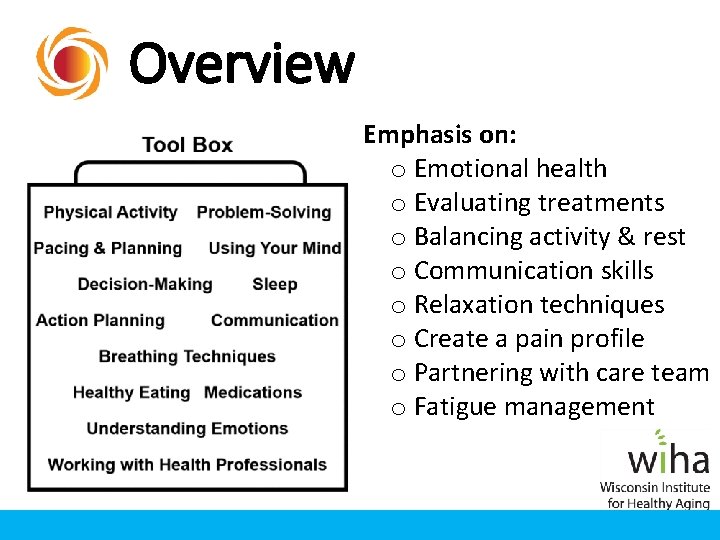
Overview Emphasis on: o Emotional health o Evaluating treatments o Balancing activity & rest o Communication skills o Relaxation techniques o Create a pain profile o Partnering with care team o Fatigue management
Target Population • Adults (age 18+) with chronic pain • Caregiver or lives with someone with chronic pain • Not suitable for people in throes of addiction or in crisis
Why Needed? • Pain affects more people than diabetes + heart disease + cancer • Difficult to manage and isolating • A top reason to seek medical care • Affects mood, activities, sleep, ability to work, & enjoyment of life o 2/3 felt pain reduced overall enjoyment of life o >75% feel depressed o 86% have difficulty sleeping
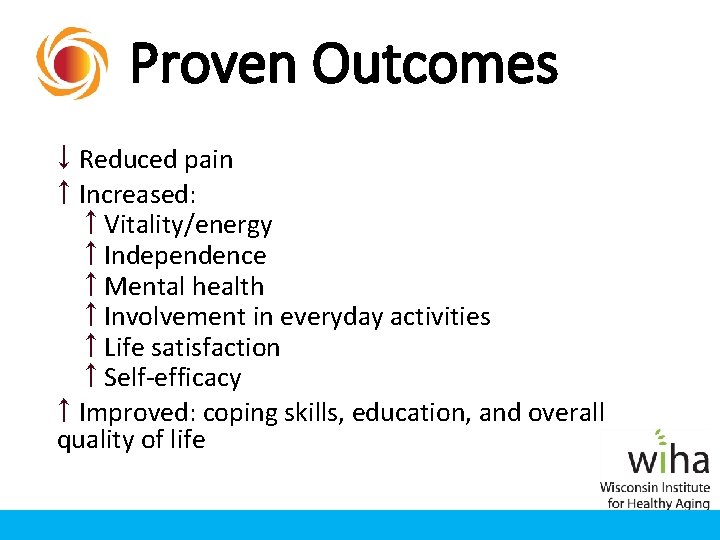
Proven Outcomes ↓ Reduced pain ↑ Increased: ↑ Vitality/energy ↑ Independence ↑ Mental health ↑ Involvement in everyday activities ↑ Life satisfaction ↑ Self-efficacy ↑ Improved: coping skills, education, and overall quality of life
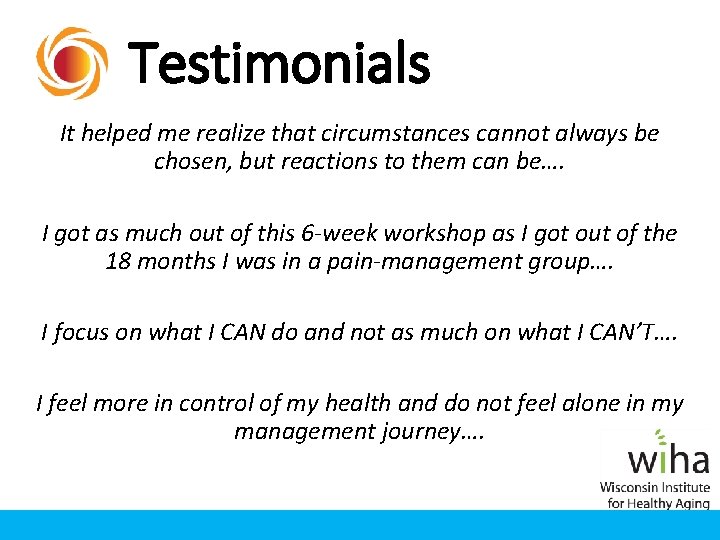
Testimonials It helped me realize that circumstances cannot always be chosen, but reactions to them can be…. I got as much out of this 6 -week workshop as I got out of the 18 months I was in a pain-management group…. I focus on what I CAN do and not as much on what I CAN’T…. I feel more in control of my health and do not feel alone in my management journey….
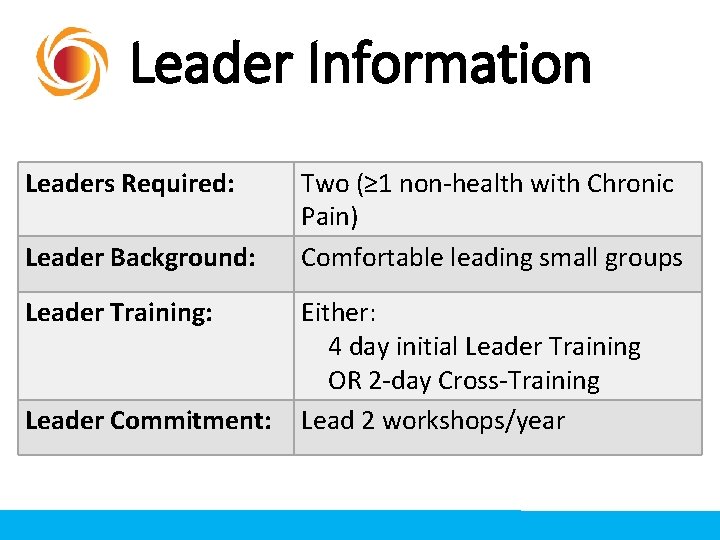
Leader Information Leaders Required: Leader Background: Leader Training: Leader Commitment: Two (≥ 1 non-health with Chronic Pain) Comfortable leading small groups Either: 4 day initial Leader Training OR 2 -day Cross-Training Lead 2 workshops/year
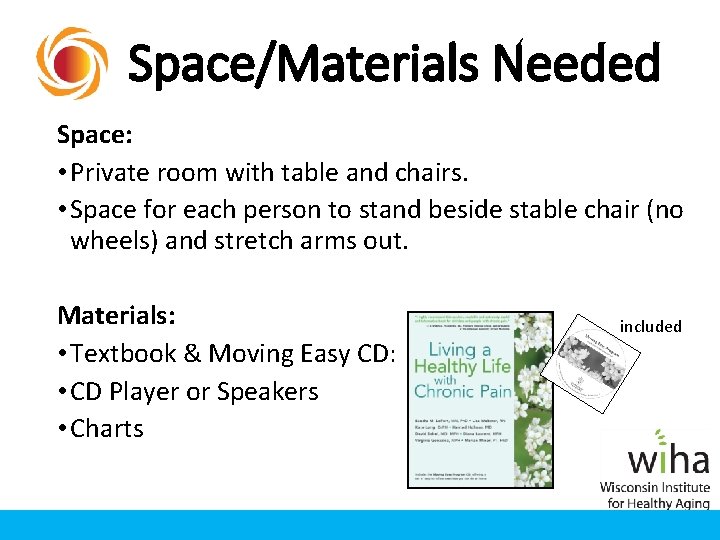
Space/Materials Needed Space: • Private room with table and chairs. • Space for each person to stand beside stable chair (no wheels) and stretch arms out. Materials: • Textbook & Moving Easy CD: • CD Player or Speakers • Charts included
Status in Wisconsin • Started 2019 • Trained 60 new Leaders from 27 counties, 1 tribe, and 1 intertribal liaison. • Upcoming: Cross-Training October 3 -4 in Waukesha • Interested in 4 -day training? o Let us know! Fill out online Leader Application form and select the General Interest option
For more information: Michelle Comeau Director of Leader Development Wisconsin Institute for Healthy Aging 262 -305 -5948 michelle. comeau@wihealthyaging. org
Better Choices, Better Health® • An online chronic disease self-management program • Version of Living Well with Chronic Conditions • Goal: Help participants better manage chronic conditions in a convenient format Developed by Stanford University, adapted by Canary Health 40
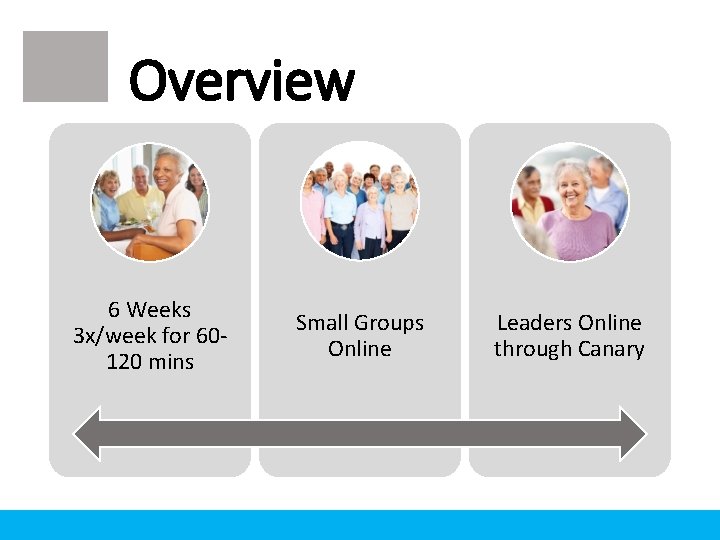
Overview 6 Weeks 3 x/week for 60120 mins Small Groups Online Leaders Online through Canary 41
Target Population • 1+ Chronic Conditions • Good cognition • Access to computer and internet
Why Needed? • Heart disease is the leading cause of death • ~1. 3 million adults have hypertension • 40% are unaware • 40% of adults expected to develop type 2 diabetes • Barely 50% meet aerobic phys activity recommendations • Only 16% of adults meet daily fruits and vegetables recommendations
Why Needed? • Convenient Peer-centered program • People with health concerns have similar experiences and problems • Individuals must manage their physical condition and the impact it has on their lives/emotions • The program process is as important, if not more important, than content: Social, routine, learning/trying new skills, and having success = self-confidence.
Proven Outcomes ↓ Decreased ↓ A 1 C (1. 27%) ↓ Depression ↓ Hospitalization ↓ Healthcare costs ↑ Increased ↑ Medication adherence ↑ Exercise • Healthcare utilization savings of $815/participant
Leader Information • All recruited and trained through Canary Health, based in Los Angeles.
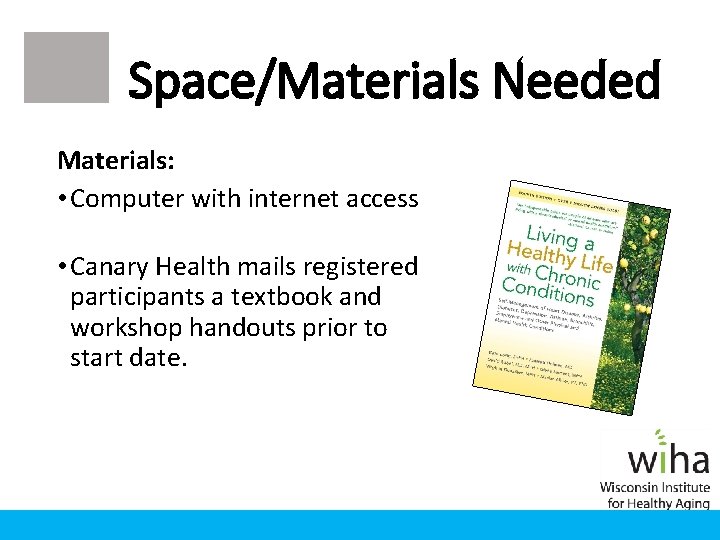
Space/Materials Needed Materials: • Computer with internet access • Canary Health mails registered participants a textbook and workshop handouts prior to start date.
Status in Wisconsin • New group begins most Mondays • Note: Fee to access o Health plan/system (payer) make available to a population, targeted patient group, or member group. o Private pay is available o Contact Margie Hackbarth
For more information: Margie Hackbarth Director of Business Development Wisconsin Institute for Healthy Aging 715 -571 -5250 Margie. hackbarth@ wihealthyaging. org
Healthy Living: Work & Home • A worksite chronic disease self-management program • Version of Living Well with Chronic Conditions • Goal: Help participants better manage chronic health conditions while balancing work and home. Developed by Stanford University and the University of Georgia 50
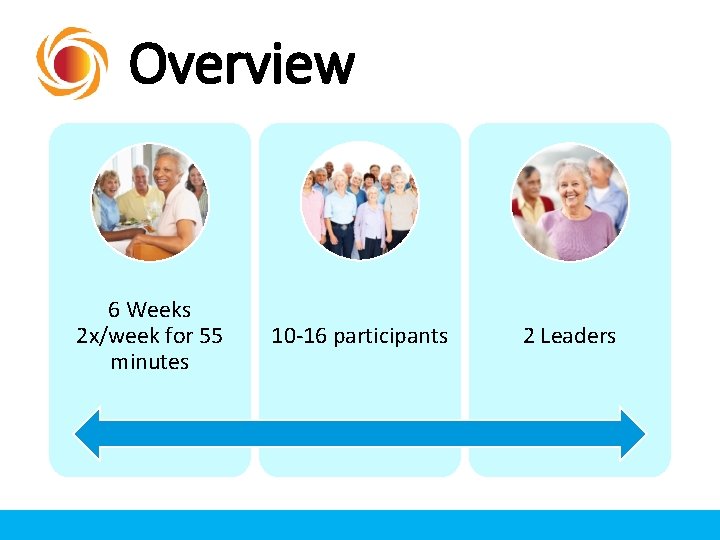
Overview 6 Weeks 2 x/week for 55 minutes 10 -16 participants 2 Leaders 51
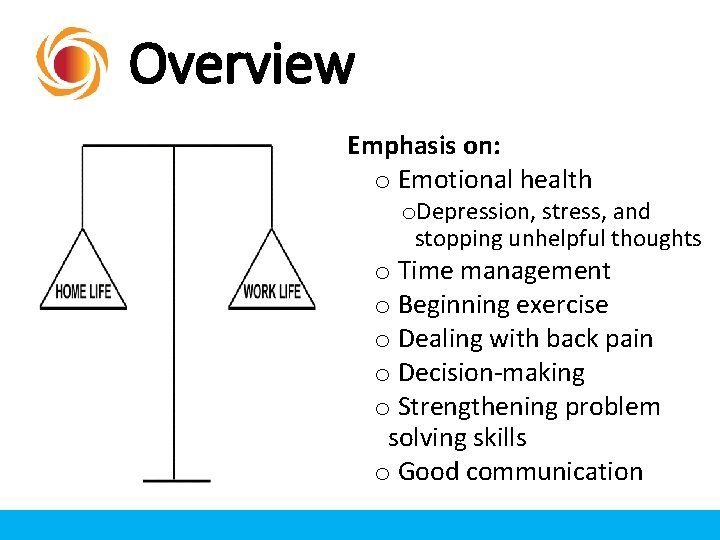
Overview Emphasis on: o Emotional health o. Depression, stress, and stopping unhelpful thoughts o Time management o Beginning exercise o Dealing with back pain o Decision-making o Strengthening problem solving skills o Good communication 52
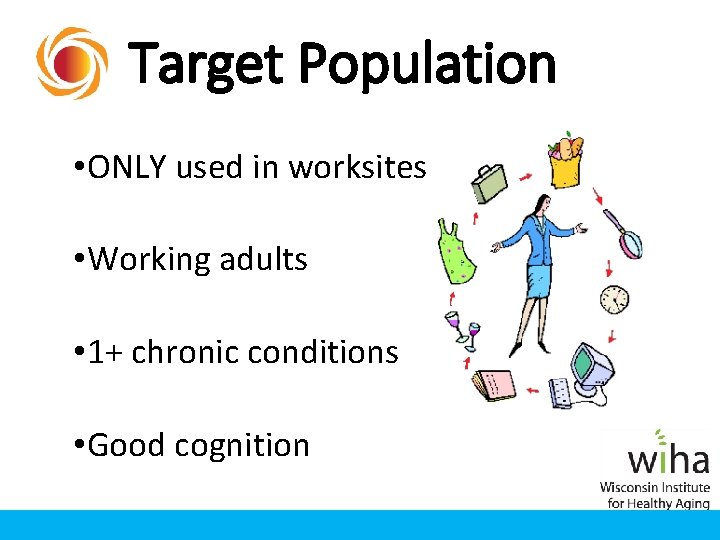
Target Population • ONLY used in worksites • Working adults • 1+ chronic conditions • Good cognition
Why Needed? • About 50% of all adults (117 million) have 1+ chronic conditions • Adults with chronic conditions report 6. 7 ‘impaired’ work days per month o Average employed adult reported 1. 1 • Cost of health-related absenteeism/presenteeism is high o $225. 8 billion annually o $1, 685 per employee/year
Proven Outcomes ↓ Decrease in: o Physical unhealthy days o Fatigue o Sedentary behaviors o Soda/sugary beverage intake o Fast food intake o Work limitations due to mental demands ↑ Increase in: o Patient-provider communications
Leader Information Leaders Required: Leader Background: Leader Training: Leader Commitment: 2 (≥ 1 non-health with Chronic Condition) Leading groups of older adults Either 4 -day LW training + cross-training (3 hour) Or 3 -hour cross-training* Lead 1 workshop/year
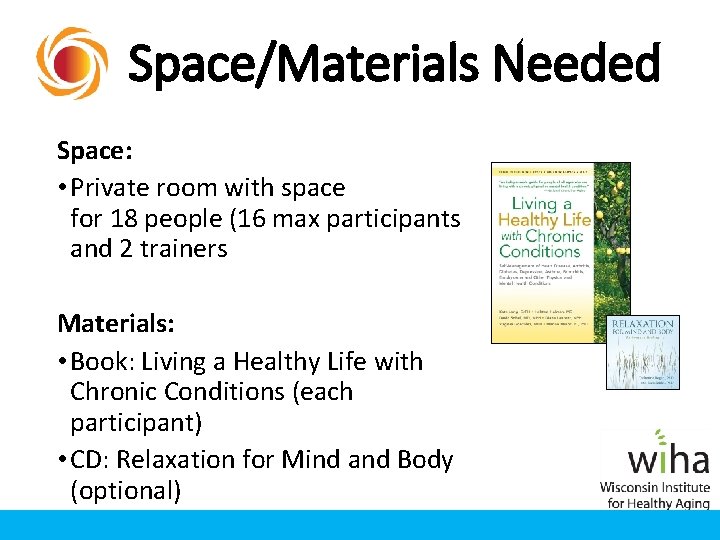
Space/Materials Needed Space: • Private room with space for 18 people (16 max participants and 2 trainers Materials: • Book: Living a Healthy Life with Chronic Conditions (each participant) • CD: Relaxation for Mind and Body (optional)
Status in Wisconsin • Introduced in 2019 for large employer groups • Contact Margie with recommended employer groups • Healthy Living: Work & Home is being disseminated with a new business model. In Wisconsin the program requires a Business Agreement in place between WIHA and host organization.
For more information: Margie Hackbarth Director of Business Development Wisconsin Institute for Healthy Aging 715 -571 -5250 Margie. hackbarth@wihealthya ging. org
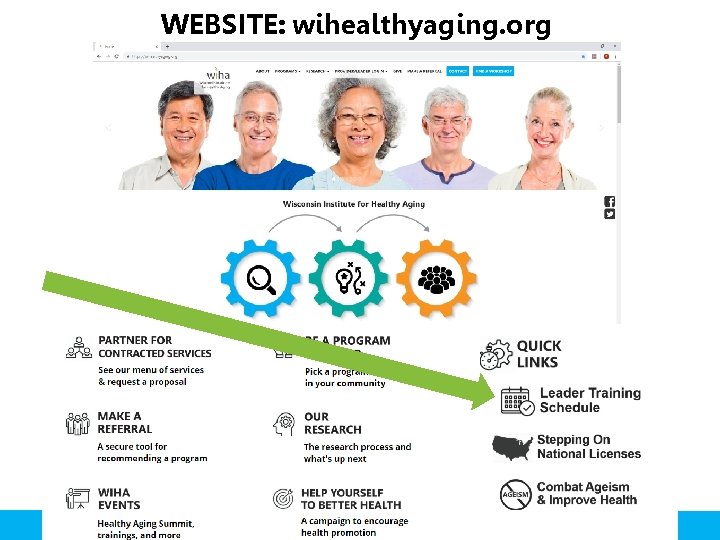
WEBSITE: wihealthyaging. org
Thank you! 61