THE WEST VIRGINIA ORAL HEALTH PROGRAM Improving health


- Slides: 68
THE WEST VIRGINIA ORAL HEALTH PROGRAM “Improving health, one smile at a time. ” Dr. Jason Roush, State Dental Director West Virginia Oral Health Program August 2019
Objectives • Discuss history of the oral health program in West Virginia; • Discuss current program initiatives; • Define/discuss the importance of collective impact on project success.
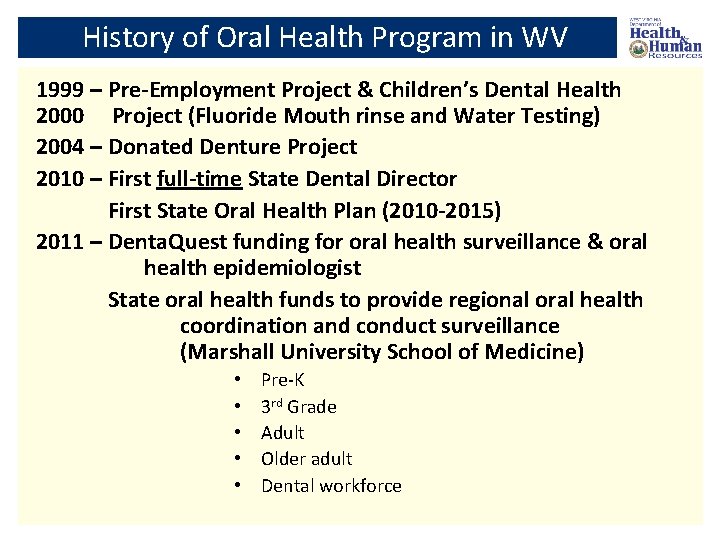
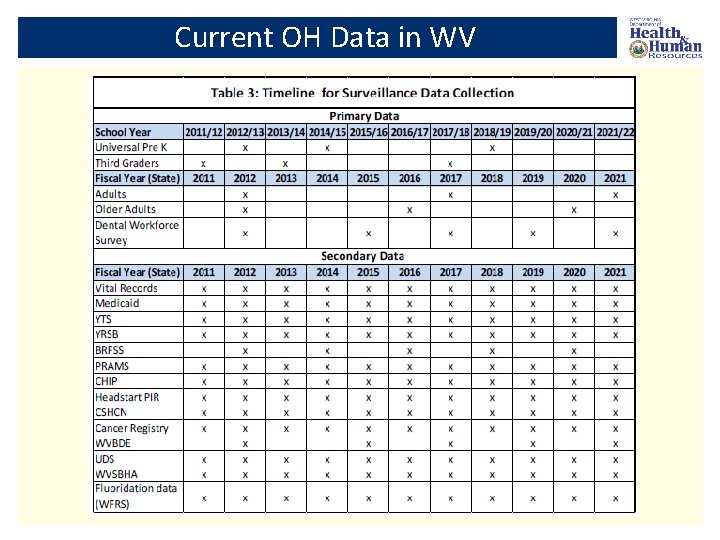
History of Oral Health Program in WV 1999 – Pre-Employment Project & Children’s Dental Health 2000 Project (Fluoride Mouth rinse and Water Testing) 2004 – Donated Denture Project 2010 – First full-time State Dental Director First State Oral Health Plan (2010 -2015) 2011 – Denta. Quest funding for oral health surveillance & oral health epidemiologist State oral health funds to provide regional oral health coordination and conduct surveillance (Marshall University School of Medicine) • • • Pre-K 3 rd Grade Adult Older adult Dental workforce
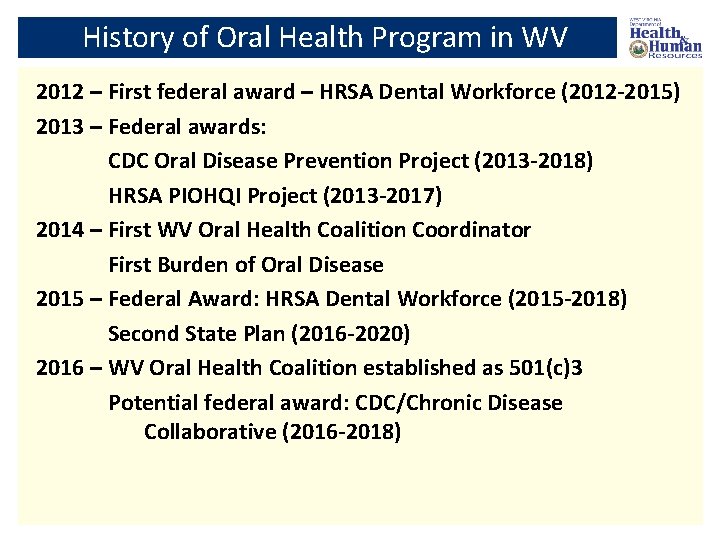
History of Oral Health Program in WV 2012 – First federal award – HRSA Dental Workforce (2012 -2015) 2013 – Federal awards: CDC Oral Disease Prevention Project (2013 -2018) HRSA PIOHQI Project (2013 -2017) 2014 – First WV Oral Health Coalition Coordinator First Burden of Oral Disease 2015 – Federal Award: HRSA Dental Workforce (2015 -2018) Second State Plan (2016 -2020) 2016 – WV Oral Health Coalition established as 501(c)3 Potential federal award: CDC/Chronic Disease Collaborative (2016 -2018)
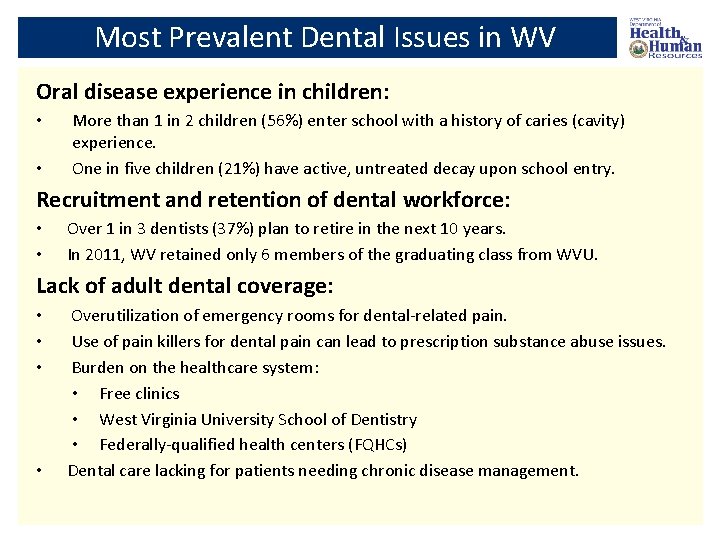
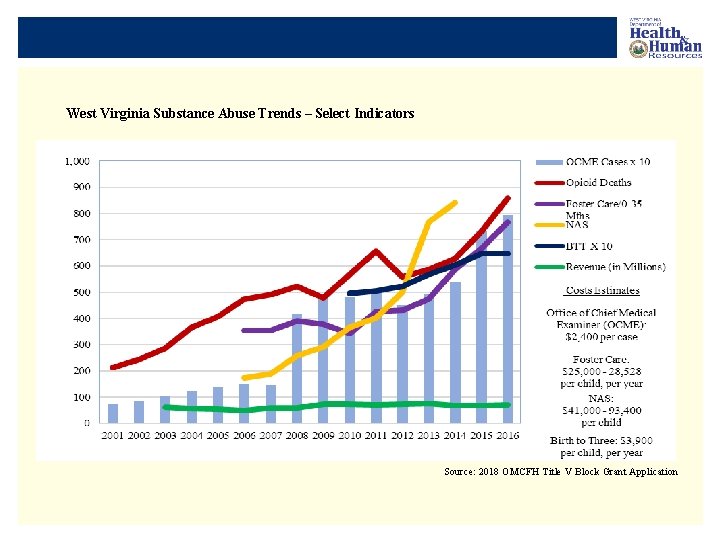
Most Prevalent Dental Issues in WV Oral disease experience in children: • • More than 1 in 2 children (56%) enter school with a history of caries (cavity) experience. One in five children (21%) have active, untreated decay upon school entry. Recruitment and retention of dental workforce: • • Over 1 in 3 dentists (37%) plan to retire in the next 10 years. In 2011, WV retained only 6 members of the graduating class from WVU. Lack of adult dental coverage: • • Overutilization of emergency rooms for dental-related pain. Use of pain killers for dental pain can lead to prescription substance abuse issues. Burden on the healthcare system: • Free clinics • West Virginia University School of Dentistry • Federally-qualified health centers (FQHCs) Dental care lacking for patients needing chronic disease management.
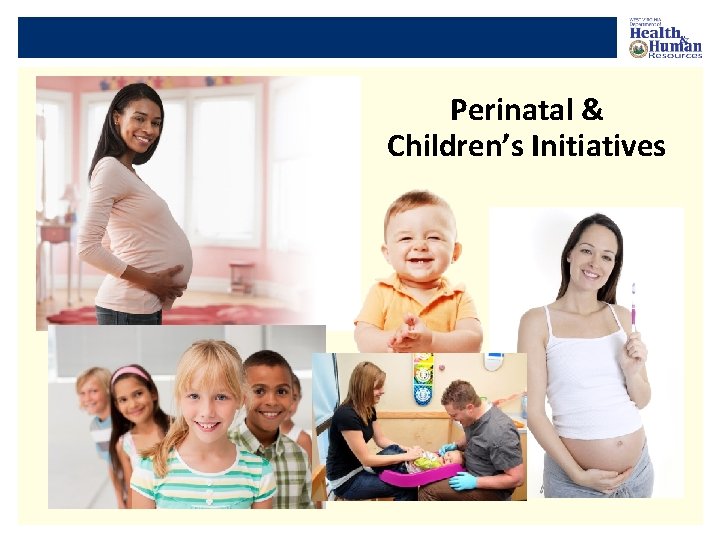
Perinatal & Children’s Initiatives
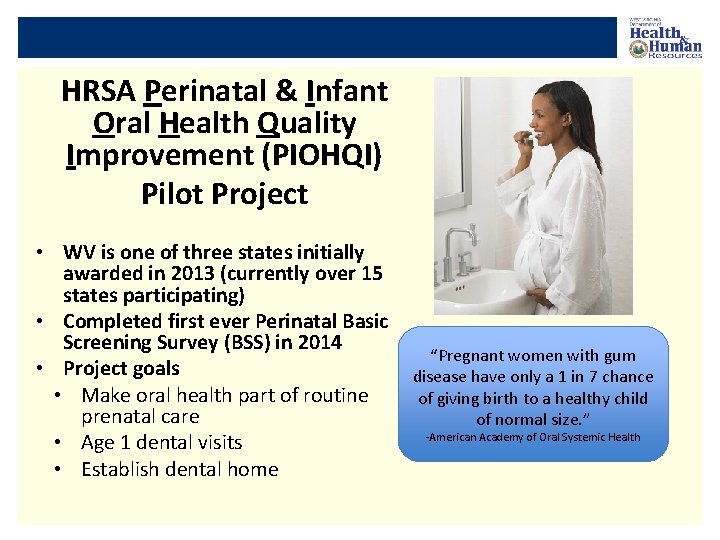
HRSA Perinatal & Infant Oral Health Quality Improvement (PIOHQI) Pilot Project • WV is one of three states initially awarded in 2013 (currently over 15 states participating) • Completed first ever Perinatal Basic Screening Survey (BSS) in 2014 • Project goals • Make oral health part of routine prenatal care • Age 1 dental visits • Establish dental home “Pregnant women with gum disease have only a 1 in 7 chance of giving birth to a healthy child of normal size. ” -American Academy of Oral Systemic Health
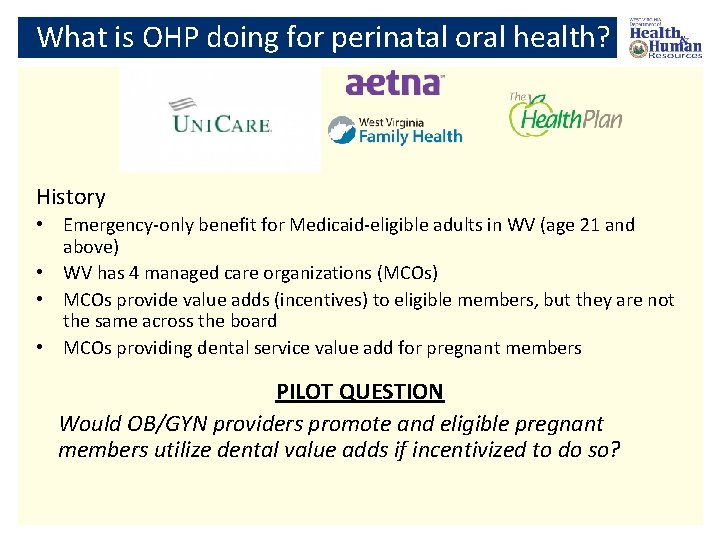
What is OHP doing for perinatal oral health? History • Emergency-only benefit for Medicaid-eligible adults in WV (age 21 and above) • WV has 4 managed care organizations (MCOs) • MCOs provide value adds (incentives) to eligible members, but they are not the same across the board • MCOs providing dental service value add for pregnant members PILOT QUESTION Would OB/GYN providers promote and eligible pregnant members utilize dental value adds if incentivized to do so?
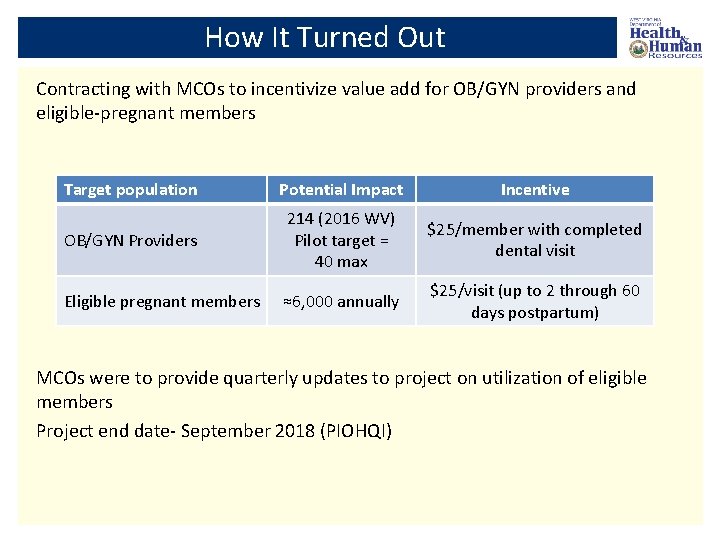
How It Turned Out Contracting with MCOs to incentivize value add for OB/GYN providers and eligible-pregnant members Target population Potential Impact Incentive OB/GYN Providers 214 (2016 WV) Pilot target = 40 max $25/member with completed dental visit Eligible pregnant members ≈6, 000 annually $25/visit (up to 2 through 60 days postpartum) MCOs were to provide quarterly updates to project on utilization of eligible members Project end date- September 2018 (PIOHQI)
Guidance for Prenatal Care Health Professionals Work in Collaboration with Oral Health Professionals • Establish relationships with oral health professionals in the community • Develop a formal referral process • Share pertinent information about pregnant women • Coordinate care Photograph is copyrighted and may not be reproduced.
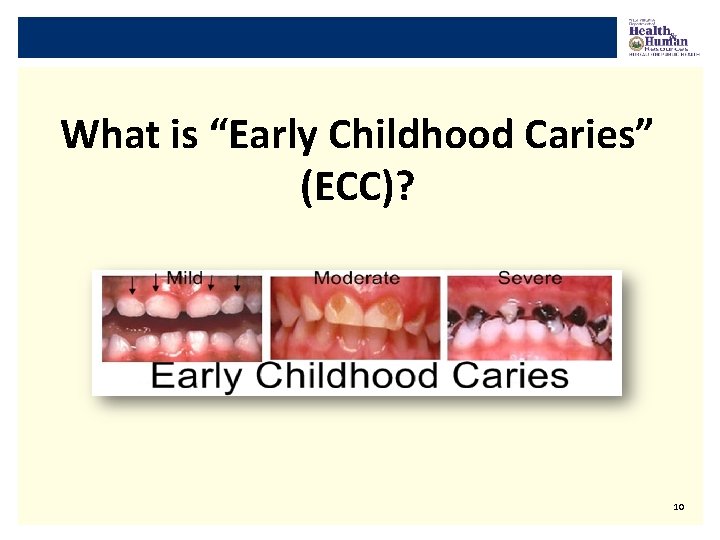
What is “Early Childhood Caries” (ECC)? 10
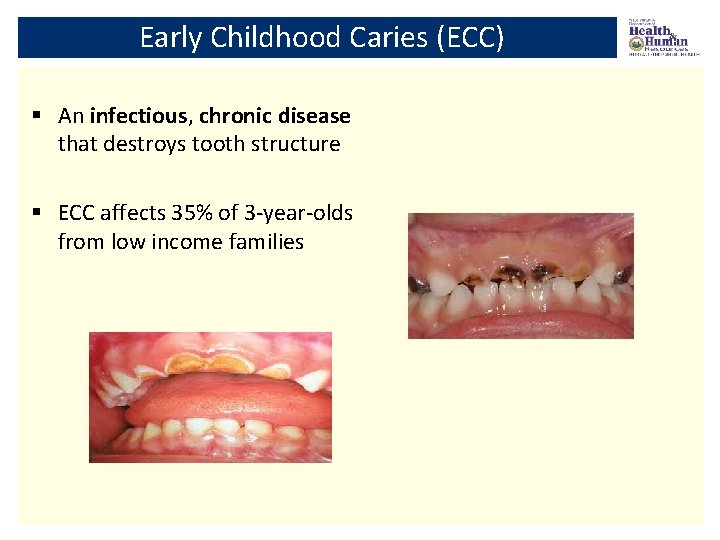
Early Childhood Caries (ECC) § An infectious, chronic disease that destroys tooth structure § ECC affects 35% of 3 -year-olds from low income families
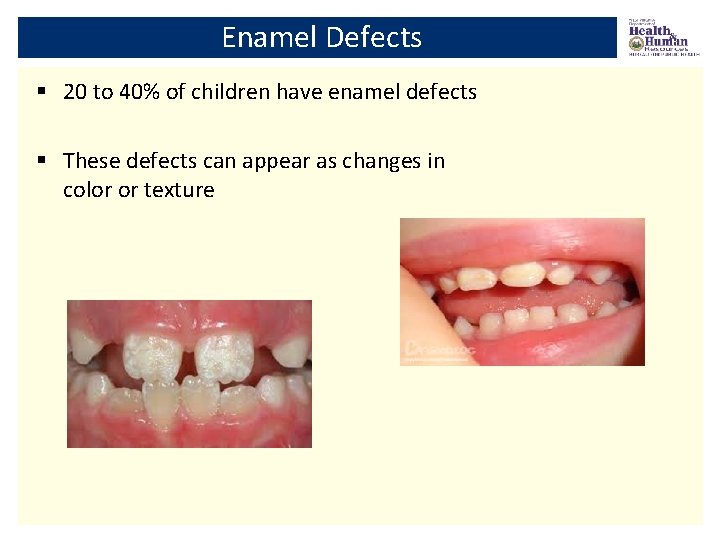
Enamel Defects § 20 to 40% of children have enamel defects § These defects can appear as changes in color or texture
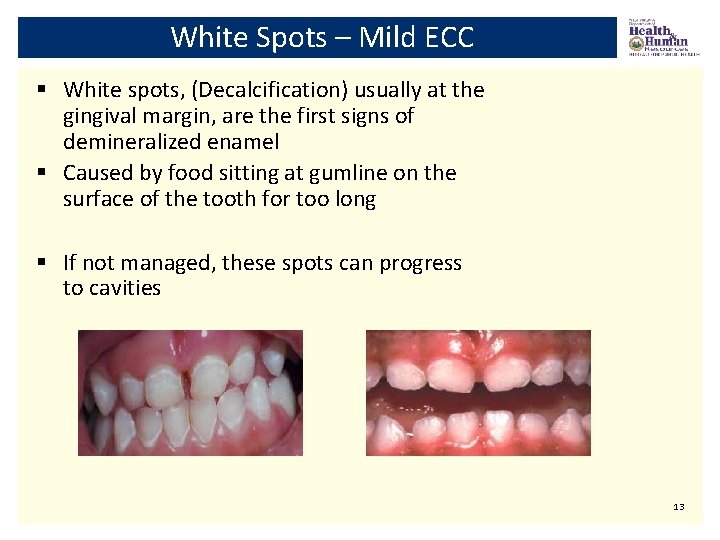
White Spots – Mild ECC § White spots, (Decalcification) usually at the gingival margin, are the first signs of demineralized enamel § Caused by food sitting at gumline on the surface of the tooth for too long § If not managed, these spots can progress to cavities 13
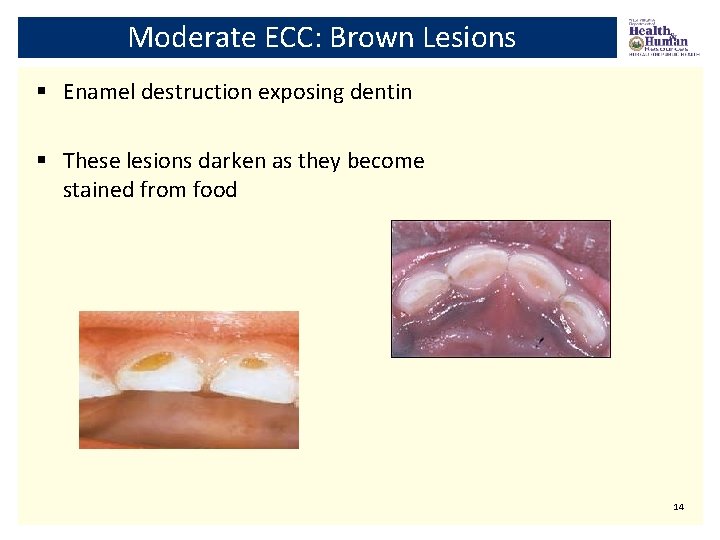
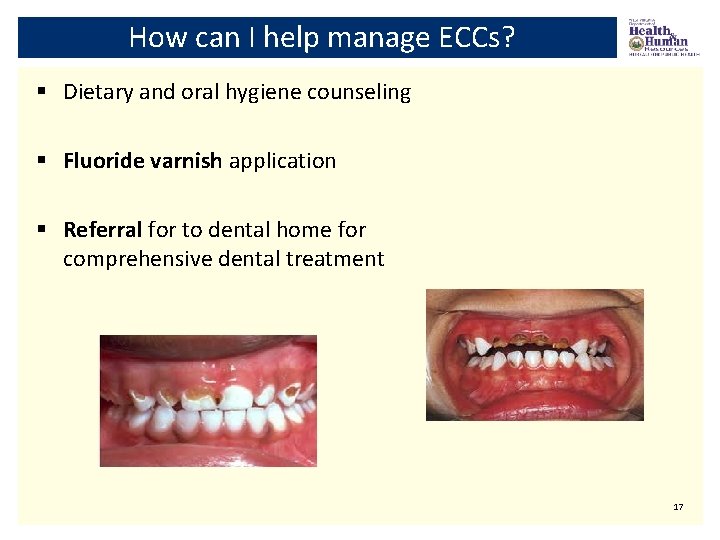
Moderate ECC: Brown Lesions § Enamel destruction exposing dentin § These lesions darken as they become stained from food 14
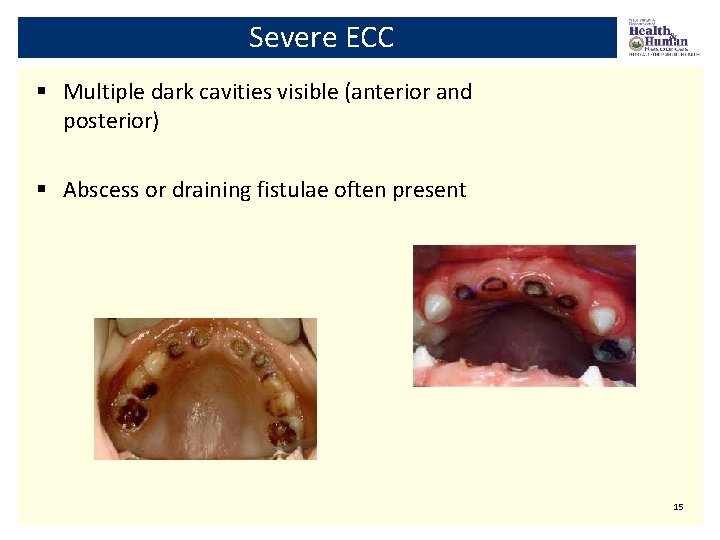
Severe ECC § Multiple dark cavities visible (anterior and posterior) § Abscess or draining fistulae often present 15
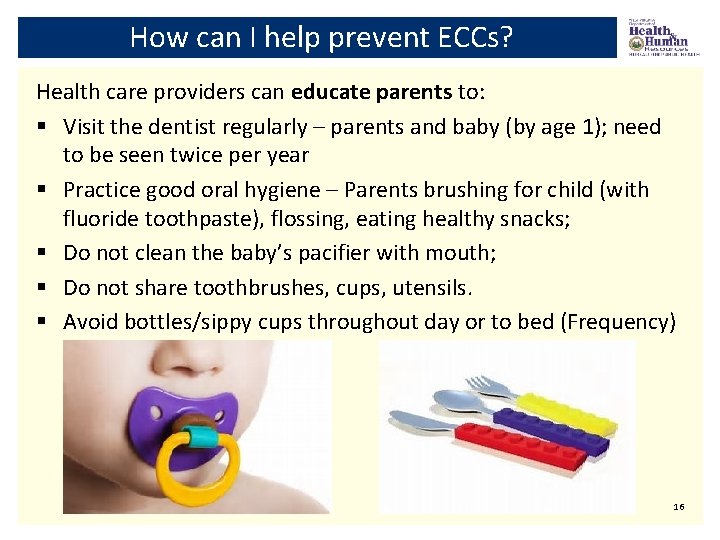
How can I help prevent ECCs? Health care providers can educate parents to: § Visit the dentist regularly – parents and baby (by age 1); need to be seen twice per year § Practice good oral hygiene – Parents brushing for child (with fluoride toothpaste), flossing, eating healthy snacks; § Do not clean the baby’s pacifier with mouth; § Do not share toothbrushes, cups, utensils. § Avoid bottles/sippy cups throughout day or to bed (Frequency) 16
How can I help manage ECCs? § Dietary and oral hygiene counseling § Fluoride varnish application § Referral for to dental home for comprehensive dental treatment 17
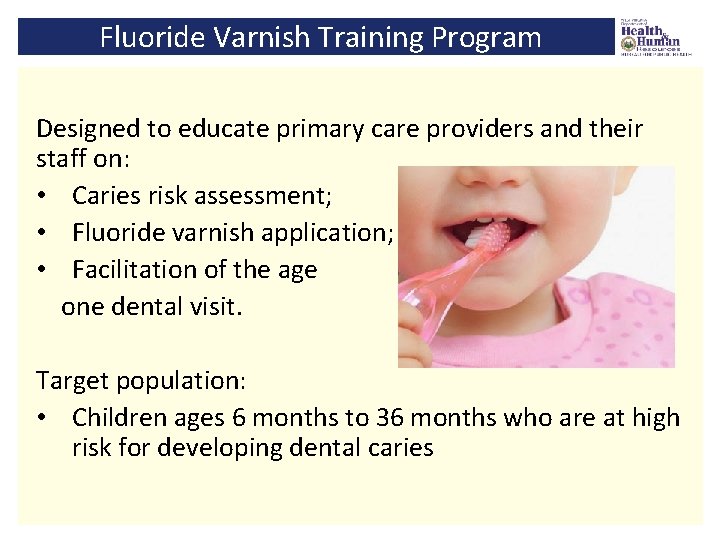
Fluoride Varnish Training Program Designed to educate primary care providers and their staff on: • Caries risk assessment; • Fluoride varnish application; • Facilitation of the age one dental visit. Target population: • Children ages 6 months to 36 months who are at high risk for developing dental caries
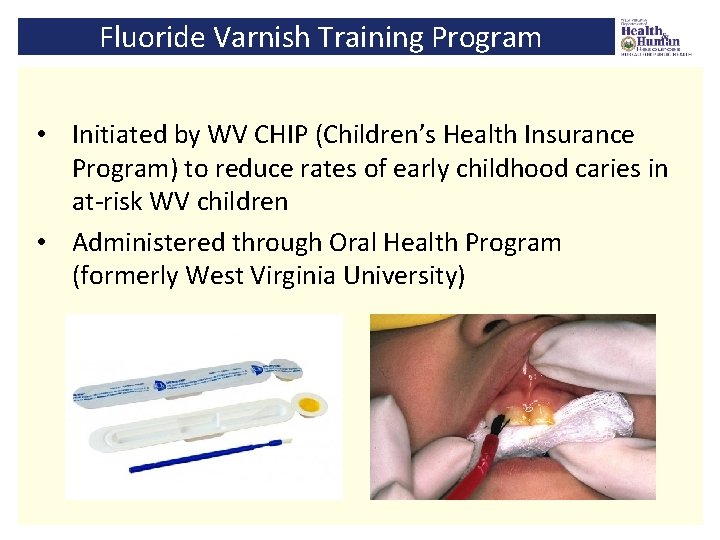
Fluoride Varnish Training Program • Initiated by WV CHIP (Children’s Health Insurance Program) to reduce rates of early childhood caries in at-risk WV children • Administered through Oral Health Program (formerly West Virginia University)
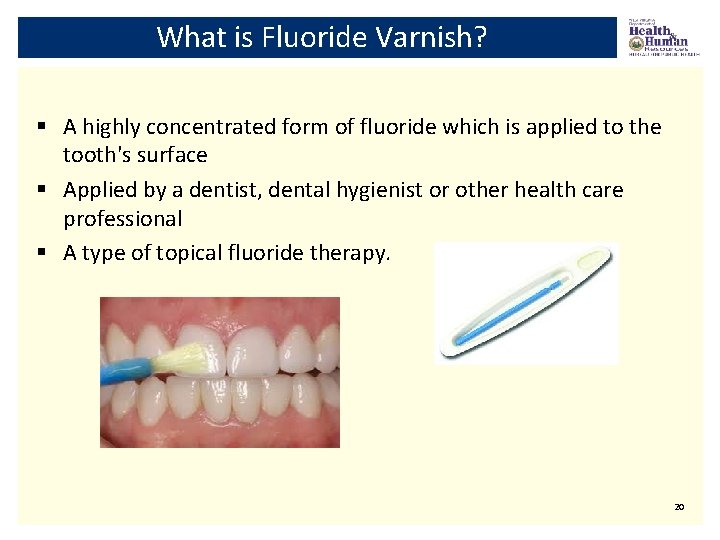
What is Fluoride Varnish? § A highly concentrated form of fluoride which is applied to the tooth's surface § Applied by a dentist, dental hygienist or other health care professional § A type of topical fluoride therapy. 20
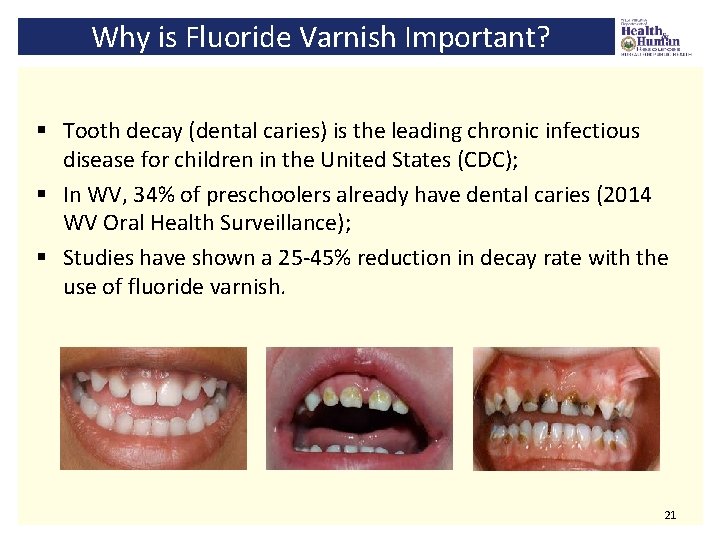
Why is Fluoride Varnish Important? § Tooth decay (dental caries) is the leading chronic infectious disease for children in the United States (CDC); § In WV, 34% of preschoolers already have dental caries (2014 WV Oral Health Surveillance); § Studies have shown a 25 -45% reduction in decay rate with the use of fluoride varnish. 21
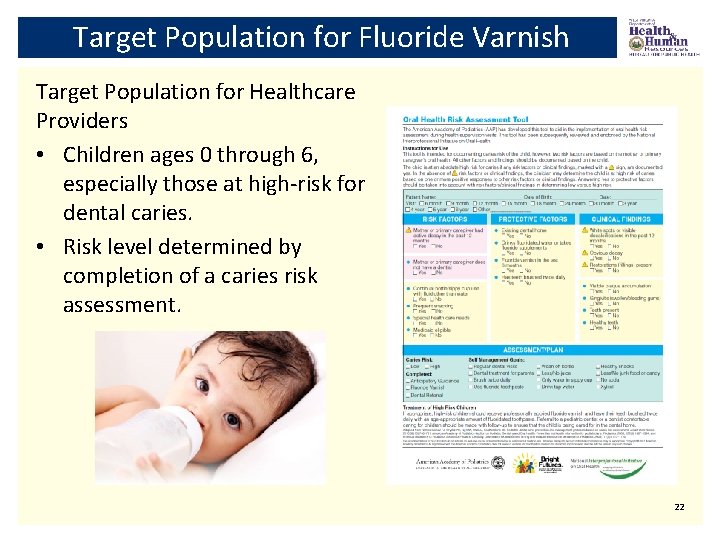
Target Population for Fluoride Varnish Target Population for Healthcare Providers • Children ages 0 through 6, especially those at high-risk for dental caries. • Risk level determined by completion of a caries risk assessment. 22
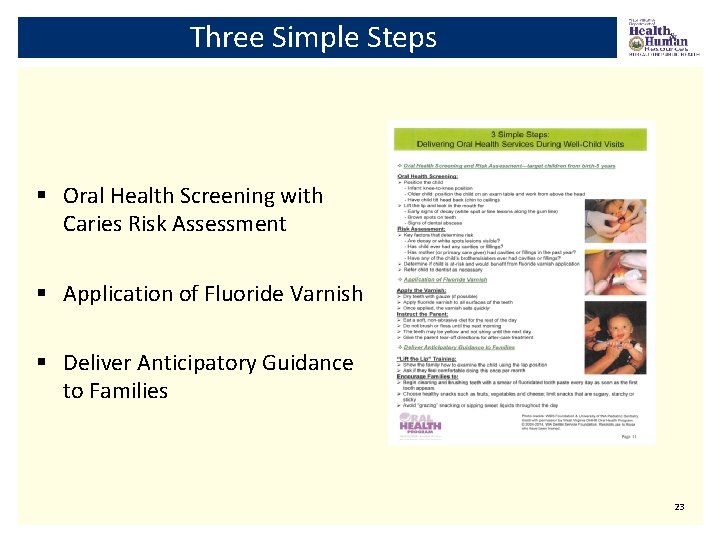
Three Simple Steps § Oral Health Screening with Caries Risk Assessment § Application of Fluoride Varnish § Deliver Anticipatory Guidance to Families 23
Oral Health Screening and Caries Risk Assessment § Lift the lip and look in the mouth for - Signs of decay (white spots) - Brown spots - Abscess § Key factors: - Are decay or white spots visible? - Has the child ever had any cavities or fillings? - Have any of the siblings had cavities or fillings? - Has the mother/primary care giver had cavities or fillings in the past year? § Determine if the child is at risk or would benefit from fluoride varnish § Refer the child to a dentist as necessary 24
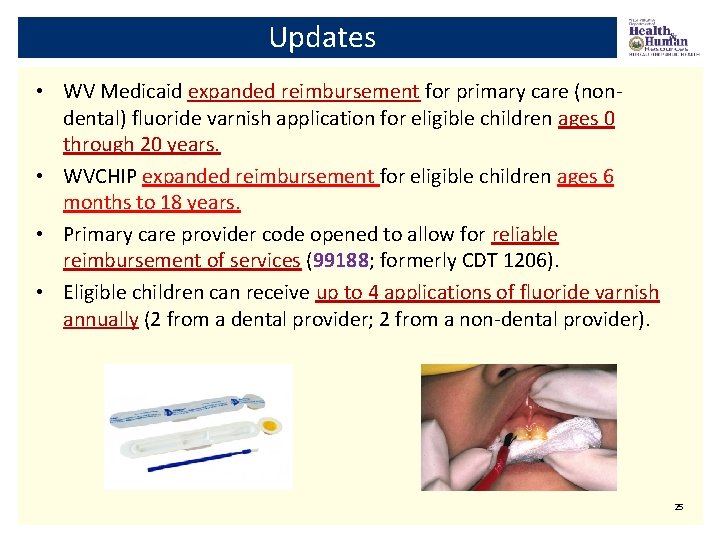
Updates • WV Medicaid expanded reimbursement for primary care (nondental) fluoride varnish application for eligible children ages 0 through 20 years. • WVCHIP expanded reimbursement for eligible children ages 6 months to 18 years. • Primary care provider code opened to allow for reliable reimbursement of services (99188; formerly CDT 1206). • Eligible children can receive up to 4 applications of fluoride varnish annually (2 from a dental provider; 2 from a non-dental provider). 25
Updates • One of two applications is recommended to take place in conjunction with the annual well-child visit (EPSDT). • Training via the Smiles for Life Curriculum, specifically Course 6: Caries Risk Assessment, Fluoride Varnish and Counseling is recommended, but not required for reimbursement of services. All updates improve alignment with recommendations/guidelines from: 26
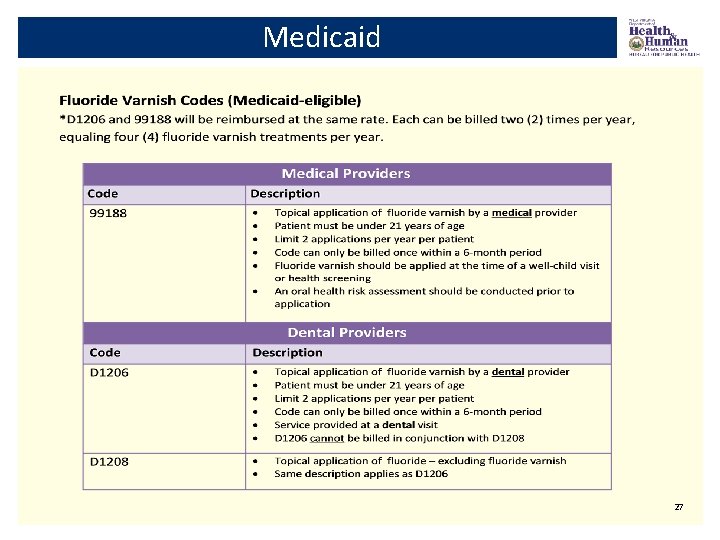
Medicaid 27
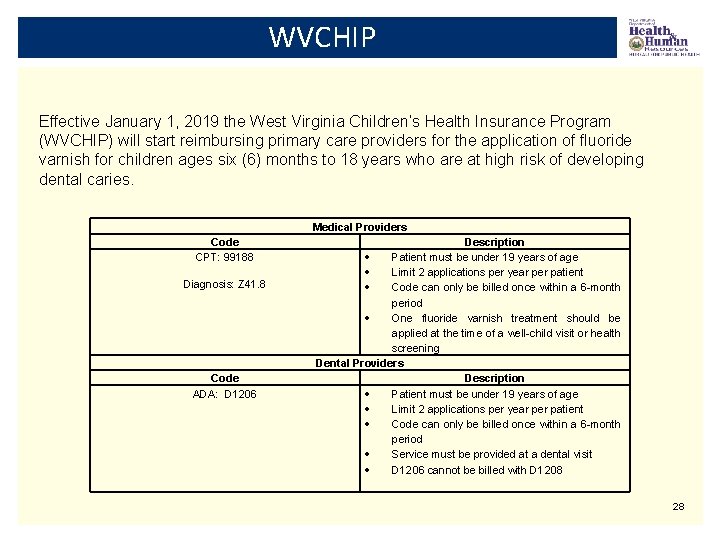
WVCHIP Effective January 1, 2019 the West Virginia Children’s Health Insurance Program (WVCHIP) will start reimbursing primary care providers for the application of fluoride varnish for children ages six (6) months to 18 years who are at high risk of developing dental caries. Medical Providers Code CPT: 99188 Diagnosis: Z 41. 8 Code ADA: D 1206 Description Patient must be under 19 years of age Limit 2 applications per year per patient Code can only be billed once within a 6 -month period One fluoride varnish treatment should be applied at the time of a well-child visit or health screening Dental Providers Description Patient must be under 19 years of age Limit 2 applications per year per patient Code can only be billed once within a 6 -month period Service must be provided at a dental visit D 1206 cannot be billed with D 1208 28
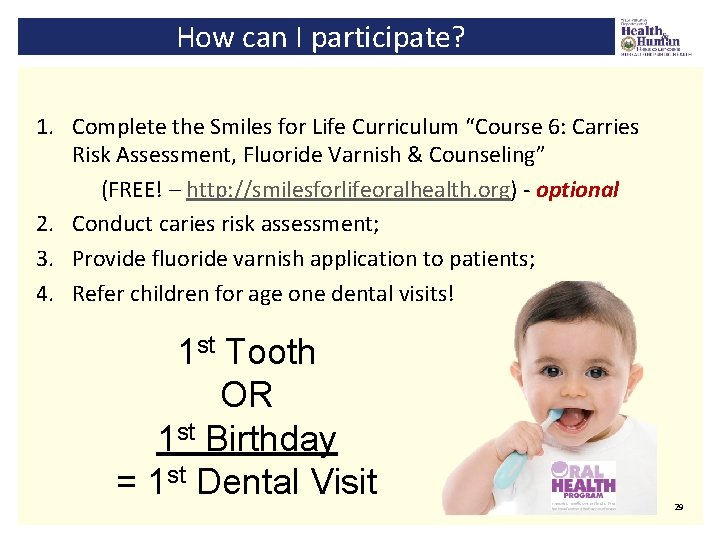
How can I participate? 1. Complete the Smiles for Life Curriculum “Course 6: Carries Risk Assessment, Fluoride Varnish & Counseling” (FREE! – http: //smilesforlifeoralhealth. org) - optional 2. Conduct caries risk assessment; 3. Provide fluoride varnish application to patients; 4. Refer children for age one dental visits! 1 st Tooth OR 1 st Birthday = 1 st Dental Visit 29
Preventing Oral Disease in Children The Guide to Community Preventive Services recommends the following interventions to address tooth decay: • Community water fluoridation (CWF) • Evidence shows the prevalence of caries is substantially lower in communities with CWF. In addition, there is no evidence that CWF results in severe dental fluorosis. • School-based dental sealant delivery programs • These programs increase the number of children who receive sealants at school and result in a large reduction in tooth decay among school-aged children (5 to 16 years of age). Source: The Guide to Community Preventive Services
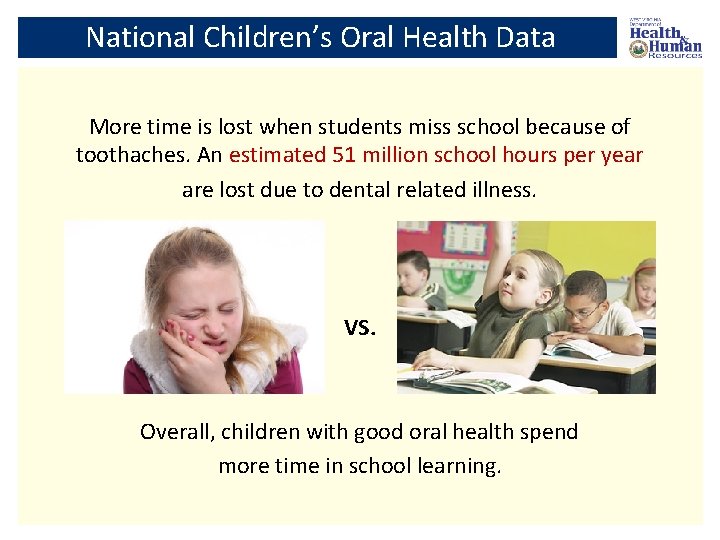
National Children’s Oral Health Data More time is lost when students miss school because of toothaches. An estimated 51 million school hours per year are lost due to dental related illness. VS. Overall, children with good oral health spend more time in school learning.
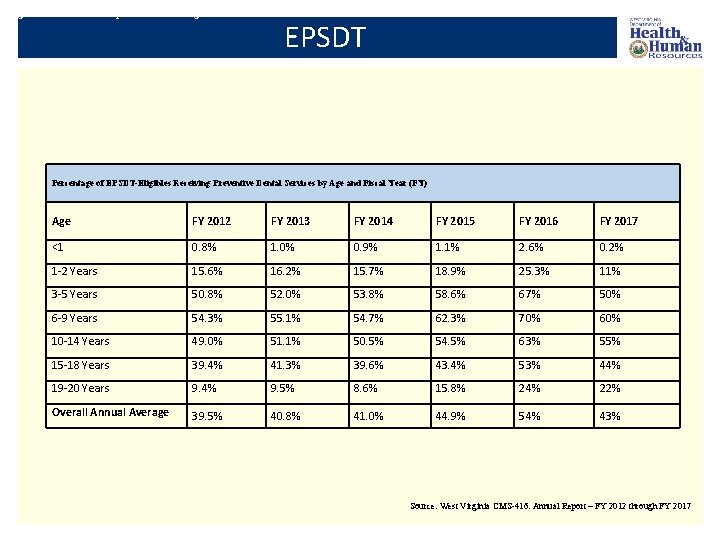
st Virginia CMS-416: Annual Report – FY 2012 through FY 2015 EPSDT Percentage of EPSDT-Eligibles Receiving Preventive Dental Services by Age and Fiscal Year (FY) Age FY 2012 FY 2013 FY 2014 FY 2015 FY 2016 FY 2017 <1 0. 8% 1. 0% 0. 9% 1. 1% 2. 6% 0. 2% 1 -2 Years 15. 6% 16. 2% 15. 7% 18. 9% 25. 3% 11% 3 -5 Years 50. 8% 52. 0% 53. 8% 58. 6% 67% 50% 6 -9 Years 54. 3% 55. 1% 54. 7% 62. 3% 70% 60% 10 -14 Years 49. 0% 51. 1% 50. 5% 54. 5% 63% 55% 15 -18 Years 39. 4% 41. 3% 39. 6% 43. 4% 53% 44% 19 -20 Years 9. 4% 9. 5% 8. 6% 15. 8% 24% 22% Overall Annual Average 39. 5% 40. 8% 41. 0% 44. 9% 54% 43% Source: West Virginia CMS-416: Annual Report – FY 2012 through FY 2017
West Virginia Substance Abuse Trends – Select Indicators Source: 2018 OMCFH Title V Block Grant Application
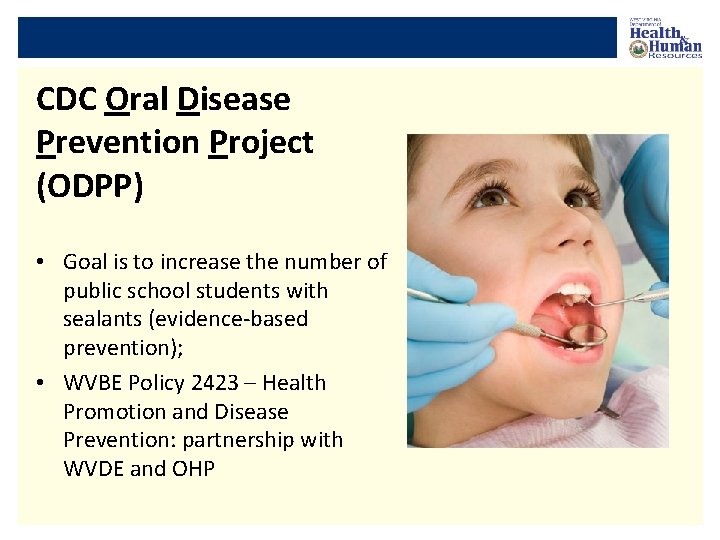
CDC Oral Disease Prevention Project (ODPP) • Goal is to increase the number of public school students with sealants (evidence-based prevention); • WVBE Policy 2423 – Health Promotion and Disease Prevention: partnership with WVDE and OHP
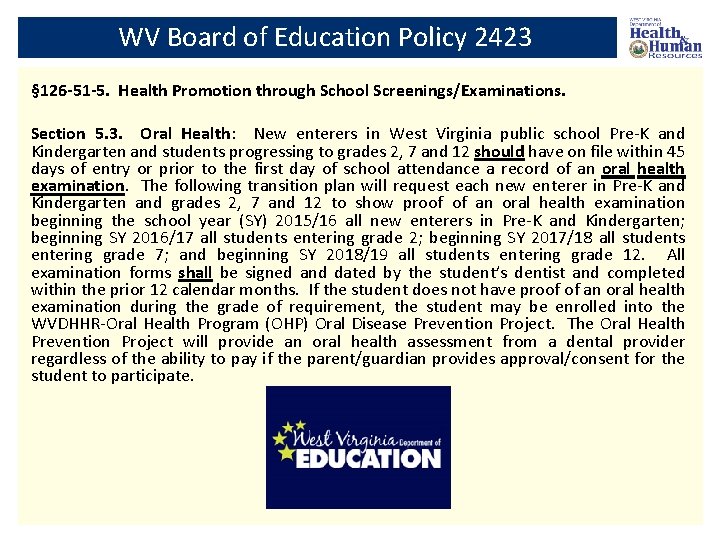
WV Board of Education Policy 2423 § 126 -51 -5. Health Promotion through School Screenings/Examinations. Section 5. 3. Oral Health: New enterers in West Virginia public school Pre-K and Kindergarten and students progressing to grades 2, 7 and 12 should have on file within 45 days of entry or prior to the first day of school attendance a record of an oral health examination. The following transition plan will request each new enterer in Pre-K and Kindergarten and grades 2, 7 and 12 to show proof of an oral health examination beginning the school year (SY) 2015/16 all new enterers in Pre-K and Kindergarten; beginning SY 2016/17 all students entering grade 2; beginning SY 2017/18 all students entering grade 7; and beginning SY 2018/19 all students entering grade 12. All examination forms shall be signed and dated by the student’s dentist and completed within the prior 12 calendar months. If the student does not have proof of an oral health examination during the grade of requirement, the student may be enrolled into the WVDHHR-Oral Health Program (OHP) Oral Disease Prevention Project. The Oral Health Prevention Project will provide an oral health assessment from a dental provider regardless of the ability to pay if the parent/guardian provides approval/consent for the student to participate.
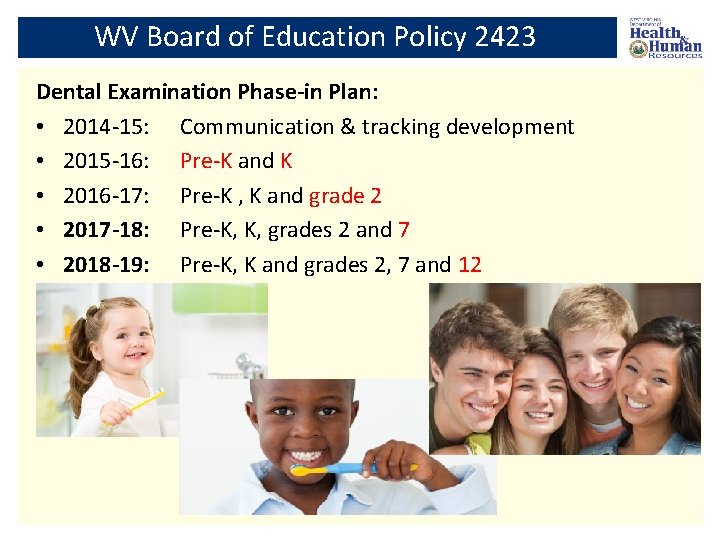
WV Board of Education Policy 2423 Dental Examination Phase-in Plan: • 2014 -15: Communication & tracking development • 2015 -16: Pre-K and K • 2016 -17: Pre-K , K and grade 2 • 2017 -18: Pre-K, K, grades 2 and 7 • 2018 -19: Pre-K, K and grades 2, 7 and 12
WV Board of Education Policy 2423 § 126 -51. 7. Quality assurance for school-based services. Section 7. 1. All community services performed in the school setting should be regular and on-going services that are evidence-based or a promising practice and follow best practices and guidelines. The terms regular and on-going services as referenced refer to community services that are provided within the school in an agreed upon manner between the school and community partner(s) which work toward promoting both the academic, health and social service needs of students. Section 7. 1. C. Oral health services shall incorporate the protocols set forth by the WVDHHR-OHP.
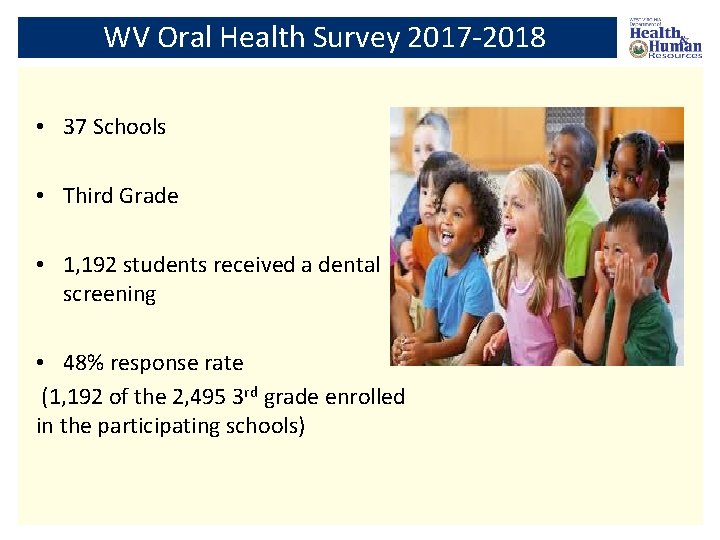
WV Oral Health Survey 2017 -2018 • 37 Schools • Third Grade • 1, 192 students received a dental screening • 48% response rate (1, 192 of the 2, 495 3 rd grade enrolled in the participating schools)
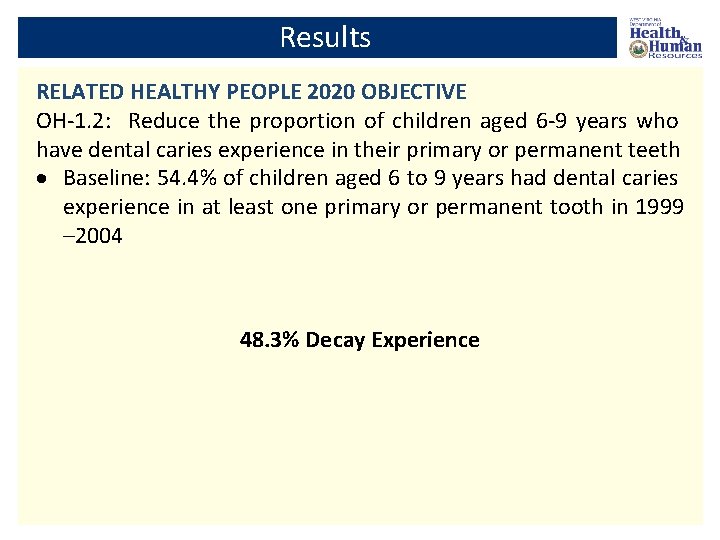
Results RELATED HEALTHY PEOPLE 2020 OBJECTIVE OH-1. 2: Reduce the proportion of children aged 6 -9 years who have dental caries experience in their primary or permanent teeth Baseline: 54. 4% of children aged 6 to 9 years had dental caries experience in at least one primary or permanent tooth in 1999 – 2004 48. 3% Decay Experience
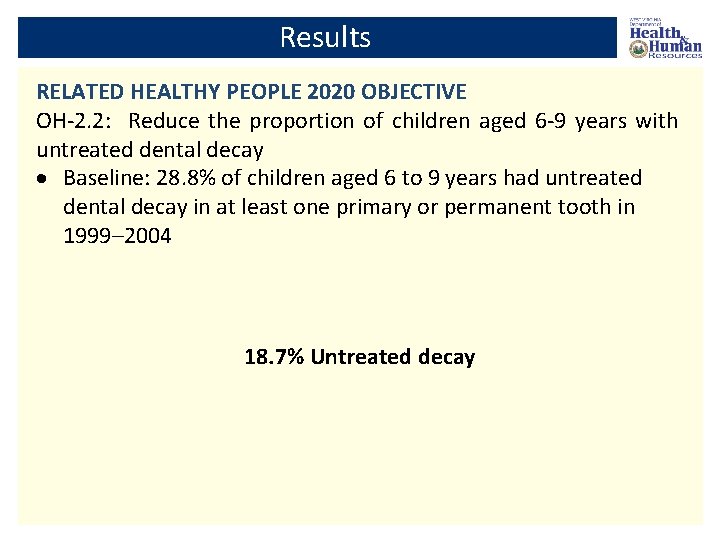
Results RELATED HEALTHY PEOPLE 2020 OBJECTIVE OH-2. 2: Reduce the proportion of children aged 6 -9 years with untreated dental decay Baseline: 28. 8% of children aged 6 to 9 years had untreated dental decay in at least one primary or permanent tooth in 1999– 2004 18. 7% Untreated decay
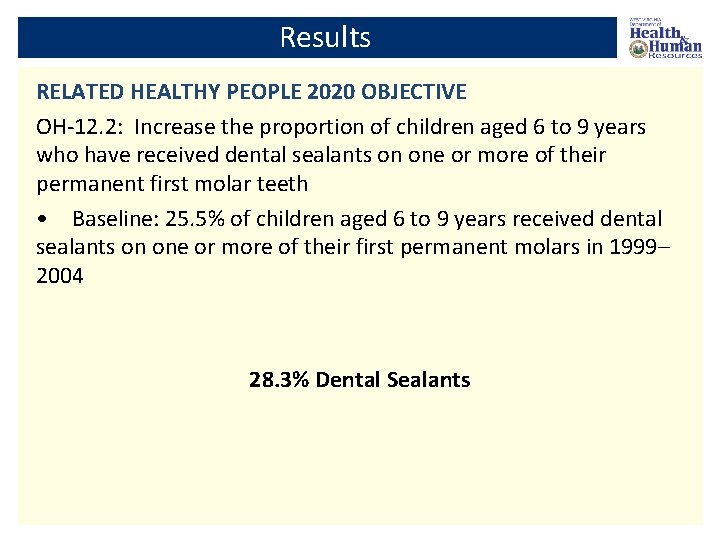
Results RELATED HEALTHY PEOPLE 2020 OBJECTIVE OH-12. 2: Increase the proportion of children aged 6 to 9 years who have received dental sealants on one or more of their permanent first molar teeth • Baseline: 25. 5% of children aged 6 to 9 years received dental sealants on one or more of their first permanent molars in 1999– 2004 28. 3% Dental Sealants
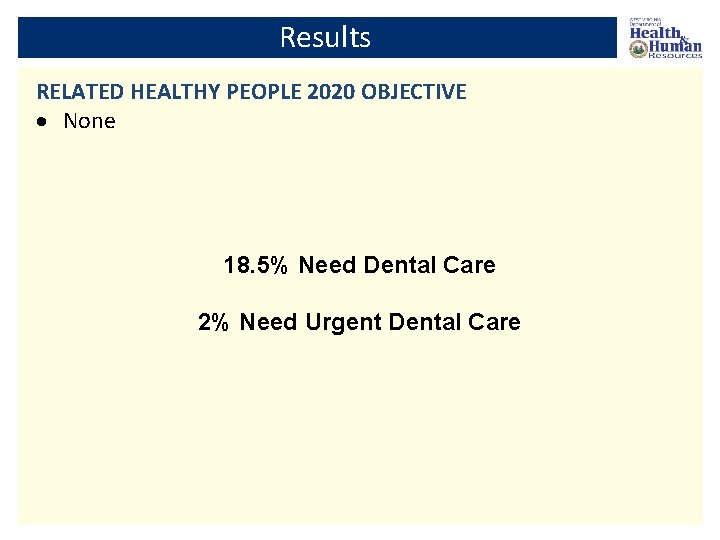
Results RELATED HEALTHY PEOPLE 2020 OBJECTIVE None 18. 5% Need Dental Care 2% Need Urgent Dental Care
Workforce
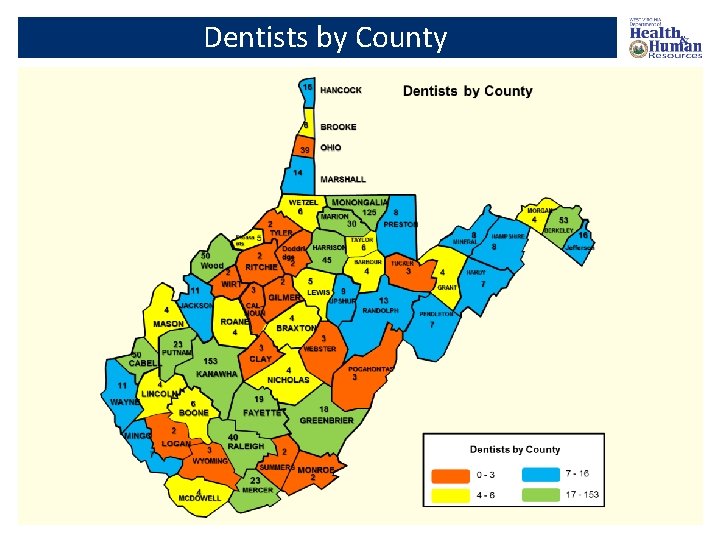
Dentists by County
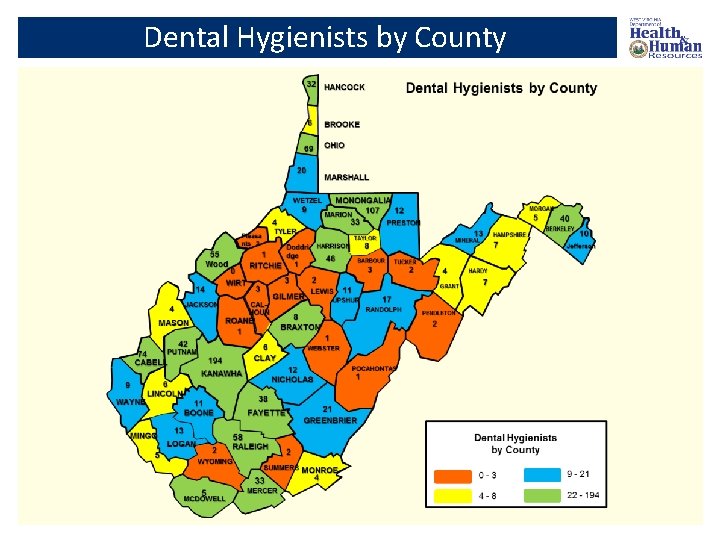
Dental Hygienists by County
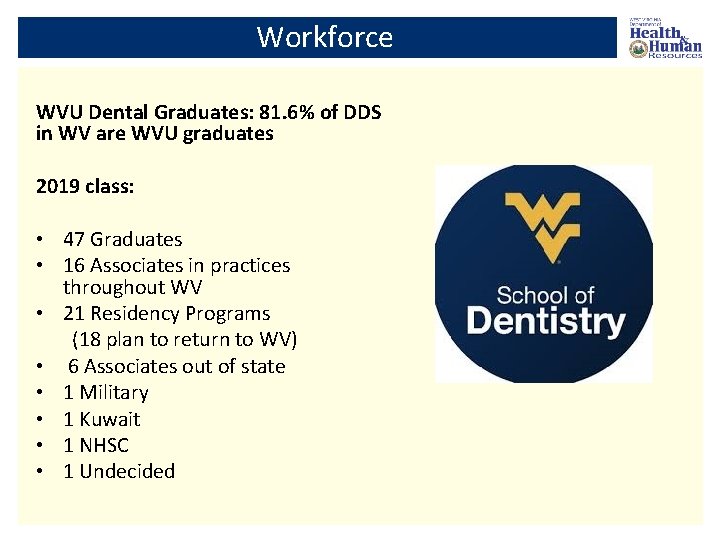
Workforce WVU Dental Graduates: 81. 6% of DDS in WV are WVU graduates 2019 class: • 47 Graduates • 16 Associates in practices throughout WV • 21 Residency Programs (18 plan to return to WV) • 6 Associates out of state • 1 Military • 1 Kuwait • 1 NHSC • 1 Undecided
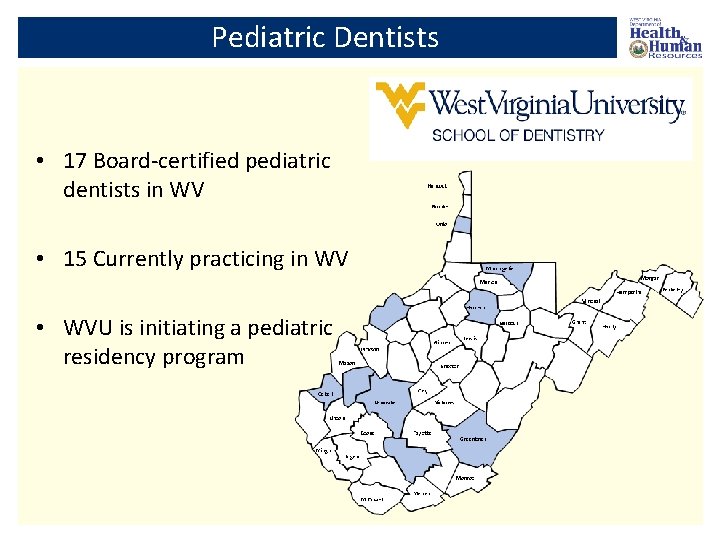
Pediatric Dentists • 17 Board-certified pediatric dentists in WV • 15 Currently practicing in WV • WVU is initiating a pediatric residency program
HRSA Dental Workforce Grant (2015 -2018) • Grants and/or low-interest loans for improving access in dental health professional shortage areas (d. HPSAs) • Dental loan reimbursement • Division of Rural Health and Recruitment • Higher Education Policy Commission • Medical & Dental Collaboration • Fluoride varnish • Hygienists in non-traditional settings (i. e. OB/GYN sites) • Technical Assistance (TA) Team
Grant Overview • • • WV OHP received HRSA funding through a competitive grant process Awarded approximately 1. 5 million dollars 3 year project A portion of the funding was used to address dental graduate retention in effort to improve access to care in Dental Health Professional Shortage Areas (DHPSA) Funding was also used to provide technical support for dentists located in isolated areas via a technical assistance team
HRSA Dental Workforce Awards ranging from $8, 000 to $40, 000 depending on specific need • The grant was awarded to expand services through equipment purchases/upgrades • Applicant must accept Medicaid and/or CHIPs and be located in a DHPSA • A total of 25 grants were awarded during the grant period •
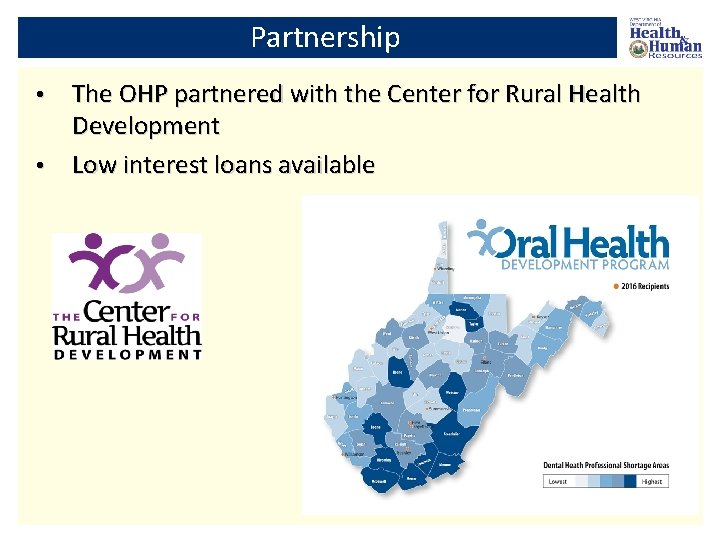
Partnership The OHP partnered with the Center for Rural Health Development • Low interest loans available •
The Supplementary Application Process The WV State Loan Repayment Program (SLRP) • Key Points: o Available to dentists, primary care physicians, nurse practitioners, nurse midwives, physician assistants o Requires obligated services in the HPSA in WV for a non-profit employer o SLRP will pay for tuition expenses, reasonable training expenses, and living expenses o US citizens who are licensed to practice in WV can apply •
State Loan Repayment Program (SLRP) • Criteria: o Must practice full-time general clinical dentistry o Must practice 40 hours per week, 45 weeks per year o Agree not to discriminate against patients on the basis of their ability to pay for their dental services o Complete a minimum 2 -year service obligation o Maximum repayment is $40, 000. 00 over the 2 year obligation o For more information: Brandon. K. Carman@wv. gov
Recruitment and Retention Community Project (RRCP) �Purpose: recruit and retain primary health care providers (general dentists) into underserved communities (DHPSA). �Support can span a maximum of 4 years �Requirements: Be located in a DHPSA Provide full continuum of care, 40 hours per week, 45 weeks per year Have an open policy to provide care regardless of a person’s ability to pay Be able to provide 50 percent matching dollars from sponsoring community organization Grant is for $20, 000 per year, for a total of $80, 000. For more information: Brandon. K. Carman@wv. gov
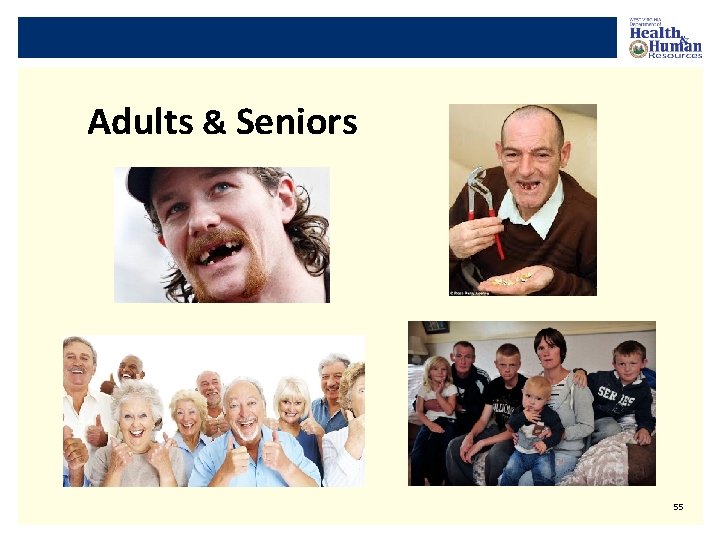
Adults & Seniors 55
Addressing Lack of Adult Dental Coverage BCF and BPH Pre-employment (Dental and Vision) Project • This project began in 2000 and provides dental and vision services for adults transitioning from “welfare to work” who are receiving Temporary Assistance for Needy Families (TANF) benefits from the WV DHHR; • Funded by the Bureau for Children and Families through Temporary Assistance for Needy Families (TANF); • Administered by the Bureau for Public Health Oral Health Program; • Lifetime limit for dental services: $3, 300/client; • Serves approximately 2, 500 people per year.
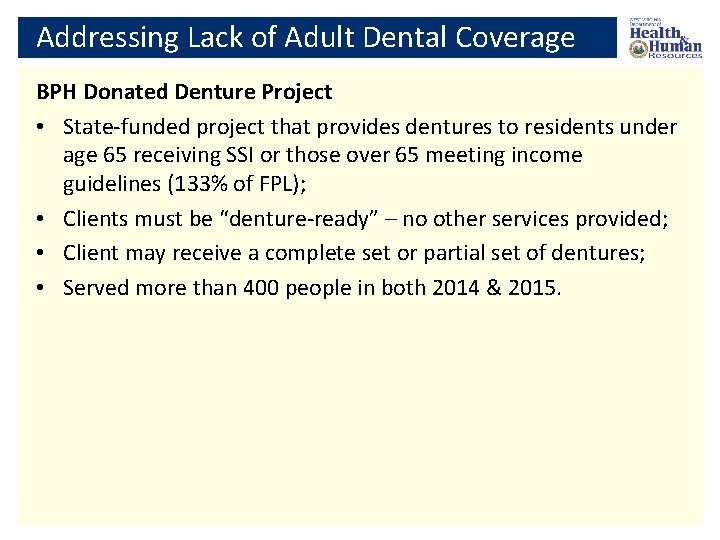
Addressing Lack of Adult Dental Coverage BPH Donated Denture Project • State-funded project that provides dentures to residents under age 65 receiving SSI or those over 65 meeting income guidelines (133% of FPL); • Clients must be “denture-ready” – no other services provided; • Client may receive a complete set or partial set of dentures; • Served more than 400 people in both 2014 & 2015.
Oral Health Surveillance & Evaluation
Oral Health Surveillance and Evaluation What our partners hear …
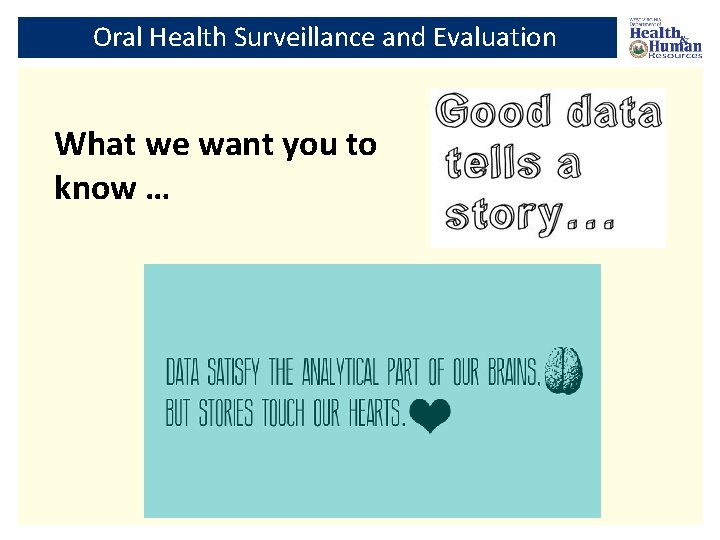
Oral Health Surveillance and Evaluation What we want you to know …
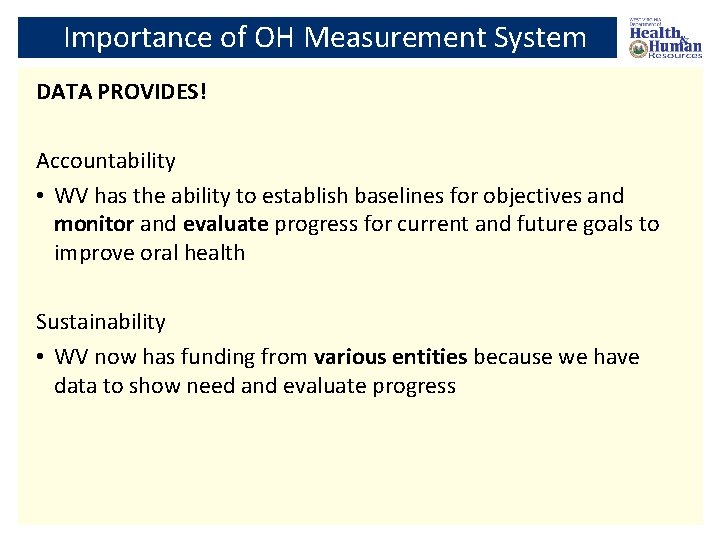
Importance of OH Measurement System DATA PROVIDES! Accountability • WV has the ability to establish baselines for objectives and monitor and evaluate progress for current and future goals to improve oral health Sustainability • WV now has funding from various entities because we have data to show need and evaluate progress
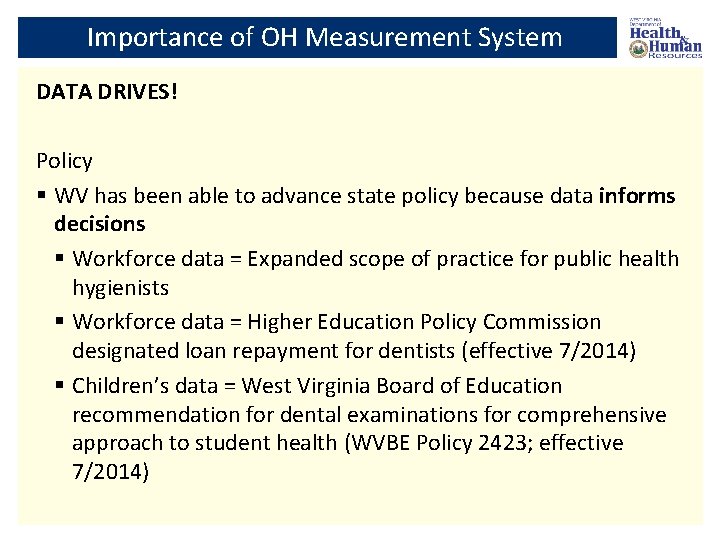
Importance of OH Measurement System DATA DRIVES! Policy § WV has been able to advance state policy because data informs decisions § Workforce data = Expanded scope of practice for public health hygienists § Workforce data = Higher Education Policy Commission designated loan repayment for dentists (effective 7/2014) § Children’s data = West Virginia Board of Education recommendation for dental examinations for comprehensive approach to student health (WVBE Policy 2423; effective 7/2014)
Current OH Data in WV
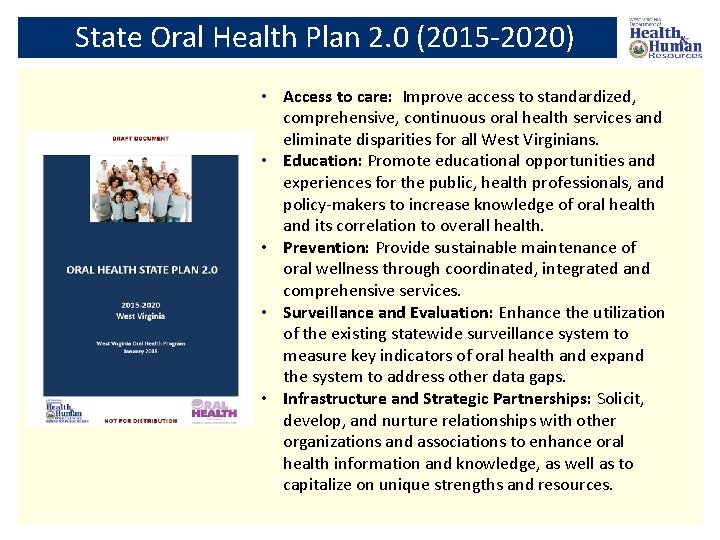
State Oral Health Plan 2. 0 (2015 -2020) • Access to care: Improve access to standardized, comprehensive, continuous oral health services and eliminate disparities for all West Virginians. • Education: Promote educational opportunities and experiences for the public, health professionals, and policy-makers to increase knowledge of oral health and its correlation to overall health. • Prevention: Provide sustainable maintenance of oral wellness through coordinated, integrated and comprehensive services. • Surveillance and Evaluation: Enhance the utilization of the existing statewide surveillance system to measure key indicators of oral health and expand the system to address other data gaps. • Infrastructure and Strategic Partnerships: Solicit, develop, and nurture relationships with other organizations and associations to enhance oral health information and knowledge, as well as to capitalize on unique strengths and resources.
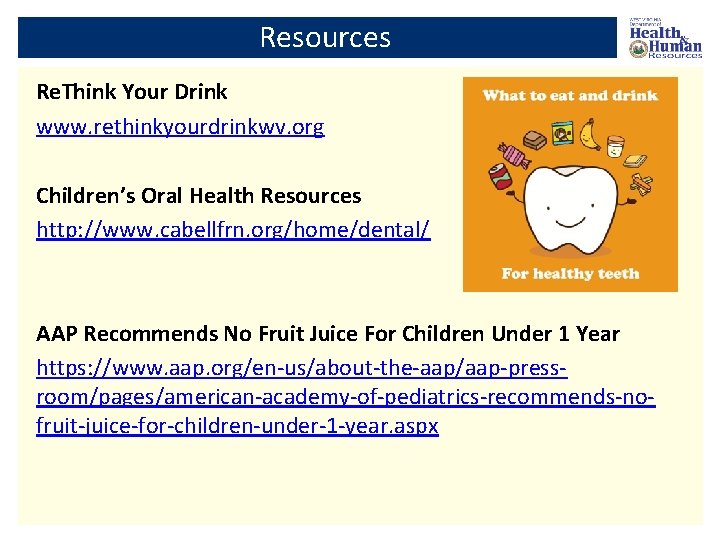
Resources Re. Think Your Drink www. rethinkyourdrinkwv. org Children’s Oral Health Resources http: //www. cabellfrn. org/home/dental/ AAP Recommends No Fruit Juice For Children Under 1 Year https: //www. aap. org/en-us/about-the-aap/aap-pressroom/pages/american-academy-of-pediatrics-recommends-nofruit-juice-for-children-under-1 -year. aspx
THANK YOU! For more information, contact: Dr. Jason Roush, State Dental Director Jason. M. Roush@wv. gov www. dhhr. wv. gov/oralhealth