The Development of LargeArea Picosecond Photodetectors Henry Frisch

- Slides: 44
The Development of Large-Area Pico-second Photodetectors Henry Frisch, Enrico Fermi Institute, Univ. of Chicago For the LAPPD Collaboration
Outline • New Types of Detectors Can Change Whole Areas of Science, Medical Imaging, Nuclear Non-proliferation • Technical details of LAPPD: Surface Physics, Giga. Hz E&M, Glass, Circuit (ASIC) design, Tech Transfer to Industry • Photocathodes- learning SS physics (!) • Opportunities – many Ph. D theses in many fields- a broad collaborative effort, including industry Acknowledgements- LAPPD collaborators, Howard Nicholson and the DOE HEP, ANL Management, and the NSF. 2/26/2021 IIT Colloquium April 2013 2
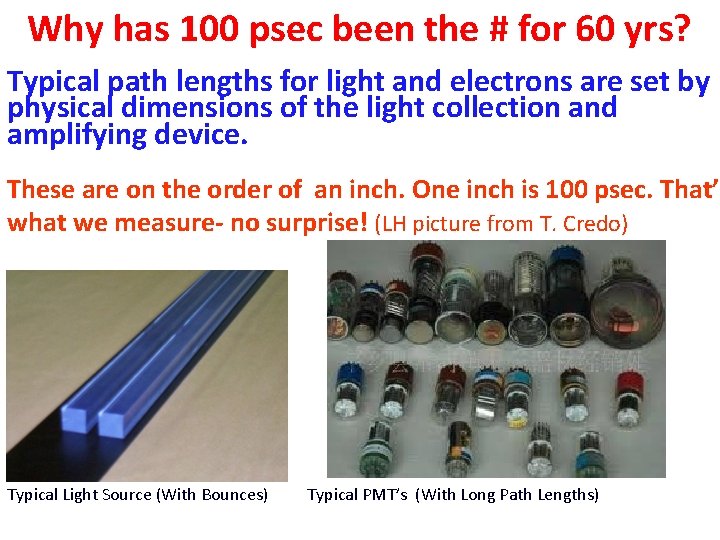
Why has 100 psec been the # for 60 yrs? Typical path lengths for light and electrons are set by physical dimensions of the light collection and amplifying device. These are on the order of an inch. One inch is 100 psec. That’s what we measure- no surprise! (LH picture from T. Credo) Typical Light Source (With Bounces) Typical PMT’s (With Long Path Lengths)
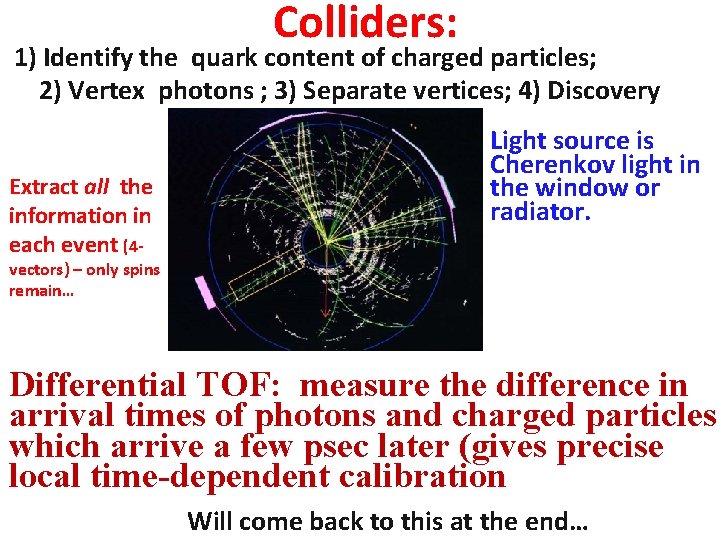
Colliders: 1) Identify the quark content of charged particles; 2) Vertex photons ; 3) Separate vertices; 4) Discovery Extract all the information in each event (4 - Light source is Cherenkov light in the window or radiator. vectors) – only spins remain… Differential TOF: measure the difference in arrival times of photons and charged particles which arrive a few psec later (gives precise local time-dependent calibration Will come back to this at the end…
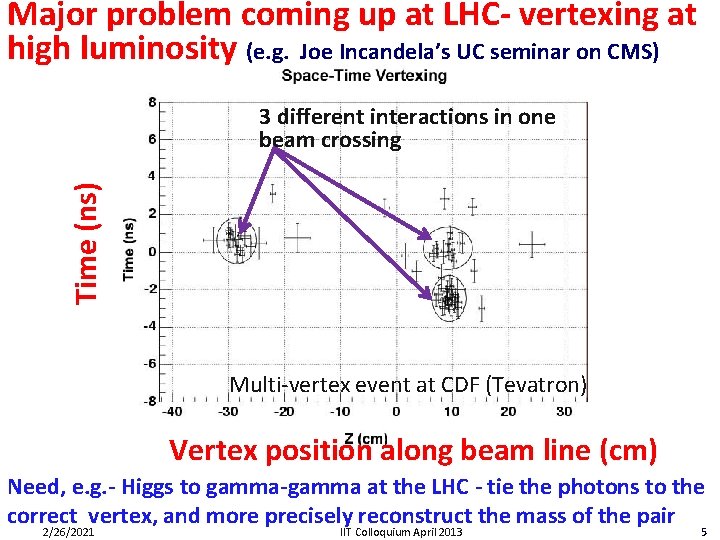
Major problem coming up at LHC- vertexing at high luminosity (e. g. Joe Incandela’s UC seminar on CMS) Time (ns) 3 different interactions in one beam crossing Multi-vertex event at CDF (Tevatron) Vertex position along beam line (cm) Need, e. g. - Higgs to gamma-gamma at the LHC - tie the photons to the correct vertex, and more precisely reconstruct the mass of the pair 2/26/2021 IIT Colloquium April 2013 5
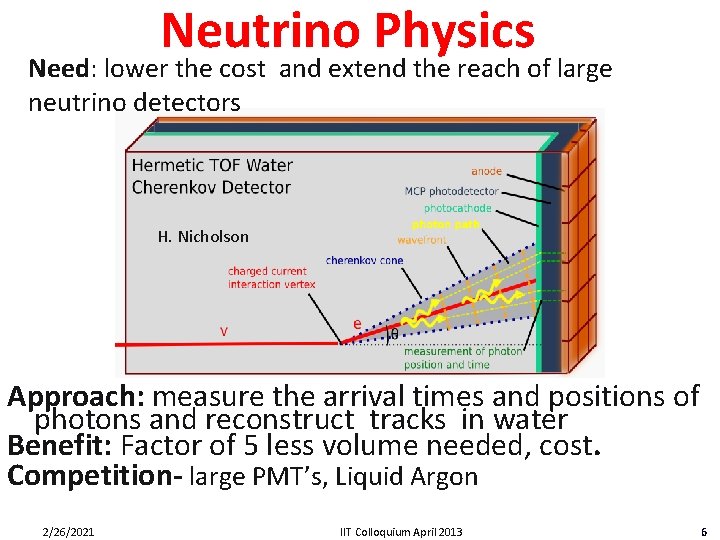
Neutrino Physics Need: lower the cost and extend the reach of large neutrino detectors H. Nicholson Approach: measure the arrival times and positions of photons and reconstruct tracks in water Benefit: Factor of 5 less volume needed, cost. Competition- large PMT’s, Liquid Argon 2/26/2021 IIT Colloquium April 2013 6
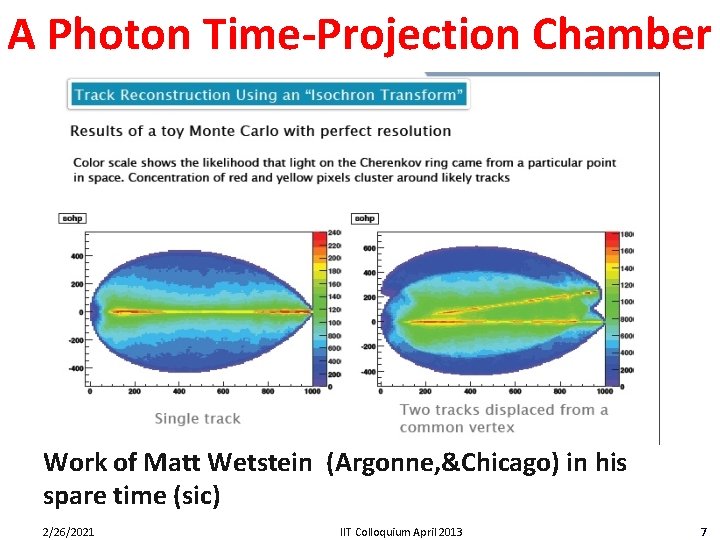
A Photon Time-Projection Chamber Work of Matt Wetstein (Argonne, &Chicago) in his spare time (sic) 2/26/2021 IIT Colloquium April 2013 7
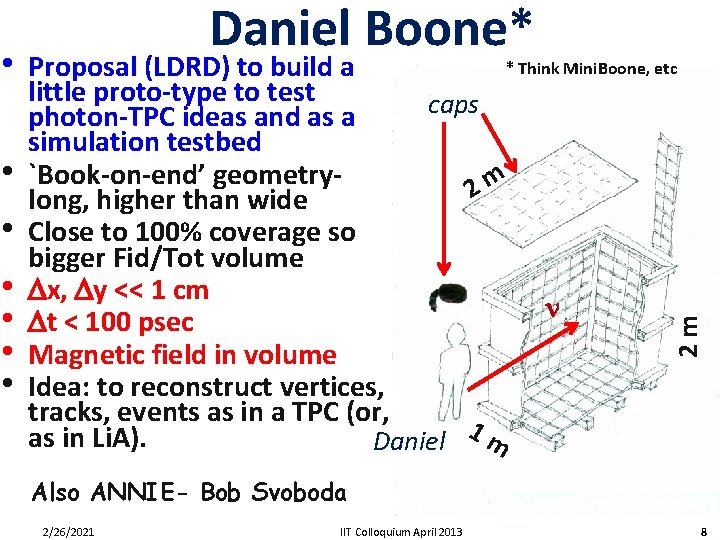
• • • * Think Mini. Boone, etc Proposal (LDRD) to build a little proto-type to test caps photon-TPC ideas and as a simulation testbed `Book-on-end’ geometrym 2 long, higher than wide Close to 100% coverage so bigger Fid/Tot volume Dx, Dy << 1 cm n Dt < 100 psec Magnetic field in volume Idea: to reconstruct vertices, tracks, events as in a TPC (or, as in Li. A). Daniel 1 m 2 m • Daniel Boone* Also ANNIE- Bob Svoboda 2/26/2021 IIT Colloquium April 2013 8
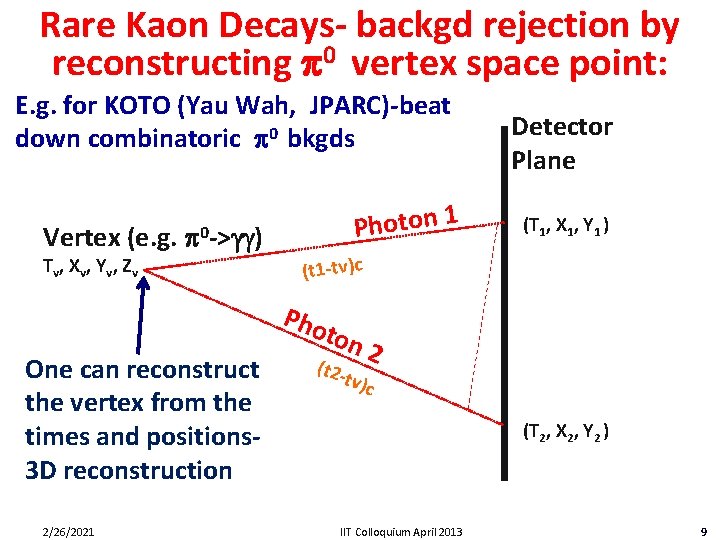
Rare Kaon Decays- backgd rejection by reconstructing p 0 vertex space point: E. g. for KOTO (Yau Wah, JPARC)-beat down combinatoric p 0 bkgds Vertex (e. g. Tv , X v , Y v , Z v p 0 ->gg) Photon 1 2/26/2021 (T 1, X 1, Y 1 ) (t 1 -tv)c Pho One can reconstruct the vertex from the times and positions 3 D reconstruction Detector Plane ton (t 2 - 2 tv)c (T 2, X 2, Y 2 ) IIT Colloquium April 2013 9
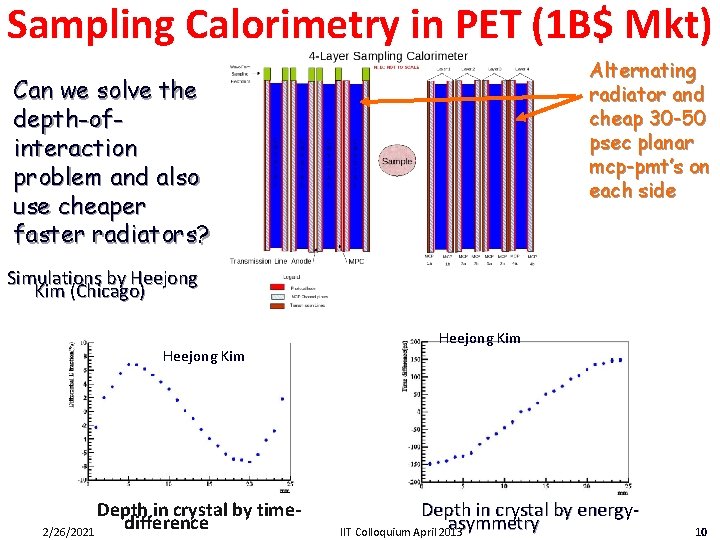
Sampling Calorimetry in PET (1 B$ Mkt) Alternating radiator and cheap 30 -50 psec planar mcp-pmt’s on each side Can we solve the depth-ofinteraction problem and also use cheaper faster radiators? Simulations by Heejong Kim (Chicago) Heejong Kim Depth in crystal by timedifference 2/26/2021 Heejong Kim Depth in crystal by energyasymmetry IIT Colloquium April 2013 10
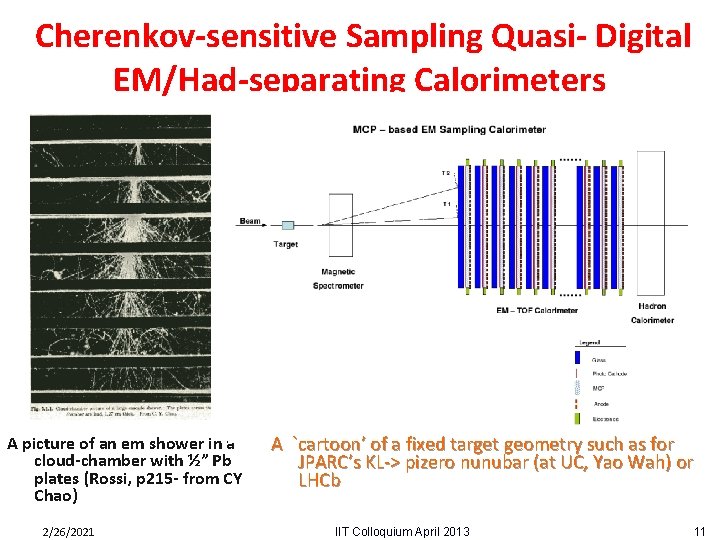
Cherenkov-sensitive Sampling Quasi- Digital EM/Had-separating Calorimeters A picture of an em shower in a cloud-chamber with ½” Pb plates (Rossi, p 215 - from CY Chao) 2/26/2021 A `cartoon’ of a fixed target geometry such as for JPARC’s KL-> pizero nunubar (at UC, Yao Wah) or LHCb IIT Colloquium April 2013 11
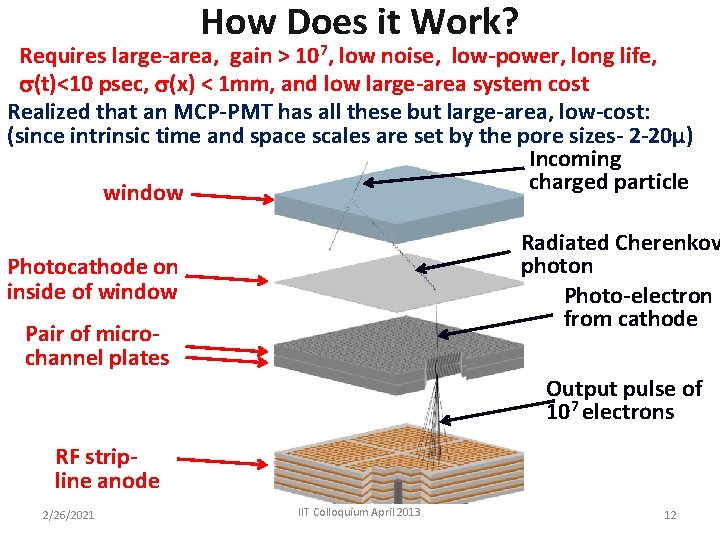
How Does it Work? Requires large-area, gain > 107, low noise, low-power, long life, (t)<10 psec, (x) < 1 mm, and low large-area system cost Realized that an MCP-PMT has all these but large-area, low-cost: (since intrinsic time and space scales are set by the pore sizes- 2 -20µ) Incoming charged particle window Radiated Cherenkov photon Photo-electron from cathode Photocathode on inside of window Pair of microchannel plates Output pulse of 107 electrons RF stripline anode 2/26/2021 IIT Colloquium April 2013 12
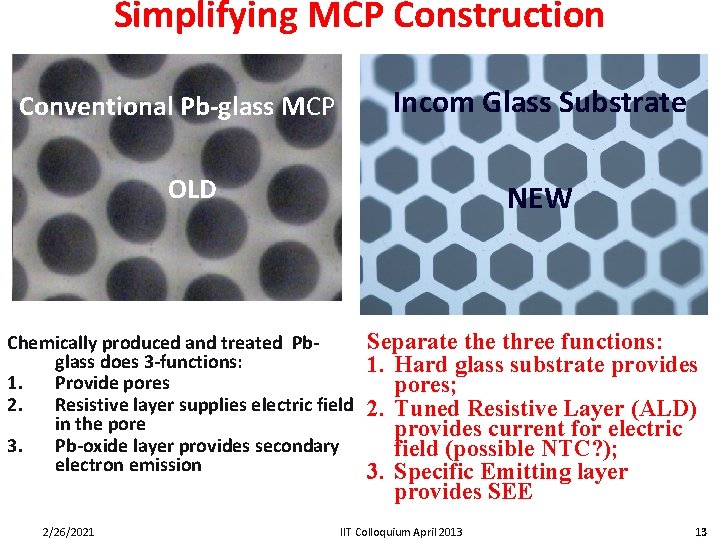
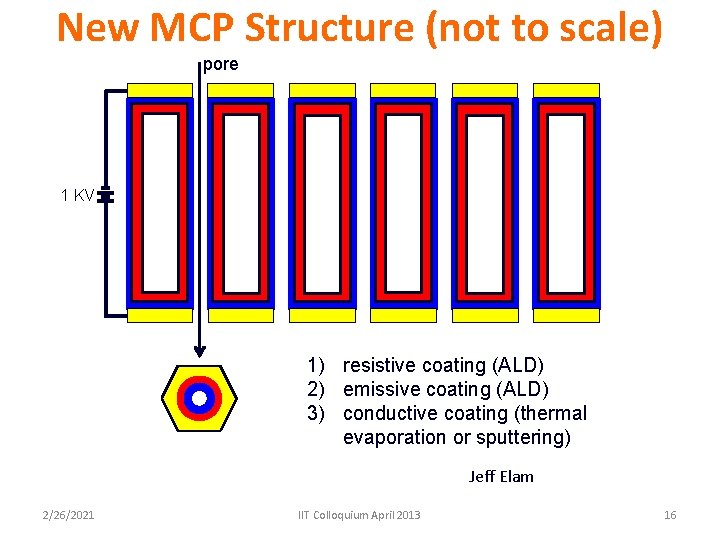
Simplifying MCP Construction Incom Glass Substrate Conventional Pb-glass MCP OLD NEW Chemically produced and treated Pbglass does 3 -functions: 1. Provide pores 2. Resistive layer supplies electric field in the pore 3. Pb-oxide layer provides secondary electron emission 2/26/2021 Separate three functions: 1. Hard glass substrate provides pores; 2. Tuned Resistive Layer (ALD) provides current for electric field (possible NTC? ); 3. Specific Emitting layer provides SEE IIT Colloquium April 2013 13
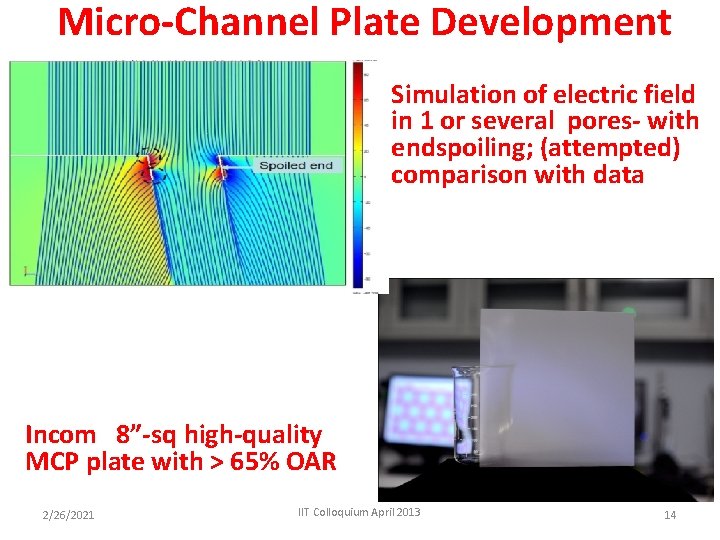
Micro-Channel Plate Development Simulation of electric field in 1 or several pores- with endspoiling; (attempted) comparison with data Incom 8”-sq high-quality MCP plate with > 65% OAR 2/26/2021 IIT Colloquium April 2013 14
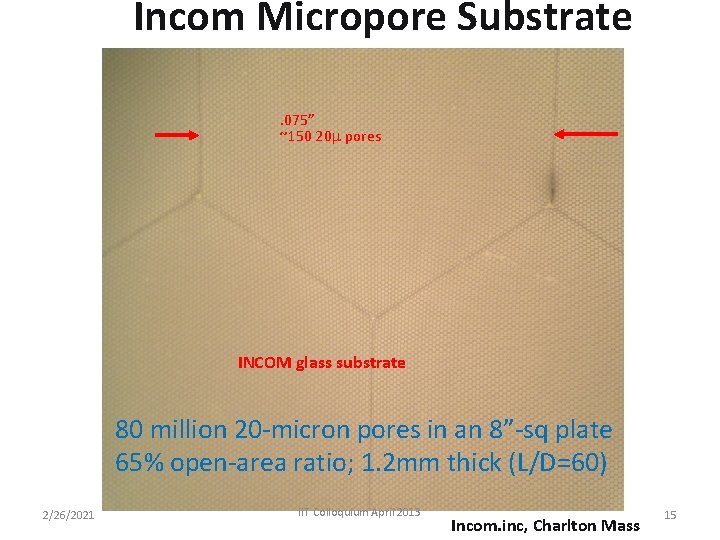
Incom Micropore Substrate. 075” ~150 20 m pores INCOM glass substrate 80 million 20 -micron pores in an 8”-sq plate 65% open-area ratio; 1. 2 mm thick (L/D=60) 2/26/2021 IIT Colloquium April 2013 Incom. inc, Charlton Mass 15
New MCP Structure (not to scale) pore 1 KV 1) resistive coating (ALD) 2) emissive coating (ALD) 3) conductive coating (thermal evaporation or sputtering) Jeff Elam 2/26/2021 IIT Colloquium April 2013 16 16
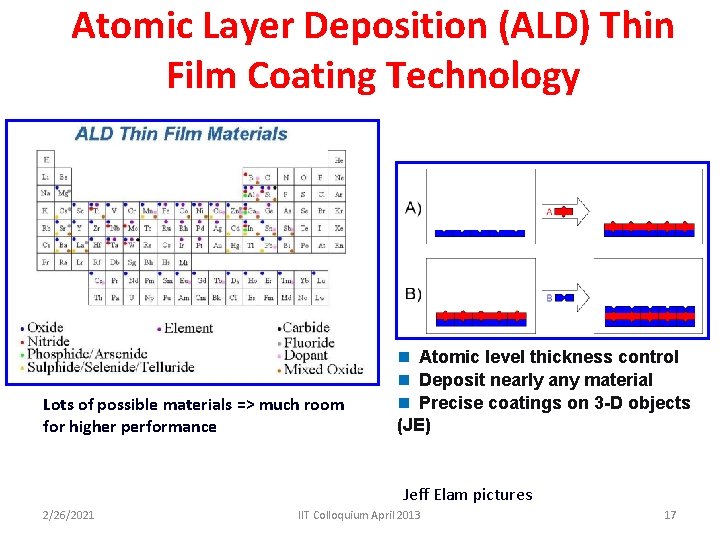
Atomic Layer Deposition (ALD) Thin Film Coating Technology Lots of possible materials => much room for higher performance n Atomic level thickness control n Deposit nearly any material n Precise coatings on 3 -D objects (JE) Jeff Elam pictures 2/26/2021 IIT Colloquium April 2013 17
Slade Jokela (ANL) 2/26/2021 IIT Colloquium April 2013 18
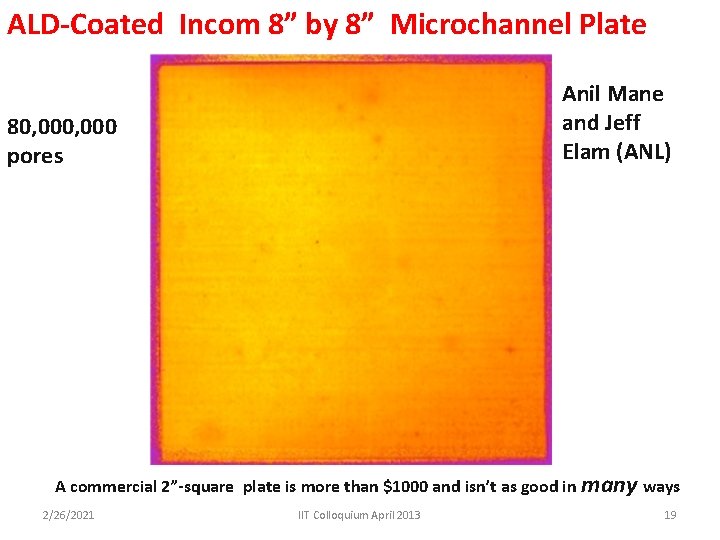
ALD-Coated Incom 8” by 8” Microchannel Plate Anil Mane and Jeff Elam (ANL) 80, 000 pores A commercial 2”-square plate is more than $1000 and isn’t as good in many ways 2/26/2021 IIT Colloquium April 2013 19
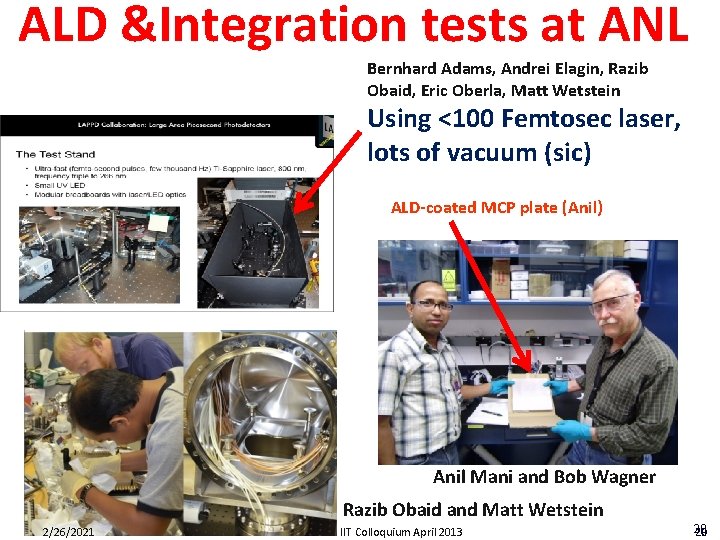
ALD &Integration tests at ANL Bernhard Adams, Andrei Elagin, Razib Obaid, Eric Oberla, Matt Wetstein Using <100 Femtosec laser, lots of vacuum (sic) ALD-coated MCP plate (Anil) Anil Mani and Bob Wagner Razib Obaid and Matt Wetstein 2/26/2021 IIT Colloquium April 2013 20 20
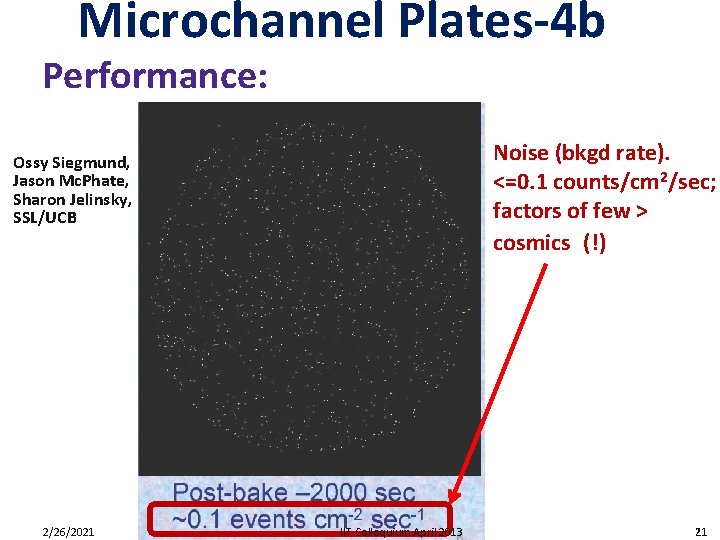
Microchannel Plates-4 b Performance: Noise (bkgd rate). <=0. 1 counts/cm 2/sec; factors of few > cosmics (!) Ossy Siegmund, Jason Mc. Phate, Sharon Jelinsky, SSL/UCB 2/26/2021 IIT Colloquium April 2013 21
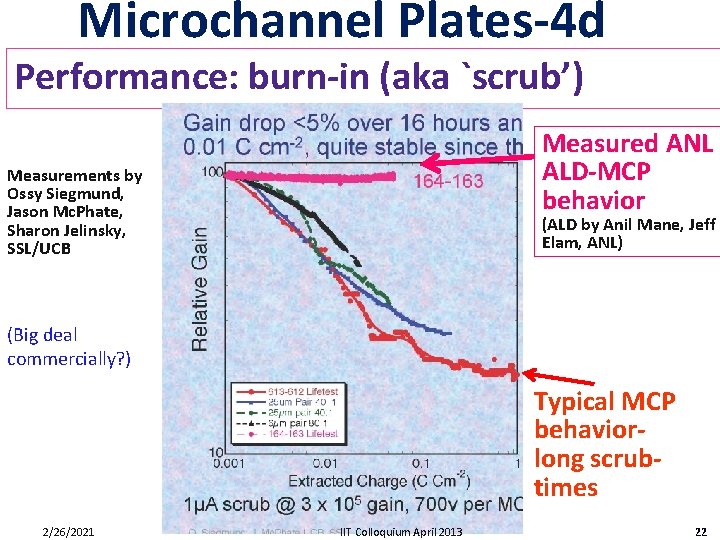
Microchannel Plates-4 d Performance: burn-in (aka `scrub’) Measured ANL ALD-MCP behavior Measurements by Ossy Siegmund, Jason Mc. Phate, Sharon Jelinsky, SSL/UCB (ALD by Anil Mane, Jeff Elam, ANL) (Big deal commercially? ) Typical MCP behaviorlong scrubtimes 2/26/2021 IIT Colloquium April 2013 22
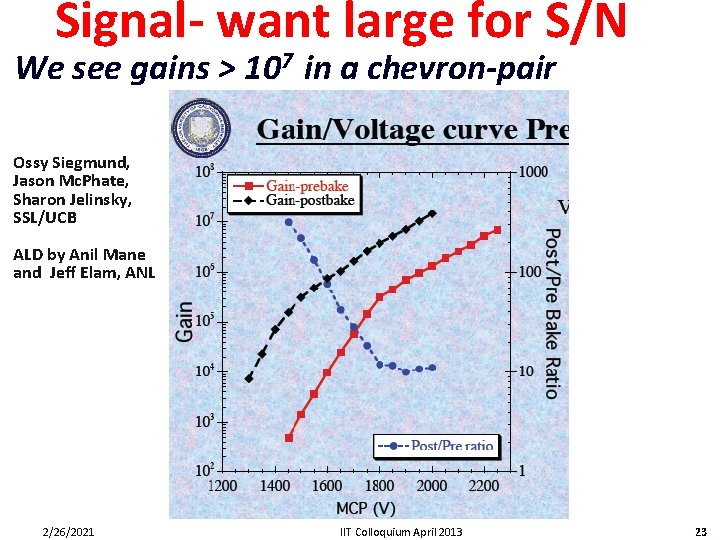
Signal- want large for S/N We see gains > 107 in a chevron-pair Ossy Siegmund, Jason Mc. Phate, Sharon Jelinsky, SSL/UCB ALD by Anil Mane and Jeff Elam, ANL 2/26/2021 IIT Colloquium April 2013 23
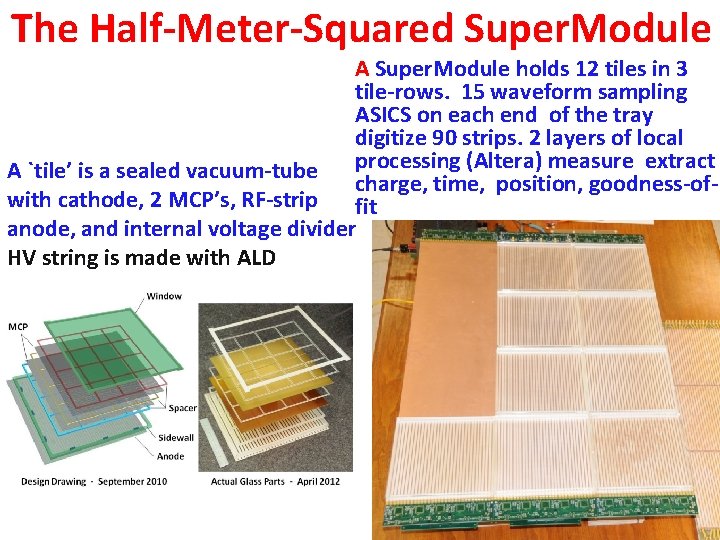
The Half-Meter-Squared Super. Module A Super. Module holds 12 tiles in 3 tile-rows. 15 waveform sampling ASICS on each end of the tray digitize 90 strips. 2 layers of local processing (Altera) measure extract A `tile’ is a sealed vacuum-tube charge, time, position, goodness-ofwith cathode, 2 MCP’s, RF-strip fit anode, and internal voltage divider HV string is made with ALD
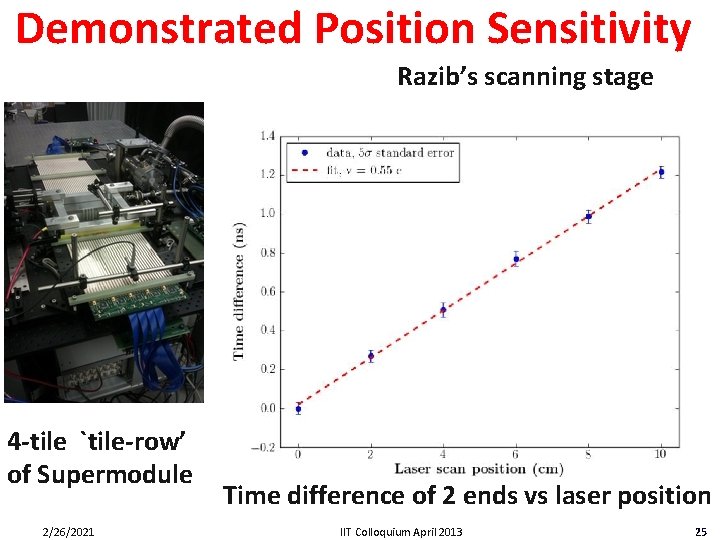
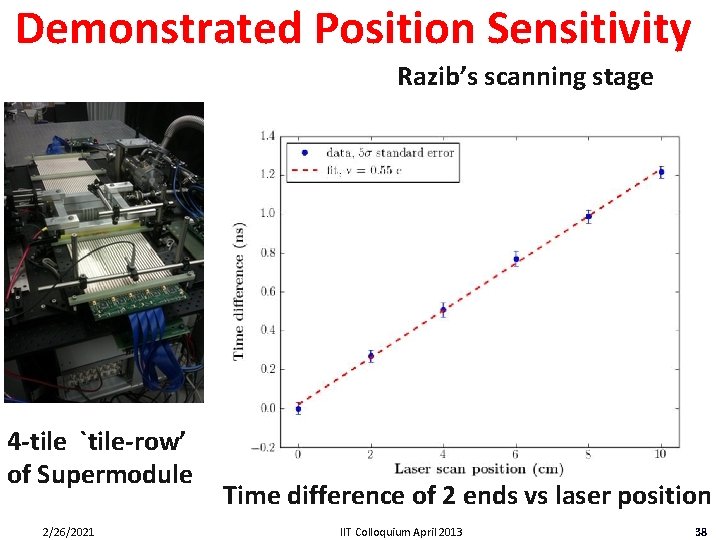
Demonstrated Position Sensitivity Razib’s scanning stage 4 -tile `tile-row’ of Supermodule 2/26/2021 Time difference of 2 ends vs laser position IIT Colloquium April 2013 25
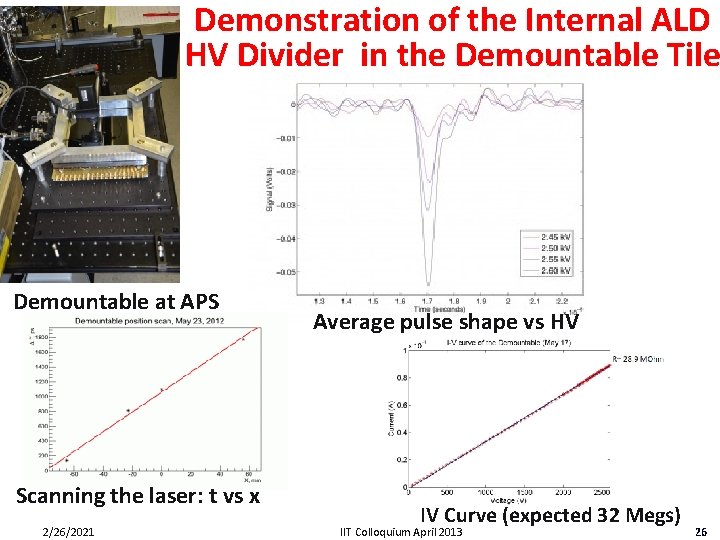
Demonstration of the Internal ALD HV Divider in the Demountable Tile Demountable at APS Scanning the laser: t vs x 2/26/2021 Average pulse shape vs HV IV Curve (expected 32 Megs) IIT Colloquium April 2013 26
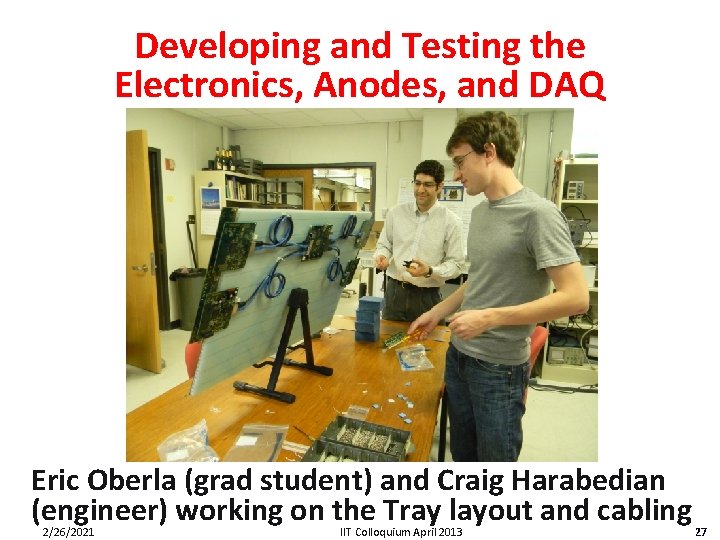
Developing and Testing the Electronics, Anodes, and DAQ Eric Oberla (grad student) and Craig Harabedian (engineer) working on the Tray layout and cabling 2/26/2021 IIT Colloquium April 2013 27
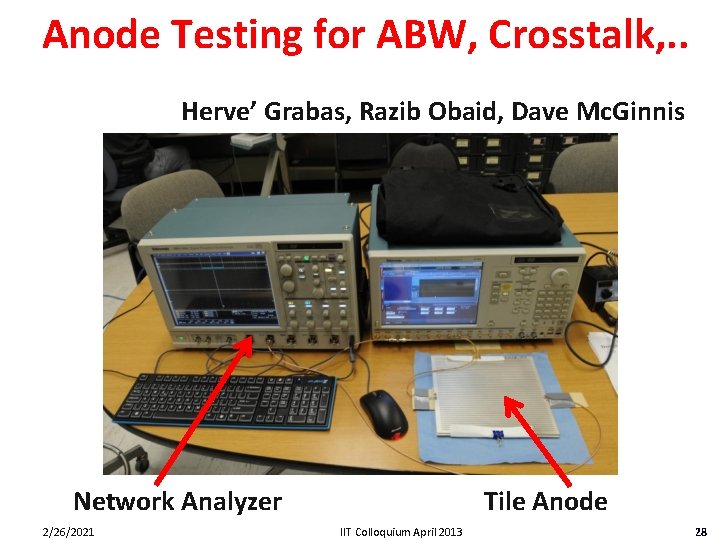
Anode Testing for ABW, Crosstalk, . . Herve’ Grabas, Razib Obaid, Dave Mc. Ginnis Network Analyzer 2/26/2021 Tile Anode IIT Colloquium April 2013 28
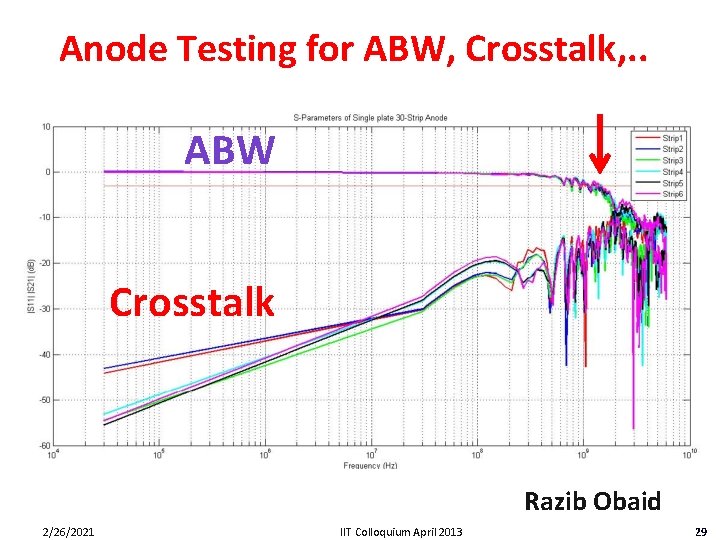
Anode Testing for ABW, Crosstalk, . . ABW Crosstalk Razib Obaid 2/26/2021 IIT Colloquium April 2013 29
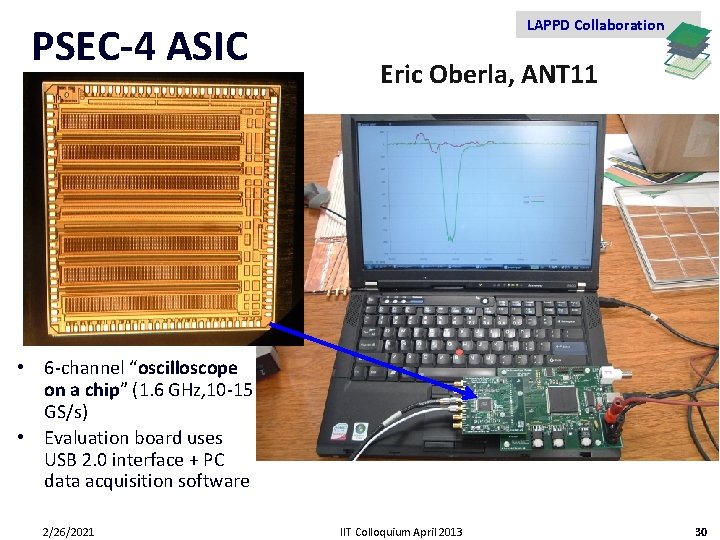
PSEC-4 ASIC LAPPD Collaboration Eric Oberla, ANT 11 • 6 -channel “oscilloscope on a chip” (1. 6 GHz, 10 -15 GS/s) • Evaluation board uses USB 2. 0 interface + PC data acquisition software 2/26/2021 IIT Colloquium April 2013 30
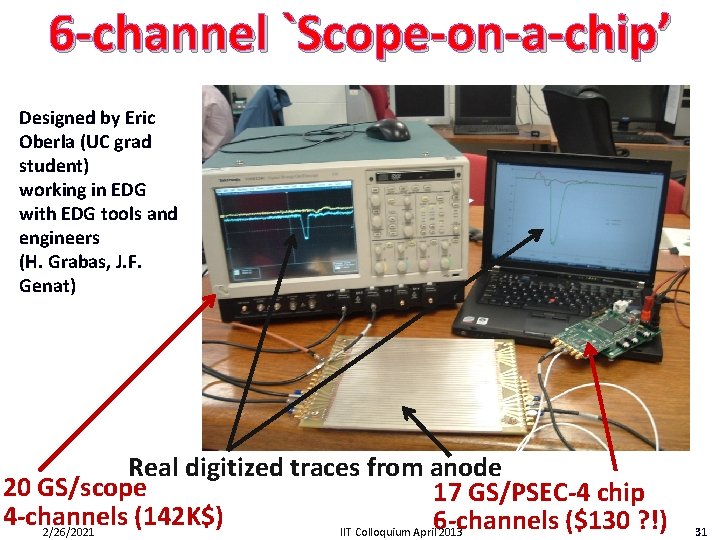
6 -channel `Scope-on-a-chip’ Designed by Eric Oberla (UC grad student) working in EDG with EDG tools and engineers (H. Grabas, J. F. Genat) Real digitized traces from anode 20 GS/scope 17 GS/PSEC-4 chip 4 -channels (142 K$) 6 -channels ($130 ? !) 2/26/2021 IIT Colloquium April 2013 31
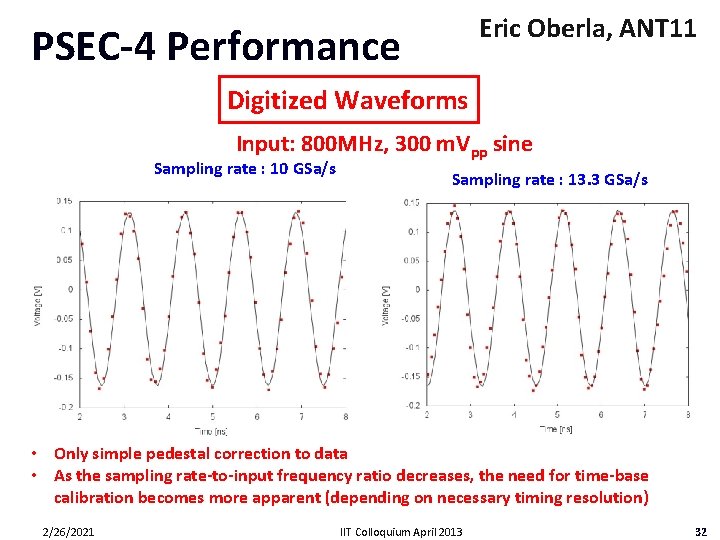
Eric Oberla, ANT 11 PSEC-4 Performance Digitized Waveforms Input: 800 MHz, 300 m. Vpp sine Sampling rate : 10 GSa/s Sampling rate : 13. 3 GSa/s • Only simple pedestal correction to data • As the sampling rate-to-input frequency ratio decreases, the need for time-base calibration becomes more apparent (depending on necessary timing resolution) 2/26/2021 IIT Colloquium April 2013 32
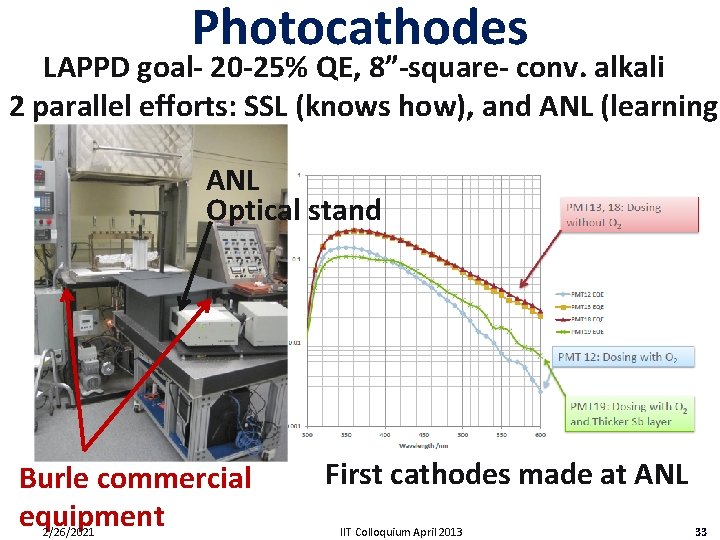
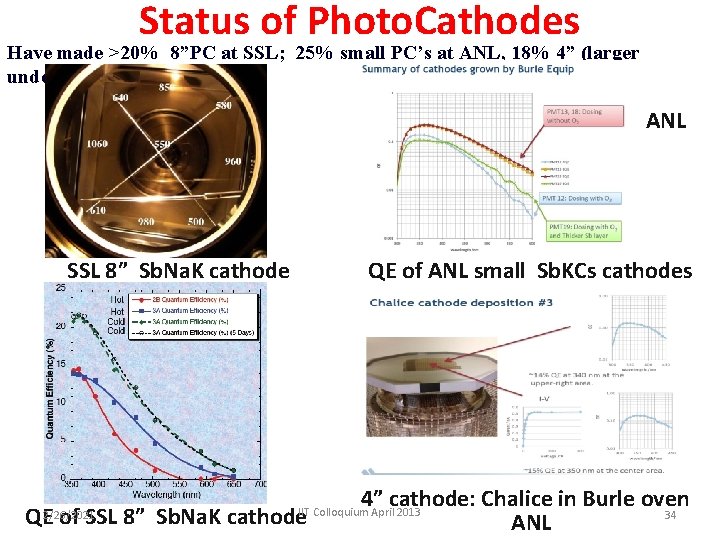
Photocathodes LAPPD goal- 20 -25% QE, 8”-square- conv. alkali 2 parallel efforts: SSL (knows how), and ANL (learning) ANL Optical stand Burle commercial equipment 2/26/2021 First cathodes made at ANL IIT Colloquium April 2013 33
Status of Photo. Cathodes Have made >20% 8”PC at SSL; 25% small PC’s at ANL, 18% 4” (larger underway) ANL SSL 8” Sb. Na. K cathode QE of ANL small Sb. KCs cathodes QE of SSL 8” Sb. Na. K cathode 2/26/2021 4” cathode: Chalice in Burle oven 34 ANL IIT Colloquium April 2013
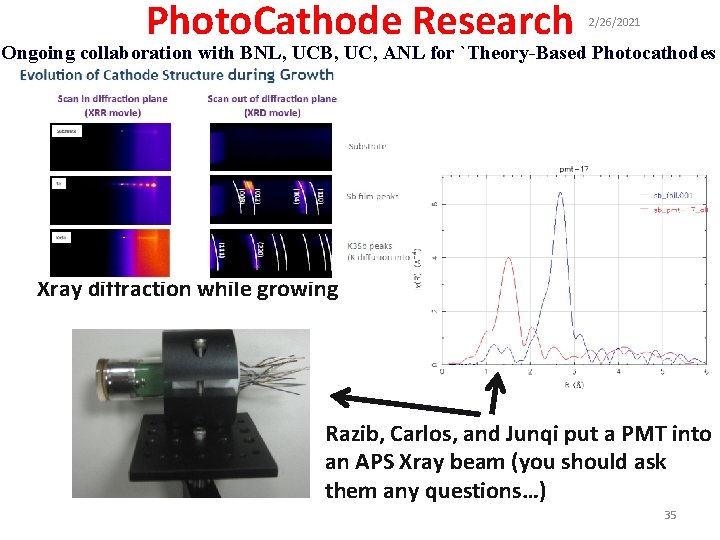
Photo. Cathode Research 2/26/2021 Ongoing collaboration with BNL, UCB, UC, ANL for `Theory-Based Photocathodes Xray diffraction while growing Razib, Carlos, and Junqi put a PMT into an APS Xray beam (you should ask them any questions…) 35
Conclusions 2/26/2021 IIT Colloquium April 2013 36
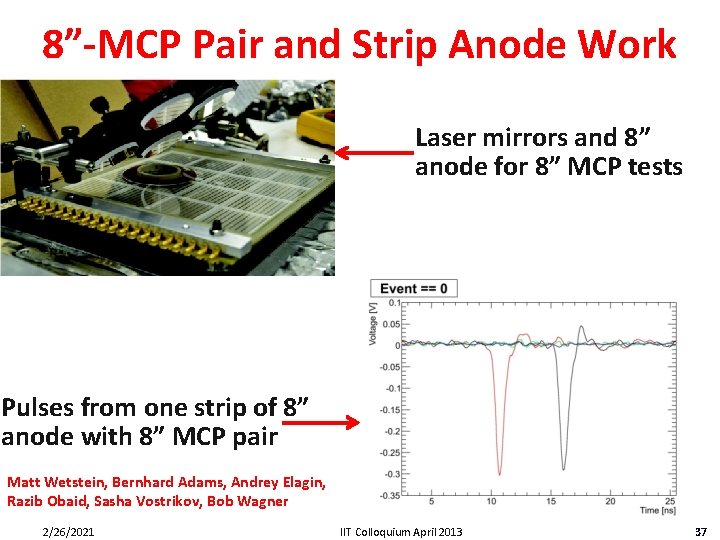
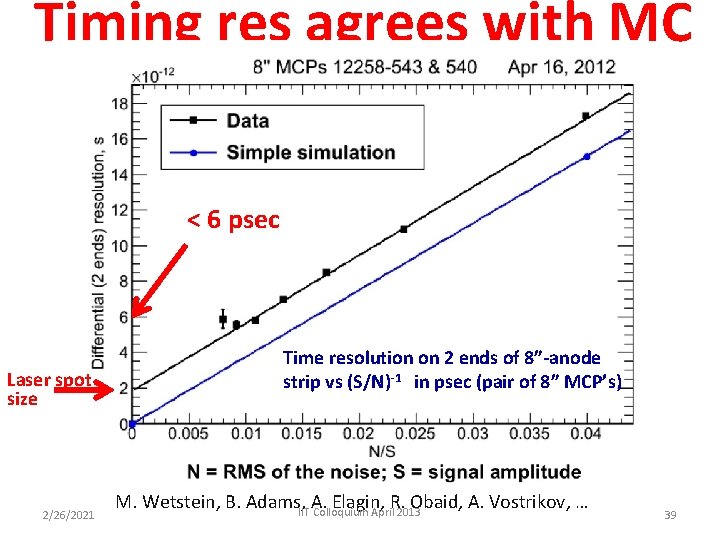
8”-MCP Pair and Strip Anode Work Laser mirrors and 8” anode for 8” MCP tests Pulses from one strip of 8” anode with 8” MCP pair Matt Wetstein, Bernhard Adams, Andrey Elagin, Razib Obaid, Sasha Vostrikov, Bob Wagner 2/26/2021 IIT Colloquium April 2013 37
Demonstrated Position Sensitivity Razib’s scanning stage 4 -tile `tile-row’ of Supermodule 2/26/2021 Time difference of 2 ends vs laser position IIT Colloquium April 2013 38
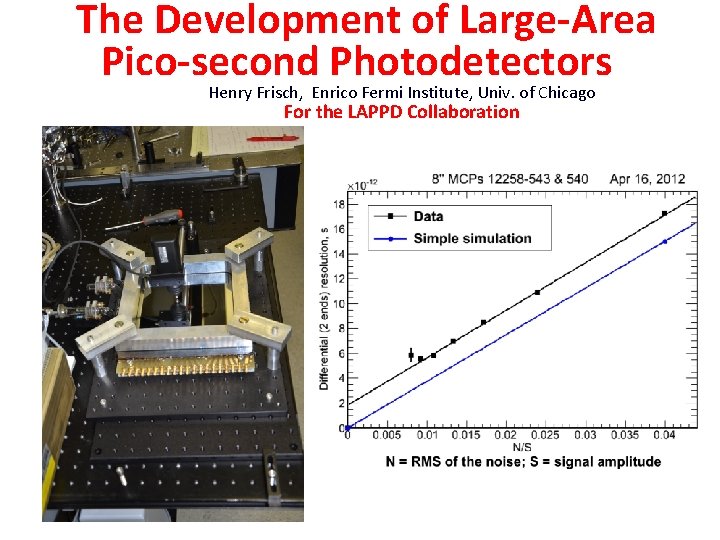
Timing res agrees with MC < 6 psec Laser spot size 2/26/2021 Time resolution on 2 ends of 8”-anode strip vs (S/N)-1 in psec (pair of 8” MCP’s) M. Wetstein, B. Adams, IITA. Elagin, R. Obaid, A. Vostrikov, … Colloquium April 2013 39
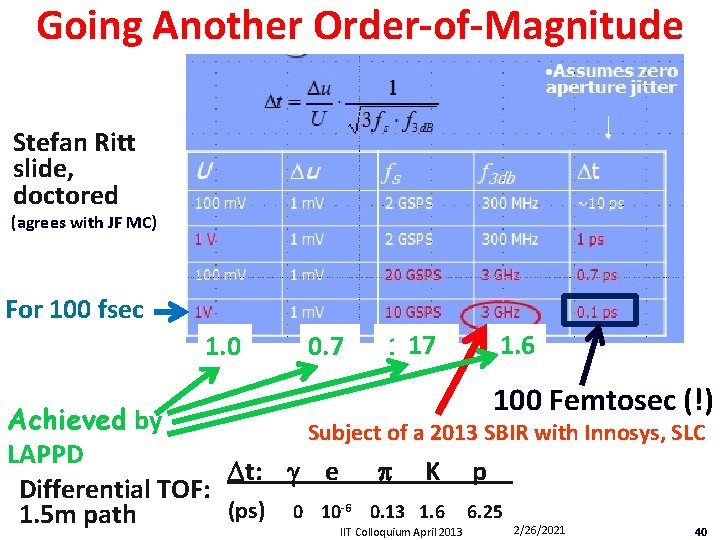
Going Another Order-of-Magnitude Stefan Ritt slide, doctored (agrees with JF MC) For 100 fsec 1. 0 0. 7 1717 1. 6 100 Femtosec (!) Achieved by Subject of a 2013 SBIR with Innosys, SLC LAPPD Dt: g e p K p Differential TOF: (ps) 0 10 -6 0. 13 1. 6 6. 25 1. 5 m path 2/26/2021 IIT Colloquium April 2013 40
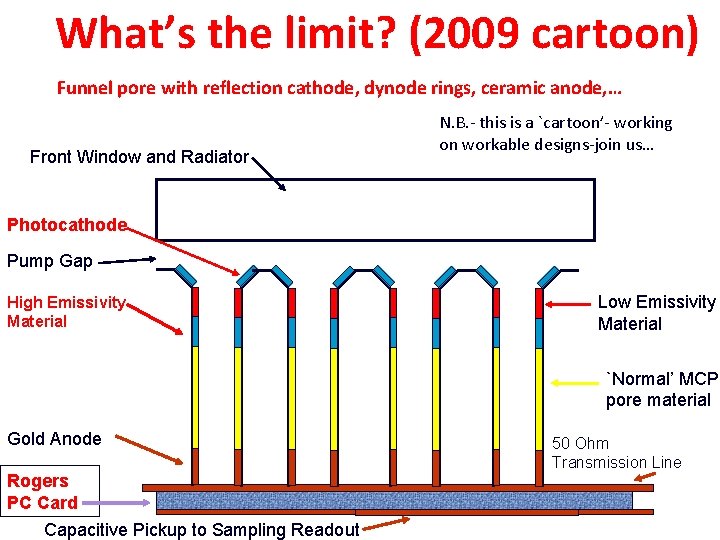
What’s the limit? (2009 cartoon) Funnel pore with reflection cathode, dynode rings, ceramic anode, … Front Window and Radiator N. B. - this is a `cartoon’- working on workable designs-join us… Photocathode Pump Gap High Emissivity Material Low Emissivity Material `Normal’ MCP pore material Gold Anode Rogers PC Card Capacitive Pickup to Sampling Readout 50 Ohm Transmission Line
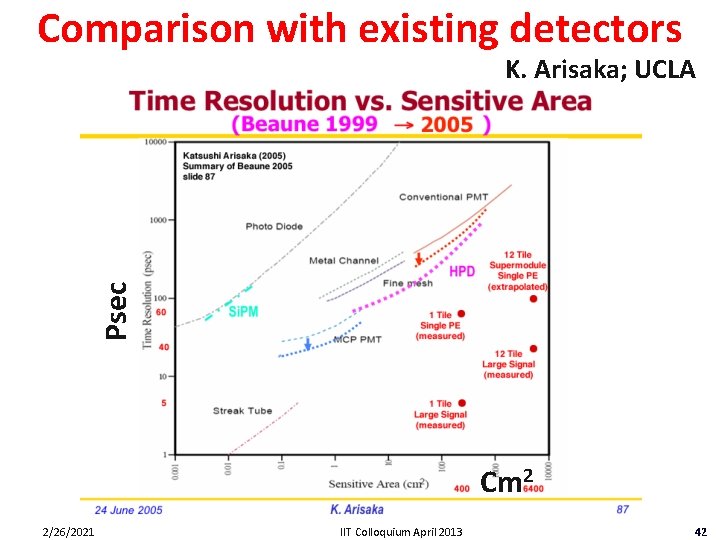
Comparison with existing detectors Psec K. Arisaka; UCLA Cm 2 2/26/2021 IIT Colloquium April 2013 42
More Information on LAPPD: • Main Page: http: //psec. uchicago. edu (has the links to the Library and Blogs) • Library: Workshops, Godparent Reviews, Image Library, Document Library, Links to MCP, Photocathode, Materials Literature, etc. ; • Blog: Our log-book- open to all (say yes to certificate Cerberus, etc. )- can keep track of us (at least several companies do); 2/26/2021 IIT Colloquium April 2013 43
The End 2/26/2021 IIT Colloquium April 2013 44