The CIDOC CRM a Standard for the Integration
- Slides: 62
The CIDOC CRM, a Standard for the Integration of Cultural Information Stephen Stead CIDOC Conceptual Reference Model Special Interest Group ICS-FORTH, Crete, Greece November, 2008 1
The CIDOC CRM Outline l Problem statement – information diversity l Motivation example – the Yalta Conference l The goal and form of the CIDOC CRM l Presentation of contents l About using the CIDOC CRM l State of development l Conclusion 2
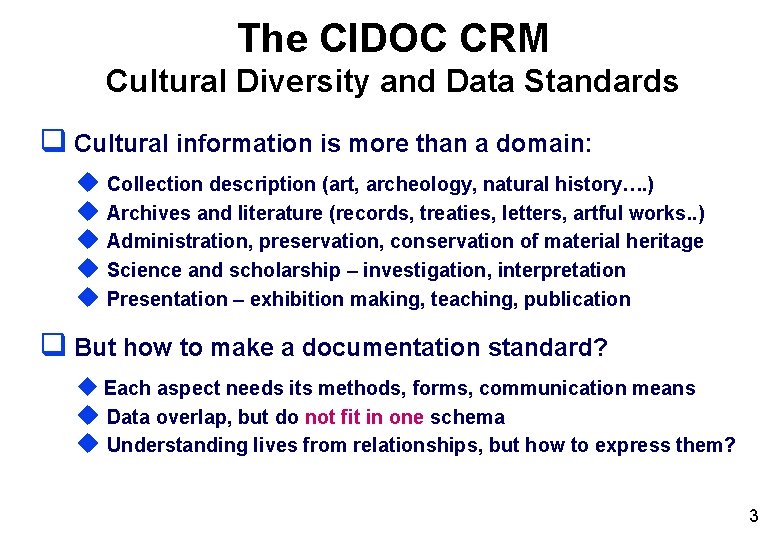
The CIDOC CRM Cultural Diversity and Data Standards q Cultural information is more than a domain: u Collection description (art, archeology, natural history…. ) u Archives and literature (records, treaties, letters, artful works. . ) u Administration, preservation, conservation of material heritage u Science and scholarship – investigation, interpretation u Presentation – exhibition making, teaching, publication q But how to make a documentation standard? u Each aspect needs its methods, forms, communication means u Data overlap, but do not fit in one schema u Understanding lives from relationships, but how to express them? 3
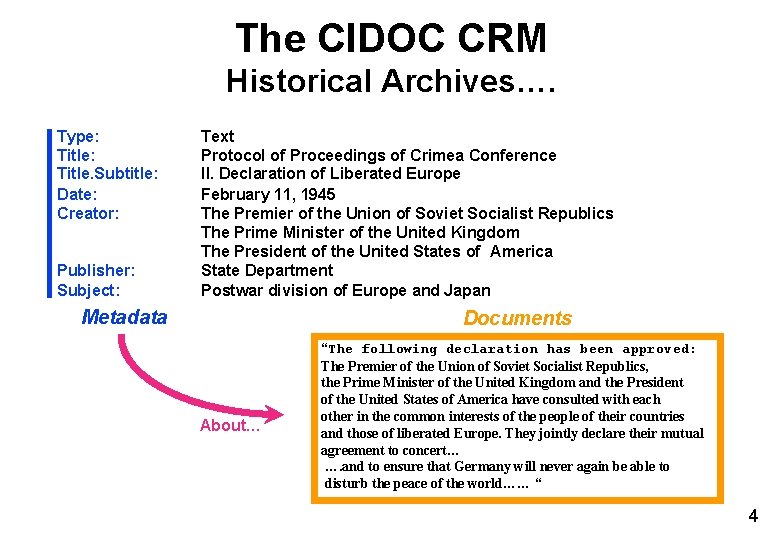
The CIDOC CRM Historical Archives…. Type: Title: Title. Subtitle: Date: Creator: Publisher: Subject: Text Protocol of Proceedings of Crimea Conference II. Declaration of Liberated Europe February 11, 1945 The Premier of the Union of Soviet Socialist Republics The Prime Minister of the United Kingdom The President of the United States of America State Department Postwar division of Europe and Japan Metadata Documents About… “The following declaration has been approved: The Premier of the Union of Soviet Socialist Republics, the Prime Minister of the United Kingdom and the President of the United States of America have consulted with each other in the common interests of the people of their countries and those of liberated Europe. They jointly declare their mutual agreement to concert… …. and to ensure that Germany will never again be able to disturb the peace of the world…… “ 4
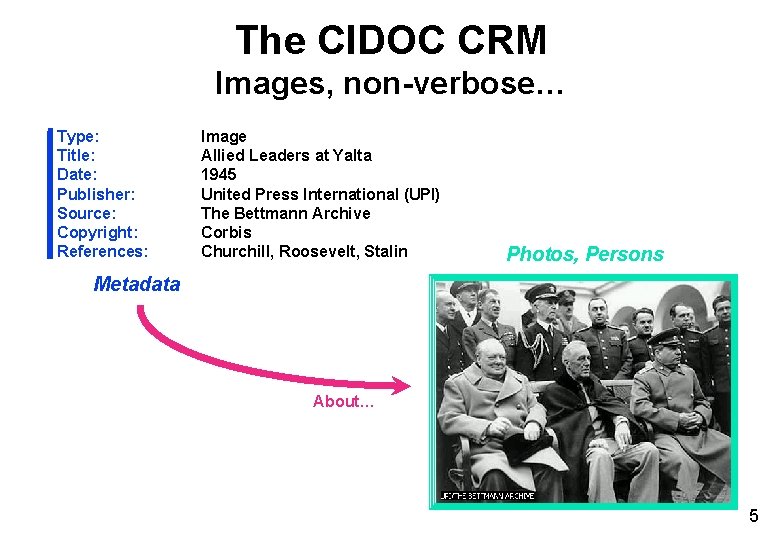
The CIDOC CRM Images, non-verbose… Type: Title: Date: Publisher: Source: Copyright: References: Image Allied Leaders at Yalta 1945 United Press International (UPI) The Bettmann Archive Corbis Churchill, Roosevelt, Stalin Photos, Persons Metadata About… 5
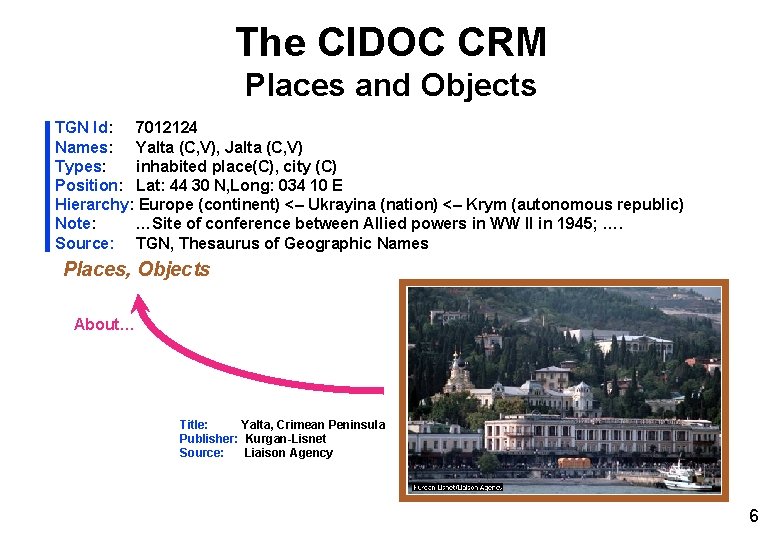
The CIDOC CRM Places and Objects TGN Id: 7012124 Names: Yalta (C, V), Jalta (C, V) Types: inhabited place(C), city (C) Position: Lat: 44 30 N, Long: 034 10 E Hierarchy: Europe (continent) <– Ukrayina (nation) <– Krym (autonomous republic) Note: …Site of conference between Allied powers in WW II in 1945; …. Source: TGN, Thesaurus of Geographic Names Places, Objects About… Title: Yalta, Crimean Peninsula Publisher: Kurgan-Lisnet Source: Liaison Agency 6
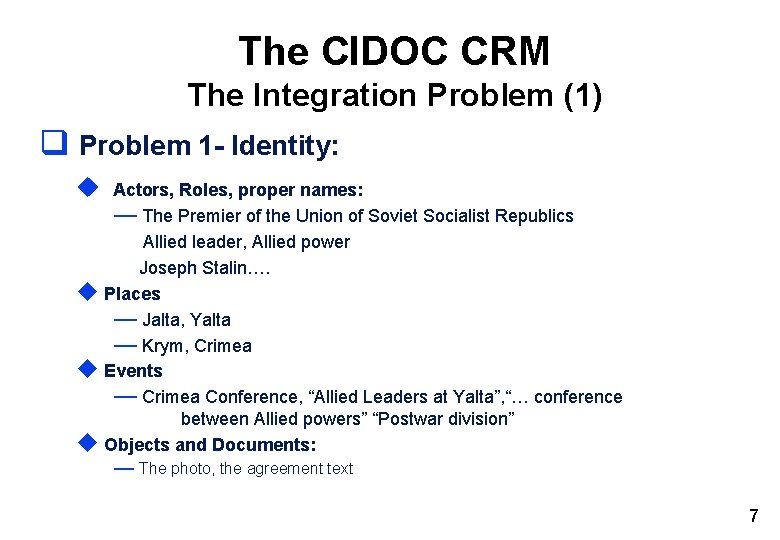
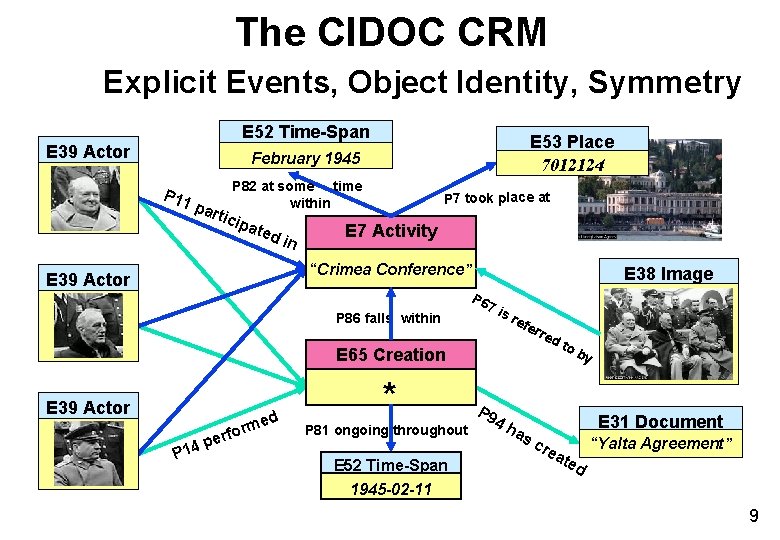
The CIDOC CRM The Integration Problem (1) q Problem 1 - Identity: u Actors, Roles, proper names: — The Premier of the Union of Soviet Socialist Republics Allied leader, Allied power Joseph Stalin…. u Places — Jalta, Yalta — Krym, Crimea u Events — Crimea Conference, “Allied Leaders at Yalta”, “… conference between Allied powers” “Postwar division” u Objects and Documents: — The photo, the agreement text 7
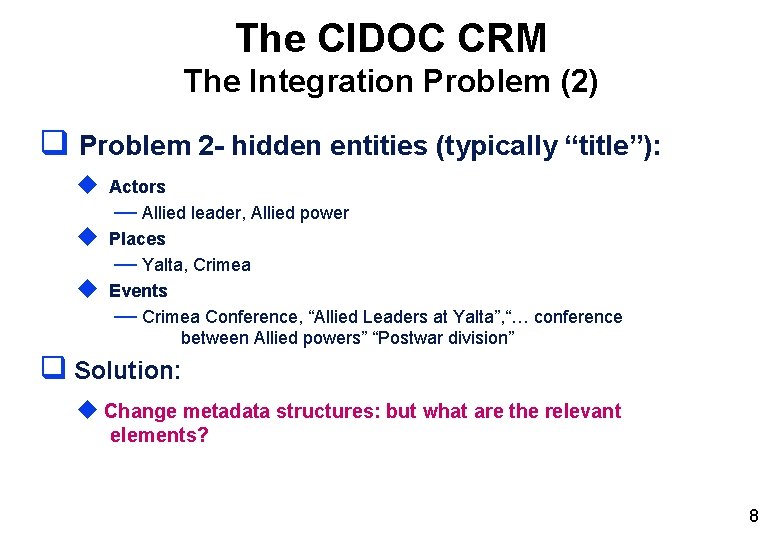
The CIDOC CRM The Integration Problem (2) q Problem 2 - hidden entities (typically “title”): u Actors — Allied leader, Allied power u Places — Yalta, Crimea u Events — Crimea Conference, “Allied Leaders at Yalta”, “… conference between Allied powers” “Postwar division” q Solution: u Change metadata structures: but what are the relevant elements? 8
The CIDOC CRM Explicit Events, Object Identity, Symmetry E 52 Time-Span E 39 Actor E 53 Place 7012124 February 1945 P 11 pa P 82 at some time within rtic ipa ted in P 7 took place at E 7 Activity “Crimea Conference” E 39 Actor E 38 Image P 6 P 86 falls within 7 i s re fer E 65 Creation Event red E 39 Actor ed p P 14 rm o f r e * P 81 ongoing throughout E 52 Time-Span P 9 4 h to by E 31 Document as cr ea ted “Yalta Agreement” 1945 -02 -11 9
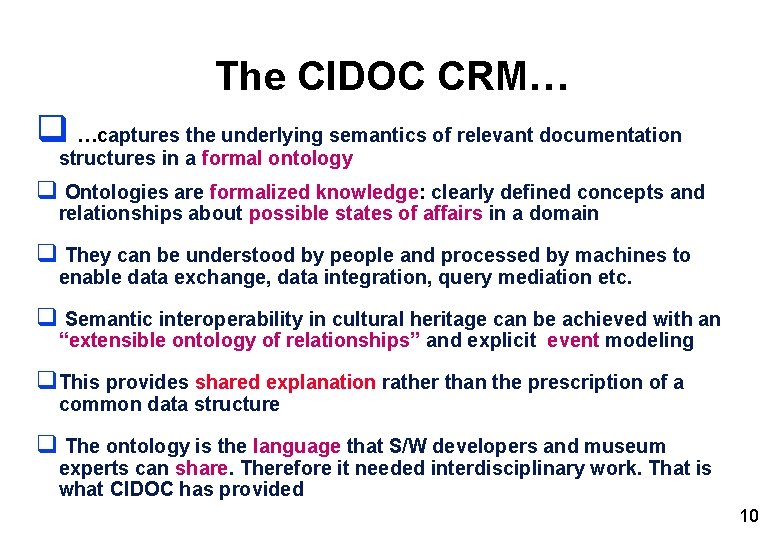
The CIDOC CRM… q …captures the underlying semantics of relevant documentation structures in a formal ontology q Ontologies are formalized knowledge: clearly defined concepts and relationships about possible states of affairs in a domain q They can be understood by people and processed by machines to enable data exchange, data integration, query mediation etc. q Semantic interoperability in cultural heritage can be achieved with an “extensible ontology of relationships” and explicit event modeling q. This provides shared explanation rather than the prescription of a common data structure q The ontology is the language that S/W developers and museum experts can share. Therefore it needed interdisciplinary work. That is what CIDOC has provided 10
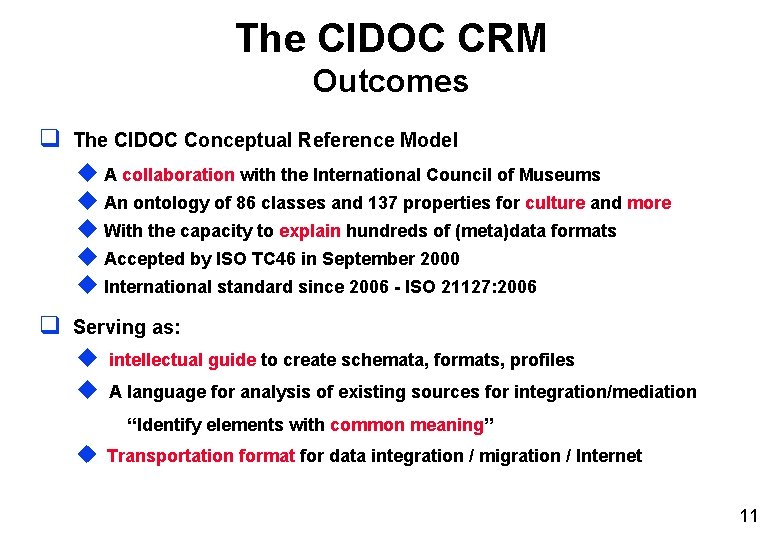
The CIDOC CRM Outcomes q The CIDOC Conceptual Reference Model u A collaboration with the International Council of Museums u An ontology of 86 classes and 137 properties for culture and more u With the capacity to explain hundreds of (meta)data formats u Accepted by ISO TC 46 in September 2000 u International standard since 2006 - ISO 21127: 2006 q Serving as: u intellectual guide to create schemata, formats, profiles u A language for analysis of existing sources for integration/mediation “Identify elements with common meaning” u Transportation format for data integration / migration / Internet 11
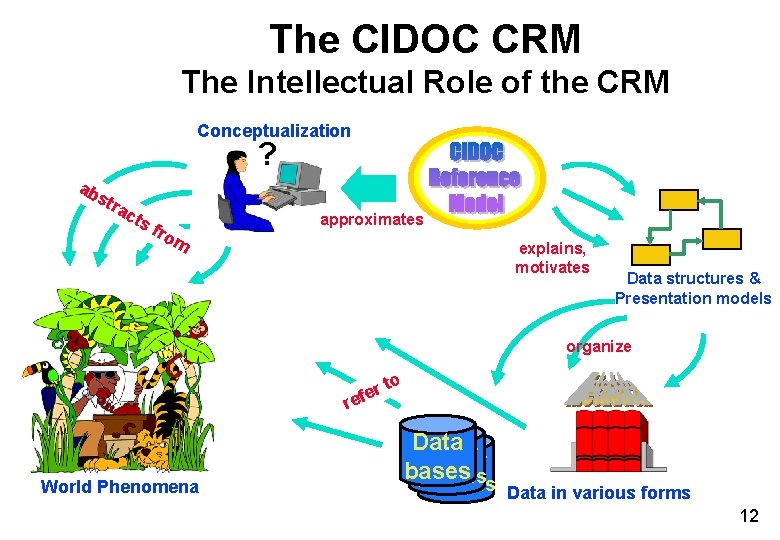
The CIDOC CRM The Intellectual Role of the CRM Conceptualization ? ab str ac ts approximates fro m explains, motivates Data structures & Presentation models organize to er f e r World Phenomena Data Legacy bases systems Data in various forms 12
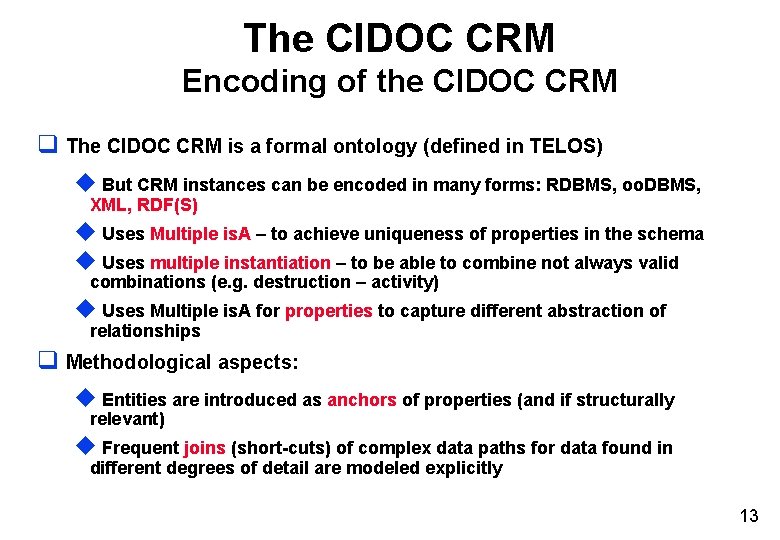
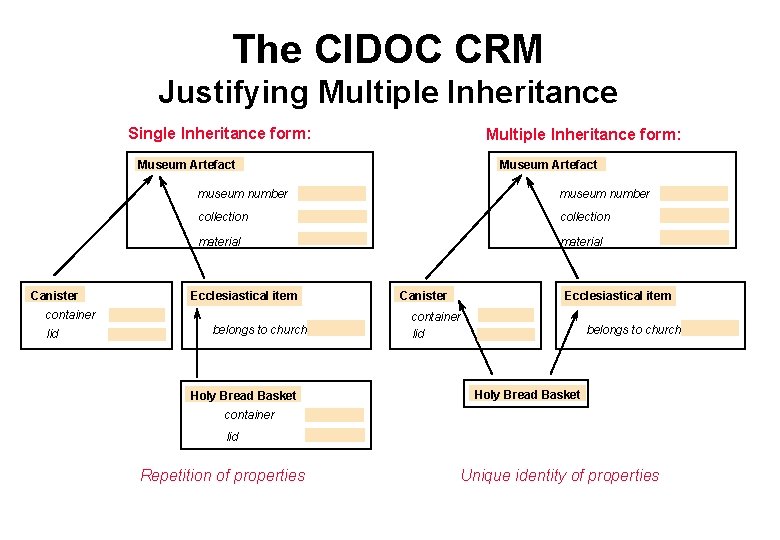
The CIDOC CRM Encoding of the CIDOC CRM q The CIDOC CRM is a formal ontology (defined in TELOS) u But CRM instances can be encoded in many forms: RDBMS, oo. DBMS, XML, RDF(S) u Uses Multiple is. A – to achieve uniqueness of properties in the schema u Uses multiple instantiation – to be able to combine not always valid combinations (e. g. destruction – activity) u Uses Multiple is. A for properties to capture different abstraction of relationships q Methodological aspects: u Entities are introduced as anchors of properties (and if structurally relevant) u Frequent joins (short-cuts) of complex data paths for data found in different degrees of detail are modeled explicitly 13
The CIDOC CRM Justifying Multiple Inheritance Single Inheritance form: Multiple Inheritance form: Museum Artefact Canister museum number collection material Ecclesiastical item container lid Museum Artefact belongs to church Holy Bread Basket Canister Ecclesiastical item container lid belongs to church Holy Bread Basket container lid Repetition of properties Unique identity of properties
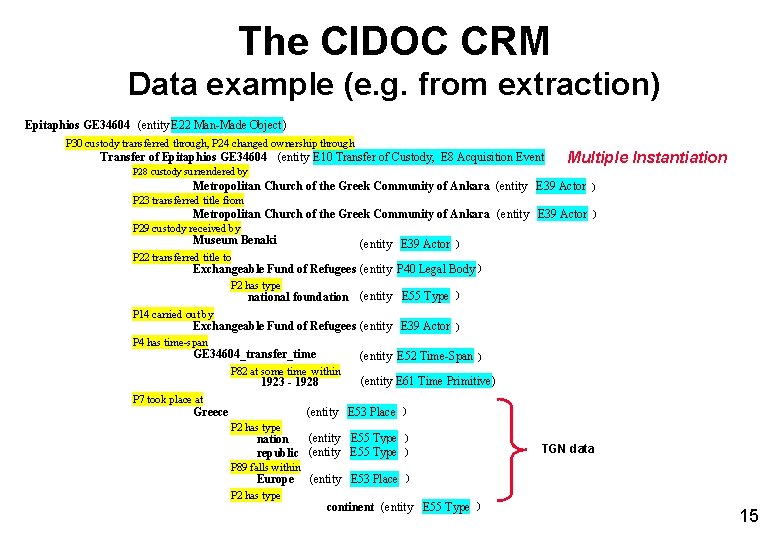
The CIDOC CRM Data example (e. g. from extraction) Epitaphios GE 34604 (entity E 22 Man-Made Object) P 30 custody transferred through, P 24 changed ownership through Transfer of Epitaphios GE 34604 (entity E 10 Transfer of Custody, E 8 Acquisition Event P 28 custody surrendered by Multiple Instantiation Metropolitan Church of the Greek Community of Ankara (entity E 39 Actor ) P 23 transferred title from Metropolitan Church of the Greek Community of Ankara (entity E 39 Actor ) P 29 custody received by Museum Benaki (entity E 39 Actor ) P 22 transferred title to Exchangeable Fund of Refugees (entity P 40 Legal Body ) P 2 has type national foundation (entity E 55 Type ) P 14 carried out by Exchangeable Fund of Refugees (entity E 39 Actor ) P 4 has time-span GE 34604_transfer_time (entity E 52 Time-Span ) P 82 at some time within 1923 - 1928 P 7 took place at Greece (entity E 61 Time Primitive) (entity E 53 Place ) P 2 has type nation (entity E 55 Type ) republic (entity E 55 Type ) P 89 falls within Europe P 2 has type TGN data (entity E 53 Place ) continent (entity E 55 Type ) 15
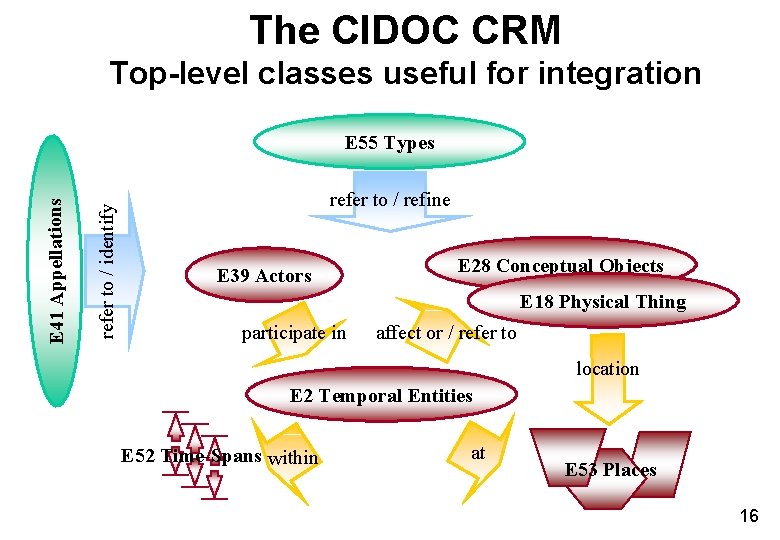
The CIDOC CRM Top-level classes useful for integration refer to / identify E 41 Appellations E 55 Types refer to / refine E 39 Actors E 28 Conceptual Objects E 18 Physical Thing participate in affect or / refer to location E 2 Temporal Entities E 52 Time-Spans within at E 53 Places 16
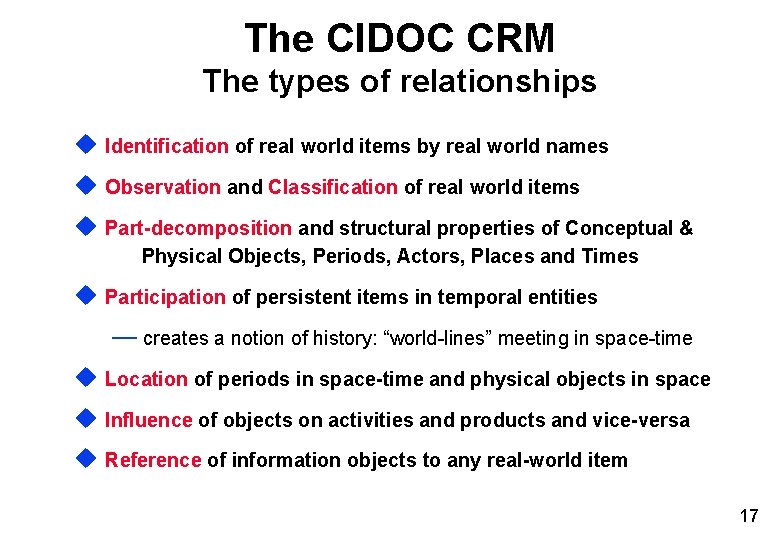
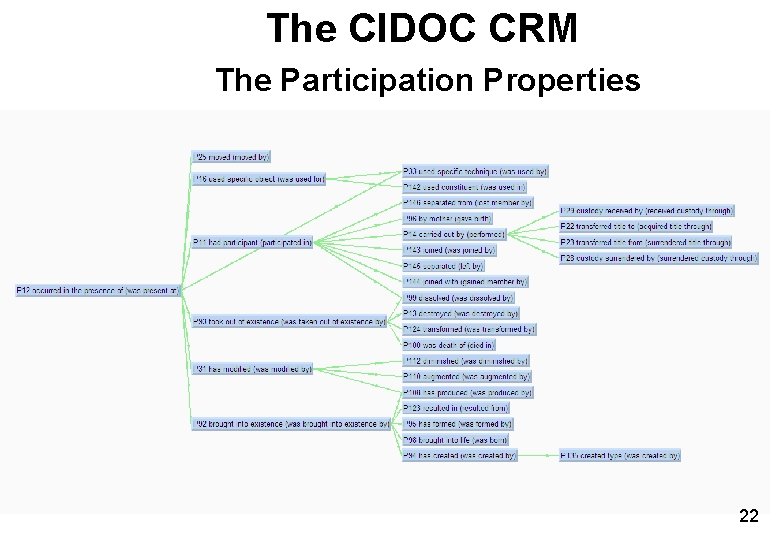
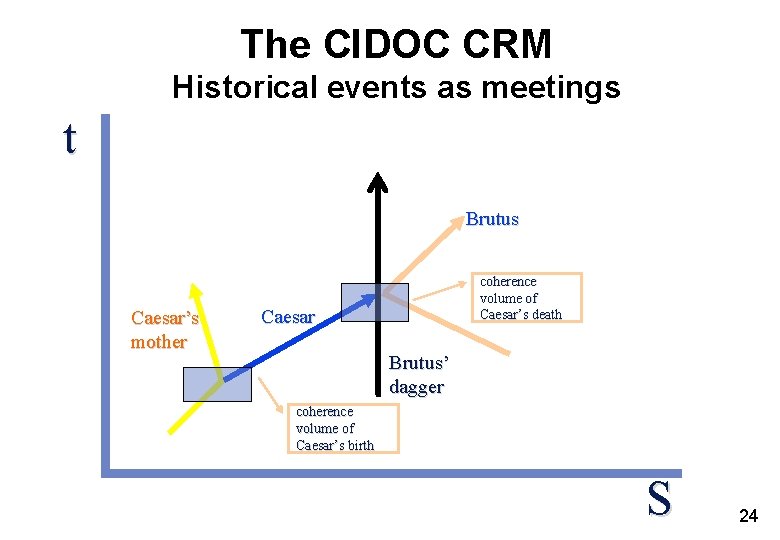
The CIDOC CRM The types of relationships u Identification of real world items by real world names u Observation and Classification of real world items u Part-decomposition and structural properties of Conceptual & Physical Objects, Periods, Actors, Places and Times u Participation of persistent items in temporal entities — creates a notion of history: “world-lines” meeting in space-time u Location of periods in space-time and physical objects in space u Influence of objects on activities and products and vice-versa u Reference of information objects to any real-world item 17
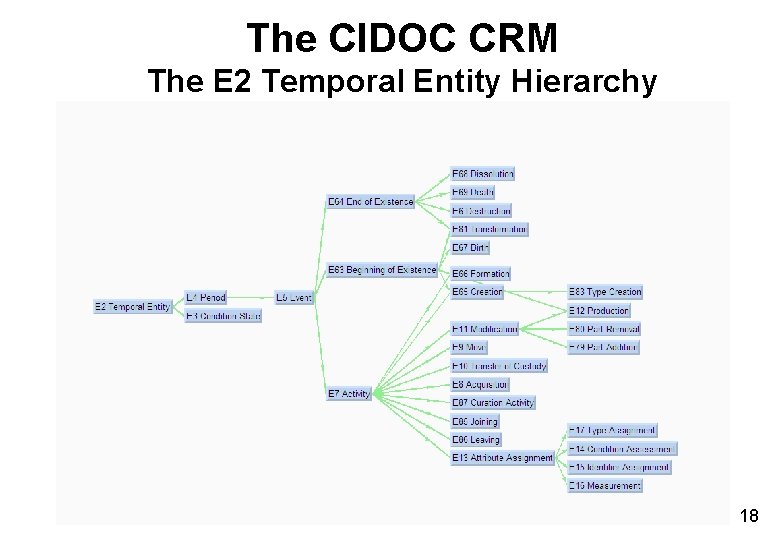
The CIDOC CRM The E 2 Temporal Entity Hierarchy 18
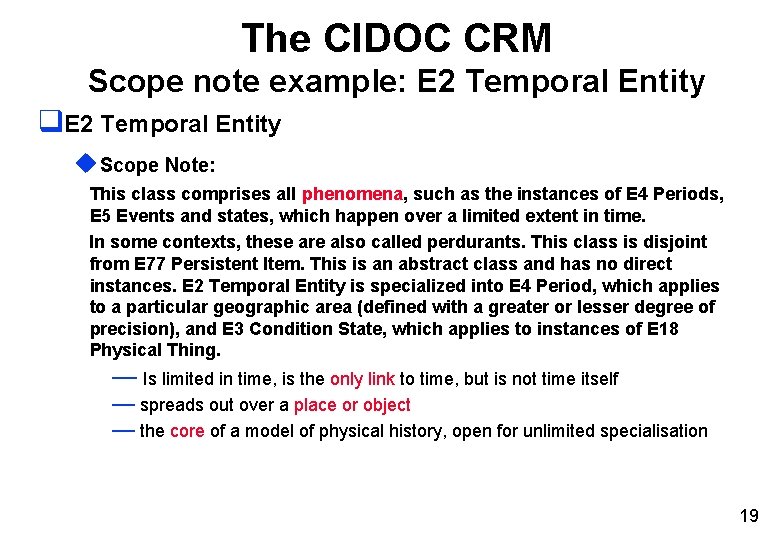
The CIDOC CRM Scope note example: E 2 Temporal Entity q. E 2 Temporal Entity u. Scope Note: This class comprises all phenomena, such as the instances of E 4 Periods, E 5 Events and states, which happen over a limited extent in time. In some contexts, these are also called perdurants. This class is disjoint from E 77 Persistent Item. This is an abstract class and has no direct instances. E 2 Temporal Entity is specialized into E 4 Period, which applies to a particular geographic area (defined with a greater or lesser degree of precision), and E 3 Condition State, which applies to instances of E 18 Physical Thing. — Is limited in time, is the only link to time, but is not time itself — spreads out over a place or object — the core of a model of physical history, open for unlimited specialisation 19
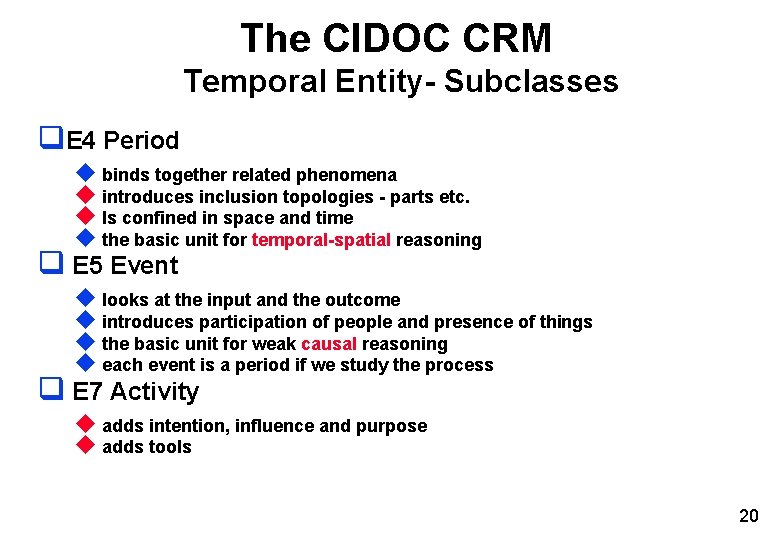
The CIDOC CRM Temporal Entity- Subclasses q. E 4 Period u binds together related phenomena u introduces inclusion topologies - parts etc. u Is confined in space and time u the basic unit for temporal-spatial reasoning q E 5 Event u looks at the input and the outcome u introduces participation of people and presence of things u the basic unit for weak causal reasoning u each event is a period if we study the process q E 7 Activity u adds intention, influence and purpose u adds tools 20
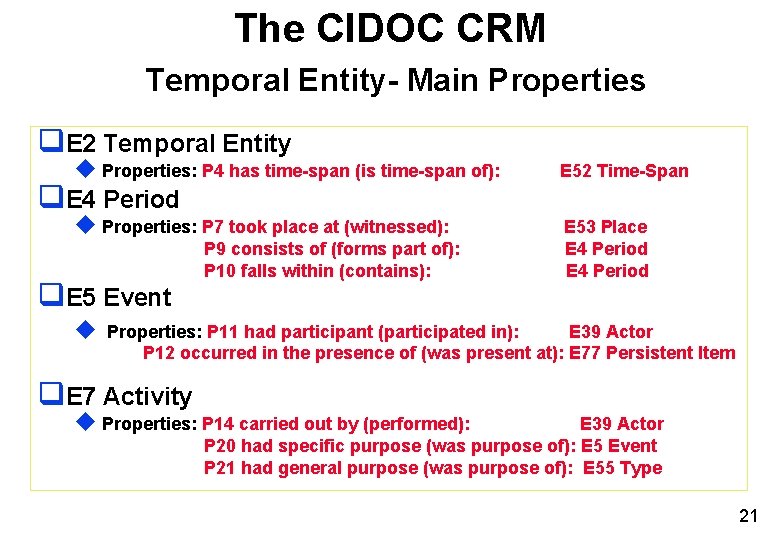
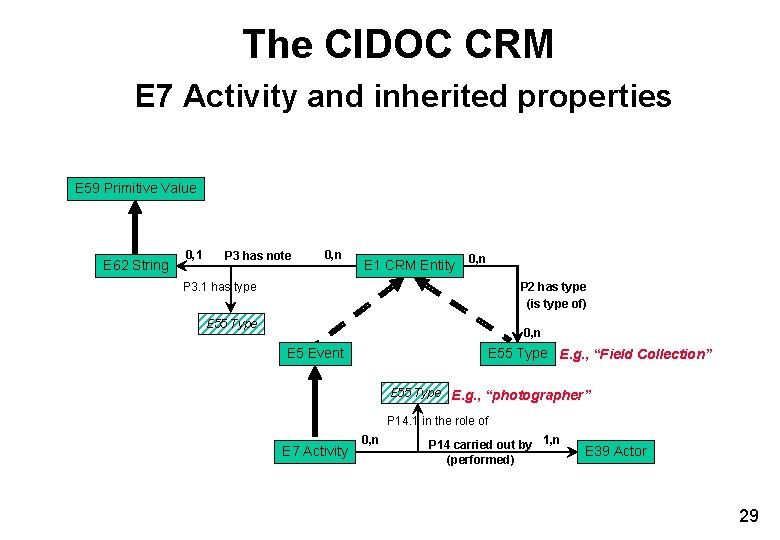
The CIDOC CRM Temporal Entity- Main Properties q. E 2 Temporal Entity u Properties: P 4 has time-span (is time-span of): E 52 Time-Span q. E 4 Period u Properties: P 7 took place at (witnessed): E 53 Place q. E 5 Event P 9 consists of (forms part of): E 4 Period P 10 falls within (contains): E 4 Period u Properties: P 11 had participant (participated in): E 39 Actor P 12 occurred in the presence of (was present at): E 77 Persistent Item q. E 7 Activity u Properties: P 14 carried out by (performed): E 39 Actor P 20 had specific purpose (was purpose of): E 5 Event P 21 had general purpose (was purpose of): E 55 Type 21
The CIDOC CRM The Participation Properties 22
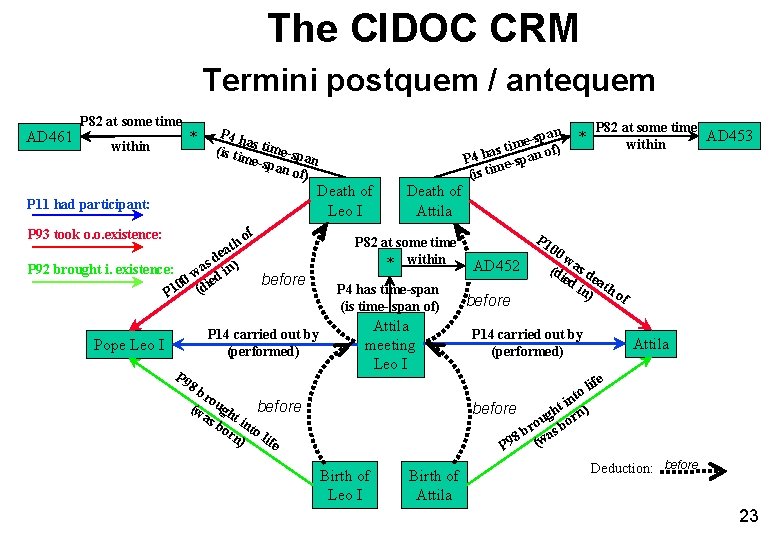
The CIDOC CRM Termini postquem / antequem AD 461 P 82 at some time within * P 4 h a (is time-sp me-s a pan n of) Death of Leo I P 11 had participant: of h t ea d P 92 brought i. existence: was in) before 00 (died 1 P P 93 took o. o. existence: P 82 at some time within * P 4 has time-span (is time- span of) P 14 carried out by (performed) Pope Leo I P 9 Death of Attila meeting Leo I n * -spa e m i t as of) P 4 h e-span m (is ti P 82 at some time AD 453 within P 1 AD 452 before 00 w (d as d ied ea in th of ) P 14 carried out by (performed) Attila e lif o t t in ) before h n g ou bor r 8 b (was 9 P 8 b ro (w ugh before as t i bo nt rn o li fe ) Birth of Leo I Birth of Attila Deduction: before 23
The CIDOC CRM Historical events as meetings t Brutus Caesar’s mother coherence volume of Caesar’s death Caesar Brutus’ dagger coherence volume of Caesar’s birth S 24
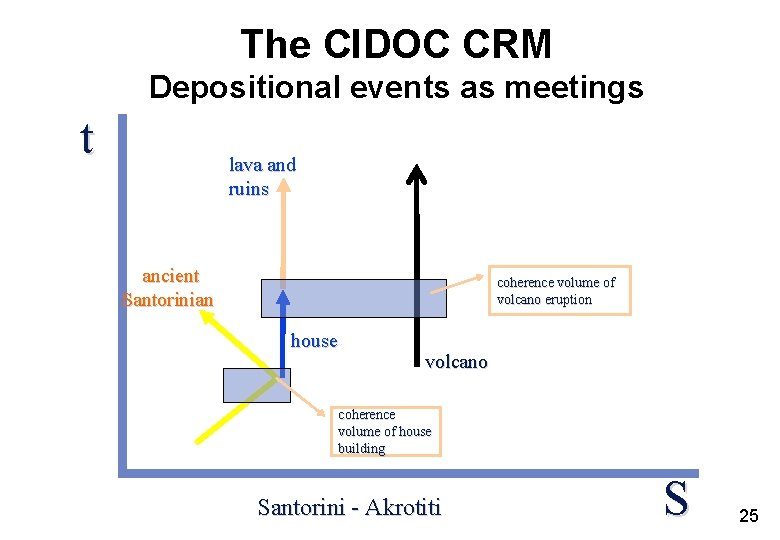
The CIDOC CRM Depositional events as meetings t lava and ruins ancient Santorinian coherence volume of volcano eruption house volcano coherence volume of house building Santorini - Akrotiti S 25
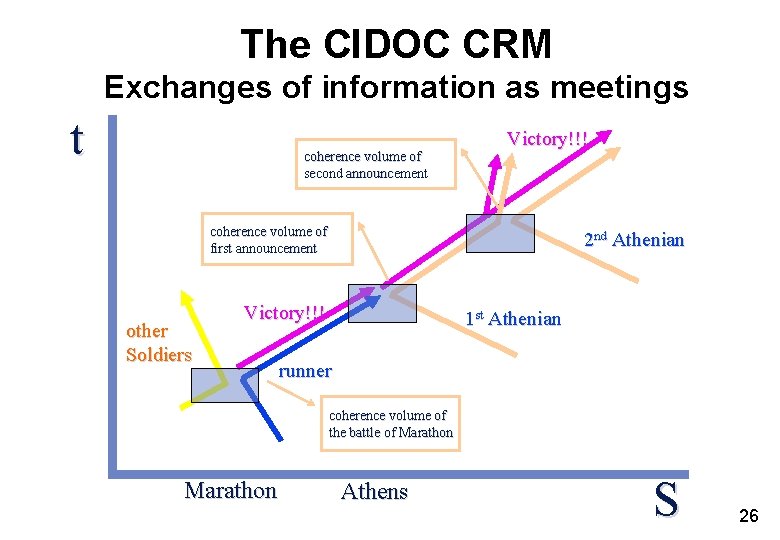
The CIDOC CRM Exchanges of information as meetings t coherence volume of second announcement Victory!!! coherence volume of first announcement other Soldiers 2 nd Athenian Victory!!! 1 st Athenian runner coherence volume of the battle of Marathon Athens S 26
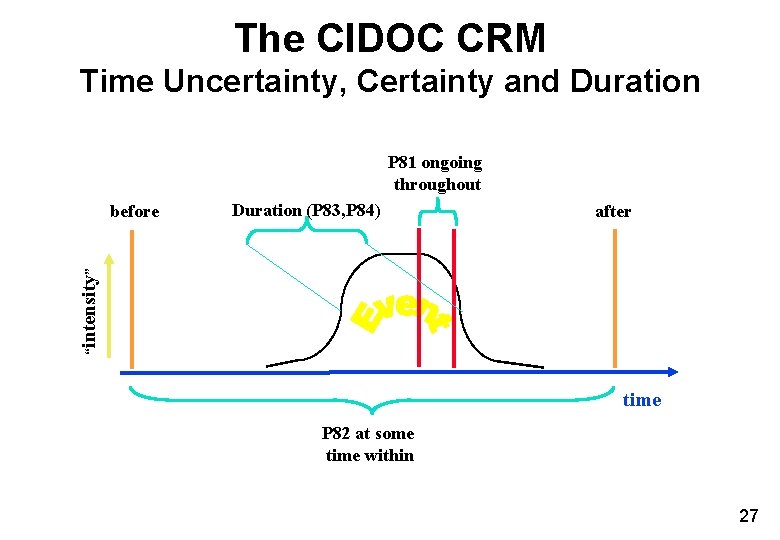
The CIDOC CRM Time Uncertainty, Certainty and Duration P 81 ongoing throughout Duration (P 83, P 84) after “intensity” before time P 82 at some time within 27
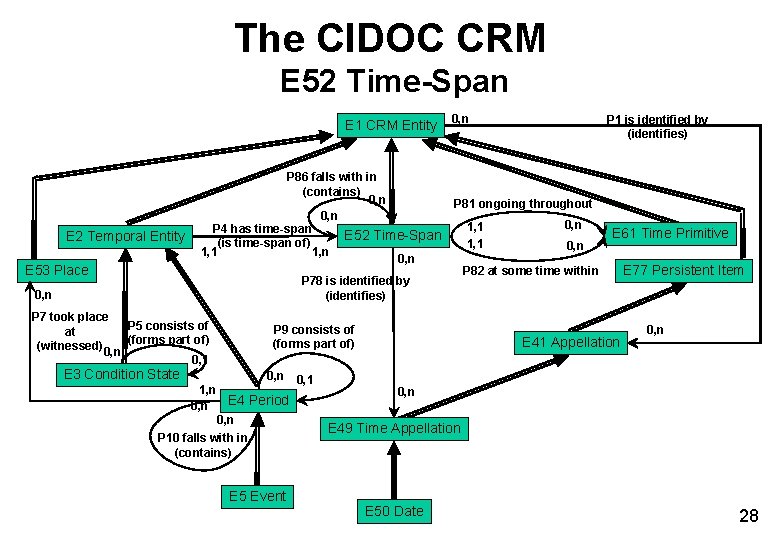
The CIDOC CRM E 52 Time-Span E 1 CRM Entity E 2 Temporal Entity E 53 Place P 86 falls with in (contains) 0, n P 4 has time-span E 52 Time-Span (is time-span of) 1, 1 1, n 0, n P 81 ongoing throughout P 78 is identified by (identifies) 0, n P 7 took place P 5 consists of at (forms part of) (witnessed) 0, n 0, 1 P 9 consists of (forms part of) E 3 Condition State 0, n 0, 1 1, n E 4 Period 0, n P 10 falls with in (contains) E 5 Event P 1 is identified by (identifies) 1, 1 0, n E 61 Time Primitive P 82 at some time within E 41 Appellation E 77 Persistent Item 0, n E 49 Time Appellation E 50 Date 28
The CIDOC CRM E 7 Activity and inherited properties E 59 Primitive Value E 62 String 0, 1 P 3 has note 0, n E 1 CRM Entity 0, n P 3. 1 has type P 2 has type (is type of) E 55 Type 0, n E 5 Event E 55 Type E. g. , “Field Collection” E 55 Type E. g. , “photographer” P 14. 1 in the role of E 7 Activity 0, n P 14 carried out by 1, n (performed) E 39 Actor 29
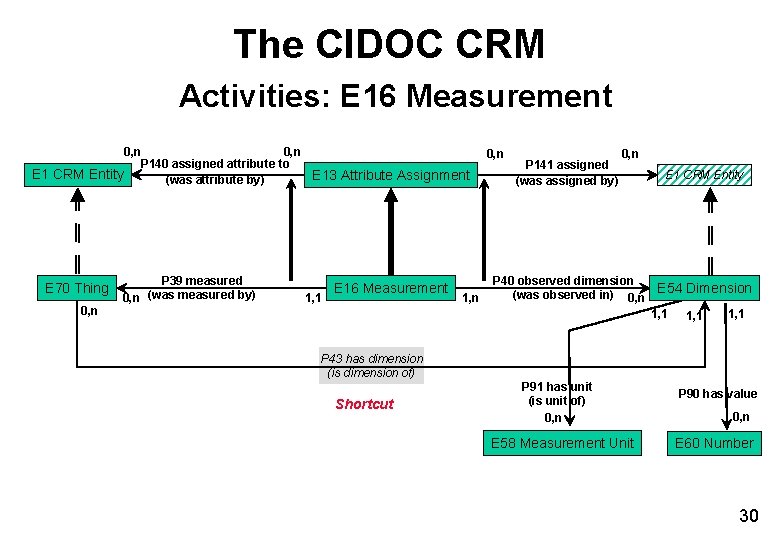
The CIDOC CRM Activities: E 16 Measurement 0, n P 140 assigned attribute to E 1 CRM Entity E 13 Attribute Assignment (was attribute by) E 70 Thing 0, n P 39 measured (was measured by) 0, n 1, 1 E 16 Measurement 1, n 0, n P 141 assigned (was assigned by) 0, n P 40 observed dimension (was observed in) 0, n E 1 CRM Entity E 54 Dimension 1, 1 P 43 has dimension (is dimension of) Shortcut P 91 has unit (is unit of) 0, n E 58 Measurement Unit P 90 has value 0, n E 60 Number 30
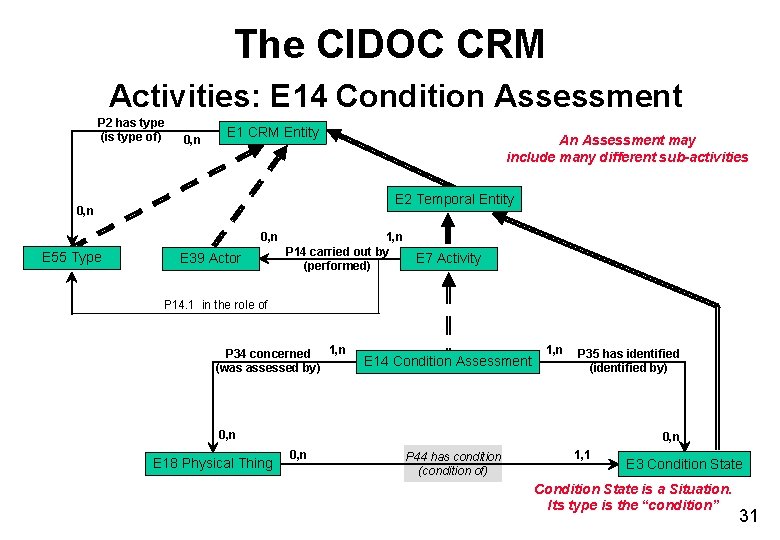
The CIDOC CRM Activities: E 14 Condition Assessment P 2 has type (is type of) 0, n E 1 CRM Entity E 2 Temporal Entity 0, n E 55 Type An Assessment may include many different sub-activities E 39 Actor 1, n P 14 carried out by (performed) E 7 Activity P 14. 1 in the role of P 34 concerned 1, n (was assessed by) E 14 Condition Assessment 1, n P 35 has identified (identified by) 0, n E 18 Physical Thing 0, n P 44 has condition (condition of) 1, 1 E 3 Condition State is a Situation. Its type is the “condition” 31
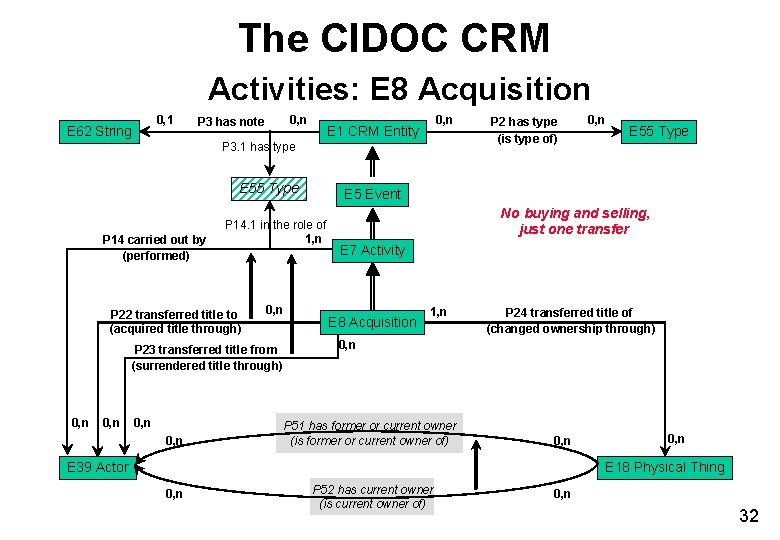
The CIDOC CRM Activities: E 8 Acquisition 0, 1 E 62 String 0, n P 3 has note 0, n E 1 CRM Entity P 3. 1 has type E 55 Type P 14 carried out by (performed) 0, n P 23 transferred title from (surrendered title through) 0, n 0, n E 55 Type E 5 Event P 14. 1 in the role of 1, n P 22 transferred title to (acquired title through) P 2 has type (is type of) No buying and selling, just one transfer E 7 Activity E 8 Acquisition 1, n P 24 transferred title of (changed ownership through) 0, n P 51 has former or current owner (is former or current owner of) 0, n E 18 Physical Thing E 39 Actor 0, n P 52 has current owner (is current owner of) 0, n 32
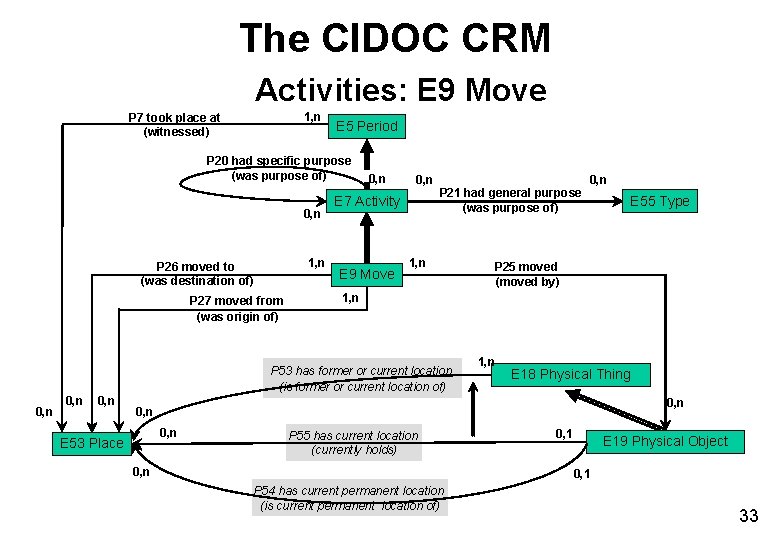
The CIDOC CRM Activities: E 9 Move 1, n P 7 took place at (witnessed) E 5 Period P 20 had specific purpose (was purpose of) 0, n 1, n P 26 moved to (was destination of) P 27 moved from (was origin of) 0, n P 21 had general purpose (was purpose of) E 7 Activity E 9 Move 0, n 1, n 0, n P 25 moved (moved by) 1, n P 53 has former or current location (is former or current location of) 0, n 1, n E 18 Physical Thing 0, n E 53 Place E 55 Type P 55 has current location (currently holds) 0, n 0, 1 E 19 Physical Object 0, 1 P 54 has current permanent location (is current permanent location of) 33
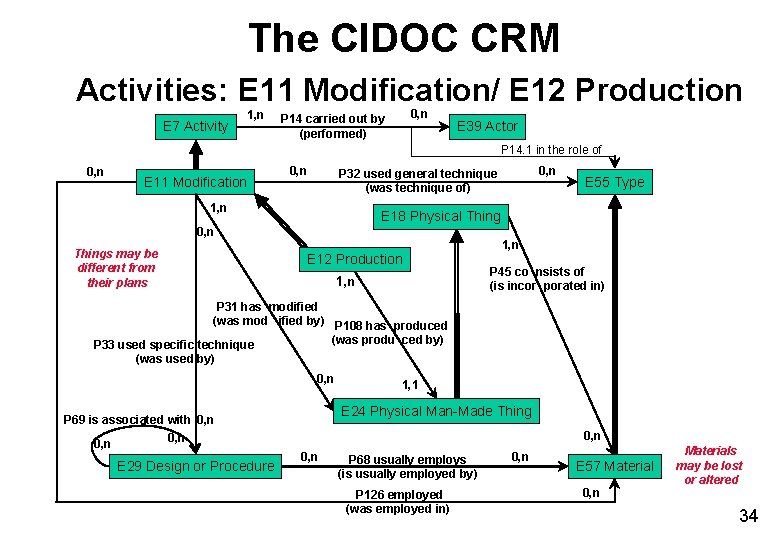
The CIDOC CRM Activities: E 11 Modification/ E 12 Production E 7 Activity 1, n 0, n P 14 carried out by (performed) E 39 Actor P 14. 1 in the role of 0, n E 11 Modification 0, n 1, n E 55 Type E 18 Physical Thing 0, n Things may be different from their plans 0, n P 32 used general technique (was technique of) 1, n E 12 Production 1, n P 45 co nsists of (is incor porated in) P 31 has modified (was mod ified by) P 108 has produced (was produ ced by) P 33 used specific technique (was used by) 0, n E 24 Physical Man-Made Thing P 69 is associated with 0, n E 29 Design or Procedure 1, 1 0, n P 68 usually employs (is usually employed by) P 126 employed (was employed in) 0, n E 57 Materials may be lost or altered 0, n 34
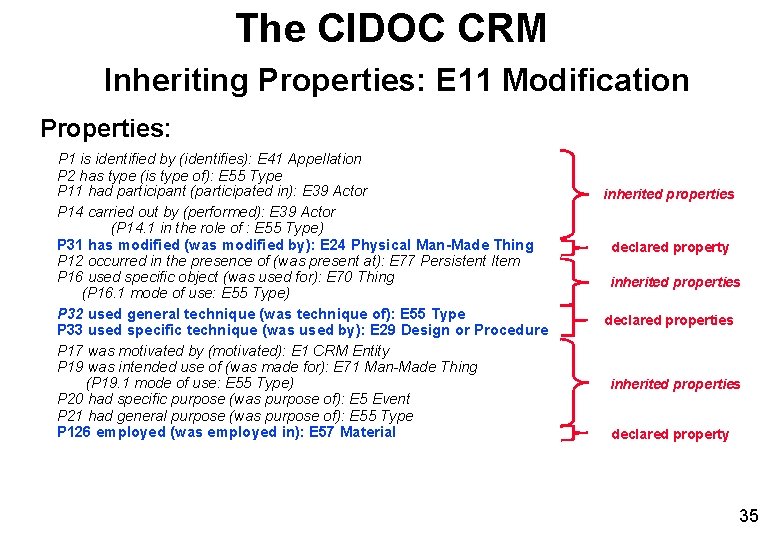
The CIDOC CRM Inheriting Properties: E 11 Modification Properties: P 1 is identified by (identifies): E 41 Appellation P 2 has type (is type of): E 55 Type P 11 had participant (participated in): E 39 Actor P 14 carried out by (performed): E 39 Actor (P 14. 1 in the role of : E 55 Type) P 31 has modified (was modified by): E 24 Physical Man-Made Thing P 12 occurred in the presence of (was present at): E 77 Persistent Item P 16 used specific object (was used for): E 70 Thing (P 16. 1 mode of use: E 55 Type) P 32 used general technique (was technique of): E 55 Type P 33 used specific technique (was used by): E 29 Design or Procedure P 17 was motivated by (motivated): E 1 CRM Entity P 19 was intended use of (was made for): E 71 Man-Made Thing (P 19. 1 mode of use: E 55 Type) P 20 had specific purpose (was purpose of): E 5 Event P 21 had general purpose (was purpose of): E 55 Type P 126 employed (was employed in): E 57 Material inherited properties declared property inherited properties declared properties inherited properties declared property 35
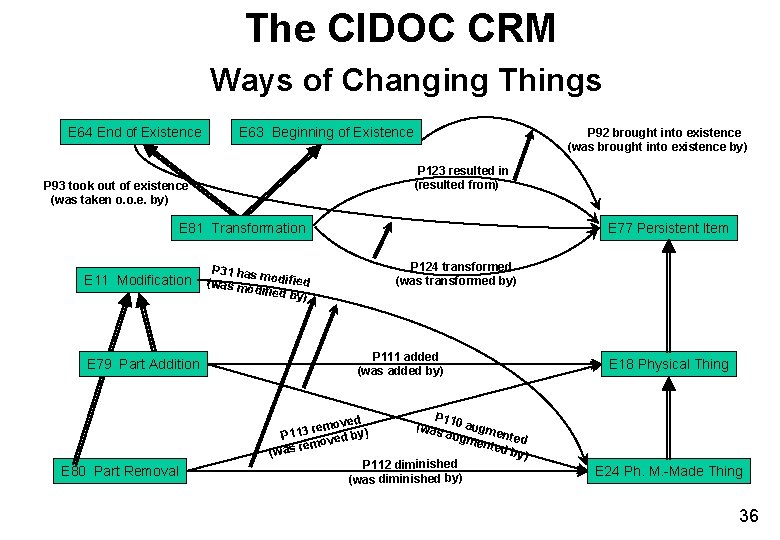
The CIDOC CRM Ways of Changing Things E 64 End of Existence E 63 Beginning of Existence P 123 resulted in (resulted from) P 93 took out of existence (was taken o. o. e. by) E 81 Transformation E 11 Modification E 79 Part Addition E 80 Part Removal P 92 brought into existence (was brought into existence by) P 31 has m (was mo odified by ) E 77 Persistent Item P 124 transformed (was transformed by) P 111 added (was added by) P 11 ed 0 v o ( m w re as a augmen 3 1 ) 1 y b P ugm t ed ente ed emov r s d a by) (w P 112 diminished (was diminished by) E 18 Physical Thing E 24 Ph. M. -Made Thing 36
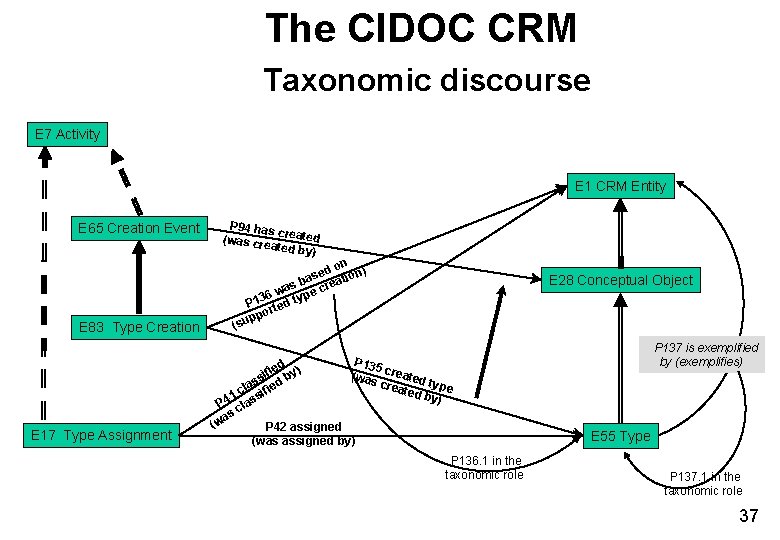
The CIDOC CRM Taxonomic discourse E 7 Activity E 1 CRM Entity E 65 Creation Event E 83 Type Creation E 17 Type Assignment P 94 ha s c (was cre reated by) on ed tion) s a ea s b wa pe cr 6 3 ty P 1 orted pp (su E 28 Conceptual Object P 13 d ) 5 e i if by (was created s type crea las ified t c e d 1 ss by) 4 a P cl as (w P 42 assigned (was assigned by) P 136. 1 in the taxonomic role P 137 is exemplified by (exemplifies) E 55 Type P 137. 1 in the taxonomic role 37
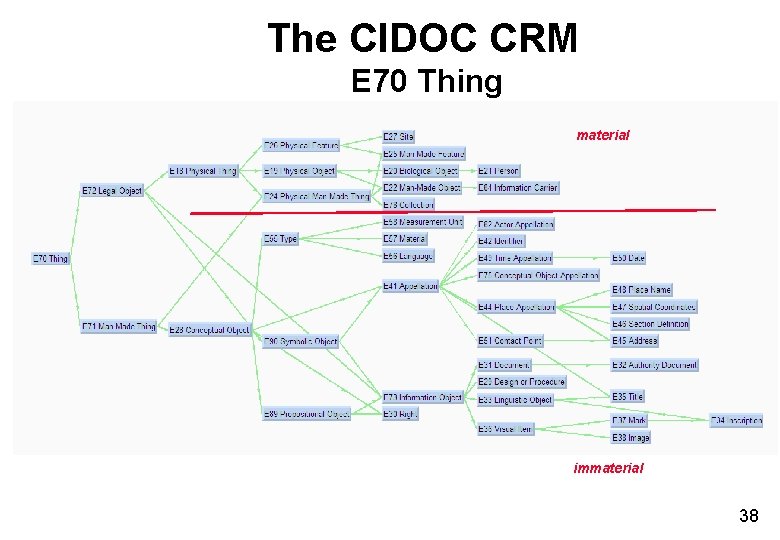
The CIDOC CRM E 70 Thing material immaterial 38
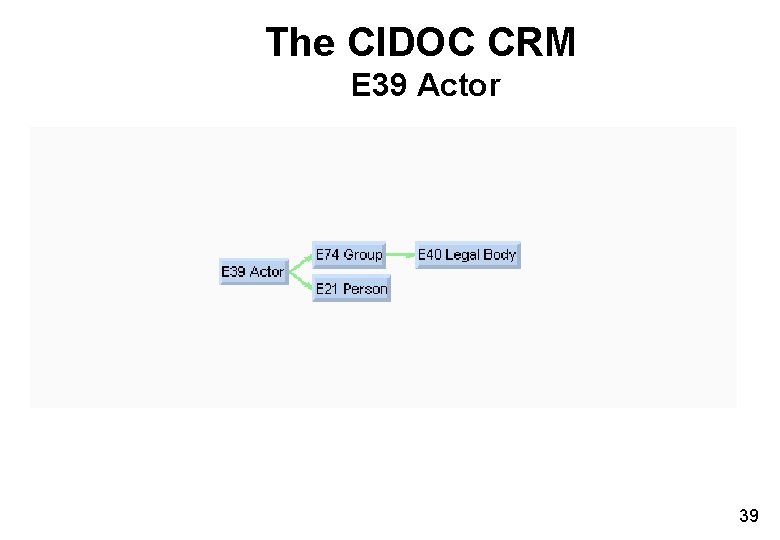
The CIDOC CRM E 39 Actor 39
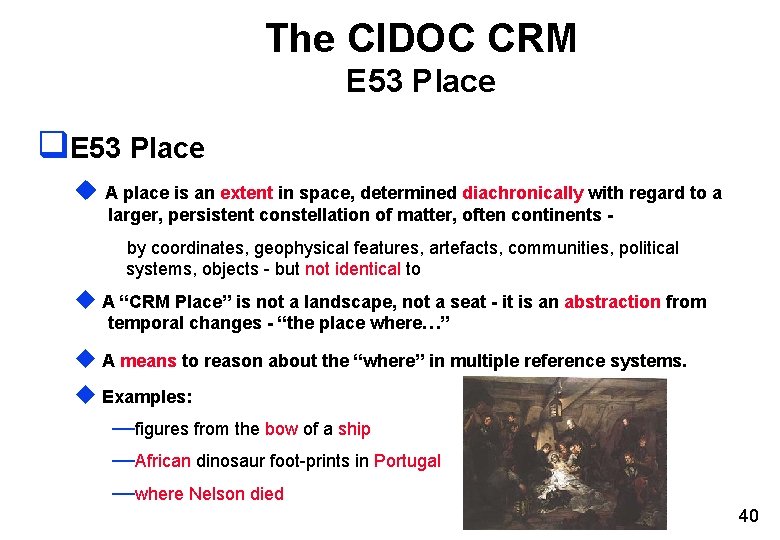
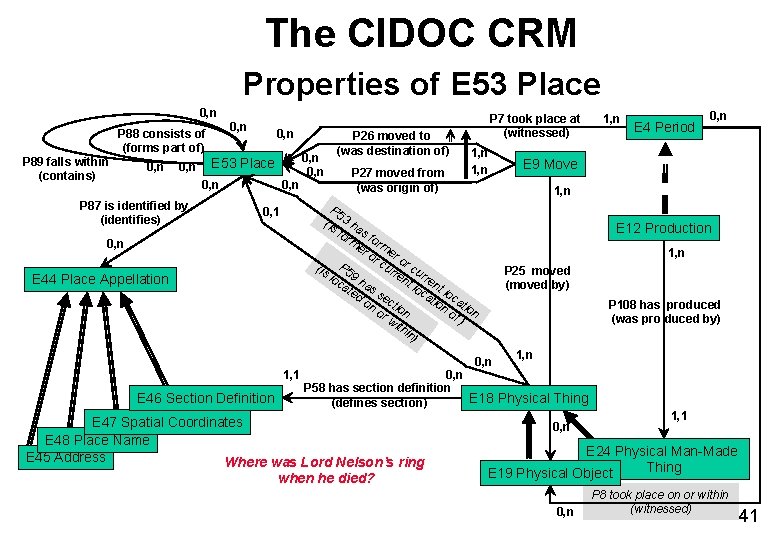
The CIDOC CRM E 53 Place q. E 53 Place u A place is an extent in space, determined diachronically with regard to a larger, persistent constellation of matter, often continents by coordinates, geophysical features, artefacts, communities, political systems, objects - but not identical to u A “CRM Place” is not a landscape, not a seat - it is an abstraction from temporal changes - “the place where…” u A means to reason about the “where” in multiple reference systems. u Examples: —figures from the bow of a ship —African dinosaur foot-prints in Portugal —where Nelson died 40
The CIDOC CRM Properties of E 53 Place 0, n P 89 falls within (contains) 0, n P 88 consists of (forms part of) 0, n E 53 Place 0, n P 87 is identified by (identifies) 0, n P 27 moved from (was origin of) 1, n 0, n E 44 Place Appellation 1, 1 1, n E 4 Period 0, n E 9 Move 1, n P 5 (is 3 ha fo s rm for er me or r cu or (is P 5 rre cur lo 9 h nt ren ca as loc t l ted s ati oca on ect on tio i o or n of n w ) ith in) 0, 1 E 46 Section Definition 0, n P 26 moved to (was destination of) P 7 took place at (witnessed) E 12 Production 1, n P 25 moved (moved by) P 108 has produced (was pro duced by) 0, n 1, n 0, n P 58 has section definition E 18 Physical Thing (defines section) E 47 Spatial Coordinates E 48 Place Name E 45 Address Where was Lord Nelson’s ring when he died? 0, n 1, 1 E 24 Physical Man-Made Thing E 19 Physical Object 0, n P 8 took place on or within (witnessed) 41
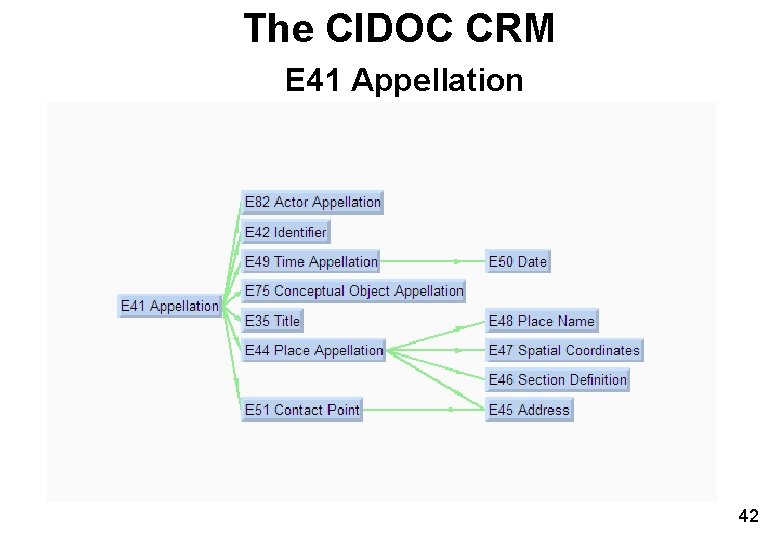
The CIDOC CRM E 41 Appellation 42
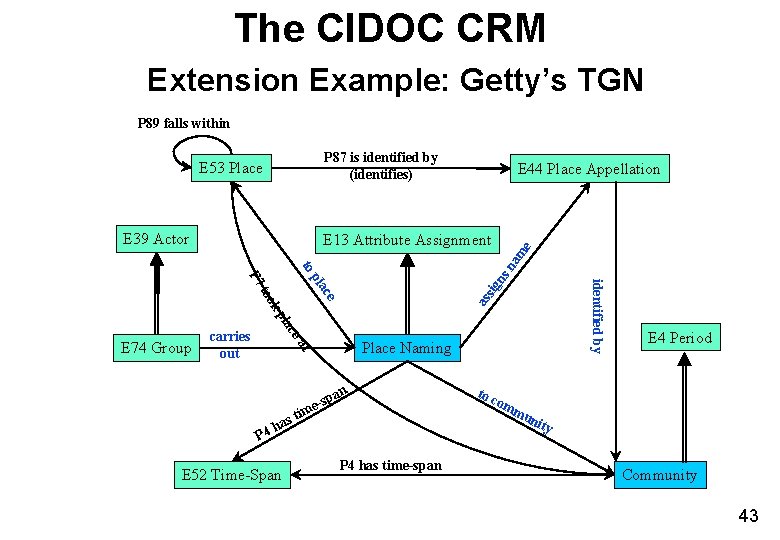
The CIDOC CRM Extension Example: Getty’s TGN P 89 falls within P 87 is identified by (identifies) E 53 Place E 39 Actor E 44 Place Appellation gn s as si identified by carries out e a Place Naming t E 74 Group ac pl ok e to ac P 7 pl to na m e E 13 Attribute Assignment an -sp e m s ti P a 4 h E 52 Time-Span E 4 Period to c om m un ity P 4 has time-span Community 43
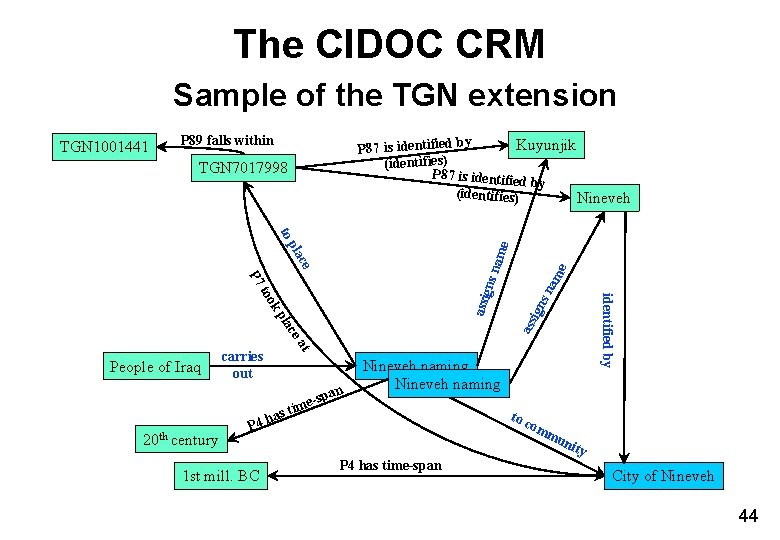
The CIDOC CRM Sample of the TGN extension P 89 falls within y Kuyunjik P 87 is identified b (identifies) P 87 is identifi ed by (identifies) Nineveh TGN 7017998 assi 20 th century 1 st mill. BC me ass t e a ac n ha P 4 identified by pl ok carries out s n a gns ce nam e pla to P 7 People of Iraq ign TGN 1001441 -spa e m i Nineveh naming s t to c om P 4 has time-span mu nit y City of Nineveh 44
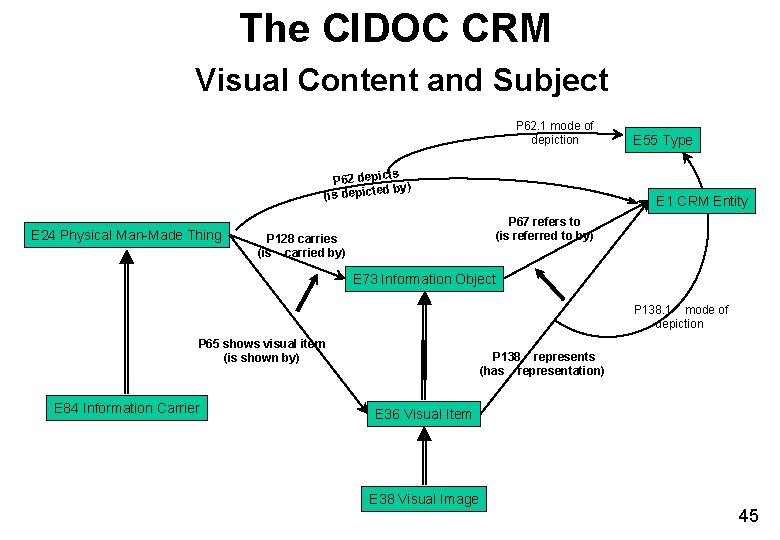
The CIDOC CRM Visual Content and Subject P 62. 1 mode of depiction ts P 62 depic d by) (is depicte E 24 Physical Man-Made Thing E 55 Type E 1 CRM Entity P 67 refers to (is referred to by) P 128 carries (is carried by) E 73 Information Object P 138. 1 mode of depiction P 65 shows visual item (is shown by) E 84 Information Carrier P 138 represents (has representation) E 36 Visual Item E 38 Visual Image 45
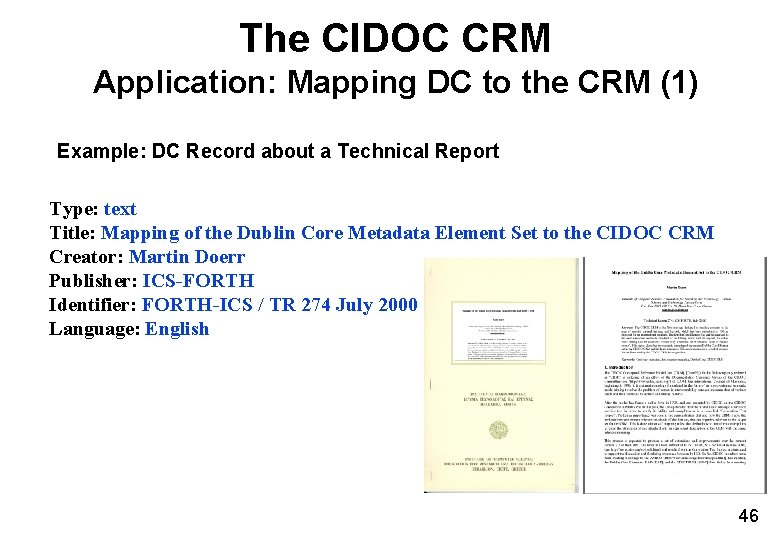
The CIDOC CRM Application: Mapping DC to the CRM (1) Example: DC Record about a Technical Report Type: text Title: Mapping of the Dublin Core Metadata Element Set to the CIDOC CRM Creator: Martin Doerr Publisher: ICS-FORTH Identifier: FORTH-ICS / TR 274 July 2000 Language: English 46
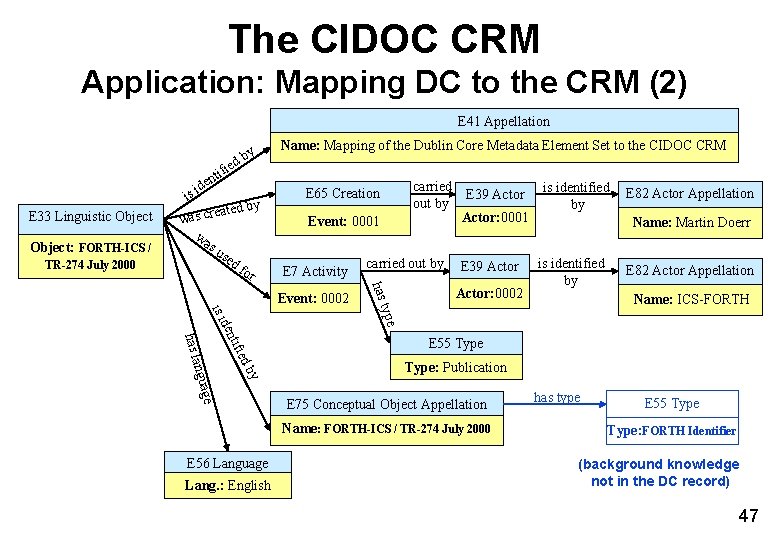
The CIDOC CRM Application: Mapping DC to the CRM (2) E 41 Appellation y db Name: Mapping of the Dublin Core Metadata Element Set to the CIDOC CRM ie is E 33 Linguistic Object: FORTH-ICS / TR-274 July 2000 tif en id ated by e r c s a w wa su se df or E 65 Creation carried out by Event: 0001 E 7 Activity has Actor: 0001 E 39 Actor: 0002 ed tifi den is i by age angu has l Lang. : English E 82 Actor Appellation Name: Martin Doerr is identified by E 82 Actor Appellation Name: ICS-FORTH E 55 Type: Publication E 75 Conceptual Object Appellation Name: FORTH-ICS / TR-274 July 2000 E 56 Language is identified by type Event: 0002 carried out by E 39 Actor has type E 55 Type: FORTH Identifier (background knowledge not in the DC record) 47
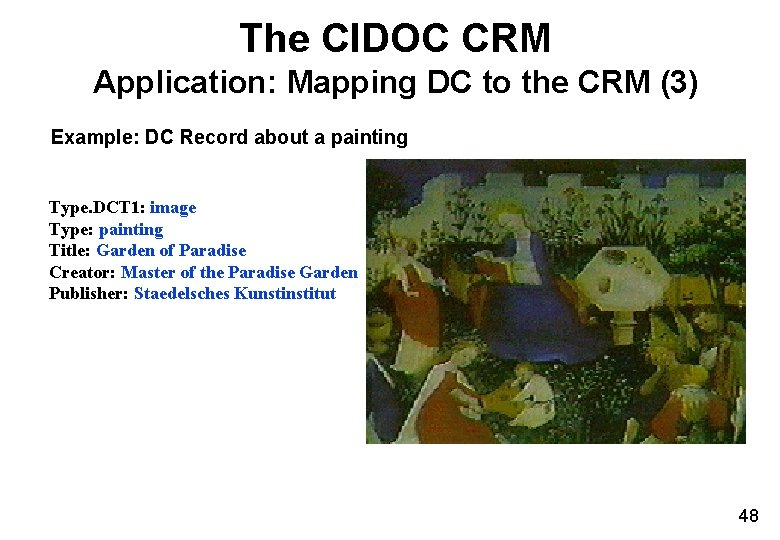
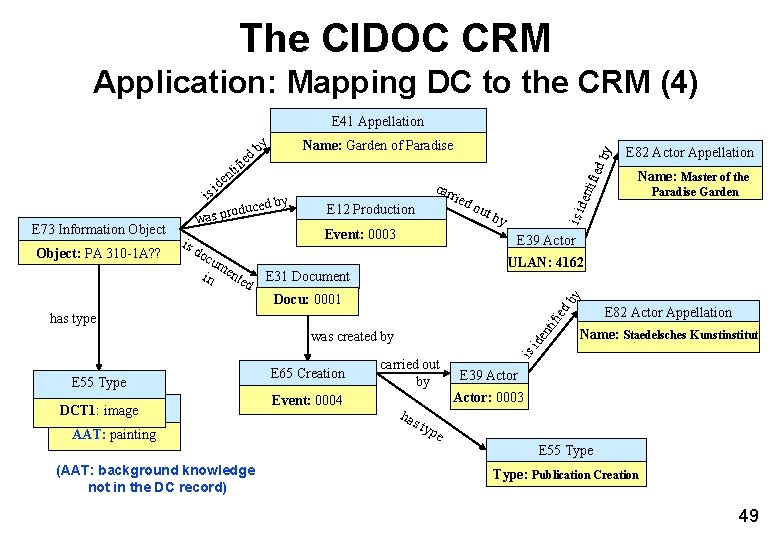
The CIDOC CRM Application: Mapping DC to the CRM (3) Example: DC Record about a painting Type. DCT 1: image Type: painting Title: Garden of Paradise Creator: Master of the Paradise Garden Publisher: Staedelsches Kunstitut 48
The CIDOC CRM Application: Mapping DC to the CRM (4) E 41 Appellation by i E 73 Information Object: PA 310 -1 A? ? was pr y uced b od is d oc um in ente d fied car ried E 12 Production Event: 0003 out by y nti fie db has type AAT: painting Event: 0004 carried out by E 82 Actor Appellation Name: Staedelsches Kunstitut is ide was created by E 55 image Type DCT 1: Paradise Garden ULAN: 4162 Docu: 0001 E 55 Type Name: Master of the E 39 Actor E 31 Document E 65 Creation E 82 Actor Appellation enti en d si by Name: Garden of Paradise is id ed i f ti E 39 Actor: 0003 has typ e E 55 Type (AAT: background knowledge not in the DC record) Type: Publication Creation 49
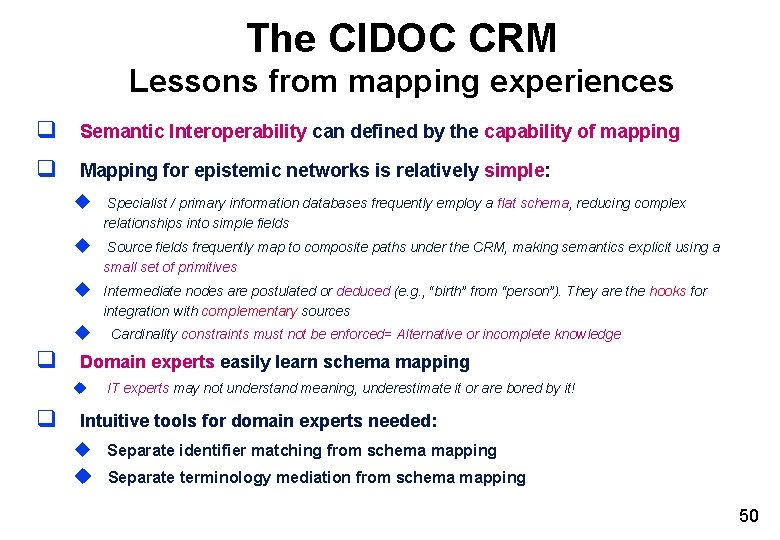
The CIDOC CRM Lessons from mapping experiences q Semantic Interoperability can defined by the capability of mapping q Mapping for epistemic networks is relatively simple: q u Specialist / primary information databases frequently employ a flat schema, reducing complex relationships into simple fields u Source fields frequently map to composite paths under the CRM, making semantics explicit using a small set of primitives u Intermediate nodes are postulated or deduced (e. g. , “birth” from “person”). They are the hooks for integration with complementary sources u Cardinality constraints must not be enforced= Alternative or incomplete knowledge Domain experts easily learn schema mapping u q IT experts may not understand meaning, underestimate it or are bored by it! Intuitive tools for domain experts needed: u Separate identifier matching from schema mapping u Separate terminology mediation from schema mapping 50
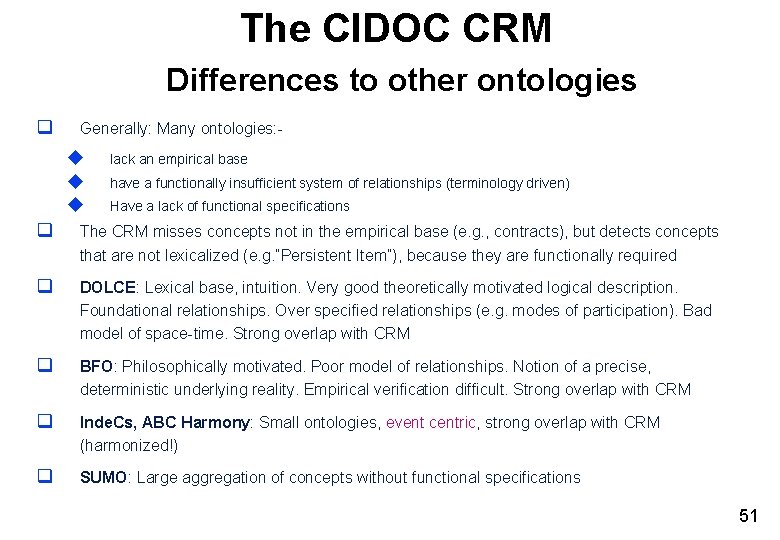
The CIDOC CRM Differences to other ontologies q Generally: Many ontologies: - u u u lack an empirical base have a functionally insufficient system of relationships (terminology driven) Have a lack of functional specifications q The CRM misses concepts not in the empirical base (e. g. , contracts), but detects concepts that are not lexicalized (e. g. ”Persistent Item”), because they are functionally required q DOLCE: Lexical base, intuition. Very good theoretically motivated logical description. Foundational relationships. Over specified relationships (e. g. modes of participation). Bad model of space-time. Strong overlap with CRM q BFO: Philosophically motivated. Poor model of relationships. Notion of a precise, deterministic underlying reality. Empirical verification difficult. Strong overlap with CRM q Inde. Cs, ABC Harmony: Small ontologies, event centric, strong overlap with CRM (harmonized!) q SUMO: Large aggregation of concepts without functional specifications 51
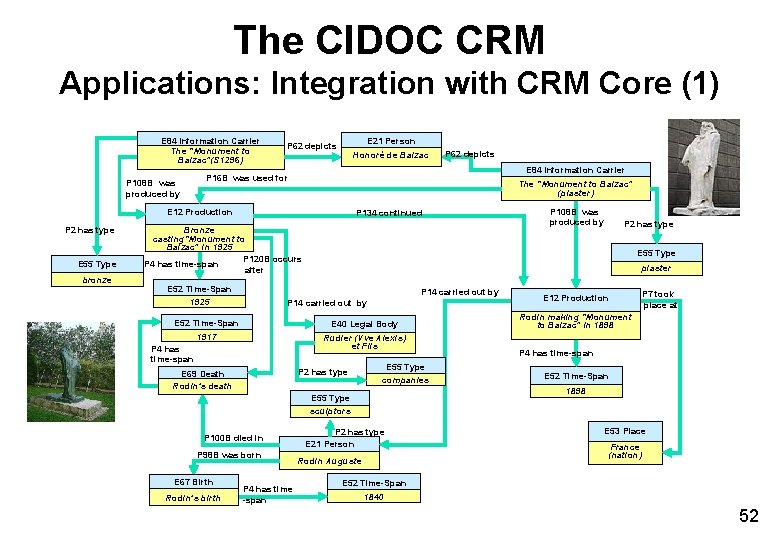
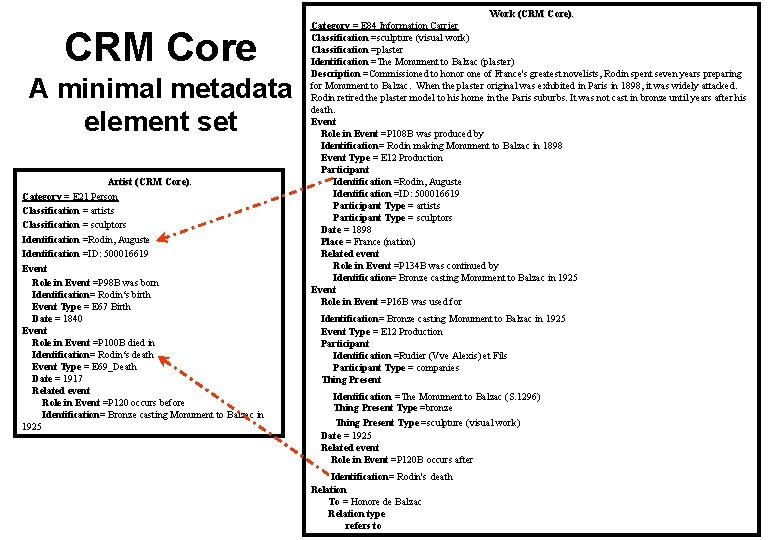
The CIDOC CRM Applications: Integration with CRM Core (1) E 84 Information Carrier The “Monument to Balzac”(S 1296) P 108 B was produced by E 21 Person Honoré de Balzac P 62 depicts E 84 Information Carrier P 16 B was used for The “Monument to Balzac” (plaster) E 12 Production P 2 has type E 55 Type bronze P 62 depicts P 134 continued Bronze casting“Monument to Balzac” in 1925 P 120 B occurs P 4 has time-span after E 52 Time-Span 1925 plaster P 14 carried out by E 40 Legal Body Rudier (Vve Alexis) et Fils P 2 has type E 69 Death Rodin’s death P 2 has type E 55 Type P 14 carried out by E 52 Time-Span 1917 P 4 has time-span P 108 B was produced by E 55 Type companies E 12 Production P 7 took place at Rodin making “Monument to Balzac” in 1898 P 4 has time-span E 52 Time-Span 1898 E 55 Type sculptors P 100 B died in P 98 B was born E 67 Birth Rodin’s birth P 4 has time -span P 2 has type E 21 Person Rodin Auguste E 53 Place France (nation) E 52 Time-Span 1840 52
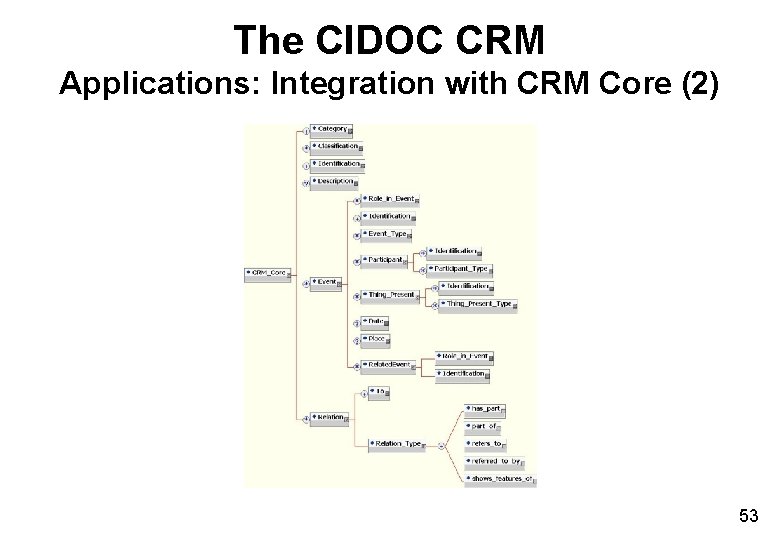
The CIDOC CRM Applications: Integration with CRM Core (2) 53
CRM Core A minimal metadata element set Artist (CRM Core). Category = E 21 Person Classification = artists Classification = sculptors Identification =Rodin, Auguste Identification =ID: 500016619 Event Role in Event =P 98 B was born Identification= Rodin‘s birth Event Type = E 67 Birth Date = 1840 Event Role in Event =P 100 B died in Identification= Rodin‘s death Event Type = E 69_Death Date = 1917 Related event Role in Event =P 120 occurs before Identification= Bronze casting Monument to Balzac in 1925 Work (CRM Core). Category = E 84 Information Carrier Classification =sculpture (visual work) Classification =plaster Identification =The Monument to Balzac (plaster) Description =Commissioned to honor one of France's greatest novelists, Rodin spent seven years preparing for Monument to Balzac. When the plaster original was exhibited in Paris in 1898, it was widely attacked. Rodin retired the plaster model to his home in the Paris suburbs. It was not cast in bronze until years after his death. Event Role in Event =P 108 B was produced by Identification= Rodin making Monument to Balzac in 1898 Event Type = E 12 Production Participant Identification =Rodin, Auguste Identification =ID: 500016619 Participant Type = artists Participant Type = sculptors Date = 1898 Place = France (nation) Related event Role in Event =P 134 B was continued by Identification= Bronze casting Monument to Balzac in 1925 Event Role in Event =P 16 B was used for Identification= Bronze casting Monument to Balzac in 1925 Event Type = E 12 Production Participant Identification =Rudier (Vve Alexis) et Fils Participant Type = companies Thing Present Identification =The Monument to Balzac (S. 1296) Thing Present Type =bronze Thing Present Type =sculpture (visual work) Date = 1925 Related event Role in Event =P 120 B occurs after Identification= Rodin's death Relation To = Honore de Balzac Relation type refers to 54
The CIDOC CRM Methodological aspects q. The CRM aims at semantic integration beyond context. q. It aims at pulling together all relevant sources and data to evaluate a scientific or scholarly question not answered by an individual document q Based on the CRM, effective integration schemata can be defined, such as “CRM Core”, the full CRM or extensions of the CRM q. The CRM can fit rich and poor models under one common logical frame-work. For instance Dublin Core (DC) maps to the CRM q Idea: Not being prescriptive creates lots of flexibility u. It does not propose what to describe. It allows interpretation of what museums and archives actually describe 55
The CIDOC CRM Documents and Knowledge q Scientific and scholarly work produces knowledge by argumentation u. This comes in closed units, “documents” u. They have a history of evolution, “versions” u. The knowledge is “directed” u. It can only be evaluated in context — document about Mona Lisa —theory about the origin of the Minoan people q It should be possible to map primary document structures to the CRM. This is easy: u E. g. good is: “creator - creation place - creation date” bad is : “provenance”, “place associations - life-cycle dates” etc. u Good document structures map easily u No completeness requirements 56
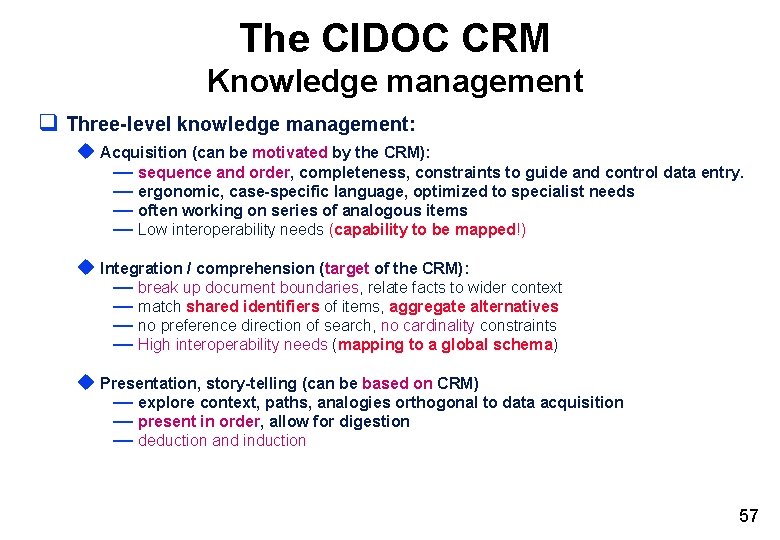
The CIDOC CRM Knowledge management q Three-level knowledge management: u Acquisition (can be motivated by the CRM): — sequence and order, completeness, constraints to guide and control data entry. — ergonomic, case-specific language, optimized to specialist needs — often working on series of analogous items — Low interoperability needs (capability to be mapped!) u Integration / comprehension (target of the CRM): — break up document boundaries, relate facts to wider context — match shared identifiers of items, aggregate alternatives — no preference direction of search, no cardinality constraints — High interoperability needs (mapping to a global schema) u Presentation, story-telling (can be based on CRM) — explore context, paths, analogies orthogonal to data acquisition — present in order, allow for digestion — deduction and induction 57
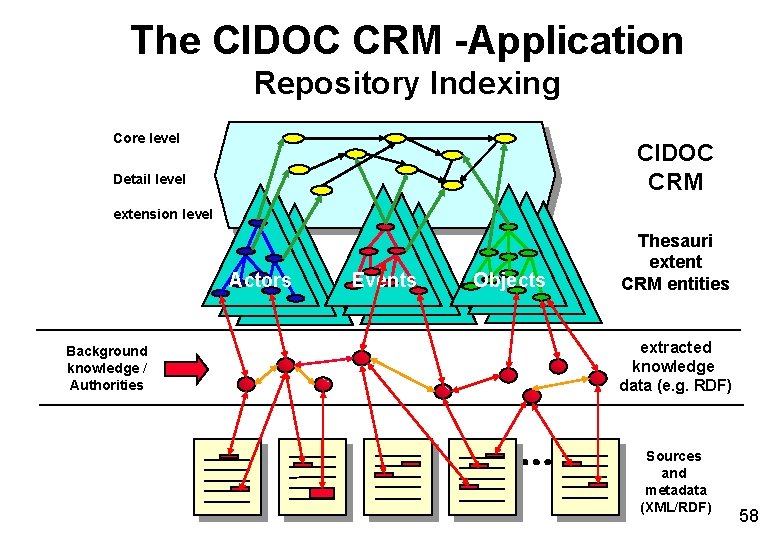
The CIDOC CRM -Application Repository Indexing Core level CIDOC CRM Detail level extension level Actors Background knowledge / Authorities Events Objects Thesauri extent CRM entities extracted knowledge data (e. g. RDF) Sources and metadata (XML/RDF) 58
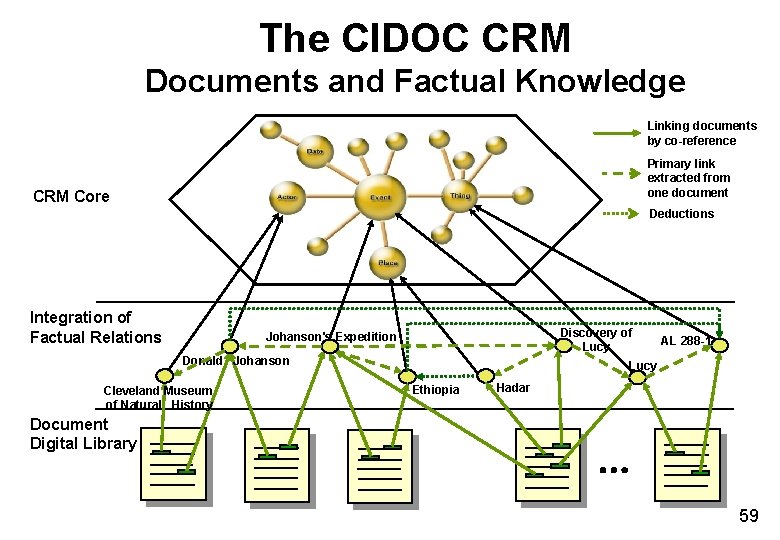
The CIDOC CRM Documents and Factual Knowledge Linking documents by co-reference Primary link extracted from one document CRM Core Deductions Integration of Factual Relations Discovery of Lucy Johanson's Expedition Donald Johanson Cleveland Museum of Natural History AL 288 -1 Lucy Ethiopia Hadar Document Digital Library 59
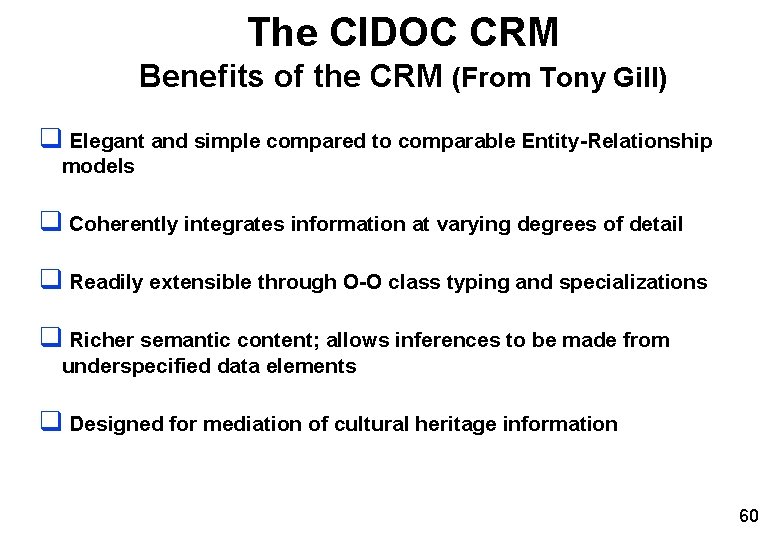
The CIDOC CRM Benefits of the CRM (From Tony Gill) q Elegant and simple compared to comparable Entity-Relationship models q Coherently integrates information at varying degrees of detail q Readily extensible through O-O class typing and specializations q Richer semantic content; allows inferences to be made from underspecified data elements q Designed for mediation of cultural heritage information 60
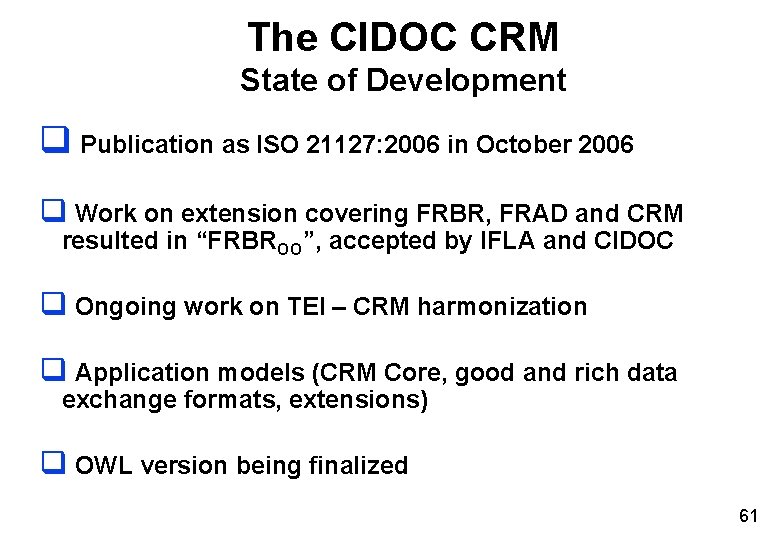
The CIDOC CRM State of Development q Publication as ISO 21127: 2006 in October 2006 q Work on extension covering FRBR, FRAD and CRM resulted in “FRBROO”, accepted by IFLA and CIDOC q Ongoing work on TEI – CRM harmonization q Application models (CRM Core, good and rich data exchange formats, extensions) q OWL version being finalized 61
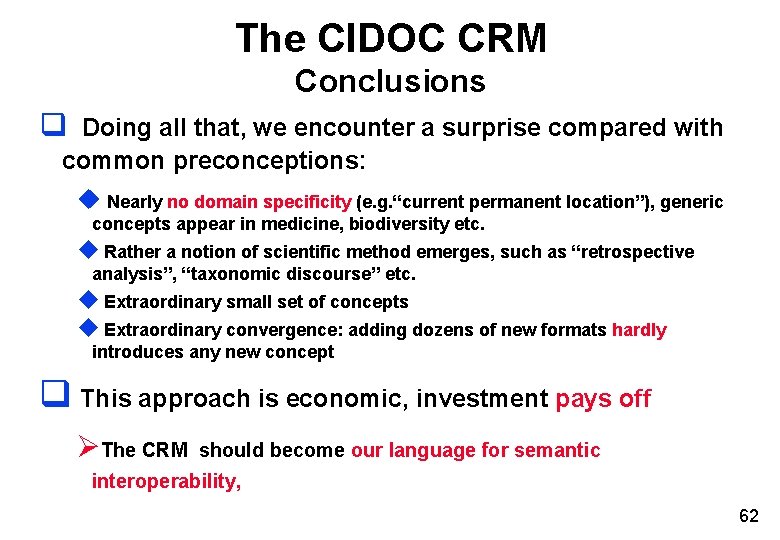
The CIDOC CRM Conclusions q Doing all that, we encounter a surprise compared with common preconceptions: u Nearly no domain specificity (e. g. “current permanent location”), generic concepts appear in medicine, biodiversity etc. u Rather a notion of scientific method emerges, such as “retrospective analysis”, “taxonomic discourse” etc. u Extraordinary small set of concepts u Extraordinary convergence: adding dozens of new formats hardly introduces any new concept q This approach is economic, investment pays off ØThe CRM should become our language for semantic interoperability, 62