
CIDOC CRM Game CRM SIG 02 2016 Initial
- Slides: 30
CIDOC CRM Game / CRM SIG / 02 -2016
Initial Training Network - Digital Cultural Heritage George Bruseker ICS-FORTH Anaïs Guillem UL-FGG Research Activity undertaken in context of ITN-DCH Marie Curie Secondment Exchange
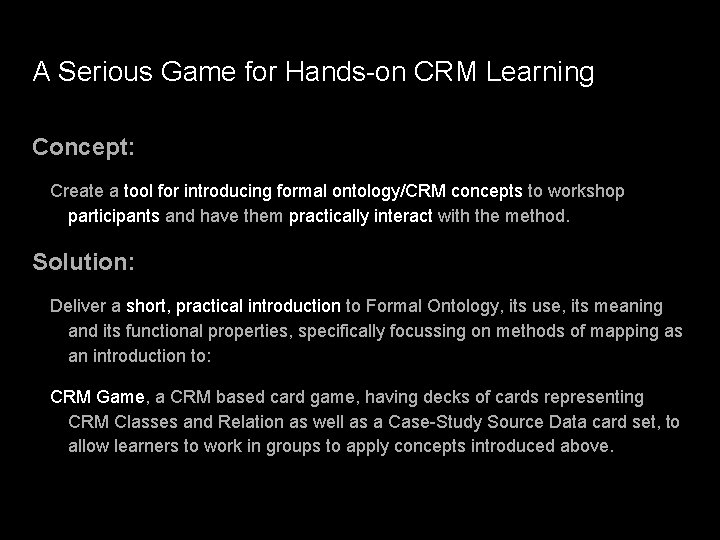
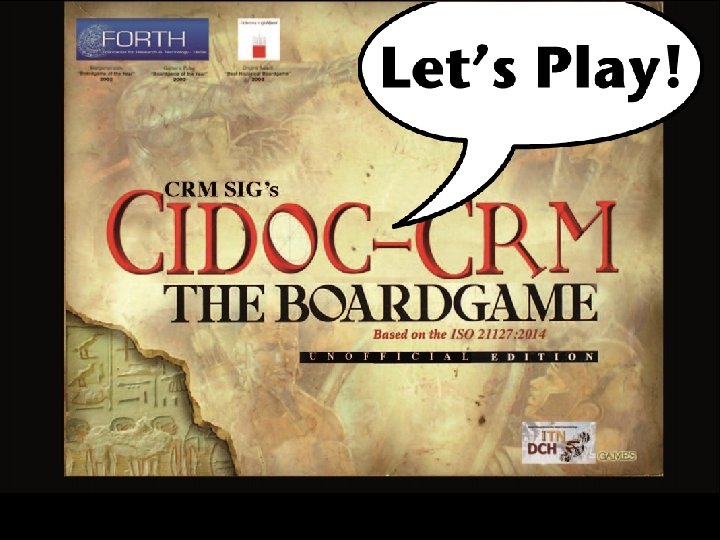
A Serious Game for Hands-on CRM Learning Concept: Create a tool for introducing formal ontology/CRM concepts to workshop participants and have them practically interact with the method. Solution: Deliver a short, practical introduction to Formal Ontology, its use, its meaning and its functional properties, specifically focussing on methods of mapping as an introduction to: CRM Game, a CRM based card game, having decks of cards representing CRM Classes and Relation as well as a Case-Study Source Data card set, to allow learners to work in groups to apply concepts introduced above.
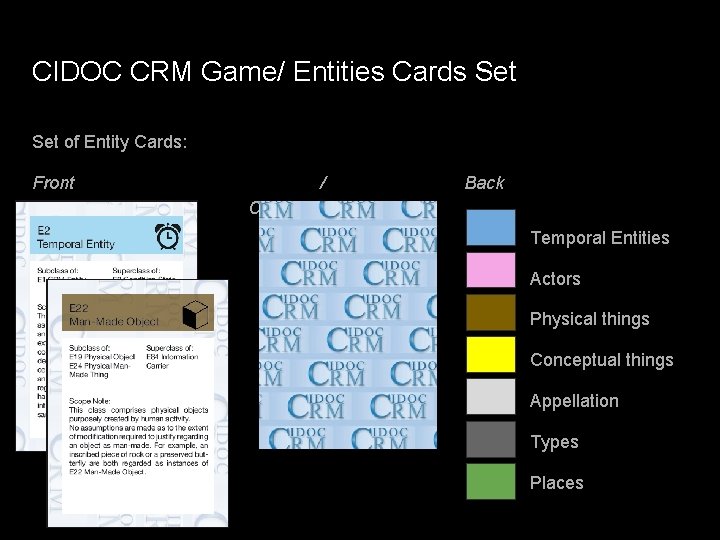
CIDOC CRM Game/ Entities Cards Set of Entity Cards: Front / / Color Code: Back Temporal Entities Actors Physical things Conceptual things Appellation Types Places
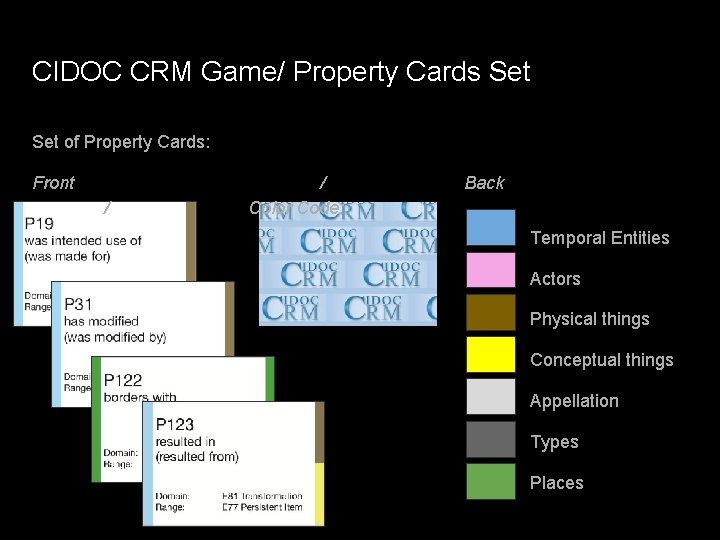
CIDOC CRM Game/ Property Cards Set of Property Cards: Front / / Color Code: Back Temporal Entities Actors Physical things Conceptual things Appellation Types Places
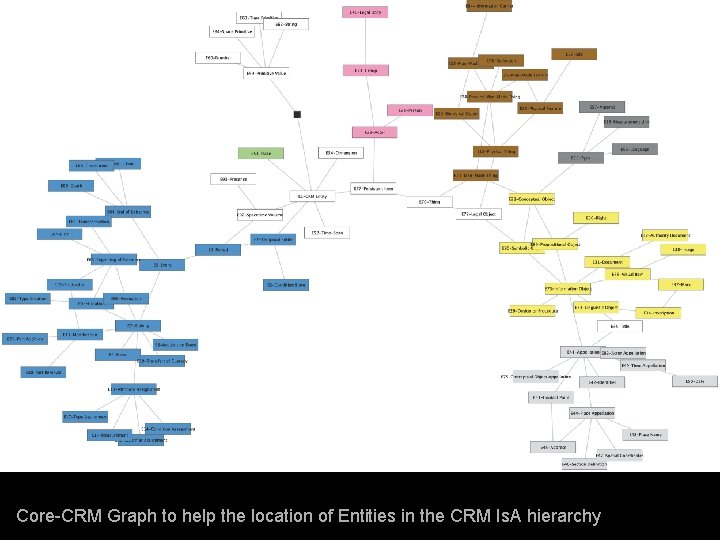
Core-CRM Graph to help the location of Entities in the CRM Is. A hierarchy
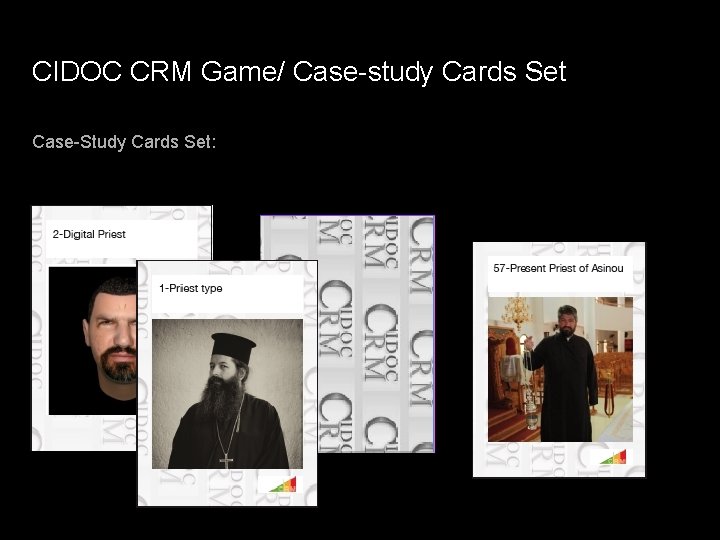
CIDOC CRM Game/ Case-study Cards Set Case-Study Cards Set:
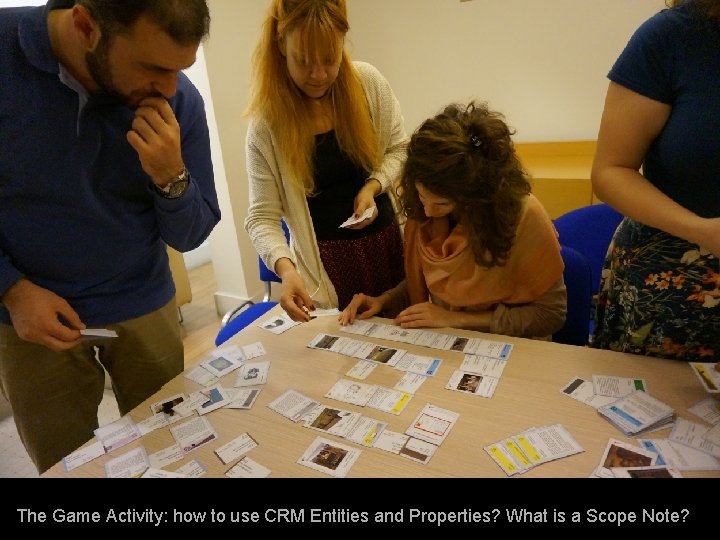
Initial CRM Game Mechanism Concept Players separated into teams that work together collaboratively. For each round, two parts: 1. 5 class cards drawn from CRM Entities Deck and 5 from Case Study Deck. Goal: try to match instances represented by Case-study cards to Classes of CRM. 1. Extra points given for creating connections (allowed to use all relation cards) between drawn cards, appropriately applying relations. At end of each round (10 mins), teams assess score with help of game supervisor. 1. 1 point for each correct match of instance to class, 2. 2 points for each correct relation.
The Game Activity: how to use CRM Entities and Properties? What is a Scope Note?
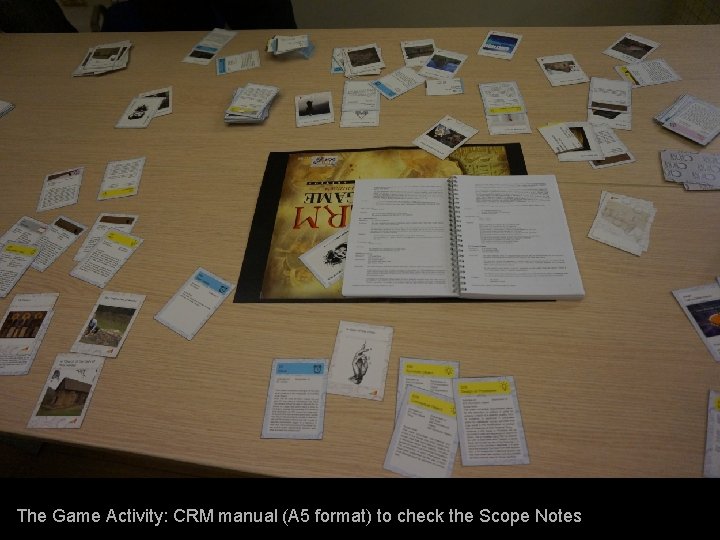
The Game Activity: CRM manual (A 5 format) to check the Scope Notes
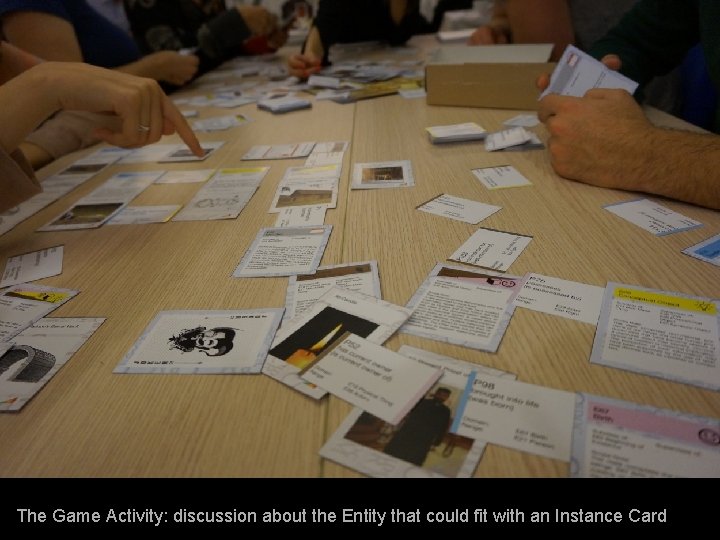
The Game Activity: discussion about the Entity that could fit with an Instance Card
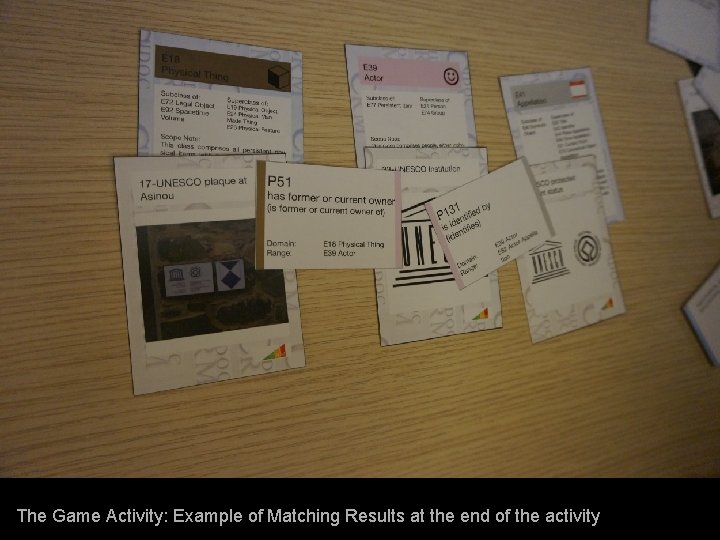
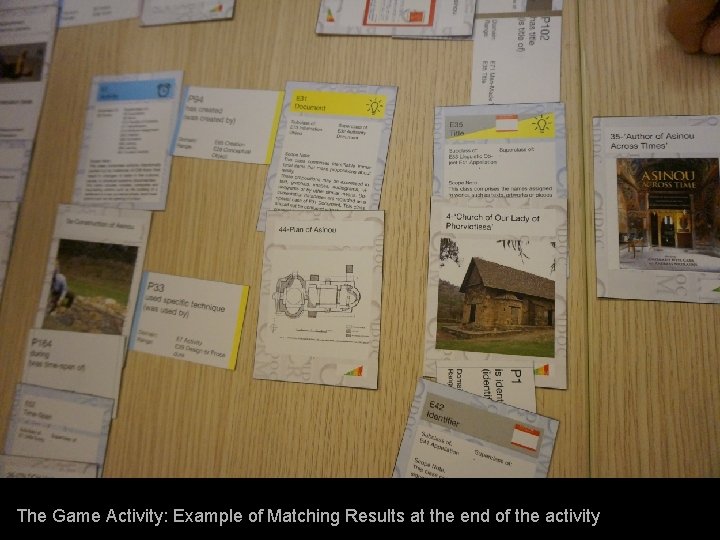
The Game Activity: Example of Matching Results at the end of the activity
The Game Activity: Example of Matching Results at the end of the activity
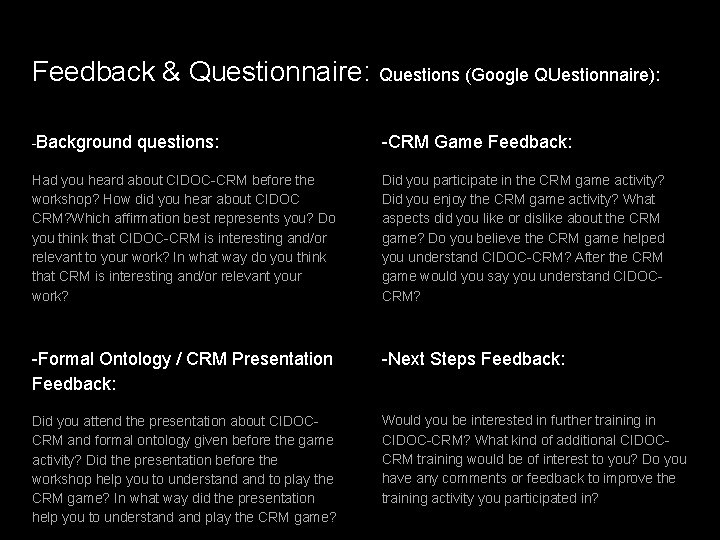
Feedback & Questionnaire: Questions (Google QUestionnaire): -Background questions: -CRM Game Feedback: Had you heard about CIDOC-CRM before the workshop? How did you hear about CIDOC CRM? Which affirmation best represents you? Do you think that CIDOC-CRM is interesting and/or relevant to your work? In what way do you think that CRM is interesting and/or relevant your work? Did you participate in the CRM game activity? Did you enjoy the CRM game activity? What aspects did you like or dislike about the CRM game? Do you believe the CRM game helped you understand CIDOC-CRM? After the CRM game would you say you understand CIDOCCRM? -Formal Ontology / CRM Presentation Feedback: -Next Steps Feedback: Did you attend the presentation about CIDOCCRM and formal ontology given before the game activity? Did the presentation before the workshop help you to understand to play the CRM game? In what way did the presentation help you to understand play the CRM game? Would you be interested in further training in CIDOC-CRM? What kind of additional CIDOCCRM training would be of interest to you? Do you have any comments or feedback to improve the training activity you participated in?
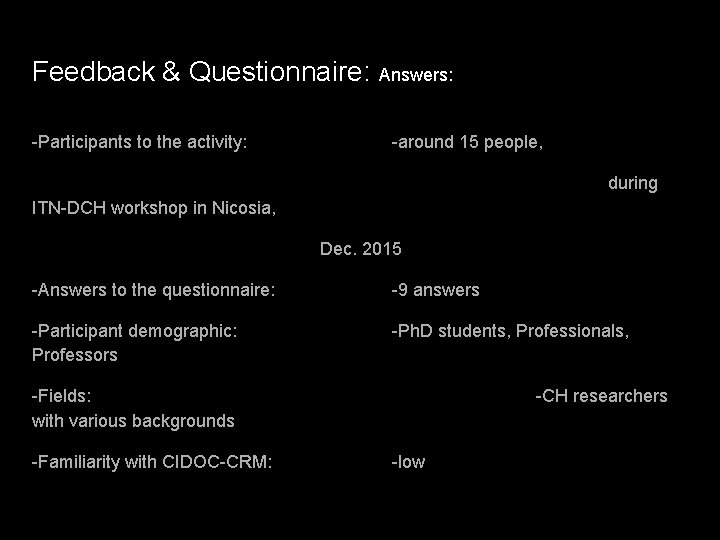
Feedback & Questionnaire: Answers: -Participants to the activity: -around 15 people, during ITN-DCH workshop in Nicosia, Dec. 2015 -Answers to the questionnaire: -9 answers -Participant demographic: Professors -Ph. D students, Professionals, -Fields: with various backgrounds -Familiarity with CIDOC-CRM: -CH researchers -low
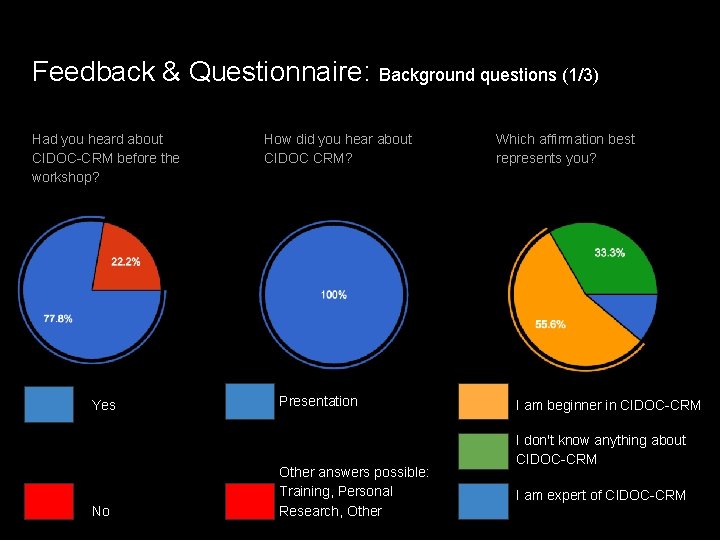
Feedback & Questionnaire: Background questions (1/3) Had you heard about CIDOC-CRM before the workshop? Yes No How did you hear about CIDOC CRM? Presentation Other answers possible: Training, Personal Research, Other Which affirmation best represents you? I am beginner in CIDOC-CRM I don't know anything about CIDOC-CRM I am expert of CIDOC-CRM
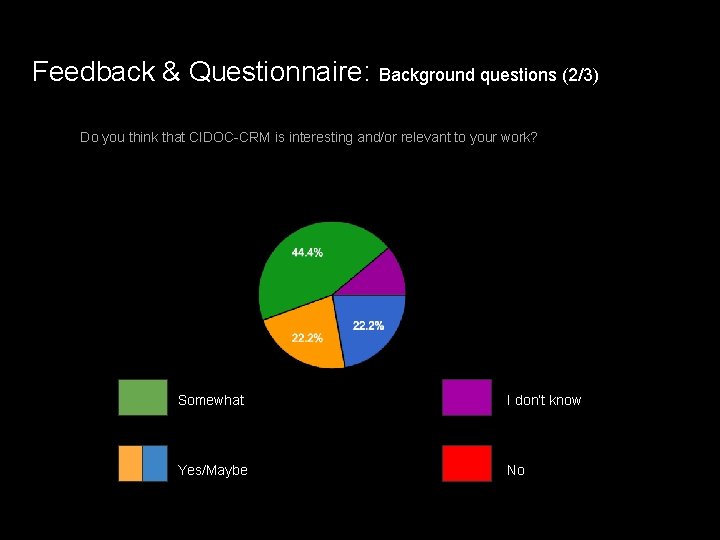
Feedback & Questionnaire: Background questions (2/3) Do you think that CIDOC-CRM is interesting and/or relevant to your work? Somewhat I don’t know Yes/Maybe No
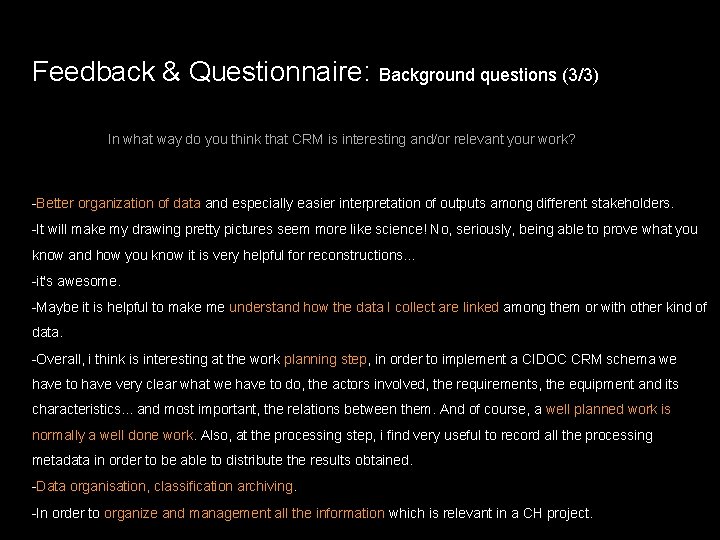
Feedback & Questionnaire: Background questions (3/3) In what way do you think that CRM is interesting and/or relevant your work? -Better organization of data and especially easier interpretation of outputs among different stakeholders. -It will make my drawing pretty pictures seem more like science! No, seriously, being able to prove what you know and how you know it is very helpful for reconstructions. . . -it's awesome. -Maybe it is helpful to make me understand how the data I collect are linked among them or with other kind of data. -Overall, i think is interesting at the work planning step, in order to implement a CIDOC CRM schema we have to have very clear what we have to do, the actors involved, the requirements, the equipment and its characteristics. . . and most important, the relations between them. And of course, a well planned work is normally a well done work. Also, at the processing step, i find very useful to record all the processing metadata in order to be able to distribute the results obtained. -Data organisation, classification archiving. -In order to organize and management all the information which is relevant in a CH project.
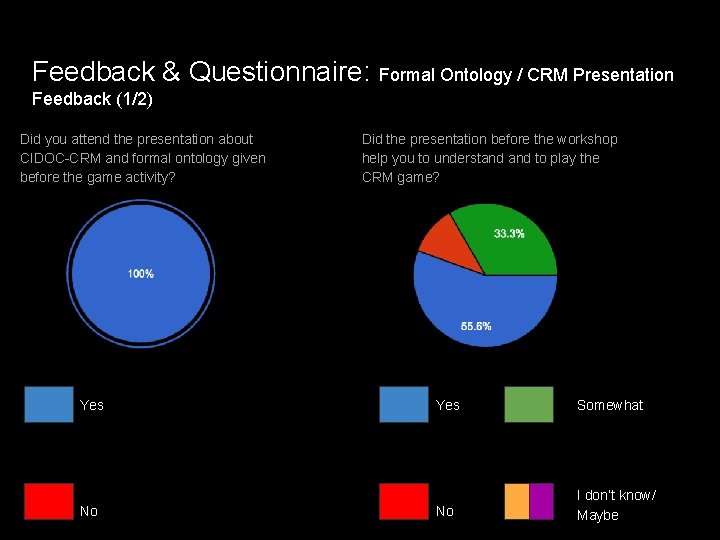
Feedback & Questionnaire: Formal Ontology / CRM Presentation Feedback (1/2) Did you attend the presentation about CIDOC-CRM and formal ontology given before the game activity? Did the presentation before the workshop help you to understand to play the CRM game? Yes Somewhat No No I don’t know/ Maybe
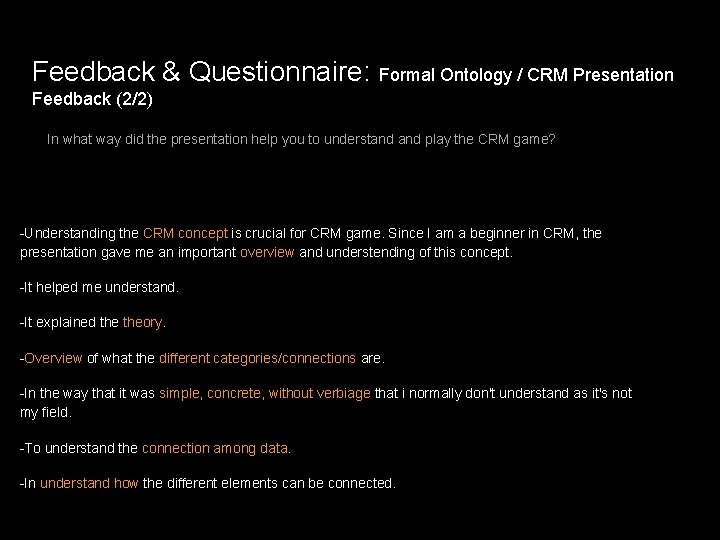
Feedback & Questionnaire: Formal Ontology / CRM Presentation Feedback (2/2) In what way did the presentation help you to understand play the CRM game? -Understanding the CRM concept is crucial for CRM game. Since I am a beginner in CRM, the presentation gave me an important overview and understending of this concept. -It helped me understand. -It explained theory. -Overview of what the different categories/connections are. -In the way that it was simple, concrete, without verbiage that i normally don't understand as it's not my field. -To understand the connection among data. -In understand how the different elements can be connected.
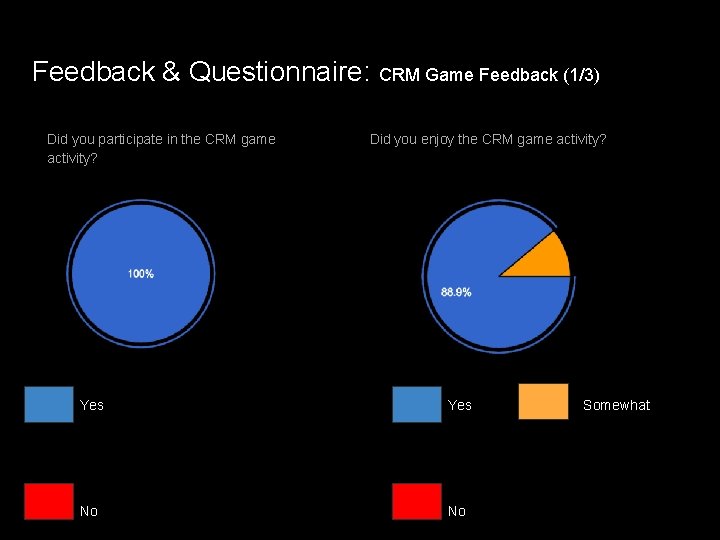
Feedback & Questionnaire: CRM Game Feedback (1/3) Did you participate in the CRM game activity? Did you enjoy the CRM game activity? Yes No No Somewhat
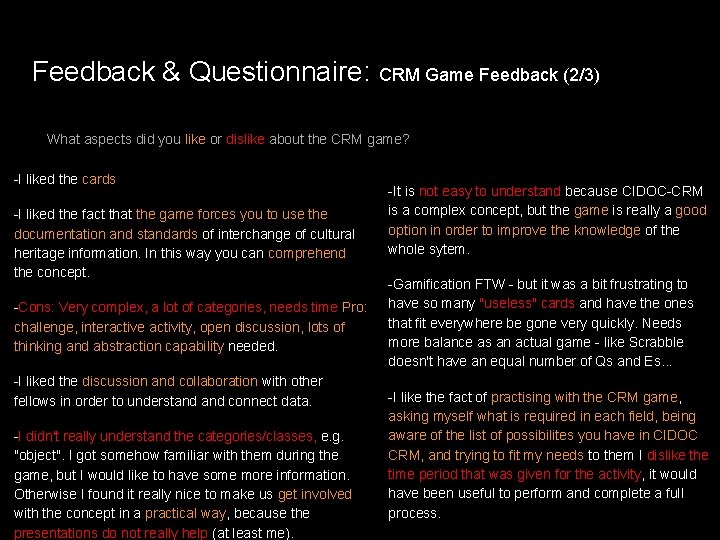
Feedback & Questionnaire: CRM Game Feedback (2/3) What aspects did you like or dislike about the CRM game? -I liked the cards -I liked the fact that the game forces you to use the documentation and standards of interchange of cultural heritage information. In this way you can comprehend the concept. -Cons: Very complex, a lot of categories, needs time Pro: challenge, interactive activity, open discussion, lots of thinking and abstraction capability needed. -I liked the discussion and collaboration with other fellows in order to understand connect data. -I didn't really understand the categories/classes, e. g. "object". I got somehow familiar with them during the game, but I would like to have some more information. Otherwise I found it really nice to make us get involved with the concept in a practical way, because the presentations do not really help (at least me). -It is not easy to understand because CIDOC-CRM is a complex concept, but the game is really a good option in order to improve the knowledge of the whole sytem. -Gamification FTW - but it was a bit frustrating to have so many "useless" cards and have the ones that fit everywhere be gone very quickly. Needs more balance as an actual game - like Scrabble doesn't have an equal number of Qs and Es. . . -I like the fact of practising with the CRM game, asking myself what is required in each field, being aware of the list of possibilites you have in CIDOC CRM, and trying to fit my needs to them I dislike the time period that was given for the activity, it would have been useful to perform and complete a full process.
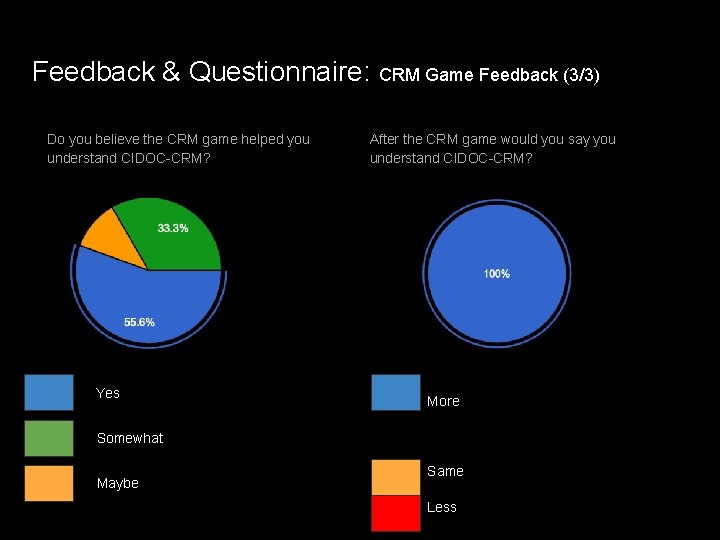
Feedback & Questionnaire: CRM Game Feedback (3/3) Do you believe the CRM game helped you understand CIDOC-CRM? Yes After the CRM game would you say you understand CIDOC-CRM? More Somewhat Maybe Same Less
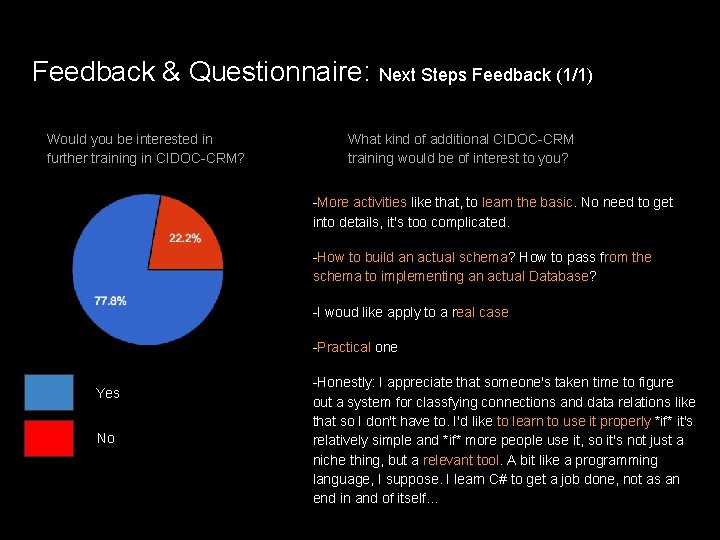
Feedback & Questionnaire: Next Steps Feedback (1/1) Would you be interested in further training in CIDOC-CRM? What kind of additional CIDOC-CRM training would be of interest to you? -More activities like that, to learn the basic. No need to get into details, it's too complicated. -How to build an actual schema? How to pass from the schema to implementing an actual Database? -I woud like apply to a real case -Practical one Yes No -Honestly: I appreciate that someone's taken time to figure out a system for classfying connections and data relations like that so I don't have to. I'd like to learn to use it properly *if* it's relatively simple and *if* more people use it, so it's not just a niche thing, but a relevant tool. A bit like a programming language, I suppose. I learn C# to get a job done, not as an end in and of itself. . .
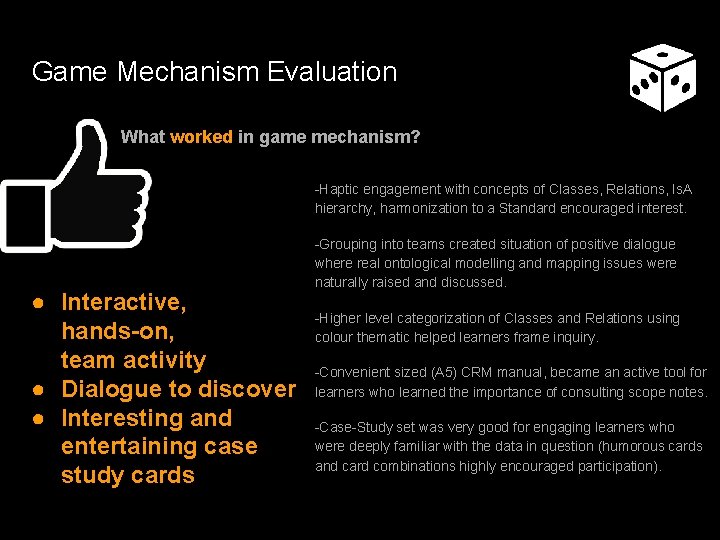
Game Mechanism Evaluation What worked in game mechanism? -Haptic engagement with concepts of Classes, Relations, Is. A hierarchy, harmonization to a Standard encouraged interest. ● Interactive, hands-on, team activity ● Dialogue to discover ● Interesting and entertaining case study cards -Grouping into teams created situation of positive dialogue where real ontological modelling and mapping issues were naturally raised and discussed. -Higher level categorization of Classes and Relations using colour thematic helped learners frame inquiry. -Convenient sized (A 5) CRM manual, became an active tool for learners who learned the importance of consulting scope notes. -Case-Study set was very good for engaging learners who were deeply familiar with the data in question (humorous cards and card combinations highly encouraged participation).
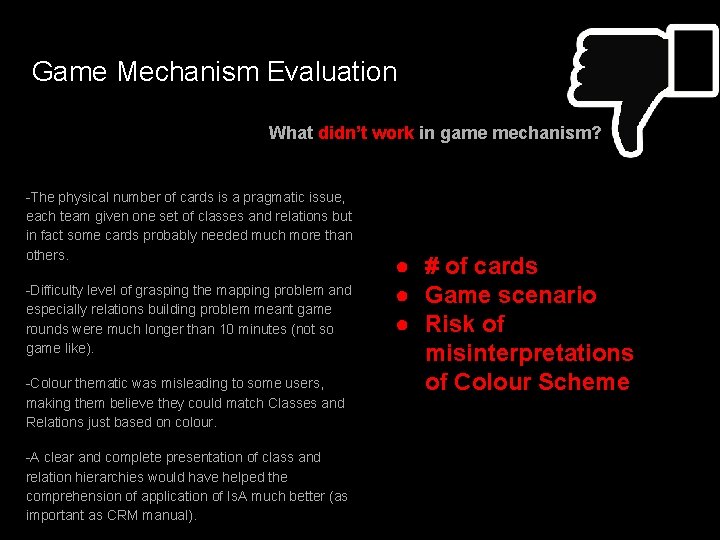
Game Mechanism Evaluation What didn’t work in game mechanism? -The physical number of cards is a pragmatic issue, each team given one set of classes and relations but in fact some cards probably needed much more than others. -Difficulty level of grasping the mapping problem and especially relations building problem meant game rounds were much longer than 10 minutes (not so game like). -Colour thematic was misleading to some users, making them believe they could match Classes and Relations just based on colour. -A clear and complete presentation of class and relation hierarchies would have helped the comprehension of application of Is. A much better (as important as CRM manual). ● # of cards ● Game scenario ● Risk of misinterpretations of Colour Scheme
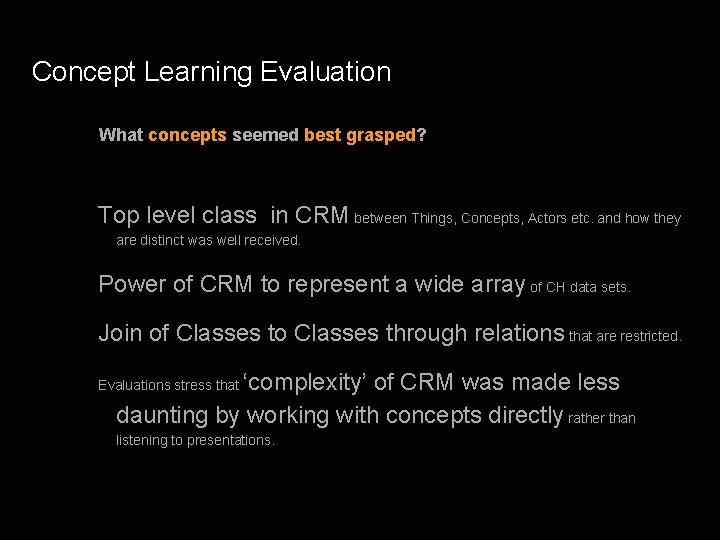
Concept Learning Evaluation What concepts seemed best grasped? Top level class in CRM between Things, Concepts, Actors etc. and how they are distinct was well received. Power of CRM to represent a wide array of CH data sets. Join of Classes to Classes through relations that are restricted. ‘complexity’ of CRM was made less daunting by working with concepts directly rather than Evaluations stress that listening to presentations.
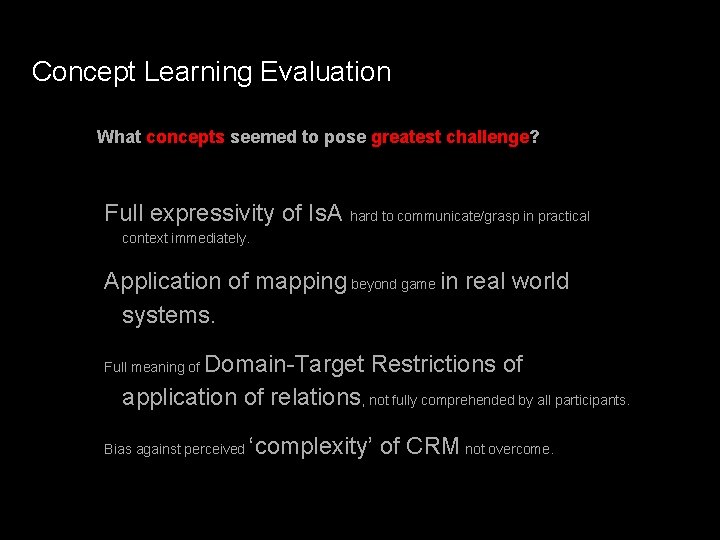
Concept Learning Evaluation What concepts seemed to pose greatest challenge? Full expressivity of Is. A hard to communicate/grasp in practical context immediately. Application of mapping beyond game in real world systems. Domain-Target Restrictions of application of relations, not fully comprehended by all participants. Full meaning of Bias against perceived ‘complexity’ of CRM not overcome.
Next Steps? New Game Mechanism Ideas. Determination of Proper Card Numbers (Scrabble analogy). Building Case Study deck with general familiarity and provoking appropriate modelling/mapping problem discussions. Further testing of game in workshops for ability to communicate concepts/engage learners. Consider means of reusing mapping solutions (good and bad) as teaching material. Explore method to connect this ‘play’ to real CRM application scenarios (strong desire to see implemented systems/implementation of systems) - could be topic of workshop on top of this one.