PHONOLOGY LI 2023 NATHALIE F MARTIN Introduction Phonology
- Slides: 107
PHONOLOGY LI 2023 NATHALIE F. MARTIN
Introduction: Phonology No human language exploits all phonetic possibilities Every language makes its own particular selection from the range of all possible ______
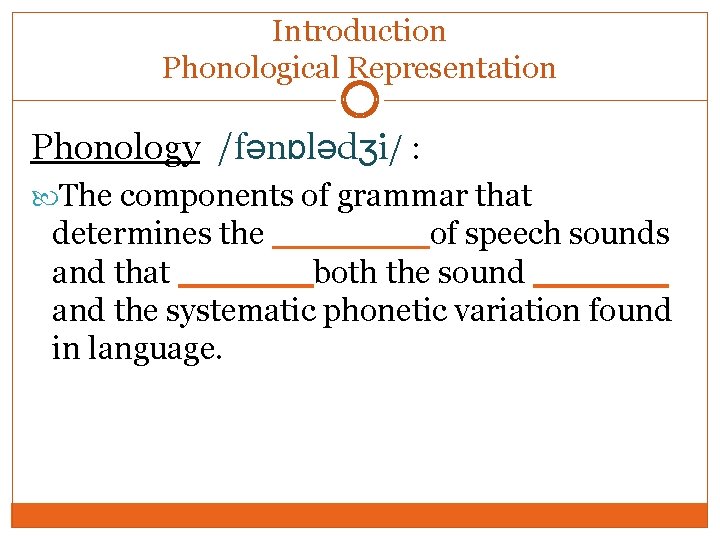
Introduction Phonological Representation Phonology /fənɒlədʒi/ : The components of grammar that determines the _______of speech sounds and that ______both the sound ______ and the systematic phonetic variation found in language.
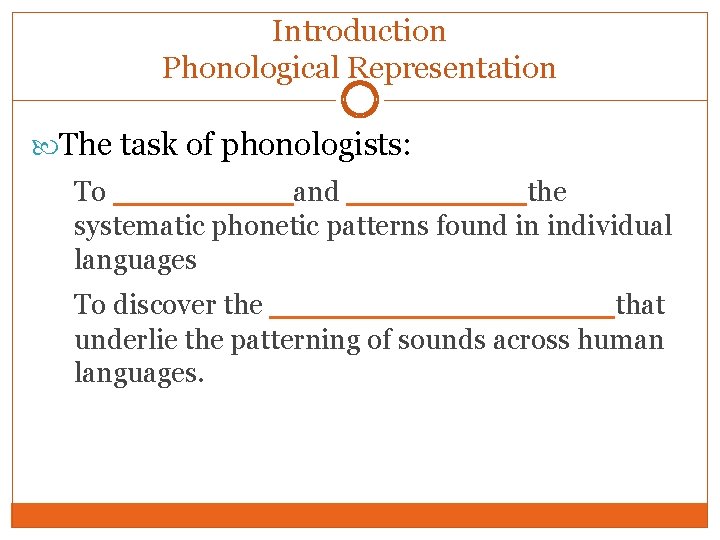
Introduction Phonological Representation The task of phonologists: To ____and ____the systematic phonetic patterns found in individual languages discover the ______that underlie the patterning of sounds across human languages. To
Introduction Phonological Representation Three major phonological units: ___________
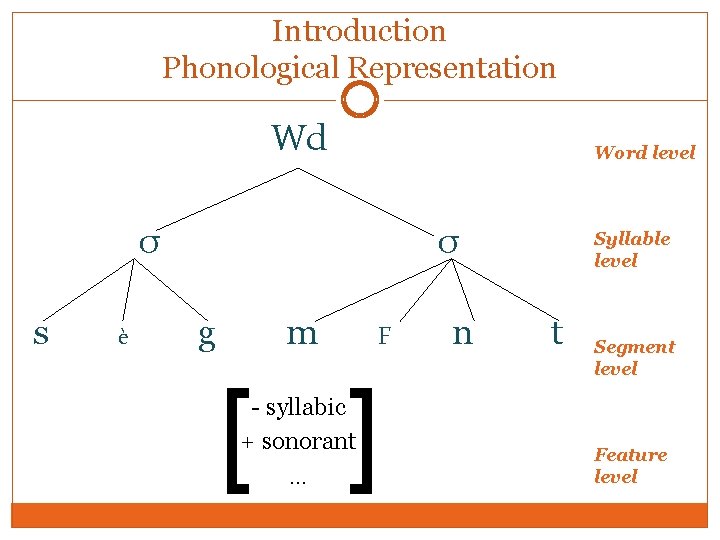
Introduction Phonological Representation Wd Word level σ s è σ g m F [ ] - syllabic + sonorant … n Syllable level t Segment level Feature level
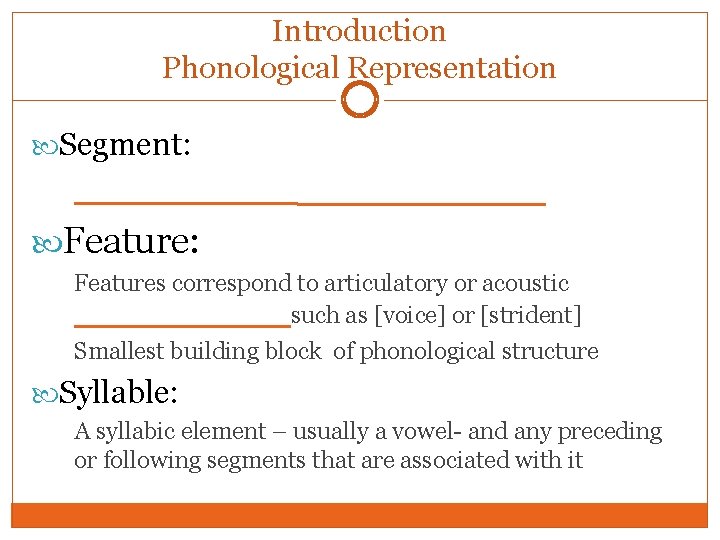
Introduction Phonological Representation Segment: ___________ Feature: Features correspond to articulatory or acoustic ______such as [voice] or [strident] Smallest building block of phonological structure Syllable: A syllabic element – usually a vowel- and any preceding or following segments that are associated with it
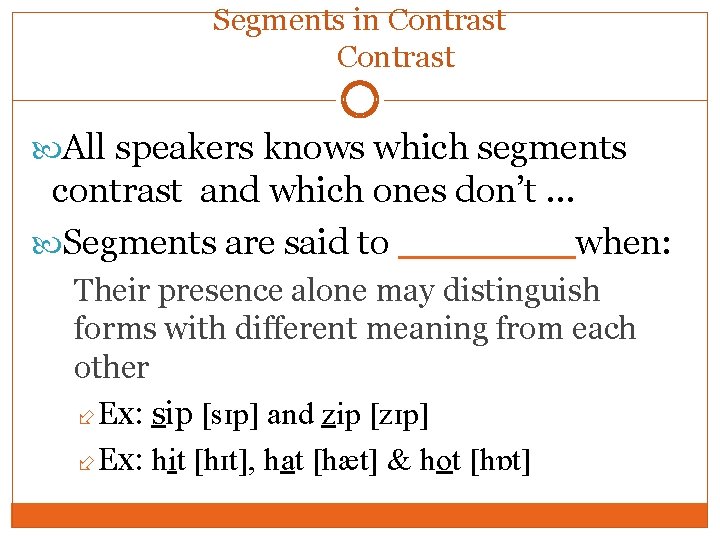
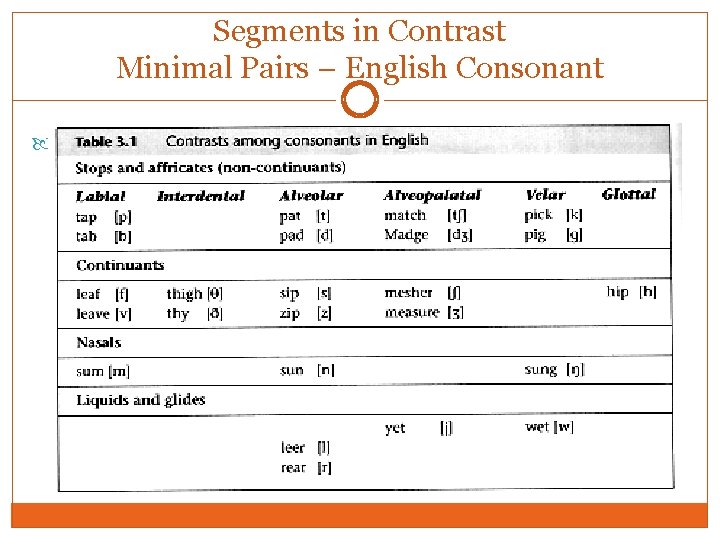
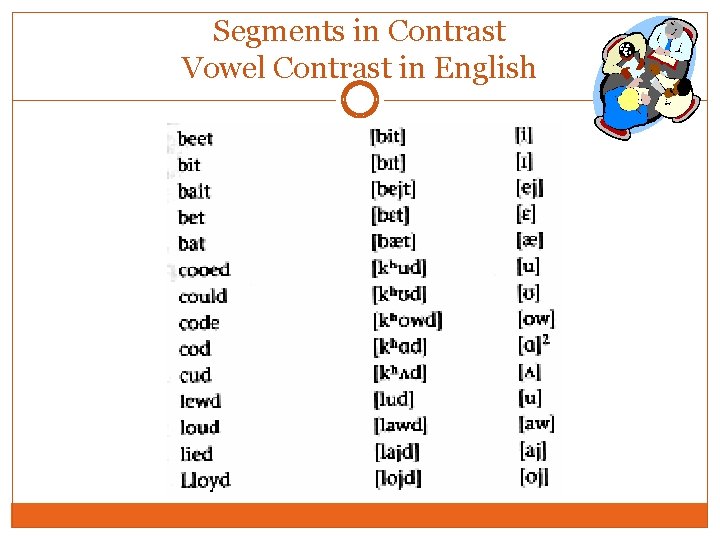
Segments in Contrast All speakers knows which segments contrast and which ones don’t … Segments are said to _______when: Their presence alone may distinguish forms with different meaning from each other Ex: sip [sɪp] and zip [zɪp] Ex: hit [hɪt], hat [hæt] & hot [hɒt]
Segments in Contrast Minimal Pairs The first step in the analysis of the phonology of language is to establish which sounds in that language are in ______with each other In order to establish contrast, it is necessary to examine the ______ of sounds in words and to compare word meanings. Ø This can be accomplished through the _______
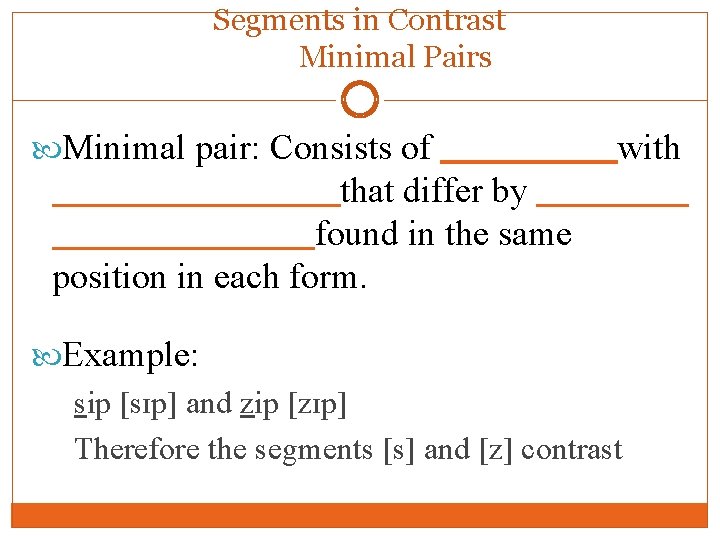
Segments in Contrast Minimal Pairs Minimal pair: Consists of _______with ______ that differ by ______found in the same position in each form. Example: sip [sɪp] and zip [zɪp] Ø Therefore the segments [s] and [z] contrast
Segments in Contrast Minimal Pairs – English Consonant Example:
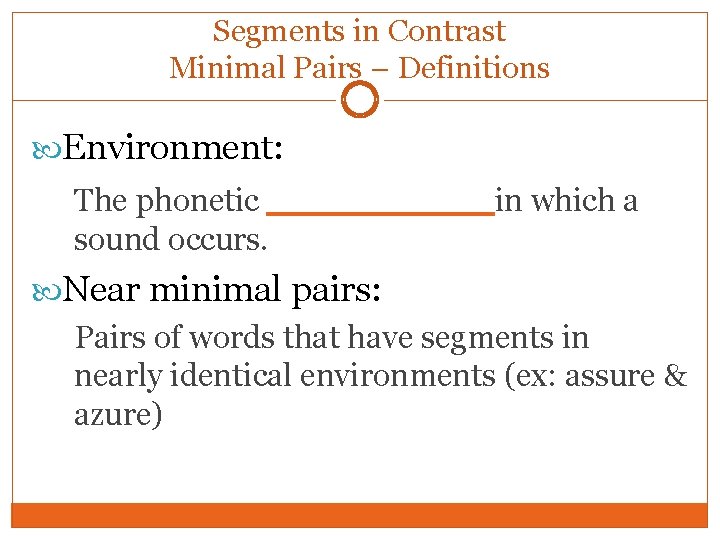
Segments in Contrast Minimal Pairs – Definitions Environment: phonetic _____in which a sound occurs. The Near minimal pairs: Pairs of words that have segments in nearly identical environments (ex: assure & azure)
Segments in Contrast Minimal Pairs – Definitions Phoneme: that _______with each other _______are said to belong to separate phonemes of that language Segments • Contrastive phonological units ØNot to be confused with ____
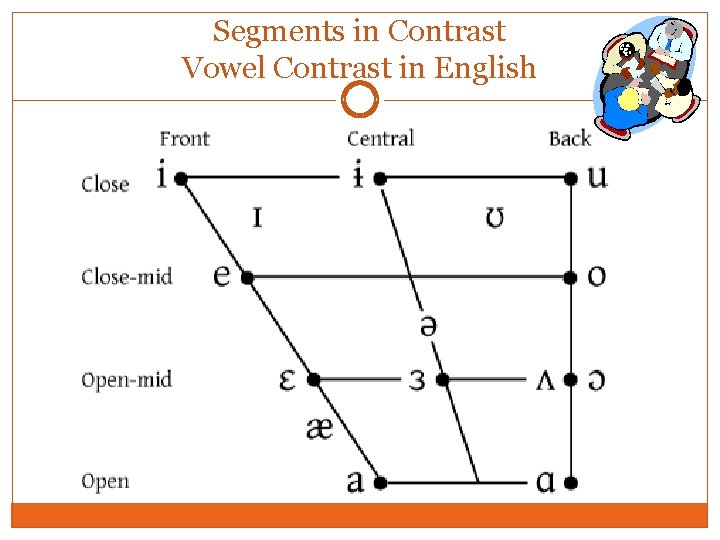
Segments in Contrast Vowel Contrast in English
Segments in Contrast Vowel Contrast in English
Segments in Contrast Language-Specific Contrasts Important: Ø- Two sounds can be phonetically distinct without necessarily being phonologically distinct or contrastive. Ø - Sounds that are contrastive in one language may not necessarily be contrastive in another.
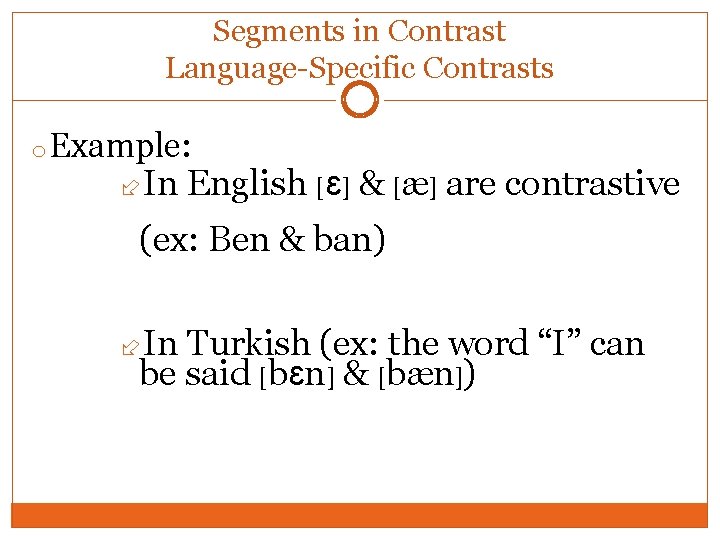
Segments in Contrast Language-Specific Contrasts o Example: In English [ɛ] & [æ] are contrastive (ex: Ben & ban) In Turkish (ex: the word “I” can be said [bɛn] & [bæn])
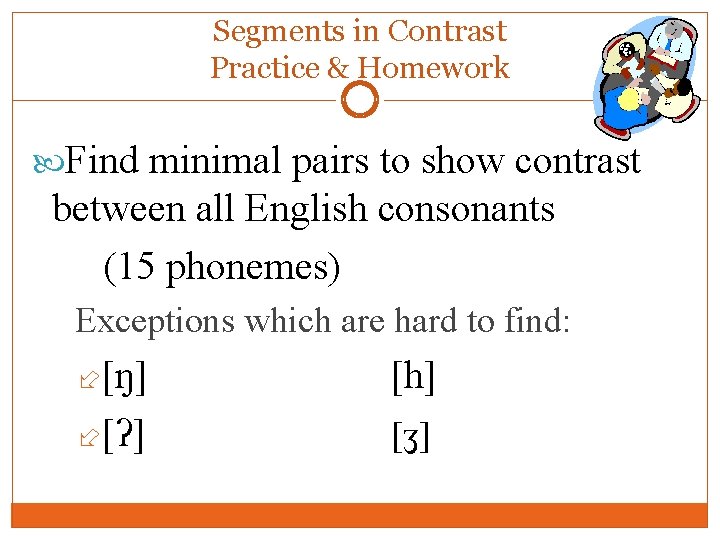
Segments in Contrast Practice & Homework Find minimal pairs to show contrast between all English consonants (15 phonemes) Exceptions which are hard to find: [ŋ] [h] [ʔ] [ʒ]
Complementary distribution
Phonetically Conditioned Variation Introduction Phonetic variation is systematic Occurs most often in phonetically similar segments by the ______ or environment in which the segments are found Conditioned
Phonetically Conditioned Variation Introduction - Variation occurs because segments are affected and altered by phonetic characteristics of neighboring elements or by the larger phonological context in which they occur Speakers and listeners of any language tend to factor out this type of variation in order to focus on contrast that affect meaning
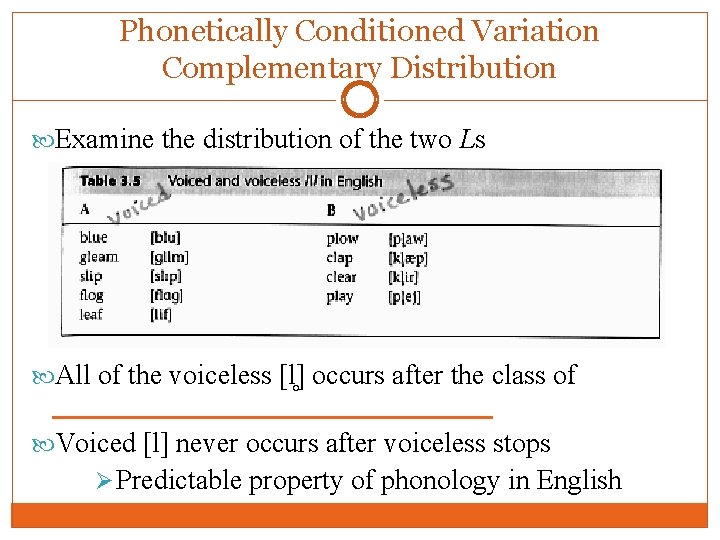
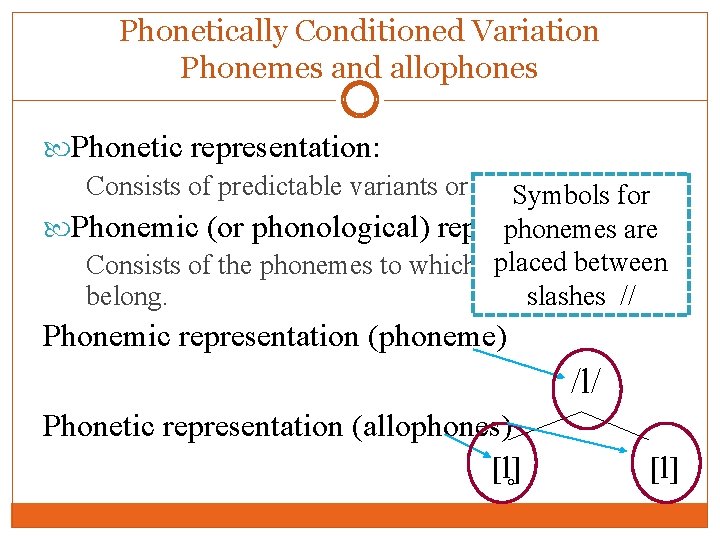
Phonetically Conditioned Variation Complementary Distribution In English, all Ls are not identical Different sounds: [l ] (voiceless l)& [l] (voiced l) Yet they do not contrast There are no minimal pairs in which the phonetic difference [l ] & [l] functions to indicate difference
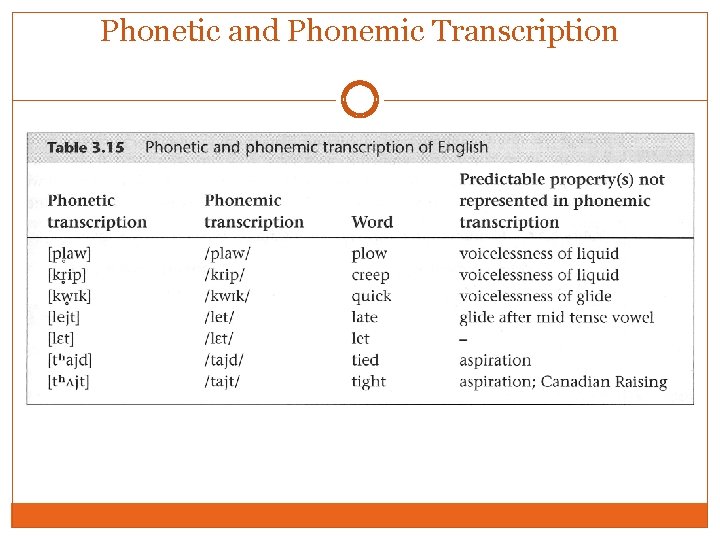
Phonetically Conditioned Variation Complementary Distribution Examine the distribution of the two Ls All of the voiceless [l ] occurs after the class of ___________ Voiced [l] never occurs after voiceless stops Ø Predictable property of phonology in English
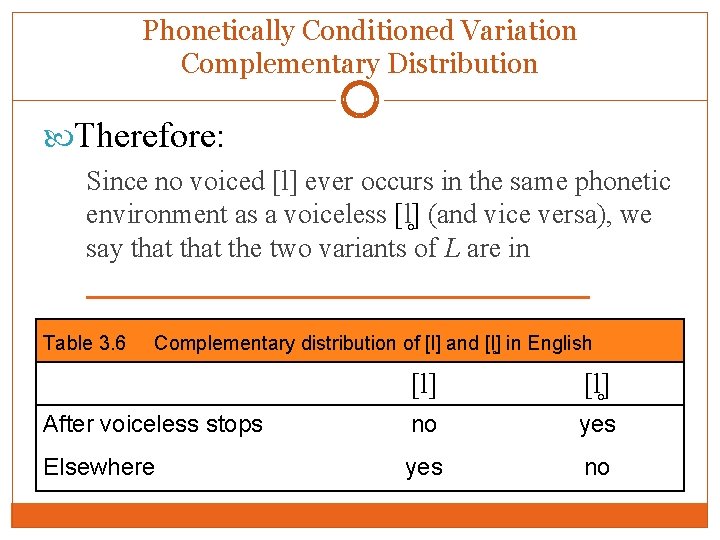
Phonetically Conditioned Variation Complementary Distribution Therefore: Since no voiced [l] ever occurs in the same phonetic environment as a voiceless [l ] (and vice versa), we say that the two variants of L are in ___________ Table 3. 6 Complementary distribution of [l] and [l ] in English [l] [l ] After voiceless stops no yes Elsewhere yes no
Phonemes and allophones
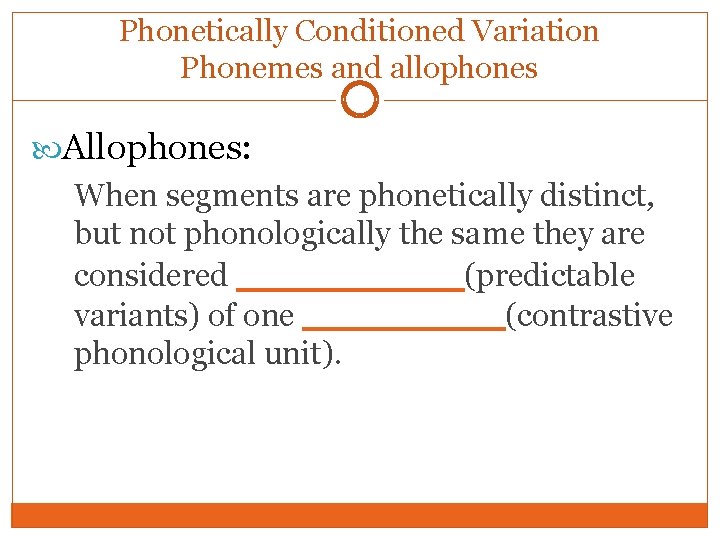
Phonetically Conditioned Variation Phonemes and allophones Allophones: When segments are phonetically distinct, but not phonologically the same they are considered _____(predictable variants) of one _____(contrastive phonological unit).
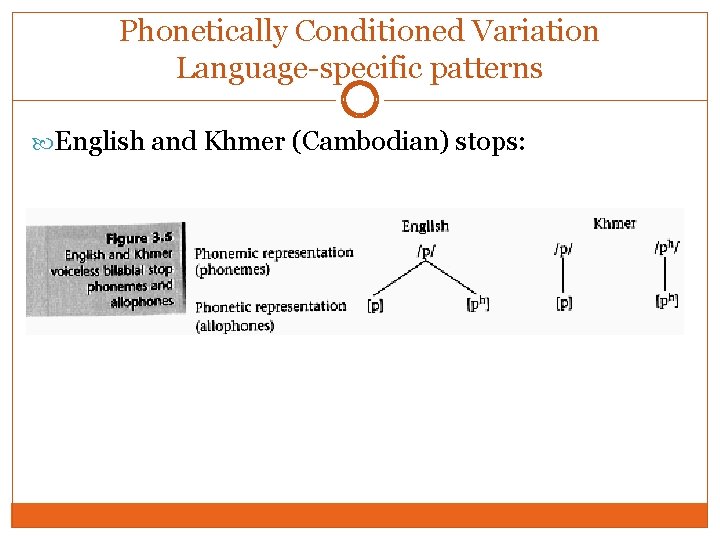
Phonetically Conditioned Variation Phonemes and allophones Phonetic representation: Consists of predictable variants or allophones Symbols for Phonemic (or phonological) representation: allophones phonemes are placed enclosed between in Consists of the phonemes to which the allophones belong. square slashes bracket // [] Phonemic representation (phoneme) /l/ Phonetic representation (allophones) [l ] [l]
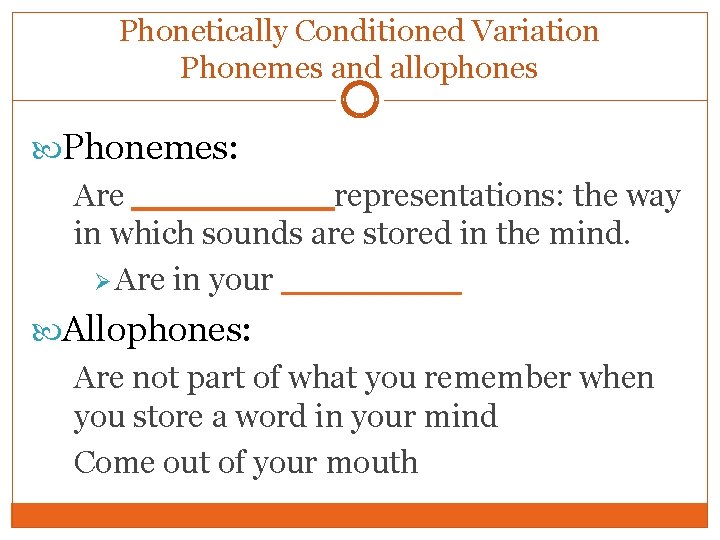
Phonetically Conditioned Variation Phonemes and allophones Phonemes: Are _____representations: the way in which sounds are stored in the mind. Ø Are in your ____ Allophones: Are not part of what you remember when you store a word in your mind Come out of your mouth
Phonetically Conditioned Variation Phonemes and allophones v. An important part of phonological analysis thus deals with discovering ______ of the phonemes of language and accounting for ___________.
Classes and generalization
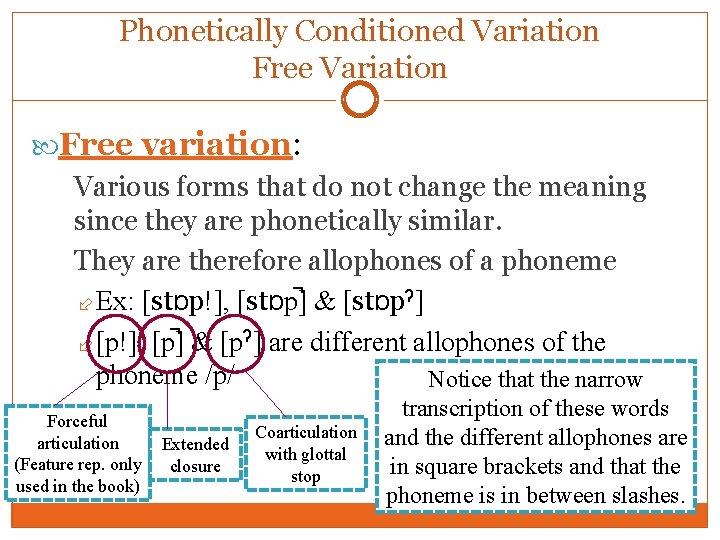
Phonetically Conditioned Variation Free variation: Various forms that do not change the meaning since they are phonetically similar. They are therefore allophones of a phoneme Ex: [stɒp!], [stɒp ] & [stɒpʔ] [p!], [p ] & [pʔ] are different allophones of the phoneme /p/ Notice that the narrow Forceful articulation (Feature rep. only used in the book) Extended closure Coarticulation with glottal stop transcription of these words and the different allophones are in square brackets and that the phoneme is in between slashes.
Phonetically Conditioned Variation Classes & Systematic Variation Everyday speech usually _______ systematically according to phonetic classes
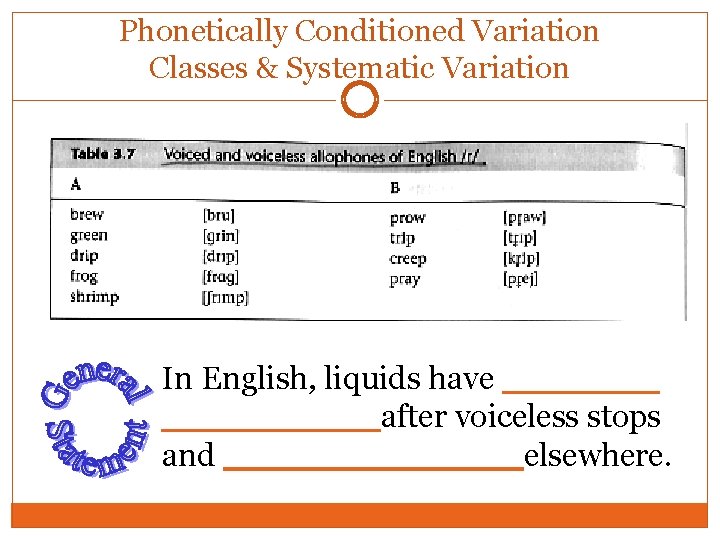
Phonetically Conditioned Variation Classes & Systematic Variation In English, liquids have _______ _____after voiceless stops and ______ __elsewhere.
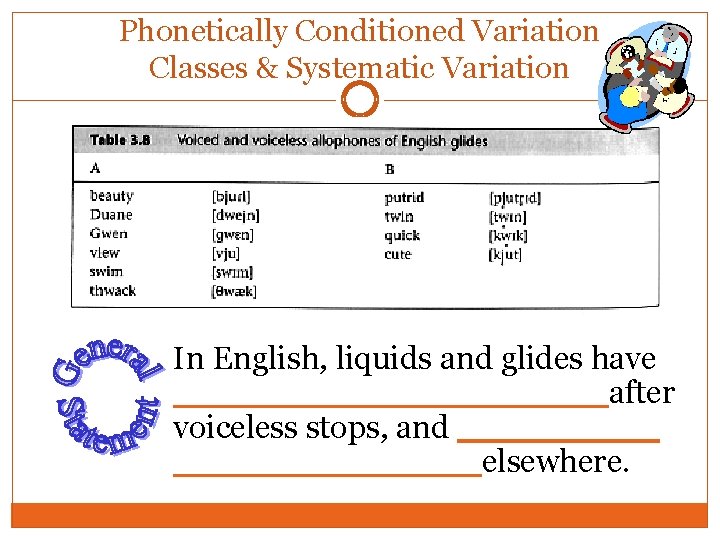
Phonetically Conditioned Variation Classes & Systematic Variation In English, liquids and glides have ______after voiceless stops, and _____ __ ______ elsewhere.
Phonetically Conditioned Variation Classes & Systematic Variation One of the major goals of phonological description is the discovery of such ____ __ ____, and the formulation of the most ______possible to describe them.
Phonetically Conditioned Variation CANADIAN RAISING ENGLISH MID VOWELS AND GLIDES LANGUAGE-SPECIFIC PATTERNS
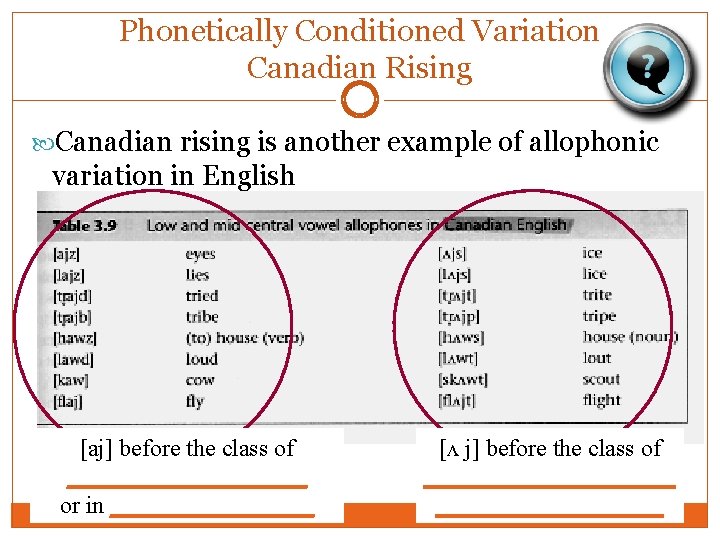
Phonetically Conditioned Variation Canadian Rising Canadian rising is another example of allophonic variation in English [aj] before the class of __________ or in _________ [ʌ j] before the class of ___________
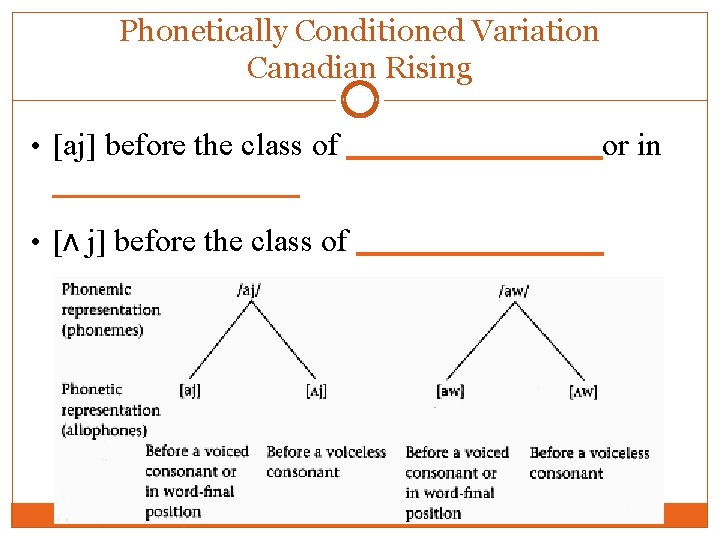
Phonetically Conditioned Variation Canadian Rising • [aj] before the class of ______ or in ______ • [ʌ j] before the class of ______
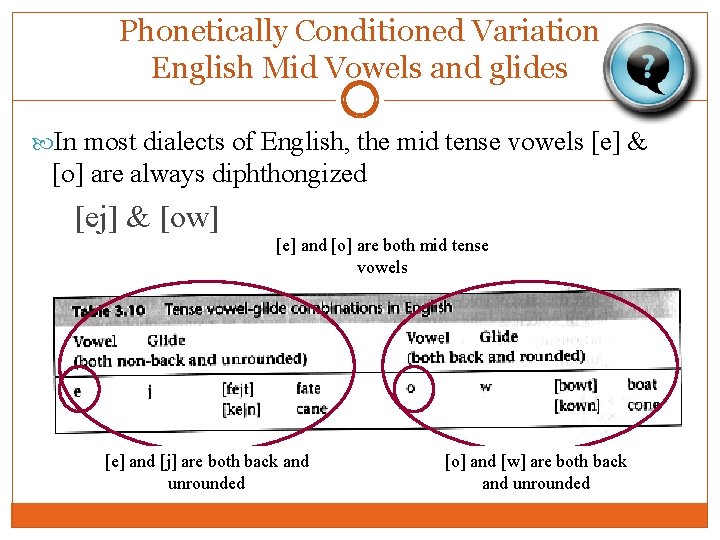
Phonetically Conditioned Variation English Mid Vowels and glides In most dialects of English, the mid tense vowels [e] & [o] are always diphthongized [ej] & [ow] [e] and [o] are both mid tense vowels [e] and [j] are both back and unrounded [o] and [w] are both back and unrounded
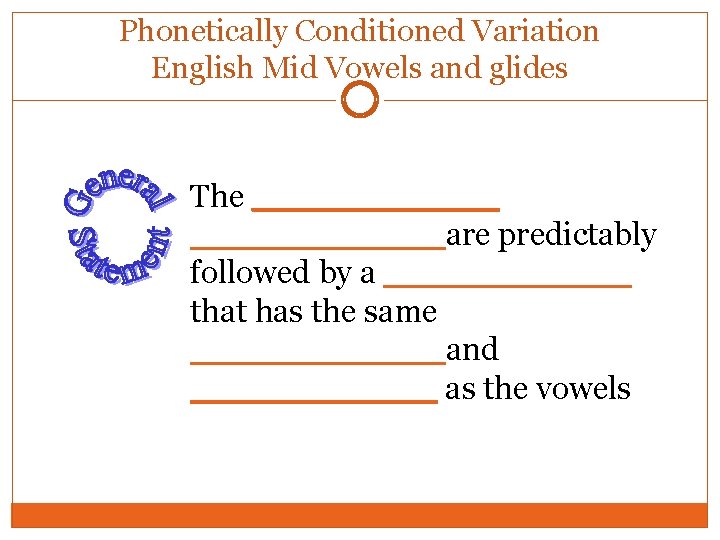
Phonetically Conditioned Variation English Mid Vowels and glides The ___________ are predictably followed by a ______ that has the same ______ and ______ as the vowels
Phonetically Conditioned Variation Language-specific patterns Important: The phenomenon of allophonic variation is universal. However, just as the phonemic contrast found in each language are specific to that language, the actual ______ of phonemes and allophones is also language-specific. Thus, whatever we discover for one language may not hold true for another.
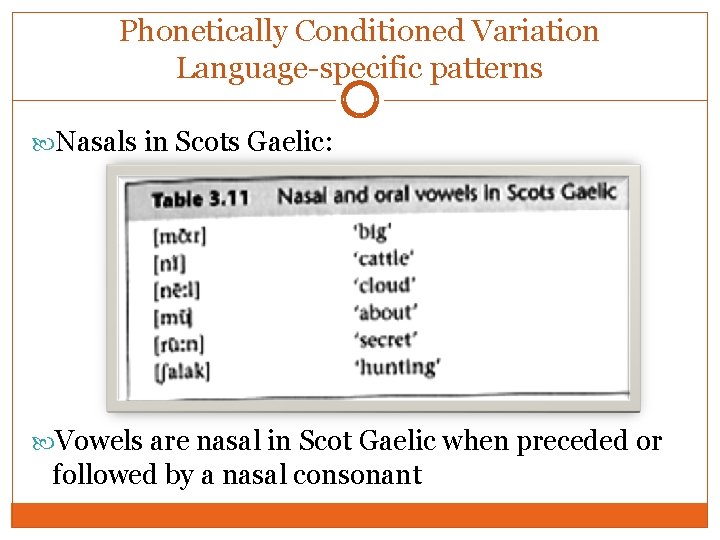
Phonetically Conditioned Variation Language-specific patterns Nasals in Scots Gaelic: Vowels are nasal in Scot Gaelic when preceded or followed by a nasal consonant
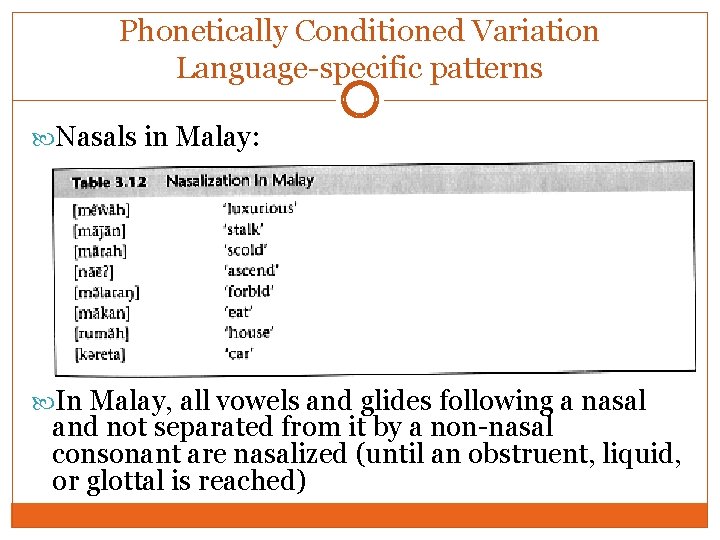
Phonetically Conditioned Variation Language-specific patterns Nasals in Malay: In Malay, all vowels and glides following a nasal and not separated from it by a non-nasal consonant are nasalized (until an obstruent, liquid, or glottal is reached)
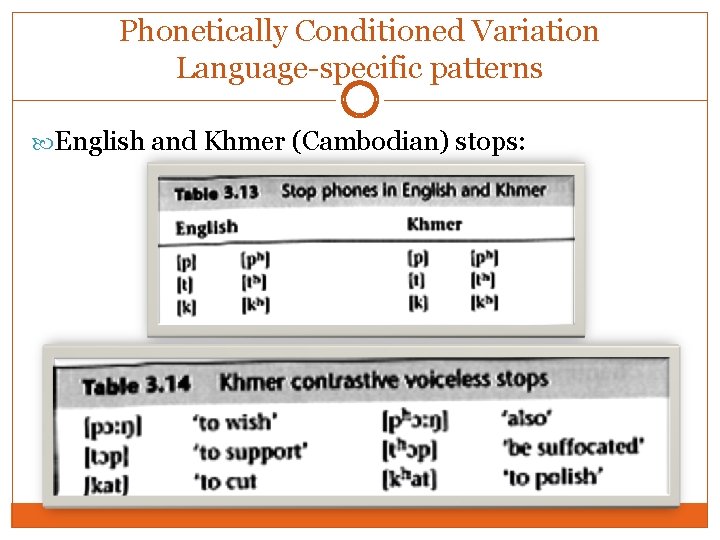
Phonetically Conditioned Variation Language-specific patterns English and Khmer (Cambodian) stops:
Phonetically Conditioned Variation Language-specific patterns English and Khmer (Cambodian) stops:
Phonetic and Phonemic Transcription
Phonetic and Phonemic Transcription
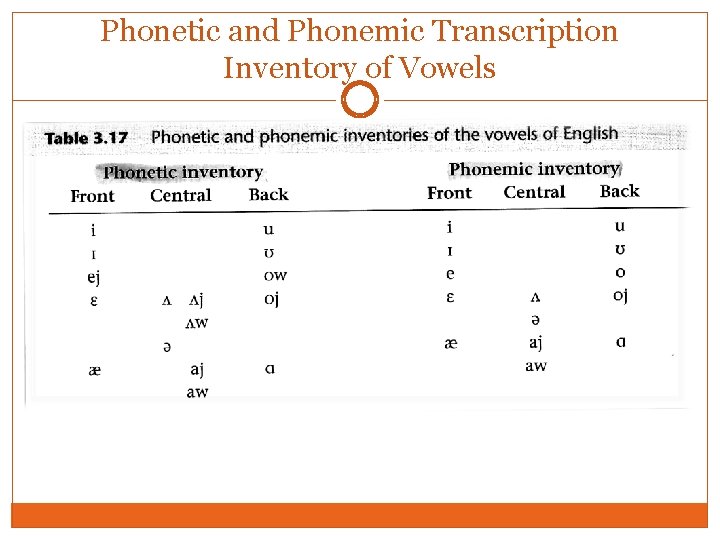
Phonetic and Phonemic Transcription Inventory of Vowels
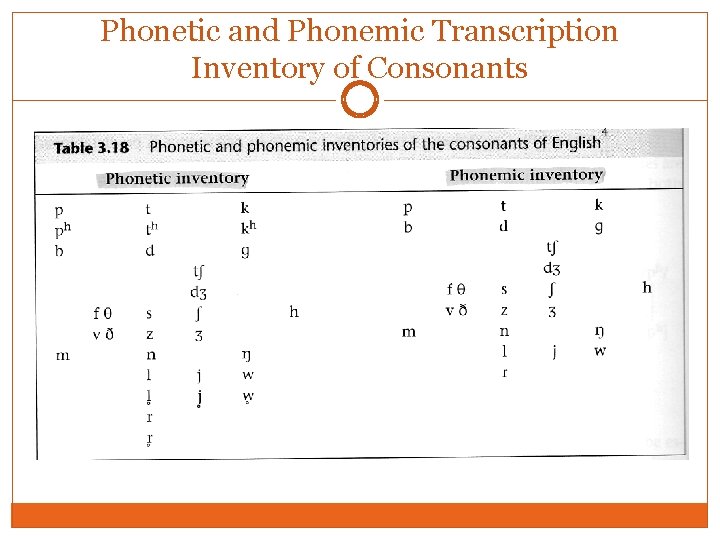
Phonetic and Phonemic Transcription Inventory of Consonants
Phonetic and Phonemic Transcription Let’s Practice! Transcribe the following words Phonemically Phonetically Don’t forget the predictable properties mentioned on the previous slides
Review Contrast, phonemes and allophones üEach language has a set of contrastive phonemes üPhonemes themselves can have predictable variants or allophones üThere are two distinct levels of representation: phonemic level and phonetic level
Syllable DEFINING THE SYLLABLE ONSET CONSTRAINTS AND PHONOTACTICS ACCIDENTAL AND SYSTEMATIC GAPS
Syllables Introduction Definition: syllable consists of a ______ _ and its associated non-syllabic (less sonorous) segments. A What speech sounds are more sonorous?
Syllables Introduction Vowels are the most sonorous sound Therefore, syllables usually have a vowel nucleus as their core Less sonorous sounds may appear ___________
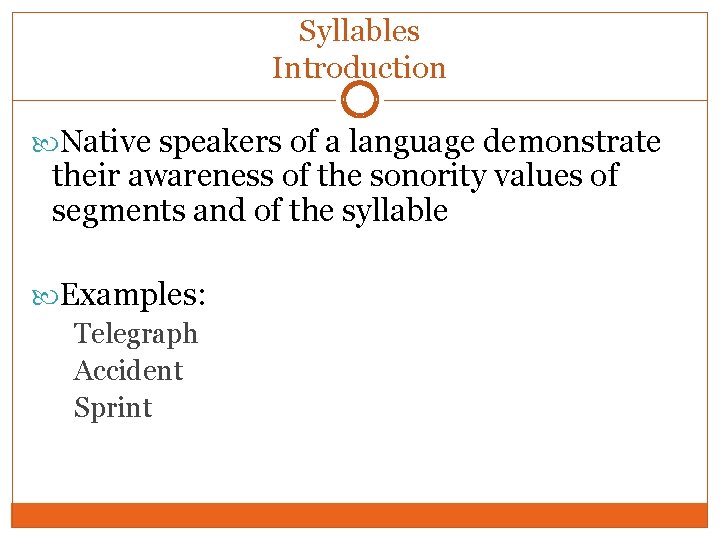
Syllables Introduction Native speakers of a language demonstrate their awareness of the sonority values of segments and of the syllable Examples: Telegraph Accident Sprint
Onset Constraints and Phonotactics
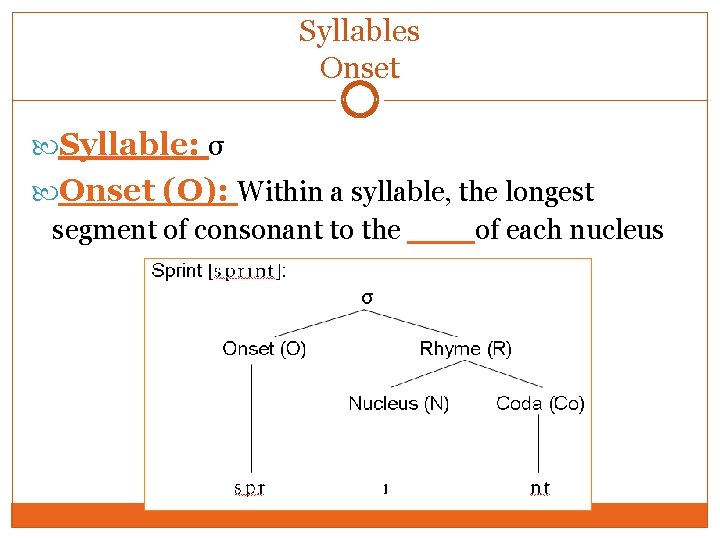
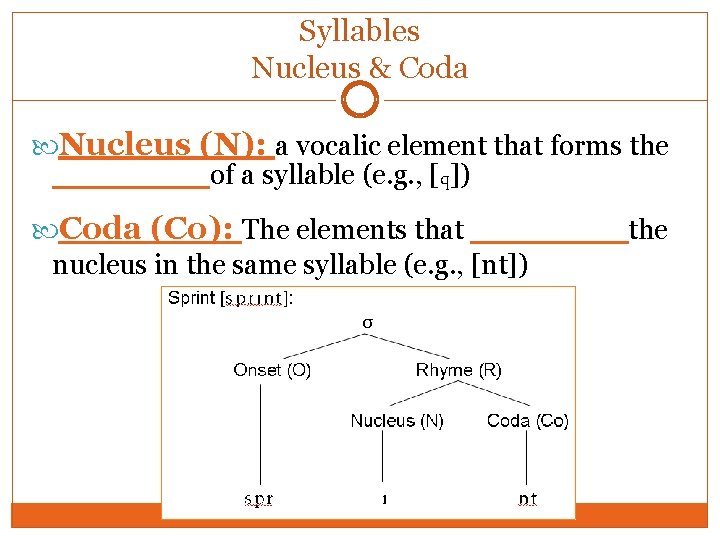
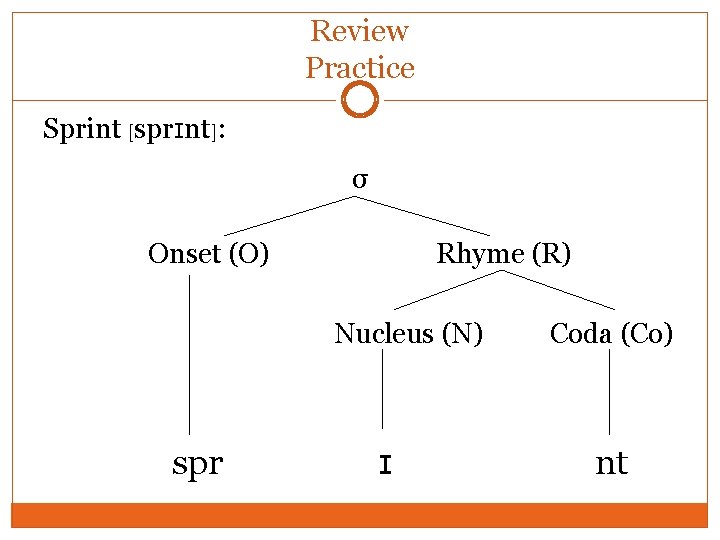
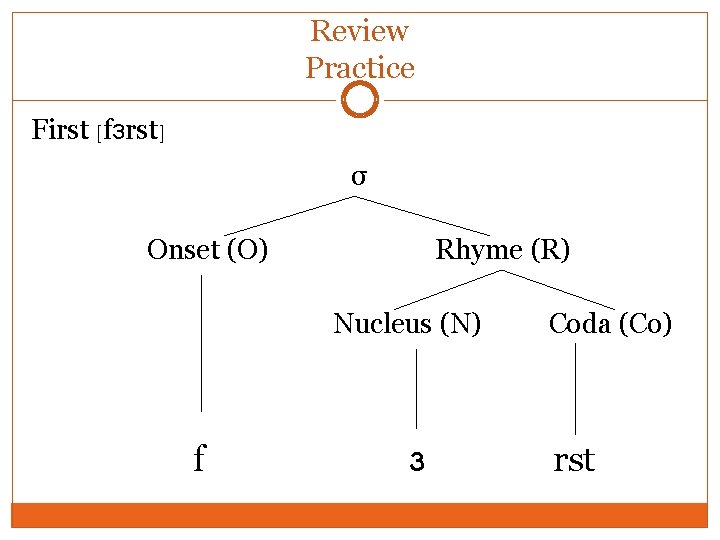
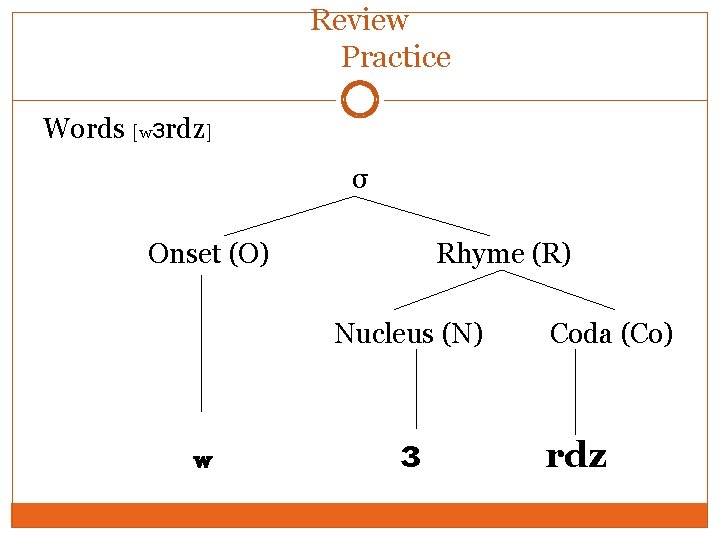
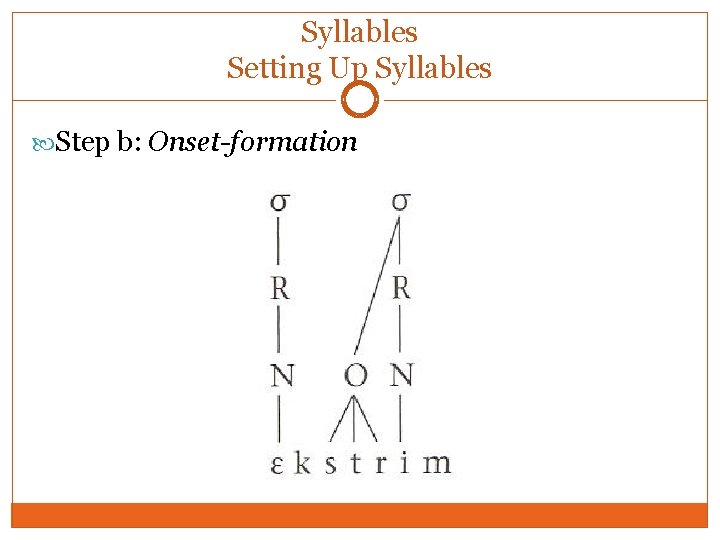
Syllables Onset Syllable: σ Onset (O): Within a syllable, the longest segment of consonant to the ___of each nucleus
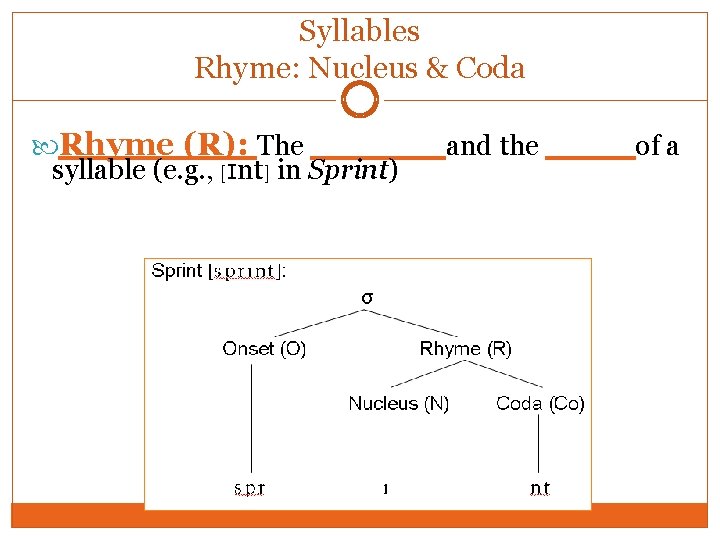
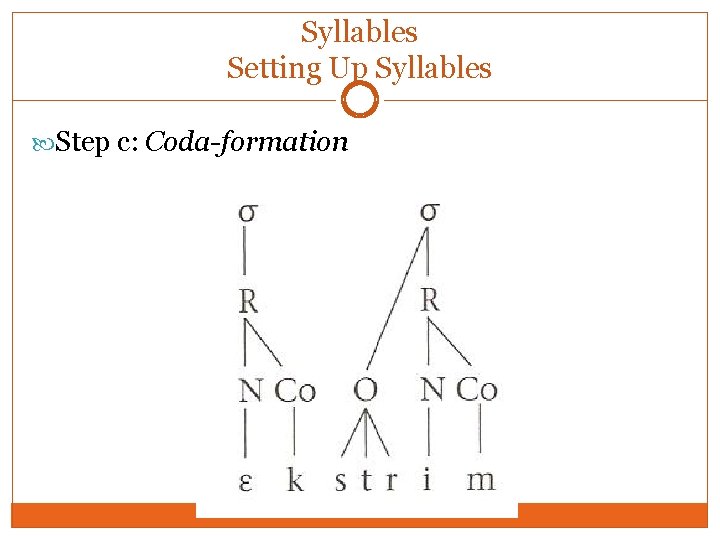
Syllables Rhyme: Nucleus & Coda Rhyme (R): The ______and the ____of a syllable (e. g. , [ɪnt] in Sprint)
Syllables Nucleus & Coda Nucleus (N): a vocalic element that forms the _______of a syllable (e. g. , [q]) Coda (Co): The elements that _______the nucleus in the same syllable (e. g. , [nt])
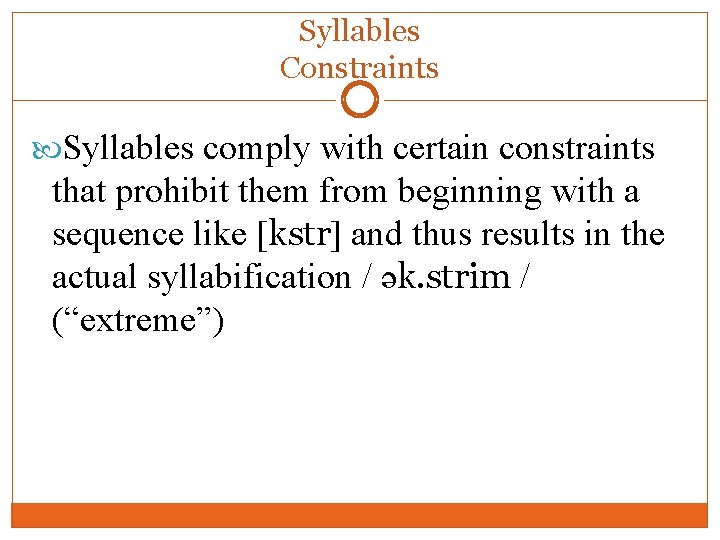
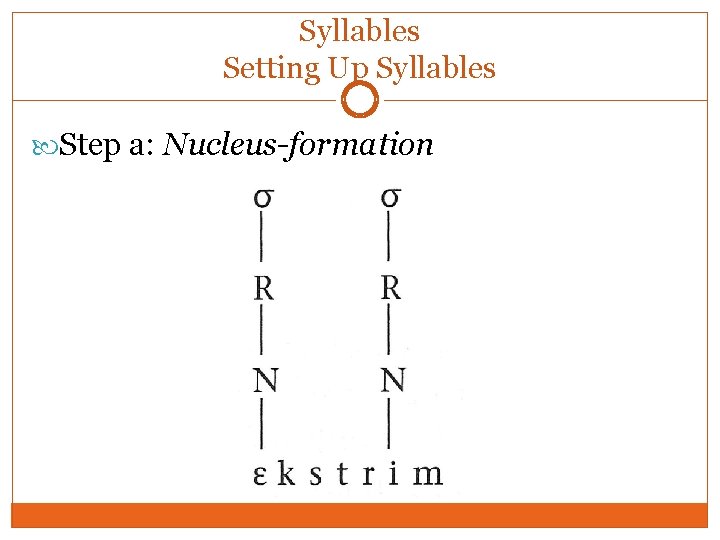
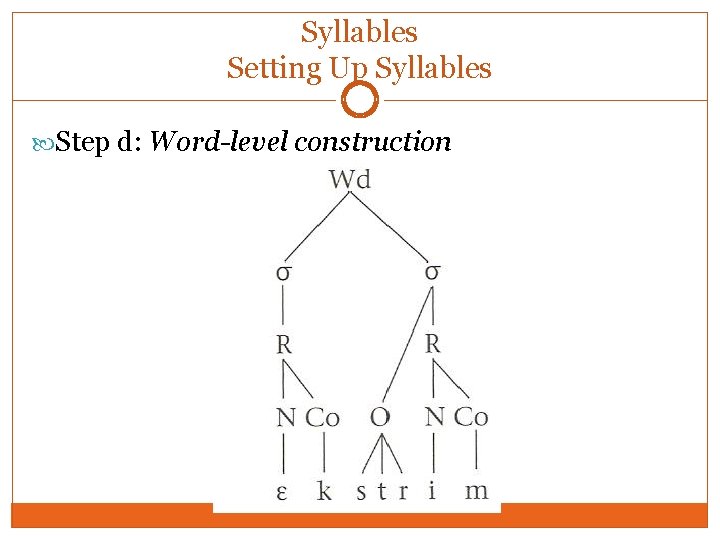
Syllables Constraints Syllables comply with certain constraints that prohibit them from beginning with a sequence like [kstr] and thus results in the actual syllabification / ək. strim / (“extreme”)
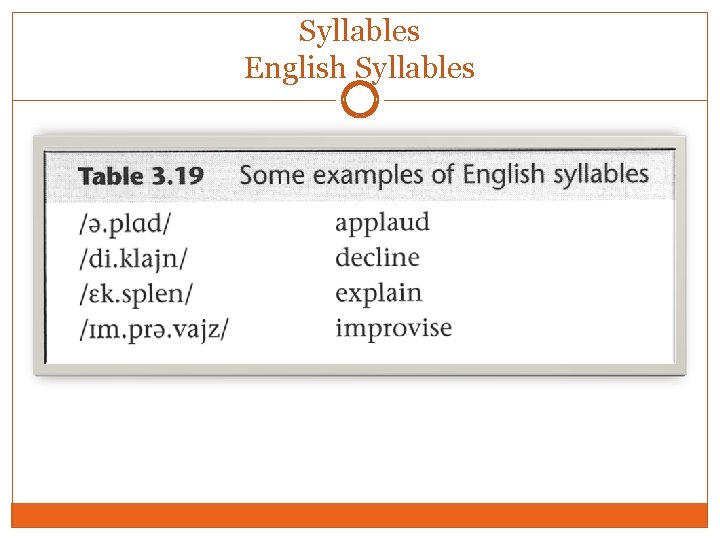
Syllables English Syllables
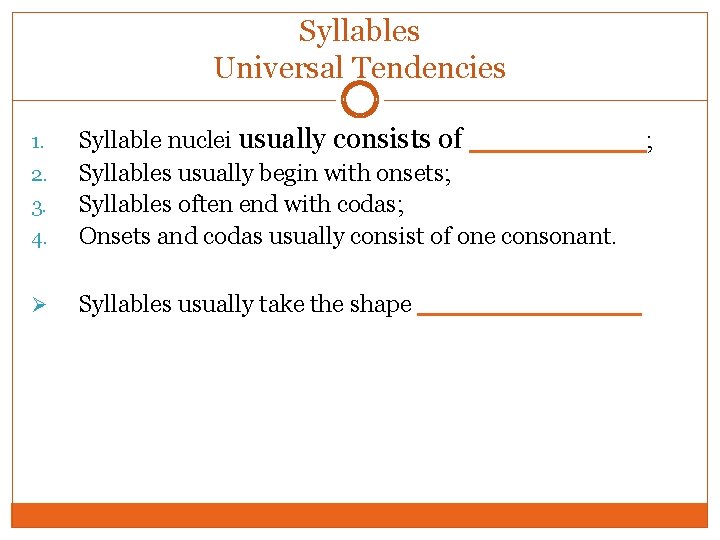
Syllables Universal Tendencies All languages have syllables The shapes or syllables are governed by various kinds of constraints But certain universal tendencies are observable
Syllables Universal Tendencies 4. Syllable nuclei usually consists of _____; Syllables usually begin with onsets; Syllables often end with codas; Onsets and codas usually consist of one consonant. Ø Syllables usually take the shape ______ 1. 2. 3.
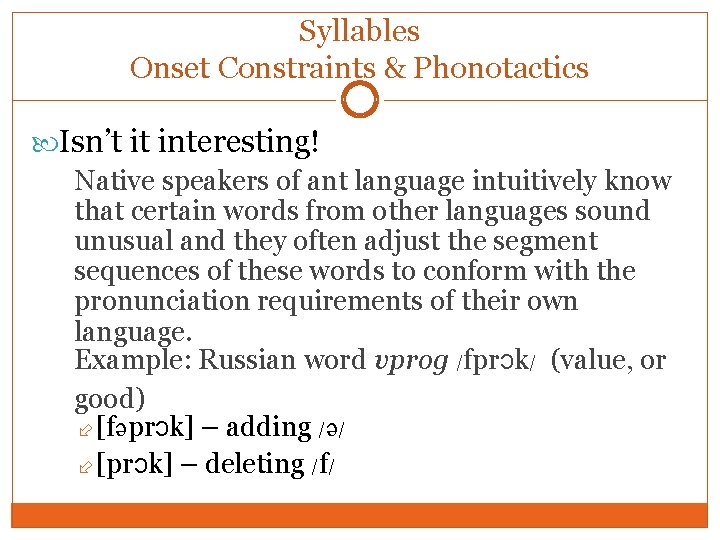
Syllables Onset Constraints & Phonotactics Isn’t it interesting! Native speakers of ant language intuitively know that certain words from other languages sound unusual and they often adjust the segment sequences of these words to conform with the pronunciation requirements of their own language. Example: Russian word vprog /fprɔk/ (value, or good) [fəprɔk] – adding /ə/ [prɔk] – deleting /f/
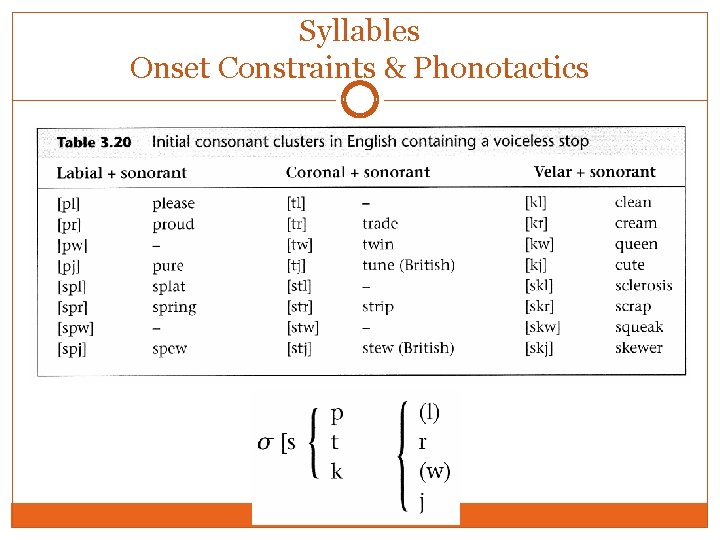
Syllables Onset Constraints & Phonotactics: The set of constraints on how sequences of segments pattern Forms part of a speakers knowledge of the phonology of his or her language
Syllables Onset Constraints & Phonotactics
Accidental and Systematic gaps
Syllables Accidental and Systematic Gaps in the language’s vocabulary that correspond to ______ but _____ forms called accidental gaps Sometimes filled by borrowed words that fill the phonotactic constraints Ex: Kodak, taco, Zen, perestroika
Syllables Accidental and Systematic Gaps Systematic gaps: Gaps in the syllable structure of a language that result not by accident but from exclusion of certain sequences Examples in English: /bz/, /pt/ & /fp/ Unacceptable in one language but not necessarily another
Syllables Accidental and Systematic Gaps Accidental gaps: filled by ______ ___that fill the phonotactic constraints Sometimes Ex: Kodak, taco, Zen, perestroika Systematic gaps: English speakers often change the pronunciation of borrowed words that do not fit the phonotactic constraints Ex: Psychology & pterodactyl
Syllables Language-specific phonotactics Language-specific constraints, on the other hand, hold true for individual languages such as English, but they may not be found in other languages
Review SETTING UP THE SYLLABLES SYLLABIC PHONOLOGY PRACTICE
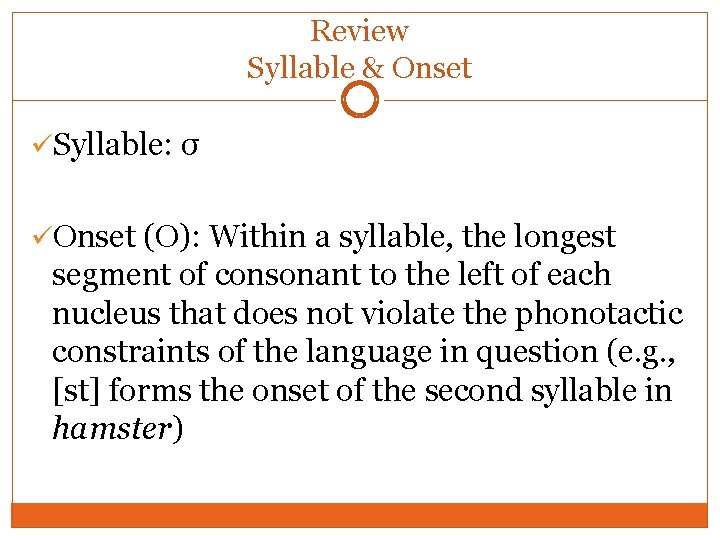
Review Syllable & Onset üSyllable: σ üOnset (O): Within a syllable, the longest segment of consonant to the left of each nucleus that does not violate the phonotactic constraints of the language in question (e. g. , [st] forms the onset of the second syllable in hamster)
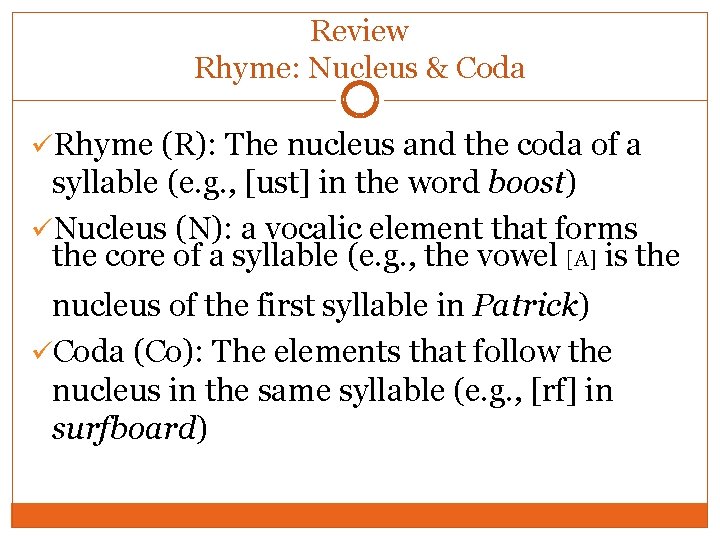
Review Rhyme: Nucleus & Coda üRhyme (R): The nucleus and the coda of a syllable (e. g. , [ust] in the word boost) üNucleus (N): a vocalic element that forms the core of a syllable (e. g. , the vowel [A] is the nucleus of the first syllable in Patrick) üCoda (Co): The elements that follow the nucleus in the same syllable (e. g. , [rf] in surfboard)
Review Practice Sprint [sprɪnt]: σ Onset (O) Rhyme (R) Nucleus (N) spr ɪ Coda (Co) nt
Review Practice First [fɜrst] σ Onset (O) Rhyme (R) Nucleus (N) f ɜ Coda (Co) rst
Review Practice Words [wɜrdz] σ Onset (O) Rhyme (R) Nucleus (N) w ɜ Coda (Co) rdz
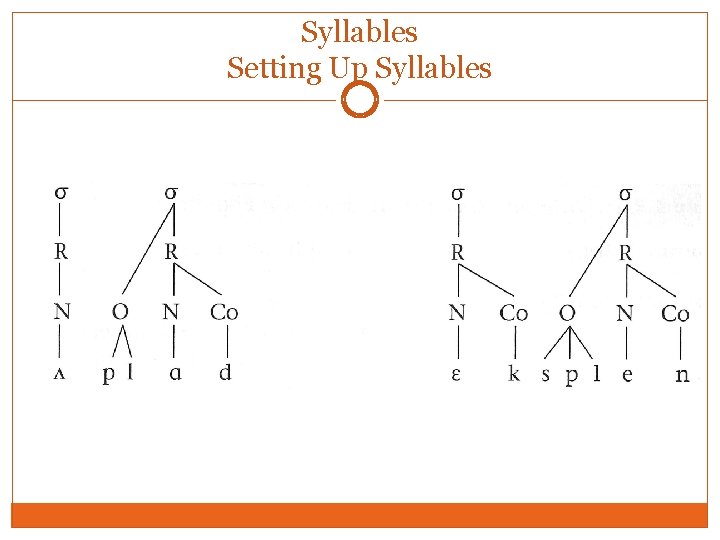
Syllables Setting Up Syllables Each language defines its own syllable structure through the interaction of universal and language-specific constraints
Syllables Setting Up Syllables Step a: Nucleus-formation
Syllables Setting Up Syllables Step b: Onset-formation
Syllables Setting Up Syllables Step c: Coda-formation
Syllables Setting Up Syllables Step d: Word-level construction
Syllables Setting Up Syllables
Syllables Syllabic Phonology One reason that syllables are treated as units of phonological structure is that they are relevant to stating generalizations about the distribution of allophonic features
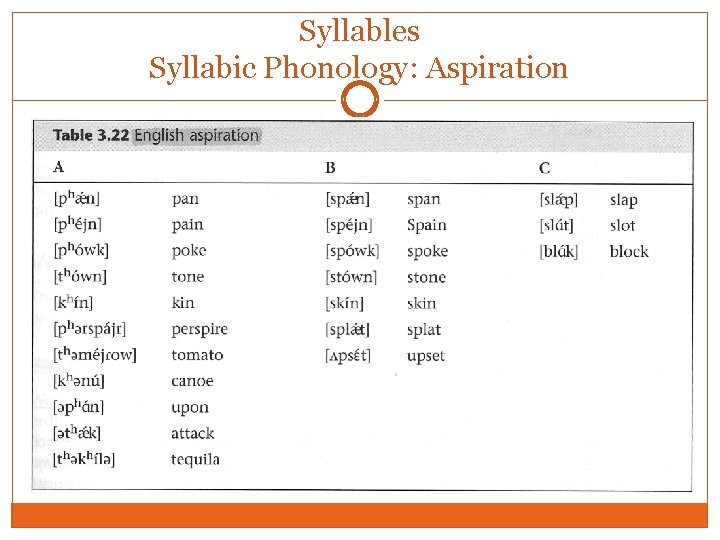
Syllables Syllabic Phonology: Aspiration
Syllables Syllabic Phonology: Aspiration English ______ are aspirated ______
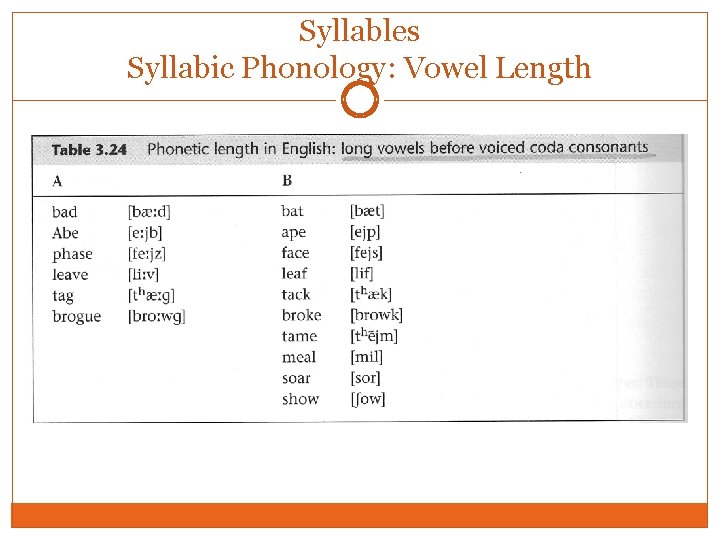
Syllables Syllabic Phonology: Vowel Length
Syllables Syllabic Phonology: Vowel Length English vowels are ____when followed by a ___________ in the ____ position of the same syllable
Features
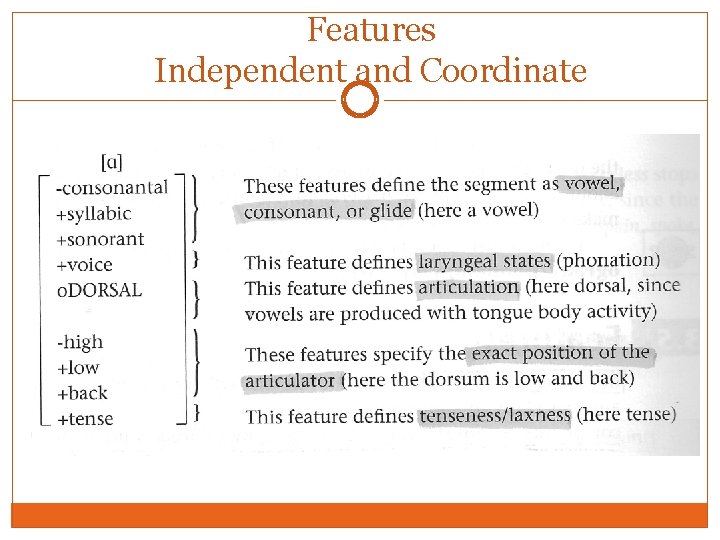
Features Definition Segments themselves are composed of even smaller, subsegmental, phonological units known as segments Smallest unit of phonology Basic building blocks of human speech sounds Independent and coordinate phonetic elements
Features Independent and Coordinate
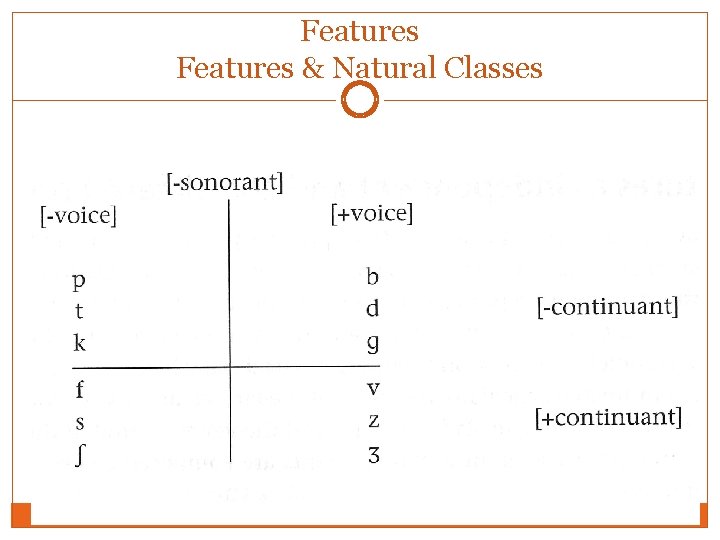
Features & Natural Classes
Features & Natural Classes
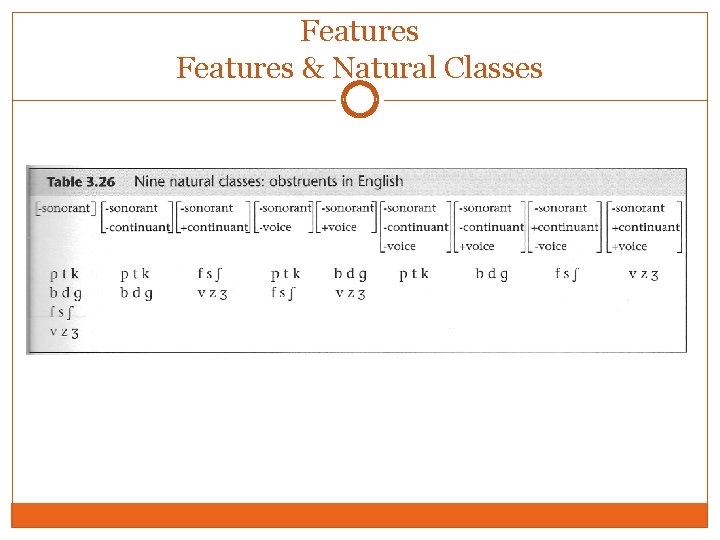
Features & Natural Classes
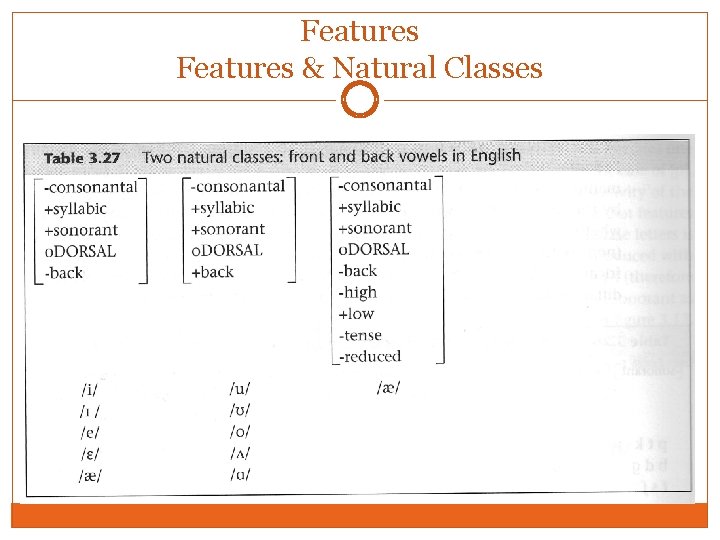
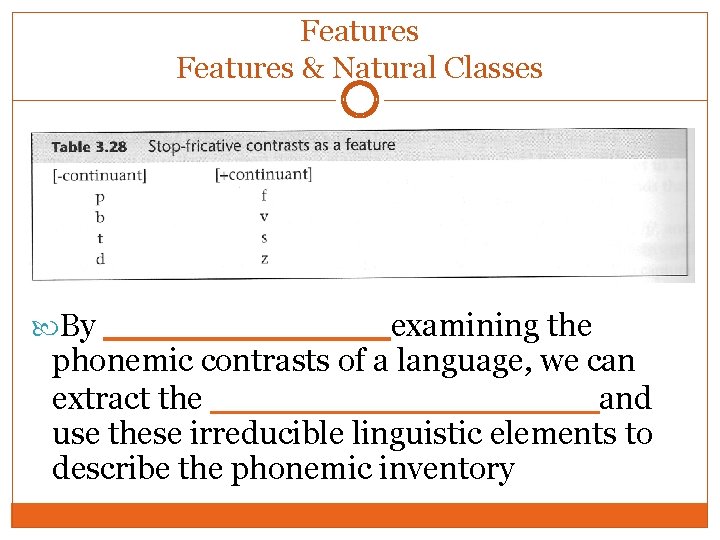
Features & Natural Classes By ______ examining the phonemic contrasts of a language, we can extract the ______and use these irreducible linguistic elements to describe the phonemic inventory
Features, Processes, & allophonic variation
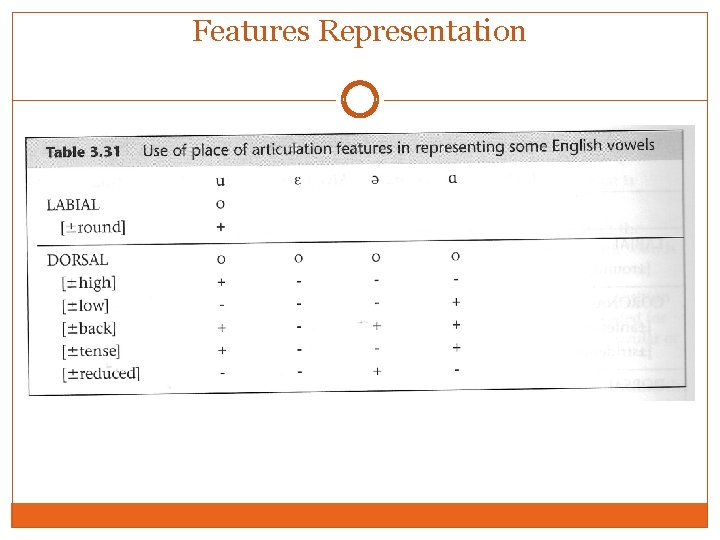
Features Representation Only a limited number of features – currently around twenty-four – have been proposed Fewer are needed to characterize the sounds of English
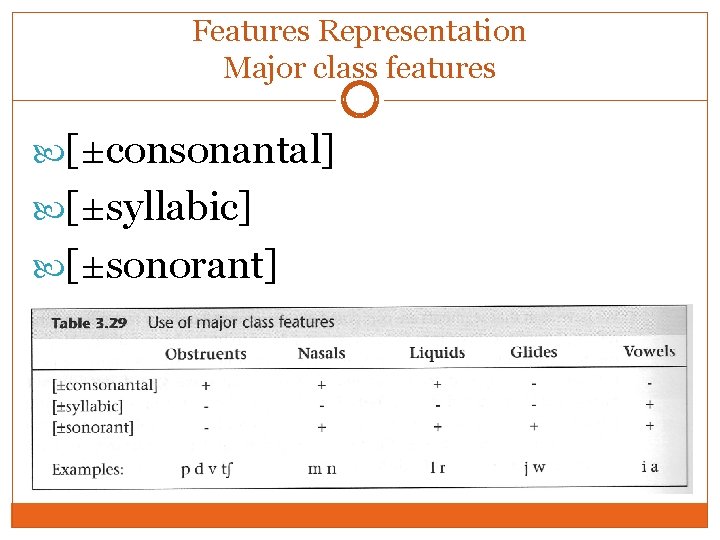
Features Representation Major class features [±consonantal] [±syllabic] [±sonorant]
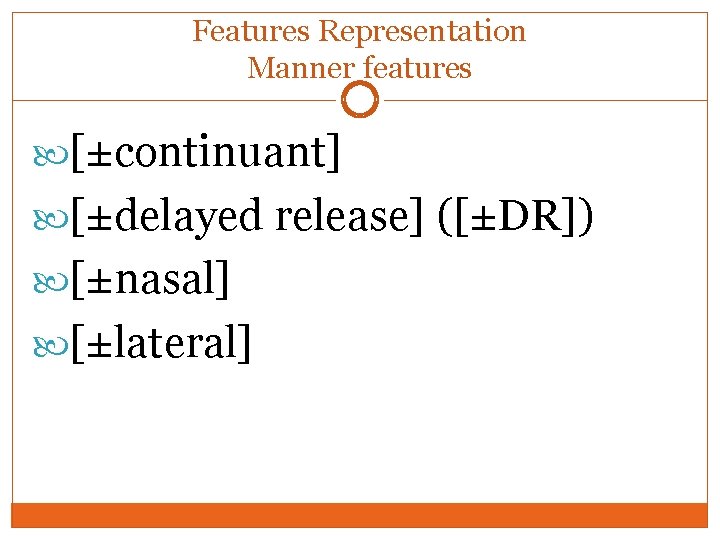
Features Representation Manner features [±continuant] [±delayed release] ([±DR]) [±nasal] [±lateral]
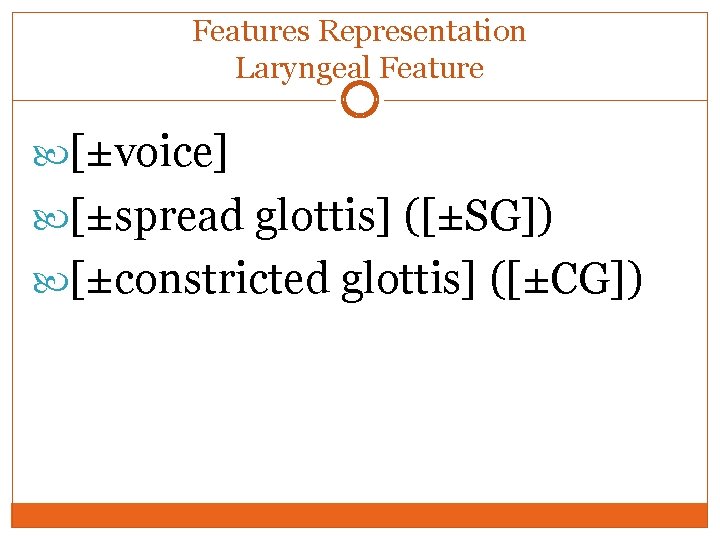
Features Representation Laryngeal Feature [±voice] [±spread glottis] ([±SG]) [±constricted glottis] ([±CG])
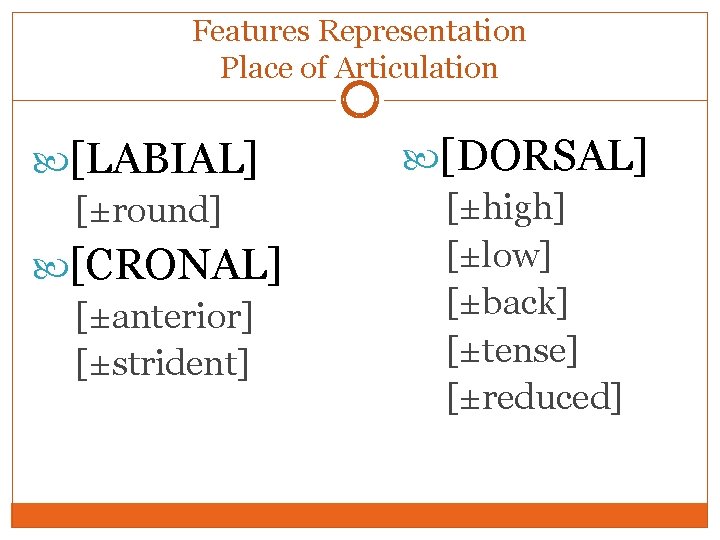
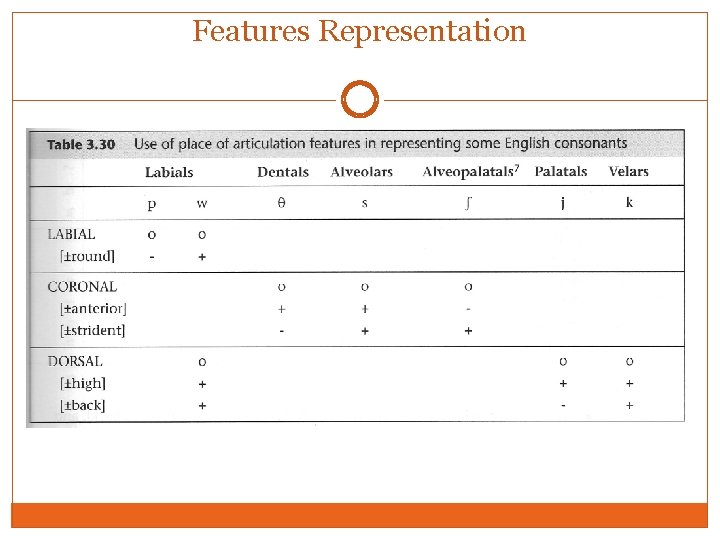
Features Representation Place of Articulation [LABIAL] [±round] [CRONAL] [±anterior] [±strident] [DORSAL] [±high] [±low] [±back] [±tense] [±reduced]
Features Representation
Features Representation
Derivations
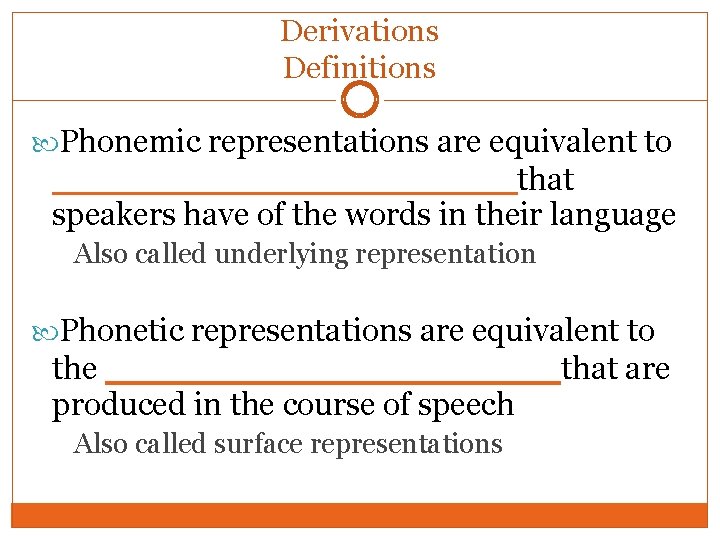
Derivations Definitions Phonemic representations are equivalent to _________ that speakers have of the words in their language Also called underlying representation Phonetic representations are equivalent to the _________that are produced in the course of speech Also called surface representations
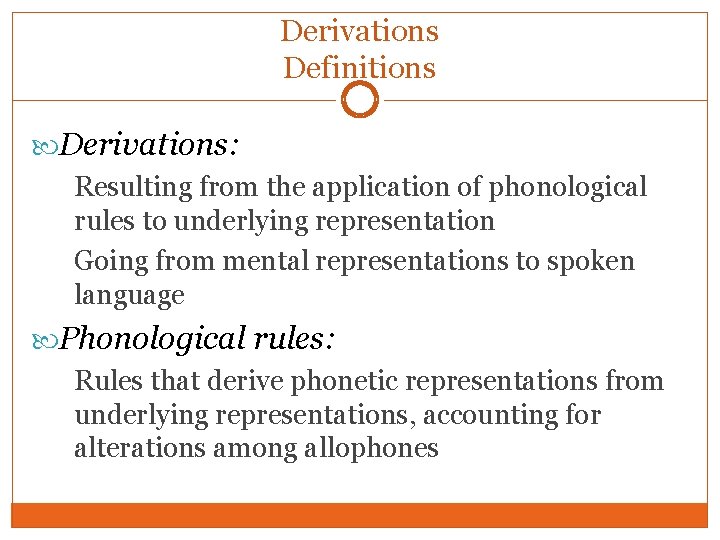
Derivations Definitions Derivations: Resulting from the application of phonological rules to underlying representation Going from mental representations to spoken language Phonological rules: Rules that derive phonetic representations from underlying representations, accounting for alterations among allophones
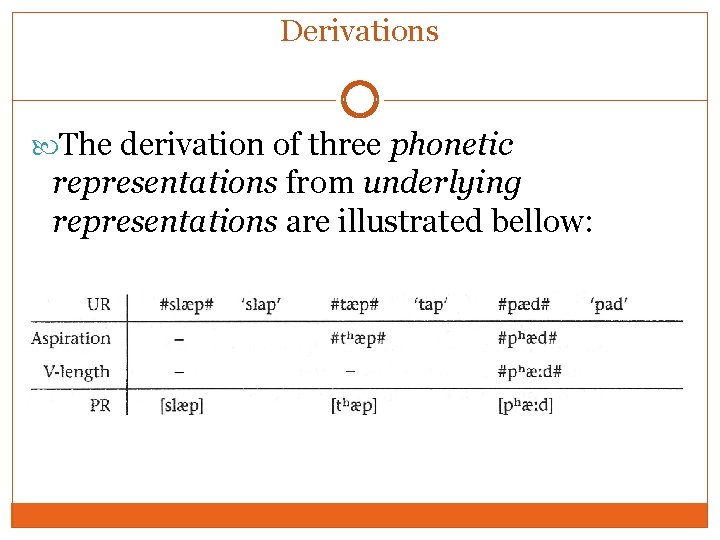
Derivations The derivation of three phonetic representations from underlying representations are illustrated bellow: