
Introduction to Russian phonology and word structure Ch

- Slides: 17
Introduction to Russian phonology and word structure Ch 11: Phonemes and minimal pairs
Q&A • 1. What is the difference between a phoneme and a phone?
Q&A • 1. What is the difference between a phoneme and a phone? – A phone is a sound that can be measured analyzed by machines. A phoneme is a basic sound in a language – it is an idea.
Q&A • 2. What information does a phonemic transcription capture? What does it ignore? What does this mean for Russian?
Q&A • 2. What information does a phonemic transcription capture? What does it ignore? What does this mean for Russian? – The phonemic system: • Captures all essential, meaning-distinguishing information • Ignores all automatic phonological phenomena • For Russian this means many things, like that consonant palatalization is phonemic, but vowel adjustments are not, that [i] and [ ] are one phoneme /i/, etc.
Notes on phonemes • We use minimal pairs to establish whether a sound can distinguish meaning, but we also use other practical judgments – Cf. the issue of [ ] and [h] in English • Note that phonemes are written between slashes: //
Q&A • 3. What is an allophone?
Q&A • 3. What is an allophone? – A conditioned variant of a phoneme • E. g. , the vowel variants that we learned about in chapters 4 & 6, or the aspirated and unaspirated /k/ in English key and ski
Q&A • 4. If we have two allophones, how do we know which one is basic (which one is the phoneme)?
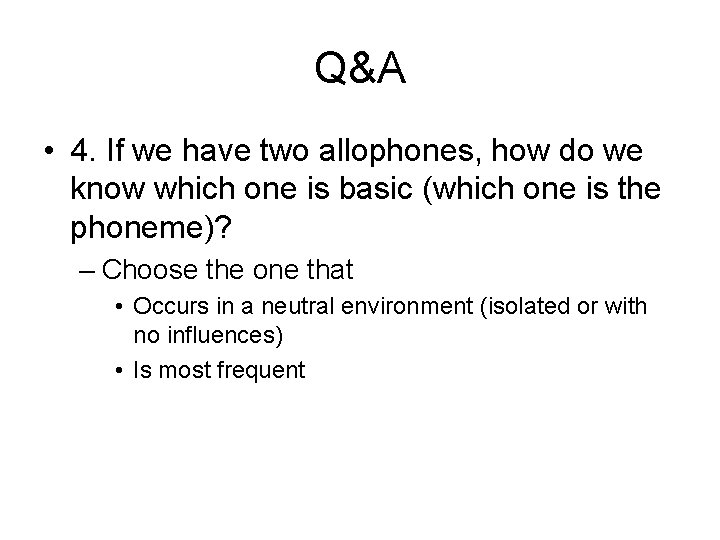
Q&A • 4. If we have two allophones, how do we know which one is basic (which one is the phoneme)? – Choose the one that • Occurs in a neutral environment (isolated or with no influences) • Is most frequent
Q&A • 5. What are all the allophones of /a/ and /i/?
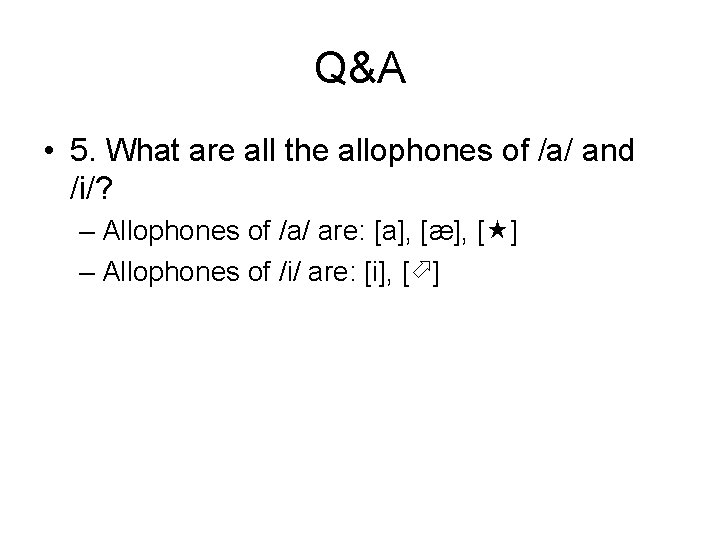
Q&A • 5. What are all the allophones of /a/ and /i/? – Allophones of /a/ are: [a], [æ], [ ] – Allophones of /i/ are: [i], [ ]
Q&A • 6. What are the differences between phonetic and phonemic transcription in Russian? Or: what distinctions does the phonemic transcription lack?
Q&A • 6. What are the differences between phonetic and phonemic transcription in Russian? Or: what distinctions does the phonemic transcription lack? – It lacks: and – Phonemically all a and o reduce to /a/, or to /i/ after a soft consonant and not in an ending – Soft velars are not phonemic, so we have only /k/, /g/, and /x/ – There is also no soft mark on /č/ because softness is not phonemic there
Q&A • 7. Some of the starred consonants in the exercise are on their way to becoming phonemes. Which ones and why?
Q&A • 7. Some of the starred consonants in the exercise are on their way to becoming phonemes. Which ones and why? – The soft velars. New words are bringing them into opposition with hard velars, making their existence independent of environment. This is what happened earlier to /v/ and /f/.
Just checking… • Are there any questions about the minimal pairs on pp. 83 -85? Maybe we should go over these together…