Online Social Networks and Media Team Formation in



- Slides: 133
Online Social Networks and Media Team Formation in Social Networks Network Ties
Thanks to Evimari Terzi ALGORITHMS FOR TEAM FORMATION
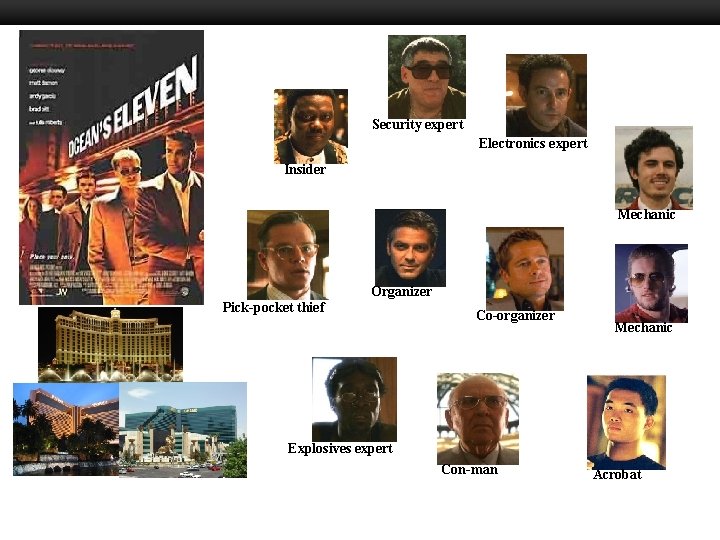
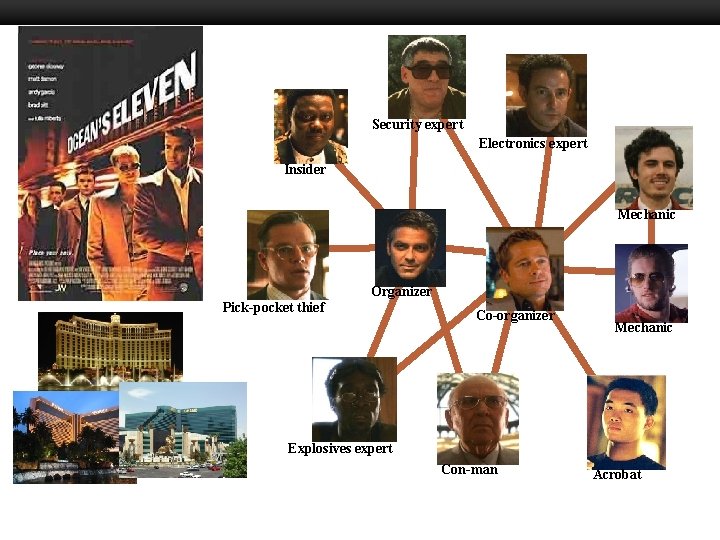
Team-formation problems Boston University Slideshow Title Goes Here } Given a task and a set of experts (organized in a network) find the subset of experts that can effectively perform the task } Task: set of required skills and potentially a budget } Expert: has a set of skills and potentially a price } Network: represents strength of relationships evimaria@cs. bu. edu
2001 Boston University Slideshow Title Goes Here Security expert Electronics expert Insider Mechanic Organizer Pick-pocket thief Co-organizer Mechanic Explosives expert Con-man Acrobat
2001 Boston University Slideshow Title Goes Here Security expert Electronics expert Insider Mechanic Organizer Pick-pocket thief Co-organizer Mechanic Explosives expert Con-man Acrobat
Applications Boston University Slideshow Title Goes Here } Collaboration networks (e. g. , scientists, actors) } Organizational structure of companies } Linked. In, Up. Work, Free. Lance } Geographical (map) of experts
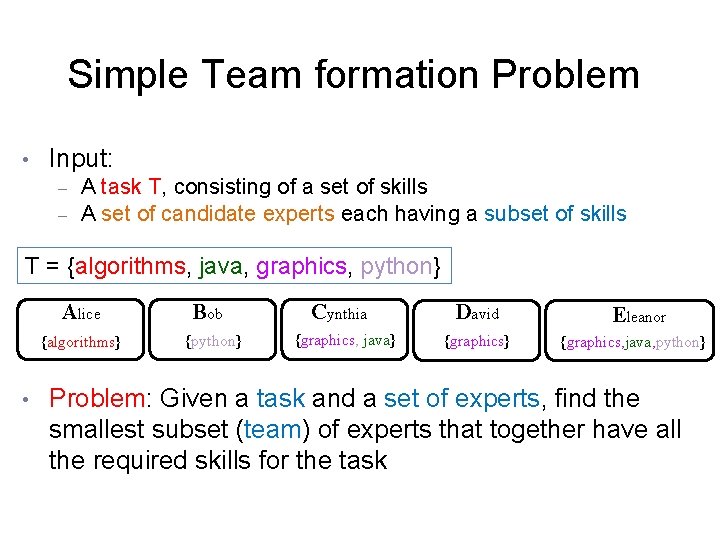
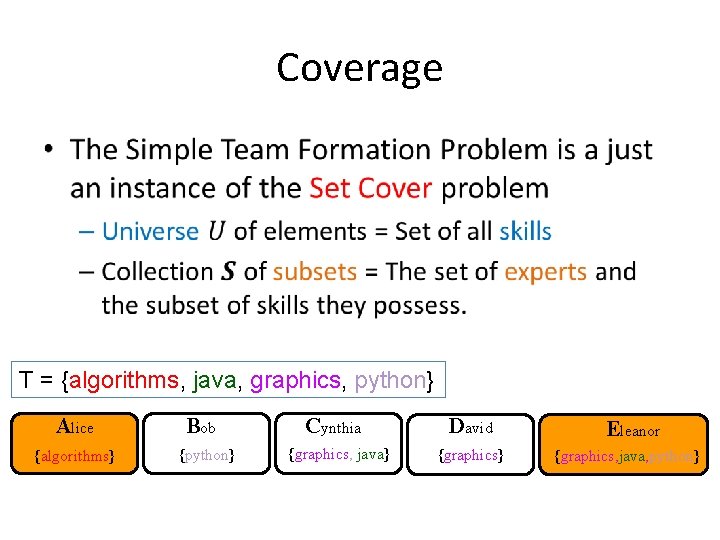
Simple Team formation Problem Boston University Slideshow Title Goes Here • Input: – – A task T, consisting of a set of skills A set of candidate experts each having a subset of skills T = {algorithms, java, graphics, python} Alice {algorithms} • Bob {python} Cynthia {graphics, java} David {graphics} Eleanor {graphics, java, python} Problem: Given a task and a set of experts, find the smallest subset (team) of experts that together have all the required skills for the task
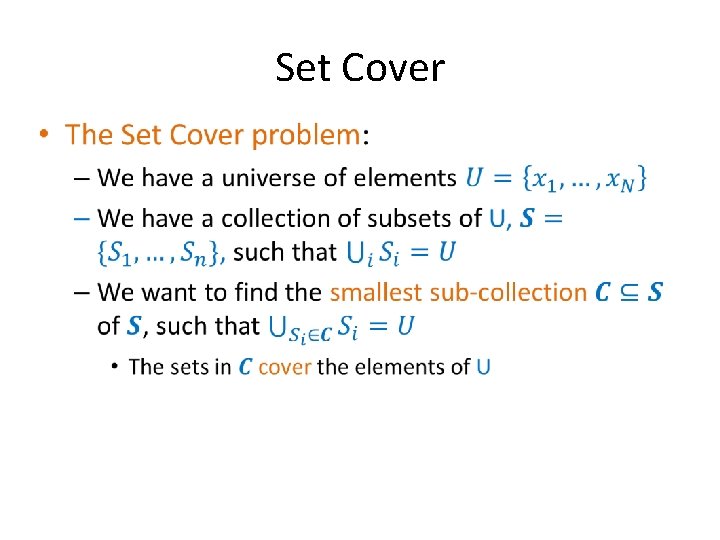
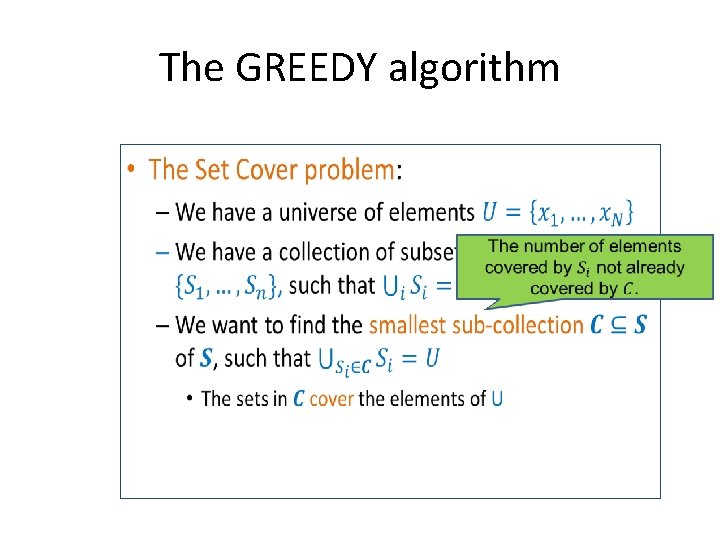
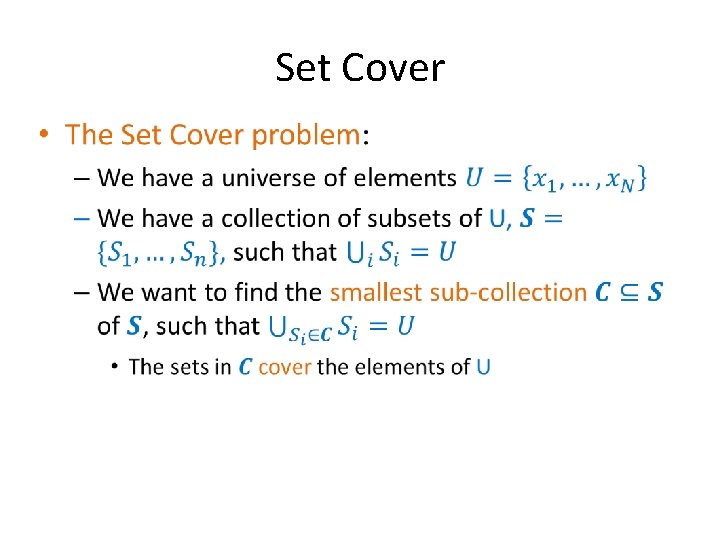
Set Cover •
Coverage • T = {algorithms, java, graphics, python} Alice {algorithms} Bob {python} Cynthia {graphics, java} David {graphics} Eleanor {graphics, java, python}
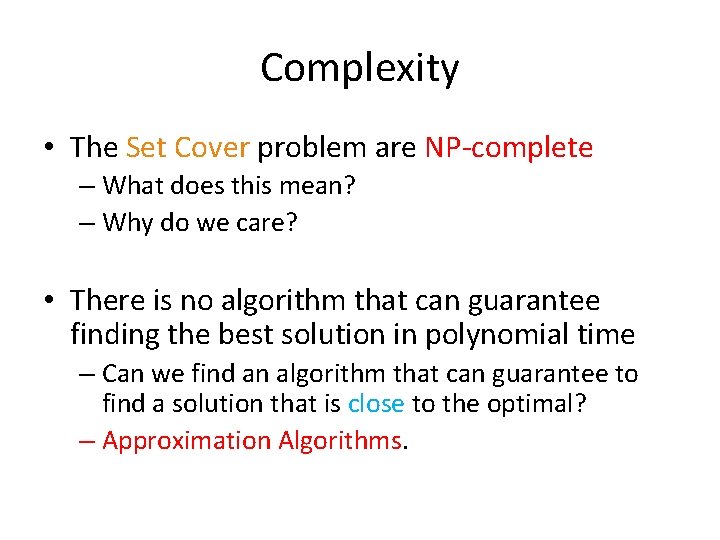
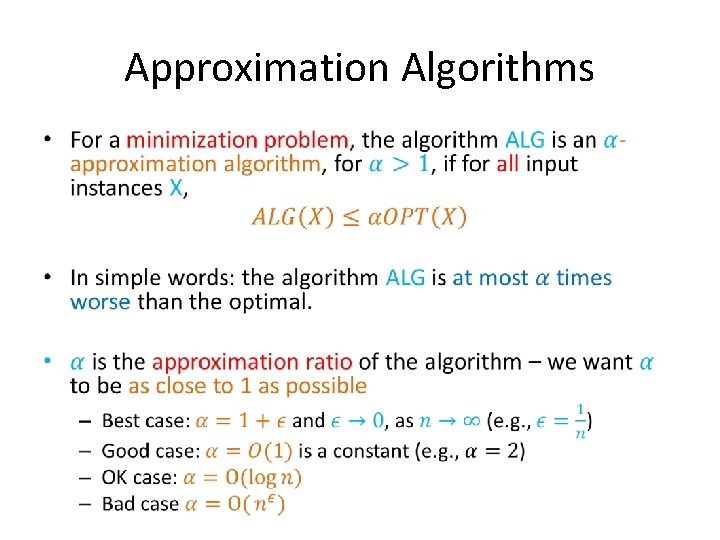
Complexity • The Set Cover problem are NP-complete – What does this mean? – Why do we care? • There is no algorithm that can guarantee finding the best solution in polynomial time – Can we find an algorithm that can guarantee to find a solution that is close to the optimal? – Approximation Algorithms.
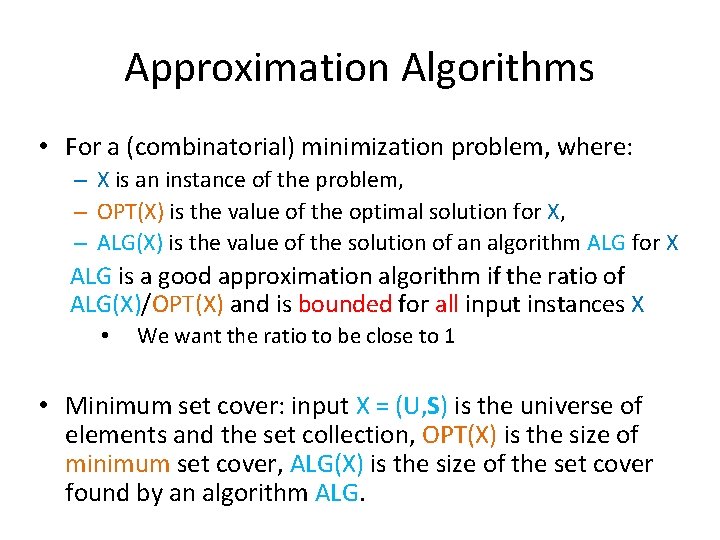
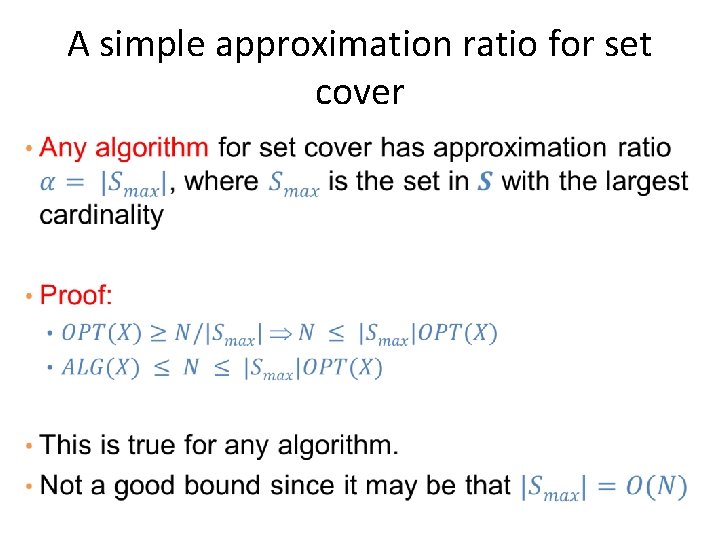
Approximation Algorithms • For a (combinatorial) minimization problem, where: – X is an instance of the problem, – OPT(X) is the value of the optimal solution for X, – ALG(X) is the value of the solution of an algorithm ALG for X ALG is a good approximation algorithm if the ratio of ALG(X)/OPT(X) and is bounded for all input instances X • We want the ratio to be close to 1 • Minimum set cover: input X = (U, S) is the universe of elements and the set collection, OPT(X) is the size of minimum set cover, ALG(X) is the size of the set cover found by an algorithm ALG.
Approximation Algorithms •
A simple approximation ratio for set cover •
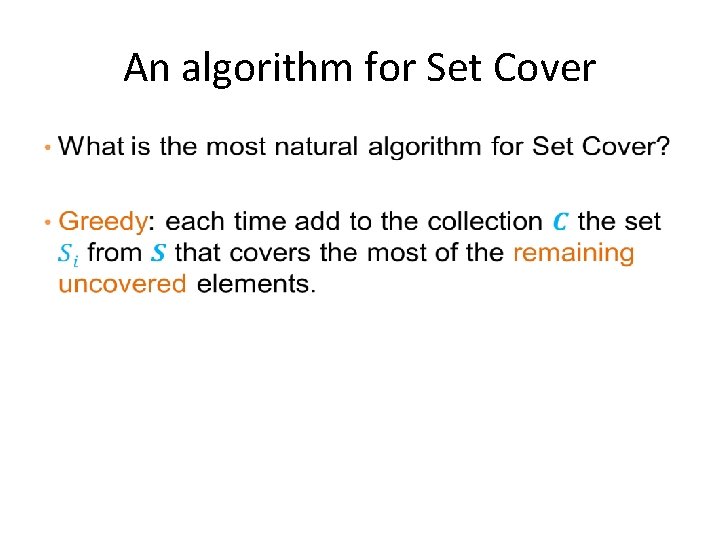
An algorithm for Set Cover •
The GREEDY algorithm •
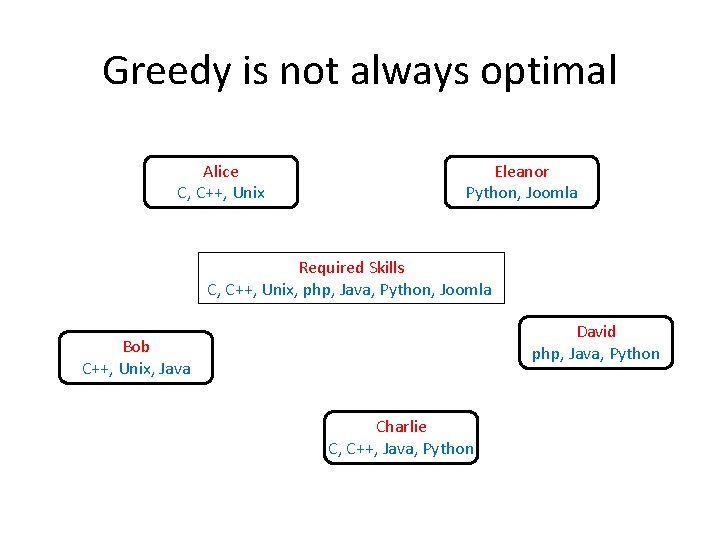
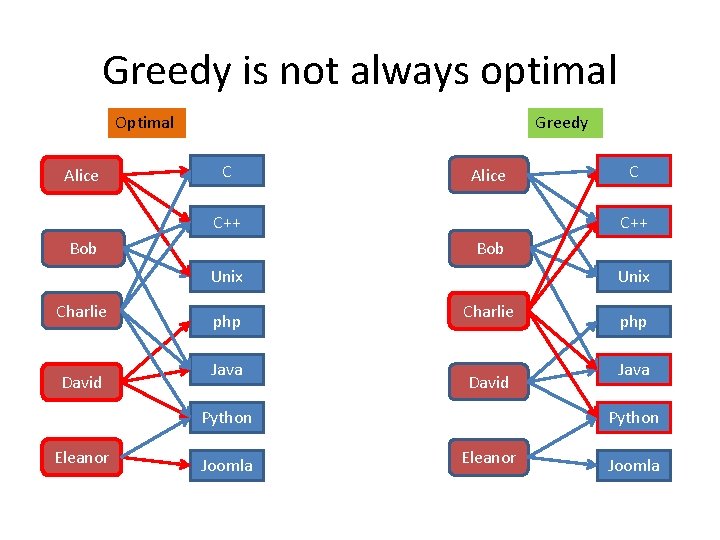
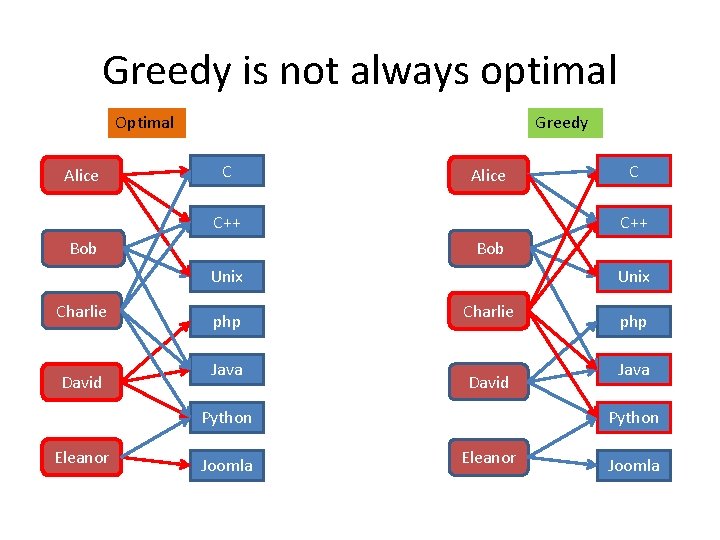
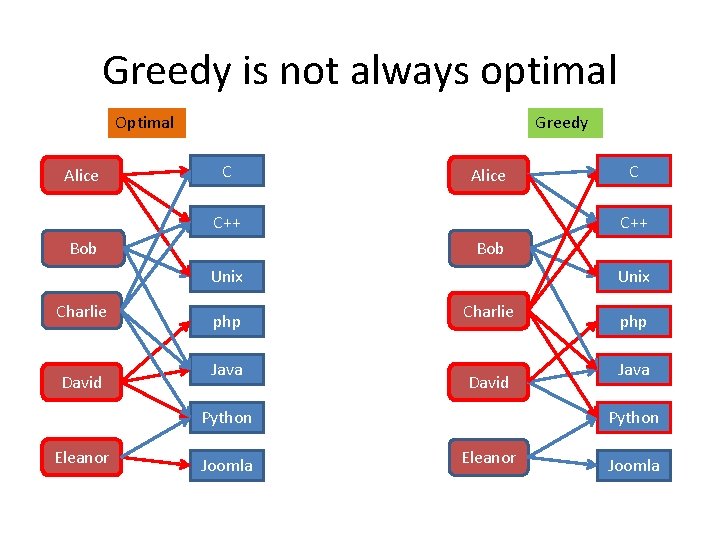
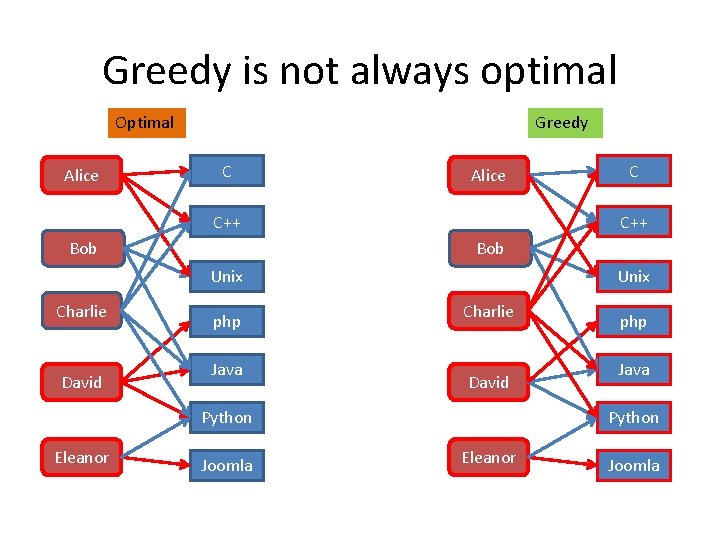
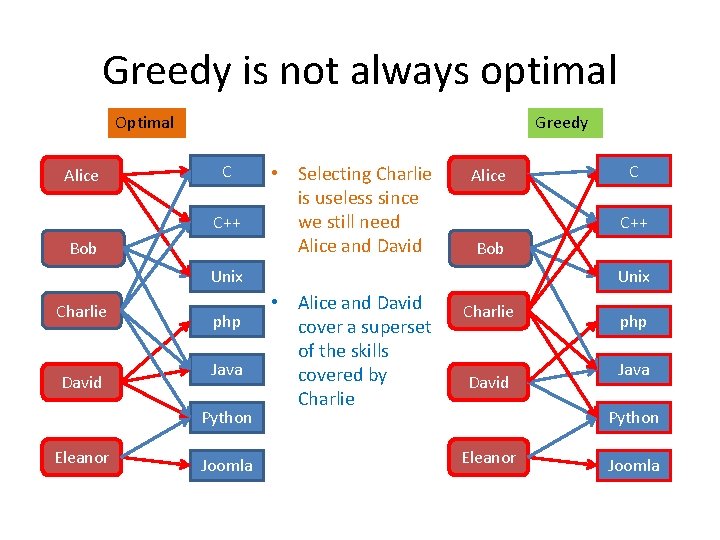
Greedy is not always optimal Alice C, C++, Unix Eleanor Python, Joomla Required Skills C, C++, Unix, php, Java, Python, Joomla David php, Java, Python Bob C++, Unix, Java Charlie C, C++, Java, Python
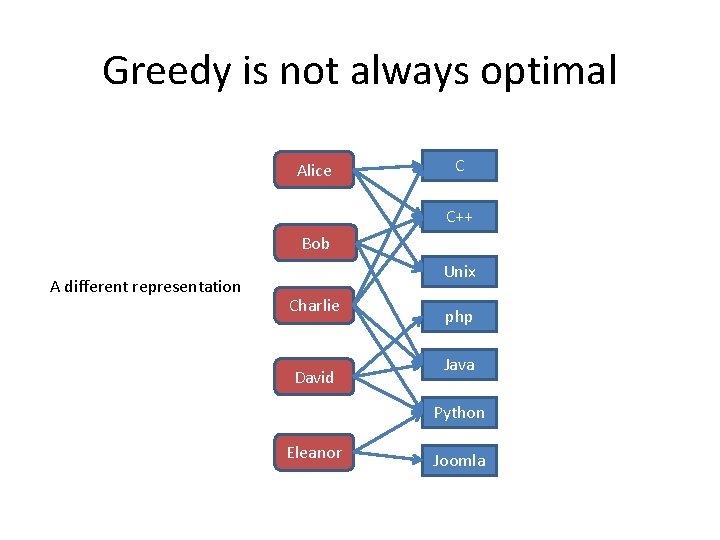
Greedy is not always optimal Alice C C++ Bob A different representation Unix Charlie David php Java Python Eleanor Joomla
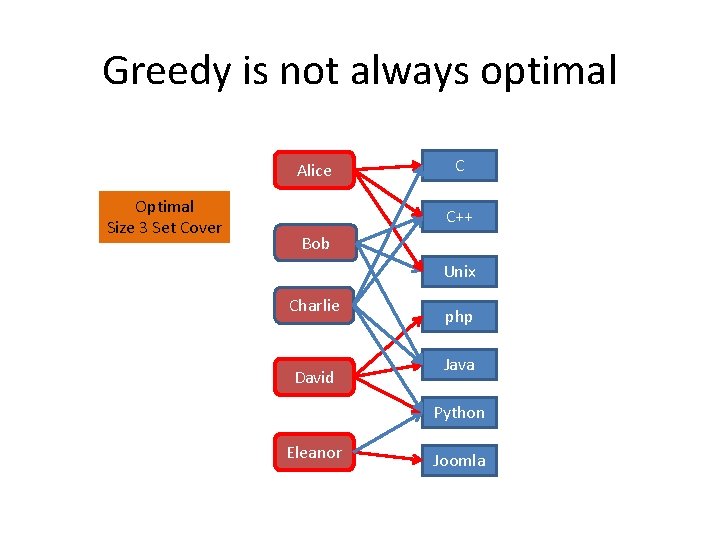
Greedy is not always optimal Alice Optimal Size 3 Set Cover C C++ Bob Unix Charlie David php Java Python Eleanor Joomla
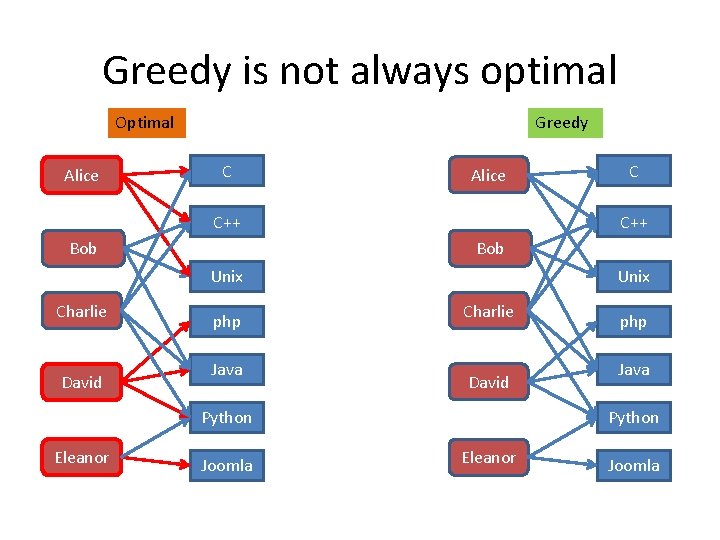
Greedy is not always optimal Optimal Alice Greedy C Alice C++ Bob Unix Charlie David php Java Unix Charlie David Python Eleanor C Joomla php Java Python Eleanor Joomla
Greedy is not always optimal Optimal Alice Greedy C Alice C++ Bob Unix Charlie David php Java Unix Charlie David Python Eleanor C Joomla php Java Python Eleanor Joomla
Greedy is not always optimal Optimal Alice Greedy C Alice C++ Bob Unix Charlie David php Java Unix Charlie David Python Eleanor C Joomla php Java Python Eleanor Joomla
Greedy is not always optimal Optimal Alice Greedy C Alice C++ Bob Unix Charlie David php Java Unix Charlie David Python Eleanor C Joomla php Java Python Eleanor Joomla
Greedy is not always optimal Optimal Alice Greedy C Alice C++ Bob Unix Charlie David php Java Unix Charlie David Python Eleanor C Joomla php Java Python Eleanor Joomla
Greedy is not always optimal Optimal Alice Greedy C C++ Bob • Selecting Charlie is useless since we still need Alice and David Alice C++ Bob Unix Charlie David php Java Python Eleanor Joomla C Unix • Alice and David cover a superset of the skills covered by Charlie David php Java Python Eleanor Joomla
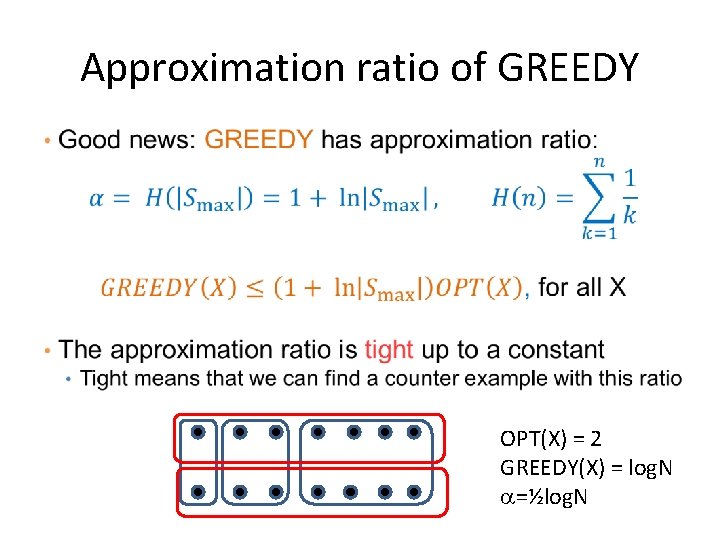
Approximation ratio of GREEDY • OPT(X) = 2 GREEDY(X) = log. N =½log. N
Team formation in the presence of a social network Boston University Slideshow Title Goes Here } Given a task and a set of experts organized in a network find the subset of experts that can effectively perform the task } Task: set of required skills } Expert: has a set of skills } Network: represents strength of relationships } Effectively: There is good communication between the team members } What does good mean? E. g. , all team members are connected.
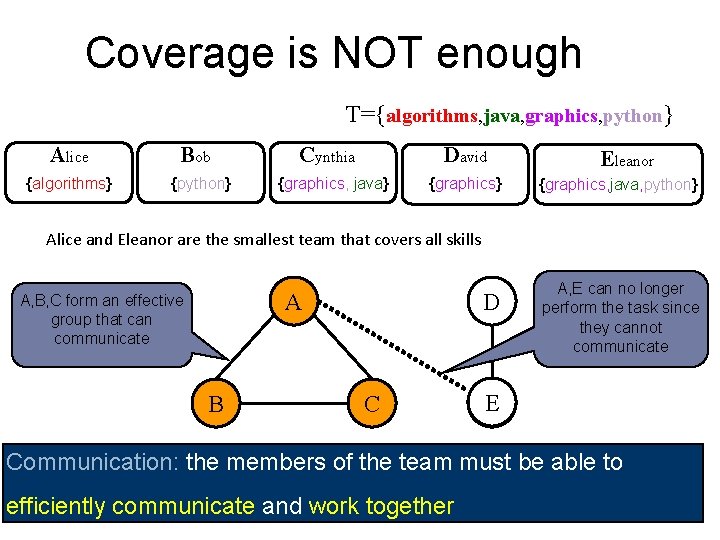
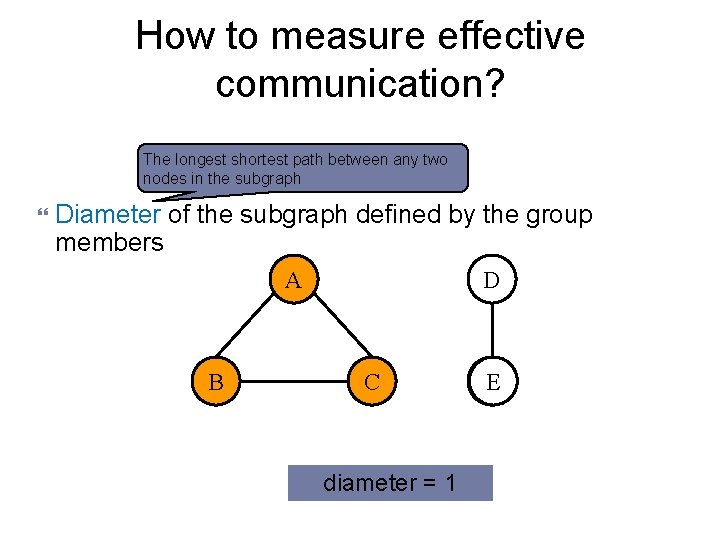
Coverage is NOT enough T={algorithms, java, graphics, python} Boston University Slideshow Title Goes Here Alice {algorithms} Bob {python} Cynthia David {graphics, java} {graphics} Eleanor {graphics, java, python} Alice and Eleanor are the smallest team that covers all skills A A, B, C form an effective group that can communicate B D C A, E can no longer perform the task since they cannot communicate E Communication: the members of the team must be able to efficiently communicate and work together
How to measure effective communication? Boston University Slideshow Title Goes Here The longest shortest path between any two nodes in the subgraph } Diameter of the subgraph defined by the group members A B D C diameter = infty diameter =1 E
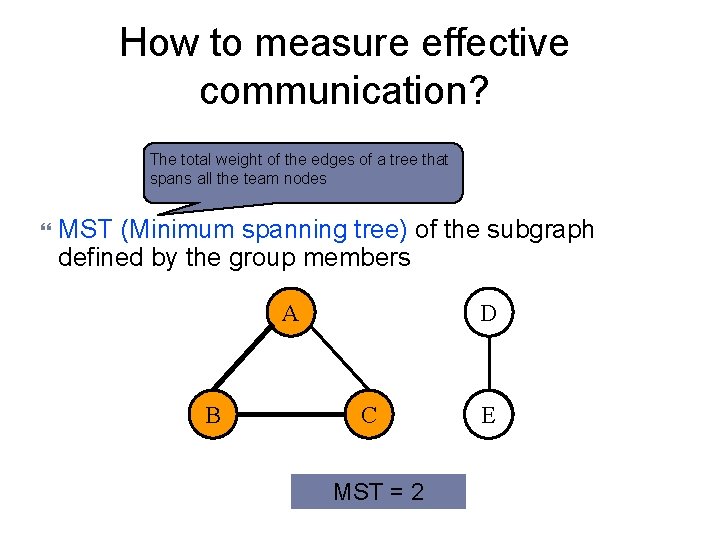
How to measure effective communication? Boston University Slideshow Title Goes Here The total weight of the edges of a tree that spans all the team nodes } MST (Minimum spanning tree) of the subgraph defined by the group members A B D C MST= =infty 2 E
Problem definition (Min. Diameter) • Boston University Slideshow Title Goes Here
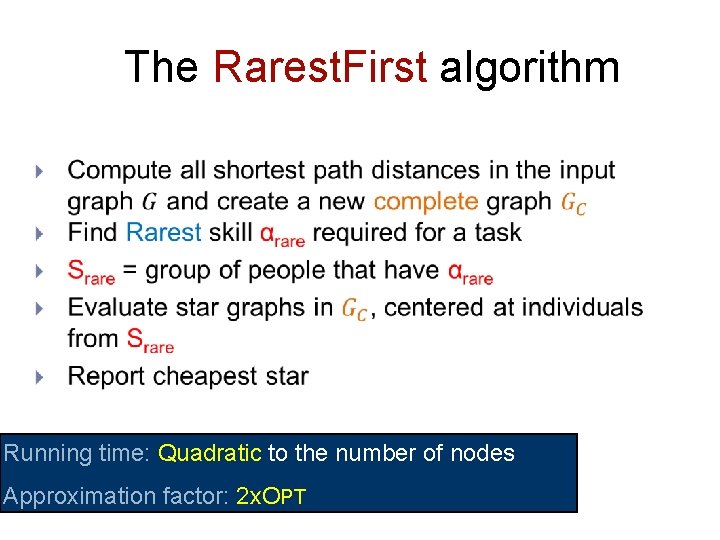
The Rarest. First algorithm Boston University Slideshow Title Goes Here • Running time: Quadratic to the number of nodes Approximation factor: 2 x. OPT
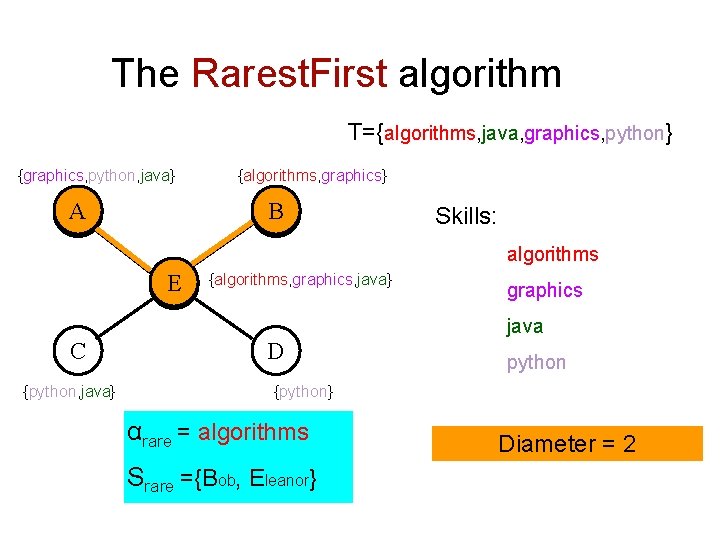
The Rarest. First algorithm Boston University Slideshow Title Goes Here {graphics, python, java} A T={algorithms, java, graphics, python} {algorithms, graphics} B Skills: algorithms E {algorithms, graphics, java} graphics java C {python, java} D python {python} αrare = algorithms Srare ={Bob, Eleanor} Diameter = 2
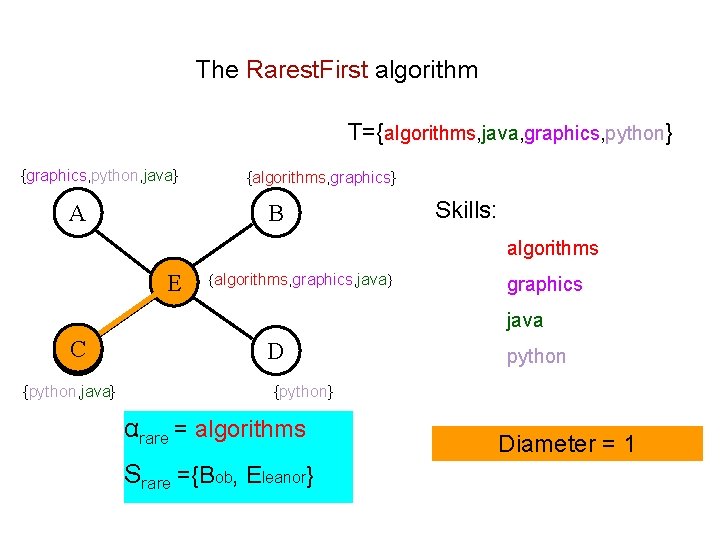
The Rarest. First algorithm Boston University Slideshow Title Goes Here {graphics, python, java} A T={algorithms, java, graphics, python} {algorithms, graphics} B Skills: algorithms E {algorithms, graphics, java} graphics java C {python, java} D python {python} αrare = algorithms Srare ={Bob, Eleanor} Diameter = 1
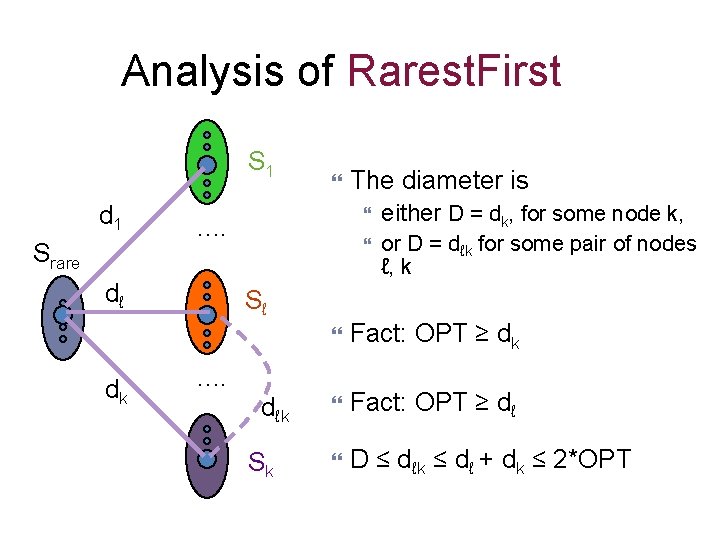
Analysis of Rarest. First Boston University Slideshow Title Goes Here S 1 d 1 Srare …. dℓ dk } Sℓ Sk } either D = dk, for some node k, } or D = dℓk for some pair of nodes ℓ, k } Fact: OPT ≥ dℓ } D ≤ dℓk ≤ dℓ + dk ≤ 2*OPT …. dℓk The diameter is
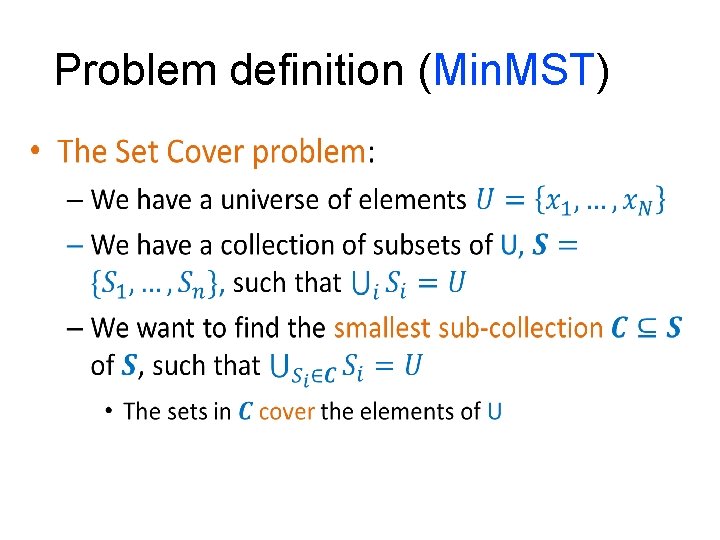
Problem definition (Min. MST) • Boston University Slideshow Title Goes Here
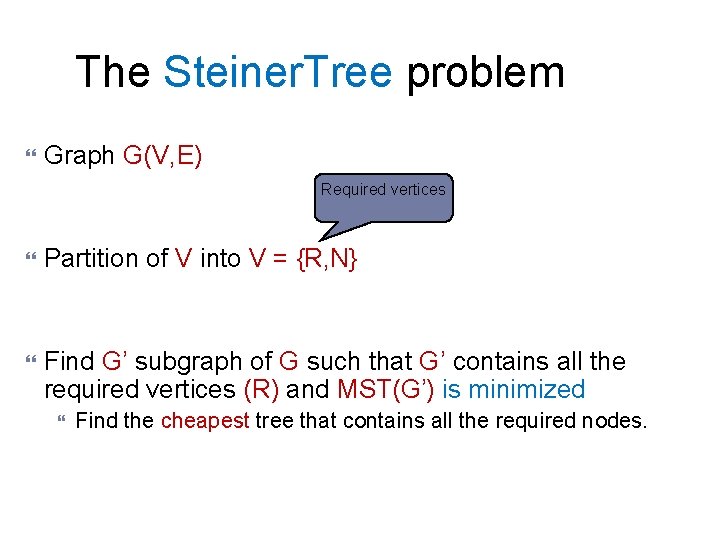
The Steiner. Tree problem Boston University Slideshow Title Goes Here } Graph G(V, E) Required vertices } Partition of V into V = {R, N} } Find G’ subgraph of G such that G’ contains all the required vertices (R) and MST(G’) is minimized } Find the cheapest tree that contains all the required nodes.
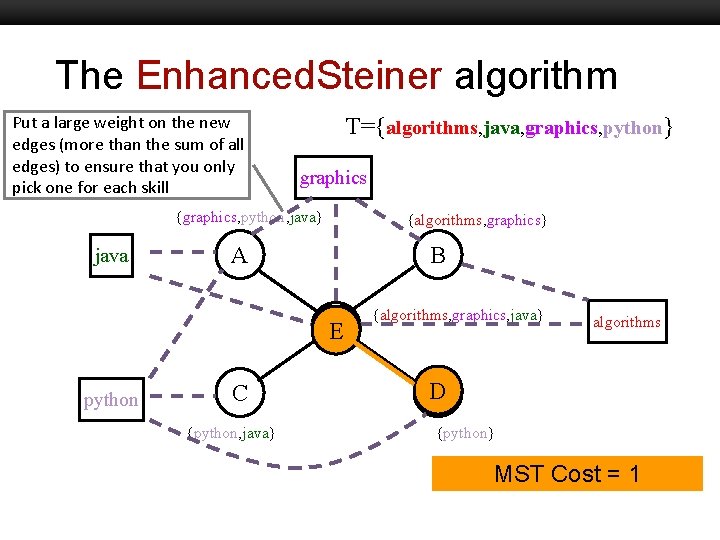
The Enhanced. Steiner algorithm Put a Boston large University weight Slideshow on the new T={algorithms, java, graphics, python} Title Goes Here edges (more than the sum of all edges) to ensure that you only graphics pick one for each skill {graphics, python, java} java {algorithms, graphics} A B E python C {python, java} {algorithms, graphics, java} algorithms D {python} MST Cost = 1
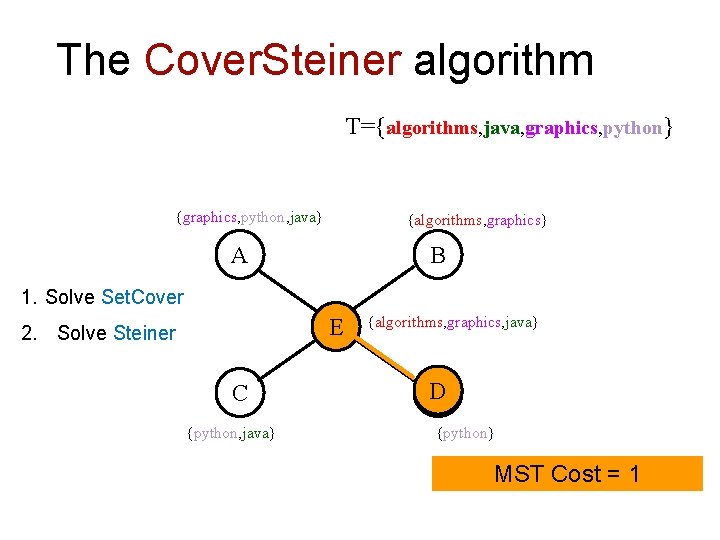
The Cover. Steiner algorithm T={algorithms, java, graphics, python} Boston University Slideshow Title Goes Here {graphics, python, java} {algorithms, graphics} A B 1. Solve Set. Cover E 2. Solve Steiner C {python, java} {algorithms, graphics, java} D {python} MST Cost = 1
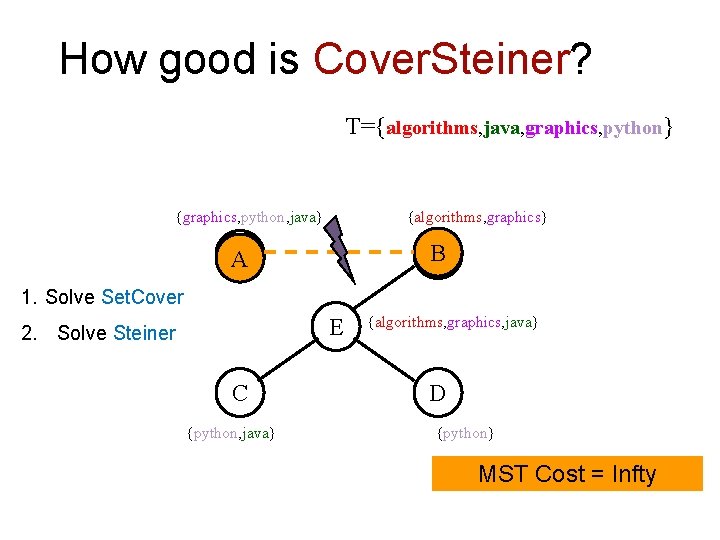
How good is Cover. Steiner? T={algorithms, java, graphics, python} Boston University Slideshow Title Goes Here {graphics, python, java} {algorithms, graphics} B A 1. Solve Set. Cover E 2. Solve Steiner C {python, java} {algorithms, graphics, java} D {python} MST Cost = Infty
References Theodoros Lappas, Kun Liu, Evimaria Terzi, Finding a team of experts in social networks. KDD 2009: 467 -476
STRONG AND WEAK TIES
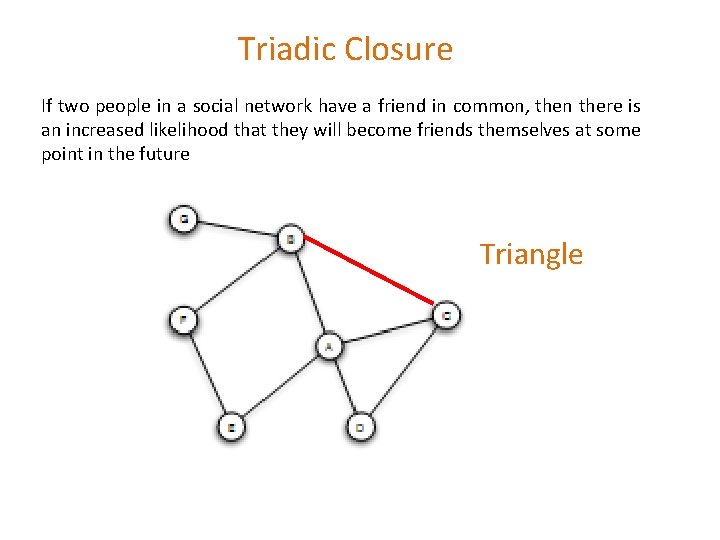
Triadic Closure If two people in a social network have a friend in common, then there is an increased likelihood that they will become friends themselves at some point in the future Triangle
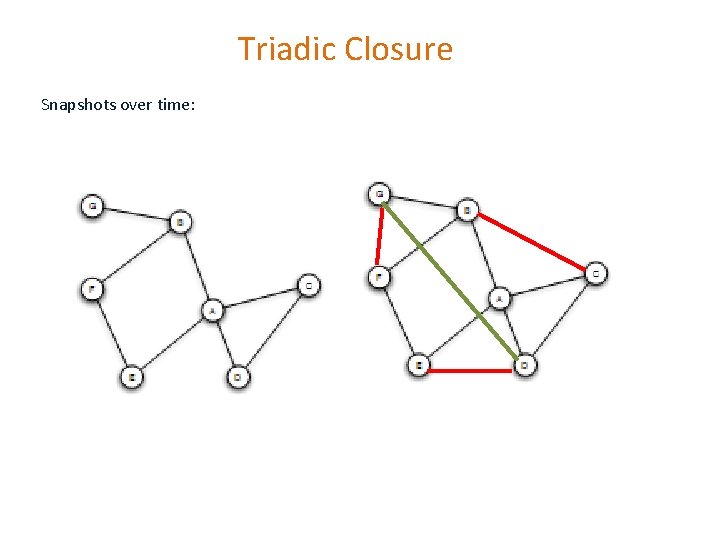
Triadic Closure Snapshots over time:
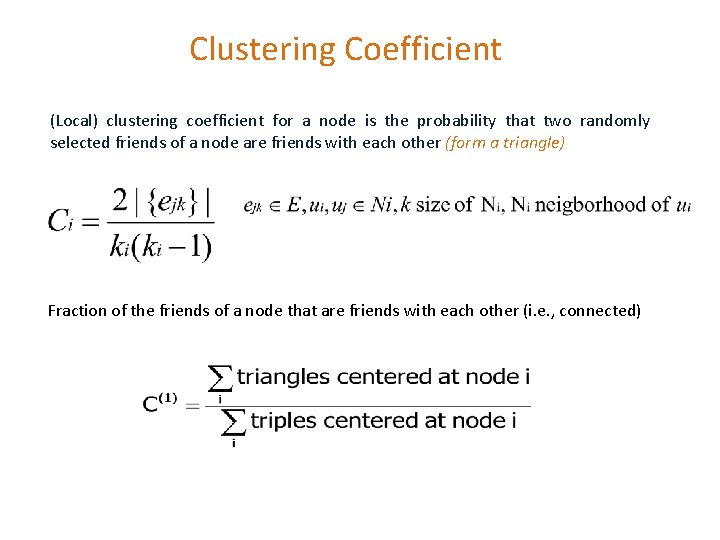
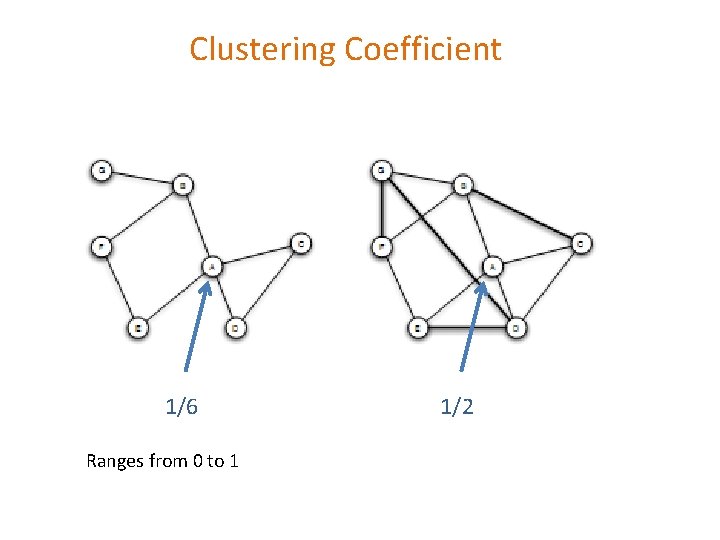
Clustering Coefficient (Local) clustering coefficient for a node is the probability that two randomly selected friends of a node are friends with each other (form a triangle) Fraction of the friends of a node that are friends with each other (i. e. , connected)
Clustering Coefficient 1/6 Ranges from 0 to 1 1/2
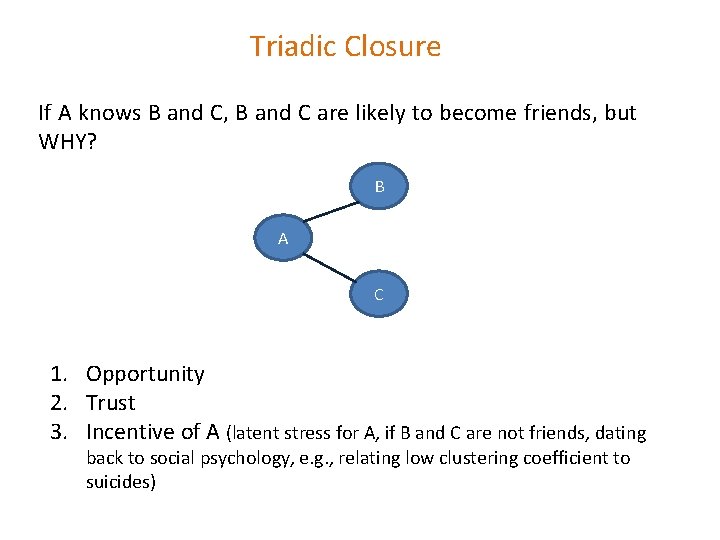
Triadic Closure If A knows B and C, B and C are likely to become friends, but WHY? B A C 1. Opportunity 2. Trust 3. Incentive of A (latent stress for A, if B and C are not friends, dating back to social psychology, e. g. , relating low clustering coefficient to suicides)
The Strength of Weak Ties Hypothesis Mark Granovetter, in the late 1960 s Many people learned information leading to their current job through personal contacts, often described as acquaintances rather than closed friends Two aspects § Structural § Local (interpersonal)
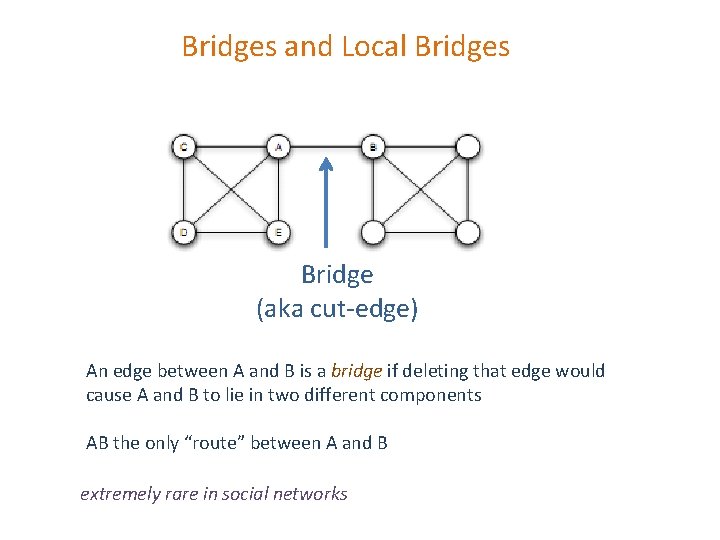
Bridges and Local Bridges Bridge (aka cut-edge) An edge between A and B is a bridge if deleting that edge would cause A and B to lie in two different components AB the only “route” between A and B extremely rare in social networks
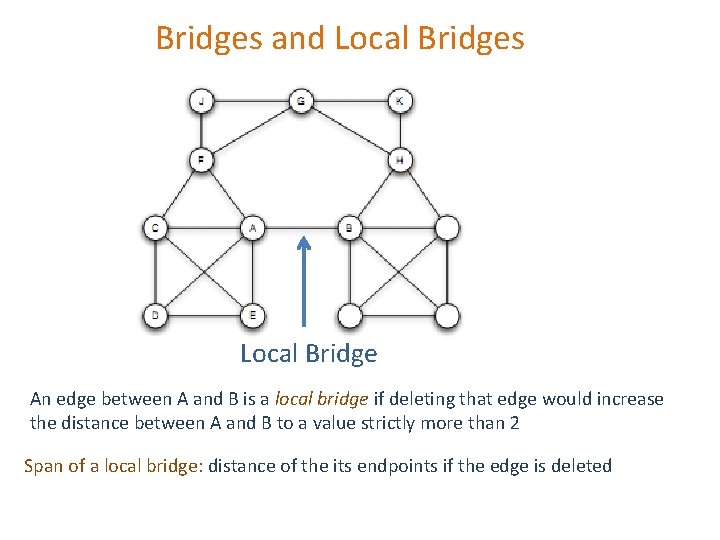
Bridges and Local Bridges Local Bridge An edge between A and B is a local bridge if deleting that edge would increase the distance between A and B to a value strictly more than 2 Span of a local bridge: distance of the its endpoints if the edge is deleted
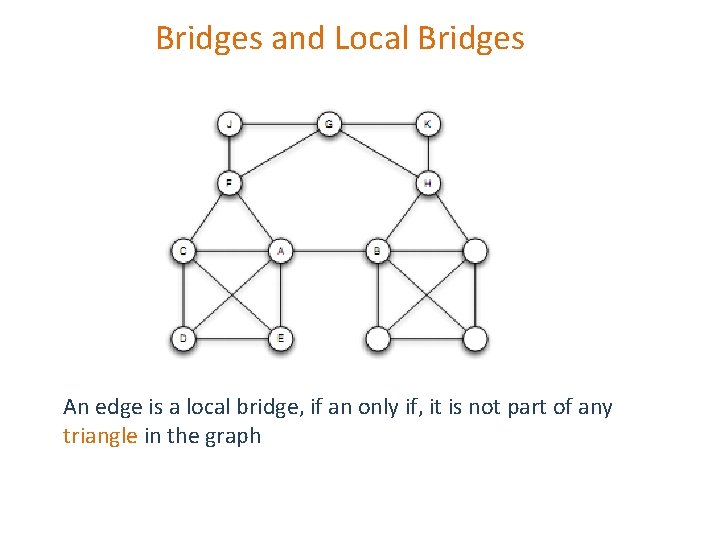
Bridges and Local Bridges An edge is a local bridge, if an only if, it is not part of any triangle in the graph
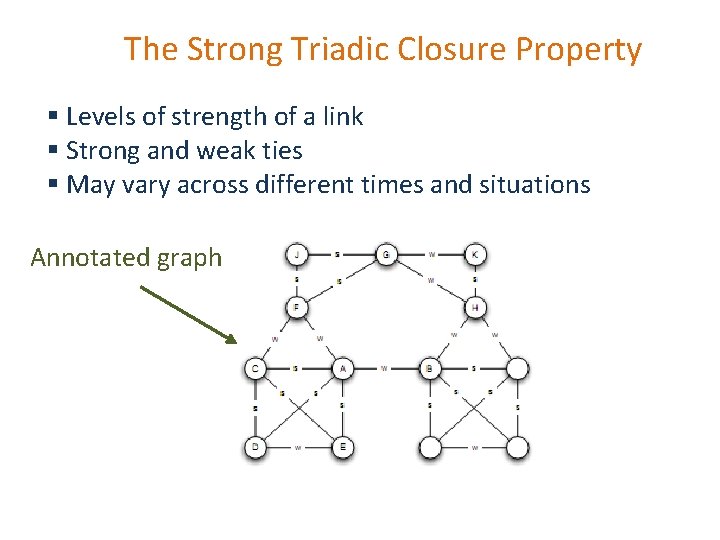
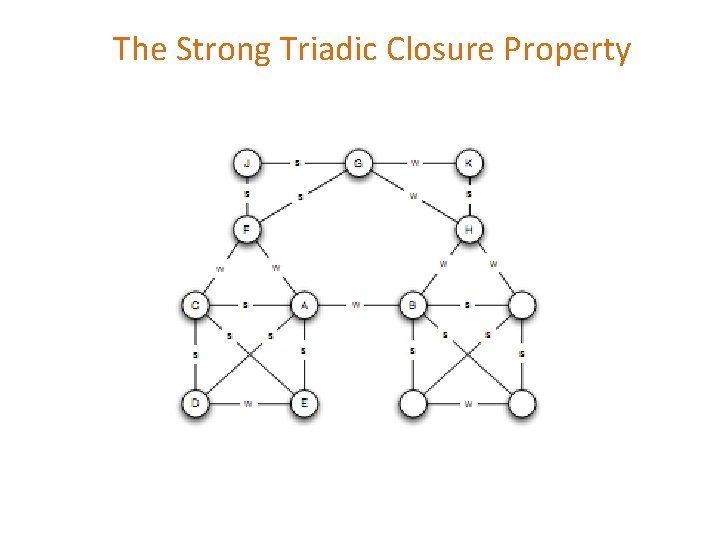
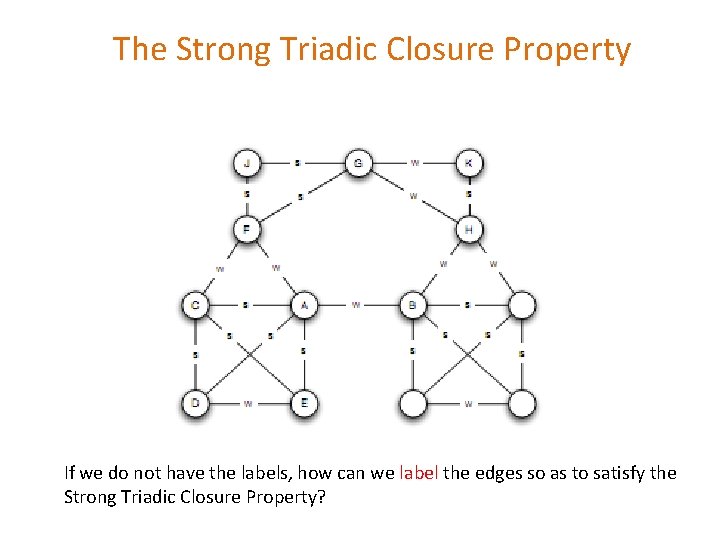
The Strong Triadic Closure Property § Levels of strength of a link § Strong and weak ties § May vary across different times and situations Annotated graph
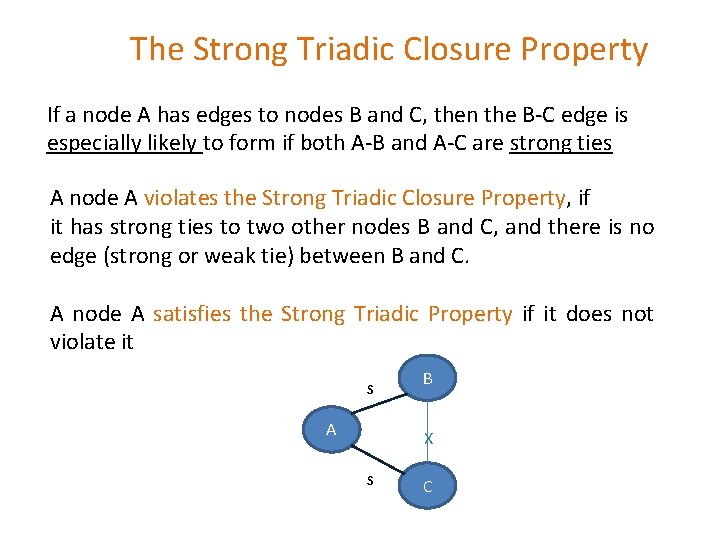
The Strong Triadic Closure Property If a node A has edges to nodes B and C, then the B-C edge is especially likely to form if both A-B and A-C are strong ties A node A violates the Strong Triadic Closure Property, if it has strong ties to two other nodes B and C, and there is no edge (strong or weak tie) between B and C. A node A satisfies the Strong Triadic Property if it does not violate it S A B X S C
The Strong Triadic Closure Property
Local Bridges and Weak Ties Local distinction: weak and strong ties -> Global structural distinction: local bridges or not Claim: If a node A in a network satisfies the Strong Triadic Closure and is involved in at least two strong ties, then any local bridge it is involved in must be a weak tie Proof: by contradiction Relation to job seeking?
The role of simplifying assumptions: § Useful when they lead to statements robust in practice, making sense as qualitative conclusions that hold in approximate forms even when the assumptions are relaxed § Stated precisely, so possible to test them in real-world data § A framework to explain surprising facts
Tie Strength and Network Structure in Large-Scale Data How to test these prediction on large social networks?
Tie Strength and Network Structure in Large-Scale Data Communication network: “who-talks-to-whom” Strength of the tie: time spent talking during an observation period Cell-phone study [Omnela et. al. , 2007] “who-talks-to-whom network”, covering 20% of the national population § Nodes: cell phone users § Edge: if they make phone calls to each other in both directions over 18 -week observation periods Is it a “social network”? Cells generally used for personal communication + no central directory, thus cellphone numbers exchanged among people who already know each other Broad structural features of large social networks (giant component, 84% of nodes)
Generalizing Weak Ties and Local Bridges So far: ü Either weak or strong ü Local bridge or not Tie Strength: Numerical quantity (= number of min spent on the phone) Quantify “local bridges”, how?
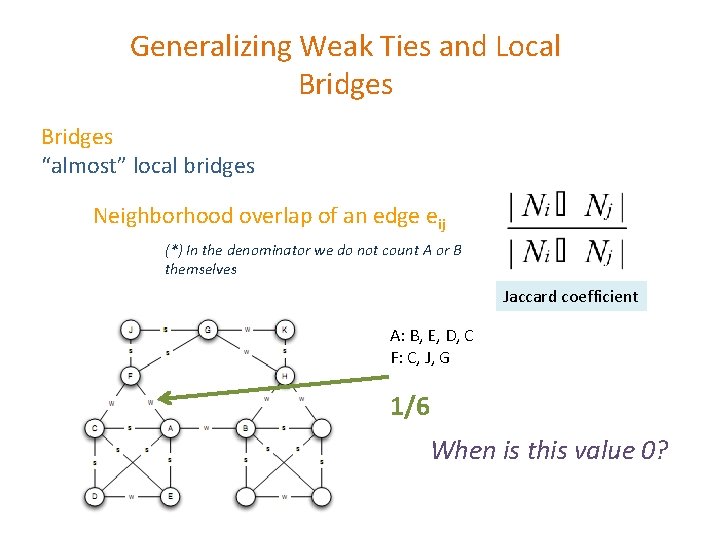
Generalizing Weak Ties and Local Bridges “almost” local bridges Neighborhood overlap of an edge eij (*) In the denominator we do not count A or B themselves Jaccard coefficient A: B, E, D, C F: C, J, G 1/6 When is this value 0?
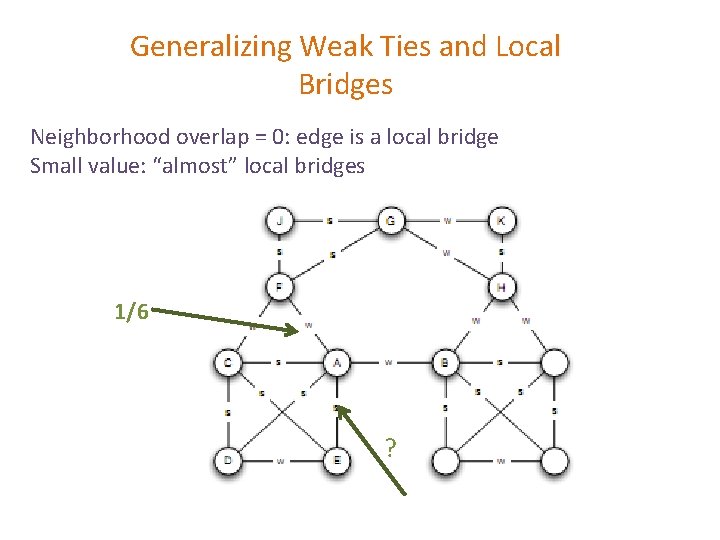
Generalizing Weak Ties and Local Bridges Neighborhood overlap = 0: edge is a local bridge Small value: “almost” local bridges 1/6 ?
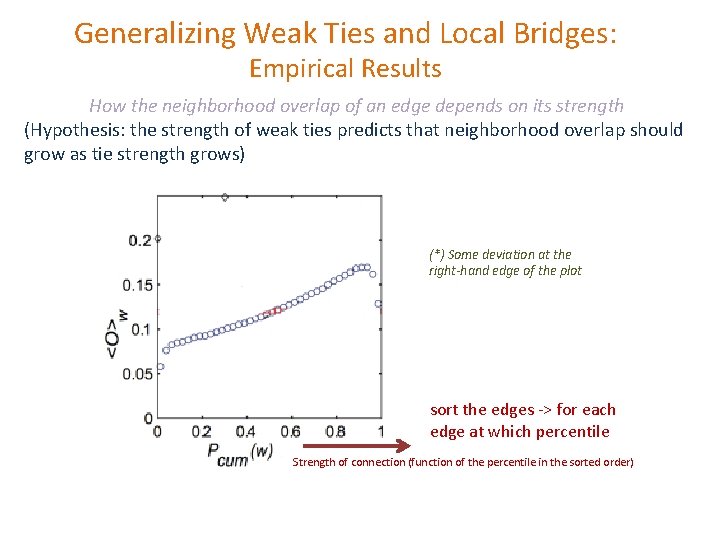
Generalizing Weak Ties and Local Bridges: Empirical Results How the neighborhood overlap of an edge depends on its strength (Hypothesis: the strength of weak ties predicts that neighborhood overlap should grow as tie strength grows) (*) Some deviation at the right-hand edge of the plot sort the edges -> for each edge at which percentile Strength of connection (function of the percentile in the sorted order)
Generalizing Weak Ties and Local Bridges: Empirical Results How to test the following global (macroscopic) level hypothesis: Hypothesis: weak ties serve to link different tightly-knit communities that each contain a large number of stronger ties
Generalizing Weak Ties and Local Bridges: Empirical Results Delete edges from the network one at a time - Starting with the strongest ties and working downwards in order of tie strength - giant component shrank steadily -Starting with the weakest ties and upwards in order of tie strength - giant component shrank more rapidly, broke apart abruptly as a critical number of weak ties were removed
Social Media and Passive Engagement People maintain large explicit lists of friends Test: How online activity is distributed across links of different strengths
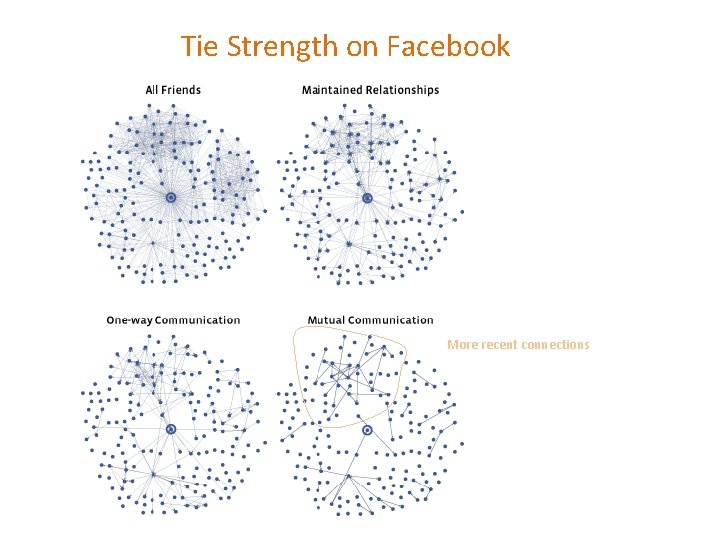
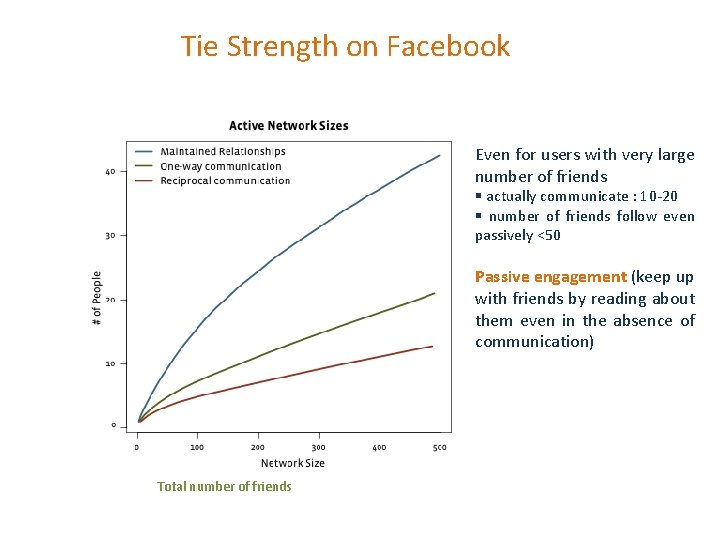
Tie Strength on Facebook Cameron Marlow, et al, 2009 At what extent each link was used for social interactions Three (not exclusive) kinds of ties (links) 1. Reciprocal (mutual) communication: both send and received messages to friends at the other end of the link 2. One-way communication: the user send one or more message to the friend at the other end of the link 3. Maintained relationship: the user followed information about the friend at the other end of the link (click on content via News feed or visit the friend profile more than once)
Tie Strength on Facebook More recent connections
Tie Strength on Facebook Even for users with very large number of friends § actually communicate : 10 -20 § number of friends follow even passively <50 Passive engagement (keep up with friends by reading about them even in the absence of communication) Total number of friends
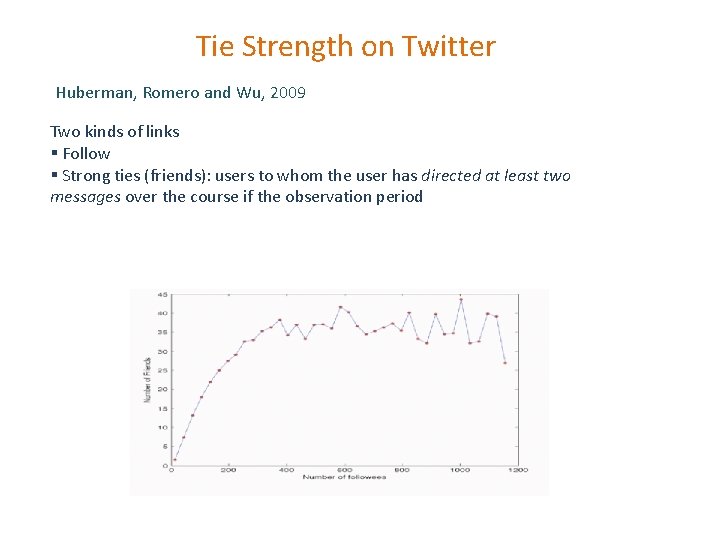
Tie Strength on Twitter Huberman, Romero and Wu, 2009 Two kinds of links § Follow § Strong ties (friends): users to whom the user has directed at least two messages over the course if the observation period
Social Media and Passive Engagement § Strong ties require continuous investment of time and effort to maintain (as opposed to weak ties) § Network of strong ties still remain sparse § How different links are used to convey information
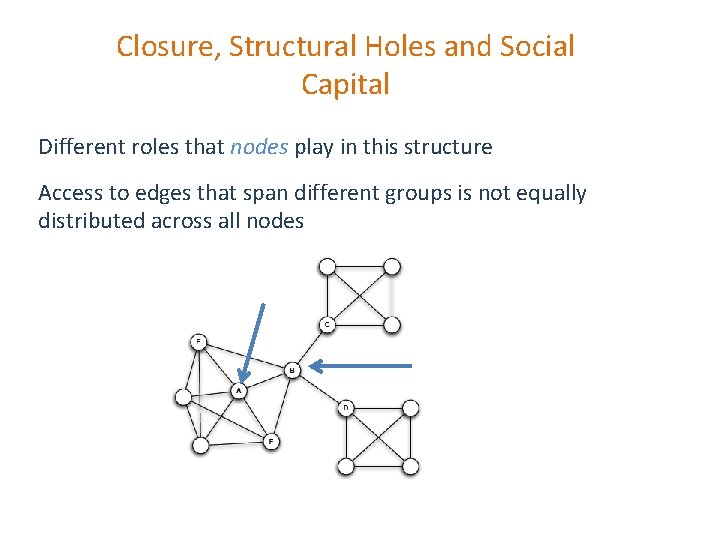
Closure, Structural Holes and Social Capital Different roles that nodes play in this structure Access to edges that span different groups is not equally distributed across all nodes
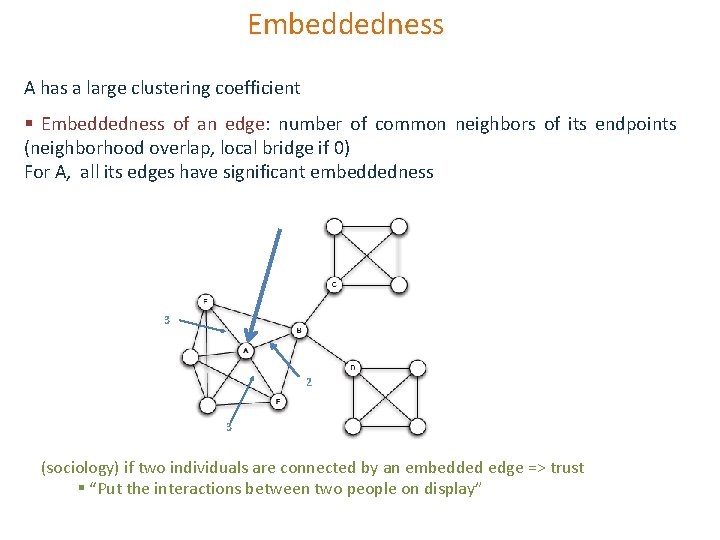
Embeddedness A has a large clustering coefficient § Embeddedness of an edge: number of common neighbors of its endpoints (neighborhood overlap, local bridge if 0) For A, all its edges have significant embeddedness 3 2 3 (sociology) if two individuals are connected by an embedded edge => trust § “Put the interactions between two people on display”
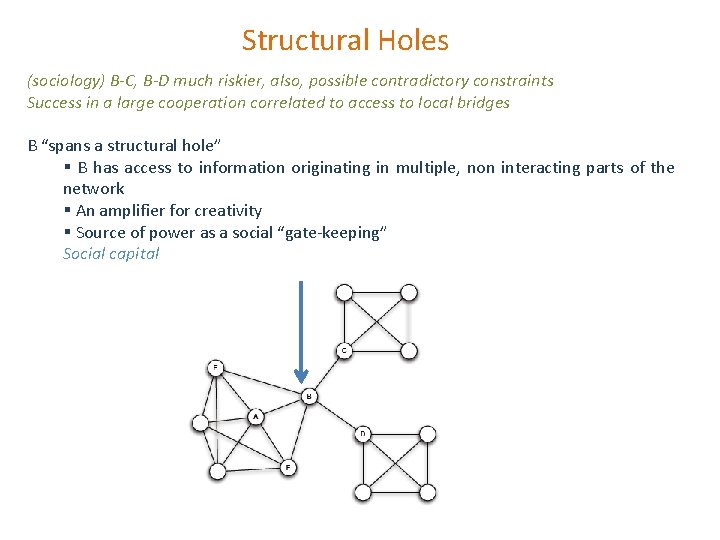
Structural Holes (sociology) B-C, B-D much riskier, also, possible contradictory constraints Success in a large cooperation correlated to access to local bridges B “spans a structural hole” § B has access to information originating in multiple, non interacting parts of the network § An amplifier for creativity § Source of power as a social “gate-keeping” Social capital
ENFORCING STRONG TRIADIC CLOSURE
The Strong Triadic Closure Property If we do not have the labels, how can we label the edges so as to satisfy the Strong Triadic Closure Property?
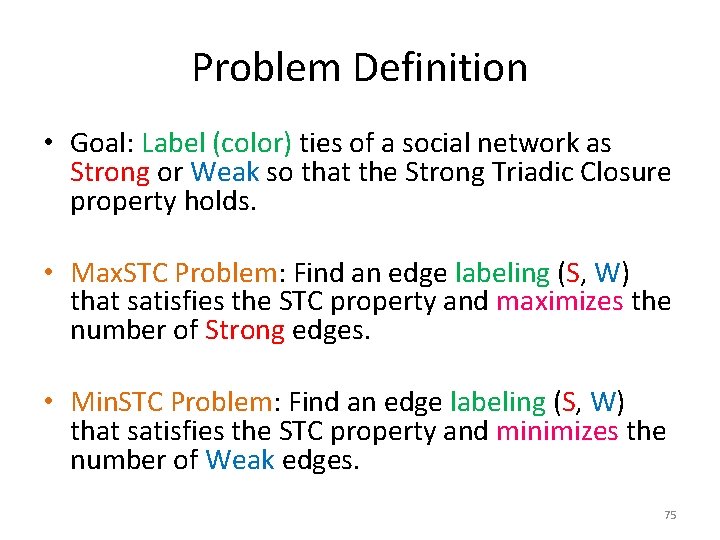
Problem Definition • Goal: Label (color) ties of a social network as Strong or Weak so that the Strong Triadic Closure property holds. • Max. STC Problem: Find an edge labeling (S, W) that satisfies the STC property and maximizes the number of Strong edges. • Min. STC Problem: Find an edge labeling (S, W) that satisfies the STC property and minimizes the number of Weak edges. 75
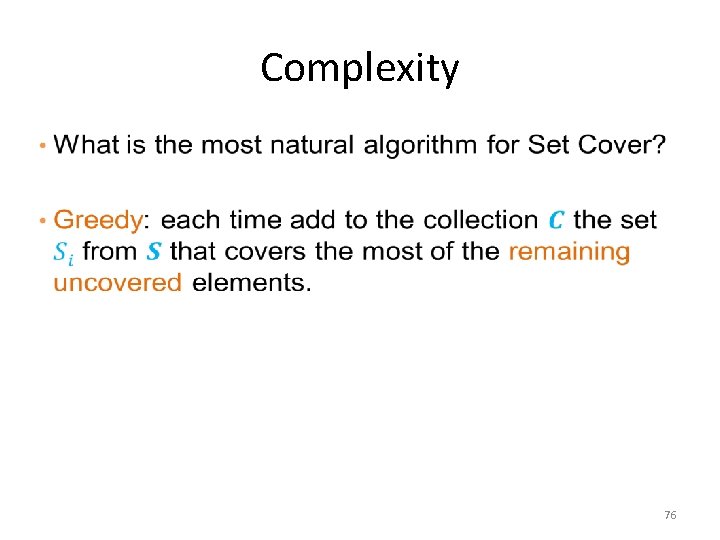
Complexity • 76
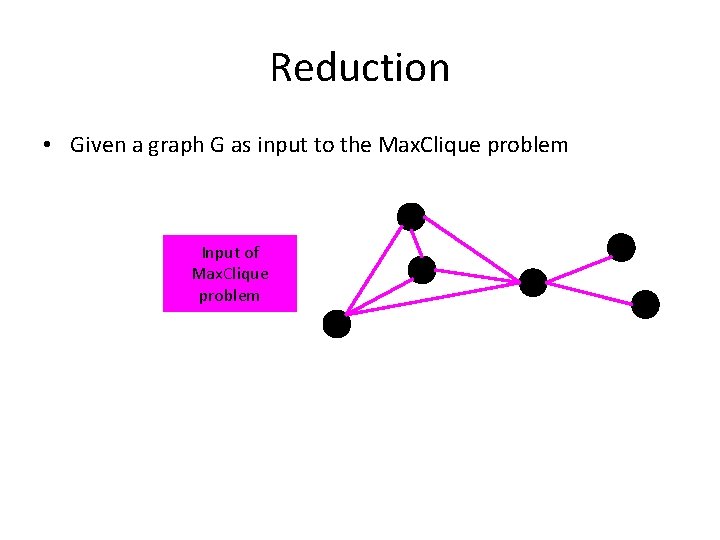
Reduction • Given a graph G as input to the Max. Clique problem Input of Max. Clique problem
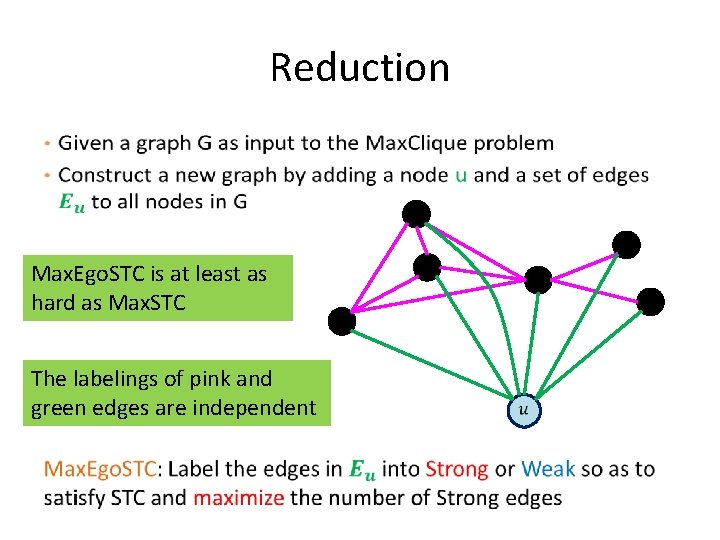
Reduction • Max. Ego. STC is at least as hard as Max. STC The labelings of pink and green edges are independent
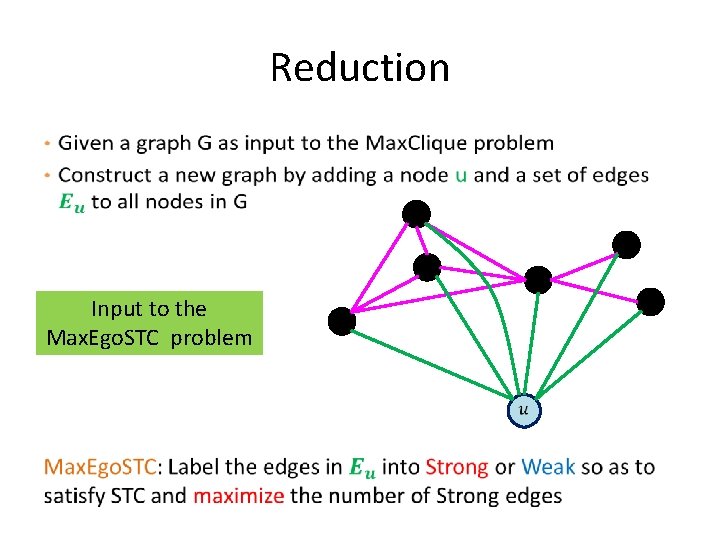
Reduction • Input to the Max. Ego. STC problem
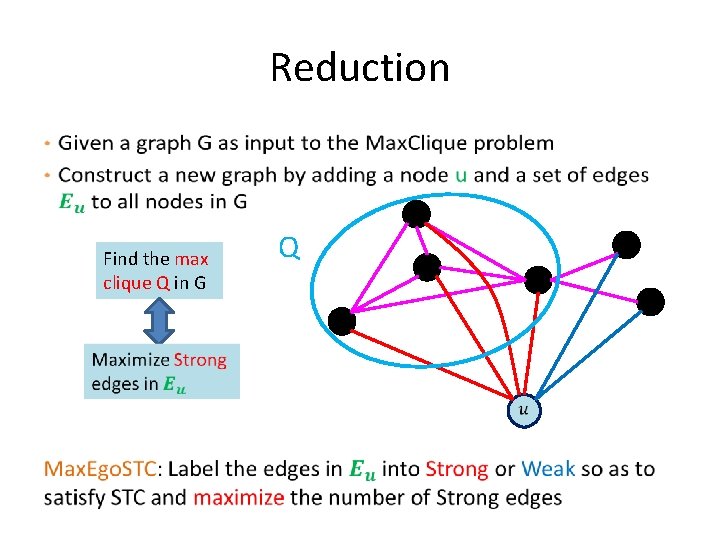
Reduction • Find the max clique Q in G Q
Approximation Algorithms • Bad News: Max. STC is hard to approximate. • Good News: There exists a 2 -approximation algorithm for the Min. STC problem. – The number of weak edges it produces is at most two times those of the optimal solution. • The algorithm comes by reducing our problem to a coverage problem
Set Cover •
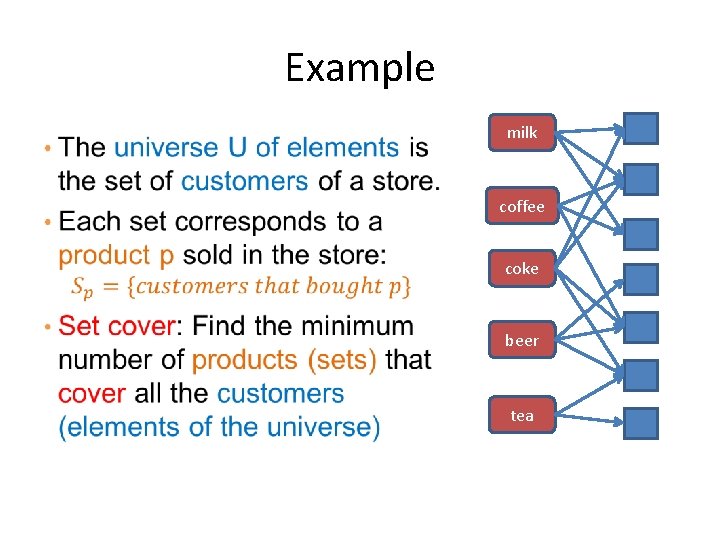
Example • milk coffee coke beer tea
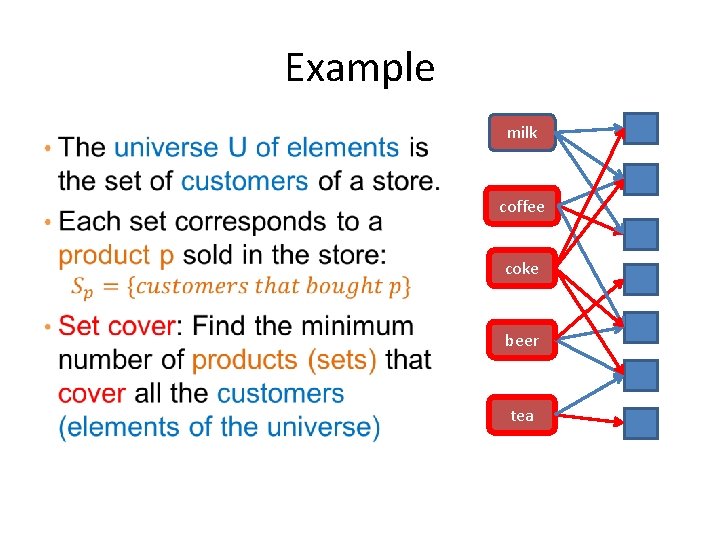
Example • milk coffee coke beer tea
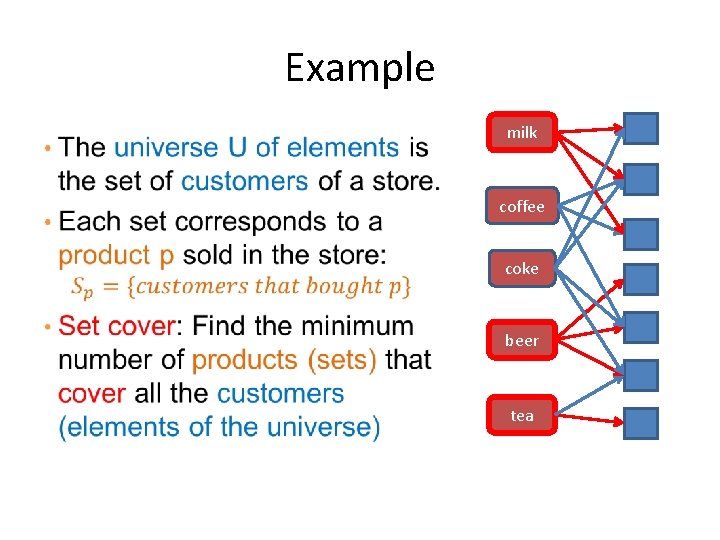
Example • milk coffee coke beer tea
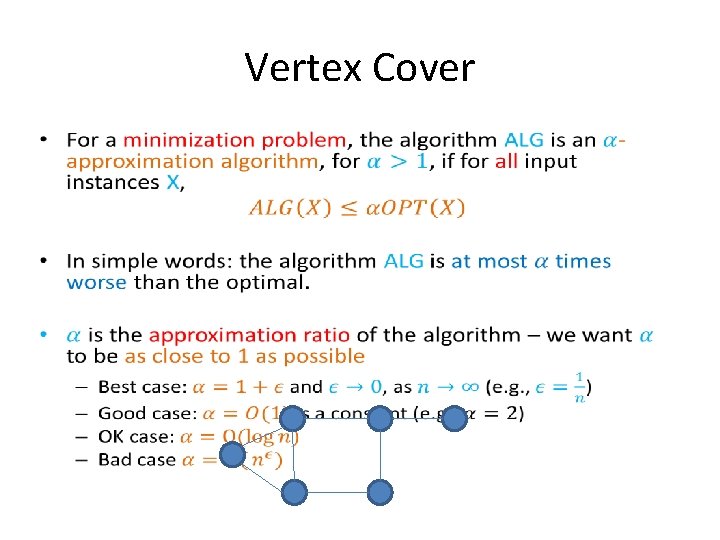
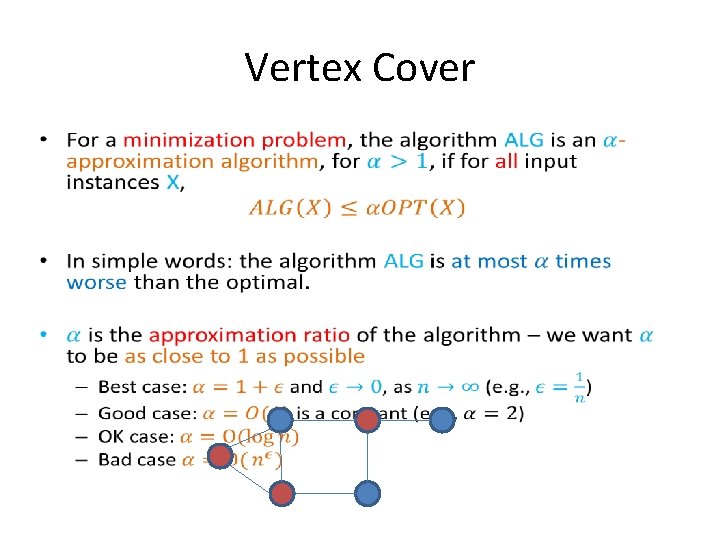
Vertex Cover •
Vertex Cover •
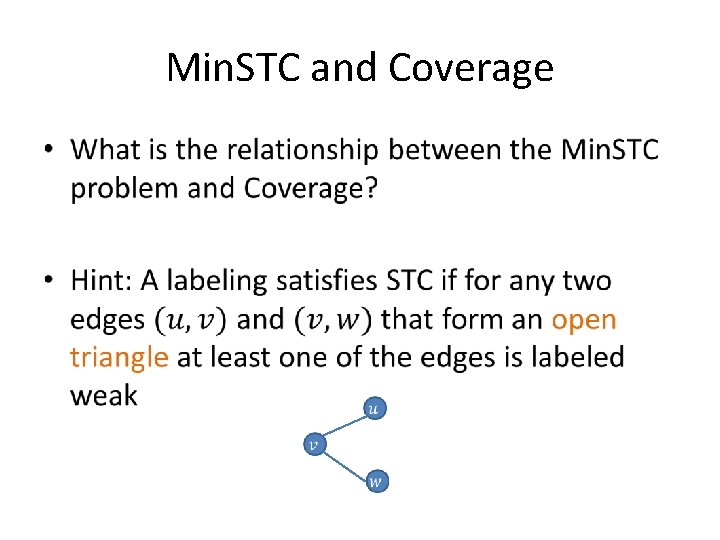
Min. STC and Coverage •
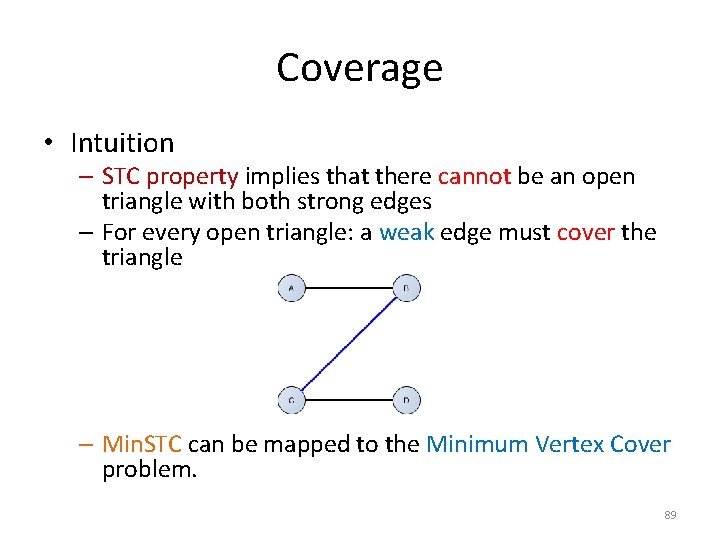
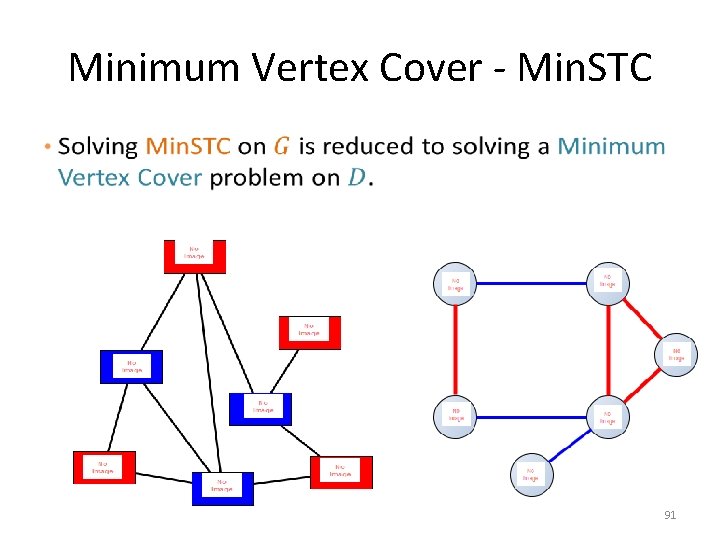
Coverage • Intuition – STC property implies that there cannot be an open triangle with both strong edges – For every open triangle: a weak edge must cover the triangle – Min. STC can be mapped to the Minimum Vertex Cover problem. 89
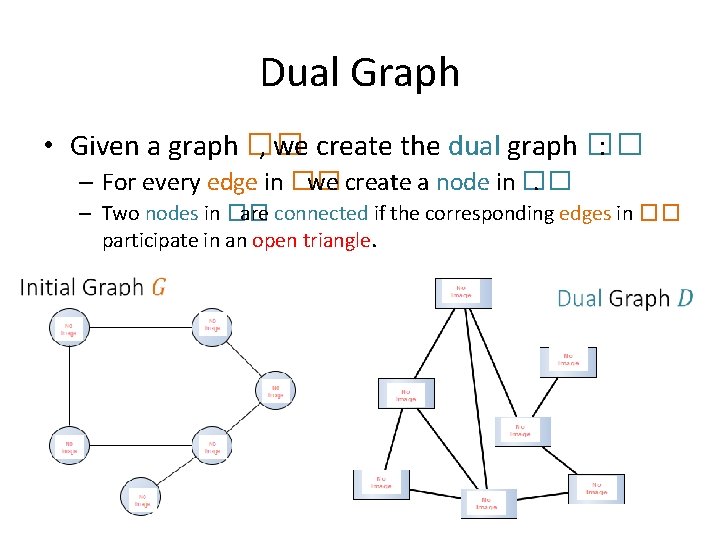
Dual Graph • Given a graph �� , we create the dual graph �� : – For every edge in �� we create a node in ��. – Two nodes in �� are connected if the corresponding edges in �� participate in an open triangle.
Minimum Vertex Cover - Min. STC • 91
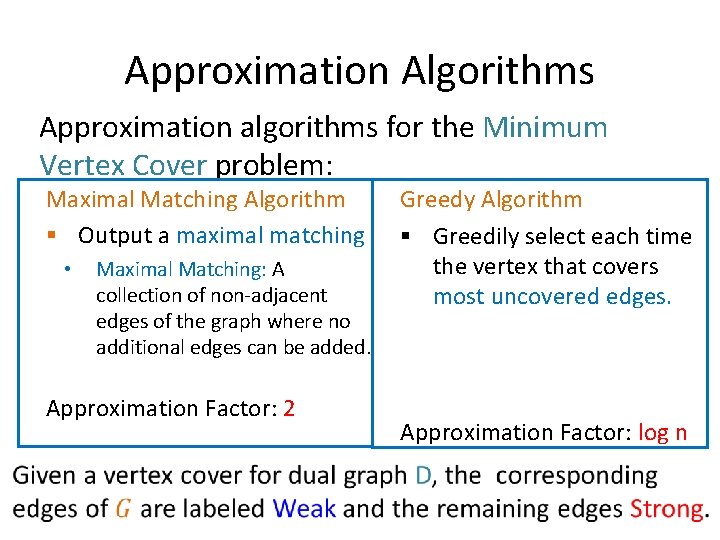
Approximation Algorithms Approximation algorithms for the Minimum Vertex Cover problem: Maximal Matching Algorithm § Output a maximal matching • Maximal Matching: A collection of non-adjacent edges of the graph where no additional edges can be added. Approximation Factor: 2 Greedy Algorithm § Greedily select each time the vertex that covers most uncovered edges. Approximation Factor: log n
Experiments • Experimental Goal: Does our labeling have any practical utility?
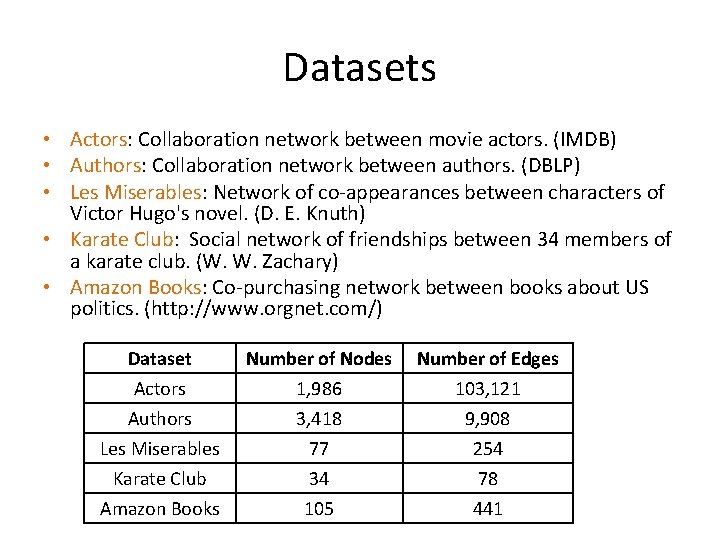
Datasets • Actors: Collaboration network between movie actors. (IMDB) • Authors: Collaboration network between authors. (DBLP) • Les Miserables: Network of co-appearances between characters of Victor Hugo's novel. (D. E. Knuth) • Karate Club: Social network of friendships between 34 members of a karate club. (W. W. Zachary) • Amazon Books: Co-purchasing network between books about US politics. (http: //www. orgnet. com/) Dataset Number of Nodes Number of Edges Actors 1, 986 103, 121 Authors 3, 418 9, 908 Les Miserables 77 254 Karate Club 34 78 Amazon Books 105 441
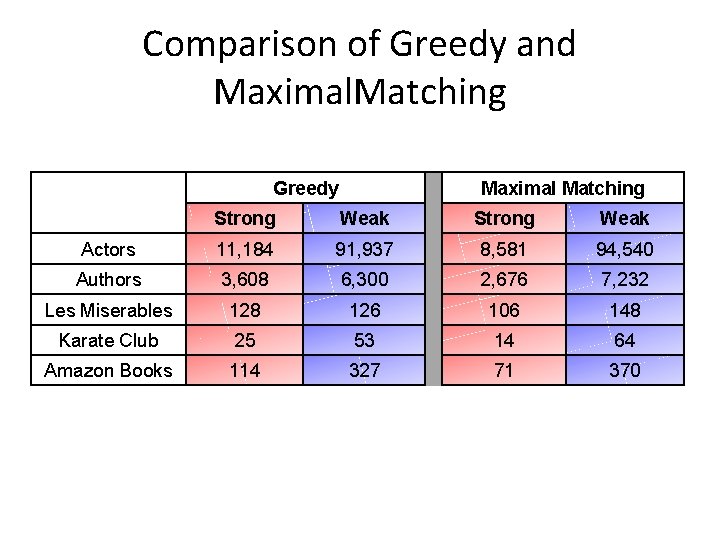
Comparison of Greedy and Maximal. Matching Greedy Maximal Matching Strong Weak Actors 11, 184 91, 937 8, 581 94, 540 Authors 3, 608 6, 300 2, 676 7, 232 Les Miserables 128 126 106 148 Karate Club 25 53 14 64 Amazon Books 114 327 71 370
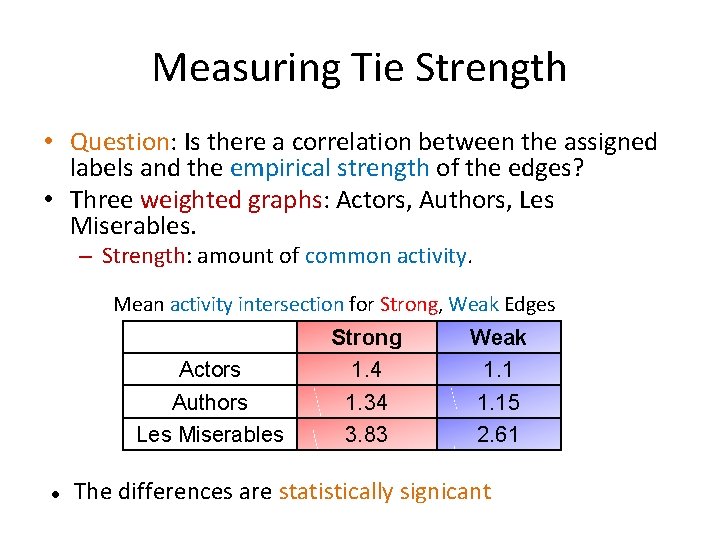
Measuring Tie Strength • Question: Is there a correlation between the assigned labels and the empirical strength of the edges? • Three weighted graphs: Actors, Authors, Les Miserables. – Strength: amount of common activity. Mean activity intersection for Strong, Weak Edges Actors Authors Les Miserables Strong 1. 4 1. 34 3. 83 Weak 1. 15 2. 61 The differences are statistically signicant
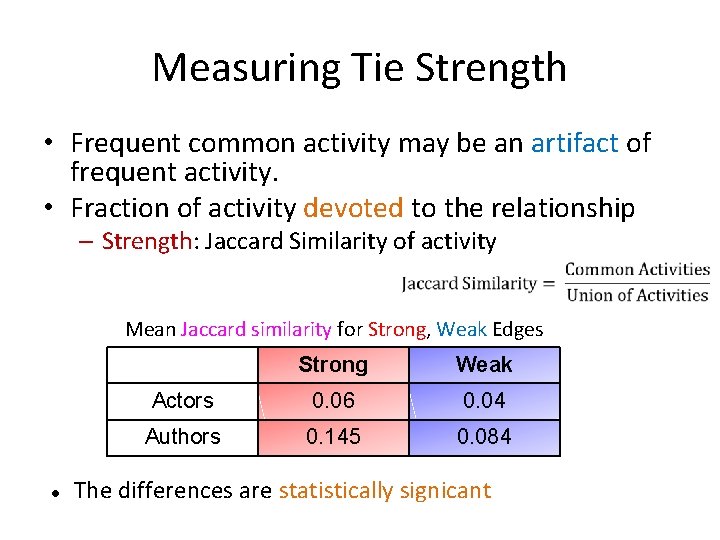
Measuring Tie Strength • Frequent common activity may be an artifact of frequent activity. • Fraction of activity devoted to the relationship – Strength: Jaccard Similarity of activity Mean Jaccard similarity for Strong, Weak Edges Strong Weak Actors 0. 06 0. 04 Authors 0. 145 0. 084 The differences are statistically signicant
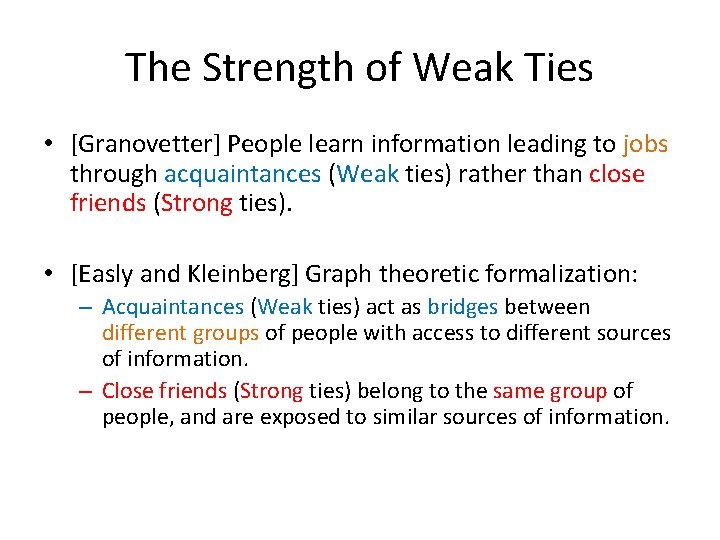
The Strength of Weak Ties • [Granovetter] People learn information leading to jobs through acquaintances (Weak ties) rather than close friends (Strong ties). • [Easly and Kleinberg] Graph theoretic formalization: – Acquaintances (Weak ties) act as bridges between different groups of people with access to different sources of information. – Close friends (Strong ties) belong to the same group of people, and are exposed to similar sources of information.
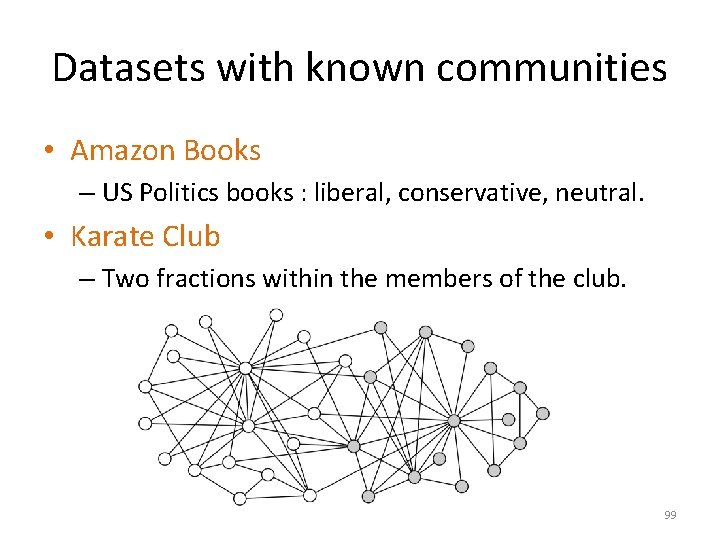
Datasets with known communities • Amazon Books – US Politics books : liberal, conservative, neutral. • Karate Club – Two fractions within the members of the club. 99
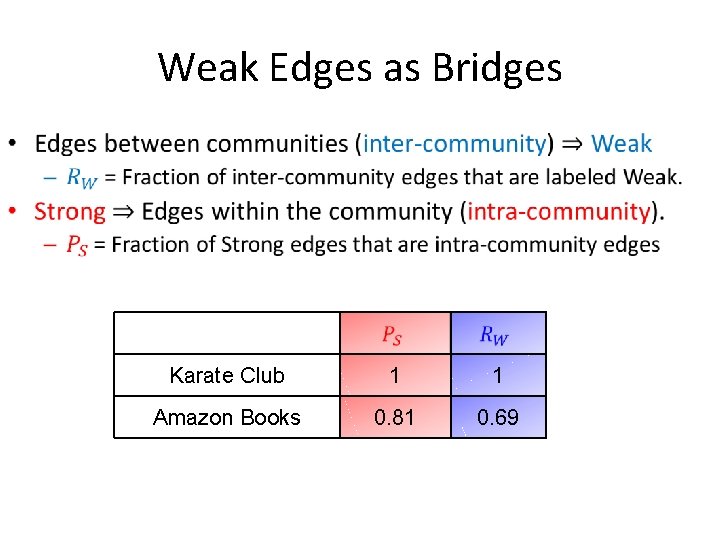
Weak Edges as Bridges • Karate Club 1 1 Amazon Books 0. 81 0. 69
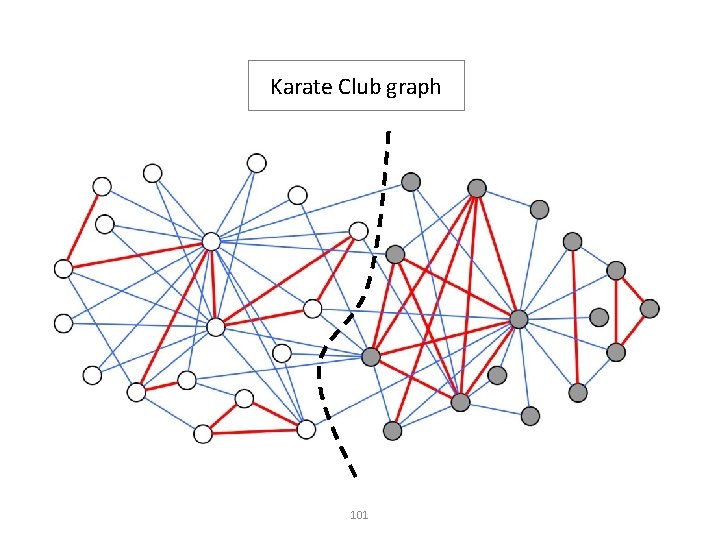
Karate Club graph 101
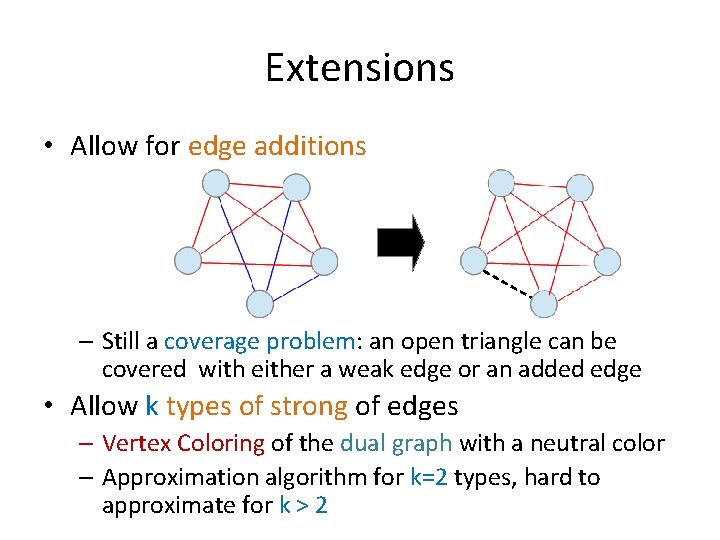
Extensions • Allow for edge additions – Still a coverage problem: an open triangle can be covered with either a weak edge or an added edge • Allow k types of strong of edges – Vertex Coloring of the dual graph with a neutral color – Approximation algorithm for k=2 types, hard to approximate for k > 2
POSITIVE AND NEGATIVE TIES
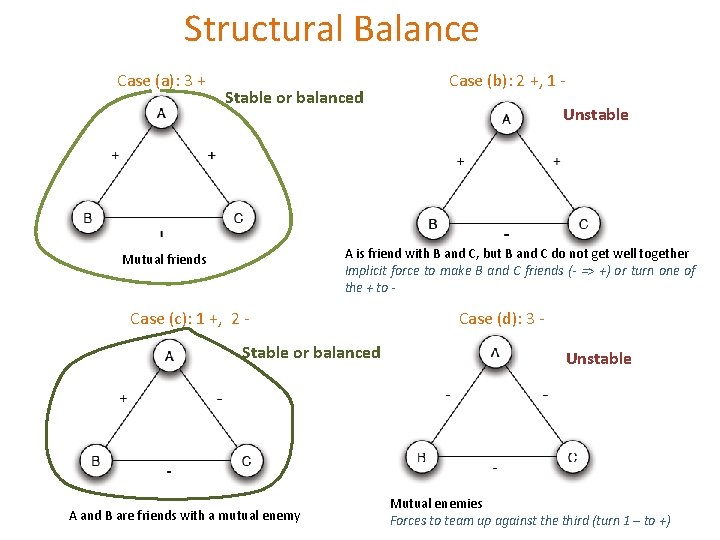
Structural Balance What about negative edges? Initially, a complete graph (or clique): every edge either + or - Let us first look at individual triangles § Lets look at 3 people => 4 cases § See if all are equally possible (local property)
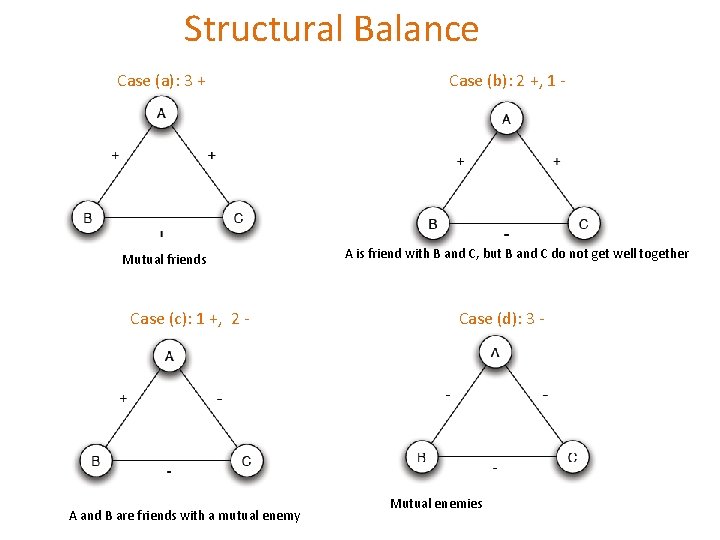
Structural Balance Case (a): 3 + Mutual friends Case (c): 1 +, 2 - A and B are friends with a mutual enemy Case (b): 2 +, 1 - A is friend with B and C, but B and C do not get well together Case (d): 3 - Mutual enemies
Structural Balance Case (a): 3 + Stable or balanced Case (b): 2 +, 1 Unstable A is friend with B and C, but B and C do not get well together Implicit force to make B and C friends (- => +) or turn one of the + to - Mutual friends Case (c): 1 +, 2 Stable or balanced A and B are friends with a mutual enemy Case (d): 3 Unstable Mutual enemies Forces to team up against the third (turn 1 – to +)
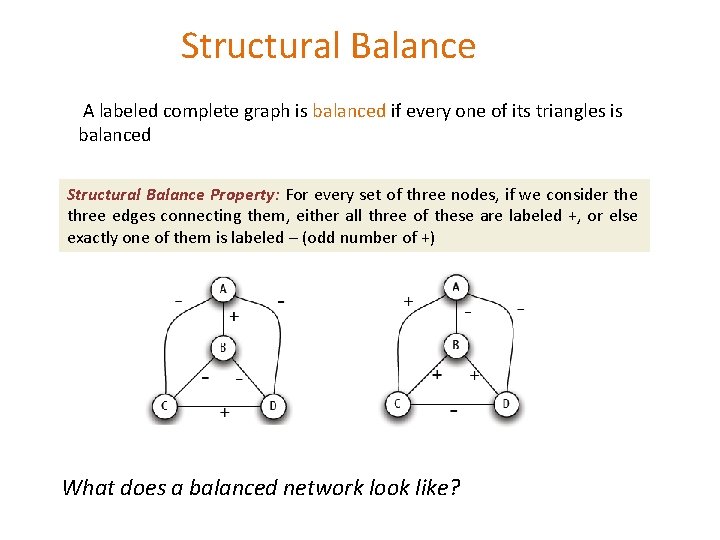
Structural Balance A labeled complete graph is balanced if every one of its triangles is balanced Structural Balance Property: For every set of three nodes, if we consider the three edges connecting them, either all three of these are labeled +, or else exactly one of them is labeled – (odd number of +) What does a balanced network look like?
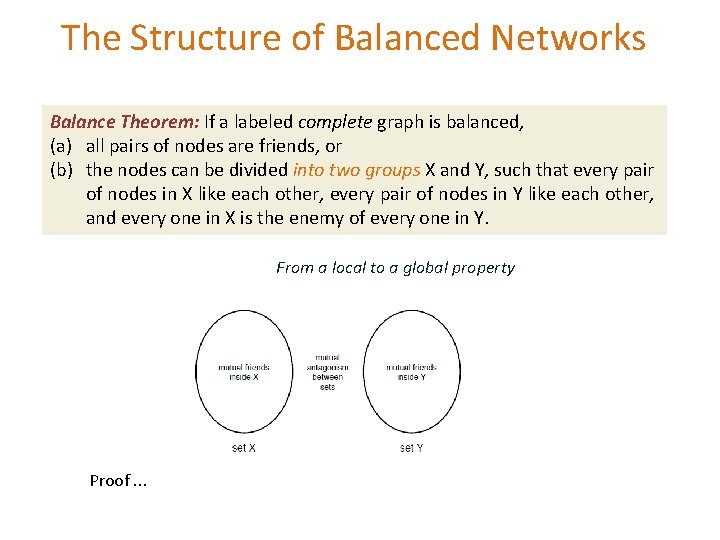
The Structure of Balanced Networks Balance Theorem: If a labeled complete graph is balanced, (a) all pairs of nodes are friends, or (b) the nodes can be divided into two groups X and Y, such that every pair of nodes in X like each other, every pair of nodes in Y like each other, and every one in X is the enemy of every one in Y. From a local to a global property Proof. . .
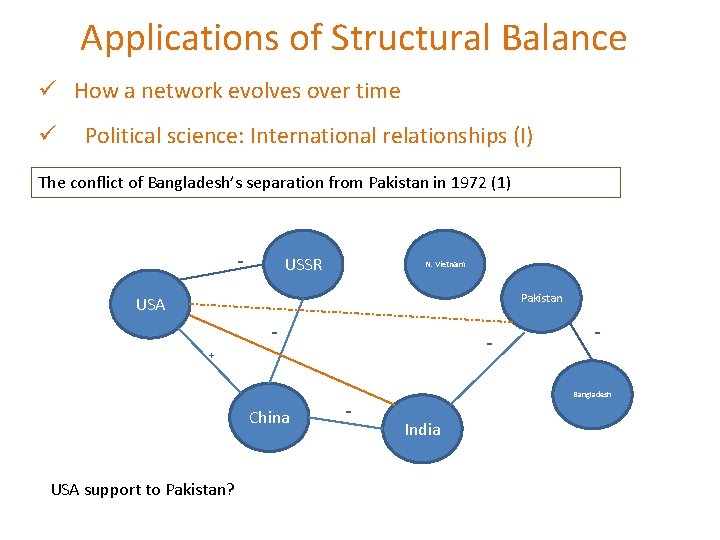
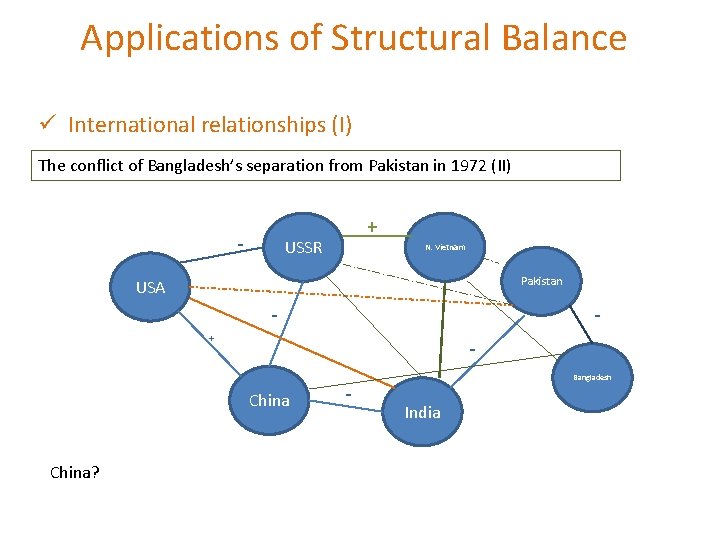
Applications of Structural Balance ü How a network evolves over time ü Political science: International relationships (I) The conflict of Bangladesh’s separation from Pakistan in 1972 (1) - USSR N. Vietnam Pakistan USA - - + China USA support to Pakistan? - Bangladesh India
Applications of Structural Balance ü International relationships (I) The conflict of Bangladesh’s separation from Pakistan in 1972 (II) - + USSR N. Vietnam Pakistan USA - - + China? - Bangladesh India
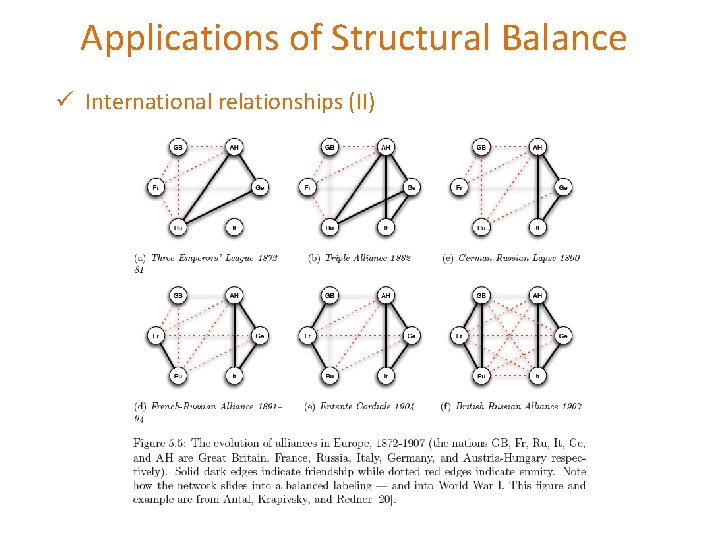
Applications of Structural Balance ü International relationships (II)
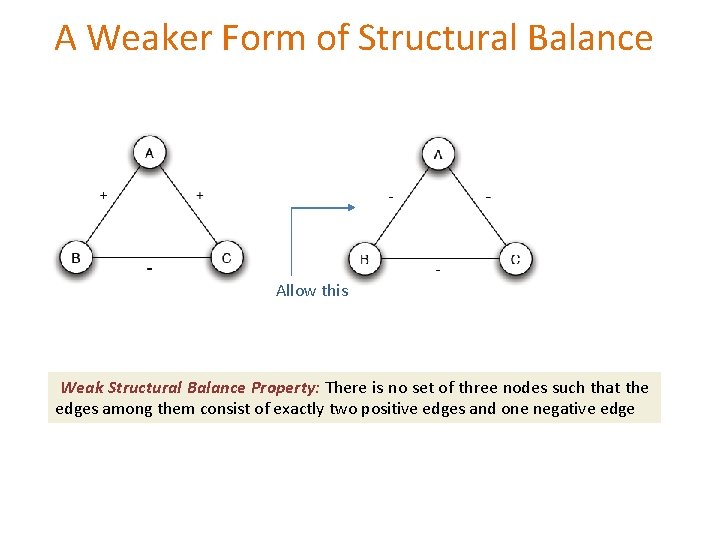
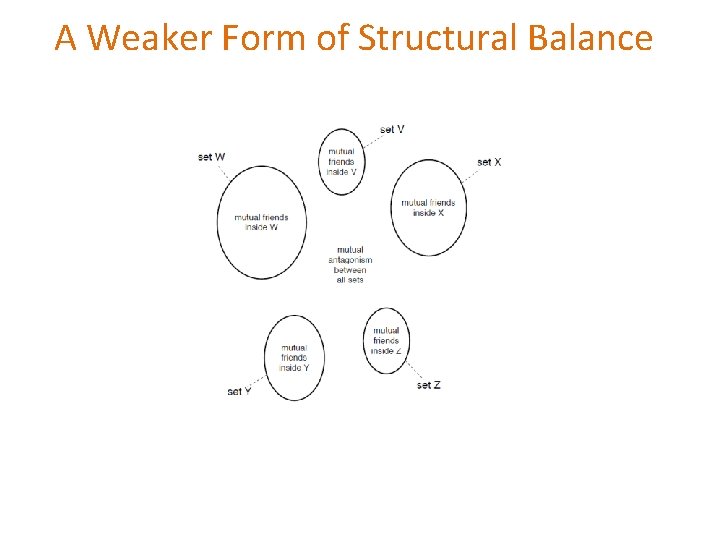
A Weaker Form of Structural Balance Allow this Weak Structural Balance Property: There is no set of three nodes such that the edges among them consist of exactly two positive edges and one negative edge
A Weaker Form of Structural Balance Weakly Balance Theorem: If a labeled complete graph is weakly balanced, its nodes can be divided into groups in such a way that every two nodes belonging to the same group are friends, and every two nodes belonging to different groups are enemies. Proof …
A Weaker Form of Structural Balance
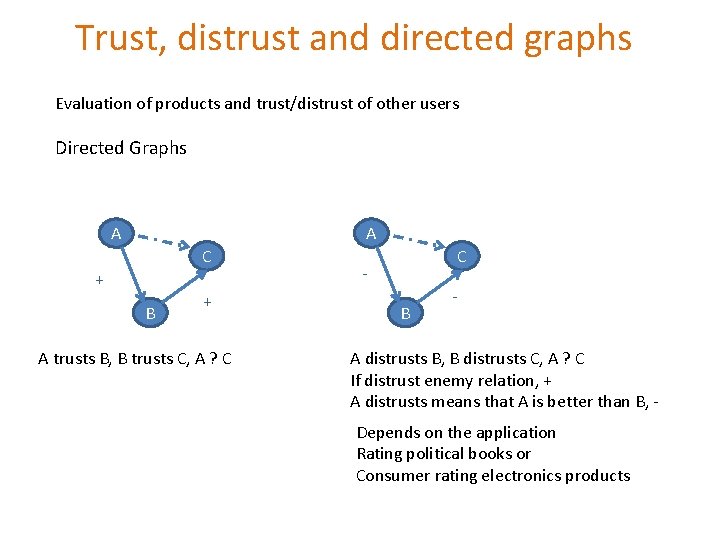
Trust, distrust and directed graphs Evaluation of products and trust/distrust of other users Directed Graphs A A C + B + A trusts B, B trusts C, A ? C C B - A distrusts B, B distrusts C, A ? C If distrust enemy relation, + A distrusts means that A is better than B, Depends on the application Rating political books or Consumer rating electronics products
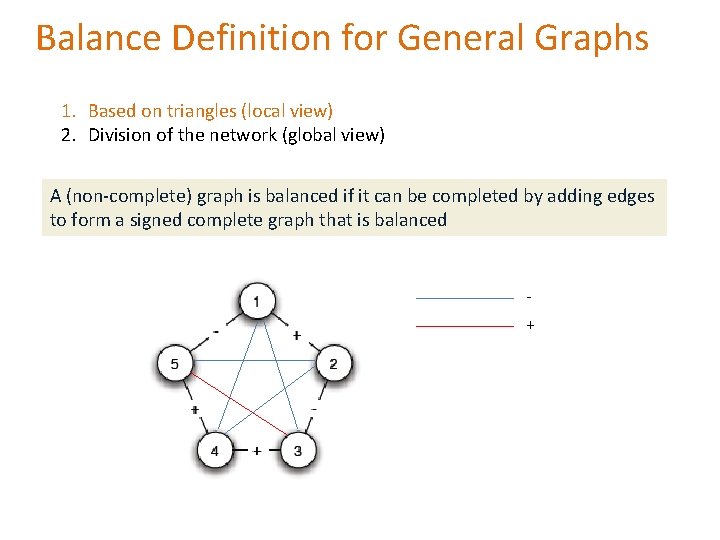
Generalizing 1. Non-complete graphs 2. Instead of all triangles, “most” triangles, approximately divide the graph We shall use the original (“non-weak” definition of structural balance)
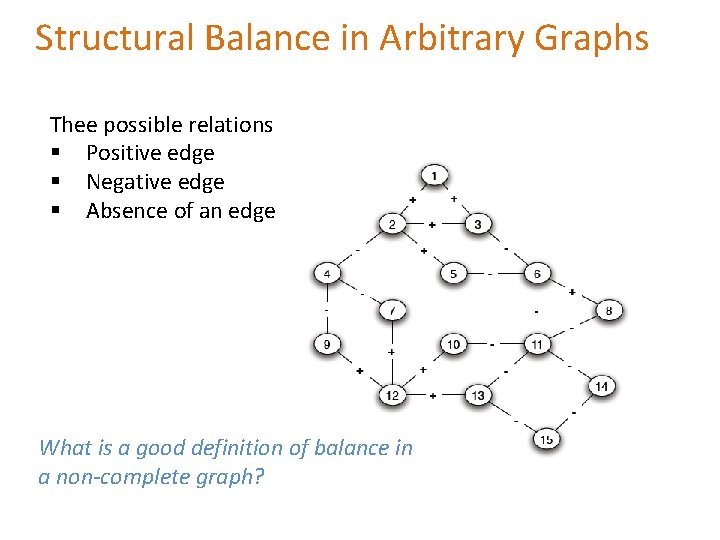
Structural Balance in Arbitrary Graphs Thee possible relations § Positive edge § Negative edge § Absence of an edge What is a good definition of balance in a non-complete graph?
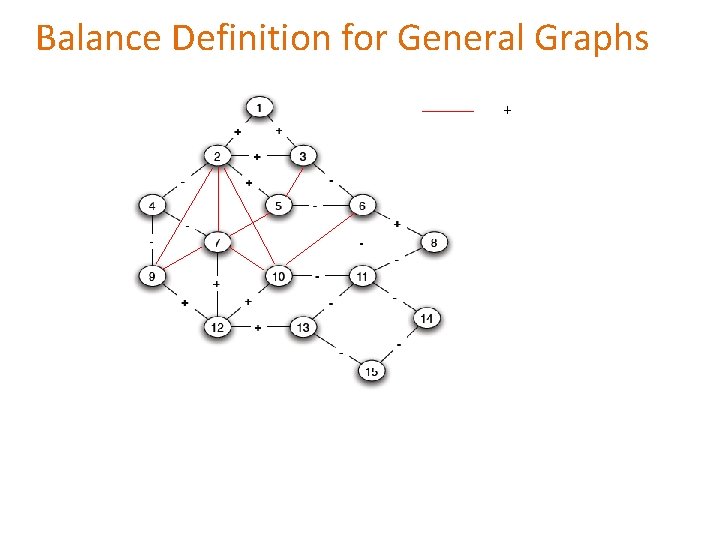
Balance Definition for General Graphs 1. Based on triangles (local view) 2. Division of the network (global view) A (non-complete) graph is balanced if it can be completed by adding edges to form a signed complete graph that is balanced +
Balance Definition for General Graphs +
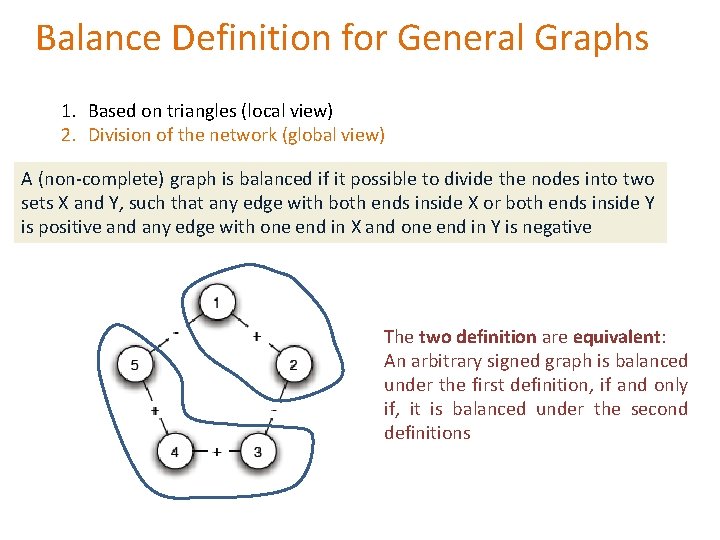
Balance Definition for General Graphs 1. Based on triangles (local view) 2. Division of the network (global view) A (non-complete) graph is balanced if it possible to divide the nodes into two sets X and Y, such that any edge with both ends inside X or both ends inside Y is positive and any edge with one end in X and one end in Y is negative The two definition are equivalent: An arbitrary signed graph is balanced under the first definition, if and only if, it is balanced under the second definitions
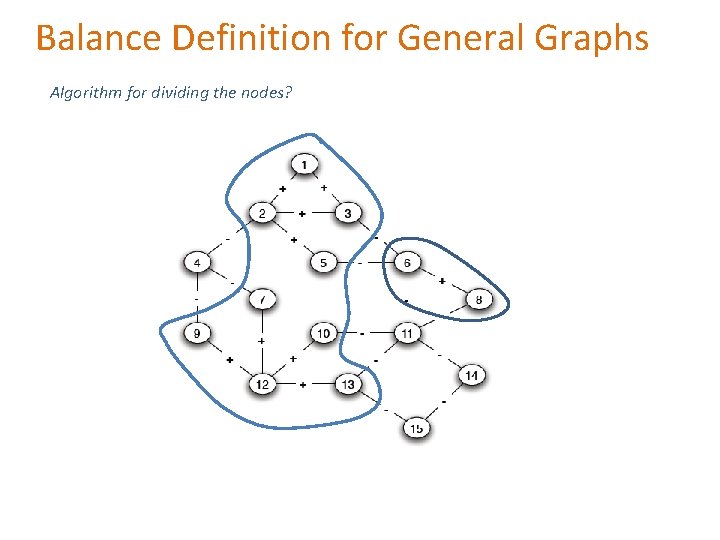
Balance Definition for General Graphs Algorithm for dividing the nodes?
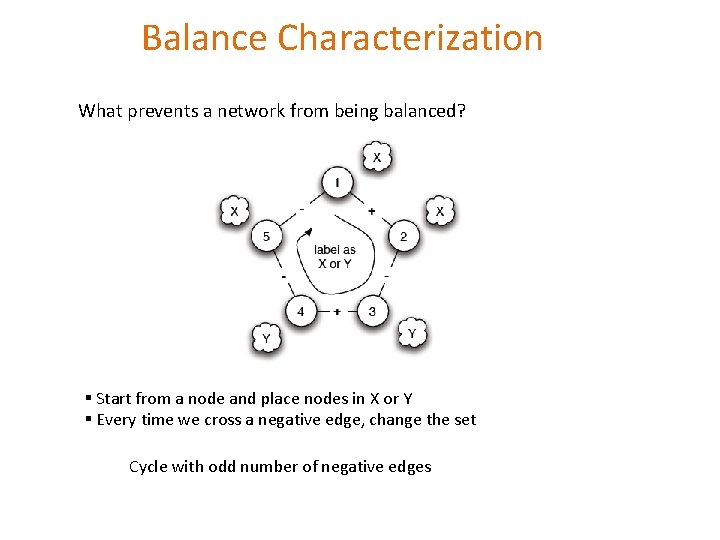
Balance Characterization What prevents a network from being balanced? § Start from a node and place nodes in X or Y § Every time we cross a negative edge, change the set Cycle with odd number of negative edges
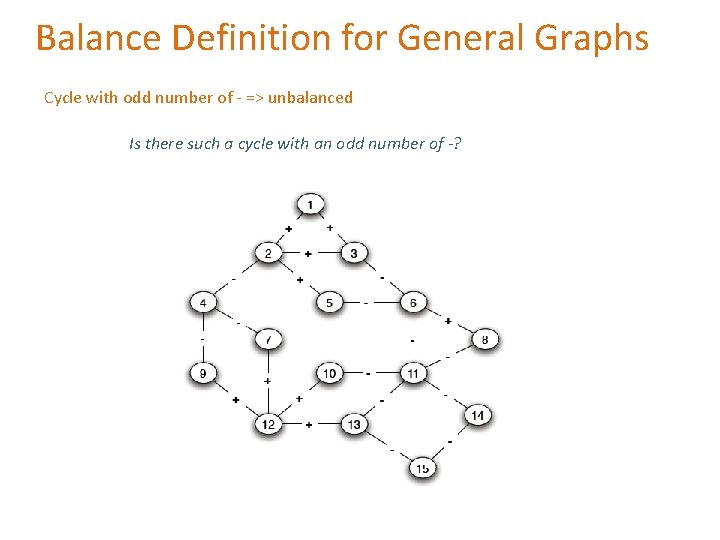
Balance Definition for General Graphs Cycle with odd number of - => unbalanced Is there such a cycle with an odd number of -?
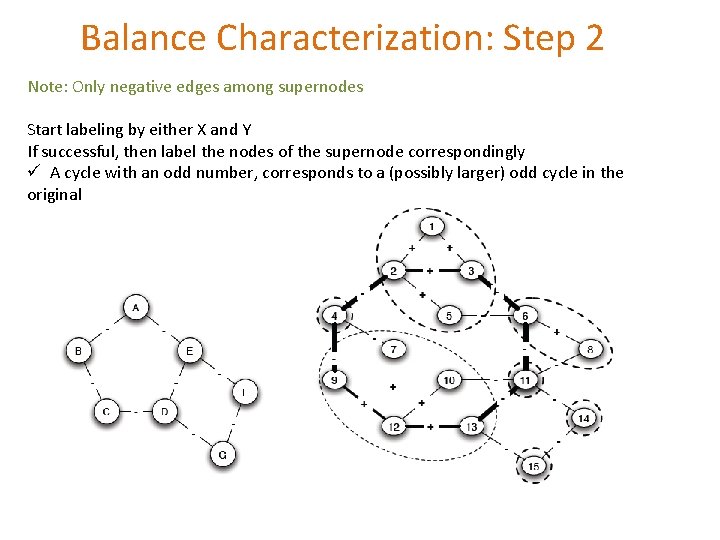
Balance Characterization Claim: A signed graph is balanced, if and only if, it contains no cycles with an odd number of negative edges (proof by construction) Find a balanced division: partition into sets X and Y, all edges inside X and Y positive, crossing edges negative Either succeeds or Stops with a cycle containing an odd number of Two steps: 1. Convert the graph into a reduced one with only negative edges 2. Solve the problem in the reduced graph
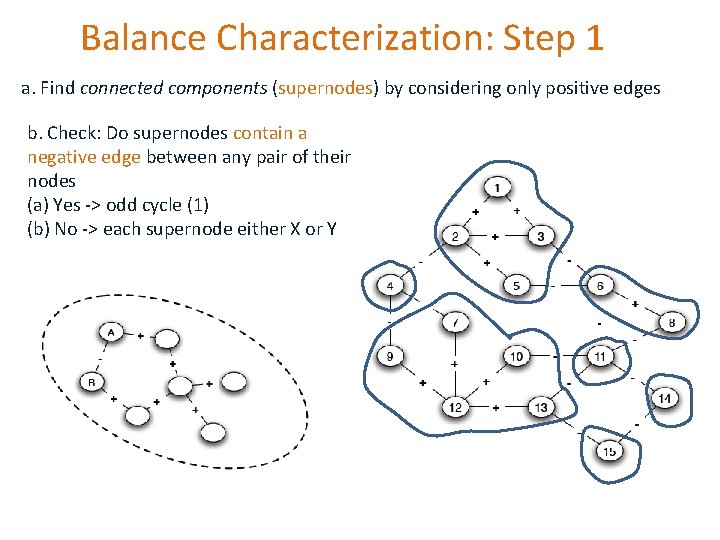
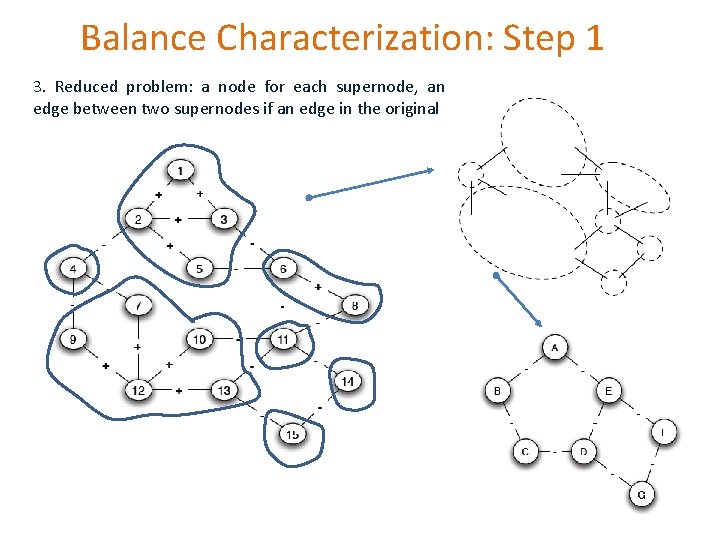
Balance Characterization: Step 1 a. Find connected components (supernodes) by considering only positive edges b. Check: Do supernodes contain a negative edge between any pair of their nodes (a) Yes -> odd cycle (1) (b) No -> each supernode either X or Y
Balance Characterization: Step 1 3. Reduced problem: a node for each supernode, an edge between two supernodes if an edge in the original
Balance Characterization: Step 2 Note: Only negative edges among supernodes Start labeling by either X and Y If successful, then label the nodes of the supernode correspondingly ü A cycle with an odd number, corresponds to a (possibly larger) odd cycle in the original
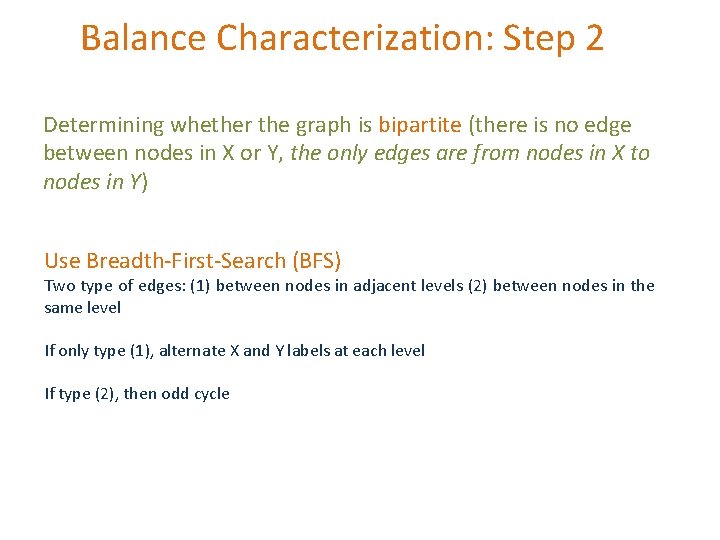
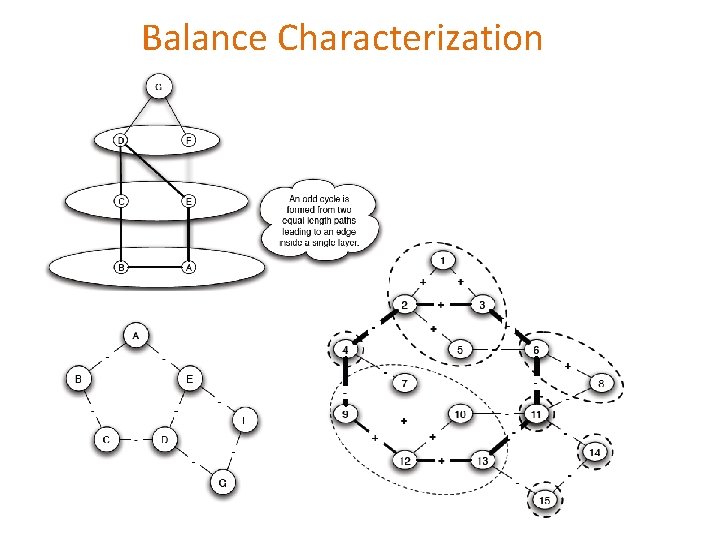
Balance Characterization: Step 2 Determining whether the graph is bipartite (there is no edge between nodes in X or Y, the only edges are from nodes in X to nodes in Y) Use Breadth-First-Search (BFS) Two type of edges: (1) between nodes in adjacent levels (2) between nodes in the same level If only type (1), alternate X and Y labels at each level If type (2), then odd cycle
Balance Characterization
Generalizing 1. Non-complete graphs 2. Instead of all triangles, “most” triangles, approximately divide the graph
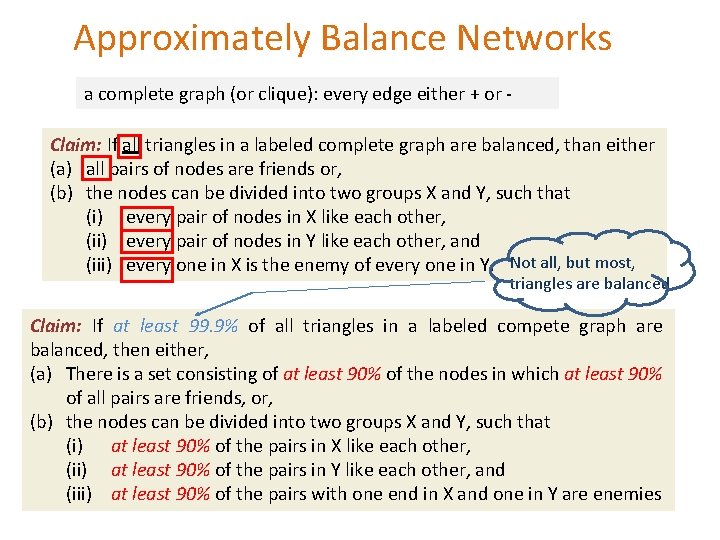
Approximately Balance Networks a complete graph (or clique): every edge either + or Claim: If all triangles in a labeled complete graph are balanced, than either (a) all pairs of nodes are friends or, (b) the nodes can be divided into two groups X and Y, such that (i) every pair of nodes in X like each other, (ii) every pair of nodes in Y like each other, and (iii) every one in X is the enemy of every one in Y. Not all, but most, triangles are balanced Claim: If at least 99. 9% of all triangles in a labeled compete graph are balanced, then either, (a) There is a set consisting of at least 90% of the nodes in which at least 90% of all pairs are friends, or, (b) the nodes can be divided into two groups X and Y, such that (i) at least 90% of the pairs in X like each other, (ii) at least 90% of the pairs in Y like each other, and (iii) at least 90% of the pairs with one end in X and one in Y are enemies
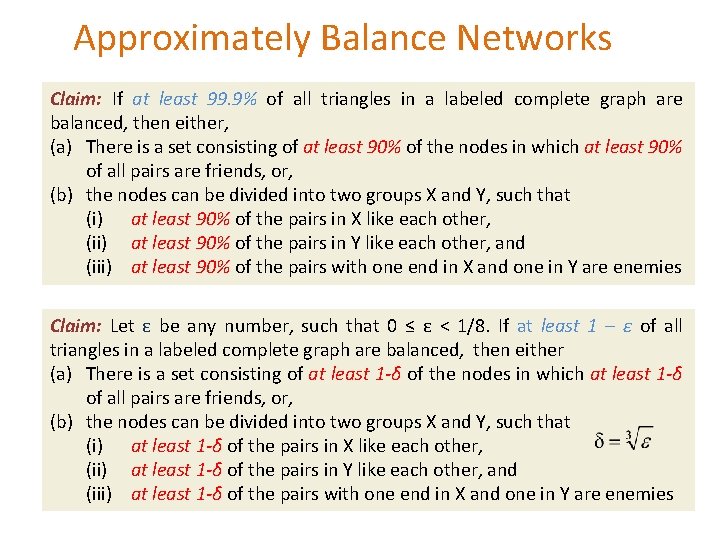
Approximately Balance Networks Claim: If at least 99. 9% of all triangles in a labeled complete graph are balanced, then either, (a) There is a set consisting of at least 90% of the nodes in which at least 90% of all pairs are friends, or, (b) the nodes can be divided into two groups X and Y, such that (i) at least 90% of the pairs in X like each other, (ii) at least 90% of the pairs in Y like each other, and (iii) at least 90% of the pairs with one end in X and one in Y are enemies Claim: Let ε be any number, such that 0 ≤ ε < 1/8. If at least 1 – ε of all triangles in a labeled complete graph are balanced, then either (a) There is a set consisting of at least 1 -δ of the nodes in which at least 1 -δ of all pairs are friends, or, (b) the nodes can be divided into two groups X and Y, such that (i) at least 1 -δ of the pairs in X like each other, (ii) at least 1 -δ of the pairs in Y like each other, and (iii) at least 1 -δ of the pairs with one end in X and one in Y are enemies
References Networks, Crowds, and Markets (Chapter 3, 5) S. Sintos, P. Tsaparas, Using Strong Triadic Closure to Characterize Ties in Social Networks. ACM International Conference on Knowledge Discovery and Data Mining (KDD), August 2014