
Numpy Tutorial CSE 5539 Social Media Text Analytics



- Slides: 23
Numpy Tutorial CSE 5539 - Social Media & Text Analytics
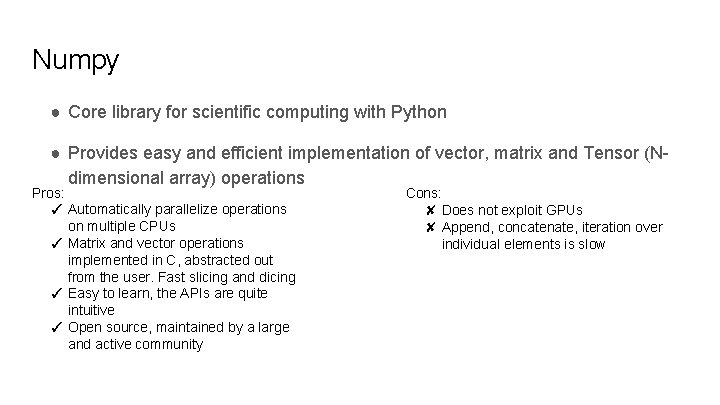
Numpy ● Core library for scientific computing with Python ● Provides easy and efficient implementation of vector, matrix and Tensor (Ndimensional array) operations Pros: ✓ Automatically parallelize operations on multiple CPUs ✓ Matrix and vector operations implemented in C, abstracted out from the user. Fast slicing and dicing ✓ Easy to learn, the APIs are quite intuitive ✓ Open source, maintained by a large and active community Cons: ✘ Does not exploit GPUs ✘ Append, concatenate, iteration over individual elements is slow
This Tutorial ➢Explore numpy package, ndarray object, its attributes and methods ➢Introduces Linear Regression via Ordinary Least Squares ➢Implement OLS using numpy Prerequisites: ➢ Python programming experience ➢ Laptop: with Python, Num. Py, Jupyter ➢ Your undivided attention for an hour!!
Part I: Getting Hands Dirty with Numpy
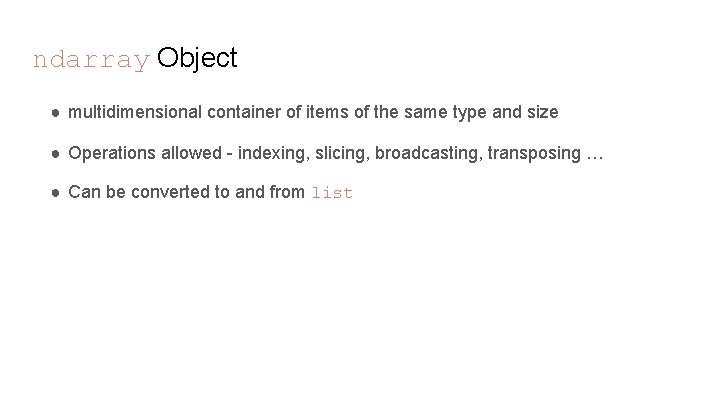
ndarray Object ● multidimensional container of items of the same type and size ● Operations allowed - indexing, slicing, broadcasting, transposing … ● Can be converted to and from list
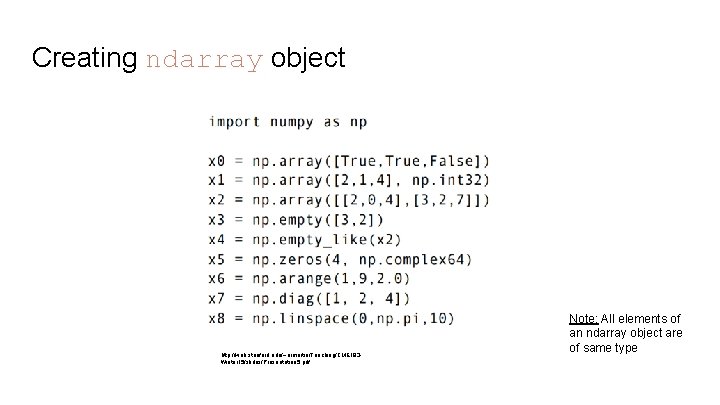
Creating ndarray object http: //web. stanford. edu/~ermartin/Teaching/CME 193 Winter 15/slides/Presentation 5. pdf Note: All elements of an ndarray object are of same type
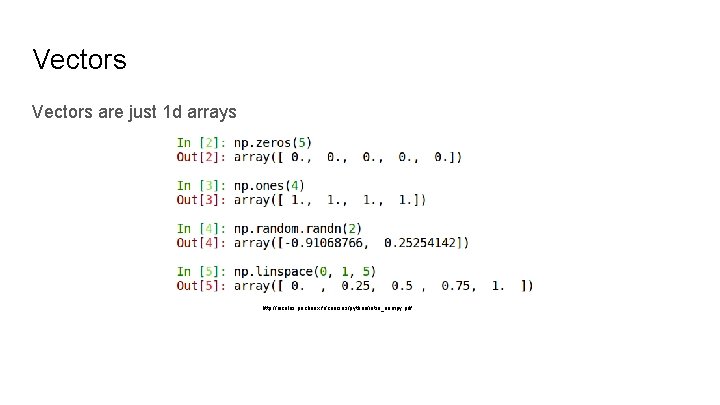
Vectors are just 1 d arrays http: //nicolas. pecheux. fr/courses/python/intro_numpy. pdf
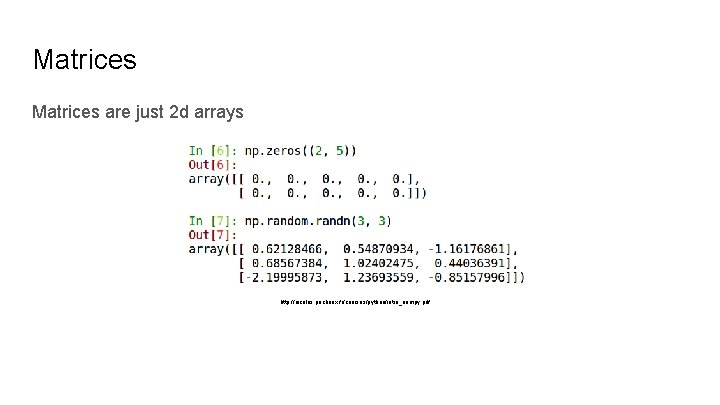
Matrices are just 2 d arrays http: //nicolas. pecheux. fr/courses/python/intro_numpy. pdf
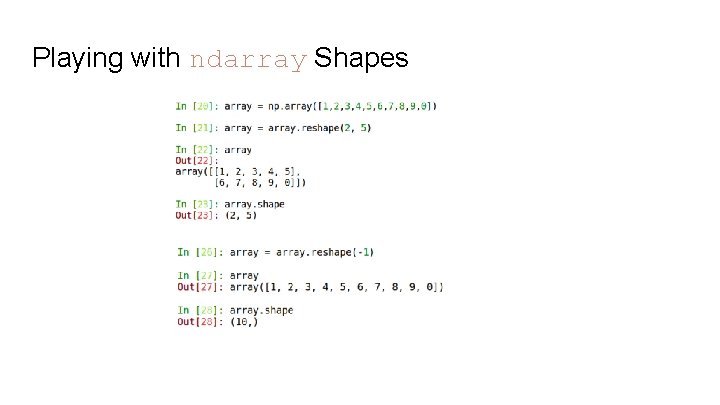
Playing with ndarray Shapes
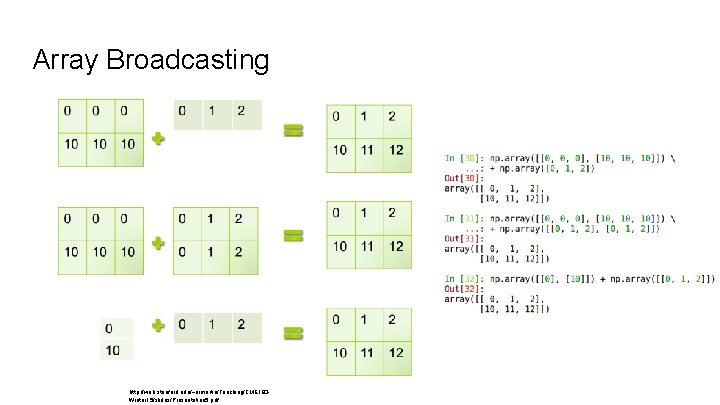
Array Broadcasting http: //web. stanford. edu/~ermartin/Teaching/CME 193 Winter 15/slides/Presentation 5. pdf
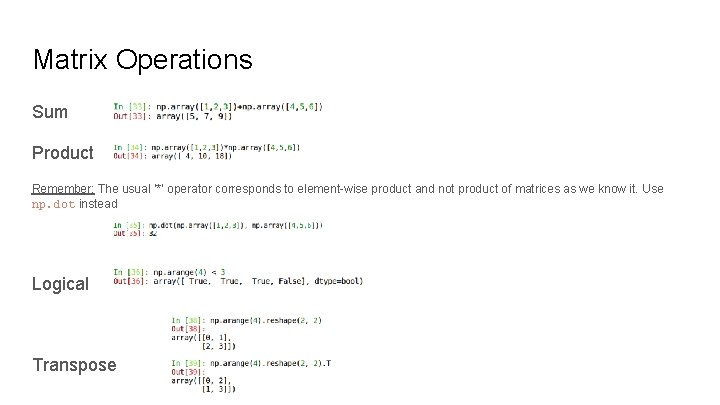
Matrix Operations Sum Product Remember: The usual ‘*’ operator corresponds to element-wise product and not product of matrices as we know it. Use np. dot instead Logical Transpose
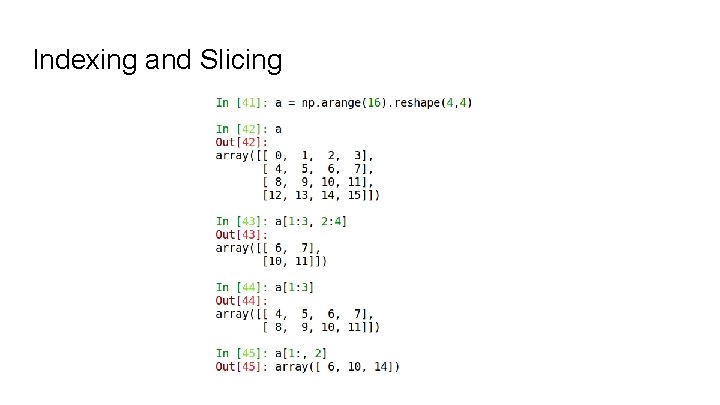
Indexing and Slicing
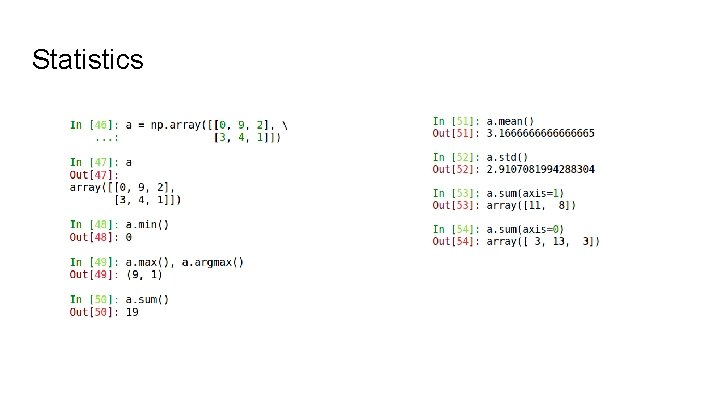
Statistics
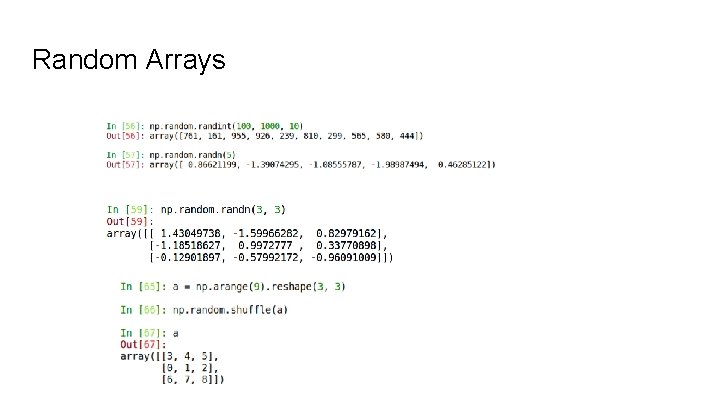
Random Arrays
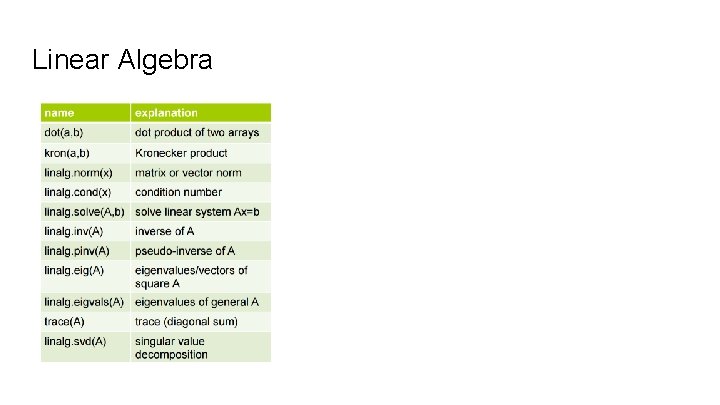
Linear Algebra
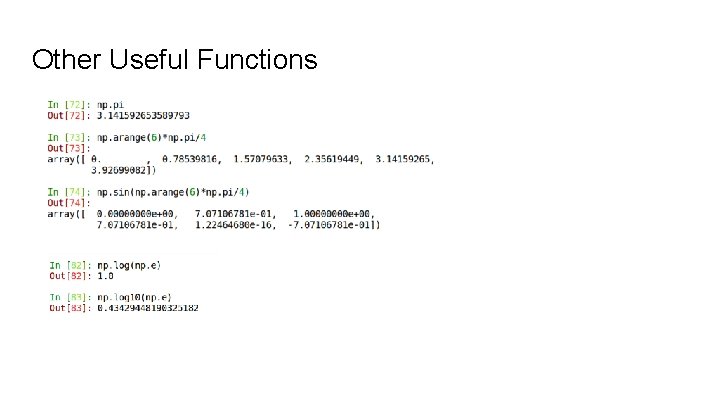
Other Useful Functions
Some useful links Documentation: https: //docs. scipy. org/doc/numpy-dev/reference/ Issues: https: //github. com/numpy/issues Questions: https: //stackoverflow. com/questions/tagged/numpy
Part II: Building a Simple Regression Model
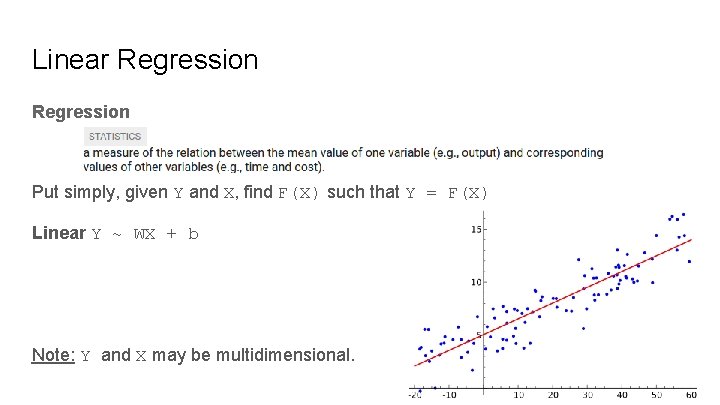
Linear Regression Put simply, given Y and X, find F(X) such that Y = F(X) Linear Y ~ WX + b Note: Y and X may be multidimensional.
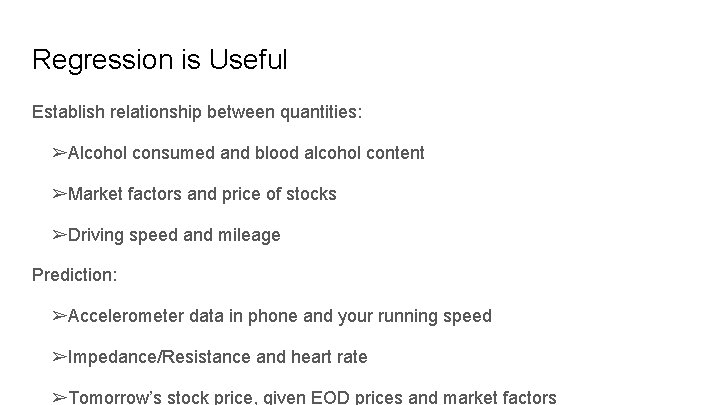
Regression is Useful Establish relationship between quantities: ➢Alcohol consumed and blood alcohol content ➢Market factors and price of stocks ➢Driving speed and mileage Prediction: ➢Accelerometer data in phone and your running speed ➢Impedance/Resistance and heart rate ➢Tomorrow’s stock price, given EOD prices and market factors
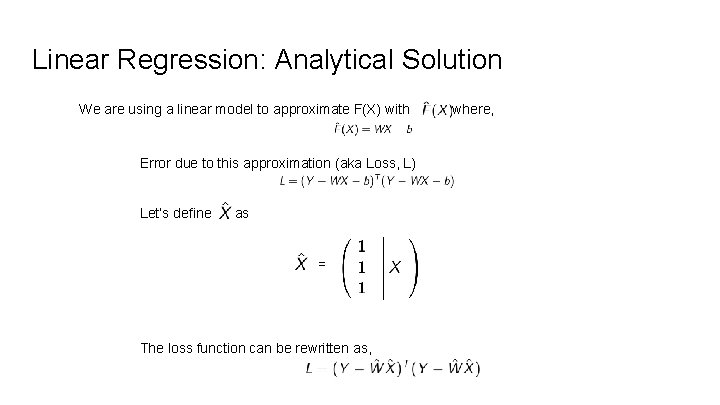
Linear Regression: Analytical Solution We are using a linear model to approximate F(X) with Error due to this approximation (aka Loss, L) Let’s define as = The loss function can be rewritten as, where,
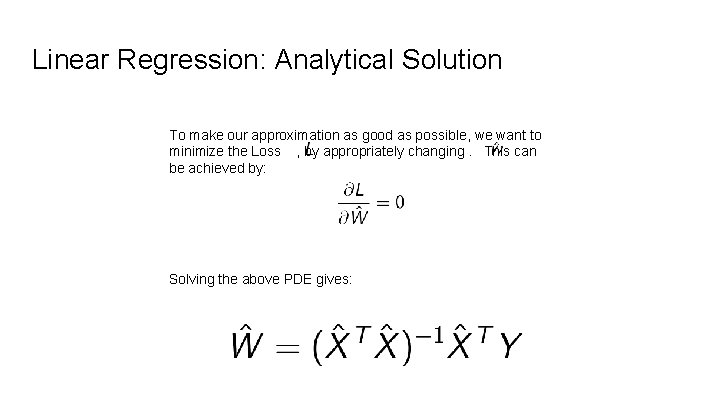
Linear Regression: Analytical Solution To make our approximation as good as possible, we want to minimize the Loss , by appropriately changing. This can be achieved by: Solving the above PDE gives:
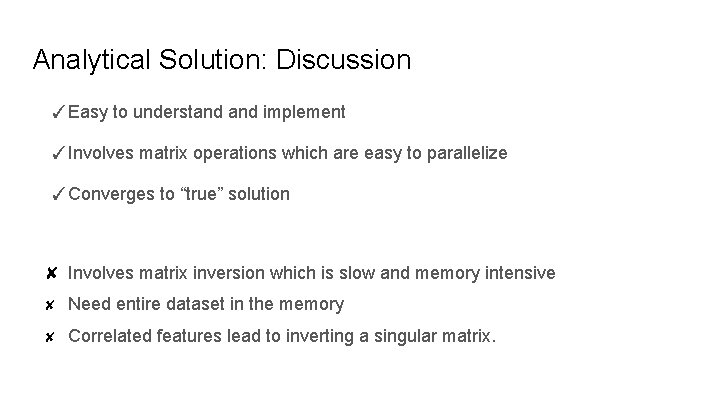
Analytical Solution: Discussion ✓Easy to understand implement ✓Involves matrix operations which are easy to parallelize ✓Converges to “true” solution ✘ Involves matrix inversion which is slow and memory intensive ✘ Need entire dataset in the memory ✘ Correlated features lead to inverting a singular matrix.