HOW DOES SOCIAL MEDIA IMPACT THE PERCEPTION OF

- Slides: 11
HOW DOES SOCIAL MEDIA IMPACT THE PERCEPTION OF EXCESSIVE USE OF FORCE? Orr, T. Research Proposal March 3, 2015
RESEARCH PROBLEM/QUESTION Research Problem There is no central database for record keeping of excessive force incidents (Johnson, Hoyer, & Heath, 2014). Researchers find it difficult to gather statistical data on the number of excessive force incidents (Johnson, Hoyer, & Heath, 2014). Research Question Has social media decreased the number of excessive use of force incidents? Does social media deter police officers from using excessive force?
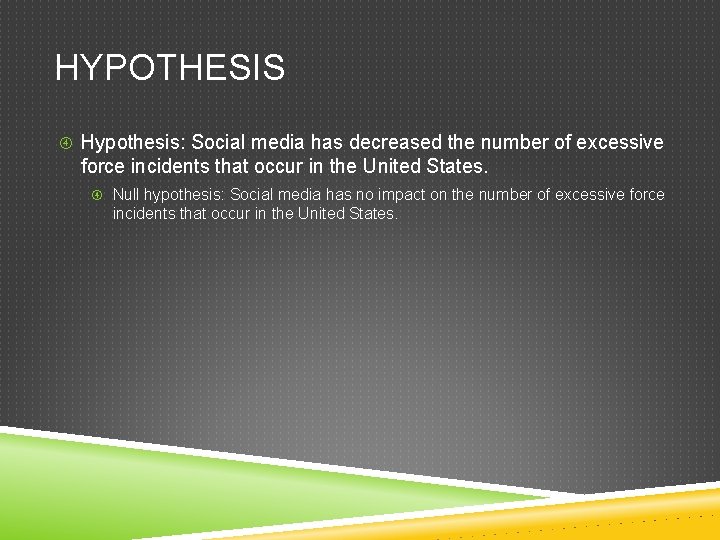
HYPOTHESIS Hypothesis: Social media has decreased the number of excessive force incidents that occur in the United States. Null hypothesis: Social media has no impact on the number of excessive force incidents that occur in the United States.
LITERATURE REVIEW What we know about excessive force Race of officer – no effect (Hassell & Archbold, 2010) Age of officer – younger more incidents, older less incidents (Hassell & Archbold, 2010) Education of officer- high school more incidents, bachelors degree less incidents (Mc. Elvain et al, 2008). Suspect resistance – more likely to use force (Stinson, 2015) What we don’t know The impact of social media on the perception of excessive force
METHODOLOGICAL PLAN Explanatory Study Research will identify the causes and effects between social media and excessive use of force Mixed Methods Netnography Content analysis Time series design
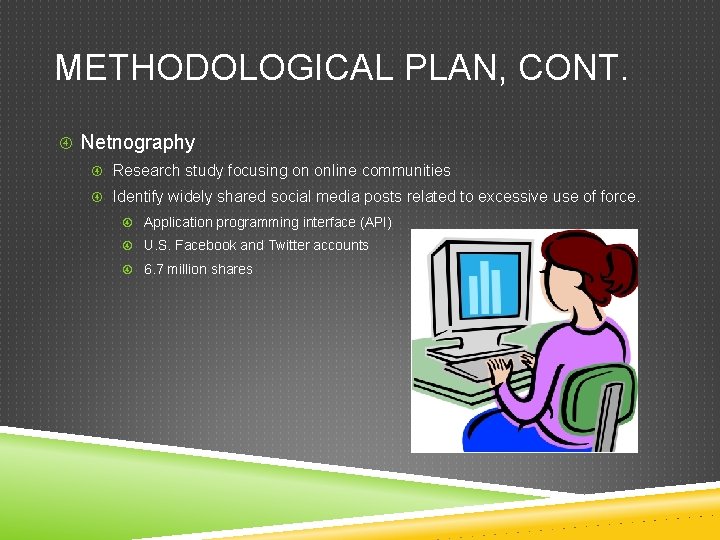
METHODOLOGICAL PLAN, CONT. Netnography Research study focusing on online communities Identify widely shared social media posts related to excessive use of force. Application programming interface (API) U. S. Facebook and Twitter accounts 6. 7 million shares
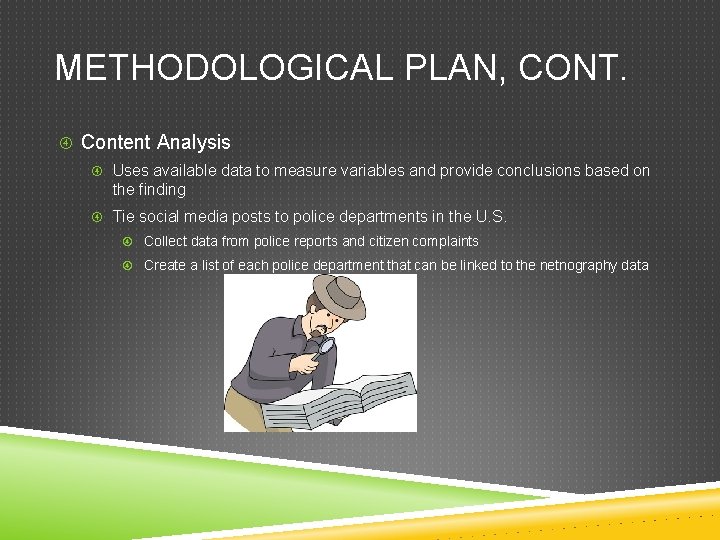
METHODOLOGICAL PLAN, CONT. Content Analysis Uses available data to measure variables and provide conclusions based on the finding Tie social media posts to police departments in the U. S. Collect data from police reports and citizen complaints Create a list of each police department that can be linked to the netnography data
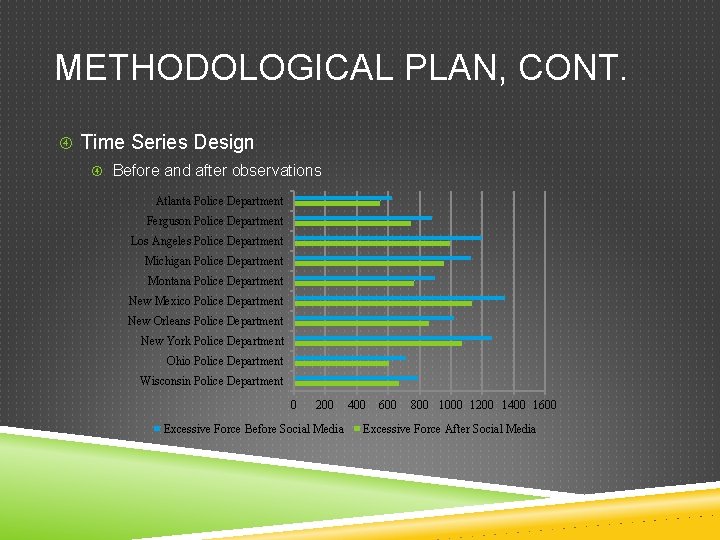
METHODOLOGICAL PLAN, CONT. Time Series Design Before and after observations Atlanta Police Department Ferguson Police Department Los Angeles Police Department Michigan Police Department Montana Police Department New Mexico Police Department New Orleans Police Department New York Police Department Ohio Police Department Wisconsin Police Department 0 200 Excessive Force Before Social Media 400 600 800 1000 1200 1400 1600 Excessive Force After Social Media
LIMITATIONS Logistical Challenges: 6. 7 million shares may be too high Problems linking social media post to police department Difficult to identify excessive force police reports and citizens complaints for time series design
LIMITATIONS Design Limitations: Selection bias – high traction on social media may lead to only high profile cases Generalizability - findings will need to include several states to be generalizable to the U. S. Causality - intervening and confounding variables such as new laws being established, more funding for community officers, and additional funding for officer training
REFERENCES Hassell, K. D. , & Archbold, C. A. (2010). Widening the scope on complaints of police misconduct. Policing, 33(3), 473 -489. doi: http: //dx. doi. org/10. 1108/13639511011066863. Johnson, K. , Hoyer, M. , & Heath, B. (2014, August 15). Local police kill 400 a year. USA TODAY. Retrieved from http: //search. proquest. com/docview/1553432121? accountid=3876 9. Mc. Elvain, J. & Kposowa, A. (2008, April). Police Officer Characteristics and the Likelihood of Using Deadly Force. Criminal Justice and Behavior, 35, 505 -521. doi: 10. 1177/0093854807313995. Stinson, P. (2015). Police Crime: The Criminal Behavior of Sworn Law Enforcement Officers. Sociology Compass, 7 -8. John Wiley & Sons Ltd.