Inside Nature The Editorial Process Explained 1 Agenda
- Slides: 43
Inside Nature The Editorial Process Explained
1 Agenda table 1 A Brief History of Nature 2 Meet the Editors 3 The Editorial Process 4 Appeals, Transfers, and Author/Referee Services 5 Writing for Impact ICRR 2019
2 A Brief History of Nature 1. 0
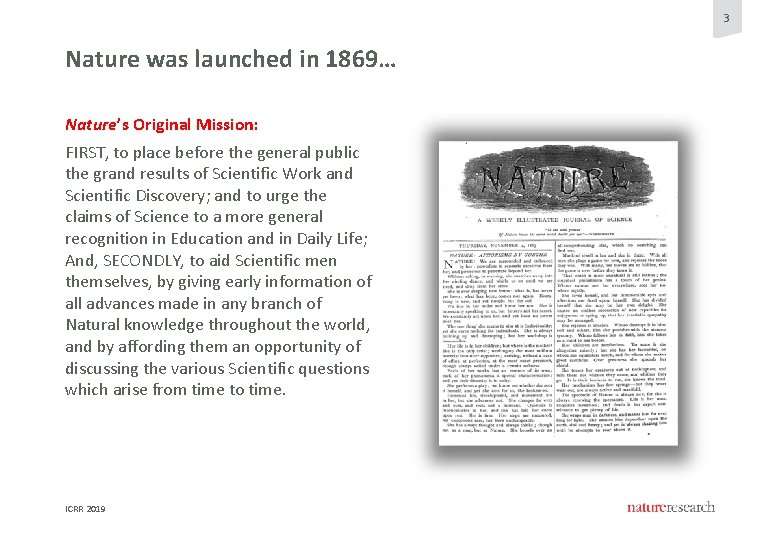
3 Nature was launched in 1869… Nature’s Original Mission: FIRST, to place before the general public the grand results of Scientific Work and Scientific Discovery; and to urge the claims of Science to a more general recognition in Education and in Daily Life; And, SECONDLY, to aid Scientific men themselves, by giving early information of all advances made in any branch of Natural knowledge throughout the world, and by affording them an opportunity of discussing the various Scientific questions which arise from time to time. ICRR 2019
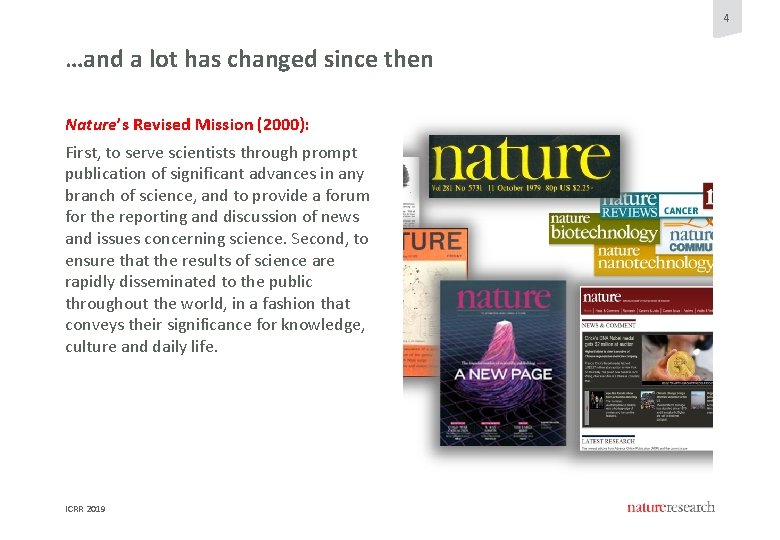
4 …and a lot has changed since then Nature’s Revised Mission (2000): First, to serve scientists through prompt publication of significant advances in any branch of science, and to provide a forum for the reporting and discussion of news and issues concerning science. Second, to ensure that the results of science are rapidly disseminated to the public throughout the world, in a fashion that conveys their significance for knowledge, culture and daily life. ICRR 2019
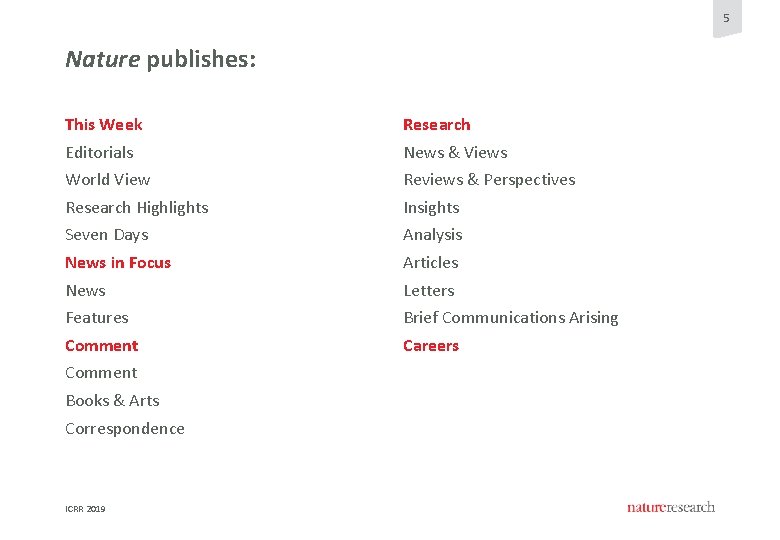
5 Nature publishes: This Week Research Editorials News & Views World View Reviews & Perspectives Research Highlights Insights Seven Days Analysis News in Focus Articles News Letters Features Brief Communications Arising Comment Careers Comment Books & Arts Correspondence ICRR 2019
6 The size of the editorial operation ~100 editorial staff including Editor-in. Chief, 2 Chief Editors, 28 Associate & Senior Editors, editorial assistants and other staff (e. g. journalists) Staff based in London, DC, San Francisco, San Diego, Munich, Berlin, Paris, Tokyo, Sydney, Delhi, Shanghai… ~120 editorial pages per week >12, 000 submissions per year; ~800 papers published ICRR 2019
7 Meet the Editors 2. 0
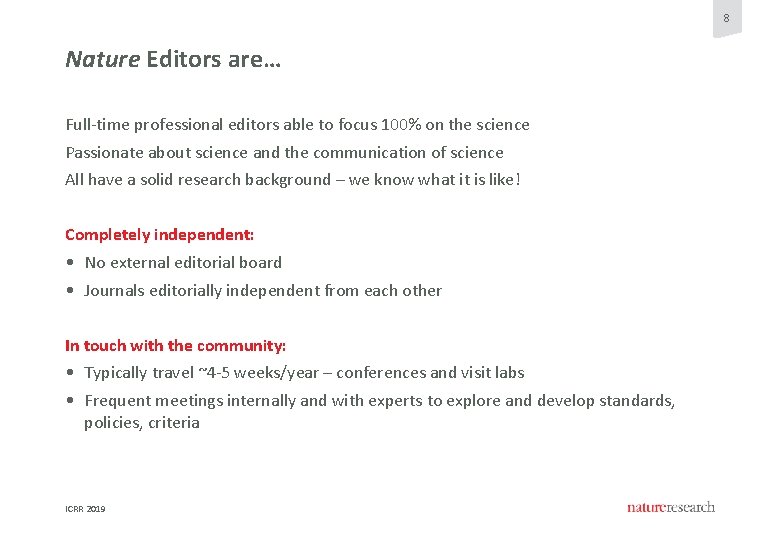
8 Nature Editors are… Full-time professional editors able to focus 100% on the science Passionate about science and the communication of science All have a solid research background – we know what it is like! Completely independent: • No external editorial board • Journals editorially independent from each other In touch with the community: • Typically travel ~4 -5 weeks/year – conferences and visit labs • Frequent meetings internally and with experts to explore and develop standards, policies, criteria ICRR 2019
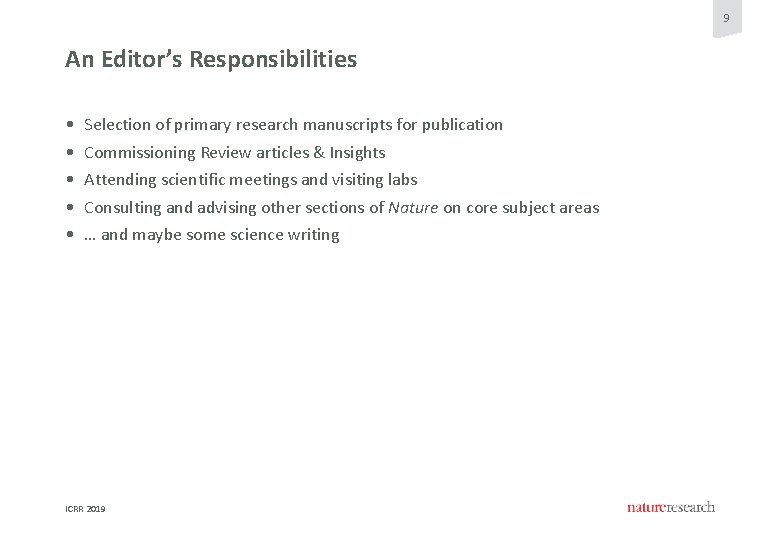
9 An Editor’s Responsibilities • • • Selection of primary research manuscripts for publication Commissioning Review articles & Insights Attending scientific meetings and visiting labs Consulting and advising other sections of Nature on core subject areas … and maybe some science writing ICRR 2019
10 Nature Editors are… …the interface between the journal and the global scientific community ICRR 2019
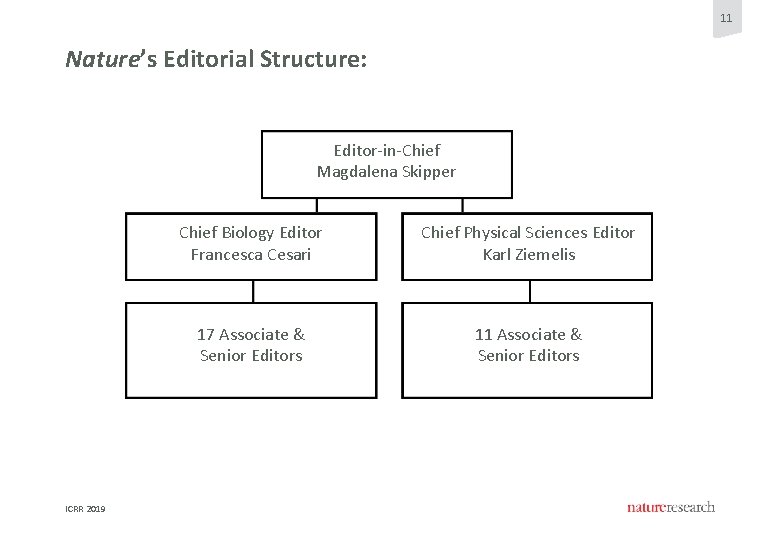
11 Nature’s Editorial Structure: Editor-in-Chief Magdalena Skipper ICRR 2019 Chief Biology Editor Francesca Cesari Chief Physical Sciences Editor Karl Ziemelis 17 Associate & Senior Editors 11 Associate & Senior Editors
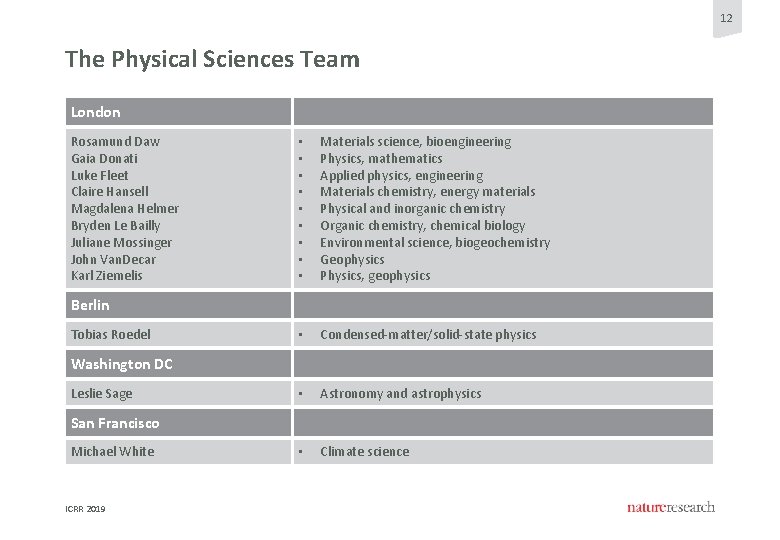
12 The Physical Sciences Team London Rosamund Daw Gaia Donati Luke Fleet Claire Hansell Magdalena Helmer Bryden Le Bailly Juliane Mossinger John Van. Decar Karl Ziemelis • • • Materials science, bioengineering Physics, mathematics Applied physics, engineering Materials chemistry, energy materials Physical and inorganic chemistry Organic chemistry, chemical biology Environmental science, biogeochemistry Geophysics Physics, geophysics • Condensed-matter/solid-state physics • Astronomy and astrophysics • Climate science Berlin Tobias Roedel Washington DC Leslie Sage San Francisco Michael White ICRR 2019
13 ICRR 2019
14 The Editorial Process 3. 0
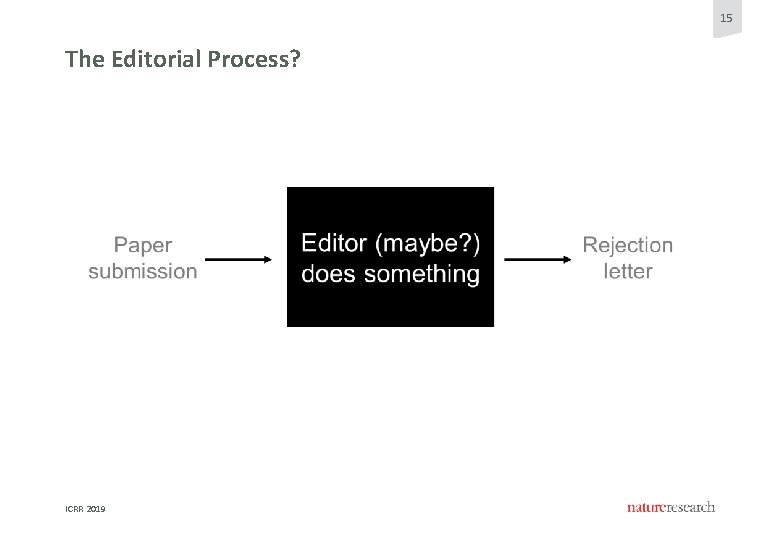
15 The Editorial Process? ICRR 2019
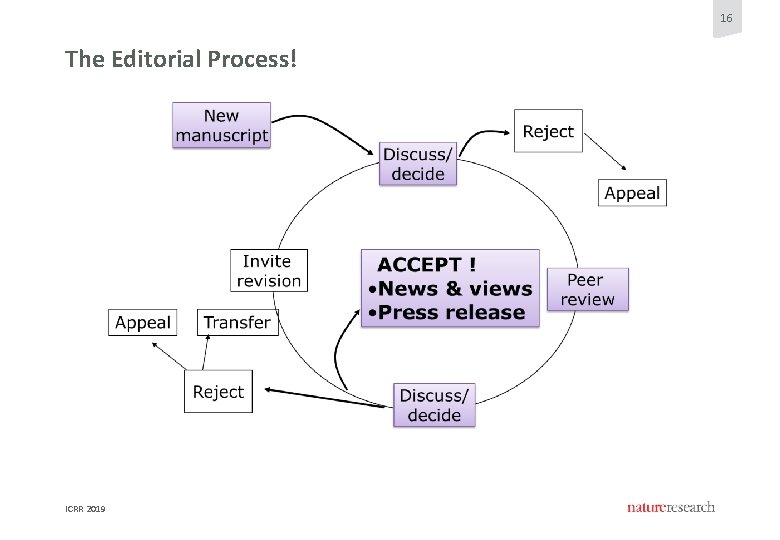
16 The Editorial Process! ICRR 2019
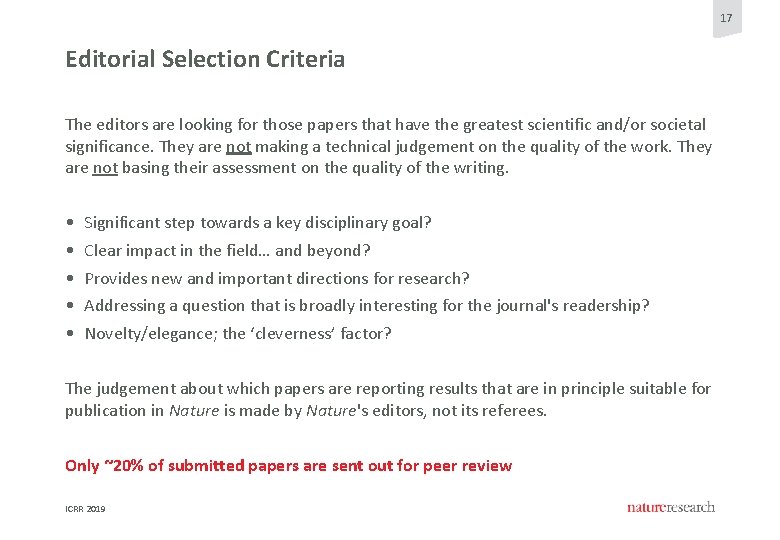
17 Editorial Selection Criteria The editors are looking for those papers that have the greatest scientific and/or societal significance. They are not making a technical judgement on the quality of the work. They are not basing their assessment on the quality of the writing. • • • Significant step towards a key disciplinary goal? Clear impact in the field… and beyond? Provides new and important directions for research? Addressing a question that is broadly interesting for the journal's readership? Novelty/elegance; the ‘cleverness’ factor? The judgement about which papers are reporting results that are in principle suitable for publication in Nature is made by Nature's editors, not its referees. Only ~20% of submitted papers are sent out for peer review ICRR 2019
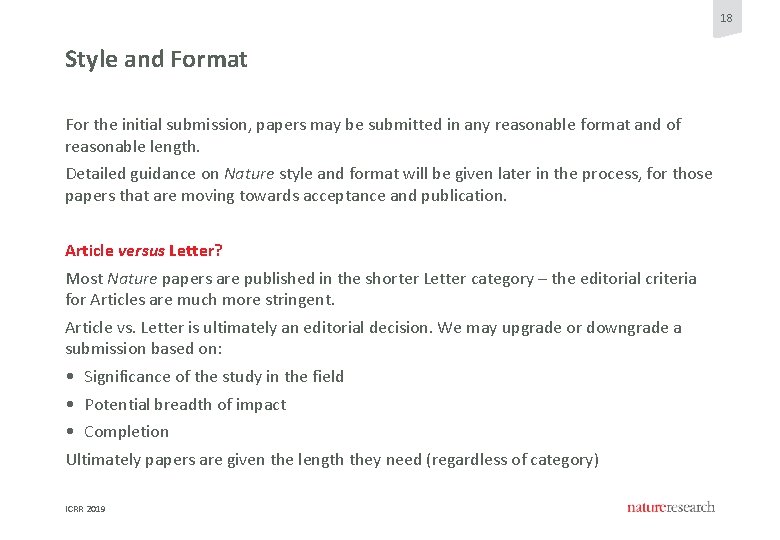
18 Style and Format For the initial submission, papers may be submitted in any reasonable format and of reasonable length. Detailed guidance on Nature style and format will be given later in the process, for those papers that are moving towards acceptance and publication. Article versus Letter? Most Nature papers are published in the shorter Letter category – the editorial criteria for Articles are much more stringent. Article vs. Letter is ultimately an editorial decision. We may upgrade or downgrade a submission based on: • Significance of the study in the field • Potential breadth of impact • Completion Ultimately papers are given the length they need (regardless of category) ICRR 2019
19 Manuscripts are evaluated based on their content, not on the cover letter, looks, or proficiency in English… …but be considerate of the editors’ and reviewers’ time ICRR 2019
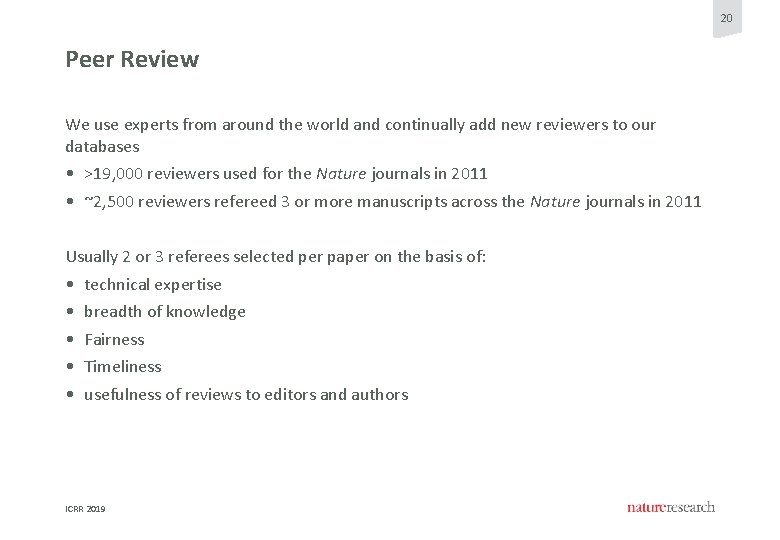
20 Peer Review We use experts from around the world and continually add new reviewers to our databases • >19, 000 reviewers used for the Nature journals in 2011 • ~2, 500 reviewers refereed 3 or more manuscripts across the Nature journals in 2011 Usually 2 or 3 referees selected per paper on the basis of: • • • technical expertise breadth of knowledge Fairness Timeliness usefulness of reviews to editors and authors ICRR 2019
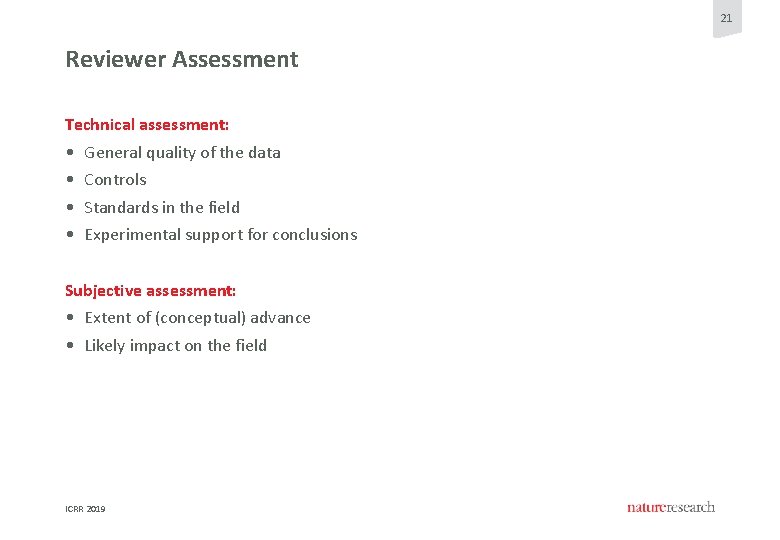
21 Reviewer Assessment Technical assessment: • • General quality of the data Controls Standards in the field Experimental support for conclusions Subjective assessment: • Extent of (conceptual) advance • Likely impact on the field ICRR 2019
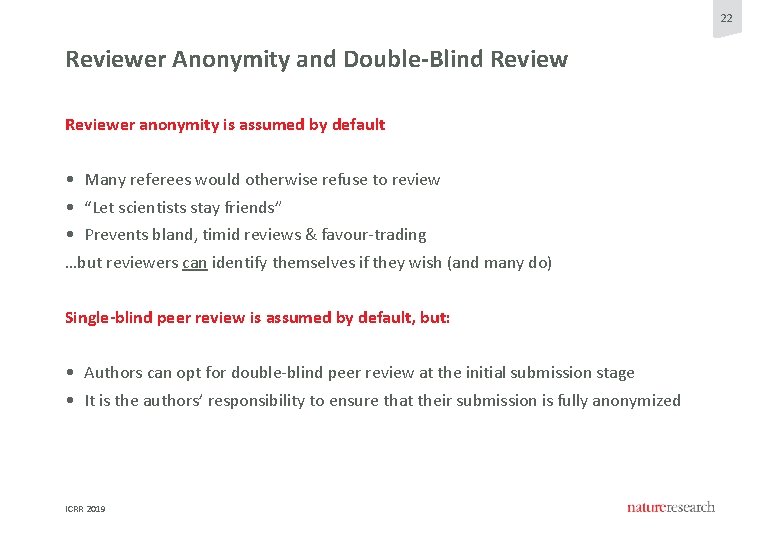
22 Reviewer Anonymity and Double-Blind Reviewer anonymity is assumed by default • Many referees would otherwise refuse to review • “Let scientists stay friends” • Prevents bland, timid reviews & favour-trading …but reviewers can identify themselves if they wish (and many do) Single-blind peer review is assumed by default, but: • Authors can opt for double-blind peer review at the initial submission stage • It is the authors’ responsibility to ensure that their submission is fully anonymized ICRR 2019
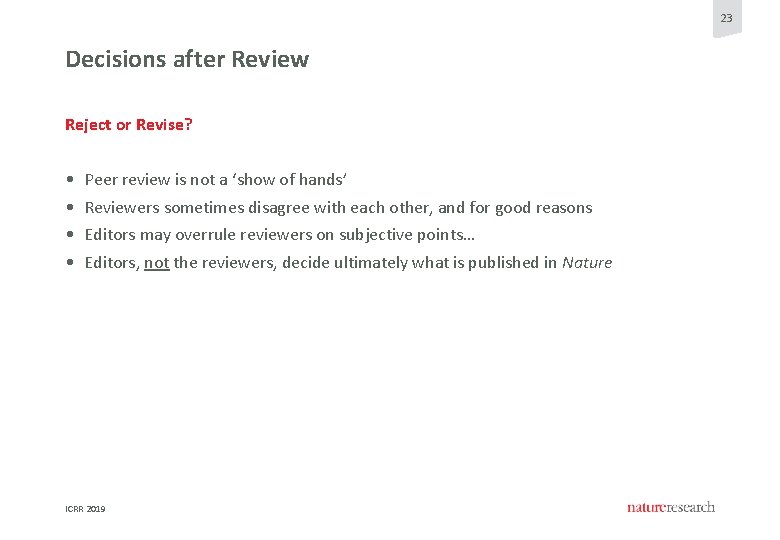
23 Decisions after Review Reject or Revise? • • Peer review is not a ‘show of hands’ Reviewers sometimes disagree with each other, and for good reasons Editors may overrule reviewers on subjective points… Editors, not the reviewers, decide ultimately what is published in Nature ICRR 2019
24 Appeals, Transfers, and Author/Referee Services 4. 0
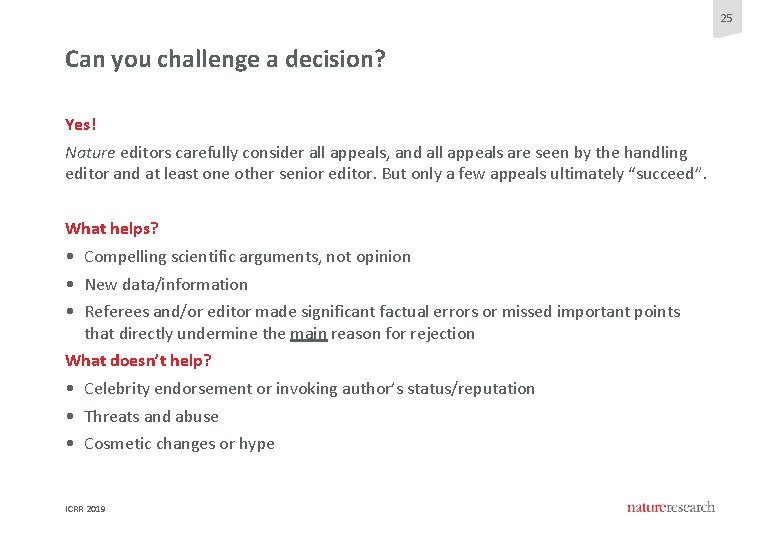
25 Can you challenge a decision? Yes! Nature editors carefully consider all appeals, and all appeals are seen by the handling editor and at least one other senior editor. But only a few appeals ultimately “succeed”. What helps? • Compelling scientific arguments, not opinion • New data/information • Referees and/or editor made significant factual errors or missed important points that directly undermine the main reason for rejection What doesn’t help? • Celebrity endorsement or invoking author’s status/reputation • Threats and abuse • Cosmetic changes or hype ICRR 2019
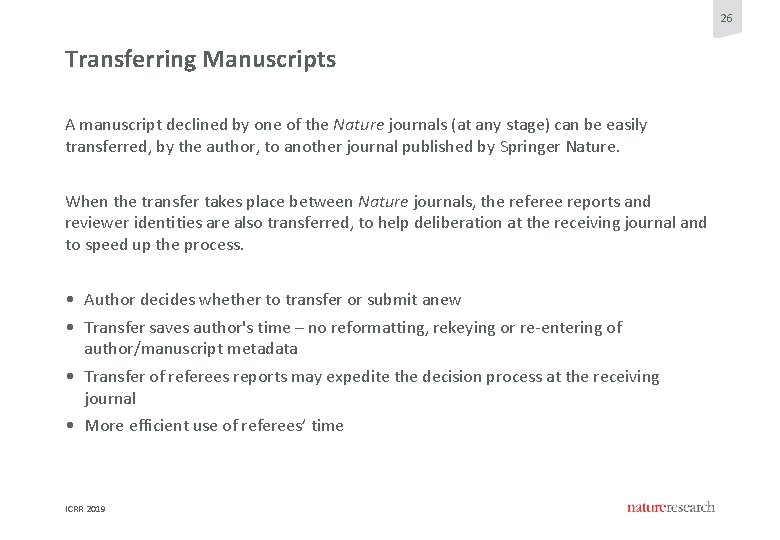
26 Transferring Manuscripts A manuscript declined by one of the Nature journals (at any stage) can be easily transferred, by the author, to another journal published by Springer Nature. When the transfer takes place between Nature journals, the referee reports and reviewer identities are also transferred, to help deliberation at the receiving journal and to speed up the process. • Author decides whether to transfer or submit anew • Transfer saves author's time – no reformatting, rekeying or re-entering of author/manuscript metadata • Transfer of referees reports may expedite the decision process at the receiving journal • More efficient use of referees’ time ICRR 2019
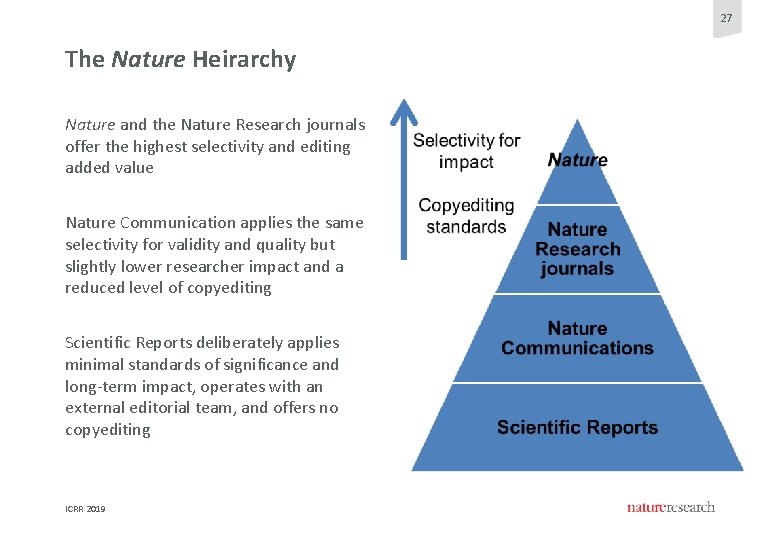
27 The Nature Heirarchy Nature and the Nature Research journals offer the highest selectivity and editing added value Nature Communication applies the same selectivity for validity and quality but slightly lower researcher impact and a reduced level of copyediting Scientific Reports deliberately applies minimal standards of significance and long-term impact, operates with an external editorial team, and offers no copyediting ICRR 2019
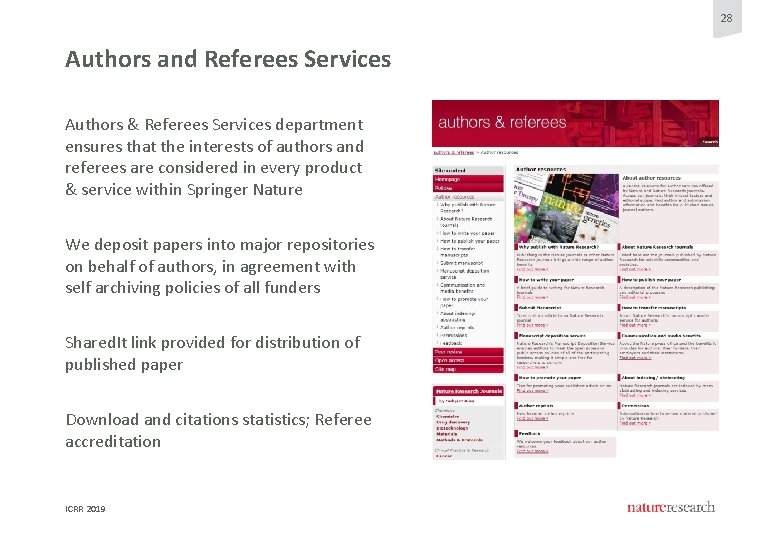
28 Authors and Referees Services Authors & Referees Services department ensures that the interests of authors and referees are considered in every product & service within Springer Nature We deposit papers into major repositories on behalf of authors, in agreement with self archiving policies of all funders Shared. It link provided for distribution of published paper Download and citations statistics; Referee accreditation ICRR 2019
29 Writing for Impact 5. 0
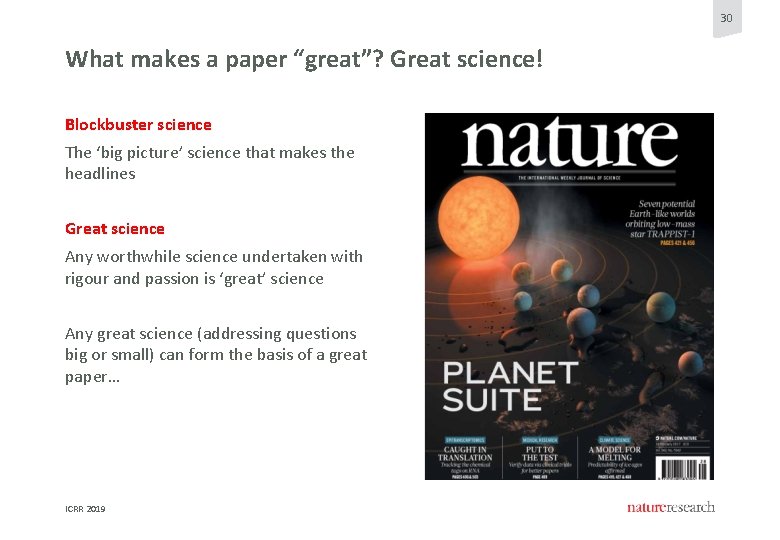
30 What makes a paper “great”? Great science! Blockbuster science The ‘big picture’ science that makes the headlines Great science Any worthwhile science undertaken with rigour and passion is ‘great’ science Any great science (addressing questions big or small) can form the basis of a great paper… ICRR 2019
31 Turning your great science into a GREAT paper A GREAT paper should: • be the culmination/celebration of a project, big or small • be written with the same attention to detail – and passion – as the research underlying it • be read, used and (maybe) even enjoyed A GREAT paper won’t: • be written and published solely for the purpose of bolstering a CV. Just because a paper can be written doesn’t necessarily mean that it should be written, at least at this point in time • be seen as a chore to write – if you do not feel any passion for the paper, it is most unlikely that others will too! ICRR 2019
32 Know your audience ICRR 2019 Hold their attention Lay foundations
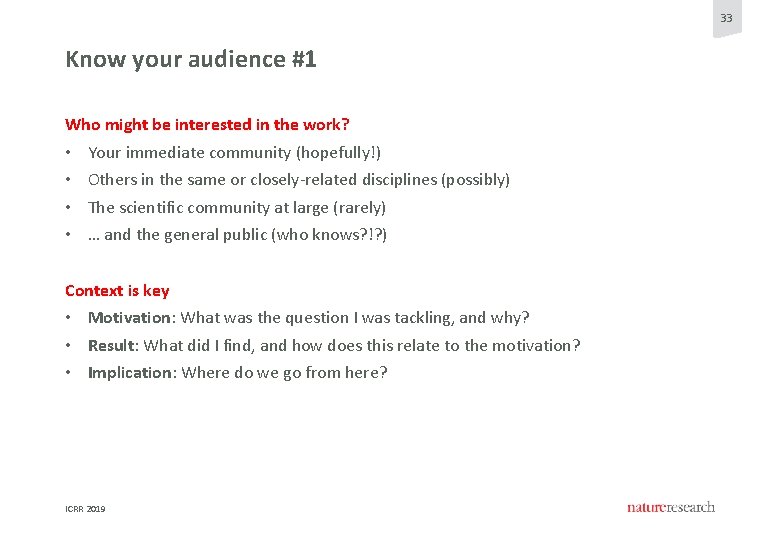
33 Know your audience #1 Who might be interested in the work? • • Your immediate community (hopefully!) Others in the same or closely-related disciplines (possibly) The scientific community at large (rarely) … and the general public (who knows? !? ) Context is key • Motivation: What was the question I was tackling, and why? • Result: What did I find, and how does this relate to the motivation? • Implication: Where do we go from here? ICRR 2019
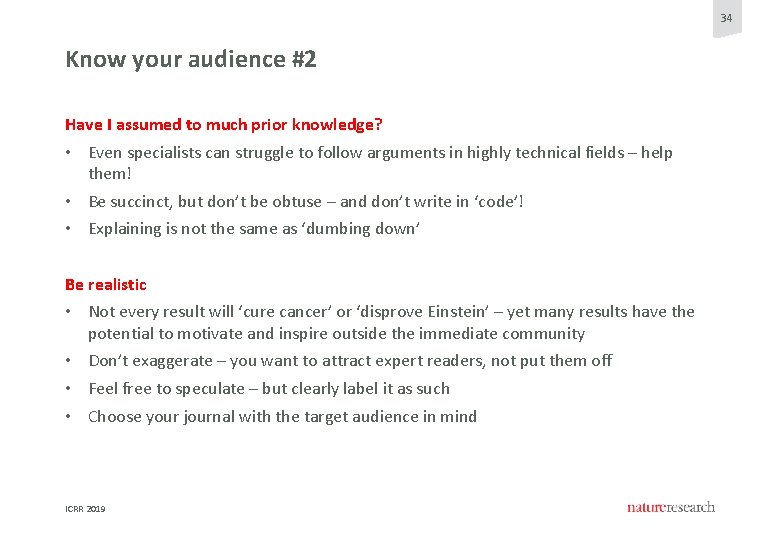
34 Know your audience #2 Have I assumed to much prior knowledge? • Even specialists can struggle to follow arguments in highly technical fields – help them! • Be succinct, but don’t be obtuse – and don’t write in ‘code’! • Explaining is not the same as ‘dumbing down’ Be realistic • Not every result will ‘cure cancer’ or ‘disprove Einstein’ – yet many results have the potential to motivate and inspire outside the immediate community • Don’t exaggerate – you want to attract expert readers, not put them off • Feel free to speculate – but clearly label it as such • Choose your journal with the target audience in mind ICRR 2019
35 Everyone is busy Authors, referees, editors and readers are all busy people – time is precious To maximise the impact of your work, you first need to ensure that it gets read, which in turn requires an investment of time on the part of the reader Focus on getting the key information across as efficiently and as usefully as possible ICRR 2019
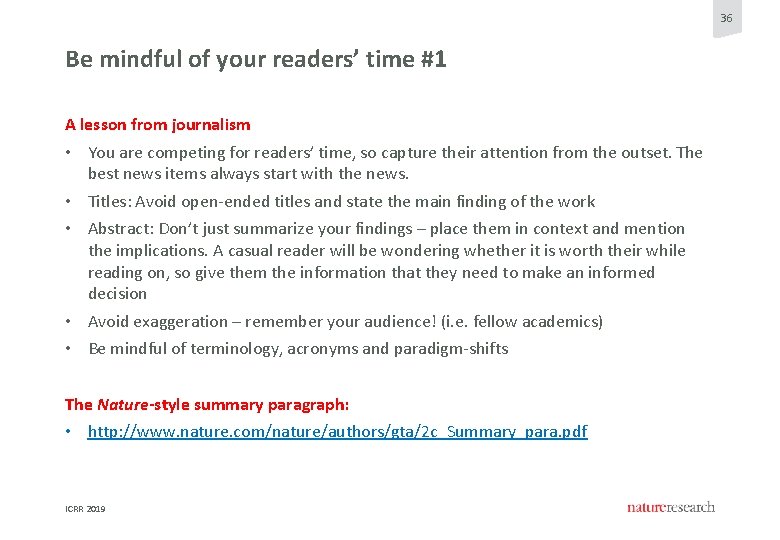
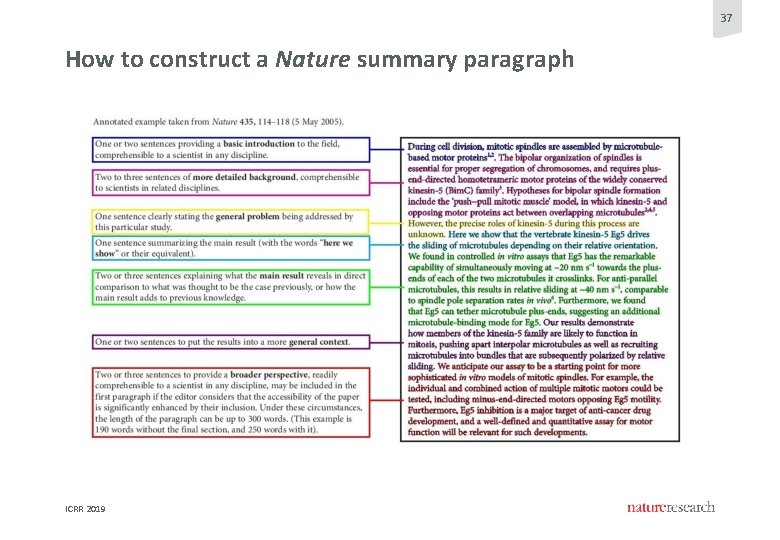
36 Be mindful of your readers’ time #1 A lesson from journalism • You are competing for readers’ time, so capture their attention from the outset. The best news items always start with the news. • Titles: Avoid open-ended titles and state the main finding of the work • Abstract: Don’t just summarize your findings – place them in context and mention the implications. A casual reader will be wondering whether it is worth their while reading on, so give them the information that they need to make an informed decision • Avoid exaggeration – remember your audience! (i. e. fellow academics) • Be mindful of terminology, acronyms and paradigm-shifts The Nature-style summary paragraph: • http: //www. nature. com/nature/authors/gta/2 c_Summary_para. pdf ICRR 2019
37 How to construct a Nature summary paragraph ICRR 2019
38 Be mindful of your readers’ time #2 Organise your thoughts • Strip down to the elements essential to conveying the results – you are not writing a novel • Bullet-point your message and arguments, and build the paper around that • Do not pad the main paper out with superfluous information… • …but don’t leave out anything important or gloss over problematic issues Signposting as you go • Guide the reader by starting each section with a brief statement of what is to follow (e. g. “We will now calculate the conditions under which XX leads to YY”) • A time-pressured reader should be able to quickly navigate through the paper, section-by-section, to follow the gist (if not the detail) of the argument • Title your figures and tables! ICRR 2019
39 Think of the users A paper is not simply the announcement of your own research achievements – it should be much more than something to be read once and filed away A paper is very rarely the final word on the matter – it is a stepping stone on the way to future scientific achievements A GREAT paper offers no barriers or obstruction to others building on the work - indeed, it should be a resource that actively facilitates replication and extension ICRR 2019
40 Laying foundations for future work Removing barriers • Science is messy: By all means be selective for the purposes of clarity, but be specific about any such selection – if an experiment is tricky to realise and/or has a high failure rate, this is valuable information for others attempting to build on the work • Don’t hide problems: do not leave out problematic information that appears to detract from the message of the paper – it should be part of that message • Clearly distinguish between information that is central to the paper’s claims, secondary to the claims (i. e. required only by fellow practitioners), and provided mainly for completion • Archive the full information behind a paper – even better and if the journal platform permits, include the source data in the paper itself • Be alert to changing community standards – and champion those standards! ICRR 2019
41 Know your audience ICRR 2019 Hold their attention Lay foundations
42 Thank you Feedback & questions always welcome k. ziemelis@nature. com ICRR 2019