History of the CAS This section provides information
- Slides: 45
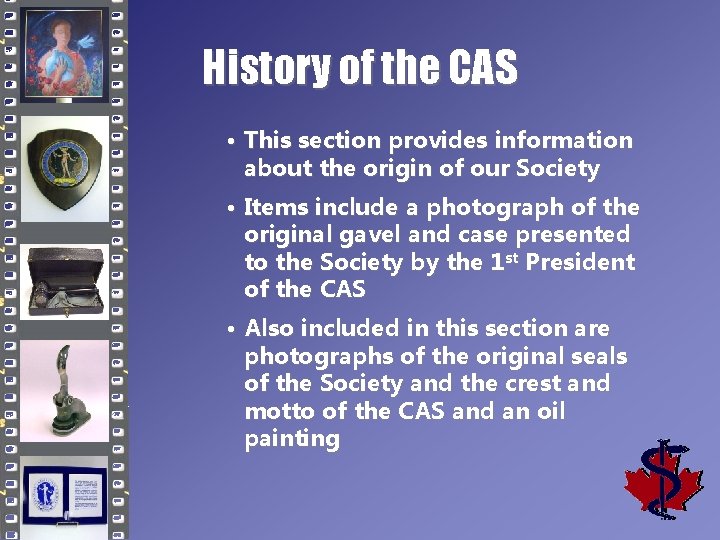
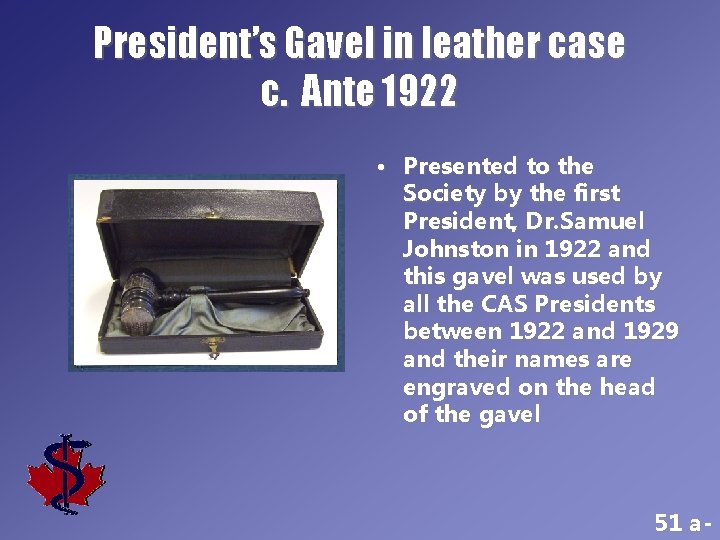
History of the CAS • This section provides information about the origin of our Society • Items include a photograph of the original gavel and case presented to the Society by the 1 st President of the CAS • Also included in this section are photographs of the original seals of the Society and the crest and motto of the CAS and an oil painting
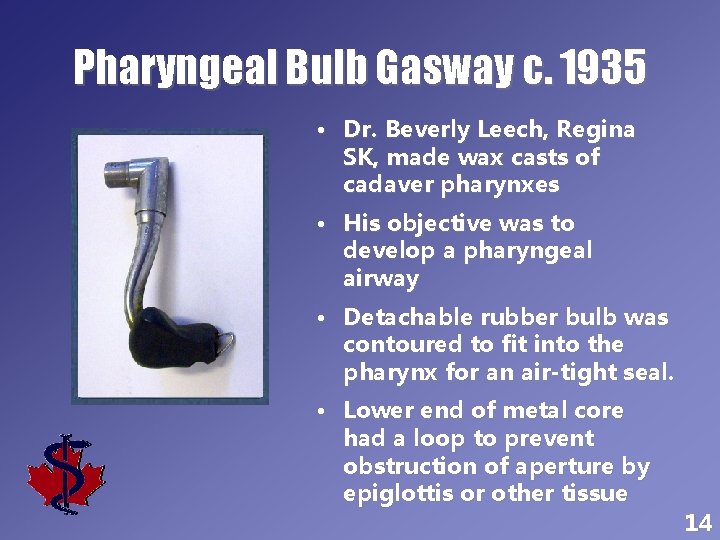
Pharyngeal Bulb Gasway c. 1935 • Dr. Beverly Leech, Regina SK, made wax casts of cadaver pharynxes • His objective was to develop a pharyngeal airway • Detachable rubber bulb was contoured to fit into the pharynx for an air-tight seal. • Lower end of metal core had a loop to prevent obstruction of aperture by epiglottis or other tissue 14
President’s Gavel in leather case c. Ante 1922 • Presented to the Society by the first President, Dr. Samuel Johnston in 1922 and this gavel was used by all the CAS Presidents between 1922 and 1929 and their names are engraved on the head of the gavel 51 a-
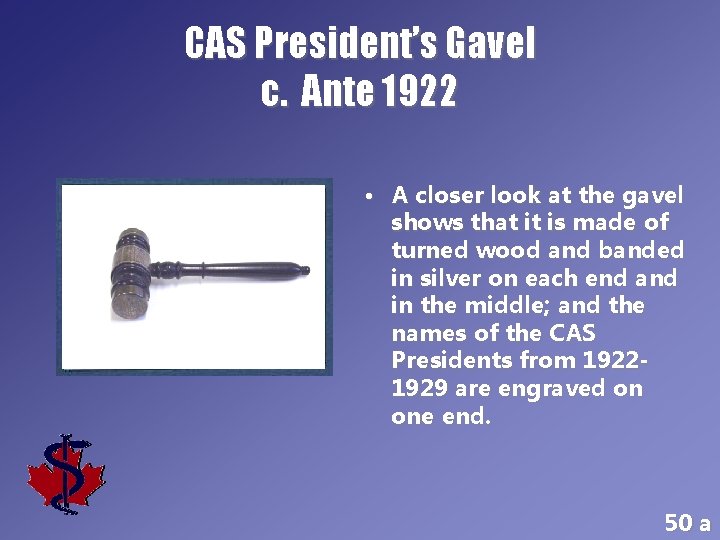
CAS President’s Gavel c. Ante 1922 • A closer look at the gavel shows that it is made of turned wood and banded in silver on each end and in the middle; and the names of the CAS Presidents from 19221929 are engraved on one end. 50 a
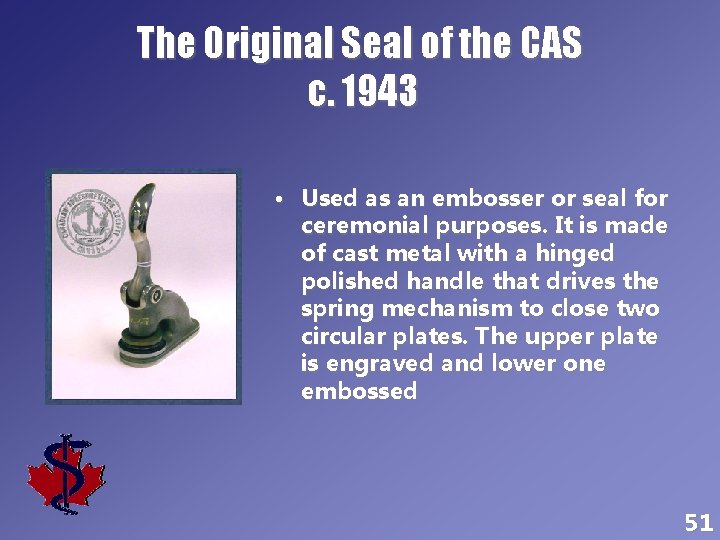
The Original Seal of the CAS c. 1943 • Used as an embosser or seal for ceremonial purposes. It is made of cast metal with a hinged polished handle that drives the spring mechanism to close two circular plates. The upper plate is engraved and lower one embossed 51
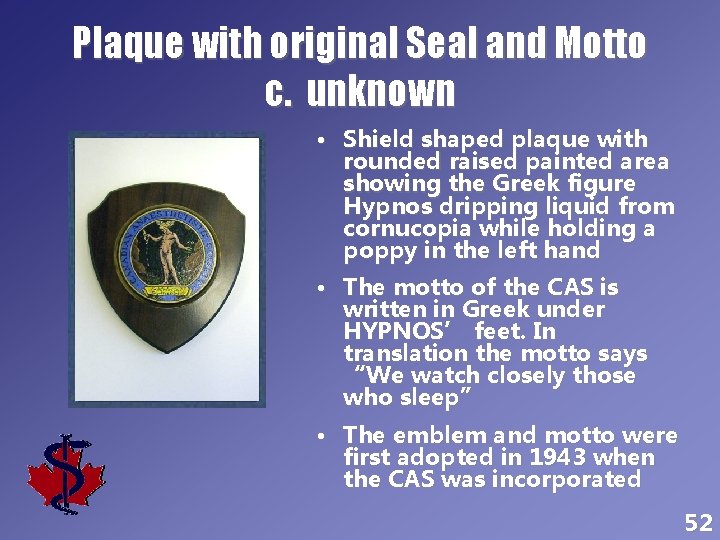
Plaque with original Seal and Motto c. unknown • Shield shaped plaque with rounded raised painted area showing the Greek figure Hypnos dripping liquid from cornucopia while holding a poppy in the left hand • The motto of the CAS is written in Greek under HYPNOS’ feet. In translation the motto says “We watch closely those who sleep” • The emblem and motto were first adopted in 1943 when the CAS was incorporated 52
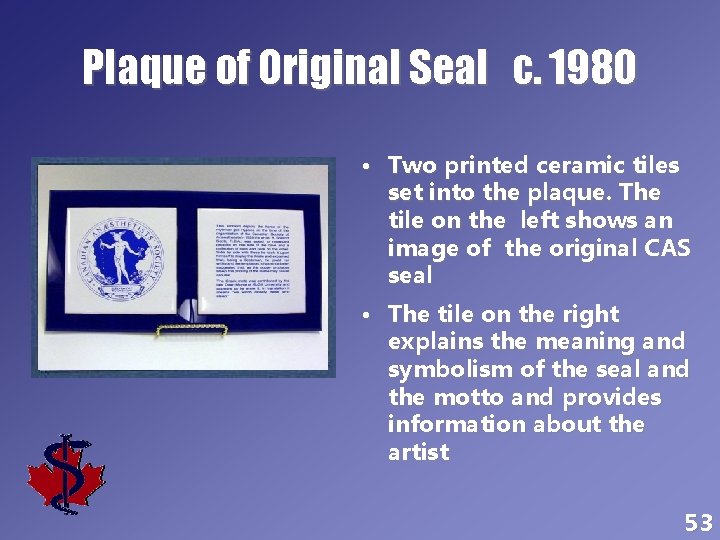
Plaque of Original Seal c. 1980 • Two printed ceramic tiles set into the plaque. The tile on the left shows an image of the original CAS seal • The tile on the right explains the meaning and symbolism of the seal and the motto and provides information about the artist 53
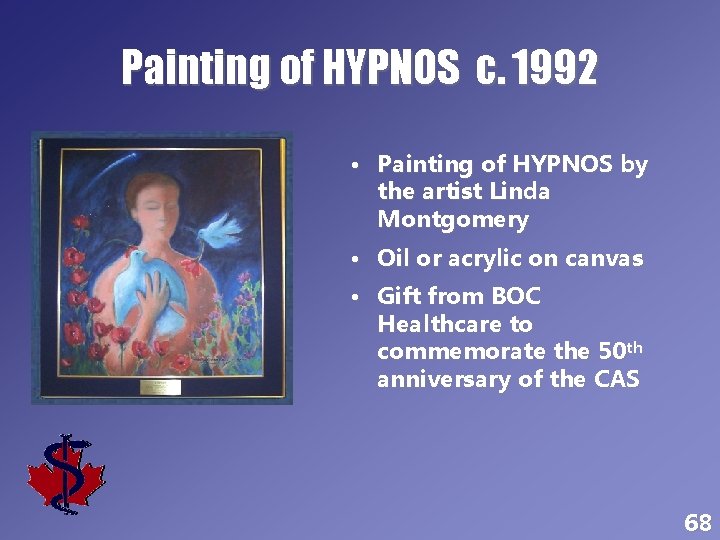
Painting of HYPNOS c. 1992 • Painting of HYPNOS by the artist Linda Montgomery • Oil or acrylic on canvas • Gift from BOC Healthcare to commemorate the 50 th anniversary of the CAS 68
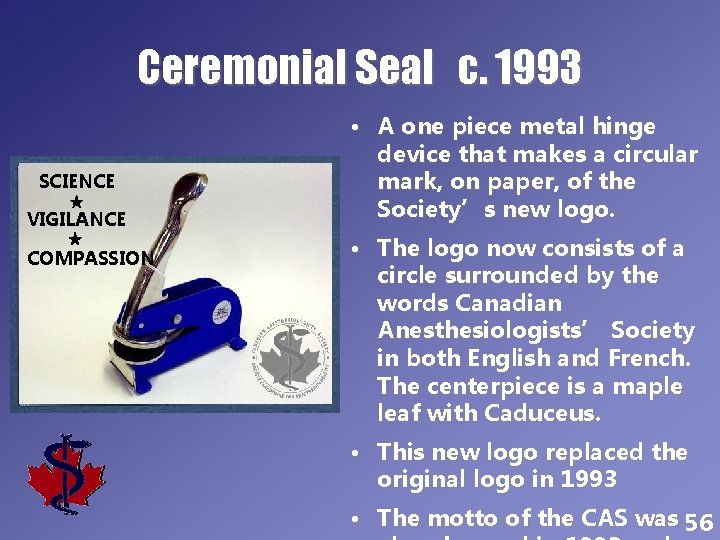
Ceremonial Seal c. 1993 SCIENCE VIGILANCE COMPASSION • A one piece metal hinge device that makes a circular mark, on paper, of the Society’s new logo. • The logo now consists of a circle surrounded by the words Canadian Anesthesiologists’ Society in both English and French. The centerpiece is a maple leaf with Caduceus. • This new logo replaced the original logo in 1993 • The motto of the CAS was 56
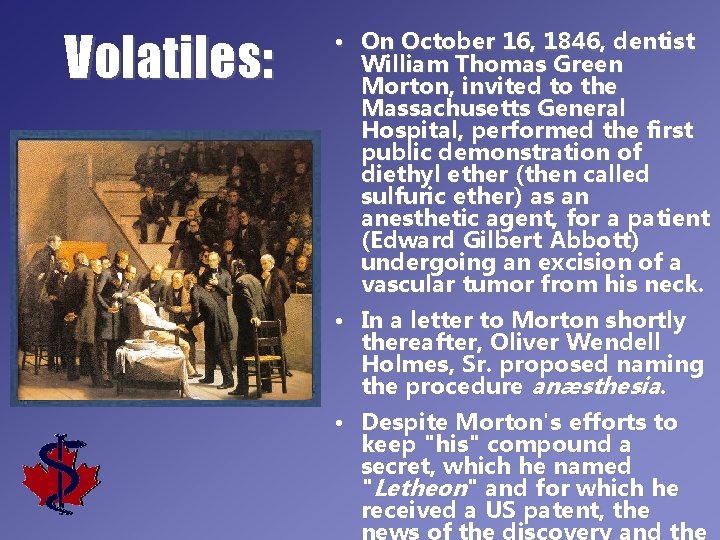
Volatiles: • On October 16, 1846, dentist William Thomas Green Morton, invited to the Massachusetts General Hospital, performed the first public demonstration of diethyl ether (then called sulfuric ether) as an anesthetic agent, for a patient (Edward Gilbert Abbott) undergoing an excision of a vascular tumor from his neck. • In a letter to Morton shortly thereafter, Oliver Wendell Holmes, Sr. proposed naming the procedure anæsthesia. • Despite Morton's efforts to keep "his" compound a secret, which he named "Letheon" and for which he received a US patent, the
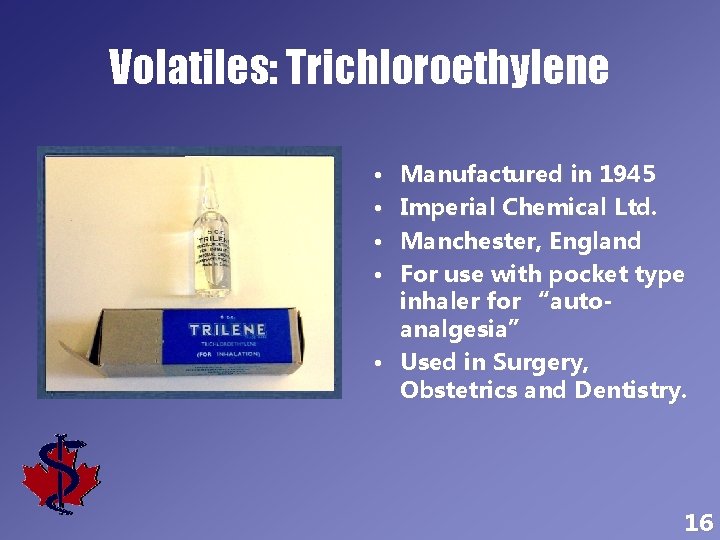
Volatiles: Trichloroethylene • • Manufactured in 1945 Imperial Chemical Ltd. Manchester, England For use with pocket type inhaler for “autoanalgesia” • Used in Surgery, Obstetrics and Dentistry. 16
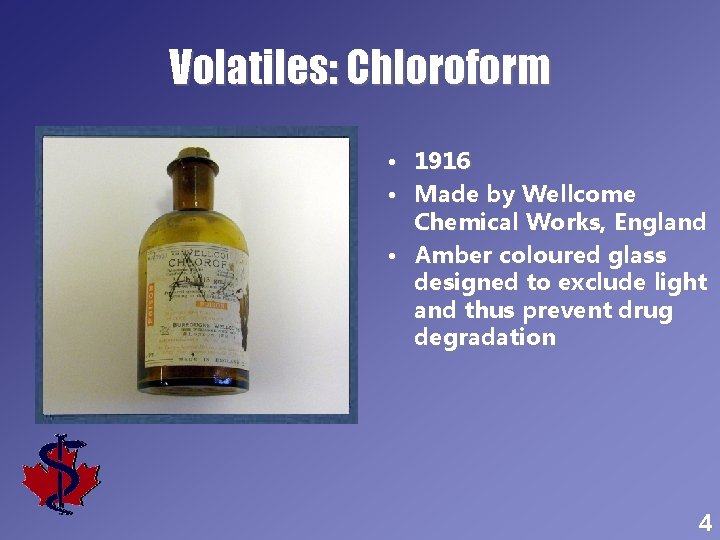
Volatiles: Chloroform • 1916 • Made by Wellcome Chemical Works, England • Amber coloured glass designed to exclude light and thus prevent drug degradation 4
Chloroform: CHCl 3 • Chloroform, the name given to trichloromethane, because of its supposed relation to formic acid. • Chloroform has a heavy, etherlike odor and a burning sweetness of taste, being about 40 times as sweet as cane sugar. • Chloroform may be prepared by the chlorination of ethyl alcohol or of methane, or by the action of iron and acid on carbon tetrachloride. • Chloroform was developed in 1831 and was first used to induce narcosis in self-experimentation by James Young Simpson (1847). • In the presence of light, however, it tends to decompose, yielding the highly poisonous compound phosgene. • The first fatality was a 15 -year-old girl called Hannah
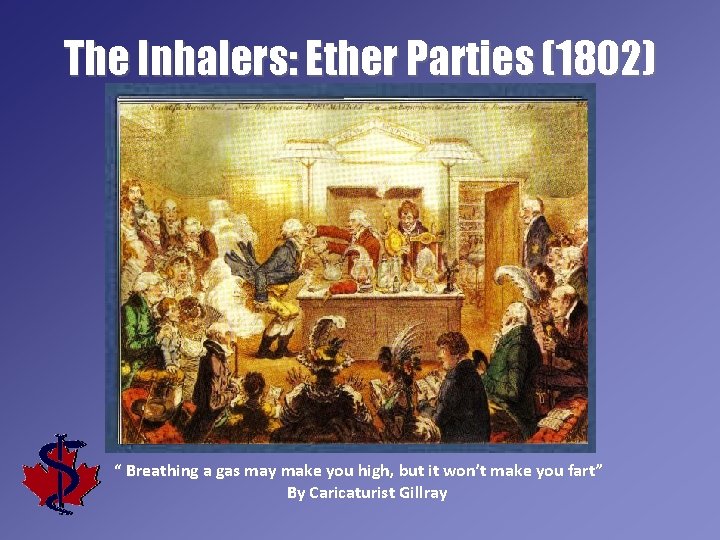
The Inhalers: Ether Parties (1802) “ Breathing a gas may make you high, but it won’t make you fart” By Caricaturist Gillray
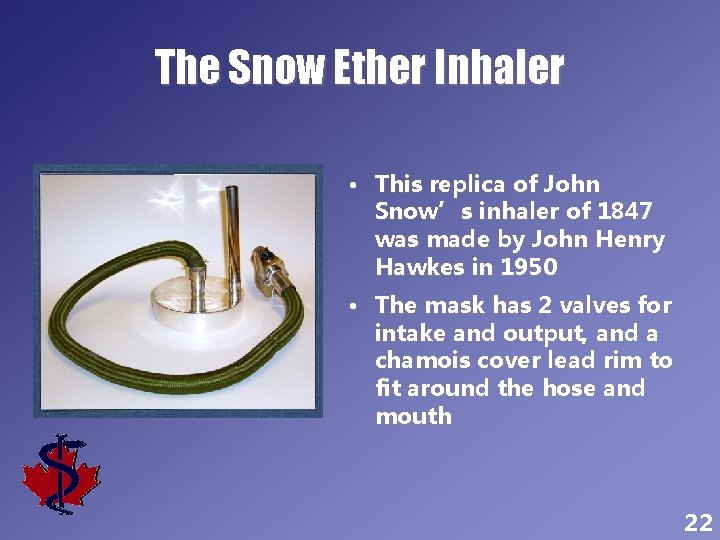
The Snow Ether Inhaler • This replica of John Snow’s inhaler of 1847 was made by John Henry Hawkes in 1950 • The mask has 2 valves for intake and output, and a chamois cover lead rim to fit around the hose and mouth 22
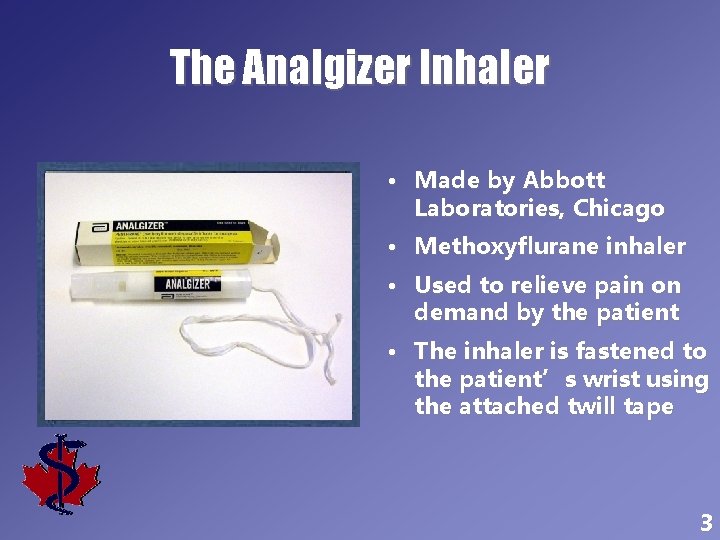
The Analgizer Inhaler • Made by Abbott Laboratories, Chicago • Methoxyflurane inhaler • Used to relieve pain on demand by the patient • The inhaler is fastened to the patient’s wrist using the attached twill tape 3
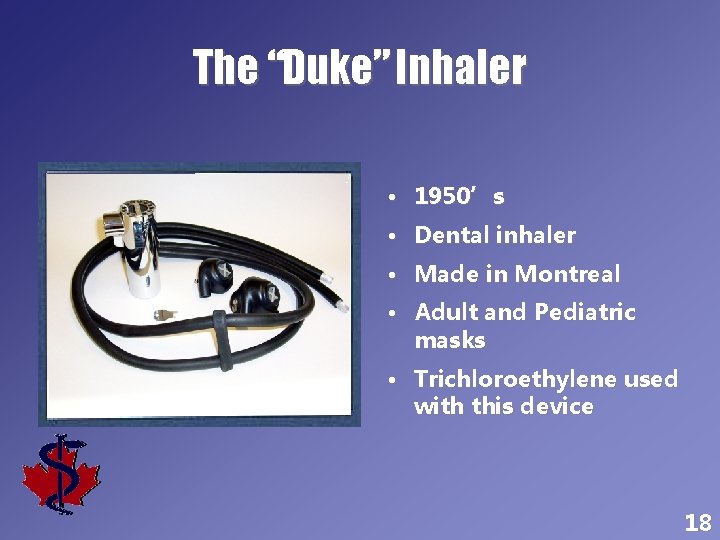
The “Duke” Inhaler • 1950’s • Dental inhaler • Made in Montreal • Adult and Pediatric masks • Trichloroethylene used with this device 18
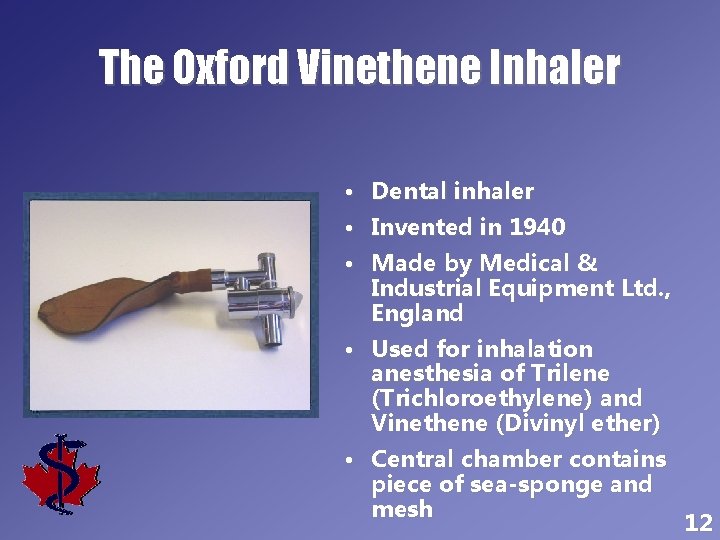
The Oxford Vinethene Inhaler • • Dental inhaler Invented in 1940 • Made by Medical & Industrial Equipment Ltd. , England • Used for inhalation anesthesia of Trilene (Trichloroethylene) and Vinethene (Divinyl ether) • Central chamber contains piece of sea-sponge and mesh 12
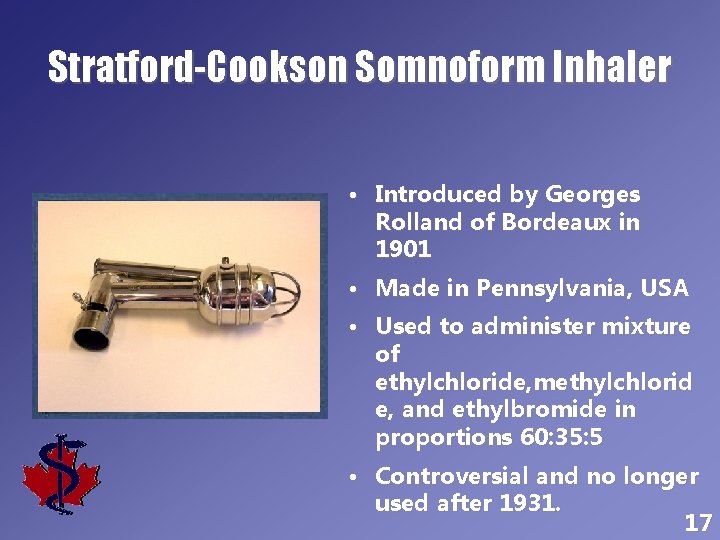
Stratford-Cookson Somnoform Inhaler • Introduced by Georges Rolland of Bordeaux in 1901 • Made in Pennsylvania, USA • Used to administer mixture of ethylchloride, methylchlorid e, and ethylbromide in proportions 60: 35: 5 • Controversial and no longer used after 1931. 17
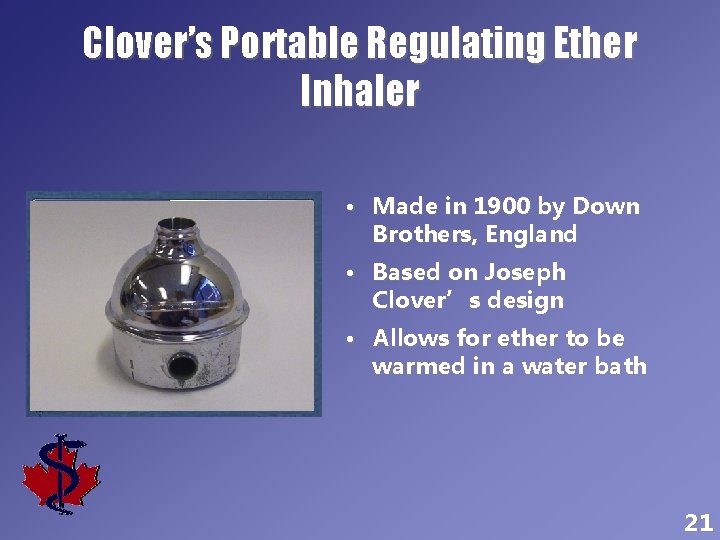
Clover’s Portable Regulating Ether Inhaler • Made in 1900 by Down Brothers, England • Based on Joseph Clover’s design • Allows for ether to be warmed in a water bath 21
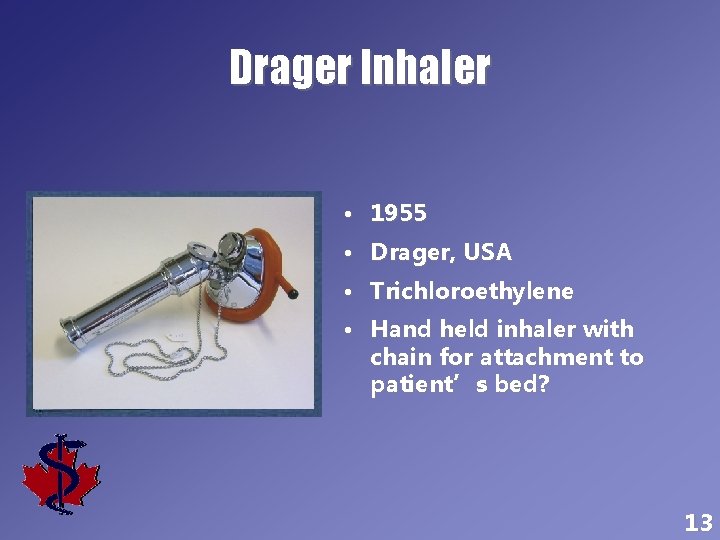
Drager Inhaler • 1955 • Drager, USA • Trichloroethylene • Hand held inhaler with chain for attachment to patient’s bed? 13
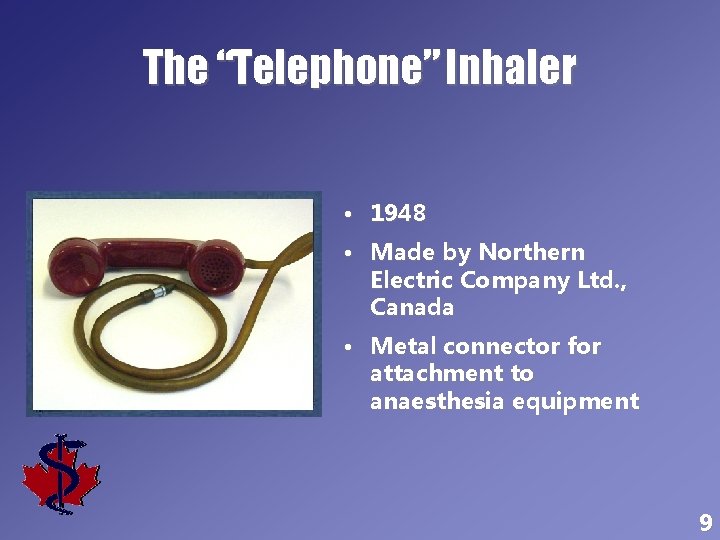
The “Telephone” Inhaler • 1948 • Made by Northern Electric Company Ltd. , Canada • Metal connector for attachment to anaesthesia equipment 9
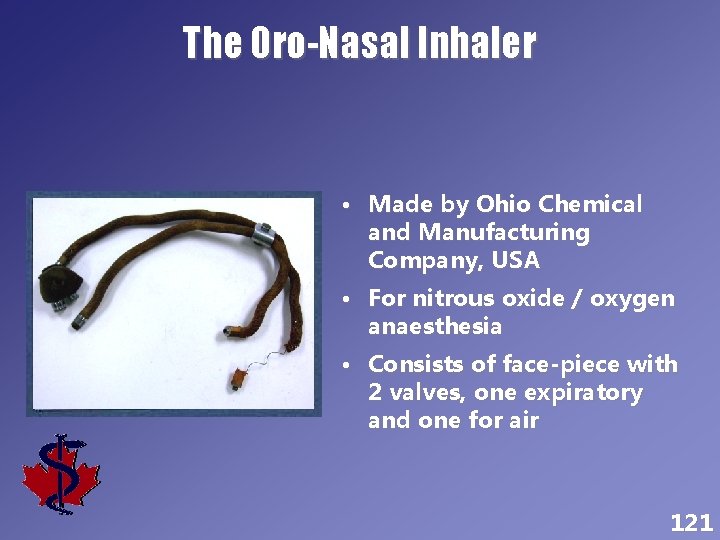
The Oro-Nasal Inhaler • Made by Ohio Chemical and Manufacturing Company, USA • For nitrous oxide / oxygen anaesthesia • Consists of face-piece with 2 valves, one expiratory and one for air 121
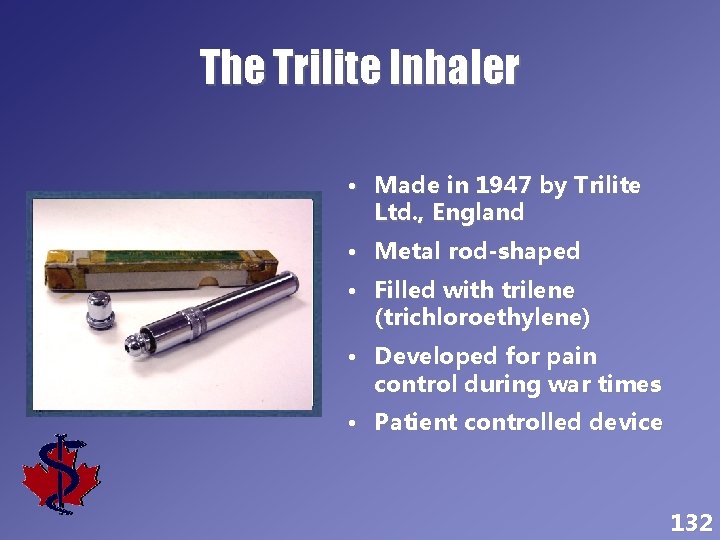
The Trilite Inhaler • Made in 1947 by Trilite Ltd. , England • Metal rod-shaped • Filled with trilene (trichloroethylene) • Developed for pain control during war times • Patient controlled device 132
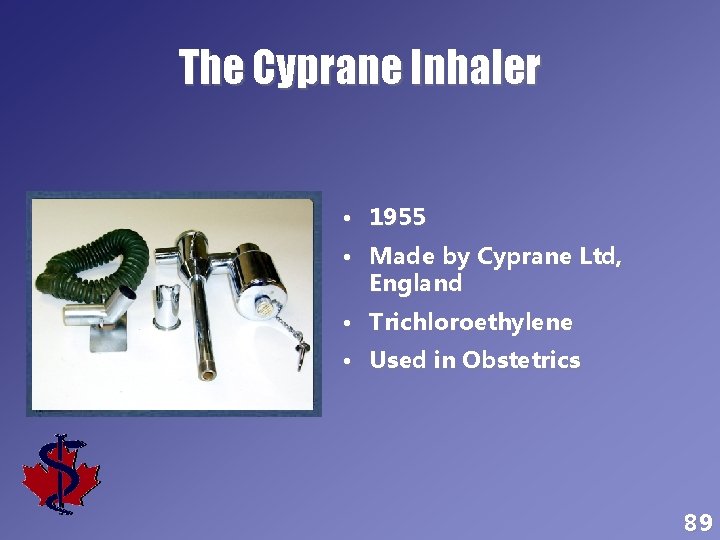
The Cyprane Inhaler • 1955 • Made by Cyprane Ltd, England • Trichloroethylene • Used in Obstetrics 89
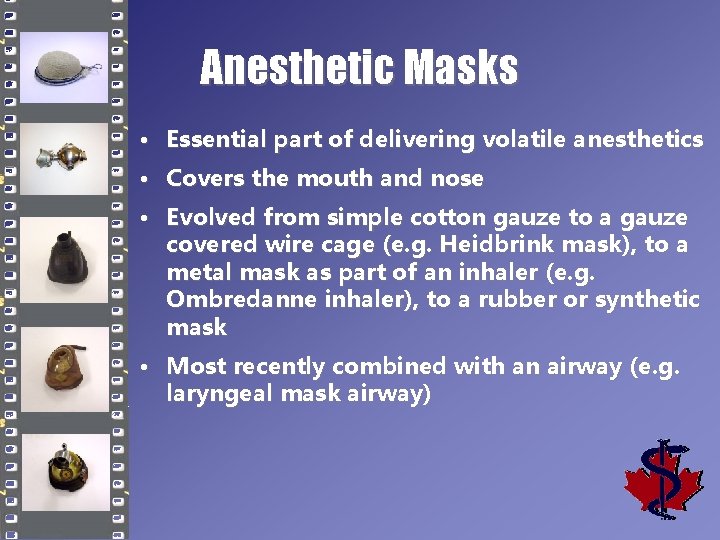
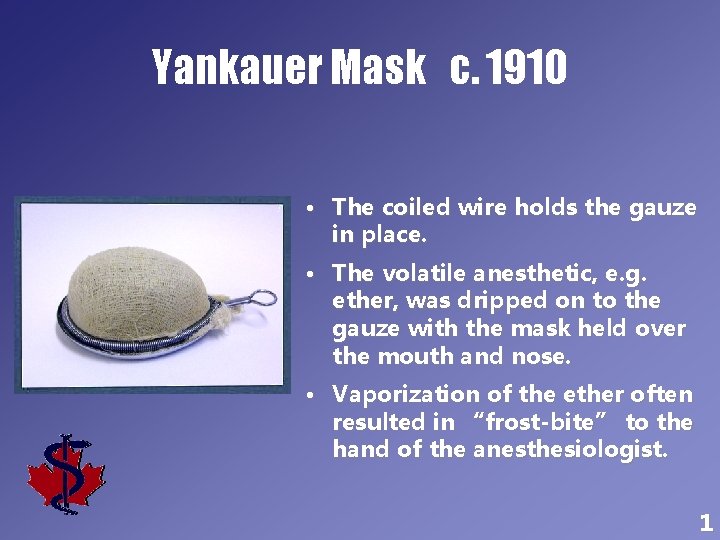
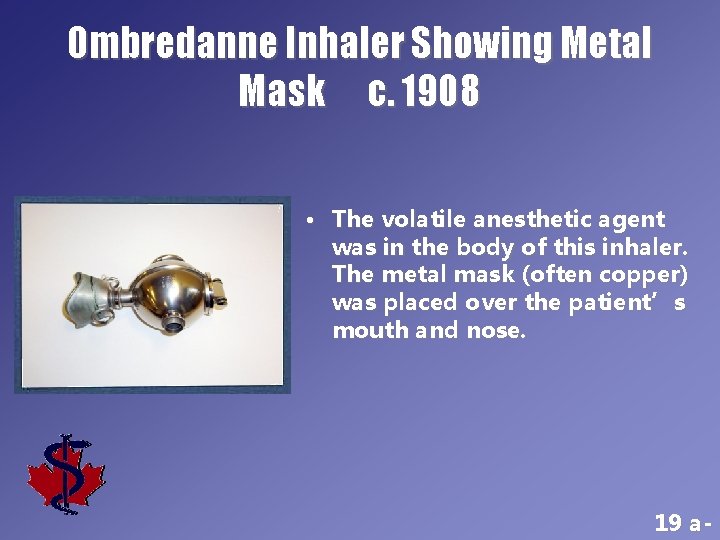
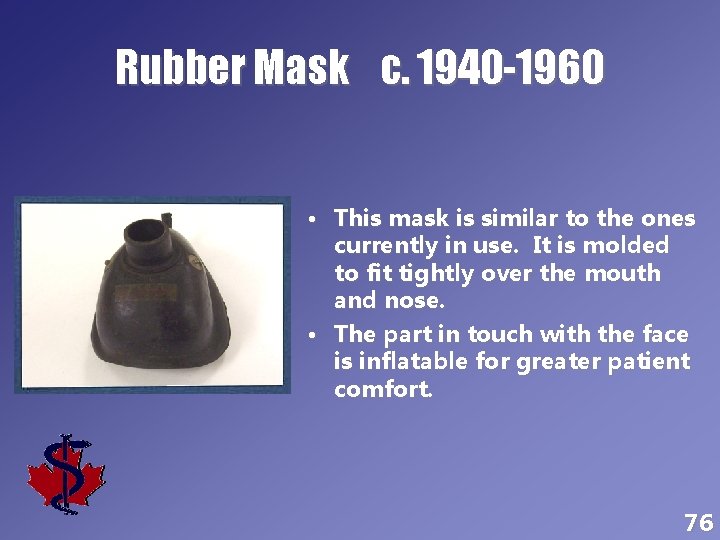
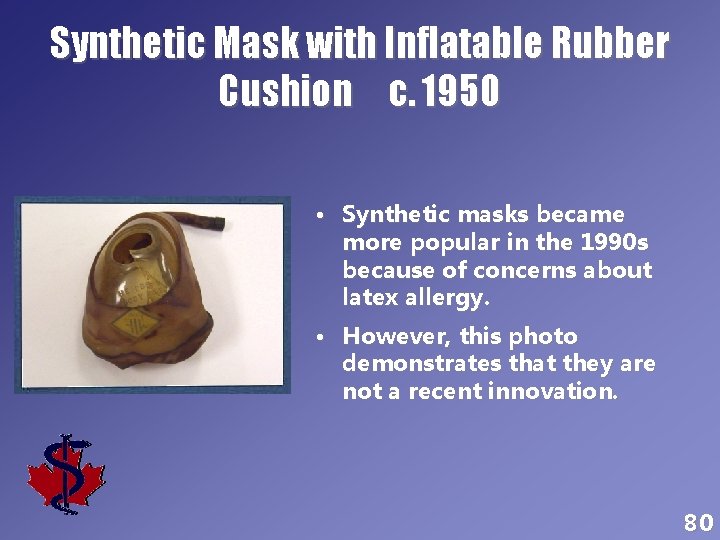
Anesthetic Masks • Essential part of delivering volatile anesthetics • Covers the mouth and nose • Evolved from simple cotton gauze to a gauze covered wire cage (e. g. Heidbrink mask), to a metal mask as part of an inhaler (e. g. Ombredanne inhaler), to a rubber or synthetic mask • Most recently combined with an airway (e. g. laryngeal mask airway)
Yankauer Mask c. 1910 • The coiled wire holds the gauze in place. • The volatile anesthetic, e. g. ether, was dripped on to the gauze with the mask held over the mouth and nose. • Vaporization of the ether often resulted in “frost-bite” to the hand of the anesthesiologist. 1
Ombredanne Inhaler Showing Metal Mask c. 1908 • The volatile anesthetic agent was in the body of this inhaler. The metal mask (often copper) was placed over the patient’s mouth and nose. 19 a-
Rubber Mask c. 1940 -1960 • This mask is similar to the ones currently in use. It is molded to fit tightly over the mouth and nose. • The part in touch with the face is inflatable for greater patient comfort. 76
Synthetic Mask with Inflatable Rubber Cushion c. 1950 • Synthetic masks became more popular in the 1990 s because of concerns about latex allergy. • However, this photo demonstrates that they are not a recent innovation. 80
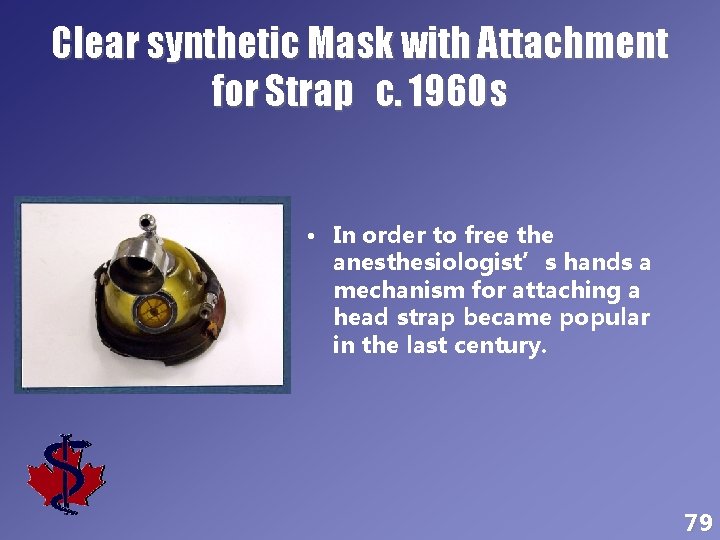
Clear synthetic Mask with Attachment for Strap c. 1960 s • In order to free the anesthesiologist’s hands a mechanism for attaching a head strap became popular in the last century. 79
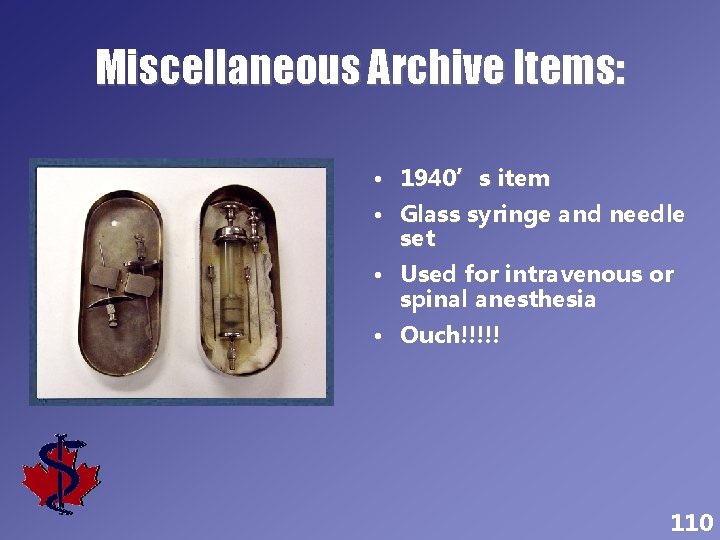
Miscellaneous Archive Items: • 1940’s item • Glass syringe and needle set • Used for intravenous or spinal anesthesia • Ouch!!!!! 110
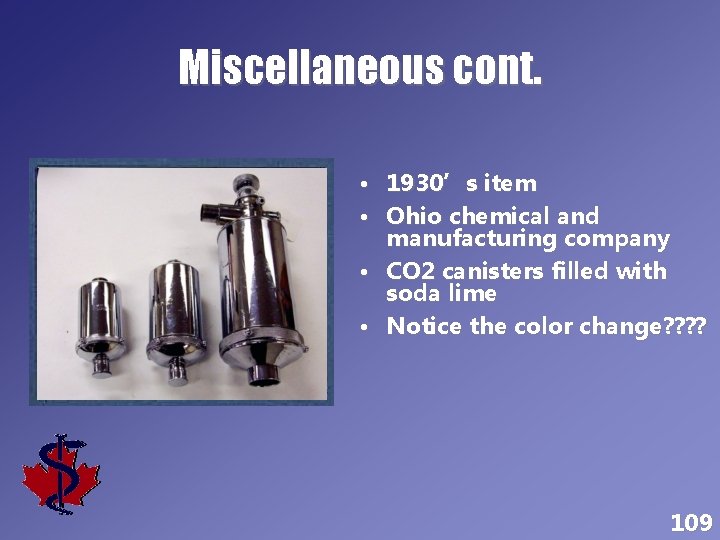
Miscellaneous cont. • 1930’s item • Ohio chemical and manufacturing company • CO 2 canisters filled with soda lime • Notice the color change? ? 109
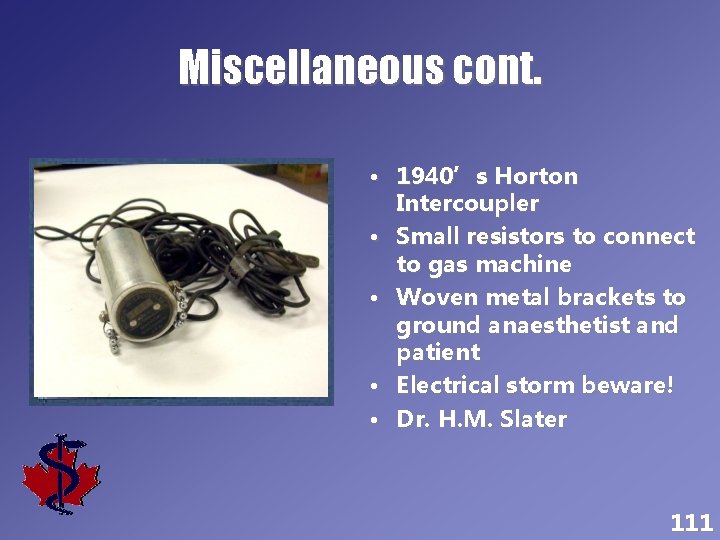
Miscellaneous cont. • 1940’s Horton Intercoupler • Small resistors to connect to gas machine • Woven metal brackets to ground anaesthetist and patient • Electrical storm beware! • Dr. H. M. Slater 111
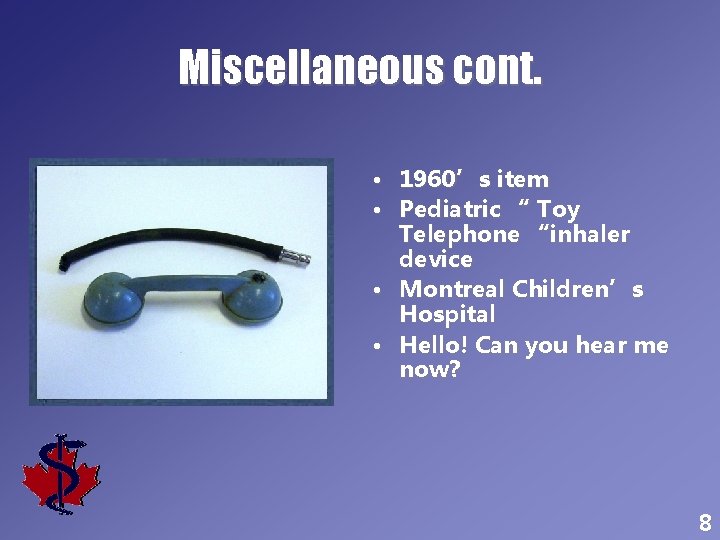
Miscellaneous cont. • 1960’s item • Pediatric “ Toy Telephone “inhaler device • Montreal Children’s Hospital • Hello! Can you hear me now? 8
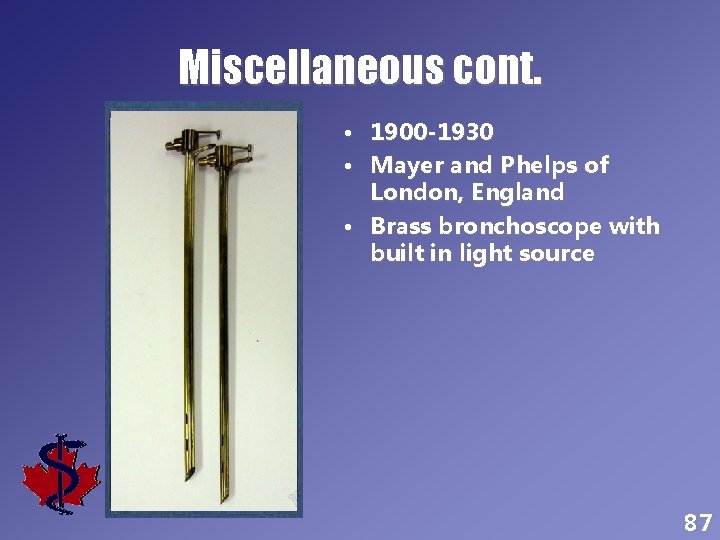
Miscellaneous cont. • 1900 -1930 • Mayer and Phelps of London, England • Brass bronchoscope with built in light source 87
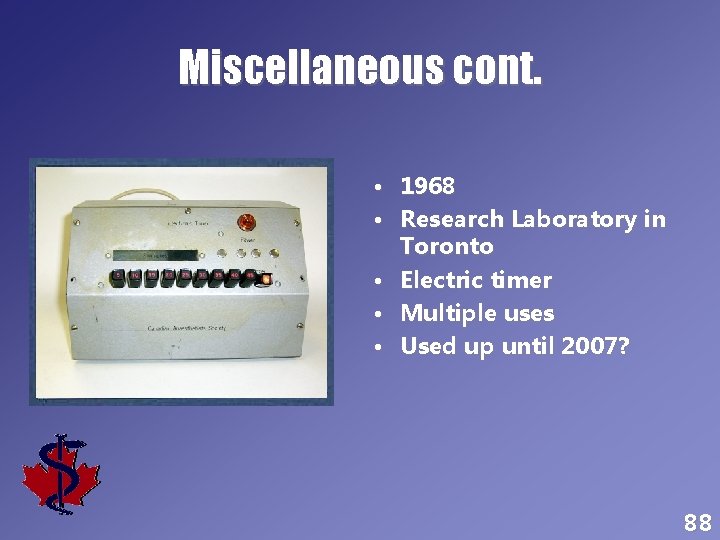
Miscellaneous cont. • 1968 • Research Laboratory in Toronto • Electric timer • Multiple uses • Used up until 2007? 88
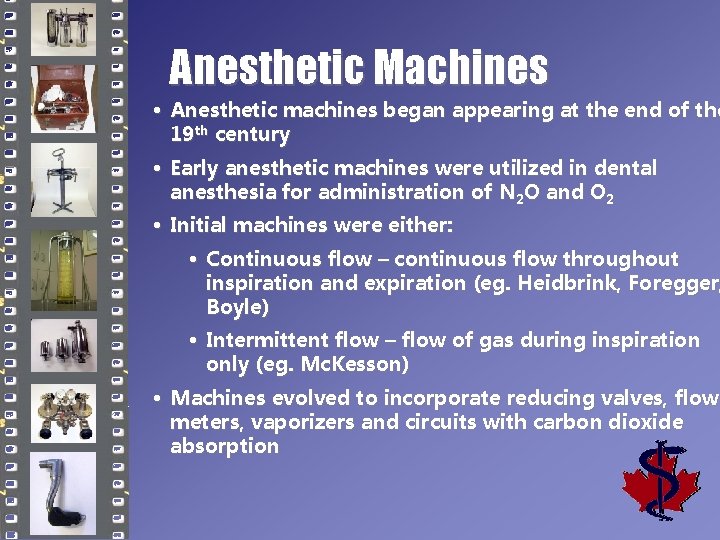
Anesthetic Machines • Anesthetic machines began appearing at the end of the 19 th century • Early anesthetic machines were utilized in dental anesthesia for administration of N 2 O and O 2 • Initial machines were either: • Continuous flow – continuous flow throughout inspiration and expiration (eg. Heidbrink, Foregger Boyle) • Intermittent flow – flow of gas during inspiration only (eg. Mc. Kesson) • Machines evolved to incorporate reducing valves, flow meters, vaporizers and circuits with carbon dioxide absorption
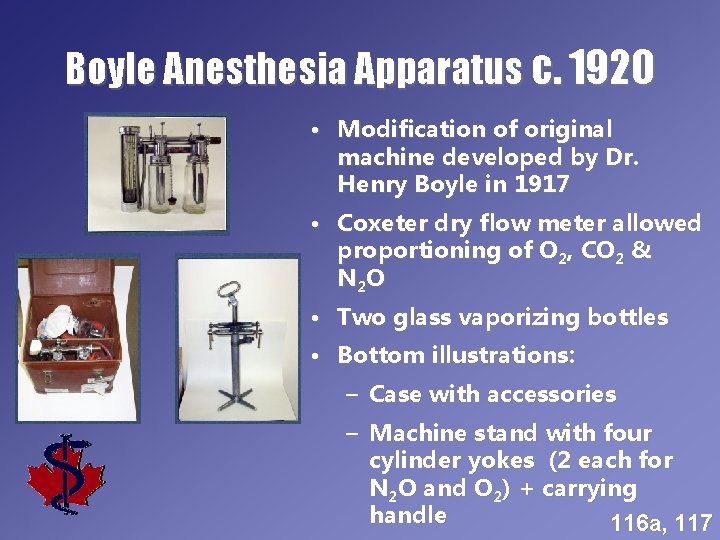
Boyle Anesthesia Apparatus c. 1920 • Modification of original machine developed by Dr. Henry Boyle in 1917 • Coxeter dry flow meter allowed proportioning of O 2, CO 2 & N 2 O • Two glass vaporizing bottles • Bottom illustrations: – Case with accessories – Machine stand with four cylinder yokes (2 each for N 2 O and O 2) + carrying handle 116 a, 117
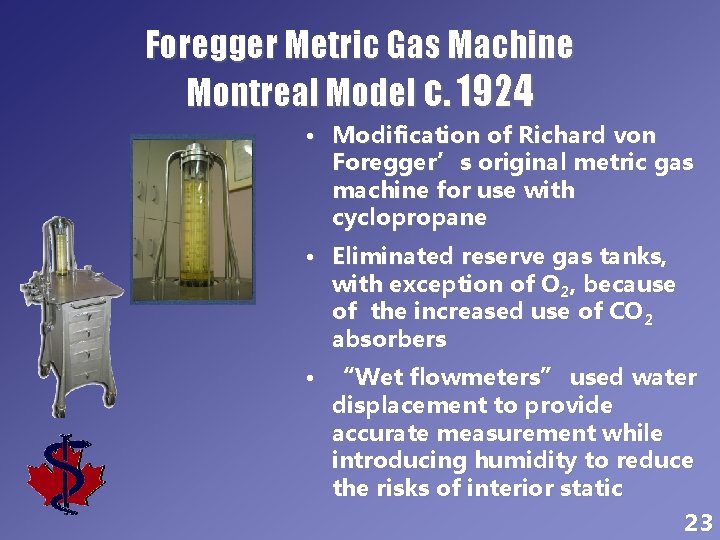
Foregger Metric Gas Machine Montreal Model c. 1924 • Modification of Richard von Foregger’s original metric gas machine for use with cyclopropane • Eliminated reserve gas tanks, with exception of O 2, because of the increased use of CO 2 absorbers • “Wet flowmeters” used water displacement to provide accurate measurement while introducing humidity to reduce the risks of interior static 23
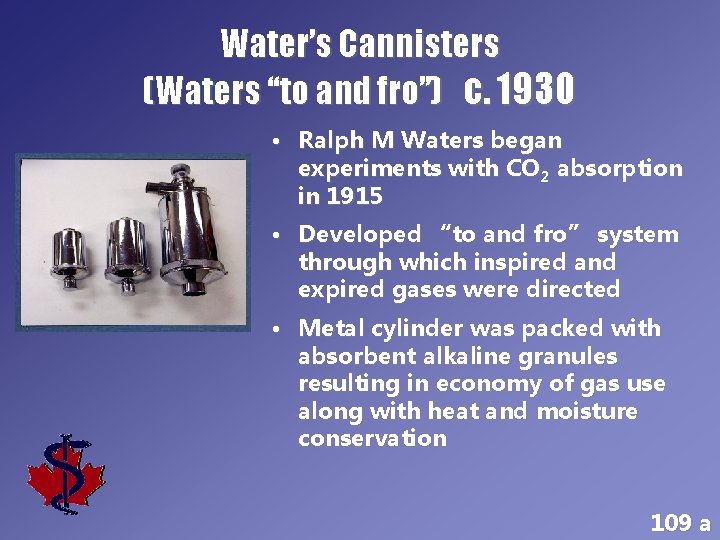
Water’s Cannisters (Waters “to and fro”) c. 1930 • Ralph M Waters began experiments with CO 2 absorption in 1915 • Developed “to and fro” system through which inspired and expired gases were directed • Metal cylinder was packed with absorbent alkaline granules resulting in economy of gas use along with heat and moisture conservation 109 a
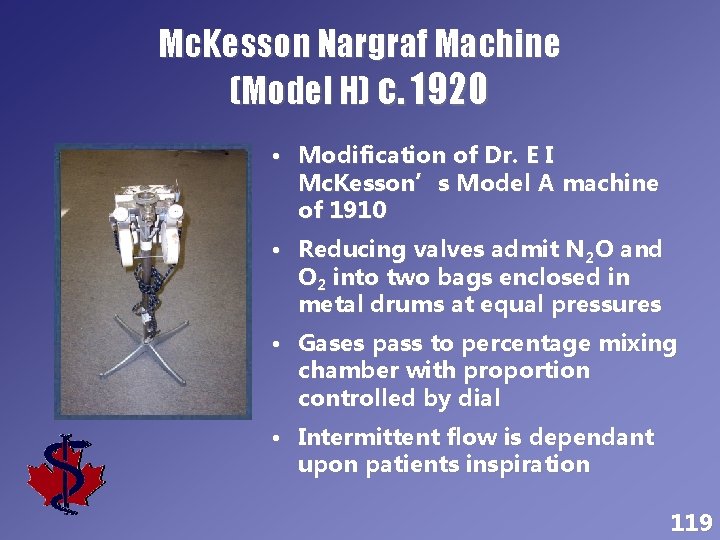
Mc. Kesson Nargraf Machine (Model H) c. 1920 • Modification of Dr. E I Mc. Kesson’s Model A machine of 1910 • Reducing valves admit N 2 O and O 2 into two bags enclosed in metal drums at equal pressures • Gases pass to percentage mixing chamber with proportion controlled by dial • Intermittent flow is dependant upon patients inspiration 119
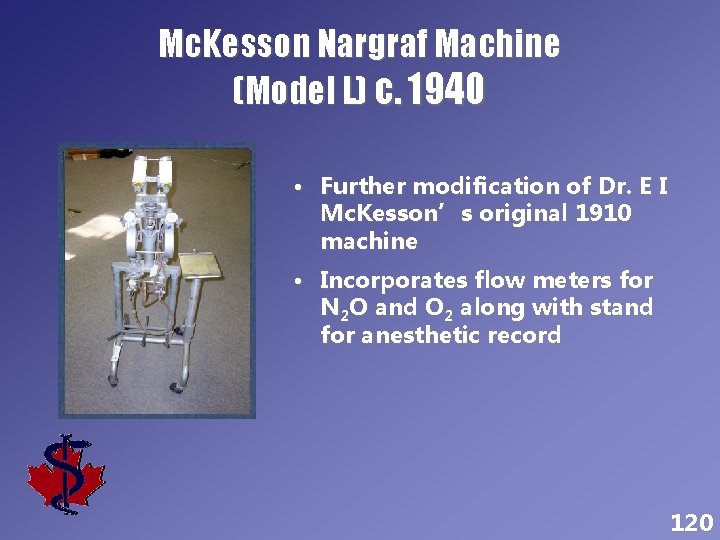
Mc. Kesson Nargraf Machine (Model L) c. 1940 • Further modification of Dr. E I Mc. Kesson’s original 1910 machine • Incorporates flow meters for N 2 O and O 2 along with stand for anesthetic record 120
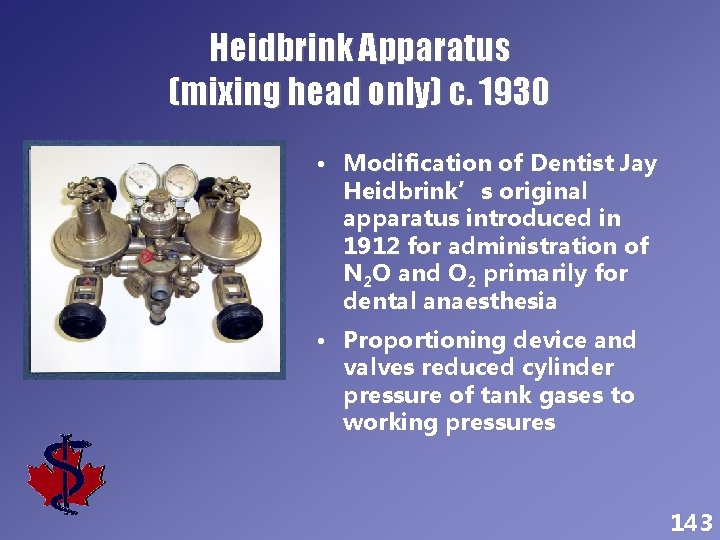
Heidbrink Apparatus (mixing head only) c. 1930 • Modification of Dentist Jay Heidbrink’s original apparatus introduced in 1912 for administration of N 2 O and O 2 primarily for dental anaesthesia • Proportioning device and valves reduced cylinder pressure of tank gases to working pressures 143
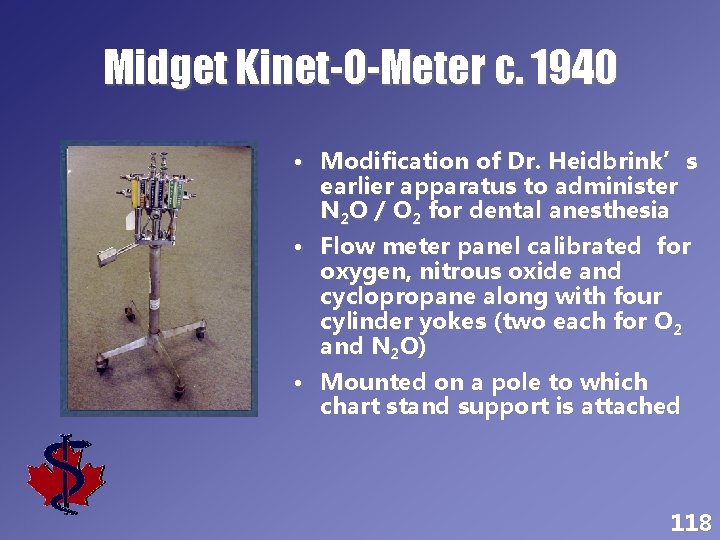
Midget Kinet-O-Meter c. 1940 • Modification of Dr. Heidbrink’s earlier apparatus to administer N 2 O / O 2 for dental anesthesia • Flow meter panel calibrated for oxygen, nitrous oxide and cyclopropane along with four cylinder yokes (two each for O 2 and N 2 O) • Mounted on a pole to which chart stand support is attached 118