General License Class General Class Chapter 8 Propagation




- Slides: 106
General License Class
General Class Chapter 8 Propagation
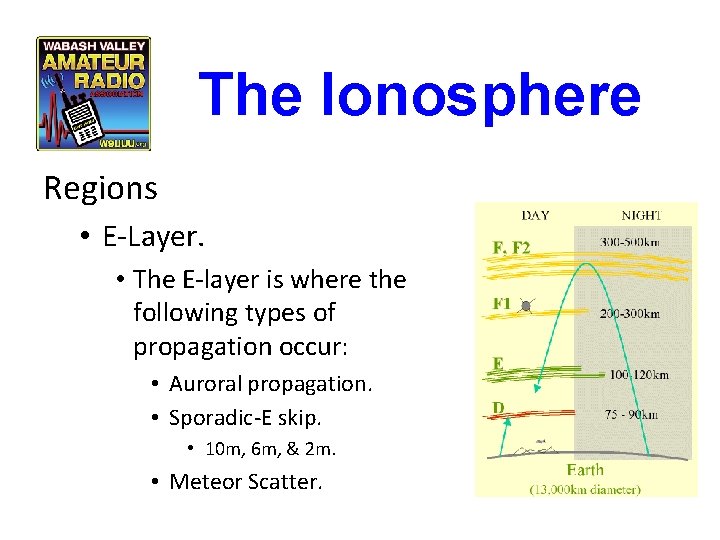
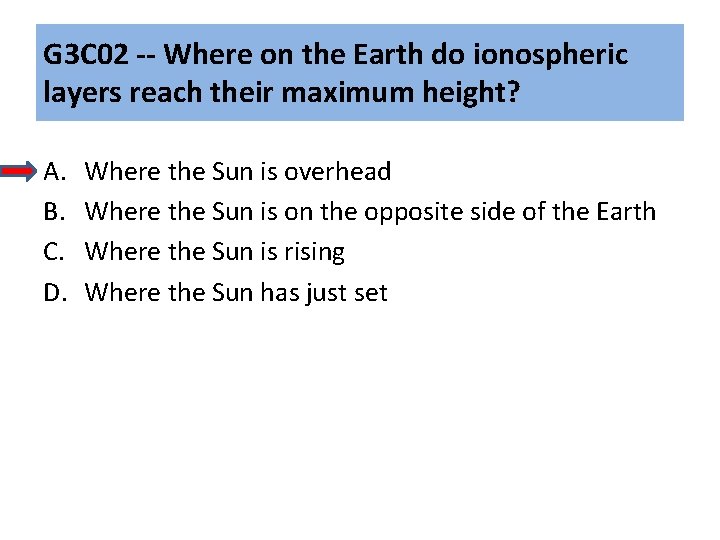
The Ionosphere Regions • Ionosphere. • The ionosphere is a portion of the atmosphere that extends from about 30 miles to about 300 miles above the surface of the Earth. • The ionosphere reaches its highest altitude when the sun is directly overhead. • Solar radiation causes atoms in the ionosphere to become ionized.
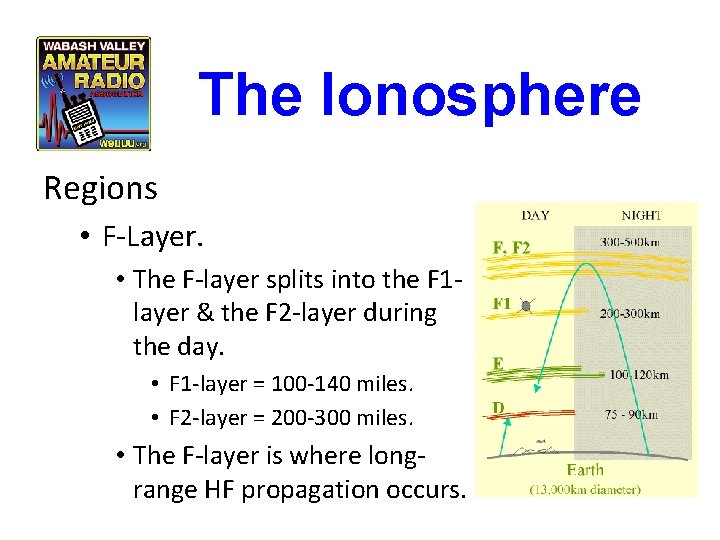
The Ionosphere Regions • Ionosphere. • The ionosphere organizes itself into regions or “layers”. • The layers vary with the strength of the ionization. • The D-region disappears at night. • The F-region splits into F 1 & F 2 regions during the day.
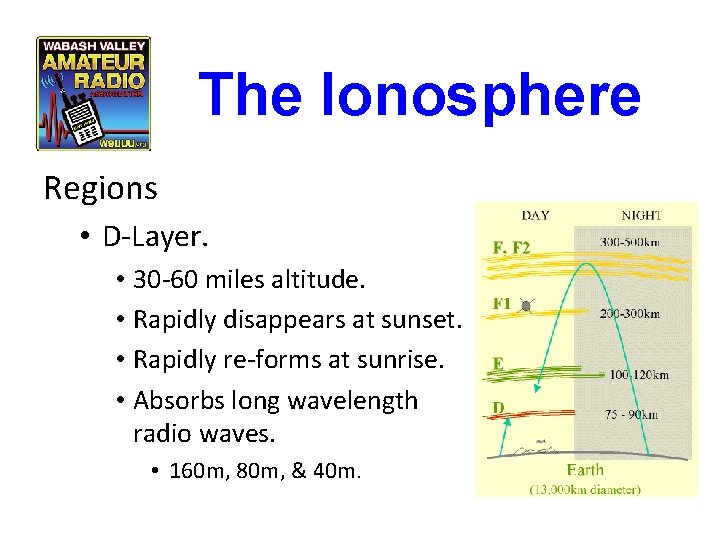
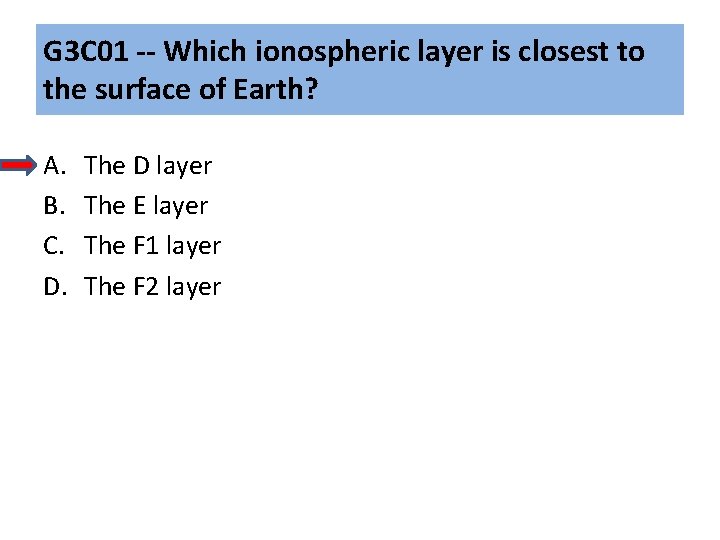
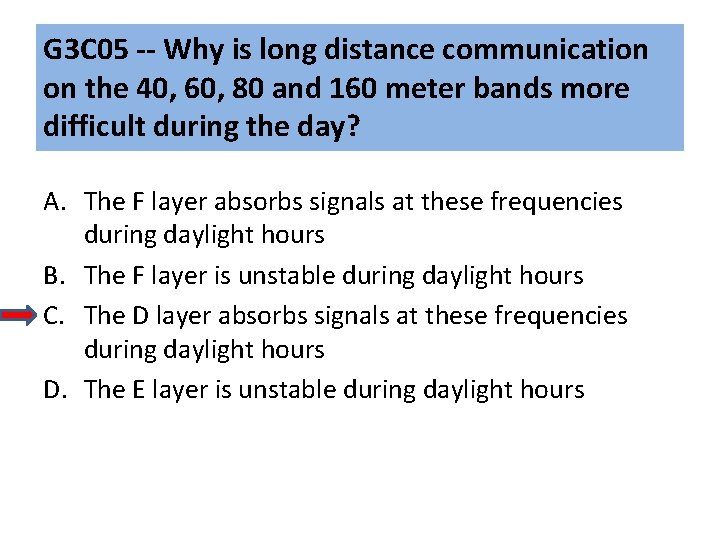
The Ionosphere Regions • D-Layer. • 30 -60 miles altitude. • Rapidly disappears at sunset. • Rapidly re-forms at sunrise. • Absorbs long wavelength radio waves. • 160 m, 80 m, & 40 m.
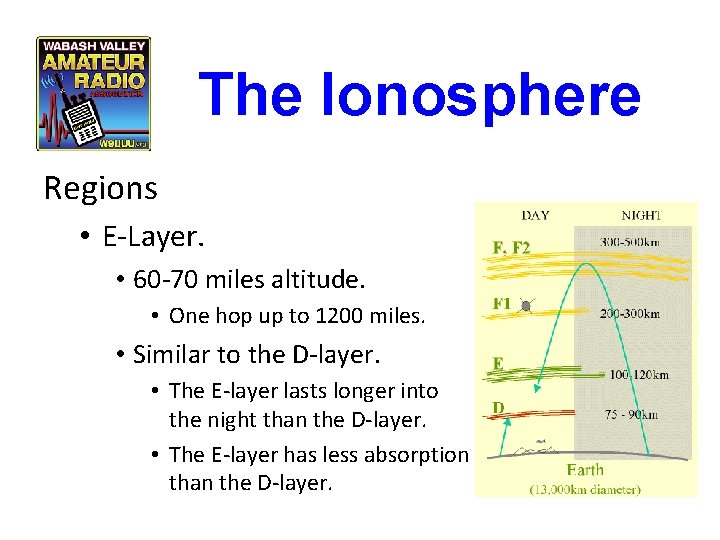
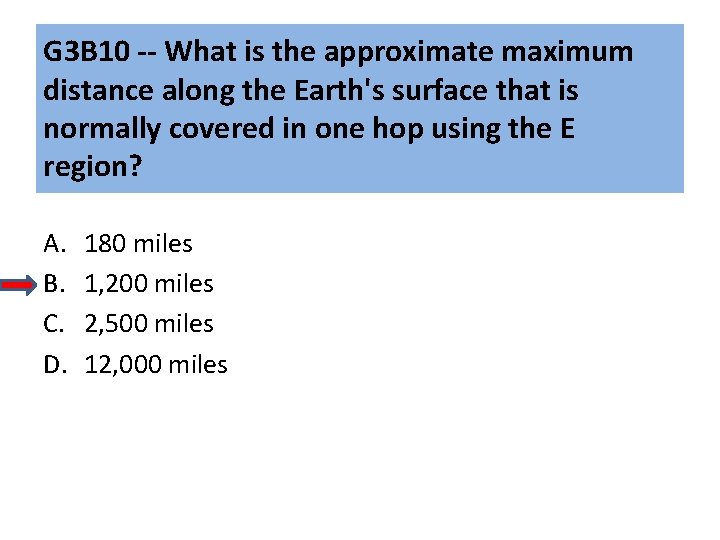
The Ionosphere Regions • E-Layer. • 60 -70 miles altitude. • One hop up to 1200 miles. • Similar to the D-layer. • The E-layer lasts longer into the night than the D-layer. • The E-layer has less absorption than the D-layer.
The Ionosphere Regions • E-Layer. • The E-layer is where the following types of propagation occur: • Auroral propagation. • Sporadic-E skip. • 10 m, 6 m, & 2 m. • Meteor Scatter.
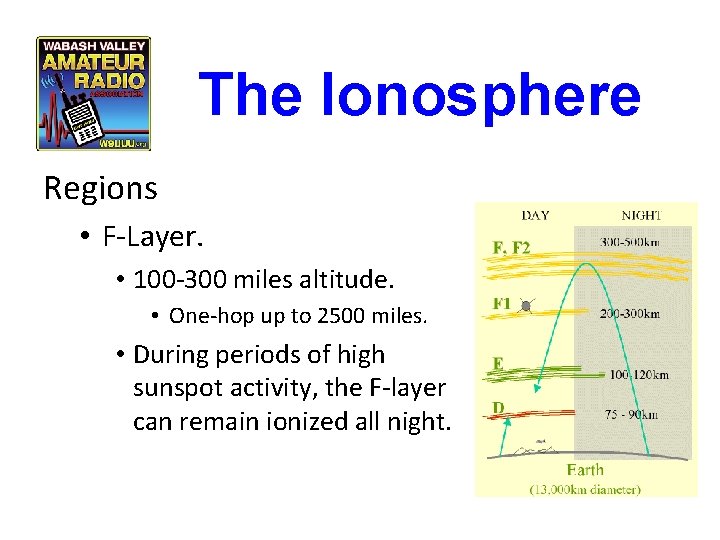
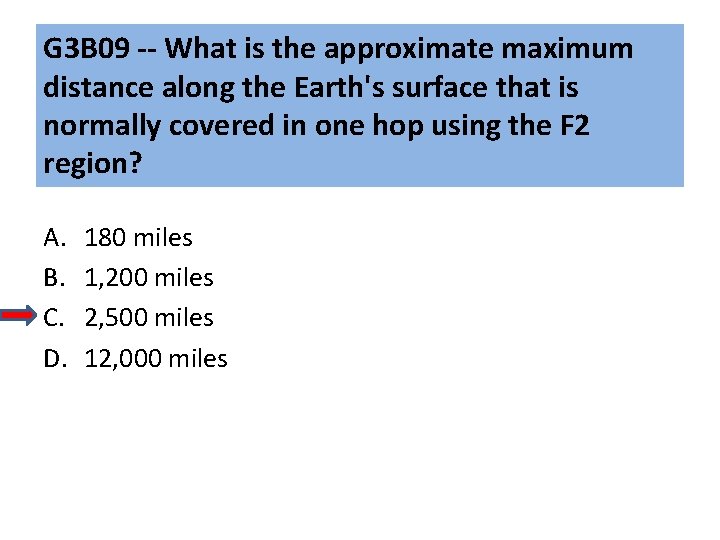
The Ionosphere Regions • F-Layer. • 100 -300 miles altitude. • One-hop up to 2500 miles. • During periods of high sunspot activity, the F-layer can remain ionized all night.
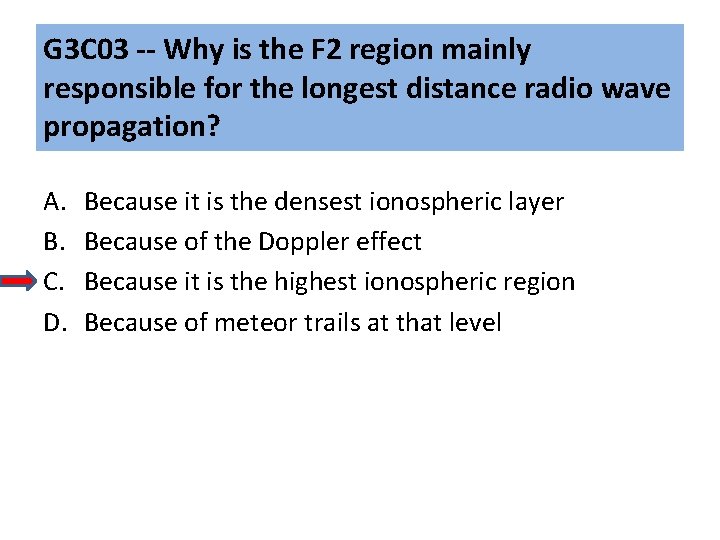
The Ionosphere Regions • F-Layer. • The F-layer splits into the F 1 layer & the F 2 -layer during the day. • F 1 -layer = 100 -140 miles. • F 2 -layer = 200 -300 miles. • The F-layer is where longrange HF propagation occurs.
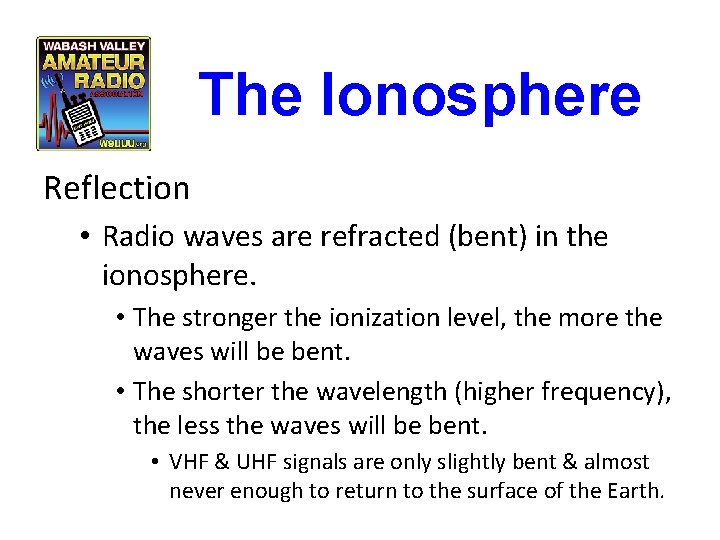
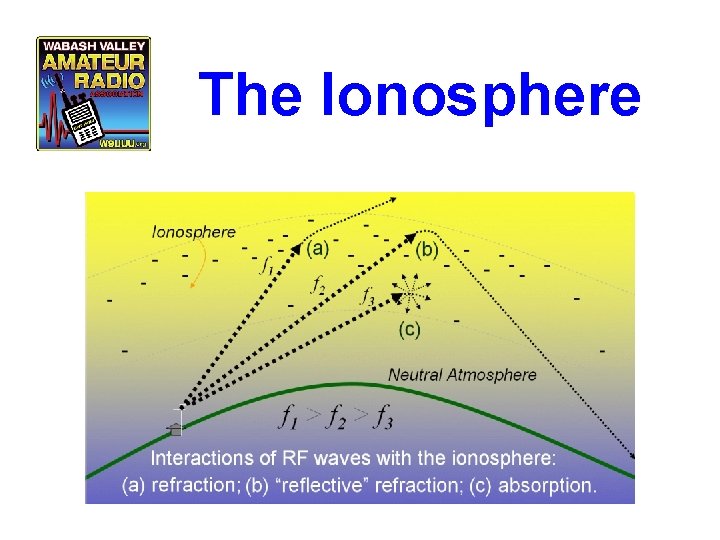
The Ionosphere Reflection • Radio waves are refracted (bent) in the ionosphere. • The stronger the ionization level, the more the waves will be bent. • The shorter the wavelength (higher frequency), the less the waves will be bent. • VHF & UHF signals are only slightly bent & almost never enough to return to the surface of the Earth.
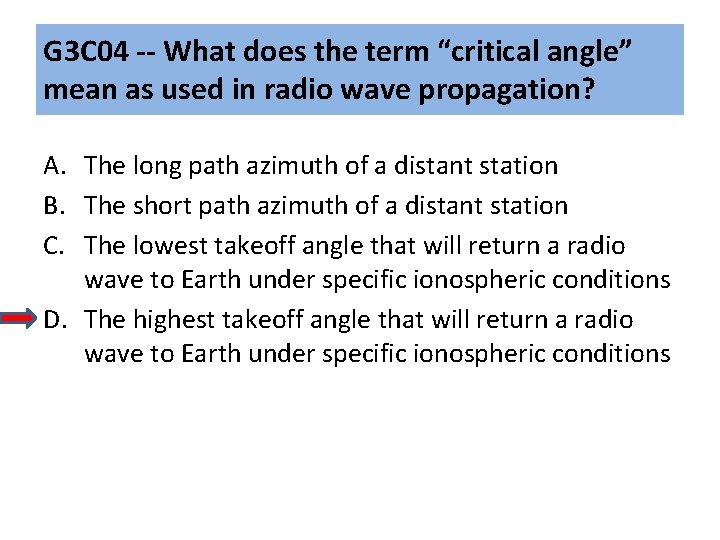
The Ionosphere Reflection • Critical angle. • The maximum angle at which radio waves are bent enough to return to the surface of the Earth. • The critical angle decreases with increasing frequency. • The critical angle is one reason why a low angle of radiation is important for working DX.
The Ionosphere Reflection • Critical frequency. • The critical frequency is the highest frequency at which radio waves sent straight up are bent enough to return to the surface of the Earth. • The critical frequency is important for NVIS operation.
The Ionosphere Absorption and Noise • Aside from low levels of ionization in the ionosphere, the two main enemies of good propagation are absorption and noise.
The Ionosphere Absorption and Noise • Absorption. • The atmosphere is denser at lower altitudes, causing part of the RF energy to be absorbed. • The longer the wavelength (lower frequency), the higher the amount of absorption.
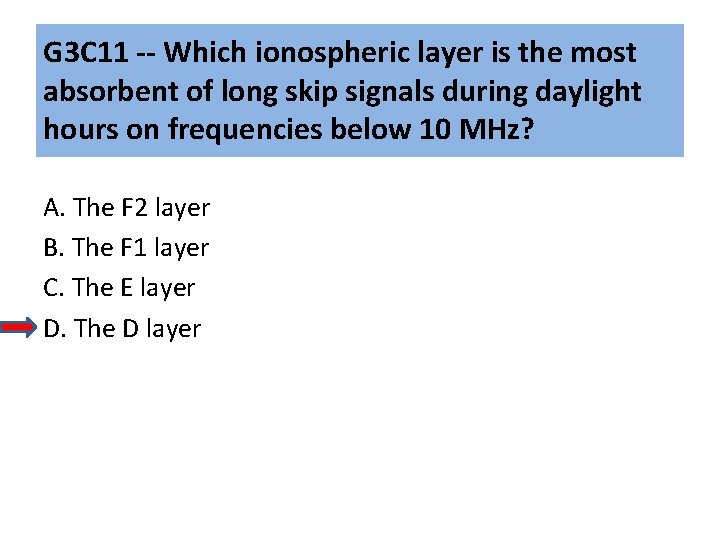
The Ionosphere Absorption and Noise • Absorption. • D-region. • Almost no refraction (bending) of radio waves. • Almost completely absorbs radio waves below 10 MHz. • E-region. • More refraction than D-region. • Less absorption than D-region.
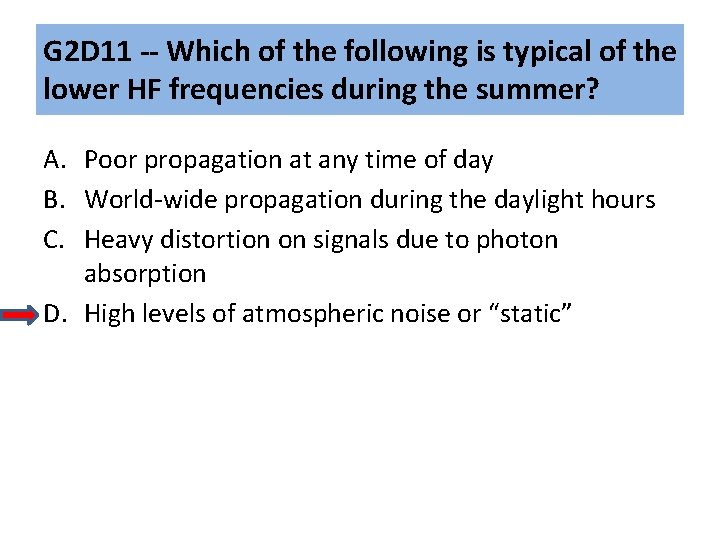
The Ionosphere Absorption and Noise • Noise. • Storms generate noise (static) which covers up weak signals, making them difficult to hear. • The strength of the noise decreases with increasing frequency. • Atmospheric noise is stronger during the summer. • More storms.
The Ionosphere
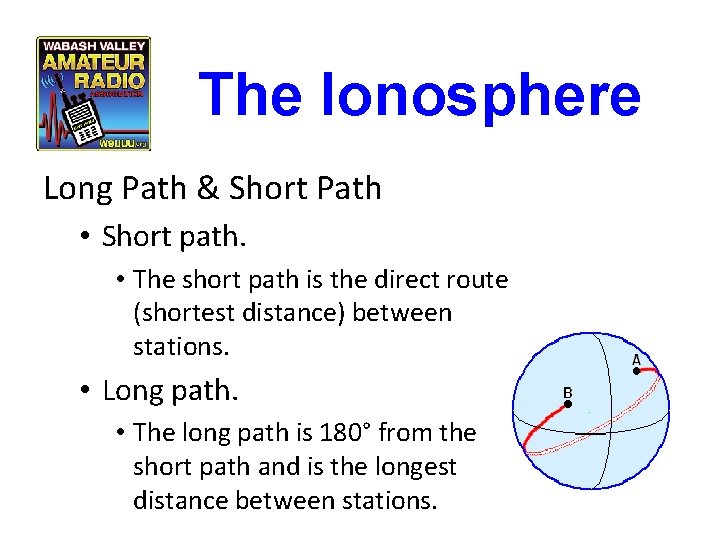
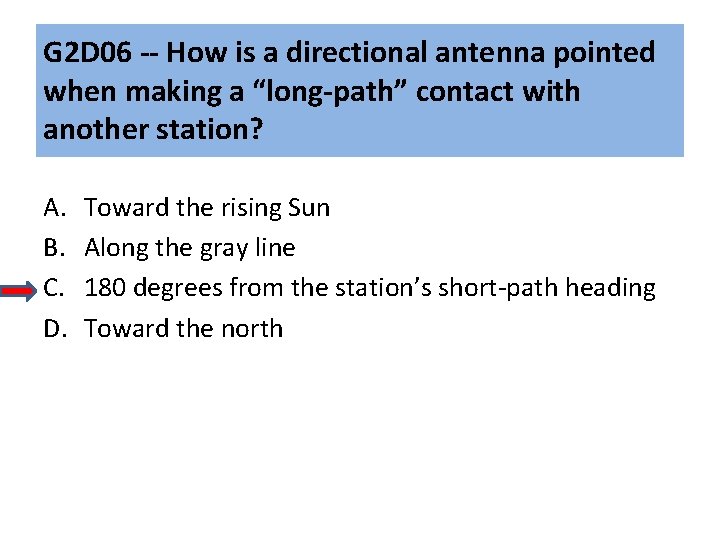
The Ionosphere Long Path & Short Path • Short path. • The short path is the direct route (shortest distance) between stations. • Long path. • The long path is 180° from the short path and is the longest distance between stations.
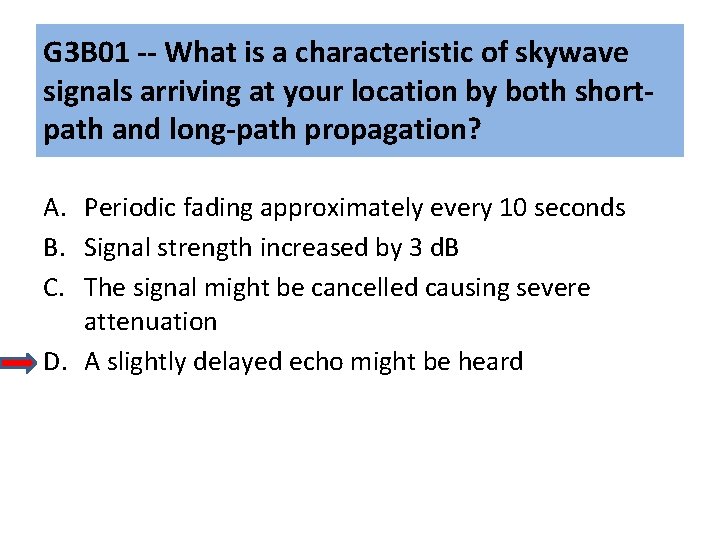
The Ionosphere Long Path & Short Path • Conditions may not support communications using the short path, but long path communications may be possible. • A pronounced echo indicates that both short & long paths are open.
The Ionosphere Long Path & Short Path
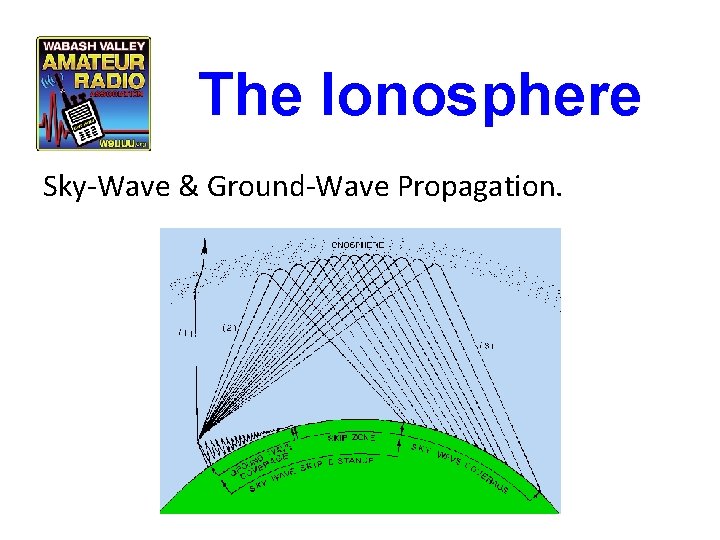
The Ionosphere Sky-Wave & Ground-Wave Propagation. • Sky-Wave. • Sky-wave propagation is refracting radio waves back to the surface of the Earth using the ionosphere (a. k. a. – skip). • Each trip from the Earth to the ionosphere & back to the Earth is called a “hop”. • Multiple hops are common.
The Ionosphere Sky-Wave & Ground-Wave Propagation. • Sky-Wave. • The maximum distance of a single hop depends on the altitude of the region where the refraction takes place. • In the E-region, a single hop can be up to 1200 miles. • In the F-region, a single hop can be up to 2500 miles.
The Ionosphere Sky-Wave & Ground-Wave Propagation. • Sky-Wave. • Hops that are considerably less than the maximum distance is called short skip. • The critical angle is higher. • The existence of short skip is a good indicator that skip is possible on a higher frequency band.
The Ionosphere Sky-Wave & Ground-Wave Propagation. • Ground-Wave. • Radio waves can follow along the surface of the Earth. • Ground waves are primarily vertically polarized. • Losses in the ground cause a rapid decrease of signal strength with increasing distance. • Higher frequency higher loss.
The Ionosphere Sky-Wave & Ground-Wave Propagation. • Skip distance. • The distance from the transmitter where a radio wave first returns to the surface of the Earth. • Skip zone. • Too close for sky-wave propagation, but too far for ground-wave propagation.
The Ionosphere Sky-Wave & Ground-Wave Propagation.
G 2 D 06 -- How is a directional antenna pointed when making a “long-path” contact with another station? A. B. C. D. Toward the rising Sun Along the gray line 180 degrees from the station’s short-path heading Toward the north
G 2 D 11 -- Which of the following is typical of the lower HF frequencies during the summer? A. Poor propagation at any time of day B. World-wide propagation during the daylight hours C. Heavy distortion on signals due to photon absorption D. High levels of atmospheric noise or “static”
G 3 B 01 -- What is a characteristic of skywave signals arriving at your location by both shortpath and long-path propagation? A. Periodic fading approximately every 10 seconds B. Signal strength increased by 3 d. B C. The signal might be cancelled causing severe attenuation D. A slightly delayed echo might be heard
G 3 B 09 -- What is the approximate maximum distance along the Earth's surface that is normally covered in one hop using the F 2 region? A. B. C. D. 180 miles 1, 200 miles 2, 500 miles 12, 000 miles
G 3 B 10 -- What is the approximate maximum distance along the Earth's surface that is normally covered in one hop using the E region? A. B. C. D. 180 miles 1, 200 miles 2, 500 miles 12, 000 miles
G 3 C 01 -- Which ionospheric layer is closest to the surface of Earth? A. B. C. D. The D layer The E layer The F 1 layer The F 2 layer
G 3 C 02 -- Where on the Earth do ionospheric layers reach their maximum height? A. B. C. D. Where the Sun is overhead Where the Sun is on the opposite side of the Earth Where the Sun is rising Where the Sun has just set
G 3 C 03 -- Why is the F 2 region mainly responsible for the longest distance radio wave propagation? A. B. C. D. Because it is the densest ionospheric layer Because of the Doppler effect Because it is the highest ionospheric region Because of meteor trails at that level
G 3 C 04 -- What does the term “critical angle” mean as used in radio wave propagation? A. The long path azimuth of a distant station B. The short path azimuth of a distant station C. The lowest takeoff angle that will return a radio wave to Earth under specific ionospheric conditions D. The highest takeoff angle that will return a radio wave to Earth under specific ionospheric conditions
G 3 C 05 -- Why is long distance communication on the 40, 60, 80 and 160 meter bands more difficult during the day? A. The F layer absorbs signals at these frequencies during daylight hours B. The F layer is unstable during daylight hours C. The D layer absorbs signals at these frequencies during daylight hours D. The E layer is unstable during daylight hours
G 3 C 11 -- Which ionospheric layer is the most absorbent of long skip signals during daylight hours on frequencies below 10 MHz? A. The F 2 layer B. The F 1 layer C. The E layer D. The D layer
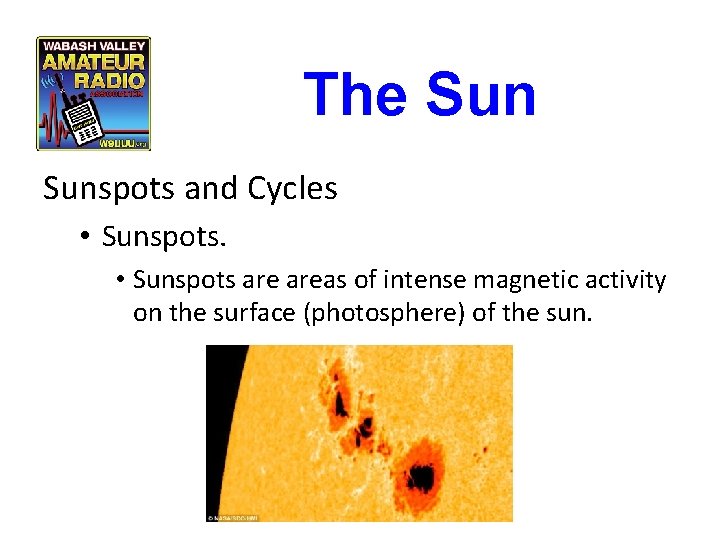
The Sunspots and Cycles • Sunspots areas of intense magnetic activity on the surface (photosphere) of the sun.
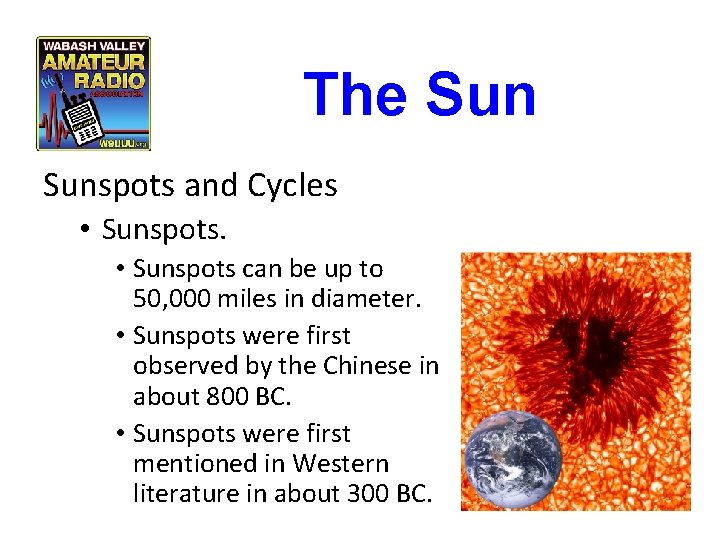
The Sunspots and Cycles • Sunspots can be up to 50, 000 miles in diameter. • Sunspots were first observed by the Chinese in about 800 BC. • Sunspots were first mentioned in Western literature in about 300 BC.
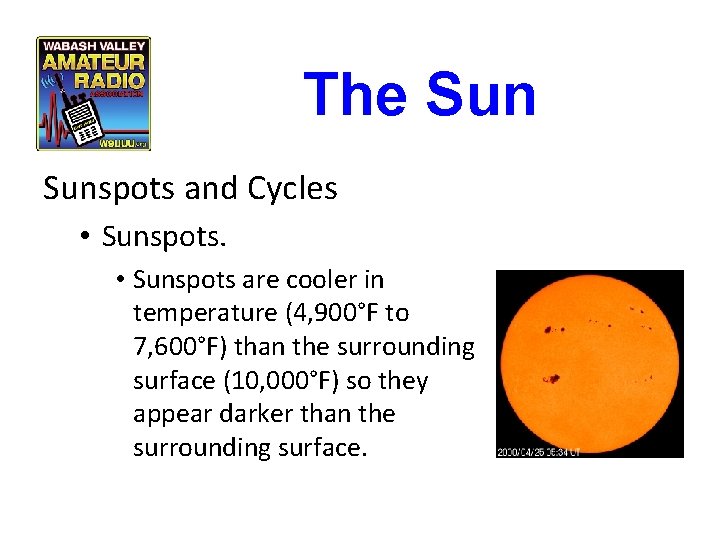
The Sunspots and Cycles • Sunspots are cooler in temperature (4, 900°F to 7, 600°F) than the surrounding surface (10, 000°F) so they appear darker than the surrounding surface.
The Sunspots and Cycles • Sunspots have a life span of less than a day to a few weeks. • Sunspots are stationary on the sun’s surface. • Sunspots appear to move because of the sun’s rotation. • Sunspots rotate back into view every 28 days.
The Sunspots and Cycles • Sunspots emit UV radiation which ionizes the Earth's atmosphere. • More sunspots higher levels of ionization. • Stronger sunspots higher levels of ionization. • Higher levels of ionization cause greater refraction of radio waves in the ionosphere. • Better HF propagation.
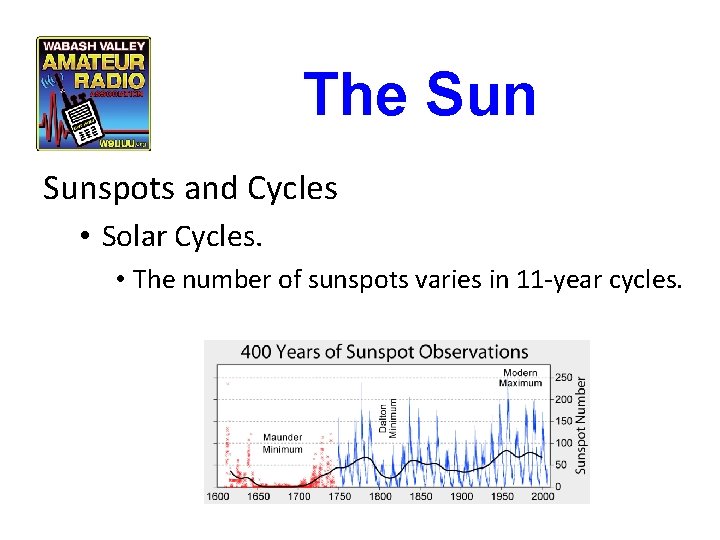
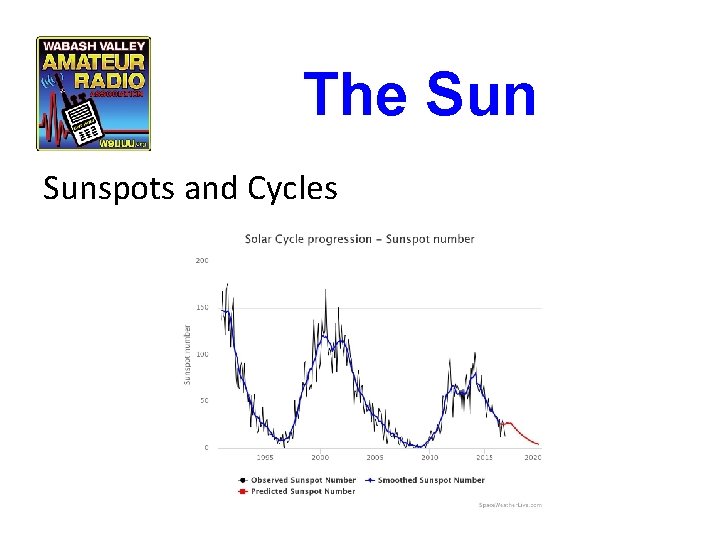
The Sunspots and Cycles • Solar Cycles. • The number of sunspots varies in 11 -year cycles.
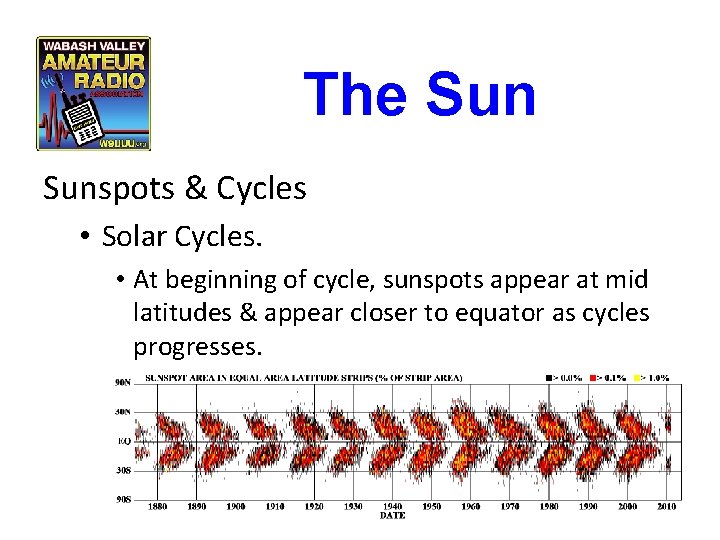
The Sunspots & Cycles • Solar Cycles. • At beginning of cycle, sunspots appear at mid latitudes & appear closer to equator as cycles progresses.
The Sunspots and Cycles
The Sunspots and Cycles • Solar Cycles. • At the peak of a solar cycle, the ionization level can be high enough that 10 m stays open all night. • At the minimum of a solar cycle, bands above 20 m may not be open at all.
The Sunspots and Cycles • Solar Cycles. • There are strong seasonal & daily variations in propagation. • Seasonal variations are due to the different levels of ionization between summer & winter. • Seasonal variations on the lower bands due to lower atmospheric noise during the winter months. • Daily variations are due to the different levels of ionization between day & night.
The Sun Measuring Solar Activity • The most familiar measurement of solar activity is the Smoothed Sunspot Number (SSN). • SSN = 10 x Nr of groups + Nr of sunspots. • The SSN is the result of observations from many different locations around the world.
The Sun Measuring Solar Activity • A better measurement of solar activity is the Solar Flux Index (SFI). • SFI is a measurement of solar radiation reaching the surface of the Earth at a wavelength of 10. 7 cm (2. 8 GHz). • The SFI indicates the amount of UV radiation impacting the ionosphere. • The SFI takes into account both the number of the sunspots and their combined strength.
The Sun Measuring Solar Activity • K-index (KP). • A measure of the shortterm stability of the Earth’s magnetic field. • Updated every 3 hours. • Higher values Poorer HF propagation. K-Index Meaning 0 Inactive 1 Very quiet 2 Quiet 3 Unsettled 4 Active 5 Minor storm 6 Major storm 7 Severe storm 8 Very severe storm 9 Extremely severe storm
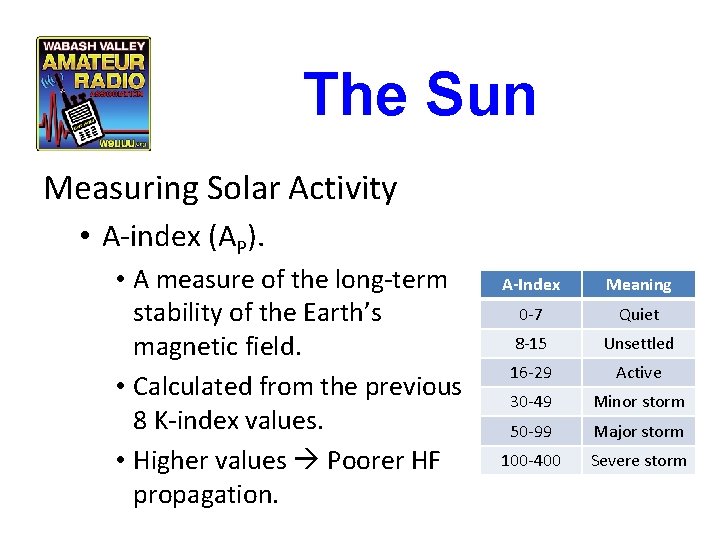
The Sun Measuring Solar Activity • A-index (AP). • A measure of the long-term stability of the Earth’s magnetic field. • Calculated from the previous 8 K-index values. • Higher values Poorer HF propagation. A-Index Meaning 0 -7 Quiet 8 -15 Unsettled 16 -29 Active 30 -49 Minor storm 50 -99 Major storm 100 -400 Severe storm
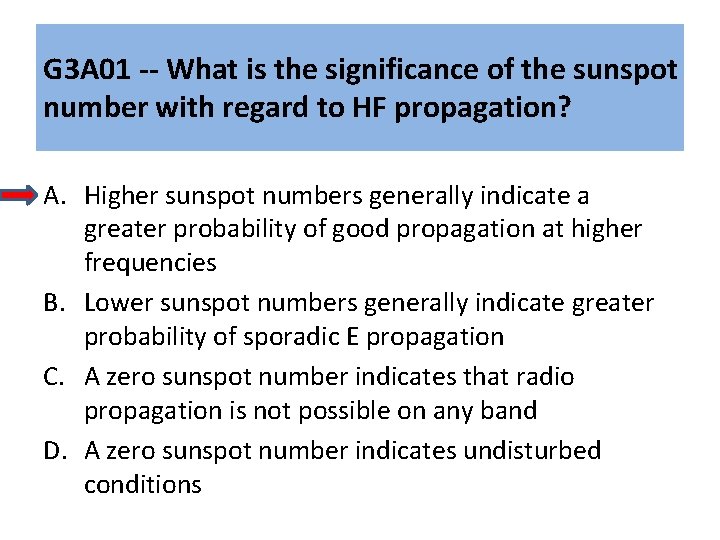
G 3 A 01 -- What is the significance of the sunspot number with regard to HF propagation? A. Higher sunspot numbers generally indicate a greater probability of good propagation at higher frequencies B. Lower sunspot numbers generally indicate greater probability of sporadic E propagation C. A zero sunspot number indicates that radio propagation is not possible on any band D. A zero sunspot number indicates undisturbed conditions
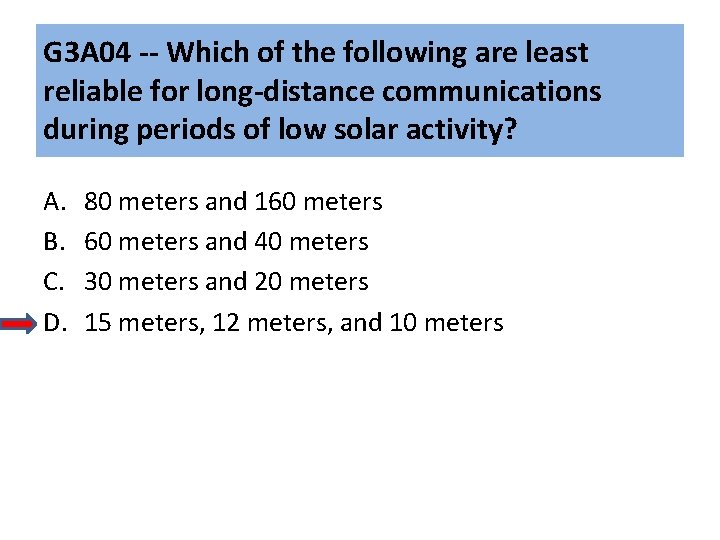
G 3 A 04 -- Which of the following are least reliable for long-distance communications during periods of low solar activity? A. B. C. D. 80 meters and 160 meters and 40 meters 30 meters and 20 meters 15 meters, 12 meters, and 10 meters
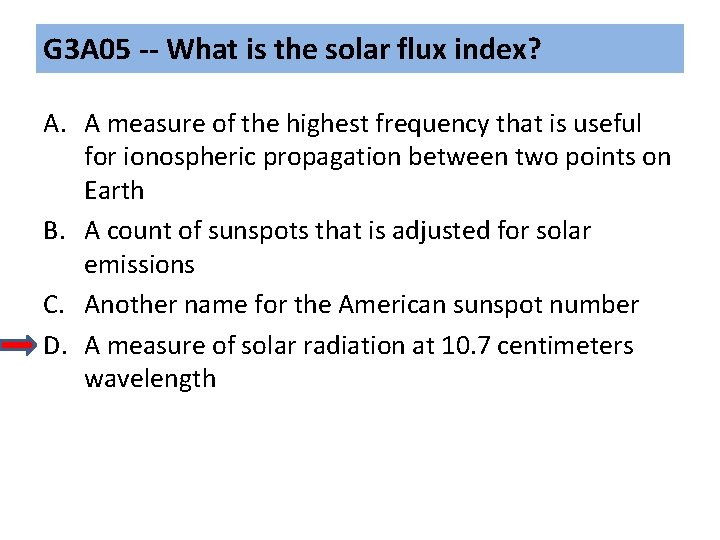
G 3 A 05 -- What is the solar flux index? A. A measure of the highest frequency that is useful for ionospheric propagation between two points on Earth B. A count of sunspots that is adjusted for solar emissions C. Another name for the American sunspot number D. A measure of solar radiation at 10. 7 centimeters wavelength
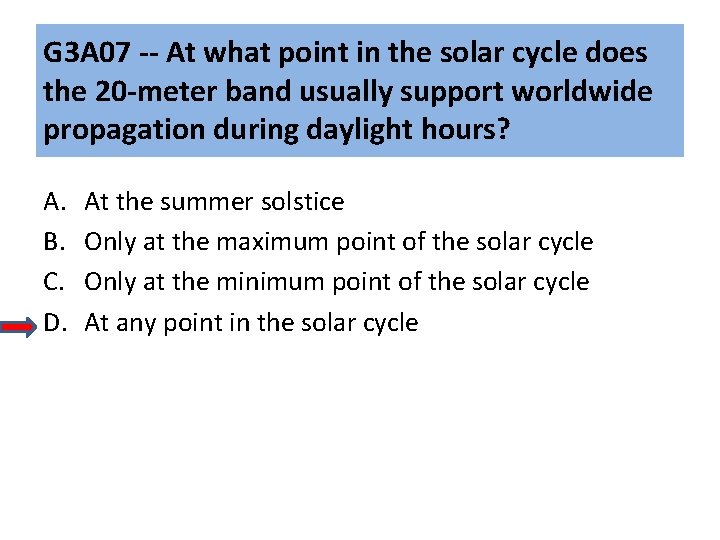
G 3 A 07 -- At what point in the solar cycle does the 20 -meter band usually support worldwide propagation during daylight hours? A. B. C. D. At the summer solstice Only at the maximum point of the solar cycle Only at the minimum point of the solar cycle At any point in the solar cycle
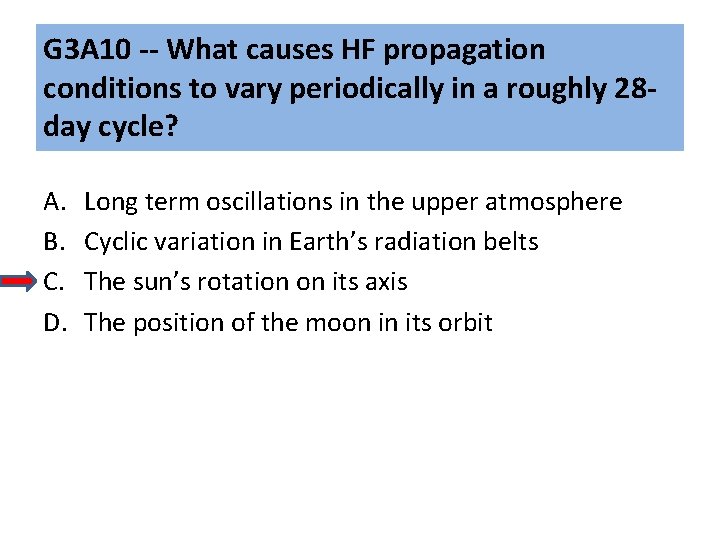
G 3 A 10 -- What causes HF propagation conditions to vary periodically in a roughly 28 day cycle? A. B. C. D. Long term oscillations in the upper atmosphere Cyclic variation in Earth’s radiation belts The sun’s rotation on its axis The position of the moon in its orbit
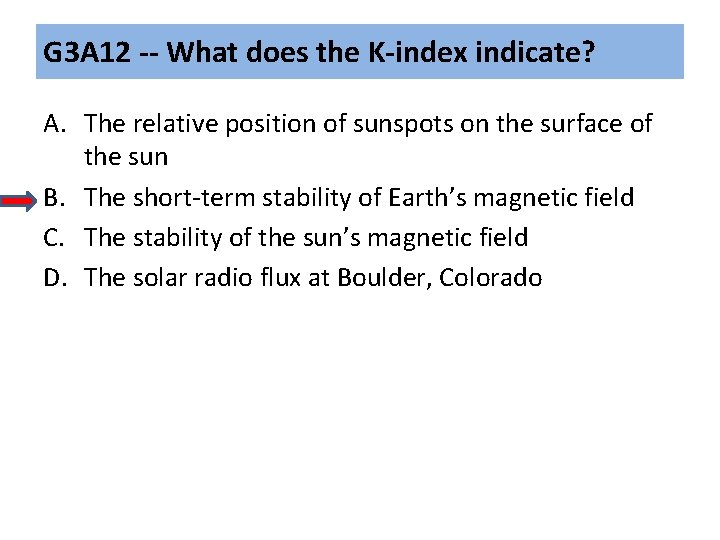
G 3 A 12 -- What does the K-index indicate? A. The relative position of sunspots on the surface of the sun B. The short-term stability of Earth’s magnetic field C. The stability of the sun’s magnetic field D. The solar radio flux at Boulder, Colorado
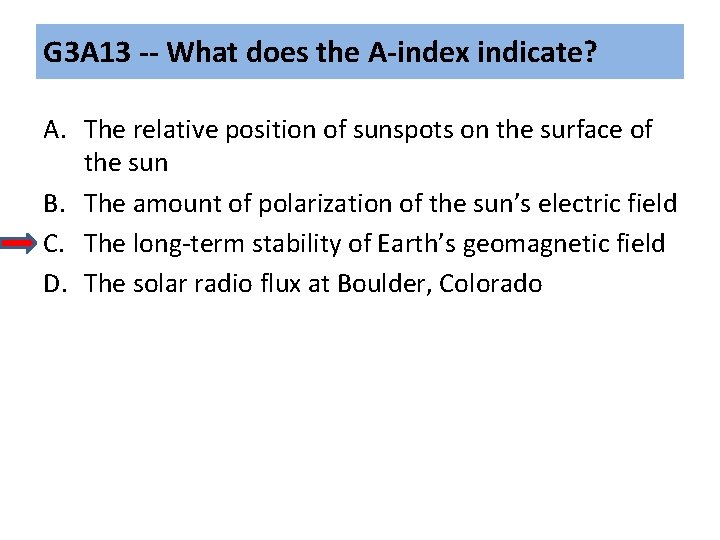
G 3 A 13 -- What does the A-index indicate? A. The relative position of sunspots on the surface of the sun B. The amount of polarization of the sun’s electric field C. The long-term stability of Earth’s geomagnetic field D. The solar radio flux at Boulder, Colorado
The Sun Assessing Propagation • Knowing the SSN, SFI, A-index, & K-index values, it is possible to do a fairly good job of predicting propagation between any 2 points on the Earth.
The Sun Assessing Propagation • Maximum useable frequency (MUF). • The highest frequency that will allow communications between 2 points. • Radio waves on frequencies below the MUF will be refracted back to the surface of the Earth. • Radio waves on frequencies above the MUF will be lost into space. • Use a frequency just below the MUF for the best results.
The Sun Assessing Propagation • Lowest useable frequency (LUF). • The lowest frequency that will allow communications between 2 points. • Radio waves on frequencies below the LUF will be absorbed by the D-region. • If the MUF drops below the LUF, then sky-wave communication is not possible between those 2 points.
The Sun Assessing Propagation • International beacons. • There is a network of beacon transmitters at 18 different locations around the world. • Sponsored by the NCDXF & the IARU. • 14. 100 MHz, 18. 110 MHz, 21. 150 MHz, 24. 930 MHz, & 28. 200 MHz. • Beacons transmit sequentially 24/7 on a 3 -minute cycle.
The Sun Assessing Propagation • International beacons. • Each beacon sends its callsign in Morse code at 22 wpm followed by four 1 -second long dashes. • • Callsign & 1 st dash = 100 Watts. 2 nd dash = 10 Watts. 3 rd dash = 1 Watt. 4 th dash = 0. 1 Watt.
The Sun Assessing Propagation • International beacons.
The Sun Assessing Propagation • Propagation can be predicted by software. • VOACAP • Voice of America Coverage Analysis Program • Online predictions. • http: //www. voacap. com/prediction. html • http: //www. voacap. com/coverage. html • Ignore the predictions – just listen!
Break
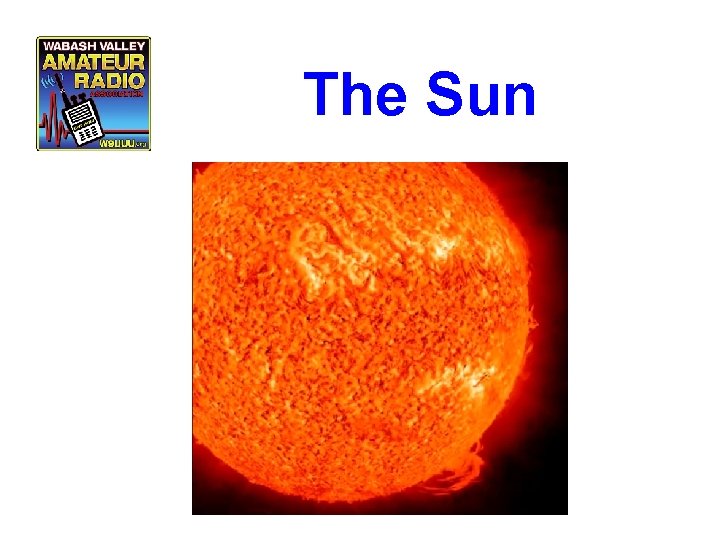
The Sun Solar Disturbances • There are occasional disturbances in the Earth’s atmosphere. • Hurricanes, typhoons, tornados, etc. • Similarly, there are occasional disturbances in the surface of the sun. • Solar flares, coronal holes, & coronal mass ejections (CMEs).
The Sun Solar Disturbances • Solar flare. • A solar flare is a large eruption of energy & particles from the surface of the sun. • Solar flares are caused by disruptions of the sun’s magnetic field. • It takes about 8 minutes for the energy from a solar flare to reach the Earth.
The Sun
The Sun Solar Disturbances • Coronal hole. • A coronal hole is a weak (thin) area in the sun’s corona through which plasma can escape the sun’s magnetic field & stream through space at high velocity.
The Sun Solar Disturbances • Coronal mass ejection (CME). • A coronal mass ejection is the violent expulsion of a large amount of material from the corona. • A CME can be either a narrow beam of material or it can be spread over a wide area. • CMEs are often associated with large solar flares. • It takes about 20 -40 hours for the particles to reach the Earth.
The Sun
The Sun Solar Disturbances • Sudden ionospheric disturbance (SID). • A sudden ionospheric disturbance (SID) occurs when the UV-rays & X-rays from a solar flare impact the ionosphere. • The rays will reach the Earth in about 8 minutes. • There is a sudden increase in the ionization level which is especially noticeable in the D-region. • The lower frequency bands will be more greatly affected.
The Sun Solar Disturbances • Sudden ionospheric disturbance (SID). • An SID can last from a few seconds to several hours. • An SID only affects the sunlit side of the Earth. • Nighttime communications are relatively unaffected.
The Sun Solar Disturbances • Geomagnetic disturbances. • CME’s result in a continuous stream of charged particles. • These particles greatly increase the strength of the solar wind. • The particles reach the Earth in about 20 -40 hours.
The Sun Solar Disturbances • Geomagnetic disturbances. • The particles become trapped in the Earth’s magnetosphere near both poles. • The particles greatly increase the ionization of the E-region which creates a geomagnetic storm.
The Sun Solar Disturbances • Geomagnetic disturbances. • High-latitude HF propagation is greatly decreased. • The effects can last several hours to a few days.
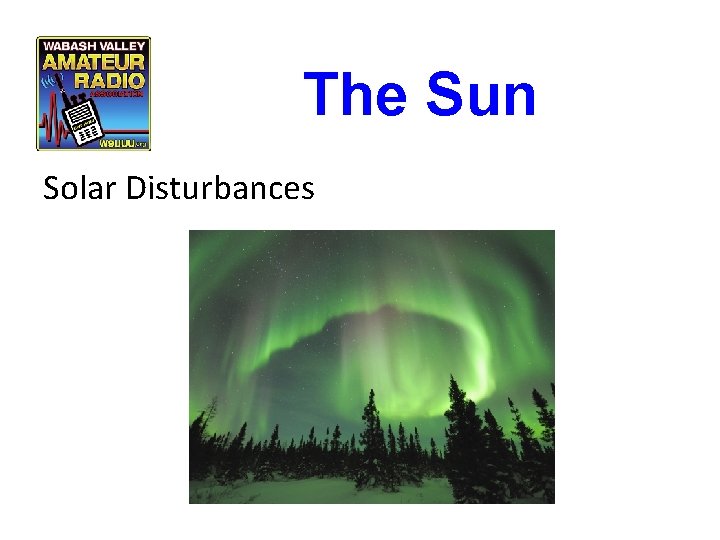
The Sun Solar Disturbances • Geomagnetic disturbances. • Auroral activity is greatly increased. • Reflection is possible on 15 m & up. • Strongest on 6 m & 2 m. • Signals are modulated with a hiss or buzz. • CW is the best mode for auroral communications.
The Sun Solar Disturbances
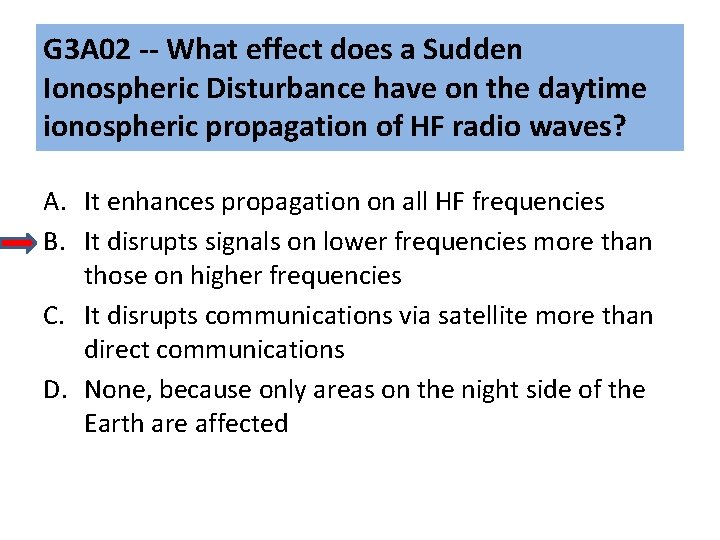
G 3 A 02 -- What effect does a Sudden Ionospheric Disturbance have on the daytime ionospheric propagation of HF radio waves? A. It enhances propagation on all HF frequencies B. It disrupts signals on lower frequencies more than those on higher frequencies C. It disrupts communications via satellite more than direct communications D. None, because only areas on the night side of the Earth are affected
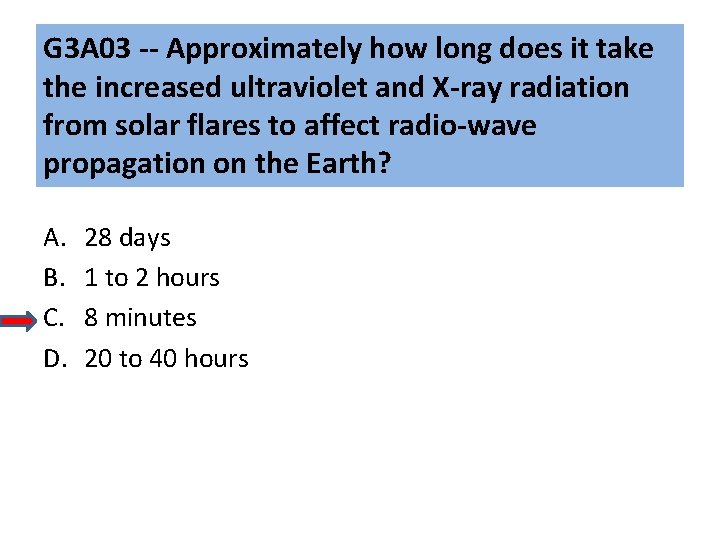
G 3 A 03 -- Approximately how long does it take the increased ultraviolet and X-ray radiation from solar flares to affect radio-wave propagation on the Earth? A. B. C. D. 28 days 1 to 2 hours 8 minutes 20 to 40 hours
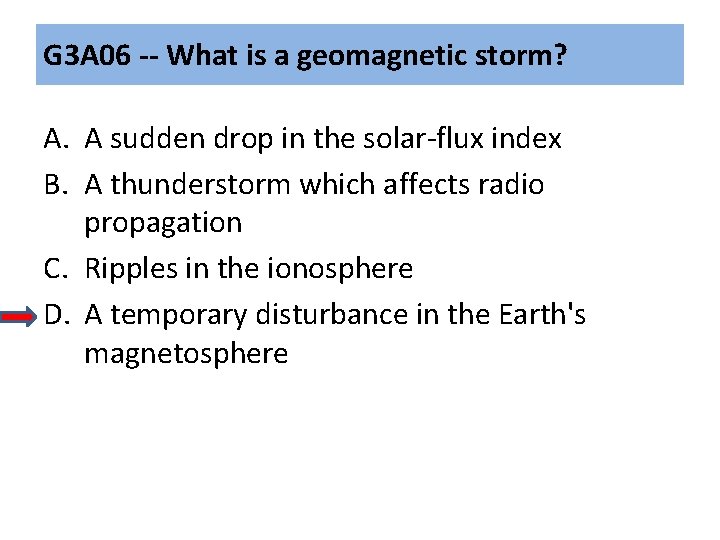
G 3 A 06 -- What is a geomagnetic storm? A. A sudden drop in the solar-flux index B. A thunderstorm which affects radio propagation C. Ripples in the ionosphere D. A temporary disturbance in the Earth's magnetosphere
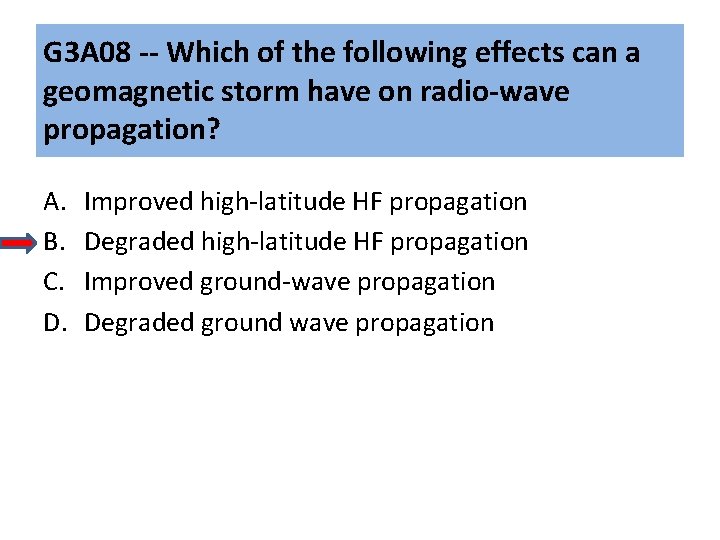
G 3 A 08 -- Which of the following effects can a geomagnetic storm have on radio-wave propagation? A. B. C. D. Improved high-latitude HF propagation Degraded high-latitude HF propagation Improved ground-wave propagation Degraded ground wave propagation
G 3 A 09 -- What benefit can high geomagnetic activity have on radio communications? A. Auroras that can reflect VHF signals B. Higher signal strength for HF signals passing through the polar regions C. Improved HF long path propagation D. Reduced long delayed echoes
G 3 A 11 -- How long does it take charged particles from coronal mass ejections to affect radio propagation on Earth? A. B. C. D. 28 days 14 days 4 to 8 minutes 20 to 40 hours
G 3 A 14 -- How are radio communications usually affected by the charged particles that reach Earth from solar coronal holes? A. B. C. D. HF communications are improved HF communications are disturbed VHF/UHF ducting is improved VHF/UHF ducting is disturbed
G 3 B 02 -- What factors affect the MUF? A. B. C. D. Path distance and location Time of day and season Solar radiation and ionospheric disturbances All these choices are correct
G 3 B 03 -- Which of the following applies when selecting a frequency for lowest attenuation when transmitting on HF? A. B. C. D. Select a frequency just below the MUF Select a frequency just above the LUF Select a frequency just below the critical frequency Select a frequency just above the critical frequency
G 3 B 04 -- What is a reliable way to determine if the MUF is high enough to support skip propagation between your station and a distant location on frequencies between 14 and 30 MHz? A. Listen for signals from an international beacon B. Send a series of dots on the band listen for echoes from your signal C. Check the strength of TV signals from Western Europe D. Check the strength of signals in the MF AM broadcast band
G 3 B 05 -- What usually happens to radio waves with frequencies below the MUF and above the LUF when they are sent into the ionosphere? A. They are bent back to the Earth B. They pass through the ionosphere C. They are amplified by interaction with the ionosphere D. They are bent and trapped in the ionosphere to circle Earth
G 3 B 06 -- What usually happens to radio waves with frequencies below the LUF? A. B. C. D. They are bent back to Earth They pass through the ionosphere They are completely absorbed by the ionosphere They are bent and trapped in the ionosphere to circle Earth
G 3 B 07 -- What does LUF stand for? A. The Lowest Usable Frequency for communications between two points B. The Longest Universal Function for communications between two points C. The Lowest Usable Frequency during a 24 hour period D. The Longest Universal Function during a 24 hour period
G 3 B 08 -- What does MUF stand for? A. The Minimum Usable Frequency for communications between two points B. The Maximum Usable Frequency for communications between two points C. The Minimum Usable Frequency during a 24 -hour period D. The Maximum Usable Frequency during a 24 -hour period
G 3 B 11 -- What happens to HF propagation when the LUF exceeds the MUF? A. No HF radio frequency will support ordinary skywave communications over the path B. HF communications over the path are enhanced C. Double hop propagation along the path is more common D. Propagation over the path on all HF frequencies is enhanced
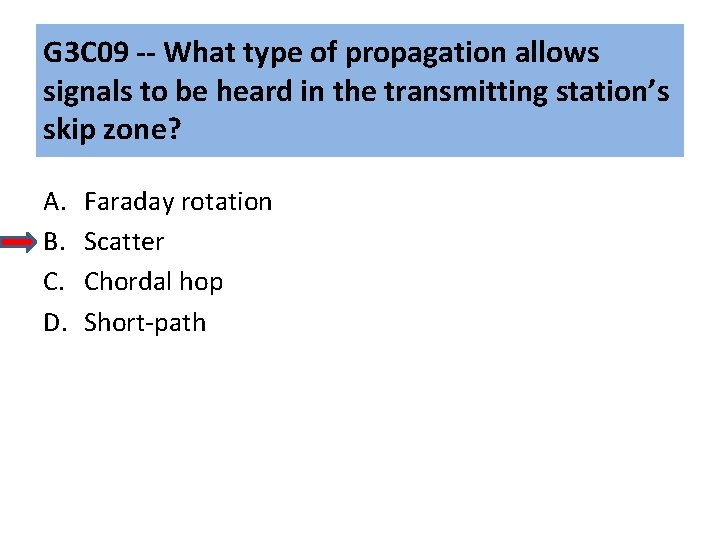
Scatter Modes Scatter Characteristics • Localized areas in the ionosphere can reflect radio waves as well as refract them. • The directions of any reflections are unpredictable.
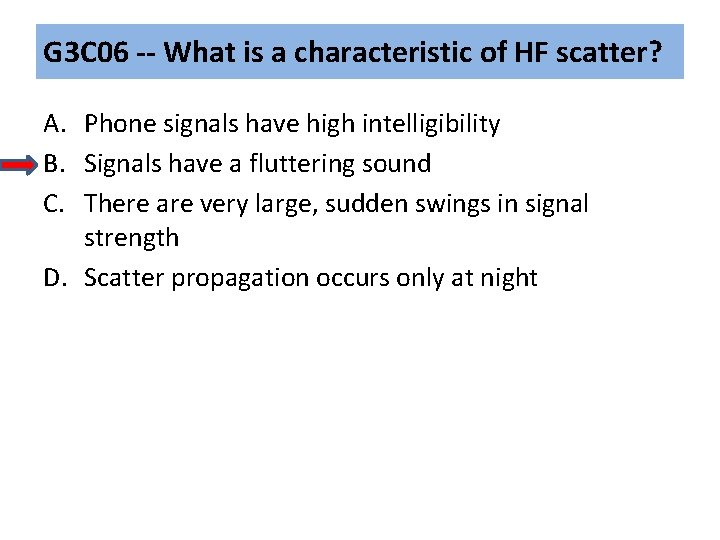
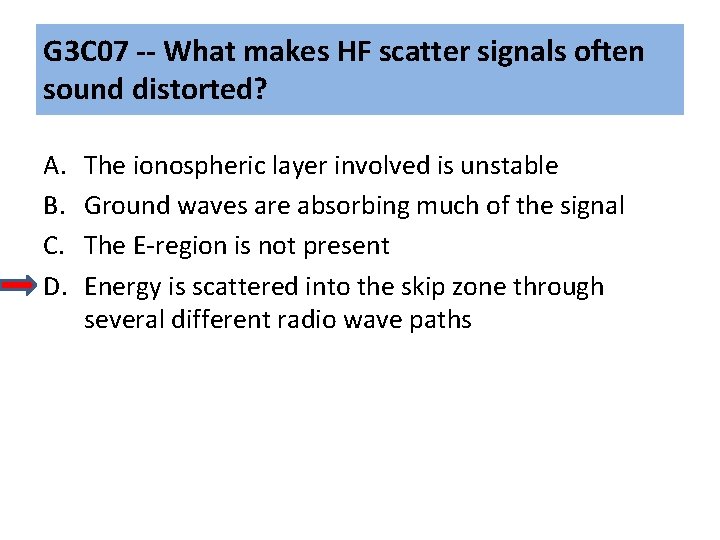
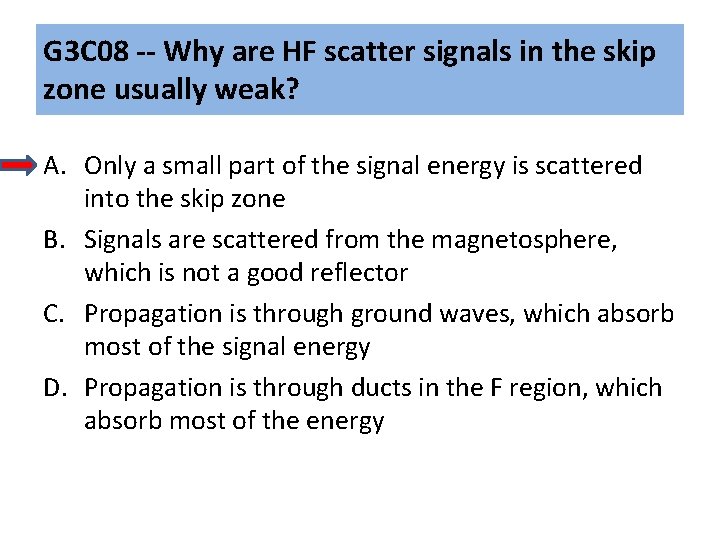
Scatter Modes Scatter Characteristics • Scatter allows propagation above the MUF. • Signals received via scatter are MUCH weaker than refracted signals. • Signals received via scatter are often distorted or have a wavering sound due to multi-path.
Scatter Modes Scatter Characteristics • Backscatter. • Signals can be reflected from uneven terrain at the far end of the path back towards the source.
Scatter Modes Near Vertical Incidence Sky-wave (NVIS) • At frequencies below the critical frequency, signals arriving at any angle are reflected. • NVIS allows communications up to 200 -300 hundred miles. • NVIS eliminates the “skip zone”.
Scatter Modes Near Vertical Incidence Sky-wave (NVIS) • Select a frequency below the critical frequency but high enough that absorption in the D-region is not excessive. • Use a horizontally-polarized antenna mounted 1/8λ to 1/4λ above the ground. • 10’ to 12’ above the ground is best. • A grounded wire on the ground directly beneath the antenna improves signal strength by up to 6 d. B.
G 3 C 06 -- What is a characteristic of HF scatter? A. Phone signals have high intelligibility B. Signals have a fluttering sound C. There are very large, sudden swings in signal strength D. Scatter propagation occurs only at night
G 3 C 07 -- What makes HF scatter signals often sound distorted? A. B. C. D. The ionospheric layer involved is unstable Ground waves are absorbing much of the signal The E-region is not present Energy is scattered into the skip zone through several different radio wave paths
G 3 C 08 -- Why are HF scatter signals in the skip zone usually weak? A. Only a small part of the signal energy is scattered into the skip zone B. Signals are scattered from the magnetosphere, which is not a good reflector C. Propagation is through ground waves, which absorb most of the signal energy D. Propagation is through ducts in the F region, which absorb most of the energy
G 3 C 09 -- What type of propagation allows signals to be heard in the transmitting station’s skip zone? A. B. C. D. Faraday rotation Scatter Chordal hop Short-path
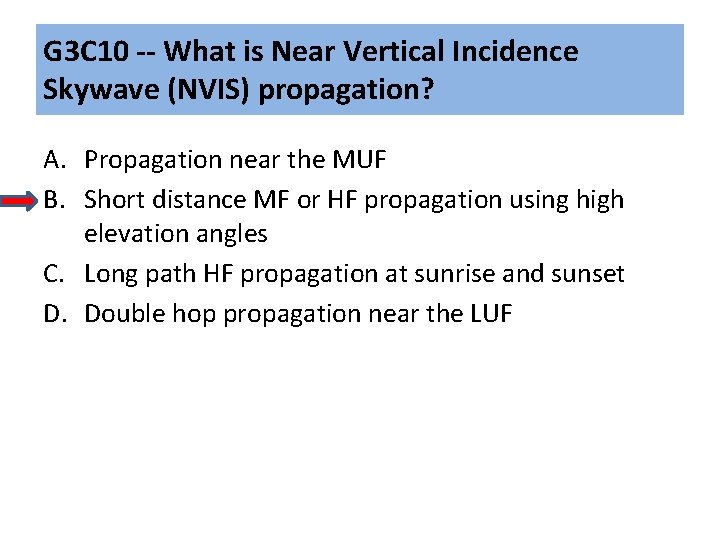
G 3 C 10 -- What is Near Vertical Incidence Skywave (NVIS) propagation? A. Propagation near the MUF B. Short distance MF or HF propagation using high elevation angles C. Long path HF propagation at sunrise and sunset D. Double hop propagation near the LUF
Questions?
General License Class Next Week Chapter 9 Safety