
Mobility Increases the Connectivity of Khop Clustered Wireless
Mobility Increases the Connectivity of K-hop Clustered Wireless Networks Qingsi Wang, Xinbing Wang Department of Electronic Engineering Shanghai Jiao Tong University, China Xiaojun Lin Department of Electrical and Computer Engineering Purdue University, USA
Outline q Introduction Ø Background Ø Motivations Ø Objectives q K-hop Clustered Network Models q Main Results and Intuitions q The Impact of Mobility q Concluding Remarks Mobility Increases the Connectivity of K-hop Clustered Wireless Networks 2
Background – I/II q Connectivity is a basic concern in designing and implementing wireless networks. q Three main schemes of connecting strategies are proposed in the literature. Ø Distance-based strategy Ø Number-of-neighbor-based strategy Ø Sector-based strategy Mobility Increases the Connectivity of K-hop Clustered Wireless Networks 3
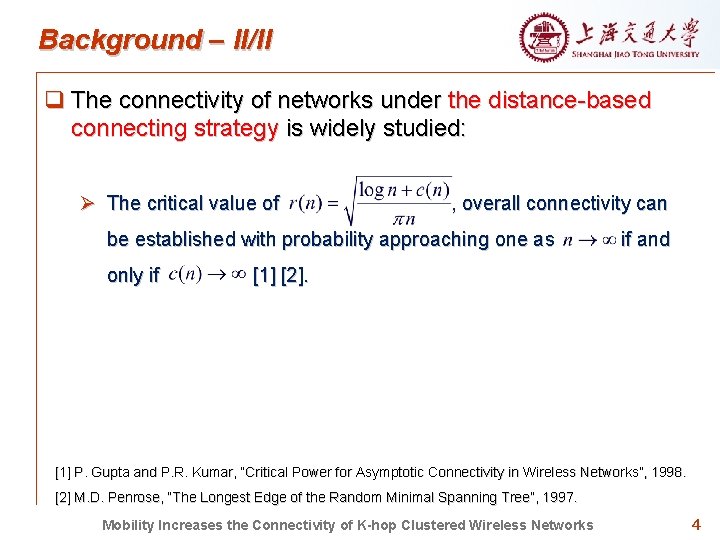
Background – II/II q The connectivity of networks under the distance-based connecting strategy is widely studied: Ø The critical value of , overall connectivity can be established with probability approaching one as only if if and [1] [2]. [1] P. Gupta and P. R. Kumar, “Critical Power for Asymptotic Connectivity in Wireless Networks”, 1998. [2] M. D. Penrose, “The Longest Edge of the Random Minimal Spanning Tree”, 1997. Mobility Increases the Connectivity of K-hop Clustered Wireless Networks 4
Motivation q The network models studied in these prior works are non-clustered (or flat) and stationary networks. q Clustering and mobility have been found to improve various aspects of network performance. q Studies on the connectivity of mobile and clustered networks are quite limited. --- We don’t even know the definition of the connectivity under such circumstances. Mobility Increases the Connectivity of K-hop Clustered Wireless Networks 5
Objective – I/II q Open question: Ø What is the impact of mobility on connectivity of clustered networks subject to delay constraints? q. We study Ø The critical transmission range for connectivity Ø K-hop mobile clustered networks (delay guarantee) Ø Random walk mobility model with non-trivial velocity Ø i. i. d. mobility model (fast mobility). Mobility Increases the Connectivity of K-hop Clustered Wireless Networks 6
Objective – II/II q We compare with the critical transmission range for connectivity in stationary k-hop clustered networks. q Implications on Ø the power-delay trade-off Ø the energy efficiency q Our results show that: Mobility does improve connectivity in k-hop clustered networks, and it also significantly decreases the energy consumption and the power-delay trade-off. Mobility Increases the Connectivity of K-hop Clustered Wireless Networks 7
Outline q Introduction q K-hop Clustered Network Models Ø An overview of flat networks Ø K-hop clustered network models q Main Results and Intuitions q The Impact of Mobility q Concluding Remarks Mobility Increases the Connectivity of K-hop Clustered Wireless Networks 8
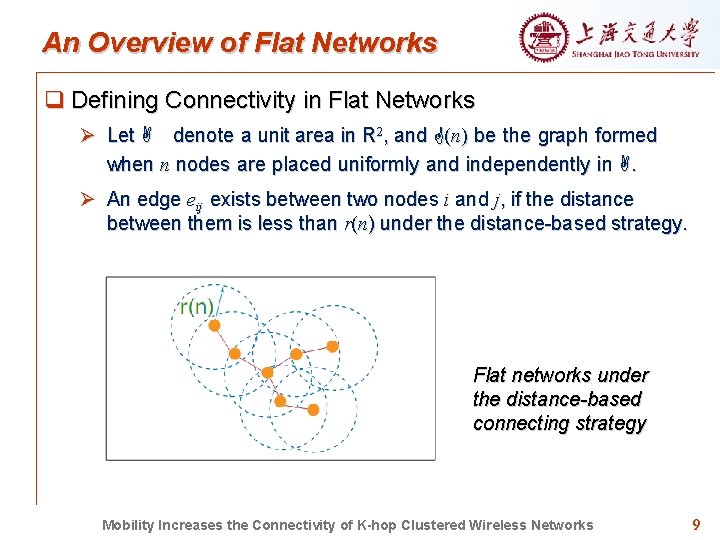
An Overview of Flat Networks q Defining Connectivity in Flat Networks Ø Let A denote a unit area in R 2, and G(n) be the graph formed when n nodes are placed uniformly and independently in A. Ø An edge eij exists between two nodes i and j, if the distance between them is less than r(n) under the distance-based strategy. Flat networks under the distance-based connecting strategy Mobility Increases the Connectivity of K-hop Clustered Wireless Networks 9
K-hop Clustered Network Models q Clustered networks Ø n normal nodes and nd cluster-head nodes Ø Static or mobile q Mobility Model Ø Random Walk Mobility Model with Non-Trivial Velocity – Uniformly chosen direction – Constant velocity (continuous path) Ø I. I. D. Mobility Model – Independently and uniformly reshuffled – Static within a single time slot Mobility Increases the Connectivity of K-hop Clustered Wireless Networks 10
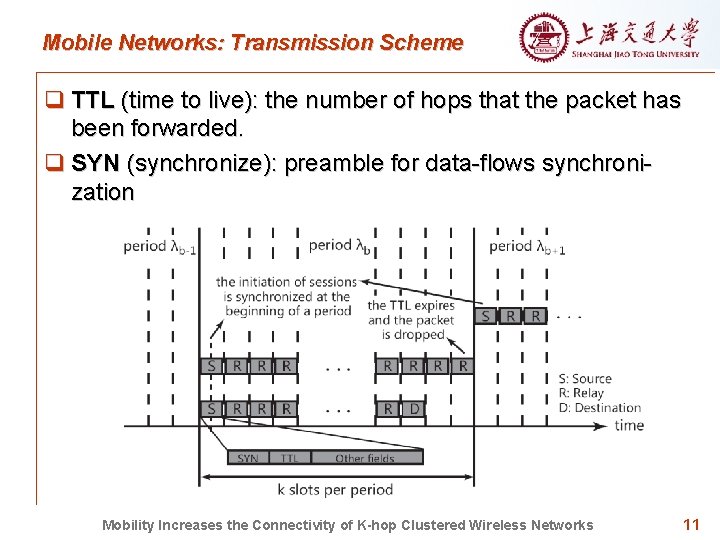
Mobile Networks: Transmission Scheme q TTL (time to live): the number of hops that the packet has been forwarded. q SYN (synchronize): preamble for data-flows synchronization Mobility Increases the Connectivity of K-hop Clustered Wireless Networks 11
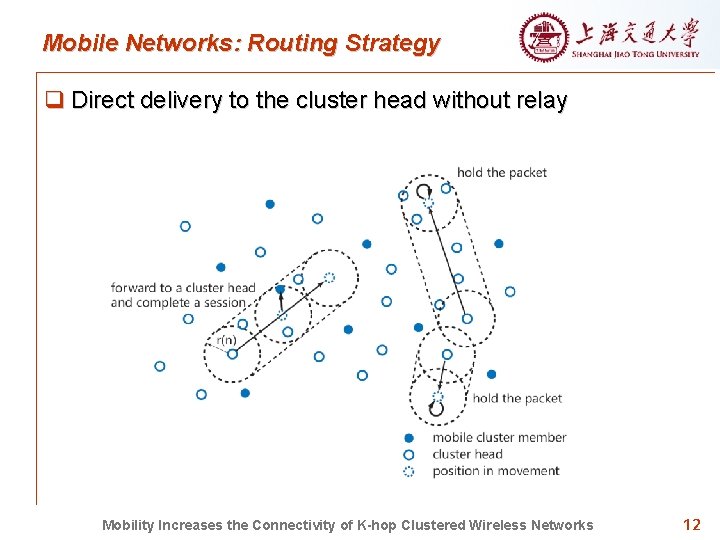
Mobile Networks: Routing Strategy q Direct delivery to the cluster head without relay Mobility Increases the Connectivity of K-hop Clustered Wireless Networks 12
Clustered Network Models q For stationary k-hop clustered networks, we say that a cluster member is connected if it can reach a cluster head within k hops. q For mobile clustered networks, a cluster member is connected if it can reach a cluster head within k slots. q If all the cluster members in a network are connected, we define that the network has full connectivity. Mobility Increases the Connectivity of K-hop Clustered Wireless Networks 13
Outline q Introduction q K-hop Clustered Network Models q Main Results and Intuitions Ø Definition of critical transmission range Ø Main results Ø Intuitive explanations q The Impact of Mobility q Concluding Remarks Mobility Increases the Connectivity of K-hop Clustered Wireless Networks 14
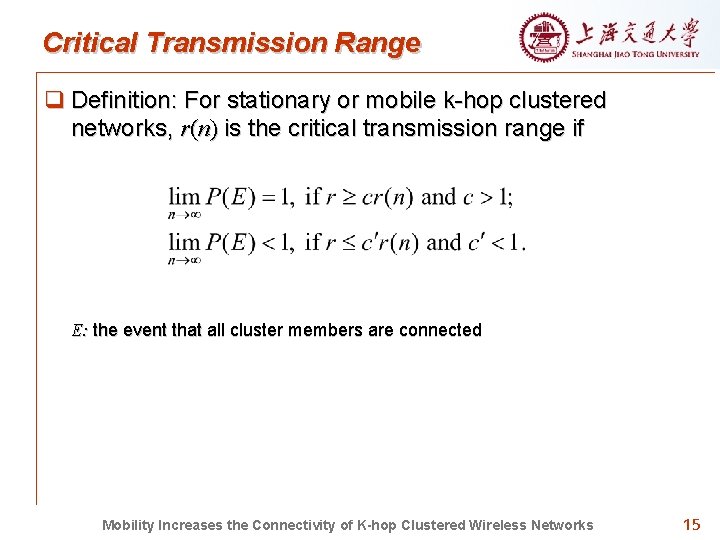
Critical Transmission Range q Definition: For stationary or mobile k-hop clustered networks, r(n) is the critical transmission range if E: the event that all cluster members are connected Mobility Increases the Connectivity of K-hop Clustered Wireless Networks 15
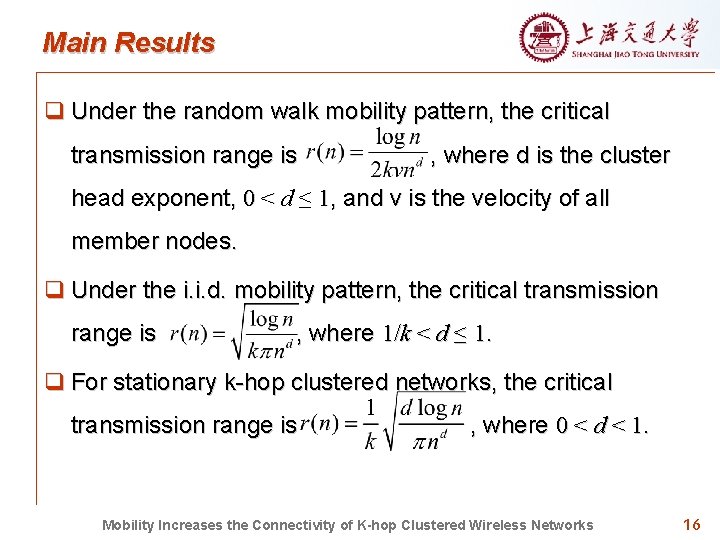
Main Results q Under the random walk mobility pattern, the critical transmission range is , where d is the cluster head exponent, 0 < d ≤ 1, and v is the velocity of all member nodes. q Under the i. i. d. mobility pattern, the critical transmission range is , where 1/k < d ≤ 1. q For stationary k-hop clustered networks, the critical transmission range is , where 0 < d < 1. Mobility Increases the Connectivity of K-hop Clustered Wireless Networks 16
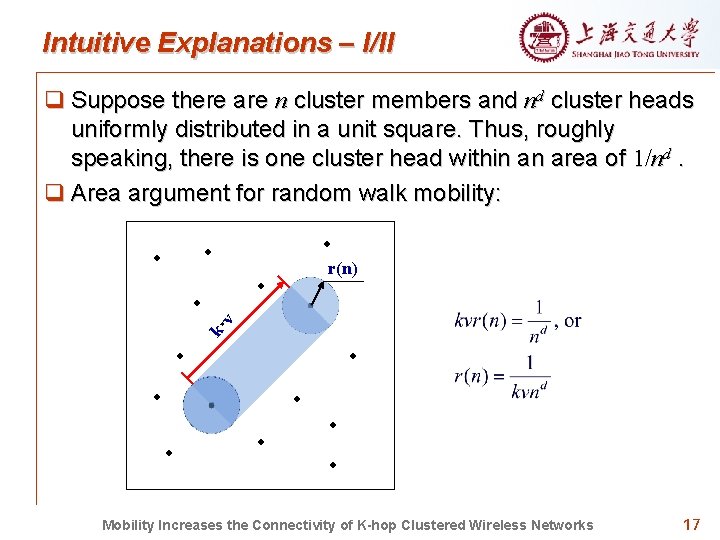
Intuitive Explanations – I/II q Suppose there are n cluster members and nd cluster heads uniformly distributed in a unit square. Thus, roughly speaking, there is one cluster head within an area of 1/nd. q Area argument for random walk mobility: k· v r(n) Mobility Increases the Connectivity of K-hop Clustered Wireless Networks 17
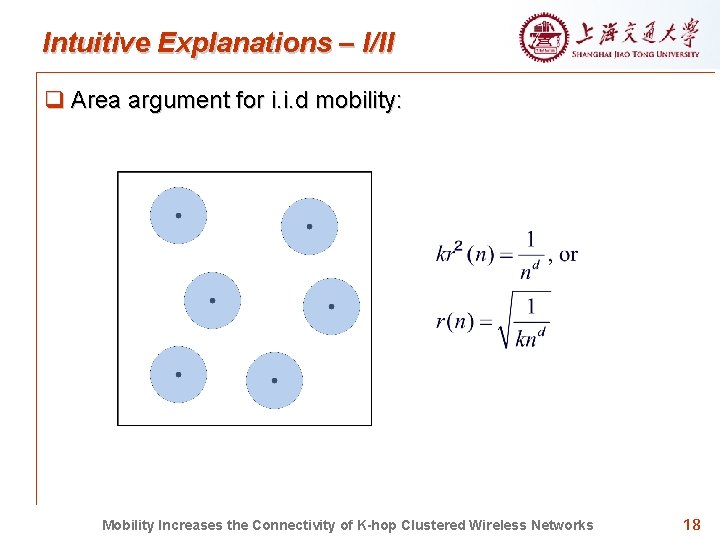
Intuitive Explanations – I/II q Area argument for i. i. d mobility: Mobility Increases the Connectivity of K-hop Clustered Wireless Networks 18
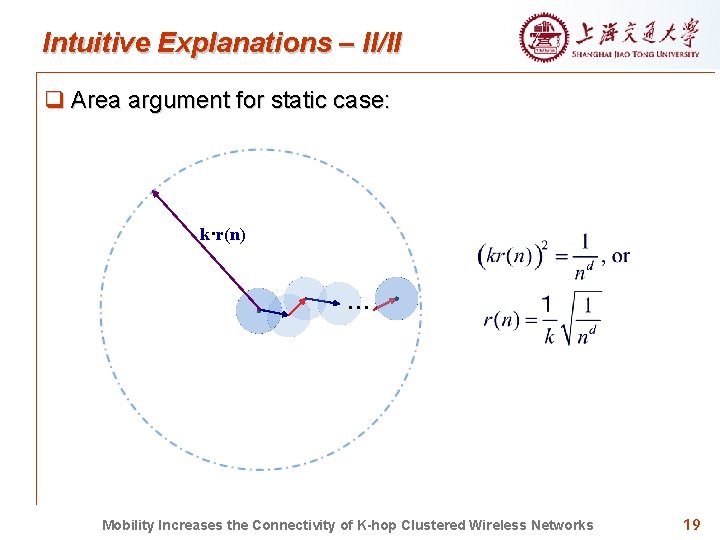
Intuitive Explanations – II/II q Area argument for static case: k·r(n) … Mobility Increases the Connectivity of K-hop Clustered Wireless Networks 19
Outline q Introduction q K-hop Clustered Network Models q Main Results and Intuitions q The Impact of Mobility Ø Transmission power Ø Energy consumption per flow Ø Discussion q Concluding Remarks Mobility Increases the Connectivity of K-hop Clustered Wireless Networks 20
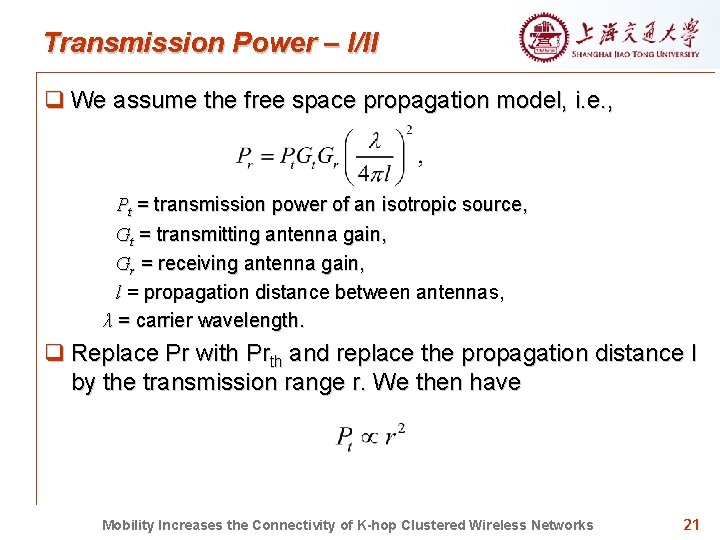
Transmission Power – I/II q We assume the free space propagation model, i. e. , Pt = transmission power of an isotropic source, Gt = transmitting antenna gain, Gr = receiving antenna gain, l = propagation distance between antennas, λ = carrier wavelength. q Replace Pr with Prth and replace the propagation distance l by the transmission range r. We then have Mobility Increases the Connectivity of K-hop Clustered Wireless Networks 21
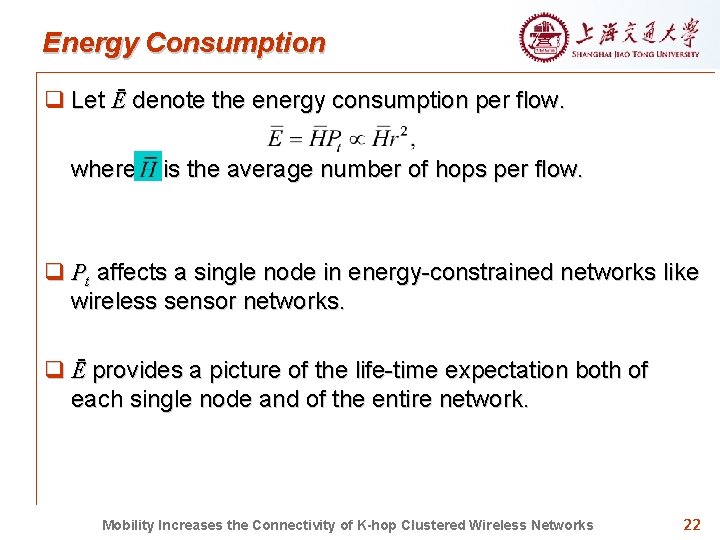
Energy Consumption q Let Ē denote the energy consumption per flow. where is the average number of hops per flow. q Pt affects a single node in energy-constrained networks like wireless sensor networks. q Ē provides a picture of the life-time expectation both of each single node and of the entire network. Mobility Increases the Connectivity of K-hop Clustered Wireless Networks 22
Discussion – I/VI q Note that in these calculations, we have ignored the energy consumption due to mobility. Hence, these results should not be interpreted as a reason to introduce mobility to an otherwise static network, but rather represent an inherent advantage of having mobility in the system. q Similarly, the comparison with the flat network is not entirely fair, since in a clustered network, a packet only needs to reach a cluster head. Hence, our following results should be viewed as an inherent advantage of clustered network due to the availability of infrastructure support. Mobility Increases the Connectivity of K-hop Clustered Wireless Networks 23
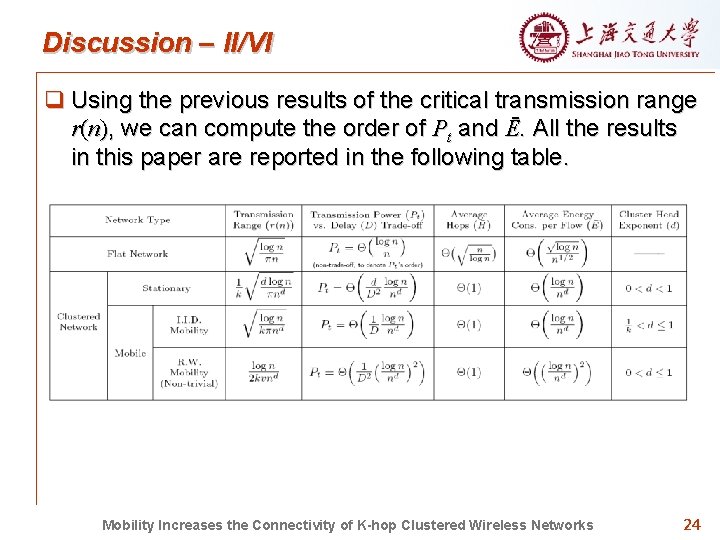
Discussion – II/VI q Using the previous results of the critical transmission range r(n), we can compute the order of Pt and Ē. All the results in this paper are reported in the following table. Mobility Increases the Connectivity of K-hop Clustered Wireless Networks 24
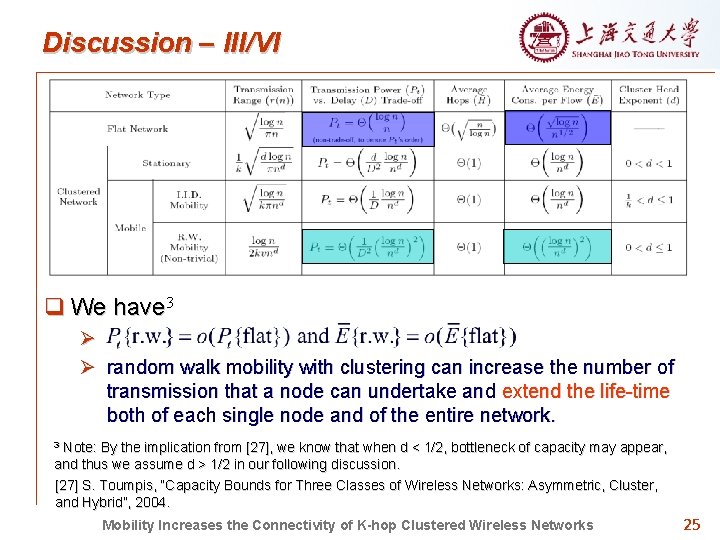
Discussion – III/VI q We have 3 Ø Ø random walk mobility with clustering can increase the number of transmission that a node can undertake and extend the life-time both of each single node and of the entire network. Note: By the implication from [27], we know that when d < 1/2, bottleneck of capacity may appear, and thus we assume d > 1/2 in our following discussion. [27] S. Toumpis, “Capacity Bounds for Three Classes of Wireless Networks: Asymmetric, Cluster, and Hybrid”, 2004. 3 Mobility Increases the Connectivity of K-hop Clustered Wireless Networks 25
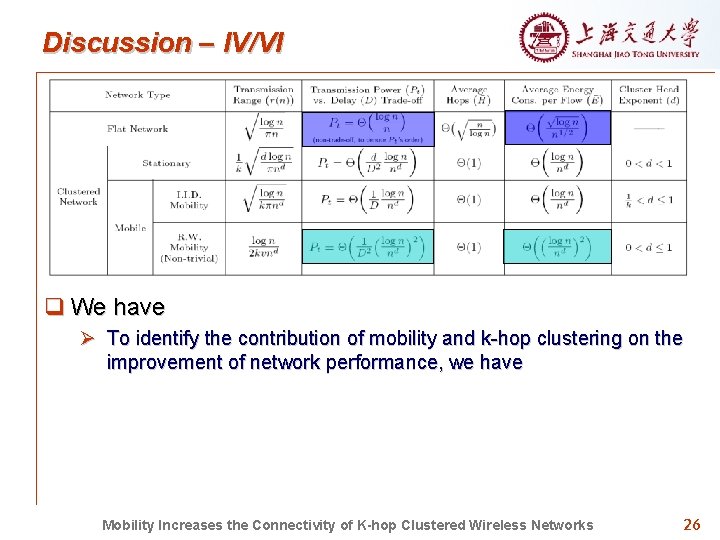
Discussion – IV/VI q We have Ø To identify the contribution of mobility and k-hop clustering on the improvement of network performance, we have Mobility Increases the Connectivity of K-hop Clustered Wireless Networks 26
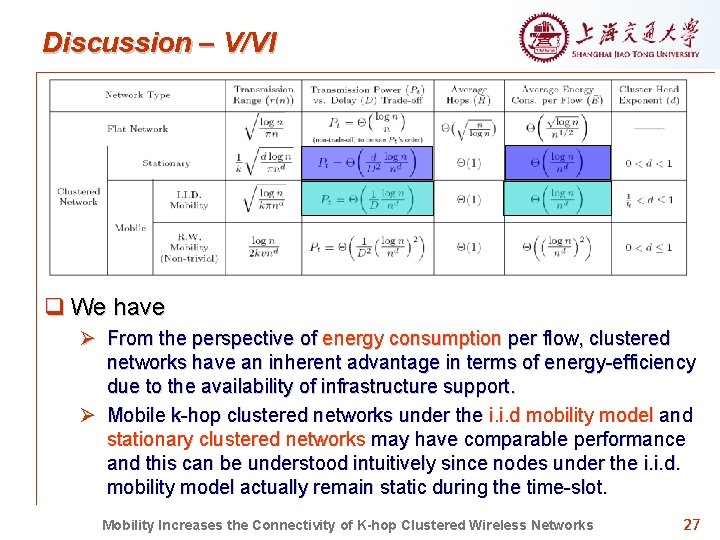
Discussion – V/VI q We have Ø From the perspective of energy consumption per flow, clustered networks have an inherent advantage in terms of energy-efficiency due to the availability of infrastructure support. Ø Mobile k-hop clustered networks under the i. i. d mobility model and stationary clustered networks may have comparable performance and this can be understood intuitively since nodes under the i. i. d. mobility model actually remain static during the time-slot. Mobility Increases the Connectivity of K-hop Clustered Wireless Networks 27
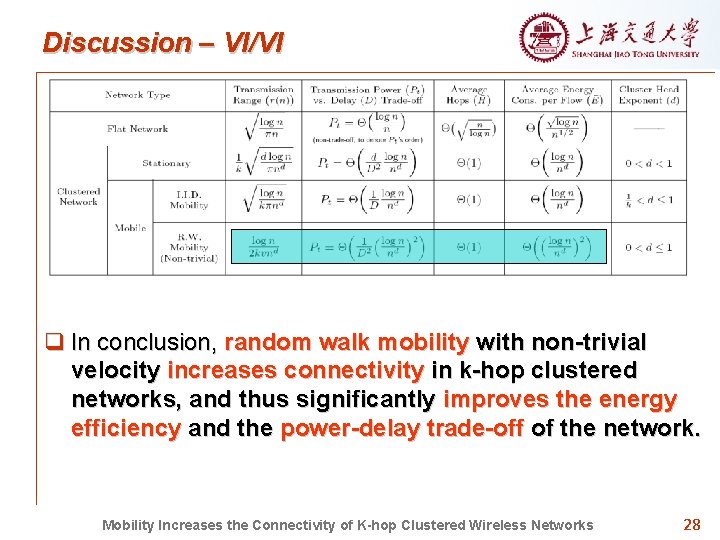
Discussion – VI/VI q In conclusion, random walk mobility with non-trivial velocity increases connectivity in k-hop clustered networks, and thus significantly improves the energy efficiency and the power-delay trade-off of the network. Mobility Increases the Connectivity of K-hop Clustered Wireless Networks 28
Outline q Introduction q K-hop Clustered Network Models q Main Results and Intuitions q The Impact of Mobility q Concluding Remarks Mobility Increases the Connectivity of K-hop Clustered Wireless Networks 29
Concluding Remarks – I/II q We have studied the effects of mobility on the critical transmission range for asymptotic connectivity in k-hop clustered networks. q Our contributions are twofold. Ø developed the critical transmission range for the mobile k-hop clustered network under the random walk mobility model with nontrivial velocity and the i. i. d. mobility model, and for the stationary khop clustered network, respectively. Ø These formulations not only provide an asymptotic description of the critical power needed to maintain the connectivity of the network, but also help to identify the contribution of mobility in the improvement of network performance. Mobility Increases the Connectivity of K-hop Clustered Wireless Networks 30
Concluding Remarks – II/II q For future work: Ø Extend the results for the random walk mobility model to account for the case where each node moves with different speed; Ø In our current model for random walk, each node changes direction after one time-slot. An interesting extension is to study the case where the change of directions occurs at random times (e. g. , a node may move a random distance before it changes direction). Ø Account for wireless interference in the system. Ø It would be interesting to study the case where cluster-heads may move as well. Mobility Increases the Connectivity of K-hop Clustered Wireless Networks 31

Thank you !
Reference – I/II q [1] P. Gupta and P. R. Kumar, “Critical Power for Asymptotic Connectivity in Wireless Networks, ” Stochastic Analysis, Control, Optimization and Applications: A Volume in Honor of W. H. Fleming, W. M. Mc. Eneaney, G. Yin, and Q. Zhang, Boston: Birkhauser, 1998. q [2] M. D. Penrose, “The Longest Edge of the Random Minimal Spanning Tree, ” Annals of Applied Probability, vol. 7, pp. 340 -361, 1997. q [8] P. Gupta and P. R. Kumar, “The Capacity of Wireless Networks, ” IEEE Transactions on Information Theory, vol. 46, pp. 388 -404, March 2000. q [9] P. Gupta, R. Gray, and P. R. Kumar, “An Experimental Scaling Law for Ad Hoc Networks, ” Univ. of Illinois at Urbana-Champaign, May 2001. q [10] W. Heinzelman, A. Chandrakasan and H. Balakrishnan, “Energy-efficient Communication Protocol for Wireless Micro Sensor Networks, ” in Proc. the 33 rd Annual Hawaii International Conference on System Sciences, pp. 3005 -3014, 2000. q [11] Qiangfeng Jiang and D. Manivannan, “Routing Protocols for Sensor Networks, ” in Consumer Communications and Networking Conference (CCNC 2004), pp. 93 -98, 2004. q [19] U. Kozat and L. Tassiulas, “Throughput capacity of random ad hoc networks with infrastructure support, ” in Proc. ACM Mobi. Com 2003, Annapolis, MD, USA, June 2003. q [20] M. Grossglauser and D. Tse, “Mobility Increases the Capacity of Ad Hoc Wireless Networks, ” IEEE/ACM Transactions on Networking, vol. 10, no. 4, pp. 477 -486, August 2002. Mobility Increases the Connectivity of K-hop Clustered Wireless Networks 33
Reference – II/II q [21] S. Čapkun, J. Hubaux and L. Buttyán, “Mobility Helps Security in Ad Hoc Networks, ” in Proc. ACM Mobi. Hoc 2003, June 2003. q [27] S. Toumpis, “Capacity Bounds for Three Classes of Wireless Networks: Asymmetric, Cluster, and Hybrid, ” in Proc. ACM Mobi. Hoc 2004, pp. 133 -144, Roppongi, Japan, May 24 -26, 2004. Mobility Increases the Connectivity of K-hop Clustered Wireless Networks 34
Mobility Pattern – II/II q Due to the assumption that v = Θ(1), the mixing time under the r. w. mobility model is on the same order as the mixing time under the i. i. d. mobility model. q However, since under the r. w. mobility model nodes can communicate during the course of movement, they will have a higher chance to connect to the cluster head compared to nodes under the i. i. d. mobility model. 1 1 Note : This advantage will become clear after we define the transmission scheme. Mobility Increases the Connectivity of K-hop Clustered Wireless Networks 35
Motivation – II/II q In a clustered network, a packet only needs to reach one of the cluster heads. Ø In a stationary k-hop clustered network, a packet must reach a cluster head within k hops. Ø In a mobile k-hop clustered network, a packet must reach a cluster head directly in k time-slots. q Clearly, clustering has an inherent advantage compared to flat networks, and it can alter the energy efficiency and delay of the system. Ø Ø Ø a different critical transmission range for connectivity different delay different energy consumption of the network Mobility Increases the Connectivity of K-hop Clustered Wireless Networks 36
Routing Strategy – II/II q Such an assumption would be valid when Ø The cluster heads are static and the cluster member has knowledge of its own position and the positions of cluster heads; Ø The cluster heads broadcast a pilot signal that covers the transmission range of a cluster member. q We do not actually use multi-hop transmissions in mobile k -hop clustered networks because multi-hop transmissions require significantly higher overhead due to the need to discover cluster-heads at a further distance away and to establish multi-hop paths on demand. q We proposed a simplified routing strategy to avoid the technicalities of a more complicated one which may obscure our main target. Mobility Increases the Connectivity of K-hop Clustered Wireless Networks 37
- Slides: 37