
Plant Propagation Sexual Asexual Prepared by L Robert
Plant Propagation (Sexual & Asexual) Prepared by: L. Robert Barber, Roland Quitugua & Ilene Iriarte For: Guam Cooperative Extension Service & Guam Department of Agriculture Funding provided by: United States Department of Agriculture Natural Resources Conservation Service, Western Region Sustainable Agriculture Research and Education, Administration for Native Americans, , & Sanctuary Incorporated
Sexual Propagation • Involves the exchange of genetic material between each parent: SEEDS • Some advantages are: – Cheapest & easiest method of producing large number of plants (Soursop, Atis) – Provides a strong tap root system – Produce new varieties of cultivars – Avoid certain diseases (resistant varieties) – Can be the only way to propagate some species
Propagation by Seed • Use seeds that are fresh & viable( will sprout) • Buy seeds that have been packaged for the current year and your region • Considerations: – Viability – Seed Orientation – Depth – Special practices (Scarification, Innoculation)
Collecting Seeds • Hybrid seeds should not be saved: – Will not be identical to parent plant • Self-Pollinated or Non-Hybrid seeds can be saved: – Similar to parent plant • Saving seed saves money • Harvest Seeds from healthy plants – Some diseases can be carried by seeds • Bringing in seeds or plants from other countries is how many serious insects or diseases are introduced (Mango) • Harvest seeds just before fruit is fully ripe
Storing Seeds • Some seeds cannot be stored – Parsley seeds need to be germinated right away after they mature or they lose viability • Once the seed has fully dried place them in an air tight container – Make sure to mark the name and date – Store seeds at 40°F (Place in Refrigerator) • Some seeds can be viable for up to 5 years or longer if properly stored • Other seeds are viable for only a few weeks
Seed Germination • Factors that affect germination: – Water (Moisture), Light, Oxygen, Temperature – Water causes the endosperm (food supply) to swell, & dissolves the nutrients in it – Light can stimulate or inhibit seed germination – Oxygen is needed so the embryo can break down stored food & begin growing – Seeds have optimum temperature range for sprouting • Growing medium must be constantly moist, not wet
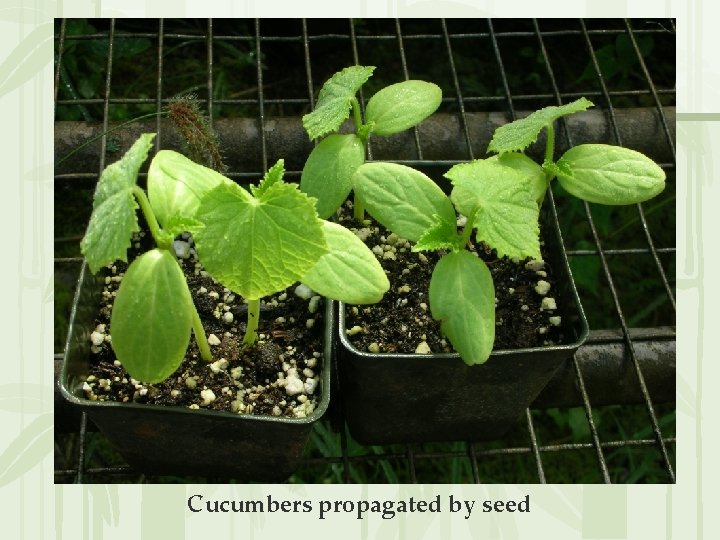
Cucumbers propagated by seed
Seed Scarification • Scarification is a process that breaks, scratches, or softens the seed coat for moisture to enter • Certain seed coats are very tough and need to be scarified • Two common methods of scarification are: – Mechanical which break the seed coat with an object – Hot Water dissolves waxy outer coat, involves placing seeds in water 170 to 210 degrees F. • It should soak for 12 – 24 hours
Asexual Propagation • Does not involve the exchange of genetic material • Genetically identical to the parent • Asexual propagation includes: – Cuttings, layering, division, grafting, budding, & tissue culture
Cuttings • Cuttings consist of removing a portion of the parent plant then the cuttings regenerates into a new plant • This is possible because the plant has the ability to grows callus tissues that differentiates into the missing plant parts
Cuttings • Select new vigorous growth with no flowers (remove buds), disease & insect free • Cut ¼ inch below a leaf node – Pull off the leaves that are at the nodes which are going below the surface • Can use a rooting hormone (not in organic operations)
Cuttings • Insert cutting into moist rooting medium • Rooting can take a few weeks to several months • Best results if cuttings are placed under a mist system or in a moist chamber
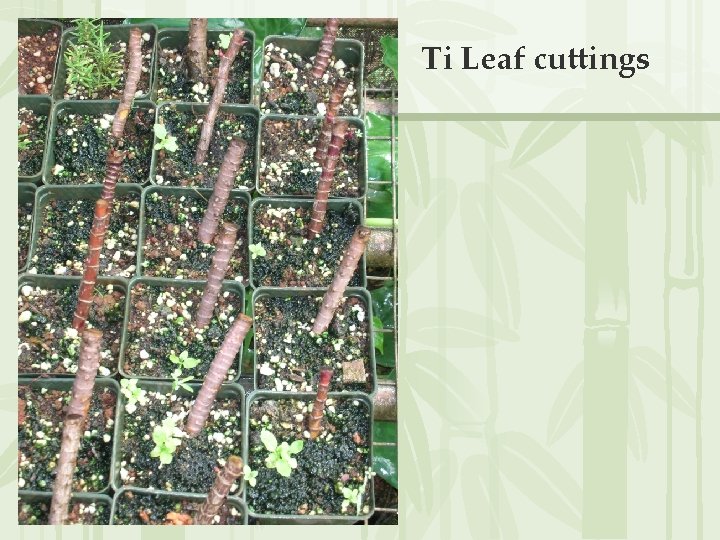
Ti Leaf cuttings
Softwood or Hardwood Cuttings • Some plants are best propagated by softwood cuttings others by hardwood • Softwood Cuttings: – Use branches that haven’t become woody – Make cuttings 2 -10 inches long – Make cuts just below leaf nodes • Hardwood Cuttings: – Cuttings are taken when tissue has become woody – Make sure the plant is not fruiting – Cut about 5 -12 inches long
Root Cuttings • Use newer root growth for cuttings • Make cuttings 1 -4 inches long at ¼ -½ inch in diameter – Cut a straight end closest to the stem (top side), and the other end a diagonal cut (bottom side) – So you know what side is up & what side is down • Should be planted directly in rooting medium • Collect root cuttings after the fruiting season is over
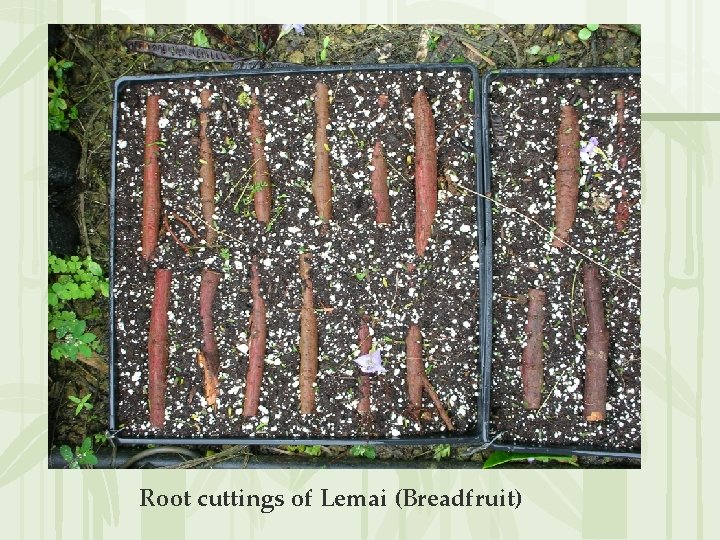
Root cuttings of Lemai (Breadfruit)
Layering • Is the process of developing roots on shoots that are still attached to the parent plant • Good to use when only a few plants are needed • There are many different types of layering – Simple, Tip, Compound, & Air Layering,
Layering • Simple Layering: – Bending the stem into the ground, burying it & leaving the top 6 -12 inches above ground, bend the tip into a vertical position & stake it in place (tomato) • Tip Layering: – Dig a hole 3 -4 inches deep, & bury the tip of the shoot & cover it with soil • Compound Layering: – Similar to simple layering, but you can bury several layers with one stem. Each section should have at least one node (bud) buried and one node exposed
Air Layering • Use stems that are pencil size or thicker. Choose an area just below the node. Remove leaves & twigs on the stem 3 – 4 inches above & below this point • For every inch of branch diameter remove 2 X the length of bark from the stem. Leave the inner woody tissue exposed. Scrape the exposed stem to remove the cambium tissue (Xylem/Phloem) to prevent the tree from forming a callus (plant response to damage).
Air Layering • Surround the wound with a handful of moist sphagnum moss (coconut husk), wrap in plastic and tie with string, or wrap it with electrical tape. Each end needs to be secure to prevent moisture loss • After the stem is covered in roots, cut the root ball below your airlayered stem
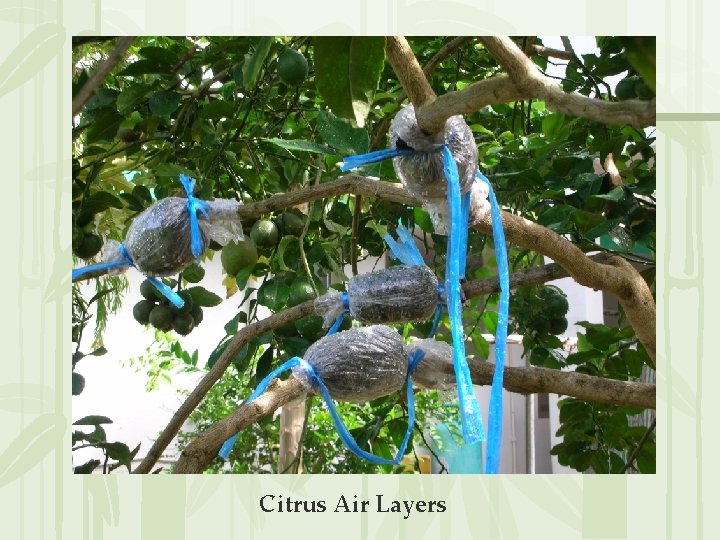
Citrus Air Layers
Division • Is the process of dividing a number of plants that are growing in clusters or multiples – Each piece needs to have a bud and roots • Dig the plant carefully, loosen the roots & lift the plant out of the ground • Bananas and taro are common examples
Bulbs and Corms • Bulbs (onion)and corms (banana, taro) can be propagated by removing the suckers that form at the base of the parent plant • It can take up to 2 or 3 years for plants to flower
Tubers & Rhizomes • Tubers of tuberous plants can be dug up & separated(potato) • Each needs to have a segment of the crown that contains at least one eye • Rhizomes grow (underground) and develop buds along their length – Gingers have rhizomes • It can be dug & cut into sections that each contain at least one eye
Grafting • Joins different segments of two different plants, but same species • Need to align the cambium layers of both segments • Some benefits of grafted plants: – Identical to parent plant – Vigorous, & early fruiting – Two different varieties can be grown on same plant
- Slides: 25