Chapter 33 The Nature and Propagation of Light

- Slides: 29
Chapter 33 The Nature and Propagation of Light Power. Point® Lectures for University Physics, Thirteenth Edition – Hugh D. Young and Roger A. Freedman Lectures by Wayne Anderson Copyright © 2012 Pearson Education Inc.
Goals for Chapter 33 • To understand light rays and wavefronts • To analyze reflection and refraction of light • To understand total internal reflection • To analyze the polarization of light • To use Huygens’s principle to analyze reflection and refraction Copyright © 2012 Pearson Education Inc.
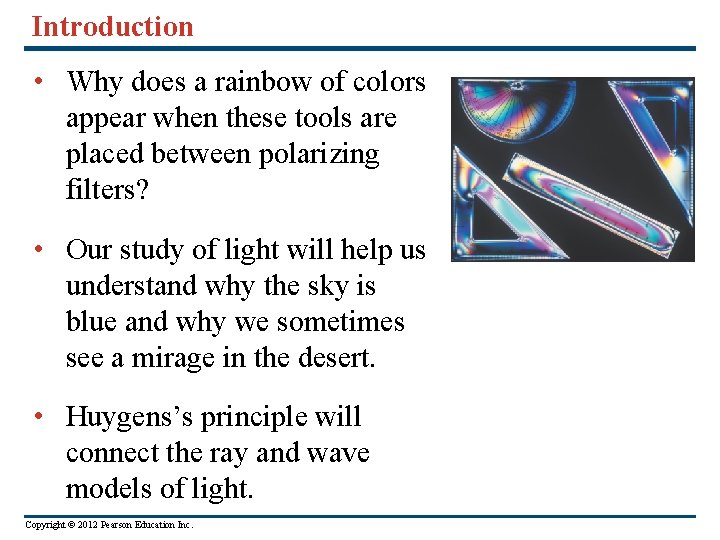
Introduction • Why does a rainbow of colors appear when these tools are placed between polarizing filters? • Our study of light will help us understand why the sky is blue and why we sometimes see a mirage in the desert. • Huygens’s principle will connect the ray and wave models of light. Copyright © 2012 Pearson Education Inc.
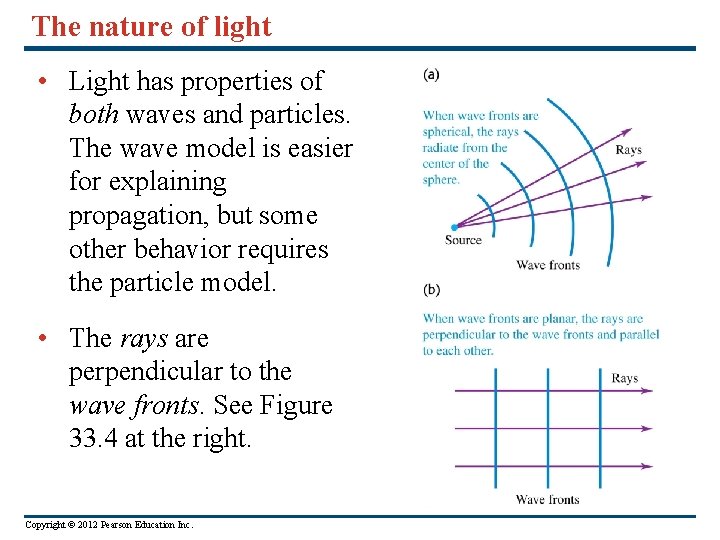
The nature of light • Light has properties of both waves and particles. The wave model is easier for explaining propagation, but some other behavior requires the particle model. • The rays are perpendicular to the wave fronts. See Figure 33. 4 at the right. Copyright © 2012 Pearson Education Inc.
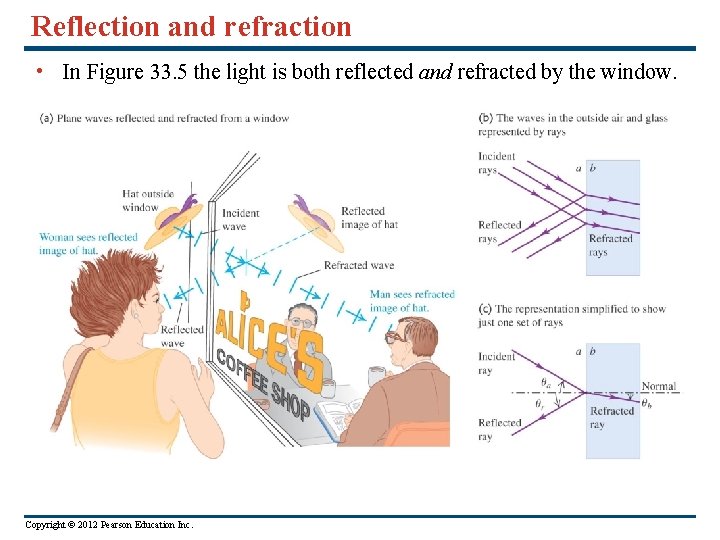
Reflection and refraction • In Figure 33. 5 the light is both reflected and refracted by the window. Copyright © 2012 Pearson Education Inc.
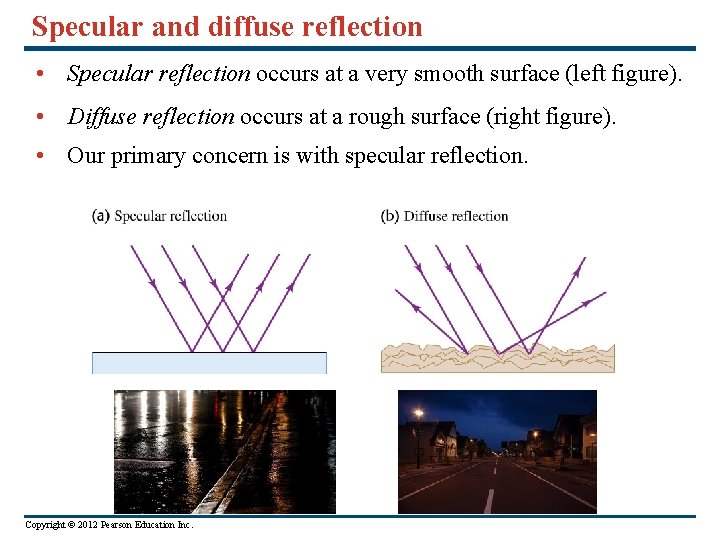
Specular and diffuse reflection • Specular reflection occurs at a very smooth surface (left figure). • Diffuse reflection occurs at a rough surface (right figure). • Our primary concern is with specular reflection. Copyright © 2012 Pearson Education Inc.
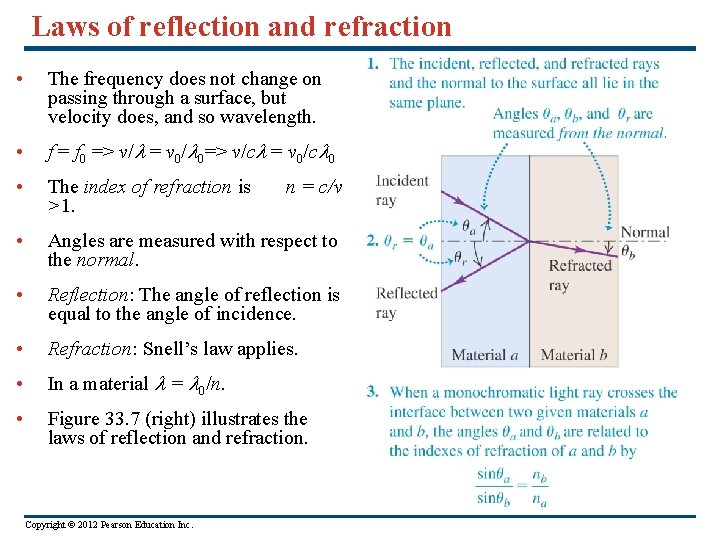
Laws of reflection and refraction • The frequency does not change on passing through a surface, but velocity does, and so wavelength. • f = f 0 => v/ = v 0/ 0=> v/c = v 0/c 0 • The index of refraction is >1. • Angles are measured with respect to the normal. • Reflection: The angle of reflection is equal to the angle of incidence. • Refraction: Snell’s law applies. • In a material = 0/n. • Figure 33. 7 (right) illustrates the laws of reflection and refraction. Copyright © 2012 Pearson Education Inc. n = c/v
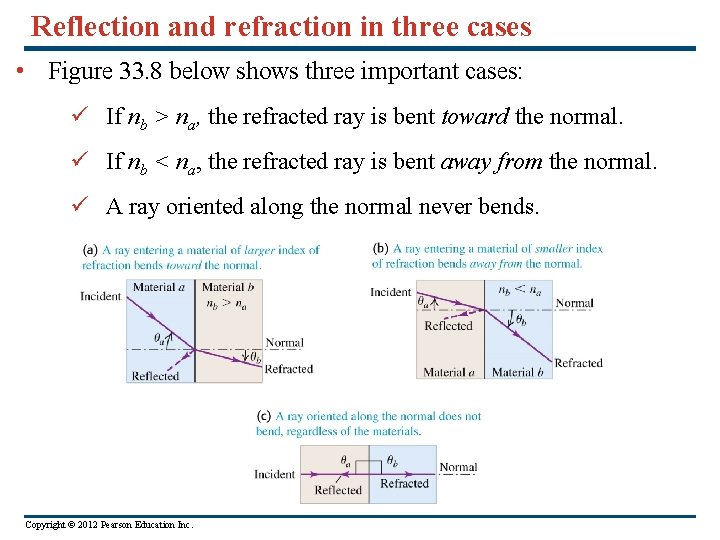
Reflection and refraction in three cases • Figure 33. 8 below shows three important cases: ü If nb > na, the refracted ray is bent toward the normal. ü If nb < na, the refracted ray is bent away from the normal. ü A ray oriented along the normal never bends. Copyright © 2012 Pearson Education Inc.
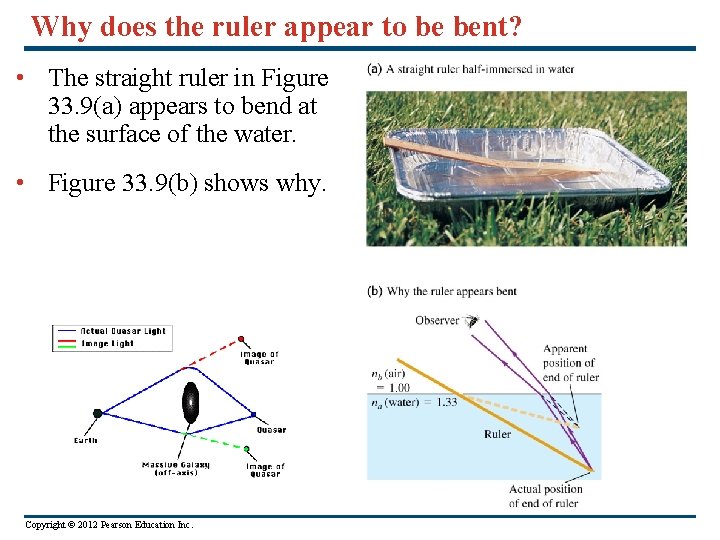
Why does the ruler appear to be bent? • The straight ruler in Figure 33. 9(a) appears to bend at the surface of the water. • Figure 33. 9(b) shows why. Copyright © 2012 Pearson Education Inc.
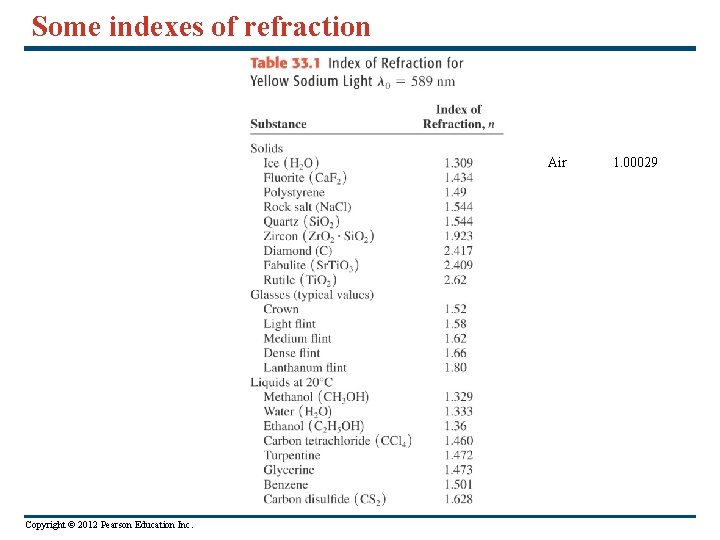
Some indexes of refraction Air Copyright © 2012 Pearson Education Inc. 1. 00029
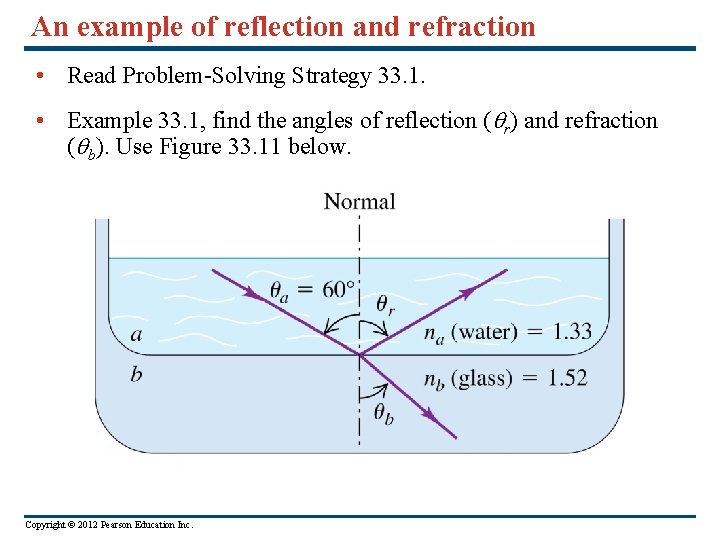
An example of reflection and refraction • Read Problem-Solving Strategy 33. 1. • Example 33. 1, find the angles of reflection ( r) and refraction ( b). Use Figure 33. 11 below. Copyright © 2012 Pearson Education Inc.
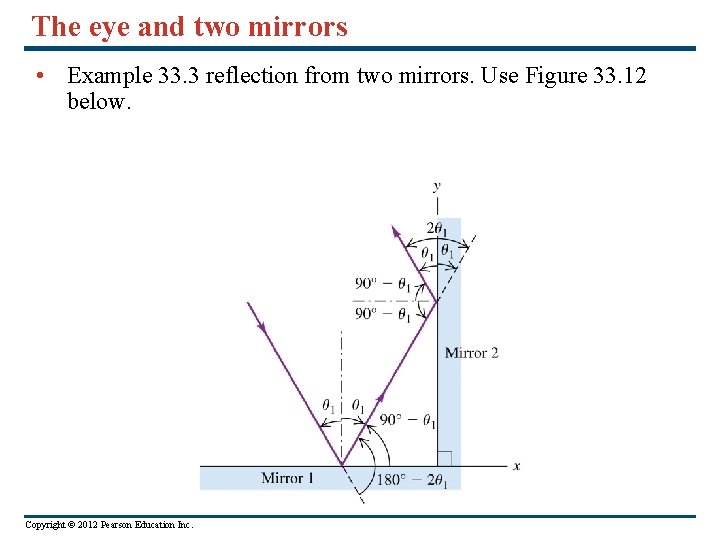
The eye and two mirrors • Example 33. 3 reflection from two mirrors. Use Figure 33. 12 below. Copyright © 2012 Pearson Education Inc.
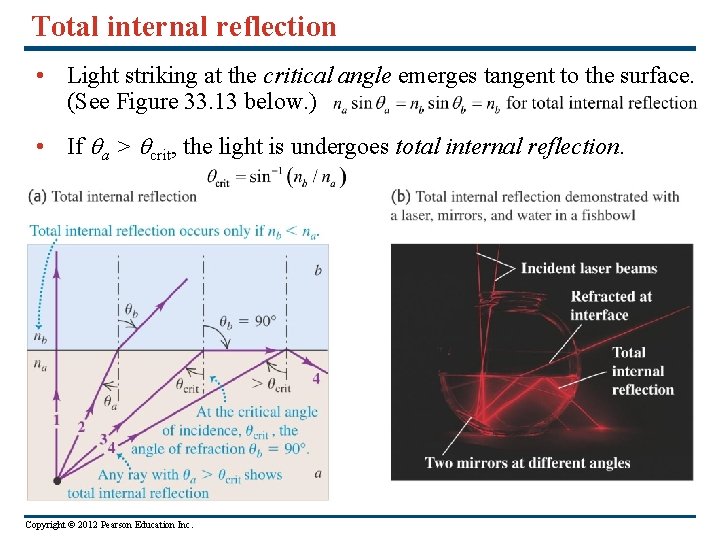
Total internal reflection • Light striking at the critical angle emerges tangent to the surface. (See Figure 33. 13 below. ) • If a > crit, the light is undergoes total internal reflection. Copyright © 2012 Pearson Education Inc.
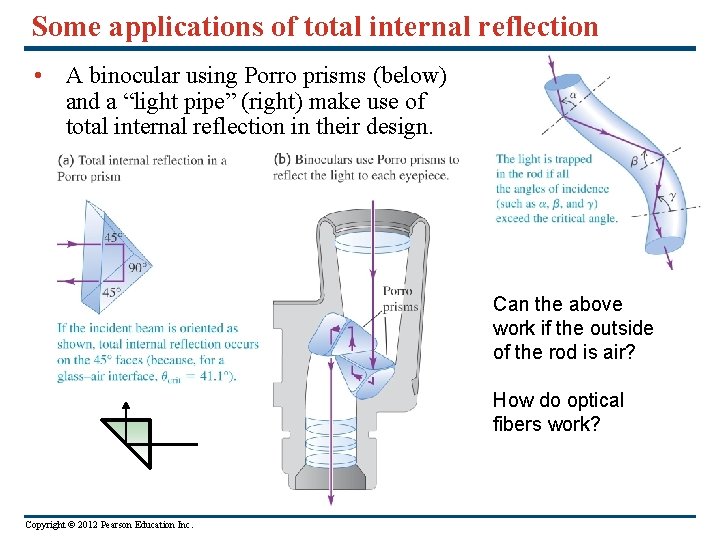
Some applications of total internal reflection • A binocular using Porro prisms (below) and a “light pipe” (right) make use of total internal reflection in their design. Can the above work if the outside of the rod is air? How do optical fibers work? Copyright © 2012 Pearson Education Inc.
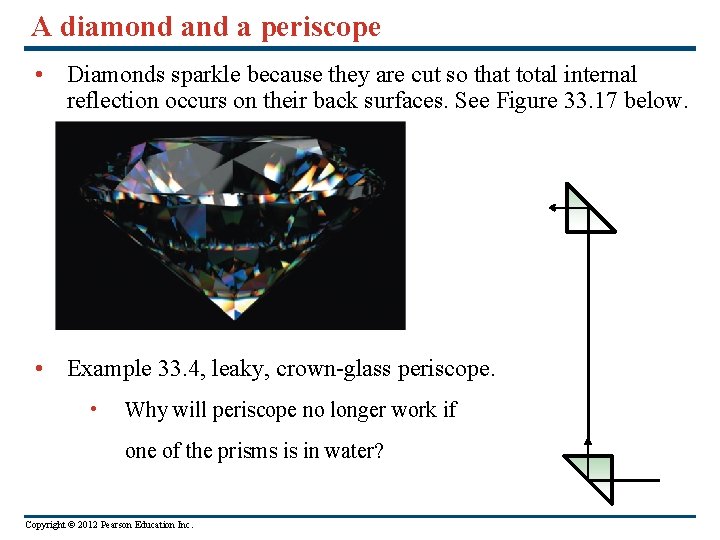
A diamond a periscope • Diamonds sparkle because they are cut so that total internal reflection occurs on their back surfaces. See Figure 33. 17 below. • Example 33. 4, leaky, crown-glass periscope. • Why will periscope no longer work if one of the prisms is in water? Copyright © 2012 Pearson Education Inc.
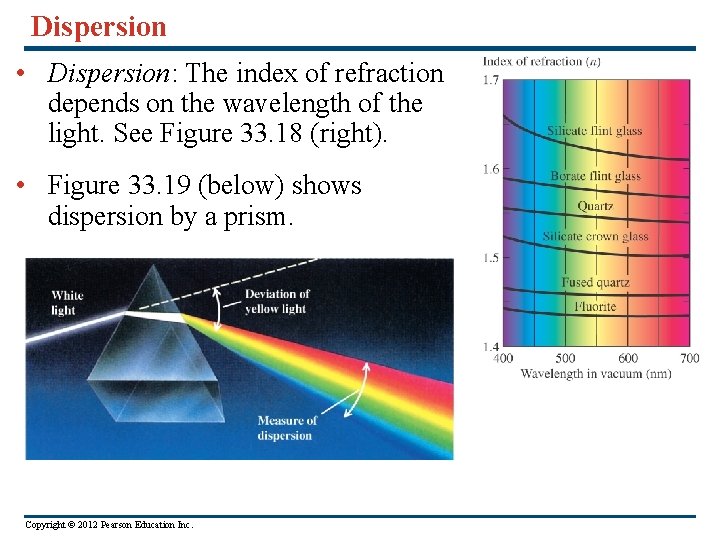
Dispersion • Dispersion: The index of refraction depends on the wavelength of the light. See Figure 33. 18 (right). • Figure 33. 19 (below) shows dispersion by a prism. Copyright © 2012 Pearson Education Inc.
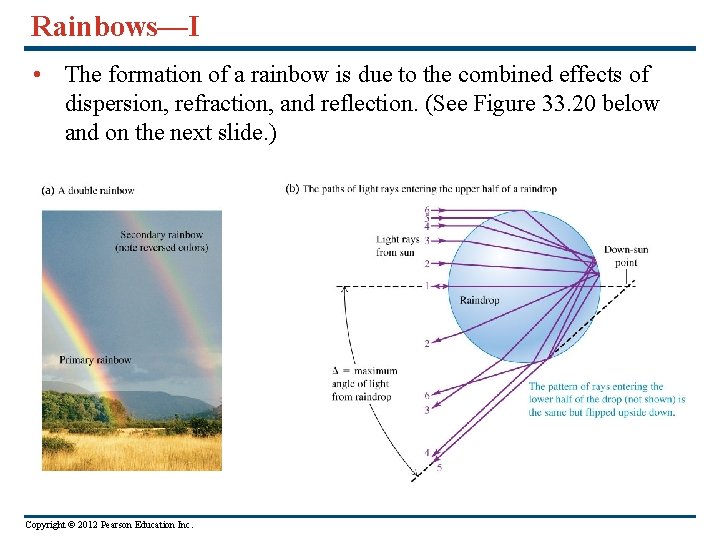
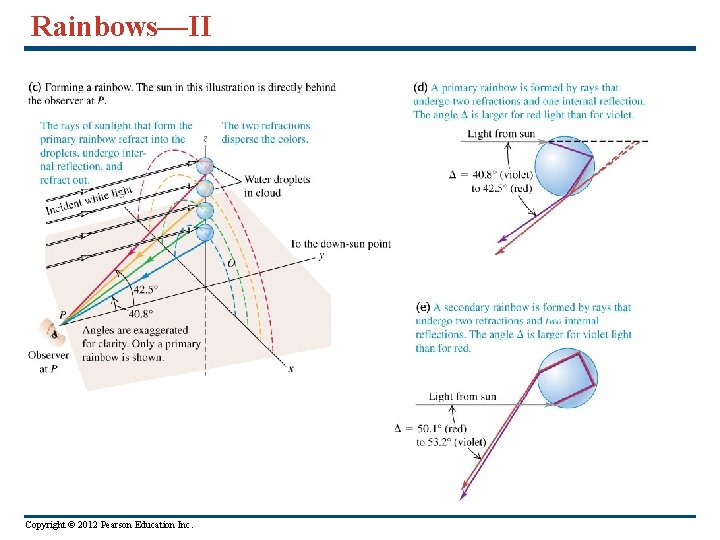
Rainbows—I • The formation of a rainbow is due to the combined effects of dispersion, refraction, and reflection. (See Figure 33. 20 below and on the next slide. ) Copyright © 2012 Pearson Education Inc.
Rainbows—II Copyright © 2012 Pearson Education Inc.
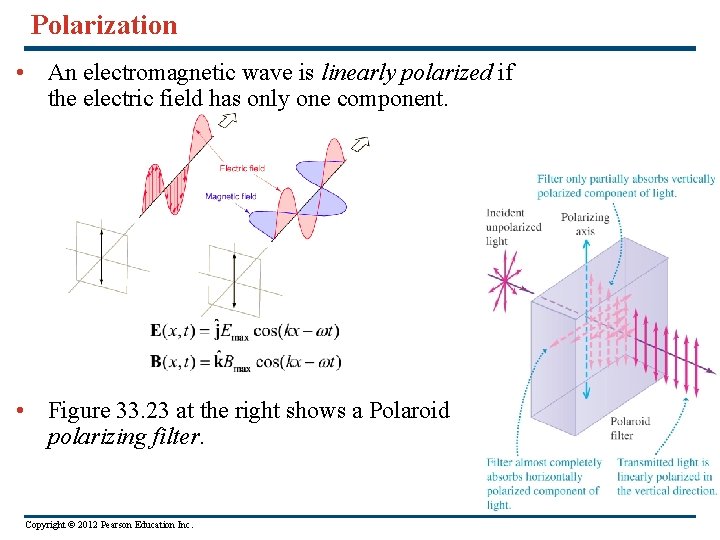
Polarization • An electromagnetic wave is linearly polarized if the electric field has only one component. • Figure 33. 23 at the right shows a Polaroid polarizing filter. Copyright © 2012 Pearson Education Inc.
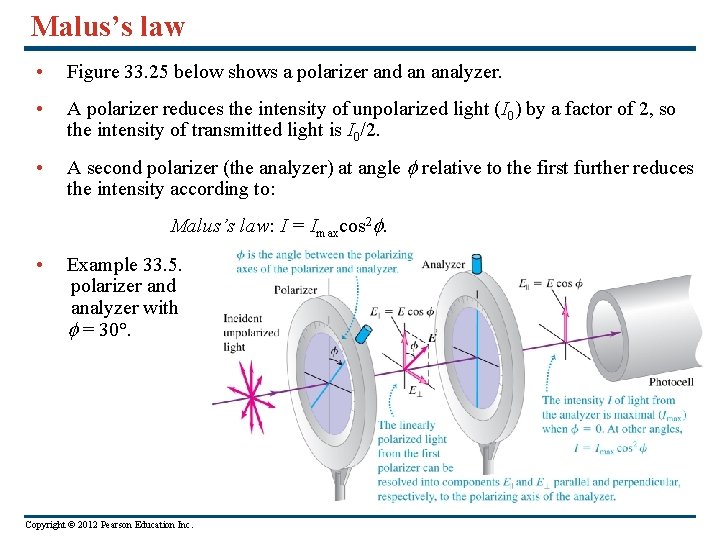
Malus’s law • Figure 33. 25 below shows a polarizer and an analyzer. • A polarizer reduces the intensity of unpolarized light (I 0) by a factor of 2, so the intensity of transmitted light is I 0/2. • A second polarizer (the analyzer) at angle relative to the first further reduces the intensity according to: Malus’s law: I = Imaxcos 2. • Example 33. 5. polarizer and analyzer with = 30°. Copyright © 2012 Pearson Education Inc.
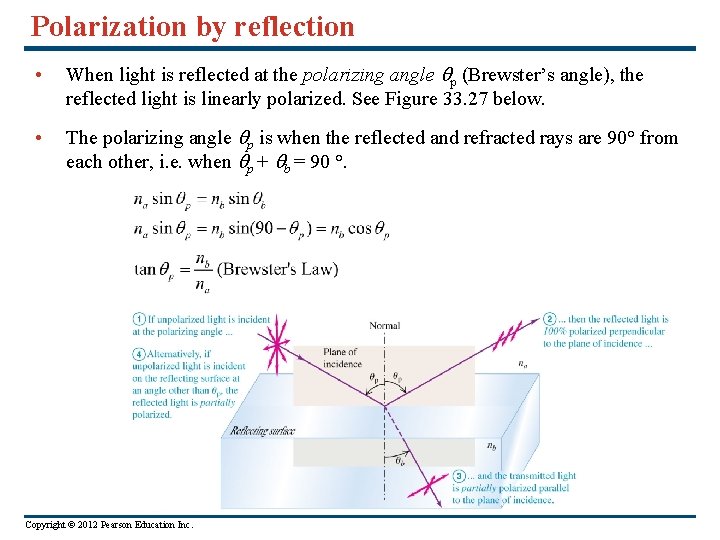
Polarization by reflection • When light is reflected at the polarizing angle p (Brewster’s angle), the reflected light is linearly polarized. See Figure 33. 27 below. • The polarizing angle p is when the reflected and refracted rays are 90° from each other, i. e. when p + b = 90 °. Copyright © 2012 Pearson Education Inc.
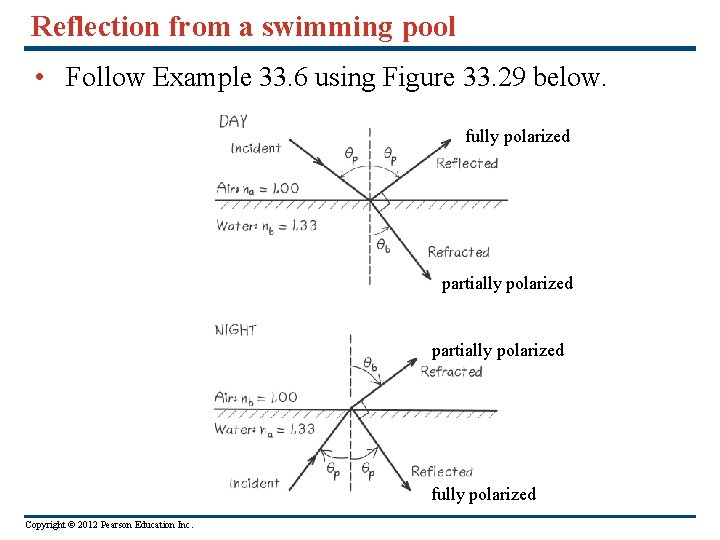
Reflection from a swimming pool • Follow Example 33. 6 using Figure 33. 29 below. fully polarized partially polarized fully polarized Copyright © 2012 Pearson Education Inc.
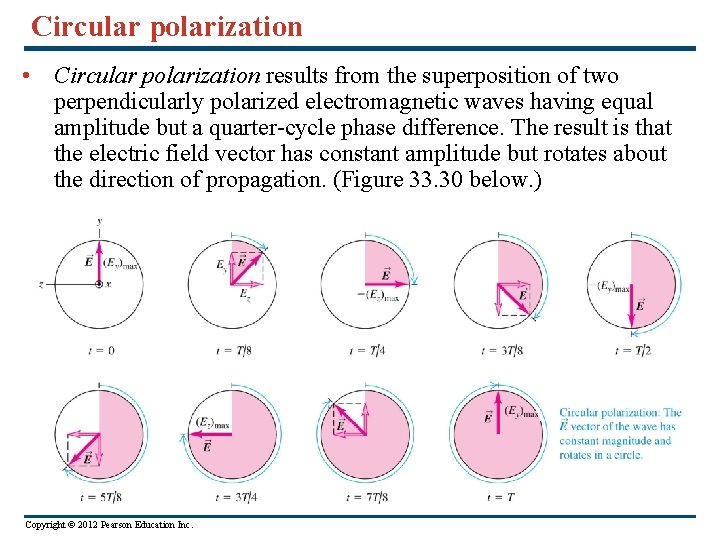
Circular polarization • Circular polarization results from the superposition of two perpendicularly polarized electromagnetic waves having equal amplitude but a quarter-cycle phase difference. The result is that the electric field vector has constant amplitude but rotates about the direction of propagation. (Figure 33. 30 below. ) Copyright © 2012 Pearson Education Inc.
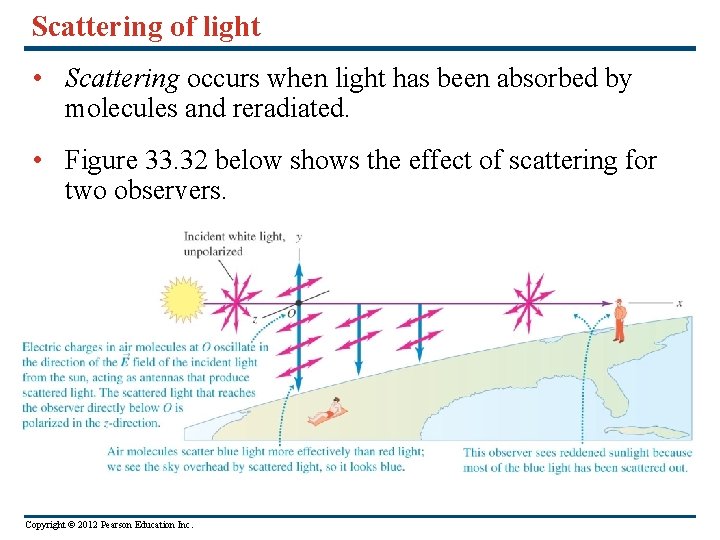
Scattering of light • Scattering occurs when light has been absorbed by molecules and reradiated. • Figure 33. 32 below shows the effect of scattering for two observers. Copyright © 2012 Pearson Education Inc.
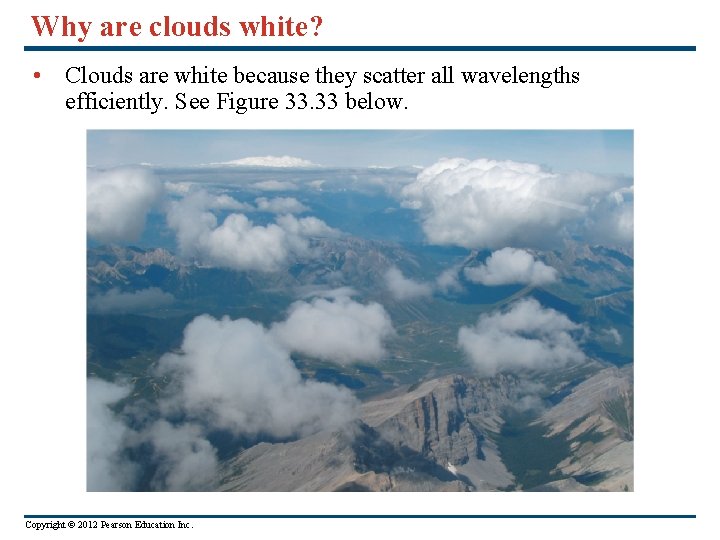
Why are clouds white? • Clouds are white because they scatter all wavelengths efficiently. See Figure 33. 33 below. Copyright © 2012 Pearson Education Inc.
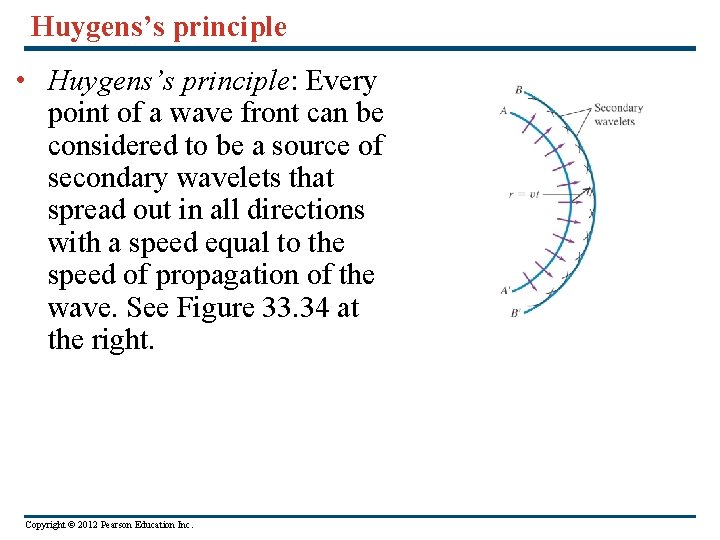
Huygens’s principle • Huygens’s principle: Every point of a wave front can be considered to be a source of secondary wavelets that spread out in all directions with a speed equal to the speed of propagation of the wave. See Figure 33. 34 at the right. Copyright © 2012 Pearson Education Inc.
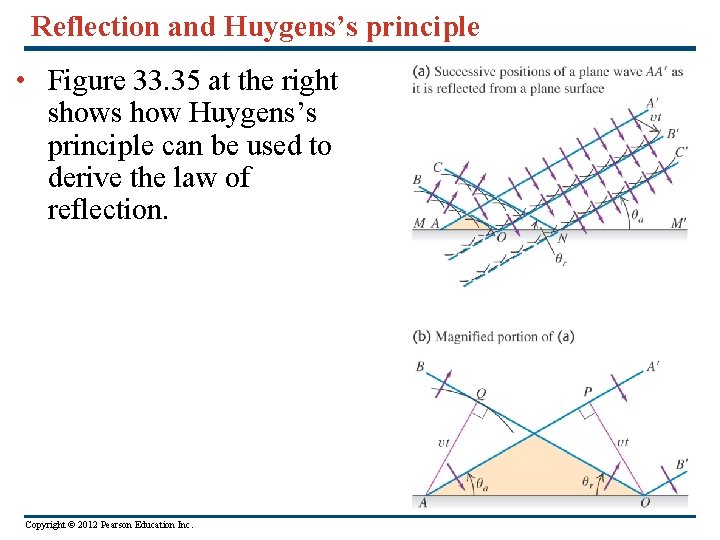
Reflection and Huygens’s principle • Figure 33. 35 at the right shows how Huygens’s principle can be used to derive the law of reflection. Copyright © 2012 Pearson Education Inc.
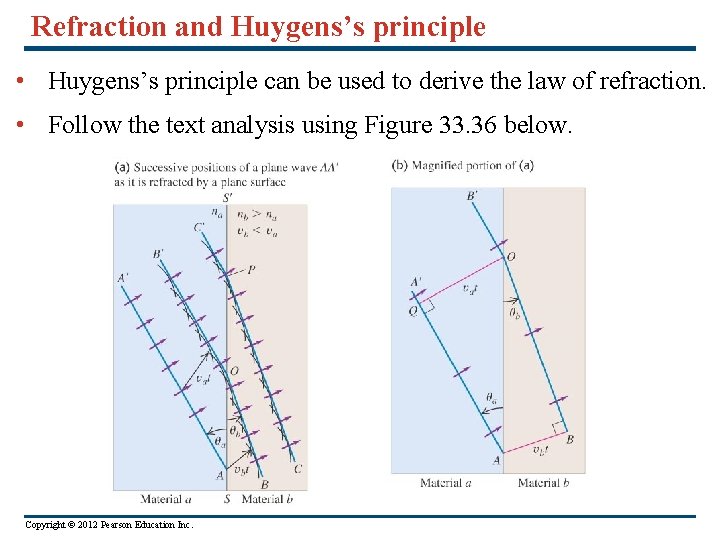
Refraction and Huygens’s principle • Huygens’s principle can be used to derive the law of refraction. • Follow the text analysis using Figure 33. 36 below. Copyright © 2012 Pearson Education Inc.
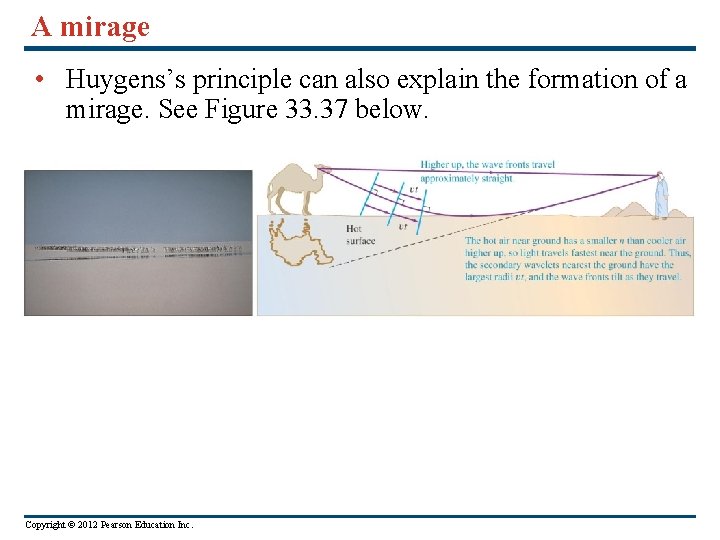
A mirage • Huygens’s principle can also explain the formation of a mirage. See Figure 33. 37 below. Copyright © 2012 Pearson Education Inc.