
Chem 253 211 Lecture Made change to slide

- Slides: 25
Chem. 253 – 2/11 Lecture Made change to slide #25 (last slide)
Announcements I • Return HW 1. 1 (discuss what was graded) + Group assignment • New HW assignment (1. 3 – posted on website) • This Week’s Group Assignment – On ozone hole – Should be shorter than last week • Today’s Lecture Topics – Tropospheric Chemistry – What is smog? – The OH radical and oxidation pathways – Tropospheric ozone formation
Tropospheric Chemistry What is Smog and What Causes It? • Air Pollution Events – a reason to study tropospheric chemistry • Poor Air Quality – Poor visibility – Increased respiratory health problems + increased deaths in particularly bad events • Historical Poor Air Quality Episodes – London (1200 s, 1600 s, 1800 s, 1950 s) – Industrial towns (Meuse, Belgium; Donora, PA, 1930 s-40 s) – Los Angeles (1960 s) – More recently (San Joaquin Valley, Mexico City)
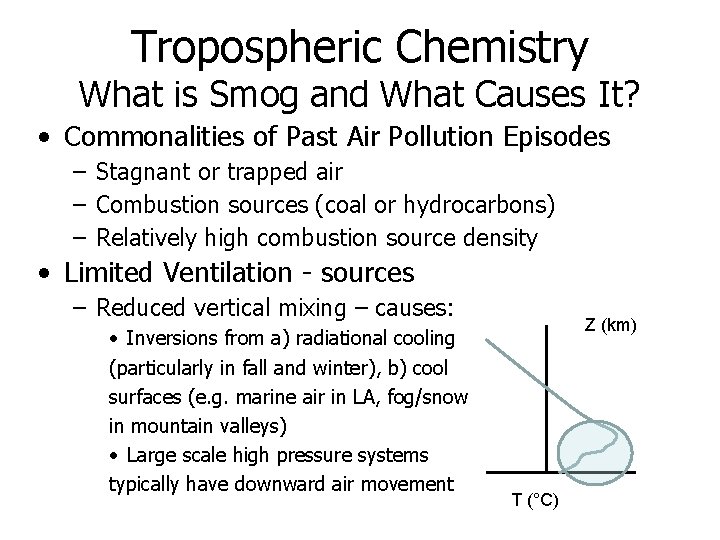
Tropospheric Chemistry What is Smog and What Causes It? • Commonalities of Past Air Pollution Episodes – Stagnant or trapped air – Combustion sources (coal or hydrocarbons) – Relatively high combustion source density • Limited Ventilation - sources – Reduced vertical mixing – causes: • Inversions from a) radiational cooling (particularly in fall and winter), b) cool surfaces (e. g. marine air in LA, fog/snow in mountain valleys) • Large scale high pressure systems typically have downward air movement Z (km) T (°C)
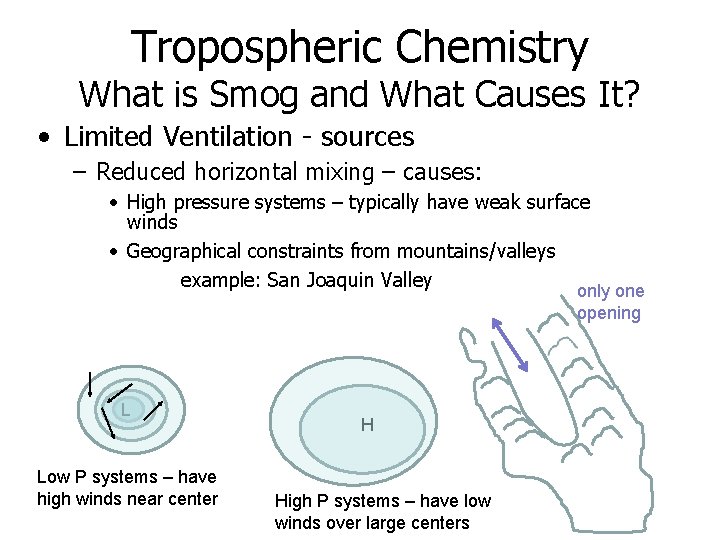
Tropospheric Chemistry What is Smog and What Causes It? • Limited Ventilation - sources – Reduced horizontal mixing – causes: • High pressure systems – typically have weak surface winds • Geographical constraints from mountains/valleys example: San Joaquin Valley only one opening L Low P systems – have high winds near center H High P systems – have low winds over large centers
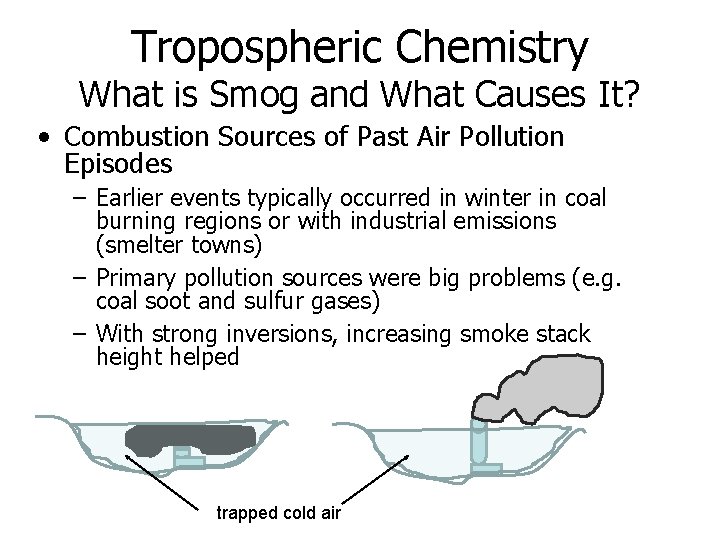
Tropospheric Chemistry What is Smog and What Causes It? • Combustion Sources of Past Air Pollution Episodes – Earlier events typically occurred in winter in coal burning regions or with industrial emissions (smelter towns) – Primary pollution sources were big problems (e. g. coal soot and sulfur gases) – With strong inversions, increasing smoke stack height helped trapped cold air
Tropospheric Chemistry What is Smog and What Causes It? • Primary Air Pollutants – An air pollutant as emitted from source (or conversion within seconds to minutes of emission) – Examples: fly ash, soot, sulfur dioxide, polyaromatic hydrocarbons – Problems are generally close to sources (within km of emission sources) – Solutions to problems • reduce source (e. g. fireplace bans for woodsmoke) • dilution (allow wood smoke under good ventilation conditions)
Tropospheric Chemistry What is Smog and What Causes It? • Secondary Air Pollutants – An air pollutant forms through atmospheric reactions – Examples: NO 2, tropospheric ozone, peracetyl nitrate, sulfate aerosol – Problems are much less restricted (Sacramento area ozone is highest in foothill communities) – Solutions require detailed understanding of issues – Ozone example: 3 ingredients needed: NOx, VOCs, and sunlight
Tropospheric Chemistry What is Smog and What Causes It? • Visibility Impairment – poor visibility is often a result of secondary pollution episodes – measured by extinction (absorbance plus scattering) – perception of visibility problems is not uniform (much easier to see pollution when above polluted air than when in it) – most visibility reduction is due to aerosol particles with some from NO 2 (absorbs lower visible wavelengths) – low visibility is not necessarily the cause of health effects, but high aerosol concentrations are associated with health problems
Tropospheric Chemistry Oxidation in the Atmosphere • Oxygen is a Thermodynamically Unstable Gas – hydrocarbons and metals typically would be more stable in their oxidized forms • However, it is stable kinetically • for even a “fast” O 2 reaction (2 NO 2 + O 2 → 2 NO 2), under polluted conditions, reaction is insignificant • Faster oxidation requires other oxidants (OH - daytime, O 3, and NO 3 – nighttime are most prevalent) • OH is the most widespread initiator of oxidation
Tropospheric Chemistry Oxidation in the Atmosphere • OH formation Reaction: O 3 + hn → O 2 + O* O* + H 2 O → 2 OH • Free Radical Cycles (also applies to most stratospheric reactions) – initiation steps (formation of one or two free radicals – those shown above) – radical propagation steps (reactions passes radical on) – radical termination steps (similar to O + O 2, which ends odd O in O only Chapman mechanism) – normally initiation and termination are slow steps
Tropospheric Chemistry Oxidation in the Atmosphere • OH Reactions – radical Propagation – Example 1: OH + CO – CO is a pollutant from incomplete combustion – Toxic at relatively high concentrations (replaces O 2 in hemoglobin) reactions: 1) CO + OH → HOCO (unstable free radical) 2) HOCO + O 2 → CO 2 + HOO (HO 2) net: CO + OH + O 2 → CO 2 + HO 2 (transforms 1 OH to 1 HO 2)
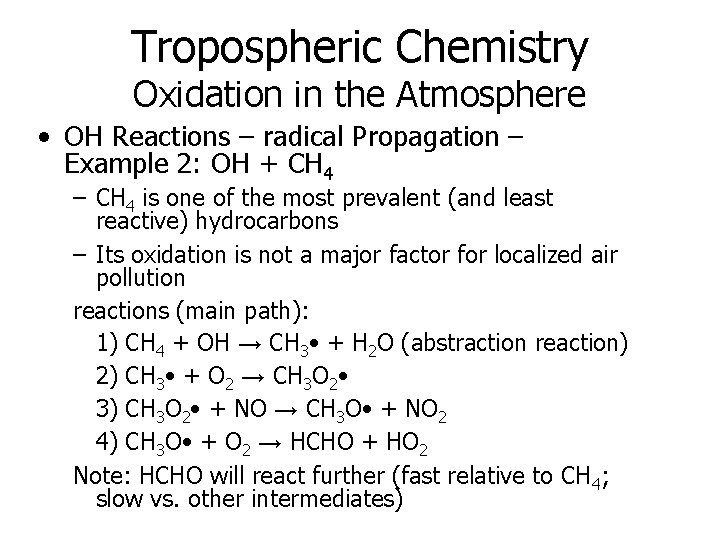
Tropospheric Chemistry Oxidation in the Atmosphere • OH Reactions – radical Propagation – Example 2: OH + CH 4 – CH 4 is one of the most prevalent (and least reactive) hydrocarbons – Its oxidation is not a major factor for localized air pollution reactions (main path): 1) CH 4 + OH → CH 3 • + H 2 O (abstraction reaction) 2) CH 3 • + O 2 → CH 3 O 2 • 3) CH 3 O 2 • + NO → CH 3 O • + NO 2 4) CH 3 O • + O 2 → HCHO + HO 2 Note: HCHO will react further (fast relative to CH 4; slow vs. other intermediates)
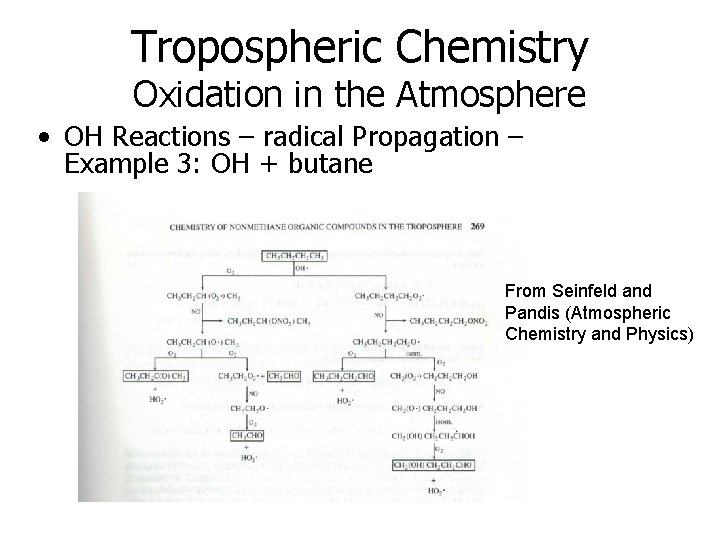
Tropospheric Chemistry Oxidation in the Atmosphere • OH Reactions – radical Propagation – Example 3: OH + butane From Seinfeld and Pandis (Atmospheric Chemistry and Physics)
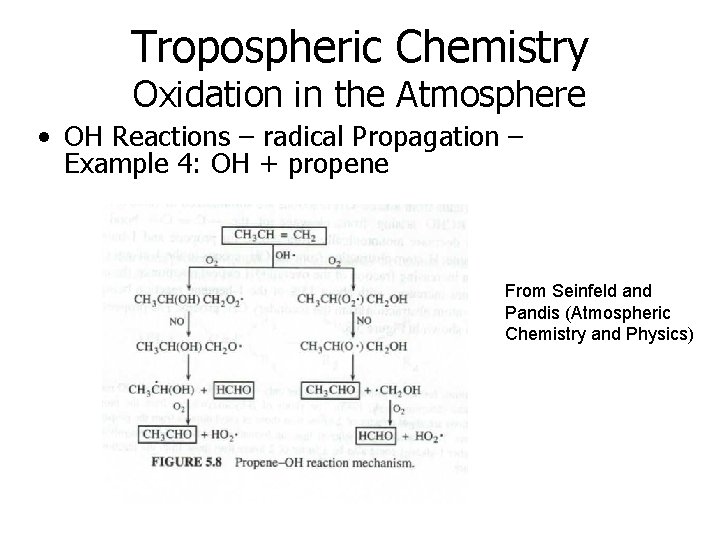
Tropospheric Chemistry Oxidation in the Atmosphere • OH Reactions – radical Propagation – Example 4: OH + propene From Seinfeld and Pandis (Atmospheric Chemistry and Physics)
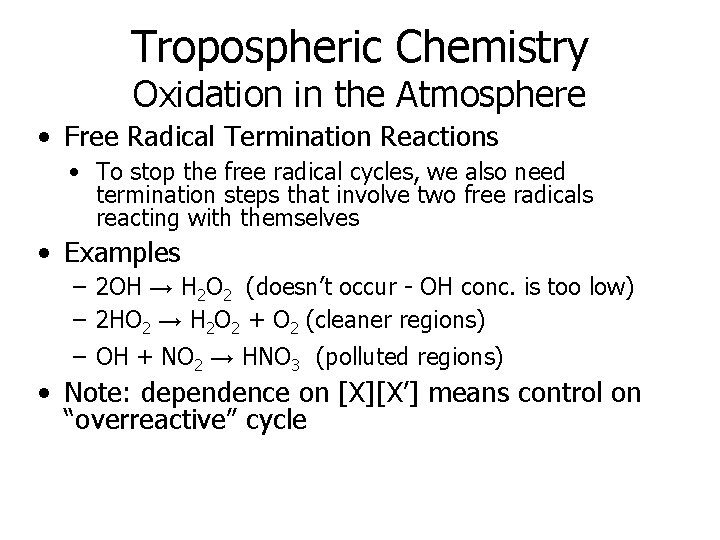
Tropospheric Chemistry Oxidation in the Atmosphere • Free Radical Termination Reactions • To stop the free radical cycles, we also need termination steps that involve two free radicals reacting with themselves • Examples – 2 OH → H 2 O 2 (doesn’t occur - OH conc. is too low) – 2 HO 2 → H 2 O 2 + O 2 (cleaner regions) – OH + NO 2 → HNO 3 (polluted regions) • Note: dependence on [X][X’] means control on “overreactive” cycle
Break for Group Activity
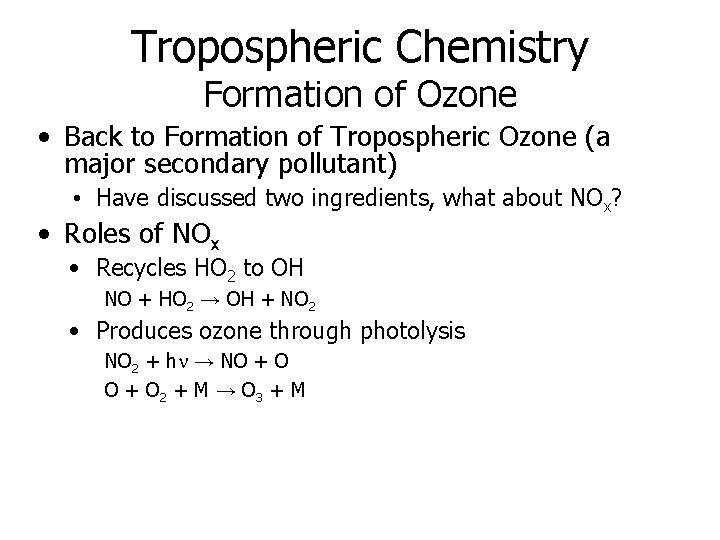
Tropospheric Chemistry Formation of Ozone • Back to Formation of Tropospheric Ozone (a major secondary pollutant) • Have discussed two ingredients, what about NOx? • Roles of NOx • Recycles HO 2 to OH NO + HO 2 → OH + NO 2 • Produces ozone through photolysis NO 2 + hn → NO + O 2 + M → O 3 + M
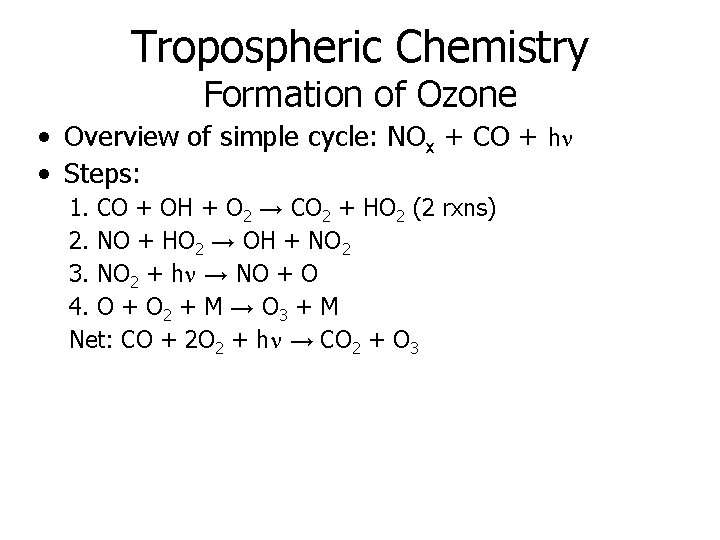
Tropospheric Chemistry Formation of Ozone • Overview of simple cycle: NOx + CO + hn • Steps: 1. CO + OH + O 2 → CO 2 + HO 2 (2 rxns) 2. NO + HO 2 → OH + NO 2 3. NO 2 + hn → NO + O 4. O + O 2 + M → O 3 + M Net: CO + 2 O 2 + hn → CO 2 + O 3
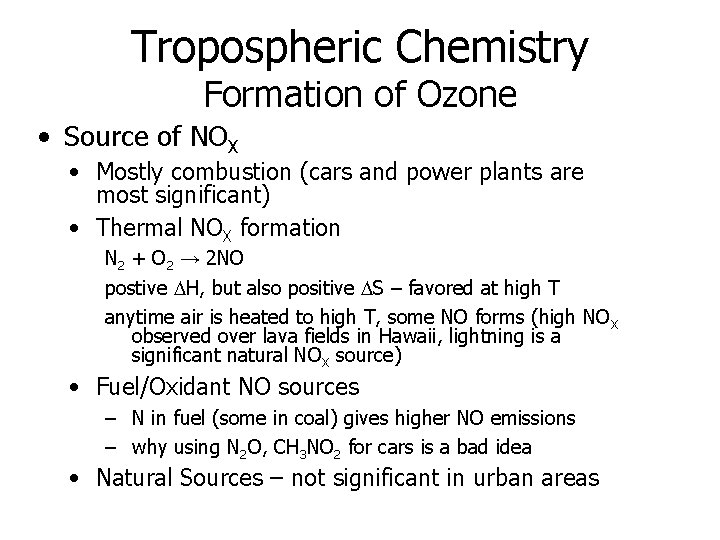
Tropospheric Chemistry Formation of Ozone • Source of NOX • Mostly combustion (cars and power plants are most significant) • Thermal NOX formation N 2 + O 2 → 2 NO postive DH, but also positive DS – favored at high T anytime air is heated to high T, some NO forms (high NO X observed over lava fields in Hawaii, lightning is a significant natural NOX source) • Fuel/Oxidant NO sources – N in fuel (some in coal) gives higher NO emissions – why using N 2 O, CH 3 NO 2 for cars is a bad idea • Natural Sources – not significant in urban areas
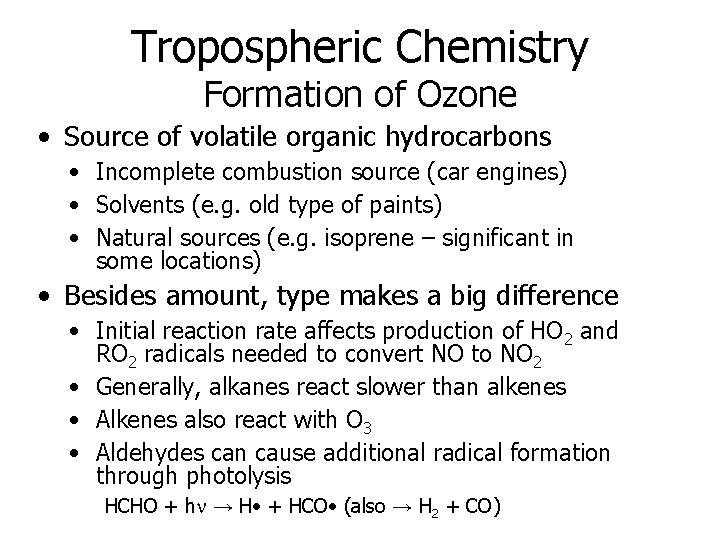
Tropospheric Chemistry Formation of Ozone • Source of volatile organic hydrocarbons • Incomplete combustion source (car engines) • Solvents (e. g. old type of paints) • Natural sources (e. g. isoprene – significant in some locations) • Besides amount, type makes a big difference • Initial reaction rate affects production of HO 2 and RO 2 radicals needed to convert NO to NO 2 • Generally, alkanes react slower than alkenes • Alkenes also react with O 3 • Aldehydes can cause additional radical formation through photolysis HCHO + hn → H • + HCO • (also → H 2 + CO)
Tropospheric Chemistry Strategies to Limit Ozone Production • Can’t reduce sunlight easily, so NOX or HC reductions are possible • Initial regulation focused on car emissions in which going to more efficient and lean (excess O 2 ) combustion, which reduces HCs but can increase NOX (until improvements in catalysts) • Two other reactions affect the strategy: NO + O 3 → NO 2 + O 2 (keeps O 3 low in downtown regions) and OH + NO 2 → HNO 3 (limits OH reactivity)
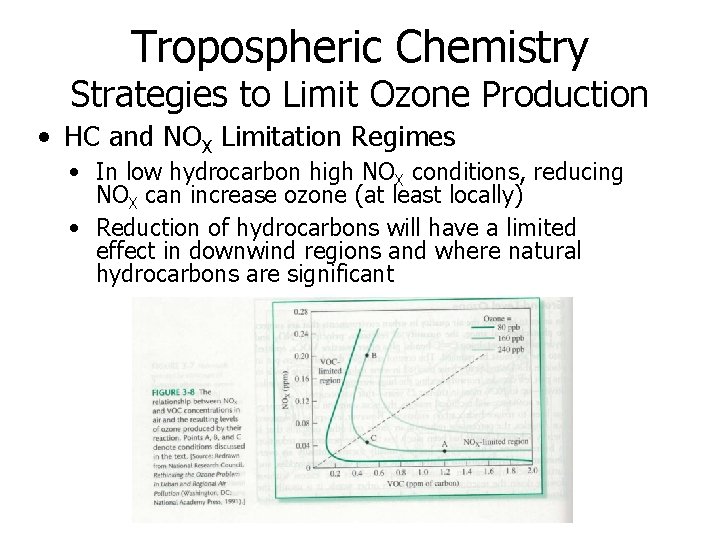
Tropospheric Chemistry Strategies to Limit Ozone Production • HC and NOX Limitation Regimes • In low hydrocarbon high NOX conditions, reducing NOX can increase ozone (at least locally) • Reduction of hydrocarbons will have a limited effect in downwind regions and where natural hydrocarbons are significant
Tropospheric Chemistry Strategies to Limit Ozone Production • Emission Reductions – Catalytic Convertors on Cars • Initial focus was to complete hydrocarbon oxidation (less CO and HCs) • Newer catalysts also reduce NOX • Diesel is more problematic • Engines are higher combustion ratio – tend to burn hotter and particulate emissions are higher • A urea based catalyst is now more common
Tropospheric Chemistry Strategies to Limit Ozone Production • Regional Ozone Problems • Focus on limiting VOCs is better for reduction in urban areas but can cause greater problems in downwind regions • A reason for this is release of reservoir species back to NOx: e. g. HNO 3 + hn → OH + NO 2 • Additionally, natural hydrocarbon sources keep hydrocarbons from dropping too low • Conditions for High Regional Ozone • Typically under warm summertime conditions with high pressures (need sunlight, limited mixing, plus high temperatures reduce wet removal)