
ITS HF Propagation Software Greg Hand US Department









- Slides: 28
ITS HF Propagation Software Greg Hand US Department of Commerce NTIA/ITS http: //elbert. its. bldrdoc. gov NTIA/ITS 13 April 2004 1
Outline w Models – ICEPAC, VOACAP, REC 533 w History w Users/Applications w Examples w Free NTIA/ITS 13 April 2004 2
Disclaimer The software contained within was developed by an agency of the U. S. Government. NTIA/ITS has no objection to the use of this software for any purpose since it is not subject to copyright protection in the U. S. NTIA/ITS 13 April 2004 3
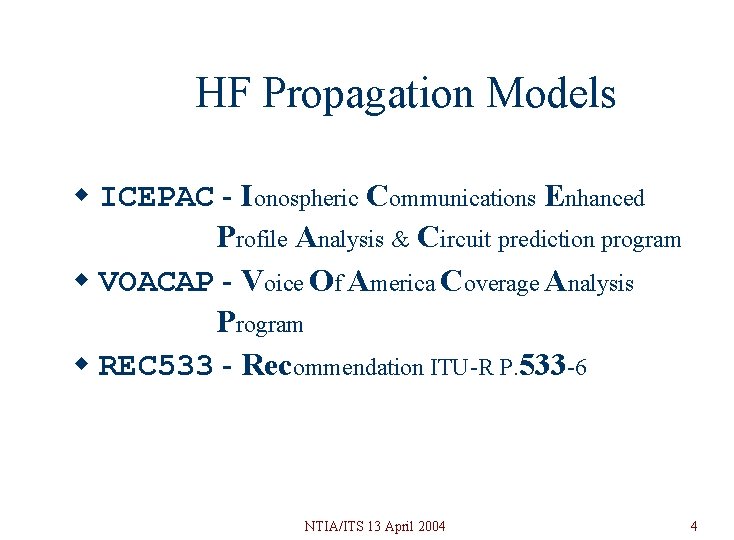
HF Propagation Models w ICEPAC - Ionospheric Communications Enhanced Profile Analysis & Circuit prediction program w VOACAP - Voice Of America Coverage Analysis Program w REC 533 - Recommendation ITU-R P. 533 -6 NTIA/ITS 13 April 2004 4
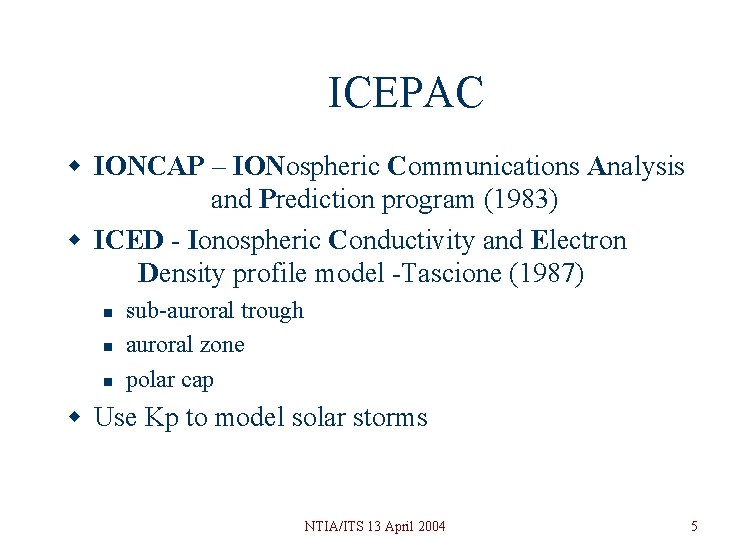
ICEPAC w IONCAP – IONospheric Communications Analysis and Prediction program (1983) w ICED - Ionospheric Conductivity and Electron Density profile model -Tascione (1987) n n n sub-auroral trough auroral zone polar cap w Use Kp to model solar storms NTIA/ITS 13 April 2004 5
VOACAP w 1985 - VOA adopts IONCAP as model to be used for broadcast station design w NRL - modifies IONCAP into VOACAP w 1993 - VOACAP released w 1993 - NTIA/ITS add DOS GUI interface w 1996 - Windows 3. x 16 -bit version w 1997 - Windows-NT 32 -bit version w Present - 04. 0324 W - Windows-XP/2000/NT/95/98 NTIA/ITS 13 April 2004 6
REC 533 w Recommendation ITU-R P. 533 -6 w First released - July 1993 w International HF Coordination NTIA/ITS 13 April 2004 7
Users of the Software w HF Broadcasters (VOA, BBC, ITU, HFCC) w Military w Defense contractors w Airline communications w HAMs w HF Email – Sailmail / Airmail w BPL NTIA/ITS 13 April 2004 8
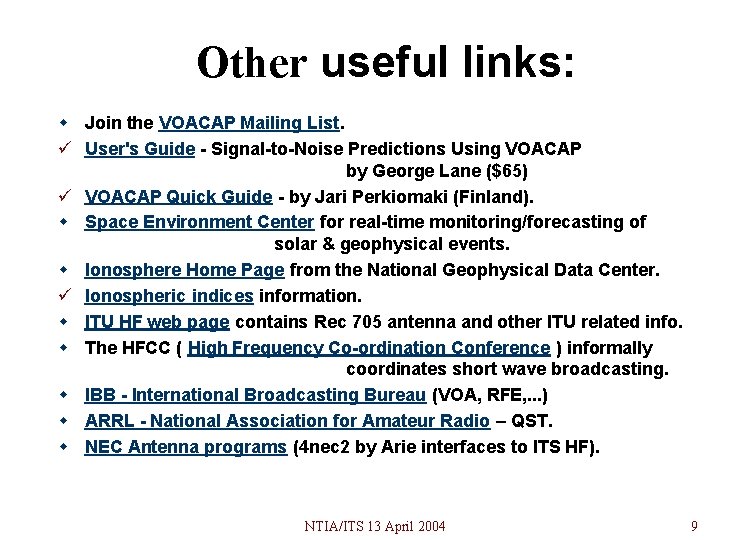
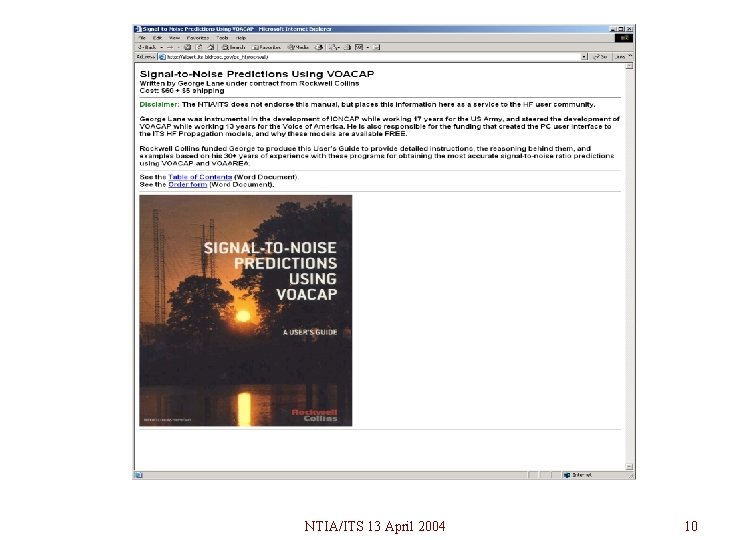
Other useful links: w Join the VOACAP Mailing List. ü User's Guide - Signal-to-Noise Predictions Using VOACAP by George Lane ($65) ü VOACAP Quick Guide - by Jari Perkiomaki (Finland). w Space Environment Center for real-time monitoring/forecasting of solar & geophysical events. w Ionosphere Home Page from the National Geophysical Data Center. ü Ionospheric indices information. w ITU HF web page contains Rec 705 antenna and other ITU related info. w The HFCC ( High Frequency Co-ordination Conference ) informally coordinates short wave broadcasting. w IBB - International Broadcasting Bureau (VOA, RFE, . . . ) w ARRL - National Association for Amateur Radio – QST. w NEC Antenna programs (4 nec 2 by Arie interfaces to ITS HF). NTIA/ITS 13 April 2004 9
NTIA/ITS 13 April 2004 10
Other useful links: w Join the VOACAP Mailing List. ü User's Guide - Signal-to-Noise Predictions Using VOACAP by George Lane ($65) ü VOACAP Quick Guide - by Jari Perkiomaki (Finland). w Space Environment Center for real-time monitoring/forecasting of solar & geophysical events. w Ionosphere Home Page from the National Geophysical Data Center. ü Ionospheric indices information. w ITU HF web page contains Rec 705 antenna and other ITU related info. w The HFCC ( High Frequency Co-ordination Conference ) informally coordinates short wave broadcasting. w IBB - International Broadcasting Bureau (VOA, RFE, . . . ) w ARRL - National Association for Amateur Radio – QST. w NEC Antenna programs (4 nec 2 by Arie interfaces to ITS HF). NTIA/ITS 13 April 2004 11
NTIA/ITS 13 April 2004 12
Other useful links: w Join the VOACAP Mailing List. ü User's Guide - Signal-to-Noise Predictions Using VOACAP by George Lane ($65) ü VOACAP Quick Guide - by Jari Perkiomaki (Finland). w Space Environment Center for real-time monitoring/forecasting of solar & geophysical events. w Ionosphere Home Page from the National Geophysical Data Center. ü Ionospheric indices information. w ITU HF web page contains Rec 705 antenna and other ITU related info. w The HFCC ( High Frequency Co-ordination Conference ) informally coordinates short wave broadcasting. w IBB - International Broadcasting Bureau (VOA, RFE, . . . ) w ARRL - National Association for Amateur Radio – QST. w NEC Antenna programs (4 nec 2 by Arie interfaces to ITS HF). NTIA/ITS 13 April 2004 13
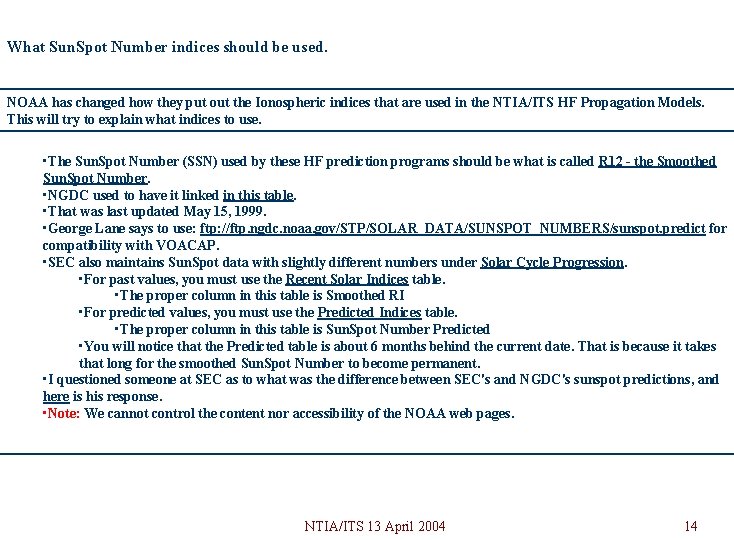
What Sun. Spot Number indices should be used. NOAA has changed how they put out the Ionospheric indices that are used in the NTIA/ITS HF Propagation Models. This will try to explain what indices to use. • The Sun. Spot Number (SSN) used by these HF prediction programs should be what is called R 12 - the Smoothed Sun. Spot Number. • NGDC used to have it linked in this table. • That was last updated May 15, 1999. • George Lane says to use: ftp: //ftp. ngdc. noaa. gov/STP/SOLAR_DATA/SUNSPOT_NUMBERS/sunspot. predict for compatibility with VOACAP. • SEC also maintains Sun. Spot data with slightly different numbers under Solar Cycle Progression. • For past values, you must use the Recent Solar Indices table. • The proper column in this table is Smoothed RI • For predicted values, you must use the Predicted Indices table. • The proper column in this table is Sun. Spot Number Predicted • You will notice that the Predicted table is about 6 months behind the current date. That is because it takes that long for the smoothed Sun. Spot Number to become permanent. • I questioned someone at SEC as to what was the difference between SEC's and NGDC's sunspot predictions, and here is his response. • Note: We cannot control the content nor accessibility of the NOAA web pages. NTIA/ITS 13 April 2004 14
Other useful links: w Join the VOACAP Mailing List. ü User's Guide - Signal-to-Noise Predictions Using VOACAP by George Lane ($65) ü VOACAP Quick Guide - by Jari Perkiomaki (Finland). w Space Environment Center for real-time monitoring/forecasting of solar & geophysical events. w Ionosphere Home Page from the National Geophysical Data Center. ü Ionospheric indices information. w ITU HF web page contains Rec 705 antenna and other ITU related info. w The HFCC ( High Frequency Co-ordination Conference ) informally coordinates short wave broadcasting. w IBB - International Broadcasting Bureau (VOA, RFE, . . . ) w ARRL - National Association for Amateur Radio – QST. w NEC Antenna programs (4 nec 2 by Arie interfaces to ITS HF). NTIA/ITS 13 April 2004 15
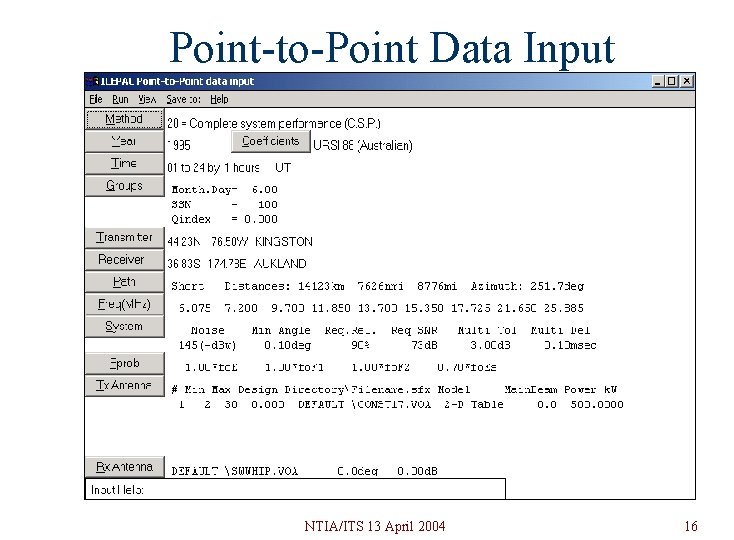
Point-to-Point Data Input NTIA/ITS 13 April 2004 16
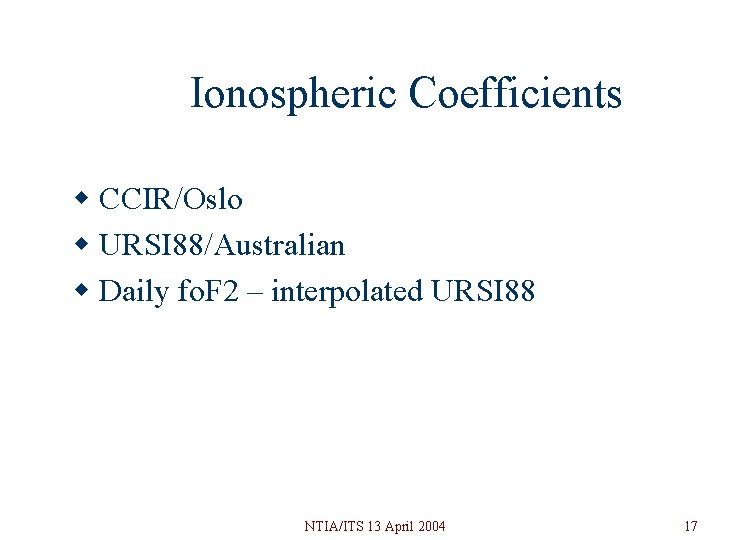
Ionospheric Coefficients w CCIR/Oslo w URSI 88/Australian w Daily fo. F 2 – interpolated URSI 88 NTIA/ITS 13 April 2004 17
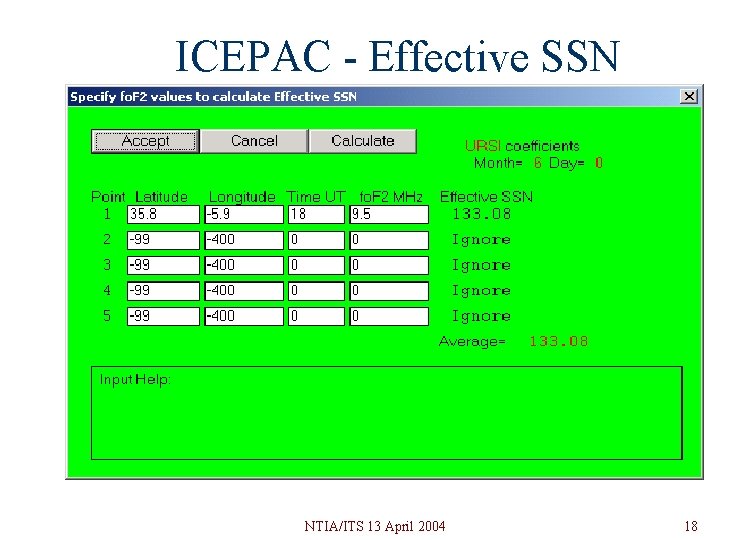
ICEPAC - Effective SSN NTIA/ITS 13 April 2004 18
Point-to-Point Output NTIA/ITS 13 April 2004 19
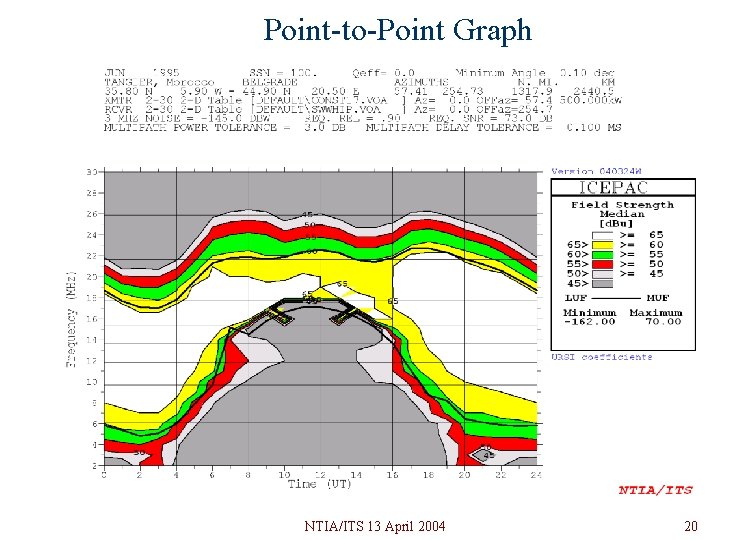
Point-to-Point Graph NTIA/ITS 13 April 2004 20
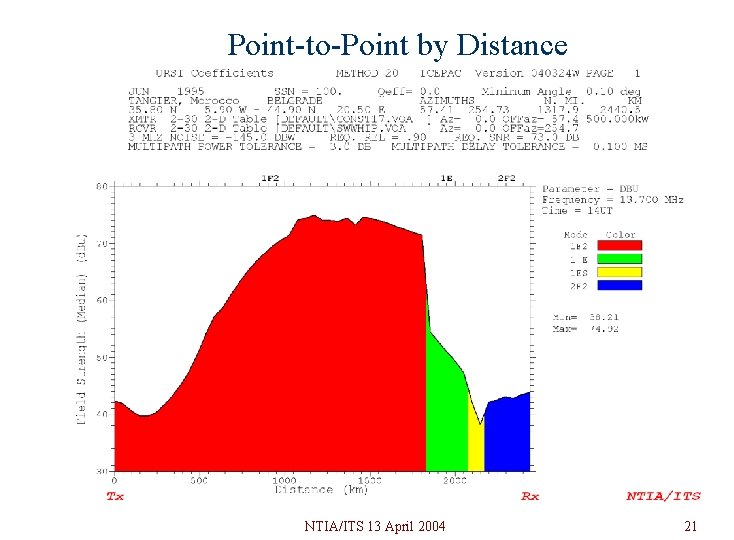
Point-to-Point by Distance NTIA/ITS 13 April 2004 21
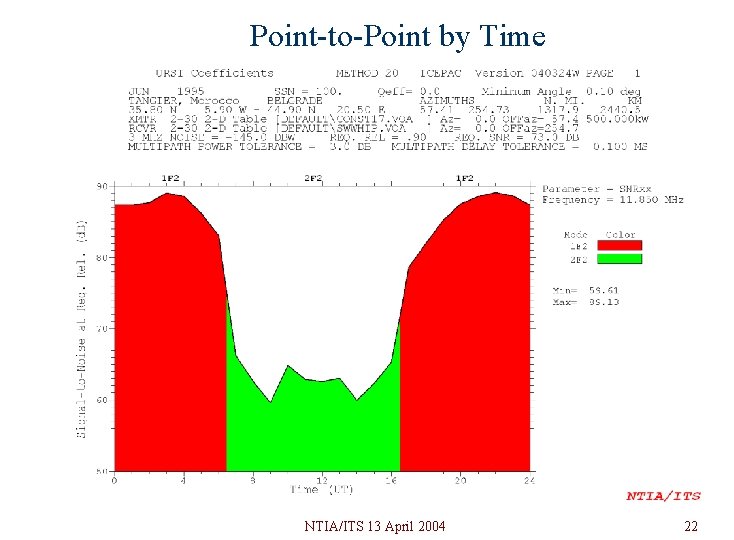
Point-to-Point by Time NTIA/ITS 13 April 2004 22
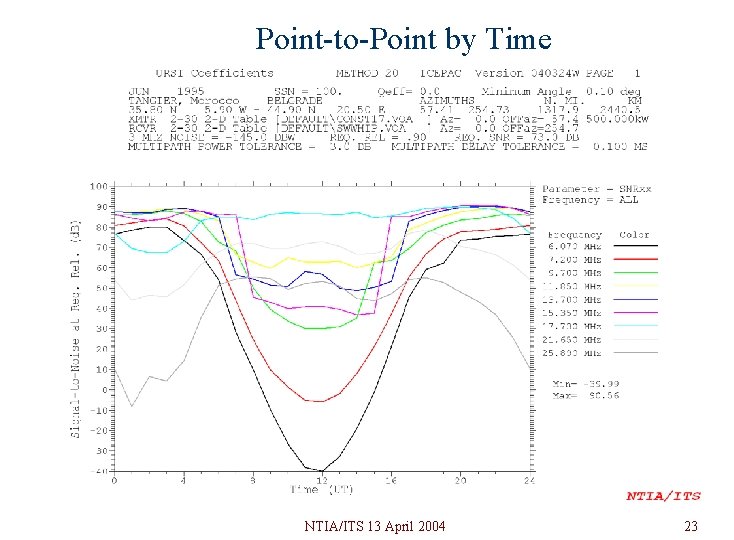
Point-to-Point by Time NTIA/ITS 13 April 2004 23
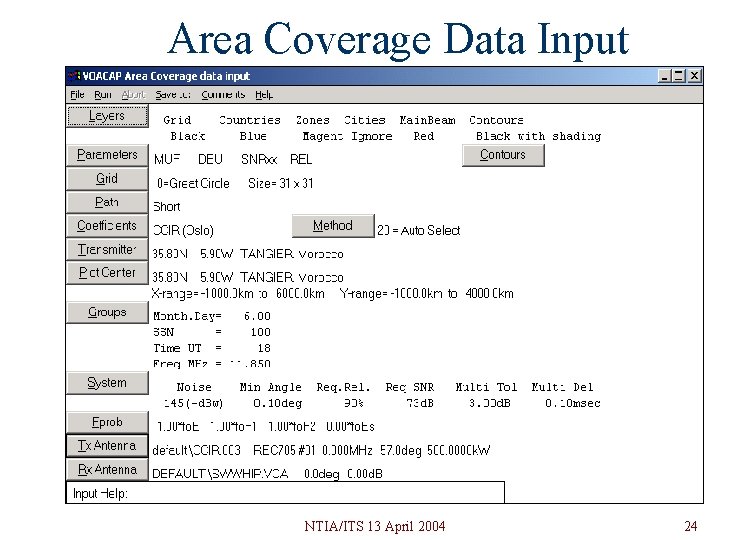
Area Coverage Data Input NTIA/ITS 13 April 2004 24
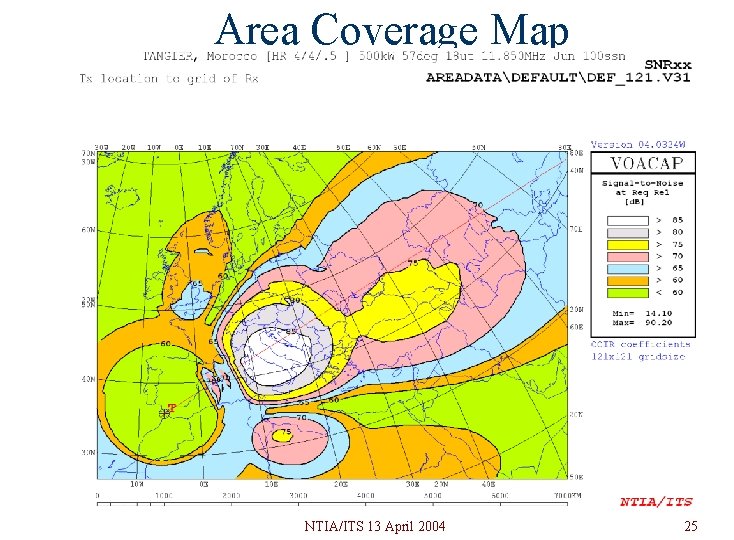
Area Coverage Map NTIA/ITS 13 April 2004 25
Combine Multiple Coverages NTIA/ITS 13 April 2004 26
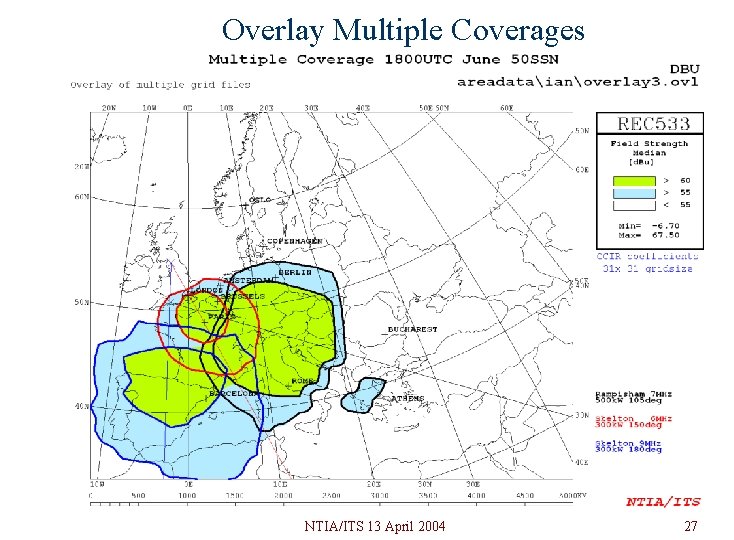
Overlay Multiple Coverages NTIA/ITS 13 April 2004 27
Conclusion w Free – http: //elbert. its. bldrdoc. gov w Current funding w Modifications via CRADA w Future? NTIA/ITS 13 April 2004 28