
Physical Layer Transmission Media CS 442 Transmission Media
- Slides: 31
Physical Layer – Transmission Media CS 442
Transmission Media • Two basic formats – Guided media : wires, fiber optics • Medium is important – Unguided media : wireless, radio transmission • Antenna is important • Each have tradeoffs over data rate, distance – Attenuation : weakening of signal over distance
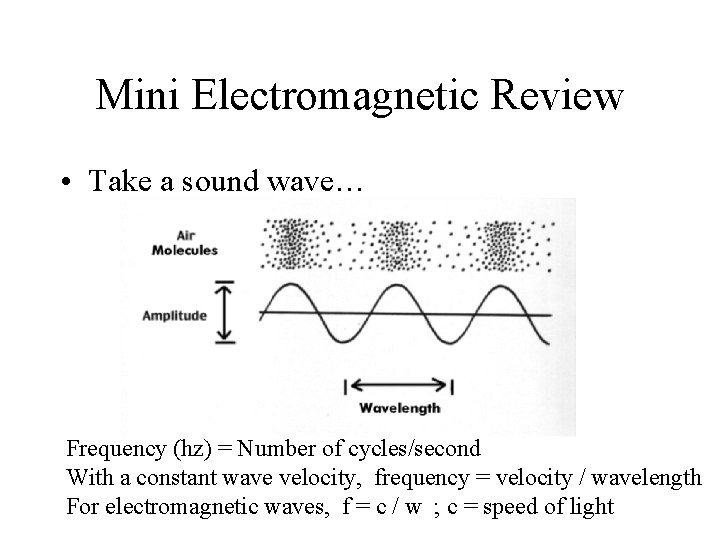
Mini Electromagnetic Review • Take a sound wave… Frequency (hz) = Number of cycles/second With a constant wave velocity, frequency = velocity / wavelength For electromagnetic waves, f = c / w ; c = speed of light
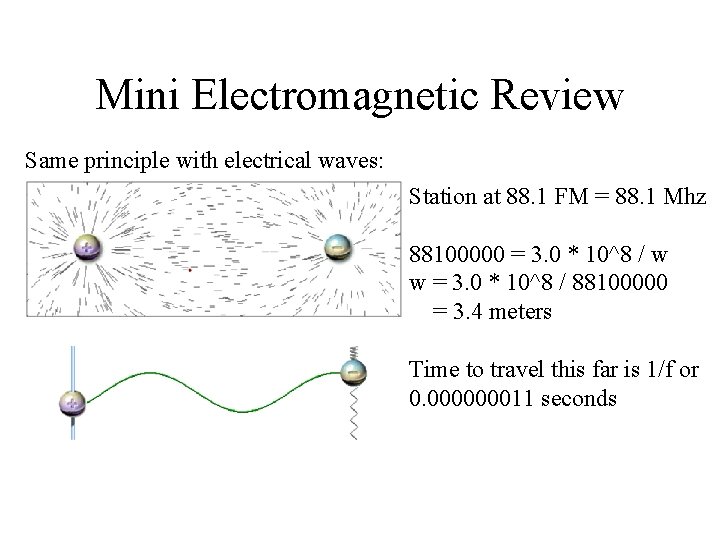
Mini Electromagnetic Review Same principle with electrical waves: Station at 88. 1 FM = 88. 1 Mhz 88100000 = 3. 0 * 10^8 / w w = 3. 0 * 10^8 / 88100000 = 3. 4 meters Time to travel this far is 1/f or 0. 000000011 seconds
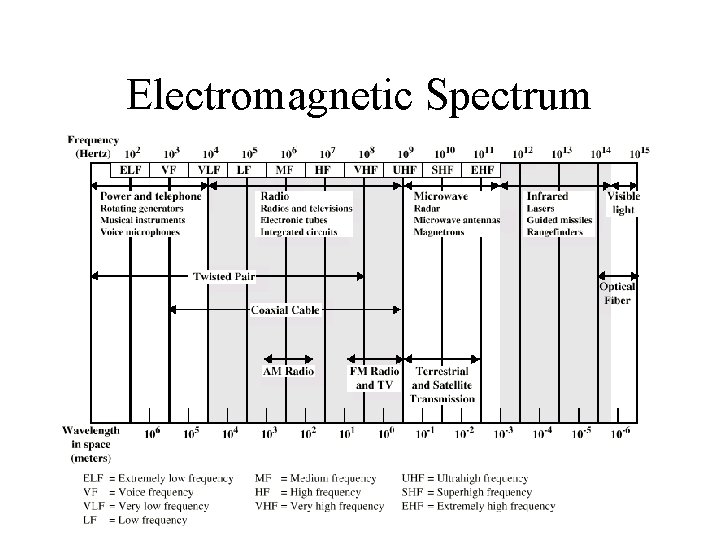
Electromagnetic Spectrum
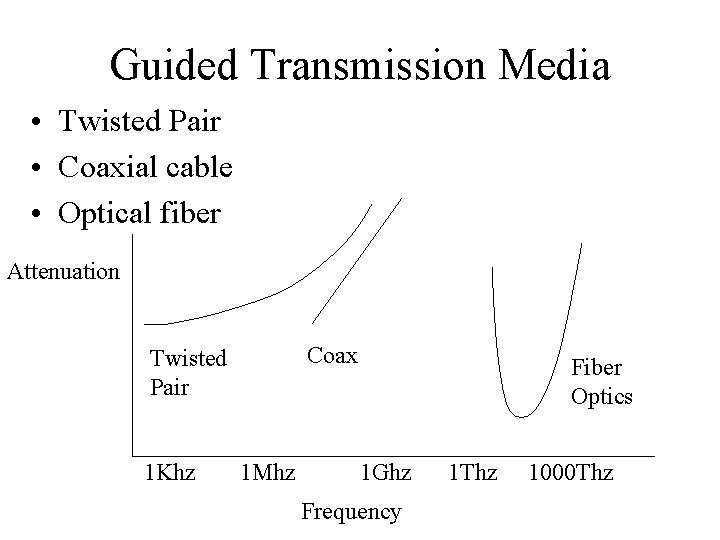
Guided Transmission Media • Twisted Pair • Coaxial cable • Optical fiber Attenuation Coax Twisted Pair 1 Khz 1 Mhz Fiber Optics 1 Ghz Frequency 1 Thz 1000 Thz
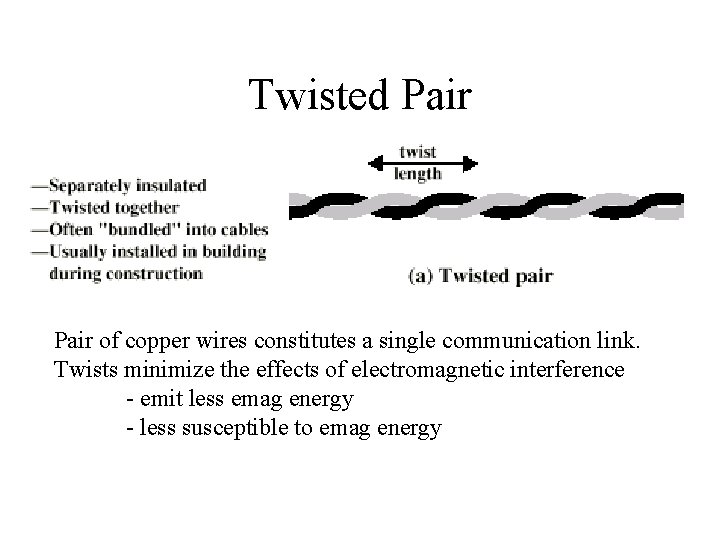
Twisted Pair of copper wires constitutes a single communication link. Twists minimize the effects of electromagnetic interference - emit less emag energy - less susceptible to emag energy
Twisted Pair - Applications • Most common medium • Telephone network – POTS – Between house and local exchange (subscriber loop), also called the end office. From the end office to Central Office (CO) class 4 CO class 1 via Public Switched Telephone Network (PSTN) • Within buildings – To private branch exchange (PBX) • For local area networks (LAN) – 10 Mbps or 100 Mbps – Possible to rev up to 1 Gbps – Gigabit Ethernet
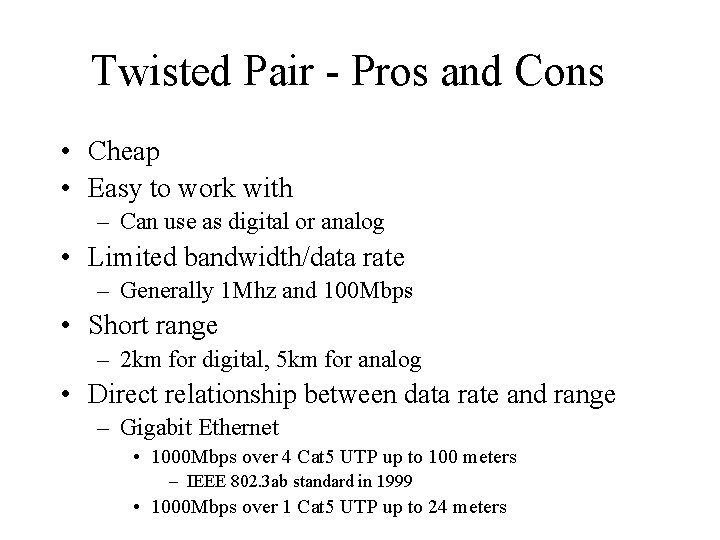
Twisted Pair - Pros and Cons • Cheap • Easy to work with – Can use as digital or analog • Limited bandwidth/data rate – Generally 1 Mhz and 100 Mbps • Short range – 2 km for digital, 5 km for analog • Direct relationship between data rate and range – Gigabit Ethernet • 1000 Mbps over 4 Cat 5 UTP up to 100 meters – IEEE 802. 3 ab standard in 1999 • 1000 Mbps over 1 Cat 5 UTP up to 24 meters
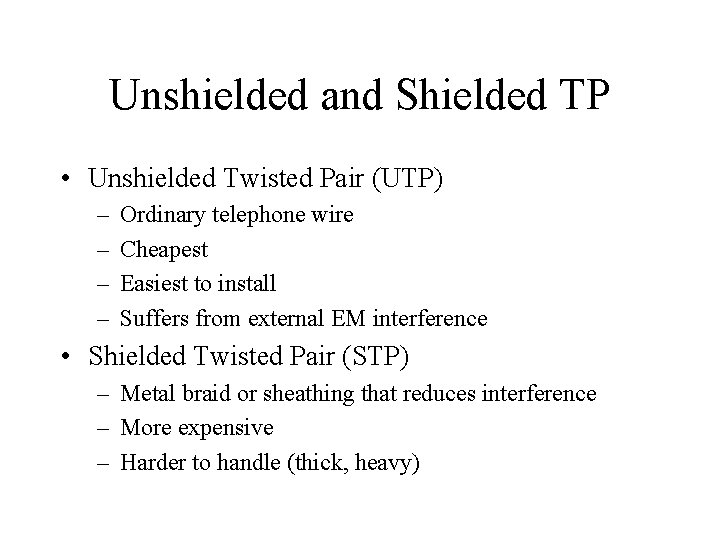
Unshielded and Shielded TP • Unshielded Twisted Pair (UTP) – – Ordinary telephone wire Cheapest Easiest to install Suffers from external EM interference • Shielded Twisted Pair (STP) – Metal braid or sheathing that reduces interference – More expensive – Harder to handle (thick, heavy)
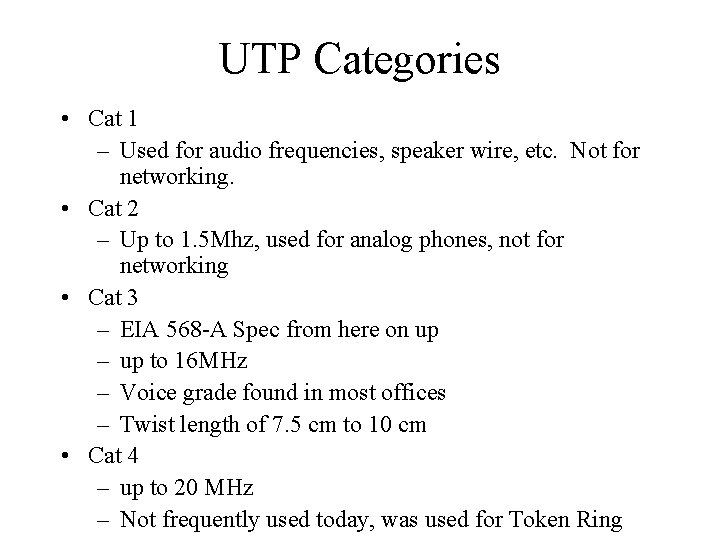
UTP Categories • Cat 1 – Used for audio frequencies, speaker wire, etc. Not for networking. • Cat 2 – Up to 1. 5 Mhz, used for analog phones, not for networking • Cat 3 – EIA 568 -A Spec from here on up – up to 16 MHz – Voice grade found in most offices – Twist length of 7. 5 cm to 10 cm • Cat 4 – up to 20 MHz – Not frequently used today, was used for Token Ring
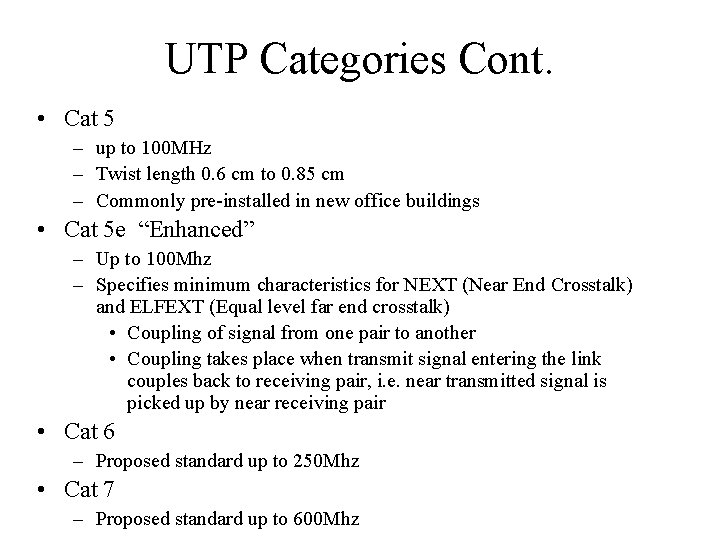
UTP Categories Cont. • Cat 5 – up to 100 MHz – Twist length 0. 6 cm to 0. 85 cm – Commonly pre-installed in new office buildings • Cat 5 e “Enhanced” – Up to 100 Mhz – Specifies minimum characteristics for NEXT (Near End Crosstalk) and ELFEXT (Equal level far end crosstalk) • Coupling of signal from one pair to another • Coupling takes place when transmit signal entering the link couples back to receiving pair, i. e. near transmitted signal is picked up by near receiving pair • Cat 6 – Proposed standard up to 250 Mhz • Cat 7 – Proposed standard up to 600 Mhz
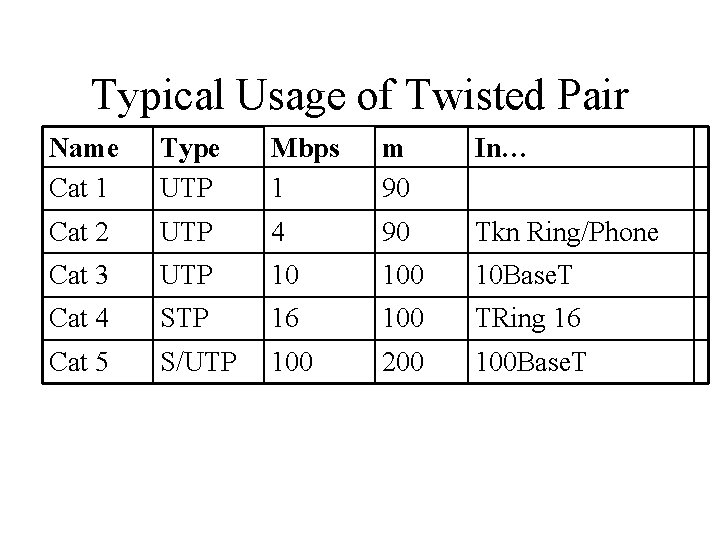
Typical Usage of Twisted Pair Name Cat 1 Type UTP Mbps 1 m 90 In… Cat 2 UTP 4 90 Tkn Ring/Phone Cat 3 UTP 10 10 Base. T Cat 4 STP 16 100 TRing 16 Cat 5 S/UTP 100 200 100 Base. T
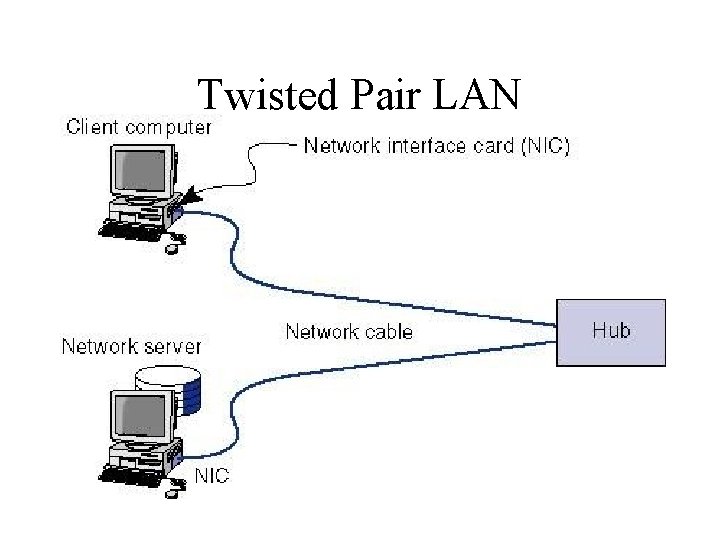
Twisted Pair LAN
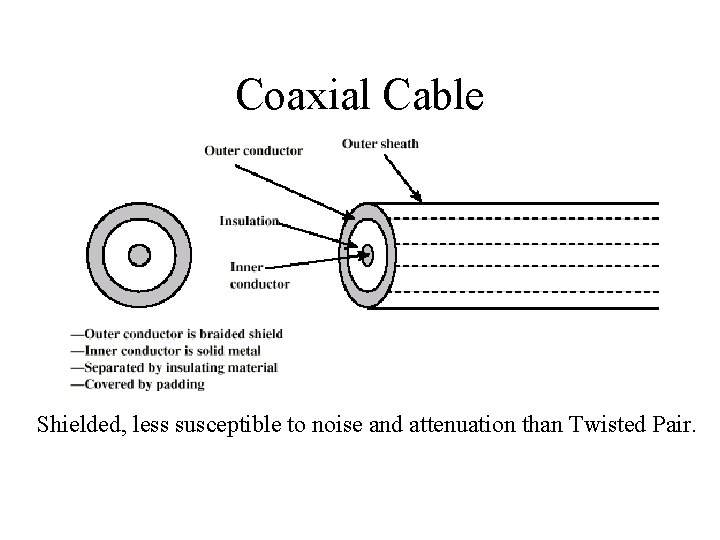
Coaxial Cable Shielded, less susceptible to noise and attenuation than Twisted Pair.
Coaxial Cable Applications • Most versatile medium • Television distribution – Cable TV • Long distance telephone transmission – Can carry 10, 000 voice calls simultaneously – Being replaced by fiber optic • Short distance computer systems links • Local area networks – More expensive than twisted pair, not as popular for LANs
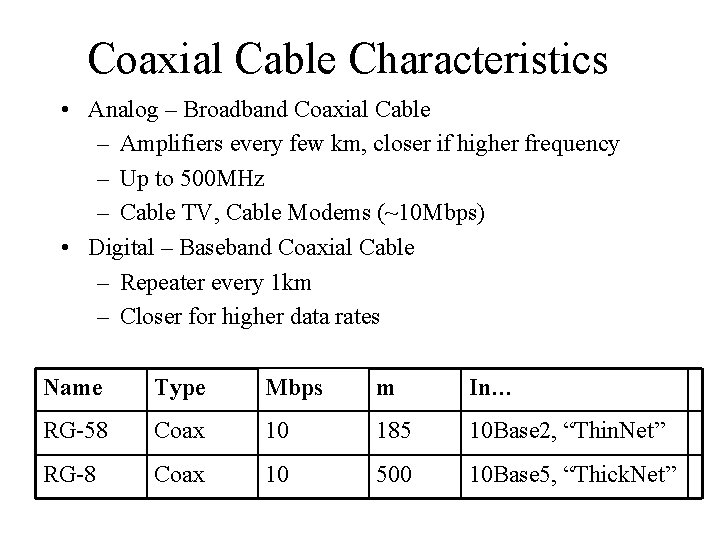
Coaxial Cable Characteristics • Analog – Broadband Coaxial Cable – Amplifiers every few km, closer if higher frequency – Up to 500 MHz – Cable TV, Cable Modems (~10 Mbps) • Digital – Baseband Coaxial Cable – Repeater every 1 km – Closer for higher data rates Name Type Mbps m In… RG-58 Coax 10 185 10 Base 2, “Thin. Net” RG-8 Coax 10 500 10 Base 5, “Thick. Net”
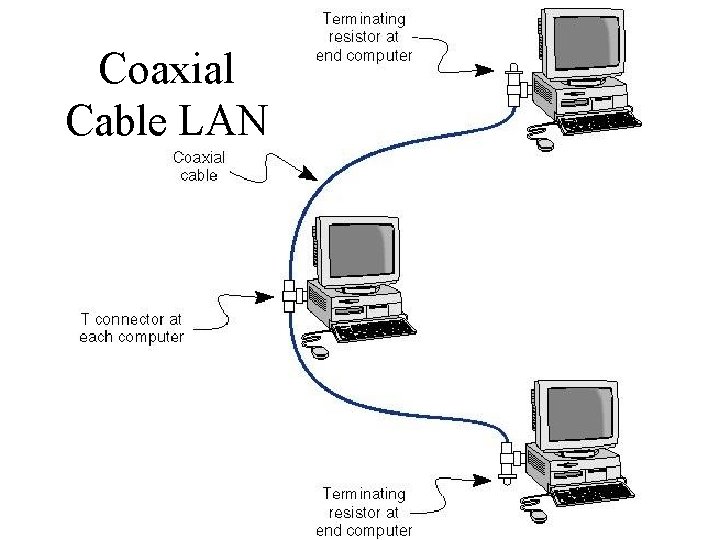
Coaxial Cable LAN
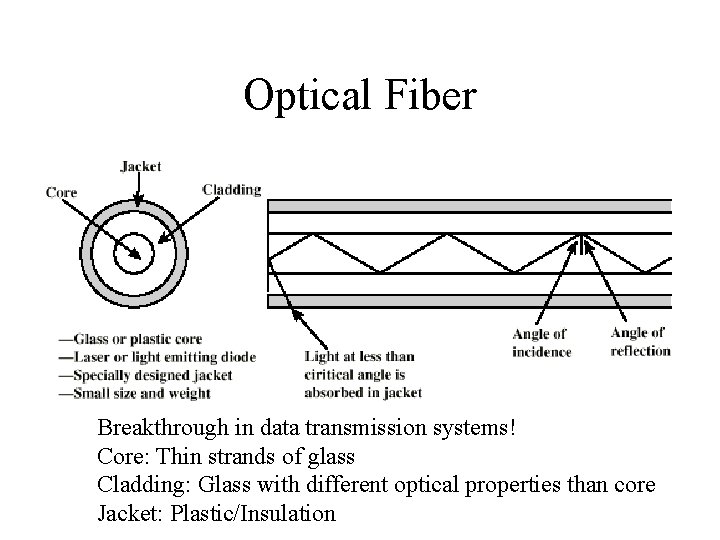
Optical Fiber Breakthrough in data transmission systems! Core: Thin strands of glass Cladding: Glass with different optical properties than core Jacket: Plastic/Insulation
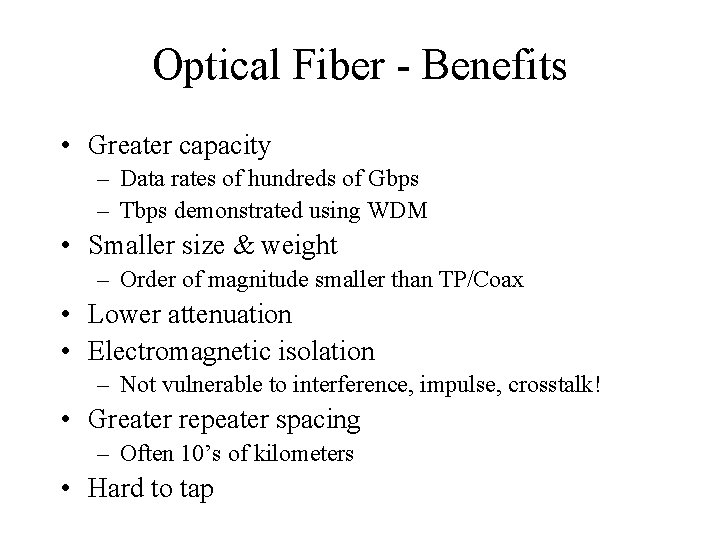
Optical Fiber - Benefits • Greater capacity – Data rates of hundreds of Gbps – Tbps demonstrated using WDM • Smaller size & weight – Order of magnitude smaller than TP/Coax • Lower attenuation • Electromagnetic isolation – Not vulnerable to interference, impulse, crosstalk! • Greater repeater spacing – Often 10’s of kilometers • Hard to tap
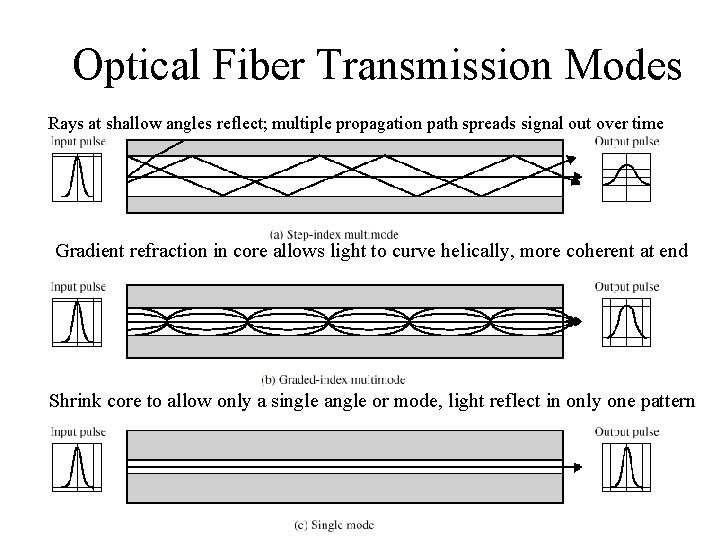
Optical Fiber Transmission Modes Rays at shallow angles reflect; multiple propagation path spreads signal out over time Gradient refraction in core allows light to curve helically, more coherent at end Shrink core to allow only a single angle or mode, light reflect in only one pattern
Wireless or Radiated Transmission • Unguided media • Transmission and reception via antenna – Desirable to make antenna one-quarter or one-half the wavelength • Directional – Focused beam – Careful alignment required • Omnidirectional – Signal spreads in all directions – Can be received by many antennas
Frequencies • 2 GHz to 40 GHz – – Microwave Highly directional Point to point Satellite • 30 MHz to 1 GHz – Omnidirectional – Broadcast radio • 3 x 10¹¹ to 2 x 10¹⁴ – Infrared – Local • Higher frequencies Higher data rates
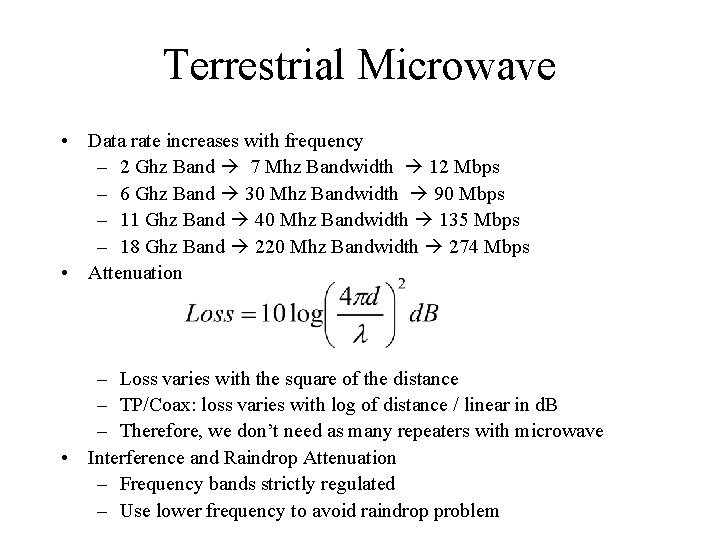
Terrestrial Microwave • Typically parabolic dish, focused beam, line of sight • Max distance between antenna: d=7. 14 * Sqrt(h. K) ; K=4/3, ; h=antenna ht in meters ; d=distance in km so two 1 meter antenna can be 7. 14*Sqrt(4/3)=8. 2 km apart • Applications – Long haul telecommunications, television. May need repeaters – Short range for BN or closed-circuit TV
Terrestrial Microwave • Data rate increases with frequency – 2 Ghz Band 7 Mhz Bandwidth 12 Mbps – 6 Ghz Band 30 Mhz Bandwidth 90 Mbps – 11 Ghz Band 40 Mhz Bandwidth 135 Mbps – 18 Ghz Band 220 Mhz Bandwidth 274 Mbps • Attenuation – Loss varies with the square of the distance – TP/Coax: loss varies with log of distance / linear in d. B – Therefore, we don’t need as many repeaters with microwave • Interference and Raindrop Attenuation – Frequency bands strictly regulated – Use lower frequency to avoid raindrop problem
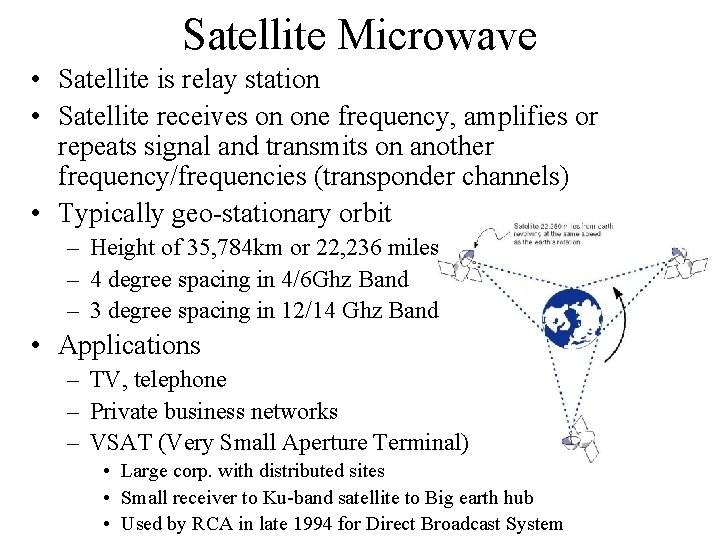
Satellite Microwave • Satellite is relay station • Satellite receives on one frequency, amplifies or repeats signal and transmits on another frequency/frequencies (transponder channels) • Typically geo-stationary orbit – Height of 35, 784 km or 22, 236 miles – 4 degree spacing in 4/6 Ghz Band – 3 degree spacing in 12/14 Ghz Band • Applications – TV, telephone – Private business networks – VSAT (Very Small Aperture Terminal) • Large corp. with distributed sites • Small receiver to Ku-band satellite to Big earth hub • Used by RCA in late 1994 for Direct Broadcast System
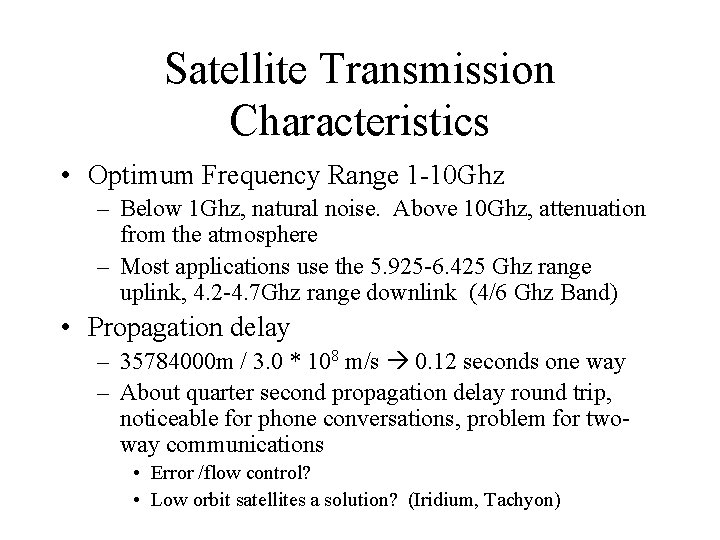
Satellite Transmission Characteristics • Optimum Frequency Range 1 -10 Ghz – Below 1 Ghz, natural noise. Above 10 Ghz, attenuation from the atmosphere – Most applications use the 5. 925 -6. 425 Ghz range uplink, 4. 2 -4. 7 Ghz range downlink (4/6 Ghz Band) • Propagation delay – 35784000 m / 3. 0 * 108 m/s 0. 12 seconds one way – About quarter second propagation delay round trip, noticeable for phone conversations, problem for twoway communications • Error /flow control? • Low orbit satellites a solution? (Iridium, Tachyon)
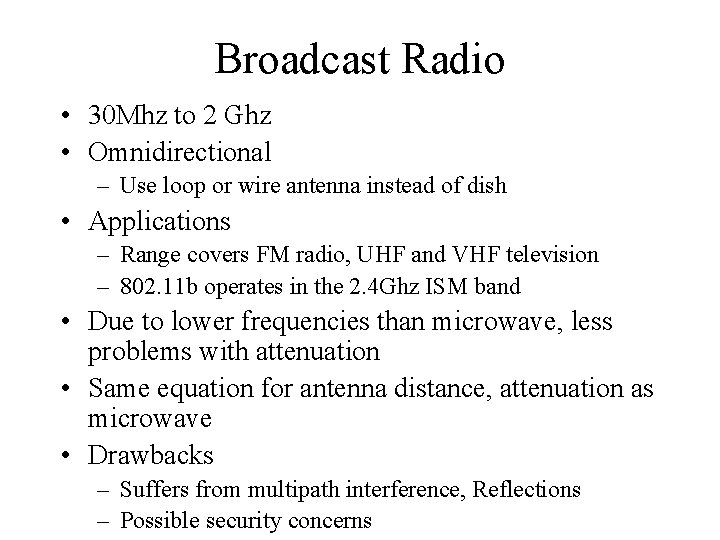
Broadcast Radio • 30 Mhz to 2 Ghz • Omnidirectional – Use loop or wire antenna instead of dish • Applications – Range covers FM radio, UHF and VHF television – 802. 11 b operates in the 2. 4 Ghz ISM band • Due to lower frequencies than microwave, less problems with attenuation • Same equation for antenna distance, attenuation as microwave • Drawbacks – Suffers from multipath interference, Reflections – Possible security concerns
Infrared • • Modulate noncoherent infrared light Line of sight (or reflection) Blocked by walls Problems – Short range, usually 50 -75 feet maximum – Low speed, 1 -4 Mbps • e. g. TV remote control, IRD port – For networks, typically only used to connect wireless hubs due to the need for direct line-of-sight
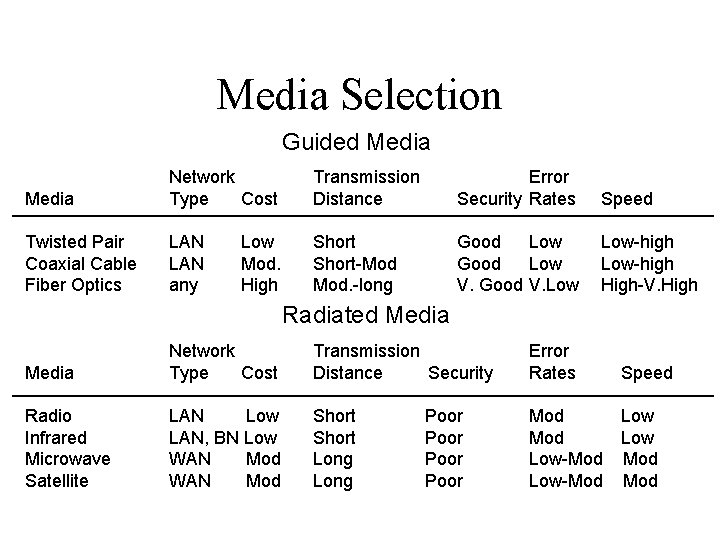
Media Selection Guided Media Network Type Cost Transmission Distance Error Security Rates Speed Twisted Pair Coaxial Cable Fiber Optics LAN any Short-Mod Mod. -long Good Low V. Good V. Low-high High-V. High Low Mod. High Radiated Media Network Type Cost Transmission Distance Security Error Rates Radio Infrared Microwave Satellite LAN Low LAN, BN Low WAN Mod Short Long Mod Low Low-Mod Mod Poor Speed
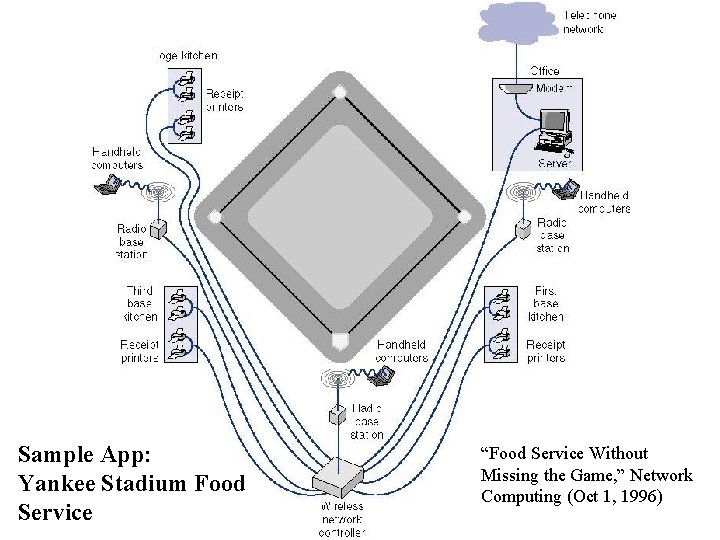
Sample App: Yankee Stadium Food Service “Food Service Without Missing the Game, ” Network Computing (Oct 1, 1996)