
Chapter 7 ARRL Skywave Excitement Gordon West The


- Slides: 26
Chapter 7 ARRL Skywave Excitement Gordon West
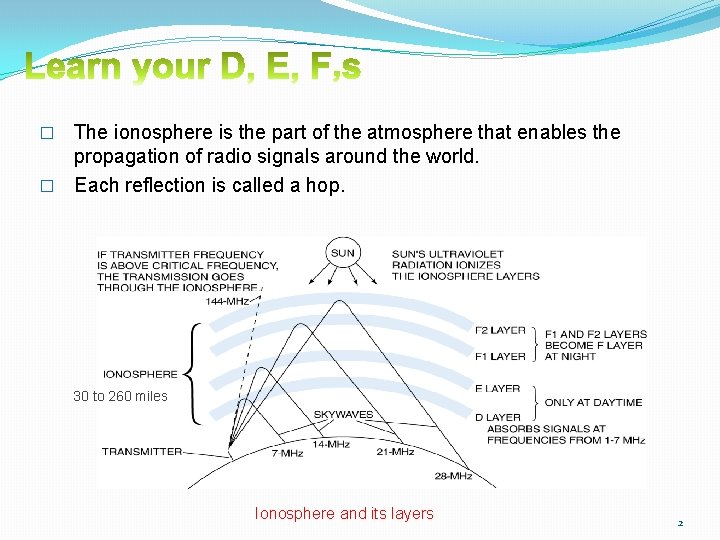
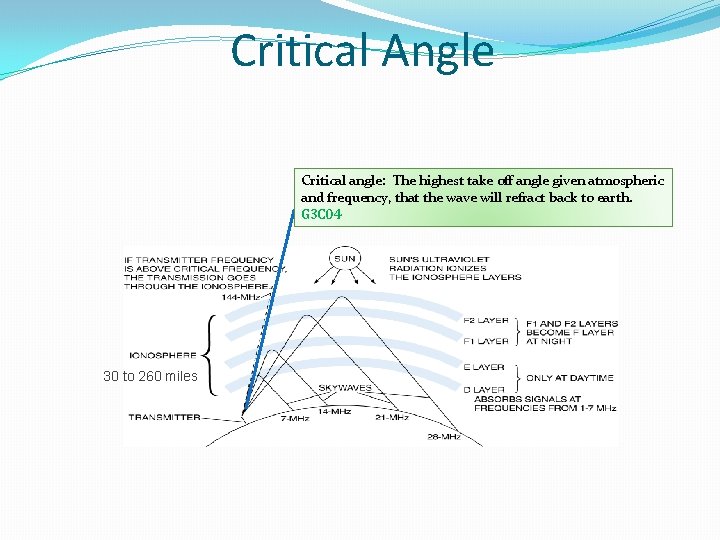
The ionosphere is the part of the atmosphere that enables the propagation of radio signals around the world. � Each reflection is called a hop. � 30 to 260 miles Ionosphere and its layers 2
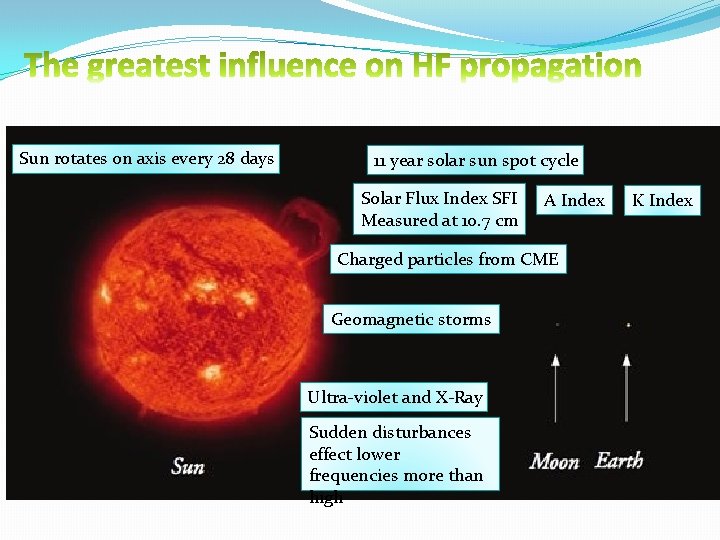
Sun rotates on axis every 28 days 11 year solar sun spot cycle Solar Flux Index SFI Measured at 10. 7 cm A Index Charged particles from CME Geomagnetic storms Ultra-violet and X-Ray Sudden disturbances effect lower frequencies more than high K Index
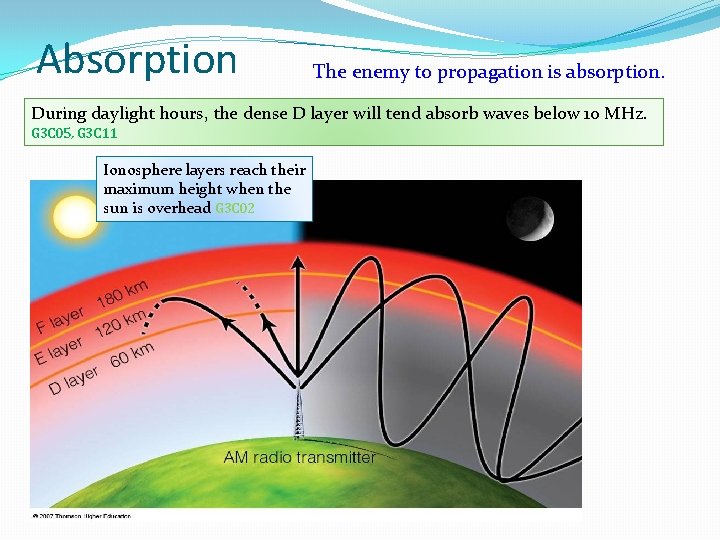
Absorption The enemy to propagation is absorption. During daylight hours, the dense D layer will tend absorb waves below 10 MHz. G 3 C 05, G 3 C 11 Ionosphere layers reach their maximum height when the sun is overhead G 3 C 02
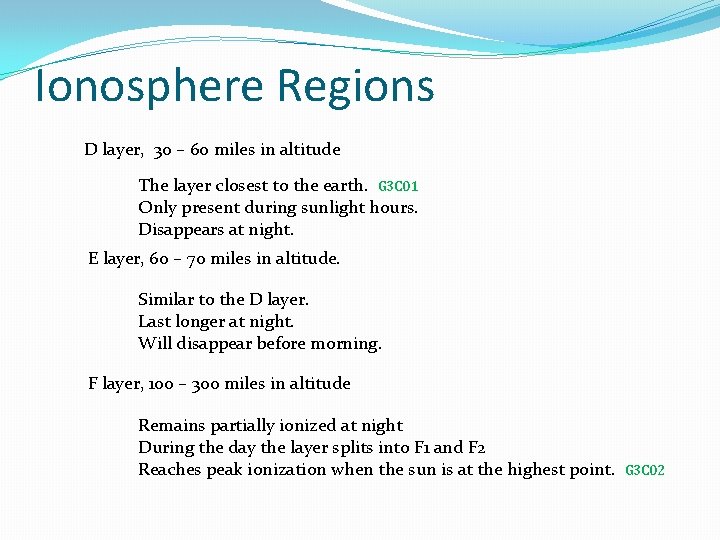
Ionosphere Regions D layer, 30 – 60 miles in altitude The layer closest to the earth. G 3 C 01 Only present during sunlight hours. Disappears at night. E layer, 60 – 70 miles in altitude. Similar to the D layer. Last longer at night. Will disappear before morning. F layer, 100 – 300 miles in altitude Remains partially ionized at night During the day the layer splits into F 1 and F 2 Reaches peak ionization when the sun is at the highest point. G 3 C 02
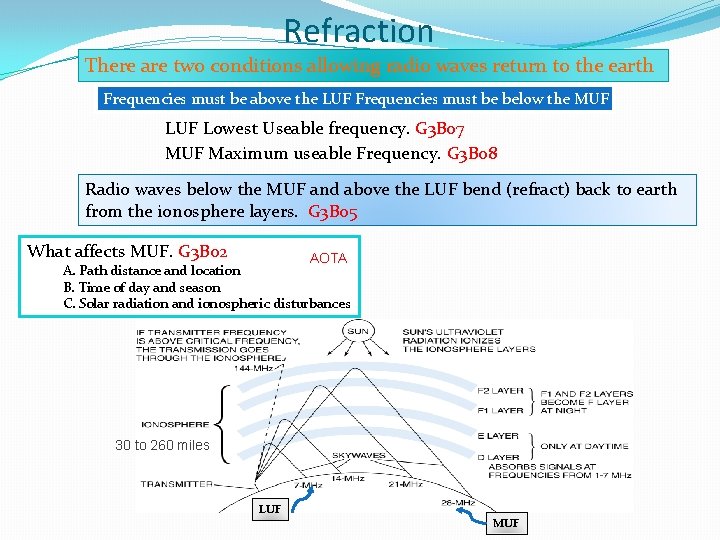
Refraction There are two conditions allowing radio waves return to the earth Frequencies must be above the LUF Frequencies must be below the MUF Lowest Useable frequency. G 3 B 07 MUF Maximum useable Frequency. G 3 B 08 Radio waves below the MUF and above the LUF bend (refract) back to earth from the ionosphere layers. G 3 B 05 What affects MUF. G 3 B 02 AOTA A. Path distance and location B. Time of day and season C. Solar radiation and ionospheric disturbances 30 to 260 miles LUF MUF
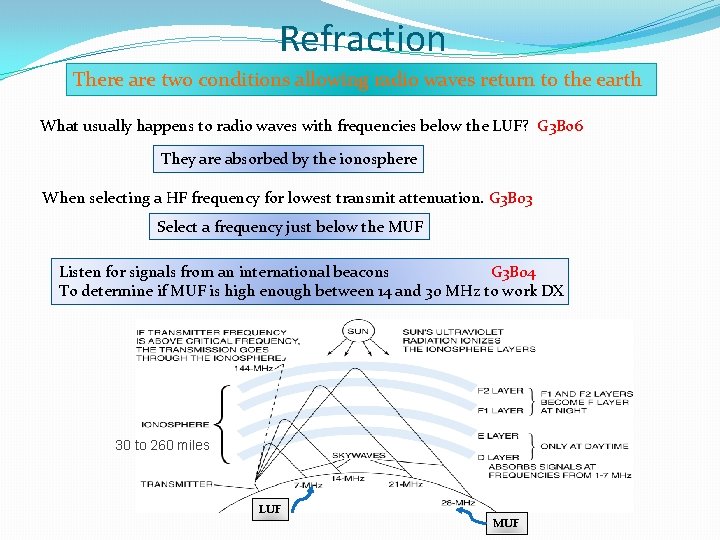
Refraction There are two conditions allowing radio waves return to the earth What usually happens to radio waves with frequencies below the LUF? G 3 Bo 6 They are absorbed by the ionosphere When selecting a HF frequency for lowest transmit attenuation. G 3 B 03 Select a frequency just below the MUF Listen for signals from an international beacons G 3 B 04 To determine if MUF is high enough between 14 and 30 MHz to work DX 30 to 260 miles LUF MUF
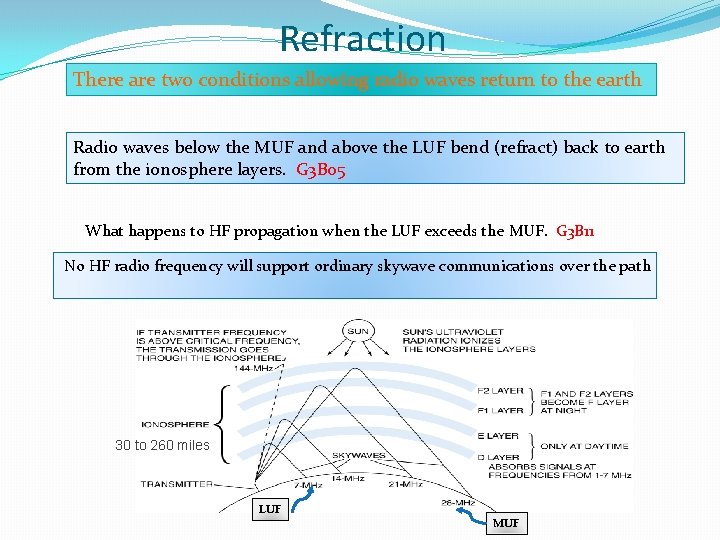
Refraction There are two conditions allowing radio waves return to the earth Radio waves below the MUF and above the LUF bend (refract) back to earth from the ionosphere layers. G 3 B 05 What happens to HF propagation when the LUF exceeds the MUF. G 3 B 11 No HF radio frequency will support ordinary skywave communications over the path 30 to 260 miles LUF MUF
Critical Angle Critical angle: The highest take off angle given atmospheric and frequency, that the wave will refract back to earth. G 3 C 04 30 to 260 miles
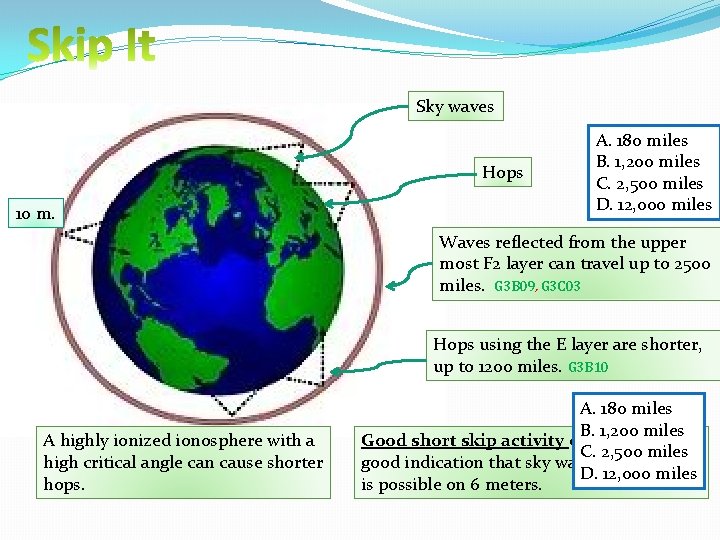
Sky waves Hops 10 m. A. 180 miles B. 1, 200 miles C. 2, 500 miles D. 12, 000 miles Waves reflected from the upper most F 2 layer can travel up to 2500 miles. G 3 B 09, G 3 C 03 Hops using the E layer are shorter, up to 1200 miles. G 3 B 10 A highly ionized ionosphere with a high critical angle can cause shorter hops. A. 180 miles B. 1, 200 miles Good short skip activity on 10 meters is a C. 2, 500 miles good indication that sky wave propagation D. 12, 000 miles is possible on 6 meters.
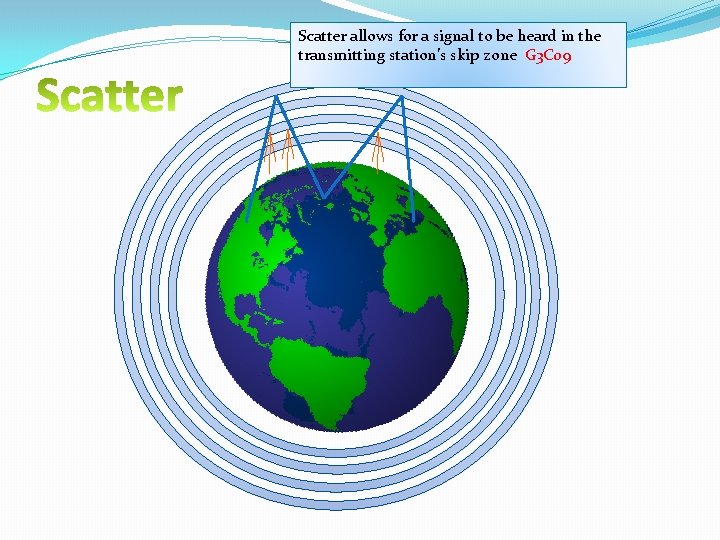
Scatter allows for a signal to be heard in the transmitting station’s skip zone G 3 C 09
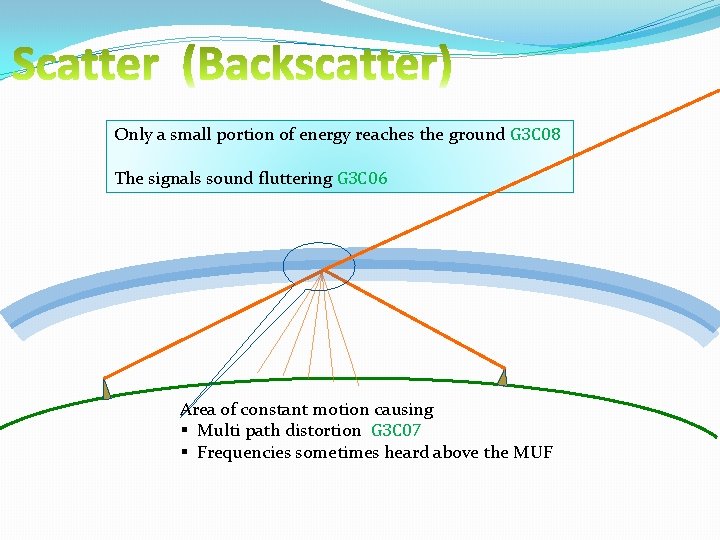
Only a small portion of energy reaches the ground G 3 C 08 The signals sound fluttering G 3 C 06 Area of constant motion causing § Multi path distortion G 3 C 07 § Frequencies sometimes heard above the MUF
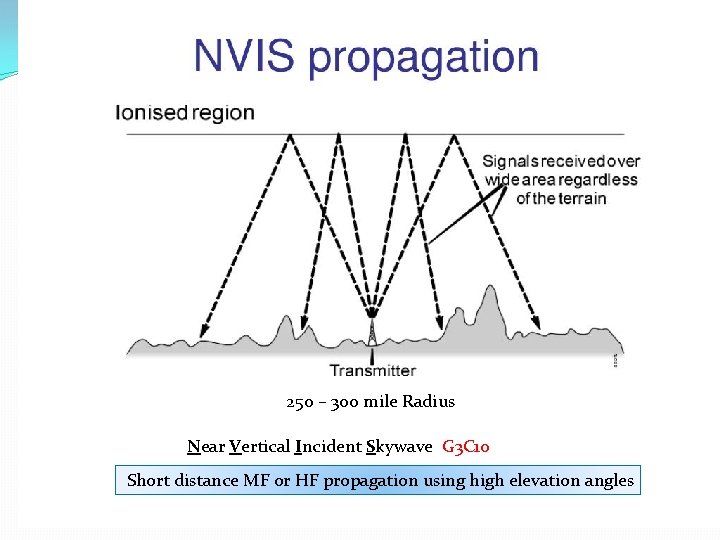
250 – 300 mile Radius Near Vertical Incident Skywave G 3 C 10 Short distance MF or HF propagation using high elevation angles
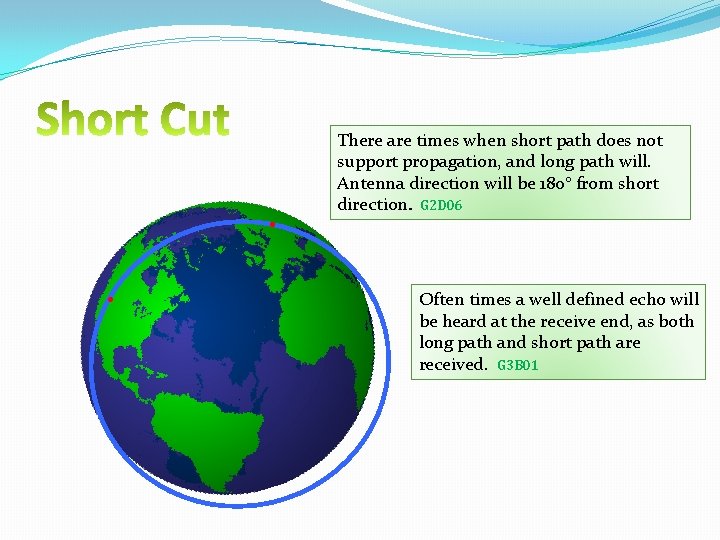
There are times when short path does not support propagation, and long path will. Antenna direction will be 180° from short direction. G 2 D 06 Often times a well defined echo will be heard at the receive end, as both long path and short path are received. G 3 B 01
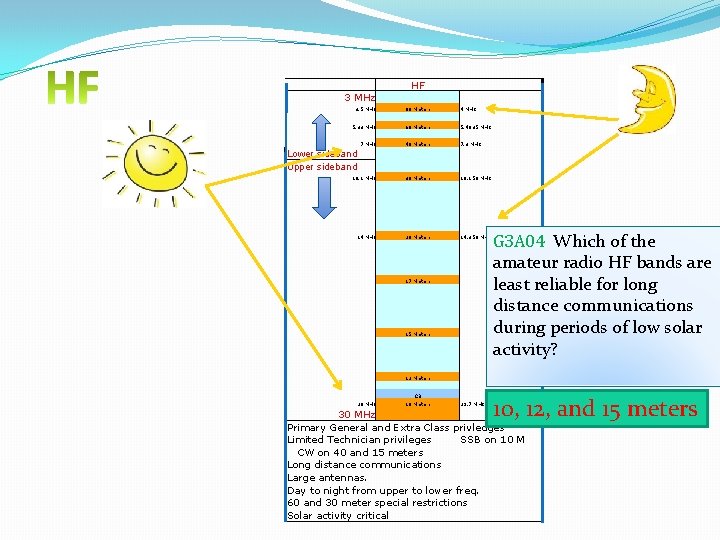
3 MHz 3. 5 MHz HF 80 Meters 5. 33 MHz 60 Meters 7 MHz Lower sideband Upper sideband 10. 1 MHz 14 MHz 28 MHz 40 Meters 4 MHz 5. 4035 MHz 7. 3 MHz 30 Meters 10. 150 MHz 20 Meters 14. 350 MHz 17 Meters 15 Meters 12 Meters CB 10 Meters 29. 7 MHz G 3 A 04 Which of the amateur radio HF bands are least reliable for long distance communications during periods of low solar activity? 10, 12, and 15 meters 30 MHz Primary General and Extra Class privledges Limited Technician privileges SSB on 10 M CW on 40 and 15 meters Long distance communications Large antennas. Day to night from upper to lower freq. 60 and 30 meter special restrictions Solar activity critical
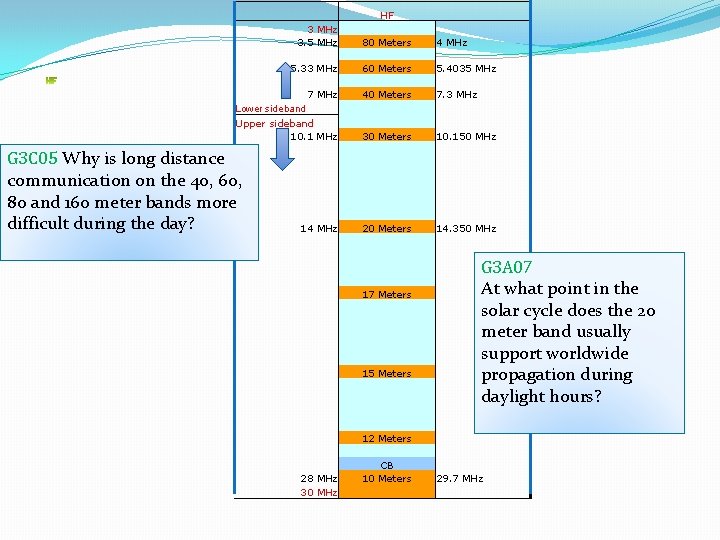
3 MHz 3. 5 MHz 5. 33 MHz 7 MHz Lower sideband Upper sideband 10. 1 MHz G 3 C 05 Why is long distance communication on the 40, 60, 80 and 160 meter bands more difficult during the day? 14 MHz 28 MHz 30 MHz HF 80 Meters 60 Meters 40 Meters 30 Meters 20 Meters 17 Meters 15 Meters 12 Meters CB 10 Meters 4 MHz 5. 4035 MHz 7. 3 MHz 10. 150 MHz 14. 350 MHz 29. 7 MHz G 3 A 07 At what point in the solar cycle does the 20 meter band usually support worldwide propagation during daylight hours?
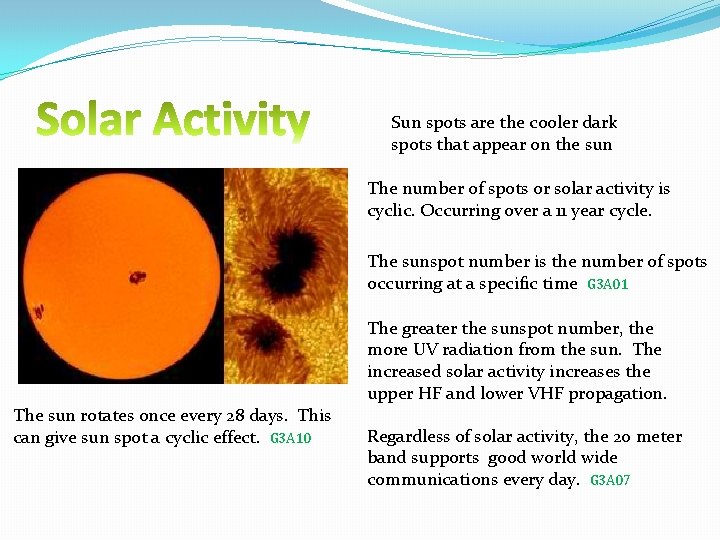
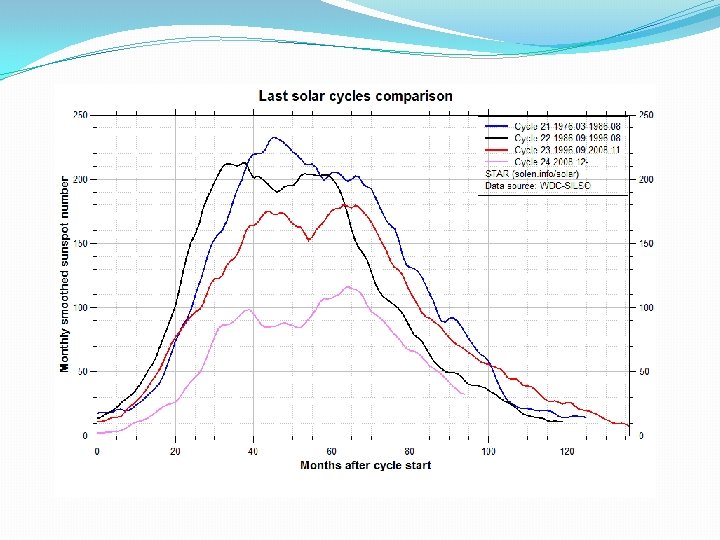
Sun spots are the cooler dark spots that appear on the sun The number of spots or solar activity is cyclic. Occurring over a 11 year cycle. The sunspot number is the number of spots occurring at a specific time G 3 A 01 The greater the sunspot number, the more UV radiation from the sun. The increased solar activity increases the upper HF and lower VHF propagation. The sun rotates once every 28 days. This can give sun spot a cyclic effect. G 3 A 10 Regardless of solar activity, the 20 meter band supports good world wide communications every day. G 3 A 07
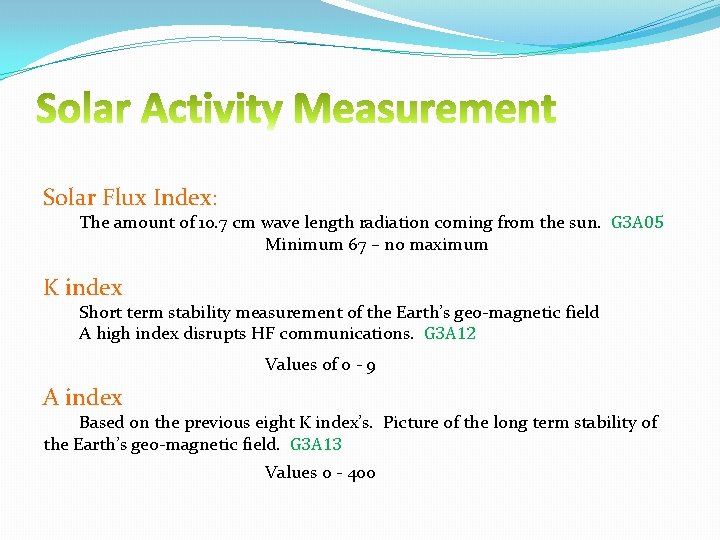
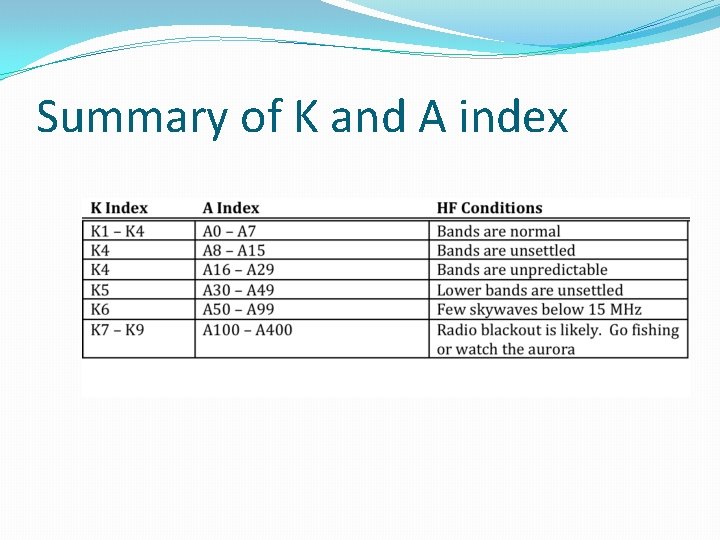
Solar Flux Index: The amount of 10. 7 cm wave length radiation coming from the sun. G 3 A 05 Minimum 67 – no maximum K index Short term stability measurement of the Earth’s geo-magnetic field A high index disrupts HF communications. G 3 A 12 Values of 0 - 9 A index Based on the previous eight K index’s. Picture of the long term stability of the Earth’s geo-magnetic field. G 3 A 13 Values 0 - 400
Summary of K and A index
Solar Indices
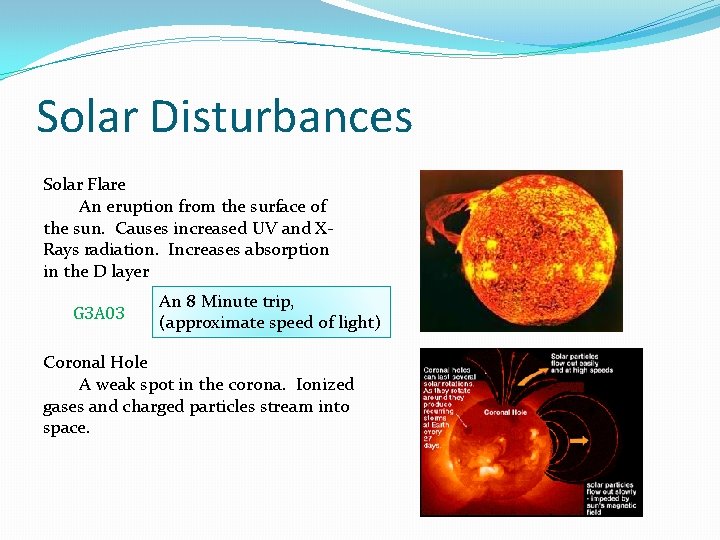
Solar Disturbances Solar Flare An eruption from the surface of the sun. Causes increased UV and XRays radiation. Increases absorption in the D layer G 3 A 03 An 8 Minute trip, (approximate speed of light) Coronal Hole A weak spot in the corona. Ionized gases and charged particles stream into space.
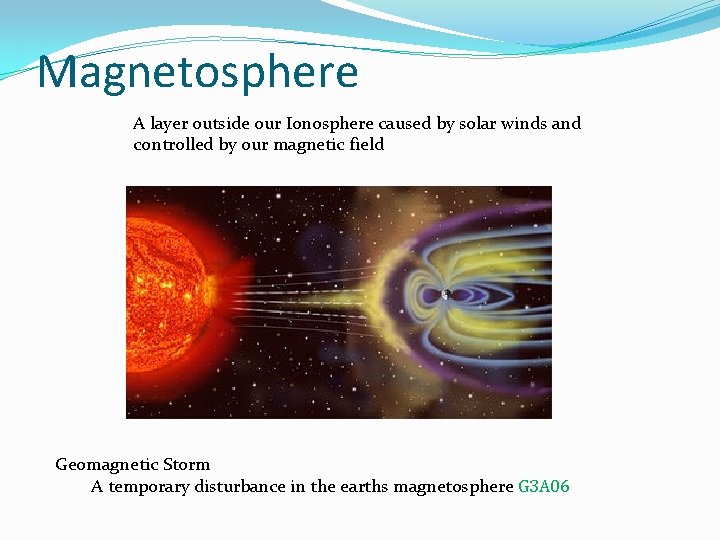
Magnetosphere A layer outside our Ionosphere caused by solar winds and controlled by our magnetic field Geomagnetic Storm A temporary disturbance in the earths magnetosphere G 3 A 06
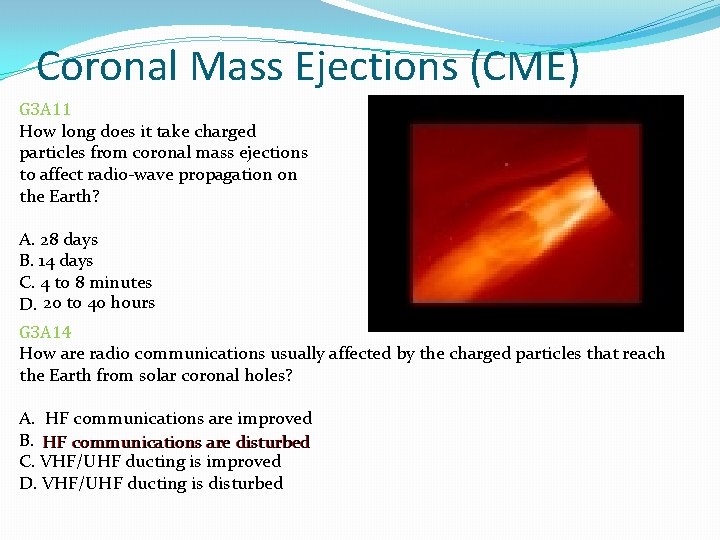
Coronal Mass Ejections (CME) G 3 A 11 How long does it take charged particles from coronal mass ejections to affect radio-wave propagation on the Earth? A. 28 days B. 14 days C. 4 to 8 minutes D. 20 to 40 hours G 3 A 14 How are radio communications usually affected by the charged particles that reach the Earth from solar coronal holes? A. HF communications are improved B. HF communications are disturbed C. VHF/UHF ducting is improved D. VHF/UHF ducting is disturbed
G 3 A 09 What is a possible benefit to radio communications resulting from periods of high geomagnetic activity? A. Aurora that can reflect VHF signals B. Higher signal strength for HF signals passing through the polar regions C. Improved HF long path propagation D. Reduced long delayed echoes G 3 A 08 Which of the following effects can a geomagnetic storm have on radio-wave propagation? A. Improved high-latitude HF propagation B. Degraded high-latitude HF propagation C. Improved ground-wave propagation D. Improved chances of UHF ducting