
Frequency Allocations and Emerging Regulations in the bands
Frequency Allocations and Emerging Regulations in the bands 70 -95 GHz Luc Bouchard, Luc Boucher Terrestrial Wireless Systems Branch (VPTWS) Communications Research Centre (CRC) / Industry Canada (IC) Fixed Wireless Communications Committee meeting, Sub-committee C, September 16, 2003
OVERVIEW OF PRESENTATION • Frequency Allocations and Emerging Policies developments in the 70 to 95 GHz bands • Refresher - Characteristics of the millimeter wave bands channel and technical considerations • Overview of the 70 -95 GHz millimeter wave band allocations and usage in various countries • Products, Market, Research and development • Conclusions
PROPAGATION AND TECHNICAL CONSIDERATIONS References “Millimeter Wave Propagation: Spectrum Management Implications” FCC - OET Bulletin No. 70 (July 1997), see: http: //www. fcc. gov/oet/info/documents/bulletins/#70 Various ITU Reports: Recommendation ITU-R P. 676: “Attenuation by atmospheric gases” ITU-R Rec. P. 530: “Propagation data and precipitation methods required for the design of terrestrial line-of-sight systems” Recommendation ITU-R P. 840: “Attenuation due to Clouds and Fog” ITU-R Rec. PN. 837: “Characteristics of Precipitation for Propagation Modeling” Recommendation ITU-R P. 833: “Attenuation in Vegetation”
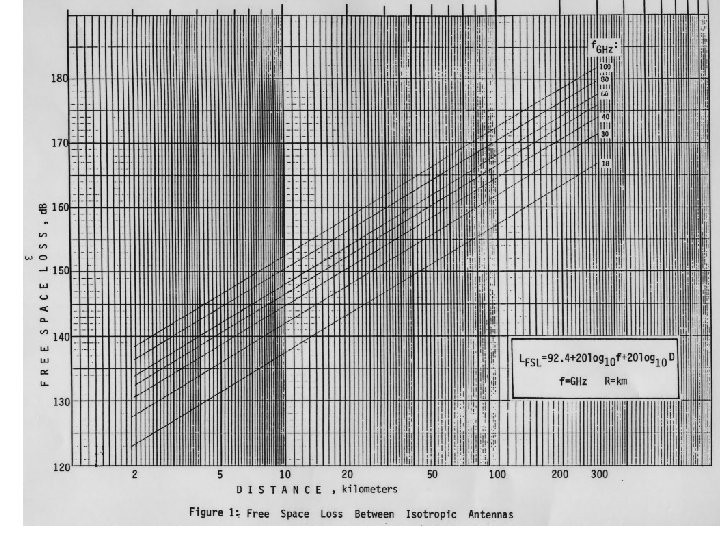
Free Space Loss increases with frequency Free Space Loss increases significantly as the frequency increases: • Propagation losses at millimeter wave frequencies are significantly larger than at lower frequencies • This results from the dependence of free space loss on the square of the radio frequency • See Figure 1, page 3 of Bulletin Number 70
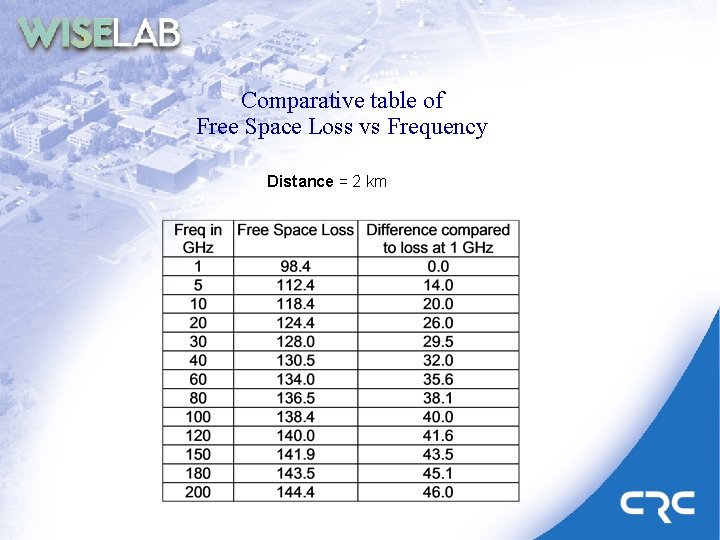
Comparative table of Free Space Loss vs Frequency Distance = 2 km
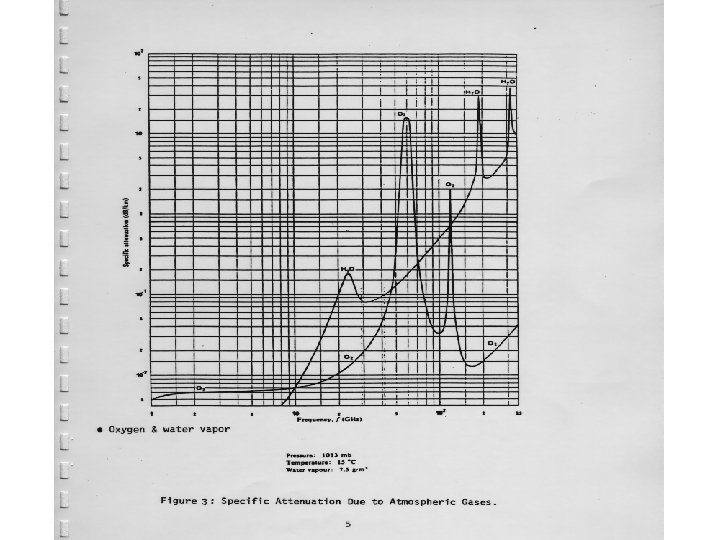
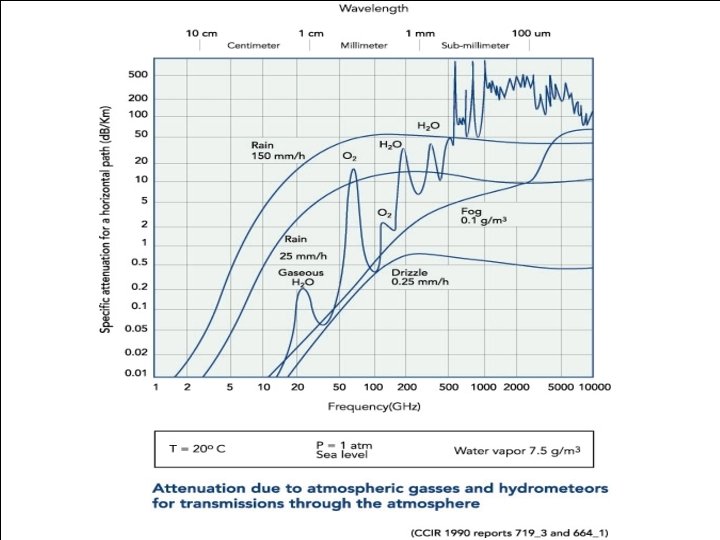
Atmospheric Effects • When atmospheric effects are included, the losses can become even greater • A major effect is due to the resonance of molecular oxygen and water vapor present in the Earth's atmosphere • These produce high propagation loss in the mmw band near the frequencies of • 60, and 118 GHz, for Oxygen, and • 22. 2, 183. 3, and 325 GHz (among others) for Water. • For example, at normal sea level air pressure, the 60 GHz oxygen resonance produces over 15 d. B of loss per Km • Figure 3, page 5 of Bulletin Number 70
Atmospheric Effects (cont. ) • It should be noted that very high rain rates occur, in many countries, only for a very short time of the year, and are limited in their coverage (1 - 2 km) • To appreciate the weather effects, it is not enough to know their relative magnitudes. It is necessary to know also the frequency of their occurrence and their duration • These parameters are needed to determine the fade margin required to establish a system % availability (e. g, 99. 99 % availability or. 01 % total outage time = 52. 6 minutes of total outage in a year)
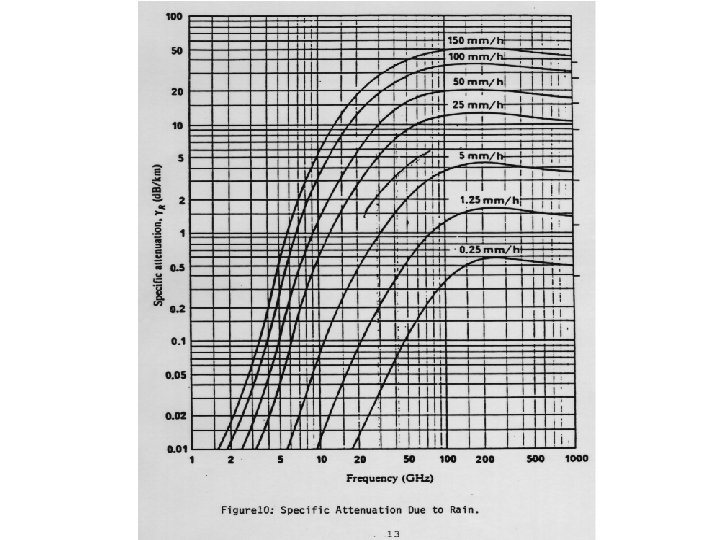
Precipitation / Hydrometeor • Since rain drops are comparable in size to the wavelength of mmw signals, they are particularly good at absorbing mmw signals • Rain attenuation is generally larger at higher mmw frequencies, and increases with the rate of rain fall • Figure 10, page 13 of Bulletin Number 70
Precipitation / Hydrometeor (cont. ) • Attenuation by Dry Snow = about the same as by rain, for values of equivalent rain rate • Since snowfall rates are usually less than an equivalent rate of 10 mm/h (which is a moderate rainfall), the effect of snow is generally less severe than rain • Exception = wet snow = effect more severe than for equivalent rain rate • Fog = close to drizzle (. 25 mm/h) for frequencies below 150 GHz • See combined figure (next slide) of CCIR reports 719 -3 and 664 -1
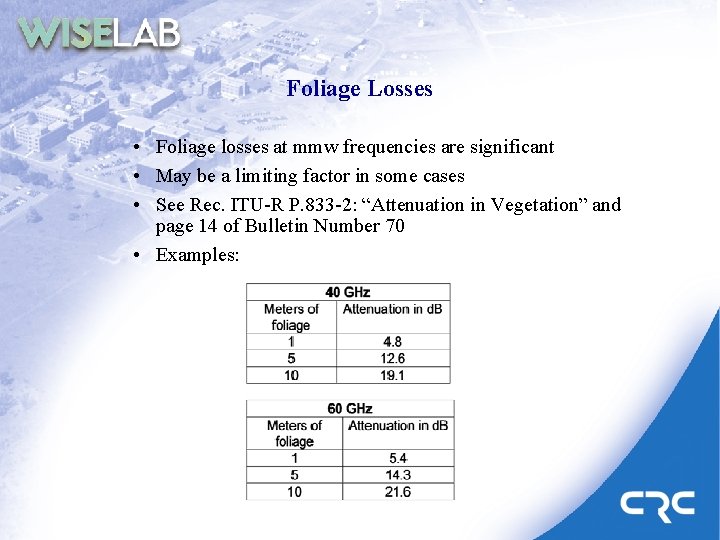
Foliage Losses • Foliage losses at mmw frequencies are significant • May be a limiting factor in some cases • See Rec. ITU-R P. 833 -2: “Attenuation in Vegetation” and page 14 of Bulletin Number 70 • Examples:
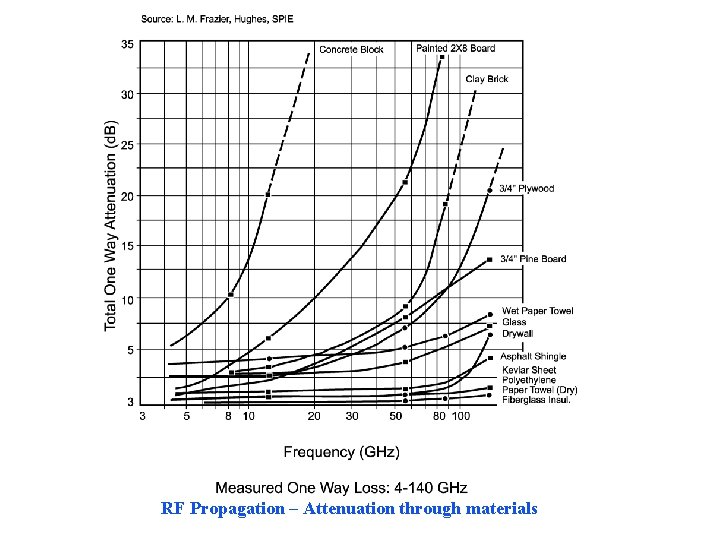
RF Propagation – Attenuation through materials
Other Impairments Scattering: The small wavelength of mmw signals produces additional losses due to scattering, when compared to lower frequencies. The effect is more pronounced at smaller wavelengths: surfaces that appear smooth at longer wavelengths (and therefore provide good mirror-like reflections) loose that characteristic at mmw frequencies Diffraction: The ability of radio waves to bend around obstacles, is also much less efficient at mmw frequencies. The effect of shadowing, where signals are blocked by a building, hill or other large structure, is therefore more pronounced Depending on the length of the link, multipath can also be a problem
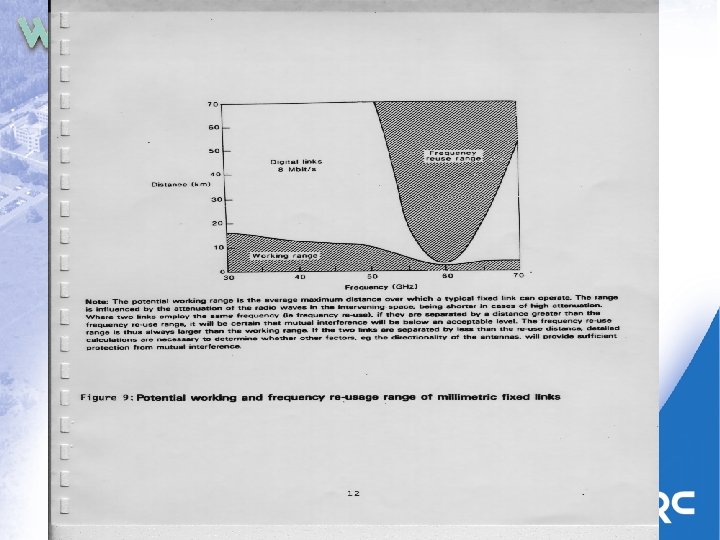
Drawbacks vs Benefits • The propagation characteristics of the mmw band can be in fact as much a benefit as a drawback • This is because some communications systems can make use of the characteristics to enhance security and provide for significantly greater frequency re-use efficiency • The working range of a 60 GHz fixed service link, for example, is about 2 km, and the channel can be used on another link (co-channel) as little as 4 km away without concern for interference • By contrast, at 55 GHz, the working range is about 5 km, but a second link would have to be located about 18 km away to avoid co-channel interference. • Figure 9, page 12 of Bulletin Number 70 • Other factors must also be considered, e. g, antenna directivity, obstacle, etc.
International Table of Frequency Allocations ITU - Radio Regulations • Article S 5 - Frequency allocations (binding to its signatories) • Frequency allocation tables updated at WRC (World Radiocommunication Conferences) • National spectrum management administrations can use frequencies inconsistently with the ITU Radio Regulations, if they avoid interference to other countries • The growing trend => international harmonization => facilitate international trade • ITU Frequency Allocation Table available on various web site, e. g. http: //www. fcc. gov/oet/spectrum/table/fcctable. pdf - Region 2 (Americas and Greenland)
United States: Use of Radio Frequencies above 70 GHz • The Federal Communications Commission (FCC) has initiated a proceeding to examine methods to promote the commercial development and growth of spectrum in the 71 -76 GHz, 81 -86 GHz and 92 -95 GHz bands. • In the US, these bands have never before been occupied by nongovernment users. • Potential uses of this spectrum include high-speed wireless local area networks, broadband access systems for the Internet, point-topoint communications, and point-to-multipoint communications. • These special uses are possible because of the shorter wavelengths, which are about three to five millimeters, and because of other technical characteristics that differentiate the 71 -76 GHz, 81 -86 GHz and 92 -95 GHz bands from other bands.

United States: Use of Radio Frequencies above 70 GHz • Specifically, the FCC seeks comment on its proposed rules to allow use of these spectrum bands for a broad range of new fixed wireless services. • Currently, this region of the spectrum is essentially undeveloped and available for new uses. • The FCC seeks to develop a flexible and streamlined regulatory framework that will encourage innovative uses of the spectrum; accommodate future developments in technology and equipment; promote competition in the communications services, equipment and related markets; and advance the potential sharing between non-Federal Government and Federal Government systems. • The FCC anticipates that its proposals will encourage the use of technologies developed in military and scientific applications in a broad range of new products and services, such as high-speed wireless local area networks and broadband access systems for the Internet.
United States: Use of Radio Frequencies above 70 GHz Background: In July 2000, the Commission held a public forum on possible new uses of the 92 -95 GHz band. • Several speakers at the forum indicated that due to recent technological developments, new uses of this band are approaching practicality. In addition, in July 2001, Loea Communications Corporation experimented with technology it developed for use of the 71 -76 GHz and 81 -86 GHz bands. As a result, Loea filed a petition requesting the establishment of service rules for the licensed use of the 71 -76 GHz and 81 -86 GHz bands on September 10, 2001.

Notice of Proposed Rule Making - FCC • Notice of Proposed Rule Making (FCC 02 -180, WT Docket No 02 -146, RM-10288) – “Allocations and Service Rules for the 7176 GHz, 81 -86 GHz and 92 -95 GHz Bands” • Adopted 13 June 2002 • Released 28 June 2002 • Comment date: 90 days after • Reply Comment date: 135 days after Comments and Reply comments made by many organizations: Cisco, Terabeam Corporation, Loea Communications, Wireless Communications Association International (WCAI), National Telecommunications and Information Administration (NTIA), National Radio Astronomy Observatory, Winstar Communications, Harris Corporation, Boeing, Sprint Corporation, Comsearch, Endwave, Fixed Wireless Communications Coalition, Public Safety and Private Wireless Division, The National Association for Amateur Radio, etc.
United States: Use of Radio Frequencies above 70 GHz Specifics of the adopted Notice: The FCC seeks comment on the following issues regarding use of the 71 -76 GHz, 81 -86 GHz and 92 -95 GHz bands: • Updating allocations in the 71 -76 GHz, 81 -86 GHz and 92 -95 GHz bands to reflect changes in the international allocations made at the 1987 and 2000 World Radio Conferences; • Developing an appropriate band plan for the 71 -76 GHz, 81 -86 GHz and 92 -95 GHz bands; • Providing for unlicensed use in some or all of these bands; • Authorizing the new licensed services under Part 101 of its Rules and the new unlicensed devices under Part 15 of its Rules; • Licensing the spectrum administered under Part 101 by geographic service areas, site-based areas, or some other scheme.
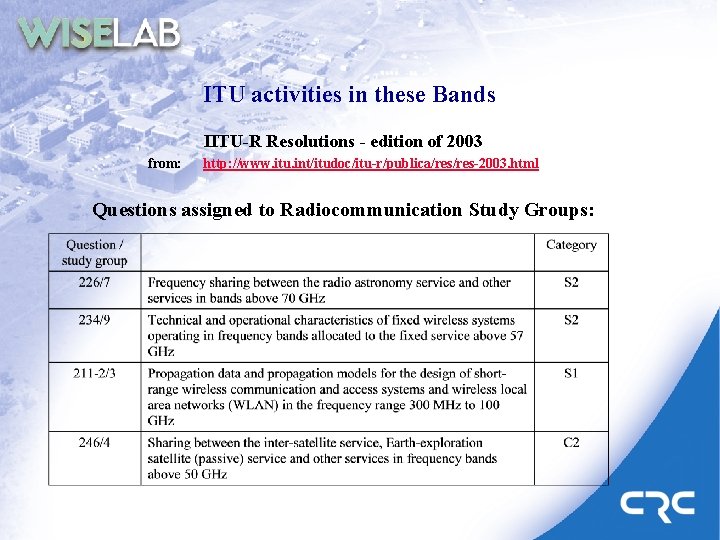
ITU activities in these Bands IITU-R Resolutions - edition of 2003 from: http: //www. itu. int/itudoc/itu-r/publica/res-2003. html Questions assigned to Radiocommunication Study Groups:
Activities in Europe “Within Europe, there are currently limited harmonized plans for fixed service use of bands above 70 GHz with few bands being earmarked for future civil applications. ” Nicholas Woollard, Radiocommunications Agency, UK (59 - 100 GHz ETSI Technical Report Rapporteur) Further details of the above allocations are available on the European Common Allocation (ECA) table: http: //www. ero. dk/doc 98/official/pdf/Rep 025. pdf. Report 25 = Harmonization of the spectrum in Europe - currently up to 105 GHz (harmonized by 2008) See Extracted Pages from European table of frequency allocation Harmonization Report 025
UK – Radiocommunications Agency – Comments >From the perspective of the Fixed Service (FS): “The UK has conducted technical work on reflection and scattering mechanisms in bands above 71 GHz. Unfortunately, apart from the ECA, there are no current regulatory proceedings towards the use of bands above 70 GHz for the FS in Europe. The UK regulator has actively promoted ideas for utilizing bands above 70 GHz for the FS prior to WRC-03, but there has been a lack of interest from other European nations to venture into this region of spectrum for FS applications as they did not see the need for new FS bands. The UK achieved European agreement for the preliminary agenda of the 2010 World Radiocommunication Conference, an agenda item to consider the progress of ITU-R studies concerning the technical and regulatory issues relative to the fixed service in the 81 -86 and 92 -100 GHz frequency bands. ” Mrinal Patel, International Regulations and Technical Studies Fixed, Terrestrial and Satellite Radiocommunications Agency
Activities in these bands in Other Countries • Research led to very few results on regulatory activities in other countries for these bands. • There is active R&D in many countries being conducted to bring the costs of the hardware down.
Canadian Table of frequency Allocations • Canadian Table of frequency Allocations - 2000 http: //strategis. ic. gc. ca/epic/internet/insmtgst. nsf/vw. Generated. Inter. E/sf 01608 e. html • Proposed Revisions to the Canadian Table of Frequency Allocations - 2000 http: //strategis. ic. gc. ca/epic/internet/insmtgst. nsf/vw. Generated. Inter. E/sf 01677 e. html • No activities for terrestrial communications described in the bands 70 -95 GHz
Benefits/Drawbacks of opening these bands • Benefits • Opening new frequency bands can help create economic opportunities (jobs, export) • Research and Development can position Canada competitively on the International market • Drawbacks • Costs of the higher than 70 GHz hardware = still very high • Propagation environment is better at lower mmw frequencies • Market for additional broadband fixed links spectrum is limited • Market may be served for a while with already allocated mmw frequencies – see next slide.
Bands below 66 GHz available for HDFS From WRC-03 Final acts: The bands 31. 8 -33. 4 GHz, 37 -40 GHz, 40. 5 -43. 5 GHz, 51. 4 -52. 6 GHz, 55. 78 -59 GHz and 64 -66 GHz are available for high-density applications in the fixed service (see Resolutions 75 (WRC 2000) and 79 (WRC 2000)).
CONCLUSIONS • Product developments by the industry in the 70 -95 GHz bands are very minimal. Hardware is very expensive. • There does not seem to be a lack of spectrum in the lower mmw bands to fulfill current broadband requirements. • Hence, there does not seem to be an urgent need to implement regulations in Canada to open the 70 -95 GHz bands – unless there is a push by the industry who would like to address this market • Recommend to invest in R&D to be able to address this market in the future. • At this time, there are no international agreements between the US, Mexico and Canada concerning the coordination of these bands across the borders.
- Slides: 32