Computer Security Foundations and Principles Nicolas T Courtois
- Slides: 169
Computer Security Foundations and Principles Nicolas T. Courtois - University College of London
Comp. Sec Intro Plan • What is Comp. Sec? – Computer Industry – Security = ? – Security Science 123 • Life Context and Threats – – – Small / Big Threats Economics Defenders Risk Failures Ethics, Hackers • Principles - Defenses – – – 2 Security Design Principles, Security Engineering Security Management Principles Weakest Link? Secrecy / Open Source Case Studies - Attack Trees Nicolas T. Courtois, January 2009
Comp. Sec Intro About Myself – Short Bio: • Cryptologist. Main interests: – Cryptanalysis – how to break things… – Smart cards, 8 years @industry » (see Applied Crypto module, term 2). – Economics, business and ethical aspects of information security. This will influence the way in which this course will be taught. 3 Nicolas T. Courtois, January 2009
Comp. Sec Intro Computers… 4 Nicolas T. Courtois, January 2009
Comp. Sec Intro Computer Industry We are dealing here with a particular industry: Computer industry. Software and Hardware. This industry is arguably VERY special, unlike any other industry that ever existed… But we can and will compare it to other industries • smart cards have their own O. S. – much more focus on security since always • mobile phones, similarly developed very differently too… • voting machines, • door/car lock systems, etc… 5 Nicolas T. Courtois, January 2009
Comp. Sec Intro A Sort of Disclaimer This whole part of my slides (152 pages ) contains a lot of “Philosophy” things… complimentary to other parts, could be studied at any moment I don’t intend to ask you abstract “philosophy” questions at the exam, rather more concrete technical questions: • beware of vague statements and excessive generalizations… • what do the principles / methodology / ideas actually do in practice… • be specific and factual 6 Nicolas T. Courtois, January 2009
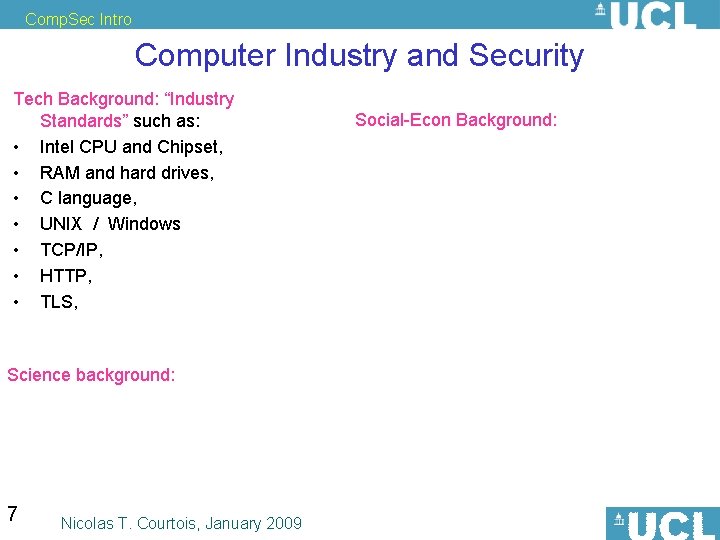
Comp. Sec Intro Computer Industry and Security Tech Background: “Industry Standards” such as: • Intel CPU and Chipset, • RAM and hard drives, • C language, • UNIX / Windows • TCP/IP, • HTTP, • TLS, Science background: 7 Nicolas T. Courtois, January 2009 Social-Econ Background:
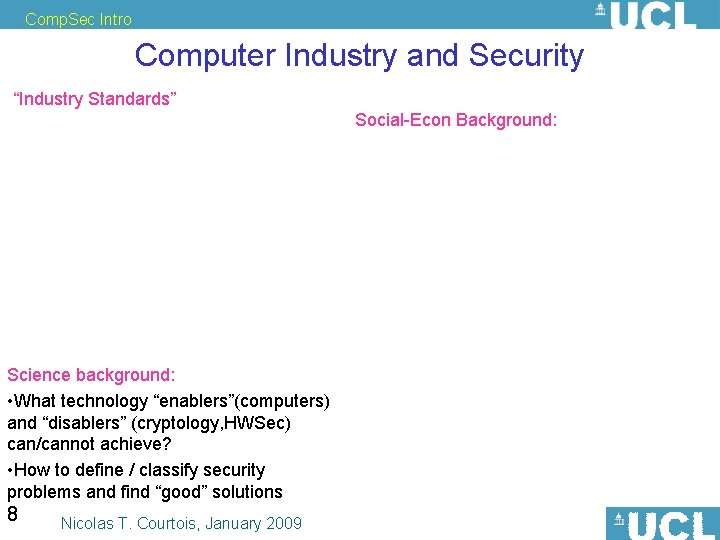
Comp. Sec Intro Computer Industry and Security “Industry Standards” Social-Econ Background: Science background: • What technology “enablers”(computers) and “disablers” (cryptology, HWSec) can/cannot achieve? • How to define / classify security problems and find “good” solutions 8 Nicolas T. Courtois, January 2009
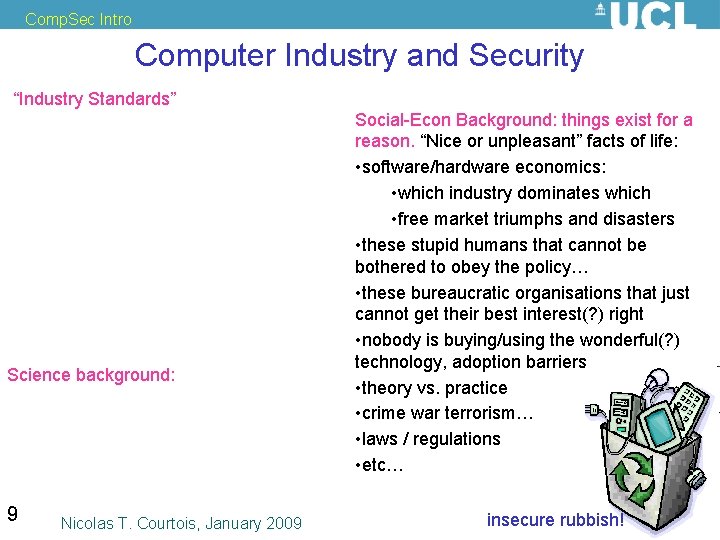
Comp. Sec Intro Computer Industry and Security “Industry Standards” Science background: 9 Nicolas T. Courtois, January 2009 Social-Econ Background: things exist for a reason. “Nice or unpleasant” facts of life: • software/hardware economics: • which industry dominates which • free market triumphs and disasters • these stupid humans that cannot be bothered to obey the policy… • these bureaucratic organisations that just cannot get their best interest(? ) right • nobody is buying/using the wonderful(? ) technology, adoption barriers • theory vs. practice • crime war terrorism… • laws / regulations • etc… insecure rubbish!
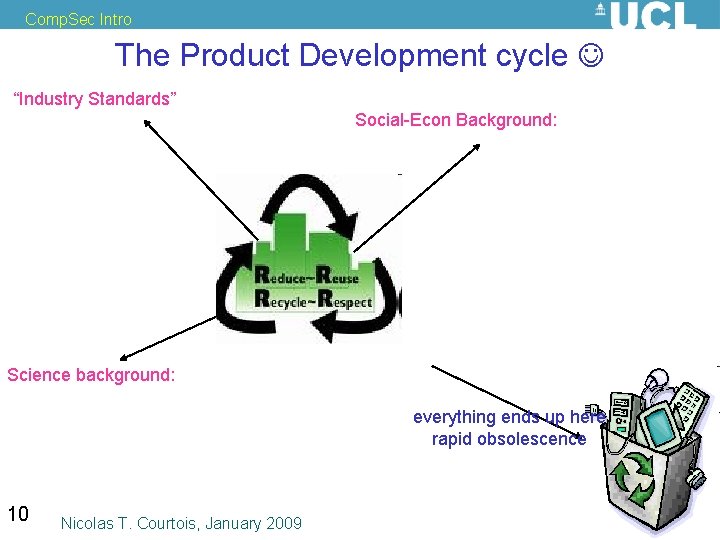
Comp. Sec Intro The Product Development cycle “Industry Standards” Social-Econ Background: Science background: everything ends up here rapid obsolescence 10 Nicolas T. Courtois, January 2009
Comp. Sec Intro What is Security? 11 Nicolas T. Courtois, January 2009
Comp. Sec Intro Definition 1 [Courtois] Security: protect the value(s). What value(s) ? ALL ! 12 Nicolas T. Courtois, January 2009
Comp. Sec Intro Security: protect the value(s). What value(s) ? • Money [economical security] But NOT ONLY MONEY. • Life and the quality of life. • Privacy is a value in itself. • Good technology vs. bad one • Freedom, Justice, etc… (CB, car panic button) 13 Nicolas T. Courtois, January 2009
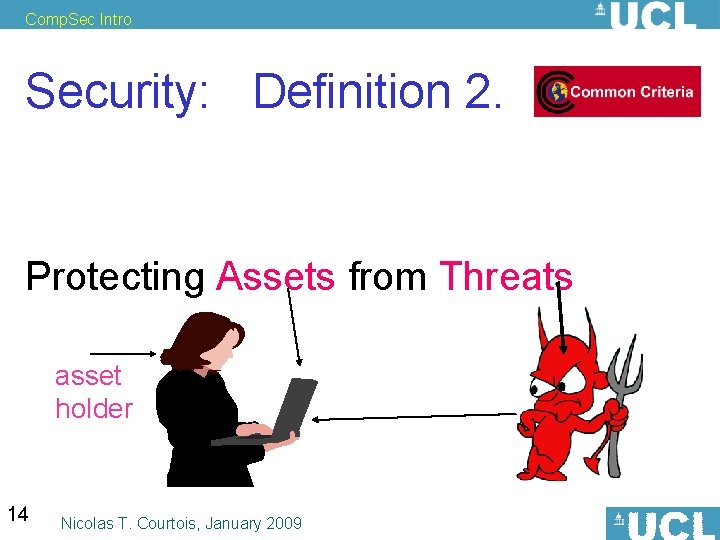
Comp. Sec Intro Security: Definition 2. Common Criteria [ISO 15408] : Protecting Assets from Threats asset holder 14 Nicolas T. Courtois, January 2009
Comp. Sec Intro Security Safety Difference: protect against intentional damages. . . Notion of an Attacker / Adversary. Notion of an Attack. 15 Nicolas T. Courtois, January 2009
Comp. Sec Intro Attacker = Adversary = Threat Agent 16 Nicolas T. Courtois, January 2009
Comp. Sec Intro **Dimensions of Security • Physical vs. Logical • Psychological / Human very different! vs. • Organizational / Business 17 Nicolas T. Courtois, January 2009
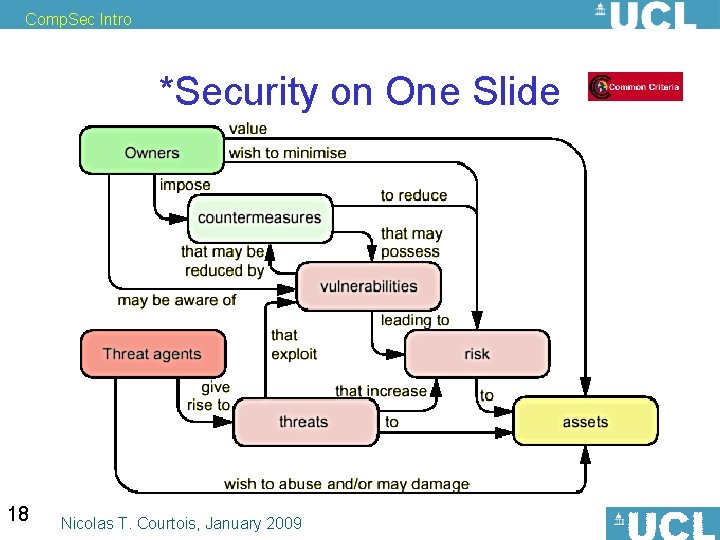
Comp. Sec Intro *Security on One Slide 18 Nicolas T. Courtois, January 2009
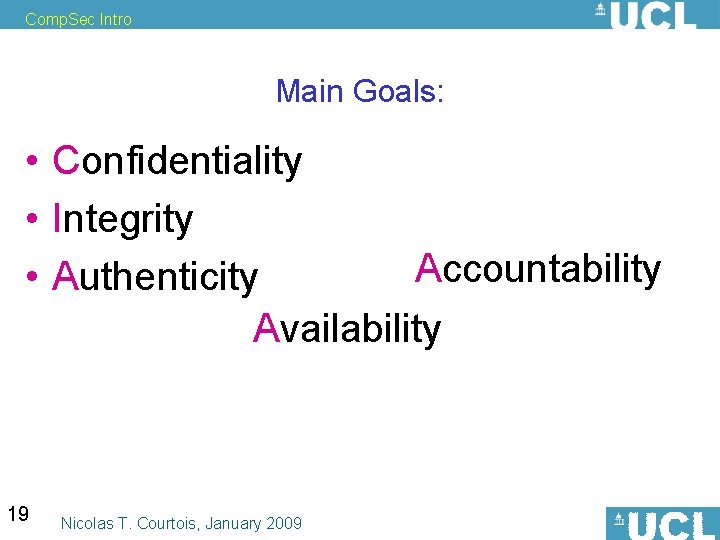
Comp. Sec Intro Main Goals: • Confidentiality • Integrity Accountability • Authenticity Availability 19 Nicolas T. Courtois, January 2009
Comp. Sec Intro In There a Need for More Security? or will I have a job tomorrow? 20 Nicolas T. Courtois, January 2009
Comp. Sec Intro Hegel [1770 -1831], German philosophy The history is the process of broadening freedom. 21 Nicolas T. Courtois, January 2009
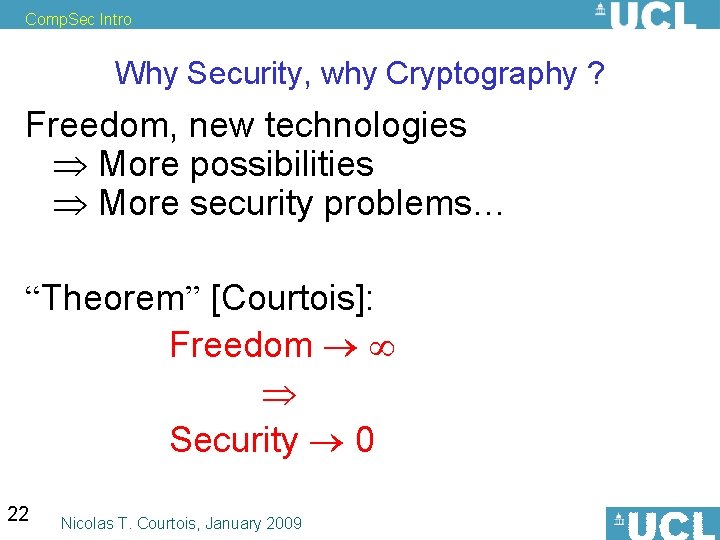
Comp. Sec Intro Why Security, why Cryptography ? Freedom, new technologies More possibilities More security problems… “Theorem” [Courtois]: Freedom Security 0 22 Nicolas T. Courtois, January 2009
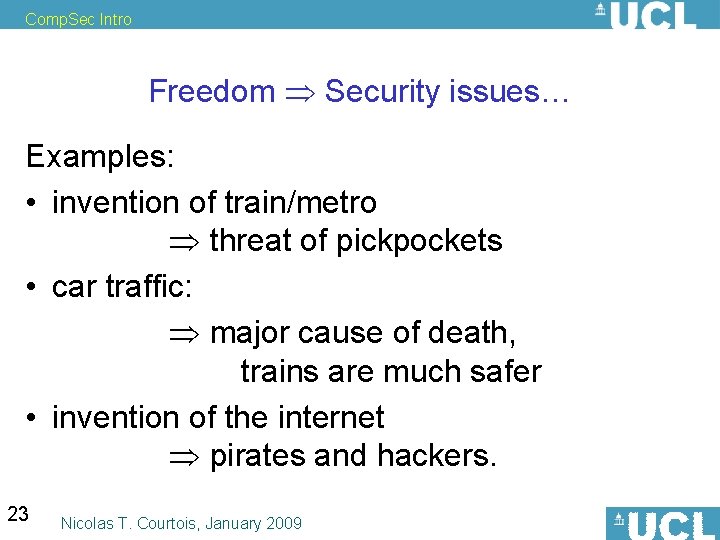
Comp. Sec Intro Freedom Security issues… Examples: • invention of train/metro threat of pickpockets • car traffic: major cause of death, trains are much safer • invention of the internet pirates and hackers. 23 Nicolas T. Courtois, January 2009
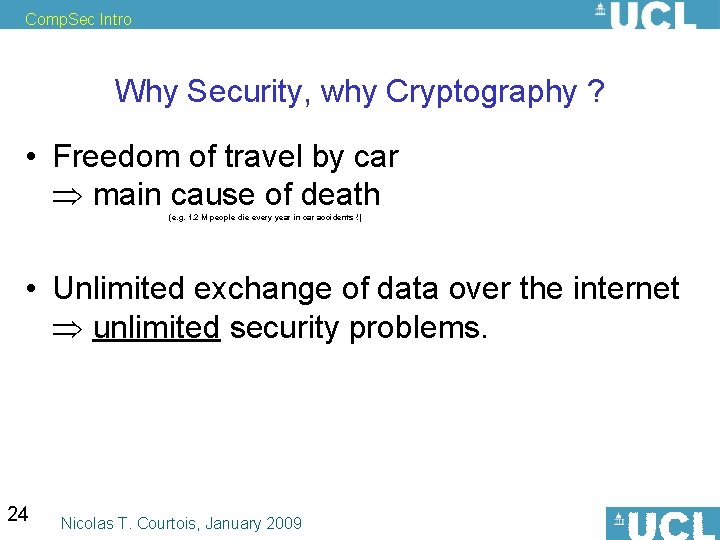
Comp. Sec Intro Why Security, why Cryptography ? • Freedom of travel by car main cause of death (e. g. 1. 2 M people die every year in car accidents !) • Unlimited exchange of data over the internet unlimited security problems. 24 Nicolas T. Courtois, January 2009
Comp. Sec Intro *Prof. Shigeo Tsujii, “The society should be designed to help people to enjoy the freedoms”… “broadened by IT”. Enjoy benefits, limit/remove disadvantages. 25 Nicolas T. Courtois, January 2009
Comp. Sec Intro “Adding” Security – Def. 3. The goal of cryptology and security [Courtois]: Add security to the information technologies (IT) that are by nature insecure. enablers/disablers 26 Nicolas T. Courtois, January 2009
Comp. Sec Intro Adding Security - Criticism 27 Nicolas T. Courtois, January 2009
Comp. Sec Intro Critics [Schneier] Why security it is an after-thought? “Aftermarket security is actually a very inefficient way to spend our security dollars; it may compensate for insecure IT products, but doesn't help improve their security”. “Additionally, as long as IT security is a separate industry, there will be companies making money based on insecurity -- companies who will lose money if the internet becomes more secure. ” Why security is not built-in? “utopian vision” Security is difficult, expensive and takes time… 28 Nicolas T. Courtois, January 2009
Comp. Sec Intro ***Today [Schneier] “I am regularly asked what average Internet users can do to ensure their security. My first answer is usually, "Nothing--you're screwed. “ 29 Nicolas T. Courtois, January 2009
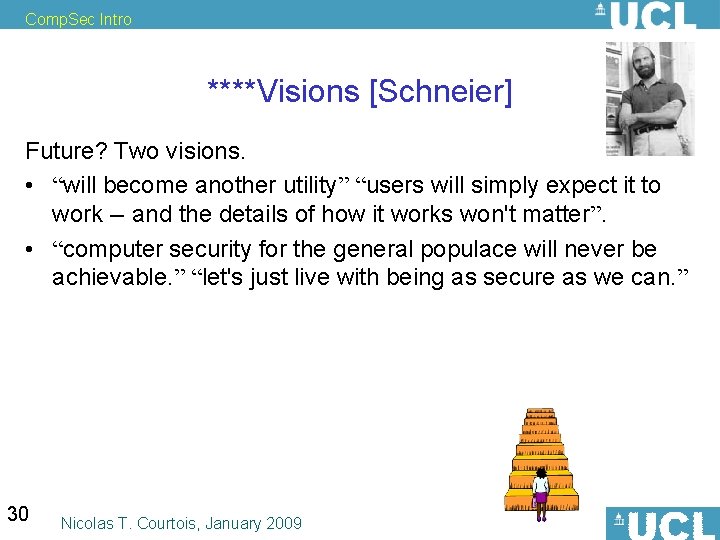
Comp. Sec Intro ****Visions [Schneier] Future? Two visions. • “will become another utility” “users will simply expect it to work -- and the details of how it works won't matter”. • “computer security for the general populace will never be achievable. ” “let's just live with being as secure as we can. ” 30 Nicolas T. Courtois, January 2009
Comp. Sec Intro Security Science 1. 2. 3. 31 Nicolas T. Courtois, January 2009
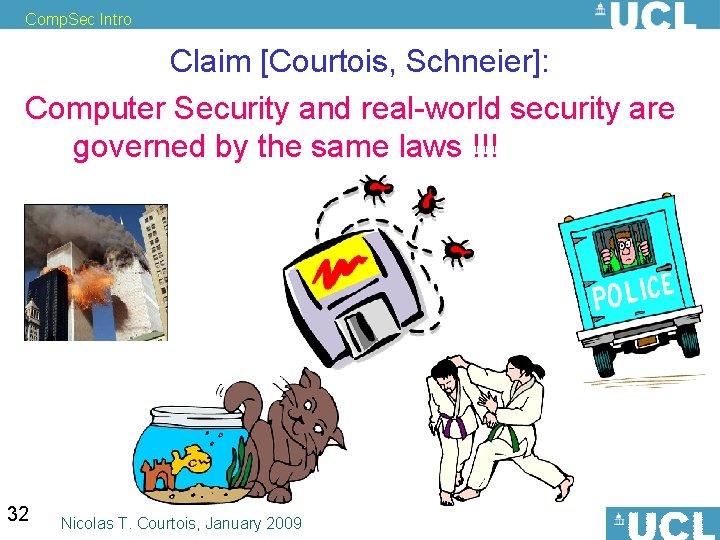
Comp. Sec Intro Claim [Courtois, Schneier]: Computer Security and real-world security are governed by the same laws !!! 32 Nicolas T. Courtois, January 2009
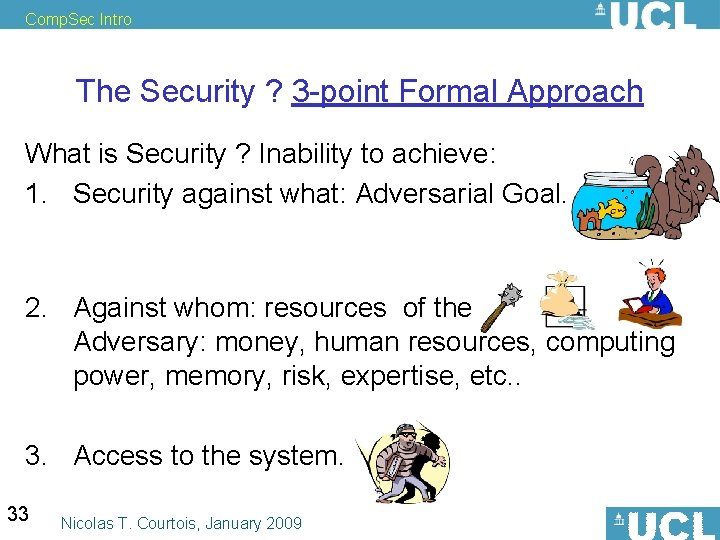
Comp. Sec Intro The Security ? 3 -point Formal Approach What is Security ? Inability to achieve: 1. Security against what: Adversarial Goal. 2. Against whom: resources of the Adversary: money, human resources, computing power, memory, risk, expertise, etc. . 3. Access to the system. 33 Nicolas T. Courtois, January 2009
Comp. Sec Intro 1. Attackers 34 Nicolas T. Courtois, January 2009
Comp. Sec Intro Vocabulary Attacker / Adversary / Threat Agent 35 Nicolas T. Courtois, January 2009
Comp. Sec Intro 1. Adversarial Goals • Enjoyment, fame, ego, role models • Develop science and offensive technology: – University researchers, (good/bad) – Security professionals (defenders) – Professional hackers, pen testers, etc… • Profits and other benefits – Crime business, – Promoting legal security business, – Political activism, terrorism, 36 Nicolas T. Courtois, January 2009
Comp. Sec Intro 2. a. Who Are the Attackers • • • bored teenagers, petty => organized criminals, rogue states, industrial espionage, disgruntled employees, … • • pure legitimate use Inadvertent events, bugs, errors, ourselves (forgot the d… password!), our family / friends / co-workers, 37 Nicolas T. Courtois, January 2009
Comp. Sec Intro 2. b. Their Means • computers (MIPS) / other hardware (antennas, liquid Nitrogen, etc…) • knowledge / expertise • risk/exposure capacity 38 Nicolas T. Courtois, January 2009
Comp. Sec Intro 3. Access 39 Nicolas T. Courtois, January 2009
Comp. Sec Intro 3. Access to Computers • Somewhat similar as for cars: 40 Nicolas T. Courtois, January 2009
Comp. Sec Intro 3. Access to your car. • • • 41 Miles away… When you drive on the road When parked on the street. Enters your garage Had a key yesterday and he made a copy … Nicolas T. Courtois, January 2009
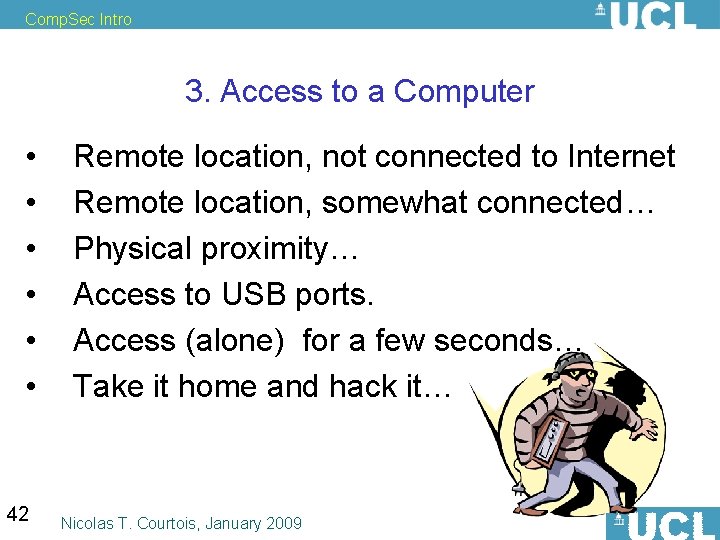
Comp. Sec Intro 3. Access to a Computer • • • 42 Remote location, not connected to Internet Remote location, somewhat connected… Physical proximity… Access to USB ports. Access (alone) for a few seconds… Take it home and hack it… Nicolas T. Courtois, January 2009
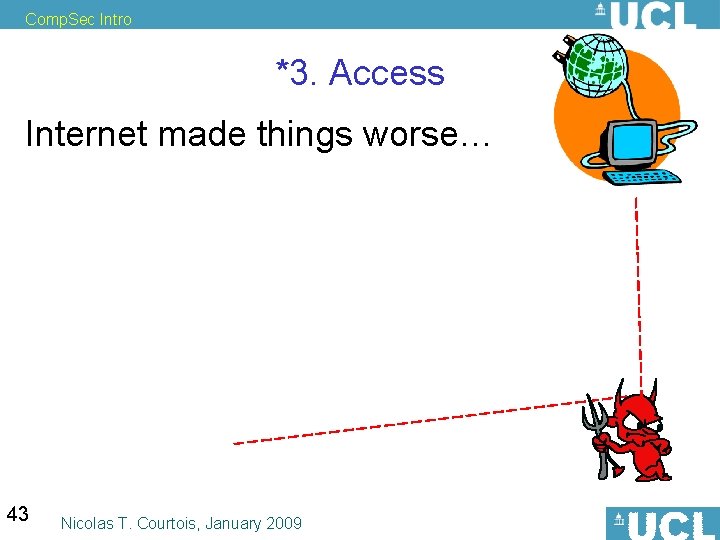
Comp. Sec Intro *3. Access Internet made things worse… and wireless communications make everything potentially attackable by anyone. 43 Nicolas T. Courtois, January 2009
Comp. Sec Intro Insecurity 44 Nicolas T. Courtois, January 2009
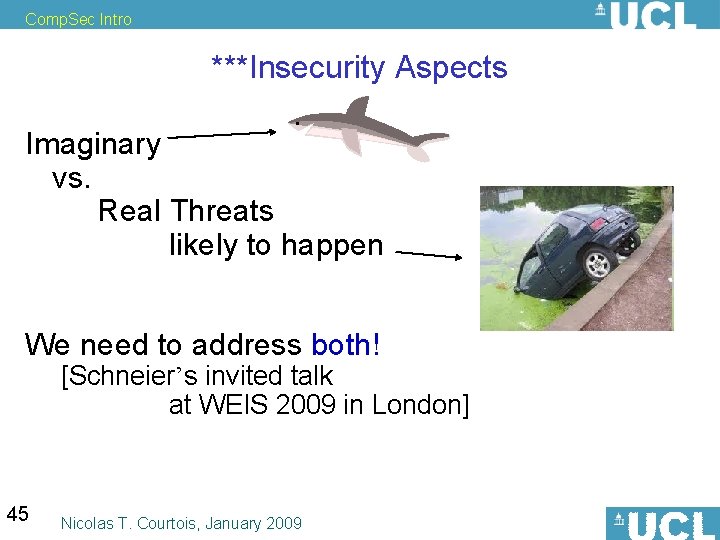
Comp. Sec Intro ***Insecurity Aspects Imaginary vs. Real Threats likely to happen We need to address both! [Schneier’s invited talk at WEIS 2009 in London] Security “Theatre” as used by Schneier: measures designed to produce a feeling of security, nothing real. 45 Nicolas T. Courtois, January 2009
Comp. Sec Intro “Small” Little Things 46 Nicolas T. Courtois, January 2009
Comp. Sec Intro What are Important Security Issues? Think twice. 47 Nicolas T. Courtois, January 2009
Comp. Sec Intro Mildest Forms of Insecurity • nuisance and irritation generated by security and updates, • necessity to think about such sordid things as security, • losing some pennies on it… Slight problem: the long tail theory. 48 Nicolas T. Courtois, January 2009
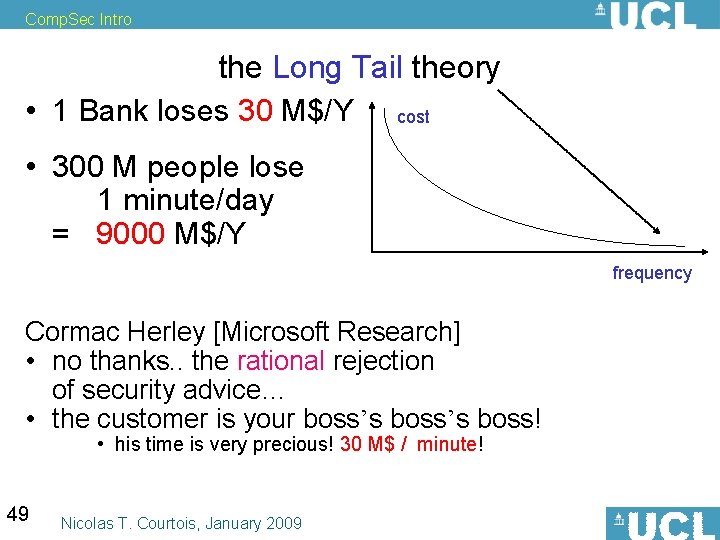
Comp. Sec Intro the Long Tail theory • 1 Bank loses 30 M$/Y cost • not more, risk management! • 300 M people lose 1 minute/day = 9000 M$/Y frequency Cormac Herley [Microsoft Research] • no thanks. . the rational rejection of security advice… • the customer is your boss’s boss! • his time is very precious! 30 M$ / minute! 49 Nicolas T. Courtois, January 2009
Comp. Sec Intro Major Threats 50 Nicolas T. Courtois, January 2009
Comp. Sec Intro Block Buster Insecurity • Viruses/Worms (e. g. Melissa 1999) • DOS hurting big corp. / countries [Estonia] • Financial/personal data files leaked/lost [lots in the media US] • Computer break-ins [little publicity? ] 51 Nicolas T. Courtois, January 2009
Comp. Sec Intro Explosion of Known Vulnerabilities http: //www. cert. org/stats/ What about the unknown ones? 52 Nicolas T. Courtois, January 2009
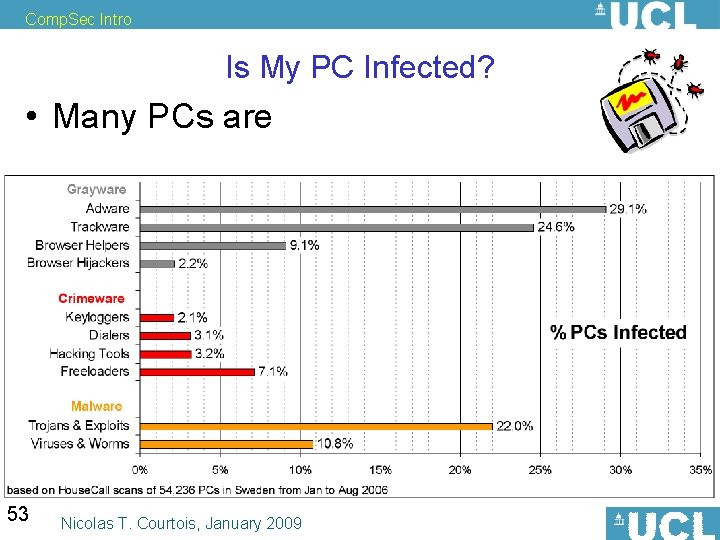
Comp. Sec Intro Is My PC Infected? • Many PCs are 53 Nicolas T. Courtois, January 2009
Comp. Sec Intro Why Things Happen? Bugs… or don’t care. • Programming developed with absence of security. • C/C++ is unsafe (Microsoft is currently blacklisting big chunks of standard C, could have happened 10 years ago). • Security/cryptography research developed with obsession with security. Both never met. • Mystified: – security issues are probably always exaggerated and distorted, one way or another (downplayed OR exaggerated, Ross Anderson: “hypertrophy” of security) • Economics/Business: – many things just don’t matter! – customers do not see => do not care about security – usability: user burden frustrates them. 54 Nicolas T. Courtois, January 2009
Comp. Sec Intro Comp. Sec and Economics 55 Nicolas T. Courtois, January 2009
Comp. Sec Intro Question “[…] Why do so many vulnerabilities exist in the first place? […]” Cf. Ross Anderson, Tyler Moore et al: 1. “The Economics of Information Security” In Science, October 2006. 2. “Security Economics and the Internal Market”: public report for ENISA (European Network and Information Security Agency), March 2008. 56 Nicolas T. Courtois, January 2009
Comp. Sec Intro Why Commercial Security Fails? Claim: the link between “money” and security is frequently broken today: – Security is a public good. • “private” incentives are weak. – Worse than “market for lemons”: • Not only that the customer cannot see the difference between good security and bad. Frequently the manufacturer cannot either. Too frequently security (and our safety) remains something that money cannot buy… (money seems to work for cars, and to fail for computers) 57 Nicolas T. Courtois, January 2009
Comp. Sec Intro Security and Economics • Security is about [sensible] security trade-offs. • Closely related to economy: How to allocate resources efficiently. Goes much further: • Most security trade-offs are economical in nature. • Security is shaped by the economy. • Uncertainty and security problems (e. g. social security) appear in all free economies. 58 Nicolas T. Courtois, January 2009
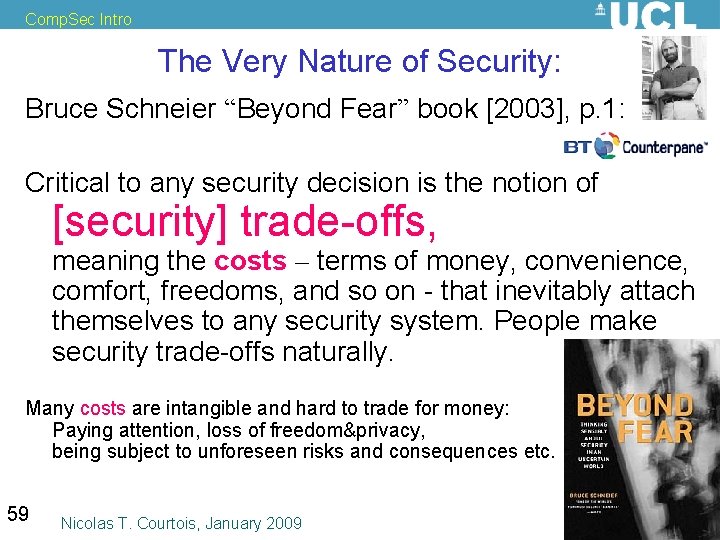
Comp. Sec Intro The Very Nature of Security: Bruce Schneier “Beyond Fear” book [2003], p. 1: Critical to any security decision is the notion of [security] trade-offs, meaning the costs – terms of money, convenience, comfort, freedoms, and so on - that inevitably attach themselves to any security system. People make security trade-offs naturally. Many costs are intangible and hard to trade for money: Paying attention, loss of freedom&privacy, being subject to unforeseen risks and consequences etc. 59 Nicolas T. Courtois, January 2009
Comp. Sec Intro *Defenders relevant though boring vocabulary. . 60 Nicolas T. Courtois, January 2009
Comp. Sec Intro 3 Actions of Defenders Ignore [can be perfectly rational!] • • • 61 Prevent Detect – Respond – have a recovery plan Nicolas T. Courtois, January 2009
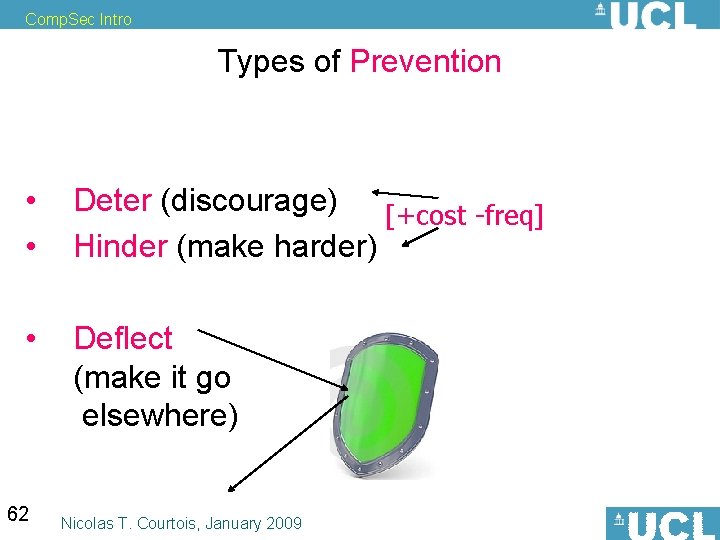
Comp. Sec Intro Types of Prevention Ignore • • Deter (discourage) [+cost -freq] Hinder (make harder) • Deflect (make it go elsewhere) 62 Nicolas T. Courtois, January 2009
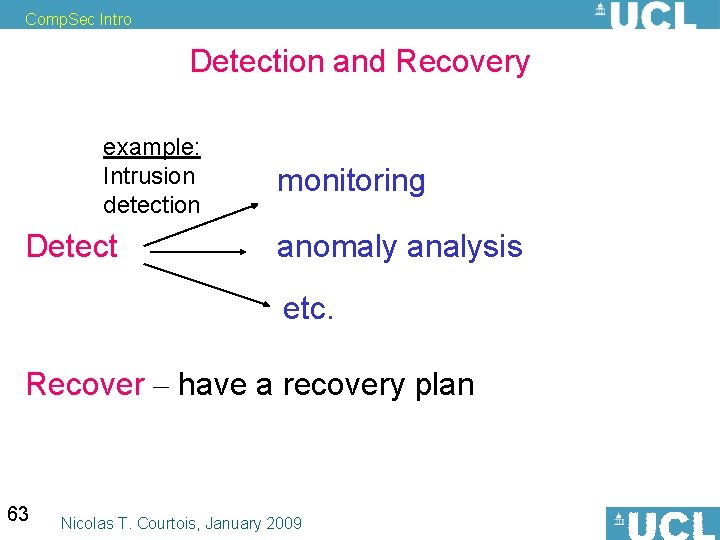
Comp. Sec Intro Detection and Recovery example: Intrusion detection Detect monitoring anomaly analysis etc. Recover – have a recovery plan 63 Nicolas T. Courtois, January 2009
Comp. Sec Intro ***IT Sec and the Military 64 Nicolas T. Courtois, January 2009
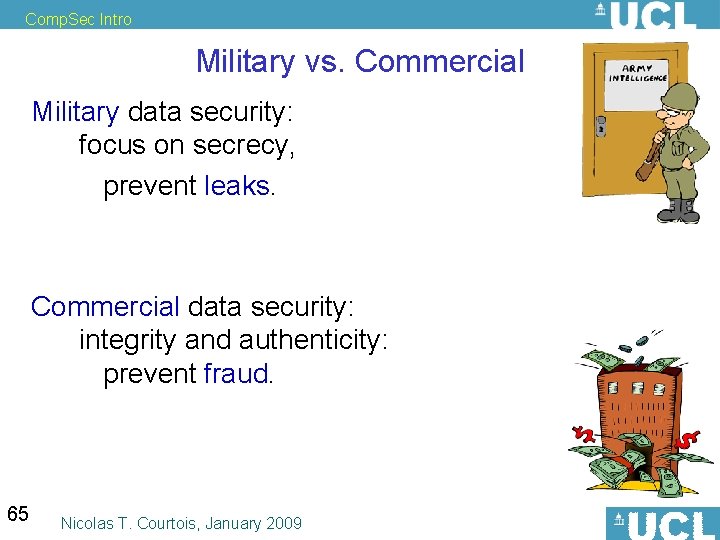
Comp. Sec Intro Military vs. Commercial Military data security: focus on secrecy, prevent leaks. Commercial data security: integrity and authenticity: prevent fraud. 65 Nicolas T. Courtois, January 2009
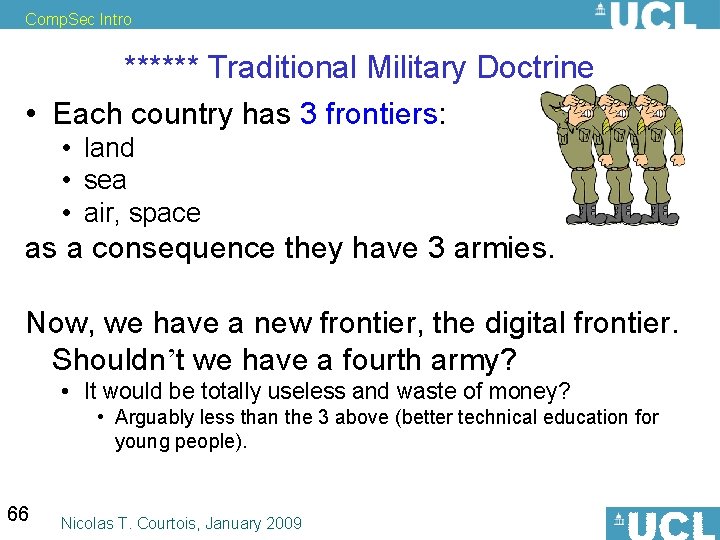
Comp. Sec Intro ****** Traditional Military Doctrine • Each country has 3 frontiers: • land • sea • air, space as a consequence they have 3 armies. Now, we have a new frontier, the digital frontier. Shouldn’t we have a fourth army? • It would be totally useless and waste of money? • Arguably less than the 3 above (better technical education for young people). 66 Nicolas T. Courtois, January 2009
Comp. Sec Intro *Risk 67 Nicolas T. Courtois, January 2009
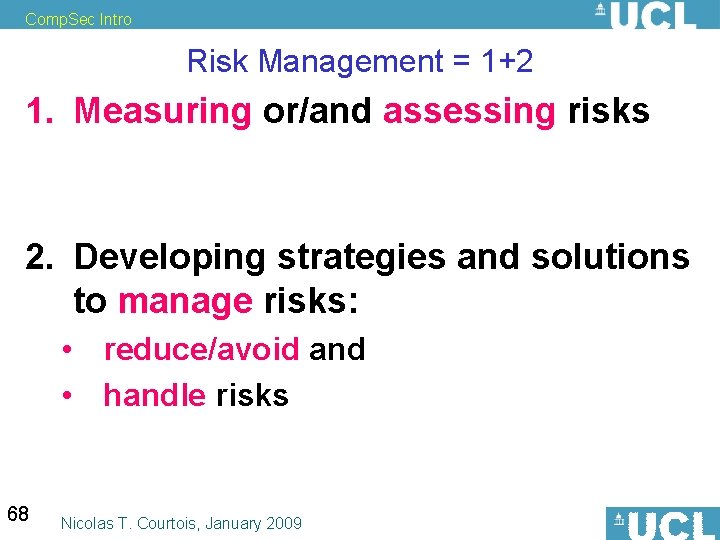
Comp. Sec Intro Risk Management = 1+2 1. Measuring or/and assessing risks 2. Developing strategies and solutions to manage risks: • reduce/avoid and • handle risks 68 Nicolas T. Courtois, January 2009
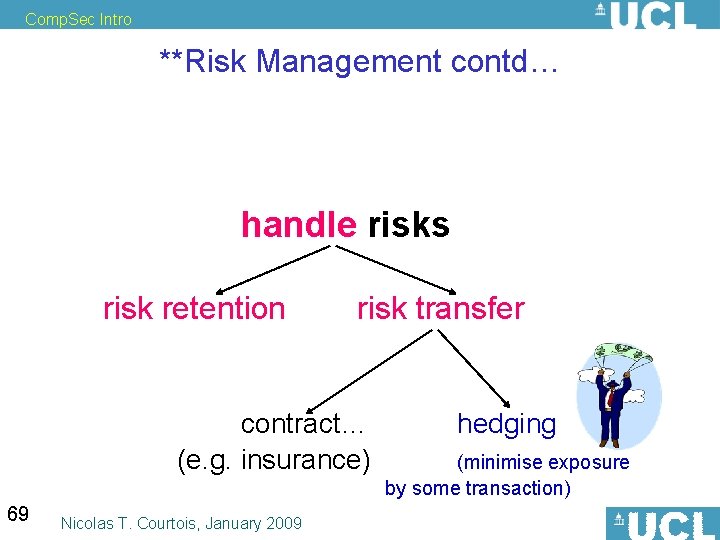
Comp. Sec Intro **Risk Management contd… handle risks risk retention risk transfer contract… (e. g. insurance) 69 Nicolas T. Courtois, January 2009 hedging (minimise exposure by some transaction)
Comp. Sec Intro Residual Risk = def what remains after defences are in place… 70 Nicolas T. Courtois, January 2009
Comp. Sec Intro Failures 71 Nicolas T. Courtois, January 2009
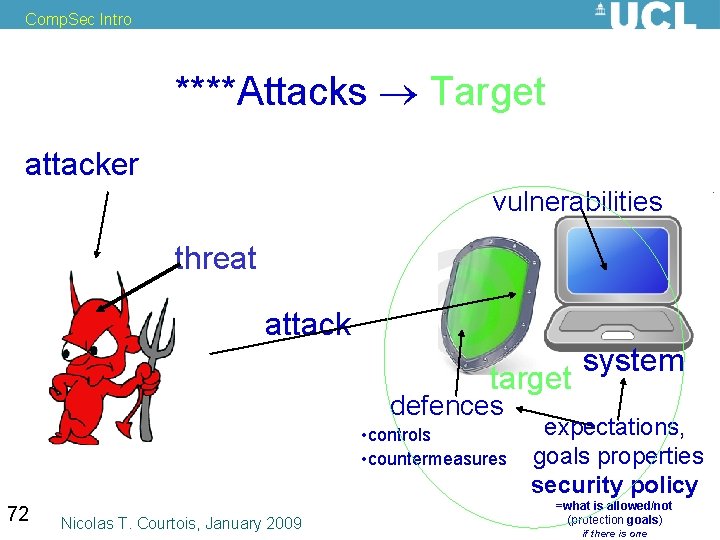
Comp. Sec Intro ****Attacks Target attacker vulnerabilities threat potential attack scenario attack target defences • controls • countermeasures 72 Nicolas T. Courtois, January 2009 system expectations, goals properties security policy =what is allowed/not (protection goals) if there is one
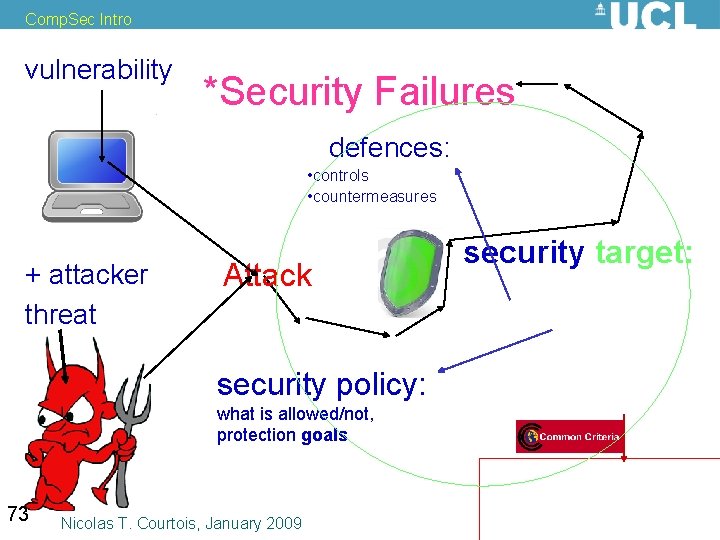
Comp. Sec Intro vulnerability *Security Failures defences: • controls • countermeasures Actual + attacker threat potential Attack scenario attack scenario security policy: what is allowed/not, protection goals security target: a more detailed specification of a set of means/protections to achieve the goals and a yardstick to evaluate if designers / implementers did a good job protection profile: 73 Nicolas T. Courtois, January 2009 what needs to be protected … allowing comparison of very different products famous for omissions
Comp. Sec Intro Types of Failures • Failure in design • Failure in implementation • Failure in operation 74 Nicolas T. Courtois, January 2009
Comp. Sec Intro If It Can Fail… It Will Schneier: http: //www. schneier. com/essay-005. html “History has taught us: never underestimate the amount of money, time, and effort someone will expend to thwart a security system. It's always better to assume the worst. Assume your adversaries are better than they are. Assume science and technology will soon be able to do things they cannot yet. Give yourself a margin for error. Give yourself more security than you need today. When the unexpected happens, you'll be glad you did. ” 75 Nicolas T. Courtois, January 2009
Comp. Sec Intro Ethics or should Karate classes be legal? 76 Nicolas T. Courtois, January 2009
Comp. Sec Intro Key Question: Is actively researching serious security vulnerabilities socially desirable? - Of Course Yes! …will tell you every professional hacker and every academic code-breaker… 77 Nicolas T. Courtois, January 2009
Comp. Sec Intro Bruce Schneier [14 May 2008]: Problem: A hacker who discovers one [attack] can sell it on the black market, blackmail the vendor with disclosure, or simply publish it without regard to the consequences. Q: […] is it ethical to research new vulnerabilities? A: Unequivocally, yes. [according to Schneier] Because: • Vulnerability research is vital because it trains our next generation of computer security experts. http: //www. schneier. com/blog/archives/2008/05/the_ethics_of_v. html 78 Nicolas T. Courtois, January 2009
Comp. Sec Intro Our Answer: The question is open to debate and remains somewhat controversial Maybe it depends. . …on what? 79 Nicolas T. Courtois, January 2009
Comp. Sec Intro Rescorla [2004] Research and disclose? Yes, if… …these vulnerabilities are likely to be rediscovered Cf. E. Rescorla. “Is finding security holes a good idea? ” In 3 rd Workshop on the Economics of Information Security (2004). 80 Nicolas T. Courtois, January 2009
Comp. Sec Intro Benefits: Disclosure creates incentives for fixing these vulnerabilities. 81 Nicolas T. Courtois, January 2009
Comp. Sec Intro Attackers and Hackers 82 Nicolas T. Courtois, January 2009
Comp. Sec Intro Motivation • Enjoyment, fame, ego, role models • Develop science and offensive technology: – University researchers, (good/bad) – Security professionals (defenders) – Professional hackers, pen testers, etc… • Profits and other benefits – Crime business, – Promoting legal security business, – Political activism, terrorism, 83 Nicolas T. Courtois, January 2009
Comp. Sec Intro Hackers Are: • • • bored teenagers, petty => organized criminals, rogue states, industrial espionage, disgruntled employees, … • • pure legitimate use Inadvertent events, bugs, errors, ourselves (forgot the d… password!), our family / friends / co-workers, 84 Nicolas T. Courtois, January 2009
Comp. Sec Intro 2. b. Their Means • computers (MIPS) / other hardware (antennas, liquid Nitrogen, etc…) • knowledge / expertise • risk/exposure capacity 85 Nicolas T. Courtois, January 2009
Comp. Sec Intro Hacker Movement • Biggest conference in Cryptography: • Crypto in Santa Barbara, CA, 500 people. • Def. Con: 9000 people. • CCC conf: 3000 people. the biggest in EU. • 80 % very young, 70 % German, 98 % male, 99 % white. => future growth potential. • Talks start at 10 h. At 23 h there are 3 technical talks in parallel. At 24 h there are “funny/entertainment/philosophy” talks. There are sofas to sleep in the congress center, but hackers never sleep, they type sth. on their laptop. Conference bandwidth was 3 Gbytes, instant tentatives of intrusion. There are stands about speed hacking, speed soldering. Practical lock-picking, RFID hacking, etc. 86 Nicolas T. Courtois, January 2009
Comp. Sec Intro Hacktivism Mostly about getting attention in the press through direct and spectacular action (hacking) against a government or corporate entity. In order to achieve a political effect. • Usually still a technology claim: • Just improve the security! It is broken. Just hire better experts/cryptographers/programmers… • Political statement unrelated to technology: • Russia does not agree with Estonia. 87 Nicolas T. Courtois, January 2009
Comp. Sec Intro Chaos Computer Club started in Hamburg in 1981 as a German-speaking libertarian-anarchist conference and social movement claiming freedom at any price, including freedom to pirate anything… 88 Nicolas T. Courtois, January 2009
Comp. Sec Intro Chaos Computer Club Very strong relations with German press makes that it is much harder to put hackers to jail (fear of bad press coverage). • Don’t do the same things that some people do. . • They will get away with it, you will not. These people are very strong defenders of some rights such as privacy and freedom of speech, and thus they achieve a sort of legitimacy in the public eye to indulge in activities that would otherwise be considered just criminal. • in the same way trade unions frequently get away with doing illegal things, but not always, many trade union leader have been in prison once or twice. The risk is totally and absolutely non-zero. In the 80 s the CCC guys showed the insecurity of Bildschirmtext computer network and made it debit a bank in Hamburg 134 K DM in favour of the Club. Then they organized a press conference. • The banks were nice, did NOT sue them. • But how can you predict they will be nice? 89 Nicolas T. Courtois, January 2009
Comp. Sec Intro Recent Trend: Rapid growth. The industrialization of hacking: • division of labour, clear definition of roles • forming a supply chain • professional management 90 Nicolas T. Courtois, January 2009
Comp. Sec Intro ***Question: Courtois: Why is it so that today: • 90 % of energy nowadays goes into hacking. • 10 % to research and development of secure products… Don’t believe it? • Check out: hacking the i. Phone, Microsoft XBOX, etc… Schneier: http: //www. schneier. com/essay-005. html “History has taught us: never underestimate the amount of money, time, and effort someone will expend to thwart a security system. It's always better to assume the worst. Assume your adversaries are better than they are. Assume science and technology will soon be able to do things they cannot yet. Give yourself a margin for error. Give yourself more security than you need today. When the unexpected happens, you'll be glad you did. ” 91 Nicolas T. Courtois, January 2009
Comp. Sec Intro Principles of Security Engineering 92 Nicolas T. Courtois, January 2009
Comp. Sec Intro Security Engineering Definition: [Ross Anderson] building systems to remain dependable in face of malice, error or mischance. 93 Nicolas T. Courtois, January 2009
Comp. Sec Intro Magic Formulas… or “Security Mantras”: • repeat after me: C. I. A. In fact we have no silver bullet. on the contrary: Security is about trade-offs. Conflicting engineering criteria…. Conflicting requirements… Overcoming human, technology and market failures. 94 Nicolas T. Courtois, January 2009 insecure rubbish!
Comp. Sec Intro Proportionality Principle Maximize security? ? ? Maximize “utility” (the benefits) while limiting risk to an acceptable level within reasonable cost… » all about economics… 95 Nicolas T. Courtois, January 2009
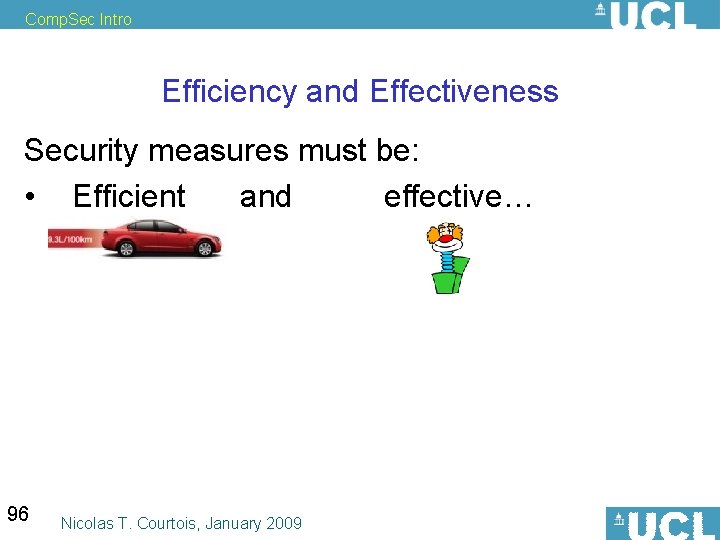
Comp. Sec Intro Efficiency and Effectiveness Security measures must be: • Efficient and effective… 96 Nicolas T. Courtois, January 2009
Comp. Sec Intro Design Principles for Protection Mechanisms [Saltzer and Schroeder 1975] important for exam 97 Nicolas T. Courtois, January 2009
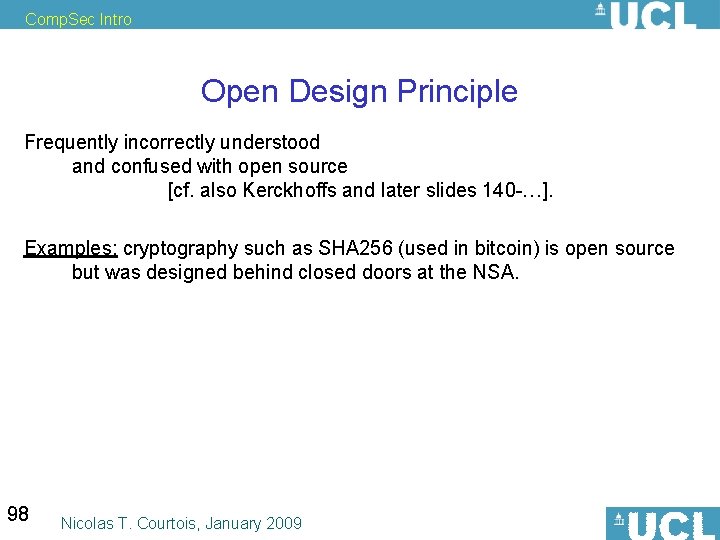
Comp. Sec Intro Open Design Principle Frequently incorrectly understood and confused with open source [cf. also Kerckhoffs and later slides 140 -…]. Examples: cryptography such as SHA 256 (used in bitcoin) is open source but was designed behind closed doors at the NSA. 98 Nicolas T. Courtois, January 2009
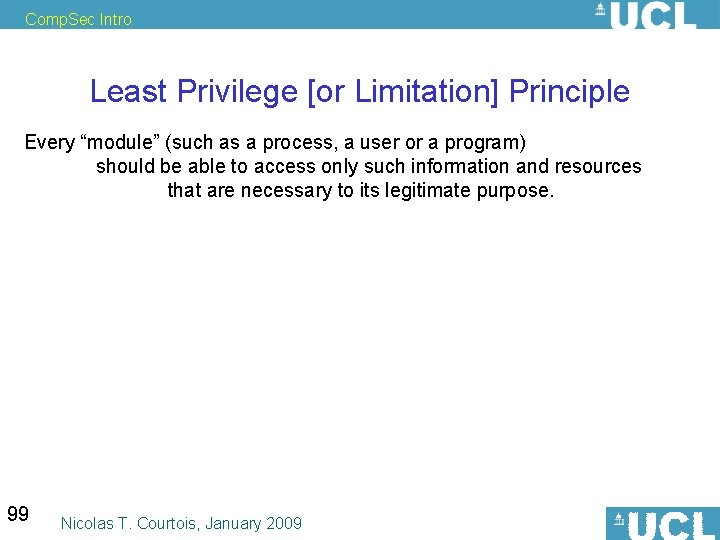
Comp. Sec Intro Least Privilege [or Limitation] Principle Every “module” (such as a process, a user or a program) should be able to access only such information and resources that are necessary to its legitimate purpose. 99 Nicolas T. Courtois, January 2009
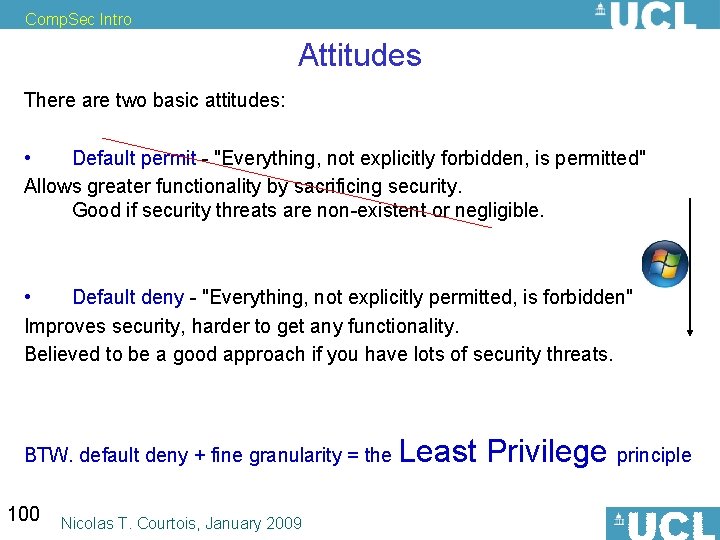
Comp. Sec Intro Attitudes There are two basic attitudes: • Default permit - "Everything, not explicitly forbidden, is permitted" Allows greater functionality by sacrificing security. Good if security threats are non-existent or negligible. • Default deny - "Everything, not explicitly permitted, is forbidden" Improves security, harder to get any functionality. Believed to be a good approach if you have lots of security threats. BTW. default deny + fine granularity = the 100 Nicolas T. Courtois, January 2009 Least Privilege principle
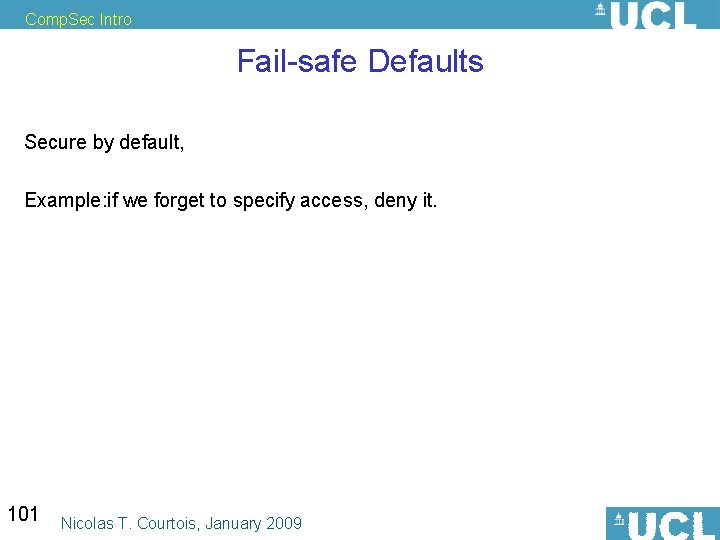
Comp. Sec Intro Fail-safe Defaults Secure by default, Example: if we forget to specify access, deny it. 101 Nicolas T. Courtois, January 2009
Comp. Sec Intro Economy of Mechanism A protection mechanism should have a simple and small design. – small and simple enough to be build in a rigorous way, • 102 and fully tested analysed Nicolas T. Courtois, January 2009
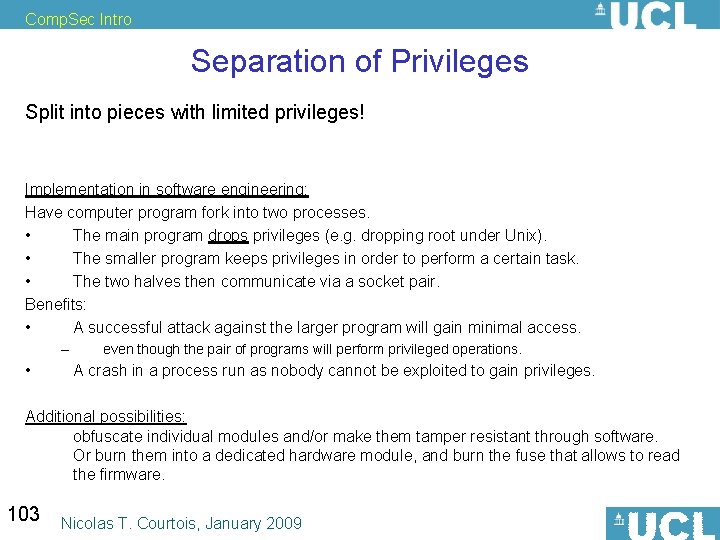
Comp. Sec Intro Separation of Privileges Split into pieces with limited privileges! Implementation in software engineering: Have computer program fork into two processes. • The main program drops privileges (e. g. dropping root under Unix). • The smaller program keeps privileges in order to perform a certain task. • The two halves then communicate via a socket pair. Benefits: • A successful attack against the larger program will gain minimal access. – • even though the pair of programs will perform privileged operations. A crash in a process run as nobody cannot be exploited to gain privileges. Additional possibilities: obfuscate individual modules and/or make them tamper resistant through software. Or burn them into a dedicated hardware module, and burn the fuse that allows to read the firmware. 103 Nicolas T. Courtois, January 2009
Comp. Sec Intro Least Common Mechanisms used to access resources should not be shared. Why? Not so obvious. • If everybody depends on it, failure will have a higher impact. • One user can do a DOS attack. • Shared service [or resource such as CPU cache] can provide side channels. Deadly for AES keys… • A mechanism serving all users must be designed to the satisfaction of every user, harder than satisfying more specialized requirements. 104 Nicolas T. Courtois, January 2009
Comp. Sec Intro Be Friendly! 105 Nicolas T. Courtois, January 2009
Comp. Sec Intro Saltzer and Schroeder 1975: • Psychologically Acceptable not enough anymore 106 Nicolas T. Courtois, January 2009
Comp. Sec Intro Usability + • Acceptable Consent and accepted… • Nice • User-friendly 107 Nicolas T. Courtois, January 2009 or not: otherwise the mechanism will be bypassed (-consent)
Comp. Sec Intro Be Even More Friendly: • Don’t annoy people. – – • Established defaults should be reasonable. – • People should not feel trapped. It should be easy to – – 108 Minimize the number of clicks Minimize the number of things to remember Make security easy to understand self-explanatory Security should NOT impact users that obey the rules. Restrict access Give access Personalize settings Etc… Nicolas T. Courtois, January 2009
Comp. Sec Intro More Design Principles 109 Nicolas T. Courtois, January 2009
Comp. Sec Intro Think Ahead Pro-active security design: • Design the security in, – • built-in from the start. Contrary of aftermarket security. Allow for future security enhancements. [Morrie Gasser 1988] also • Fail securely: if sth. goes wrong, yes, make sure it “fails securely”. 110 Nicolas T. Courtois, January 2009
Comp. Sec Intro Trust vs. Security 111 Nicolas T. Courtois, January 2009
Comp. Sec Intro Trust Following Ross Anderson and US Dept of Defence definitions: • Trusted system [paradoxical definition]: one that can break the security policy (in theory, risk). • Trustworthy system: one that won’t fail us (0 risk). An employee who is selling secrets is trusted and NOT trustworthy at the same time. Piotr Cofta in his book has like 17 definitions of trust… 112 Nicolas T. Courtois, January 2009
Comp. Sec Intro Be Reluctant to Trust Cf. Least Privilege. 113 Nicolas T. Courtois, January 2009
Comp. Sec Intro Be Trustworthy Public scrutiny promotes trust. Commitment to security is visible in the long run. Repeated game theory: even if the customers will not switch they will refuse to give you a rise (buy a more expensive version of the product). Adam Smith about recurrent business transactions (but not occasional ones). They promote positive traits of character. 114 Nicolas T. Courtois, January 2009
Comp. Sec Intro *Management Principles for Production and Development, or Integrity of a Business Process… [Lipner 1982] slides also relevant and repeated in 02 part 115 Nicolas T. Courtois, January 2009
Comp. Sec Intro Lipner 1982 These can be see as management principles: How to manage development and production, avoid random failures and security breaches alike. Principle of Segregation of Duties = Separation of Duty. 116 Nicolas T. Courtois, January 2009
Comp. Sec Intro Segregation of Duties Achieved by (closely related): • Principle of Functional separation: Several people should cooperate. Examples: • one developer should not work alone on a critical application, • the tester should not be the same person as the developer • If two or more steps are required to perform a critical function, at least two different people should perform them, etc. – This principle makes it very hard for one person to compromise the security, on purpose of inadvertently. • Principle of Dual Control: – Example 1: in the SWIFT banking data management system there are two security officers: left security officer and right security officer. Both must cooperate to allow certain operations. – Example 2: nuclear devices command. – Example 3: cryptographic secret sharing 117 Nicolas T. Courtois, January 2009
Comp. Sec Intro Auditing / Monitoring – Record what actions took place and who performed them – Contributes to both disaster recovery (business continuity) and accountability. 118 Nicolas T. Courtois, January 2009
Comp. Sec Intro Lipner 1982: Requirements, focus on integrity of the business processes and of the “production” data whatever it means: 1. Users will not write their own programs. 2. Separation of Function: Programmers will develop on test systems and test data, not on “production” systems. 3. A special procedure will allow to execute programs. 4. Compliance w. r. t. 3 will be controlled / audited. 5. Managers and auditors should have access to the system state and to all system logs. 119 Nicolas T. Courtois, January 2009
Comp. Sec Intro The False Principle: The Weakest Link 120 Nicolas T. Courtois, January 2009
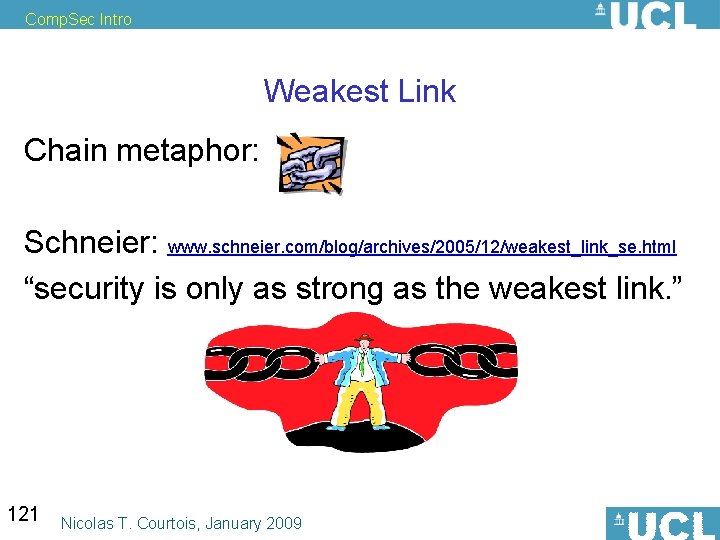
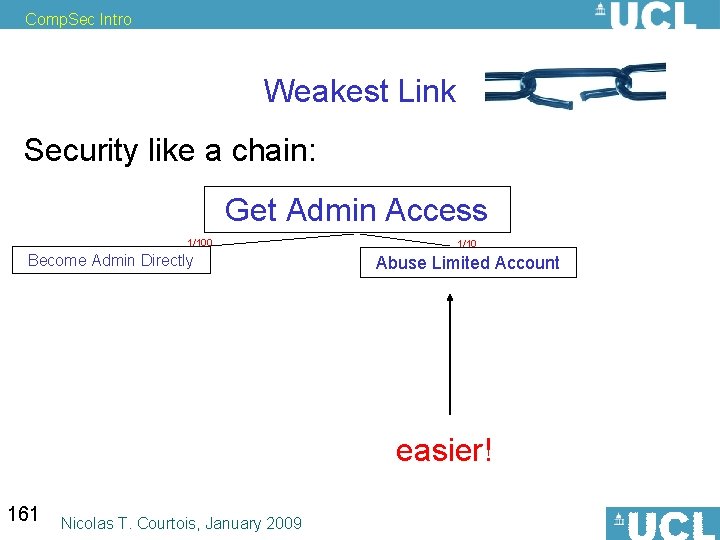
Comp. Sec Intro Weakest Link Chain metaphor: Schneier: www. schneier. com/blog/archives/2005/12/weakest_link_se. html “security is only as strong as the weakest link. ” 121 Nicolas T. Courtois, January 2009
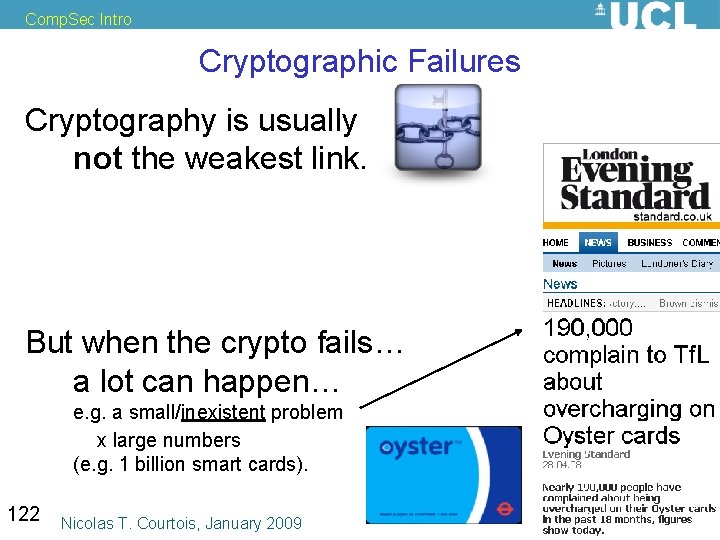
Comp. Sec Intro Cryptographic Failures Cryptography is usually not the weakest link. except… for crypto freaks But when the crypto fails… a lot can happen… e. g. a small/inexistent problem x large numbers (e. g. 1 billion smart cards). 122 Nicolas T. Courtois, January 2009
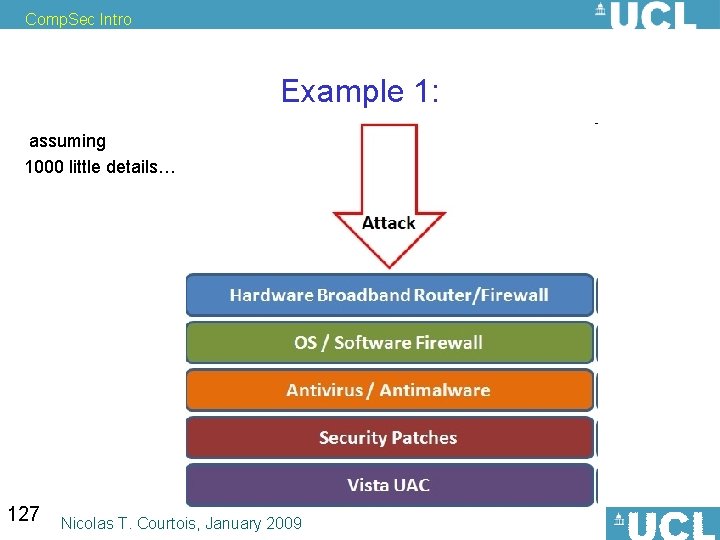
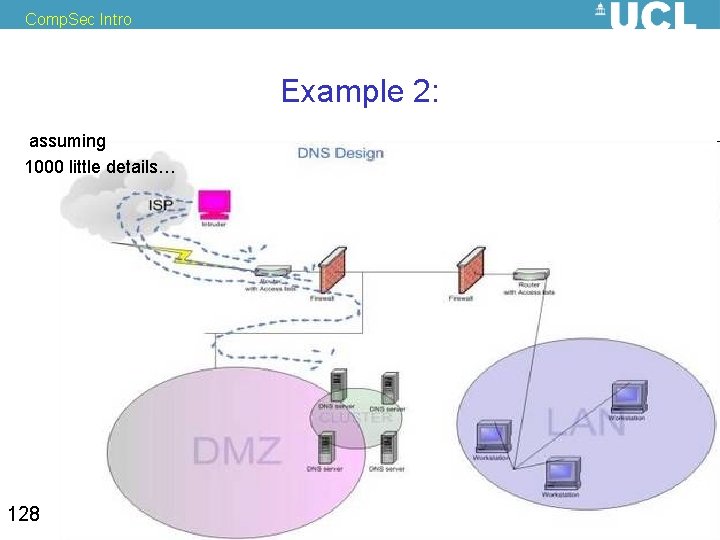
Comp. Sec Intro Chains vs. Layers 123 Nicolas T. Courtois, January 2009
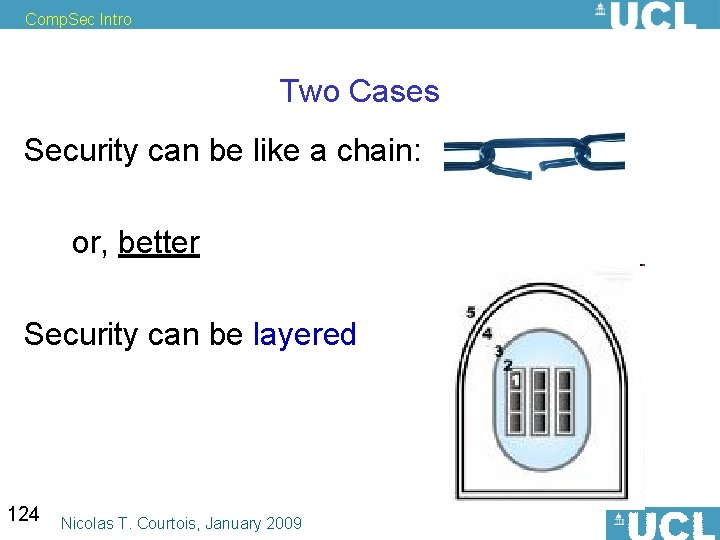
Comp. Sec Intro Two Cases Security can be like a chain: or, better Security can be layered 124 Nicolas T. Courtois, January 2009
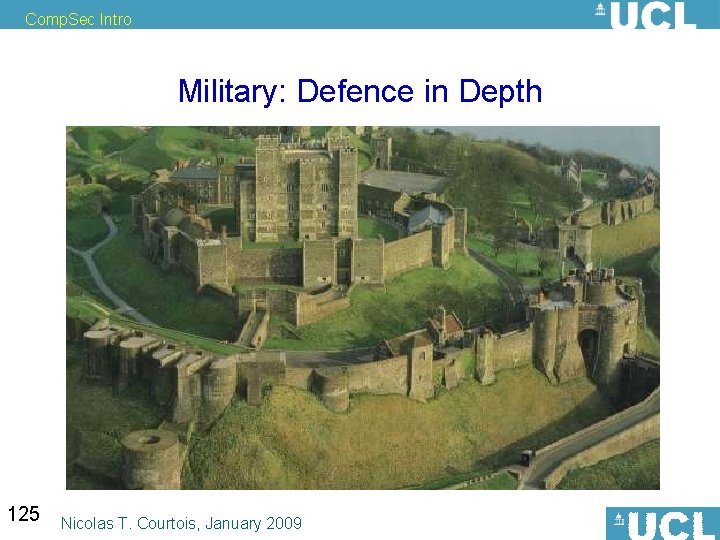
Comp. Sec Intro Military: Defence in Depth 125 Nicolas T. Courtois, January 2009
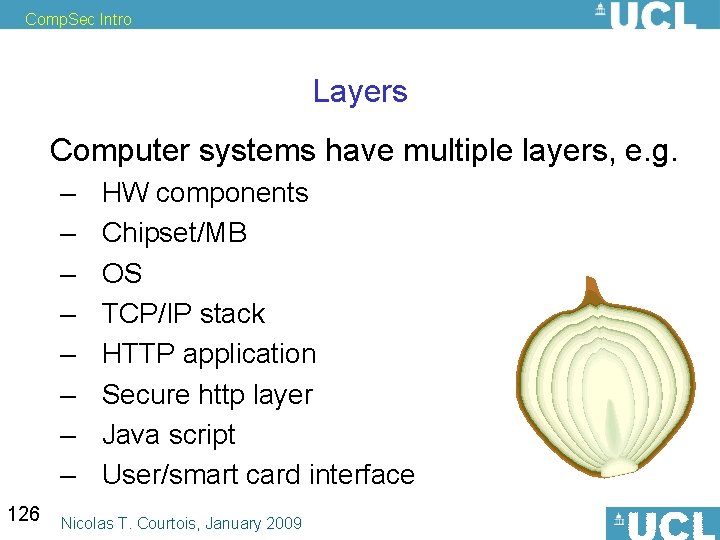
Comp. Sec Intro Layers Computer systems have multiple layers, e. g. – – – – 126 HW components Chipset/MB OS TCP/IP stack HTTP application Secure http layer Java script User/smart card interface Nicolas T. Courtois, January 2009
Comp. Sec Intro Example 1: assuming 1000 little details… 127 Nicolas T. Courtois, January 2009
Comp. Sec Intro Example 2: assuming 1000 little details… 128 Nicolas T. Courtois, January 2009
Comp. Sec Intro **Weakest Link vs. Sum of Efforts 129 Nicolas T. Courtois, January 2009
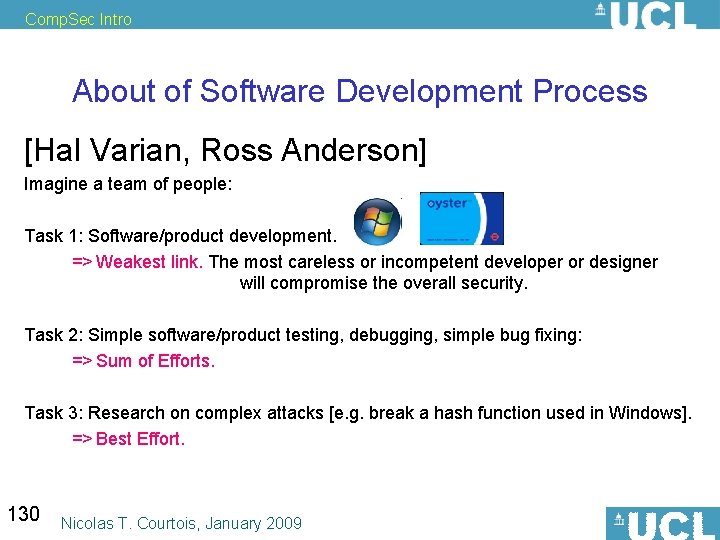
Comp. Sec Intro About of Software Development Process [Hal Varian, Ross Anderson] Imagine a team of people: Task 1: Software/product development. => Weakest link. The most careless or incompetent developer or designer will compromise the overall security. Task 2: Simple software/product testing, debugging, simple bug fixing: => Sum of Efforts. Task 3: Research on complex attacks [e. g. break a hash function used in Windows]. => Best Effort. Close to layering the defences… 130 Nicolas T. Courtois, January 2009
Comp. Sec Intro *Probability Distributions 131 Nicolas T. Courtois, January 2009
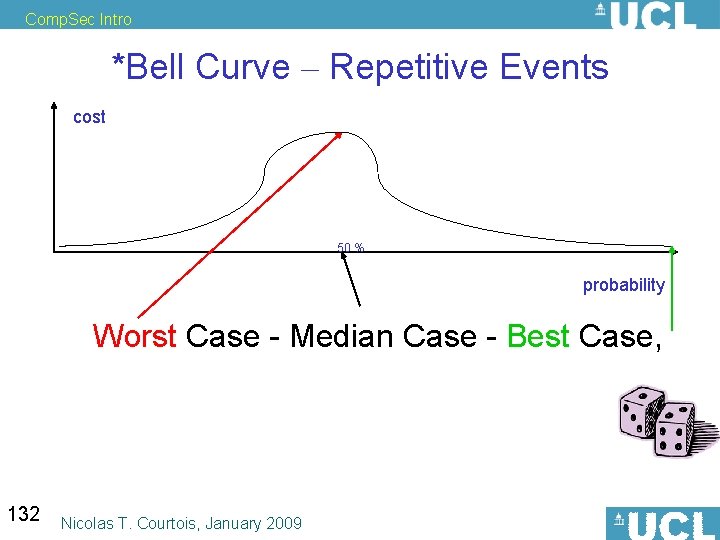
Comp. Sec Intro *Bell Curve – Repetitive Events cost 50 % probability Worst Case - Median Case - Best Case, 132 Nicolas T. Courtois, January 2009
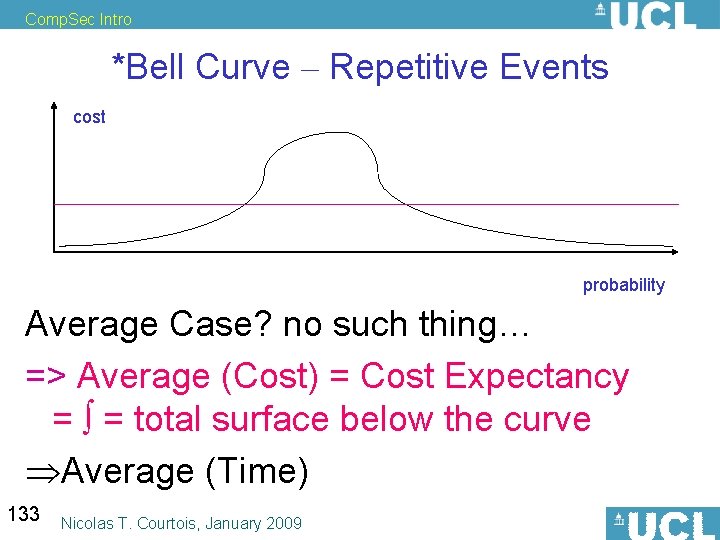
Comp. Sec Intro *Bell Curve – Repetitive Events cost probability Average Case? no such thing… => Average (Cost) = Cost Expectancy = = total surface below the curve Average (Time) 133 Nicolas T. Courtois, January 2009
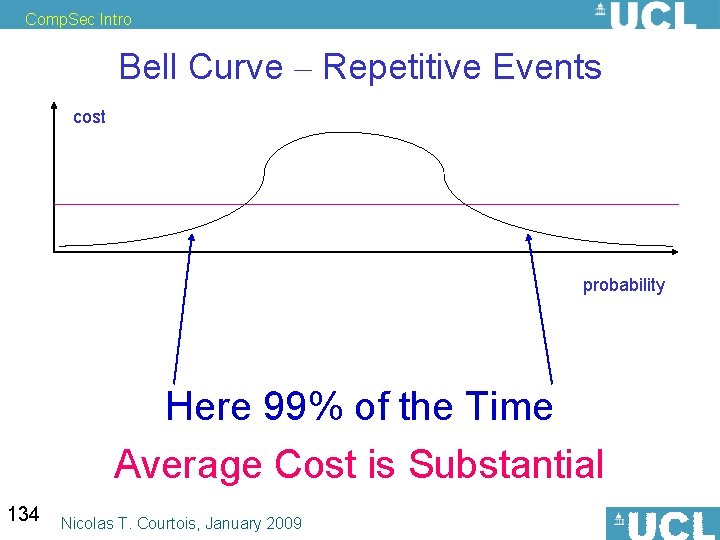
Comp. Sec Intro Bell Curve – Repetitive Events cost probability Here 99% of the Time Average Cost is Substantial 134 Nicolas T. Courtois, January 2009
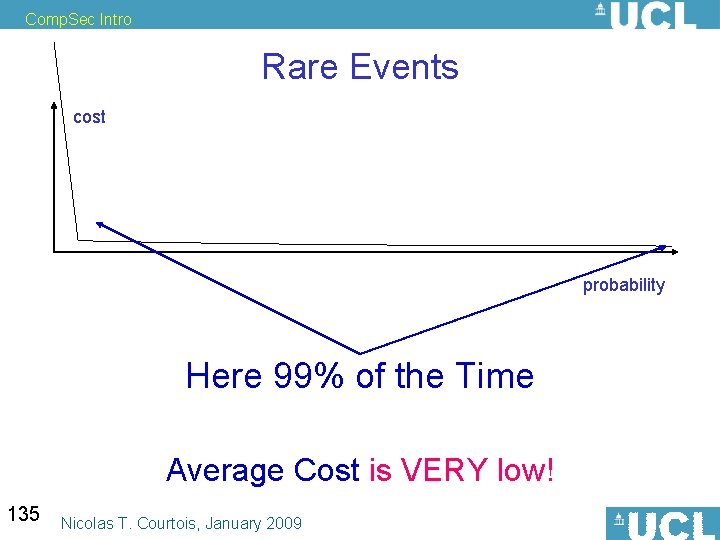
Comp. Sec Intro Rare Events cost probability Here 99% of the Time Average Cost is VERY low! 135 Nicolas T. Courtois, January 2009
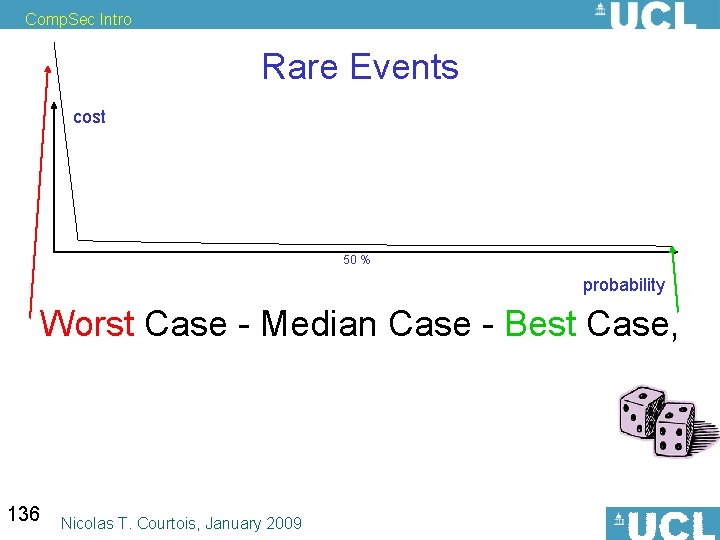
Comp. Sec Intro Rare Events cost 50 % probability Worst Case - Median Case - Best Case, 136 Nicolas T. Courtois, January 2009
Comp. Sec Intro Back to Schneier Quote www. schneier. com/essay-005. html “It's always better to assume the worst. Assume your adversaries are better than they are. Assume science and technology will soon be able to do things they cannot yet. Give yourself a margin for error. Give yourself more security than you need today. When the unexpected happens, you'll be glad you did. ” BUT… this is rubbish 137 Nicolas T. Courtois, January 2009
Comp. Sec Intro Worst Case Defences? Criticism Cormac Herley [Microsoft research]: • Most security systems are build to defend against the worst case. • In reality, the average case losses are insignificant or small, • e. g. actually computer crime worldwide is very small… • and many security technologies are maybe -- from the economics point of view -- totally useless • but it depends, we cannot judge security technologies by present losses, because there also losses that have been avoided or deterred by this technology, and also that losses evolve over the time with highly chaotic pattern (they are 0 then suddenly they may explode) 138 Nicolas T. Courtois, January 2009
Comp. Sec Intro Worst Case Defences? Conclusion There is no general answer. Both arguments are legitimate. More detailed analysis is needed; what if etc. . . Can this be done? Maybe there will always be some purely political choices that is impossible neither to justify, nor to undermine. 139 Nicolas T. Courtois, January 2009
Comp. Sec Intro Security Technologies: Security as f(penetration rate) 140 Nicolas T. Courtois, January 2009
Comp. Sec Intro Deployment / Penetration Rate Two sorts of technologies: A) Those that are effective if deployed at 20%: Examples: 1. 2. 3. B) virus detection (as opposed to removal / fighting the viruses), 99 % email / hard disk encryption, 20 % making the entry/authentication harder, as an option for the user, 20% Those that are totally ineffective even at 99%: Examples: 1. 2. virus removal, buggy anti-virus: “your anti-virus has just restarted due to an internal error”… we click YES for 1 % of the security alerts out of fatigue… 3. • 4. 141 • certificates are frequently invalid… it invalidates the 99 % of the time we did prevent the intrusion… we lost our time if some ATMs still accept a blank mag-stripe only cards, the whole purpose of chips on bank cards is nearly defeated… Nicolas T. Courtois, January 2009
Comp. Sec Intro Secrecy vs. Transparency 142 Nicolas T. Courtois, January 2009
Comp. Sec Intro Open Source vs. Closed Source and Security 143 Nicolas T. Courtois, January 2009
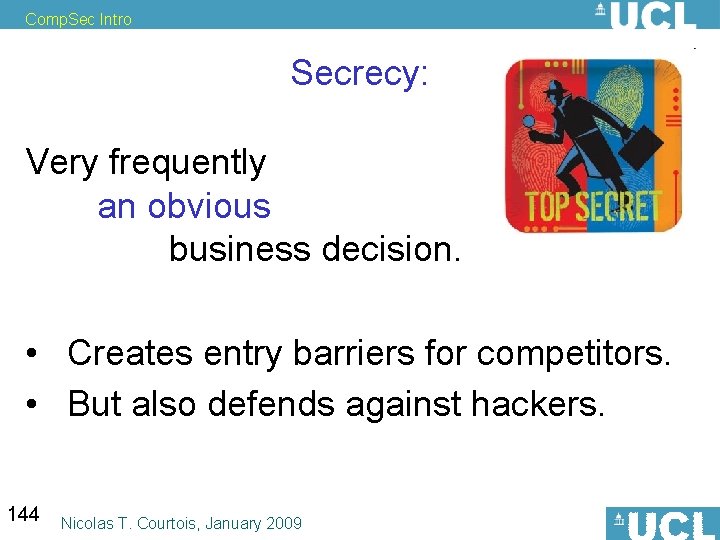
Comp. Sec Intro Secrecy: Very frequently an obvious business decision. • Creates entry barriers for competitors. • But also defends against hackers. 144 Nicolas T. Courtois, January 2009
Comp. Sec Intro Kerckhoffs’ principle: [1883] “The system must remain secure should it fall in enemy hands …” 145 Nicolas T. Courtois, January 2009
Comp. Sec Intro Kerckhoffs’ principle: [1883] Most of the time: incorrectly understood. Utopia. Who can force companies to publish their specs? ? ? No obligation to disclose. • Security when disclosed. • Better security when not disclosed. 146 Nicolas T. Courtois, January 2009
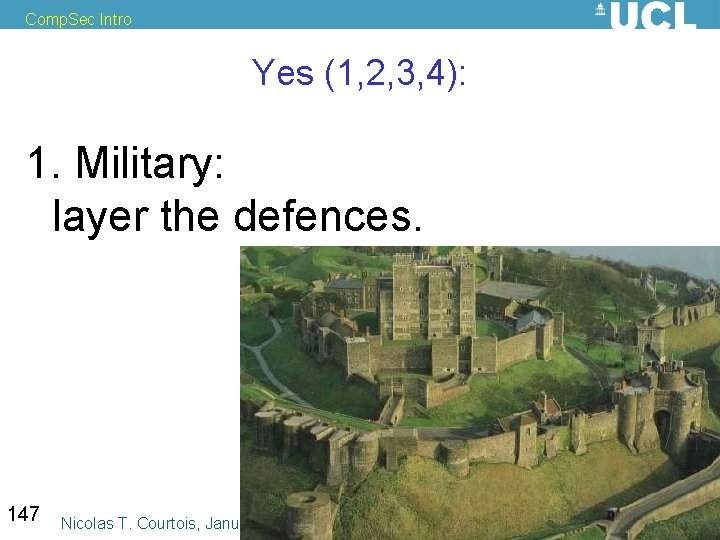
Comp. Sec Intro Yes (1, 2, 3, 4): 1. Military: layer the defences. 147 Nicolas T. Courtois, January 2009
Comp. Sec Intro Yes (2): 2) Basic economics: these 3 extra months (and not more ) are simply worth a a lot of money. 148 Nicolas T. Courtois, January 2009
Comp. Sec Intro Yes (3): 3) Prevent the erosion of profitability / barriers for entry for competitors / “inimitability” 149 Nicolas T. Courtois, January 2009
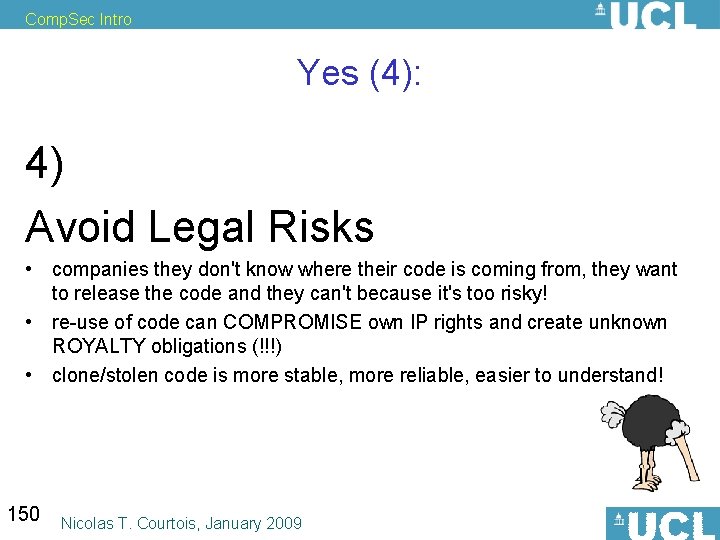
Comp. Sec Intro Yes (4): 4) Avoid Legal Risks • companies they don't know where their code is coming from, they want to release the code and they can't because it's too risky! • re-use of code can COMPROMISE own IP rights and create unknown ROYALTY obligations (!!!) • clone/stolen code is more stable, more reliable, easier to understand! 150 Nicolas T. Courtois, January 2009
Comp. Sec Intro What’s Wrong with Open Source? 151 Nicolas T. Courtois, January 2009
Comp. Sec Intro Kerckhoffs principle: • Rather WRONG in the world of smart cards… – Reasons: • side channel attacks, • Pay. TV card sharing attacks • etc. . • But could be right elsewhere for many reasons… – Example: • DES, AES cipher, open-source, never really broken • Kee. Loq cipher, closed source, broken in minutes… 152 Nicolas T. Courtois, January 2009
Comp. Sec Intro *Kerckhoffs principle vs. Public Key Crypto vs. Financial Cryptography • In Public Key Cryptography one key CAN be made public. In practice this means that – some group of people has it – NO obligation to disclose, to make it really public (and it is almost never done in serious financial applications) • Again full disclosure for public keys is unbelievably stupid and simply BAD security engineering and BAD security management. Examples: • all ATMs in the country have 6 public keys, not really public though • in Bitcoin: the public key can remain a secret for years, only a hash is revealed, this is BRILLIANT key management which makes Bitcoin MUCH more secure that it would otherwise be! 153 Nicolas T. Courtois, January 2009
Comp. Sec Intro Which Model is Better? Open and closed security are more or less equivalent… more or less as secure: opening the system helps both the attackers and the defenders. Cf. Ross Anderson: Open and Closed Systems are Equivalent (that is, in an ideal world). In Perspectives on Free and Open Source Software, MIT Press 2005, pp. 127 -142. 154 Nicolas T. Courtois, January 2009
Comp. Sec Intro Open Source: Remains a wishful thinking utopia kind of concept. I know people that were fired because of their open source advocacy… and very naïve and stupid on behalf of young people: 155 Nicolas T. Courtois, January 2009
Comp. Sec Intro Social Critique of Open Source Software Open source is just the second market failure, as bad as Microsoft, and a part of the same problem. [according to Courtois]: A. Why young and skilled programmers would work for FREE while doing a work of absolutely huge social benefit? B. Why incompetent programmers at ill-intentioned corporations are millionaires in dollars? – They corrupt governments and university professors, • as a result people in group A cannot afford education for their children – They buy houses and drive the real-estate market crazy. • as a result people in group A have to move far away from technology hubs Economics: Not sustainable. They will be less and less people in group A… Hopefully! Opinion: Working for free is plainly and totally wrong, and can be illegal. • Don’t work for free [unless you have a personal wealth to support it]. • Get paid! 156 Nicolas T. Courtois, January 2009
Comp. Sec Intro Attack Trees could be at the exam? 157 Nicolas T. Courtois, January 2009
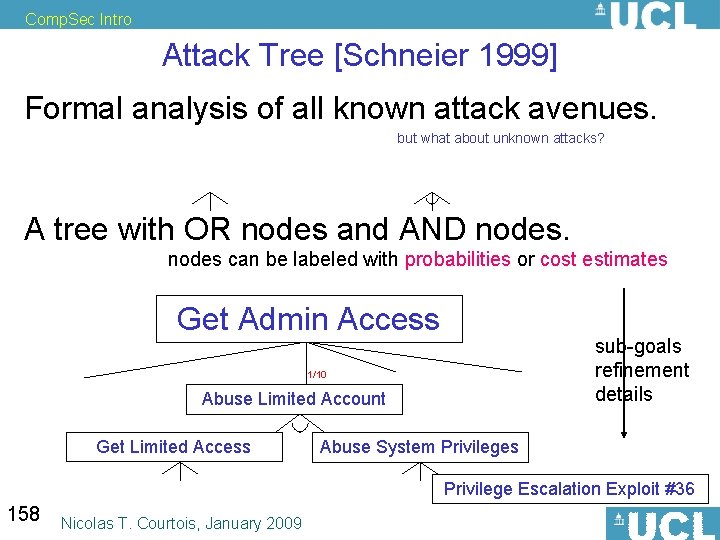
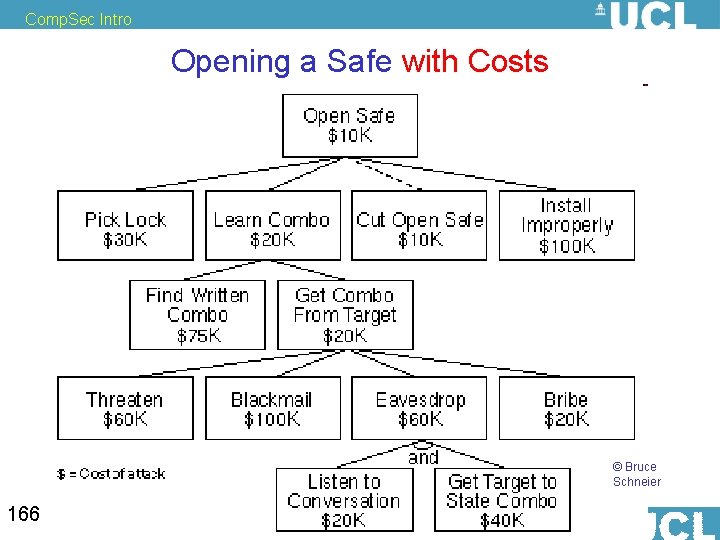
Comp. Sec Intro Attack Tree [Schneier 1999] Formal analysis of all known attack avenues. but what about unknown attacks? Identical to fault tree analysis… A tree with OR nodes and AND nodes can be labeled with probabilities or cost estimates Get Admin Access sub-goals refinement details 1/10 Abuse Limited Account Get Limited Access Abuse System Privileges Privilege Escalation Exploit #36 158 Nicolas T. Courtois, January 2009
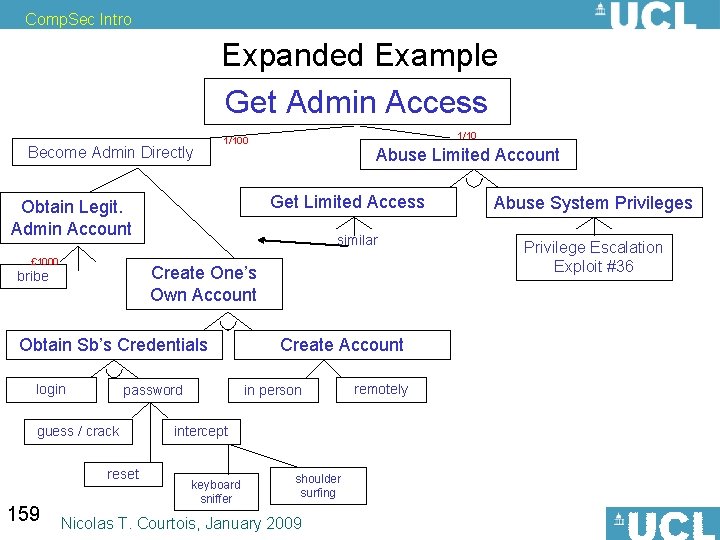
Comp. Sec Intro Expanded Example Get Admin Access Become Admin Directly similar Create One’s Own Account bribe Obtain Sb’s Credentials login password guess / crack reset 159 Abuse Limited Account Get Limited Access Obtain Legit. Admin Account £ 1000 1/100 Create Account in person intercept keyboard sniffer shoulder surfing Nicolas T. Courtois, January 2009 remotely Abuse System Privileges Privilege Escalation Exploit #36
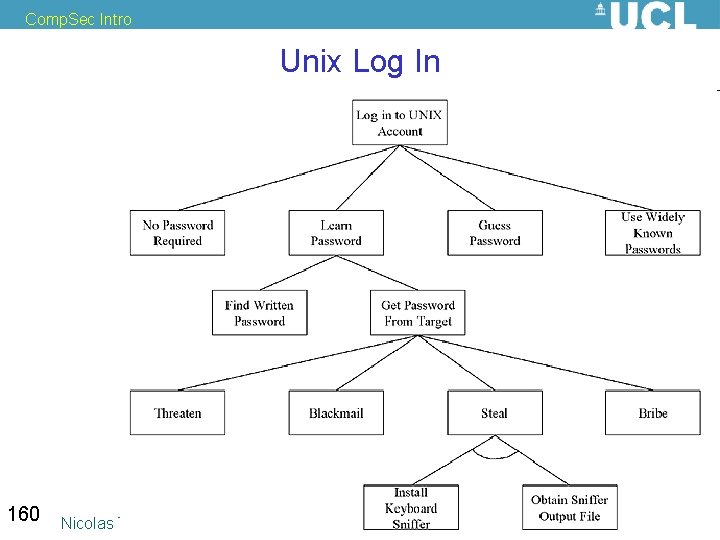
Comp. Sec Intro Unix Log In 160 Nicolas T. Courtois, January 2009
Comp. Sec Intro Weakest Link Security like a chain: Get Admin Access 1/100 Become Admin Directly 1/10 Abuse Limited Account easier! 161 Nicolas T. Courtois, January 2009
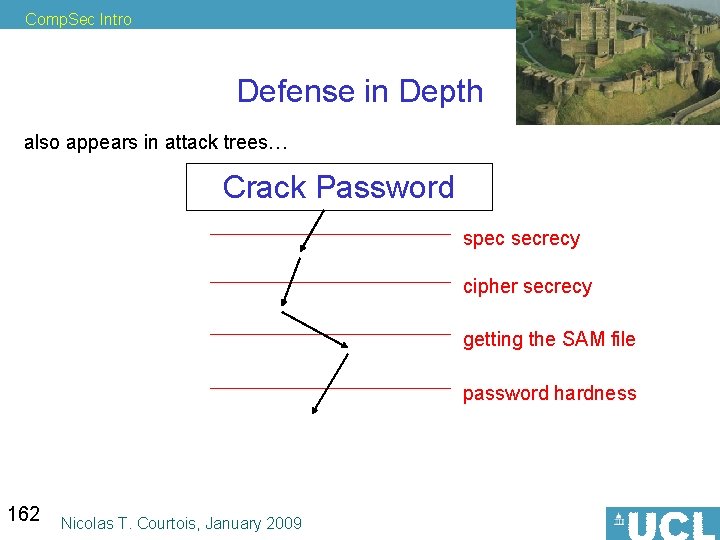
Comp. Sec Intro Defense in Depth also appears in attack trees… Crack Password spec secrecy cipher secrecy getting the SAM file password hardness 162 Nicolas T. Courtois, January 2009
Comp. Sec Intro Conclusion: In complex systems, the principles of weakest link and defence in depth will occur simultaneously. 163 Nicolas T. Courtois, January 2009
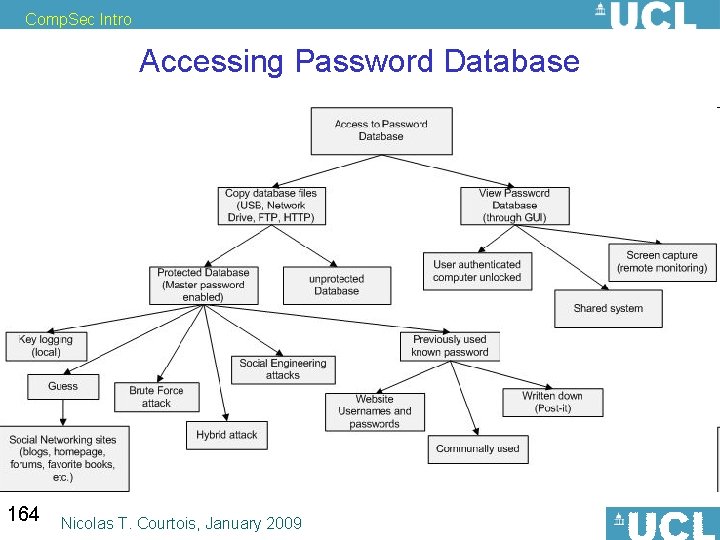
Comp. Sec Intro Accessing Password Database 164 Nicolas T. Courtois, January 2009
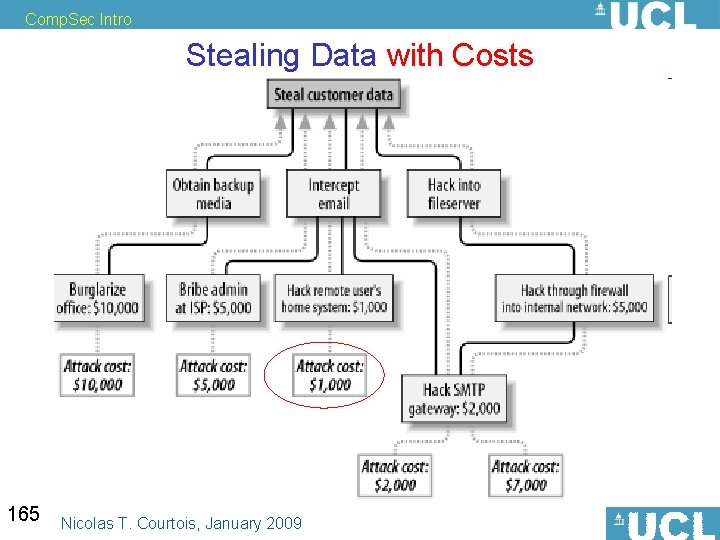
Comp. Sec Intro Stealing Data with Costs 165 Nicolas T. Courtois, January 2009
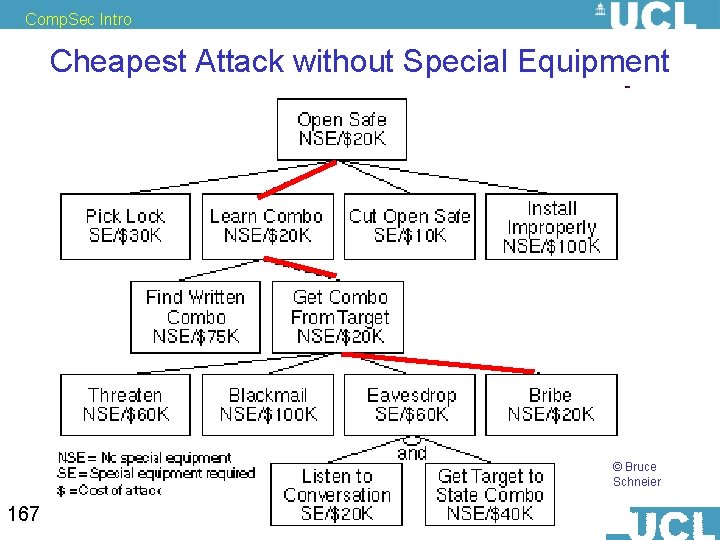
Comp. Sec Intro Opening a Safe with Costs © Bruce Schneier 166 Nicolas T. Courtois, January 2009
Comp. Sec Intro Cheapest Attack without Special Equipment © Bruce Schneier 167 Nicolas T. Courtois, January 2009
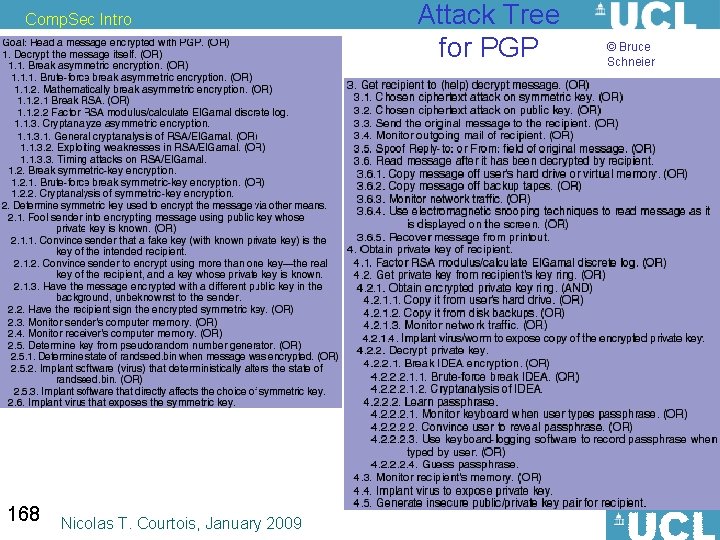
Comp. Sec Intro 168 Nicolas T. Courtois, January 2009 Attack Tree for PGP © Bruce Schneier
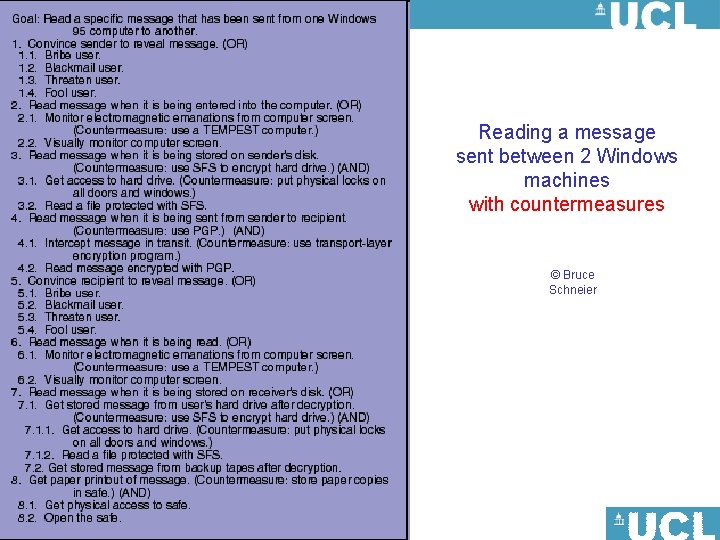
Comp. Sec Intro Reading a message sent between 2 Windows machines with countermeasures © Bruce Schneier 169 Nicolas T. Courtois, January 2009