
Clinical Supervision Foundations 1 HOUSEKEEPING 2 Module One



- Slides: 114
Clinical Supervision Foundations 1
HOUSEKEEPING 2
Module One: Learning Objectives § Get to know each other § Identify personal expectations § Clarify course assumptions § Review workshop agenda Participant Workbook – p. 8 3
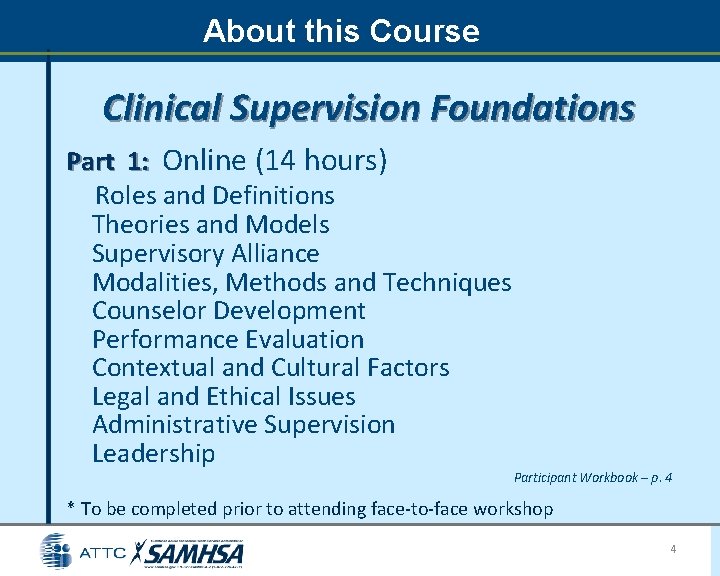
About this Course Clinical Supervision Foundations Part 1: Online (14 hours) Roles and Definitions Theories and Models Supervisory Alliance Modalities, Methods and Techniques Counselor Development Performance Evaluation Contextual and Cultural Factors Legal and Ethical Issues Administrative Supervision Leadership Participant Workbook – p. 4 * To be completed prior to attending face-to-face workshop 4
Course Assumptions § Relational issues § Direct observation § Counselor self-efficacy § Solution-based and strength-based § Needs-based approach § Outcome-oriented § Evidence-based practices § Individualized model Participant Workbook – pp. 8 -9 5
About this Course Clinical Supervision Foundations Part 2: Workshop (16 hours) 1. Roles and Definitions 2. A Personal Model of Supervision 3. Supervisory Alliance 4. Modalities and Methods 5. Assessment Resources 6. Performance Evaluation 7. Counselor Development Participant Workbook – p. 4 6
Clinical Supervision Foundations Module One Roles and Definitions 7
Module One: Learning Objectives 1. Define primary goals of supervisory practice 2. Identify discrepancies between and current practice ideal 3. Analyze own supervisory practice 4. Identify barriers to balancing roles and responsibilities Participant Workbook – p. 12 8
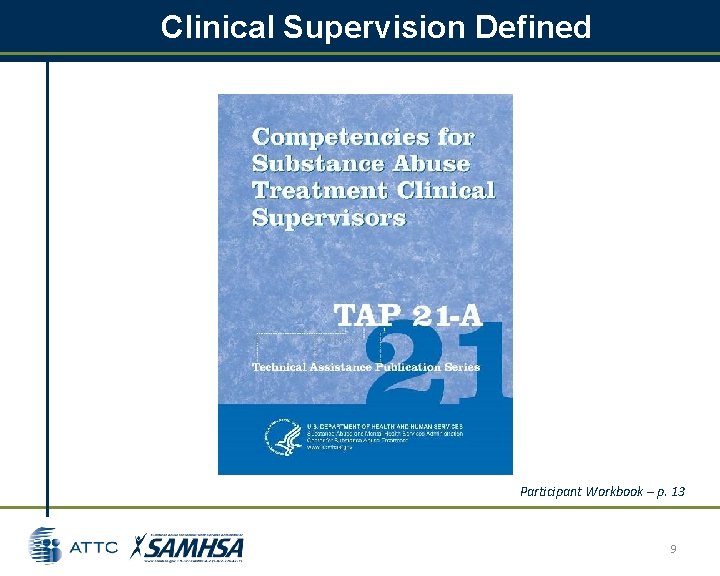
Clinical Supervision Defined Participant Workbook – p. 13 9
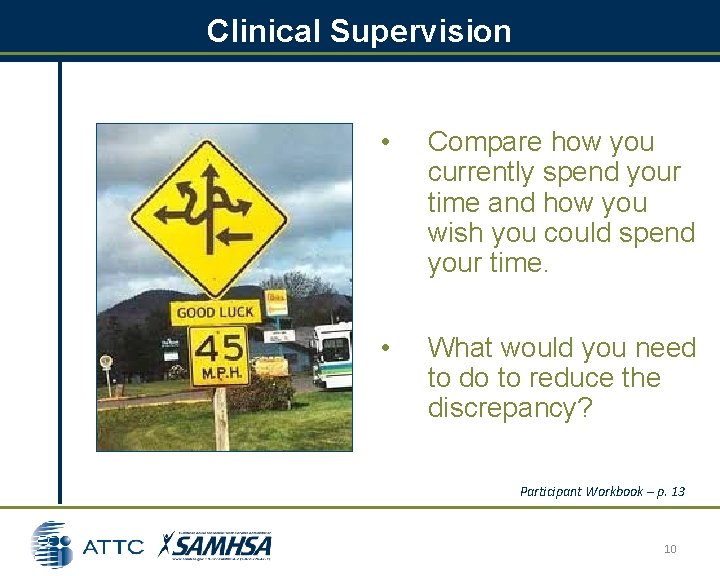
Clinical Supervision • Compare how you currently spend your time and how you wish you could spend your time. • What would you need to do to reduce the discrepancy? Participant Workbook – p. 13 10
Four Supervisory Goals 1. Promote professional growth 2. Protect welfare of clients 3. Monitor counselor performance 4. Empower counselor Participant Workbook – p. 13 11
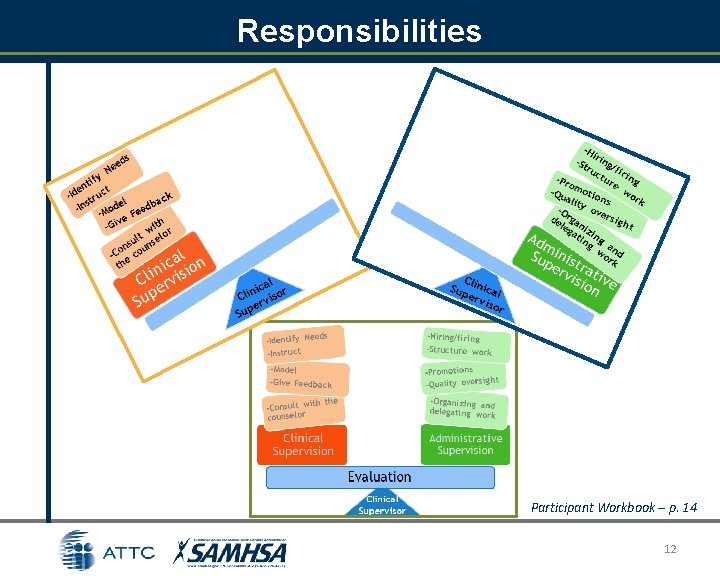
Responsibilities Participant Workbook – p. 14 12
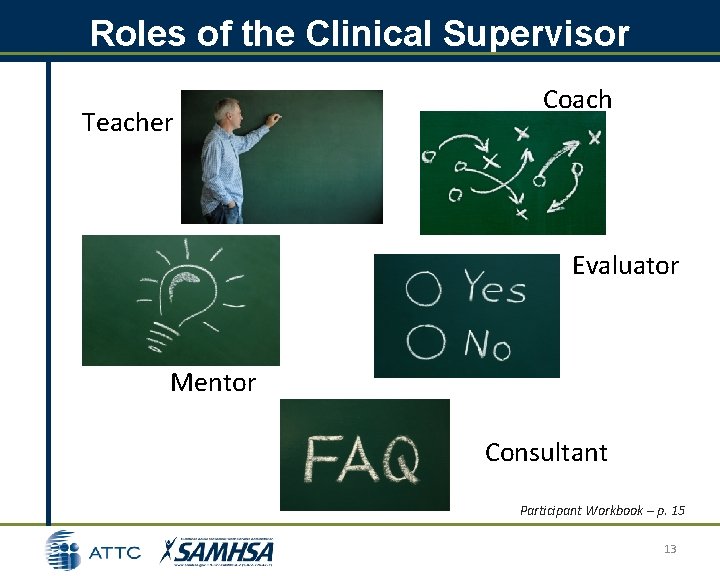
Roles of the Clinical Supervisor Teacher Coach Evaluator Mentor Consultant Participant Workbook – p. 15 13
Clinical Supervision Foundations Module Two A Personal Model of Supervision 14
Module 2: Learning Objectives 1. Articulate characteristics of various clinical supervision models 2. Describe theoretical concepts upon which your own personal approach to clinical supervision is based 3. Begin to define your own model of supervision Participant Workbook – p. 16 15
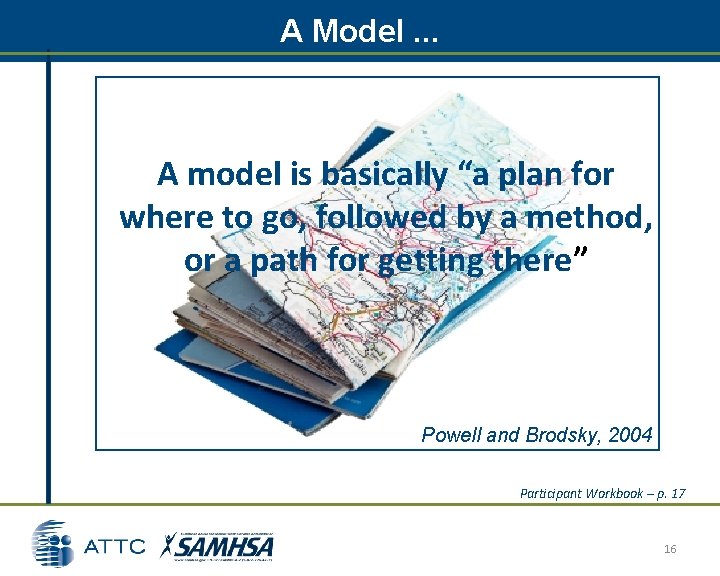
A Model. . . A model is basically “a plan for where to go, followed by a method, or a path for getting there” Powell and Brodsky, 2004 Participant Workbook – p. 17 16
“If you don’t know where you’re going any road will take you there. ” Anonymous 17
Discussion • What are the advantages of being able to explain or defend what you do as a clinical supervisor? • What is the value of having a theoretical base that supports what you do? • Who is accountable for clinical services? • How does having a supervisory model or standard protect the supervisor and the agency? 18
Theoretical Foundations • Write your answers to the Theoretical Foundations questions in the Workbook. • Next, compare and contrast your answers with others at your table. Participant Workbook – p. 24 19
Discussion • What did you discover as you answered the questions and then discussed them? • How do your ideas about change influence how you do clinical supervision? 20
Supervisory Models • • Competency based Treatment based Developmental Integrated Let’s refresh our memories Participant Workbook – pp. 17 -23 21
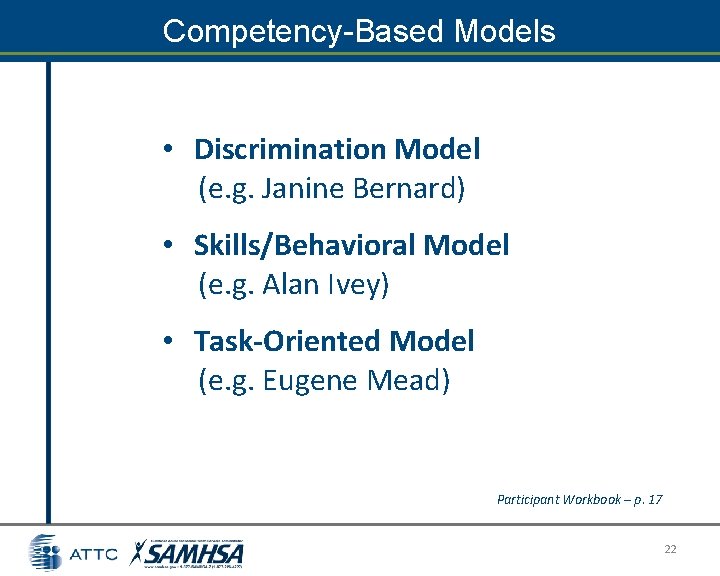
Competency-Based Models • Discrimination Model (e. g. Janine Bernard) • Skills/Behavioral Model (e. g. Alan Ivey) • Task-Oriented Model (e. g. Eugene Mead) Participant Workbook – p. 17 22
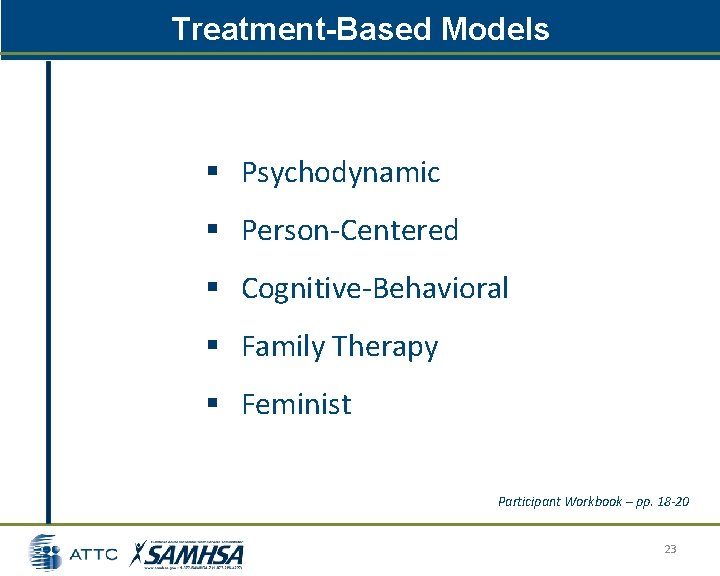
Treatment-Based Models § Psychodynamic § Person-Centered § Cognitive-Behavioral § Family Therapy § Feminist Participant Workbook – pp. 18 -20 23
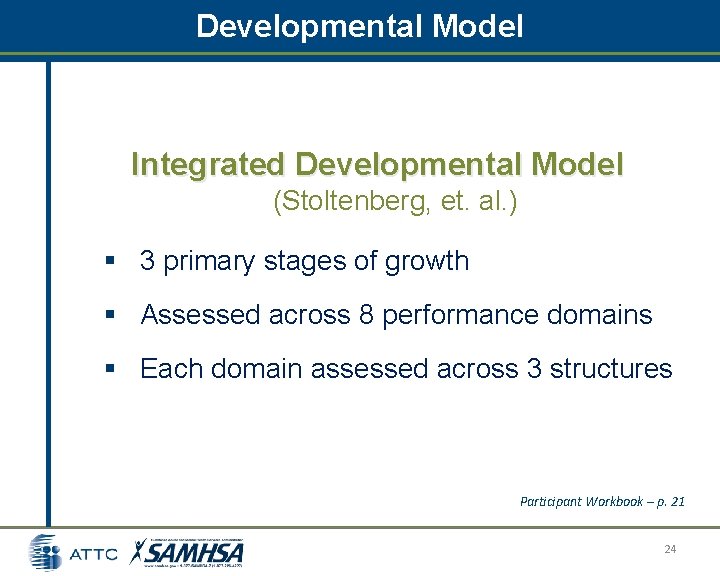
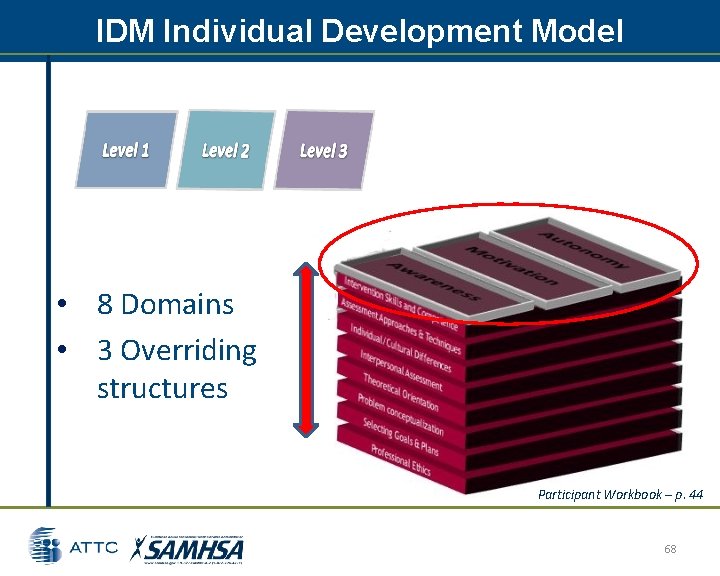
Developmental Model Integrated Developmental Model (Stoltenberg, et. al. ) § 3 primary stages of growth § Assessed across 8 performance domains § Each domain assessed across 3 structures Participant Workbook – p. 21 24
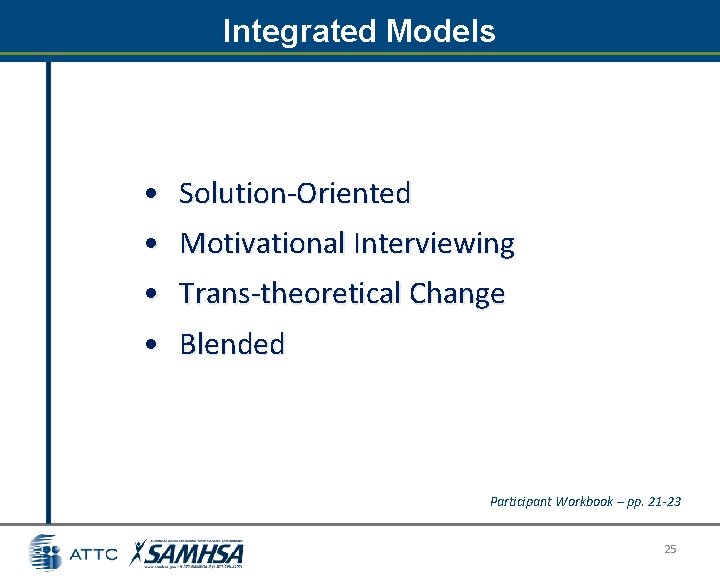
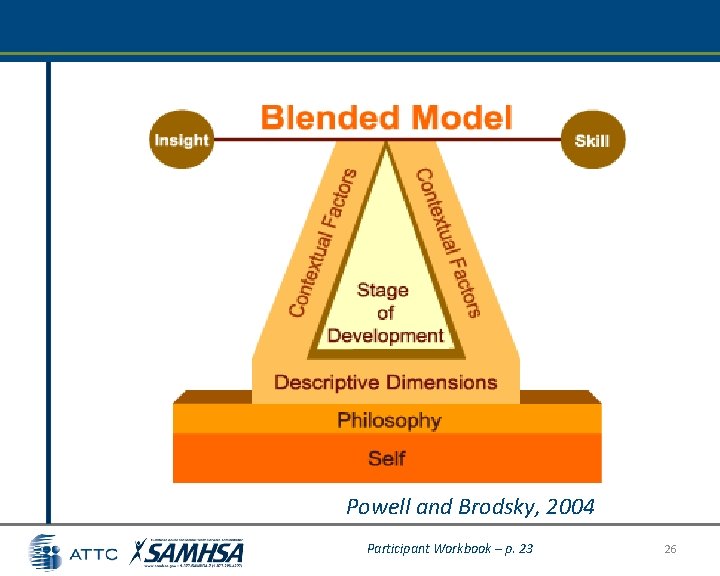
Integrated Models • Solution-Oriented • Motivational Interviewing • Trans-theoretical Change • Blended Participant Workbook – pp. 21 -23 25
Powell and Brodsky, 2004 Participant Workbook – p. 23 26
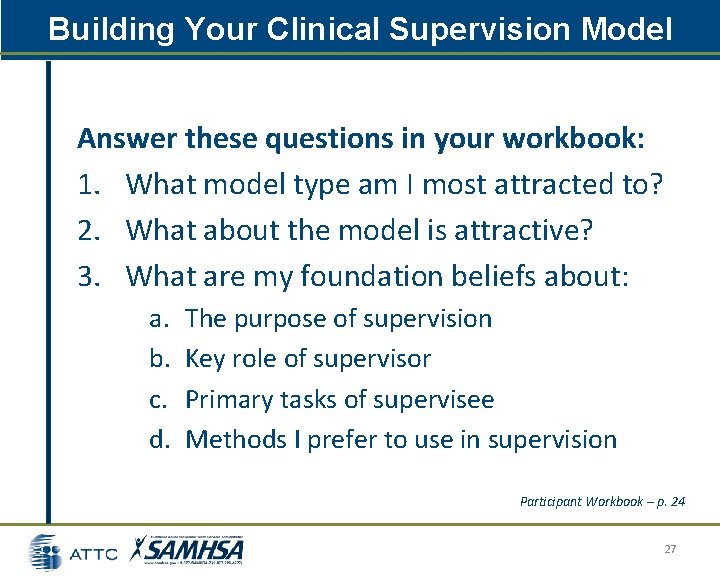
Building Your Clinical Supervision Model Answer these questions in your workbook: 1. What model type am I most attracted to? 2. What about the model is attractive? 3. What are my foundation beliefs about: a. b. c. d. The purpose of supervision Key role of supervisor Primary tasks of supervisee Methods I prefer to use in supervision Participant Workbook – p. 24 27
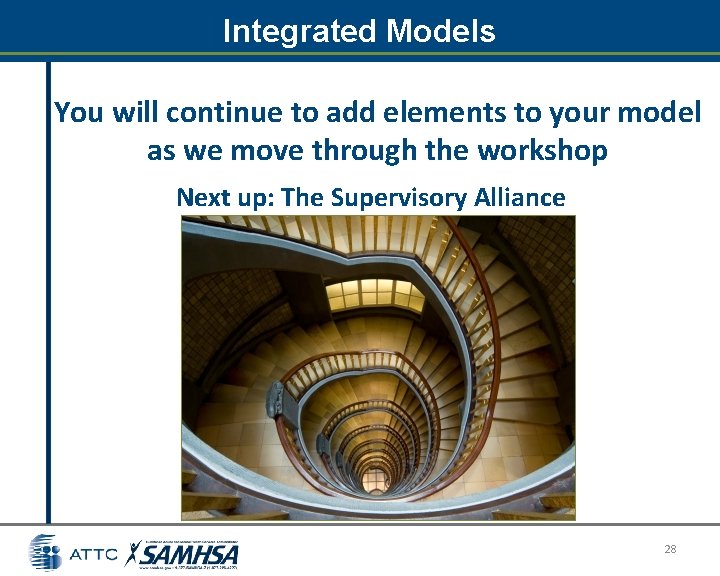
Integrated Models You will continue to add elements to your model as we move through the workshop Next up: The Supervisory Alliance 28
Clinical Supervision Foundations Module Three Supervisory Alliance 29
Module 3: Learning Objectives 1. Understand value of an effective supervisory alliance 2. Describe concept of parallel process in relation to supervisory alliance 3. Identify key factors which strengthen or compromise supervisory alliance 4. Recognize conflict in supervision and identify methods to minimize or resolve conflicts Participant Workbook – p. 25 30
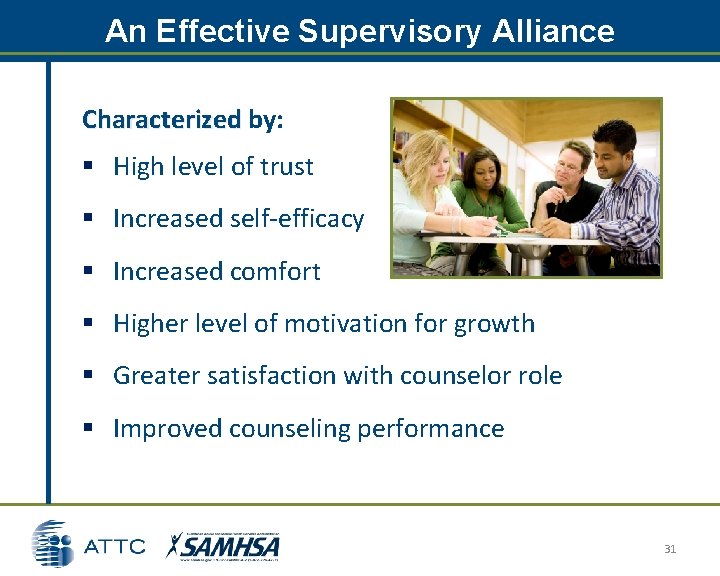
An Effective Supervisory Alliance Characterized by: Characterized § High level of trust § Increased self-efficacy § Increased comfort § Higher level of motivation for growth § Greater satisfaction with counselor role § Improved counseling performance 31
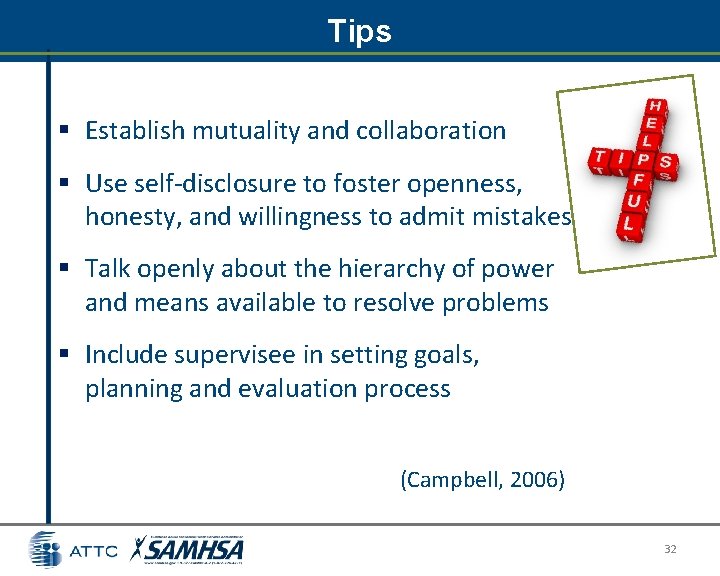
Tips § Establish mutuality and collaboration § Use self-disclosure to foster openness, honesty, and willingness to admit mistakes § Talk openly about the hierarchy of power and means available to resolve problems § Include supervisee in setting goals, planning and evaluation process (Campbell, 2006) 32
Challenges • Boundary issues/Dual relationships • Power and authority • Interpersonal processes • Conflicts with supervisee • Supervisee resistance • Supervisor resistance Participant Workbook – pp. 27 -29 33
Scenarios Participant Workbook – pp. 30 -32 34
Scenario 1: Boundary Issues You are now supervising someone you were close to as a peer. 1. What are the advantages and disadvantages? 2. What are potential problems? 3. How would you manage it? Participant Workbook – p. 30 35
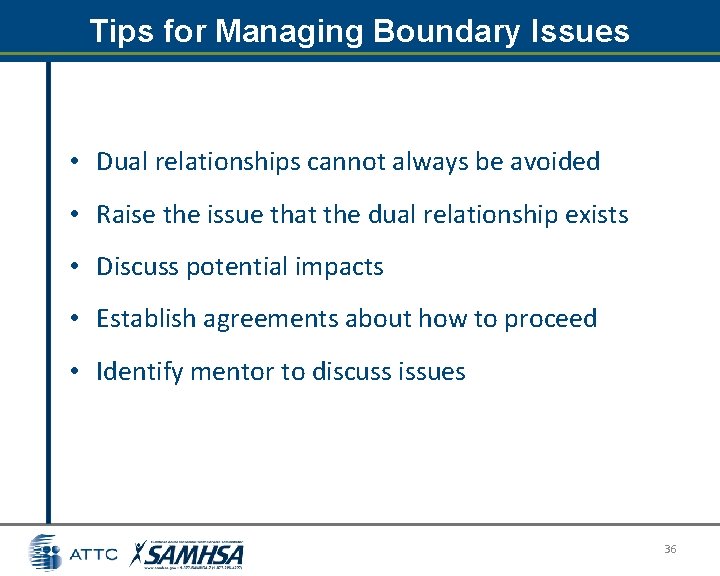
Tips for Managing Boundary Issues • Dual relationships cannot always be avoided • Raise the issue that the dual relationship exists • Discuss potential impacts • Establish agreements about how to proceed • Identify mentor to discuss issues 36
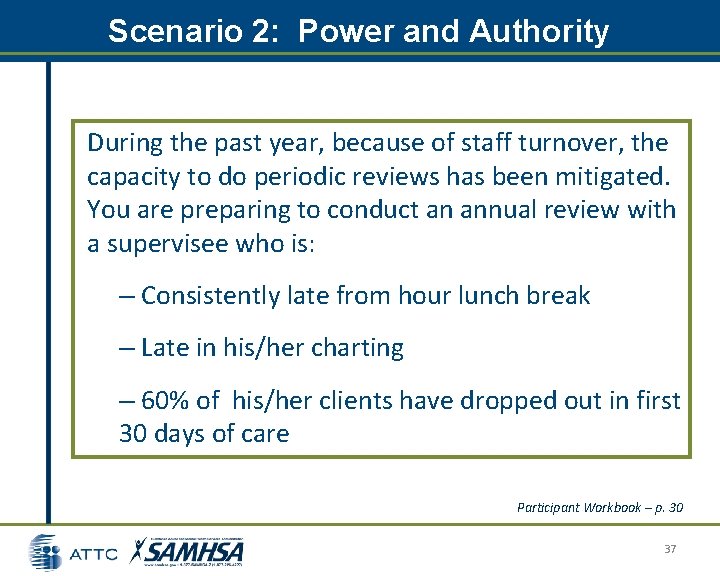
Scenario 2: Power and Authority During the past year, because of staff turnover, the capacity to do periodic reviews has been mitigated. You are preparing to conduct an annual review with a supervisee who is: – Consistently late from hour lunch break – Late in his/her charting – 60% of his/her clients have dropped out in first 30 days of care Participant Workbook – p. 30 37
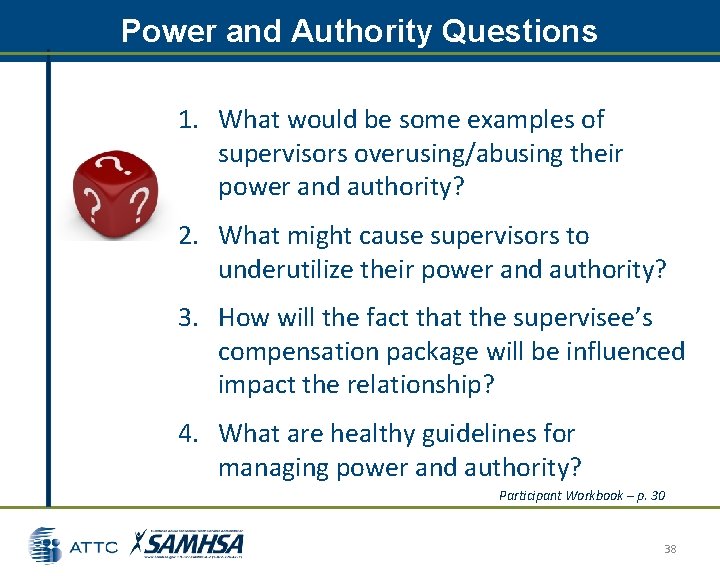
Power and Authority Questions 1. What would be some examples of supervisors overusing/abusing their power and authority? 2. What might cause supervisors to underutilize their power and authority? 3. How will the fact that the supervisee’s compensation package will be influenced impact the relationship? 4. What are healthy guidelines for managing power and authority? Participant Workbook – p. 30 38
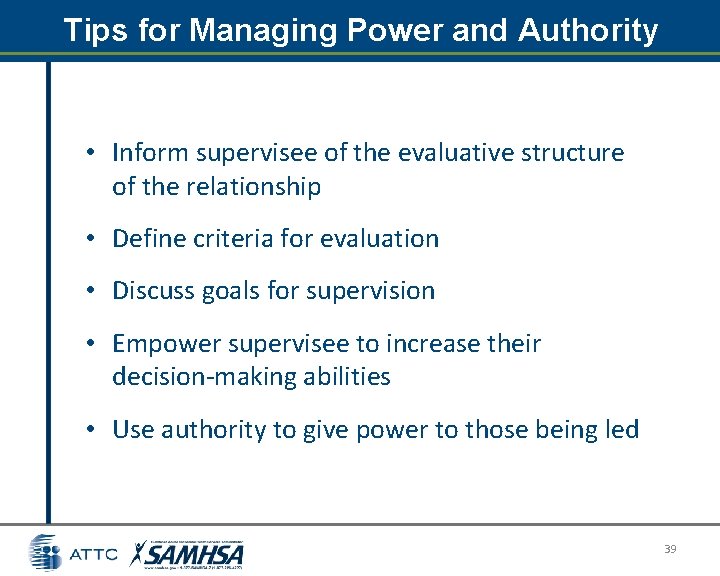
Tips for Managing Power and Authority • Inform supervisee of the evaluative structure of the relationship • Define criteria for evaluation • Discuss goals for supervision • Empower supervisee to increase their decision-making abilities • Use authority to give power to those being led 39
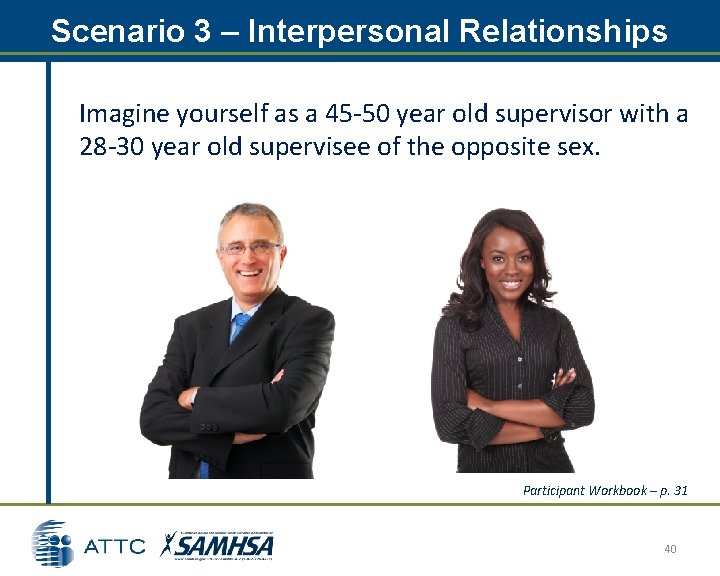
Scenario 3 – Interpersonal Relationships Imagine yourself as a 45 -50 year old supervisor with a 28 -30 year old supervisee of the opposite sex. Participant Workbook – p. 31 40
Interpersonal Relationship Questions 1. What potentially impacts the supervisory alliance? 2. How might a supervisor abuse his/her power and authority because of emotional reaction to supervisee? 3. What would your responses be if supervisor and supervisee were: • Same age and same gender • Same age and different gender • Same age, same gender, different sexual orientation Participant Workbook – p. 31 41
Tips Regarding the Relationship • Supervisors need to be aware of feelings which may impact supervision • Supervisors need to recognize clues, do careful selfexamination, and have own supervision • When relationship issues are more transparent counselors may be more open to addressing difficulties • Counselors should be rewarded for raising relationship issues in supervision • May be necessary to transfer supervisees 42
Scenario 4: Conflict Imagine yourself in supervisory relationship where: – Supervisor believes in empowering clients to take responsibility for their own recovery – Supervisee believes in providing guidance to help the client avoid making mistakes which will interfere with their recovery Participant Workbook – p. 32 43
Conflict Questions 1. How might these differences impact the supervisory relationship? 2. What are special considerations supervisor will have to give to establish a successful supervisory alliance? 3. What guidelines would you suggest for managing these ideological differences? Participant Workbook – p. 32 44
Tips for Managing Conflict • Open and frank discussions • Describe a satisfactory relationship • Identify steps to reach a satisfactory relationship • Share goals to gauge similarities and differences • Acknowledge counselor’s challenges • Recognize, appreciate, and understand counselor 45
Scenario 5: Resistance A supervisee’s former supervisor was highly critical, directive, and constantly disappointed in the supervisee’s performance. Now in a new supervisory relationship, the supervisee is hesitant, afraid of criticism, of taking risks, and of being observed. Even though the supervisee is achievement oriented, there seems to be a strong fear of failure. The supervisor notices the resistance to supervision and is trying to communicate that making mistakes and taking risks are a natural part of the learning process. Participant Workbook – p. 32 46
Resistance Questions 1. What does the supervisor have to attend to in this situation to enhance the alliance? 2. How can supervisor reassure supervisee? 3. What would be impact of having such a supervisee on supervisor’s expectations and how relationship will develop? 4. What are some guidelines for managing resistant counselors? Participant Workbook – p. 32 47
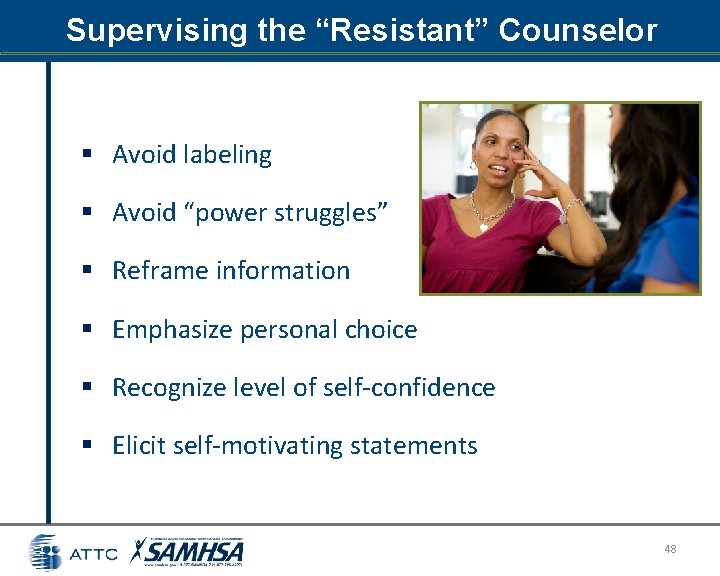
Supervising the “Resistant” Counselor § Avoid labeling § Avoid “power struggles” § Reframe information § Emphasize personal choice § Recognize level of self-confidence § Elicit self-motivating statements 48
Clinical Supervision Foundations Module Four Supervisory Modalities and Methods 49
Module 4: Learning Objectives 1. Define when to use selected modalities 2. Describe three different methods of gathering job performance information 3. List methods for individual and group CS 4. Build enthusiasm for direct observation Participant Workbook – p. 33 50
Clinical Supervision Models • Competency based • Treatment based • Developmental • Integrated Participant Workbook – p. 33 51
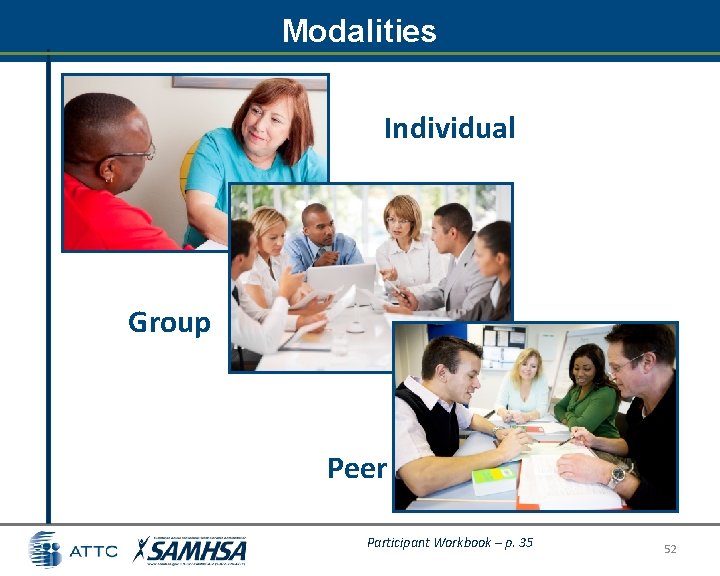
Modalities Individual Group Peer Participant Workbook – p. 35 52
Supervision Modality Decision Questionnaire Participant Workbook – p. 34 53
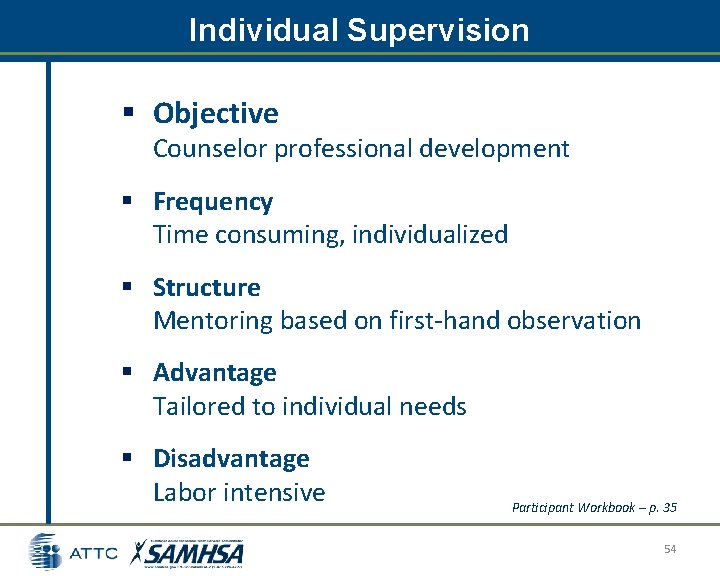
Individual Supervision § Objective Counselor professional development § Frequency Time consuming, individualized § Structure Mentoring based on first-hand observation § Advantage Tailored to individual needs § Disadvantage Labor intensive Participant Workbook – p. 35 54
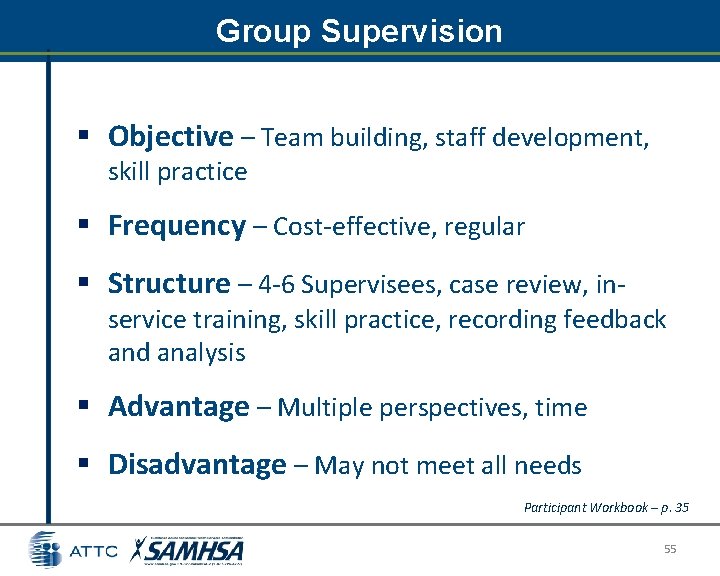
Group Supervision § Objective – Team building, staff development, skill practice § Frequency – Cost-effective, regular § Structure – 4 -6 Supervisees, case review, in- service training, skill practice, recording feedback and analysis § Advantage – Multiple perspectives, time § Disadvantage – May not meet all needs Participant Workbook – p. 35 55
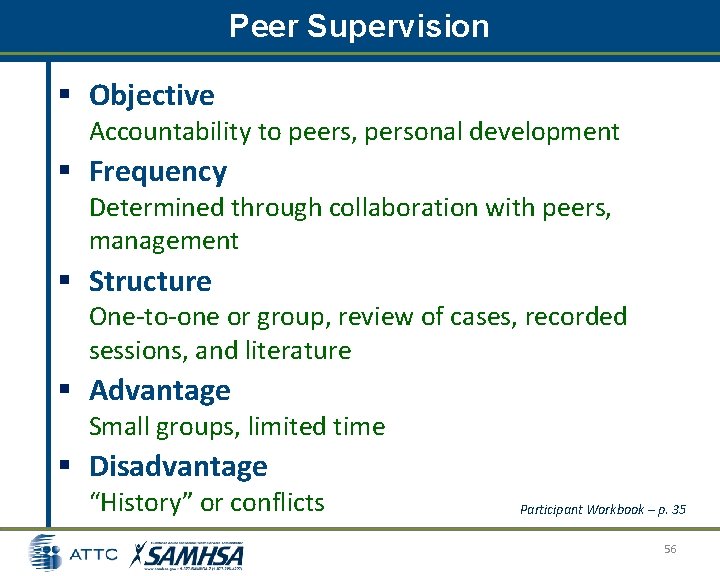
Peer Supervision § Objective Accountability to peers, personal development § Frequency Determined through collaboration with peers, management § Structure One-to-one or group, review of cases, recorded sessions, and literature § Advantage Small groups, limited time § Disadvantage “History” or conflicts Participant Workbook – p. 35 56
Case Study Review 1. Briefly review the four cases and decide which supervision modality seems most appropriate for each 2. Share your reasoning with your small group 3. Discuss your conclusions in the large group Participant Workbook – pp. 36 -38 57
Supervisory Methods Choices depend on: ü Personal preference ü Supervisee needs ü Agency policy Participant Workbook – p. 39 58
Direct Observation § Live § One-way mirror § Audio or video recording Participant Workbook – p. 39 59
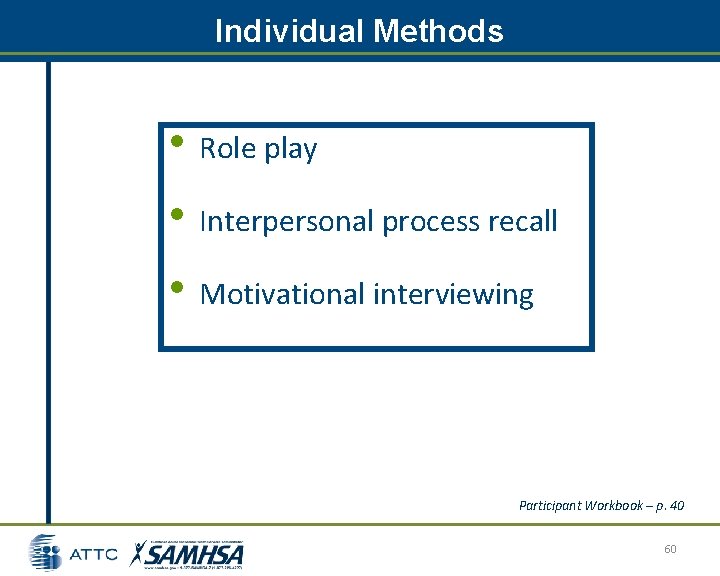
Individual Methods • Role play • Interpersonal process recall • Motivational interviewing Participant Workbook – p. 40 60
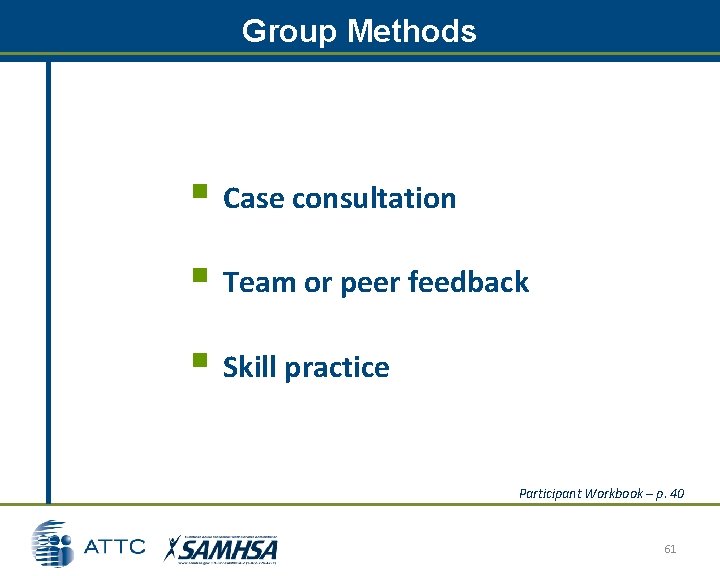
Group Methods § Case consultation § Team or peer feedback § Skill practice Participant Workbook – p. 40 61
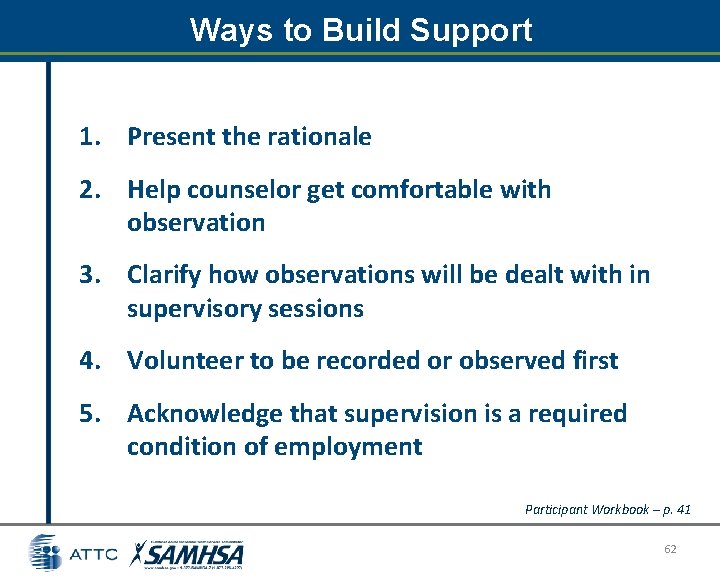
Ways to Build Support 1. Present the rationale 2. Help counselor get comfortable with observation 3. Clarify how observations will be dealt with in supervisory sessions 4. Volunteer to be recorded or observed first 5. Acknowledge that supervision is a required condition of employment Participant Workbook – p. 41 62
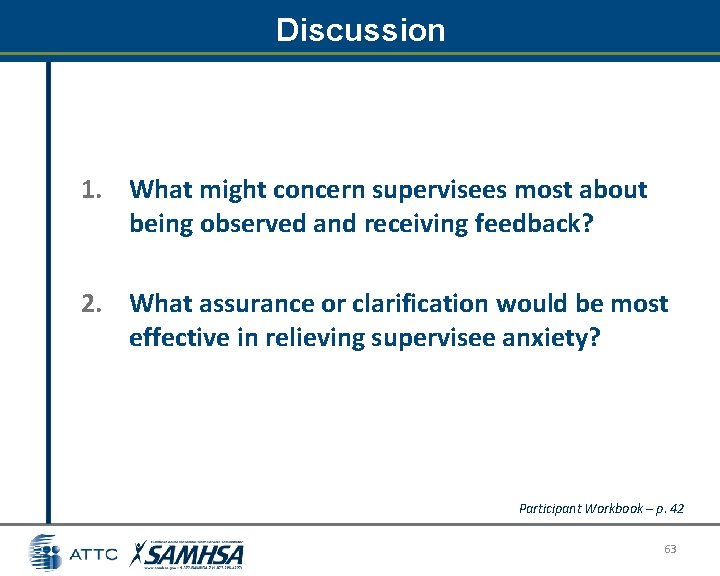
Discussion 1. What might concern supervisees most about being observed and receiving feedback? 2. What assurance or clarification would be most effective in relieving supervisee anxiety? Participant Workbook – p. 42 63
Practice Securing Support 1. Observe a demonstration and discuss 2. Practice in groups of 3 Ü Supervisor Ü Supervisee Ü Observer 3. Roles rotate as you engage in three 5 -7 minute interviews 4. Observer gives feedback on methods used 5. Supervisee shares impact of the interview on enthusiasm for clinical supervision Participant Workbook – p. 41 64
Continuing Concerns What uncertainties or fears do you have about direct observation? Next: Counselor development 65
Clinical Supervision Foundations Module Five Assessment Resources 66
Module 5: Learning Objectives 1. Understand the value of a developmental perspective 2. Link TAP 21: Addiction Counseling Competencies to the companion Performance Assessment Rubrics 3. Assess counselor performance and develop learning goals using TAP 21 and the Rubrics Participant Workbook – p. 43 67
IDM Individual Development Model • 8 Domains • 3 Overriding structures Participant Workbook – p. 44 68
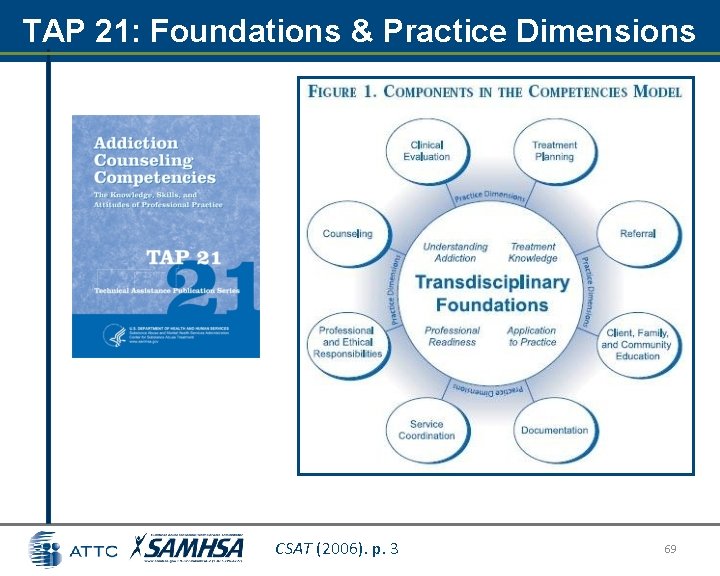
TAP 21: Foundations & Practice Dimensions CSAT (2006). p. 3 69
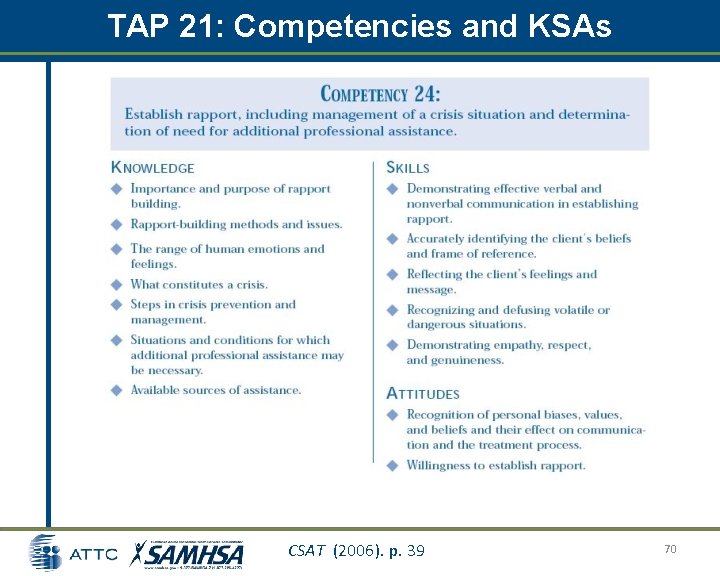
TAP 21: Competencies and KSAs CSAT (2006). p. 39 70
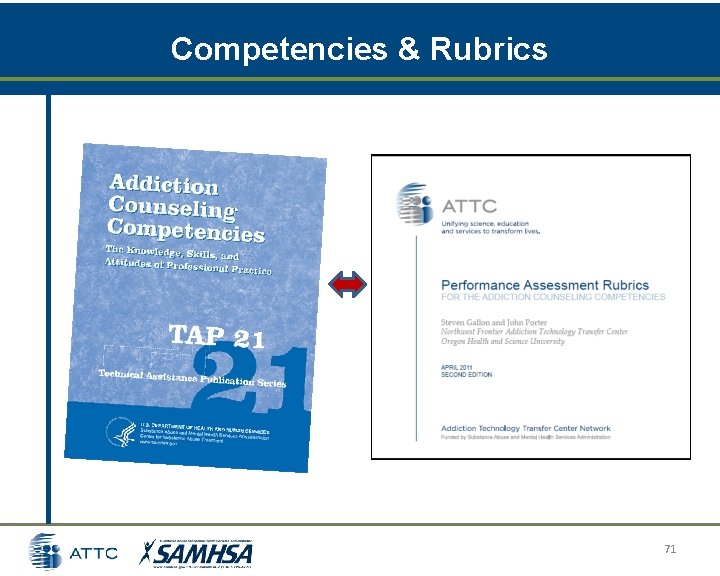
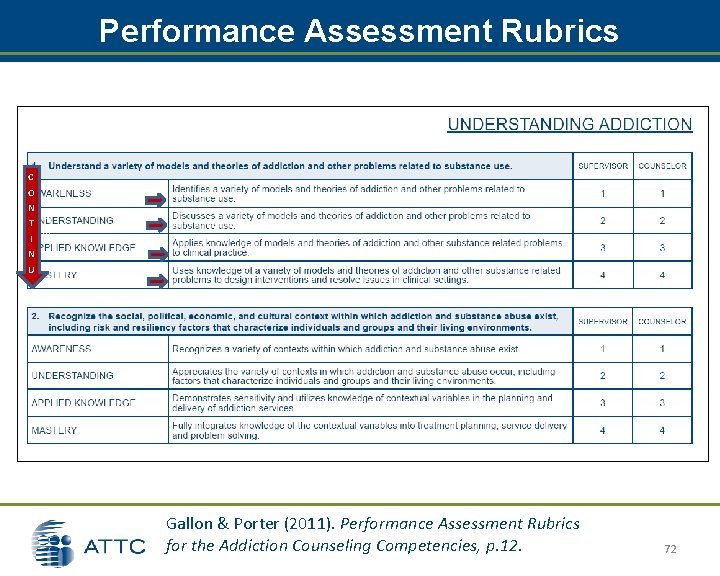
Competencies & Rubrics 71
Performance Assessment Rubrics C O N U T M I N U Gallon & Porter (2011). Performance Assessment Rubrics for the Addiction Counseling Competencies, p. 12. 72
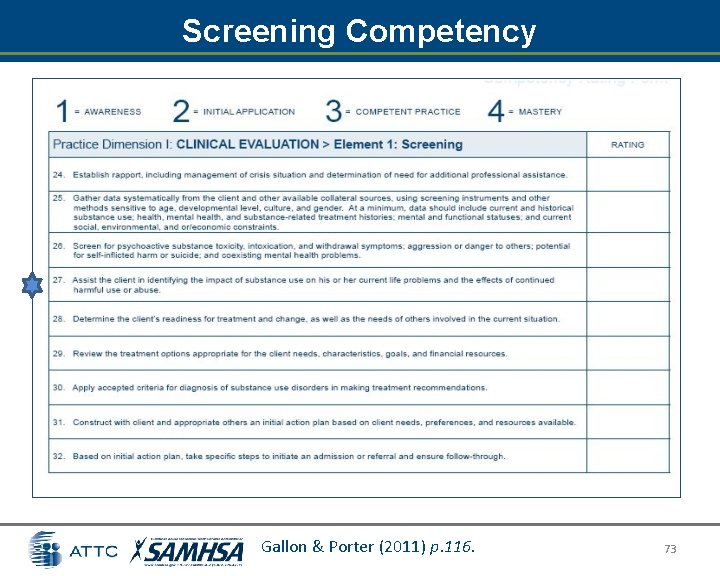
Screening Competency Gallon & Porter (2011) p. 116. 73
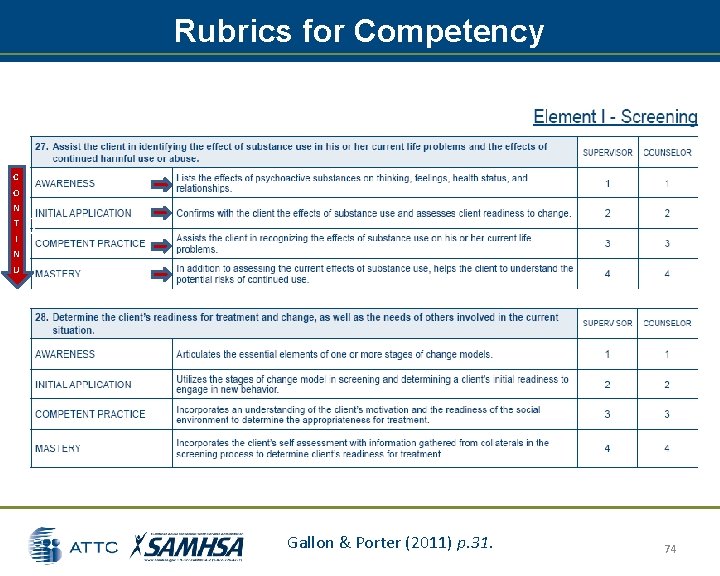
Rubrics for Competency C O N U T M I N U Gallon & Porter (2011) p. 31. 74
Rubrics Exercise Think of a specific supervisee (or counselor) for whom Competency 24 has been a challenge: 1. Use rubric for Competency 24 to assess/rate proficiency. 2. Use the KSA breakdown to identify issues for improvement. 3. Explain your assessment of counselor’s proficiency in Competency 24. 4. Propose one or two learning goals with “supervisee” to consider based on KSAs. 5. Summarize discussion. 6. Exchange roles and repeat the exercise. Participant Workbook – p. 45 75
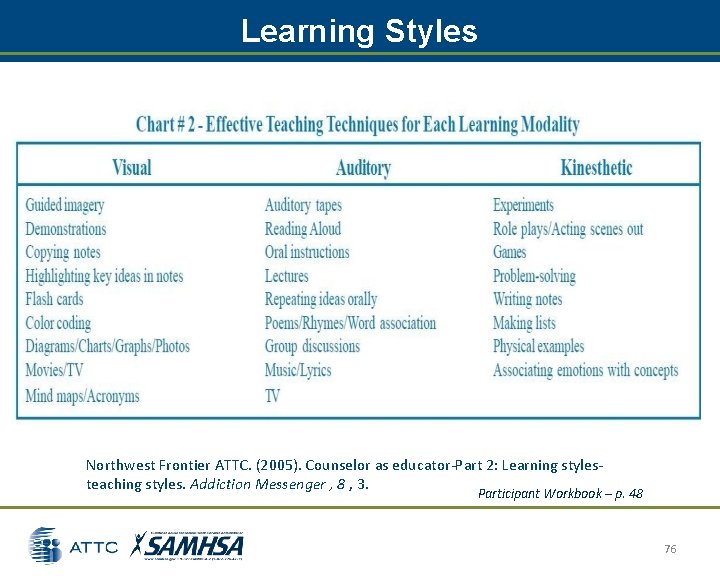
Learning Styles Northwest Frontier ATTC. (2005). Counselor as educator-Part 2: Learning stylesteaching styles. Addiction Messenger , 8 , 3. Participant Workbook – p. 48 76
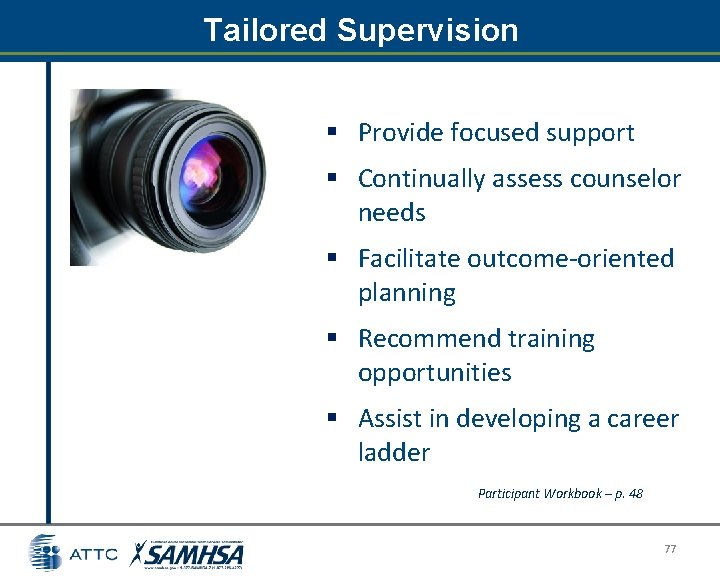
Tailored Supervision § Provide focused support § Continually assess counselor needs § Facilitate outcome-oriented planning § Recommend training opportunities § Assist in developing a career ladder Participant Workbook – p. 48 77
Clinical Supervision Foundations Module Six Performance Evaluation 78
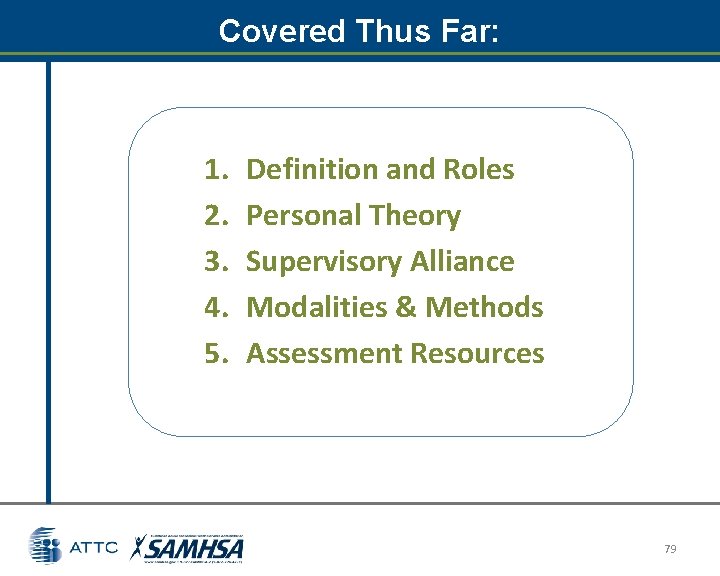
Covered Thus Far: 1. 2. 3. 4. 5. Definition and Roles Personal Theory Supervisory Alliance Modalities & Methods Assessment Resources 79
Module 6: Learning Objectives 1. Identify importance of performance evaluation 2. List a number of methods for monitoring job performance 3. Provide performance-based feedback 4. Structure supervisory interviews to be of most benefit Participant Workbook – p. 49 80
Role of Performance Evaluation 1. Assess job performance and professional development within context of supportive alliance 2. Link counselor performance with criteria and evaluation methods 3. Engage supervisees in continuous learning 4. Assure agency mission, quality of care and client safety Participant Workbook – p. 49 81
Case Study 1. Read the case study 2. Identify concerns about the interview 3. Note what merits positive feedback 4. What strategy might foster professional development within the counselor? 5. On what would you focus in providing performance based feedback? Participant Workbook – p. 50 82
Supervisory Methods: A Review Direct observation Individual or tutorial Group Participant Workbook – p. 52 83
Resources • Performance Assessment Rubrics • Fidelity measures for EBP 84
Measuring EBP Implementation • Using established fidelity scales • Modifying established fidelity scales • Identifying agency-based performance indicators 85
Levels of Fidelity Assessment • Program: Addresses whether structure, procedures, and routines are in place • Practitioner: Addresses whether practitioner is delivering services consistent with program • Client: Addresses whether client is receiving services within the practice framework 86
Integrative Activity 1. Reconsider the case study of Tony and his counselor, Megan 2. On which issues would you consider giving Megan feedback? 3. Using Practice Dimensions I and II in the Rubrics document, identify up to three competencies which could be targeted for Megan’s professional development Participant Workbook – p. 53 87
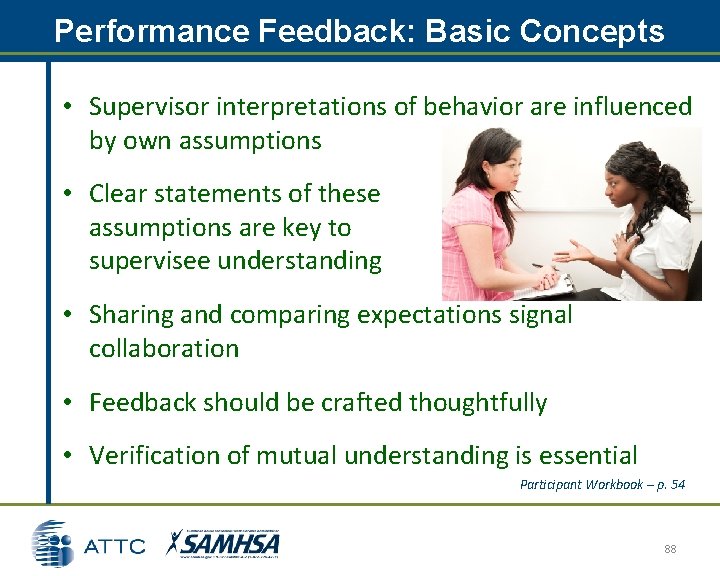
Performance Feedback: Basic Concepts • Supervisor interpretations of behavior are influenced by own assumptions • Clear statements of these assumptions are key to supervisee understanding • Sharing and comparing expectations signal collaboration • Feedback should be crafted thoughtfully • Verification of mutual understanding is essential Participant Workbook – p. 54 88
Feedback Defined Feedback is any overt response, verbal or nonverbal, that gives specific and subjective information about how a person’s behavior in a particular situation affects someone or something Participant Workbook – p. 54 89
Objective Transmit reliable information so that a person receiving it can establish a “data bank” from which to change behavior if she/he chooses to do so. Participant Workbook – p. 54 90
Oral Feedback Model O = Observe R = Report A = Assumption L = Level Participant Workbook – p. 55 91
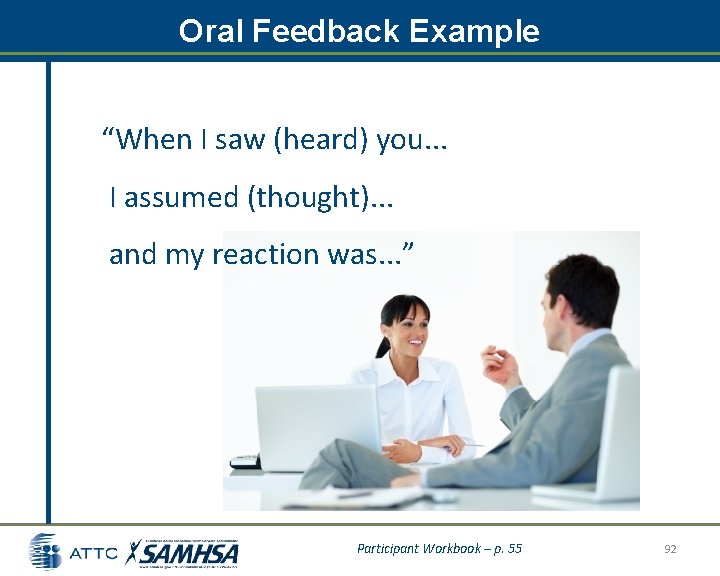
Oral Feedback Example “When I saw (heard) you. . . I assumed (thought). . . and my reaction was. . . ” Participant Workbook – p. 55 92
Adding Three More Steps … 1. Start by asking for permission to share feedback 2. Request playback of the message 3. Confirm mutual understanding after accurate playback Participant Workbook – p. 55 93
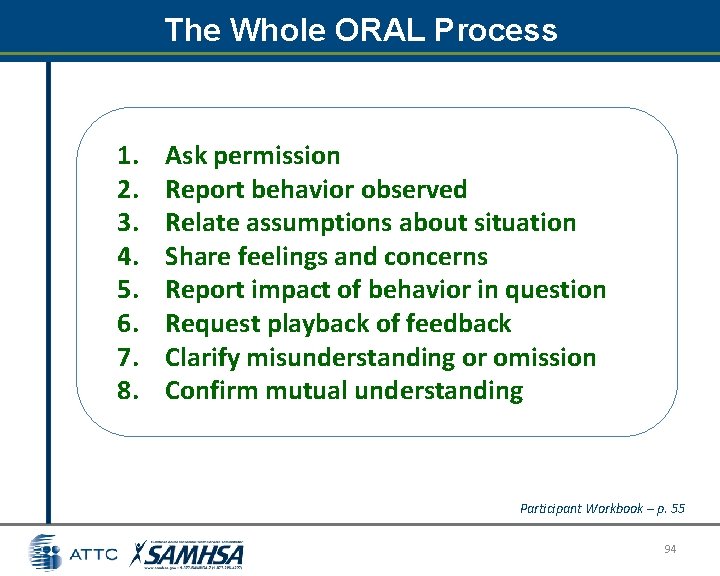
The Whole ORAL Process 1. 2. 3. 4. 5. 6. 7. 8. Ask permission Report behavior observed Relate assumptions about situation Share feelings and concerns Report impact of behavior in question Request playback of feedback Clarify misunderstanding or omission Confirm mutual understanding Participant Workbook – p. 55 94
Practice-Optional • • Groups of 3 Supervisor – Supervisee – Observer 3 cycles in this activity – roles rotate Each cycle: – Supervisor provides performance feedback to supervisee using ORAL model – Observer provides feedback on use of model Participant Workbook – p. 55 95
Discussion What is the value of the ORAL model? How important is the playback? How might this skill impact the relationship between supervisor and supervisee? 96
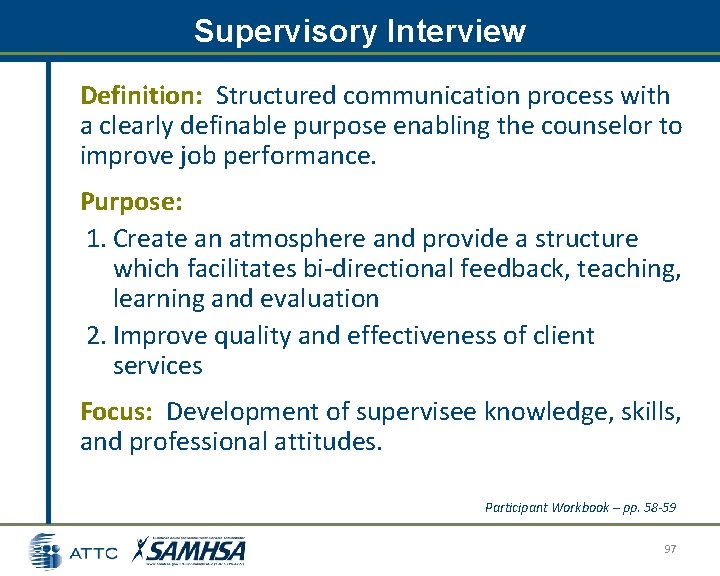
Supervisory Interview Definition: Structured communication process with a clearly definable purpose enabling the counselor to improve job performance. Purpose: 1. Create an atmosphere and provide a structure which facilitates bi-directional feedback, teaching, learning and evaluation 2. Improve quality and effectiveness of client services Focus: Development of supervisee knowledge, skills, and professional attitudes. Participant Workbook – pp. 58 -59 97
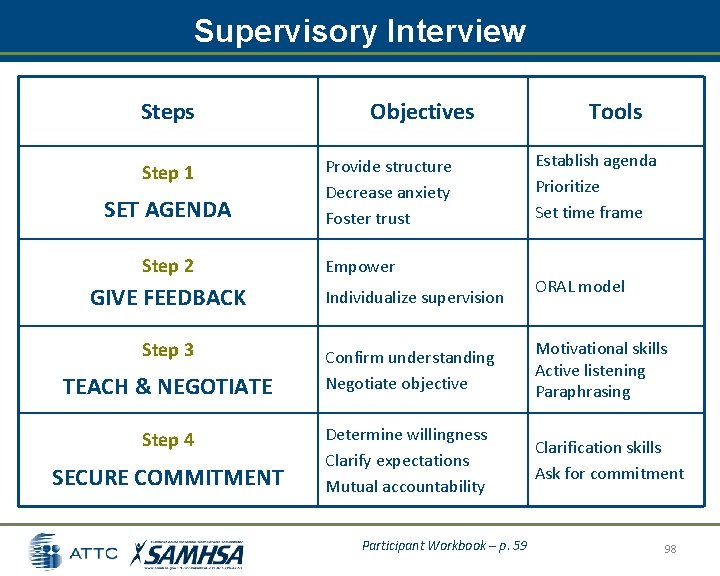
Supervisory Interview Steps Step 1 SET AGENDA Step 2 Objectives Provide structure Decrease anxiety Foster trust Empower Tools Establish agenda Prioritize Set time frame ORAL model GIVE FEEDBACK Individualize supervision Step 3 Confirm understanding Negotiate objective Motivational skills Active listening Paraphrasing Determine willingness Clarify expectations Mutual accountability Clarification skills Ask for commitment TEACH & NEGOTIATE Step 4 SECURE COMMITMENT Participant Workbook – p. 59 98
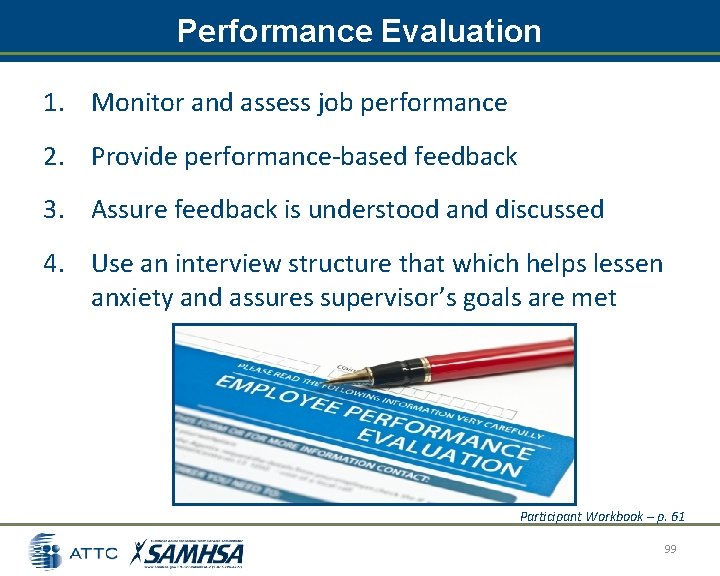
Performance Evaluation 1. Monitor and assess job performance 2. Provide performance-based feedback 3. Assure feedback is understood and discussed 4. Use an interview structure that which helps lessen anxiety and assures supervisor’s goals are met Participant Workbook – p. 61 99
Clinical Supervision Foundations Module Seven Counselor Development 100
Covered Thus Far: 1. 2. 3. 4. 5. 6. Definition and Roles Personal Theory Supervisory Alliance Modalities & Methods Assessment Resources Performance Evaluation 101
Module 7: Learning Objectives 1. Verbalize a process for facilitating professional growth of supervisees, 2. Appreciate cultural and contextual factors that impact the supervisory relationship 3. Utilize a Professional Development Plan, and 4. Plan to implement selected strategies from this workshop in the workplace. Participant Workbook – p. 63 102
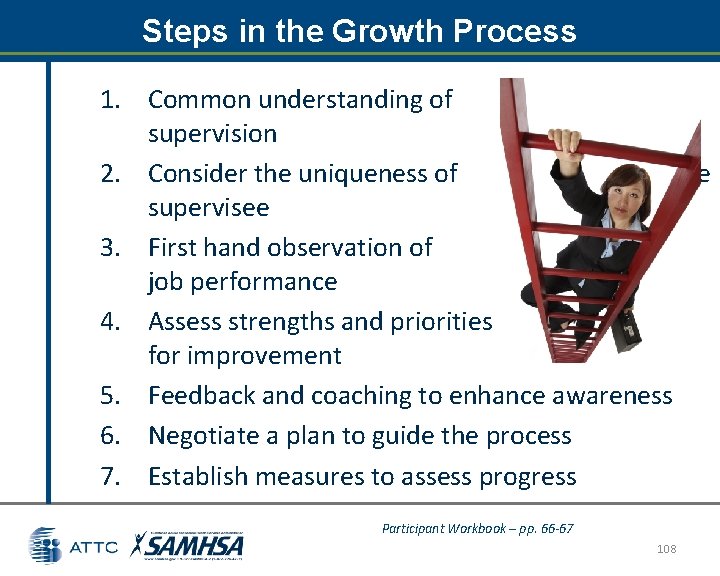
Steps in the Growth Process 1. Common understanding of supervision 2. Consider the uniqueness of the supervisee 3. First hand observation of job performance 4. Assess strengths and priorities for improvement 5. Feedback and coaching to enhance awareness 6. Negotiate a plan to guide the process 7. Establish measures to assess progress Participant Workbook – p. 64 103
Gaining Cultural Sensitivity § Become self-aware § Engage a supervisee-centered relationship § Be culturally responsive Participant Workbook – p. 64 104
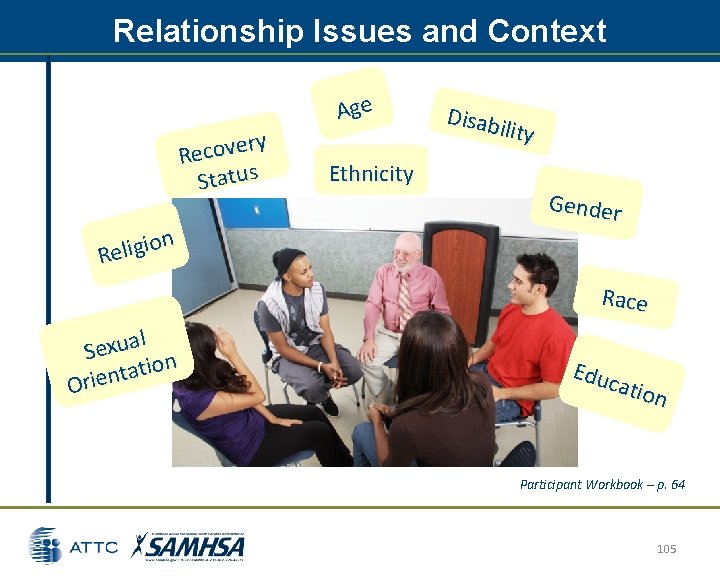
Relationship Issues and Context Age ry e v o c e R Status n o i g i l Re Ethnicity Disab ility Gender Race l Sexua n tio a t n e i Or Educ ation Participant Workbook – p. 64 105
Strategies for Relationship Building § § § § § Examine your own biases and assumptions Explore and discuss differences openly Increase personal sensitivity Value differences Promote contextual understanding Use context to strengthen relationships Create collaboration Promote learning and growth Provide proactive staff training Create an environment for multicultural communication Participant Workbook – p. 65 106
Simple Steps • Avoid generalizations • Be aware that many factors affect how people think, perceive, and act • Ask questions rather than assume • Do not imagine you know all there is to know. Participant Workbook – p. 65 107
Steps in the Growth Process 1. Common understanding of supervision 2. Consider the uniqueness of the supervisee 3. First hand observation of job performance 4. Assess strengths and priorities for improvement 5. Feedback and coaching to enhance awareness 6. Negotiate a plan to guide the process 7. Establish measures to assess progress Participant Workbook – pp. 66 -67 108
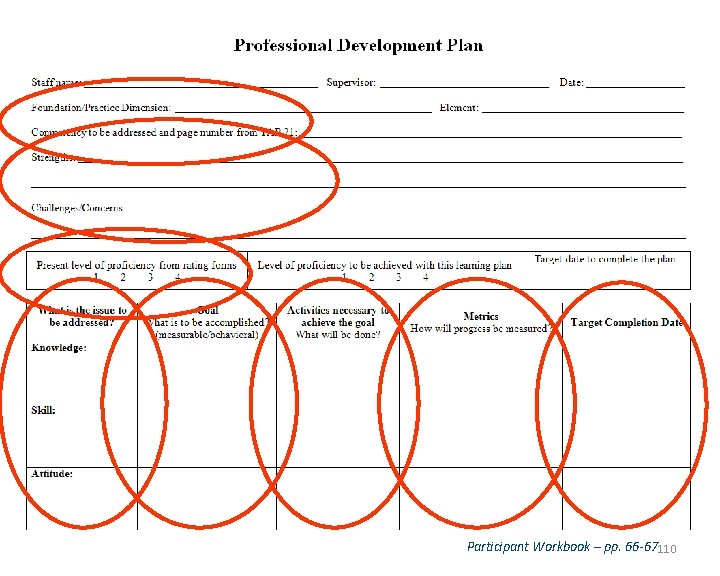
Elements of a Planning Tool • A target competency • Counselor strengths • Specific concerns • Identification of target KSA’s • Learning activities, and • Measures of progress Participant Workbook – pp. 66 -67 109
Participant Workbook – pp. 66 -67 110
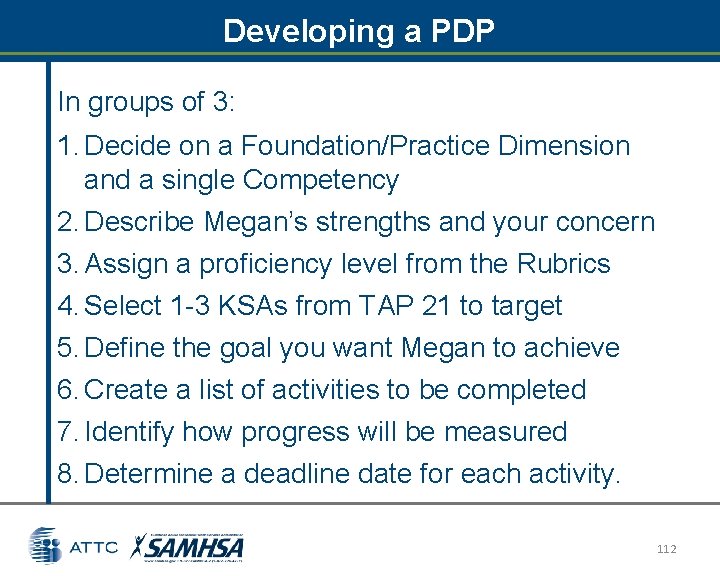
Developing a PDP In groups of 3: 1. Decide on a Foundation/Practice Dimension and a single Competency 2. Describe Megan’s strengths and your concern 3. Assign a proficiency level from the Rubrics 4. Select 1 -3 KSAs from TAP 21 to target 5. Define the goal you want Megan to achieve 6. Create a list of activities to be completed 7. Identify how progress will be measured 8. Determine a deadline date for each activity. 111
Developing a PDP In groups of 3: 1. Decide on a Foundation/Practice Dimension and a single Competency 2. Describe Megan’s strengths and your concern 3. Assign a proficiency level from the Rubrics 4. Select 1 -3 KSAs from TAP 21 to target 5. Define the goal you want Megan to achieve 6. Create a list of activities to be completed 7. Identify how progress will be measured 8. Determine a deadline date for each activity. 112
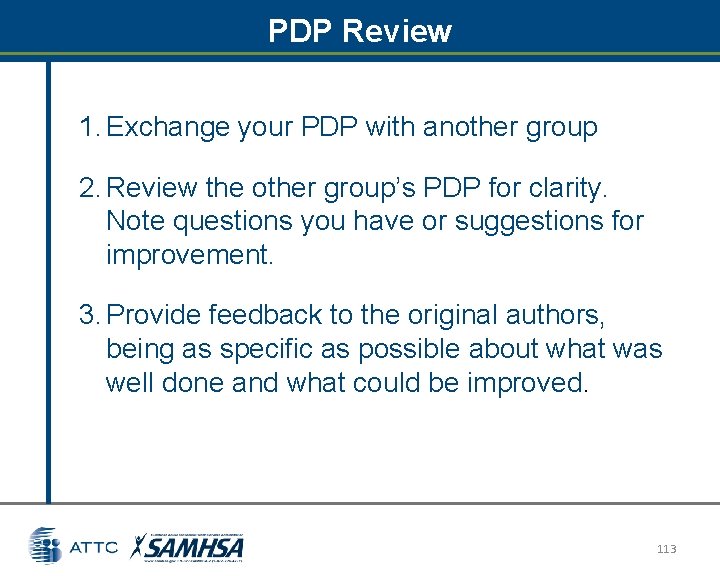
PDP Review 1. Exchange your PDP with another group 2. Review the other group’s PDP for clarity. Note questions you have or suggestions for improvement. 3. Provide feedback to the original authors, being as specific as possible about what was well done and what could be improved. 113
114