Computer Fraud and Security UAA ACCT 316 Accounting



- Slides: 97
Computer Fraud and Security UAA – ACCT 316 Accounting Information Systems Dr. Fred Barbee 1
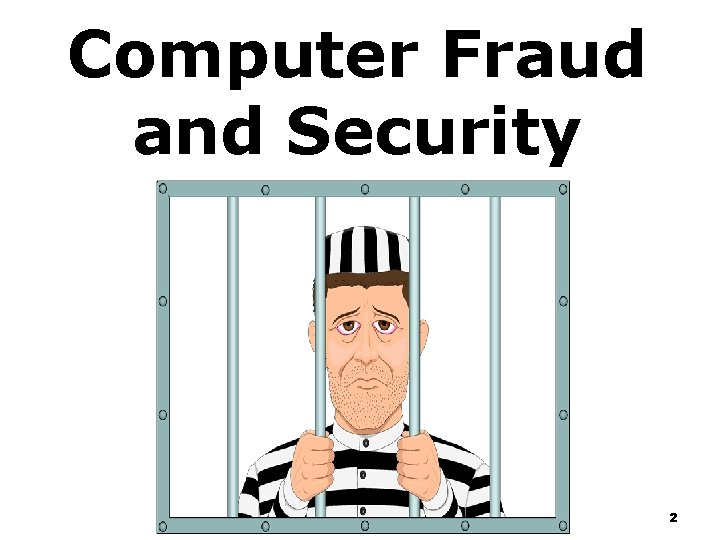
Computer Fraud and Security 2
What’s an Oxymoron? ? ? 3
Interesting Oxymorons l Advanced l Airline BASIC food l Government l Sanitary organization landfill 4
Scarey Oxymorons l. Computer security l. Business Ethics 5
Blatant Oxymorons l. Microsoft Works 6
Introduction Business Ethics 7
Ethics l “Our ethical standards come out of the past – out of our inheritance as a people; religions, philosophical, historical. And the more we know of that past, the more sure-footedly we can inculcate ethical conduct in the future. ” John Akers, Former Chairman of the Board and CE 0 of IBM 8
Business Ethics pertains to the principles of conduct that individuals use in l making choices, and l guiding their behavior in situations that involve the concepts of right and wrong. 9
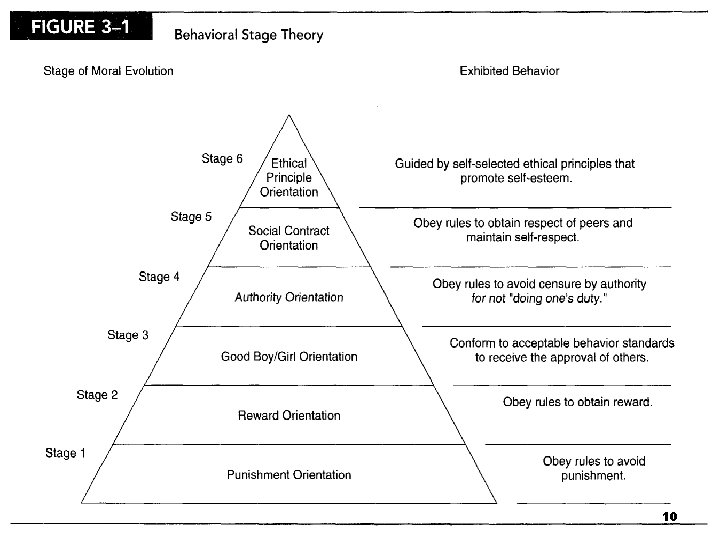
10
Introduction Fraud 11
What is Fraud l Fraud is any and all means a person uses to gain an unfair advantage over another person. 12
In the Business Environment Fraud is l intentional deception, l misappropriation assets, or l manipulation of a company’s of its financial data to the advantage of the perpetrator. 13
Common Law Definition Intentional deception, such as the l misrepresentation, l concealment, or l nondisclosure of a material fact, that results in injury to another. 14
Fraud l Business fraud typically comes at two levels: l Employee fraud l Management fraud 15
Characteristics of Employee Fraud l Designed to directly convert cash or other assets to personal benefit. l Typically circumvents the firm’s internal control system for personal gain. l Usually involves three steps which the text refers to as “the Fraud Process. ” 16
Characteristics of Management Fraud l Fraud is perpetrated at levels of management above the one which internal control structures typically target. l Usually involves using the financial statements to create the illusion that the firm is doing better than it really is. 17
Characteristics of Management Fraud l If the fraud involves misappropriation of assets, it frequently is shrouded in a maze of complex business transactions, often involving third parties. 18
Fraudulent Financial Reporting The Treadway Commission 19
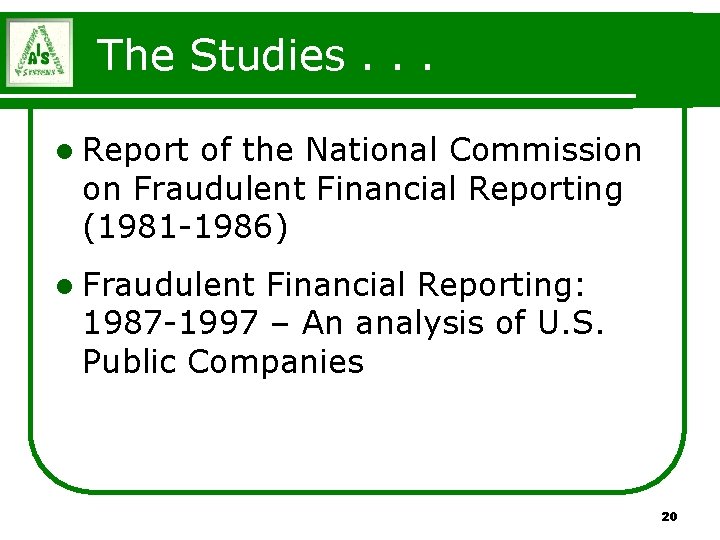
The Studies. . . l Report of the National Commission on Fraudulent Financial Reporting (1981 -1986) l Fraudulent Financial Reporting: 1987 -1997 – An analysis of U. S. Public Companies 20
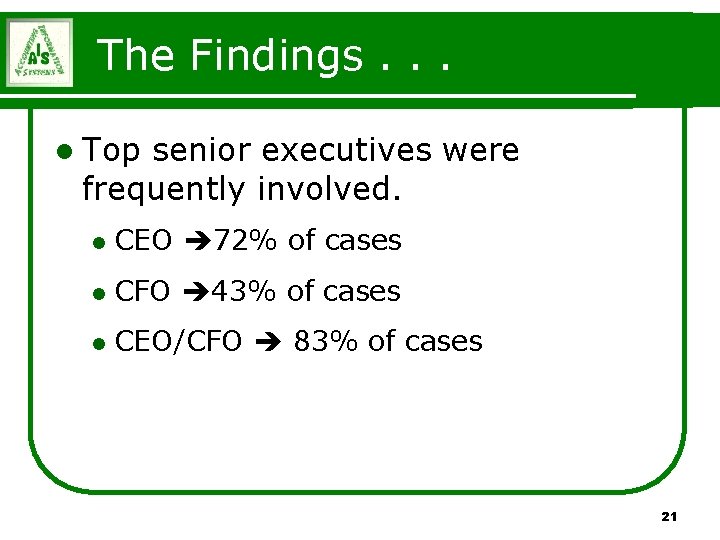
The Findings. . . l Top senior executives were frequently involved. l CEO 72% of cases l CFO 43% of cases l CEO/CFO 83% of cases 21
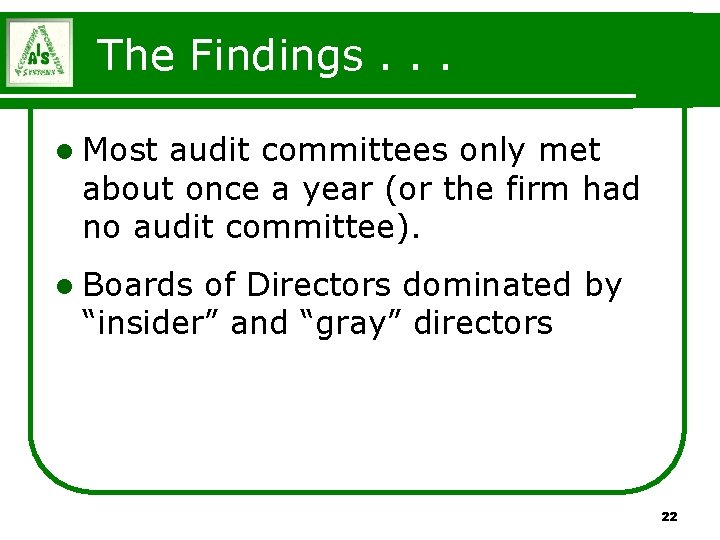
The Findings. . . l Most audit committees only met about once a year (or the firm had no audit committee). l Boards of Directors dominated by “insider” and “gray” directors 22
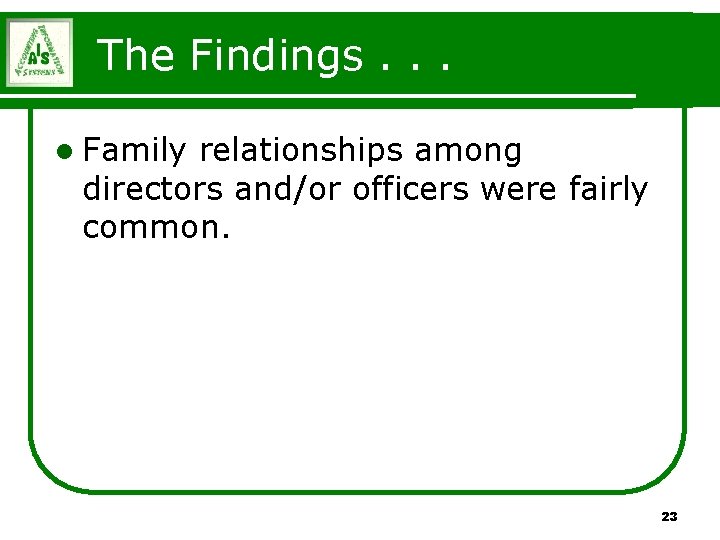
The Findings. . . l Family relationships among directors and/or officers were fairly common. 23
Fraudulent Financial Reporting l Intentional or reckless conduct, whether by act or omission, that results in materially misleading financial statements. 24
Committee Recommendations 1. Establish an organizational environment that contributes to the integrity of the financial reporting process. 2. Identify and understand the factors that lead to fraudulent financial reporting. 25
Committee Recommendations 3. Assess the risk of fraudulent financial reporting within the company. 4. Design and implement internal controls to provide reasonable assurance that fraudulent financial reporting is prevented. 26
Let’s Take a Slight Detour 27
What are the Common Law Requirements for Fraud? 28
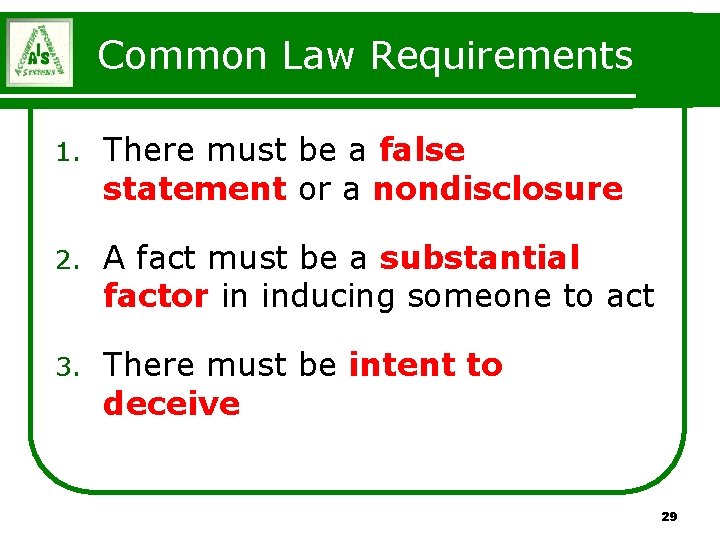
Common Law Requirements 1. There must be a false statement or a nondisclosure 2. A fact must be a substantial factor in inducing someone to act 3. There must be intent to deceive 29
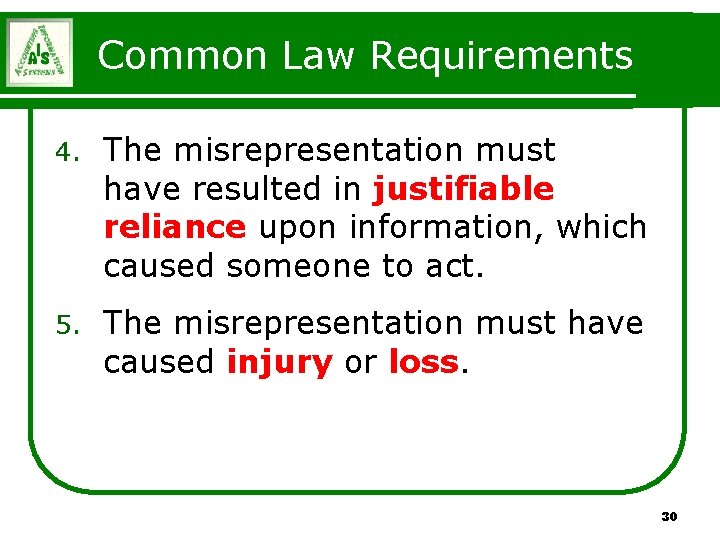
Common Law Requirements 4. The misrepresentation must have resulted in justifiable reliance upon information, which caused someone to act. 5. The misrepresentation must have caused injury or loss. 30
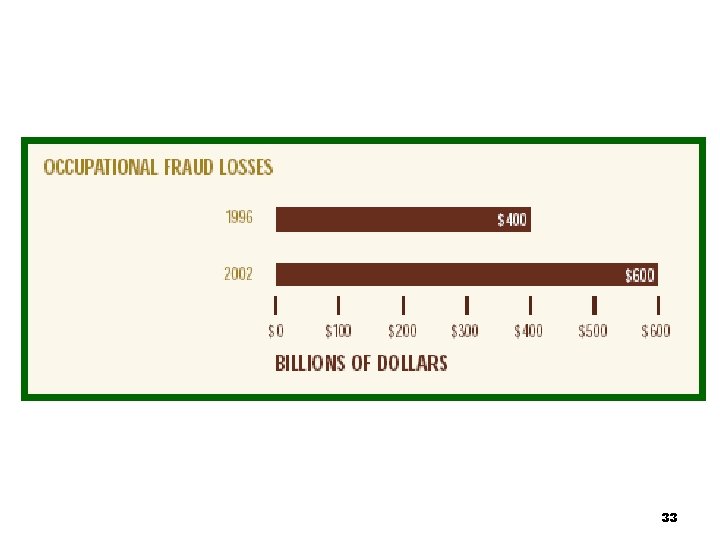
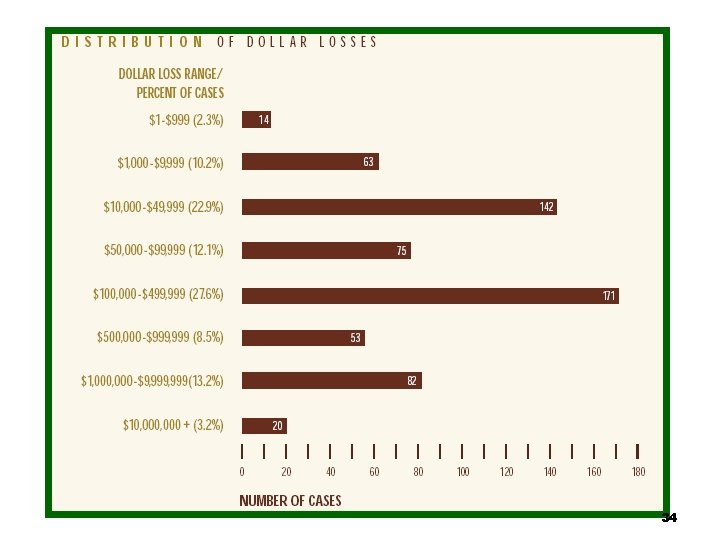
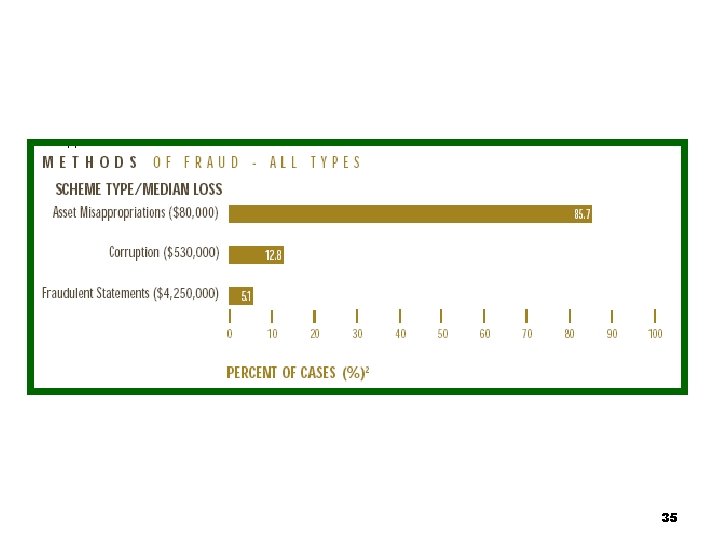
Is Fraud a Problem? 31
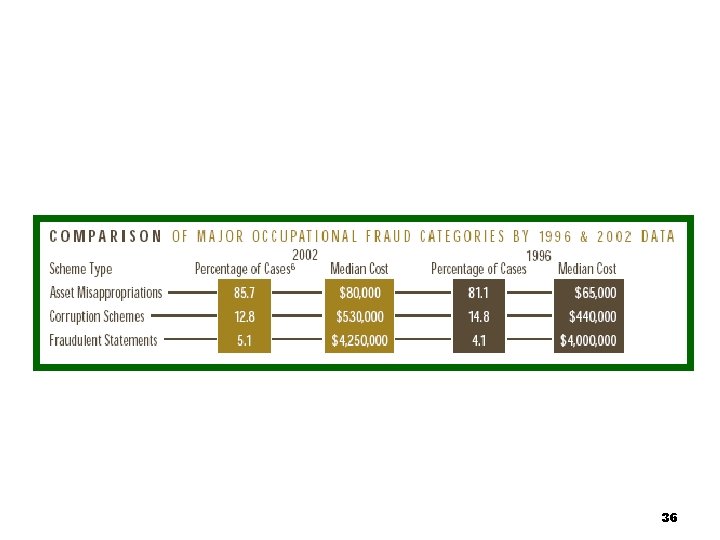
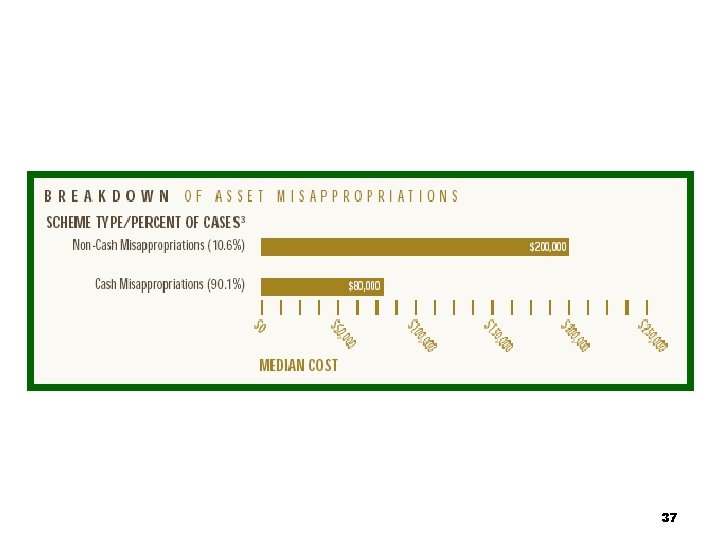
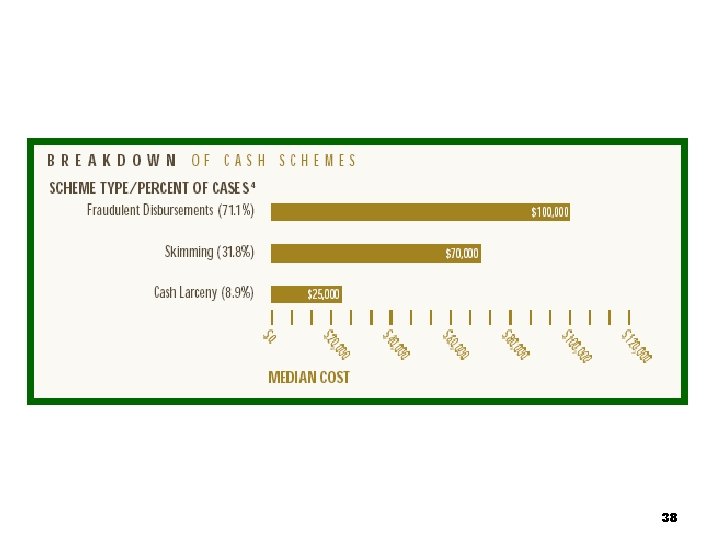
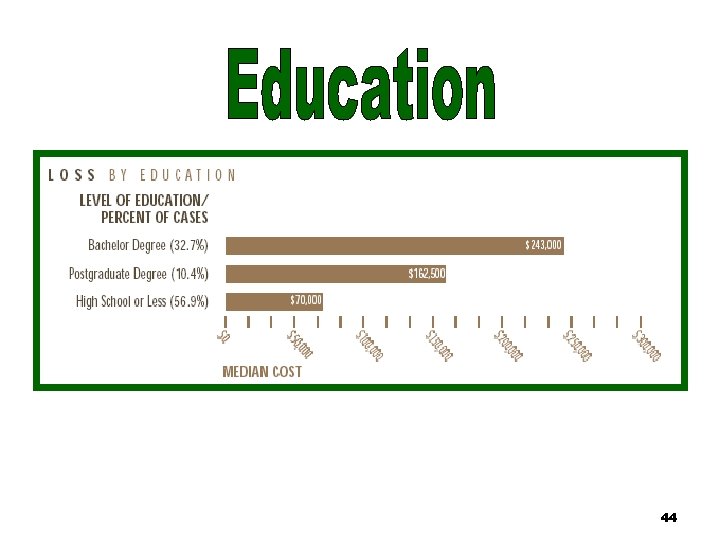
ACFE 2002 Report to the Nation Occupational Fraud and Abuse 32
33
34
35
36
37
38
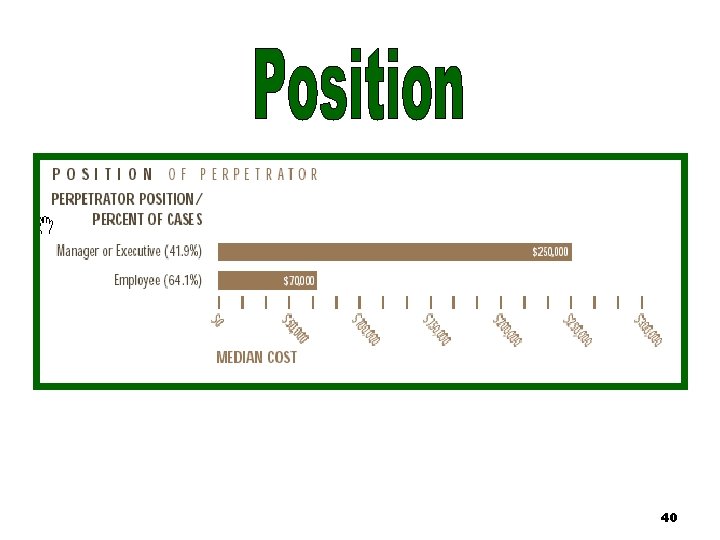
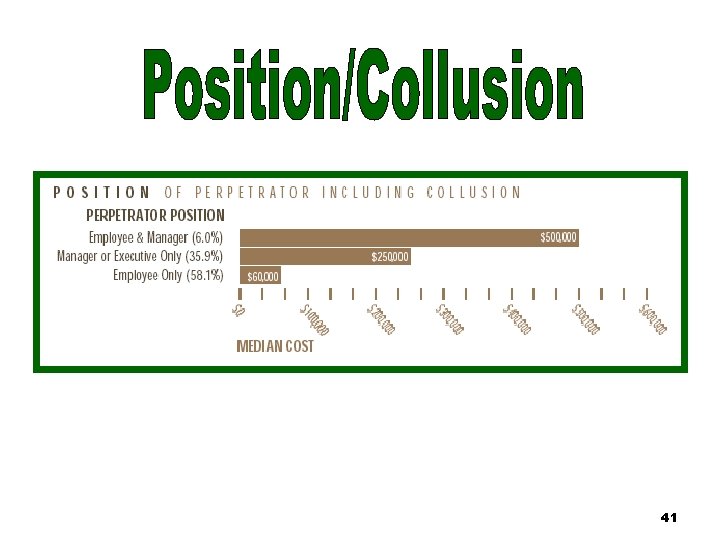
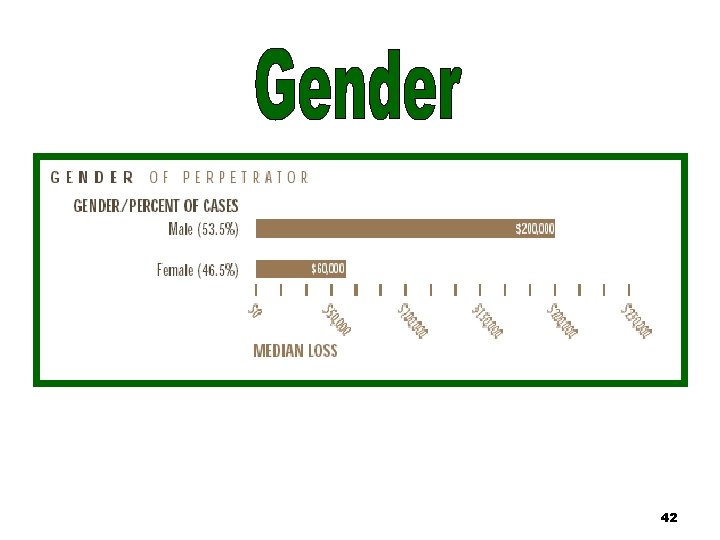
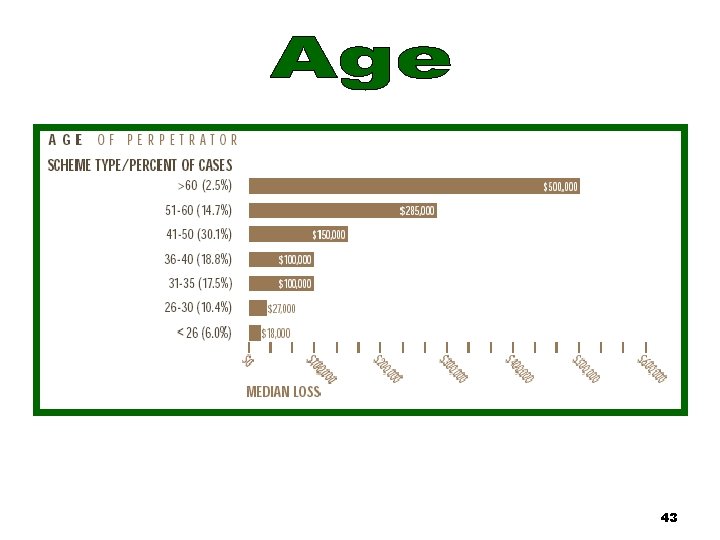
At the Sources of Fraud 39
40
41
42
43
44
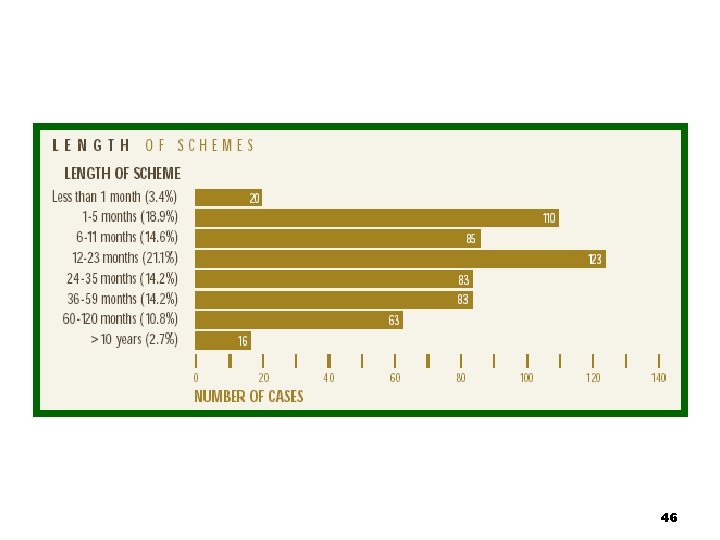
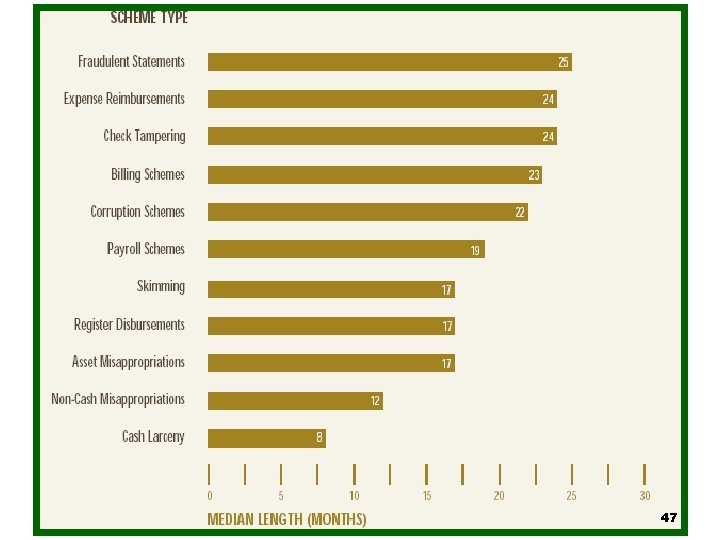
At the Duration of the schemes 45
46
47
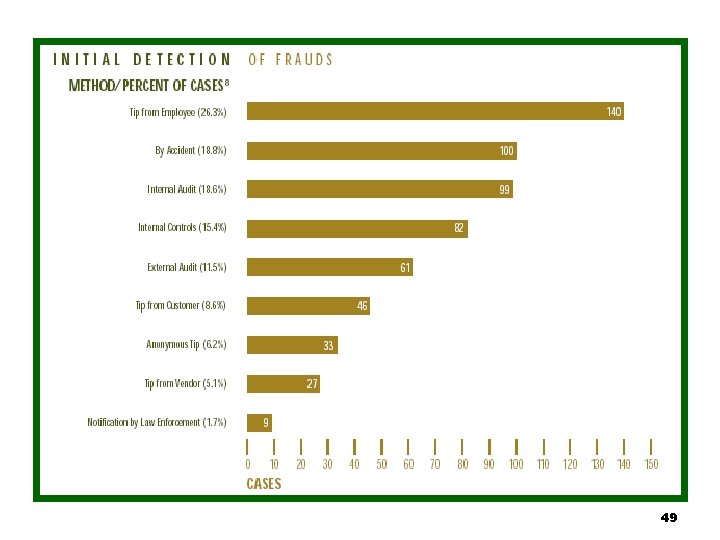
How Were They Detected? 48
49
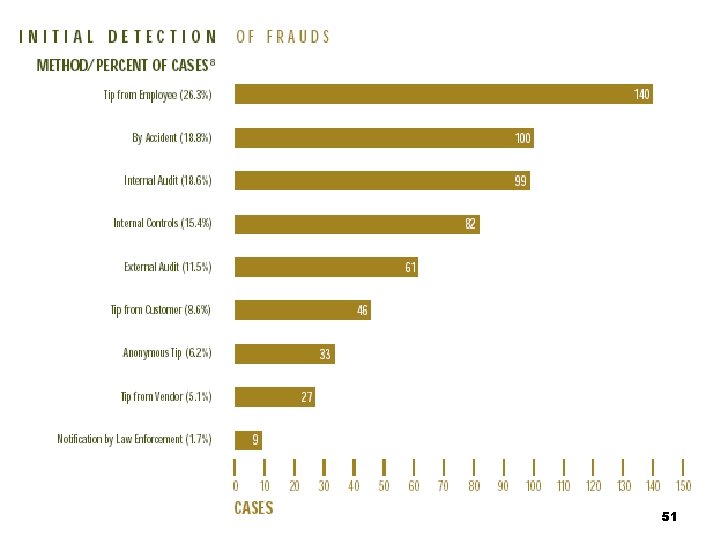
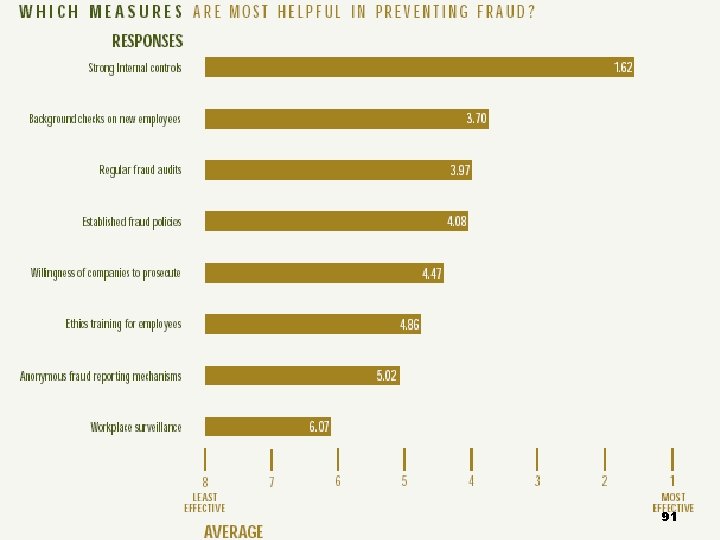
Fraud Prevention Measures 50
51
52
Now, Back to the Text The Fraud Process 53
54
Computer Fraud and Security Why Fraud Occurs 55
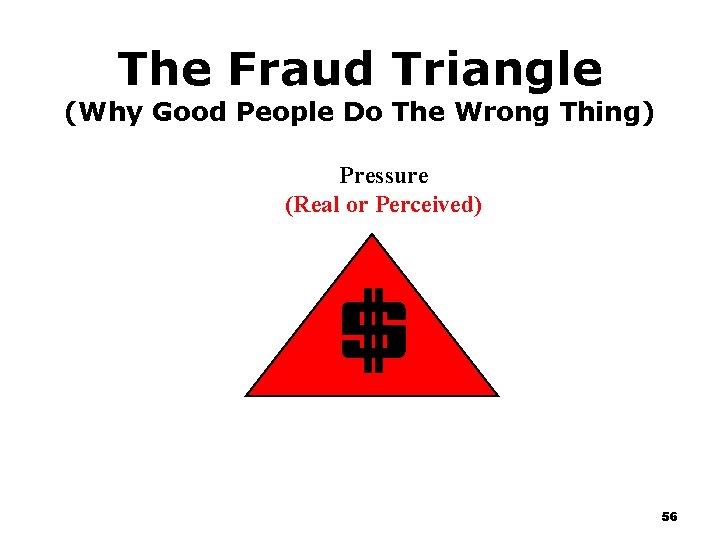
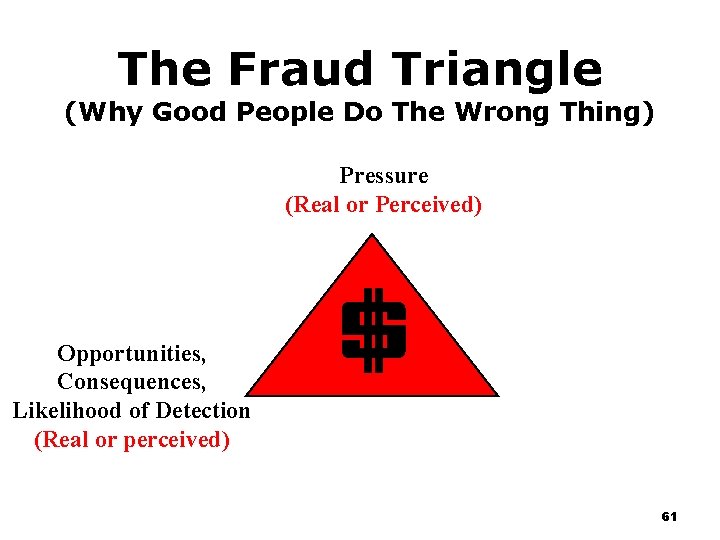
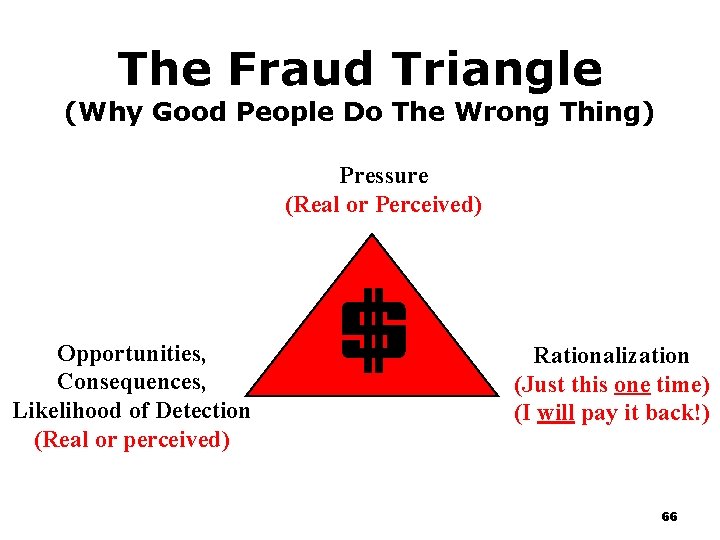
The Fraud Triangle (Why Good People Do The Wrong Thing) Pressure (Real or Perceived) 56
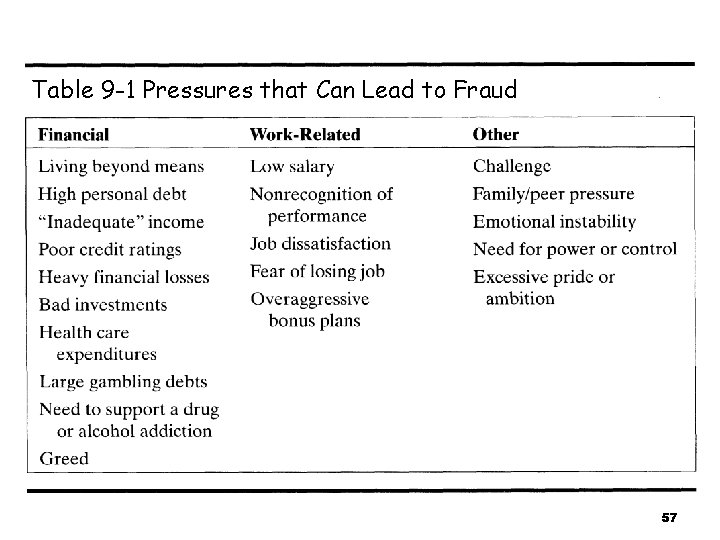
Table 9 -1 Pressures that Can Lead to Fraud 57
Situational Pressures The Treadway Commission 58
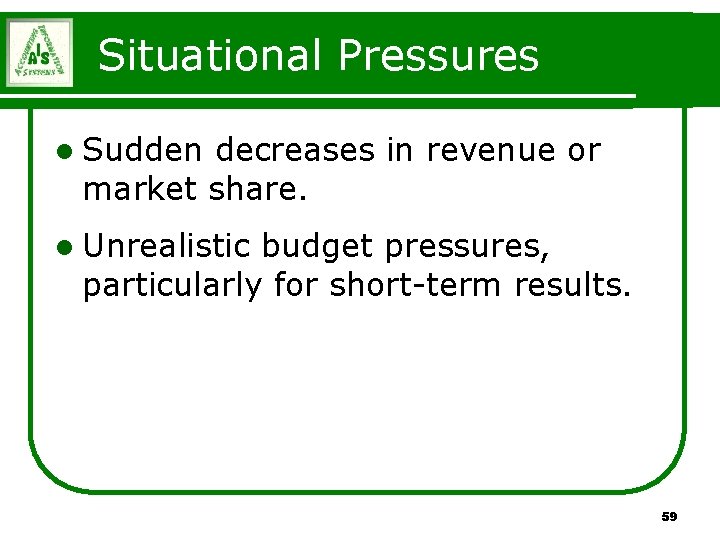
Situational Pressures l Sudden decreases in revenue or market share. l Unrealistic budget pressures, particularly for short-term results. 59
Situational Pressures l Financial pressure resulting from bonus plans that depend on shortterm economic performance. 60
The Fraud Triangle (Why Good People Do The Wrong Thing) Pressure (Real or Perceived) Opportunities, Consequences, Likelihood of Detection (Real or perceived) 61
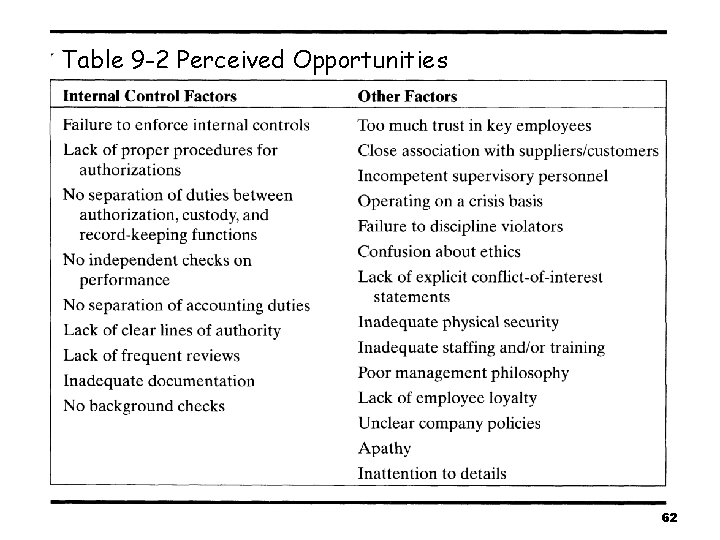
Table 9 -2 Perceived Opportunities 62
Opportunities The Treadway Commission 63
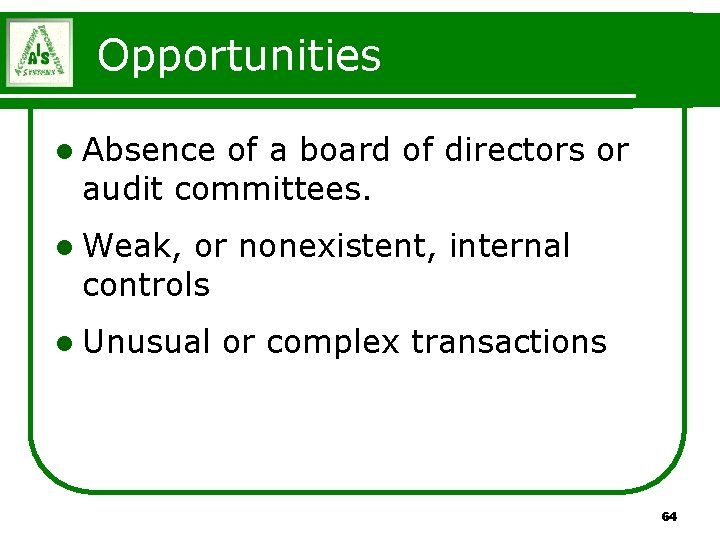
Opportunities l Absence of a board of directors or audit committees. l Weak, or nonexistent, internal controls l Unusual or complex transactions 64
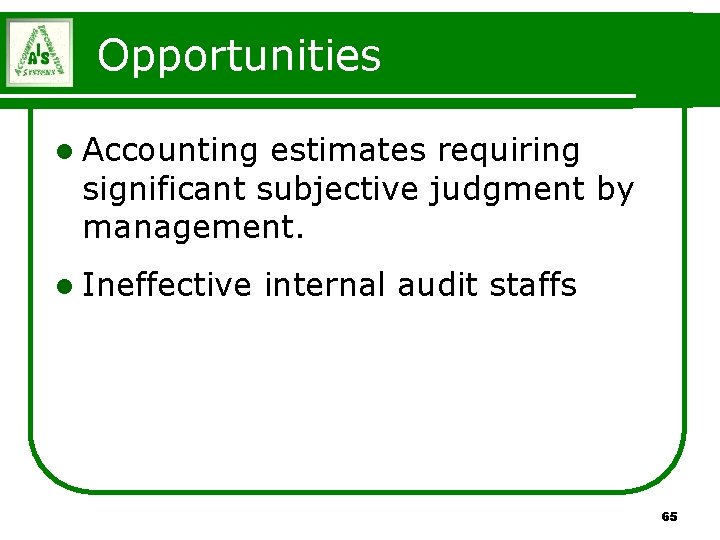
Opportunities l Accounting estimates requiring significant subjective judgment by management. l Ineffective internal audit staffs 65
The Fraud Triangle (Why Good People Do The Wrong Thing) Pressure (Real or Perceived) Opportunities, Consequences, Likelihood of Detection (Real or perceived) Rationalization (Just this one time) (I will pay it back!) 66
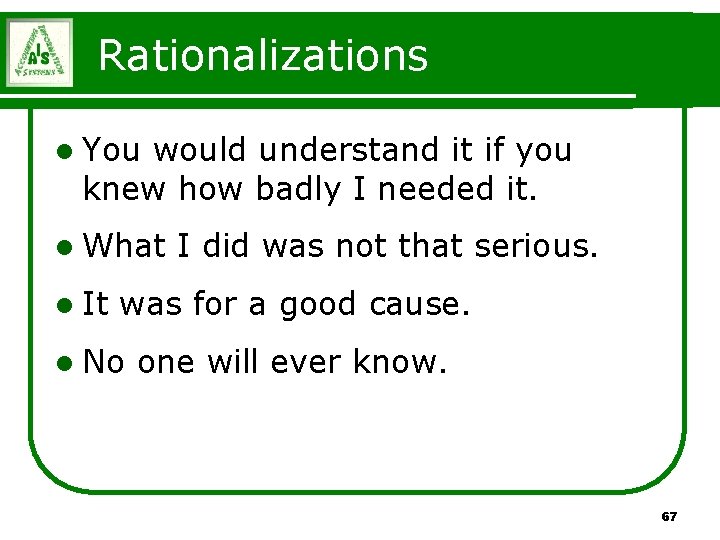
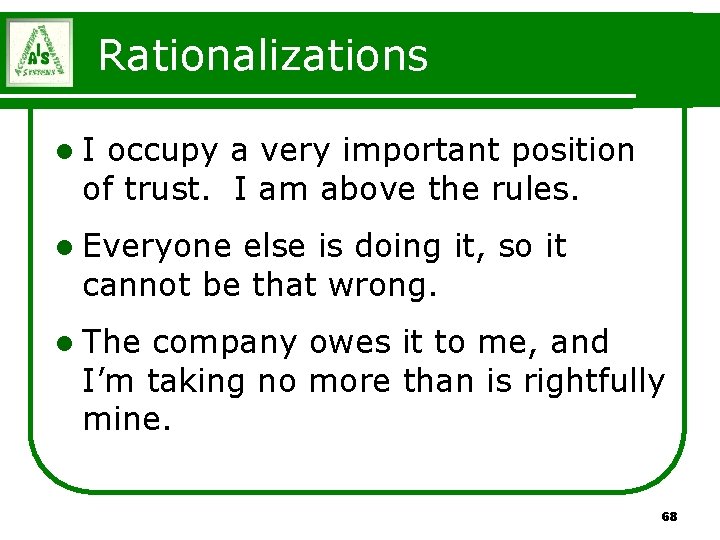
Rationalizations l You would understand it if you knew how badly I needed it. l What l It I did was not that serious. was for a good cause. l No one will ever know. 67
Rationalizations l. I occupy a very important position of trust. I am above the rules. l Everyone else is doing it, so it cannot be that wrong. l The company owes it to me, and I’m taking no more than is rightfully mine. 68
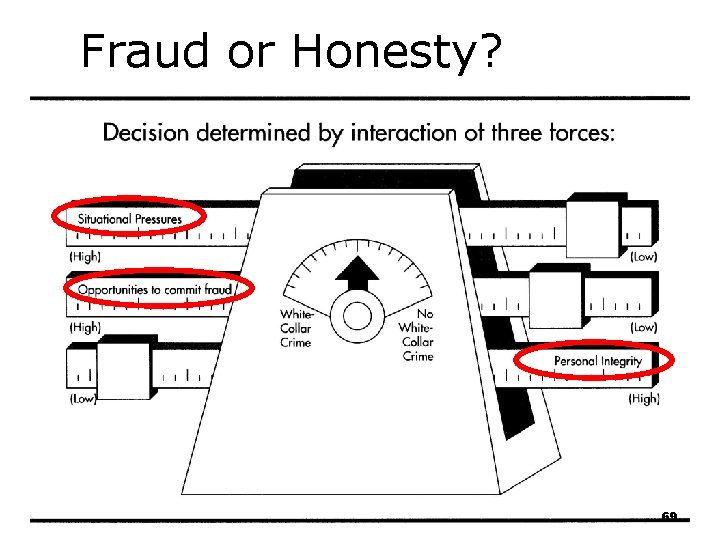
Fraud or Honesty? 69
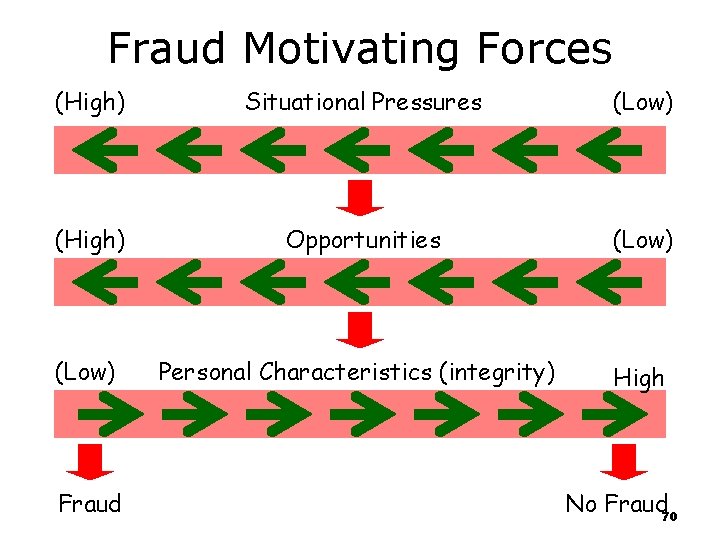
Fraud Motivating Forces (High) Situational Pressures (Low) (High) Opportunities (Low) Personal Characteristics (integrity) High Fraud No Fraud 70
Computer Fraud and Security Computer Fraud 71
Computer Fraud. . . l Computer fraud is any illegal act for which knowledge of computer technology is essential for its perpetration, investigation, or prosecution. 72
Computer Fraud. . . l Unauthorized theft, use, access, modification, copying, and destruction of software or data. l Theft of money by altering computer records or theft computer time. of 73
Computer Fraud. . . l Theft or destruction of computer hardware. l Use or the conspiracy to use computer resources to commit a felony l Intent to illegally obtain information or tangible property through the use of computers. 74
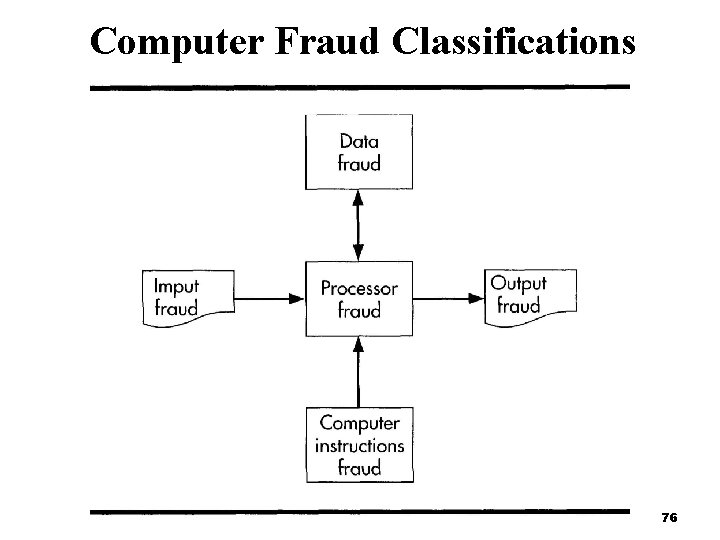
Computer Fraud Classifications 75
Computer Fraud Classifications 76
Preventing and Detecting Computer Fraud Make Fraud Less Likely to Occur 78
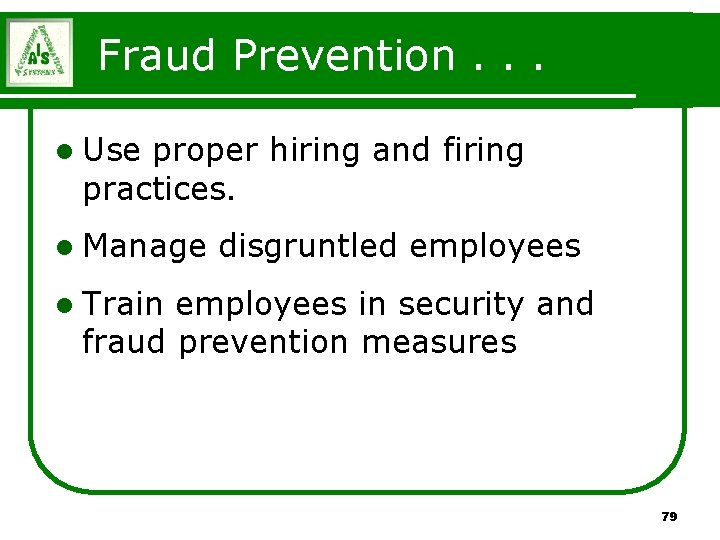
Fraud Prevention. . . l Use proper hiring and firing practices. l Manage disgruntled employees l Train employees in security and fraud prevention measures 79
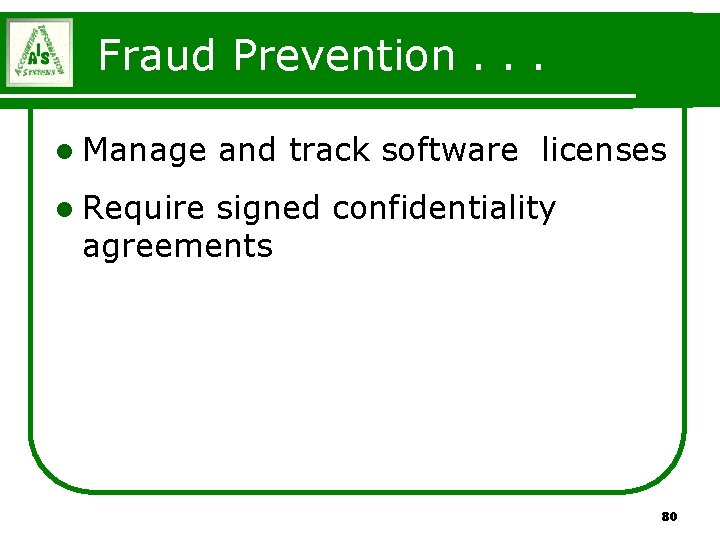
Fraud Prevention. . . l Manage and track software licenses l Require signed confidentiality agreements 80
Preventing and Detecting Computer Fraud Increasing the difficulty of committing fraud 81
Fraud Prevention. . . l Develop controls a strong system of internal l Segregate l Require duties vacations and rotate duties. 82
Fraud Prevention. . . l Restrict access to computer equipment and data files l Encrypt l Protect data and programs telephone lines 83
Fraud Prevention. . . l Protect the system from viruses l Control sensitive data l Control laptop computers l Monitor hacker information 84
Preventing and Detecting Computer Fraud Improve detection methods 85
Fraud Prevention. . . l Conduct frequent audits l Use a computer security officer l Set up a fraud hot line l Use computer consultants 86
Fraud Prevention. . . l Monitor system activities l Use forensic accountants l Use fraud detection software 87
Preventing and Detecting Computer Fraud Other 88
Fraud Prevention. . . l Reduce Fraud Losses l Prosecute and Incarcerate Fraud Perpetrators 89
Preventing and Detecting Computer Fraud 2002 Wells Report Survey Data 90
91
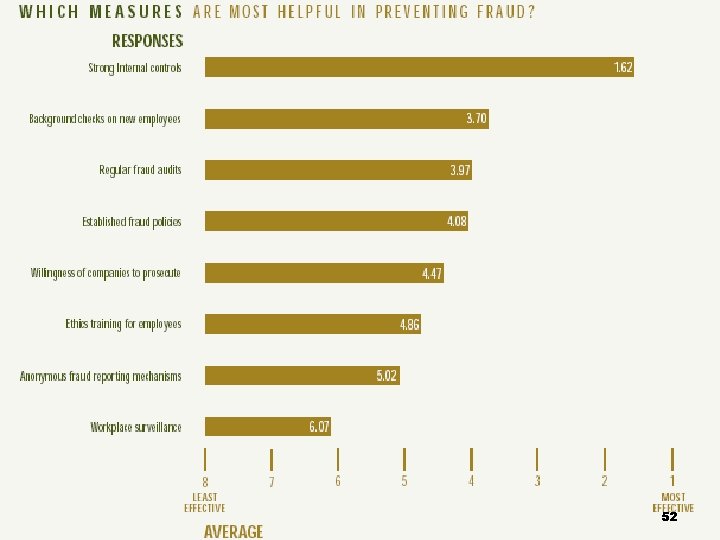
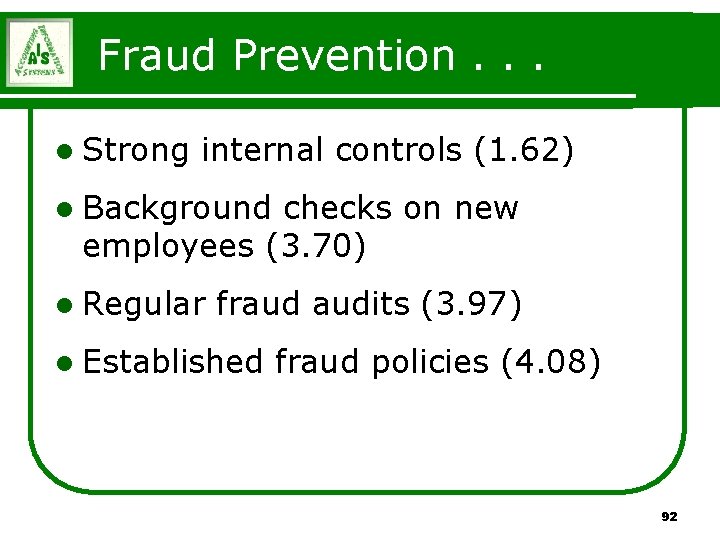
Fraud Prevention. . . l Strong internal controls (1. 62) l Background checks on new employees (3. 70) l Regular fraud audits (3. 97) l Established fraud policies (4. 08) 92
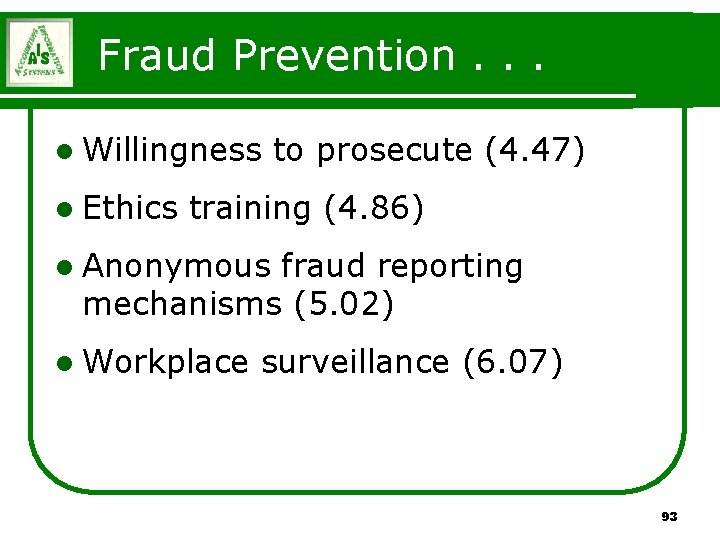
Fraud Prevention. . . l Willingness l Ethics to prosecute (4. 47) training (4. 86) l Anonymous fraud reporting mechanisms (5. 02) l Workplace surveillance (6. 07) 93
Preventing and Detecting Computer Fraud Survey Data 1996 94
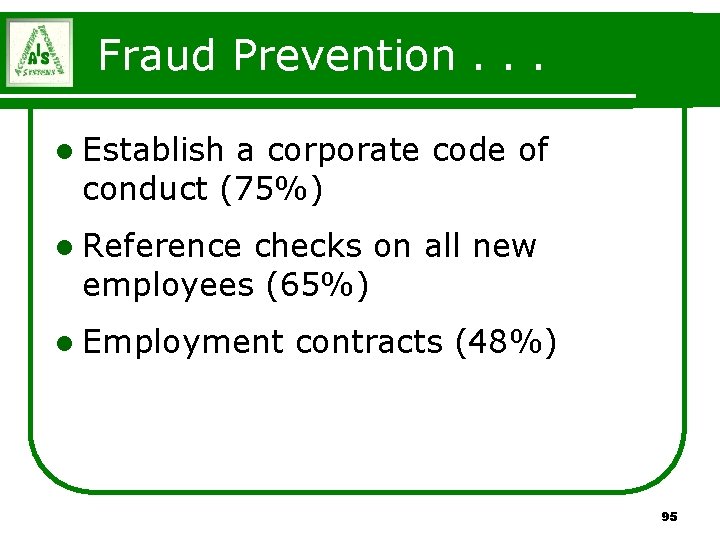
Fraud Prevention. . . l Establish a corporate code of conduct (75%) l Reference checks on all new employees (65%) l Employment contracts (48%) 95
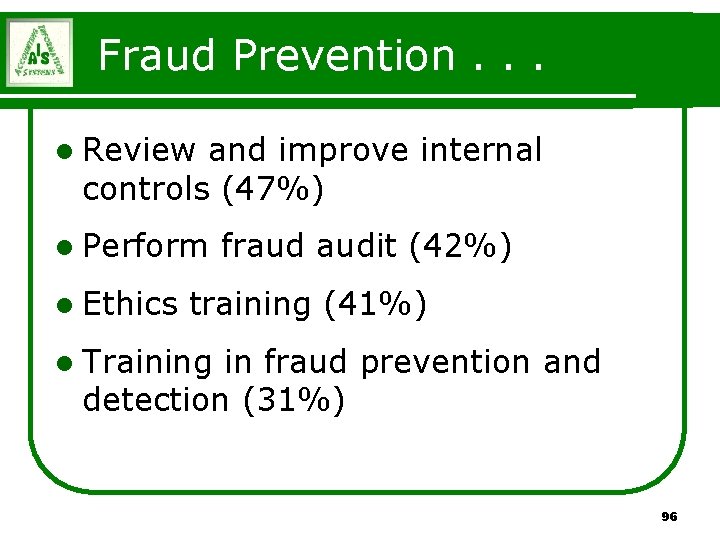
Fraud Prevention. . . l Review and improve internal controls (47%) l Perform l Ethics fraud audit (42%) training (41%) l Training in fraud prevention and detection (31%) 96
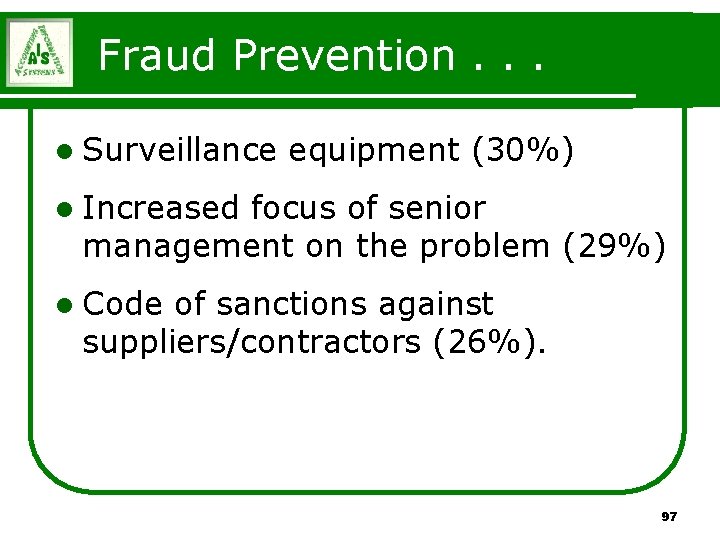
Fraud Prevention. . . l Surveillance equipment (30%) l Increased focus of senior management on the problem (29%) l Code of sanctions against suppliers/contractors (26%). 97
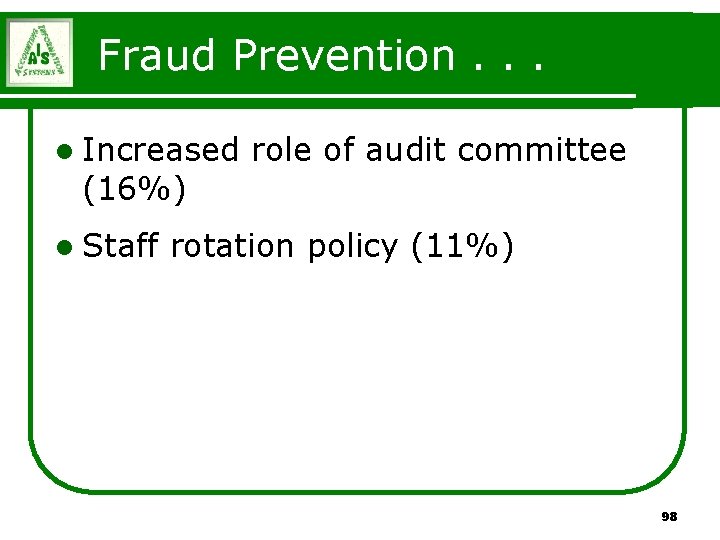
Fraud Prevention. . . l Increased (16%) l Staff role of audit committee rotation policy (11%) 98