
Fraud and Forensic Accounting The Basics October 23

Fraud and Forensic Accounting The Basics October 23, 2008 Economic Crime Institute Dr. Richard A. (Dick) Riley West Virginia University Tanner Distinguished Professor of Public Accounting
Opening Remarks In God We Trust Everyone Else, We Examine Adapted from Michael Connelly’s Void Moon Ronald Reagan: Trust, but Verify
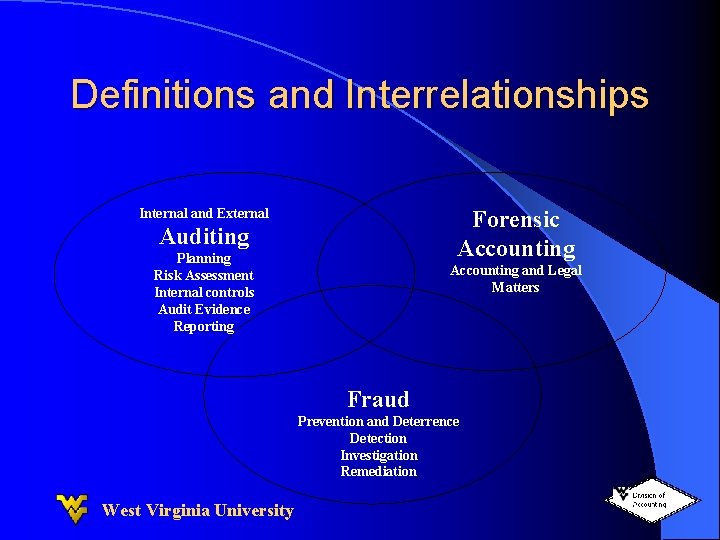
Definitions and Interrelationships Internal and External Forensic Accounting Auditing Planning Risk Assessment Internal controls Audit Evidence Reporting Accounting and Legal Matters Fraud Prevention and Deterrence Detection Investigation Remediation West Virginia University
Forensic Accounting Intersection of accounting and the law asset misappropriation corruption / abuse / conflicts of interest financial statement fraud (fraudulent representations) broader legal engagements – civil litigation West Virginia University
Fraud Professional l. Prevention & Deterrence l. Detection l. Investigation l. Remediation West Virginia University
Auditing l. F/S free from material misstatement – Planning – Risk Assessment – Internal Controls – Audit Evidence – Reporting West Virginia University
Fraud and Forensic Accounting Skills Working knowledge of: Accounting The legal system Criminology Investigative Techniques Detail oriented Organized Think critically Excellent communication skills West Virginia University
Critical Thinking Exercise Assuming the following are true statements about a deck of cards, what can a deck of cards be likened to? l l l 12 face cards (excluding ace) 52 cards in a deck 4 suits Source: Card Games for Smart Kids (Margie Golick, Ph. D, Sterling Publishing, NY) West Virginia University
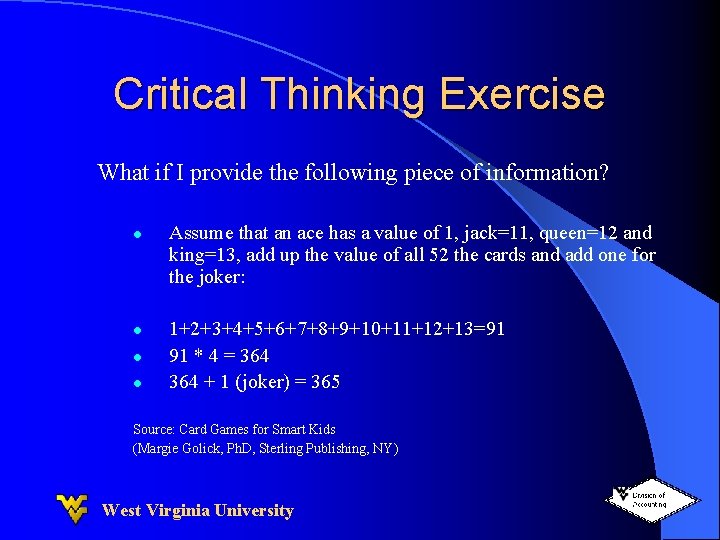
Critical Thinking Exercise What if I provide the following piece of information? l l Assume that an ace has a value of 1, jack=11, queen=12 and king=13, add up the value of all 52 the cards and add one for the joker: 1+2+3+4+5+6+7+8+9+10+11+12+13=91 91 * 4 = 364 + 1 (joker) = 365 Source: Card Games for Smart Kids (Margie Golick, Ph. D, Sterling Publishing, NY) West Virginia University
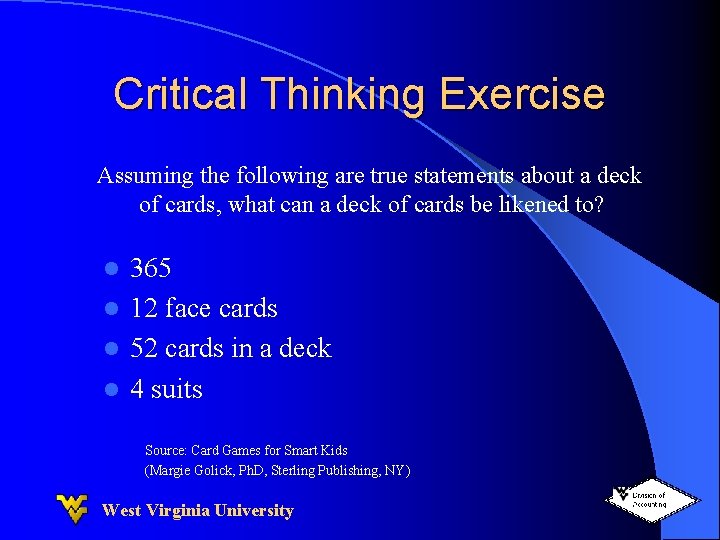
Critical Thinking Exercise Assuming the following are true statements about a deck of cards, what can a deck of cards be likened to? 365 l 12 face cards l 52 cards in a deck l 4 suits l Source: Card Games for Smart Kids (Margie Golick, Ph. D, Sterling Publishing, NY) West Virginia University
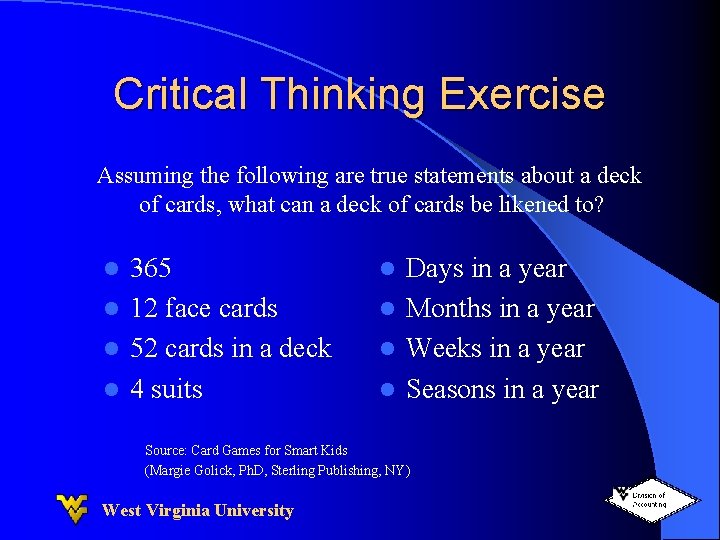
Critical Thinking Exercise Assuming the following are true statements about a deck of cards, what can a deck of cards be likened to? 365 l 12 face cards l 52 cards in a deck l 4 suits l Days in a year l Months in a year l Weeks in a year l Seasons in a year l Source: Card Games for Smart Kids (Margie Golick, Ph. D, Sterling Publishing, NY) West Virginia University
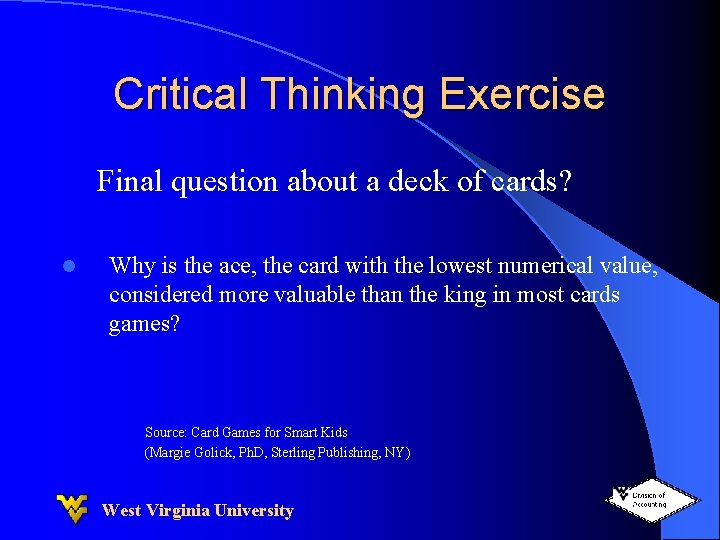
Critical Thinking Exercise Final question about a deck of cards? l Why is the ace, the card with the lowest numerical value, considered more valuable than the king in most cards games? Source: Card Games for Smart Kids (Margie Golick, Ph. D, Sterling Publishing, NY) West Virginia University
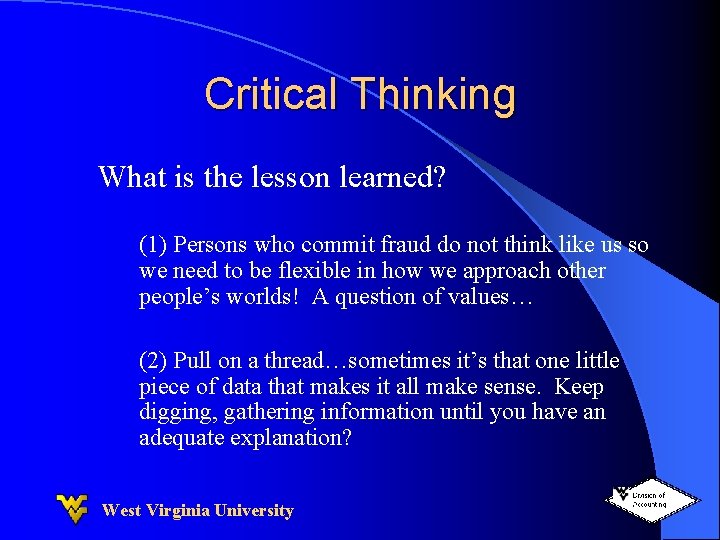
Critical Thinking What is the lesson learned? (1) Persons who commit fraud do not think like us so we need to be flexible in how we approach other people’s worlds! A question of values… (2) Pull on a thread…sometimes it’s that one little piece of data that makes it all make sense. Keep digging, gathering information until you have an adequate explanation? West Virginia University
Investigating Fraud West Virginia University

What would you do? l Thomas Coughlin – Vice-Chairman of Walmart – Long-time Family Friend of Sam Walton – Need: Alligator Books, Dog Pen, Hunting Vacations – Is it OK to Make Walmart Pay for this? West Virginia University Division of Accounting
What would you do? l Losses? l Income? Division of Accounting West Virginia University
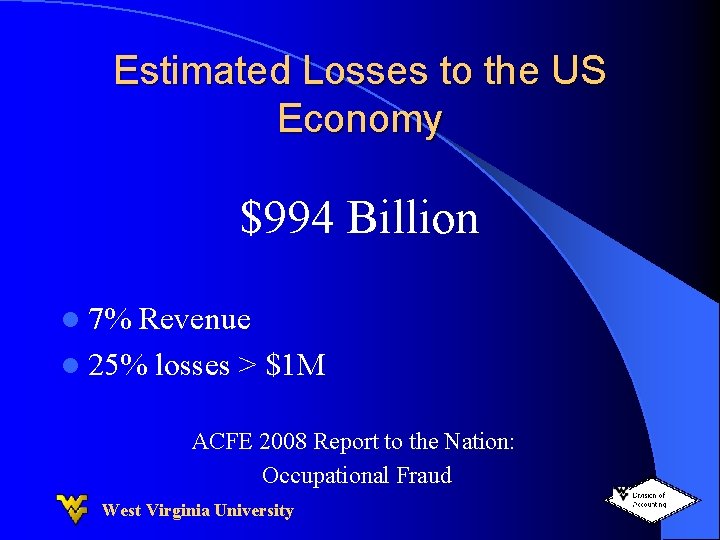
Estimated Losses to the US Economy $994 Billion l 7% Revenue l 25% losses > $1 M ACFE 2008 Report to the Nation: Occupational Fraud West Virginia University
West Virginia University
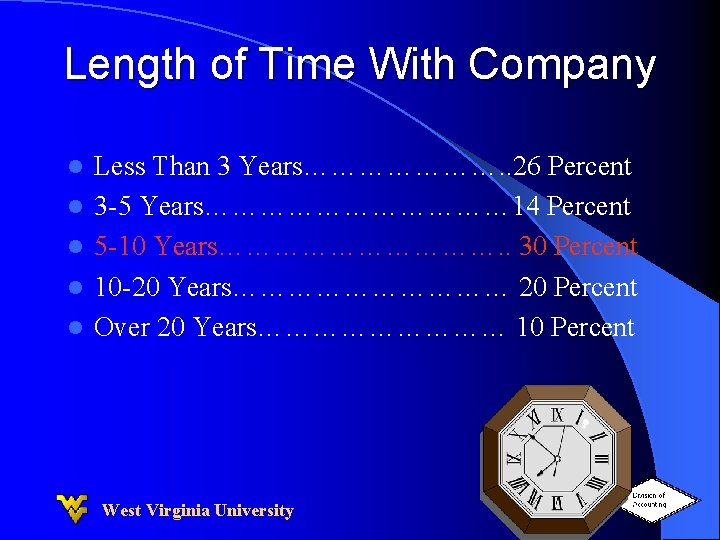
Length of Time With Company l l l Less Than 3 Years…………………. . 26 Percent 3 -5 Years……………… 14 Percent 5 -10 Years……………. . 30 Percent 10 -20 Years…………… 20 Percent Over 20 Years…………… 10 Percent West Virginia University
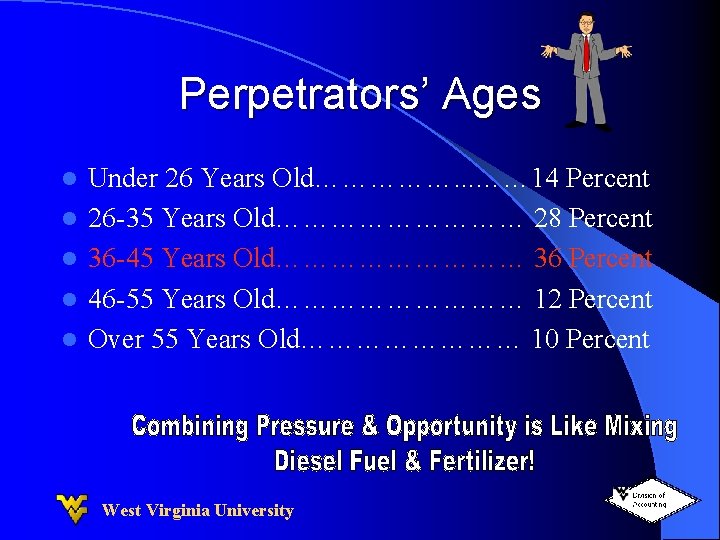
Perpetrators’ Ages l l l Under 26 Years Old……………. . . …… 14 Percent 26 -35 Years Old…………… 28 Percent 36 -45 Years Old…………… 36 Percent 46 -55 Years Old…………… 12 Percent Over 55 Years Old………… 10 Percent West Virginia University
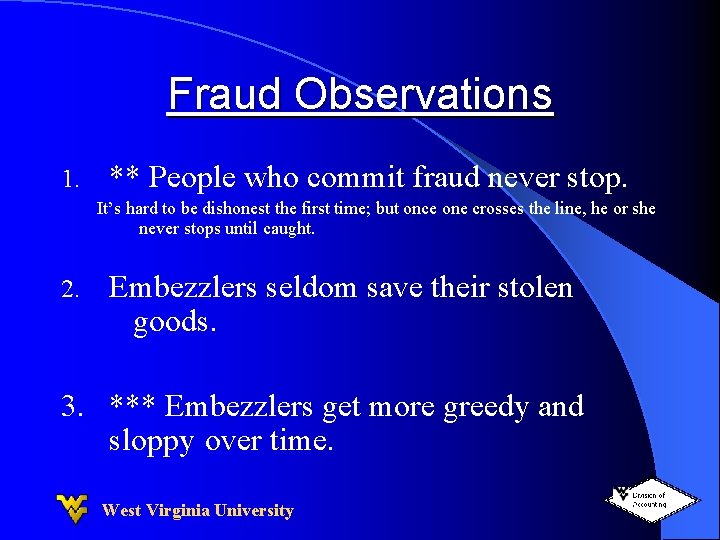
Fraud Observations 1. ** People who commit fraud never stop. It’s hard to be dishonest the first time; but once one crosses the line, he or she never stops until caught. 2. Embezzlers seldom save their stolen goods. 3. *** Embezzlers get more greedy and sloppy over time. West Virginia University
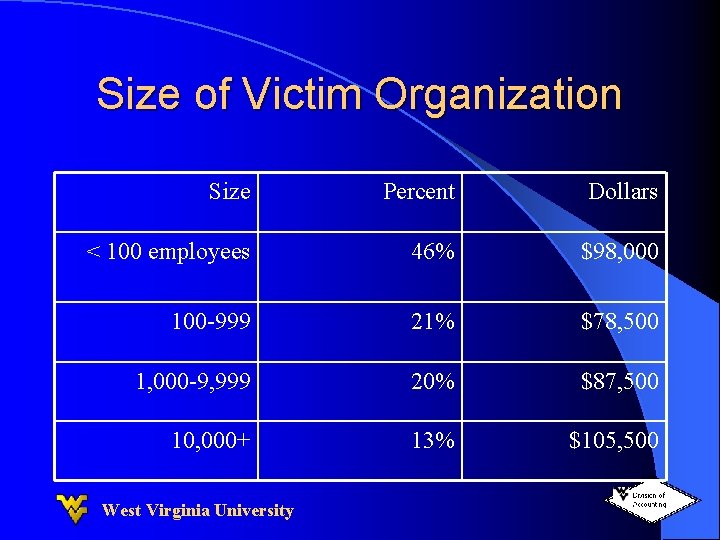
Size of Victim Organization Size Percent Dollars < 100 employees 46% $98, 000 100 -999 21% $78, 500 1, 000 -9, 999 20% $87, 500 10, 000+ 13% $105, 500 West Virginia University
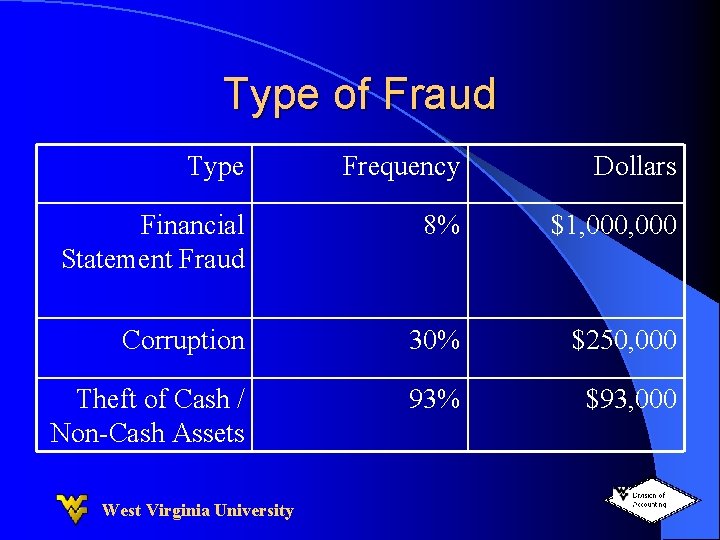
Type of Fraud Type Frequency Dollars Financial Statement Fraud 8% $1, 000 Corruption 30% $250, 000 Theft of Cash / Non-Cash Assets 93% $93, 000 West Virginia University
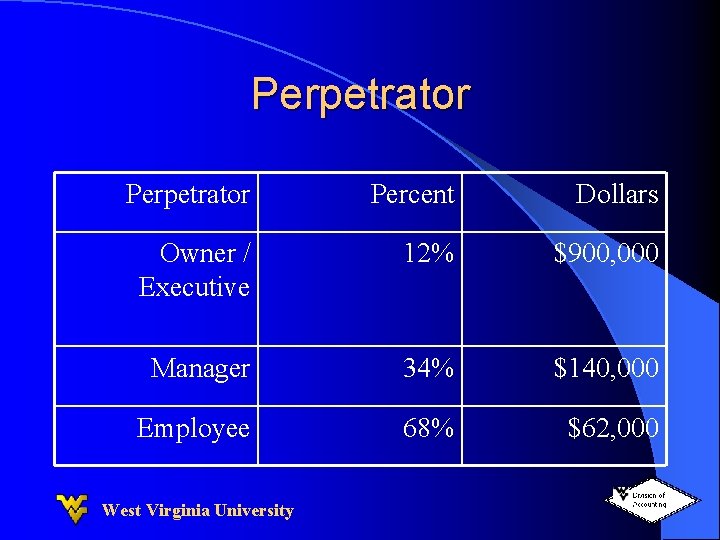
Perpetrator Percent Dollars Owner / Executive 12% $900, 000 Manager 34% $140, 000 Employee 68% $62, 000 West Virginia University
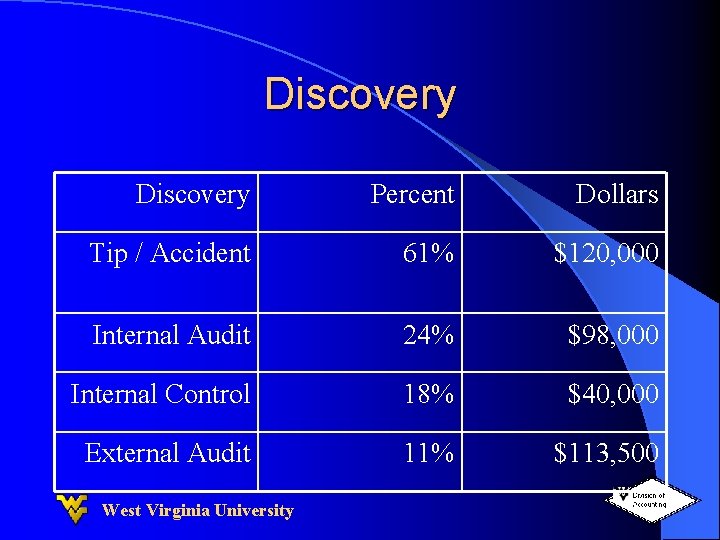
Discovery Percent Dollars Tip / Accident 61% $120, 000 Internal Audit 24% $98, 000 Internal Control 18% $40, 000 External Audit 11% $113, 500 West Virginia University
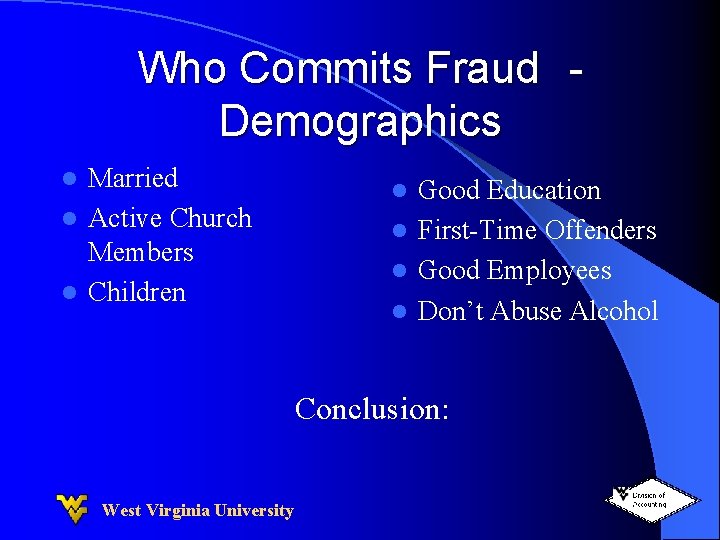
Who Commits Fraud Demographics Married l Active Church Members l Children l Good Education l First-Time Offenders l Good Employees l Don’t Abuse Alcohol l Conclusion: West Virginia University
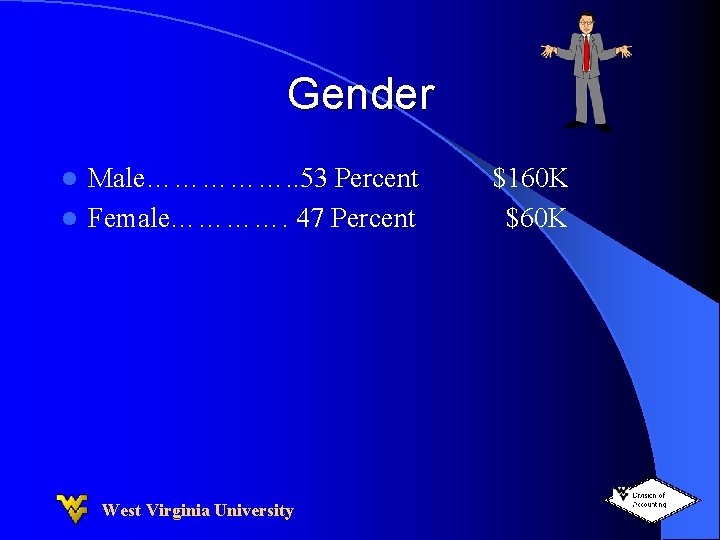
Gender Male……………. . 53 Percent $160 K l Female…………. 47 Percent $60 K l West Virginia University
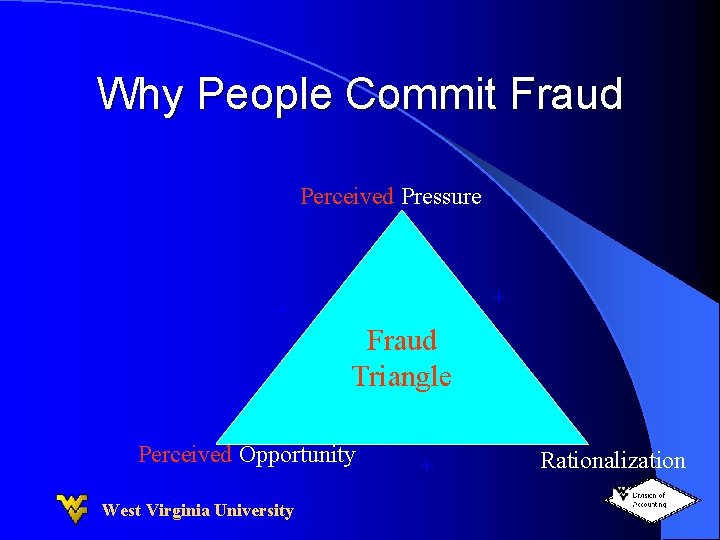
Why People Commit Fraud Perceived Pressure + + Fraud Triangle Perceived Opportunity West Virginia University + Rationalization
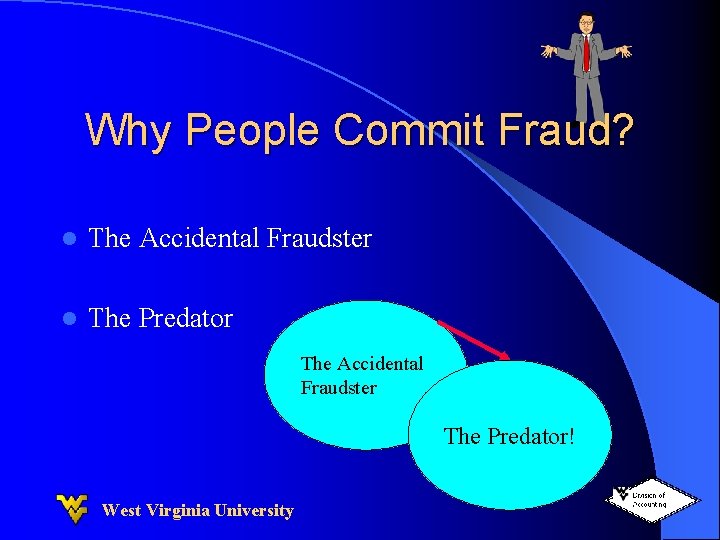
Why People Commit Fraud? l The Accidental Fraudster l The Predator The Accidental Fraudster The Predator! West Virginia University
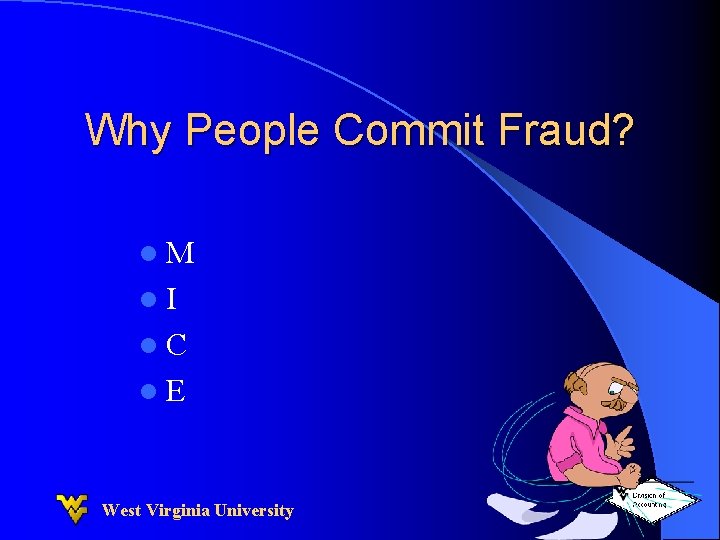
Why People Commit Fraud? l. M l. I l. C l. E West Virginia University
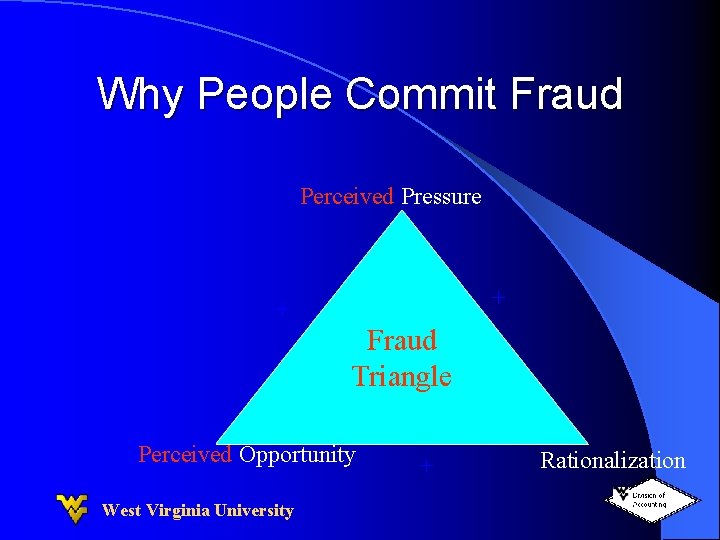
Why People Commit Fraud Perceived Pressure + + Fraud Triangle Perceived Opportunity West Virginia University + Rationalization
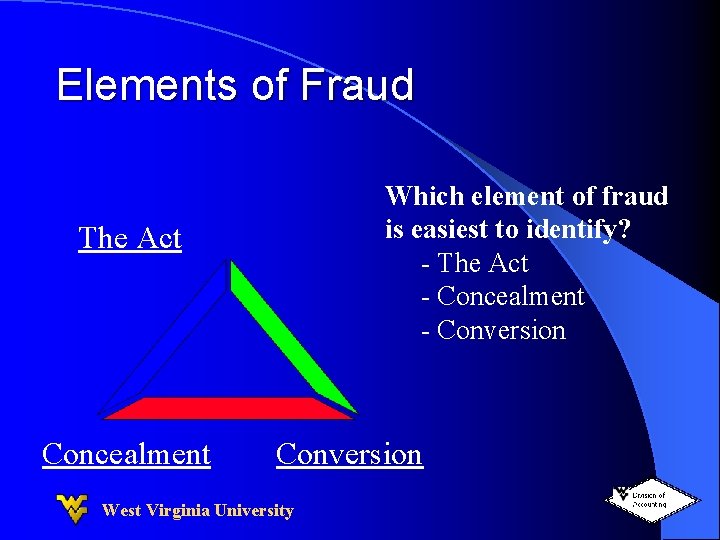
Elements of Fraud Which element of fraud is easiest to identify? - The Act - Concealment - Conversion The Act Concealment Conversion West Virginia University
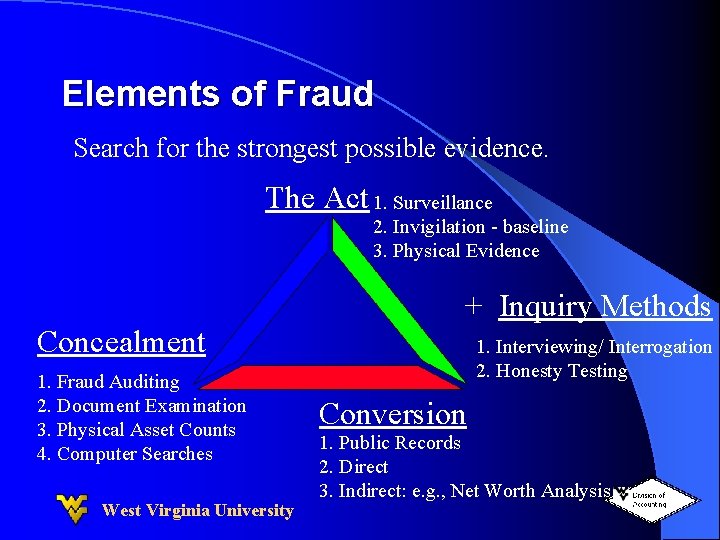
Elements of Fraud Search for the strongest possible evidence. The Act 1. Surveillance 2. Invigilation - baseline 3. Physical Evidence + Inquiry Methods Concealment 1. Fraud Auditing 2. Document Examination 3. Physical Asset Counts 4. Computer Searches West Virginia University 1. Interviewing/ Interrogation 2. Honesty Testing Conversion 1. Public Records 2. Direct 3. Indirect: e. g. , Net Worth Analysis
Fraud Detection West Virginia University
Professional Skepticism l A recognition that fraud may be present l An attitude that includes a questioning mind a critical assessment of audit evidence – Pull on the threads! l A commitment to persuasive evidence (whether or not fraud is present) – Go that extra mile West Virginia University
Assuming the Fraud May Be Present l Process to: (-) Identify the possibility of fraud (-) Convincingly resolve any badges, symptoms, red flags of fraud West Virginia University
Consider the Risk of Fraud l Brainstorm l Consider how and where financial information might be susceptible to fraud l Consider how and where fraud might be hidden – Targeted Risk Assessment l Exercise professional skepticism! West Virginia University
Red Flags - Approach West Virginia University
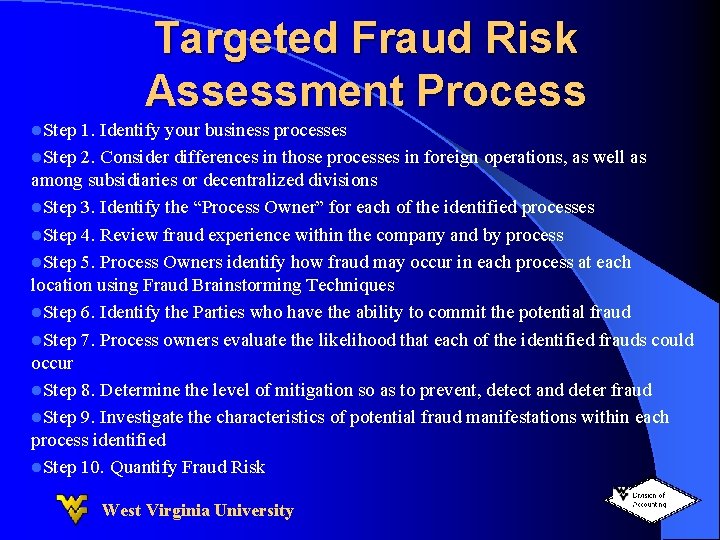
Targeted Fraud Risk Assessment Process l. Step 1. Identify your business processes l. Step 2. Consider differences in those processes in foreign operations, as well as among subsidiaries or decentralized divisions l. Step 3. Identify the “Process Owner” for each of the identified processes l. Step 4. Review fraud experience within the company and by process l. Step 5. Process Owners identify how fraud may occur in each process at each location using Fraud Brainstorming Techniques l. Step 6. Identify the Parties who have the ability to commit the potential fraud l. Step 7. Process owners evaluate the likelihood that each of the identified frauds could occur l. Step 8. Determine the level of mitigation so as to prevent, detect and deter fraud l. Step 9. Investigate the characteristics of potential fraud manifestations within each process identified l. Step 10. Quantify Fraud Risk West Virginia University
Obtain information needed to identify risk of fraud l Interview ownership, management, internal auditors, clericals – carefully document statements l Consider results of analytical and preliminary examination procedures l Consider badges, symptoms and red flags of fraud West Virginia University
Consider Policies, Procedures and Controls l Understand the internal control environment l Evaluate whether policies, programs and controls are operational l Evaluate whether policies, programs and controls address the identified risks of fraud l Draw conclusions about the risk of fraud West Virginia University
Respond to Results of the Assessment As risk increases l Overall response: – More creativity – More non-financial performance metrics l Specific response: – Consider need to gathering additional evidence: l the nature and extent of examination procedures West Virginia University
Evaluate Examination Evidence l Assess risk of fraud throughout the examination l Evaluate results of analytical and examination procedures performed l Re-evaluate risk of fraud near completion of fieldwork West Virginia University
Draw Conclusions l Obtain explanations for errors, misstatements / omission and other irregularities l Corroborate explanations l Make judgment: – Consult with manager – Consult with Fraud Technical Advisor West Virginia University
Communicate about Fraud l Document findings l Write report West Virginia University
The Power of Non-Financial Data The power of using non-financial data to corroborate financial information cannot be understated: – l l l Laundromat electricity usage Laundromat cycle time Gas produced Tons of minerals mined Invoice details (beer) The Science – l l NORA (Non-Obvious Relationship Analysis) Data mining technique West Virginia University
The Power of Non-Financial Data The world revolves around p*g: – l l – p = price q = quantities - Break down activity into p’s and q’s West Virginia University
Reasons Why Fraud Investigations Fail Lack of Factual Development (not proven intent) Reliance on “Bad Person” Theory * Pointing to Frivolous Arguments without Developing Complete Case West Virginia University

Interviewing
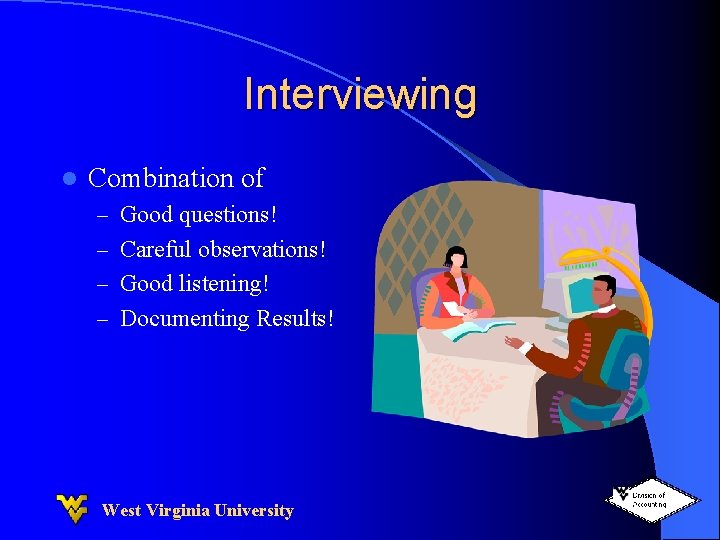
Interviewing l Combination of – Good questions! – Careful observations! – Good listening! – Documenting Results! West Virginia University
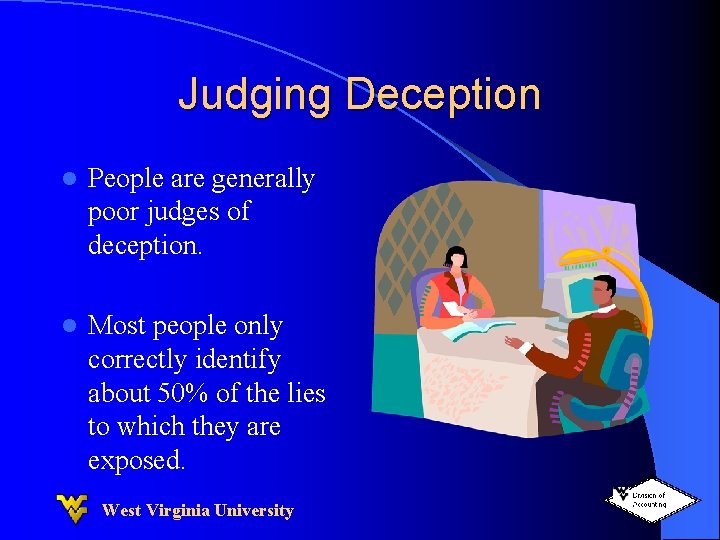
Judging Deception l People are generally poor judges of deception. l Most people only correctly identify about 50% of the lies to which they are exposed. West Virginia University
Remember!! l No single symptom or behavior proves anything because even truthful subjects can generate a random symptom that is of no consequence. l Look for a “cluster” of symptoms – two or more behaviors occurring at the same moment l The behaviors should be “timely” in that they should occur or will occur at the same moment the mental and emotional stress level of the subject either peaks or dramatically ceases. West Virginia University
Fraud and Forensic Accounting Comments and Questions West Virginia University
- Slides: 53