
SS 8 H 5 ab Georgias History 2014
SS 8 H 5 ab Georgia’s History: © 2014 Brain Wrinkles Education, Religion,
Standards SS 8 H 5 The student will explain significant factors that affected the development of Georgia as part of the growth of the United States between 1789 and 1840. a. Explain the establishment of the University of Georgia, Louisville, and the spread of Baptist and Methodist churches. b. Evaluate the impact of land policies pursued by Georgia; include the headright system, land lotteries, and the Yazoo land fraud. © 2014 Brain Wrinkles

Who’s & What’s Definition: What I think this means: Headright System Definition: What I think happened here: Louisville Directions: BEFORE the lesson, write what you think each term means. AFTER the presentation, you will write down new information about each term. University of Georgia What I think this means: Definition: Spread of Baptist & Methodist Churches What I think this means: Definition: What I think this means: Land Lotteries What I think this means: Definition: Yazoo Land Fraud Definition: © 2014 Brain Wrinkles
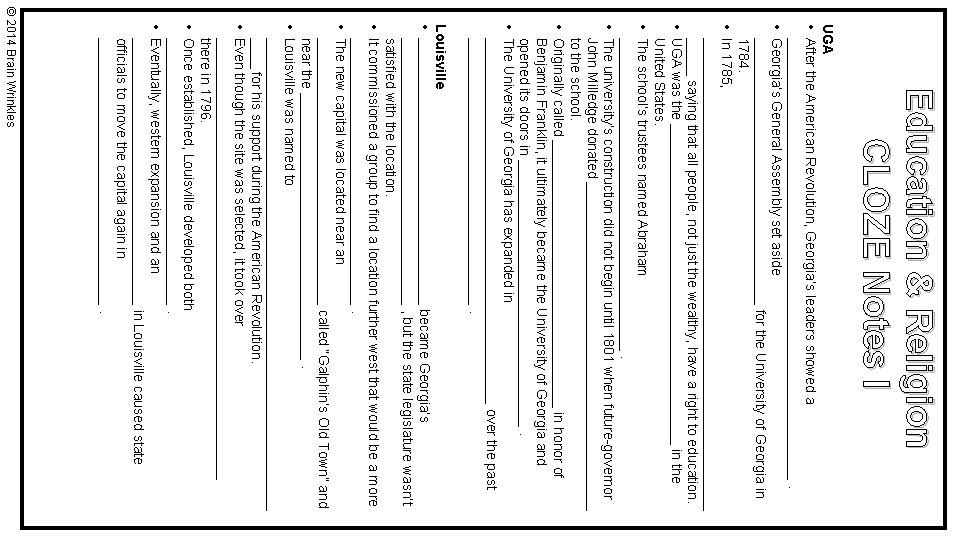
Education & Religion CLOZE Notes I UGA • After the American Revolution, Georgia’s leaders showed a _____________________________. • Georgia’s General Assembly set aside __________________ for the University of Georgia in 1784. • In 1785, _______________________________ saying that all people, not just the wealthy, have a right to education. • UGA was the _____________________ in the United States. • The school’s trustees named Abraham _____________________. • The university’s construction did not begin until 1801 when future-governor John Milledge donated ______________________ to the school. • Originally called __________________ in honor of Benjamin Franklin, it ultimately became the University of Georgia and opened its doors in __________________. • The University of Georgia has expanded in ________________________ over the past __________________. Louisville • __________________ became Georgia’s __________________ , but the state legislature wasn’t satisfied with the location. • It commissioned a group to find a location further west that would be a more __________________. • The new capital was located near an __________________ called “Galphin’s Old Town” and near the __________________. • Louisville was named to _______________________________ for his support during the American Revolution. • Even though the site was selected, it took over _____________________________ there in 1796. • Once established, Louisville developed both __________________. • Eventually, western expansion and an __________________ in Louisville caused state officials to move the capital again in __________________. © 2014 Brain Wrinkles
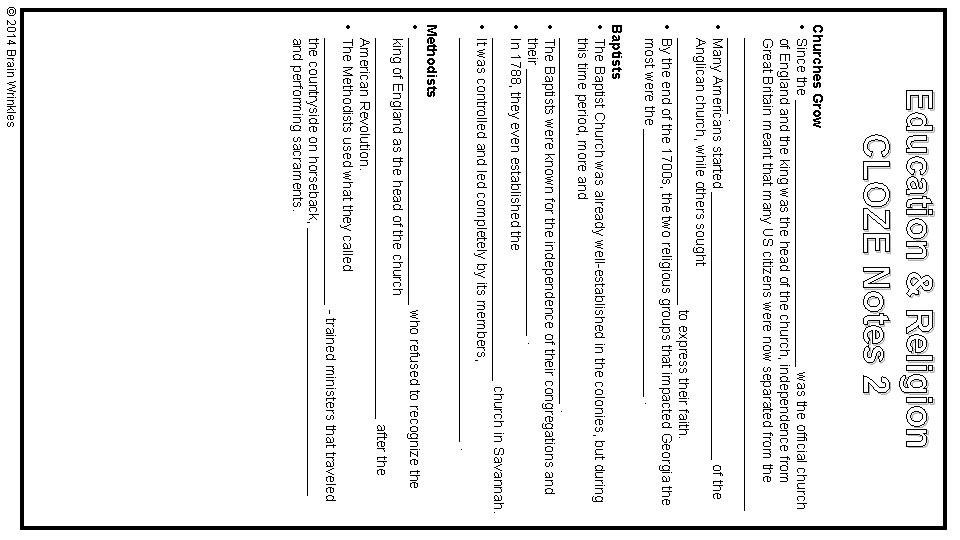
Education & Religion CLOZE Notes 2 Churches Grow • Since the __________________ was the official church of England the king was the head of the church, independence from Great Britain meant that many US citizens were now separated from the _______________________________. • Many Americans started __________________ of the Anglican church, while others sought __________________ to express their faith. • By the end of the 1700 s, the two religious groups that impacted Georgia the most were the __________________. Baptists • The Baptist Church was already well-established in the colonies, but during this time period, more and ________________________. • The Baptists were known for the independence of their congregations and their __________________. • In 1788, they even established the _______________________ church in Savannah. • It was controlled and led completely by its members, ___________________________. Methodists • __________________ who refused to recognize the king of England as the head of the church _________________________ after the American Revolution. • The Methodists used what they called __________________ - trained ministers that traveled the countryside on horseback, __________________ and performing sacraments. © 2014 Brain Wrinkles
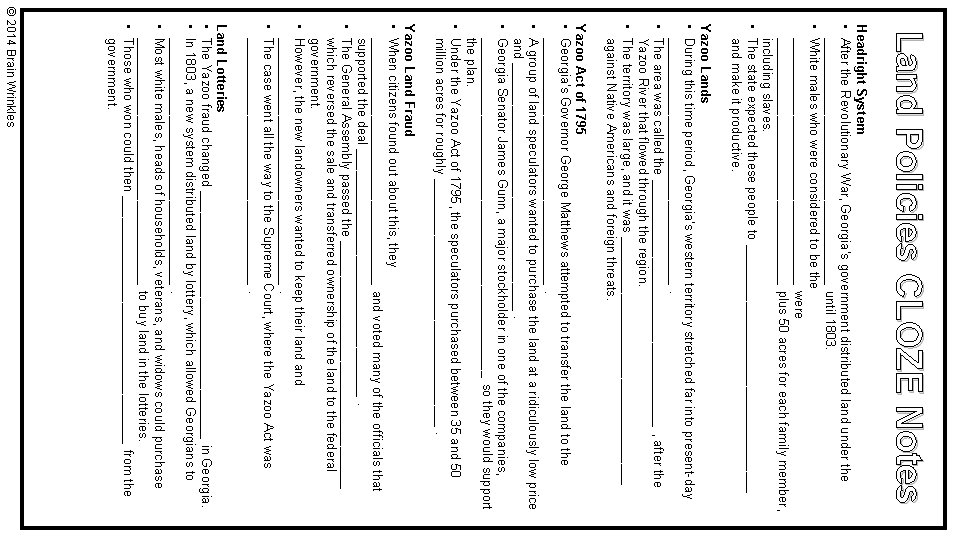
Land Policies CLOZE Notes Headright System • After the Revolutionary War, Georgia’s government distributed land under the __________________ until 1803. • White males who were considered to be the __________________ were __________________ plus 50 acres for each family member, including slaves. • The state expected these people to __________________ and make it productive. Yazoo Lands • During this time period, Georgia’s western territory stretched far into present-day __________________. • The area was called the __________________ , after the Yazoo River that flowed through the region. • The territory was large, and it was __________________ against Native Americans and foreign threats. Yazoo Act of 1795 • Georgia’s Governor George Matthews attempted to transfer the land to the __________________. • A group of land speculators wanted to purchase the land at a ridiculously low price and __________________. • Georgia Senator James Gunn, a major stockholder in one of the companies, ________________________ so they would support the plan. • Under the Yazoo Act of 1795, the speculators purchased between 35 and 50 million acres for roughly __________________. Yazoo Land Fraud • When citizens found out about this, they __________________ and voted many of the officials that supported the deal __________________. • The General Assembly passed the __________________ which reversed the sale and transferred ownership of the land to the federal government. • However, the new landowners wanted to keep their land __________________. • The case went all the way to the Supreme Court, where the Yazoo Act was __________________. Land Lotteries • The Yazoo fraud changed __________________ in Georgia. • In 1803, a new system distributed land by lottery, which allowed Georgians to __________________. • Most white males, heads of households, veterans, and widows could purchase __________________ to buy land in the lotteries. • Those who won could then __________________ from the government. © 2014 Brain Wrinkles
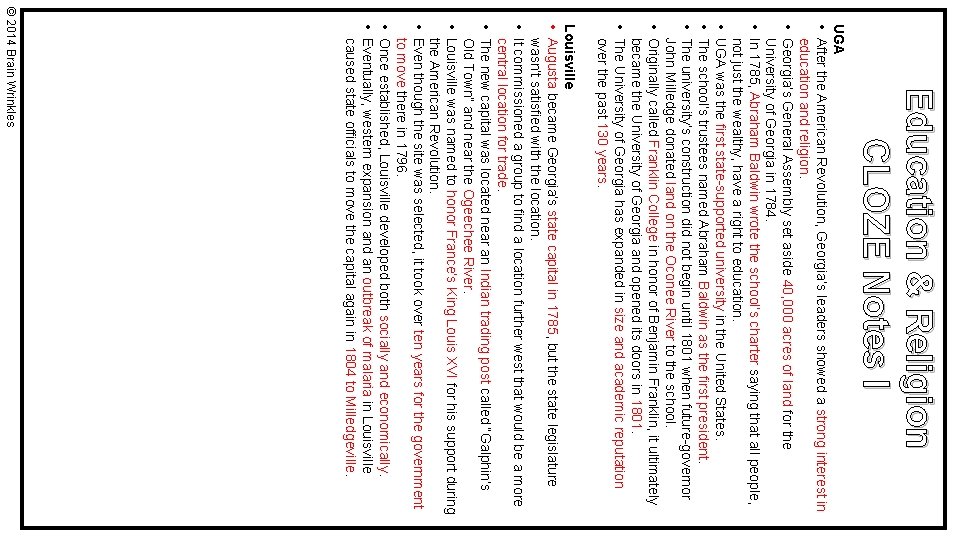
Education & Religion CLOZE Notes I UGA • After the American Revolution, Georgia’s leaders showed a strong interest in education and religion. • Georgia’s General Assembly set aside 40, 000 acres of land for the University of Georgia in 1784. • In 1785, Abraham Baldwin wrote the school’s charter saying that all people, not just the wealthy, have a right to education. • UGA was the first state-supported university in the United States. • The school’s trustees named Abraham Baldwin as the first president. • The university’s construction did not begin until 1801 when future-governor John Milledge donated land on the Oconee River to the school. • Originally called Franklin College in honor of Benjamin Franklin, it ultimately became the University of Georgia and opened its doors in 1801. • The University of Georgia has expanded in size and academic reputation over the past 130 years. Louisville • Augusta became Georgia’s state capital in 1785, but the state legislature wasn’t satisfied with the location. • It commissioned a group to find a location further west that would be a more central location for trade. • The new capital was located near an Indian trading post called “Galphin’s Old Town” and near the Ogeechee River. • Louisville was named to honor France’s King Louis XVI for his support during the American Revolution. • Even though the site was selected, it took over ten years for the government to move there in 1796. • Once established, Louisville developed both socially and economically. • Eventually, western expansion and an outbreak of malaria in Louisville caused state officials to move the capital again in 1804 to Milledgeville. © 2014 Brain Wrinkles
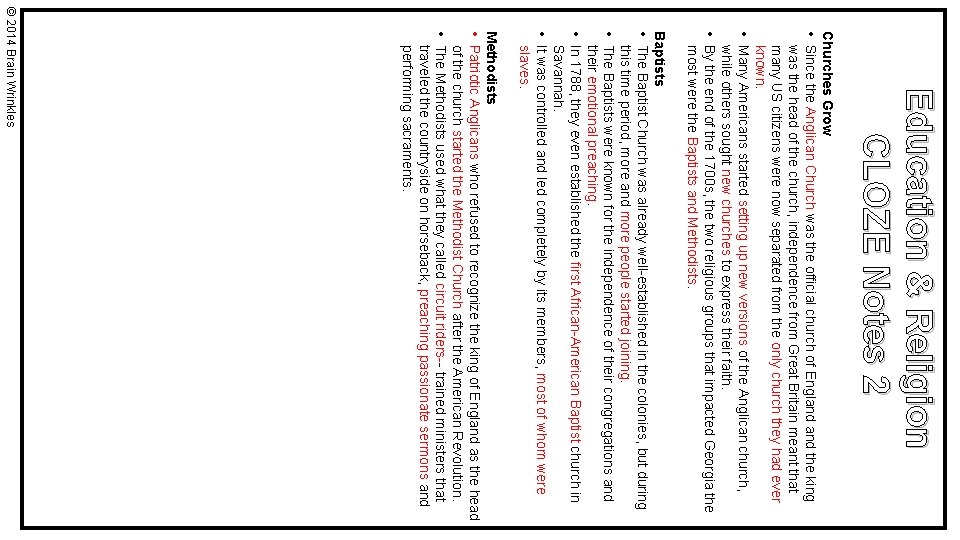
Education & Religion CLOZE Notes 2 Churches Grow • Since the Anglican Church was the official church of England the king was the head of the church, independence from Great Britain meant that many US citizens were now separated from the only church they had ever known. • Many Americans started setting up new versions of the Anglican church, while others sought new churches to express their faith. • By the end of the 1700 s, the two religious groups that impacted Georgia the most were the Baptists and Methodists. Baptists • The Baptist Church was already well-established in the colonies, but during this time period, more and more people started joining. • The Baptists were known for the independence of their congregations and their emotional preaching. • In 1788, they even established the first African-American Baptist church in Savannah. • It was controlled and led completely by its members, most of whom were slaves. Methodists • Patriotic Anglicans who refused to recognize the king of England as the head of the church started the Methodist Church after the American Revolution. • The Methodists used what they called circuit riders-- trained ministers that traveled the countryside on horseback, preaching passionate sermons and performing sacraments. © 2014 Brain Wrinkles
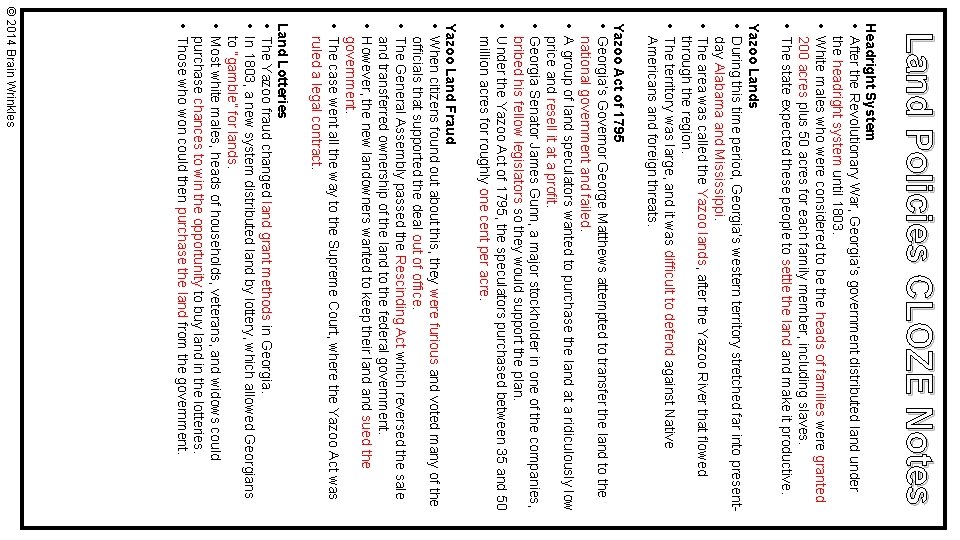
Land Policies CLOZE Notes Headright System • After the Revolutionary War, Georgia’s government distributed land under the headright system until 1803. • White males who were considered to be the heads of families were granted 200 acres plus 50 acres for each family member, including slaves. • The state expected these people to settle the land make it productive. Yazoo Lands • During this time period, Georgia’s western territory stretched far into presentday Alabama and Mississippi. • The area was called the Yazoo lands, after the Yazoo River that flowed through the region. • The territory was large, and it was difficult to defend against Native Americans and foreign threats. Yazoo Act of 1795 • Georgia’s Governor George Matthews attempted to transfer the land to the national government and failed. • A group of land speculators wanted to purchase the land at a ridiculously low price and resell it at a profit. • Georgia Senator James Gunn, a major stockholder in one of the companies, bribed his fellow legislators so they would support the plan. • Under the Yazoo Act of 1795, the speculators purchased between 35 and 50 million acres for roughly one cent per acre. Yazoo Land Fraud • When citizens found out about this, they were furious and voted many of the officials that supported the deal out of office. • The General Assembly passed the Rescinding Act which reversed the sale and transferred ownership of the land to the federal government. • However, the new landowners wanted to keep their land sued the government. • The case went all the way to the Supreme Court, where the Yazoo Act was ruled a legal contract. Land Lotteries • The Yazoo fraud changed land grant methods in Georgia. • In 1803, a new system distributed land by lottery, which allowed Georgians to “gamble” for lands. • Most white males, heads of households, veterans, and widows could purchase chances to win the opportunity to buy land in the lotteries. • Those who won could then purchase the land from the government. © 2014 Brain Wrinkles
SS 8 H 5 a Education and Religion © 2014 Brain Wrinkles
UGA • After the American Revolution, Georgia’s leaders showed a strong interest in education and religion. • Georgia’s General Assembly set aside 40, 000 acres of land for the University of Georgia in 1784. • In 1785, Abraham Baldwin wrote the school’s charter saying that all people, not just the wealthy, have a right to education. • UGA was the first state-supported university in the United States. © 2014 Brain Wrinkles
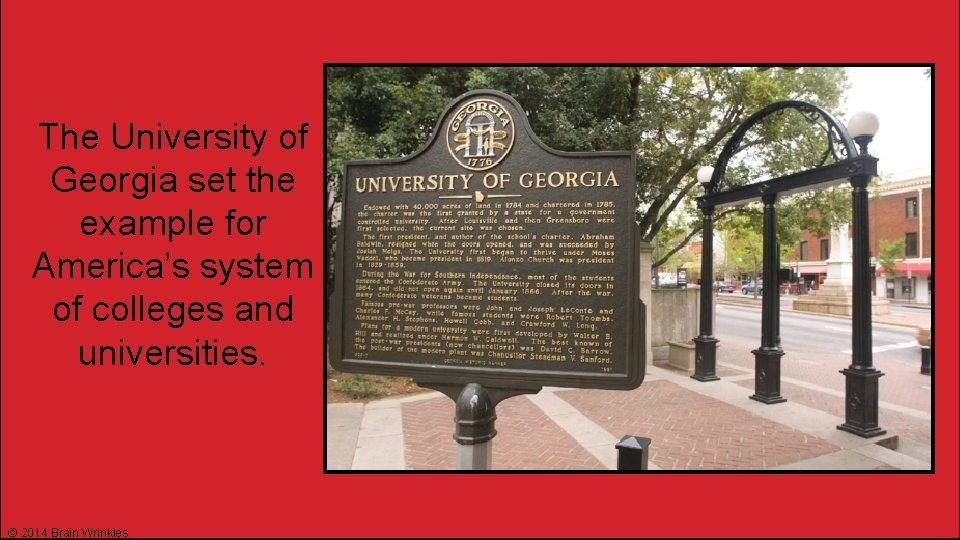
The University of Georgia set the example for America’s system of colleges and universities. © 2014 Brain Wrinkles
UGA • The school’s trustees named Abraham Baldwin as the first president. • The university’s construction did not begin until 1801 when future-governor John Milledge donated land on the Oconee River to the school. • Originally called Franklin College in honor of Benjamin Franklin, it ultimately became the University of Georgia and opened its doors in 1801. • The University of Georgia has expanded in size and academic reputation over the past 130 years. © 2014 Brain Wrinkles
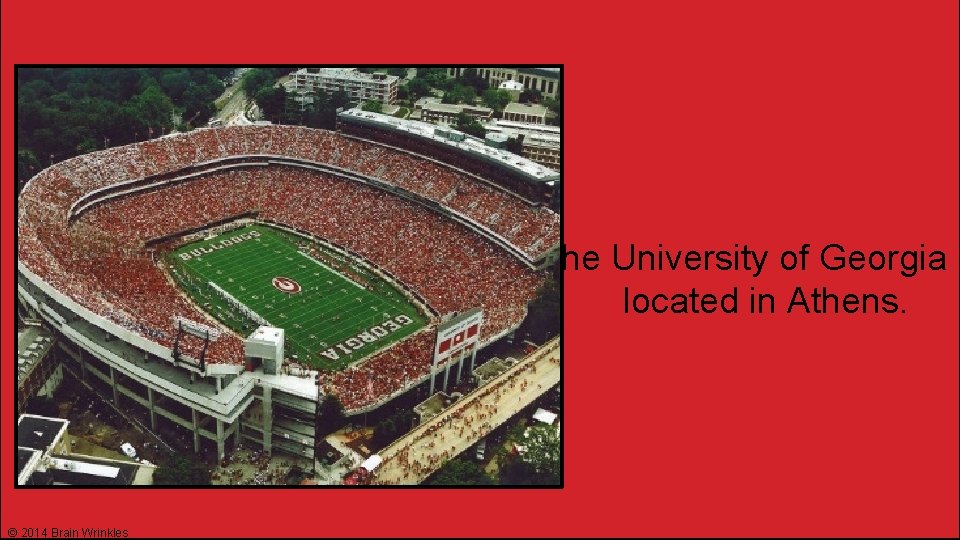
The University of Georgia i located in Athens. © 2014 Brain Wrinkles
Louisville • Augusta became Georgia’s state capital in 1785, but the state legislature wasn’t satisfied with the location. • It commissioned a group to find a location further west that would be a more central location for trade. • The new capital was located near an Indian trading post called “Galphin’s Old Town” and near the Ogeechee River. • Louisville was named to honor France’s King Louis XVI for his support during the American Revolution. © 2014 Brain Wrinkles
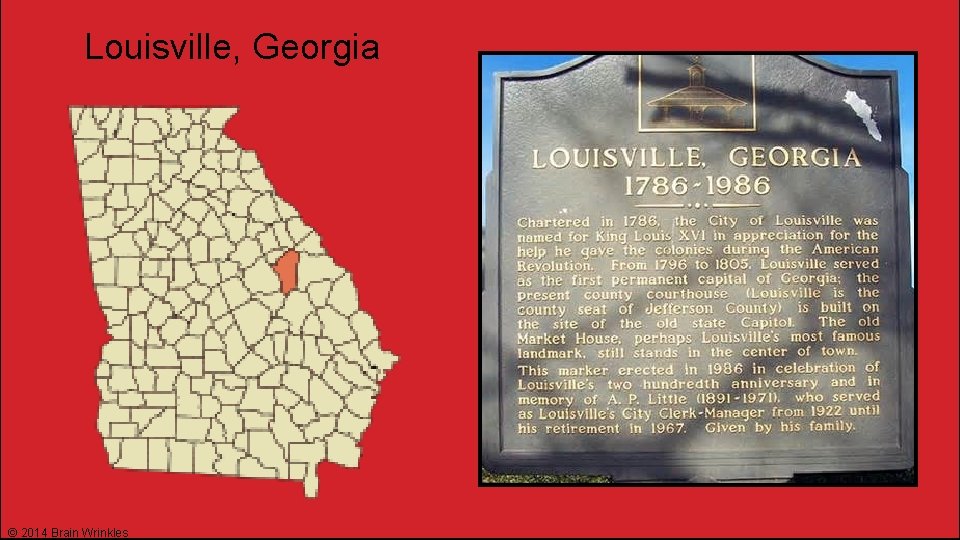
Louisville, Georgia © 2014 Brain Wrinkles
Louisville • Even though the site was selected, it took over ten years for the government to move there in 1796. • Once established, Louisville developed both socially and economically. • Eventually, western expansion and an outbreak of malaria in Louisville caused state officials to move the capital again in 1804 to Milledgeville. © 2014 Brain Wrinkles
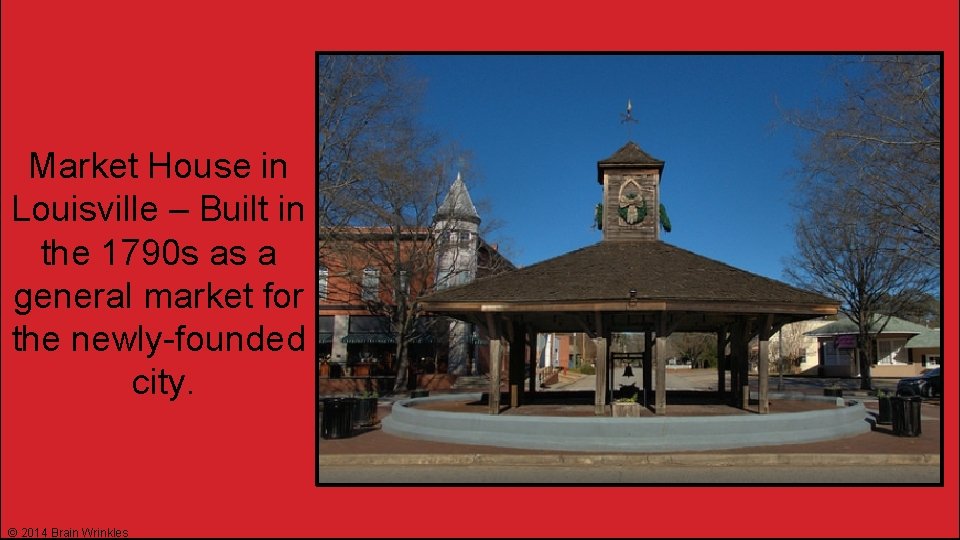
Market House in Louisville – Built in the 1790 s as a general market for the newly-founded city. © 2014 Brain Wrinkles
• • • Churches Grow Since the Anglican Church was the official church of England the king was the head of the church, independence from Great Britain meant that many US citizens were now separated from the only church they had ever known. Many Americans started setting up new versions of the Anglican church, while others sought new churches to express their faith. By the end of the 1700 s, the two religious groups that impacted Georgia the most were the Baptists and Methodists. © 2014 Brain Wrinkles
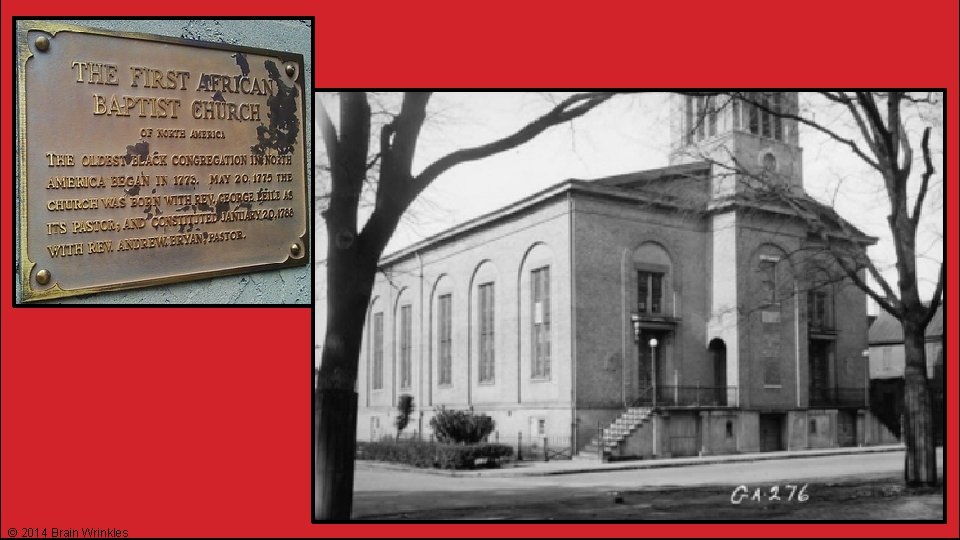
Baptists • The Baptist Church was already well-established in the colonies, but during this time period, more and more people started joining. • The Baptists were known for the independence of their congregations and their emotional preaching. • In 1788, they even established the first African-American Baptist church in Savannah. • It was controlled and led completely by its members, most of whom were slaves. © 2014 Brain Wrinkles
© 2014 Brain Wrinkles
Methodists • Patriotic Anglicans who refused to recognize the king of England as the head of the church started the Methodist Church after the American Revolution. • The Methodists used what they called circuit riders-- trained ministers that traveled the countryside on horseback, preaching passionate sermons and performing sacraments. © 2014 Brain Wrinkles
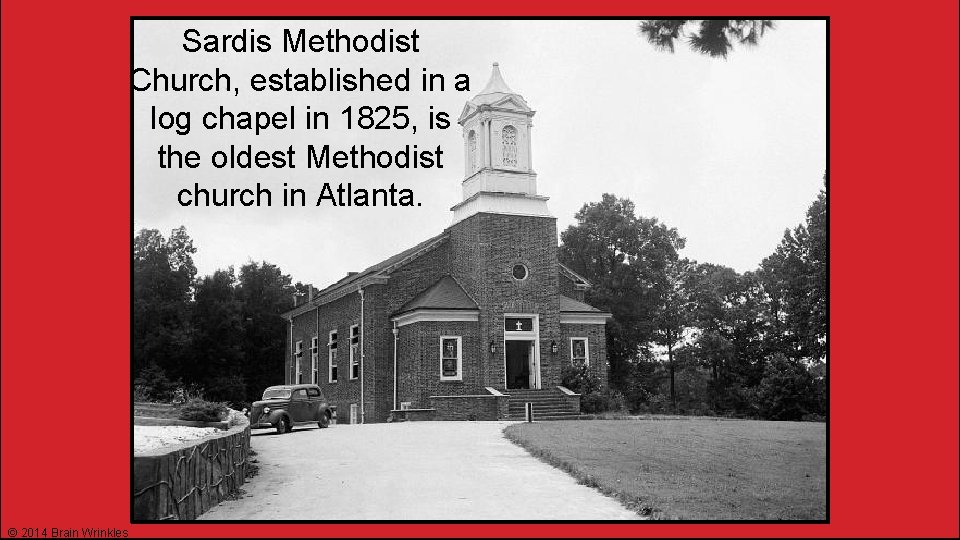
Sardis Methodist Church, established in a log chapel in 1825, is the oldest Methodist church in Atlanta. © 2014 Brain Wrinkles
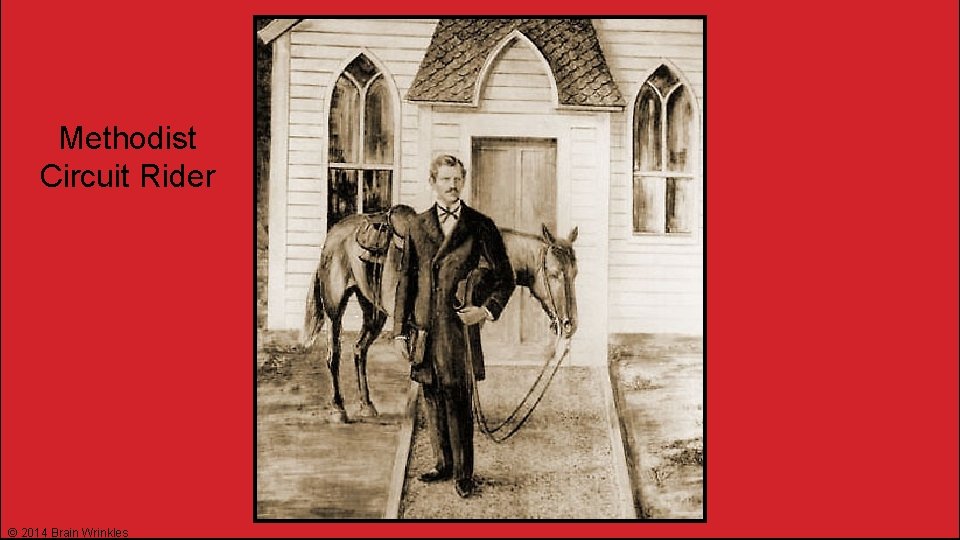
Methodist Circuit Rider © 2014 Brain Wrinkles
SS 8 H 5 b Land Policies © 2014 Brain Wrinkles
Headright System • After the Revolutionary War, Georgia’s government distributed land under the headright system until 1803. • White males who were considered to be the heads of families were granted 200 acres plus 50 acres for each family member, including slaves. • The state expected these people to settle the land make it productive. © 2014 Brain Wrinkles
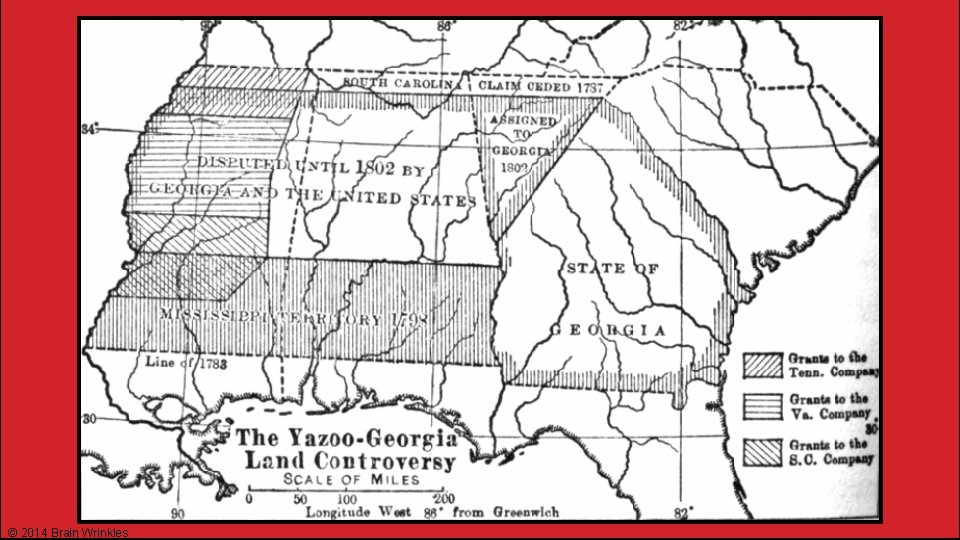
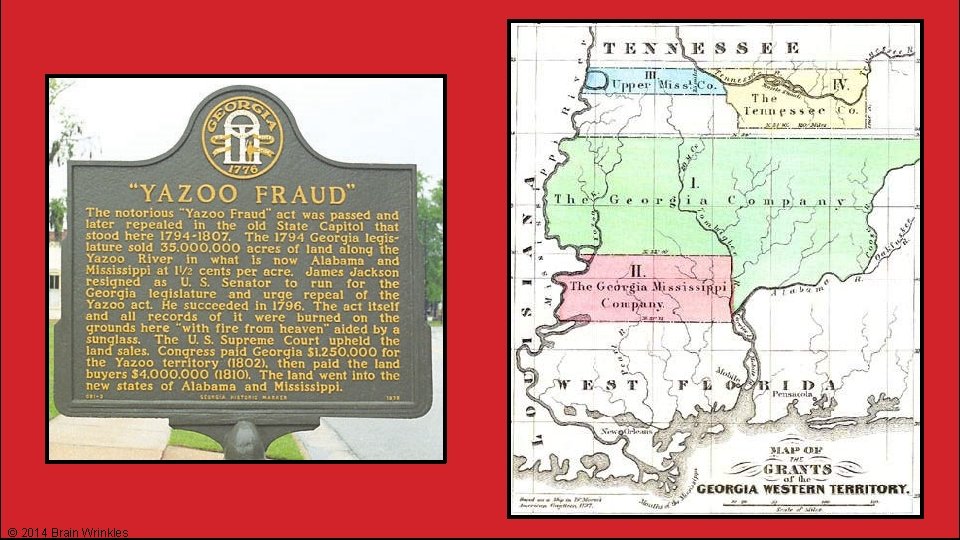
Yazoo Lands • During this time period, Georgia’s western territory stretched far into present-day Alabama and Mississippi. • The area was called the Yazoo lands, after the Yazoo River that flowed through the region. • The territory was large, and it was difficult to defend against Native Americans and foreign threats. © 2014 Brain Wrinkles
© 2014 Brain Wrinkles
Yazoo Act of 1795 • Georgia’s Governor George Matthews attempted to transfer the land to the national government and failed. • A group of land speculators wanted to purchase the land at a ridiculously low price and resell it at a profit. • Georgia Senator James Gunn, a major stockholder in one of the companies, bribed his fellow legislators so they would support the plan. • Under the Yazoo Act of 1795, the speculators purchased between 35 and 50 million acres for roughly one cent per acre. © 2014 Brain Wrinkles
Yazoo Land Fraud • When citizens found out about this, they were furious and voted many of the officials that supported the deal out of office. • The General Assembly passed the Rescinding Act which reversed the sale and transferred ownership of the land to the federal government. • However, the new landowners wanted to keep their land sued the government. • The case went all the way to the Supreme Court, where the Yazoo Act was ruled a legal contract. © 2014 Brain Wrinkles
© 2014 Brain Wrinkles
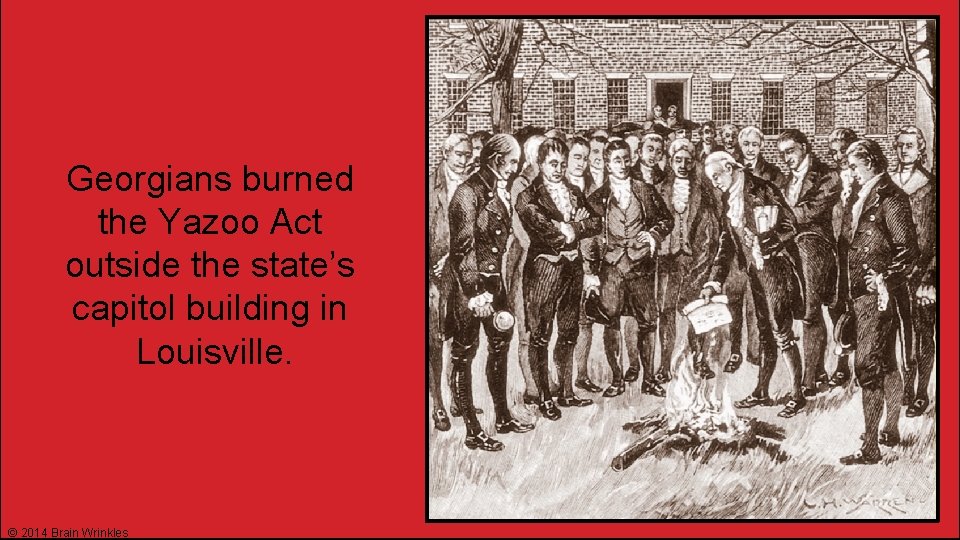
Georgians burned the Yazoo Act outside the state’s capitol building in Louisville. © 2014 Brain Wrinkles
Land Lotteries • The Yazoo fraud changed land grant methods in Georgia. • In 1803, a new system distributed land by lottery, which allowed Georgians to “gamble” for lands. • Most white males, heads of households, veterans, and widows could purchase chances to win the opportunity to buy land in the lotteries. • Those who won could then purchase the land from the government. © 2014 Brain Wrinkles
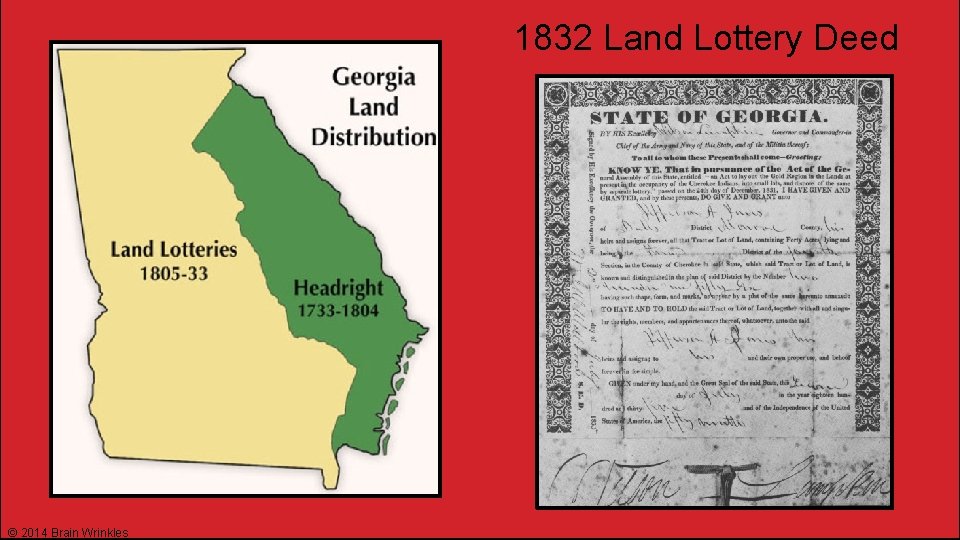
1832 Land Lottery Deed © 2014 Brain Wrinkles
Teacher Directions – Magazine Cover & Advertisement • Have the students create a magazine cover for one of the topics that were discussed from this time period (UGA, Louisville, Spread of Baptist & Methodist Churches). • They will draw the event and write a caption to describe the illustration. • On the advertisement side – they will create an advertisement for Georgians to buy some of the Yazoo lands that could have appeared during this time period. © 2014 Brain Wrinkles
Year National Geographic Draw an illustration that represents one of the key topics that we’ve studied (UGA, Louisville, or Baptist & Methodist Churches). Write a short caption that includes a description of your picture. © 2014 Brain Wrinkles Advertisement: Create an advertisement for Georgians to buy plots of Yazoo Land. Your ad should tell people why they need to buy land in this region. Don’t forget to include a picture & price!
National Geographic © 2014 Brain Wrinkles Advertisement:
Teacher Directions – Create a Political Cartoon • Have the students create a political cartoon that depicts the Yazoo Land Fraud. • Note: You may want to refresh their memories on what makes a good political cartoon (symbolism), and that political cartoons are not just straight drawings of the events. It is a good idea to show them examples of political cartoons that correspond to current events so that they know what to aim for. © 2014 Brain Wrinkles
Yazoo Land Fraud Political Cartoon Directions: Create a political cartoon that includes images & words that depict what occurred during the Yazoo Land Fraud. Include a creative and symbolic title. Also, make sure that your cartoon shows symbolism. © 2014 Brain Wrinkles
Teacher Directions – Political Cartoon Analysis • When the students are finished creating their political cartoons, have the students trade papers with a partner. • Each student will complete a Political Cartoon Analysis on their partner’s cartoon. (It is a good idea to let them talk at this point so that they can discuss the cartoons. ) If the partner doesn’t understand the cartoon, the student should go back and fix it to make it better. © 2014 Brain Wrinkles
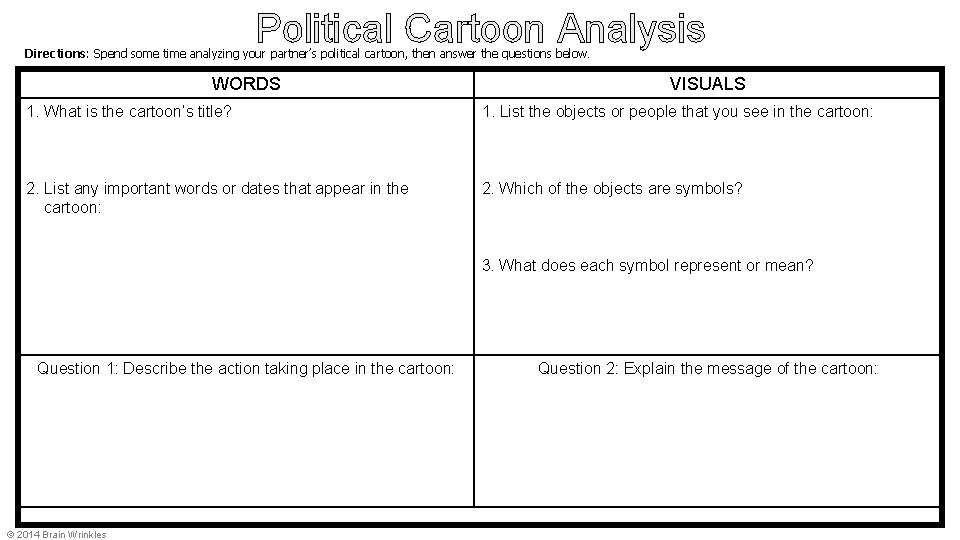
Political Cartoon Analysis Directions: Spend some time analyzing your partner’s political cartoon, then answer the questions below. WORDS VISUALS 1. What is the cartoon’s title? 1. List the objects or people that you see in the cartoon: 2. List any important words or dates that appear in the cartoon: 2. Which of the objects are symbols? 3. What does each symbol represent or mean? Question 1: Describe the action taking place in the cartoon: © 2014 Brain Wrinkles Question 2: Explain the message of the cartoon:
Teacher Directions – Read My Lips • Print out the Read My Lips summarizing strategy handout for each student. • After the presentation, have the students write down everything that they would say about the key terms as if they were explaining the meanings to someone else. © 2014 Brain Wrinkles
Read My Lips Directions: AFTER the presentation, write down everything that you would say about the terms below as if you were explaining their meanings to someone else. em st y S ht g i dr ea in urches t Ch Baptis GA H eorgia ty of G Universi Land Lo tterie s hurc C t s odi Meth in GA © 2014 Brain Wrinkles hes d n rau F d z Ya o L Lo uis vil le, G A
Thank You! Thank you so much for downloading this file. I sincerely hope you find it helpful and that your students learn a lot from it! I look forward to reading your feedback in my store. If you like this file, you might want to check out some of my other products that teach social studies topics in creative, engaging, and hands-on ways. Best of luck to you this school year, Ansley at Brain Wrinkles © 2014 Brain Wrinkles
Terms of Use © 2014 Brain Wrinkles. Your download includes a limited use license from Brain Wrinkles. The purchaser may use the resource for personal classroom use only. The license is not transferable to another person. Other teachers should purchase their own license through my store. This resource is not to be used: • By an entire grade level, school, or district without purchasing the proper number of licenses. For school/district licenses at a discount, please contact me. • As part of a product listed for sale or free by another individual. • On shared databases. • Online in any way other than on password-protected website for student use only. © Copyright 2014. Brain Wrinkles. All rights reserved. Permission is granted to copy pages specifically designed for student or teacher use by the original purchaser or licensee. The reproduction of any other part of this product is strictly prohibited. Copying any part of this product and placing it on the Internet in any form (even a personal/classroom website) is strictly forbidden. Doing so makes it possible for an Internet search to make the document available on the Internet, free of charge, and is a violation of the Digital Millennium Copyright Act (DMCA). Clipart, fonts, & digital papers for this product were purchased from: Thank you, Ansley at Brain Wrinkles © 2014 Brain Wrinkles
- Slides: 45