
Unit 8 Contract law 2 Misrepresentation Skills focus









- Slides: 65
Unit 8 Contract law 2: Misrepresentation
Skills focus Reading • understanding dependent clauses with passives Writing • paraphrasing • expanding notes into complex sentences • recognizing different essay types/structures: descriptive analytical comparison/evaluation argument • writing essay plans • writing essays Vocabulary focus • synonyms • nouns from verbs • definitions • common ‘direction’ verbs in essay titles (discuss, analyze, evaluate, etc. )
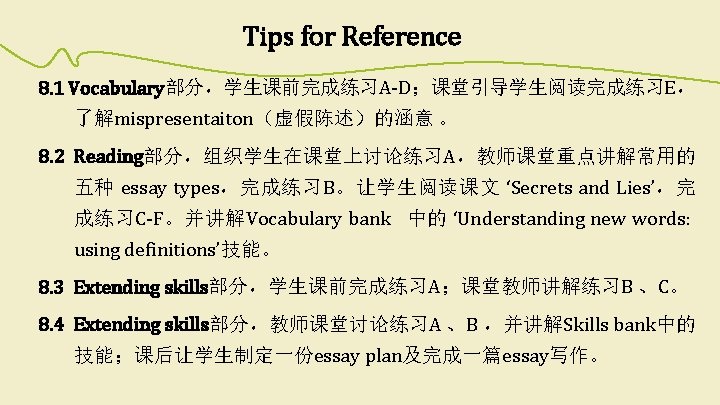
8. 1 Vocabulary 8. 2 Reading 8. 3 Extending skills 8. 4 Extending skills
8. 1 Vocabulary A Discuss the following questions. 1 What do you think is meant by misrepresentation in contract law? (Clue: remove the affixes to find the base word. ) 2 The items in box a are connected with misrepresentation. Give an example of each kind of misrepresentation. The answer: 1. fraudulent – when you deliberately use false words or actions to persuade someone to enter into a contract with you 2. innocent – when you wholly believe that your words or actions in persuading someone to form a contract with you are true 3. negligent – when you carelessly or recklessly use false words or actions to persuade someone to enter into a contract with you
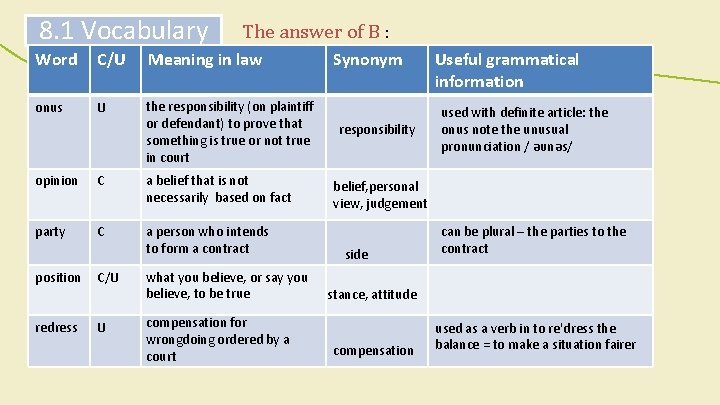
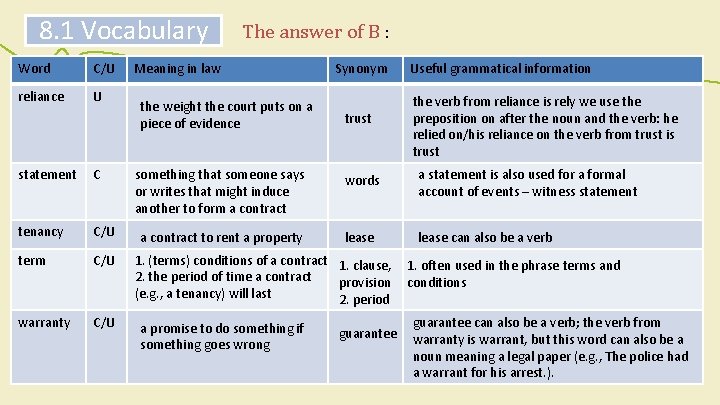
8. 1 Vocabulary B Look up each noun in box b in a dictionary. 1 Is it countable, uncountable or both? 2 What is its legal meaning? 3 Can you think of a synonym? 4 What useful grammatical information can you find?
8. 1 Vocabulary The answer of B : Word C/U Meaning in law onus U the responsibility (on plaintiff or defendant) to prove that something is true or not true in court opinion C a belief that is not necessarily based on fact party C a person who intends to form a contract position C/U what you believe, or say you believe, to be true redress U compensation for wrongdoing ordered by a court Synonym responsibility Useful grammatical information used with definite article: the onus note the unusual pronunciation / əυnəs/ belief, personal view, judgement side can be plural – the parties to the contract stance, attitude compensation used as a verb in to re'dress the balance = to make a situation fairer
8. 1 Vocabulary Word C/U reliance U statement C tenancy C/U term C/U warranty C/U The answer of B : Meaning in law the weight the court puts on a piece of evidence Synonym trust Useful grammatical information the verb from reliance is rely we use the preposition on after the noun and the verb: he relied on/his reliance on the verb from trust is trust something that someone says or writes that might induce another to form a contract words a statement is also used for a formal account of events – witness statement a contract to rent a property lease can also be a verb 1. (terms) conditions of a contract 1. clause, 2. the period of time a contract provision (e. g. , a tenancy) will last 2. period a promise to do something if something goes wrong guarantee 1. often used in the phrase terms and conditions guarantee can also be a verb; the verb from warranty is warrant, but this word can also be a noun meaning a legal paper (e. g. , The police had a warrant for his arrest. ).
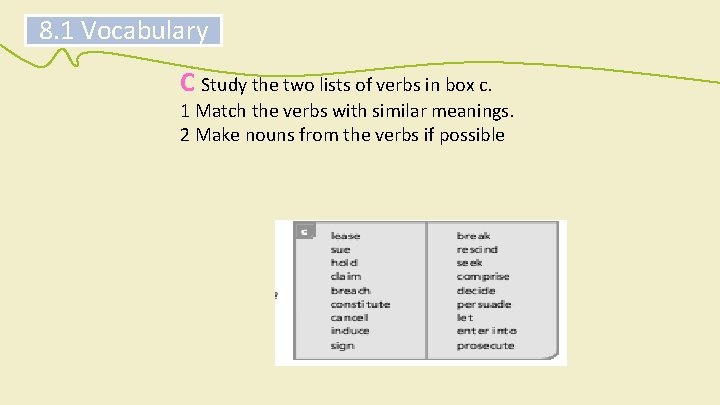
8. 1 Vocabulary C Study the two lists of verbs in box c. 1 Match the verbs with similar meanings. 2 Make nouns from the verbs if possible
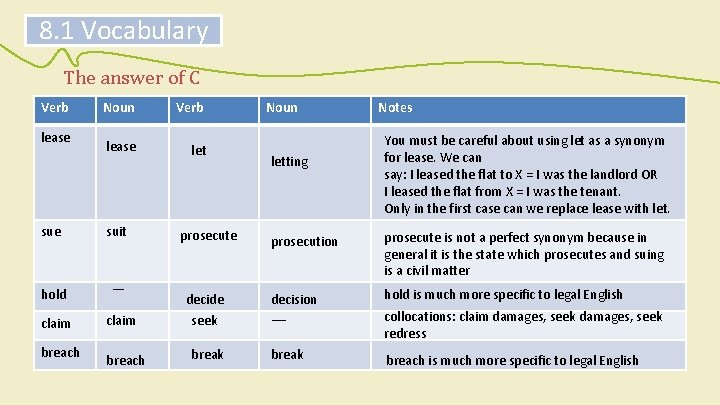
8. 1 Vocabulary The answer of C Verb lease Noun Verb lease let sue suit hold — claim breach prosecute decide seek break Noun letting Notes You must be careful about using let as a synonym for lease. We can say: I leased the flat to X = I was the landlord OR I leased the flat from X = I was the tenant. Only in the first case can we replace lease with let. prosecution prosecute is not a perfect synonym because in general it is the state which prosecutes and suing is a civil matter decision hold is much more specific to legal English — collocations: claim damages, seek redress break breach is much more specific to legal English
8. 1 Vocabulary The answer of C Verb Noun constitute — cancellation induce — signature Verb comprise Noun — constitution has a special meaning in law – the overall laws of a country rescind rescission persuade persuasion enter into Notes entry rescission does not exist in general English; people might say rescinding as the noun if they used the word at all induction has a completely different meaning from the verb = giving people basic information about a new topic note the different sound of ‘g’ in the verb and the noun
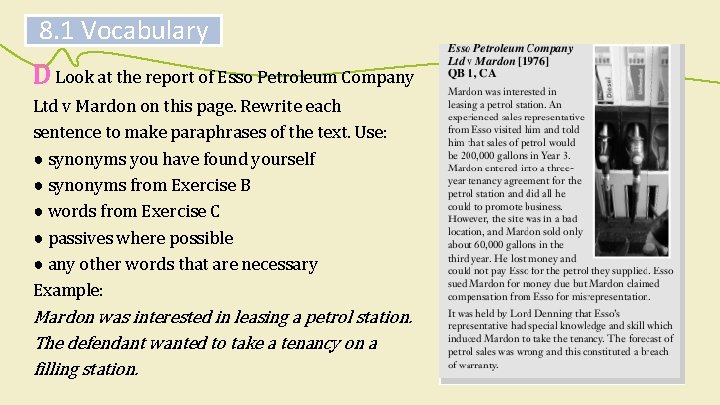
8. 1 Vocabulary D Look at the report of Esso Petroleum Company Ltd v Mardon on this page. Rewrite each sentence to make paraphrases of the text. Use: ● synonyms you have found yourself ● synonyms from Exercise B ● words from Exercise C ● passives where possible ● any other words that are necessary Example: Mardon was interested in leasing a petrol station. The defendant wanted to take a tenancy on a filling station.
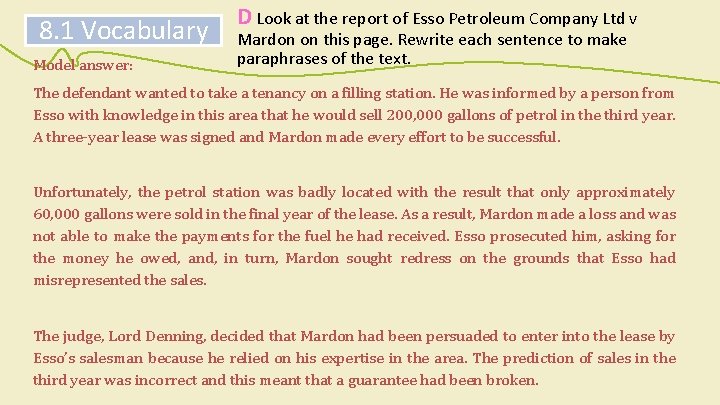
8. 1 Vocabulary Model answer: D Look at the report of Esso Petroleum Company Ltd v Mardon on this page. Rewrite each sentence to make paraphrases of the text. The defendant wanted to take a tenancy on a filling station. He was informed by a person from Esso with knowledge in this area that he would sell 200, 000 gallons of petrol in the third year. A three-year lease was signed and Mardon made every effort to be successful. Unfortunately, the petrol station was badly located with the result that only approximately 60, 000 gallons were sold in the final year of the lease. As a result, Mardon made a loss and was not able to make the payments for the fuel he had received. Esso prosecuted him, asking for the money he owed, and, in turn, Mardon sought redress on the grounds that Esso had misrepresented the sales. The judge, Lord Denning, decided that Mardon had been persuaded to enter into the lease by Esso’s salesman because he relied on his expertise in the area. The prediction of sales in the third year was incorrect and this meant that a guarantee had been broken.
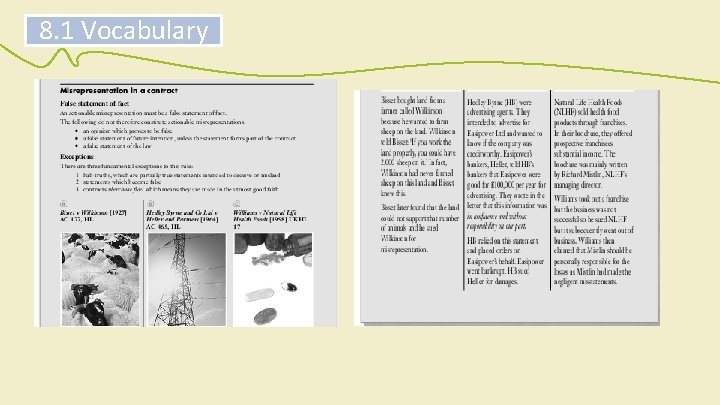
8. 1 Vocabulary E Study the information on misrepresentation on the opposite page. Then read one of the cases, A, B or C, underneath the information. 1 What kind of misrepresentation was involved in the case? 2 Work in groups of three with one A, one B and one C. Give the facts of your case, in your own words. Reach a consensus on the judgment. 3 Listen to the judgments. Did you reach the same conclusions?
8. 1 Vocabulary
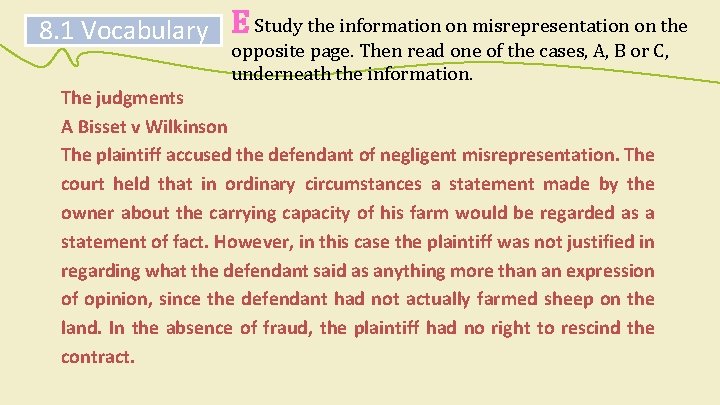
8. 1 Vocabulary E Study the information on misrepresentation on the opposite page. Then read one of the cases, A, B or C, underneath the information. The judgments A Bisset v Wilkinson The plaintiff accused the defendant of negligent misrepresentation. The court held that in ordinary circumstances a statement made by the owner about the carrying capacity of his farm would be regarded as a statement of fact. However, in this case the plaintiff was not justified in regarding what the defendant said as anything more than an expression of opinion, since the defendant had not actually farmed sheep on the land. In the absence of fraud, the plaintiff had no right to rescind the contract.
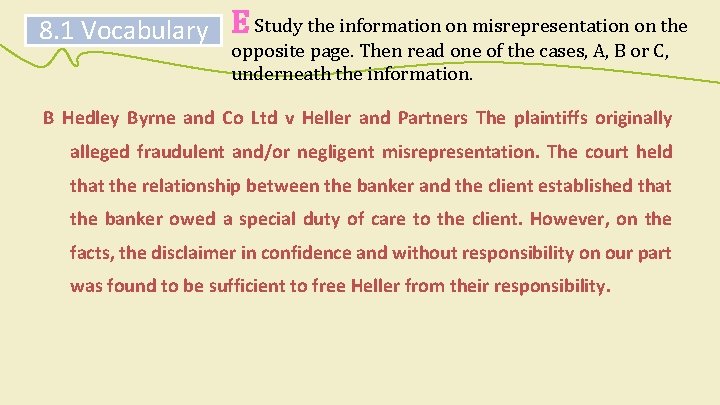
8. 1 Vocabulary E Study the information on misrepresentation on the opposite page. Then read one of the cases, A, B or C, underneath the information. B Hedley Byrne and Co Ltd v Heller and Partners The plaintiffs originally alleged fraudulent and/or negligent misrepresentation. The court held that the relationship between the banker and the client established that the banker owed a special duty of care to the client. However, on the facts, the disclaimer in confidence and without responsibility on our part was found to be sufficient to free Heller from their responsibility.
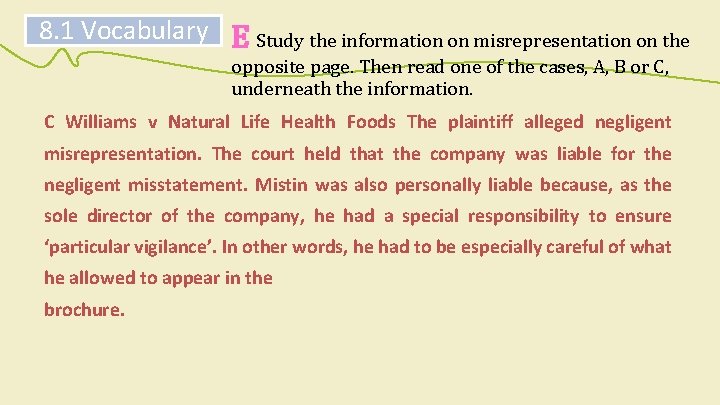
8. 1 Vocabulary E Study the information on misrepresentation on the opposite page. Then read one of the cases, A, B or C, underneath the information. C Williams v Natural Life Health Foods The plaintiff alleged negligent misrepresentation. The court held that the company was liable for the negligent misstatement. Mistin was also personally liable because, as the sole director of the company, he had a special responsibility to ensure ‘particular vigilance’. In other words, he had to be especially careful of what he allowed to appear in the brochure.
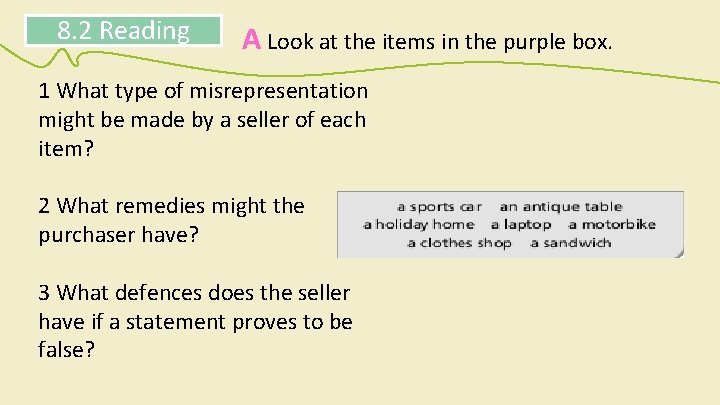
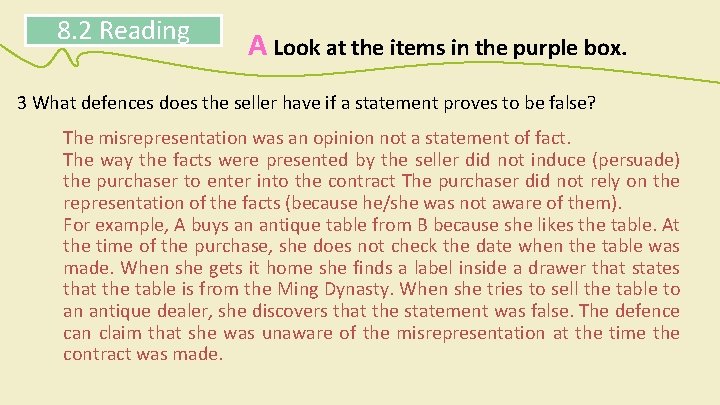
8. 2 Reading A Look at the items in the purple box. 1 What type of misrepresentation might be made by a seller of each item? 2 What remedies might the purchaser have? 3 What defences does the seller have if a statement proves to be false?
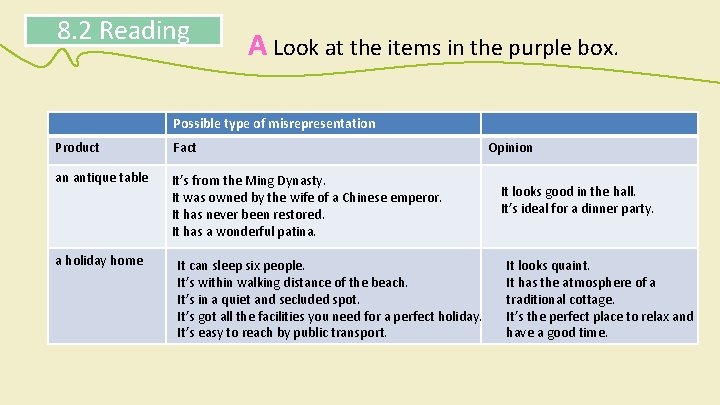
8. 2 Reading A Look at the items in the purple box. Possible type of misrepresentation Product Fact an antique table It’s from the Ming Dynasty. It was owned by the wife of a Chinese emperor. It has never been restored. It has a wonderful patina. a holiday home It can sleep six people. It’s within walking distance of the beach. It’s in a quiet and secluded spot. It’s got all the facilities you need for a perfect holiday. It’s easy to reach by public transport. Opinion It looks good in the hall. It’s ideal for a dinner party. It looks quaint. It has the atmosphere of a traditional cottage. It’s the perfect place to relax and have a good time.
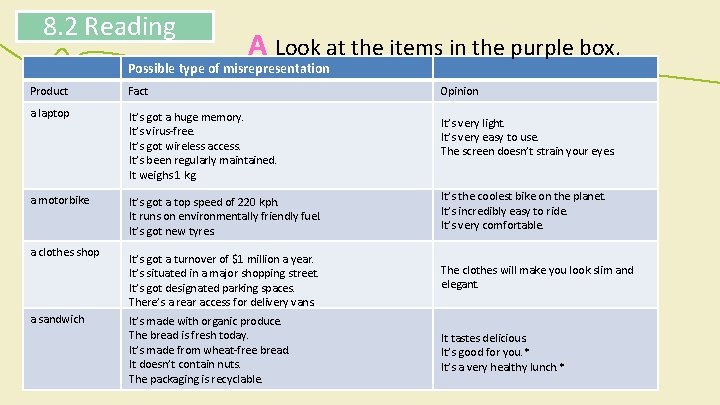
8. 2 Reading A Look at the items in the purple box. Possible type of misrepresentation Product Fact Opinion a laptop It’s got a huge memory. It’s virus-free. It’s got wireless access. It’s been regularly maintained. It weighs 1 kg. It’s very light. It’s very easy to use. The screen doesn’t strain your eyes. a motorbike It’s got a top speed of 220 kph. It runs on environmentally friendly fuel. It’s got new tyres. It’s the coolest bike on the planet. It’s incredibly easy to ride. It’s very comfortable. It’s got a turnover of $1 million a year. It’s situated in a major shopping street. It’s got designated parking spaces. There’s a rear access for delivery vans. The clothes will make you look slim and elegant. It’s made with organic produce. The bread is fresh today. It’s made from wheat-free bread. It doesn’t contain nuts. The packaging is recyclable. It tastes delicious. It’s good for you. * It’s a very healthy lunch. * a clothes shop a sandwich
8. 2 Reading A Look at the items in the purple box. 2 Remedies: Accept any reasonable answers. Remind students that they are only discussing the general principles of misrepresentation and that each case needs to be decided on the facts. For more information on remedies, see the Subject note at the beginning of this lesson.
8. 2 Reading A Look at the items in the purple box. 3 What defences does the seller have if a statement proves to be false? The misrepresentation was an opinion not a statement of fact. The way the facts were presented by the seller did not induce (persuade) the purchaser to enter into the contract The purchaser did not rely on the representation of the facts (because he/she was not aware of them). For example, A buys an antique table from B because she likes the table. At the time of the purchase, she does not check the date when the table was made. When she gets it home she finds a label inside a drawer that states that the table is from the Ming Dynasty. When she tries to sell the table to an antique dealer, she discovers that the statement was false. The defence can claim that she was unaware of the misrepresentation at the time the contract was made.
8. 2 Reading B Look at the four essay types on the right. 1 What should the writer do in each type? 2 Match each essay type with one of the questions below the slide (A–D). 3 What topics should be covered in each essay question? See vocabulary bank
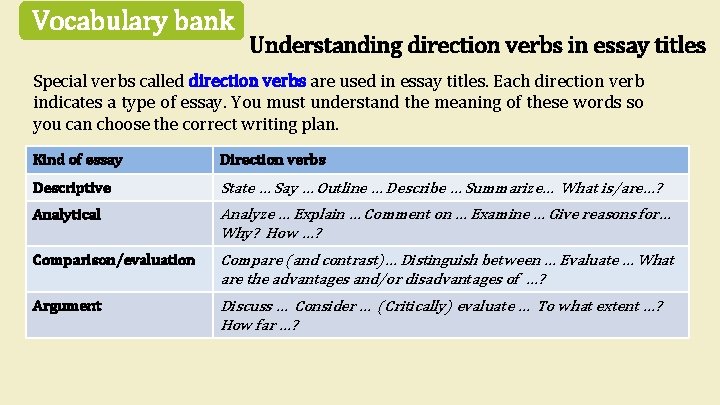
Vocabulary bank Understanding direction verbs in essay titles Special verbs called direction verbs are used in essay titles. Each direction verb indicates a type of essay. You must understand the meaning of these words so you can choose the correct writing plan. Kind of essay Direction verbs Descriptive State … Say … Outline … Describe … Summarize… What is/are…? Analytical Analyze … Explain … Comment on … Examine … Give reasons for… Why? How …? Comparison/evaluation Compare (and contrast)… Distinguish between … Evaluate … What are the advantages and/or disadvantages of …? Argument Discuss … Consider … (Critically) evaluate … To what extent …? How far …?
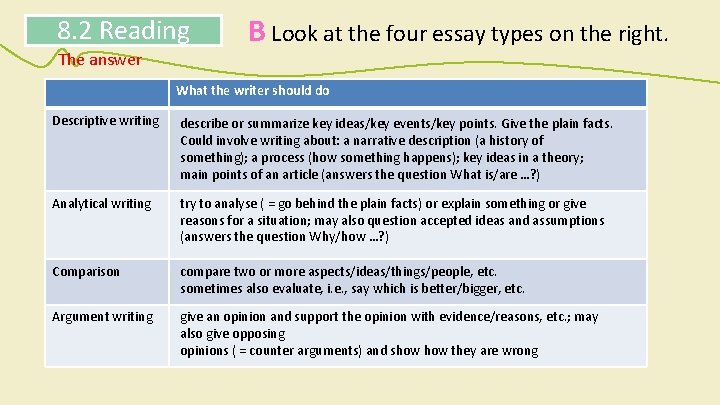
8. 2 Reading The answer B Look at the four essay types on the right. What the writer should do Descriptive writing describe or summarize key ideas/key events/key points. Give the plain facts. Could involve writing about: a narrative description (a history of something); a process (how something happens); key ideas in a theory; main points of an article (answers the question What is/are …? ) Analytical writing try to analyse ( = go behind the plain facts) or explain something or give reasons for a situation; may also question accepted ideas and assumptions (answers the question Why/how …? ) Comparison compare two or more aspects/ideas/things/people, etc. sometimes also evaluate, i. e. , say which is better/bigger, etc. Argument writing give an opinion and support the opinion with evidence/reasons, etc. ; may also give opposing opinions ( = counter arguments) and show they are wrong
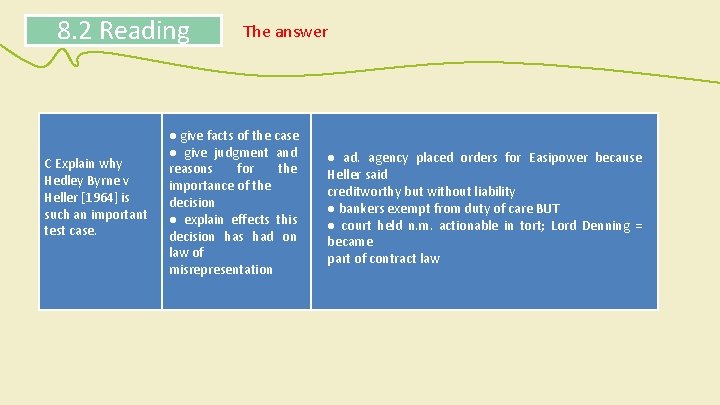
8. 2 Reading B Look at the four essay types on the right. Type of writing D What are the four types of misrepresentation? What are the remedies if misrepresentation is proven in each case? ● list the four types ● define the four types ● give the remedy/ies available for each type C Explain why Hedley Byrne v Heller [1964] is such an important test case. ● give facts of the case ● give judgment and reasons for the importance of the decision ● explain effects this decision has had on law of misrepresentation Comparison A What are the key differences between fraudulent misrepresentation and negligent misrepresentation? ● define fraudulent misrepresentation ● define negligent misrepresentation ● list the key differences, in terms of actions, defences and remedies Argument writing B ‘The law on misrepresentation does not adequately protect the purchaser of goods or services. ’ To what extent do you agree with this statement? ● define misrepresentation in law ● give the remedies for different types of misrepresentation ● say in what ways, in your opinion, the law favours the purchaser ● say in what ways, in your opinion, it favours the seller ● sum up with your own opinion of the statement Descriptive writing Analytical writing
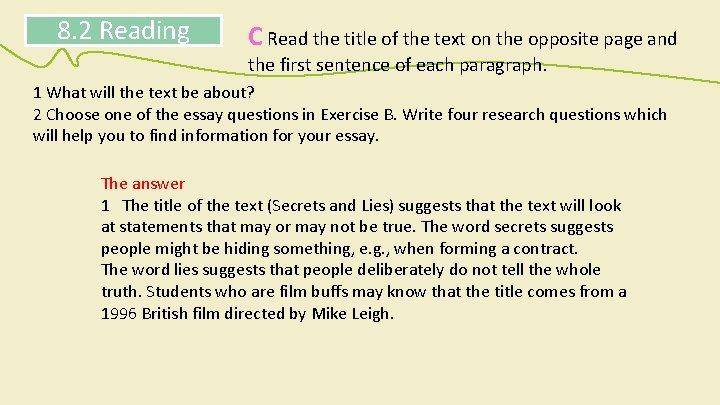
8. 2 Reading C Read the title of the text on the opposite page and the first sentence of each paragraph. 1 What will the text be about? 2 Choose one of the essay questions in Exercise B. Write four research questions which will help you to find information for your essay. The answer 1 The title of the text (Secrets and Lies) suggests that the text will look at statements that may or may not be true. The word secrets suggests people might be hiding something, e. g. , when forming a contract. The word lies suggests that people deliberately do not tell the whole truth. Students who are film buffs may know that the title comes from a 1996 British film directed by Mike Leigh.
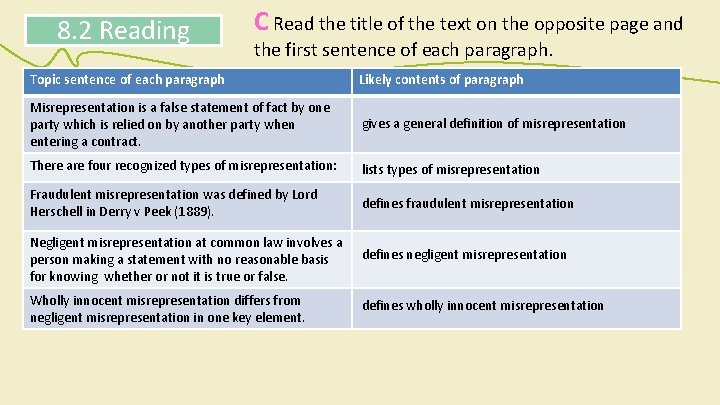
8. 2 Reading C Read the title of the text on the opposite page and the first sentence of each paragraph. Topic sentence of each paragraph Likely contents of paragraph Misrepresentation is a false statement of fact by one party which is relied on by another party when entering a contract. gives a general definition of misrepresentation There are four recognized types of misrepresentation: lists types of misrepresentation Fraudulent misrepresentation was defined by Lord Herschell in Derry v Peek (1889). defines fraudulent misrepresentation Negligent misrepresentation at common law involves a person making a statement with no reasonable basis for knowing whether or not it is true or false. defines negligent misrepresentation Wholly innocent misrepresentation differs from negligent misrepresentation in one key element. defines wholly innocent misrepresentation
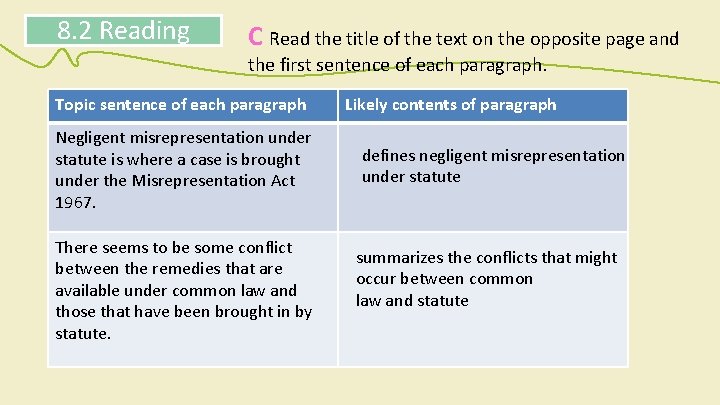
8. 2 Reading C Read the title of the text on the opposite page and the first sentence of each paragraph. Topic sentence of each paragraph Negligent misrepresentation under statute is where a case is brought under the Misrepresentation Act 1967. There seems to be some conflict between the remedies that are available under common law and those that have been brought in by statute. Likely contents of paragraph defines negligent misrepresentation under statute summarizes the conflicts that might occur between common law and statute
8. 2 Reading D Read the text. 1 Using your own words, make notes from the text on information for your essay question. Indicate where you need to do more research. 2 Work with another person who has chosen the same essay question as you Compare your notes.
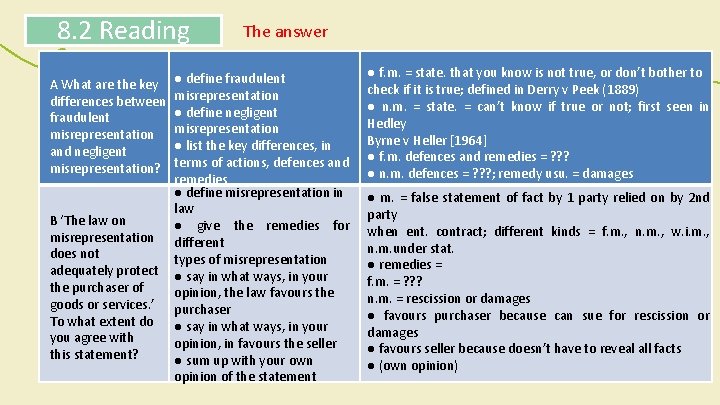
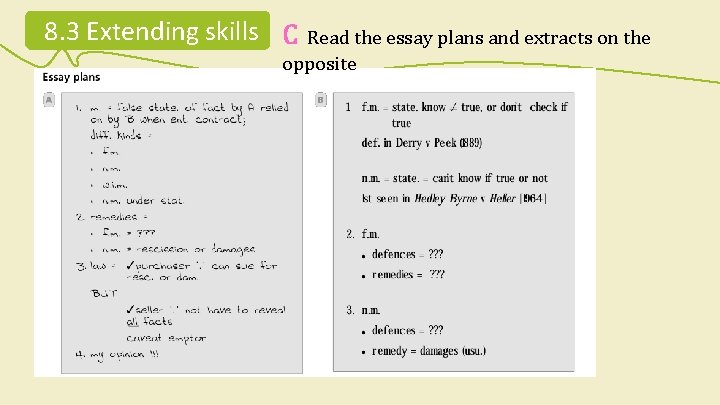
8. 2 Reading A What are the key differences between fraudulent misrepresentation and negligent misrepresentation? B ‘The law on misrepresentation does not adequately protect the purchaser of goods or services. ’ To what extent do you agree with this statement? The answer ● define fraudulent misrepresentation ● define negligent misrepresentation ● list the key differences, in terms of actions, defences and remedies ● define misrepresentation in law ● give the remedies for different types of misrepresentation ● say in what ways, in your opinion, the law favours the purchaser ● say in what ways, in your opinion, in favours the seller ● sum up with your own opinion of the statement ● f. m. = state. that you know is not true, or don’t bother to check if it is true; defined in Derry v Peek (1889) ● n. m. = state. = can’t know if true or not; first seen in Hedley Byrne v Heller [1964] ● f. m. defences and remedies = ? ? ? ● n. m. defences = ? ? ? ; remedy usu. = damages ● m. = false statement of fact by 1 party relied on by 2 nd party when ent. contract; different kinds = f. m. , n. m. , w. i. m. , n. m. under stat. ● remedies = f. m. = ? ? ? n. m. = rescission or damages ● favours purchaser because can sue for rescission or damages ● favours seller because doesn’t have to reveal all facts ● (own opinion)
8. 2 Reading C Explain why Hedley Byrne v Heller [1964] is such an important test case. The answer ● give facts of the case ● give judgment and reasons for the importance of the decision ● explain effects this decision has had on law of misrepresentation ● ad. agency placed orders for Easipower because Heller said creditworthy but without liability ● bankers exempt from duty of care BUT ● court held n. m. actionable in tort; Lord Denning = became part of contract law
8. 2 Reading D What are the four types of misrepresentation? What are the remedies if misrepresentation is proven in each case? The answer ● list the four types ● define the four types ● give the remedy/ies available for each type ● f. m. , n. m. , w. i. m. , n. m. under stat. ● def. ● f. m. = statement that you know is not true, or don’t bother to check if it is true; defined in Derry v Peek (1889) ● n. m. = statement = can’t know if true or not; first seen in Hedley Byrne v Heller [1964] ● w. i. m. = thought statement = true ● n. m. under stat. = if loss can claim damages even if mis. not made fraudulently ● remedies: ● f. m. = ? ? ? ● n. m. = damages ● w. i. m. = rescission/damages ● n. m. under stat. = damages/rescission
8. 2 Reading E Study the highlighted sentences in the text. 1 Underline all the subjects and their verbs. 2 Which is the main subject and verb for each sentence?
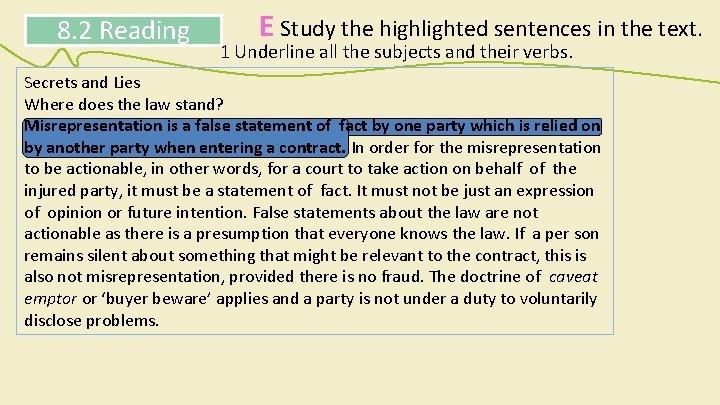
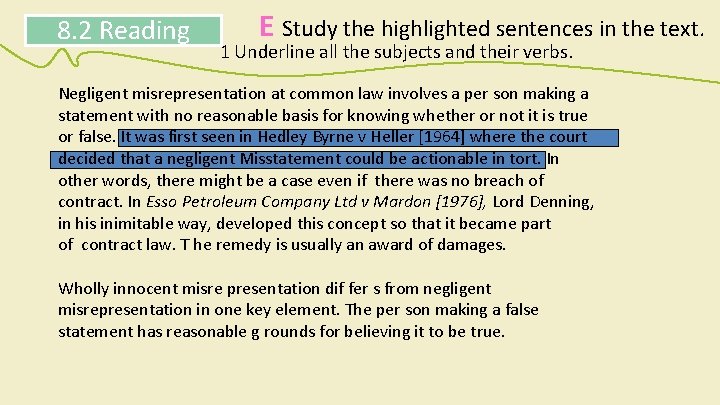
8. 2 Reading E Study the highlighted sentences in the text. 1 Underline all the subjects and their verbs. Secrets and Lies Where does the law stand? Misrepresentation is a false statement of fact by one party which is relied on by another party when entering a contract. In order for the misrepresentation to be actionable, in other words, for a court to take action on behalf of the injured party, it must be a statement of fact. It must not be just an expression of opinion or future intention. False statements about the law are not actionable as there is a presumption that everyone knows the law. If a per son remains silent about something that might be relevant to the contract, this is also not misrepresentation, provided there is no fraud. The doctrine of caveat emptor or ‘buyer beware’ applies and a party is not under a duty to voluntarily disclose problems.
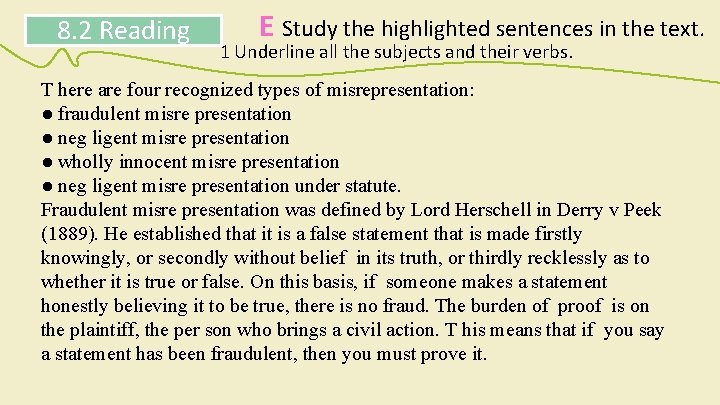
8. 2 Reading E Study the highlighted sentences in the text. 1 Underline all the subjects and their verbs. T here are four recognized types of misrepresentation: ● fraudulent misre presentation ● neg ligent misre presentation ● wholly innocent misre presentation ● neg ligent misre presentation under statute. Fraudulent misre presentation was defined by Lord Herschell in Derry v Peek (1889). He established that it is a false statement that is made firstly knowingly, or secondly without belief in its truth, or thirdly recklessly as to whether it is true or false. On this basis, if someone makes a statement honestly believing it to be true, there is no fraud. The burden of proof is on the plaintiff, the per son who brings a civil action. T his means that if you say a statement has been fraudulent, then you must prove it.
8. 2 Reading E Study the highlighted sentences in the text. 1 Underline all the subjects and their verbs. Negligent misrepresentation at common law involves a per son making a statement with no reasonable basis for knowing whether or not it is true or false. It was first seen in Hedley Byrne v Heller [1964] where the court decided that a negligent Misstatement could be actionable in tort. In other words, there might be a case even if there was no breach of contract. In Esso Petroleum Company Ltd v Mardon [1976], Lord Denning, in his inimitable way, developed this concept so that it became part of contract law. T he remedy is usually an award of damages. Wholly innocent misre presentation dif fer s from negligent misrepresentation in one key element. The per son making a false statement has reasonable g rounds for believing it to be true.
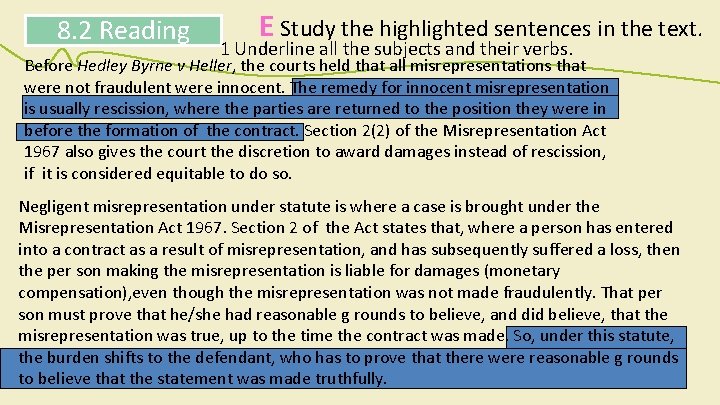
8. 2 Reading E Study the highlighted sentences in the text. 1 Underline all the subjects and their verbs. Before Hedley Byrne v Heller, the courts held that all misrepresentations that were not fraudulent were innocent. The remedy for innocent misrepresentation is usually rescission, where the parties are returned to the position they were in before the formation of the contract. Section 2(2) of the Misrepresentation Act 1967 also gives the court the discretion to award damages instead of rescission, if it is considered equitable to do so. Negligent misrepresentation under statute is where a case is brought under the Misrepresentation Act 1967. Section 2 of the Act states that, where a person has entered into a contract as a result of misrepresentation, and has subsequently suffered a loss, then the per son making the misrepresentation is liable for damages (monetary compensation), even though the misrepresentation was not made fraudulently. That per son must prove that he/she had reasonable g rounds to believe, and did believe, that the misrepresentation was true, up to the time the contract was made. So, under this statute, the burden shifts to the defendant, who has to prove that there were reasonable g rounds to believe that the statement was made truthfully.
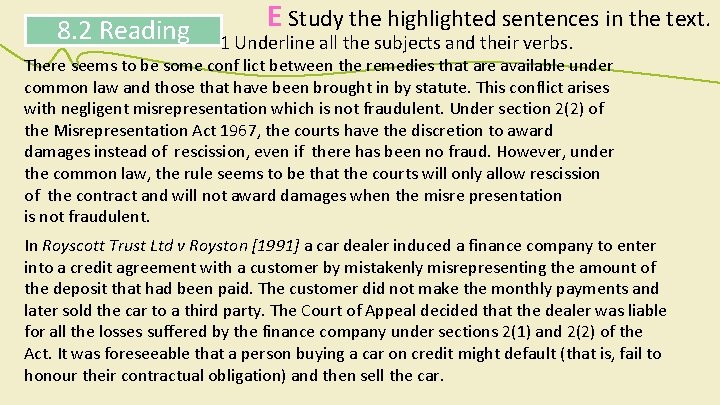
8. 2 Reading E Study the highlighted sentences in the text. 1 Underline all the subjects and their verbs. There seems to be some conf lict between the remedies that are available under common law and those that have been brought in by statute. This conflict arises with negligent misrepresentation which is not fraudulent. Under section 2(2) of the Misrepresentation Act 1967, the courts have the discretion to award damages instead of rescission, even if there has been no fraud. However, under the common law, the rule seems to be that the courts will only allow rescission of the contract and will not award damages when the misre presentation is not fraudulent. In Royscott Trust Ltd v Royston [1991] a car dealer induced a finance company to enter into a credit agreement with a customer by mistakenly misrepresenting the amount of the deposit that had been paid. The customer did not make the monthly payments and later sold the car to a third party. The Court of Appeal decided that the dealer was liable for all the losses suffered by the finance company under sections 2(1) and 2(2) of the Act. It was foreseeable that a person buying a car on credit might default (that is, fail to honour their contractual obligation) and then sell the car.
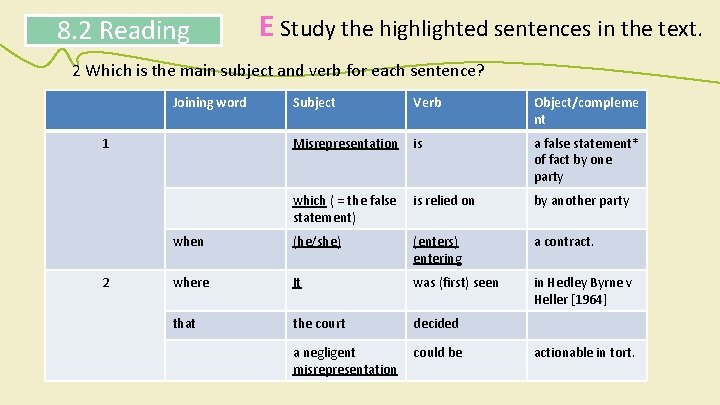
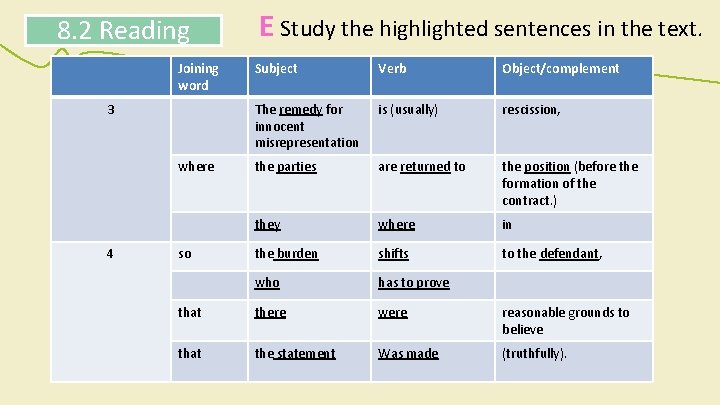
8. 2 Reading E Study the highlighted sentences in the text. 2 Which is the main subject and verb for each sentence? Joining word Subject Verb Object/compleme nt Misrepresentation is a false statement* of fact by one party which ( = the false statement) is relied on by another party when (he/she) (enters) entering a contract. where It was (first) seen in Hedley Byrne v Heller [1964] that the court decided a negligent misrepresentation could be 1 2 actionable in tort.
8. 2 Reading Joining word Subject Verb Object/complement The remedy for innocent misrepresentation is (usually) rescission, the parties are returned to the position (before the formation of the contract. ) they where in the burden shifts to the defendant, who has to prove that there were reasonable grounds to believe that the statement Was made (truthfully). 3 where 4 E Study the highlighted sentences in the text. so
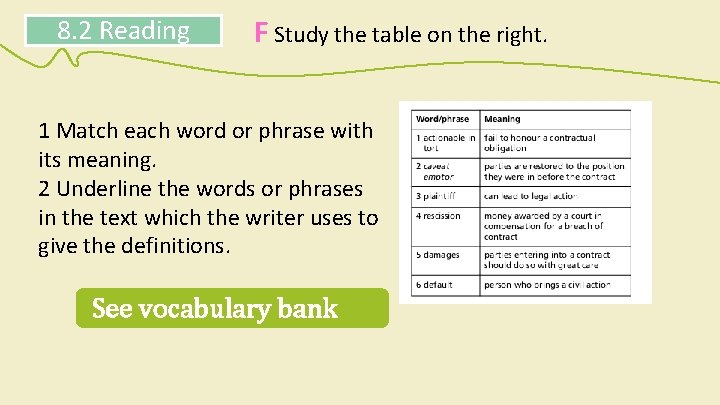
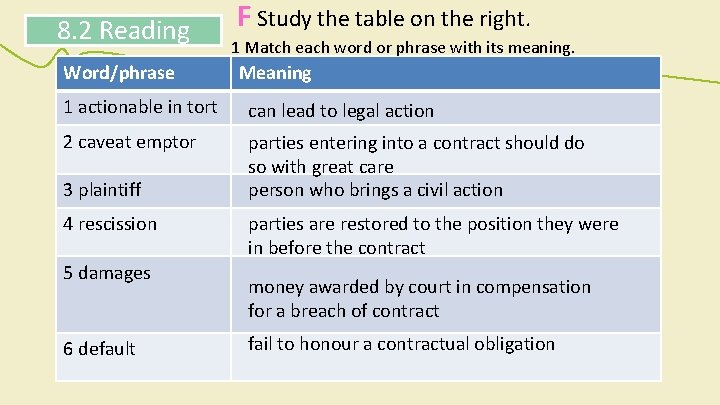
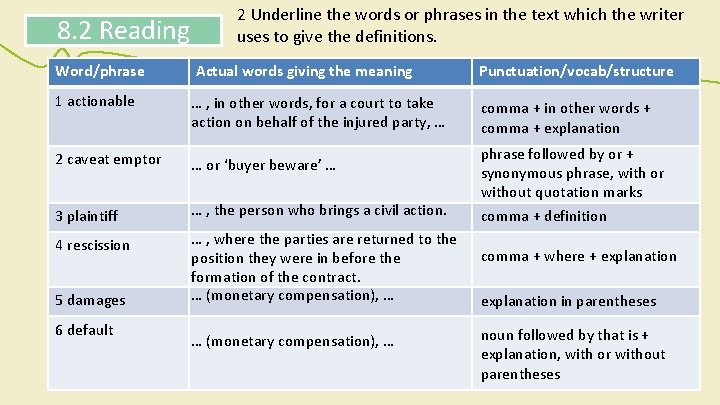
8. 2 Reading F Study the table on the right. 1 Match each word or phrase with its meaning. 2 Underline the words or phrases in the text which the writer uses to give the definitions. See vocabulary bank
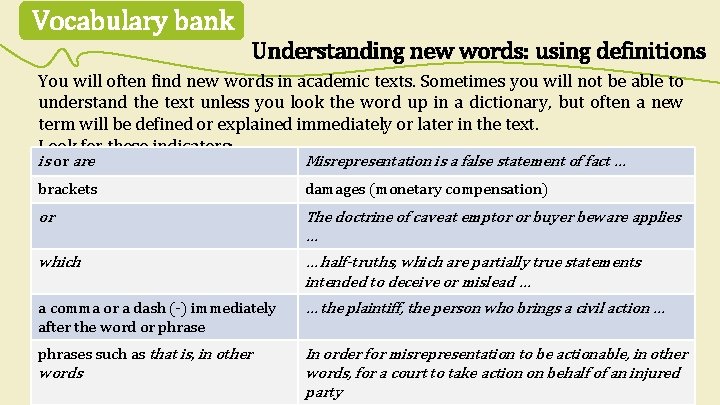
Vocabulary bank Understanding new words: using definitions You will often find new words in academic texts. Sometimes you will not be able to understand the text unless you look the word up in a dictionary, but often a new term will be defined or explained immediately or later in the text. Look for these indicators: is or are Misrepresentation is a false statement of fact … brackets damages (monetary compensation) or The doctrine of caveat emptor or buyer beware applies … which … half-truths, which are partially true statements intended to deceive or mislead … a comma or a dash (-) immediately after the word or phrase … the plaintiff, the person who brings a civil action … phrases such as that is, in other In order for misrepresentation to be actionable, in other words, for a court to take action on behalf of an injured party words
8. 2 Reading Word/phrase F Study the table on the right. 1 Match each word or phrase with its meaning. Meaning 1 actionable in tort can lead to legal action 2 caveat emptor parties entering into a contract should do so with great care person who brings a civil action 3 plaintiff 4 rescission 5 damages 6 default parties are restored to the position they were in before the contract money awarded by court in compensation for a breach of contract fail to honour a contractual obligation
8. 2 Reading 2 Underline the words or phrases in the text which the writer uses to give the definitions. Word/phrase Actual words giving the meaning Punctuation/vocab/structure 1 actionable … , in other words, for a court to take action on behalf of the injured party, … comma + in other words + comma + explanation 2 caveat emptor … or ‘buyer beware’ … 3 plaintiff … , the person who brings a civil action. 4 rescission … , where the parties are returned to the position they were in before the formation of the contract. … (monetary compensation), … 5 damages 6 default … (monetary compensation), … phrase followed by or + synonymous phrase, with or without quotation marks comma + definition comma + where + explanation in parentheses noun followed by that is + explanation, with or without parentheses
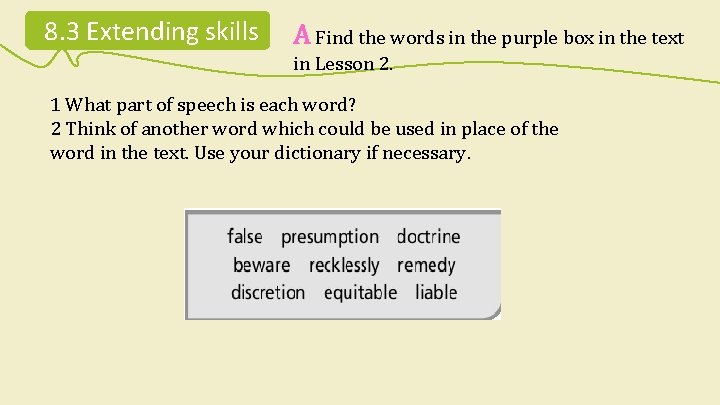
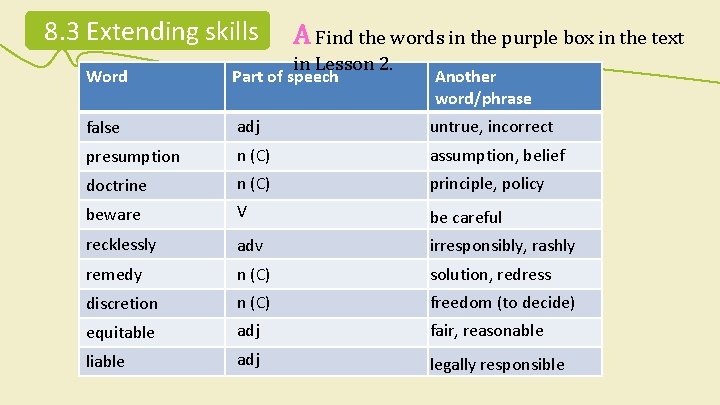
8. 3 Extending skills A Find the words in the purple box in the text in Lesson 2. 1 What part of speech is each word? 2 Think of another word which could be used in place of the word in the text. Use your dictionary if necessary.
8. 3 Extending skills A Find the words in the purple box in the text in Lesson 2. Word Part of speech Another word/phrase false adj untrue, incorrect presumption n (C) assumption, belief doctrine n (C) principle, policy beware V be careful recklessly adv irresponsibly, rashly remedy n (C) solution, redress discretion n (C) freedom (to decide) equitable adj fair, reasonable liable adj legally responsible
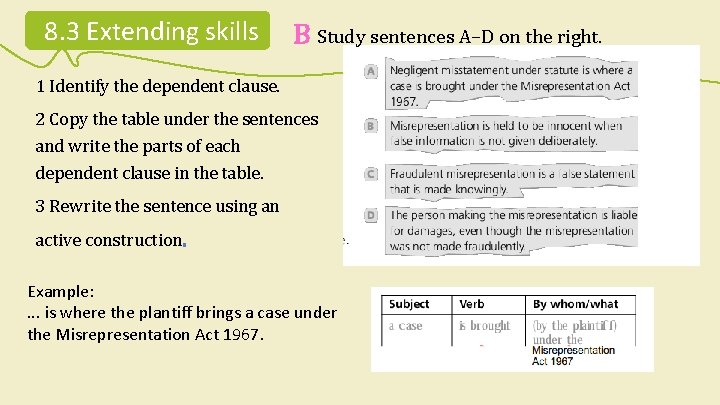
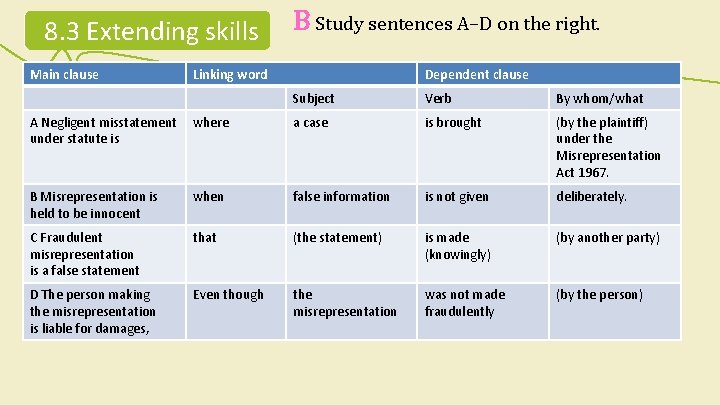
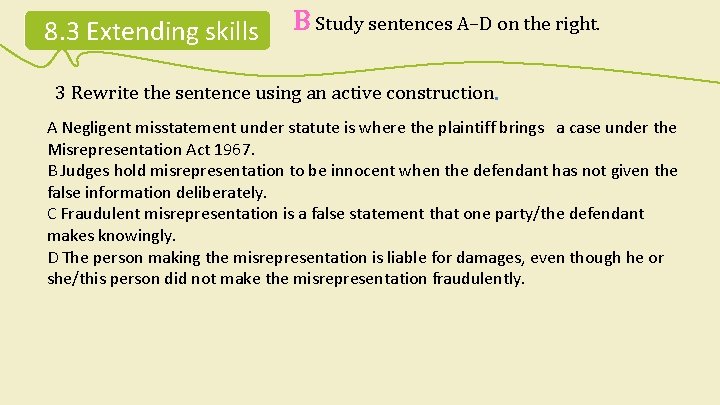
8. 3 Extending skills B Study sentences A–D on the right. 1 Identify the dependent clause. 2 Copy the table under the sentences and write the parts of each dependent clause in the table. 3 Rewrite the sentence using an active construction. Example: . . . is where the plantiff brings a case under the Misrepresentation Act 1967.
4. 2 Extending Reading skills 8. 3 Main clause B Study sentences A–D on the right. Linking word Dependent clause Subject Verb By whom/what A Negligent misstatement under statute is where a case is brought (by the plaintiff) under the Misrepresentation Act 1967. B Misrepresentation is held to be innocent when false information is not given deliberately. C Fraudulent misrepresentation is a false statement that (the statement) is made (knowingly) (by another party) D The person making the misrepresentation is liable for damages, Even though the misrepresentation was not made fraudulently (by the person)
4. 2 Extending Reading skills 8. 3 B Study sentences A–D on the right. 3 Rewrite the sentence using an active construction. A Negligent misstatement under statute is where the plaintiff brings a case under the Misrepresentation Act 1967. B Judges hold misrepresentation to be innocent when the defendant has not given the false information deliberately. C Fraudulent misrepresentation is a false statement that one party/the defendant makes knowingly. D The person making the misrepresentation is liable for damages, even though he or she/this person did not make the misrepresentation fraudulently.
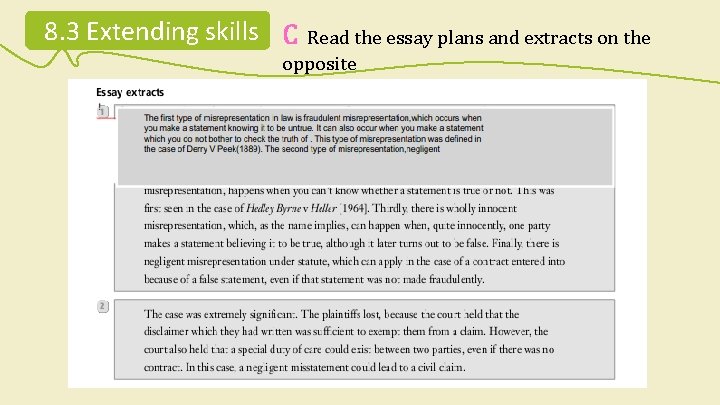
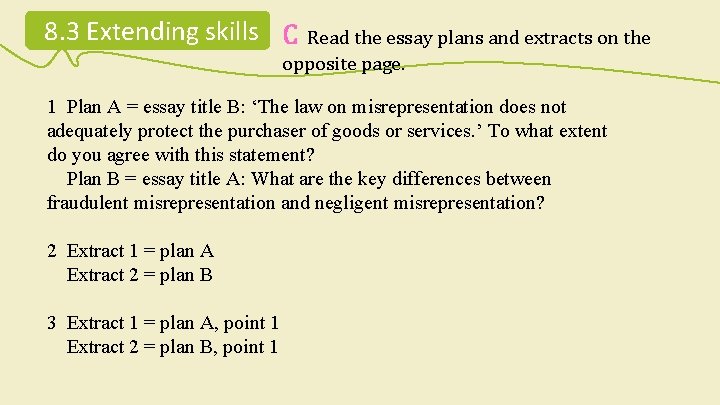
8. 3 Extending skills C Read the essay plans and extracts on the opposite 1 Match each plan with an essay title in Lesson 2. 2 Which essay is each extract from? 3 Which part of the plan is each extract from?
8. 3 Extending skills C Read the essay plans and extracts on the opposite
8. 3 Extending skills C Read the essay plans and extracts on the opposite
8. 3 Extending skills C Read the essay plans and extracts on the opposite page. 1 Plan A = essay title B: ‘The law on misrepresentation does not adequately protect the purchaser of goods or services. ’ To what extent do you agree with this statement? Plan B = essay title A: What are the key differences between fraudulent misrepresentation and negligent misrepresentation? 2 Extract 1 = plan A Extract 2 = plan B 3 Extract 1 = plan A, point 1 Extract 2 = plan B, point 1
8. 3 Extending skills D Work with a partner. 1 Write another paragraph for one of the plans. 2 Exchange paragraphs with another pair. Can they identify where it comes from?
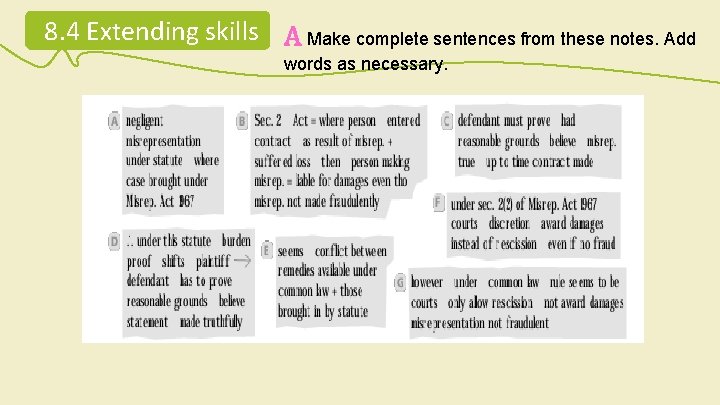
8. 4 Extending skills A Make complete sentences from these notes. Add words as necessary.
8. 4 Extending skills B Check your sentences with the last two paragraphs of the text in Lesson 2.
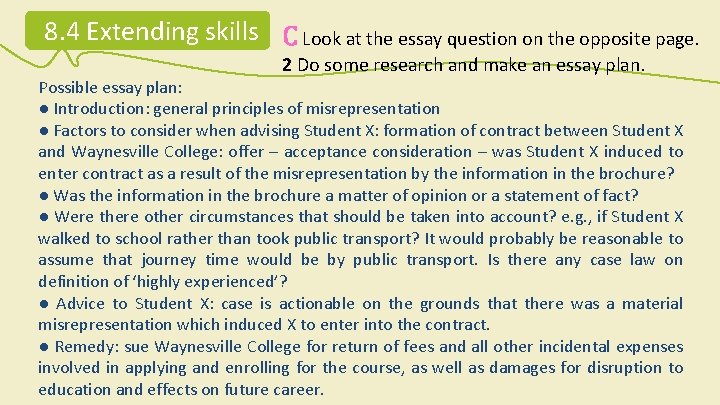
8. 4 Extending skills C Look at the essay question on the opposite page. 1 What kind of essay is this? 2 Do some research and make an essay plan. 3 Write the essay. 1. This essay is largely analytical since it requires reasons for advice. It also asks students to think critically about the way in which statements might be interpreted. See Skills bank
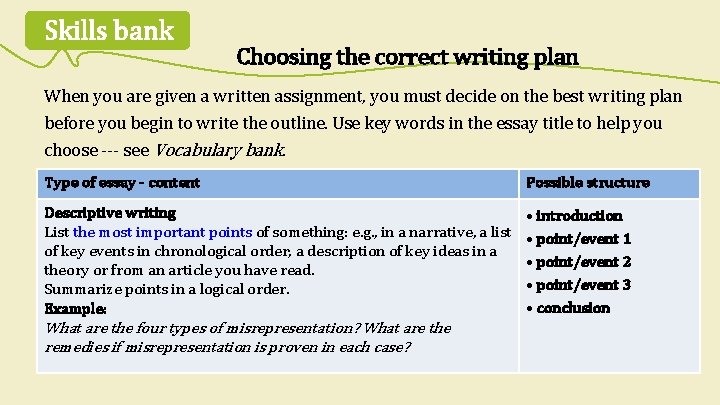
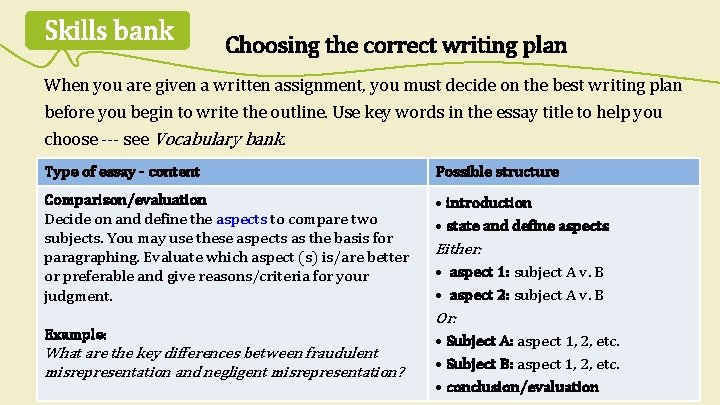
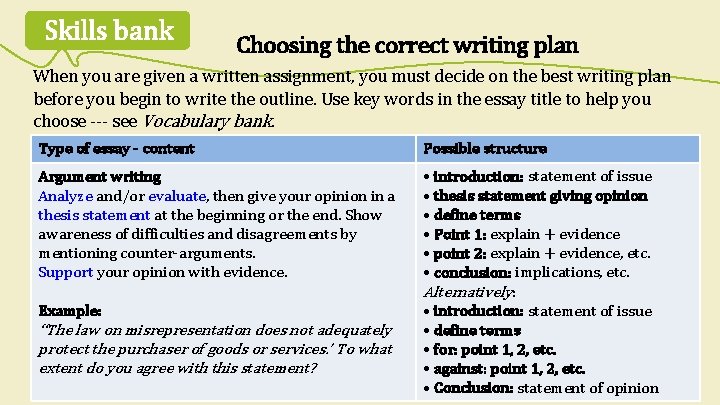
Skills bank Choosing the correct writing plan When you are given a written assignment, you must decide on the best writing plan before you begin to write the outline. Use key words in the essay title to help you choose --- see Vocabulary bank. Type of essay - content Possible structure Descriptive writing List the most important points of something: e. g. , in a narrative, a list of key events in chronological order; a description of key ideas in a theory or from an article you have read. Summarize points in a logical order. Example: • introduction • point/event 1 • point/event 2 • point/event 3 • conclusion What are the four types of misrepresentation? What are the remedies if misrepresentation is proven in each case?
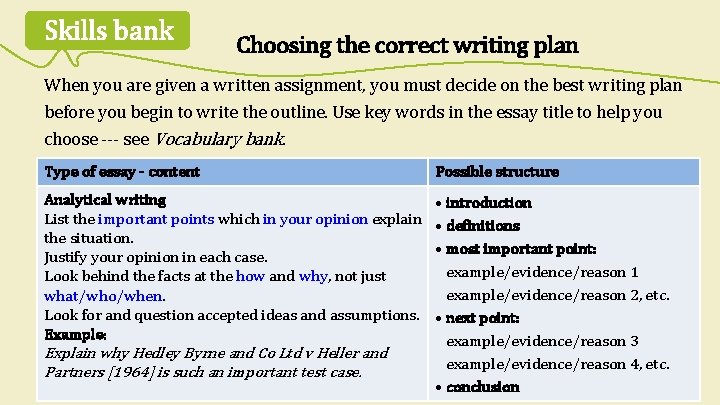
Skills bank Choosing the correct writing plan When you are given a written assignment, you must decide on the best writing plan before you begin to write the outline. Use key words in the essay title to help you choose --- see Vocabulary bank. Type of essay - content Possible structure Analytical writing List the important points which in your opinion explain the situation. Justify your opinion in each case. Look behind the facts at the how and why, not just what/who/when. Look for and question accepted ideas and assumptions. Example: • introduction • definitions • most important point: example/evidence/reason 1 example/evidence/reason 2, etc. • next point: example/evidence/reason 3 example/evidence/reason 4, etc. • conclusion Explain why Hedley Byrne and Co Ltd v Heller and Partners [1964] is such an important test case.
Skills bank Choosing the correct writing plan When you are given a written assignment, you must decide on the best writing plan before you begin to write the outline. Use key words in the essay title to help you choose --- see Vocabulary bank. Type of essay - content Possible structure Comparison/evaluation Decide on and define the aspects to compare two subjects. You may use these aspects as the basis for paragraphing. Evaluate which aspect (s) is/are better or preferable and give reasons/criteria for your judgment. • introduction • state and define aspects Either: • aspect 1: subject A v. B • aspect 2: subject A v. B Or: • Subject A: aspect 1, 2, etc. • Subject B: aspect 1, 2, etc. • conclusion/evaluation Example: What are the key differences between fraudulent misrepresentation and negligent misrepresentation?
Skills bank Choosing the correct writing plan When you are given a written assignment, you must decide on the best writing plan before you begin to write the outline. Use key words in the essay title to help you choose --- see Vocabulary bank. Type of essay - content Possible structure Argument writing Analyze and/or evaluate, then give your opinion in a thesis statement at the beginning or the end. Show awareness of difficulties and disagreements by mentioning counter-arguments. Support your opinion with evidence. • introduction: statement of issue • thesis statement giving opinion • define terms • Point 1: explain + evidence • point 2: explain + evidence, etc. • conclusion: implications, etc. Alternatively: • introduction: statement of issue • define terms • for: point 1, 2, etc. • against: point 1, 2, etc. • Conclusion: statement of opinion Example: ‘‘The law on misrepresentation does not adequately protect the purchaser of goods or services. ’ To what extent do you agree with this statement?
8. 4 Extending skills C Look at the essay question on the opposite page. 2 Do some research and make an essay plan. Possible essay plan: ● Introduction: general principles of misrepresentation ● Factors to consider when advising Student X: formation of contract between Student X and Waynesville College: offer – acceptance consideration – was Student X induced to enter contract as a result of the misrepresentation by the information in the brochure? ● Was the information in the brochure a matter of opinion or a statement of fact? ● Were there other circumstances that should be taken into account? e. g. , if Student X walked to school rather than took public transport? It would probably be reasonable to assume that journey time would be by public transport. Is there any case law on definition of ‘highly experienced’? ● Advice to Student X: case is actionable on the grounds that there was a material misrepresentation which induced X to enter into the contract. ● Remedy: sue Waynesville College for return of fees and all other incidental expenses involved in applying and enrolling for the course, as well as damages for disruption to education and effects on future career.