18734 Foundations of Privacy Protocols for Anonymous Communication
- Slides: 35
18734: Foundations of Privacy Protocols for Anonymous Communication Anupam Datta CMU Fall 2017
Privacy on Public Networks Internet is designed as a public network Routing information is public Machines on your LAN may see your traffic, network routers see all traffic that passes through them IP packet headers identify source and destination Even a passive observer can easily figure out who is talking to whom Encryption does not hide identities Encryption hides payload, but not routing information Even IP-level encryption (tunnel-mode IPSec/ESP) reveals IP addresses of IPSec gateways
Applications of Anonymity (I) Privacy Untraceable electronic mail Hide online transactions, Web browsing, etc. from intrusive governments, marketers and archivists Corporate whistle-blowers Political dissidents Socially sensitive communications (online AA meeting) Confidential business negotiations Law enforcement and intelligence Sting operations and honeypots Secret communications on a public network
Applications of Anonymity (II) Digital cash Electronic currency with properties of paper money (online purchases unlinkable to buyer’s identity) Anonymous electronic voting Censorship-resistant publishing
What is Anonymity? Anonymity is the state of being not identifiable within a set of subjects Unlinkability of action and identity You cannot be anonymous by yourself! Hide your activities among others’ similar activities For example, sender and his email are no more related after observing communication than they were before Unobservability (hard to achieve) Any item of interest (message, event, action) is indistinguishable from any other item of interest
Attacks on Anonymity Passive traffic analysis Active traffic analysis Infer from network traffic who is talking to whom To hide your traffic, must carry other people’s traffic! Inject packets or put a timing signature on packet flow Compromise of network nodes Attacker may compromise some routers It is not obvious which nodes have been compromised Attacker may be passively logging traffic Better not to trust any individual router Assume that some fraction of routers is good, don’t know which
Outline Protocols for anonymous communication High-latency Low-latency Chaum Mixes as a building block, onion routing Optimized Onion Routing and Tor Dining Cryptographers
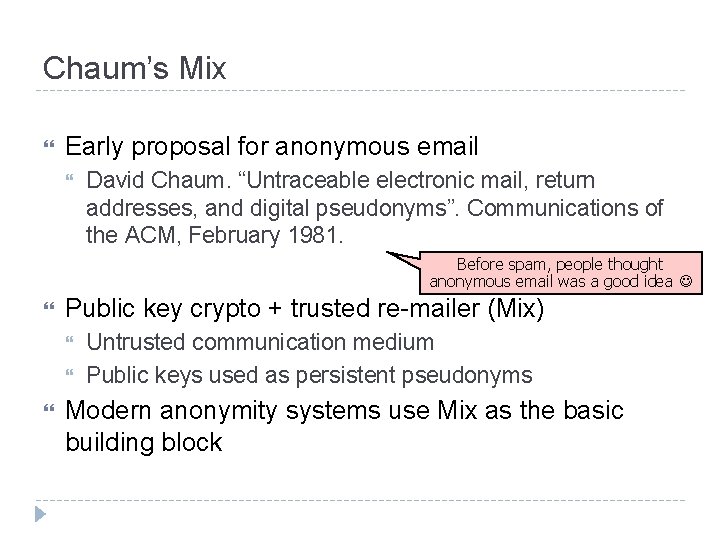
Chaum’s Mix Early proposal for anonymous email David Chaum. “Untraceable electronic mail, return addresses, and digital pseudonyms”. Communications of the ACM, February 1981. Before spam, people thought anonymous email was a good idea Public key crypto + trusted re-mailer (Mix) Untrusted communication medium Public keys used as persistent pseudonyms Modern anonymity systems use Mix as the basic building block
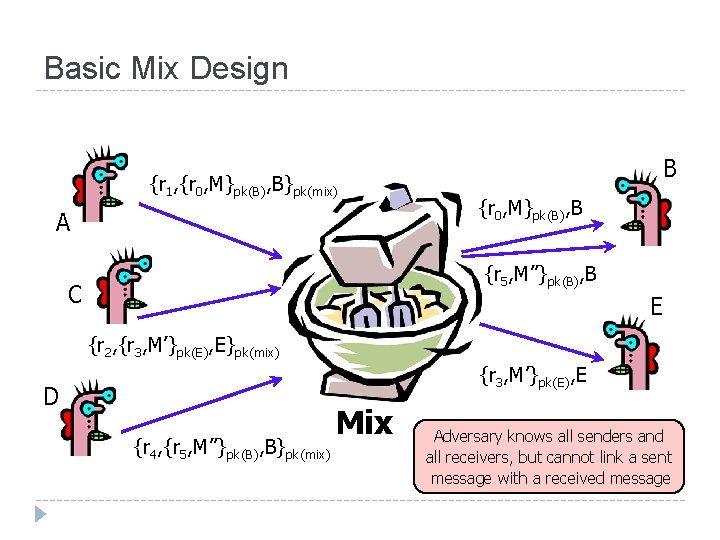
Basic Mix Design {r 1, {r 0, M}pk(B), B}pk(mix) A B {r 0, M}pk(B), B {r 5, M’’}pk(B), B C E {r 2, {r 3, M’}pk(E), E}pk(mix) {r 3, M’}pk(E), E D {r 4, {r 5, M’’}pk(B), B}pk(mix) Mix Adversary knows all senders and all receivers, but cannot link a sent message with a received message
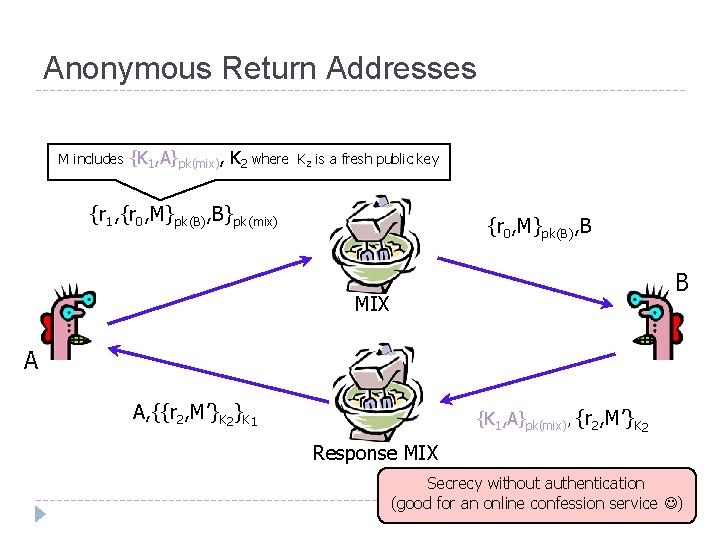
Anonymous Return Addresses M includes {K 1, A}pk(mix), K 2 where K 2 is a fresh public key {r 1, {r 0, M}pk(B), B}pk(mix) {r 0, M}pk(B), B B MIX A A, {{r 2, M’}K 2}K 1 {K 1, A}pk(mix), {r 2, M’}K 2 Response MIX Secrecy without authentication (good for an online confession service )
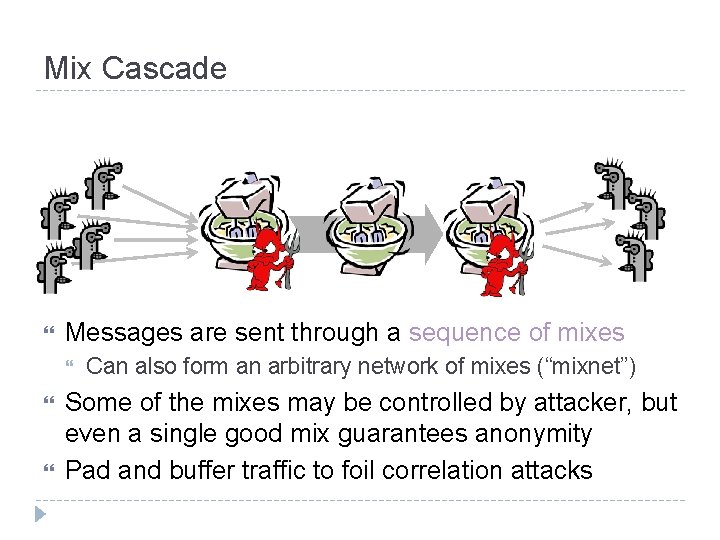
Mix Cascade Messages are sent through a sequence of mixes Can also form an arbitrary network of mixes (“mixnet”) Some of the mixes may be controlled by attacker, but even a single good mix guarantees anonymity Pad and buffer traffic to foil correlation attacks
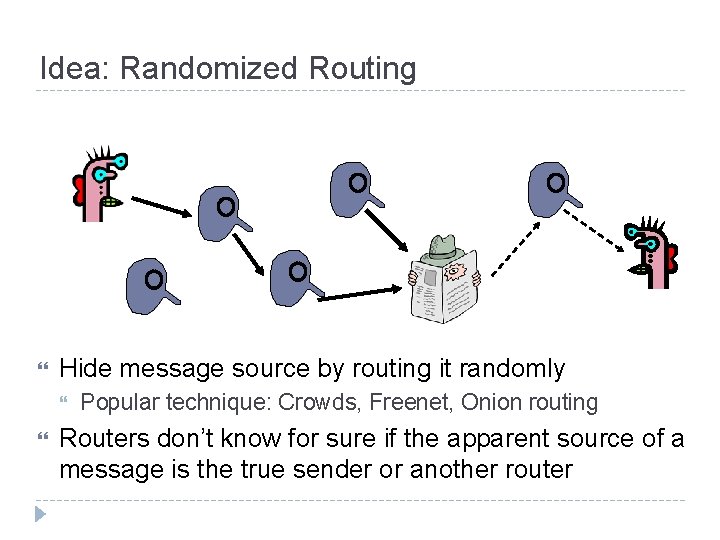
Idea: Randomized Routing Hide message source by routing it randomly Popular technique: Crowds, Freenet, Onion routing Routers don’t know for sure if the apparent source of a message is the true sender or another router
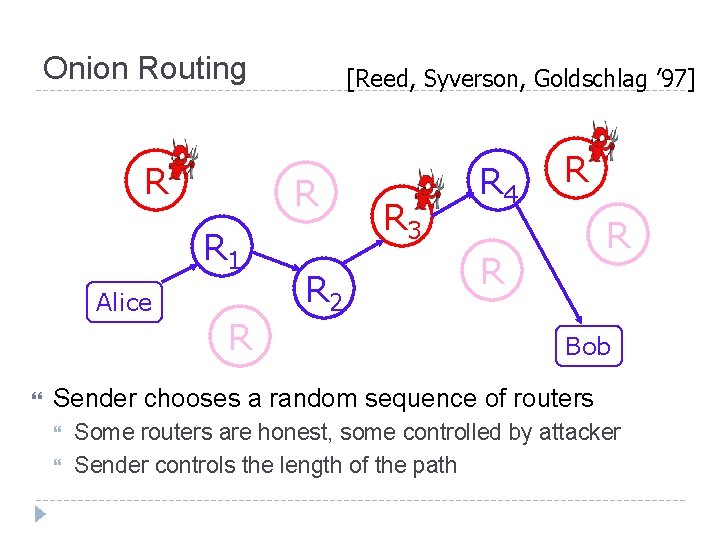
Onion Routing R R R 1 Alice [Reed, Syverson, Goldschlag ’ 97] R R 2 R 3 R 4 R R R Bob Sender chooses a random sequence of routers Some routers are honest, some controlled by attacker Sender controls the length of the path
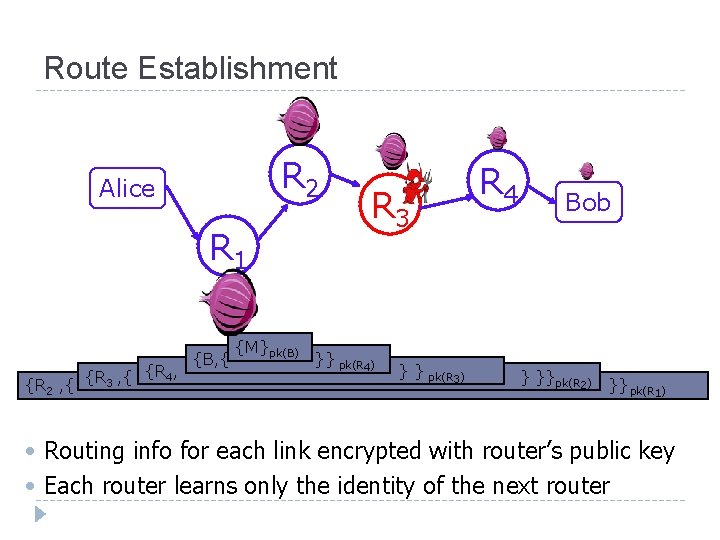
Route Establishment R 2 Alice R 1 {R 2 , { {R 3 , { {R 4, {B, { {M}pk(B) R 3 }} pk(R 4) } } pk(R 3) R 4 Bob } }}pk(R 2) }} pk(R 1) • Routing info for each link encrypted with router’s public key • Each router learns only the identity of the next router
Disadvantages of Basic Mixnets/Onion Routing Public-key encryption and decryption at each mix/router are computationally expensive Basic mixnets have high latency Ok for email, not Ok for anonymous Web browsing Challenge: low-latency anonymity network
Outline Protocols for anonymous communication High-latency Low-latency Chaum Mixes as a building block Onion Routing and Tor Dining Cryptographers
Tor Second-generation onion routing network http: //tor. eff. org Developed by Roger Dingledine, Nick Mathewson and Paul Syverson Specifically designed for low-latency anonymous Internet communications Running since October 2003 Thousands of nodes, 2 MM+ users “Easy-to-use” client proxy Freely available, can use it for anonymous browsing
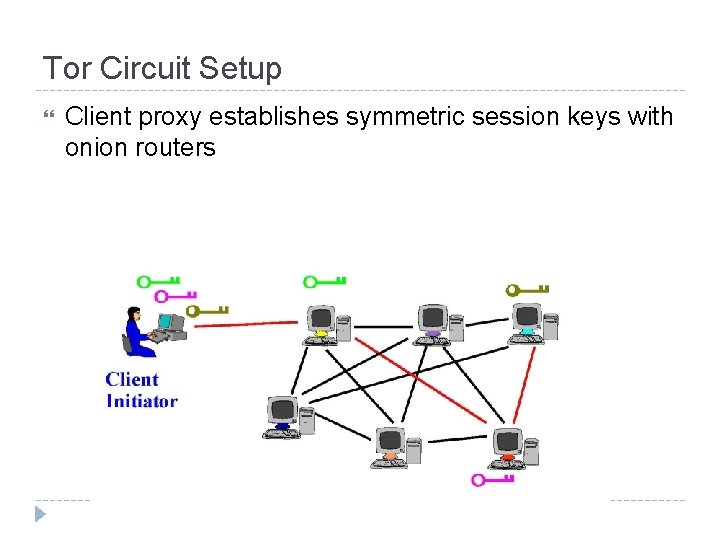
Tor Circuit Setup Client proxy establishes symmetric session keys with onion routers
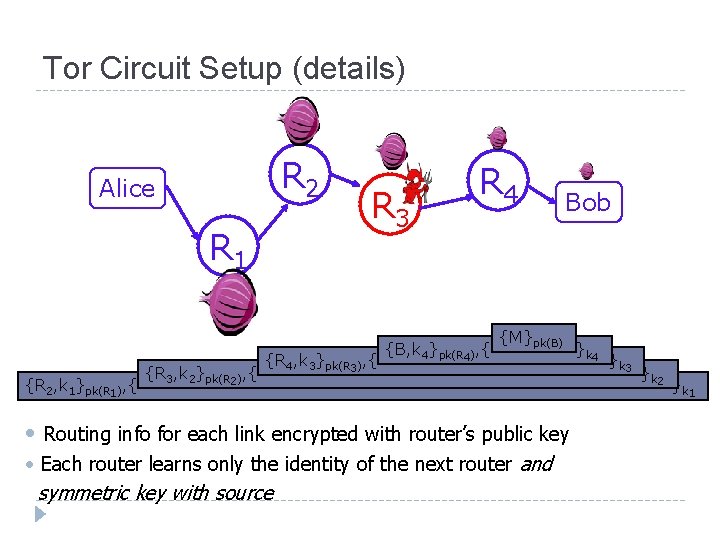
Tor Circuit Setup (details) R 2 Alice R 1 {R 2, k 1}pk(R 1), { {R 3, k 2}pk(R 2), { R 3 {R 4, k 3}pk(R 3), { R 4 {B, k 4}pk(R 4), { Bob {M}pk(B) • Routing info for each link encrypted with router’s public key • Each router learns only the identity of the next router and symmetric key with source } k 4 } k 3 } k 2 } k 1
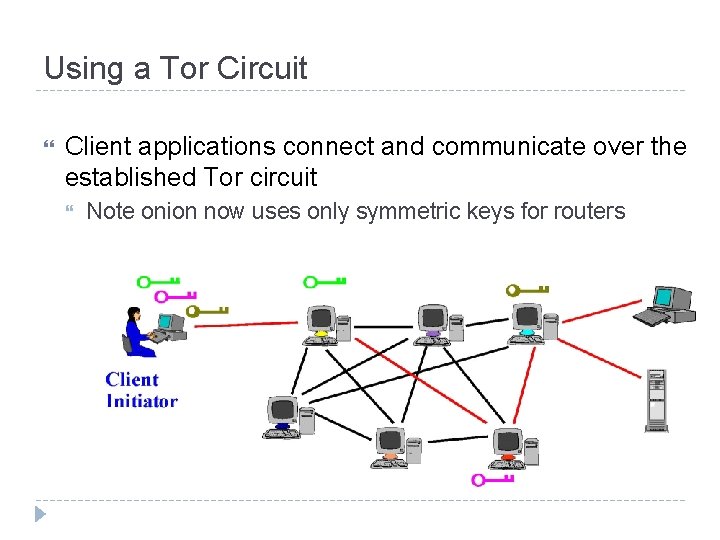
Using a Tor Circuit Client applications connect and communicate over the established Tor circuit Note onion now uses only symmetric keys for routers
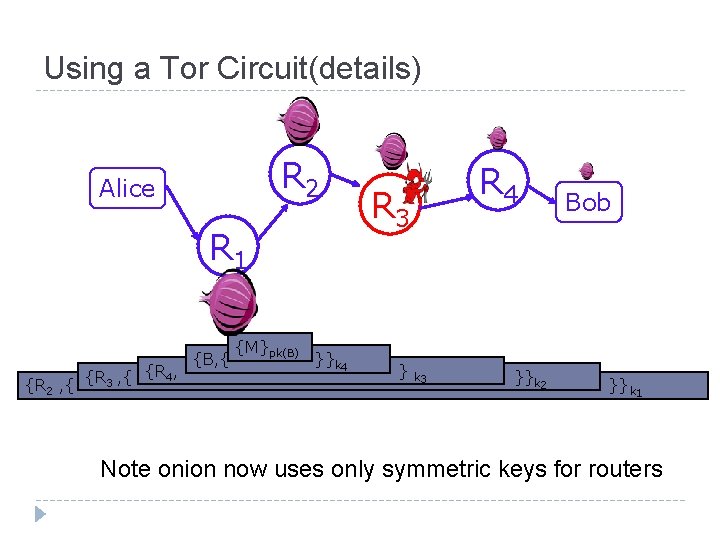
Using a Tor Circuit(details) R 2 Alice R 1 {R 2 , { {R 3 , { {R 4, {B, { {M}pk(B) }}k 4 R 3 } k 3 }}k 2 Bob }} k 1 Note onion now uses only symmetric keys for routers
Tor Management Issues Many applications can share one circuit Tor router doesn’t need root privileges Multiple TCP streams over one anonymous connection Encourages people to set up their own routers More participants = better anonymity for everyone Directory servers Maintain lists of active onion routers, their locations, current public keys, etc. Control how new routers join the network “Sybil attack”: attacker creates a large number of routers Directory servers’ keys ship with Tor code
Deployed Anonymity Systems Free Haven project has an excellent bibliography on anonymity Tor (http: //tor. eff. org) Overlay circuit-based anonymity network Best for low-latency applications such as anonymous Web browsing Mixminion (http: //www. mixminion. net) Network of mixes Best for high-latency applications such as anonymous email
Outline Protocols for anonymous communication High-latency Low-latency Chaum Mixes as a building block Onion Routing and Tor Dining Cryptographers
Dining Cryptographers Clever idea how to make a message public in a perfectly untraceable manner Guarantees information-theoretic anonymity for message senders David Chaum. “The dining cryptographers problem: unconditional sender and recipient untraceability. ” Journal of Cryptology, 1988. This is an unusually strong form of security: defeats adversary who has unlimited computational power Impractical, requires huge amount of randomness In group of size N, need N random bits to send 1 bit
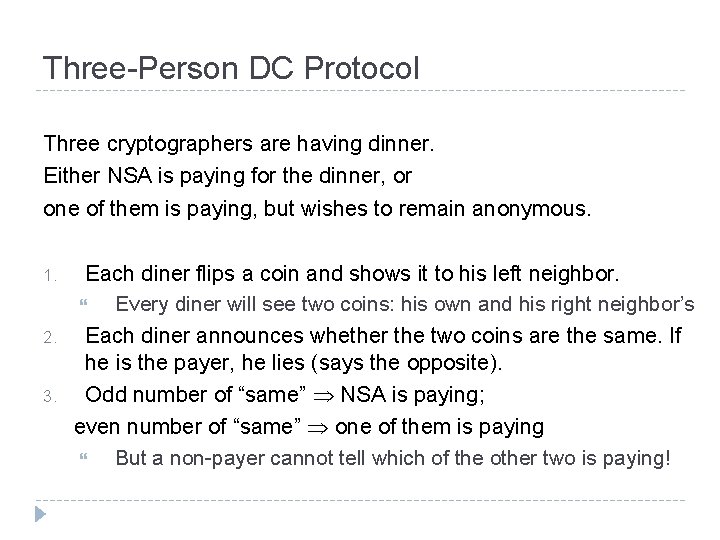
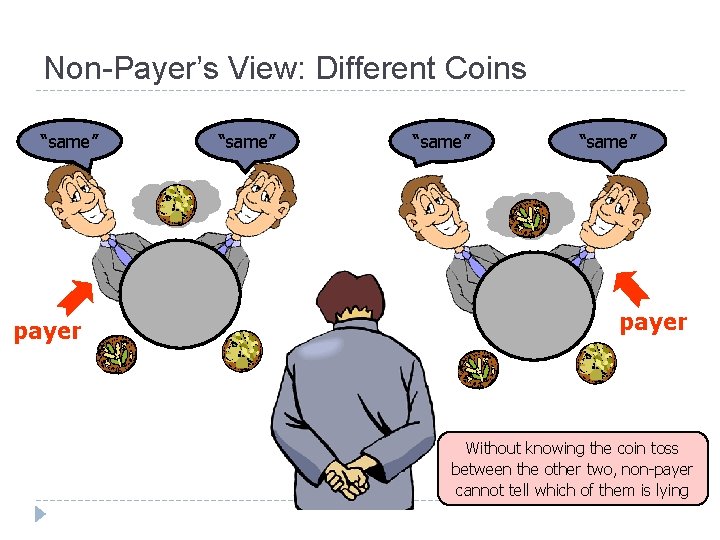
Three-Person DC Protocol Three cryptographers are having dinner. Either NSA is paying for the dinner, or one of them is paying, but wishes to remain anonymous. 1. 2. 3. Each diner flips a coin and shows it to his left neighbor. Every diner will see two coins: his own and his right neighbor’s Each diner announces whether the two coins are the same. If he is the payer, he lies (says the opposite). Odd number of “same” NSA is paying; even number of “same” one of them is paying But a non-payer cannot tell which of the other two is paying!
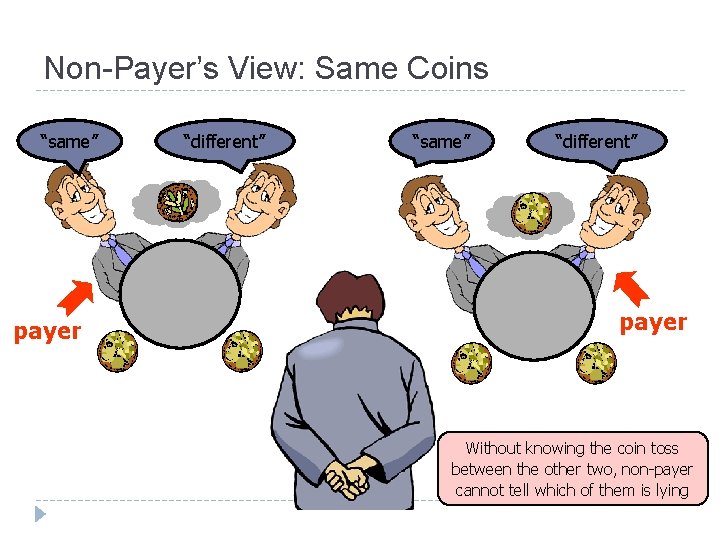
Non-Payer’s View: Same Coins “same” “different” ? payer “same” “different” ? payer Without knowing the coin toss between the other two, non-payer cannot tell which of them is lying
Non-Payer’s View: Different Coins “same” ? payer “same” ? payer Without knowing the coin toss between the other two, non-payer cannot tell which of them is lying
Superposed Sending This idea generalizes to any group of size N For each bit of the message, every user generates 1 random bit and sends it to 1 neighbor Every user learns 2 bits (his own and his neighbor’s) Each user announces own bit XOR neighbor’s bit Sender announces own bit XOR neighbor’s bit XOR message bit XOR of all announcements = message bit Every randomly generated bit occurs in this sum twice (and is canceled by XOR), message bit occurs once
DC-Based Anonymity is Impractical Requires secure pairwise channels between group members Otherwise, random bits cannot be shared Requires massive communication overhead and large amounts of randomness DC-net (a group of dining cryptographers) is robust even if some members collude Guarantees perfect anonymity for the other members
Thanks! Questions Acknowledgement: This lecture uses a number of slides provided by Vitaly Shmatikov
Location Hidden Servers Goal: deploy a server on the Internet that anyone can connect to without knowing where it is or who runs it Accessible from anywhere Resistant to censorship Can survive full-blown Do. S attack Resistant to physical attack Can’t find the physical server!
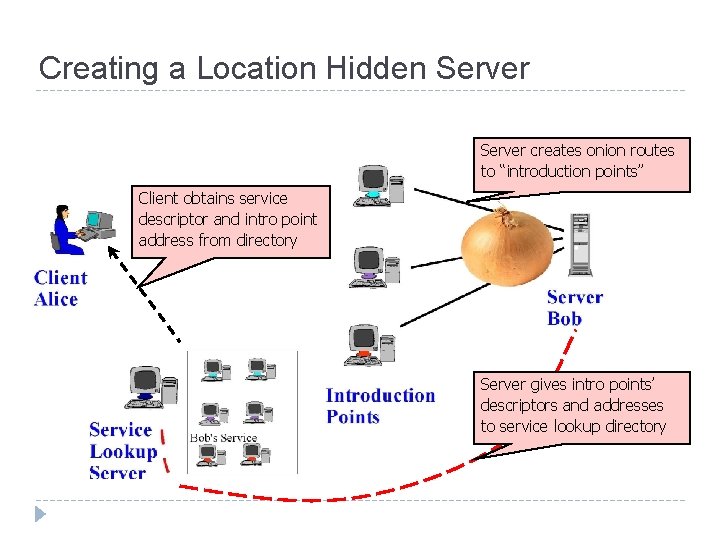
Creating a Location Hidden Server creates onion routes to “introduction points” Client obtains service descriptor and intro point address from directory Server gives intro points’ descriptors and addresses to service lookup directory
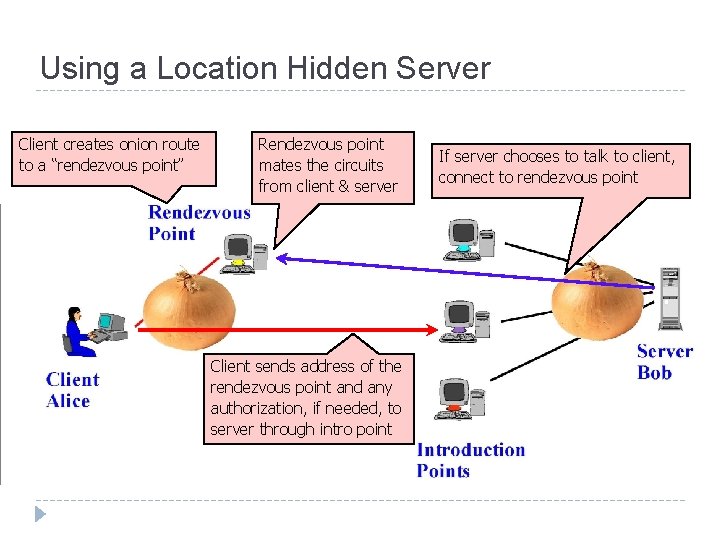
Using a Location Hidden Server Client creates onion route to a “rendezvous point” Rendezvous point mates the circuits from client & server Client sends address of the rendezvous point and any authorization, if needed, to server through intro point If server chooses to talk to client, connect to rendezvous point
A simple idea: Basic Anonymizing Proxy Channels appear to come from proxy, not true originator Appropriate for Web connections etc. : SSL, TLS (Lower cost symmetric encryption) Example: The Anonymizer Simple, focuses lots of traffic for more anonymity Main disadvantage: Single point of failure, compromise, attack